Music

Innovation V6.0 – While Spotify Innovates, The Governments And The Entertainment Industries Legislate

Van Morrison once said that “Music is spiritual. The music business is not”. How true that comment is.

Spotify recently announced the acquisition of “The Echo Nest” , a music intelligence company that will give Spotify and its users a better music discovery platform. As is the norm these days, it is technologists leading the way for the music business and in general the entertainment business at large.

When Spotify offered free mobile access, they had more sign ups in one month than the whole year prior. Spotify knows it’s all about domination. The history of the internet has shown us that. Pandora is unrivalled in the radio streaming stakes. Apples iTunes Radio is non-existent.

Labels are rolling it in from streaming services and they are not passing those extras on to the artists. That is not Spotify or Pandora’s fault. That is the labels fault. Again, if Spotify is that bad for the artist, then artists like Metallica and Motley Crue that actually own their own copyrights wouldn’t participate. But they did.

While Spotify innovates, the entertainment industries legislate, still focused on censorship and take downs.

Over at Italy, their communications watchdog has given itself a “Judge Dredd” like power. They are basically censoring websites based on a copyright infringement claim from a copyright holder and without any real judicial due process for the website involved.

Just recently, the Public Prosecutor from Italy has decided to go all “Wild West Sheriff Style” on the Internet by ordering Internet Service Providers (ISP’s) to censor dozens of websites, because he said that the websites are places that contain infringing materials. In this case, no copyright holder made any claim against these websites. Yep, it sure sounds like innovation to me.

This is how bad copyright has gotten. People believe that COPYRIGHT INFRINGEMENT OF MUSIC is the same thing as PROPERTY, an actual physical tangible product. And because of this viewpoint, sites that infringe on people’s copyrights are treated the same as sites that deal in stolen merchandise. When a copy is made of a song and shared, it is not theft. It is copyright infringement and it needs to be treated as such.

In recent years, studies have shown over and over again that people who share movies and music illegally are the ones that end up spending more on legal entertainment. The research is now even recognized by the “Industry Trust For IP Awareness” which is a body that includes all of the major Hollywood Studios as its members, along with the major labels in music.

The latest anti-piracy message from the IP Awareness Industry Trust is a positive one. Instead of labelling all of their customers as pirates and criminals, they are now saying that they understand people like movies and that they appreciate that people are sharing and spending money on movies. This time around they are pushing a slogan of “Moments Worth Paying For” instead of the Big Brother “You Can Click But Can’t Hide”.

Neil Gaiman is one of those people who actually is open-minded when it comes to piracy. There is a video doing the rounds from a while back (on Reddit) where Gaiman talks about piracy;

“You’re not losing sales by getting stuff out there. When I do a big talk now on these kinds of subjects and people ask “What about the sales you are losing by having stuff floating out there?” I started asking the audience to raise their hands for one question — Do you have a favourite author? And they say yes and I say good. What I want is for everybody who discovered their favourite author by being lent a book put up your hand. Then anybody who discovered their favourite author by walking into a book story and buying a book. And it’s probably about 5-10%, if that, of the people who discovered their favourite author who is the person they buy everything of and they buy the hardbacks. And they treasure the fact they’ve got this author. Very few of them bought the book. They were lent it. They were given it. They did not pay for it. That’s how they found their favourite author. And that’s really all this is; it’s people lending books.”

Let’s rephrase those questions in terms of music. Even musicians out there should ask themselves the same question.

Do they have a favourite artist?

How did they discover their favourite artist? Was it by buying their music or was it by someone sharing the music with them or was it by someone lending them a CD, a mix tape, an LP or an iPod full of mp3’s or by someone talking up the artist.

How many people discovered their favourite artist by walking into a record shop and buying a CD without even hearing it? Or in today’s world, how many people discovered their favourite artist by going onto Spotify and listening to music of someone they haven’t heard about.

Gaiman gets it. He is a realist. Hey, look over in Japan. They actually have a rental policy in place for fans of music. People hire/lend the CD, take it home, rip it and then return it for another. Personally, Spotify is a better alternative, however rights holders don’t allow it to exist at this point in time.

Finally, the great land down under, Australia is in the news again. Of course as a country founded by convicts, we have a proud history of seeing higher copyright infringement rates thanks to the lack of legitimate and affordable options.

So we don’t have Netflix and because of that we have resorted to using VPNs to mask our location and subscribe to Netflix anyway.

Of course, the free to air TV stations, the pay TV station Foxtel (who is owned by News Corp) and Quickflix along with the News Corp owned “The Australian” news outlet are labelling these paying users of Netflix as “PIRATES”. Yep that’s right. We are paying for a service that is affordable (something that Quickflix doesn’t know anything about) by masking our IP address so that we can access it and we are still labelled as pirates.

So there you have it, another wonderful week has come and gone, that shows that the Entertainment Industries still don’t get it and technologist and open-minded creators do get it.

http://www.dmwmedia.com/news/2014/03/06/spotify-acquires-the-echo-nest
https://www.techdirt.com/articles/20140305/10000226442/italys-public-prosecutor-orders-isps-to-block-dozens-pirate-websites-just-because-he-said-so.shtml

http://torrentfreak.com/pirates-movie-industrys-valuable-customers-140304/?utm_source=feedburner&utm_medium=email&utm_campaign=Feed%3A+Torrentfreak+%28Torrentfreak%29

https://www.techdirt.com/articles/20140303/11511026409/australian-broadcasters-netflix-competitors-pout-because-netflix-hasnt-banned-vpn-users-yet.shtml

http://comicsalliance.com/neil-gaiman-piracy-lending-books/

https://www.techdirt.com/articles/20140303/11511026409/australian-broadcasters-netflix-competitors-pout-because-netflix-hasnt-banned-vpn-users-yet.shtml

Standard
Copyright, Music, My Stories

This Is How The Out Of Touch Music Business Innovates

The Music Business launches an Anti-Piracy App to educate young people on piracy while at the same time copyright infringement of music is declining each year due to decent legal options.

The game allows players to select an aspiring artist from a list of hopefuls, compose tracks from a roster of song-writers, producers and studio technicians and balance the books by keeping an eye on how radio play, streaming and piracy impact on profits. So maybe the game will show players how much an artist REALLY gets for a song.

However, if the recording industries want to be treated seriously, what about the income from live shows, merchandise deals, licensing, video games, YouTube, Kickstarter, Indiegogo, Pledge and the many other ways an artist can make money these days.

Then you have Paul McGuiness who wants Google to do more to protect the old business models of the recording industry. This is what Paul McGuiness had to say;

What needs to be done is simple, take the sites down and keep them down. If the pirates can manage to replace their sites instantly with legions of bots, Google, with their brilliant algorithm engineers can counter it.

Umm, can someone tell Paul McGuiness that Google is only a search engine. It is not their job to police the internet for the entertainment industries.

We need the technology giants like Google to do the things that labels, the publishers, the artists, the writers repeatedly ask them to do. They need to show corporate and social responsibility. Take down the illegal sites, keep them down and clear the way for the legal digital distributers like iTunes, Spotify, Deezer, the new Jimmy Iovine Beats service, which promises to be a very serious competitor. Those services now exist, it is no longer acceptable to say that the music industry is not available, not making its wares available online.

People have been downloading since the Napster days. So it’s pretty clear to the recording industry people that their customers want to download an albums worth of music, they want to do it for free, they want it DRM free and they want to do it anonymously. So why isn’t the recording industry offering this service to their customers.

They claim illegal pirate sites make money from the advertisements. So why can’t the recording industry offer the same service, via the BitTorrent protocol and make money from the Advertisements.

We’re all aware in this room that subscription is now replacing downloading — legal or illegal — but we do need those mega corporations to make a genuine effort to cooperate and feed the industry that has been so good to them.

Corporations exists to offer a service to their customers. They do not exist to prop up dated business models based on high profit margin CD’s.

Finally you have a company called Rightscorp who is accumulating Copyrights

I’ve posted previously about the whole shambles around Copyright and how their extended copyright terms are purely there to protect the interest of the Corporations that have paid the creator a sum to control their copyright or the Corporations that have paid the record label (who is the current holder of the Copyright) to control the record label right. In the metal and rock sphere, two record labels come to mind, where I feel that their intentions are motivated by having a copyright monopoly on certain songs.

One is Frontiers and the other is Rock Candy. Frontiers are getting a lot of the Eighties greats to create forgeries of their hits, while Rock Candy is buying up albums from the Eighties and re-releasing them with expanded packaging, so that all these forgeries and new versions of the Eighties albums fall under a new copyright term.

While the two labels deal with music, Rightscorp Inc, is otherwise known as a COPYRIGHT TROLL. Rightscorp claims that they have a “patent pending digital loss prevention technology” that focuses on the infringement of digital content such as music, movies, software, and games and ensures that owners and creators are rightfully paid for their IP.

The Wall Street Journal article also mentions that the following;

Rightscorp implements existing laws to solve copyright infringements by collecting payments from illegal file sharing activities via notifications sent through Internet Service Providers (ISPs). The Company’s technology identifies copyright infringers, who are offered a reasonable settlement option when compared to the legal liability defined in the Digital Millennium Copyrights Act (DMCA).

It is very interesting reading the above paragraph, especially when the Justice system in the U.S is waking up and realising that an IP address does not identify who the actual copyright infringer is.

While the music business innovates in their own litigious way, the so called “pirates” are innovating in a very different way by making it even easier for fans of music to download and even stream music.

Standard
A to Z of Making It, Music, Unsung Heroes

Lifers

If you want to have a career in the music business “Lifer” is a term that you need to get used to. You need to be in it for life.

Look at Mike Portnoy. He is a lifer. He lives and breathes music. In his youth, he worked in a record shop and substituted his pay for records. It shows his life commitment to music. Since December 2010, he has pushed out new music on a consistent basis and he has toured non-stop behind that new music. I can’t say I like everything from the bands that Portnoy is involved in, however he understands the current music business. And as much as the metal and rock bands don’t like it, the music recording business is not about releasing an album of 10 songs or more every two years and then touring behind it.

The recording business is about releasing music consistently. Capturing that spontaneity. When music is too thought out it loses its soul. It becomes processed. Even though I am not a big fan of “The Winery Dogs”, I do appreciate the soul of the songs, that loose feeling that anything could happen. This brings to mind a quote from Kevin Shirley who was the producer on the Dream Theater “Falling Into Infinity” album. He loved the original solo take that John Petrucci did for the song “Hollow Years” because it had this spontaneous feeling to it that fit the mood of the song. However Petrucci didn’t like it because it wasn’t precise enough and of course, Petrucci ended up re-doing the solo section to make it precise.

Going back to Portnoy, in 2011 he was involved in the Adrenaline Mob EP, the Neal Morse “Testimony 2” album as well as a tribute album to The Beatles (with Paul Gilbert, Neal Morse, and Kasim Sulton) called “Yellow Matter Custard – One More Night in New York City”.

2012 saw the release of the Adrenaline Mob album “Omertà”, the Flying Colors self-titled debut album as well as another Neal Morse album called “Momentum”.

2013 saw the release of a covers album from Adrenaline Mob called “Covertà”, as well as the self-titled debut from The Winery Dogs. In addition, live releases came out from the “Portnoy, Sheehan, MacAlpine and Sherinian” 2012 tour called “Live In Tokyo” as well as the Flying Colors 2012 European tour called “Live in Europe”.

2014 will see a new Transatlantic album called “Kaleidoscope” as well as the new BigElf album that Portnoy played drums on called “Into The Maelstrom”. Also in the pipework’s is a new Flying Colors album and a live release from “The Winery Dogs”.

In amongst all the studio time of the official releases, Portnoy was on the road, touring. That is a lifer to me. He implored Damon Fox from Bigelf to carry on when he thought about throwing in the towel and even stepped up to the plate to play drums. That is a lifer inspiring another musician to also become a lifer. It’s contagious.

What about bassist, Marco Mendoza? Who you say?

The first time I heard Marco was on the Blue Murder album “Nothin But Trouble” released in 1993. He then fell in with John Sykes, appearing on “Screaming Blue Murder” in 1994 and then on John Sykes’s solo album in 1995 called “Out Of My Tree.” He also appeared on the 1997 albums “Loveland” and “20th Century Heartache” and “Nuclear Cowboy” released in 2000. That year also saw a Thin Lizzy (this is the version that John Sykes put together in 1994,with guitarist Scott Gorham, keyboard player Darren Wharton and drummer Brian Downey. After a few one-off concerts, the band toured more consistently from 1996 until 2000, with Downey being replaced by Tommy Aldridge) live release called “One Night Only” as well as his involvement with David Coverdale’s solo album “Into The Light.”

Real musicians are lifers. He hasn’t had that hit single or appeared on that hit album, but that doesn’t make Marco any less successful.

He spent time with Ted Nugent, went back to John Sykes, then jumped ship to Whitesnake, while still continuing with the John Sykes Thin Lizzy project up until 2009. That project then became Black Star Riders. In between he appeared in Lynch Mob and their Smoke and Mirrors album in 2009. He is going to tour Australia with the band “The Dead Daises” led by former Noiseworks vocalist Jon Stevens.

Would you say that Marco Mendoza has been successful at his music career?

Marco has played with two of my biggest guitar influences in John Sykes and George Lynch. He is a great vocalist and from watching the live Whitesnake DVD from 2006, he hits those highs that Glenn Hughes did in “Burn”.

He has never been without a decent sized gig and if he is, he has his little solo band and his jazz three-piece project that play the bars and the clubs. The bottom line is that he is working non-stop. He is a lifer when it comes to music. That is why he is still around. While record labels whine about the lack of recorded sales in a society where streaming has won the war, Marco is the definition of the long hard slog to have a musical career. A lifer. Excellence is the key. That is why he is in demand. He fits in well, is professional and he doesn’t have a social media presence.

You want a career in music, prepare to be a lifer.

Standard
A to Z of Making It, Alternate Reality, Copyright, Music, My Stories, Piracy, Stupidity, Treating Fans Like Shit

Chaos + Disruption = The Music Business

It’s a chaotic and disruptive time in the music business and with chaos comes opportunity.

On one side you have COPYRIGHT. And that can be broken down into a lot of other little chaotic categories like infringement, the length of copyright terms, copyright monopolies, the lack of works entering the public domain and so on.

The public domain is culture. Keith Richards once said, ‘you can’t copyright the blues.’

Culture is built and expanded by sharing stories and building on the works of others. Led Zeppelin, The Beatles, The Rolling Stones and all of the sixties greats like Hendrix, Clapton and Beck used this concept. They built off the blues.

However copyright law and its real purpose got hijacked by corporations and everything changed. Instead of culture being built up in the works that the public creates and shares, the public is now faced with copyright corporations locking away works that should be in the public domain by now. These works that should be in the public domain do not benefit the original creators in any way, however they are beneficial for the few copyright monopoly gatekeepers.

For culture to thrive once again, it is important to respect the public domain.

Then on another side of the music business you have the RIAA who continually push lies out into the world, so that technology companies can do something to protect crap business models. Did you know that the global music industry sent it’s 100 million takedown notice to Google, to remove search links to certain sites. It looks like the RIAA doesn’t get it.

So if a person types in “free mp3” in Google Search what should Google return?

Sites that have free mp3’s or sites that the RIAA want Google to point to when that term is typed in. Maybe when that person types in free mp3, they want a free mp3 and have no interest in paying.

Then you have the ISP’s on another side that are caught up in the middle of all this as they offer the service that provides internet access to users. According to the RIAA and the record labels, the ISP’s allow “copyright infringement” to happen, therefore, they need to do something about it to help out the music industry. In Australia, this is heavily disputed, however in other parts of the world gradual response schemes are in place.

Then you have the technology companies trying to offer low cost services to fans of music. However, low cost to a fan means high costs to the RIAA and the record labels in licensing fees. This is before the new service is even allowed to trade. If the new service starts to trade without licensing in place, expect them to be litigated into submission.

Have you noticed that artists have not been mentioned anywhere as yet. That is how far the music business has come, where the actual music is only a small part of it, however it should be the major part of it. For the business to thrive, you need great music.

I was looking back to some of the releases in 2013 that I liked. Two of my favourites are “Protest The Hero” and “Coheed and Cambria”.

“Protest The Hero” and “Coheed and Cambria” are working to the “Keep your fan base close” mantra. Both of the bands moved from major labels into a DIY independent mindset, realising that their fans are king.

Exceptional fan service is the key driving force behind a bands success. I expect “Coheed and Cambria” will get a lot more fans purchasing the next super deluxe package for the new album because they did such a great job with “The Afterman” releases.

“Protest The Hero” on the other hand have fallen into the fan funded conundrum where the perks always arrive later than expected for international fans. I live in Australia and I am still waiting for the perks to arrive. The band have been clear with their information, advising that it will take 6 to 8 weeks.

It’s good old business 101, “treat your customers right and they’ll stay with you forever”.

Then you have bands like Five Finger Death Punch, Avenged Sevenfold, Dream Theater, Stone Sour, Killswitch Engage, Trivium, Volbeat, Alter Bridge and TesserAct that have label deals.

Should those bands go independent like Protest The Hero or Coheed and Cambria. It all depends on a person’s definition of success and hard work. Going independent means that you need to build a team around you like any business start-up.

What are the benefits of going independent?

The lesson is simple. Selling your artistic freedom and independence as a “success” strategy can bring lucrative rewards. But it’s not always the best move for your career, as you are also selling off important data to the record label. The record label doesn’t want to know your fans or connect with them. They want you to do it, so that the label can make money of that relationship and then pay you a percentage of it.

Coheed and Cambria moved over 100,000 units of their deluxe “Afterman” editions. At $60 (I think it was $68, however I will use $60 for the example) an edition, that comes to $6 million in revenue. If the band was on the label model, what percentage would the band see from that $6 million.

The music market/business is filled with acts trying to make it. It is going to take a huge effort to stand out amongst the rest. Music is a lifer game. It is a slow and steady approach that builds careers.

Artists should be looking at development. With each song release, artists should never be afraid to try things out. Even try out new technologies that make it very easy for their fans to interact with them and their music. In a company, this is called research and development. Investing in your career is never a mistake.

The artists have the power to make the record labels redundant, purely to be used as a distribution arm if needed, however with the rise of streaming technologies, even this arm can be in danger of disappearing. Bands like Coheed and Cambria, Protest The Hero and Digital Summer have seen the recorded business side of things and have decided, hey we can do it better. That’s what great businesses are made of.

So in all of this chaos, who will rise and who will fall? Time will tell, however if you compare music to technology, you will see only a select few rise to the top. Smartphones and tablets is all Apple and Samsung. Amazon has online shopping cornered. Google is the king of search. Spotify will win the streaming war. Facebook rules social media. iTunes rules the mp3 and app market. Will the same fate happen in the music business?

2019 Crystal ball predictions;

Coheed and Cambria – will get bigger and bigger. Their style is unique, so expect them to keep to that style, sort of like how AC/DC releases music in the same style or Iron Maiden.

Protest The Hero – proved to themselves that they still matter. Will get bigger and more crazier. The future of progressive metal.

Machine Head – will still be bigger then what they are. Robb Flynn understands the internet and understands the change that is coming. He will make sure that Machine Head rides the wave all the way to the shoreline, while Adam Duce circles in the undercurrent, ready to litigate the band into submission.

TesseracT – will become the next Pink Floyd.

Digital Summer – are one of the hardest working rock bands around like Twisted Sister and Dream Theater. They will get bigger as they are lifers.

Avenged Sevenfold – will become the new Metallica.

Five Finger Death Punch – I have a feeling that they will break up after one more album.

Shinedown – will be bigger than what Aerosmith ever was.

Volbeat – will remain relevant in their niche genre.

Metallica – will still be relevant in the same way the Seventies act remained relevant.

Dream Theater – will still tour and do a lot of side projects, however they will be replaced by TesseracT and Protest The Hero.

Black Veil Brides – will take over the void left by Motley Crue and Guns N Roses.

Trivium – will deliver an astounding progressive technical metal album.

Killswitch Engage – will remain relevant in their niche genre.

Alter Bridge – The world needs Led Zeppelin to continue. Expect Alter Bridge to fill this void. They have one of the best vocalists of the modern era in Myles Kennedy. Marc Tremonti is a prolific writer. Call his Creed project, “The Yardbirds” and Alter Bridge as “Led Zeppelin.”

Bullet For My Valentine – will deliver their own version of “Master Of Puppets” and “The Blackening”.

Lets see how it pans out.

Standard
A to Z of Making It, Copyright, Music, My Stories, Piracy, Stupidity, Treating Fans Like Shit

What a great idea? Give the fan a choice. Lessons from Dream Theater, Trivium, Shinedown, Protest The Hero, Coheed and Cambria

Does anyone in the music business know what works or doesn’t work when it comes to marketing a band?

For some reason, a lot of the parties involved still believe in a scorched earth marketing policy. That is where the said artist is promoted everywhere and on everything.

Will a corporate deal with a large newspaper or an online news site for an exclusive pre-album release stream help an act’s career in the long run?

Dream Theater went along this route for the “The Enemy Inside” launch, the “Along For The Ride” launch and the pre-album stream.

Three corporate deals that put money in the hands of the record label however what did it do for the band?

If you followed the band, you would have seen the comments on Facebook that when the launches happened, people in other countries couldn’t access the stream and frustration turned to anger. Of course within 24 hours the problem was fixed, however fans waited 24 hours. In the era of the World Wide Web. Geographical restrictions are old school.

In addition the album isn’t really setting the sales department alight. After a six week run, it is more or less obsolete and out of the conversation. Don’t believe, type in “Dream Theater self titled” in Google search and go to the news section.

Do TV and Newspaper ads work at all in 2013?

I rarely watch free to air TV and I rarely read Newspapers. Most of the stuff I do is online. I have an “online” life. So if I visit Loudwire, Noisecreep, Metal Insider or some other music site, I do notice ads on the side for new releases. However not once have I clicked on them or decided to hear a band because of those ads. So in my view, they don’t work.

What about YouTube plays and Spotify stream counts? This is what gets me interested. When I type in a band name into these platforms the first thing I normally play is the track with the most views/streams. These stats will help a band in the long run.

For example, Shinedown’s most streamed song is “Call Me”. The fans decided that is the song they can connect with the most. On YouTube, the fans have used that song as a soundtrack to their own video clips and the numbers are staggering.

It looks like a lot of big decisions in relation to the career of the artists are made on hunches or gut feelings by the record labels. This is ridiculous in 2013.

Labels are in this business to make money. They will be looking at what makes them money.

Trivium is on Roadrunner. Their latest album moved around 50,000 units in the U.S. Is it a dud? The label will probably use that stat and say it is. However, if you look at YouTube, you will see the video clip to “Strife” has 1,093,648 views. This has more than doubled “In Waves” that is sitting at 589,175 views. Hell, it’s even greater that Dream Theater’s “The Enemy Inside” clip which is at 891,939 views. Is the new Trivium album a dud now? Of course not.

Why?

People are listening to it. The numbers are there.

The labels flushed out Protest The Hero. The band then went the fan funding route. That route also gave them access to data. The data is a list of fans. Once an act employs a data model, they will start to get wins on the board. Once a band starts winning, others will gravitate to them.

On YouTube, the Underbite video has 137,339 views. The Clarity video has 163,773 views and the Drumhead Trial video has 250,972 views. For an independent band, those numbers are good.

Coheed and Cambria employed a data model with “The Afterman” releases? They put the focus on the deluxe packages. Those packages proved way too tempting to resist and guess what; thousands upon thousands of Coheed fans signed up to their modlife website and purchased. In the process, Coheed and Cambria made sales and gathered data of their hard core fans. That data list is close to 100,000 people.

With that Super Deluxe purchase, came the VIP Meet and Greet perk. So as long as you purchased a normal concert ticket, you had the VIP pass for meet and greets already and you could purchase another pass for a friend a discounted rate. What a loyalty program.

For example, I purchased “The Afterman” deluxe edition. A VIP pass came with this purchase. Then when Coheed and Cambria announced a Sydney show, I purchased two concert tickets at $66 each. Then I went on line and purchased another VIP pass for $15 for a friend of mine. This entitled us to early entry into the venue for either a special acoustic performance of one of the band members or a meet and greet.

Due to the large number of people that had this perk, it ended up being an acoustic performance. However, if the numbers were low, it would have been a meet and greet. The reason why the Sydney show was a success and the Australian tour in general was because Coheed and Cambria used data to connect with their fans.

Then the band used the data to promote special merchandise releases, Comic-Con appearances, video clip releases and side project releases.

Go on YouTube. Domino The Destitute has 1,295,151 views and Dark Side Of Me has 1,144,730 views.

Then the band promoted “The Afterman” live edition. This edition involved “The Afterman” albums plus a live CD. However, if a fan had purchased “The Afterman” CD’s before and all they want is the live CD, that was also available to them. All they had to do was log in to their account and pick what they wanted.

What a great idea? Give the fan a choice.

Instead we get the normal rubbish from the RIAA and the Record Labels, about how they are losing sales due to digital piracy.

Studies have shown that Peer To Peer traffic is now below 10%. It was 60% eleven years ago.

So 11 years ago, the only choice the fans had was to buy the expensive CD or to share individual tracks. Fans picked the sharing option.

However in 2013, people don’t need to pirate anymore because there is no need to. Whatever the fans want is available for free anyway, on YouTube, Spotify, Pandora, Grooveshark and so on. It has also become easy, which is something the labels have no idea how to do. Cough Cough “DRM” anyone.

Even when artists come out bemoaning piracy they fail to understand the shift that happened in the music industry. The fans decision to pursue single tracks instead of a whole album, changed the profits from a high-margin return to a low margin return for the label.

The Lie That Fuels The Music Industry’s Paranoia
http://www.forbes.com/sites/bobbyowsinski/2013/11/27/the-lie-that-fuels-the-music-industrys-paranoia/

Peer To Peer Traffic is Down
https://www.sandvine.com/pr/2013/11/11/sandvine-report-netflix-and-youtube-account-for-50-of-all-north-american-fixed-network-data.html

Standard
A to Z of Making It, Music, My Stories, Piracy

The Winners In Music are always the Gamblers

REFORMS and CHANGES present challenges for every business. So why should it be any different for the Music and Entertainment Business?

AMC is a large power player in TV at the moment. So if they employ the Record Label business model, AMC should now scream piracy and get different laws passed to help protect their past incomes.

However they are not doing that? AMC recently announced that two new pilots have been ordered in Galyntine (which looks like a competitor for Revolution) and Knifeman (set in 18th century London and telling a story about a genius who challenges the normality of society in his quest to discover.) On top of that they already have ordered pilots for Line of Sight, Preacher, Raiders, The Terror, an Untitled The Walking Dead Spin-off and White City. Add to this list shows that passed the pilot stage and are in the scripted stage, with debuts set for 2014 like Better Call Saul, Halt & Catch Fire, Turn and King Of Arms.

That is a lot of gambles they are taking in order to remain relevant. Are the record labels doing that? Are artists doing that?

Then you have Netflix. Netflix is an innovator when it comes to movies. They provide a service to fans that the actual movie studios refused to provide.

Recently they branched out in original programming. House Of Cards was a success. Not just the show, but the way Netflix released it. This is the “all at once/binge viewing” model. This is what fans want today instead of the old school weekly episodes model.

So it was only a matter of time before other players came knocking on Netflix’s door. And that was Marvel.

Marvel will produce five shows for the platform, one each about heroes Daredevil, Jessica Jones, Luke Cage (formerly known as Power Man) and Iron Fist. The four individual superhero shows will then merge into a fifth show called The Defenders where the four heroes work together as a team. If these shows prove to be popular, no one knows, however it is a risk that a lot of people are taking.

The above demonstrates that entertainment is all about the new. If artists are not investing in their future, they might as well scream piracy or move into another career.

In business, you need to adjust your way of doing things to suit the reforms, otherwise you will go out of business. So why is it that in the Entertainment business, the major players need laws to be re-written, they need people prosecuted, they need websites taken down, they need the police to act on evidence provided by the Lobby Groups and they just scream and complain about everything else.

Music was always a risk game. The great success stories in the music business always came from left field. Even now, if you look at the great mainstream success stories recently, no one predicted Adele to sell over 10 million albums of her “21” album and she did that with her album available for free on all the illegal downloading sites.

No one expected an unknown New Zealand singer Lorde to out sell “the superstars – backed by a huge marketing budget” like Katy Perry, Lady Gaga and Miley Cyrus. Of course, she got a big boost by Sean Parker, who added her song “Royals” to his Hipster Spotify list, which has over 800,000 followers.

Money spent building up and marketing an artist doesn’t always make money. What the label or the A&R rep believes in doesn’t always equate to what the fans of music believe in.

No one predicted that the self-produced and financed Five Finger Death Punch debut album would be certified GOLD in the US, three years after its release. “The Way Of The Fist” was released and distributed via Finnish record label Spinefarm in Europe and in America it was distributed via artist and talent management company The Firm. They didn’t even have a major label behind them.

The album came out on July 31, 2007 in the U.S, selling only 5,400 copies in its first week and debuting at No. 199 on the Billboard 200 chart. In relation to charting, its highest position was No. 107 on the Billboard 200 chart. However, the album just kept on selling on a weekly basis and it was certified gold by the R.I.A.A for selling in excess of 500,000 copies as of April 1, 2010. Don’t be surprised if the album is certified platinum by 2015.

There is plenty of money to be made if the artist is good and if the artist is in a position to take it. If the music is poor, then it is no one’s fault except the artist.

No one has a guarantee that they will make it in the music business. No one is entitled to make it in the music business.

That is what art is all about. Entertainment is not a safety net. It is always about the new. If artists can get by in music, good luck. If they can’t, then they need to write better songs. No one cares if family and friends like the song.

In Australia, we have a shortfall of skilled fitters and machinists. We are even importing them from overseas. However to be musicians, the queues stretch across city blocks when X Factor, Voice, Idol and Got Talent shows hit town.

Today there is a new generation of artist that have grown up with the “everyone gets a trophy” paradigm regardless of how good they are. So you have a new generation cruising on sub-standard effort. It is those artists that didn’t play in the local soccer team that end up succeeding.

In my opinion, the music business began to decline when the label executives tried to become as famous as the artists. That is when the labels stopped caring about music and started caring about the Forbes Top 100 and profits. That was when reforms, innovation and changes went out the window, to be replaced by maintaining the profits that came.

In relation to profits, if artists are not making any money from music, what that means is that they are basically not good enough at the moment to capitalise. This applies to artists starting off, to artists paying their dues and to artists who were once successful. Artists need to realise that they are not entitled to people’s attention today based on past victories.

Look at your local sporting franchise. When they start losing, they struggle to fill stadiums, however when they are winning, no one can get a ticket.

In relation to music, I love Metallica, however everything they have done since the Black album has been worth a listen, but that’s it. There is no desire to go back and give it multiple spins. To prove my point, go and name the full track list of Reload without Googling it. However, they have taken gambles. St Anger was a gamble, the symphony concert was a gamble, the LULU project was a gamble and the 3D movie was a gamble. Some pay off and some don’t.

YouTube and Spotify allow us to sample and move on. If it is great, we stick around. But the music industry complains.

The truck drivers that transport CD’s are out of work, the people who work at the CD manufacturing warehouses are out of a job, the $2000 a day recording studios are out of business because people can record at home. Finally, you have the recording industry propping up the large record stores like HMV.

It’s not like anyone wants to go back to the days when we paid twenty dollars to buy an album, just to get home and find out it’s terrible. It’s not like we want to go back to the days of not being able to afford the great records that we couldn’t hear because we outlaid our money on duds the week before.

If the music is that good, the fans will come out to seek it and when we do, the artist needs to be in a position that they can capitalise on it as there’s plenty of money to be made.

Standard
A to Z of Making It, Music, My Stories, Piracy

The Good Way and The Bad Way

So if I pay $120 for a Spotify Premium account, it means that i can listen to a lot of songs. If I pay $120 worth of songs from iTunes in Australia, I can only listen to 70 songs. In Australia, we are charged $1.69 for a track. As a fan of music what is the better option.

However, for the artists that were doing well under the old record label controlled system, then Spotify and iTunes is probably not for them and they should retire.

For the larger group of artists that didn’t have the six winning lotto numbers in the record label lottery, then Spotify is the leveller. Spotify is changing the distribution of wealth within the music business. 

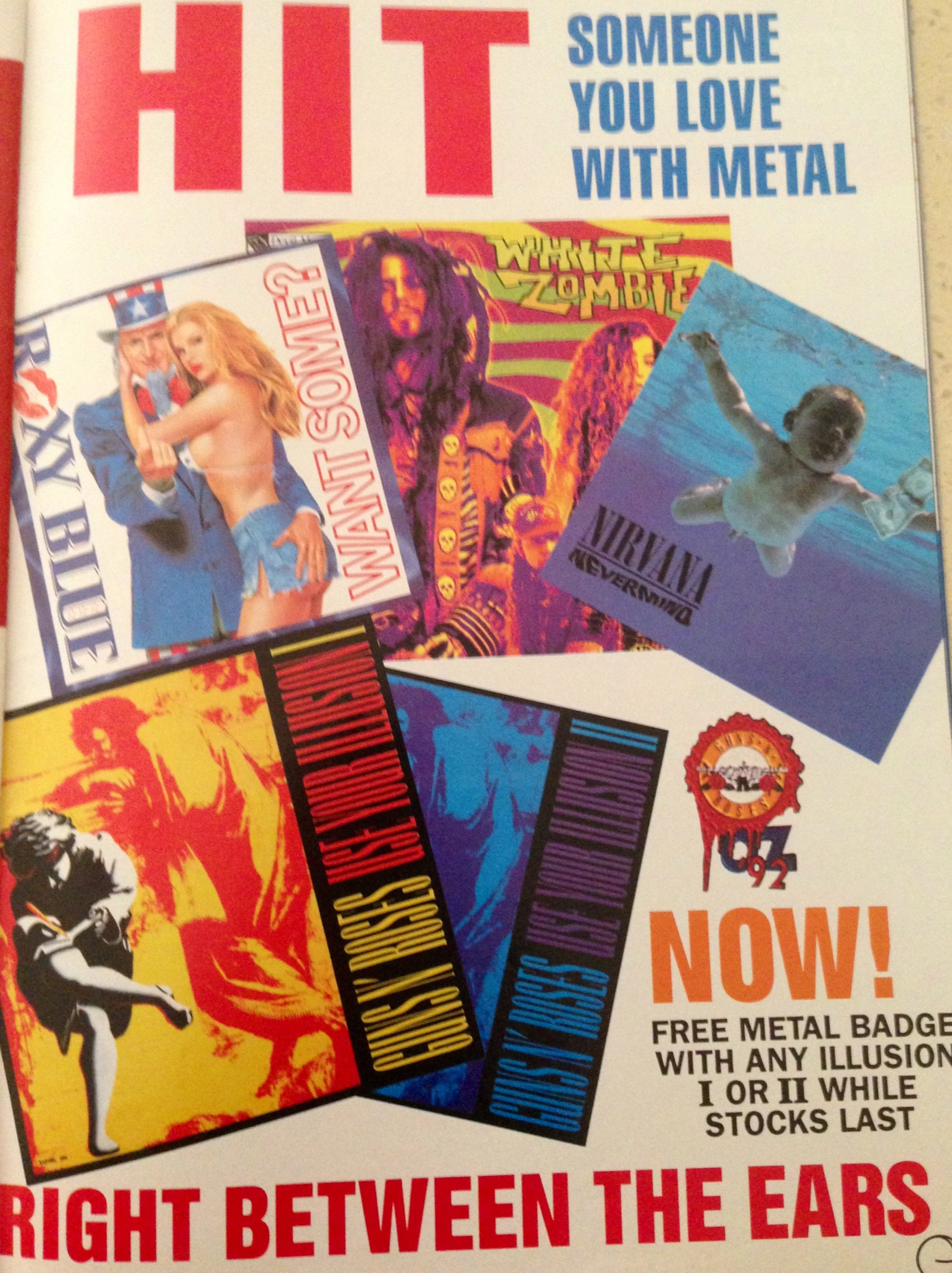
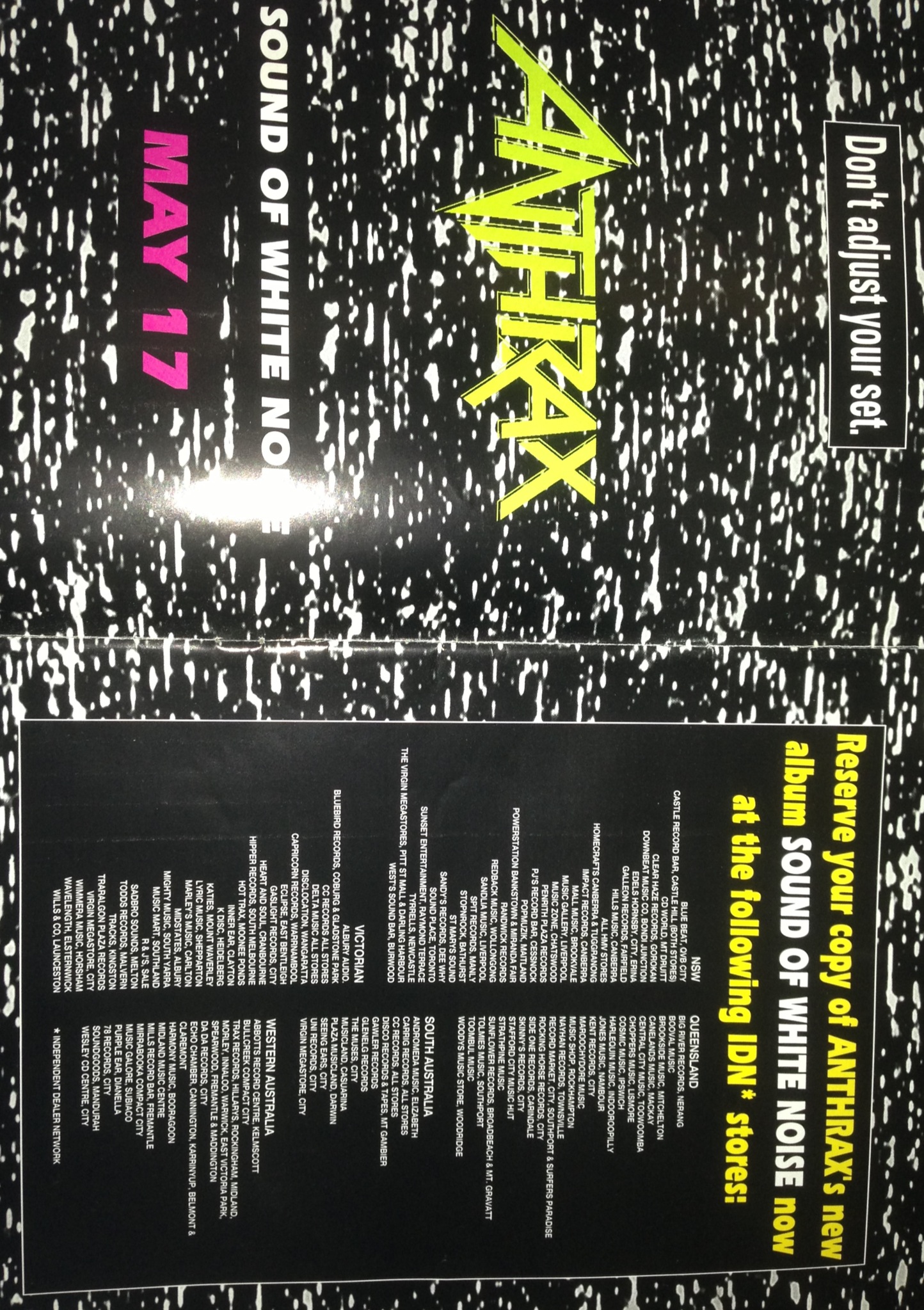
For the artists that don’t like the new way they can then go back to releasing their albums with the following advertising from the Nineties;


photo (6) photo (5)


Scott Ian from Anthrax can get his fans to go to all of the stores mentioned above. I trust that none of them are around anymore. It wasn’t piracy that killed them off, it was new technologies and bad business models.

The major chains all could have innovated, however they didn’t. Steve Jobs and Apple did. Daniel Ek and Spotify did.

In relation to the record labels. Imagine all the poor artists that were on Geffen Records in 1992. Talk about Geffen hedging their bets. That flyer is promoting Guns N Roses and Roxy Blue (Hard Rock) vs Nirvana (Grunge) vs White Zombie (Industrial Groove Metal). Guess we know who was the loser overall. Hard Rock.

The internet has enabled artists to reach out to wider and different communities than they could in the past. Previously, artists had to connect with people nearby and wait on the record label to spread the word.

However in 2013, many more artists are able to connect and build a fan base by finding and bringing together a unique fan base that is right for them and them alone.

Protest The Hero just did it with “Volition” and their Indiegogo campaign.

Coheed and Cambria did a great job with “The Afterman” releases.

Digital Summer is doing a great job at it as a DIY artist.

Marillion started it off in 2001. With everything there has to be a leader and for fan funding, that leader was Marillion.

The purpose of music is not to make people rich. It was always about the social bonding. If an artist can accomplish the bonding part, then the artist is giving the fan a reason to buy. It is human nature to reciprocate, to acknowledge value.

All those artists complaining, that they are losing, is because they are obsessed with the money they are losing. They have no one to blame but themselves. They are losing money because they no longer are making connections. They are just offering a piece of music up for sale without any connections and relationships. That is the bad way.

Standard
A to Z of Making It, Classic Songs to Be Discovered, Derivative Works, Influenced, Music, My Stories

Who Do You Think RPWL Are?

Lost in all the noise that is the music business, is a German neo progressive rock band called RPWL. They started of their career as a Pink Floyd cover band.

That is how all bands start off. Playing the songs of our favourites. Eventually, they started to create their own music, heavily influenced by the music they covered. Singer, Yogi Lange has the Gilmour tone to his voice and guitarist Karl Heinz Wallner gets very close to Gilmour’s signature sound.

However, the RPWL story didn’t start in 1997. It goes back to 1992 and a band called Violet District. On their debut and only album, “Terminal Breath”, Pink Floyd influences abound, however the influence of Marillion is more predominant. The nucleus of Violet District are the talents of Karl-Heinz Wallner, Chris Postl and Yogi Lang who of course went on to become members of RPWL. So from the ashes of Violet District, RPWL is born. Like Bon Scott said, it is a long way to the top if you want to prog and roll.

God Has Failed (2000)

This album should have done better in recognition. The world needed some Pink Floyd, and while the original band was on hiatus, RPWL stepped up to fill the void. Remember the catchy cry; progress is derivative. RPWL’s “God Has Failed” is Pink Floyds “A Momentary Lapse Of Reason Pt. 2”. Tempus Fugit the record label said that with the release of the RPWL debut album, it was their first album that made some money in sales and it gave the label the chance to invest the profits in other artists.

This album got the band labelled as Pink Floyd clones, much the same way Kingdom Come was labelled Led Zeppelin clones after their debut. The difference between the two in sales is staggering, as Kingdom Come went on a multi-platinum victory lap and RPWL didn’t.

This is RPWL raw and showing the world their influences. If you don’t like it I don’t care. If you don’t know it, you should.

“Who Do You Think We Are”
Great title to sum up the band, and I believe the song also sums up the musical style of the album. This is The Beatles crossed with Pink Floyd. The Beatles are a big influence that went largely unnoticed when this album came out. George Harrison could have written this track. It is a pop song with a progressive chorus.

Who do you think we are
There’s nothing left
But the shades of our past

When you reach that point in a relationship or a friendship and each side has gone in different directions. Where do we stand at this point in time? How do we fit in each other’s lives right now? When you can’t find the answer, the only thing left is the past.

We both know the sun will rise again
We both thought that it will never end
But somewhere deep inside
Life as got a bitter taste
When not a single friend is here to stay

Isn’t that always the case. When a break up happens, either in a relationship or a friendship, people take sides. There is always one that will be left all alone.

“In Your Dreams”
This follows on with The Beatles meets Pink Floyd theme set in “Who Do You Think We Are”. It’s the seventies merged with the eighties in the Year 2000. Think of the song “Sorrow” from “A Momentary Lapse of Reason”. The song has those moments of recognition, however as the track goes on, it becomes its own track and it evolves into the heaviest bit of the album.

Tell me what do you feel
When you die in your dreams

Who hasn’t woken up from a dream state, with that terrible sinking feeling. You have just dreamt your death, and that sick feeling lingers.

“Farewell”
It should have been the closer on the album. If anything the album is just a tad too long. 45 minutes would be sufficient, however RPWL released 71 minutes worth of music. It looks like they couldn’t part with some of the material. In this song, I am hearing King Crimson influence’s merged with Pink Floyd.

Remember all the time when life
Was only china in our hands

What a way to sum up how fragile life is, by comparing it to valuable china plates. You know, those plates that your parents bring out on special occasions to serve dinner when people are around. Then they are hand washed carefully, and dried in a safe place, so that the gold edge doesn’t get damaged.

When the Master calls
Don’t be afraid to say Farewell

In the end when the maker calls, the negotiations are over. It doesn’t matter how much you argue and try to buy more time, the end is the end. Death is just a transition.

Standard
A to Z of Making It, Music, My Stories

It’s A Long Way To The Top (If You Don’t Have The Grit To Rock N Roll)

I just finished reading a “Wall Street Journal” article that had a section about Angela Lee Duckworth, about how “GRIT TRUMPS TALENT” and the GRIT scale that she designed.

Grit means the passion and perseverance for long-term goals. In other words, the grittiest person will end up achieving much more than the talented person who doesn’t exhibit any grit. The career of an aritst is all about the taking risks, putting it all on the line and on occasion experiencing defeat. Add to that mix, “GRIT”.

So in every facet of our lives we will face a person that has super talent and grit. We will face a person who possess some talent, but a lot of grit. Finally, we will face a person who has no talent and no grit.

When I think of GRIT, I think of Mick Mars and Twisted Sister.

Starting off with Mick Mars.

Was he supremely talented? No.

Did he have the GRIT? Hell yeah.

Just think about it for a moment. Mick Mars started off doing the band circuit around 1971 and it was 11 years later when Motley Crue got picked up Elektra. Then came the shred era with the release of Yngwie Malmsteen’s “Rising Force” in 1983 and poor old Mick Mars was blasted by the new guitar fans of the movement.

He was too sloppy, he was too old, he was too slow, he wasn’t technical enough and it just went on and on. The last laugh is being had by Mick Mars. He is still around. Regardless of what you think about Motley Crue, or the band members within, one thing they do have is GRIT.

Let’s look at Twisted Sister, the best bar band doing the tri-state scene. For Jay Jay French, it was a long way to the top. He started off Twisted Sister in 1972. Dee Snider joined in 1976. The band came to world-wide attention in 1983, with the release of “You Can’t Stop Rock N Roll” and the follow-up “Stay Hungry” in 1984.

Was Twisted Sister the most talented heavy metal band doing the rounds at this time? Of course not.

Did Twisted Sister have the grit to make it? Hell Yeah.

One could argue that the band ceased to be in 1987, so what happened to the GRIT? It lived on with Dee Snider. Regardless of the success of his post Twisted Sister bands, Dee Snider continued to battle it out. He never gave up.

Looking at some other artists, I immediately think of Vito Bratta from White Lion.

Vito Bratta is a favourite of mine and a massive influence. He is a supremely talented guitarist and songwriter, however with his exile from the music business since 1992, it looks like he just didn’t have the GRIT.

Mike Tramp on the other hand, has the GRIT (Freaks Of Nature, a new version of White Lion, plus a tonne of solo releases), but without Vito, he doesn’t have the talent in the compositions.

Jake E. Lee is another favourite of mine that has sort of disappeared from the public conversation. A very talented musician, who got the boot from Ozzy Osbourne because he couldn’t agree with Sharon Osbourne over the publishing rights of Ozzy’s music. So he goes on to form Badlands with Ray Gillen (RIP) and they release two excellent albums before calling it a day with ego tantrums and arguments.

Is Jake E. Lee talented? Of course

Does he have any GRIT? I am going to answer YES on this one. Since the end of Badlands, Jake E Lee has gone on to appear on a lot of tribute albums, along with a few solo releases and a couple of projects that he demoed songs with. The bottom line is, he never really stopped creating.

Currently, he is recording songs for a new project called Jake E. Lee’s Red Dragon Cartel.

To finish off, the immortal words of Bon Scott (RIP) from AC/DC;

Gettin’ had
Gettin’ took
I tell you folks
It’s harder than it looks

Standard
A to Z of Making It, Alternate Reality, Music, My Stories, Piracy

Dreams of Machine Head’s new album, Great Fear Metaphor and the views of Mr Sixx

Machine Head’s trajectory in the 2000’s is comparable to Metallica’s trajectory in the Eighties. Yep, I know that Machine Head began in the Nineties and that their first album came out in 1994. However, after “Supercharger” in 2001, Machine Head pressed the reset switch on their career and due to certain circumstances, they started writing songs that they were producing as well.

In 2003, Machine Head released “Through The Ashes Of Empires”. To me this is comparable to “Ride The Lightning” from Metallica released in 1984.

In 2007, Machine Head released “The Blackening”. To me this is comparable to “Master Of Puppets” from Metallica released in 1986.

In 2011, Machine Head released “Unto The Locust.” To me this is comparable to “…And Justice For All” from Metallica released in 1988.

It looks like the new Machine Head album will have a street date sometime in 2014. The question is, will the new Machine Head album be comparable to the spectacular Black album from Metallica released in 1991.

Robb Flynn has put out some thoughts around the consumption of music and the way it is released and marketed. He was asking fans, what do they want Machine Head in respect to the new album. I agree with his mindset and his view point. So the question is, how will Machine Head release their new music?

Will they focus on just the existing CD format and packaging that the record labels have done since day dot?

Will they focus on the idea, that if you purchase the CD, you also get a digital rip of the album at the same time? (Amazon does this for participating bands and Coheed and Cambria did this for The Afterman releases).

Will they have a super deluxe packaging option for their hard core fans?

I actually had a dream that I purchased a super deluxe pack from Machine Head for their new album. In my dream, my subconscious mind gave the album the title of “Great Fear Metaphor”.

The pack included the following items (I still can’t believe I dreamt this stuff);

*A unique T Shirt, with band art on the front and on the back of the T-Shirt, the fans surname with a number like 00001 for the first person to purchase it, 00002 for the next and so forth. Each premium package focused on it being unique  and personalised.  I was allowed to purchase extra multiple T-Shirts in different sizes for a decent price so that I had the same shirts for my wife and my kids.

* Different album art for each Premium box.

* A 30 page booklet, that talks about the songs, their meanings, the musical inspirations behind the riffs with each page littered with tab like musical drawings/excerpts of some of the riffs and their leads.

* The usual CD plus DVD plus access to a digital download area, where I could download the mp3’s of the songs, plus early demo drafts of the songs.

In my opinion, the super deluxe packaging is for the super fan market and if bands are not satisfying this market, they are leaving money on the table.

I remember reading some of the negative comments in relation to Robb’s views on the CD format, and a lot of them said the same thing, like how can Robb Flynn be talking about abandoning the CD format when he is in the business of selling CD’s.  

Umm, no. Machine Head and Robb Flynn are in the music business. First and foremost, they create music. They are not in the business to sell CD’s. That was the role of the record label. In the past, for a fan to hear that music, it needed to be placed onto a format that could be distributed. These formats involved, LP’s, Cassettes and CD’s. This in turn gave control to the Record Labels. The record labels made money by exploiting the work of the artists it signed.  

Read this article about the introduction of certain formats and the resistance to those formats initially.

Two main things stood out to me in the article. The first is when cassettes came out in the seventies. People started to copy music onto these cassettes. So what do the music business do? They scream piracy and demand government action. In 1971, the music business had a Piracy convention in Geneva, to put into force an agreement to stamp out piracy. This is the comment from the article;

“Twenty-three countries have signed the agreement, which is expected to be widely ratified to provide an effective international protection against the pirating menace predicted as formidable enough to disrupt the whole of the world music industry if allowed to continue unchecked.”

Sound familiar to 2013. It looks like the music business didn’t get the hint back in 1971. People want to copy and share their music.

The next thing that stood out is the following comment;

“Unless you find another way of making money besides controlling copying, you will not last in the digital age.”

A person by the name of Ram Samudrala made that comment in Billboard Magazine issue that was dated July 18, 1998. That is 15 years ago. The Record Labels and the RIAA ignored the advice and as such, they failed their artists on their roster.

Fast forward to 2013, and you have the real artists trying to find other ways of making money besides record sales, while the record labels are still ignoring this advice and are trying to get back the control they had over copying and distribution by litigating against ISP’s, sharers, downloaders and trying to get legislation passed to benefit them.

Does it all sound familiar? A failure to innovate leads to a piracy unchecked problem. A failure to service the customer base leads to a piracy unchecked problem.

On the topic of innovation I want to comment on a favourite artists of mine, Nikki Sixx. He posted the below comments recently and I was very surprised at his stance, as I always viewed him as an innovator and someone that was always trying to find other ways to make money besides selling recorded music;

When I was scrounging through record shops as a kid you usually (unless you just shopped for single’s) bought the whole album. I always fell deeper in love with the band because “ALL” their songs spoke to me. Of course some jumped out at you right away while others grew on you but you didn’t skip any songs, you would listen from top to bottom over and over again.

When I started making albums I always believed the WHOLE album was the adventure. Of course there is the lead single for radio but when did THAT become the whole experience?

I talk to more and more people every day who tell me they only buy singles now. iTunes hasn’t helped for that of course. We have asked them many times to bundle our album as one download so fans wouldn’t cherry pick the hits and miss the hidden gems but it’s not part of their business model. I love iTunes and buy music almost daily from it but it still frustrates me. I just wish more people clicked “BUY ALBUM”. Maybe I am old fashioned in how I believe music should be listened to but I refuse to ever buy just a band’s single. I always buy the WHOLE album. I encourage you to do the same. Technology may have changed but the fact that a band makes a WHOLE album for you hasn’t.  Dig deep and I promise you, you will fall deeper in love with the artist than you ever could only listening to one song.

In relation to his first paragraph and the comment “you usually (unless you just shopped for single’s) bought the whole album”.

Yes, that is correct, we usually purchased the whole album because that was the only way we could hear the music. In a lot of independent record shops during the mid to late eighties, you couldn’t even find a single. The only option we had to buy was the album.

Remember the comments from Brad Paisley, it is always about the songs. That is why the fans stick around with the artists. As soon as the quality of the songs disappears, the fan becomes burned on the artist and they turn away. For any artist these days, if you want people to purchase the whole album, you need to create greatness. If you have 8 great songs, put 8 great songs on it. Don’t put 8 great songs and 4 fillers.

I have always purchased the albums from Motley Crue (as well as their box sets Music To Crash Your Car Vol. 1 and 2, Loud as F… and so on), Brides Of Destruction, Sixx A.M., 58, Tommy Lee, Methods of Mayhem and Vince Neil’s solo albums.

I always skip tracks from each Motley Crue album, because they are just not great.

One thing that Motley Crue has been very poor at is releasing super deluxe packaging for their super fans. They are dead set not satisfying this market.

I really like what Nikki Sixx has done with Sixx A.M so far, in the way that they have a book and a body of music with each release. However, as a fan you still needed to buy them separately. There was no super deluxe pack that was unique.  

Standard