Copyright, Music, Stupidity

The Labels Want Songwriters’ Rights, Just Not Songwriters Themselves

The article.

Chaos for Who?

The music industry loves to talk about artists.

It loves to celebrate artists.

It loves to hand out awards, sponsor songwriter camps, run social media campaigns about creativity, and tell the world that music starts with the creator.

Until the creator asks for something back. Then suddenly the language changes.

Now it’s not about art. It’s not about fairness. It’s not about creators. It’s about “chaos.”

The major labels and BMG have petitioned the United States Supreme Court to overturn a ruling that would allow songwriter Cyril Vetter to reclaim worldwide rights to a song he wrote more than sixty years ago.

And their argument is fascinating. Not because it’s convincing. Because it exposes exactly how the industry thinks.

The labels claim that if songwriters can reclaim worldwide copyrights under U.S. termination law, it will create uncertainty, confusion and disruption throughout the music business.

Chaos.

That’s the word.

Chaos.

Funny how the same industry that spent decades telling creators to sign away global rights in perpetuity is suddenly worried about fairness and stability.

The same companies that built billion-dollar catalog empires from contracts signed generations ago now want us to believe they are protecting the music ecosystem.

Protecting whom?

Certainly not the songwriter. The songwriter is the one who created the asset. The songwriter is the one who took the risk. The songwriter is the one whose work still generates value decades later.

Yet when a court finally interprets the law in a way that potentially benefits creators, the industry’s first instinct isn’t celebration.

It’s litigation.

The hypocrisy becomes even more obvious when you look at history.

Labels routinely tell artists that contracts are sacred. Deals are deals. You signed it. Live with it.

Except when the labels don’t like the outcome.

Then contracts, precedents and long-standing interpretations suddenly become flexible.

Then the legal teams arrive. Then the lobbying starts. Then the scare campaign begins.

We’re told the sky will fall. We’re told investment will disappear. We’re told the business will collapse.

We’ve seen this movie before.

Every technological shift was supposedly going to destroy music.

Home taping. CD burning. MP3s. Streaming. TikTok. Now songwriter rights.

The industry’s prediction record on catastrophe is so bad that “chaos” should probably be treated as a marketing term rather than a legal argument.

Because let’s be honest.

If a songwriter reclaiming rights after half a century creates disruption, maybe the disruption isn’t the problem.

Maybe the underlying business model is.

The labels argue that billions of dollars and countless agreements were built around the assumption that foreign rights remain permanently with publishers.

That may be true.

But an industry building its future around assumptions doesn’t magically transform those assumptions into justice.

There was a time when artists couldn’t own masters.

There was a time when musicians signed contracts they barely understood.

There was a time when labels controlled manufacturing, distribution, promotion and access to audiences.

That world is disappearing.

And perhaps what we’re seeing in Vetter v. Resnik isn’t chaos. Perhaps we’re seeing correction.

The most revealing part of this case isn’t the legal argument. It’s the language.

The labels describe the songwriter’s position as a fringe theory. Yet a federal appeals court agreed with it.

Creator groups support it. And the logic is straightforward.

If termination rights exist to give creators a second chance at ownership, why should that second chance stop at a national border?

Why should a songwriter get half the apple?

The answer seems obvious.

Because half the apple is still enough for the labels to keep the other half.

That’s what this fight is really about.

Control.

Not creativity. Not fairness. Not artists.

Control.

The irony is that the music business constantly tells young creators that ownership matters.

Keep your rights. Build your catalog. Think long term. Become an entrepreneur.

Until those same principles start applying to creators whose songs were written decades ago.

Then ownership suddenly becomes dangerous. Then ownership becomes disruptive. Then ownership becomes chaos.

The labels want everyone to believe they’re defending stability.

What they’re actually defending is a system that has benefited them enormously for generations.

A system where rights flow one way. A system where creators are encouraged to surrender ownership but discouraged from reclaiming it. A system where fairness is celebrated in speeches but challenged in court.

If the Supreme Court ultimately hears the case, the decision will affect far more than one song.

It will answer a much bigger question. Who does copyright actually exist to serve?

The corporations that acquired it.

Or the people who created it.

Because if reclaiming your own work after sixty years is considered chaos, perhaps the real chaos was the arrangement that existed before.

Standard
Copyright, Music, Stupidity, Treating Fans Like Shit

Fender Wants Your Guitar Back

Fender has lost its mind.

It thinks it can copyright a shape, and call that “heritage.”

That’s corporate greed, pretending it’s preserving culture.

The Stratocaster body shape is not sacred scripture. It’s a guitar shape that entered the bloodstream of modern music decades ago. Pretending to own the shape now is like claiming ownership of the power chord, the double cutaway, or rock and roll itself.

And somehow this whole mess started with Fender suing an AliExpress seller in Germany.

The seller never showed up.

Fender won by default.

Then, suddenly, that default judgment became the foundation for a wider campaign. Cease-and-desist letters started flying. Builders, retailers and manufacturers of their own guitars using the Stratocaster body shape, found themselves being told that Fender now had legal proof that it owned the Stratocaster body shape.

Not a patent. Not a trademark. A copyright.

And that’s where things start getting ridiculous.

Because this wasn’t simply about stopping counterfeit guitars with fake Fender logos on the headstock. Most musicians understand that. Most builders understand that.

The company reportedly demanded that builders and retailers destroy their existing inventory.

Destroy it. Millions of dollars in manufacturing and research/development.

And then things got even uglier.

Fender allegedly wanted stores and manufacturers to hand over the names and addresses of customers who had already bought guitars with Strat body shapes.

The request?

Have those customers return their guitars so they too could be destroyed.

Read that again.

A billion-dollar corporation wasn’t just trying to stop future sales. It wanted guitars already sitting in people’s homes.

That’s the moment this stopped looking like brand protection and started looking like corporate intimidation.

And nobody likes a bully. Make no mistake, that’s exactly how this looks.

Then comes the inevitable question.

Why now?

The Stratocaster body shape debuted in 1954.

Seventy-plus years later we’re suddenly being told the shape is protected in a way that thousands of builders and guitar tinkerers somehow missed?

Think of EVH tinkering with a Stratocaster body, to come up with his sound and the Frankenstein look. George Lynch playing Charvel and then ESP’s that use the Stratocaster body shape. Hell, Lynch even makes Custom guitars right now utilizing the Strat body shape. Add to that list Kirk Hammett and his ESP guitars and every other guitarist that played a guitar with a Strat body that wasn’t Fender. All of the guitars are illegal according to Fender.

And let’s be honest about who’s making these decisions.

Fender’s CEO, Edward “Bud” Cole, is a Fender lifer. He knows the history. He knows the market. He knows exactly what the Stratocaster means to players.

Which means this isn’t confusion.

But here’s the uncomfortable truth.

Fender is no longer automatically the best guitar in the room. There was a time when the logo alone was enough.

Not anymore.

Today there are boutique builders producing instruments with better fretwork, better neck profiles, tighter quality control and greater consistency than many production-line Fenders.

We feel it immediately as soon as we pick up a guitar and within ten seconds we know.

No legal brief changes that. No cease-and-desist letter changes that.

The PR damage may be even worse.

Because Fender looks like the guy who arrives at the party after midnight, grabs the microphone and starts yelling at everyone.

Nobody likes that guy. Nobody respects that guy. And nobody forgets that guy.

The guitar industry has already lived through this movie. Gibson went after PRS over the single-cut body shape.

The courts ultimately rejected the idea that one company could permanently monopolize a broadly recognized guitar design.

That should have been the lesson.

Instead Fender looked at history and apparently concluded:

Let’s try it ourselves. Only louder.

And the saddest part?

Fender should know better. Its reputation wasn’t built by lawsuits or cease-and-desist letters or by demanding customer lists or threatening independent builders.

It was built by making great guitars.

This entire campaign feels disconnected from players and completely connected to spreadsheets.

That’s how great brands start to decay. Not because competitors catch them. Because they convince themselves that people love the logo more than the product. They don’t.

That’s why this whole thing lands so badly.

It’s petty.

It’s defensive.

It’s short-sighted.

And most importantly, it’s unnecessary.

If Fender wants respect, make better guitars. If Fender wants loyalty, earn it. If Fender wants to remain the standard, stop acting like the standard needs a lawyer.

Because the truth is already out there.

The shape is not the product. The player is.

And if Fender has forgotten that, the damage it’s doing to its own brand may last a lot longer than any body-shape ruling ever will.

Standard
Alternate Reality, Music, My Stories

Motley Crue

Back before the internet, rock mythology lived in the gaps. The gaps between announcements and releases. The gaps between rumors and facts. The gaps between what bands said publicly and what was actually happening behind studio doors.

And sometimes those gaps leave behind artifacts.

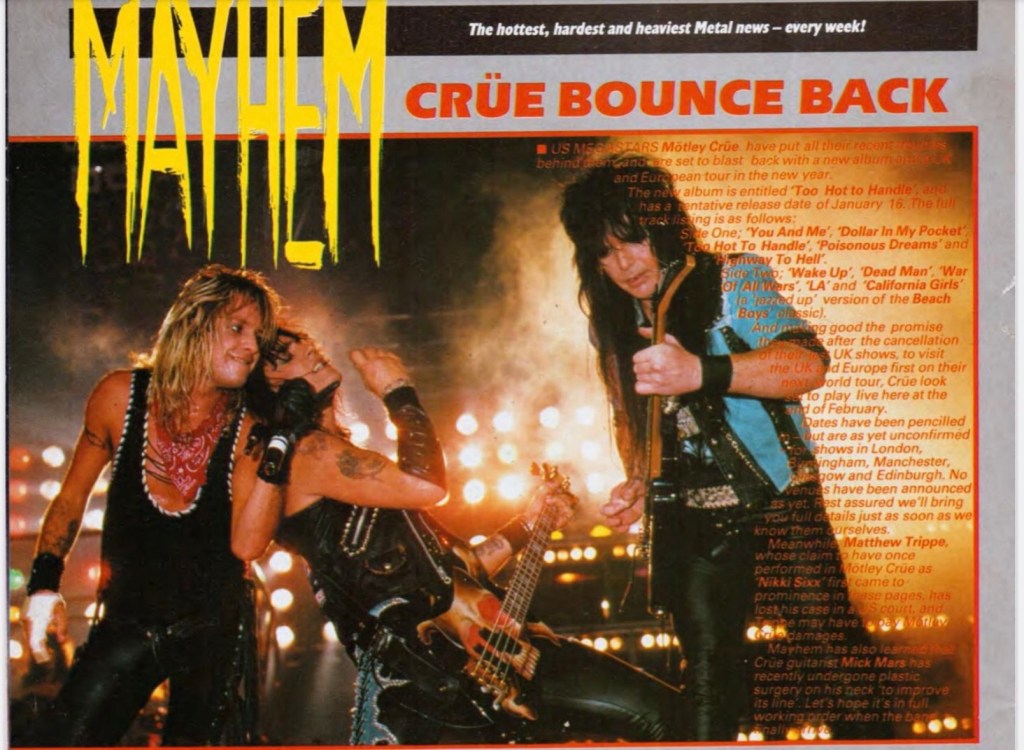
Like this old UK metal magazine clipping from Kerrang, claiming Mötley Crüe’s next album after “Girls, Girls, Girls” was going to be called “Too Hot To Handle”.

Not a rumor whispered by a fan on Reddit thirty years later. An actual printed story. With a release date. A European tour plan. And a track listing full of songs nobody has ever officially heard.

Now, if you’re under forty, you probably think this means one of two things: Either it was fake or somebody got it wrong.

But that’s because modern audiences don’t understand how information moved in the ‘80s.

Music journalism back then wasn’t journalism in the modern sense. It was half-access, half-chaos, half-propaganda and half-drunk-guy-at-the-bar storytelling. Labels leaked incomplete information. Managers exaggerated. Journalists filled in blanks. Bands changed direction midstream because somebody overdosed, disappeared, got arrested, the label rejected it or the band decided the entire record sucked halfway through recording it.

Especially Mötley Crüe.

Which means this article was likely discussing the project that eventually became “Dr. Feelgood”.

And suddenly the timeline becomes incredibly interesting, because the article mentions a January release schedule.

But “Dr. Feelgood” didn’t come out until August 1989.

So what happened to push the date out?

Nikki Sixx overdose on December 23, 1997. The overdose fundamentally interrupted the momentum of the band. Tours were cancelled. Europe got burned. The machine stalled out.

Maybe “Too Hot To Handle” was the original album title. Maybe those track names were demo titles. Maybe the record was originally intended to be a faster, dirtier continuation of “Girls, Girls, Girls”.
Maybe songs were abandoned after rehab, rewrites and Bob Rock entered the picture.

Because here’s the thing people forget about “Dr. Feelgood”:

That album sounds NOTHING like a band spiraling out of control.

It sounds focused. Massive. Disciplined. Intentional.

Bob Rock basically forced Mötley Crüe to stop behaving like a gang and start behaving like a professional recording act. Vince had to get vocal lessons before he started to record the vocals. The grooves tightened. The hooks became sharper. The production became cinematic. The chaos got filtered into something enormous.

That version of the band did not exist when this article was printed.

And honestly, the album titles themselves tell the story better than anything else.

“Too Hot To Handle” sounds like old Crue. Cartoon sleaze. Sunset Strip excess. Cheap danger.

“Dr. Feelgood” sounds darker. More narcotic. More sinister. Like the party stopped being fun.

One title sounds like a band chasing pleasure. The other sounds like a band trying to survive it.

Does the article prove some lost Mötley Crüe album exists in a vault somewhere.

Maybe it does. Maybe it doesn’t.

What matters is that this article captures a moment before rehab rewrote the band. Before Bob Rock transformed them.

And maybe that’s what made the pre-internet era better.

Mystery.

You didn’t know everything. You weren’t supposed to. The uncertainty was part of the experience.

Now every demo gets uploaded instantly. Which I love by the way. Every studio update becomes social media content. Every rumor gets “fact checked” within ten minutes by people who confuse searchable information with understanding.

But rock mythology was built on incomplete information.

On possibility.

On strange magazine clippings that make you wonder whether somewhere, buried in a storage locker or sitting on an old cassette tape in Nikki Sixx’s archive, there’s an alternate version of Mötley Crüe history labeled:

“Too Hot To Handle”.

P.S.

The full track listing is as follows:
Side One; “You And Me”, “Dollar In My Pocket”, “Too Hot To Handle”, “Poisonous Dreams”, “Highway To Hell”.

Side Two; “Wake Up”, “Dead Man”, “War Of All Wars”, “LA”, “California Girls” (a jazzed up version of the Beach Boys classic).

Standard
Music, My Stories, Treating Fans Like Shit

When the Party Turns into a Legacy: Bon Jovi, “We Got It Going On,” and the Forever Dilemma

Bon Jovi are back in the headlines again.

The “Forever” Tour.

The big announcement.

And, as always, the internet did what it does best, split down the middle.

Half the fans were ecstatic: “They’re back! Jon’s finally bringing the band around again.”

The other half were grimacing at the live clips, whispering the kind of thing you never want to say about your heroes: maybe the forever part should’ve ended a while ago.

That’s the heartbreak of watching icons age in public. We want the fire without the fallibility, the 1986 Bon Jovi frozen in amber, talkbox wailing, hair on fire, fists in the air, not the version that’s grown reflective, too polished, and painfully human.

But for me, this whole “Forever”discussion takes me back to 2007.

To “Lost Highway”.

I was a diehard then. Still am, I guess. The kind of fan who buys the record before hearing a note, because “Slippery When Wet”, “New Jersey”, and “Keep the Faith” were practically scripture. So when the band leaned into country-rock, I wanted to believe in it. But you could feel the calculation. You could feel the intention.

“Who Says You Can’t Go Home” worked because it wasn’t supposed to. It was an accident, a crossover that caught fire because it felt genuine. Then Jon, the businessman, doubled down. And when you chase authenticity, you lose it.

But buried under the Nashville polish was one song that didn’t care about charts or categories.

“We Got It Going On.”

“Is there anybody out there looking for a party? Yeah!!
Shake your money maker, baby, smoke it if you got it.”

That opening riff hits like swamp water and motor oil, sleazy, sexual, bluesy. Sambora’s talkbox returns like a ghost, resurrected not for nostalgia but for sheer noise. You can almost see the lights dim, the crowd swell, the camera pan across faces that just want to feel something again.

This song wasn’t written for critics. It was written for the night, for bodies pressed together, beer in the air, the scream that shakes the workweek loose.

“We Got It Goin’ On
We’ll be banging and singing just like the Rolling Stones.”

That line nails it. The nod to the Stones, the eternal road dogs, still out there rattling bones decades later.

And the truth is, I’ve left concerts sore, half-deaf, heart syncing with the subwoofers. That’s what great live music does: it inhabits you. You don’t walk out the same.

It’s all there, the “Ah ha ha” chant, the “ticket to kick it” call to arms, the invitation to ditch your suburban restraint.

“Everybody’s getting down, we’re getting down to business
Insane, freak train, you don’t wanna miss this.”

That’s Primal Scream energy. Nikki Sixx said it best:

“Primal scream and shout, let that mother out.”

That’s what “We Got It Going On” captures, not country, not crossover, but catharsis.

And it kills me that it never became a setlist regular. It tore through “Live at Madison Square Garden” and proved it belonged beside their classics.

But now, watching the new “Forever” performances, I can’t help but think about that title.

Because say what you want about the voice, the image, the years, when that talkbox hits and the crowd still roars, for a few minutes at least, they really do got it going on.

Bon Jovi’s strength was that mix of optimism and blue-collar defiance that said, we’re gonna shake up your soul, we’re gonna rattle your bones.

The challenge now isn’t pitch or range, it’s rediscovering the part of themselves that still wants to party like it’s dangerous again.

With presales kicking off October 27–28 and general sales slated for October 31, fans were ready.

Hungry. Hopeful.

But within hours, that excitement curdled into outrage.

Across X (Twitter) and fan forums, the stories were brutal: hours-long virtual queues, endless errors, “these tickets are no longer available” messages that mocked you after two hours of waiting.

One fan said they spent their entire last day of vacation fighting Ticketmaster’s glitch-riddled system.

Another logged in early for presale, only to find seats instantly gone, calling it “a joke” where real fans lose to bots every time.

Queues hit 160,000 people for UK shows like Wembley.

Some fans swore the platform was holding tickets back to manufacture demand. Others pointed to instant resales, the same seats appearing online minutes later, inflated beyond belief.

And they weren’t exaggerating. Prices hit $900 for single seats.
VIP “Legendary” packages, front row, tote bag, lanyard, mocked for charging hundreds extra for souvenirs no one asked for.

One fan summed it up perfectly:

“It’s not the Forever Tour because of Bon Jovi’s career — it’s because we’ll be paying it off forever.”

That’s the reality of fandom in 2025. We want connection, not corporate friction.

We crave the “Livin’ on a Prayer” moment, but we get login errors and resale markups instead.

Some fans did score tickets, celebrating in disbelief, hoping maybe, just maybe, Richie Sambora will reappear and make it all feel whole again.

But the dominant emotion across social media isn’t excitement. It’s exhaustion.

This is the paradox of legacy. When the dream outlives the danger, the machine takes over.

Bon Jovi were always about inclusion. Blue jeans, big choruses, stadium-wide singalongs. They weren’t supposed to be exclusive.

But the modern ticketing system turned “forever” into a commodity, a limited edition for those who can afford it.

And maybe that’s the real tragedy of this era: we can still sing along, but we can’t always get in the door.

Bon Jovi built a career on songs that made ordinary people feel invincible.

Now, the fight is to make those people feel included again.

Because the legacy doesn’t live in the hits, or the sales, or the streaming stats.

It lives in the noise, the sweat, the singalong, the place where “We Got It Going On” still means something.

Standard
A to Z of Making It, Influenced, Music

Joel Hoekstra on The Jay Jay French Connection Podcast (Sept 19, 2023)

Steve Lukather has nothing but the highest praise for Hoekstra, and it’s easy to see why.

Born in Iowa City, Joel moved to Chicago as a kid, then later spent time in L.A., working at Cherokee Studios in 1991 and 1992. By that time, legendary producers Tom Werman and Geoff Workman had already moved on, but their legacy lingered.

Hoekstra studied at the Musicians Institute (GIT) in L.A., though he had a head start, his local teacher had already introduced him to the curriculum before he even arrived. On day one, he found himself among 500 other guitarists in the main hall, an intimidating experience.

Growing up with classically trained parents, he learned to read music early on, though he admits it’s only occasionally useful in his current work. It did, however, come in handy when he landed “Rock of Ages” and other theater gigs.

Unlike many of his peers, the ’80s shred scene didn’t have a huge impact on him, he was too young for it to be a major influence.

He did, however, run in circles with some serious musicians, including drummer Scott Coogan, guitarist Pete Thorn (well-known for gear demos), and Joy Basou (who found success in pop music, working with artists like Jessica Simpson and Nick Lachey).

When asked about his guitar heroes, Hoekstra named Steve Morse (High Tension Wires), Steve Vai (Passion and Warfare), and Joe Satriani (Flying in a Blue Dream, Surfing With the Alien).

While Eric Clapton wasn’t a big influence, he admired Jimmy Page for his rhythmic licks, Jeff Beck for, well, everything, and Jimi Hendrix for his showmanship. He also loved everything “Rush” did, as well as Trevor Rabin’s “Yes” era, he still follows Rabin’s work, including his latest album “Rio”.

Jay Jay French mentioned for his generation, Johnny Winter and Alvin Lee were the Yngwie Malmsteens of their time.

Over the years, Hoekstra transitioned from playing Floyd Rose-equipped Jacksons and Kramers to a Fender Telecaster, then a Gibson SG, before settling on a Gibson Les Paul in 2004. He admitted that while playing a Les Paul means sacrificing about 10% of your technique, each note is worth it. Initially, he avoided Les Pauls because he’d heard they had tuning issues.

As a solo artist, Hoekstra has released three instrumental albums covering various styles. However, when he shifted into hard rock and heavy metal, fans wanted more of that sound.

Instead of branding it as a solo project, he launched “Joel Hoekstra’s 13”, where he writes all the music and lyrics while bringing in powerhouse rock musicians to jam with him. At the time of the interview he was onto his third release with “JH13”, along with “Eagle Flight” from Revolution Saints.

Speaking of collaborations, Hoekstra has another project called “Iconic”, featuring Michael Sweet (guitar), Marco Mendoza (bass), Tommy Aldridge (drums), and Nathan James (vocals). At the time of the interview, new releases from Iconic and Revolution Saints are on the way.

Since then, Revolution Saints dropped “Against The Winds” in 2024 however Iconic hasn’t been released yet.

As for Whitesnake, the future remains uncertain. Everything depends on David Coverdale, with the band currently in a holding pattern. Their European tour had a few canceled dates, and the U.S. tour was ultimately called off due to Coverdale’s sinus infection.

If you like to hear a good story, check out Joel Hoekstra.

Standard
A to Z of Making It, Copyright, Influenced, Music, Unsung Heroes

Derek Schulman

On October 15, 2020, Derek Schulman appeared on the Bob Lefsetz Podcast.

I first heard of Schulman as the guy responsible for signing Bon Jovi and Cinderella. But before becoming a label executive, he was a member of Gentle Giant (GG), a band that has a bigger fan base today than when they originally broke up.

When Lefsetz asked why GG had grown in popularity, Schulman explained: “We wrote music for ourselves, didn’t follow trends, and the music held up.” Interestingly, GG never considered themselves a progressive rock band. Rock, yes, but not prog. They simply pushed themselves musically.

I believe GG’s resurgence is largely due to the internet. Their music isn’t locked away in a vault, it’s widely accessible. If we were still in the pre-Napster era, their catalog might have remained buried, since labels wouldn’t see the financial incentive to print CDs. Labels have always believed they know what fans want, but they’ve often been wrong. Had they continued releasing hard rock in the ’90s, the genre could have still produced acts selling close to 500,000 units. Instead, they abandoned it.

It always comes back to the music. People return for the music, not for record sales, labels, executives, or streaming numbers.

From Musician to Executive

Before Gentle Giant, Schulman played in a band with a few hit singles, but by 1969, he was burned out from the pressure to keep churning out commercial hits. He wanted to form a band that was the opposite of pop, so GG was born.

But by 1980, after 14 years in bands, Schulman was done. GG had become a job, and he had lost enthusiasm for recording and touring. With nothing lined up, he spent a year feeling lost. Fortunately, he had savings, thanks to his role as GG’s quasi-manager in the mid-’70s.

A friend at PolyGram called with a job offer. Schulman moved from California to New York and joined the label as a Promotions/A&R rep, though his role was mostly promotions. He was hired because two of PolyGram’s heads of radio promotion were huge Gentle Giant fans.

At the time, PolyGram was a mess. The label had major acts like KISS and Def Leppard, but they drained a lot of resources. Schulman’s break came when artists and managers started bringing him albums. Uriah Heep was shopping a new record, and Schulman helped organize a deal to release it.

Then came Bon Jovi.

Bon Jovi’s Breakthrough

Schulman met Jon Bon Jovi and was impressed by his focus and drive. Jon wanted to be bigger than Elvis. He even introduced Schulman to his parents, who told him: “Take care of our son.”

At the time, no other labels were bidding on Bon Jovi. Schulman also had a strict policy, he refused to get into bidding wars.

The key move was bringing in Doc McGhee. Doc originally came to Schulman’s office pushing Pat Travers, but Schulman told him to check out Bon Jovi instead. Schulman saw in Doc the same relentless drive that Jon had.

Jon met Doc, they struck a deal, and just like with Schulman, Jon’s parents needed to approve.

McGhee put Bon Jovi on tour with Ratt and Scorpions. Their debut album was a success, but their second record, “7800° Fahrenheit”, was considered a sophomore slump. Schulman hated the album title, the recording process was a mess, and the overall vibe felt off. But the album did its job, it kept the band on the road while McGhee worked overtime to book shows.

Schulman, meanwhile, had started working with producers Bob Rock and Bruce Fairbairn, who had just finished albums with Loverboy and Honeymoon Suite. Jon and Doc knew they needed great producers to reach the next level.

Schulman suggested co-writing with others. Paul Stanley and Gene Simmons had already introduced Jon to Desmond Child. The rest is history.

The label knew they had something big as soon as “Slippery When Wet” was mastered. The original album cover was scrapped, and Jon designed the new one himself. “You Give Love a Bad Name” and “Livin’ on a Prayer” were immediate hits, and the album shot to No. 1. Schulman had a percentage point on the album, but when he left the label, his royalties ended.

Cinderella

Schulman was introduced to Cinderella by an agent, a lawyer, and Jon Bon Jovi, who knew Tom Keifer.

He went to see them play a club in Philadelphia. The band wasn’t great, Tom Keifer stood out, Jeff LaBar was solid on guitar, but the other two members weren’t up to par. Then Schulman listened to a 90-song demo of Keifer’s original material. He was blown away by Keifer’s songwriting.

Schulman told the lawyer: “Get Tom to replace the other two with better musicians, and I’ll give you a deal.”

Andy Johns was brought in to produce “Night Songs”. The album dropped shortly after “Slippery When Wet” exploded, and “Night Songs” shot into the Top 10. Suddenly, Schulman was on fire, he had two bands in the Top 10.

When Lefsetz asked why Cinderella never released another big album, Schulman pointed out that they did, “Long Cold Winter”, but he had briefly forgotten the title.

Tom Keifer eventually lost his voice, which Schulman confirmed was true. Schulman also helped shape Cinderella’s albums with his artist experience, though he didn’t contribute to Bon Jovi’s records in the same way. He even co-wrote songs with Tom but never took credit.

Dream Theater

Derek Oliver, an A&R representative at Atco Records and a passionate fan of progressive rock, was the key figure in discovering Dream Theater.

In the late 1980s, Dream Theater had self-released their debut album, “When Dream and Day Unite”, through Mechanic/MCA Records, but the album failed to gain much traction due to poor promotion and distribution.

Meanwhile, Oliver, who had interviewed and reviewed the band during the period as part of Kerrang was impressed by their technical proficiency and songwriting.

Recognizing their potential, he brought Dream Theater to the attention of Derek Schulman, the head of Atco Records at the time.

After meeting the band and seeing their dedication, Schulman agreed to sign them to Atco. Under his guidance, Dream Theater recorded their breakthrough album, Images and Words (1992), which featured the hit single “Pull Me Under.” The album’s success helped establish them as a leading force in progressive metal, proving that Schulman and Oliver’s instincts were right.

Running Labels

Schulman also played a key role in launching Bob Rock’s production career, giving him his first gig with Kingdom Come, another band that went on to dominate the charts.

In 1989, Schulman left PolyGram to run Atco Records. PolyGram wanted to keep him, offering him control of Vertigo and Mercury, but he wanted a change, even if it meant losing his Bon Jovi and Cinderella royalties.

Doug Morris was hesitant about Schulman at first and saw him as a potential replacement. But Schulman built an impressive roster, signing Pantera and The Rembrandts. He had actually planned to sign Pantera to PolyGram but knew he was leaving, so he told their attorney to wait until he moved to Atco.

At first, Atco thrived. Schulman put together a strong team, and the first three years were fantastic. But eventually, he started losing perspective. One day, he heard a No. 1 song on the radio and liked it. When he asked a work colleague who had signed the artist, they said: “You did.” That moment shook him.

Doug wanted him out, but Schulman quit. He even attempted a coup while on a trip to Russia.

Roadrunner Records and the Rise of Metal

Schulman took a break before getting a call from an old friend, Case Wessels, at Roadrunner Records. Initially consulting for a year, he eventually became president.

Roadrunner was independent, which Schulman loved—no board to answer to. He scrapped some of Wessels’ ideas and focused on breaking bands like Coal Chamber and Fear Factory, both signed by Monte Conner.

Then he saw Slipknot live and knew they would be massive.

He also signed Nickelback. Their first album (with Roadrunner) featuring “Leader of Men”, got some airplay, but when “Silver Side Up” dropped, Schulman immediately recognized its potential. The moment he heard “How You Remind Me”, he knew it would be huge.

Roadrunner was suddenly rolling in cash. Wessels wanted another “Silver Side Up”, but Schulman knew those albums don’t appear every six months, more like every 5 to 10 years.

Lefsetz asked why Nickelback gets so much hate. Schulman believes they’re a guilty pleasure, many people who claim to hate them secretly enjoy their music.

Finally, Schulman pointed out that while the industry panicked over piracy during Napster, hip-hop thrived by giving music away for free.

When streaming took over, hip-hop was already dominant—and it still is.

If you like your hard rock and metal history, then Derek Schulman is an unsung hero and this podcast is one to listen to.

Standard
Copyright, Derivative Works, Music, My Stories, Piracy, Stupidity

Four For Friday

When I started these weekly posts it was a means to keep me blogging during a hectic schedule.

And there was no definitive structure as to what I would cover. But I can see that Cooyright issues keep appearing.

And here is another week devoted to that beautiful term. Copyright. Which was designed to give the creator a limited monopoly on their works so they could create more works.

LETS GET IT OVER WITH

Ed Sheeran can’t get a break. Last week, the case against him from the daughter of Ed Townsend was dropped.

But this week, an organization called “Structured Asset Sales”, (SAS) have started their own litigation.

They control a different one-third stake in Townsend’s copyrights. They “own” the basic notation (musical score) filed at the Copyrights Office decades ago.

When the original case was happening, (SAS) was also a part of it, seeking a “monopoly over a basic musical building block.”

Their case was also thrown out.

But they are appealing their part. Because hey, they created nothing and believe they should be paid for creating nothing. And they want a monopoly on a feel and style.

A big reason why Copyright had expiry terms initially was to stop all this crap. Politicians had a foresight back in the early 1900s to see this coming.

And that changed in the 60s when the labels and book publishers started to amass intellectual property and then started to lobby politicians to change laws and bring in new laws to give these corporations a monopoly on the works.

It’s funny now, how the labels are also getting sued from the very laws they sponsored to benefit them.

124 WEEKS

In April 2021, UFC fighter Jake Paul knocked out Ben Askren in less than two minutes.

Soon after, the popular H3 Podcast on YouTube commented on the fight and showed a clip of the fight.

Event promotor Triller wasn’t happy and issued a copyright infringement lawsuit demanding $50 million in damages.

H3 opted for a fair use defense.

The case is now in its 124th week.

The clip of the fight was 119 seconds long.

Who are the real winners here?

URUGUAY

The Uruguayan Government has a bill in motion which would allow artists to go direct to internet platforms like Spotify and social media sites like Facebook for compensation.

Spotify would still need to pay the existing licensing agreements and if this bill goes ahead could be forced to pay again to the artists direct.

I’m all for artists getting paid but the problem lays with the entities who hold the rights to the songs. They get the majority of the streaming pool and they don’t distribute it back to the artists.

This is a perfect example.

Spotify still needs to honor the licensing agreements with the labels and publishers so these organizations will receive their cut.

And if they are aware of the artist going direct, I am sure that some creative accounting will take place to hold back any payments to the artists.

Anyway. Spotify isn’t happy with the bill and unless it’s changed they will pull out of Uruguay.

As a byproduct, the local music industry which has been growing 20% from streaming revenue will have this source of income come to zero.

ALBERT NAMATJIRA

Albert Namatjira died in 1959. He was an Aboriginal artist, painting the Australian landscapes in watercolors.

The copyright in his art is due to expire in 2029, 70 years after his death.

This means the works will be part of the public domain and anyone can use them in their works moving forward.

But lawyers for the family are arguing that Copyright should last in perpetuity. Forever. Never expire.

And they are pissed.

The issue here is that the family were getting royalties for his art up until 1983. At that point in time, the government trust that administered the rights sold them to a private organization and the royalties ceased.

It took the family 34 years to get the rights back in 2017, with the proviso they need to relinquish them again in 2029.

Furthermore in the last 5 years, Namatjira’s art has exploded in popularity and has become a valuable intellectual property.

But Copyright was never meant to be a reversionary pension fund.

Standard
A to Z of Making It, Copyright, Music, My Stories, Stupidity

Four For Friday

Copyright and Spotify again.

SHARE PRICE

It’s cool how copyright makes money for valuable Intellectual Property. And you can’t get a bigger and more valuable IP than “The Beatles”.

The thing is, not one of the members from The Beatles held or even hold their rights. At one stage, Michael Jackson was the sole holder of the rights.

And with all the transfers and sell offs, The Beatles catalog settled at Round Hill Music Royalty Fund. But like all companies on the stock exchange, the share price just didn’t reflect the true value of the Company.

In this case, shares in the company were trading around $0.70. And share prices this low don’t make share holders and board members happy.

So in comes Alchemy Copyrights with a $496 million buyout offer which means shareholders in Round Hill Music will get $1.15 in cash per share. Suddenly, you have happy shareholders and board members, who get a nice payday for holding shares in culture.

They created nothing culturally and yet still benefit. But I keep hearing how stronger copyright is needed to protect the creators.

Mmmm.

SHARE PRICE 2

Hipgnosis Songs Fund is also selling some of its catalogues for $465 million. This is to pay down debt and increase its share price

And as expected, the share price increased,

Again, you have an organization that created nothing culturally and yet it still benefits. And I keep hearing how stronger copyright is needed to protect the creators.

COPYRIGHT FAMILY DISPUTE

Motown songwriter and producer Ron Miller died in 2007. If Copyright expired on the death of the creator like it once did, then this would be a non issue.

But, Copyright doesn’t expire at this point. It’s still valid for another 70 to 90 years, depending on the country.

Fast forward to 2022, Sony Music Publishing signs a deal with Lisa Miller, for rights to 130 of her fathers songs.

But Ron’s other children Julie Moss and Mark Miller from Ron’s first wife didn’t like this and are now going to court.

They allege that Lisa Miller tricked her mother, Aurora Miller (Ron’s second wife) to sign away her claim to the songs.

The claim further states;

“As Aurora’s health continued to decline, Lisa began forging Aurora’s signature on notices of copyright termination.”

And I keep hearing how stronger copyright is needed to protect the creators. In this case a dead creator.

SHOWCASE

Spotify’s new marketing tool.

Artists can buy dedicated space on listeners home pages to promote new releases, deep cuts, etc.

Each click from a fan on the showcase button will cost the artist 40 cents per click until their campaign budget is maxed.

Spotify believes that people who see these ads are six times more likely to stream the release.

It shits me how artists always have to cough up cash.

Back in the label days, if the label marketed you, they billed you to recoup their costs.

If an independent act marketed themselves, they paid for a marketing campaign themselves.

Standard
A to Z of Making It, Copyright, Music, My Stories, Piracy, Stupidity

Four For Friday

RIAA POWERS

How much power is too much power?

Two years ago, the RIAA won a piracy lawsuit against two sites that offered YouTube-rippers. For those that don’t know, these sites allow the user to turn a YouTube video into an mp3.

After the verdict, the RIAA demanded $83 million in damages from the site owners.

And suddenly, there was an appeal.

As the TorrentFreak article explains;

“If the record companies can really get multi-million dollar judgments without having to prove a single instance of infringement within the United States, then no one who operates a website is safe,” Gurvits (Defense Lawyer) said at the time.

There has to be some onus on the RIAA to prove infringement.

And they can’t because they don’t know who infringed.

It’s easy to get a techie to run a report and say that the YouTube ripping sites were accessed by U.S IP addresses. But. It’s not easy to prove who is responsible when their evidence is made up of IP addresses.

But accessing the sites doesn’t constitute Copyright infringement. And the RIAA cannot prove what infringement took place or what videos from YouTube were turned into mp3s.

So why is the law allowing them to bring cases to trial without this proof.

JASON ALDEAN

The song “Try That In A Small Town” came out in May 2023 and it was out of the public conversation. It was a dud and no one cared enough to listen to it. His true fans did but no one else.

Then someone (Critic Zero) started the backlash against the song in the middle of July, 2023 and by doing so, they amplified the song by providing much needed free marketing.

The criticism then spread to other blogs and news outlets faster than Covid and as a by product the streams and downloads of the song kept going up. In the space of two weeks the songs Spotify numbers went from 1.5 million to 12.3 million.

To top off the controversy, Aldean and his team had to edit the music video because it contained footage which was copyrighted.

SPOTIFY INCREASE

The price of Premium Family is changing from A$18.99/month to A$20.99/month.

My favorite part is the reason Spotify gives for the increase, which is word for word to what Netflix gave a year ago;

We’re increasing the price of Premium Family so that we can continue to invest in and innovate on our product offerings and features, and bring you the best experience.

Really.

It’s nice to know that Spotify is using subscription money to pay people for podcasts that a lot of their customers don’t like.

BAND I’M SEEING

I’ve got tickets to watch “The Night Flight Orchestra” in Sydney next Friday. Readers of the blog will know that I am a fan. Each album has been reviewed glowingly.

In case you are interested.

You can read the debut album “Internal Affairs” (2012) review here.

“Skyline Whispers” (2015) is here.

“Amber Galactic” (2017) is here.

“Sometimes The World Ain’t Enough” (2018) is here.

“Aeromantic” (2020) is here.

“Aeromantic II” (2021) is here.

SONG IM LISTENING TO

“Crime Of The Century” by Revolution Saints. It’s a great piece of melodic rock and that Chorus just sticks around forever.

My review of the recent album is here.

Standard
A to Z of Making It, Classic Songs to Be Discovered, Copyright, Influenced, Music, My Stories

Four For Friday

It’s all about Copyright, that little piece of legislation meant to give creators a monopoly on their works, so they could create new works, however the creators now sell or license their rights to a corporation, who then seem to hold onto the rights forever and by doing so, the Corporations keep lobbying hard to change laws so copyright lasts forever.

THE VALUE IN COPYRIGHTS KEEPS GETTING BIGGER

It’s 2008 and the Global Finacial Crisis decimated assets across the world. In these wastelands, the Investment Houses turned to Copyrights to balance portfolios.

The arrival of streaming services took off the cloak and funny math on royalties by the labels. While artists complained about the pay per stream rate, one thing they couldn’t complain about was the amount of money paid to the organizations that held the rights.

15 years later, these portfolios keep making money for the Investment Houses as the majority of music consumers transitioned to streaming.

In 2022, Germany generated 1.656 Billion in streaming revenue. The total income for the country was 2.07 Billion so streaming equated to 80 percent of it.

Globally in 2022, streaming revenues reached 17.5 billion U.S. dollars. 70 percent of total recorded music revenue.

If you are not getting a cut of it, someone else definitely is.

COPYRIGHT AFTER DEATH

It’s been five years since Aretha Franklin died and her heirs are still fighting over who handles her Estate, which has her Royalties paid to.

The unusual trial will determine which of the two handwritten wills, including one found in couch cushions, will come in force.

The interesting part is how Aretha valued her earnings from Copyright, which she listed as $1. Meanwhile, the Estate earned $4 million in one year after her death.

SPOTIFY PAYMENTS TO SWEDISH ARTISTS

Since 2008, Sabaton has amassed 2.5 billion streams on Spotify. Check out the research.

It is estimated that Spotify has paid the rights holder of Sabaton’s catalogue between $9.6 million and $15.9 million during this time.

If Sabaton owned their Masters 100%, then they would have received between $7.6 and $12.6 million dollars from Spotify. It equates to $507K and $840K per year. There are five members in the band, so taking the lower amount, each member would get $100K each. This takes into account that they have no manager percentage, accountant percentage and so forth.

If they had a 50% Royalty agreement with their label, they would have received between $3.7 and $6.3 million dollars. It equates to $247K and $420K.

If they had a 20% Royalty agreement with their label, they would have received between $1.5 and $2.5 million dollars as the label would get the other 80%. It equates to $100K and $167K. Taking the lower value, each member would receive $20K for the year, which comes to $1,666 per month. This takes into account that they have no manager percentage, accountant percentage and so forth.

RE-RECORDINGS

The Law states that artists can get back their rights after so many years. But the labels are fighting each case tooth and nail.

So if the artists have the means, they are creating new masters and are making those new masters as canon. This in turn gives them control over their music and they can then license these recordings to TV Shows and Movies and Games on their own terms.

SONG I AM LISTENING TO

Chokehold from Sleep Token.

It came up on a Release Radar many months ago and I’ve been hooked ever since. Hooked enough to buy the Vinyl album when it came out a few weeks ago.

From the U.K, they combine Pop, R&B, World, New Age, Church, Classical, Folk and Djent like tech metal. And I’m a fan.

To show how much cross over appeal they have, you can watch Daughtry do a live acoustic cover of the song.

Metal music is always resilient to changes in genres however it’s also easily adaptable to other genres or it can be used as a fusion element.

And fusion is happening everywhere.

Taylor Sheridan is good at mashing unrelated and different story ideas into one cohesive story.
Yellowstone is a mash up of Classic Westerns, Medieval dramas with a lot of back story and political thrillers. Tulsa King is “The Godfather” in a Western setting.

And then I did some research on em, and they have a gimmick, wearing face covering like ninjas from an anime.

Check em out.

Standard