Classic Songs to Be Discovered, Derivative Works, Influenced, Music

The Lost Art of Melody: Paul Stanley’s Underrated KISS Gems From 1987–1992

Somewhere between 1987 and 1992, Paul Stanley quietly became one of the best melodic hard rock songwriters in the business. Maybe he already was the best.

While thrash bands were chasing aggression and hair bands were drowning in excess, Paul Stanley was still obsessed with choruses. Diehards accused him of selling out, but to the Star Child, how can you sell out when you are doing the same thing you’ve always been doing.

Writing great Choruses.

If you don’t believe me, go back and listen again.

“My Way.”
“King Of Hearts.”
“Heart Of Chrome.”

They’re hidden gems from a period people spent decades dismissing because KISS dared to sound polished during the peak of pop metal.

And that’s always been the crime in rock history… accessibility.

But writing massive melodic hooks is harder than writing heaviness. Everybody can down-tune guitars and write about darkness or about the things that should not be.

Paul Stanley walked a tightrope constantly, trying to write something memorable, without it collapsing into cheese.

“King of Hearts” wasn’t just Paul Stanley writing another song, it was Paul teaming up with Vini Poncia, the architect behind some of KISS’s most polished late-70s and early-80s material. Full disclosure, the 1978 to 1980 era from KISS is huge in Australia. In other words, I’m a fan of this songwriting team.

“She was just 19, but in her eyes she was old enough to know.”

Everyone remembers being young and thinking they had to grow up too fast.

Nineteen is an age of contradiction. You’re legally an adult, emotionally still assembling yourself, and already discovering that life doesn’t care how prepared you are. The lyric is telling us about experience. Some people accumulate years. Others accumulate scars.

“In her eyes” suggests wisdom earned through disappointment, responsibility, and surviving things a person shouldn’t have had to survive.

That’s one of life’s uncomfortable truths: innocence doesn’t disappear because time passes. It disappears because reality arrives early.

“We were caught between two city streets, like a bad dream.”

Cities promise opportunity, but they can also make you anonymous.

This line is describing limbo. Existing in the space between where you are and where you wish you were. You have movement all around you but no direction of your own.

We’ve all lived there at some point, psychologically. Between careers. Between relationships. Between the life we imagined and the one we’re actually living.

The bad dream is the feeling there’s no obvious way out.

“I’m the King of Hearts, livin’ in a fantasy.”

On the surface, it’s a classic arena-rock chorus. But underneath, there’s something more fragile.

The kingdom isn’t power, money, or status. It’s a relationship. His entire identity exists inside an emotional space created by two people.

And then comes the twist:

“Livin’ in a fantasy.”

He knows it isn’t permanent.

Love often feels like borrowing time from reality. For a few hours, or a few years, the chaos outside fades into the background, and the ordinary rules stop applying.

The fantasy is believing you’ve found somewhere the rest of the world can’t reach you.

It’s saying that sometimes love gives you just enough shelter to walk back into the world and face it again.

Give it a spin.

“My Way” paired Paul with Desmond Child and keyboardist Bruce Turgon, and that tells you everything about the song before you even hear it. Child was the master of arena-sized hooks, while Turgon was steeped in the melodic AOR rock world through his work with Lou Gramm, then Shadow King, and eventually Foreigner.

It is a song about defiance, self-determination, and refusing to surrender your identity to outside forces.

It is the anthem of someone who has reached the point where approval is no longer the currency they live by.

“Oh the heat is on / And my back’s against the wall”

Everyone understands this feeling.

Life eventually puts everyone in the same position: the deadline is impossible, the relationship is breaking, the dream feels too far away, the world doesn’t care about your excuses.

“I’m never gonna stop / I’m never gonna give up in the fight”

Every great transformation story has this moment:

The hero gets knocked down.

The world says: “Stay down. Accept your limitations.”

And the hero answers: “No.”

But persistence is misunderstood.

The successful person is rarely the person who feels inspired every day.

They are the person who decided: The fight is against the part of yourself that wants the easy exit.

“I’m gonna talk like I talk, walk like I walk my way”

The real battle is authenticity.

Every day people edit themselves: They soften their opinions. They hide their passions. They become smaller to fit into rooms. They trade truth for acceptance.

And eventually they wake up surrounded by relationships, careers, and identities built around a fake version of themselves.

The problem with trying to make everyone like you is that eventually you become someone you don’t even like.

The cost of authenticity is rejection.

But the cost of pretending is losing yourself.

“I’m never gonna run / I’m never gonna tell myself a lie”

Running away is obvious. But lying to yourself is the more dangerous enemy.

People don’t usually destroy their lives through one massive mistake. They do it through thousands of tiny compromises:

“It’s only temporary.”

“I’ll fix it later.”

“This isn’t really who I am.”

“Everyone else does it.”

Self-deception is the invisible cage.

The hardest person to be honest with is yourself because you already know all your own excuses.

“I’ve got the right to decide”

You cannot control, what people think, whether people approve, whether life is fair, whether you succeed immediately

But you can control your response.

Doing it “my way” is not freedom from consequences. It is accepting ownership of consequences.

That is why these kinds of songs endure. They are not really about winning. They are about refusing to disappear.

And people mocked albums like “Crazy Nights” and “Hot In The Shade” for years because KISS were “trying to sound contemporary.”

Of course they were. That’s what great bands do.

The irony is the same people who trashed those records now worship melodic Scandinavian hard rock bands who built entire careers recycling the exact songwriting formula from these albums.

The DNA is obvious.

And then came “Heart Of Chrome” on “Revenge”, the “serious” KISS album. The heavier record. The darker reinvention. Bob Ezrin back in the fold. Grunge looming over the horizon. Less lipstick. More muscle. More Demon. And Vinnie Vincent.

“Heart of Chrome” brought together Paul Stanley, Vinnie Vincent and Bob Ezrin. It’s a reminder that KISS at their best was never just one personality, it was controlled chaos with a chorus attached.

Yet it still carries Paul Stanley’s melodic fingerprints all over it.

The Chrome shines. It reflects. It looks beautiful. But it’s cold, hard, and incapable of feeling. That’s the accusation running through the entire song.

“Yeah, ‘til the day we met, I was cruisin’, I was doin’ fine.”

Every serious heartbreak costs you something beyond the relationship itself. It changes the way you evaluate people. It teaches you to hesitate where you once trusted. That’s why people don’t simply “get over it.” They become a slightly different version of themselves.

The hardest part isn’t losing someone. It’s losing the person you were before they arrived.

“Everybody knew you used me, but I was just too blind to see.”

Nothing hurts quite like discovering everyone else saw the truth before you did.

More often, betrayal is self-deception. We ignore warning signs because they conflict with the future we’ve already imagined. We defend someone long after the evidence says we shouldn’t.

Embarrassment lingers because it’s public. Heartbreak is private until you realise everyone else watched it unfold in real time.

“You told me lies about all that you feel. I realize now that nothing was real.”

When trust collapses, you don’t just question one conversation. You question every conversation.

Every compliment.

Every promise.

Every memory.

The mind becomes an archaeologist, digging through the ruins looking for evidence of what was genuine and what was performance.

That’s why betrayal has such a long half-life. You’re auditing your own reality.

The relationship ends once. The replay lasts until you’ve built a version of the story that finally makes sense.

“You took everything you could beg, borrow, steal.”

Most people think betrayal is about what someone takes from you.

Money.

Time.

Love.

The deeper theft is confidence.

You begin to question your own judgment. You wonder whether you’ll recognise the next warning sign. You become cautious, not because you’re weak, but because your internal compass has been shaken.

The irony is that the people who betray us rarely carry the consequences as long as the people they betrayed.

“Heart of Chrome” sounds like a revenge song, but beneath it is something far more familiar: the struggle to make sense of betrayal without letting it define you.

The real victory is reaching the point where they no longer occupy your thoughts.

Because that’s the final irony of a “heart of chrome.” Metal can’t feel. But the person carrying the anger still can.

Melody survives generations.

That’s why these deeper cuts still resonate decades later. And honestly, this era deserves reevaluation.

They weren’t just party anthems.
They were songs about ambition, loneliness, survival, aging, heartbreak and identity disguised inside arena-rock choruses.

And maybe that’s the real story of late-80s KISS. Paul Stanley kept writing gigantic melodic songs during a period where rock music slowly forgot how important melody actually was.

Standard
Copyright, Music, Treating Fans Like Shit

My Love Affair With Spotify Is Over

There was a time when Friday meant Release Radar.

I’d open Spotify and there it was: a little digital treasure chest of new music.

Sometimes it was brilliant. Sometimes it was shit. Sometimes it was something I’d never heard of from a band I’d never heard of and suddenly I’d spent the next three weeks listening to their back catalogue.

That was the magic.

Spotify didn’t just give me music. It gave me the possibility of discovering something.

I’m not sure when that disappeared. But my love affair with Spotify is over.

Spotify won.

That’s the funny part.

It has mass acceptance. It’s become infrastructure. Music streaming isn’t some revolutionary new technology anymore. It’s plumbing.

And once something becomes plumbing, you stop asking whether it’s magical. You just turn the tap on. And the water is there.

Which raises an uncomfortable question: What happens when the thing you once loved becomes merely good enough?

Spotify keeps raising prices. The product keeps evolving. There are more features, more data, more playlists, more recommendations, more algorithms and more ways to consume music than ever before.

And yet I’m increasingly convinced that the actual experience of discovering music has become worse. That’s quite an achievement.

We’ve gone from having too little music to having virtually all of it.

And somehow I’m listening to the same records I bought thirty years ago.

The Discover playlist used to be good. Like, really good.

Eight years ago it could occasionally make me stop what I was doing.

“What the fuck is this?”

That’s the best feeling a music service can give you.

Now?

Not so much.

The recommendations increasingly feel like they’ve been generated by somebody who looked at my listening history and decided that the safest possible interpretation of it was the best one.

I listen to Thin Lizzy. Here’s some Thin Lizzy. I listen to Whitesnake. Here’s Whitesnake. I listen to Iron Maiden. Here’s Iron Maiden.

I’ve saved these songs.

So apparently Spotify thinks I want to hear them again tomorrow.

And the day after that. And perhaps in a different playlist on Thursday.

Saving a song does not mean I want to hear it every fucking day. It means I like the song. There is a difference.

The Daily Mixes are probably the perfect example. They’re not really discovery. They’re comfort food. They’re Spotify saying:

“We’ve studied your behaviour and concluded that you’d probably like the things you already like.”

Well, thanks. I knew that. That’s why I saved them.

The whole reason I use a streaming service is because I don’t want to have to manually construct my listening experience every day.

I want to be surprised. I want the obscure album. The forgotten B-side. The guitarist I somehow missed. The band from 1987 that released one great album and disappeared. The song that isn’t popular enough to have been algorithmically blessed.

I want the rabbit hole. And the rabbit hole is where Spotify increasingly feels lost.

Then there’s Release Radar.

This one hurts because Release Radar was once my favourite thing Spotify did.

Every Friday I’d go looking for new music. And now I get:

A new XYZ release from a Hindu Yogi. A new Loverboy release from a young rapper. A new Sykes release from someone who definitely isn’t John Sykes. A new Ratt release that isn’t from Ratt.

Somewhere between the artist, distributor, metadata database, record label and algorithm, something has gone spectacularly fucking wrong.

And I understand how this happens. There are thousands of artists. There are multiple artists with the same names.

There are distributors.

Labels.

Rights holders.

Metadata.

Automated ingestion.

Millions of releases.

It’s complicated.

But that’s the problem.

The system is complicated enough to explain the mistake and still not good enough to prevent it.

And every Friday, instead of opening a treasure chest, I’m checking whether Spotify has accidentally delivered somebody else’s mail.

And the music itself can disappear.

There’s another bizarre problem with the streaming age. We were promised access to everything. And for the most part, we got it.

But streaming isn’t ownership. It’s access. The music is sitting there until somebody decides it shouldn’t be.

Licensing changes. Rights change hands. Distributors disappear. Labels change. Artists change their minds. Regional agreements expire.

Albums appear. Albums disappear. Albums come back. Then disappear again.

Maybe some of the master tapes don’t even exist anymore. Maybe they burned down in one of those mysterious fires that seem to have consumed half the history of recorded music.

But here’s the strange thing: We were told digital music would solve scarcity.

Instead, we’ve created a different kind of scarcity.

The music isn’t necessarily hard to find. It’s hard to know whether it’ll still be there tomorrow.

The cloud looks permanent.

It isn’t.

Here’s where I really started to understand the problem. Ask Spotify for something simple:

“Best emotive guitar solos.”

Go on.

Do it.

You don’t get emotion. You get metadata. You get lists compiled by magazines.

Lists compiled by websites. Lists compiled from other lists. Wikipedia. “The 50 Greatest Guitar Solos Of All Time.”

And there’s the problem.

Spotify knows what an emotive guitar solo is supposed to look like in data. It doesn’t necessarily know what makes one matter.

Because how do you quantify Michael Schenker playing “Try Me”?

How do you quantify David Gilmour playing “Comfortably Numb”?

How do you explain Zakk Wylde on “Angel of Mercy”?

Mick Mars on “Home Sweet Home”?

C.C. DeVille on “Life Goes On”?

John Sykes on “Straight For The Heart”?

Warren DeMartini on “Giving Yourself Away”?

George Lynch on “Alone Again”?

John Petrucci on “Learning To Live”?

Al Pitrelli on “Blue For You”?

Gary Moore on “Empty Rooms”?

Eddie Ojeda on “The Price”?

Vivian Campbell on whatever particular piece of magic he happened to be responsible for that week during his stint with Dio.

Yngwie Malmsteen doing what Yngwie does.

Vinnie Vincent on “I Still Love You.”

Steve Rothery on “Easter.”

Bruce Kulick on “Tears Are Falling.”

Bob Kulick on “The Idol.”

Randy Piper on “Sleeping in the Fire.”

Richie Sambora on “Dry County.”

Dave Meniketti on almost fucking anything.

Adrian Smith on “Stranger in a Strange Land.”

James Hetfield on “Nothing Else Matters.”

Kirk Hammett on the outro to “Bleeding Me.”

Randy Rhoads on “Goodbye To Romance”. There are many others that I can’t think of right now.

These aren’t simply guitar solos. They’re moments. They’re performances. They’re context. They’re tone. They’re restraint. They’re excess. They’re the note that arrives half a second later than you expect.

They’re the bend that hangs in the air. They’re the player knowing when not to play. They’re everything that happens between the notes. Try putting that into a database.

And this is where I don’t buy the lazy argument that Spotify’s engineers are idiots.

They’re not.

They’re probably fucking brilliant.

They’ve built an extraordinary machine. Spotify knows what I’ve listened to. It knows what I’ve skipped. It knows what I’ve saved. It knows what people who listen to the bands I listen to also listen to.

It knows tempo. Genre. Popularity. Release dates. Listening patterns.

It can probably predict with frightening accuracy that if you listen to Judas Priest at 10:47pm on a Wednesday, there’s a statistically meaningful chance you’ll listen to Iron Maiden next.

It’s incredible.

And yet I ask it for an emotive guitar solo and it gives me an SEO list.

That’s the paradox.

The machine understands the data surrounding music extraordinarily well.

I’m not convinced it understands music.

This is where Spotify’s problem becomes everybody’s problem.

We’re increasingly trying to turn taste into data. But taste isn’t simply a collection of preferences.

Taste is memory. Context. Association. Experience. History.

You don’t just like David Gilmour.

Maybe you heard “Comfortably Numb” when you were fifteen.

Maybe you heard it when you were thirty-five.

Maybe the guitar solo reminds you of someone who isn’t in your life anymore.

Maybe you heard Gary Moore’s “Empty Rooms” at exactly the wrong moment in your life and now the opening notes carry twenty years of emotional baggage.

Spotify doesn’t know that.

And it can’t.

Because the emotional meaning of music isn’t contained inside the audio file.

It’s contained inside you.

That’s why two people can listen to the same song and hear completely different things.

And that’s why the idea that an algorithm can eventually know your taste better than you do is worth questioning.

Maybe it can predict your behaviour.

That’s not the same thing.

We lost the obsessive music nerd.

There used to be people who knew music. The guy in the record shop who’d hear you mention Van Halen and say: “You need to hear this.”

The radio DJ who’d play something you’d never heard. The bloke at school who had an album nobody else had. The friend who’d make you a mixtape.

The magazine writer who’d disappear down some obscure musical rabbit hole and drag you along with them.

They were often wrong.

And that’s what made them useful.

Algorithms want evidence.

Humans have hunches.

Humans make mistakes.

Humans have obsessions.

And sometimes an obsession is exactly what you need.

Spotify has become safe. It got too good at being Spotify.

It knows what I like. It knows what people like me like. It knows what songs are popular. It knows what songs are associated with other songs.

It knows what gets skipped. It knows what gets saved. It knows everything except the one thing I’m actually asking: Surprise me.

Not randomly. Not stupidly.

Not with another artist whose name happens to match the artist I’m looking for.

Surprise me intelligently.

Take a risk. Connect two things that don’t obviously belong together.

Tell me why. That’s what a great music obsessive does.

And then there’s YouTube, sitting there with an enormous music catalogue as well.

And YouTube has something Spotify doesn’t have in quite the same way: the internet’s collective memory.

Live performances. Interviews. Bootlegs. Old television appearances. Fan uploads. Rare tracks. Alternate mixes. Gear breakdowns. Concert footage. Someone filming a guitarist playing one obscure solo in 1989.

The ecosystem is chaotic. But chaos has advantages.

Spotify is beautifully organised. YouTube is a fucking junk drawer.

And sometimes the junk drawer is exactly where you find the thing you were looking for.

So what am I actually paying Spotify for?

That’s the question I keep coming back to. Because Spotify isn’t bad. That’s almost the problem. It’s convenient. It works.

The catalogue is enormous. The interface is good. The sound is good. The integration is good. It’s easy. (In saying all of this, I’m currently devouring the Bernie Torme history).

And that’s exactly why I’m frustrated.

I’m paying for convenience and getting increasingly less discovery.

The service is becoming more expensive while the thing I personally valued most about it seems to be deteriorating. Maybe that’s not a universal experience.

Maybe millions of people couldn’t care less about Release Radar.

Maybe most people just want to press play and hear songs they already like.

That’s perfectly rational. But I’m not most people.

And I don’t want Spotify to know me so well that it stops introducing me to things I don’t know.

We’ve never had more music. Millions of albums. Decades of recorded history.

Every obscure corner of rock, metal, jazz, blues, punk, pop, electronic music and everything else sitting inside a phone.

Humanity has created an almost unimaginable archive of sound.

And yet the technological solution to infinite choice seems increasingly to be: Here’s the stuff you’ve already heard.

That’s not discovery. That’s a loop. An echo chamber.

And the larger the database becomes, the more important curation becomes.

Not less.

Because abundance creates its own scarcity.

There is too much music. There are too many releases. Too many artists. Too many playlists. Too much content.

The scarce resource isn’t music anymore.

It’s attention.

And the service that wins isn’t necessarily the one with the most music.

It’s the one that can make me care about something I didn’t know I cared about.

I don’t want better algorithms.

Maybe that’s the wrong conclusion. Maybe I don’t need another algorithm. Maybe I need better curators.

Or weird curators. Or human curators assisted by algorithms.

Let the machines do what they’re brilliant at. Find patterns. Search billions of tracks. Surface connections.

Handle the impossible scale of the catalogue.

But let humans inject the thing machines are still terrible at: taste.

Give me the obsessive metal nerd.

Give me the person who knows every forgotten 1980s hard-rock record.

Give me the person who can tell you which pressing of an album sounds better and why.

Give me someone who has spent thirty years listening to guitar players. Someone who knows why that solo matters.

Maybe the problem is that Spotify stopped feeling like a record shop.

That might be what I’m really missing. The record shop wasn’t efficient. It wasn’t personalized.

It didn’t know my listening history.

It couldn’t calculate my predicted enjoyment of an album.

It didn’t have machine learning.

It had a bloke behind the counter who had listened to 10,000 records and had strong opinions.

And sometimes he’d hand you something and say:

“You’ll hate this.”

Then you’d buy it anyway.

And thirty years later you’d still be listening to it.

That’s discovery.

That’s the thing Spotify used to make me feel.

And somewhere along the way, the algorithm got better and the experience got worse.

So no, Spotify isn’t dead.

Far from it. It’s enormous. It’s successful. It’s going to be around for a very long time.

But my love affair with it is over.

Because Spotify has access to more music than any human being in history.

And somehow, I’m finding myself listening to the same records I bought thirty years ago.

Maybe the problem isn’t that Spotify doesn’t have enough music.

Maybe it has too much.

Maybe the problem is that somewhere inside that enormous machine, nobody knows what makes one fucking note matter.

Standard
Copyright, Music, Stupidity

The Labels Want Songwriters’ Rights, Just Not Songwriters Themselves

The article.

Chaos for Who?

The music industry loves to talk about artists.

It loves to celebrate artists.

It loves to hand out awards, sponsor songwriter camps, run social media campaigns about creativity, and tell the world that music starts with the creator.

Until the creator asks for something back. Then suddenly the language changes.

Now it’s not about art. It’s not about fairness. It’s not about creators. It’s about “chaos.”

The major labels and BMG have petitioned the United States Supreme Court to overturn a ruling that would allow songwriter Cyril Vetter to reclaim worldwide rights to a song he wrote more than sixty years ago.

And their argument is fascinating. Not because it’s convincing. Because it exposes exactly how the industry thinks.

The labels claim that if songwriters can reclaim worldwide copyrights under U.S. termination law, it will create uncertainty, confusion and disruption throughout the music business.

Chaos.

That’s the word.

Chaos.

Funny how the same industry that spent decades telling creators to sign away global rights in perpetuity is suddenly worried about fairness and stability.

The same companies that built billion-dollar catalog empires from contracts signed generations ago now want us to believe they are protecting the music ecosystem.

Protecting whom?

Certainly not the songwriter. The songwriter is the one who created the asset. The songwriter is the one who took the risk. The songwriter is the one whose work still generates value decades later.

Yet when a court finally interprets the law in a way that potentially benefits creators, the industry’s first instinct isn’t celebration.

It’s litigation.

The hypocrisy becomes even more obvious when you look at history.

Labels routinely tell artists that contracts are sacred. Deals are deals. You signed it. Live with it.

Except when the labels don’t like the outcome.

Then contracts, precedents and long-standing interpretations suddenly become flexible.

Then the legal teams arrive. Then the lobbying starts. Then the scare campaign begins.

We’re told the sky will fall. We’re told investment will disappear. We’re told the business will collapse.

We’ve seen this movie before.

Every technological shift was supposedly going to destroy music.

Home taping. CD burning. MP3s. Streaming. TikTok. Now songwriter rights.

The industry’s prediction record on catastrophe is so bad that “chaos” should probably be treated as a marketing term rather than a legal argument.

Because let’s be honest.

If a songwriter reclaiming rights after half a century creates disruption, maybe the disruption isn’t the problem.

Maybe the underlying business model is.

The labels argue that billions of dollars and countless agreements were built around the assumption that foreign rights remain permanently with publishers.

That may be true.

But an industry building its future around assumptions doesn’t magically transform those assumptions into justice.

There was a time when artists couldn’t own masters.

There was a time when musicians signed contracts they barely understood.

There was a time when labels controlled manufacturing, distribution, promotion and access to audiences.

That world is disappearing.

And perhaps what we’re seeing in Vetter v. Resnik isn’t chaos. Perhaps we’re seeing correction.

The most revealing part of this case isn’t the legal argument. It’s the language.

The labels describe the songwriter’s position as a fringe theory. Yet a federal appeals court agreed with it.

Creator groups support it. And the logic is straightforward.

If termination rights exist to give creators a second chance at ownership, why should that second chance stop at a national border?

Why should a songwriter get half the apple?

The answer seems obvious.

Because half the apple is still enough for the labels to keep the other half.

That’s what this fight is really about.

Control.

Not creativity. Not fairness. Not artists.

Control.

The irony is that the music business constantly tells young creators that ownership matters.

Keep your rights. Build your catalog. Think long term. Become an entrepreneur.

Until those same principles start applying to creators whose songs were written decades ago.

Then ownership suddenly becomes dangerous. Then ownership becomes disruptive. Then ownership becomes chaos.

The labels want everyone to believe they’re defending stability.

What they’re actually defending is a system that has benefited them enormously for generations.

A system where rights flow one way. A system where creators are encouraged to surrender ownership but discouraged from reclaiming it. A system where fairness is celebrated in speeches but challenged in court.

If the Supreme Court ultimately hears the case, the decision will affect far more than one song.

It will answer a much bigger question. Who does copyright actually exist to serve?

The corporations that acquired it.

Or the people who created it.

Because if reclaiming your own work after sixty years is considered chaos, perhaps the real chaos was the arrangement that existed before.

Standard
Alternate Reality, Music, My Stories

Motley Crue

Back before the internet, rock mythology lived in the gaps. The gaps between announcements and releases. The gaps between rumors and facts. The gaps between what bands said publicly and what was actually happening behind studio doors.

And sometimes those gaps leave behind artifacts.

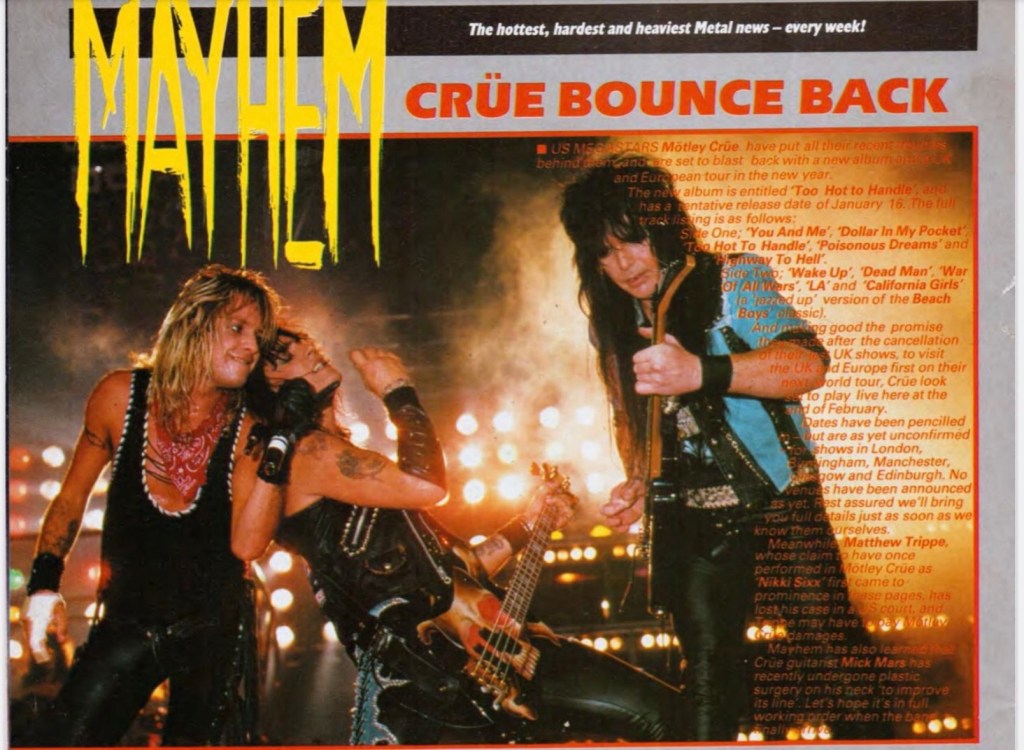
Like this old UK metal magazine clipping from Kerrang, claiming Mötley Crüe’s next album after “Girls, Girls, Girls” was going to be called “Too Hot To Handle”.

Not a rumor whispered by a fan on Reddit thirty years later. An actual printed story. With a release date. A European tour plan. And a track listing full of songs nobody has ever officially heard.

Now, if you’re under forty, you probably think this means one of two things: Either it was fake or somebody got it wrong.

But that’s because modern audiences don’t understand how information moved in the ‘80s.

Music journalism back then wasn’t journalism in the modern sense. It was half-access, half-chaos, half-propaganda and half-drunk-guy-at-the-bar storytelling. Labels leaked incomplete information. Managers exaggerated. Journalists filled in blanks. Bands changed direction midstream because somebody overdosed, disappeared, got arrested, the label rejected it or the band decided the entire record sucked halfway through recording it.

Especially Mötley Crüe.

Which means this article was likely discussing the project that eventually became “Dr. Feelgood”.

And suddenly the timeline becomes incredibly interesting, because the article mentions a January release schedule.

But “Dr. Feelgood” didn’t come out until August 1989.

So what happened to push the date out?

Nikki Sixx overdose on December 23, 1997. The overdose fundamentally interrupted the momentum of the band. Tours were cancelled. Europe got burned. The machine stalled out.

Maybe “Too Hot To Handle” was the original album title. Maybe those track names were demo titles. Maybe the record was originally intended to be a faster, dirtier continuation of “Girls, Girls, Girls”.
Maybe songs were abandoned after rehab, rewrites and Bob Rock entered the picture.

Because here’s the thing people forget about “Dr. Feelgood”:

That album sounds NOTHING like a band spiraling out of control.

It sounds focused. Massive. Disciplined. Intentional.

Bob Rock basically forced Mötley Crüe to stop behaving like a gang and start behaving like a professional recording act. Vince had to get vocal lessons before he started to record the vocals. The grooves tightened. The hooks became sharper. The production became cinematic. The chaos got filtered into something enormous.

That version of the band did not exist when this article was printed.

And honestly, the album titles themselves tell the story better than anything else.

“Too Hot To Handle” sounds like old Crue. Cartoon sleaze. Sunset Strip excess. Cheap danger.

“Dr. Feelgood” sounds darker. More narcotic. More sinister. Like the party stopped being fun.

One title sounds like a band chasing pleasure. The other sounds like a band trying to survive it.

Does the article prove some lost Mötley Crüe album exists in a vault somewhere.

Maybe it does. Maybe it doesn’t.

What matters is that this article captures a moment before rehab rewrote the band. Before Bob Rock transformed them.

And maybe that’s what made the pre-internet era better.

Mystery.

You didn’t know everything. You weren’t supposed to. The uncertainty was part of the experience.

Now every demo gets uploaded instantly. Which I love by the way. Every studio update becomes social media content. Every rumor gets “fact checked” within ten minutes by people who confuse searchable information with understanding.

But rock mythology was built on incomplete information.

On possibility.

On strange magazine clippings that make you wonder whether somewhere, buried in a storage locker or sitting on an old cassette tape in Nikki Sixx’s archive, there’s an alternate version of Mötley Crüe history labeled:

“Too Hot To Handle”.

P.S.

The full track listing is as follows:
Side One; “You And Me”, “Dollar In My Pocket”, “Too Hot To Handle”, “Poisonous Dreams”, “Highway To Hell”.

Side Two; “Wake Up”, “Dead Man”, “War Of All Wars”, “LA”, “California Girls” (a jazzed up version of the Beach Boys classic).

Standard
Classic Songs to Be Discovered, Influenced, Music, Unsung Heroes

Evergrey – Architects Of A New Weave

The older you get, music becomes about connection.

I’ve been on an Evergrey overdose lately. Partly because I had tickets for the May Sydney show before it was postponed until October. Partly because every pre-release track from “Architects Of A New Weave” kept pulling me back.

And partly because Evergrey occupies a unique space in heavy music.

They write about being human.

Fear.

Shame.

Depression.

Identity.

Redemption.

The messy business of surviving yourself.

So while I’m still waiting for my physical copy to make the long journey from Napalm Records Austria to Australia, I’ve spent the last few weeks immersed in this album.

And the more I listen, the more I think this may be Evergrey’s most hopeful record in years.

Not optimistic.

Hopeful.

There’s a difference.

“Architects Of A New Weave” is Evergrey’s fifteenth studio album.

It’s also the second Evergrey record in over two decades that doesn’t feature the songwriting partnership and lead guitar presence of Henrik Danhage. Plenty of reviews have explored that story already, so I won’t spend too much time dwelling on it.

For me, Evergrey begins and ends with Tom Englund. Bands lose members. Bands change. Bands evolve.

Sometimes they survive it. Sometimes they don’t.

When Henrik Danhage and Jonas Ekdahl left during the “Glorious Collision” era, the wounds felt fresh. Tom Englund sounded like a man trying to hold the pieces together.

This feels different.

The Tom Englund of 2026 isn’t the same man we heard in 2011.

He’s more resilient. More grounded. More accepting of life’s imperfections. And that mindset bleeds into every corner of this album.

Joining Englund are Johan Niemann on bass, Rikard Zander on keyboards, and Simen Sandnes on drums. Henrik Danhage appears to be credited for guitars during the recording period, though I’ll confirm that once my physical copy finally lands.

The album was produced by Tom Englund and Vikram Shankar.

Mixed by Adam “Nolly” Getgood. And the mix is massive.

The low end punches. The drums are modern and surgical. The guitars are thick without becoming muddy.

Without Danhage, lead guitar responsibilities naturally shift.

A lot of the melodic identity now seems to come from Tom’s emotional phrasing and Johan Niemann’s increasingly important compositional role.

Johan isn’t just holding down bass anymore. He’s helping shape the sound of modern Evergrey.

The title itself suggests humanity as authors of its own future. Patterns. Scripts. Self-destruction. Transformation. Reconstruction.

The phrase “new weave” implies something important. Life isn’t repaired by returning to the old pattern. It requires creating a new one.

Almost every song wrestles with the same central idea: You cannot become whole by cutting away the damaged parts of yourself. You become whole by incorporating them into the pattern.

That’s the new weave.

Not repair.

Reconstruction.

Welcome To The Pattern

A spoken word sermon.

“Welcome to the pattern. Step into the flame”
“Together, we shape what the world can’t name”

The future always arrives before language catches up to it. That’s why the world resists it.

The invitation here isn’t to observe the fire. It’s to walk into it. To participate in creating something so new that nobody has words for it yet.

The Shadow Self

This darkness, this darkness calling me

Most people think growth is about eliminating the darkness. It isn’t. The shadow isn’t the part of you that needs to be destroyed, it’s the part you’ve buried, ignored, or been taught to fear.

The darkness keeps calling because maturity comes when you stop fighting the shadow and start understanding it.

Architects Of The New Weave

“Architects of a new weave”
“Recreation of you and me”

Most people are trying to repair their lives when they should be redesigning them.

The phrase “new weave” suggests that transformation isn’t about returning to who you were before the mistakes. It’s about creating a new pattern from the threads that remain.

And “Recreation of you and me” is the real revelation. The people who thrive are the ones willing to become someone new when the old version no longer fits.

The World Is On Fire

“I promised you heaven / A promise that I can’t keep it seems”
“My world is on fire / And all I have to take the flames out are these tears that I cry”

The older I get, the more I realize that love isn’t destroyed by bad intentions. It’s destroyed by human limitations.

Life happens. Fear happens. Weakness happens. These lines aren’t about betrayal as much as they’re about the crushing weight of realizing people are incapable of becoming the person someone else needs them to be.

Make sure you check out the section from 2:30 onwards, And stick around for that headbanging outro.

Heaven

I like the energy of the intro with the keys decorating.

“I was always under and never brave”
“I am desire / I am the fire in your eyes”

The question the song really asks isn’t how you become brave, it’s what kind of force you become when you finally stop disappearing.

And check out the part at 2:52, when they borrow from “The Masterplan”.

The Script

You can call in Djent like in feel and mood.

“How do you shape a heart from a fist”
“There is no way out?”

Life hits, and the instinct is to close the hand. Protect the soft parts. Turn vulnerability into armor.

And then it collapses into the real existential panic: “There is no way out?”

It’s a thought people have at 3am.

The uncomfortable truth is there often isn’t a clean exit. Just the slow, brutal work of reshaping the fist into something that can hold instead of strike.

Leaving The Emptiness

If the opening riff doesn’t get the foot tapping and the head nodding, please check for a pulse.

“I am lost and feeling heartless”
“We’re leaving the emptiness behind”

Here’s the catch: emptiness doesn’t get left behind, it gets carried. It just changes shape.

The song is that good that we also get an instrument version of it on the deluxe. Check out my post on it as well.

Longing

The keys in Evergrey changed on “Hymns Of The Broken” album. They became more soundscape and soundtrack like.

And it continued with “Storm Within” and I remember they mentioned a French electronic act called M83 that influenced them a lot for the vibe of the “Storm Within” album.

And then Englund did his Silent Skies project with pianist/composer Vikram Shankar. Funny that this team also co-produced and co-write this album.

And with each album there has been evolution to the keys.

So here we are with “Longing”. A rock song that sits somewhere between rock and metal and pop and whatever new sonic ethereal soundscape is being created and dreamt up.

This song is perfection.

The vocal hooks are memorable, pop like and the lead from 3:34, so simple and sing along like.

“Who are we when the lights go out?”
“How do we find our way again?”

Strip everything away, status, language, performance, identity, and this is the question left standing.

A Burning Flame (Featuring Mikael Stanne)

How good is the title?

From 3:45, I’m addicted to that feel and mood.

“I was lost and found but lost again”
“Be a burning flame forever”

You get better, then you don’t. You understand yourself, then you don’t. You think you’ve broken through, then life quietly resets the puzzle. Progress, regression, recognition, forgetfulness. Over and over.

But the song refuses to stay in that loop. “Be a burning flame forever” is defiance against stagnation.

Maybe the goal was never to stop being lost. Maybe it was to keep burning while you are.

Call Off Your Lions

A 10/10 song. It has all of the Evergrey trademarks and the songwriting is progressive like.

The best part is that “woh-oh-oh” section from 4:33. It’s hopeful and optimistic and it had me singing it as loud as I could.

“Call off your lions”
“Don’t watch your life from the side, let it go”

The lions aren’t protecting you anymore, they’ve become your prison guards. They keep everyone at a distance while convincing you they’re keeping you safe.

“Don’t watch your life from the side.”

That’s the disease of modern existence. Endless observation. Endless analysis. Endless preparation.

We consume other people’s lives through screens while postponing our own. We wait until we’re ready, until we’re healed, until we’re certain. But life doesn’t wait. It keeps moving whether you participate or not.

Chains Of Shame

Press play for the section at 2:31 which builds and then the drums/bass kick in at 2:52 and I’m soaring.

“I am no stranger to darkness, it knows my name and won’t leave me alone”
“These chains of shame we have worn far too long”

Shame convinces you that your mistakes are your identity, that your failures are permanent, that the worst thing you’ve ever done is the truest thing about you.

The darkness is familiar and the chains aren’t imposed by society alone, they’re maintained by the stories we repeat to ourselves.

Sometimes things need to come undone before they can be rebuilt into something worth becoming.

The Prophecy

It’s “Storm Within” rewritten and updated. And I like that section from 2:30.

“I don’t fear anymore, and I know why”
“And the scars that I used to hide now tell a tale of light”

Courage is what remains after you’ve spent enough years being broken by reality that you stop expecting certainty.

And that’s the real prophecy of the song, the realization that suffering can become instruction rather than identity.

Heights

It’s got a broken hearted vocal melody and the “wo-ohs” chants remind me of electronica acts along with acts like Kings Of Leon and 30 Seconds To Mars.

The track is also a bonus track on the Deluxe Edition.

“I don’t know who I am without fear”
“Keep faking the way that I smile”

What happens when fear becomes your identity?

That’s the uncomfortable question asked. After enough years of anxiety, people-pleasing, and self-protection, fear stops feeling like an emotion and starts feeling like a personality.

You don’t know who you’d be without it because you’ve built an entire life around managing it.

Oxygen

I like that 3:18 section.

“I can’t do this hurt, so why go on, dream on at all?”
“Wish I was strong just like you”

At some point, pain stops being an event and starts becoming a lens. Everything gets filtered through it. Possibility shrinks.

And then comes the comparison trap. “Wish I was strong just like you.”

We all do this. Most of the people we admire are simply carrying burdens we can’t see.

Progressive isn’t all about technical fast passages and intricate time changes. The term progressive also includes songwriting structures, sounds that create moods, the mashing up of different styles, yet the artist still stays true to their style.

And this is what Evergrey is doing here. Staying true to their style.

“Architects Of A New Weave” doesn’t reinvent the band’s sound.

And after fifteen albums, that’s a far more impressive achievement than reinvention.

Ultimately this album isn’t about architects. It’s about survivors.

That’s the prophecy. That’s the burning flame. That’s the shadow self. That’s the new weave.

And that’s why I’ll still be listening when the physical copy finally arrives from Austria.

Standard
A to Z of Making It, Classic Songs to Be Discovered, Influenced, Music, Unsung Heroes

Dave Meniketti, Y&T and the Fight For Your Life

There are bands that become brands. And then there are bands that become lifers.

Y&T belongs to the second category.

Which is why most people missed them. Because the culture trains you to chase explosions. First-week sales. But rock and roll was built by road dogs. Bands willing to drive through snowstorms to play to 200 people in a club that smelled like stale beer and wet denim.

That’s where Y&T came from.

Back in 1974, before the branding, before the anniversary tours, before nostalgia became an industry, the band was called “Yesterday & Today”, a name borrowed from The Beatles. And like every hard rock band clawing its way out of garages and bars, they looked half dangerous and half ridiculous. Long hair. Tight pants. Big amps. No guarantees.

Just volume and belief.

And here’s the thing younger audiences don’t fully understand about that era: There was no shortcut.

You built a following city by city. State by state. You played a city enough times that it stopped being a market and started feeling like home. Meniketti says anywhere within five hours of the Bay Area felt local to them.

That’s how careers were built before algorithms decided who deserved visibility. You earned it physically.

The road was the filter.

And if you survived long enough, eventually you ended up sharing stages with giants.

Dave Meniketti talks about touring Europe with AC/DC in 1982 on the “For Those About To Rock” tour like a man remembering the moment the scale of rock music fully revealed itself as a sea of leather and blue jeans.

Think about that image for a second. No phones in the air. No influencers backstage. No corporate activations.

Just identity.

People didn’t attend those shows to create content. They went because rock music was part of who they were.

And AC/DC… they weren’t just successful. They were undeniable. One of those bands that made every other group either rise or disappear.

For Y&T, that tour became validation. Timing met preparation.

Because history rewrites success as inevitability. But careers are timing mixed with survival. Miss the window by two years and the story changes completely.

Then there’s the other side of ‘80s hard rock.

The insanity.

Y&T toured with Mötley Crüe in 1985, and Meniketti tells a story about Crüe’s manager approaching them and saying:

“Keep some of your guys away from our band.”

Which is hilarious when you remember who he’s talking about.

Rock bands back then were unstable chemistry experiments with Marshall stacks.

And yet here’s what separates the survivors from the casualties:

Integrity.

That’s Meniketti’s word, not mine.

He says the secret is integrity with the live show, integrity with the fans, integrity in how they perform.

And that sounds simple until you realize how rare it is.

Most bands eventually start treating the audience like a pension fund. Same setlist. Same speeches. Same tired motions repeated under spotlights for people buying memories instead of experiences.

But fans know. We always know.

We can feel when a band still means it.

That’s why Y&T still draws people decades later. Not because they were the biggest band. Not because they had the most hits. But because they never stopped believing in the thing itself.

The songs. The stage. The connection. The volume.

People think longevity comes from preserving youth. It doesn’t. It comes from preserving purpose.

At the end of the interview, Meniketti says there’s no retirement plan. No exit strategy.

“We’re just going to keep going until we drop.”

That’s not a slogan.

That’s identity.

And reading that 2013 interview in 2026 changes everything.

The classic lineup was still part of the living. But time does what time always does. Since that interview, Y&T lost Phil Kennemore, Leonard Haze and Joey Alves, leaving Meniketti as the last surviving member of the classic era.

And yet the band never stopped.

Meniketti kept touring. Kept singing. Kept carrying the weight of the songs forward like they still mattered. And maybe that’s because to him they do.

And Meniketti kept creating. Acoustic records. Documentaries. Touring schedules that would exhaust musicians half his age. Not because he had to. Because stopping never seemed natural to him.

Sorry this was a large digression.

The post is about “Fight For Your Life” from Contagious (1987), the first record after the jump to Geffen, the moment Y&T stepped into the “big label” world where everything is supposed to get cleaner, bigger, more commercial… and somehow this track still feels dangerous.

The intro and main riff carry that unmistakable chromatic climb, there’s a clear lineage back to something like “Kashmir”, not in imitation but in DNA. That slow, ascending tension that feels like it’s dragging the whole song upward by force.

You can also hear echoes of “Too Late for Love” era Def Leppard in the emotional architecture of it, melodic, but never soft. Then the pre-chorus hits and it shifts gears entirely. It goes full NWOBHM, tight, aggressive, no excess fat, just pure tension waiting to snap.

And then the chorus opens up like it’s trying to break out of the studio walls. Vocally it sits comfortably in the same emotional lane as “Pyromania” era hooks, big, wide, unapologetically melodic without losing its edge.

And the solo doesn’t just arrive, it escalates. It keeps building, stacking layers of intensity until it feels like it’s running out of structural permission to continue, and then it pushes anyway.

Lyrically the core isn’t excess, it’s erosion.

“First the pleasure, then the pain”

Every lifecycle that feels like freedom eventually starts collecting interest.

“Dream a million dreams of gold”

Exposes the illusion engine, ambition reframed as control, when in reality it’s just momentum with no steering wheel attached.

“it goes on and on”

The real psychological trap; not the behavior itself, but the inability to mentally exit it while still inside it.

Nothing here is invented in isolation. Riffs borrowed from somewhere, reshaped through different hands, turned into something slightly new but emotionally familiar.

And when it hits right, like it does here, you stop caring where it came from. You just feel the voltage.

Crank it up.

Standard
Classic Songs to Be Discovered, Influenced, Music, My Stories

Nobody Rides For Free

There’s something unsettling about a band when they stop sounding like themselves… and somehow become more honest because of it.

That’s what “Nobody Rides for Free” feels like.

It doesn’t belong neatly anywhere. Not on an album. Not in the canon people casually reach for when they say Ratt. It lives off to the side, buried in the sunburnt chaos of “Point Break”, a film about adrenaline, identity, and the cost of chasing something you can’t hold onto.

Which is exactly what this song sounds like.

This wasn’t just another track.

It’s their first recording without Robbin Crosby, the muscle behind “Ratt ‘N’ Roll” and whether you think that absence directly shaped the song or not, you can feel the air change. The density is gone. The gloss is stripped back. What’s left is space… and in that space, something more dangerous creeps in.

Restraint.

Ratt were never about restraint.

They were about excess, hooks, attitude, swagger. The Sunset Strip distilled into sound. But here? The arrangement breathes. It doesn’t pile on. It withholds. The guitars don’t smother you, they stalk. Warren DeMartini plays like a guy who knows silence is a weapon.

And Stephen Pearcy doesn’t seduce here.

He warns.

That’s the shift most people miss.

This isn’t “come along for the ride.”

It’s “understand the cost before you even think about getting in.”

Even the DNA of the song hints at something different. You’ve got Steve Caton, a guy shaped by film and television, writing alongside Pearcy, DeMartini, and Juan Croucier. That matters. Because this song doesn’t just play, it frames. It feels like a scene. A tension arc. A moment where the character realizes the rules have changed and nobody bothered to tell them.

Then again, the large amounts offered to artists to submit soundtrack songs is a huge incentive.

And then you hit the title.

“Nobody rides for free”

Every choice has a cost. Every high comes with a tab you don’t see until later.

In life? It’s everything.

Relationships. Careers. Identity.

You think you’re getting away with something.

You’re not.

The bill just hasn’t arrived yet.

“In my dreams see I’m on TV / Get back exactly who I wanna be”

This is identity as performance.

Not discovery, construction.

It assumes the version of you in your head is already valid, already formed, already worthy, just waiting for recognition.

But reality doesn’t reward internal narratives. It rewards execution.

So there’s tension here: the dream self is controlled, admired, defined while the real self is blocked, frustrated, unproven.

And that gap?

That’s where most people stall out.

“I’m sick and tired of it getting in my way”

This is the line where ambition turns impatient.

“It” is never defined, which is the point.

“It” becomes: Other people, systems, limitations or, more uncomfortably… your own lack of progress

You either: remove the obstacle, or keep blaming it

Most people choose the second option because it protects the ego.

Don’t stop to think ’cause I know where I stand”

This is pure momentum thinking. And it’s seductive as hell.

Because overthinking kills action, but not thinking at all kills direction.

“You’ve gotta pay to play”

This is the thesis. Strip everything else away, this is the operating system.

Nothing is free: not success, not freedom, not identity and not even escape

You pay in something: time, reputation, relationships or sanity

And here’s the uncomfortable truth most people avoid: you don’t get to choose if you pay. You only choose what you pay with.

That’s the real contract.

“You thought he could swim but I guess you were wrong / You sink to the depths of your misery”

This is where the fantasy collapses.

Someone bet on ability, maybe their own, maybe someone else’s, and lost.

And the wording matters: “Thought he could swim” is assumed competence. “Sink to the depths” is reality doesn’t negotiate.

This is what happens when self-perception isn’t matched by capacity.

And the world is ruthless about exposing that gap.

No warning. No soft landing. Just gravity.

Nobody Rides for Free isn’t a freedom anthem. It’s a cost-of-entry manifesto.

Wrapped in attitude, sure. Delivered like defiance. But underneath, it’s brutally transactional.

You want the life? Pay for it.

You think you’re ready? Prove it.

You believe your own hype? The fall is coming.

And that’s why it feels “un-Ratt-y.”

Because it’s not selling the dream.

Standard
A to Z of Making It, Derivative Works, Influenced, Music, My Stories, Unsung Heroes

Ross The Boss – Heyday: The Record That Refused to Belong Anywhere

Ross the Boss is gone.

Most people will stop the story at Manowar. Big sound, bigger mythology. Steel, leather, and volume turned into identity.

But that’s only half the truth.

Because in 1994, when rock was busy cannibalising itself into subgenres and scenes, Ross dropped “Heyday”. One album. No follow-up. No safety net. And now… not even on streaming.

Which makes it dangerous.

Because you can’t casually consume it. You have to commit to it.

Ross wrote a manifesto in the liner notes:

When I started playing guitar, it didn’t matter what type of Rock ‘N’ Roll you played, it was all just called ROCK! It hadn’t yet become so segregated into so many labeled categories.

Now, after twelve allums, I find myself, once again, going against the grain of the “mainstream”, playing the music that I choose to – and just having a great time with it.

So whether the mainstream becomes the underground; or the underground becomes the mainstream, Heyday is going to ROCK!”

That’s not nostalgia. That’s defiance.

By ’94, rock had fractured into tribes, grunge, metal, alternative, punk revival and let’s not mention how many labels hard rock and metal went into, each one building fences to keep the others out.

And Ross? He walks straight through all of them.

Blues rock. NWOBHM. New York punk. Glam attitude.

No permission. No alignment.

If the world narrows, you widen.

This wasn’t a solo indulgence. This was a unit: Ross the Boss on guitar, Charlie Cayte on vocals, Richie Fazio on drums and Erik Boyd on bass.

Charlie Cayte is the ghost in this machine. One of those singers who should’ve been everywhere… but got caught in the wrong year.

Because by 1994, the industry had already decided what rock shouldn’t sound like.

Mine Tonight

It starts with a riff that doesn’t ask, doesn’t build, doesn’t tease, it arrives.

Immediate. Violent. Alive.

“Now I’m aware of mine, are you aware of yours?”

That line hits because most people aren’t.

They hesitate. They soften. They hide behind ambiguity.

This song doesn’t.

Know what you want. Say it. Most people never do, and that’s why they never get it.

Mother Mary

This should have been massive. Arena chorus. Built for thousands.

Instead, it got buried.

“Mother Mary did you make the people, or did we make you?”

That’s not rebellion, it’s interrogation.

We build belief systems, then kneel to them. Religion, careers, identities. We forget we created them in the first place.

“I’ve been prayin’ for so long, to someone I don’t know…”

That’s existential drift.

If you don’t choose your beliefs consciously, you’ll spend your life serving them unconsciously.

A Matter of Time

Blues creeps in. Not as a genre, as a truth.

“To wait for the right moment was my first mistake.”

There is no right moment.

There’s only the moment you either take, or lose.

“I was born too early, and you were born too late.”

Timing isn’t romantic. It’s ruthless.

Hesitation doesn’t protect you, it erases you.

Brown Eyed Girl

A Van Morrison classic, dragged through a louder, dirtier filter.

Less nostalgia. More movement.

It’s not trying to improve the original, it’s reclaiming it. Making it live in this band’s world.

And that’s the point of covers when they work: not tribute, transformation.

Private Hell

This is where the album turns inward.

“I built the inferno…”

That’s the line.

Because people love blaming the fire, but not building it.

“Now a key’s been handed down my way…”

Recognition is the key. Not escape.

The moment you admit you built the problem is the moment you gain the power to dismantle it.

Movin’ On

This one swings.

You can hear echoes of Van Halen swagger and AC/DC punch. It’s reckless, fast, borderline unhinged.

“When push comes to shove, I’m gone.”

That’s freedom, but also avoidance.

There’s a fine line between movement and escape.

Reinvention is powerful, but if you never stay, you never build anything that lasts.

The Letter

The emotional core channeling Hendrix and “Little Wing”.

No metaphor. No disguise.

“What’s done is done and it can’t be changed.”

That’s it.

No modern spin. No redemption arc baked in.

Then the dagger:

“If I could call back father time… things would be the same.”

That’s self-awareness at its most brutal.

It’s not about wishing for a redo. It’s about understanding you weren’t ready to choose differently.

Don’t chase second chances. Build the mindset that wouldn’t need one.

Pack of Lies

Anger, but focused.

“You’re the first to sign the card, but the last to write the check.”

That line lands in any era.

Performative virtue. Empty signalling. Talking big, doing nothing.

Integrity is measured in action, not alignment.

Search and Destroy

A cover of Iggy Pop, but stripped of subtlety and pushed into hard rock aggression.

It’s less art-punk, more street fight.

And it works, because the band commits fully. No irony. No distance.

Back Where I Belong

Back to that EVH stomping groove. Back to weight.

“No way to know what feels right until you give it a try.”

Simple. True. Rarely followed.

People want certainty before action. Life doesn’t work that way.

Experience is the only real teacher, and it charges upfront.

It’s not just a “lost album.”

It’s a contradiction: Too late for the scene it belonged to. Too early for the nostalgia cycle that would’ve saved it. Too honest to reshape itself for trends

So it disappeared.

But that’s also why it still works.

Because it’s not tied to anything external.

It’s tied to a mindset: Play what you believe. Say what you mean. Accept the consequences.

No compromise. I called it:

“A perfect slab of hard rock.”

And it is.

But underneath that? It’s a manual.

On desire. On belief. On regret. On consequence. On owning your life, even when you get it wrong.

Most albums chase relevance. Heyday rejected it. And that’s exactly why it still matters. If you find the CD at a used store, buy it.

Rest in peace, Ross the Boss.

Standard
Classic Songs to Be Discovered, Music, Unsung Heroes

Megadeth

The album didn’t just arrive, it was staged.

Announced in August 2025 with Vic Rattlehead literally on fire, rolled out through four singles across four months, and framed as the final Megadeth statement.

Not a late-career album. A closing argument. The farewell tour wasn’t an afterthought; it was embedded in the release plan.

Production began quietly in late 2024 with producer Chris Rakestraw, largely remote at first. Mustaine and guitarist Teemu Mäntysaari traded ideas while the room was empty. This will be the only Megadeth studio album Mäntysaari will ever appear on, which gives his playing a different gravity, it’s not contribution, it’s inscription.

Mäntysaari arrives with a pedigree that matters more than hype: classically trained, composition-literate, and forged in the Scandinavian metal ecosystem where precision, melody, and structure are non-negotiable.

Best known for his work in Wintersun, he comes from a lineage that treats guitar not just as a weapon but as an architectural tool, stacked harmonies, modal phrasing, neoclassical discipline, and an almost orchestral sense of movement. You can hear influences ranging from European power metal and melodic death metal to classical and film-score logic, where riffs aren’t just aggressive but directional.

As a co-writer with Mustaine, Mäntysaari doesn’t challenge Megadeth’s DNA; he refracts it. The result is a distinctly Euro-metal contour, tighter harmonic logic, cleaner thematic development, and a sense of inevitability baked into the riffs, less street brawl, more war plan.

His presence subtly modernizes the band without diluting it, giving these songs a colder, more surgical feel that contrasts with Mustaine’s snarling, American thrash instincts. It’s not a takeover; it’s an overlay. And because this is his only Megadeth studio document, that influence feels permanent, etched, not experimented with.

By June 2025, vocals were being tracked. By January 2026, the album was positioned as history.

Tipping Point

This is the mission statement.

Flat-out thrash. No apology. No warm-up. The title is a tell, this isn’t about balance, it’s about inevitability. Musically, it does exactly what a “final album” lead single must do: reassure the base. “Yes, we can still do this. Yes, the hands still work.”

What’s more revealing is what it doesn’t do. No experimentation. No curveballs.

Mustaine knows the first impression defines the entire conversation.

And it works.

“Today I may bleed, but tonight you will die”

Patience weaponized.

“You buried the truth under layers of lies”

Self-inflicted decay. The deeper the stack, the more violent the reckoning.

“Push me, I push you back”

Symmetry established. You set the terms; I enforce them.

“Hiding your secrets out in plain sight”

Collective denial. The secret survives not by concealment, but tolerance.

And then the outro riff lands like a body blow.

“You won’t define me, you’ll never find me”

Refusal of containment. To define is to reduce. To find is to fix. Autonomy is reclaimed through disappearance.

The tipping point isn’t rage. It’s clarity.

I Don’t Care

Three minutes. Punk bones. No fat.

This reconnects Megadeth with the sneer that predates thrash orthodoxy. It’s not refined, and it’s not trying to be. That’s the point. Precision was never the whole story; attitude was.

Releasing this as the second single is a message: don’t expect reverence. This isn’t a victory lap. It’s a shrug with distortion.

“I don’t care what the headline said”

A rejection of outsourced reality. Headlines collapse complexity into verdicts built for attention, not truth.

“You know a rat never learns”

Not an insult, but pattern recognition. Repetition without reflection. Once behavior stabilizes, hope of reform disappears. Expectation shifts from change to containment.

Hey, God?!

Classic Mustaine: theology as confrontation, grievance elevated to cosmic scale. Musically solid, structurally familiar.

“The years are passing by like days”

Time compression, not aging. When days lose distinction, life accelerates.

The fear isn’t death, it’s unused life.

And make sure you stick around for the guitar solos.

Let There Be Shred

The most Megadeth song here, and the most ridiculous. Which is why it works.

Creation myth rewritten as guitar doctrine. No irony. No wink. Just total commitment. Mustaine dares you to flinch first.

“On the day I was born, a guitar in my hands”

Identity fused to function. Not “I chose this”, this chose me. Careerism disappears.

What’s left is vocation.

“Destroying pretenders, only ashes remains”

Authenticity under pressure.

Puppet Parade

The curveball.

Mid-tempo. Melodic. Built for repeat listens. The kind of song late-’90s Megadeth fans pretend never happened, and yet it’s arguably the best-written track here.

The irony is precise: the song about manipulation is the most controlled thing on the record. Hooks are intentional. Dynamics are measured. Accessibility was never incompetence; it was choice.

“I punch your clock, I play a role”

Labor as submission. Performance without belief. Effort is real; meaning is outsourced.

“Where the lies are truth / And our lives are trade”

The moral core. Reality assigned, not discovered. People reduced from ends to inputs. Exploitation normalized through redefinition.

Once that switch flips, marching doesn’t need enforcement. It’s automatic.

Another Bad Day

Functional. Efficient. Disposable.

Nothing offensive. Nothing essential.

“My life’s a mess, but I call it mine”

Ownership without redemption. No fixing. No reframing. Just authorship claimed.

“Every scar is a line I drew”

Pain turned into power. Not innocence, responsibility. The quiet weight that follows.

Made to Kill

Thrash returns, lean and calibrated.

This is Megadeth on autopilot, but it’s a well-tuned autopilot.

Mäntysaari proves he understands the internal math of Megadeth riffs. You don’t remember it for the message. You remember it because it moves.

“Taught to pray, yet made to kill”

Contradiction as training. Belief installed alongside violence. Prayer as insulation, not restraint.

“Truth is sold in streaming lies”

Propaganda as infrastructure. Truth isn’t erased, it’s monetized and drowned in volume until disbelief feels pointless.

What survives isn’t ignorance.

It’s exhaustion.

Obey the Call

Shadowy control. Puppetmasters. Faceless systems. A reflection of Mustaine’s conspiratorial gravity.

“It feeds on faith, but it bleeds gasoline”

Belief exploited as fuel. Devotion weaponized. The cost is always physical.

“And the pawns will rise / And empires fall”

Not heroics, structure. Collapse seeded by control itself.

I Am War

Shorter. Sharper. More effective.

Less sermon, more declaration. It knows exactly how much energy it has, and spends it carefully.

“To know you, I become you”

Empathy weaponized.

Understanding as assimilation.

Victory through total cognitive immersion.

“I am war, I am hurt and pain”

Not metaphor, identity. War isn’t something enacted; it’s embodied.

No separation between actor and action.

The Last Note

Five and a half minutes of unresolved intent.

Sentiment or defiance?

Curtain call or middle finger?

It wants both and never fully chooses. Which is fitting. Mustaine has never mastered endings.

“One more winding road that I won’t come back”

Finality without drama. Motion without return. Acceptance, not mourning.

“Each song has got beneath my skin”

Creation as accumulation. Art doesn’t cleanse, it erodes and stays.

“I can’t outrun the spinning hands of time”

Aging as pursuit. Speed once solved everything. Now it doesn’t.

“They gave me gold, they gave me a name”

Recognition as transaction.

Success always arrives with a bill.

Ride the Lightning (Metallica cover)

Not an encore, a provocation.

Ending the final album by revisiting the band that expelled you isn’t nostalgia. It’s wound management. The performance is heavier, cleaner, but its purpose isn’t musical.

It’s psychological.

“There’s someone else controlling me”

Agency surrendered to process. Terror born not from chaos, but automation.

“Consciousness, my only friend”

Everything external stripped away. Awareness remains, forced to witness its own erasure.

The cruelty isn’t death.

Its presence during death.

The “Ride the Lightning” cover didn’t drift into the middle, it drew a line. Based on a sample of X comments, fans either hear a powerful legacy statement or an unnecessary retread. The split is clean: some hear reverence and authority, others hear dilution and loss of danger, with a small group stuck in polite indifference.

For me, it works. The slightly increased tempo injects urgency without rewriting history, and the performance understands the assignment: pay homage, don’t vandalize the blueprint. It respects the original’s gravity while letting Megadeth’s muscle show through.

This isn’t really about quality. It’s about philosophy.

Do you want a cover to preserve the fire, or to replace it?

To sum it all up, it’s a controlled burn, a managed farewell that captures exactly what Megadeth has always been: brilliant, stubborn, technically elite, emotionally unresolved, and incapable of clean exits.

If this really is the end, it ends the only way it could.

Not with peace. With insistence.

And that’s the most honest thing Megadeth could have done.

P.S. i just listened to the bonus tracks “Bloodlust” and “Nobody’s Hero” on YouTube. Wow. But they will be for another post.

Standard
Classic Songs to Be Discovered, Music

Best Of The Reissues (2025)

Whitesnake – Forevermore

No one does reissues like David Coverdale. That’s not consensus thinking, that’s pattern recognition. Every time he opens the vaults, he doesn’t ration. He overdelivers.

The “Evolution” demos remain the gold standard. You hear songs before they know what they’re supposed to be. No polish, no mythology, just instinct turning into architecture. Vocal phrasing evolves, melodies get bent, arrangements harden. This is songwriting exposed, not curated.

Most artists protect the illusion. Coverdale documents the process. That’s the difference.

Bruce Springsteen – Nebraska ’82: Expanded Edition

This is a great release, not because it’s archival, but because it reframes history.

You get demos that never made “Nebraska,” some of which migrate directly into “Born in the U.S.A.” like the title track, “Downbound Train”, “Working on the Highway”, and others. You can literally hear the pivot happening. Darkness bleeding into muscle.

Then there’s “Gun in Every Room.” Written 44 years ago. Still uncomfortably current. No irony. No distance. Just proof that the American psyche doesn’t evolve as fast as the technology around it.

Acoustic demos. Electric versions. Live performances. Album masters.

The instruction manual is simple:

Listen to this.

Watch “Springsteen: Deliver Me From Nowhere.”

Then listen again.

You’ll hear a different record the second time.

Dream Theater – Quarantième: Live à Paris

This one’s straightforward, and it should be.

It captures the 40th Anniversary Tour.

It documents Mike Portnoy’s return.
It sounds massive, precise, and unapologetically technical.

No revisionism required. No narrative scaffolding.

This is Dream Theater being Dream Theater again, with the missing limb reattached.

What more does a fan actually need?

Metallica – Load: Remastered

There’s something quietly profound about hearing James Hetfield build melodies out of oohs, ahhs, half-formed vowels and instinctive phrasing.

This is the god of heavy metal before the armor locks in.

These demos sit right alongside Coverdale’s Evolution material in terms of value. Not because they’re raw, but because they’re human. You hear uncertainty, exploration, and the willingness to sound wrong on the way to sounding right.

“Load” has always been misunderstood because people expected aggression instead of vulnerability. This reissue finally gives context instead of apology.

Mötley Crüe – Theatre of Pain (40th Anniversary Expanded Editions)

Context matters here.

If you don’t own the Crucial Crüe remasters with the bonus tracks, this is a solid pickup. The packaging is lavish, the presentation respectful, and it preserves a very specific moment when excess and melody were still coexisting.

But for longtime fans who already have the original, purchased the remasters and then bought “Dogs of War”, “Home Sweet Home” picture discs, “Cancelled” on vinyl and CD, this doesn’t move the needle much.

And at this stage, Crüe reissues are less about discovery and more about collecting variations of something you already know by heart.

The best reissues don’t just add tracks. They add understanding.

Coverdale and Springsteen treat the archive like a living organism.

Metallica lets you hear doubt before dominance.

Dream Theater captures continuity.

Crüe caters to completionists.

Reissues aren’t nostalgia when they’re done right. They’re blueprints.

And 2025 proved, again, that the artists who trust their process enough to expose it are the ones worth revisiting.

Standard