A to Z of Making It, Classic Songs to Be Discovered, Derivative Works, Influenced, Music, Unsung Heroes

Bangalore Choir — On Target: They Had Everything Except Time

There are records that arrive at exactly the wrong fucking moment. Bangalore Choir’s “On Target” is another record to add to those lists.

Released by Giant Records in 1992, “On Target” had the voice of a former Accept frontman, two guitarists carrying the DNA of an obscure but excellent 1980s hard-rock band, a rhythm section that had already come through another major-label act, production from Max Norman, and songs connected to people such as Jon Bon Jovi, Aldo Nova and Steve Plunkett.

This was a band assembled from musicians who had already spent years trying to make it.

Because the story of “On Target” isn’t really “here’s another forgotten hair-metal album.”

It’s the story of what happens when talented, experienced musicians get another shot and the world changes just as they’re taking it.

The lineage is the story. Start with David Reece.

Before Bangalore Choir, Reece had already won the musical lottery and discovered that winning the lottery doesn’t necessarily mean you’ve won.

He became the American singer chosen to replace Udo Dirkschneider in Accept and recorded “Eat the Heat” in 1989.

But “Eat the Heat” became controversial, the Accept experiment ended, and Reece returned to Los Angeles.

Instead of giving up, he started again. And Reece didn’t simply recruit random musicians.

He found John Kirk through the Guitar Institute of Technology in Hollywood. Kirk had previously played with Curt Mitchell in Reno band Razormaid. Mitchell joined.

That’s already a hell of a musical family tree. Then came Ian Mayo and Jackie Ramos.

Both had been members of Hericane Alice, the Atlantic Records band that released “Tear the House Down” in 1990.

Bangalore Choir’s management had also managed Hericane Alice, and the opportunity came almost immediately after Hericane Alice had been dropped.

So look at what you’re actually hearing:

David Reece — Accept
Curt Mitchell — Razormaid
John Kirk — Razormaid
Ian Mayo — Hericane Alice
Jackie Ramos — Hericane Alice

It’s absolutely a supergroup of experience.

And, more importantly, these weren’t musicians getting their first taste of the business.

They had already been through it.

The really strange thing about “On Target” is how much machinery was behind it.

Bangalore Choir played only a handful of Los Angeles shows before major-label interest arrived. Reece later recalled via the metalforcesmagazine.com that after around nine shows, the band had offers from labels around the city. Giant Records, distributed through Warner Bros., won the race.

Then Giant brought in Max Norman to produce. His résumé already included Ozzy Osbourne, Megadeth, Lynch Mob, Savatage and others.

The album also had Jon Bon Jovi and Aldo Nova connections on “Doin’ the Dance,” while “Loaded Gun” had Ricky Phillips among its co-writers.

And yet the album didn’t explode.

That’s the great paradox. The band had the musicians. The singer. The songs. The producer. The label. The industry connections. The look.

The timing should have worked. Except the timing didn’t.

And we are back to the seismic moment of 1991–92, when the musical ground underneath hard rock was moving.

Nirvana had detonated. Pearl Jam were exploding. Soundgarden were breaking through.

And then the record industry did what the record industry always does when it discovers something that sells.

It copied it.

The same machine that had saturated the Sunset Strip with interchangeable hair-metal bands now turned toward Seattle. Suddenly everyone wanted flannel, distortion, alienation and authenticity.

MTV changed.

Radio changed.

Labels changed.

The irony is that the industry eventually did to Seattle what it had done to the Sunset Strip: saturate the market with bands trying to reproduce the sound of the bands that broke through, until the movement itself became exhausted.

Bangalore Choir weren’t suddenly bad.

The market had stopped asking for what they were selling.

And that’s the brutal part of making it in music.

Music is a supply and demand economy. Talent isn’t enough. Hard work isn’t enough. Experience isn’t enough. You can spend ten years building something only to discover that the market has moved somewhere else.

Bangalore Choir got their opportunity. They just got it at the end of an era.

“Angel in Black”

And what a way to open the record.

“Angel in Black” immediately tells you what Bangalore Choir are.

Big guitars. Big vocal. Big chorus. Big fucking attitude. It’s melodic hard rock without apologising for the “rock” part.

Reece sounds enormous. There’s swagger and melodic freedom here.

There’s something familiar buried in the main riff too. It reminds me of the riff that comes after the chorus in Alice Cooper’s “Snakebite.”

The song had an interesting history too: it was originally associated with Autograph, with Steve Plunkett credited as its writer along with Jack Conrad. Their demo version was released on an Autograph anthology release.

“Loaded Gun”

An overused song title in the 70s and 80s. However this is the commercial punch.

It’s got some serious songwriting lineage around it. Written by Curtis Cuomo, Harry Paress and Rick Phillips.

Phillips is coming from a pedigree that involves “The Baby’s” and “Bad English”. He’s hardened and been around. Paress already had success writing for Vixen, including “Love Is a Killer.” He would go on to write songs for Fiona, Quiet Riot, Bobby Kimball and Steelhouse Lane. And then there is Curtis Cuomo. His name would later become much more recognisable when he appeared as a co-writer on “Psycho Circus” with Paul Stanley, plus on all the Paul Stanley sung tracks on the “Carnival of Souls” album.

So if “Angel in Black” introduces the band, “Loaded Gun” is the song designed to make the radio understand them.

It’s hooky, muscular and built around the kind of chorus that could have lived comfortably alongside late-80s Bon Jovi, Whitesnake or Def Leppard.

The song was pushed as a single and received trade promotion from Giant Records. The music video has since become a piece of pop-culture trivia because a very young Jared Leto appeared in it.

“If the Good Die Young (We’ll Live Forever)”

It’s one of those songs where the title sounds like something you’ve heard a hundred times, but the band sells it because the melody is stronger than the cliché.

“Doin’ the Dance”

This is one of the album’s most interesting tracks because of the songwriting pedigree.

Jon Bon Jovi and Aldo Nova are involved in the writing.

There’s groove. There’s melody. There’s attitude.

But it’s not their best track. It’s competent, commercial and perfectly engineered for the moment, but compared with “Angel in Black” and “Loaded Gun,” it doesn’t hit with the same force.

“Hold On to You”

The inevitable ballad. Co written by the band with Russell Miller.

The guitars become atmosphere rather than artillery, and the song provides the album with some breathing room.

“All or Nothin’”

This is one of the songs that reveals the band’s confidence.

It was one of the earliest songs written by the developing Bangalore Choir lineup, along with “Slippin’ Away.”

And you can hear that it isn’t trying to impress anybody.

It’s simply a band discovering its identity.

The riff is direct. The chorus is huge. The rhythm section drives rather than decorates.

And Reece attacks the vocal like a man who knows he has something to prove.

Which, frankly, he did.

“Slippin’ Away”

It’s a great piece of melodic rock. And the title is prophetic. Because things just slip away.

Eras. Youth. Relationships. Opportunities. And the musical culture that had created the conditions for Bangalore Choir to exist.

Reece has said via SleazeRoxx that decades later, “Slippin’ Away” remains one of the Bangalore Choir songs audiences know and sing along to.

That’s the ultimate vindication.

The industry may have forgotten the album. The audience didn’t.

It just took them longer to find it.

“She Can’t Stop”

An AOR gem about a lonely girl dancing under neon lights who can’t stop running away.

“Freight Train Rollin’”

This is one of the album’s hardest hitters. A great riff to kick it off.

The title tells you everything.

It’s movement. Momentum. Power. And the song doesn’t mess around.

I love the groove around the verse riffs. The simplicity is deceptive. Getting stuff to sound effortless is difficult.

“Just One Night”

And then the album closes.

“Just One Night” isn’t the biggest song here, and that’s probably why it works as the closer.

After all the swagger, sex, guitars and huge choruses, the record finishes without trying to manufacture some grand finale.

It’s simply another strong melodic hard-rock song.

And then it’s over.

Thirty-eight minutes.

Ten songs.

No filler marathon.

No desperate attempt to prove they’re the next Metallica.

Just a fucking good hard-rock album.

And then reality arrived.

Bangalore Choir had done everything right.

They had paid their dues. They had experienced musicians. They had a respected producer. They had a major-label deal. They had songs. They had management.

And still…

Nothing.

There’s a tendency to look back at bands like Bangalore Choir and think: “These guys just appeared, made an album and disappeared.”

No. That’s completely wrong. The musicians had been grinding for years.

Razormaid had been around since the early 1980s before “First Cutt” arrived in 1987.

Hericane Alice had spent years developing before Atlantic released “Tear the House Down.”

Reece had already gone through the extraordinary experience of joining Accept and recording a major-label album.

Mayo and Ramos had already experienced the major-label dream, and the pain of being dropped.

By the time these musicians stood together as Bangalore Choir, they weren’t beginners.

They were survivors.

You’re listening to musicians who had already learned how fucking hard it was.

And looking at where these five musicians went afterwards only strengthens the argument.

Mayo and Ramos moved into Bad Moon Rising, connecting them to Kal Swan and Doug Aldrich of Lion.

Jerry Best’s parallel Lion/Freak of Nature/Dio story eventually connects the same ecosystem to Mike Tramp, Dio and even Courtney Love.

Reece would go on to Sircle of Silence, Bonfire, Gypsy Rose and his solo work, eventually returning to Bangalore Choir decades later.

Mitchell and Reece would eventually revive Bangalore Choir.

The family tree keeps growing.

Here’s the beautiful part. The album didn’t disappear. It went underground. Collectors found it.

Hard-rock fans rediscovered it. CDs changed hands. People bought it on eBay years after its release.

And eventually a younger generation started hearing it without any of the baggage attached to 1992.

That’s the funny thing about music.

Sometimes the audience you were chasing isn’t the audience that eventually saves you.

“On Target” isn’t a lost masterpiece because it reinvented hard rock.

It’s a lost classic because it executed the genre extraordinarily well at exactly the wrong moment.

The guitars sound enormous. The vocals are killer. The songs are melodic without becoming soft. The production has the pedigree. The musicians had the experience.

And the album has something a lot of technically impressive records don’t: personality.

Could On Target have been a major commercial hard-rock record in 1987, 1988 or even 1989?

Absolutely.

But in 1992?

That’s the tragedy. The machine changed what it wanted.

That’s timing. And sometimes timing is the difference between a band everybody knows and a band people spend 30 years telling other people they should know.

Because Bangalore Choir didn’t miss because they weren’t good enough.

They missed because the target moved.

Standard
Classic Songs to Be Discovered, Derivative Works, Influenced, Music

The Lost Art of Melody: Paul Stanley’s Underrated KISS Gems From 1987–1992

Somewhere between 1987 and 1992, Paul Stanley quietly became one of the best melodic hard rock songwriters in the business. Maybe he already was the best.

While thrash bands were chasing aggression and hair bands were drowning in excess, Paul Stanley was still obsessed with choruses. Diehards accused him of selling out, but to the Star Child, how can you sell out when you are doing the same thing you’ve always been doing.

Writing great Choruses.

If you don’t believe me, go back and listen again.

“My Way.”
“King Of Hearts.”
“Heart Of Chrome.”

They’re hidden gems from a period people spent decades dismissing because KISS dared to sound polished during the peak of pop metal.

And that’s always been the crime in rock history… accessibility.

But writing massive melodic hooks is harder than writing heaviness. Everybody can down-tune guitars and write about darkness or about the things that should not be.

Paul Stanley walked a tightrope constantly, trying to write something memorable, without it collapsing into cheese.

“King of Hearts” wasn’t just Paul Stanley writing another song, it was Paul teaming up with Vini Poncia, the architect behind some of KISS’s most polished late-70s and early-80s material. Full disclosure, the 1978 to 1980 era from KISS is huge in Australia. In other words, I’m a fan of this songwriting team.

“She was just 19, but in her eyes she was old enough to know.”

Everyone remembers being young and thinking they had to grow up too fast.

Nineteen is an age of contradiction. You’re legally an adult, emotionally still assembling yourself, and already discovering that life doesn’t care how prepared you are. The lyric is telling us about experience. Some people accumulate years. Others accumulate scars.

“In her eyes” suggests wisdom earned through disappointment, responsibility, and surviving things a person shouldn’t have had to survive.

That’s one of life’s uncomfortable truths: innocence doesn’t disappear because time passes. It disappears because reality arrives early.

“We were caught between two city streets, like a bad dream.”

Cities promise opportunity, but they can also make you anonymous.

This line is describing limbo. Existing in the space between where you are and where you wish you were. You have movement all around you but no direction of your own.

We’ve all lived there at some point, psychologically. Between careers. Between relationships. Between the life we imagined and the one we’re actually living.

The bad dream is the feeling there’s no obvious way out.

“I’m the King of Hearts, livin’ in a fantasy.”

On the surface, it’s a classic arena-rock chorus. But underneath, there’s something more fragile.

The kingdom isn’t power, money, or status. It’s a relationship. His entire identity exists inside an emotional space created by two people.

And then comes the twist:

“Livin’ in a fantasy.”

He knows it isn’t permanent.

Love often feels like borrowing time from reality. For a few hours, or a few years, the chaos outside fades into the background, and the ordinary rules stop applying.

The fantasy is believing you’ve found somewhere the rest of the world can’t reach you.

It’s saying that sometimes love gives you just enough shelter to walk back into the world and face it again.

Give it a spin.

“My Way” paired Paul with Desmond Child and keyboardist Bruce Turgon, and that tells you everything about the song before you even hear it. Child was the master of arena-sized hooks, while Turgon was steeped in the melodic AOR rock world through his work with Lou Gramm, then Shadow King, and eventually Foreigner.

It is a song about defiance, self-determination, and refusing to surrender your identity to outside forces.

It is the anthem of someone who has reached the point where approval is no longer the currency they live by.

“Oh the heat is on / And my back’s against the wall”

Everyone understands this feeling.

Life eventually puts everyone in the same position: the deadline is impossible, the relationship is breaking, the dream feels too far away, the world doesn’t care about your excuses.

“I’m never gonna stop / I’m never gonna give up in the fight”

Every great transformation story has this moment:

The hero gets knocked down.

The world says: “Stay down. Accept your limitations.”

And the hero answers: “No.”

But persistence is misunderstood.

The successful person is rarely the person who feels inspired every day.

They are the person who decided: The fight is against the part of yourself that wants the easy exit.

“I’m gonna talk like I talk, walk like I walk my way”

The real battle is authenticity.

Every day people edit themselves: They soften their opinions. They hide their passions. They become smaller to fit into rooms. They trade truth for acceptance.

And eventually they wake up surrounded by relationships, careers, and identities built around a fake version of themselves.

The problem with trying to make everyone like you is that eventually you become someone you don’t even like.

The cost of authenticity is rejection.

But the cost of pretending is losing yourself.

“I’m never gonna run / I’m never gonna tell myself a lie”

Running away is obvious. But lying to yourself is the more dangerous enemy.

People don’t usually destroy their lives through one massive mistake. They do it through thousands of tiny compromises:

“It’s only temporary.”

“I’ll fix it later.”

“This isn’t really who I am.”

“Everyone else does it.”

Self-deception is the invisible cage.

The hardest person to be honest with is yourself because you already know all your own excuses.

“I’ve got the right to decide”

You cannot control, what people think, whether people approve, whether life is fair, whether you succeed immediately

But you can control your response.

Doing it “my way” is not freedom from consequences. It is accepting ownership of consequences.

That is why these kinds of songs endure. They are not really about winning. They are about refusing to disappear.

And people mocked albums like “Crazy Nights” and “Hot In The Shade” for years because KISS were “trying to sound contemporary.”

Of course they were. That’s what great bands do.

The irony is the same people who trashed those records now worship melodic Scandinavian hard rock bands who built entire careers recycling the exact songwriting formula from these albums.

The DNA is obvious.

And then came “Heart Of Chrome” on “Revenge”, the “serious” KISS album. The heavier record. The darker reinvention. Bob Ezrin back in the fold. Grunge looming over the horizon. Less lipstick. More muscle. More Demon. And Vinnie Vincent.

“Heart of Chrome” brought together Paul Stanley, Vinnie Vincent and Bob Ezrin. It’s a reminder that KISS at their best was never just one personality, it was controlled chaos with a chorus attached.

Yet it still carries Paul Stanley’s melodic fingerprints all over it.

The Chrome shines. It reflects. It looks beautiful. But it’s cold, hard, and incapable of feeling. That’s the accusation running through the entire song.

“Yeah, ‘til the day we met, I was cruisin’, I was doin’ fine.”

Every serious heartbreak costs you something beyond the relationship itself. It changes the way you evaluate people. It teaches you to hesitate where you once trusted. That’s why people don’t simply “get over it.” They become a slightly different version of themselves.

The hardest part isn’t losing someone. It’s losing the person you were before they arrived.

“Everybody knew you used me, but I was just too blind to see.”

Nothing hurts quite like discovering everyone else saw the truth before you did.

More often, betrayal is self-deception. We ignore warning signs because they conflict with the future we’ve already imagined. We defend someone long after the evidence says we shouldn’t.

Embarrassment lingers because it’s public. Heartbreak is private until you realise everyone else watched it unfold in real time.

“You told me lies about all that you feel. I realize now that nothing was real.”

When trust collapses, you don’t just question one conversation. You question every conversation.

Every compliment.

Every promise.

Every memory.

The mind becomes an archaeologist, digging through the ruins looking for evidence of what was genuine and what was performance.

That’s why betrayal has such a long half-life. You’re auditing your own reality.

The relationship ends once. The replay lasts until you’ve built a version of the story that finally makes sense.

“You took everything you could beg, borrow, steal.”

Most people think betrayal is about what someone takes from you.

Money.

Time.

Love.

The deeper theft is confidence.

You begin to question your own judgment. You wonder whether you’ll recognise the next warning sign. You become cautious, not because you’re weak, but because your internal compass has been shaken.

The irony is that the people who betray us rarely carry the consequences as long as the people they betrayed.

“Heart of Chrome” sounds like a revenge song, but beneath it is something far more familiar: the struggle to make sense of betrayal without letting it define you.

The real victory is reaching the point where they no longer occupy your thoughts.

Because that’s the final irony of a “heart of chrome.” Metal can’t feel. But the person carrying the anger still can.

Melody survives generations.

That’s why these deeper cuts still resonate decades later. And honestly, this era deserves reevaluation.

They weren’t just party anthems.
They were songs about ambition, loneliness, survival, aging, heartbreak and identity disguised inside arena-rock choruses.

And maybe that’s the real story of late-80s KISS. Paul Stanley kept writing gigantic melodic songs during a period where rock music slowly forgot how important melody actually was.

Standard
Alternate Reality, Music, My Stories

Motley Crue

Back before the internet, rock mythology lived in the gaps. The gaps between announcements and releases. The gaps between rumors and facts. The gaps between what bands said publicly and what was actually happening behind studio doors.

And sometimes those gaps leave behind artifacts.

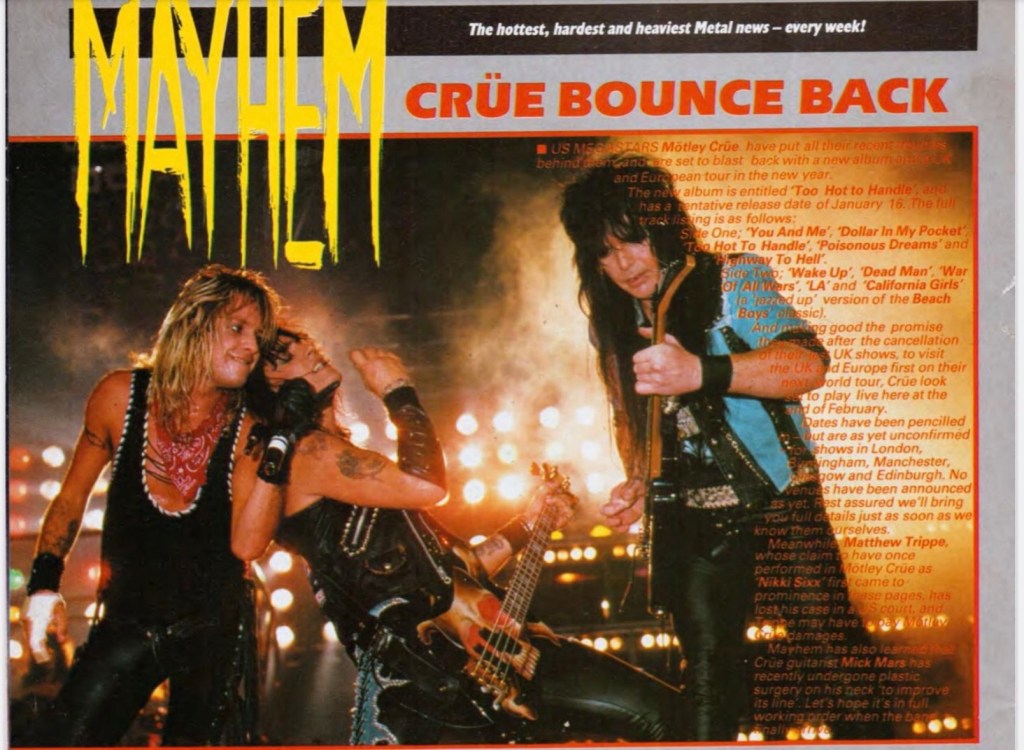
Like this old UK metal magazine clipping from Kerrang, claiming Mötley Crüe’s next album after “Girls, Girls, Girls” was going to be called “Too Hot To Handle”.

Not a rumor whispered by a fan on Reddit thirty years later. An actual printed story. With a release date. A European tour plan. And a track listing full of songs nobody has ever officially heard.

Now, if you’re under forty, you probably think this means one of two things: Either it was fake or somebody got it wrong.

But that’s because modern audiences don’t understand how information moved in the ‘80s.

Music journalism back then wasn’t journalism in the modern sense. It was half-access, half-chaos, half-propaganda and half-drunk-guy-at-the-bar storytelling. Labels leaked incomplete information. Managers exaggerated. Journalists filled in blanks. Bands changed direction midstream because somebody overdosed, disappeared, got arrested, the label rejected it or the band decided the entire record sucked halfway through recording it.

Especially Mötley Crüe.

Which means this article was likely discussing the project that eventually became “Dr. Feelgood”.

And suddenly the timeline becomes incredibly interesting, because the article mentions a January release schedule.

But “Dr. Feelgood” didn’t come out until August 1989.

So what happened to push the date out?

Nikki Sixx overdose on December 23, 1997. The overdose fundamentally interrupted the momentum of the band. Tours were cancelled. Europe got burned. The machine stalled out.

Maybe “Too Hot To Handle” was the original album title. Maybe those track names were demo titles. Maybe the record was originally intended to be a faster, dirtier continuation of “Girls, Girls, Girls”.
Maybe songs were abandoned after rehab, rewrites and Bob Rock entered the picture.

Because here’s the thing people forget about “Dr. Feelgood”:

That album sounds NOTHING like a band spiraling out of control.

It sounds focused. Massive. Disciplined. Intentional.

Bob Rock basically forced Mötley Crüe to stop behaving like a gang and start behaving like a professional recording act. Vince had to get vocal lessons before he started to record the vocals. The grooves tightened. The hooks became sharper. The production became cinematic. The chaos got filtered into something enormous.

That version of the band did not exist when this article was printed.

And honestly, the album titles themselves tell the story better than anything else.

“Too Hot To Handle” sounds like old Crue. Cartoon sleaze. Sunset Strip excess. Cheap danger.

“Dr. Feelgood” sounds darker. More narcotic. More sinister. Like the party stopped being fun.

One title sounds like a band chasing pleasure. The other sounds like a band trying to survive it.

Does the article prove some lost Mötley Crüe album exists in a vault somewhere.

Maybe it does. Maybe it doesn’t.

What matters is that this article captures a moment before rehab rewrote the band. Before Bob Rock transformed them.

And maybe that’s what made the pre-internet era better.

Mystery.

You didn’t know everything. You weren’t supposed to. The uncertainty was part of the experience.

Now every demo gets uploaded instantly. Which I love by the way. Every studio update becomes social media content. Every rumor gets “fact checked” within ten minutes by people who confuse searchable information with understanding.

But rock mythology was built on incomplete information.

On possibility.

On strange magazine clippings that make you wonder whether somewhere, buried in a storage locker or sitting on an old cassette tape in Nikki Sixx’s archive, there’s an alternate version of Mötley Crüe history labeled:

“Too Hot To Handle”.

P.S.

The full track listing is as follows:
Side One; “You And Me”, “Dollar In My Pocket”, “Too Hot To Handle”, “Poisonous Dreams”, “Highway To Hell”.

Side Two; “Wake Up”, “Dead Man”, “War Of All Wars”, “LA”, “California Girls” (a jazzed up version of the Beach Boys classic).

Standard
Music

Skin and Bones – The Last Gasp of Glam Rock’s Glory

You don’t end up in a band like Skin & Bones by accident. No one gets discovered on the Sunset Strip because they teased their hair the right way. This was earned. Clubs, vans, missed paychecks, girlfriends clapping out of obligation, bartenders as your only audience. That’s the DNA here, a Baltimore-bred, L.A.-dreaming rock outfit that never got its due.

Johnny Vamp, Jimi K. Bones, and Steve Mach cut their teeth in “The Vamps” (not the UK version but a popular localized Baltimore version) with endless club gigs, nights when only the bartender clapped. Pete Pagan rolled in from The Throbs, already scarred by almost-making-it. And Gregg Gerson? He’d toured with Billy Idol and Wayne Kramer. He knew the drill.

They had history. They had chops. And then they got the producers: Andy Taylor (yes, from Duran Duran) and Mike Fraser (AC/DC, Aerosmith). Gloss and muscle in one package. 

Put those two together and you get a record like “Not A Pretty Sight”, half pop gloss, half rock muscle, all late-’80s ambition.

That’s the problem and the charm. You listen back now and the production screams “1990.” Gated reverb, layered vocals, guitars EQ’d to cut through car stereos. But inside that gloss are real songs. 

“Nail It Down” 

A monster opener. Riff up front, chorus built for arenas. 

“I’m gonna take your love and nail it down”

At face value, it’s sleaze-rock swagger, dominance, conquest, pinning desire in place like a trophy. But beneath that bravado, it could flip: not about taking at all, but about holding on. Accepting someone’s love and making it permanent, refusing to let it slip away. It’s either lust in leather or commitment in disguise, depending on how you hear it.

“Resurrection Love” 

It should have been a single, commercial enough for radio, rock enough for the faithful. 

I see the satisfied look in the broken mirror / Said, “Ya fooled me one last time”

When the devil’s out of work ’cause there’s no more sinners / Maybe I’ll change your mind

It’s self-destruction reflected back. The mirror’s cracked, just like the guy staring into it. He’s been burned before, lied to, used, but he still can’t let go. 

And then the kicker: when even the devil’s unemployed, when sin runs out, maybe then I’ll get through to you.

“Cover Me With Roses” 

Play it and tell me it doesn’t deserve a second life. The hooks are undeniable.

As the candle burns, sing your lullaby / We’ll make a date in heaven, so dry your crying eyes

Cover me with roses / Cover me from the falling rain / Turn my bones to ashes / I won’t feel the pain, no pain

This is death dressed up as romance. A candle flickering, a lullaby, its comfort at the edge of goodbye. The promise isn’t for tomorrow, it’s for heaven, for somewhere beyond the wreckage of here and now.

Cover me with roses, (bury me in beauty), disguise the decay. Cover me from the falling rain, (shield me from the grief that’s about to wash over). And when it’s all gone, when the bones turn to ash, the pain disappears.

“Hey Stupid”

“All you engineers and scientists with your doctor degree / You don’t need a microscope to see / This ole’ world’s got a problem or two / It’s coming apart at the seams.”

The world’s messy, broken, obvious to anyone paying attention.

Credentials won’t fix it. Music won’t fix it either, but damn if it won’t let you scream about it.

“Nymphomania” 

It works because the band leans in, no apology. A product of its time, like “Cherry Pie” and “Unskinny Bop”. 

Big bosom lady with a smile on her face / Trying to put your backbone out of place

The “big bosom lady” isn’t just a character, she’s a force of chaos, a temptation that threatens to undo the guy’s composure.

From sleaze and swagger to sorrow and soul, Skin & Bones could turn on a dime, proof that this wasn’t just a band chasing trends.

“Kiss This”

It has the swagger modern bands try too hard to fake with some back alley attitude from “Piece Of Me” by Skid Row. 

Kiss this! I’ve had enough of your lies / Kiss this! You won’t be running my life / Kiss this! You don’t know wrong from right / You better scratch my name off your list / Kiss this!

Each “Kiss this!” is a declaration: I’m done with your manipulation, your control, your moral lectures.

“All the Girls in the World”

A derivative title, yes, but that chorus is engineered for sing-alongs in every suburban bar in America. 

And Johnny Vamp? 

He sells it. You can’t fake that kind of delivery.

And there’s a million sexy ladies I’m gonna meet / They’re waiting for me after the show

It’s less about the actual women and more about the mythology of the rockstar life: the tour, the adoration, the endless possibilities waiting after the lights go down.

“Let Her Go”

It’s a slower rock song, a ballad, but not cliched like the rest. More street life, classic rock vibe than glam rock polish. 

We used to drink and dance to our favorite song / I wonder how I played, played the part so long / Cause now this ruby has turned back to stone / Ain’t it funny how love cuts you, cuts you to the bone

Nostalgia laced with regret, dancing, drinking, pretending everything was fine while knowing it wasn’t. The “ruby turned back to stone” is the perfect metaphor: something once precious and alive has hardened into something cold, unyielding. 

And the final line? 

That’s the sting: love doesn’t just hurt, it carves into you, leaving scars you can’t ignore.

“Out With The Boys”

On the streets, we’re a scene / In the clubs, we’re a scream / You can’t come between us tonight / In the wind like dust / If the joint is a bust / We’ll find a place that’s just right

This is pure camaraderie and rock ’n’ roll freedom. The song isn’t just a night on the town, it’s a ritual, a declaration of brotherhood against the mundane. The streets, the clubs, the chaos, they’re a playground, a stage, and a battlefield all at once. 

“My World”

Hope I didn’t ruin all your family plans / Cause Daddy wants his girl to have a college man

Tongue-in-cheek rebellion with a sly wink. There’s charm in the defiance, a knowing grin in the face of convention. It’s about rocking your own rules, tempting fate, and laughing at the social script while still acknowledging it.

There is a tragedy and a beauty to “Not A Pretty Sight”. It’s a record caught between ambition and extinction. The band name was from the A&R playbook, the production was as high-profile as you could ask for, and the songs were good enough. But timing is everything in this business. They arrived just as the party was ending, when the hangover was setting in.

By the time this record dropped, the window was closing. 

However, labels were still throwing money at bands like Skin & Bones, hoping for another Bon Jovi, another Guns N Roses, another Skid Row. 

But the culture had moved. 

Grunge was already tuning its guitars down in Seattle. The hair spray was evaporating. 

If “Not A Pretty Sight” had landed in ’86, it might have broken. In ’90, it sounded like the last gasp of a genre about to be steamrolled.

But. 

“Not A Pretty Sight” is more than just an artifact. It’s a snapshot of a moment, the sound of the majors doubling down on a trend, the musicianship of a band that could play, the polish of a team that knew how to make a record shimmer. It may not have changed the world, but it damn well earns a listen.

Because sometimes the market gets it wrong. Sometimes the band with the derivative name makes a record that deserved better.

And this one did.

P.S. Steve Mach

The tragedy doesn’t end with the record. Bassist Steve Mach was shot and killed by Baltimore police in 2011. Fifty-two years old. Sitting in his room with a pellet gun that cops swore looked real.

This wasn’t some burnout cliché. He’d worked as a lighting tech. He was an animal activist, devoted to rescue cats. Jimi K. Bones remembered him fogging up his basement with a DIY dry-ice machine the first time they met, and thought, “I’ve got to be in a band with this guy”.

Like the record itself, Steve Mach’s story is beautiful and broken, a reminder that behind every forgotten band was someone who lived and breathed the dream until the end.

Rest and rock in peace.

Standard
Classic Songs to Be Discovered, Music

Marcie Free’s Hidden Fire: The Soul Behind Ready to Strike

It’s 1985.

The Sunset Strip is still a religion, and every kid with a can of Aqua Net thinks they’re destined for MTV.

Out of the chaos comes King Kobra’s debut “Ready to Strike”.

Led by guitarists David Michael-Philips & Mick Sweda.

David Michael‑Philips briefly joined Keel before being recruited by drummer Carmine Appice for King Kobra in 1984. Mick Sweda had been doing East Coast cover/punk stuff, moved to L.A., and was also tapped by Appice for Kobra.

After Kobra he co-founded Bulletboys with Marq Torien.

Johnny Rod held the low end here and after King Kobra he joined W.A.S.P., appearing on “Inside the Electric Circus”, “Live…in the Raw”, “The Headless Children”.

The season veteran here was drummer Carmine Appice, coming from Vanilla Fudge, Rod Stewart, Ozzy Osborne and the architect behind King Kobra. Post-Kobra he went on to other projects (including Blue Murder with John Sykes).

And a singer named Mark Free, the kind of vocalist who could level you with a single held note.

And now, that voice is gone. Marcie Free (Mark transitioned in the 90s), passed away. No reasons given. Maybe there doesn’t need to be one. Sometimes the world just loses a frequency.

Listen to “Ready to Strike” today and tell me you don’t feel it. That impossible range. That clean, surgical tone cutting through Spencer Proffer’s slightly overcompressed mix.

“Ready To Strike”

Co-written by the band, Proffer, and the mysterious H. Banger, a name that appears on six tracks and nowhere else. Ever. Believed to be a collective pseudonym representing members of Kick Axe, whose fingerprints are all over the Pasha Records era.

“Up here on this tightrope / Tryin’ not to fall / The spotlight is on me tonight / I want to have it all.”

It’s a metaphor for the rock life, hunger, exposure, the weight of wanting everything. The guitars duel, the drums explode, and Free prowls through the mix like a panther who’s just discovered the cage door’s open.

“Hunger”

Written by Kick Axe and Proffer.

“When I see what I want, I’m gonna take it / If it’s against some law, you can bet I’m gonna break it.”

The tempo drops, the groove thickens. Free’s voice walks the line between desire and desperation, the sound of ambition burning too hot to contain.

“Shadow Rider”

“Midnight is my time / I’m the Shadow Rider / I come from the other side.”

It’s the nocturnal anthem, the loner archetype on a chrome horse, riding between light and dark.

“I’ll stand beside you and take the blows” isn’t just a lyric; it’s a code of honor. The song rumbles like an engine idling in a back alley.

“Shake Up”

“You grew up on rock ’n’ roll / So why deny it now?”

This is the youth call, the defiant reminder that rock isn’t fashion, it’s DNA. It’s a fist-in-the-air track, bright and rallying. The message is simple: don’t outgrow what saved you.

“Attention”

“You just want attention, baby, that’s all.”

A riff built for smoke machines and strip lights. But listen closer, there’s bite in Free’s delivery. Sarcasm, empathy, truth. It’s a mirror held up to a scene that fed on validation. Every artist in L.A. wanted the same thing: to be seen, to be loved, to matter.

“Breakin’ Out”

“I’m breakin’ out, gonna make my stand…”

The liberation song, before anyone knew how literal it would become. Appice’s drums hit like battering rams. Free’s vocal swings from defiance to freedom, warrior to wounded bird.

“Tough Guys”

“Tough guys never cry…”

The façade song. What sounds like macho posturing becomes, in Free’s phrasing, heartbreak. The mask slips. The world tells men not to feel; what does it cost to fake it.

“Dancing With Desire”

“I’m losing control tonight…”

The silk thread between danger and devotion. The groove is sleek, the vocal magnetic. Desire becomes identity, the moment you stop pretending and start existing.

“Second Thoughts”

“I had it all planned, then I changed my mind…”

It’s the sound of someone questioning the script.

Behind the arena sheen, it’s a confession: the fear of choosing the wrong version of yourself. Free sings like someone tearing up a contract with fate.

“Piece of the Rock”

“We all want a piece of the rock…”

The closer. It’s ambition reimagined as reckoning. You can hear the disillusionment under the triumph, the realization that success and happiness rarely share the same stage. It ends not in celebration, but transcendence.

King Kobra never quite made it to the top. The songs were there, the image marketable, the talent undeniable. But the breaks never came. One more album, and the curtain fell.

Yet “Ready to Strike” remains, a document of promise, power, and prophecy. The record of a voice that burned too bright to be ordinary.

Mark Free sang like someone fighting for air. Marcie Free lived like someone who finally found it.

RIP.

Standard
Classic Songs to Be Discovered, Derivative Works, Influenced, Music, My Stories, Unsung Heroes

Rare “Glam Metal” Bands

I was looking for a quick and short podcast episode today and I came across an episode titled “Rare Glam and Hair Metal Bands” that was less than 10 minutes on the 80’s Glam Metalcast. Now the podcast itself is not a big production, it’s unpolished and garage like, but that’s why I like it.

So I’m thinking. A cool short and sweet episode on rare glam metal bands. Wham bam, Amsterdam.

And then I started to write down all the bands mentioned and suddenly a short podcast ended up as a long blog post.

Cold Sweat

From Ex-Keel guitarist, Marc Ferrari.

They only released one album, “Break Out” in 1990 on MCA Records, otherwise known as “No Idea Records” when it came to promoting rock and metal bands.

Produced by Kevin Beamish.

Oni Logan was the original singer and he left the band to join Lynch Mob, just as they were about to record the album.

Singer Rory Cathey was found from a lot of demo tapes to replace Logan. The band was rounded out by Erik Gamans on guitars, Chris McLernon on bass and Anthony White on drums.

The album didn’t get any traction and if you couldn’t find it in stores it’s because the label had already dropped the band.

Check out the 12/8 Blues groove of “Cryin’ Shame” and the great guitar playing or the power ballad, “Waiting In Vain” or the melodic rockers “Take This Heart of Mine” and “Let’s Make Love Tonight”.

“Killing Floor” is the usual “run of the mill” hard rock tunes. Then there is “Riviera/Long Way Down” which is an acoustic instrumental merging into a massive rock groove for “Long Way Down”.

Sweet F.A

They had Howard Benson producing them. For those who don’t know Benson, towards the late 90’s and onwards, Benson became like the new Tom Werman for me. I would gravitate to the records he produced.

Sweet F.A is another band signed to “No Idea Records” otherwise known as MCA Records.

The band is made up of Steven David DeLong (really, how long) on vocals, Jon “Lightning” Huffman and James Thunder (really, Lightning and Thunder) on guitar, Jim Quick (really, please stop with these names) on bass and Tricky Lane (they saved the best for last) on drums and percussion.

So what do ya get when The Long, Lightning, Thunder, Quick And Lane get together?

The debut album “Stick To Your Guns” came out in 1989.

And it did nothing commercially and of course, they got dropped by their label and then released another album “Temptation” on another label a few years later and that also did nothing commercially and the band was done.

The title track is very Led Zepplenish with a bit of Bad Company and “Shooting Star”. And I like it. The hair metal tag doesn’t really suit a cut like this, but then again, these terms weren’t meant to be complimentary.

“Whiskey River” is worthy and “Breaking The Law” is sort of like a Badlands tune. Maybe with a bit of “Hot For Teacher” chucked in for good measure.

But the rest is the usual “this track bleeds into this track and this track bleeds into this track”.

Silent Rage

I’m surprised this one didn’t do greater based on its cover. You know the one, a buffed bod, six pack showing, wearing tight leathers with the album title “Don’t Touch Me There” just over the crotch.

I guess Silent Rage and their label RCA forgot that males made up the majority of the record purchases in 1989 when it came to rock and metal releases.

And I was thinking why would a band who formed in 1976 and who finally got a chance to release an album 13 years later go with that cover. Because the stupid cover hindered the chances of the album doing anything.

Because I didn’t but it because of the cover.

But I should judge an album by its cover.

As soon as I pressed play I was a fan of the music.

“Runnin On Love”, “I Wanna Feel It”, “Tonight You’re Mine” and “Rebel With A Cause” is a four punch knockout combo.

I guess whatever Gene Simmons touched, turned to black. There’s a story there as well. Paul Sabu started producing the album and then Gene took over. I guess when you’re a band on Simmons Records, the boss takes precedence.

Most of the songs are written by E.J. Curse on bass, Mark Hawkins on guitar and Jesse Damon on vocals.

Producer Paul Sabu assisted on “Tonight You’re Mine”, Joe Lynn Turner assisted on “I Wanna Feel It” and Bruce Kulick assisted with “All Night Long”. There is a cover song from ELO called, “Can’t Get Her Out Of My Head”. Then there is “Don’t Touch Me There” written by Bob Kulick with Adam Mitchell. Album closer “I’m On Fire” is one of those fast paced hard rock songs that rhymes fire and desire.

It’s an arena rock album. But they never got to em.

Kik Tracee

It’s 1991, the third wave of L.A Metal (now known as Glam Metal or Hair Metal) is in full force and “No Rules” comes out, produced by Dana Strum from Slaughter on BMG Records.

Kik Tracee’s metal and hard rock sound is mixed with some alternative. Even the Hugh Syme cover is different.

An old steam train has arrived in a cityscape environment, and there is the same person walking out of it multiple times, dressed in old clothing and a hat, with a badge on his chest that states “No Rules”. It’s like the train is a time machine, entering our current lives to bring about a little chaos and anarchy.

Rolling Stone even had this album at 46 of the 50 Best Hair Metal Albums, which was a surprise. Even the great Martin Popoff who is normally tough on bands known as hair metal gave it some nice words on his “Collectors Guide” book.

“Big Western Sky” was called “the centrepiece” in the same Rolling Stone review. It’s one of those tunes that moves between acoustic and distortion.

It’s hard to escape the comparison to Guns N Roses. Tracks like “Soul Shaker” even starts off with that “Mr Brownstone” feel. “Tangerine Man” has an intro that could have come from Zakk Wylde’s fingertips. “Lost” feels like a Neil Young cut with a bit of The Beatles chucked in. “Velvet Crush” reminds me of Van Halen with an Axl Rose style vocal.

And by the end of the album, I didn’t feel like I listened to a “glam metal” album. Just a solid rock album. One review described it as Gunners meets The Cure meets The Beatles meets Paul Simon meets Neil Young meets Van Halen. I think that sums it up.

But being part of the third wave of acts, they were part of the first wave of acts to be dropped by the labels.

Singer Stephen Shareaux auditioned for the lead singer job in Motley Crue, losing out to John Corabi and in the late 90’s he also auditioned for Velvet Revolver, losing out to Scott Weiland.

Sleeze Beez

I didn’t like the band name at all.

“Screwed Blued And Tattooed” came out in 1990 on Atlantic Records. They are from the Netherlands formed in 1987.

“Stranger Than Paradise” was a hit on U.S MTV because of its melodic rock chrorus and a riff influenced by “Kashmir” but it’s the hard rocking tracks that get me interested.

Opener “Rock In The Western World” is a mixture of ZZ Top (Eliminator/Afterburner era), Van Halen and AC/DC. It’s perfect and one of the most underrated tracks from 1990. “House Is On Fire” is basically a rewrite of an AC/DC song called “This House Is On Fire”.

The title track “Screwed Blued N Tattooed” is a Van Halen like cut, similar to the hard rocking tracks from “5150”. Lyrically by know I had heard all of the “kids in a candy store” and “dog without a bone” references.

“When The Brains Go Down To The Balls” is pretty self-explanatory and it’s the most AC/DC sounding track on the album.

Guitarists Chriz Van Jaarsveld and Don Van Spall are excellent and they are virtually unknown. And the band is rounded out by Andrew Elt on vocals, Ed Jongsma on bass guitar and Jan Koster on drums.

They released one more album in 1992 on Atlantic called “Powertool” and that was the last I heard of em.

Salty Dog

This band deserved better as their blues rock still sounds fresh today as it did back then.

“Every Dog Has Its Day” came out in 1990, on Geffen Records.

Tom Werman mentioned in his interview on Lefsetz, that he produced the band and he liked their blues, funk, rock vibe, which was different and removed from the glam hair metal they got marketed with. So sonically, the album is great.

Formed in L.A in 1986 by guitarist Scott Lane, bassist Michael Hannon, and drummer Kurt Maier. Later, they were joined by lead singer Jimmi Bleacher. Founding guitarist Scott Lane was replaced by Pete Reeven in 1987 and with this version of the band they got their Geffen deal.

The cover for a generic “Every Dog Has It’s Day” title, is pretty cool with the great Biblical flood consuming great empires and cities, as they are the “dogs” having their “day”. It’s a pretty cool piece of early Photoshop art.

According to Wikipedia, the record was recorded in Wales, and the band was reportedly not told by the label they had to pay back the recording costs. Artists are naïve when they get their first deal and find out the hard way when the label starts to claim it back from money they’ve earned in sales or on the road.

Check out tracks like the bluesy AC/DC “Cat’s Got Nine”, the swinging blues of “Ring My Bell”, the alternative bluesy sounds of “Where The Sun Don’t Shine”.

“Spoonful” has this blues riff that sounds like something James Hetflied used on “Load” and “Reload” or Zakk Wylde on his Black Label Society band.

“Just Like A Woman” is like a southern rock ballad. “Keep Me Down” has this Led Zeppelin and Peter Frampton style groove. “Heave Hard” is an excellent Cinderella cut.

And the album doesn’t really have a bad tune if you are into blues rock.

Other bands mentioned are Beau Nasty, London (the same London that had Nikki Sixx and Blackie Lawless in it), Shotgun Messiah and my favourite, Hericane Alice which I have already posted about in the past.

Standard
Classic Songs to Be Discovered, Derivative Works, Influenced, Music, My Stories, Unsung Heroes

1985 – V1

Two releases come to mind immediately for 1985, that I can never forget. They are “Live After Death” from Iron Maiden and “Come Out And Play” from Twisted Sister. I’ve written about these albums before and will probably keep on writing about them.

Iron Maiden – Live After Death

It’s the best live album ever and my first proper exposure to Iron Maiden, as prior to this it was just the few video clips I taped from the music TV shows.

Because this was my first proper exposure, I got to hear Bruce Dickinson sing the DiAnno era songs before Paul DiAnno and I didn’t know it at the time, but the tempo of the songs had a small increase compared to the recorded versions. So when I eventually got to the first two albums, DiAnno’s voice (along with Blaze Bayley many years later) proved to be a struggle, but when Bruce did those songs live, wow.

P.S.

Maiden hit the bullseye again with the “Rock In Rio” release, especially the live footage in the DVD release. And on that “Rock In Rio”, Bruce Dickinson also gave the Blaze era songs a new life.

P.S.S.

Maiden did it again with “Flight 666” which is a great memento for me for the two nights I watched em perform the same set.

Twisted Sister – Come Out And Play

I just remember dropping the needle on this, laying in my bed, reading the lyrics of each song and looking at the graffiti art on the back cover.

So what was happening in the Twisted Sister department?

By the time this album hit, Twisted Sister was on an album per year cycle and while the “Stay Hungry” album was written during the recording of “You Can’t Stop Rock N Roll”, this one was written after the “Stay Hungry” tour.

And it didn’t sell as much as “Stay Hungry” and “You Cant Stop Rock N Roll”, because everyone were still buying those albums.

And just because the sale didn’t match the label expectations, it didn’t mean that this album is not a quality album.

But I wasn’t a fan of the singles like “Leader Of The Pack” and “Be Cruel To Your School”. All of the other tracks definitely resonated and the bonus track “King Of Fools” is one of my favourite Sister tracks. But those two singles proved to be a bad decision.

And they didn’t soften their sound just because they made it with “Stay Hungry”. They came out all guns blazing with the title track and “The Fire Still Burns” is a speed metal classic.

Dee said to “join our cavalcade” and join I did.

P.S.

But the cavalcade that jumped on the ship with “Stay Hungry” didn’t all come back in 1985, but they would return ten fold in the 2000’s.

P.S.S.

One more album later in 1987 and the band would cease to be until the 2000’s.

Dokken – Under Lock And Key

It was the “Unchain The Night” video release which got me interested. My cousin Mega dubbed it off some other guy who dubbed it off some other guy. And I dubbed it off my cousin. The video sounded dodgy, with that white noise effect running in the background, due to it being copied so many times.

So I didn’t get this album until two years later, because the cover didn’t scream out “buy me” either.

There are songs which do sound like they are written for the charts, but its tracks like “Unchain The Night”, “Lightning Strikes Again”, “Will The Sun Rise” and “Till The Living End” which showcase the metal side of the band and still to this day, stand out as favourites. And when you add the rock tracks like “The Hunter”, “In My Dreams”, “Its Not Love” and “Don’t Lie To Me”, well, you have a pretty solid little album even though it was made from punch-a-thons, arguments and arm wrestles.

P.S.
Pilson likes this album, but in a recent interview he said that “Tooth And Nail” is his favourite. And he had a co-write in all of those tracks. The true unsung hero of Dokken.

Yngwie Malmsteen – Marching Out

One of the bands I was in, the co-guitarist was a devoted Yngwie fan. He would make fun at my tastes of guitarists because according to him, none of them came even close to the maestro level of Malmsteen. It was this elitism from him that made me hate Malmsteen at the start, but I also understood that in my journey to be a guitar player, I would need to check out some of the Malmsteen recordings.

And.

This is a good album.

Jeff Scott Soto on vocals brings it on songs like “I’ll See The Light Tonight”, “Don’t Let It End” and “Caught In The Middle” which he also co-wrote with the man known as the Fury. The other standout to me is “On The Run Again” which Malmsteen originally wrote while he was in Steeler with Ron Keel. At the time it was called “Victim Of The City”.

And I became a fan up to the “Fire And Ice” album. As soon as grunge hit and his albums were not available in Australia, he wasn’t on my radar anymore. I’ve heard a few albums since on Spotify and I can honestly say those 80’s and early 90’s albums are the go to albums for me.

P.S
Malmsteen would use JSS for one more album, “Trilogy”, and then many years later would diss him by saying that he (Malmsteen) came up with everything and JSS did nothing.

P.S.S.
Malmsteen is the fury.

Motley Crue – Theater of Pain

Only two video clips came out to support the album. And it was enough because the Crue generated enough controversy to remain in the press permanently.

“Louder Than Hell”, “Tonight”, the Bad Company sounding “Raise Your Hands To Rock”, “Fight For Your Rights” and “Save Our Souls” are some of my favorites.

Even tracks like “Keep Your Eye On The Money” and “City Boy Blues” are worthy tracks. So to me, there isn’t really any filler on this album. Actually I would put “Smokin In The Boys Room” as a filler track.

P.S

Was there really an imposter pretending to be Nikki Sixx during this period?

P.S.S.

Mick Mars, riffs away on this album and he’s playing is so underrated, it’s criminal. And Tommy Lee is a pocket drummer, something he doesn’t get enough credit for.

Ratt – Invasion Of Your Privacy

“Lay Me Down” and “You’re In Love” sold this album as the clips got a lot of TV time in Australia.

And when you drop the needle on it, you are greeted with a triple knockout punch. It kicks off with that LA Sunset riff for “You’re In Love” and it moves to “Never Use Love” and “Lay It Down”.

P.S.

The album came out too early as “Out Of The Cellar” was still selling a lot, so people would have had to choose between those albums. In other words, Ratt and their label cannibalized their sales.

P.S.S.

It’s a solid album.

And that’s it for 1985 part 1. Now I’m off to 1977.

Standard
Influenced, Music, My Stories

Hair Metal

There is no doubt that artists who played the Strip had a certain dominance on the charts until a new sound from up the Pacific coast, washed em away. And when people started to write about the 80’s, there was nothing positive said. All of these new indie writers tried to re-write history in favour of their preferred musical taste and all they wrote about was the bad hair, the bad music, the lipstick and hairspray, the bad hair again, the lifestyles, the bad hair again x2 and the bad music again.

Would “Guitar Hero” have existed if it wasn’t for the 80’s?

Van Halen is one of the first bands that I know that came from the Strip, more because they played up and down the Strip like crazy instead of living on the Strip. And even though they had long hair, it wasn’t teased and hair sprayed and glammed up. Only David Lee Roth would take that on, even though the poster boy look upset the Van Halen brothers. When the band became Van Hagar, they still had a down to earth look, with Sammy even wearing an interesting red outfit.

Motley Crue is the first prominent band to came from the Strip, living and breathing it. While “Too Fast For Love” was done independently with songs written before the Crue was formed, it wasn’t until “Shout At The Devil” hit the streets, that the sound of the strip was born.

The generic sounding “Shout At The Devil” sets up the “Shout” call and response vocal, while “Looks That Kill” pulverises you with its down tuned riff and razor sharp women ready to slice the little boys apart. Even “Helter Skelter” sounds like it came from the Strip, instead of the clubs of Liverpool, England. In “Ten Seconds To Love” Vince is telling his girl to wait a little bit more, because here he comes and how he can’t wait to tell the boys about her, while she shines his pistol a little bit more.

Glam metal then left the Sunset Strip and moved to Sheffield England and an album called “Pyromania” from Def Leppard.

From the opening notes of the AC/DC influenced “Rock Rock (Til You Drop)”, to the harmonies of “Photograph” and “Rock Of Ages”, to the grooves of “Billy’s Got A Gun” and “Die Hard The Hunter”, Def Leppard changed the game. They brought the sounds of the NWOBHM, mixed em with AC/DC, Queen, The Sweet and Mott The Hoople and suddenly, the glam hair sound is developing even further.

The glam sounds returned to the Sunset Strip and a band called RATT took over with a song called “Round and Round” from “Out Of The Cellar” released in 1984.

It’s got streets, where people meet, to cross lines and get into fights. And we loved it, even though the chorus of “love finding a way” didn’t really match the threatening verses of picking a fight. The Rat gang also got a mention in “Wanted Man” and my favourite track, “The Morning After” comes roaring out of the speaker.

WASP is another Sunset act, which was thrown in with glam, but to me, that’s like placing Motorhead as a glam act as well. Then again, with songs like “Animal (Fuck Like A Beast)” and “L.O.V.E Machine”, they got traction and Tipper Gore added the band to her filthy list.

At the same time, a band that played the New Jersey/New York State area for a decade broke big with big hair and a glam rock look from the 70’s and film clips about standing up for your rights, like “We’re Not Gonna Take It” and “I Wanna Rock”.

And the term hair band and glam metal got even messier.

Poison moved to the Sunset Strip, dragged the cat in, played dirty and screamed for action with their 1986 debut album, and their 1988 follow up “Open Up And Say Ahh” cemented big hair.

Bon Jovi showed how slippery it really gets when things get wet and “New Jersey” in 1988 further cemented the big hair look.

Suddenly, we had Skid Row going wild with their big guns, looking for a piece of everyone. Def Leppard poured even more sugar on their sound with “Hysteria” and finally, a bunch of highly strung musicians got it together to write and record an album called “Appetite For Destruction”.

You know where you are, you’re in the jungle baby, and that jungle proved so easy to please, with cheap booze on the Nighttrain, while talking to Mr Brownstone on our way to the Paradise City.

Regardless of what you think of the music from these artists, or how you want to label them, this form of rock and roll was loud, in your face and it didn’t really care what you thought, sort of like how Axl said, if you think your so cool, you can just fuck off.

The journal that inspired this post.

Standard
A to Z of Making It, Music, My Stories, Unsung Heroes

Metal Evolution – Glam Metal Episode

I watched the Metal Evolution Glam Rock, Thrash and Grunge documentaries a few nights ago. When you play “The Trooper” as your intro riff to the series, how am I not going to like the documentaries. That alone classifies it as a winner to me. The documentaries are great viewing and I recommend them to all fans of the rock and metal genres and also to any other fan who is interested in a good narrative.

YouTube Link

I think the Glam Rock/Metal movement doesn’t get the respect it deserves. If it wasn’t for “Sonic Temple” from The Cult and “Dr Feelgood” from Motley Crue there would be no such thing as the “Black” sound and the millions of metal bands that the Metallica album spawned. Yet this is not mentioned, even though Lars and James have gone on the record to state that the sound of “Dr Feelgood” is what they wanted for the “Black” album and that is why they went with Bob Rock.

However, in the Thrash documentary, Sam Dunn tells Lars he felt betrayed when the Black album was released and Lars responds by saying that it would have been a betrayal if Metallica did Justice Part 2. Brilliant interviewing. Since Sam Dunn is a fan, it was a fan question that a lot of Metallica fans from the first four albums wanted to ask. And Lars actually gave a great response back.

But back to the Glam Metal episode first.

I couldn’t stop laughing at Sam Dunn’s assessment of “Glam Metal”. To him he felt “they were boy bands put together by record label execs”.

There is a good history on the L.A Hard Rock scene and how it goes back to the original pioneers “Van Halen”. It set the style that bands needed to have a real showman for a lead vocalist, a real hot-shot guitarist and a rhythm section tighter than a G-string.

Franki Banali the drummer from Quiet Riot cracked me up with his assessment of Edward Van Halen “the name sounds like a painter”.

It’s good to see Spencer Proffer get recognition for his idea of trying to find a band to record “Cum On Feel The Noize” from Slade. It was a game changer for Quiet Riot even though they resisted it.

Then you have the big heavy metal day on the 1983 U.S festival. It was a game changer for the LA scene and for metal in general.

Randy Rhoads was always a big influence on the LA Glam strip with his guitar playing in Quiet Riot before he joined Ozzy.

MTV also had a perfect vehicle in Glam Metal as all the bands where all about the image and the performance. And MTV was the catalyst for getting bands that would normally sell a hundred thousand albums into the multi-million ranges. The seventies bands that became part of the movement re-invigorated their career and also replenished their fan bases.

John Kalonder was fucking hilarious. When he spoke, I couldn’t stop laughing. He sounded like that baddy voice over dub in the movie “Kung Pow”.

And it was a time of excess. If Tawny Kitaen is to be believed, then the 1987 Whitesnake album cost over $2 million dollars to record and produce.

One thing that is very rarely mentioned in the press is all the gear enhancements that took place during the Eighties era. Rock guitar players were customizing amps and guitars and they were always seeking new sounds.

As a musician it would be great to see how producers and technology shaped each genre. We all love a narrative and we all like to see unsung heroes get their time in the sun. The rise of Mesa Boogie and their Rectifier amps. Tom Werman, Bob Rock, Keith Olsen, Andy Johns, Bruce Fairbairn, Mike Clink and so on, also deserved to be recognised. The polished sounds from the Eighties records played a huge rule in the evolution in the metal and rock genres. The whole Grunge movement used producers that cut their teeth engineering on metal and glam rock albums from the 80’s.

Look at some of the stuff “The Edge” did with Digital Delays and Phasers. Eddie Van Halen is a classic that comes to mind with his innovative “Brown” sound. Warren DeMartini from Ratt had a hot rodded amp that everyone wanted to use.

As a fan of the genre, there needs to be another documentary that brings to light some of the unsung heroes of metals evolution, those guys that altered and enhanced the sounds.

Because in the first episode that covered the origins of metal Dunn touched on the sound aspects and about how a speaker was cut with a razor blade to get a distorted sound and how the invention of the first Marshall amp paved the way for a new style of sound.

Dunn’s reporting of the “Guns N Roses Effect” on glam rock spot on. That is the argument I have had with many people. I always said that Glam Rock died because it got over saturated with inferior bands, along with Gunners showing up the movement with their nod to Seventies classic rock. So when Grunge came along, it offered an alternative to the clichéd glam rock styles and lyrics.

To me the documentaries are also trying to change the culture of the metal fan, you know, get all the elitist judges to be more relaxed and appreciate the different aspects rather than seeing themselves as part of a niche. Get them to appreciate and open their mind and feel united as one big diverse family, to inspire evolution, a Metal Evolution

“Bang you Head…”

Standard