A to Z of Making It, Influenced, Music, Unsung Heroes

Audrey Horne – Achilles: The War Inside Us

Audrey Horne have always been something of a contradiction.

Formed in Bergen, Norway, in 2002 by musicians better known for extreme and progressive metal, they deliberately chose another path: classic hard rock built on riffs, melody, swagger and songs that demand to be played loud.

The pedigree was serious from the beginning. Thomas Tofthagen, Tom Cato Visnes, Kjetil Greve, Torkjell “Toschie” Rød, Arve Isdal and Herbrand Larsen brought connections to bands including Sahg, Gorgoroth and Enslaved, but Audrey Horne became their escape route from extremity.

Their 2005 debut, “No Hay Banda”, earned strong reviews and a Norwegian Spellemann Award, while “Le Fol” (2007) pushed them further into the European rock circuit.

Then came the breakthrough. Their self-titled 2010 album was my introduction to the band. I spent three months in Europe back then and overdosed on it.

“Youngblood” (2013), “Pure Heavy” (2014), “Blackout” (2018) and “Devil’s Bells” (2022) progressively sharpened the formula: big guitars, bigger melodies and an increasingly confident identity. They survived lineup changes, relentless touring and a pandemic interruption, emerging as one of Norway’s most dependable modern hard-rock bands.

Now comes “Achilles”, released on September 4, 2026, via Napalm Records. My vinyl and CD just arrived, however streaming filled the gap. I also took liberty to fill a few gaps in my collection, so when ordered “Achilles”, I also purchased “Pure Heavy” and “Youngblood” on vinyl.

Clocking in at 44:15, “Achilles” lands in the sweet spot anyone raised on physical media will remember. Back when the TDK 90-minute cassette was essential equipment, this was the kind of album you could record in full on one side, no flipping the tape halfway through, no songs left behind. Just 44 minutes of Audrey Horne: load it up, press play and let it run.

Audrey Horne’s DNA is unmistakable: Iron Maiden’s twin-guitar attack and grandeur; the swagger of Kiss and Mötley Crüe; the melodic instincts of Thin Lizzy and Europe; and the riff power of Black Sabbath, Judas Priest and Led Zeppelin. Ozzy Osbourne and Dio appear in the darker edges, Van Halen in the flash, Scorpions in the melodic weight and Deep Purple in the classic-rock muscle. Every so often, the sharper guitar work of the NWOBHM, particularly Diamond Head, creeps through.

Achilles

As soon as the intro riff kicks in, which is the same riff that becomes the chorus, “Can I Play With Madness” comes to mind. The DNA.

“Achilles” is the ultimate symbol of the warrior: almost invincible, terrifyingly capable, driven by honour, rage, pride and revenge.

But his story is also about the price of becoming the weapon everyone needs you to be. He wins glory and loses everything that makes glory worthwhile.

The song turns that mythology inside out. The warrior doesn’t want another battle. He wants a ceasefire. The repeated word starts to sound like someone trying to convince himself there must be another way.

“The blood that we spill to feed the mouth of greed.”

We dress war up as honour, freedom, territory, security, history, the flag, the cause and the enemy.

We build elaborate stories around violence because “somebody benefits from this” doesn’t make for an inspiring recruitment poster.

But blood is still blood, and greed is still greed. The people doing the bleeding are rarely the people deciding how much bleeding is necessary.

Maybe “Achilles” is every person who has spent a lifetime fighting somebody else’s war and finally gets tired. That isn’t weakness. That’s the beginning of the ceasefire.

In the Eye of the Hurricane

The intro and verses bring “Creatures of the Night” by Kiss to mind. The chorus, meanwhile, is pure Scorpions, and a certain song with “Hurricane” in its title.

“Carry on, into the eye of the hurricane.”

Sound familiar? That’s adulthood.

We’re sold the bullshit idea that eventually we arrive at permanent stability. Get the job. Pay off the mortgage. Find the person. Get your shit together. Then you can relax.
Except the hurricane doesn’t give a shit about your five-year plan.

The strange thing about a hurricane is that the most violent thing imaginable has a calm centre: the eye. You don’t defeat the storm by pretending it isn’t happening. You move through it until your feet hit the ground again.

The world throws enough shit at you and eventually you choose: let the storm destroy you, or become something it can’t blow away.
Carry on, not because everything is going to be okay, but because it isn’t.

Vampires

The intro and verse riffs recall “Rime of the Ancient Mariner” by Iron Maiden, merged with the pulse of “Heaven and Hell” by Black Sabbath and “Holy Diver” by Dio. There’s nothing else to do except bang your head.

“Achilles” was about conflict and “In the Eye of the Hurricane” about surviving chaos. “Vampires” is about the people who feed on you while pretending they aren’t the problem.

“You drank it all.”

Four words. The whole crime.

Some people don’t enter your life to share it. They enter to consume your time, attention, money, ideas, optimism, patience and belief in yourself.

They rarely announce themselves as vampires. They arrive looking like everybody else: friend, lover, boss, colleague, business partner, sometimes even family. They tell you they’re taking care of you while quietly taking everything from you.

That’s why the repeated “liar, liar” matters. The spell has broken. Once you see the vampire, you can’t unsee the teeth.

Make sure you stick around for the solo section with the “woah-oh” vocals. Brilliant.

God Damn Beautiful

This is high-energy AOR melodic rock with a steroid-strength foundation recalling “Just Another Night” by Mick Jagger, plus twin harmonies that bring Thin Lizzy to mind. Bassist Espen Lien also takes the lead vocal.

“Every turn you take is gonna lead you back to where you’ve been.”

That’s the trap. We convince ourselves we’re moving forward because we’re moving: new relationship, new job, new city, new haircut, new version of ourselves.

Look at me! I’m different!

No. You’re just taking the same baggage to a different postcode.
The road isn’t necessarily the problem. The driver is. You can change direction a hundred times and still arrive at the same destination if you haven’t changed what’s steering you.

Relationships expose this particularly well. We leave someone because they’re “the problem,” find somebody else and, six months later, have the same argument with a different face across the table.

Maybe the hardest part of heartbreak isn’t losing the person. It’s recognising the pattern.

Sometimes the person you’re trying to escape isn’t standing beside you. It’s the person in the mirror.

That’s why the chorus feels bittersweet rather than triumphant. She’s still beautiful. He still misses her. He still loves her. But love doesn’t automatically mean you belong together.

Goddamn beautiful. Goddamn painful.

Pretty Little Lies

It starts as a slow rock song, recalling “Sail Away” from Audrey Horne’s 2010 self-titled album.

“God Damn Beautiful” was about losing someone you still love. “Pretty Little Lies” is about knowing you’re causing the damage and continuing anyway.

“Don’t believe a word I say to you, ’cause telling little lies is what I do.”

Now there’s some fucking honesty.

The destructive lies aren’t always enormous. They’re the little ones: “I’m fine.” “It’s nothing.” “Of course I love you.” “Things will change.” “Just give me some time.”

Stack enough of them together and you build an alternate reality.

Sometimes we lie to ourselves. We say we’re staying because we love someone, when perhaps we’re afraid of being alone. We promise things will change when we already know what tomorrow will bring: nothing.

The pièce de résistance is the lead break, a song within a song. If it doesn’t make you play air guitar, check for a pulse.

When the “on and on” chants arrive, the energy rises, followed by violins in the final thirty seconds that push the riffs into “Kashmir” territory.

The only thing I can do is press play again.

Prodrome

A brief instrumental built around a warlike drum pattern and harmony guitars drawn from Audrey Horne’s Thin Lizzy and Maiden influences.

I had to look up what “Prodrome” meant, An early sign or symptom that signals the impending onset of a disease before major or specific symptoms appear.

Like fever, body aches, and tiredness often act as early warnings before a specific infectious illness takes full hold.

Insanity

Now we’re cranking. It feels as though they’ve taken their best track, “This Is War,” and reimagined it for the verses.

“Did I kill a man?”

That isn’t a confession. It’s worse. A confession means you know what you did. This character doesn’t.

Suddenly we’re inside the head of somebody who can’t trust the most basic fact about himself.

Did I do it? Was I there? Was it a dream? Am I the same person I was yesterday?

We construct stories about ourselves and spend our lives defending them: I’m a good person. I’m the victim. I always do the right thing. Then something happens that doesn’t fit the story.

“If there’s a God, tell him to leave me be.”

There’s no grand revelation or comforting answer. Just a man alone in the dark, surrounded by rain, rats and his own thoughts.

That’s where the Iron Maiden influence matters. The song is a prequel to “Hallowed Be Thy Name”.

Maiden’s condemned man is in prison, waiting to be executed. He faces death, questions God and considers what comes next.

“Insanity” belongs earlier in that story, before the cell, before the execution and before certainty.

And then comes the “Back in the Village”, inspired outro. Excellent.

Hell Is Eternity

Bass and drums start the song before an open-string melodic riff kicks in. It’s fast, high-energy and immediately engaging.

“It leaves a mark on me. The kind that you can’t see.”

The invisible stuff is harder to explain. You can walk into a room carrying ten years of pain and nobody knows. You smile, work, make dinner, crack a joke, and something is still eating you alive.

The monster doesn’t need claws or horns. It doesn’t even need to exist outside your head. It just needs access.

“Hell is eternity.”

That’s the real hell. Permanence. Pain is survivable when you believe it ends. Tell someone their suffering has no end and watch what happens to their world.

Six Feet in the Ground

The foundational DNA here comes from “Unmasked” and “Dynasty” era Kiss. “Naked City,” “Sure Know Something” and “Easy as It Seems” all come to mind.

“Monday early morning, I wake up and open up my eyes.”

The alarm goes off and, before your feet hit the floor, you already know how the day will feel. Same shit. Same routine. Same problems. Same person in the mirror.

“Days drag but nothing changes.”

Repetition is the real prison. Pain gives you something to fight. Repetition wears you down. One day becomes a week, a month, a year, and eventually you realise you’ve spent years waiting for change.

“Happiness is a long gone friend by now.”

Happiness used to live here. Now it’s gone. You can function and still feel fucking dead inside. You can show up while feeling six feet underground and everybody else is living on the surface.

“All I need is some time to think it over.”

Except time doesn’t solve everything. Sometimes it simply gives you more time to avoid what you need to confront.

“All I need is a drink to wait it out.”

It doesn’t solve the problem, just makes it quieter for a few hours.

“Most people learn faster when on fire.”

Pain is an excellent teacher. Unfortunately, most of us are terrible students until the exam is already burning.

Running Through the Night

This is fast and furious Iron Maiden. The verses recall “Aces High,” while the introduction feels influenced by the vibe from the “Powerslave” album.

Tony Soprano. That’s where we start. Tony fucking Soprano.
He’s a captain of industry, family man, criminal, violent, terrified, powerful and miserable.

Underneath it all, he’s “just a kid from New Jersey.”

“I’m going crazy and I don’t know what I’m gonna do.”

There’s a guy losing his shit and moving forward.

“Right is wrong.”

There’s the problem. Once the rules become negotiable, everybody writes their own version of reality. The criminal is protecting his family. The businessman is playing the game. The politician is doing what has to be done. Everyone has a reason, a story and a version in which they’re the hero.

Nobody wakes up intending to become the villain. They wake up feeling justified.

Running toward something requires a destination. Running away only requires fear.

The repeated “Running through the night” gives us no arrival. Just movement. Again. Again. Again.
Then come the fragments: “Gloria,” “Suicide,” “Chinatown,” “Bring me down.”

Images, places, death, crime, despair, fame and violence mashed together.

And that section from the 2:30 mark?

I was ready to break my desk in half. The tempo change, groove and classic-rock blues are brilliant.

New Star Falling

After the chaos and self-destruction of “Running Through the Night,” this becomes intimate. The character isn’t running anymore. He’s hiding.

“From this place where I hide, stripped from pleasure and pride.”

Whatever version existed before has been reduced to whatever remains when the bullshit disappears.

There’s loneliness throughout the song, the ugly kind, the kind where you can be surrounded by people and still feel completely disconnected.

“As I’m sitting here beside you, I can’t feel you here.”

You can know somebody’s voice, face, habits and coffee order, yet still lose access to them, or they to you.

“If you’re looking for me, look closer and you will see a new star falling.”

A supernova isn’t just beautiful light. It’s destruction. A star reaches the end of itself and explodes; its death becomes its final spectacle.

It sounds like a warning: watch me disappear.

“Tell me how to undo what can’t be undone.”

The heart of the song: regret. You can’t rewind a conversation, unsay a sentence or return to who you were before you knew what you know now.

“Falling from grace, my supernova, lights out I’m falling down.”

The brightest person in the room can still be falling.

The sequencing gives “Achilles” a cinematic psychological arc.

“Achilles” asks why we’re fighting. “In the Eye of the Hurricane” asks how we survive chaos. “Vampires” asks who’s draining us. “God Damn Beautiful” asks what happens when we lose someone. “Pretty Little Lies” asks what damage we cause each other.

“Insanity” asks whether we can trust our own minds. “Hell Is Eternity” asks what happens when we can’t escape them. “Six Feet in the Ground” asks what happens when we have to get out of bed and live with it. “Running Through the Night” asks whether escape is possible, or merely another form of self-destruction. “New Star Falling” asks what remains when the running finally stops.

The album keeps moving inward: from the world outside, to the people around us, to relationships, lies, the mind, despair and identity.

By “New Star Falling,” that identity is burning out like a dying star.

Which brings us back to “Achilles”. He wasn’t invulnerable. His famous weakness was the one place where he could be wounded. Maybe “Achilles” isn’t about finding the strongest part of ourselves. Maybe it’s about discovering where we’re vulnerable, and what happens when that vulnerability becomes the battlefield.

“Achilles” is a great album, and I’m glad I’m a fan of Audrey Horne. I didn’t actually drop dollars on the band until “Blackout” came out. The self-titled album, my introduction to them, was downloaded free through cyber lockers.

Who said piracy doesn’t pay?

That free download turned into a fan, then a buyer, then somebody waiting for the vinyl to arrive. That’s how music gets you. One album slips through the cracks, and years later you’re still pressing play, still hearing the influences, still finding new things to say.

Audrey Horne take Iron Maiden, Kiss, Scorpions, Thin Lizzy, Black Sabbath, Dio, Europe, Led Zeppelin, Deep Purple, Van Halen, Judas Priest, Diamond Head and all the rest, then turn those ingredients into something that belongs to them. “Achilles” sounds familiar without being second-hand, classic without being trapped in the past and modern without sanding off the danger.

That’s the real achievement. The album doesn’t simply remind me why I love hard rock. It reminds me why I became a fan of Audrey Horne in the first place.

Standard
Classic Songs to Be Discovered, Music, Unsung Heroes

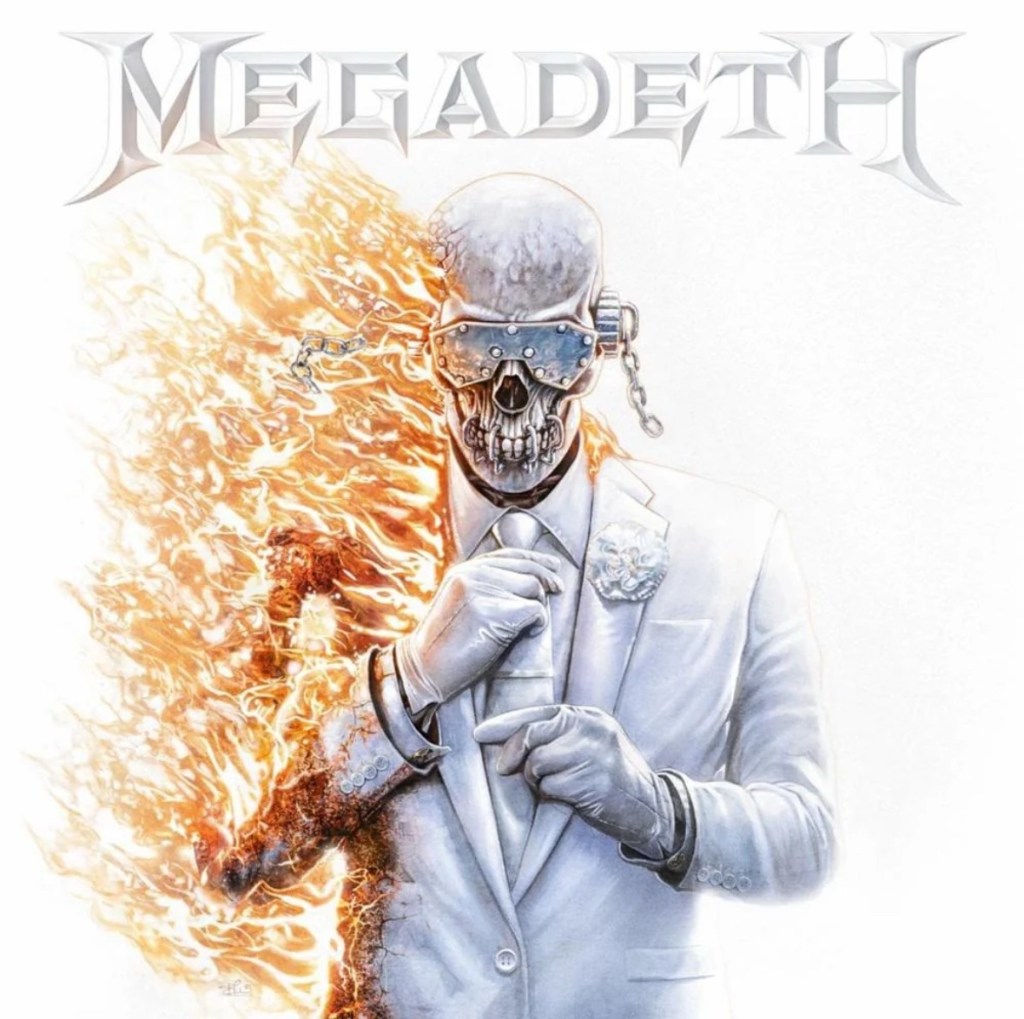
Megadeth

The album didn’t just arrive, it was staged.

Announced in August 2025 with Vic Rattlehead literally on fire, rolled out through four singles across four months, and framed as the final Megadeth statement.

Not a late-career album. A closing argument. The farewell tour wasn’t an afterthought; it was embedded in the release plan.

Production began quietly in late 2024 with producer Chris Rakestraw, largely remote at first. Mustaine and guitarist Teemu Mäntysaari traded ideas while the room was empty. This will be the only Megadeth studio album Mäntysaari will ever appear on, which gives his playing a different gravity, it’s not contribution, it’s inscription.

Mäntysaari arrives with a pedigree that matters more than hype: classically trained, composition-literate, and forged in the Scandinavian metal ecosystem where precision, melody, and structure are non-negotiable.

Best known for his work in Wintersun, he comes from a lineage that treats guitar not just as a weapon but as an architectural tool, stacked harmonies, modal phrasing, neoclassical discipline, and an almost orchestral sense of movement. You can hear influences ranging from European power metal and melodic death metal to classical and film-score logic, where riffs aren’t just aggressive but directional.

As a co-writer with Mustaine, Mäntysaari doesn’t challenge Megadeth’s DNA; he refracts it. The result is a distinctly Euro-metal contour, tighter harmonic logic, cleaner thematic development, and a sense of inevitability baked into the riffs, less street brawl, more war plan.

His presence subtly modernizes the band without diluting it, giving these songs a colder, more surgical feel that contrasts with Mustaine’s snarling, American thrash instincts. It’s not a takeover; it’s an overlay. And because this is his only Megadeth studio document, that influence feels permanent, etched, not experimented with.

By June 2025, vocals were being tracked. By January 2026, the album was positioned as history.

Tipping Point

This is the mission statement.

Flat-out thrash. No apology. No warm-up. The title is a tell, this isn’t about balance, it’s about inevitability. Musically, it does exactly what a “final album” lead single must do: reassure the base. “Yes, we can still do this. Yes, the hands still work.”

What’s more revealing is what it doesn’t do. No experimentation. No curveballs.

Mustaine knows the first impression defines the entire conversation.

And it works.

“Today I may bleed, but tonight you will die”

Patience weaponized.

“You buried the truth under layers of lies”

Self-inflicted decay. The deeper the stack, the more violent the reckoning.

“Push me, I push you back”

Symmetry established. You set the terms; I enforce them.

“Hiding your secrets out in plain sight”

Collective denial. The secret survives not by concealment, but tolerance.

And then the outro riff lands like a body blow.

“You won’t define me, you’ll never find me”

Refusal of containment. To define is to reduce. To find is to fix. Autonomy is reclaimed through disappearance.

The tipping point isn’t rage. It’s clarity.

I Don’t Care

Three minutes. Punk bones. No fat.

This reconnects Megadeth with the sneer that predates thrash orthodoxy. It’s not refined, and it’s not trying to be. That’s the point. Precision was never the whole story; attitude was.

Releasing this as the second single is a message: don’t expect reverence. This isn’t a victory lap. It’s a shrug with distortion.

“I don’t care what the headline said”

A rejection of outsourced reality. Headlines collapse complexity into verdicts built for attention, not truth.

“You know a rat never learns”

Not an insult, but pattern recognition. Repetition without reflection. Once behavior stabilizes, hope of reform disappears. Expectation shifts from change to containment.

Hey, God?!

Classic Mustaine: theology as confrontation, grievance elevated to cosmic scale. Musically solid, structurally familiar.

“The years are passing by like days”

Time compression, not aging. When days lose distinction, life accelerates.

The fear isn’t death, it’s unused life.

And make sure you stick around for the guitar solos.

Let There Be Shred

The most Megadeth song here, and the most ridiculous. Which is why it works.

Creation myth rewritten as guitar doctrine. No irony. No wink. Just total commitment. Mustaine dares you to flinch first.

“On the day I was born, a guitar in my hands”

Identity fused to function. Not “I chose this”, this chose me. Careerism disappears.

What’s left is vocation.

“Destroying pretenders, only ashes remains”

Authenticity under pressure.

Puppet Parade

The curveball.

Mid-tempo. Melodic. Built for repeat listens. The kind of song late-’90s Megadeth fans pretend never happened, and yet it’s arguably the best-written track here.

The irony is precise: the song about manipulation is the most controlled thing on the record. Hooks are intentional. Dynamics are measured. Accessibility was never incompetence; it was choice.

“I punch your clock, I play a role”

Labor as submission. Performance without belief. Effort is real; meaning is outsourced.

“Where the lies are truth / And our lives are trade”

The moral core. Reality assigned, not discovered. People reduced from ends to inputs. Exploitation normalized through redefinition.

Once that switch flips, marching doesn’t need enforcement. It’s automatic.

Another Bad Day

Functional. Efficient. Disposable.

Nothing offensive. Nothing essential.

“My life’s a mess, but I call it mine”

Ownership without redemption. No fixing. No reframing. Just authorship claimed.

“Every scar is a line I drew”

Pain turned into power. Not innocence, responsibility. The quiet weight that follows.

Made to Kill

Thrash returns, lean and calibrated.

This is Megadeth on autopilot, but it’s a well-tuned autopilot.

Mäntysaari proves he understands the internal math of Megadeth riffs. You don’t remember it for the message. You remember it because it moves.

“Taught to pray, yet made to kill”

Contradiction as training. Belief installed alongside violence. Prayer as insulation, not restraint.

“Truth is sold in streaming lies”

Propaganda as infrastructure. Truth isn’t erased, it’s monetized and drowned in volume until disbelief feels pointless.

What survives isn’t ignorance.

It’s exhaustion.

Obey the Call

Shadowy control. Puppetmasters. Faceless systems. A reflection of Mustaine’s conspiratorial gravity.

“It feeds on faith, but it bleeds gasoline”

Belief exploited as fuel. Devotion weaponized. The cost is always physical.

“And the pawns will rise / And empires fall”

Not heroics, structure. Collapse seeded by control itself.

I Am War

Shorter. Sharper. More effective.

Less sermon, more declaration. It knows exactly how much energy it has, and spends it carefully.

“To know you, I become you”

Empathy weaponized.

Understanding as assimilation.

Victory through total cognitive immersion.

“I am war, I am hurt and pain”

Not metaphor, identity. War isn’t something enacted; it’s embodied.

No separation between actor and action.

The Last Note

Five and a half minutes of unresolved intent.

Sentiment or defiance?

Curtain call or middle finger?

It wants both and never fully chooses. Which is fitting. Mustaine has never mastered endings.

“One more winding road that I won’t come back”

Finality without drama. Motion without return. Acceptance, not mourning.

“Each song has got beneath my skin”

Creation as accumulation. Art doesn’t cleanse, it erodes and stays.

“I can’t outrun the spinning hands of time”

Aging as pursuit. Speed once solved everything. Now it doesn’t.

“They gave me gold, they gave me a name”

Recognition as transaction.

Success always arrives with a bill.

Ride the Lightning (Metallica cover)

Not an encore, a provocation.

Ending the final album by revisiting the band that expelled you isn’t nostalgia. It’s wound management. The performance is heavier, cleaner, but its purpose isn’t musical.

It’s psychological.

“There’s someone else controlling me”

Agency surrendered to process. Terror born not from chaos, but automation.

“Consciousness, my only friend”

Everything external stripped away. Awareness remains, forced to witness its own erasure.

The cruelty isn’t death.

Its presence during death.

The “Ride the Lightning” cover didn’t drift into the middle, it drew a line. Based on a sample of X comments, fans either hear a powerful legacy statement or an unnecessary retread. The split is clean: some hear reverence and authority, others hear dilution and loss of danger, with a small group stuck in polite indifference.

For me, it works. The slightly increased tempo injects urgency without rewriting history, and the performance understands the assignment: pay homage, don’t vandalize the blueprint. It respects the original’s gravity while letting Megadeth’s muscle show through.

This isn’t really about quality. It’s about philosophy.

Do you want a cover to preserve the fire, or to replace it?

To sum it all up, it’s a controlled burn, a managed farewell that captures exactly what Megadeth has always been: brilliant, stubborn, technically elite, emotionally unresolved, and incapable of clean exits.

If this really is the end, it ends the only way it could.

Not with peace. With insistence.

And that’s the most honest thing Megadeth could have done.

P.S. i just listened to the bonus tracks “Bloodlust” and “Nobody’s Hero” on YouTube. Wow. But they will be for another post.

Standard