Copyright, Music, Treating Fans Like Shit

My Love Affair With Spotify Is Over

There was a time when Friday meant Release Radar.

I’d open Spotify and there it was: a little digital treasure chest of new music.

Sometimes it was brilliant. Sometimes it was shit. Sometimes it was something I’d never heard of from a band I’d never heard of and suddenly I’d spent the next three weeks listening to their back catalogue.

That was the magic.

Spotify didn’t just give me music. It gave me the possibility of discovering something.

I’m not sure when that disappeared. But my love affair with Spotify is over.

Spotify won.

That’s the funny part.

It has mass acceptance. It’s become infrastructure. Music streaming isn’t some revolutionary new technology anymore. It’s plumbing.

And once something becomes plumbing, you stop asking whether it’s magical. You just turn the tap on. And the water is there.

Which raises an uncomfortable question: What happens when the thing you once loved becomes merely good enough?

Spotify keeps raising prices. The product keeps evolving. There are more features, more data, more playlists, more recommendations, more algorithms and more ways to consume music than ever before.

And yet I’m increasingly convinced that the actual experience of discovering music has become worse. That’s quite an achievement.

We’ve gone from having too little music to having virtually all of it.

And somehow I’m listening to the same records I bought thirty years ago.

The Discover playlist used to be good. Like, really good.

Eight years ago it could occasionally make me stop what I was doing.

“What the fuck is this?”

That’s the best feeling a music service can give you.

Now?

Not so much.

The recommendations increasingly feel like they’ve been generated by somebody who looked at my listening history and decided that the safest possible interpretation of it was the best one.

I listen to Thin Lizzy. Here’s some Thin Lizzy. I listen to Whitesnake. Here’s Whitesnake. I listen to Iron Maiden. Here’s Iron Maiden.

I’ve saved these songs.

So apparently Spotify thinks I want to hear them again tomorrow.

And the day after that. And perhaps in a different playlist on Thursday.

Saving a song does not mean I want to hear it every fucking day. It means I like the song. There is a difference.

The Daily Mixes are probably the perfect example. They’re not really discovery. They’re comfort food. They’re Spotify saying:

“We’ve studied your behaviour and concluded that you’d probably like the things you already like.”

Well, thanks. I knew that. That’s why I saved them.

The whole reason I use a streaming service is because I don’t want to have to manually construct my listening experience every day.

I want to be surprised. I want the obscure album. The forgotten B-side. The guitarist I somehow missed. The band from 1987 that released one great album and disappeared. The song that isn’t popular enough to have been algorithmically blessed.

I want the rabbit hole. And the rabbit hole is where Spotify increasingly feels lost.

Then there’s Release Radar.

This one hurts because Release Radar was once my favourite thing Spotify did.

Every Friday I’d go looking for new music. And now I get:

A new XYZ release from a Hindu Yogi. A new Loverboy release from a young rapper. A new Sykes release from someone who definitely isn’t John Sykes. A new Ratt release that isn’t from Ratt.

Somewhere between the artist, distributor, metadata database, record label and algorithm, something has gone spectacularly fucking wrong.

And I understand how this happens. There are thousands of artists. There are multiple artists with the same names.

There are distributors.

Labels.

Rights holders.

Metadata.

Automated ingestion.

Millions of releases.

It’s complicated.

But that’s the problem.

The system is complicated enough to explain the mistake and still not good enough to prevent it.

And every Friday, instead of opening a treasure chest, I’m checking whether Spotify has accidentally delivered somebody else’s mail.

And the music itself can disappear.

There’s another bizarre problem with the streaming age. We were promised access to everything. And for the most part, we got it.

But streaming isn’t ownership. It’s access. The music is sitting there until somebody decides it shouldn’t be.

Licensing changes. Rights change hands. Distributors disappear. Labels change. Artists change their minds. Regional agreements expire.

Albums appear. Albums disappear. Albums come back. Then disappear again.

Maybe some of the master tapes don’t even exist anymore. Maybe they burned down in one of those mysterious fires that seem to have consumed half the history of recorded music.

But here’s the strange thing: We were told digital music would solve scarcity.

Instead, we’ve created a different kind of scarcity.

The music isn’t necessarily hard to find. It’s hard to know whether it’ll still be there tomorrow.

The cloud looks permanent.

It isn’t.

Here’s where I really started to understand the problem. Ask Spotify for something simple:

“Best emotive guitar solos.”

Go on.

Do it.

You don’t get emotion. You get metadata. You get lists compiled by magazines.

Lists compiled by websites. Lists compiled from other lists. Wikipedia. “The 50 Greatest Guitar Solos Of All Time.”

And there’s the problem.

Spotify knows what an emotive guitar solo is supposed to look like in data. It doesn’t necessarily know what makes one matter.

Because how do you quantify Michael Schenker playing “Try Me”?

How do you quantify David Gilmour playing “Comfortably Numb”?

How do you explain Zakk Wylde on “Angel of Mercy”?

Mick Mars on “Home Sweet Home”?

C.C. DeVille on “Life Goes On”?

John Sykes on “Straight For The Heart”?

Warren DeMartini on “Giving Yourself Away”?

George Lynch on “Alone Again”?

John Petrucci on “Learning To Live”?

Al Pitrelli on “Blue For You”?

Gary Moore on “Empty Rooms”?

Eddie Ojeda on “The Price”?

Vivian Campbell on whatever particular piece of magic he happened to be responsible for that week during his stint with Dio.

Yngwie Malmsteen doing what Yngwie does.

Vinnie Vincent on “I Still Love You.”

Steve Rothery on “Easter.”

Bruce Kulick on “Tears Are Falling.”

Bob Kulick on “The Idol.”

Randy Piper on “Sleeping in the Fire.”

Richie Sambora on “Dry County.”

Dave Meniketti on almost fucking anything.

Adrian Smith on “Stranger in a Strange Land.”

James Hetfield on “Nothing Else Matters.”

Kirk Hammett on the outro to “Bleeding Me.”

Randy Rhoads on “Goodbye To Romance”. There are many others that I can’t think of right now.

These aren’t simply guitar solos. They’re moments. They’re performances. They’re context. They’re tone. They’re restraint. They’re excess. They’re the note that arrives half a second later than you expect.

They’re the bend that hangs in the air. They’re the player knowing when not to play. They’re everything that happens between the notes. Try putting that into a database.

And this is where I don’t buy the lazy argument that Spotify’s engineers are idiots.

They’re not.

They’re probably fucking brilliant.

They’ve built an extraordinary machine. Spotify knows what I’ve listened to. It knows what I’ve skipped. It knows what I’ve saved. It knows what people who listen to the bands I listen to also listen to.

It knows tempo. Genre. Popularity. Release dates. Listening patterns.

It can probably predict with frightening accuracy that if you listen to Judas Priest at 10:47pm on a Wednesday, there’s a statistically meaningful chance you’ll listen to Iron Maiden next.

It’s incredible.

And yet I ask it for an emotive guitar solo and it gives me an SEO list.

That’s the paradox.

The machine understands the data surrounding music extraordinarily well.

I’m not convinced it understands music.

This is where Spotify’s problem becomes everybody’s problem.

We’re increasingly trying to turn taste into data. But taste isn’t simply a collection of preferences.

Taste is memory. Context. Association. Experience. History.

You don’t just like David Gilmour.

Maybe you heard “Comfortably Numb” when you were fifteen.

Maybe you heard it when you were thirty-five.

Maybe the guitar solo reminds you of someone who isn’t in your life anymore.

Maybe you heard Gary Moore’s “Empty Rooms” at exactly the wrong moment in your life and now the opening notes carry twenty years of emotional baggage.

Spotify doesn’t know that.

And it can’t.

Because the emotional meaning of music isn’t contained inside the audio file.

It’s contained inside you.

That’s why two people can listen to the same song and hear completely different things.

And that’s why the idea that an algorithm can eventually know your taste better than you do is worth questioning.

Maybe it can predict your behaviour.

That’s not the same thing.

We lost the obsessive music nerd.

There used to be people who knew music. The guy in the record shop who’d hear you mention Van Halen and say: “You need to hear this.”

The radio DJ who’d play something you’d never heard. The bloke at school who had an album nobody else had. The friend who’d make you a mixtape.

The magazine writer who’d disappear down some obscure musical rabbit hole and drag you along with them.

They were often wrong.

And that’s what made them useful.

Algorithms want evidence.

Humans have hunches.

Humans make mistakes.

Humans have obsessions.

And sometimes an obsession is exactly what you need.

Spotify has become safe. It got too good at being Spotify.

It knows what I like. It knows what people like me like. It knows what songs are popular. It knows what songs are associated with other songs.

It knows what gets skipped. It knows what gets saved. It knows everything except the one thing I’m actually asking: Surprise me.

Not randomly. Not stupidly.

Not with another artist whose name happens to match the artist I’m looking for.

Surprise me intelligently.

Take a risk. Connect two things that don’t obviously belong together.

Tell me why. That’s what a great music obsessive does.

And then there’s YouTube, sitting there with an enormous music catalogue as well.

And YouTube has something Spotify doesn’t have in quite the same way: the internet’s collective memory.

Live performances. Interviews. Bootlegs. Old television appearances. Fan uploads. Rare tracks. Alternate mixes. Gear breakdowns. Concert footage. Someone filming a guitarist playing one obscure solo in 1989.

The ecosystem is chaotic. But chaos has advantages.

Spotify is beautifully organised. YouTube is a fucking junk drawer.

And sometimes the junk drawer is exactly where you find the thing you were looking for.

So what am I actually paying Spotify for?

That’s the question I keep coming back to. Because Spotify isn’t bad. That’s almost the problem. It’s convenient. It works.

The catalogue is enormous. The interface is good. The sound is good. The integration is good. It’s easy. (In saying all of this, I’m currently devouring the Bernie Torme history).

And that’s exactly why I’m frustrated.

I’m paying for convenience and getting increasingly less discovery.

The service is becoming more expensive while the thing I personally valued most about it seems to be deteriorating. Maybe that’s not a universal experience.

Maybe millions of people couldn’t care less about Release Radar.

Maybe most people just want to press play and hear songs they already like.

That’s perfectly rational. But I’m not most people.

And I don’t want Spotify to know me so well that it stops introducing me to things I don’t know.

We’ve never had more music. Millions of albums. Decades of recorded history.

Every obscure corner of rock, metal, jazz, blues, punk, pop, electronic music and everything else sitting inside a phone.

Humanity has created an almost unimaginable archive of sound.

And yet the technological solution to infinite choice seems increasingly to be: Here’s the stuff you’ve already heard.

That’s not discovery. That’s a loop. An echo chamber.

And the larger the database becomes, the more important curation becomes.

Not less.

Because abundance creates its own scarcity.

There is too much music. There are too many releases. Too many artists. Too many playlists. Too much content.

The scarce resource isn’t music anymore.

It’s attention.

And the service that wins isn’t necessarily the one with the most music.

It’s the one that can make me care about something I didn’t know I cared about.

I don’t want better algorithms.

Maybe that’s the wrong conclusion. Maybe I don’t need another algorithm. Maybe I need better curators.

Or weird curators. Or human curators assisted by algorithms.

Let the machines do what they’re brilliant at. Find patterns. Search billions of tracks. Surface connections.

Handle the impossible scale of the catalogue.

But let humans inject the thing machines are still terrible at: taste.

Give me the obsessive metal nerd.

Give me the person who knows every forgotten 1980s hard-rock record.

Give me the person who can tell you which pressing of an album sounds better and why.

Give me someone who has spent thirty years listening to guitar players. Someone who knows why that solo matters.

Maybe the problem is that Spotify stopped feeling like a record shop.

That might be what I’m really missing. The record shop wasn’t efficient. It wasn’t personalized.

It didn’t know my listening history.

It couldn’t calculate my predicted enjoyment of an album.

It didn’t have machine learning.

It had a bloke behind the counter who had listened to 10,000 records and had strong opinions.

And sometimes he’d hand you something and say:

“You’ll hate this.”

Then you’d buy it anyway.

And thirty years later you’d still be listening to it.

That’s discovery.

That’s the thing Spotify used to make me feel.

And somewhere along the way, the algorithm got better and the experience got worse.

So no, Spotify isn’t dead.

Far from it. It’s enormous. It’s successful. It’s going to be around for a very long time.

But my love affair with it is over.

Because Spotify has access to more music than any human being in history.

And somehow, I’m finding myself listening to the same records I bought thirty years ago.

Maybe the problem isn’t that Spotify doesn’t have enough music.

Maybe it has too much.

Maybe the problem is that somewhere inside that enormous machine, nobody knows what makes one fucking note matter.
Standard
A to Z of Making It, Music, My Stories

Is Rock Really Dead? Let’s Talk About It.

So, my Release Day playlist on Spotify one week was packed with tracks like “Who Said Rock N Roll Is Dead” by Crazy Lixx, “Rock N Roll Survivors” by Bonfire, and “Gods Of Rock N Roll” by Billy Morrison, Ozzy Osbourne, and Steve Stevens.

Then the next week it had “Rock And Roll Party Cowboy” from The Darkness. And my train of thought moves to “Rock And Roll Deserves To Die”, one of my favorite songs from em.

Naturally, it got me thinking about the ever-recurring debate:

Is rock actually dead?

Lenny Kravitz released a song titled “Rock and Roll Is Dead” on his 1995 album “Circus”, a cynical take on the state of rock music at the time.

Marilyn Manson, has a song “Rock Is Dead” from the 1998 album “Mechanical Animals” which is critical of the commercialization and his perceived decline of rock’s rebellious spirit.

L.A. Guns released a song titled “Rock and Roll Is Dead” on their 2005 album “Tales from the Strip”, about the genre’s struggles in the modern era.

Even The Doors’ had a track “Rock Is Dead” (recorded in 1969, released posthumously).

Gene Simmons is the guy most often quoted on this. In a 2022 statement, he told “Metal Hammer”, “I stand by my words, rock is dead and the fans killed it,” blaming file-sharing and the decline of record industry support for new rock talent. He also elaborated on this in a 2014 “Esquire” interview, pointing to the lack of new iconic bands since the Beatles era and the economic challenges for emerging artists.

However plenty of legacy artists share a similar sentiment.

Jay Jay French fromTwisted Sister had made a few forays into this. You can read his latest here.

He makes a good argument about rock’s decline in cultural relevance, essentially claiming that rock is “dead” because it no longer produces massive young stars like it did in the late ’60s and ’70s.

He also points out that rock doesn’t define youth identity in the way hip-hop, pop, and country do today. It’s a compelling argument, but it’s not the full picture.

So where does Jay Jay have a point.

Rock isn’t the dominant force in youth culture anymore. Streaming, social media, and internet-driven virality have helped hip-hop and pop thrive while rock has struggled to keep up.

Since exact weekly numbers aren’t available, I’ll estimate based on monthly listener counts and annual streams, dividing by 52 for a rough weekly average, adjusted for current trends.

The top 50 metal and rock artists generate 70-100M weekly streams. This is a fraction of the broader streaming landscape, where total weekly streams across all genres exceed 4-5 billion (based on Spotify’s 2023 global totals of 200B+ annual streams).

Pop/Hip-Hop genres account for 50-60% of streams. Their top 50 artists alone could hit 400-500M weekly, 4-5x higher than metal/rock.

Metal and rock, despite passionate fanbases, remain a smaller player in the streaming game, punching above their weight culturally but not numerically.

The days of four kids in a garage forming a band and becoming icons by 25 is way harder to pull off now. Labels and streaming platforms push polished, solo acts over traditional bands.

Just like jazz and big band had their golden eras before becoming niche genres, rock’s mainstream heyday as a youth movement may simply be over.

So where does Jay Jay’s argument fall short?

Sure, rock isn’t a monoculture anymore, but it’s alive and well in subgenres like metal, indie, punk, and prog. Just because it’s not topping the Billboard Hot 100 doesn’t mean it’s dead.

Even in those subgenres, there are further subgenres and even more splintering.

In Latin America, Japan, and Scandinavia, rock and metal are huge. Just because the major markets aren’t as tuned in doesn’t mean the genre is extinct.

Back in the day, you were either a rock and metal fan or a hip-hop fan.

Now?

A single playlist might have Metallica, Bon Jovi, Kendrick Lamar, Whitesnake, Shinedown, Taylor Swift, and Bring Me The Horizon. Genre loyalty is weaker than ever.

As much as the internet was meant to level the playing field and remove the gatekeepers, streaming algorithms and major labels still push what’s easy to market.

Rock isn’t dying; it’s just not the industry’s priority.

French isn’t wrong. Rock doesn’t dominate pop culture like it used to, and we’re unlikely to see another Beatles-level rock phenomenon.

But calling it “dead” is an oversimplification.

The genre is evolving, diversifying, and thriving in different ways. It might never reclaim its past mainstream dominance, but it’s far from irrelevant.

Standard
A to Z of Making It, Copyright, Music, My Stories, Stupidity

Four For Friday

It’s a SPOTIFY and HIPGNOSIS special today.

The article I am referencing is from Music Business Worldwide.

NEW ROYALTY MODEL

There will be an annual stream count that artists must meet in order to start generating Spotify royalties.

Spotify is targeting a tiny proportion of tracks on its service that are very low in popularity.

In total, the tracks Spotify is targeting, generate royalties that when combined add up to tens of millions of dollars a year. If no action is taken, these tracks accumulated together will generate around $40 million.

SO WHAT HAPPENS TO THE $40 MILLION?

It will go back into Spotify’s ‘Streamshare’ royalty pot.

And the monies in the pot will be re-distributed amongst the tracks that are, more popular.

Take from the poor so that the rich get richer.

Spotify is telling the world that this targets the royalty payouts whose value is being destroyed or who are not even being paid to the creators because they haven’t met the digital aggregator minimum level for payments. And they are sitting in their bank accounts, earning interest.

Spotify seems to forget that every artist begins with low plays/streams.

MMM. SO THIS HELPS THE ARTISTS HOW

So while Spotify is thinking of keeping streaming money in their bank account to pay the larger artists, Hipgnosis who is an investment fund is doing something fishy.

As you probably are aware, Hipgnosis purchased a lot of rights to valuable intellectual properties. It’s share price doesn’t reflect what the company believes it’s worth.

It wanted to do something sneaky to inflate or boost its share price by selling a stake of the company to another entity owned by Hipgnosis and to use the profits of the sale to pay down debt.

This was all contingent on some mathematical equations about retroactive Copyright payments from the US.

Hipgnosis estimated they were due USD$21.7M however when all the dust settled they are only getting $9.9 million.

So they had this share but back scheme which they have now shelved and their share price went down even further.

All of these schemes and creative accounts on the backs of the rights they own from artists.

And Yes, I do know that the artists sold their rights to Hipgnosis for a large fee.

Standard
Copyright, Derivative Works, Music, My Stories, Piracy, Stupidity

Four For Friday

When I started these weekly posts it was a means to keep me blogging during a hectic schedule.

And there was no definitive structure as to what I would cover. But I can see that Cooyright issues keep appearing.

And here is another week devoted to that beautiful term. Copyright. Which was designed to give the creator a limited monopoly on their works so they could create more works.

LETS GET IT OVER WITH

Ed Sheeran can’t get a break. Last week, the case against him from the daughter of Ed Townsend was dropped.

But this week, an organization called “Structured Asset Sales”, (SAS) have started their own litigation.

They control a different one-third stake in Townsend’s copyrights. They “own” the basic notation (musical score) filed at the Copyrights Office decades ago.

When the original case was happening, (SAS) was also a part of it, seeking a “monopoly over a basic musical building block.”

Their case was also thrown out.

But they are appealing their part. Because hey, they created nothing and believe they should be paid for creating nothing. And they want a monopoly on a feel and style.

A big reason why Copyright had expiry terms initially was to stop all this crap. Politicians had a foresight back in the early 1900s to see this coming.

And that changed in the 60s when the labels and book publishers started to amass intellectual property and then started to lobby politicians to change laws and bring in new laws to give these corporations a monopoly on the works.

It’s funny now, how the labels are also getting sued from the very laws they sponsored to benefit them.

124 WEEKS

In April 2021, UFC fighter Jake Paul knocked out Ben Askren in less than two minutes.

Soon after, the popular H3 Podcast on YouTube commented on the fight and showed a clip of the fight.

Event promotor Triller wasn’t happy and issued a copyright infringement lawsuit demanding $50 million in damages.

H3 opted for a fair use defense.

The case is now in its 124th week.

The clip of the fight was 119 seconds long.

Who are the real winners here?

URUGUAY

The Uruguayan Government has a bill in motion which would allow artists to go direct to internet platforms like Spotify and social media sites like Facebook for compensation.

Spotify would still need to pay the existing licensing agreements and if this bill goes ahead could be forced to pay again to the artists direct.

I’m all for artists getting paid but the problem lays with the entities who hold the rights to the songs. They get the majority of the streaming pool and they don’t distribute it back to the artists.

This is a perfect example.

Spotify still needs to honor the licensing agreements with the labels and publishers so these organizations will receive their cut.

And if they are aware of the artist going direct, I am sure that some creative accounting will take place to hold back any payments to the artists.

Anyway. Spotify isn’t happy with the bill and unless it’s changed they will pull out of Uruguay.

As a byproduct, the local music industry which has been growing 20% from streaming revenue will have this source of income come to zero.

ALBERT NAMATJIRA

Albert Namatjira died in 1959. He was an Aboriginal artist, painting the Australian landscapes in watercolors.

The copyright in his art is due to expire in 2029, 70 years after his death.

This means the works will be part of the public domain and anyone can use them in their works moving forward.

But lawyers for the family are arguing that Copyright should last in perpetuity. Forever. Never expire.

And they are pissed.

The issue here is that the family were getting royalties for his art up until 1983. At that point in time, the government trust that administered the rights sold them to a private organization and the royalties ceased.

It took the family 34 years to get the rights back in 2017, with the proviso they need to relinquish them again in 2029.

Furthermore in the last 5 years, Namatjira’s art has exploded in popularity and has become a valuable intellectual property.

But Copyright was never meant to be a reversionary pension fund.

Standard
A to Z of Making It, Copyright, Music, My Stories, Stupidity

Four For Friday

Copyright and Spotify again.

SHARE PRICE

It’s cool how copyright makes money for valuable Intellectual Property. And you can’t get a bigger and more valuable IP than “The Beatles”.

The thing is, not one of the members from The Beatles held or even hold their rights. At one stage, Michael Jackson was the sole holder of the rights.

And with all the transfers and sell offs, The Beatles catalog settled at Round Hill Music Royalty Fund. But like all companies on the stock exchange, the share price just didn’t reflect the true value of the Company.

In this case, shares in the company were trading around $0.70. And share prices this low don’t make share holders and board members happy.

So in comes Alchemy Copyrights with a $496 million buyout offer which means shareholders in Round Hill Music will get $1.15 in cash per share. Suddenly, you have happy shareholders and board members, who get a nice payday for holding shares in culture.

They created nothing culturally and yet still benefit. But I keep hearing how stronger copyright is needed to protect the creators.

Mmmm.

SHARE PRICE 2

Hipgnosis Songs Fund is also selling some of its catalogues for $465 million. This is to pay down debt and increase its share price

And as expected, the share price increased,

Again, you have an organization that created nothing culturally and yet it still benefits. And I keep hearing how stronger copyright is needed to protect the creators.

COPYRIGHT FAMILY DISPUTE

Motown songwriter and producer Ron Miller died in 2007. If Copyright expired on the death of the creator like it once did, then this would be a non issue.

But, Copyright doesn’t expire at this point. It’s still valid for another 70 to 90 years, depending on the country.

Fast forward to 2022, Sony Music Publishing signs a deal with Lisa Miller, for rights to 130 of her fathers songs.

But Ron’s other children Julie Moss and Mark Miller from Ron’s first wife didn’t like this and are now going to court.

They allege that Lisa Miller tricked her mother, Aurora Miller (Ron’s second wife) to sign away her claim to the songs.

The claim further states;

“As Aurora’s health continued to decline, Lisa began forging Aurora’s signature on notices of copyright termination.”

And I keep hearing how stronger copyright is needed to protect the creators. In this case a dead creator.

SHOWCASE

Spotify’s new marketing tool.

Artists can buy dedicated space on listeners home pages to promote new releases, deep cuts, etc.

Each click from a fan on the showcase button will cost the artist 40 cents per click until their campaign budget is maxed.

Spotify believes that people who see these ads are six times more likely to stream the release.

It shits me how artists always have to cough up cash.

Back in the label days, if the label marketed you, they billed you to recoup their costs.

If an independent act marketed themselves, they paid for a marketing campaign themselves.

Standard
Copyright, Music, My Stories

Four For Friday

It’s all about Spotify today.

MONEY LAUNDERING

This time around Swedish criminal gangs are using Spotify launder money.

The scheme is interesting.

The drug money they have is converted to bitcoin.

Bitcoin is then used to pay “fake stream” entities to do exactly that, create fake streams on Spotify for an artist.

The artist in question is linked or involved with the gang.

By creating the fake streams, the artists would end up on top of the charts and as a byproduct, those fake streams would lead to real streams.

As the Guardian article explains:

Higher streams lead to higher payouts from Spotify. The newspaper said that in Sweden, amassing a million streams pays about 40,000 to 60,000 kronor (£2,800 to £4,300).

WHITE NOISE

Have you ever come across a Podcast that’s just white noise.

It’s definitely annoying and I don’t care what people say about it, it’s basically streaming spam.

The rule was if the podcast got over a 100 listens (it can be from the same user) they would qualify for ad supported payments.

Well now it’s 1000 unique listeners before they qualify. Hopefully they just filter out.

SONGS AND SPAM

In 2018, 20,000 songs would get uploaded to Spotify. In 2023, it’s at 120,000. A large majority of those uploads are via bots and they are basically the same as email spam

AI COVERS

AI-generated “covers” of popular songs using artists’ voices are still being released on Spotify.

Universal’s trying to partner with Google on a tool that lets fans create these songs without infringing copyright.

Universal has also partnered with Deezer to ensure that music created by breathing people gets a higher preference on the service than AI created music.

It’s a start, however AI is really making streaming economics even trickier.

Standard
A to Z of Making It, Copyright, Music, My Stories, Piracy, Stupidity

Four For Friday

RIAA POWERS

How much power is too much power?

Two years ago, the RIAA won a piracy lawsuit against two sites that offered YouTube-rippers. For those that don’t know, these sites allow the user to turn a YouTube video into an mp3.

After the verdict, the RIAA demanded $83 million in damages from the site owners.

And suddenly, there was an appeal.

As the TorrentFreak article explains;

“If the record companies can really get multi-million dollar judgments without having to prove a single instance of infringement within the United States, then no one who operates a website is safe,” Gurvits (Defense Lawyer) said at the time.

There has to be some onus on the RIAA to prove infringement.

And they can’t because they don’t know who infringed.

It’s easy to get a techie to run a report and say that the YouTube ripping sites were accessed by U.S IP addresses. But. It’s not easy to prove who is responsible when their evidence is made up of IP addresses.

But accessing the sites doesn’t constitute Copyright infringement. And the RIAA cannot prove what infringement took place or what videos from YouTube were turned into mp3s.

So why is the law allowing them to bring cases to trial without this proof.

JASON ALDEAN

The song “Try That In A Small Town” came out in May 2023 and it was out of the public conversation. It was a dud and no one cared enough to listen to it. His true fans did but no one else.

Then someone (Critic Zero) started the backlash against the song in the middle of July, 2023 and by doing so, they amplified the song by providing much needed free marketing.

The criticism then spread to other blogs and news outlets faster than Covid and as a by product the streams and downloads of the song kept going up. In the space of two weeks the songs Spotify numbers went from 1.5 million to 12.3 million.

To top off the controversy, Aldean and his team had to edit the music video because it contained footage which was copyrighted.

SPOTIFY INCREASE

The price of Premium Family is changing from A$18.99/month to A$20.99/month.

My favorite part is the reason Spotify gives for the increase, which is word for word to what Netflix gave a year ago;

We’re increasing the price of Premium Family so that we can continue to invest in and innovate on our product offerings and features, and bring you the best experience.

Really.

It’s nice to know that Spotify is using subscription money to pay people for podcasts that a lot of their customers don’t like.

BAND I’M SEEING

I’ve got tickets to watch “The Night Flight Orchestra” in Sydney next Friday. Readers of the blog will know that I am a fan. Each album has been reviewed glowingly.

In case you are interested.

You can read the debut album “Internal Affairs” (2012) review here.

“Skyline Whispers” (2015) is here.

“Amber Galactic” (2017) is here.

“Sometimes The World Ain’t Enough” (2018) is here.

“Aeromantic” (2020) is here.

“Aeromantic II” (2021) is here.

SONG IM LISTENING TO

“Crime Of The Century” by Revolution Saints. It’s a great piece of melodic rock and that Chorus just sticks around forever.

My review of the recent album is here.

Standard
A to Z of Making It, Classic Songs to Be Discovered, Copyright, Influenced, Music, My Stories

Four For Friday

It’s all about Copyright, that little piece of legislation meant to give creators a monopoly on their works, so they could create new works, however the creators now sell or license their rights to a corporation, who then seem to hold onto the rights forever and by doing so, the Corporations keep lobbying hard to change laws so copyright lasts forever.

THE VALUE IN COPYRIGHTS KEEPS GETTING BIGGER

It’s 2008 and the Global Finacial Crisis decimated assets across the world. In these wastelands, the Investment Houses turned to Copyrights to balance portfolios.

The arrival of streaming services took off the cloak and funny math on royalties by the labels. While artists complained about the pay per stream rate, one thing they couldn’t complain about was the amount of money paid to the organizations that held the rights.

15 years later, these portfolios keep making money for the Investment Houses as the majority of music consumers transitioned to streaming.

In 2022, Germany generated 1.656 Billion in streaming revenue. The total income for the country was 2.07 Billion so streaming equated to 80 percent of it.

Globally in 2022, streaming revenues reached 17.5 billion U.S. dollars. 70 percent of total recorded music revenue.

If you are not getting a cut of it, someone else definitely is.

COPYRIGHT AFTER DEATH

It’s been five years since Aretha Franklin died and her heirs are still fighting over who handles her Estate, which has her Royalties paid to.

The unusual trial will determine which of the two handwritten wills, including one found in couch cushions, will come in force.

The interesting part is how Aretha valued her earnings from Copyright, which she listed as $1. Meanwhile, the Estate earned $4 million in one year after her death.

SPOTIFY PAYMENTS TO SWEDISH ARTISTS

Since 2008, Sabaton has amassed 2.5 billion streams on Spotify. Check out the research.

It is estimated that Spotify has paid the rights holder of Sabaton’s catalogue between $9.6 million and $15.9 million during this time.

If Sabaton owned their Masters 100%, then they would have received between $7.6 and $12.6 million dollars from Spotify. It equates to $507K and $840K per year. There are five members in the band, so taking the lower amount, each member would get $100K each. This takes into account that they have no manager percentage, accountant percentage and so forth.

If they had a 50% Royalty agreement with their label, they would have received between $3.7 and $6.3 million dollars. It equates to $247K and $420K.

If they had a 20% Royalty agreement with their label, they would have received between $1.5 and $2.5 million dollars as the label would get the other 80%. It equates to $100K and $167K. Taking the lower value, each member would receive $20K for the year, which comes to $1,666 per month. This takes into account that they have no manager percentage, accountant percentage and so forth.

RE-RECORDINGS

The Law states that artists can get back their rights after so many years. But the labels are fighting each case tooth and nail.

So if the artists have the means, they are creating new masters and are making those new masters as canon. This in turn gives them control over their music and they can then license these recordings to TV Shows and Movies and Games on their own terms.

SONG I AM LISTENING TO

Chokehold from Sleep Token.

It came up on a Release Radar many months ago and I’ve been hooked ever since. Hooked enough to buy the Vinyl album when it came out a few weeks ago.

From the U.K, they combine Pop, R&B, World, New Age, Church, Classical, Folk and Djent like tech metal. And I’m a fan.

To show how much cross over appeal they have, you can watch Daughtry do a live acoustic cover of the song.

Metal music is always resilient to changes in genres however it’s also easily adaptable to other genres or it can be used as a fusion element.

And fusion is happening everywhere.

Taylor Sheridan is good at mashing unrelated and different story ideas into one cohesive story.
Yellowstone is a mash up of Classic Westerns, Medieval dramas with a lot of back story and political thrillers. Tulsa King is “The Godfather” in a Western setting.

And then I did some research on em, and they have a gimmick, wearing face covering like ninjas from an anime.

Check em out.

Standard
A to Z of Making It, Classic Songs to Be Discovered, Music, My Stories, Unsung Heroes

Dust And Gold

A shimmering clean tone guitar sets the song but it’s the vocals from Dave Hodges which makes me a fan.

Yes it’s the same David Hodges who was a studio contributor to Evanescence between 1999–2002 which accumulated in the “Fallen” album.

He has since had success co-writing and co-producing for various pop, pop rock and country artists, including Kelly Clarkson, Celine Dion, Daughtry, Backstreet Boys, Avril Lavigne, David Archuleta, Christina Aguilera, Carrie Underwood, Jessie James, 5 Seconds of Summer, and Tim McGraw. His career is basically an “A to Z in Making It”.

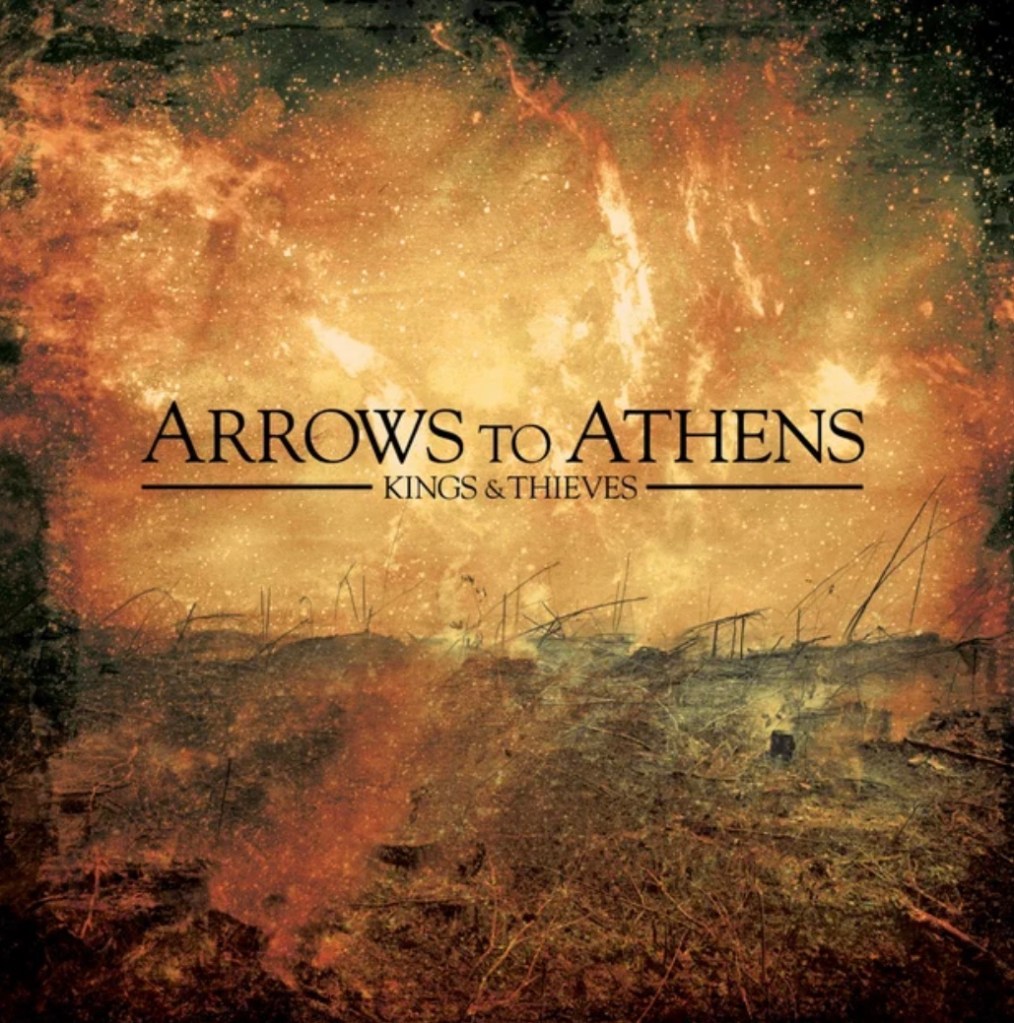
“Dust and Gold” is a song by Arrows To Athens, a David Hodges band project. It was released as a single in 2011 and later included on the band’s debut album, “Kings & Thieves” released in the same year.

It’s sitting at 5.4 million streams on Spotify. Forgotten. It’s a tragedy.

It’s down to you and me
On these cold and empty streets
Forgotten what we’re living for

The “you “ in this case is the persons belief.

The lyrics describe a struggle to find meaning and purpose in life. Their is reflection on the challenges and hardships faced, and wonders if there is any deeper significance to the experiences.

All I see are kings and thieves
When all I own is just dust and gold

The album title in the Chorus of another song.

The phrase could be interpreted in a few different ways, but generally, it speaks to the idea that people in power and those who steal or exploit others, who are normally the ones in power, seem to be the most visible and influential figures in society, while the second part of the phrase, “when all I own is just dust and gold,” could mean that the person has come to the realization that material possessions, hold little value in the grand scheme of things. This may contrast with the wealth and power of the kings and thieves mentioned in the first part of the phrase.

It can also be interpreted as a metaphor for the idea that while we may be insignificant in the grand scheme of things, we still have value and worth.

The mood and feel of the song has made it a popular choice for use in film and television, and it has been featured in trailers for movies like “The Mortal Instruments: City of Bones” and TV shows like “The Vampire Diaries.”

Musically, “Dust and Gold” features a driving beat and soaring vocals, with a sound that is reminiscent of bands like Thirty Seconds to Mars and Imagine Dragons.

Overall, “Dust and Gold” is a powerful and inspiring song that speaks to the universal human desire to find meaning and purpose in life, and to recognize the value of our own experiences and struggles.

Standard
Music, My Stories

Spotify Ramblings from 2022

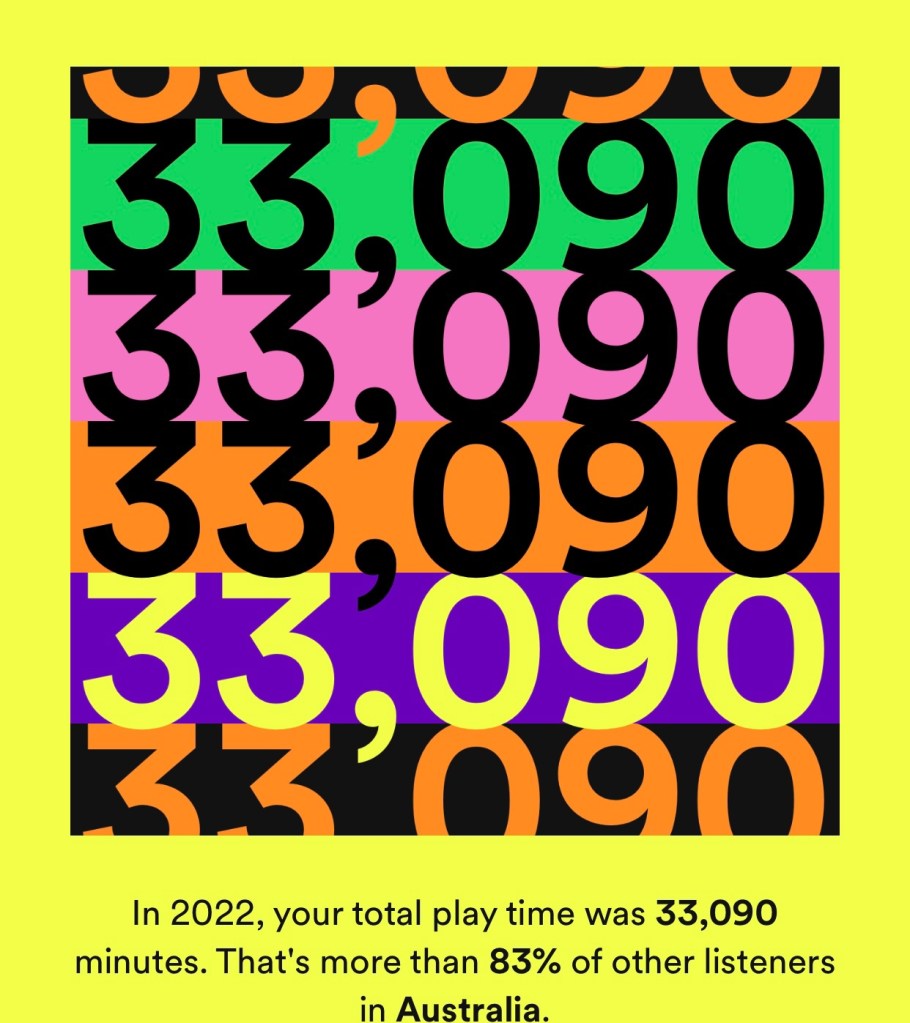
I listened to 33,090 minutes of music on Spotify last year. It equates to 90 minutes a day and it doesn’t include any vinyl or CDs played on my stereo system.

This involves listening to 1214 different artists.

I say it ever year.

Once upon a time the maximum records I would have purchased in a year was between 20 to 30 different artists, when I had my own money and before that when my parents were funding me, it was 8 to 12 different artists and most of em came in November for my birthday and December for Christmas.

And those artists would hold my attention for a lot longer because that was all I had to listen to.

But when you have the entire history of recorded music at your fingertips (almost), it’s pretty easy to flick between so many different artists.

And to be creative with playlists (aka old mixtapes) from so many different artists.

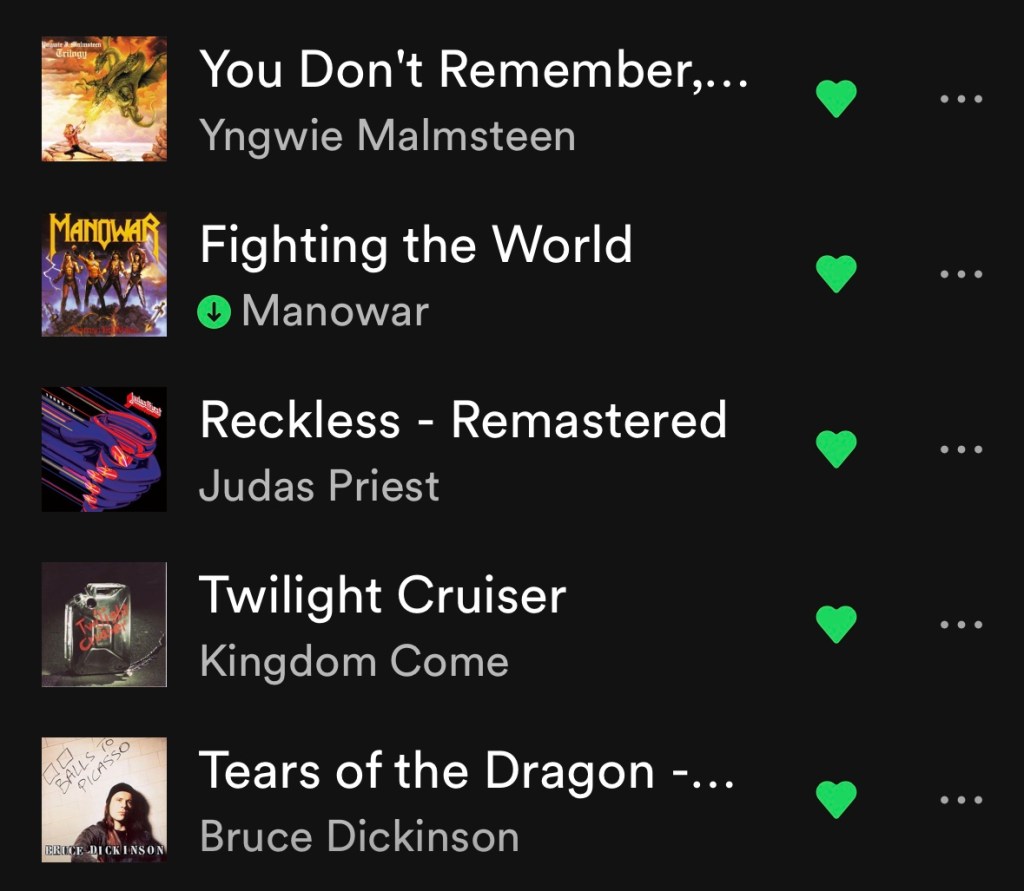
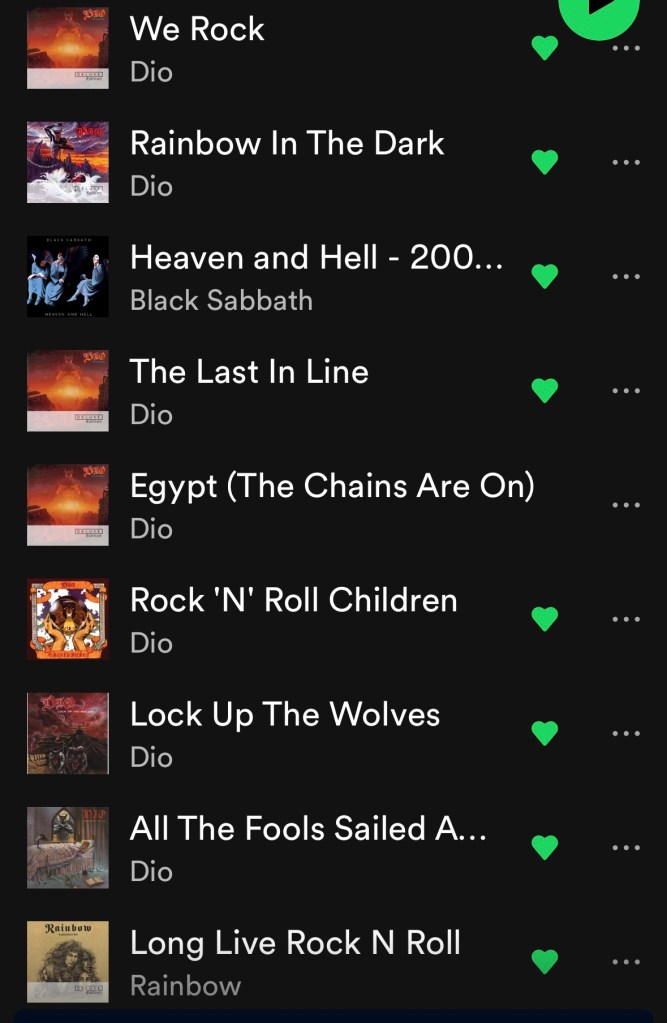
Like an old school playlists incorporating 80s and 90s songs (above) or a more current 2010s and above playlist (below).

Or you can combine the entire history of an artist into a playlist. Like Glen Hughes. 27 hours worth of music. There are a few more releases to add.

The same with Dio, but this time I tried to sequence the playlist like an album.

Then again Dio’s career is so wide, I was able to sequence a lot of different albums.

Standard