A to Z of Making It, Copyright, Music, My Stories, Piracy, Stupidity, Unsung Heroes

And Comparisons For All….

What a month in the world for new music.

After Bon Jovi withheld “The House Is Not For Sale” for a week from Spotify, the band managed to land the Number 1 spot again and sold over 128,000 units via a concert ticket promotion campaign that included a physical copy of the album with every ticket purchased. And the mainstream press lapped up the news.

While today, both Metallica and Sixx A.M. released new albums. “Hardwired To Self Destruct” and “Prayers For The Blessed” hit the streets. Meanwhile, Avenged Sevenfold’s unexpected album drop “The Stage” has had two consecutive weeks in the Top 10 Billboard charts. But those anyone care about the charts.

Is anyone listening to the albums?

At least Metallica, Sixx A.M. and Avenged Sevenfold didn’t withhold their album from Spotify like Bon Jovi did and treated their paying streaming fans the same as their fans who purchase a physical product.

“Hardwired” is up to 11,526,511 streams on Spotify and 21,076,824 views on YouTube, while “Moth Into Flame” is at 7,531,372 streams on Spotify and 12,859,400 views on YouTube. “Atlas Rise”, a song which came out a week ago has 6,793,498 views on YouTube.

Bon Jovi’s new music on the other hand pales compared to Metallica. The “This House Is Not For Sale” video came out three months on YouTube and it has 5,115,129 views. “Atlas Rise” from Metallica which came out a week ago has already overtaken this song. Other pre-release singles, “Knockout” has 793,789 views on YouTube and “Labor Of Love” has 480,060 views on YouTube.

This tells me that Bon Jovi is not gaining any new fans while Metallica still is. Even Lars Ulrich admitted as much when he was at a loss to explain how their self-titled “Black” album was still moving 2000 units a week 25 years after its release.

Avenged Sevenfold’s “The Stage” video that came out a month ago is up to 9,292,711 views and it has way more than Bon Jovi’s three videos combined.

If you want to compare listens, Avenged Sevenfold’s “Hail To The King” music video released 3 years ago has 67,228,814 views on YouTube. Bon Jovi’s “Because We Can” music video, also released 3 years ago, has 14,483,692 views. So it’s pretty safe to say that Jovi’s last proper album was a dud of epic proportions and it looks like “This House Is Not For Sale” is headed for the same fall. But those charts show it’s a number 1 album and the mainstream press is all over it. That’s the one part the big legacy players still control in music. The news cycle and their belief is he who reaches the most people wins today. But there is no story in Bon Jovi’s Number 1 album.

I heard the album today and it’s already in the rear view, fading fast. It was withheld from Spotify for 7 days and it comes out on the service when Metallica and Sixx A.M release albums that are way better than Bon Jovi’s offering. So my listening attention will be diverted to those bands for the next few weeks.

Streaming services are now the biggest contributors to the record labels bottom line. Streaming has won. The majority of people who like music, listen to recorded music via a streaming service. And if Scott Ian and the other guys from Anthrax can get behind streaming, anyone can be converted. Maybe not Gene Simmons and Paul Stanley.

A scorched earth publicity campaign might get a decent return on first week sales and then what.

Selling a 130,000 copies in a week or even a million copies in week, in a country of 300 plus million is a needle in a haystack. But the news reports it. If the news cycle wants to report on bands selling, they should report on Five Finger Death Punch, Breaking Benjamin, Disturbed, Shinedown, Skillet and Volbeat, who still have their albums on the charts, after months and in same years over a year and half since release date. Yep these artists are still selling units or racking up enough streams to count as a unit sale. But those bands don’t own the news cycle and they didn’t make it big in the 80’s, so why would the media report on them.

There is a common misconception that fans of artists who made it big in the 80’s or the 90’s don’t care about their new music. That’s not true, we do care about their new music. But it needs to be good for us to care and it needs to be good enough to attract a new generation to care as well. An artist’s career is dependent on the need to replenish their fan base as fans drop out and new fans drop in.

Standard
A to Z of Making It, Copyright, Music, My Stories, Piracy, Unsung Heroes

Score Card Inc

Three years ago in November, 2013, I posted a score sheet on certain artists/trends and how they are dealing with the music business.

Three years later, how are the artists fairing.

Robb Flynn
He still understands that it is not all about making records. From Nov 2013 to now, Robb Flynn via Machine Head, kept on releasing his Journals both video and written. In April, 2014, “Killers and Kings” came out for Record Store Day and the band went on tour. He started a clothing range called “Killers and Kings” that didn’t really take off. In November, 2014, “Bloodstone and Diamonds” came out and the band embarked on a lengthy “An Evening With” world tour. In June 1, 2016, “Is There Anybody Out There?” came out as a stand-alone single.

His connection with his audience runs deep. People either dig him or detest him or some people will not just forget him in an orange jumpsuit during the Nu-Metal phase of the band’s career.

Protest The Hero
Back in 2013, “Protest The Hero” showed how the record labels are so out of touch with its customers. PTH was dropped because the label told them they have no audience. However, a fan funding campaign showed a pretty impressive hard-core audience that was willing to cough up some serious dollars for the band. Even the band was blown away at the response.

And they did it again between Nov 2015 and April 2016 with “Pacific Myth” an innovative one song per month release over six months via Bandcamp. Fans had the option of two packages, and I selected the one that also had the six video releases. In between, the guys would upload drum videos, cooking videos, song transcriptions and what not.

Nikki Sixx
In 2013, he talked about a farewell tour. Well that tour finally happened and concluded in 2015. The Crue fan base didn’t really need one more world tour however, they wanted to finish up in their own way and the world tour is what we got, with a new song called “All Bad Things”. The movie is still in the works, they have their own pleasure toys, a rumour of The Dirt 2, plus lawsuits from photographers and opening bands to contend with. Seriously, squirting piss at a bunch of guys who paid $1 million to be on the tour would always end up in the courts.

With Sixx A.M. he has released an albums worth of music and the next album is coming in a few weeks. They are on tour with Five Finger Death Punch, he does his Sixx Sense Radio Show and he doesn’t like to wash his hands after going to the toilet.

Coheed and Cambria
By November, 2013, COCA had been touring non-stop on the back of “The Afterman” two album releases that came out within a 4 month window. Add to that Comic Con appearances, plus Sci-Fi conventions and appearances in Comic Shops and you get the idea that this band realises that it is not just about music and money. It is about creativity.

Since then, Claude Sanchez became a dad. He wrote more comics with his wife called “Translucid” in 2014 and in 2015 managed to release another slab of songs called “The Color Before The Sun” and go on a another world tour.

Metallica
Back in 2013, I wrote;

They need to make new music soon. There are only so many times that a band can go on a worldwide victory lap on the same piece of music. They need to be back in the studio.

Well, we are almost one week away from that new music hitting the streets and in the meantime, we have been treated to three tracks.
It’s a welcome relief to hear Metallica doing what they do best and I believe they have enough new music in their archives for another album to drop within two years this time, instead of eight.

And after hearing the album – yes it is available on the pirate sites, I can honestly say that it’s not worth the 8 year wait at all and maybe 4 song EP’s is the best way to go.

Dream Theater
I wrote in November 2013, that they need a great record soon or they will become yesterday’s news. Dream Theater has a knack for popping up with some goodies, like “Images and Words”, “Scenes From A Memory”, “Systematic Chaos” and “A Dramatic Turn Of Events”.

So in January 2016, they dropped the 130 minute “Astonishing” concept album, about a dystopian future society. Concept albums lead to different revenue spin offs like a stage play, comic book stories, video games, animations, TV series, a movie and so forth. But then again, Slayer are doing a graphic comic book series and have never done a concept album.

Stone Sour
I wrote in 2013, that something went south with their career trajectory. Of course, a beast called Slipknot would devour the creative forces of the band. Their take on modern metal is good, but with Slipknot getting more melodic, is there a reason for Stone Sour to exist.

Five Finger Death Punch
They have an audience who purchases and streams their product. Along the way, each album has received certifications for so many units moved. An onstage meltdown, a record label lawsuit and then a change of label has not slowed the band down in any way. If they can remain together, they will remain a powerhouse.

Trivium
Back in November, 2013, their new album “Vengeance Falls” was called a Disturbed covers album. The truth is, if people are talking about you, it is a good thing. And that album gave Trivium a concert classic in “Strife”. Since then, they released “Silence In The Snow” in 2015. They are always looking to reinvent themselves constantly while staying true to heavy metal. Plus Matt Heafy has a pretty cool Top 10 list of albums that changed his life.

1. Metallica – The Black Album (1991)
“A kid lent me The Black Album at school and it changed my life. I had never heard anything like it before, and I started playing guitar all the time.”

2. In Flames – Whoracle (1997)
“That was at the time of Napster, and I was into the classic great metal bands. I was on Napster and I found In Flames. I had never heard melodic death metal before, and it changed my ear on what kind of music I wanted to play.”

3. Queen – A Night At The Opera (1975)
“What I’ve always loved about Queen is that they’ve never released the same thing twice. Everything is drastically different while still sounding like Queen. Every song on A Night At The Opera sounds different to the next one and they all stand up as fantastic.”

4. Iron Maiden – Seventh Son Of A Seventh Son (1988)
“With Iron Maiden it’s hard, because I love so many of their records. They’re all so important. Seventh Son, though, is the one that really got me into Iron Maiden. It’s one of their more epic records; there’s vivid storytelling going on. Getting into Iron Maiden helped me trace the roots of the music that I love. I could see where so many metal, death metal and black metal bands had taken things from.”

5. Ihsahn – Eremita (2012)
“Emperor changed my life, and Ihsahn changed my life again with this album. He spun the idea of black metal on its head by incorporating jazz chords, interesting production and clean singing. That record taught me to never be afraid of making whatever I want to make. We’ve always done that, but this album drove that home for me.”

6. Boston – Boston (1976)
“The vocal production is insane. Everything about this record epitomises the best things of rock ‘n’ roll.”

7. The Beatles – Abbey Road (1969)
“The Beatles blow my mind in the same way that Queen do in that every song and record is so different to the last. Both of those bands have incredible songwriters as well. It’s not like nowadays where you might have one songwriter in a band.”

8. Emperor – Anthems To The Welkin At Dusk (1997)
“This is where Emperor really changed the dynamic of where black metal was going. Black metal was the rebellion to rock and metal, and was supposed to be different. “When there’s a movement like that, a lot of bands come out playing semi-similar music. That record opened up with clean guitar and there’s this classical singing; it has chaotic moments and beautiful moments all in one. Emperor makes such interesting black metal with these big dramatic moments.”

9. Depeche Mode – Violator (1990)
“Listening to Depeche Mode, you can hear that Rammstein is a combination of Depeche Mode and Metallica. Violator is one of the darkest, scariest records I’ve ever heard. It has this different kind of sadness that you feel in the music.”

10. The London Symphony Orchestra – Mozart’s Requiem (1791)
“The gothic artwork of that record is incredible, and this version for me is just the best. Listening to this, you can hear that out of all contemporary music, metal is the closest living relative to classical. It is the most epic moments of music that have always drawn me in, and I feel that with Mozart’s Requiem that is where you’re getting into the blueprint for everything that was to come.”

Shinedown
They have an audience who want to listen to them and so far, no one’s doing hard rock better than them. Their new album “Threat To Survival” has taken its influences from Adele, Imagine Dragons and other pop artists and they still made it rock hard. Daughtry and James Durbin should take note. Along the way, their fans purchased and streamed all the way to certification after certification.

Avenged Sevenfold
Say what you will about the “influences” on “Hail To The King”, doing that album was a bigger risk for Avenged Sevenfold then their new album and it paid off for them.

Fast forward to 2016, and their new album drops early. It is a creative tour de force but to me it’s already in the rear view. All of the good bits in each song are undone by the creativity of trying to push the boundaries.

Piracy
In 2013, I wrote that piracy is not that large of a problem as the majors and the RIAA make it out to be and with revenues in 2016, approaching the pre-Napster era, it’s further proof that piracy does not affect their bottom lines, especially when there are services out there that can compete with piracy.

Evergrey
The pure definition of perseverance with 20 plus years in the music business and still going strong.

By November 2013, the “new” version of the band that delivered “Glorious Collision” had splintered again and lead vocalist/guitarist Tom Englund was not sure on the next step. A reconnection with drummer Jonas Ekdahl and guitarist Henrik Danhage (who departed before “Glorious Collision”) spawned the excellent “Hymns For The Broken” in 2014 and a few months ago, “The Storm Within” builds on the atmospherics created by “Hymns”.

Megadeth
In 2013, Megadeth’s new album “Supercollider” was outsold by Metallica’s self-titled “Black” album. In 2015, Mustaine got his metal chops back and in 2016, “Dystopia” came out. Another Mustaine Resurrection was at hand.

Tremonti/Alter Bridge
Mark Tremonti knows it’s about putting new music out there and consistently. In 2013, we had “Fortress” from Alter Bridge. In 2015, we had “Cauterize” from Tremonti and 2016 has given us, “Dust” from Tremonti and “The Last Hero” from Alter Bridge. In three years, Tremonti has been part of 4 albums while Metallica ……

The Night Flight Orchestra
The best classic rock side project ever from Soilwork and Arch Enemy band members. The first album “Internal Affairs” came out in 2012 and the second “Skyline Whispers” in 2015. Essential listening to any hard rock fans of the 80’s.

Sales
In 2013, I wrote that sales are not the best metric to measure a bands reach and pull in the market. In 2016, listens are more important than sales.

Bullet For My Valentine
By November 2013, people had lost their “Temper Temper” with them, but in 2015, the band found their “Venom” again, which leads us to new music hitting the net in November 2016.

Revolution Saints
In 2013, this band existed in the head of the Frontiers President. In 2015, they released an excellent melodic AOR rock album. So much potential, so many good songs, great musicians and it all went to hell because Castronovo couldn’t keep his 5555t together. Let’s hope that Jack Blades and Doug Aldrich forgive him and they try for another album. This time with the three of them writing.

TesseracT
One of the hardest working progressive bands out there, building their fanbase, city by city. In 2011, they released “One”. In 2013, they released the excellent “Altered State” and in 2015 we got “Polaris”.

Days Of Jupiter
An unsung Swedish melodic groove rock band, that’s a cross between Evergrey and Disturbed. In 2012 they released “Secrets Brought to Life” and in 2015, “Only Ashes Remain” came out.

Sweet and Lynch
Another album would be sweet.

Muse
They play stadiums but they don’t have the same sales figures as the 70’s and 80’s legends. A perfect example of the modern world, in which massive single songs sell concert tickets.

Live
In 2013, I wrote;
Remember the excitement and the buzz of going to the show. It was uncontrollable. Everyone waiting in line to get inside, to watch a band that rules, in an era that music ruled. Today, it is too expensive to take kids to a concert and that is only for a glimpse in the back. This business needs a reset.

Concert ticket prices are still high, especially for the superstar acts. The price gauge happened as an offset to dwindling revenues from recorded sales, however with recorded music revenue now as high as the pre-Napster era, there is no reason for the high concert ticket prices.

Slash
As an artist, he didn’t need to go back to Gunners. He had enough momentum to keep going as a solo artist and with Myles Kennedy, a better front man than Axl Rose. Slash kept on releasing new music consistently, while Duff and Axl complained of piracy and artistically were dead in the water. Money triumphs over creativity and in this case, it’s really sad.

Album
Back in 2013, I wrote how everyone talks about the money that is lost due to piracy as album sales shrink. Back then 20% of the tracks on Spotify have never been played. So what is the point of the album, when people ignore the songs that are not “hits”. When I go to Spotify and I come across an artist I haven’t heard before, I go to their Spotify page and hear the tracks in their top 10 list. Those tracks in most cases are pulled from many different albums.

And if any of those tracks connect with me, I might dig deeper into the album.

Rodrigo Y Gabriela
Created by their love of metal and rock music and when that same genre put up roadblocks to a career in music, they changed tact and went all flamenco acoustic on the world. Talk about paying their dues and taking risks. They moved from Mexico and took a chance in Europe. Over an 8 year Dublin residence, they honed their style and songs, so when their “official” debut album hit in 2006, what seemed like an overnight sensation was 15 years in the making.

There is nothing more difficult in the world then trying to make it as a musician. You need to show up day after day, week after week, year after year. And your brand or movement might just make some small gains. Then it hits a few speed bumps, like Rodrigo and Gabriela’s metal band losing their recording contract in 1997 and suddenly you are back at the start. But they kept on showing up, on the coast of Mexico and playing their acoustic guitars in the bars. Because showing up day after day, is the hardest part of making a difference. If you look at the history of the artists we like and admire, you will see many years in pursuit of their dreams.

It is a work of a lifetime to create an impact and build something of substance. In 2013, they were riding the highs of their 2012 “Area 52” collaboration, which involved re-working their best songs with a full flamenco band. Then in 2014, “9 Dead Alive” dropped and new music is needed ASAP.

Sebastian Bach/Skid Row
They shouldn’t get back together, because no one cares about Skid Row in the way they used too. They might have a large audience in Japan, like Dokken, but the rest of the “Youth Gone Wild” have moved on. Sebastian Bach is actually bigger than Skid Row and releases way better music than Skid Row have done without him. But, what was he thinking when he approved the photo for his memoir’s cover.

The Kindred
From Canada and the healthy progressive scene. They started off as “Today I Caught The Plague” from the ashes of another band called “A Legend Falls”. In 2011 they released the excellent “Lore” and went on tour with one of my favourite bands in Protest The Hero and their “Scurrilous Tour”. Then in 2013, a name change happened to “The Kindred” and the excellent “Life In Lucidity” came out at the start of 2014.

However, PTH needed a drummer for their “Volition” tour and it was no surprise that they tapped Mike Ieradi (who also co-founded the group) to fill the spot. Then in 2015, vocalist David Journeaux departed, with Johnny McArthur as their new vocalist and Kenny Saunders as their new drummer. So now I wait to see what comes next.

Streaming
Back in 2013, I wrote that everyone talks about the money which isn’t filtering down to the artist and how streaming is too entrenched to be replaced. Since then the record labels have grown their revenues on the back of streaming. Artists who negotiate deals with the streaming services like Metallica and Motley Crue have never complained about streaming. Suddenly, luddites Anthrax are not complaining and Scott Ian even mentioned how he believes streaming is the best thing to have happened to the recording industry.

Streaming is the future and those artist who don’t grow with this future will be too busy shrinking.

The Gaslight Anthem
They do the early 80’s Bruce Springsteen better than Bruce Springsteen these days. It was like a supergroup of independent musicians that came together in New Jersey in 2006. Their 2010 album, “American Slang” spawned an unexpected hit with the title track and “45” from their 2012 album “Handwritten” became their biggest hit. Since then, “Get Hurt” came out in 2014 and by July 2015, the band went on an indefinite hiatus.

Since the hiatus, singer Brian Fallon released a solo album called “Painkillers” in March 2016, and on April, 2016, a vinyl EP called “Georgia” was released for Record Store Day 2016 with a limited pressing run of 2,000 copies on 10″ vinyl. Let’s hope that “The Gaslight Anthem” get together for more music over the next three-year period.

Volbeat
Seen as overnight sensations however they are over 25 years in the business. It all started with “Guitar Gangsters & Cadillac Blood” in 2008 and being added to the Metallica “Death Magnetic U.S. Tour”. Then in 2010, “Beyond Hell/Above Heaven” came out and while that was still selling, they released “Outlaw Gentlemen and Shady Ladies” in 2013 and they hit every major music market over and over again. Since then, they released “Seal the Deal and Let’s Boogie” and are continuing on their merry ways. For all the newbies, check out their streaming numbers. They are huge compared to other major label metal/rock acts.

Killswitch Engage/Times Of Grace
In 2013, Killswitch Engage released “Disarm the Descent”, their comeback album with Jesse Leach on vocals. And how good is “In Due Time” with brutal verses and an arena rock chorus. Then in February 2015, a new track called “Loyalty” appeared on “Catch The Throne: The Mixtape Volume 2” to promote “Game of Thrones”. They then toured and kept on working on “Incarnate” which finally came out on March 11, 2016. Since then, they toured and are planning on releasing a beer. Meanwhile, “Times of Grace” have five songs completed for a new album to come out, with their last one coming out in 2011.

Standard
A to Z of Making It, Classic Songs to Be Discovered, Music, My Stories, Piracy, Unsung Heroes

It’s A Singles World

All of the “billions lost” post Napster can all be tracked back to the SoundScan era. According to Wikipedia, on May 25, 1991, Billboard started to use SoundScan data to work out the Billboard 200 Top Albums. Finally the music industry had a proper sales metric to gauge what was popular.

Prior to the SoundScan era, the charts were formulated by an honesty system from every record shop in the land. This meant that the manager of the record store had the power to decide what was popular. So the record labels swooped in and started corrupting the process.

But when it all went to SoundScan data, the record labels saw a lot of people were buying metal, rock and country than the old corrupted honesty system claimed.

Metallica had a large audience before the “Black” album came out, however their “sales” just didn’t match the concert attendances. Why would a record store manager tell Billboard that a band who had no MTV presence was moving product out especially when the same record store manager is encouraged by record label executives to report something different.

And like everything else in music, the record labels were dragged kicking and screaming into the new SoundScan era. SoundScan actually presented their proposal to the record labels in 1990 and of course the labels rejected their proposal. The MP3 technology was also presented to the record labels once upon a time before Napster and it was also rejected. But when Billboard made the deal with Soundscan a year later, the labels had no choice but to comply, although with much complaining. Gone was the “fixing” of the system by record label executives and “in” was the “people power” of the system, which put the careers of artists in the hands of consumers.

If this sounds familiar, Steve Jobs and Apple did the exact same thing to the record labels with the iTunes store.

Suddenly, the labels and the press had no idea what was happening.

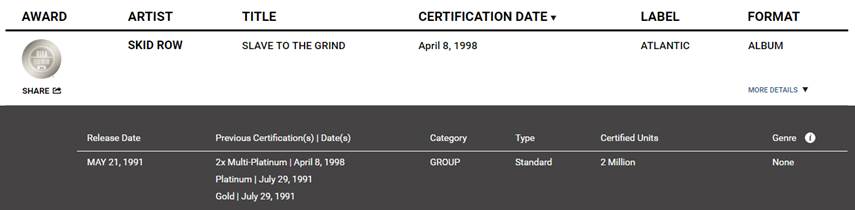
image002

In the first month of the SoundScan era, Skid Row’s “Slave To The Grind” skyrocketed to number 1. In the space of two months, it was purchased over a million times. Trackable purchases, not inflated ones based on a store manager opinion.

For comparison, the self-titled debut album was listed to have sold “3 million” records under the good old honesty system. Really.

image006

And popularity is a monolith that dominates. If the album is selling and doing well, more people will turn to it. And in the internet era, this is so true. The chaos era means we return to what we know. Sure, we might listen to some obscure acts or certain scenes. Like for me, Swedish Hard/Heavy Rock has me hooked at this point in time. But that’s via my choice and not by some flash marketing campaign or by some feature in a magazine.

And the reason those acts are not getting rich is because just a few people are. It’s always been that the one percent of acts that become global underpin the whole industry. And SoundScan showed the recording industry just how global Metallica really is.

“Enter Sandman” comes out two weeks before the album release and it gets added to radio. Metallica have a listening party in Madison Square Garden. The song and the pending album release is building a buzz like never before. MTV takes notice and suddenly mainstream radio stations that play “pop” music have the single in rotation. The album comes out and it debuts at No. 1 on the Billboard 200. Suddenly, the “Black” album is selling by the hundreds of thousands. It’s trackable. And then, the back catalogue of Metallica started selling. Normal rock music lovers couldn’t avoid it. Pop fans couldn’t avoid it. Skater fans couldn’t avoid it. Suddenly fans of all genres are embracing Metallica.

I recently had a look at the recent RIAA certifications and it more or less confirms we are living in a “singles” world.

Check out all of the certifications that Shinedown received recently.

There is a platinum certification for “Simple Man”, a song released in 2004. This is what music is about. The longevity. 12 years later, people are still listening to the song and are still purchasing it. However, the record labels and a lot of misguided artists believe it’s about the instant payday. It’s not.

Next up is a Platinum certification for “The Sound Of Madness” single. Again, it’s been a long time between certifications but this song is a monster and as classic as anything from the classic rock era. Like “Simple Man” before, it’s about the longevity. 7 years later, it’s still listened to and it has close to 26 million streams on Spotify.

It’s just a matter of time before “Call Me” gets a certification and it was never even released as a single, however it has been streamed close to 33 million times on Spotify.

Then you have a few Gold certifications for the songs “Bully”, “The Crow And The Butterfly” and “Diamond Eyes”. “Bully” is a favourite of mine. It’s message is powerful.


Speaking of singles, Disturbed is killing it on the back of “The Sound Of Silence” and their album is moving units on the backs of their cover.

And Muse are now moving into album certification territory on the backs of some very large singles. “Absolution” gets a platinum gong, 12 years after it was released. Again, the longevity is more important than the payday.

So again, on the strength of a few songs here and there, artists are seeing an interest in their back catalogue. It happened to Metallica with “Enter Sandman”. It’s happening to Disturbed with “The Sound Of Silence”. It’s continually happening to Muse and Shinedown. This is music and music is for the lifers.

Standard
A to Z of Making It, Music, My Stories, Stupidity

Fame Game

“You let them know you are large and in charge. It’s the way you stand, the way you carry yourself. Being a front man is less about your voice than your ability to connect with a crowd. A front man is a salesman. Steve Jobs was a front man. Wozniak was the great songwriter, but he couldn’t sell the thing he created. He needed the cock rocker Jobs to say, “Pay attention to this!” I wasn’t always confident, but confidence is a self-fulfilling prophecy. It starts as false bravado—you’re acting like you’re cool and confident even when you’re not—but if you’re convincing enough, people start to believe it. Then you start to believe it and then it’s the reality.”
Dee Snider on his philosophy on how to connect with an audience

You see, fame ain’t what it used to be. In the past, very few people made it and when they did, we all knew their name, regardless of their style of music. Now, no one even knows who the “stars” are. The odds of breaking through your inner circle are tiny, but people keep trying.

So where does that leave the artists who are trying to sustain a career in an ever-changing marketplace because fame is a game. It’s not always about the music, but more about communication and participation.

Sully Erna is a salesman. He goes on a radio show and Nikki Sixx becomes the topic of his conversation. He generates a ton of interest, a lot of discussion and he played the fame game. But that was weeks ago. The feud is old news again. Forgotten for the time being. The audience moved on to another topic, to another artist.

Remember when music records and singles used to be number one for ages. Well, that doesn’t happen anymore in music and it definitely doesn’t happen when it comes to information. News is an on demand item. The only question is where are we going to get it from. The usual suspects are far from impartial. Look at the Top 20 lists at Loudwire and Noisecreep and Ultimate Classic Rock and you will see that the lists are made up of the bands that had big PR campaigns with the website; not because the albums are worthy of being in the top 20.

Music is not the leader anymore. Information is. And with a million ways to occupy ourselves, artists need to find a different way to make us pay attention. So with everything available, we are drawn to very few.

Like James Hetfield.

The “SoWhat” fan club magazine interviews offer up personal viewpoints and feelings that people can connect with. He doesn’t do side projects because it needs to add to what he is about and not detract from Metallica. However he is now okay with his band mates side projects. He told us that Metallica lost millions doing the Orion Music + More festivals and he offers his insights as to why that might be the case. He gives us his feelings on “Lulu”. Then there is the movie “Through The Never” that cost the band millions. Again more insights or “excuses” as some metal websites called them.

So even though Metallica hasn’t released new music in seven years, Hetfield is constantly out there playing the fame game.

Whether you agree with the viewpoints or not, it’s actually good to listen to artists having a say instead of not saying anything. Even artists like Scott Ian, Gene Simmons and Paul Stanley who fail to understand or realise that the record company model is based on stealing everything from the artist, are good at playing the fame game, especially when they have nothing new to offer musically.

Because it is virtually impossible to get mindshare in todays cluttered and chaotic world. We had MTV, Hit Parader, Circus, Rip and Metal Edge magazines and they reached everybody. Today, we get the popular squeezing out the less popular and what we have are people complaining there is no money in music.

And who cares what sales record is broken. Adele is all over the news about her sales figures. Star Wars the same. Michael Jackson and Thriller just passed 30 million.

Does anyone know who many records Black Sabbaths “Paranoid” sold, or Motley Crue’s “Shout At The Devil” or Dream Theater’s “Images and Words” or Bon Jovi’s “Slippery When Wet” or Twisted Sister’s “Stay Hungry” or Journey’s “Escape”.

Hell, even the bands won’t know how many albums they would have sold, as the accounting of it all was dodgy and secretive. But the music has maintained. Dream Theater is still doing victory laps from the success of “Images and Words”. I just forked out $170 for “The Astonishing” pre order of the deluxe edition.

In the end, everything is a game, with winners and losers.

Standard
A to Z of Making It, Music, My Stories, Piracy

It’s Always Been About The Songs

“The biggest thing that surprised me about fame was that it was fleeting. You work so hard to get there and you just assume that it’s some sort of finish line, or you take a victory lap and maybe spike the ball, run around the field screaming ‘Goal,” I don’t know.”
Dee Snider 

It is pretty well-known how long and hard Twisted Sister worked at getting their sound and image out to the masses. It is also pretty well-known how short their fame was in the Eighties and how quickly they faded from the conversation.

You see, the biggest untold story in music is that when an artist hits a high with one album/song, it doesn’t mean that the next album/song will also hit that same high.

“Stay Hungry” sold over 2 million copies when “Come Out And Play” was released in 1985. At that point in time, “Under The Blade” was still selling, “You Can’t Stop Rock ‘N’ Roll” was still selling and so was “Stay Hungry”. Because when an album crosses over into the mainstream, the back catalogue of the artists suddenly become popular.

Then a new album drops and suddenly the sales are not as high as the previous album. It doesn’t mean the band is not famous or popular anymore, it just meant that a re-adjustment was going on with the fans.

A lot of fans were still digesting the back catalogue and a lot of fans moved on to the next flavour of the year.

So instead of Twisted Sister’s management team booking a normal theatre and shed tour, they booked an arena tour for “Come Out And Play”. And when the arena shows failed to sell out, the tour got canned which cost the band money. The merchandise agreement for the tour became null and void which cost the band money.

“The reality is that rock and roll, in the mainstream, it’s in a difficult place right now. People don’t buy music, and they certainly don’t buy rock bands’ music in the way that they used to. And so, for our genre, it’s kind of… We’re limping along when it comes to public appeal. I believe that rock and roll is alive and well. I just think that people need to show their support and let the genre keep thriving.”
Andy Biersack – Black Veil Brides

People never wanted to buy music. I know I never did. I wanted to listen to music. However, corporations got involved with music, and a big business was born from it. Guess how many records Kiss sold from their first album, before they started to record their second album.

If you answered 70,000 units, then you are correct. If you don’t believe me, read Paul Stanley’s “Face The Music”. Metallica’s “Kill Em All” didn’t set any sales records when it came out either. Nine months after the album’s release, Metallica went back into the studio to record “Ride The Lightning”.

But today, bands want instant success. They want their first album to sell like Metallica’s “Black” album or Bon Jovi’s “Slippery When Wet”.

“Metal was really strong in the 80s and kind of had hard times in the 90s. I think we treaded water and kept alive and kept focused on being Testament, and writing songs that we wrote without thinking or trying to change and play with what’s current at the time. It really hurt a lot of bands trying to do that. Fortunately, we didn’t do that. We went opposite. We went a little darker and heavier at that time. Then the metal got healthy again, and coming out the other end, we were in the right spot with the direction we were going, and the history we had, it just carried through. Metal has been real strong since the early 2000s. It’s been gradually picking up. I see the generation changing with a lot more younger fans coming to shows now over the last ten years.”
CHUCK BILLY – Testament

The crux of longevity is the replenishing of your fan base, year after year. And you do that by being in the game. Each album release will do some of the following;

  • Pick up new fans and keep all of the old fans
  • Pick up new fans and lose some of the old fans
  • Pick up new fans and lose all of the old fans
  • Keep all of the old fans
  • Lose some of the old fans

It’s just the way it is. You see for me, I lost interest in Testament after Alex Skolnick left. My cousin Mega, still purchased their albums, I heard them and forgot them. It was just part of getting older. Musical tastes changed for a while. That is why in 2015, my music collection has everything from folk, blues, classic rock, metal, hard rock, glam rock, thrash metal, death metal, metalcore, progressive rock, etc…

So in 2015, the album is just not as important as it was once was. With streaming it is all about the songs. For all the artists that complain about sales, the truth is if you’re popular, people want to listen to your music and they want more of it, if it is good. My kids don’t even care if the songs all came from the same album.

Today, the artists get paid every time we listen.

Elektra sold Metallica’s self-titled album and the band only got paid once for the sale. Today, Metallica is cleaning up, as fans are streaming their tracks over and over again. They are getting paid continuously. And right now payments are low, but they will grow as more people subscribe. And if we are listening to our favourites music, they will get paid forever.

So it all comes down to listens and good songs have a long listening life, a long time to make money.

And it’s always been about good songs.

Metallica did not break big until “Enter Sandman” crossed over. Twisted Sister did not break big until “We’re Not Gonna Take It” crossed over.

We all want more if the artists are great and the hard truth is that very few are.

Standard
A to Z of Making It, Copyright, Music, My Stories, Piracy, Stupidity

Guess What: Not A Lot Has Changed

“In 1981, there was a crackdown after the big payola scandal of the late 70s. Right at the beginning of the 80s, the record companies were being safe. They were not handing out advances. They would advance your recording budget, but that was it.”
Brian Forsythe – Kix

So what has changed in 2015.

The record labels are still being safe and with recording costs so low, the recording budget is even lower.

Yeah, of course, we all know that the record labels had a massive boom that started with “Thriller” in 1984 and that allowed them to take more risks. And for some reason it looks like musicians and the labels are only looking at the boom when they compare now vs then. Typical revisionist history.

“None of us knew what we were doing. We were just so excited to have a record deal. There are writer’s royalties, and the mechanical royalties that go to the band. The record company gets paid back through the mechanical until the bill (advancement) is paid off. Donnie was the main songwriter, so he was still getting his (writers) money. By the time we got to “Blow My Fuse” – our biggest selling record – we were two million dollars in debt.” 
Brian Forsythe – Kix

Even in the era of information, with everything is at our fingertips, artists are still unaware of their entitlements. And when they do find out, it is the crux of every argument. Especially between band members because every band has a person that just writes better songs than the others at certain points of time, or in some cases always. Kix’s bass player Donnie Purdell, was another Nikki Sixx. He was crucial to Kix.

It should act as no surprise to anyone that bands in the Seventies, Eighties or Nineties, ended up with such large debts to the label. That is the label creative accounting machine at its best. And the shameful part of it all is that current musicians still look at the past to gauge what success means in 2015.

“Go pull up the sales for 1985, 1986 for heavy metal bands. I guarantee you it’s ten times what it is now. That doesn’t mean there’s ten times less fans — in fact, I think there’s more heavy metal fans now than possibly there ever was. But the bottom line is the numbers show that metal bands are not selling what they did back in the day, and that’s because of Internet piracy. I don’t wanna get on that subject, because it always turns into a depressing, negative subject, but it is a fact. So the answer to the question, ‘Would that record sell more in 1985?’ I would say the answer would be yes.”
Shawn Drover – Act of Defiance

Shawn Drover, wishes it was 1985 and 1986 because for some reason, he believes that he will have more money in his pocket and if his new band “Act Of Defiance” sold a million copies of an album, they would be mega rich and popular. Brian Forsythe from Kix, lived that period and ended up with a $2 million debt, even though they had albums that sold in excess of a million.

And guess what venues they are playing right now?

Clubs and theaters.

Dokken albums achieved Platinum awards and the band today plays clubs and theaters. Stryper and Ratt albums achieved Platinum awards and the bands today play clubs and theaters.

A sale of a record never equaled a fan. It’s the usual comparison between;

  • a person that purchased a record, heard it once and hated it
    vs
  • a person that purchased a record, heard it, loved it and listened to it every day
    vs
  • a person that purchased a record, heard the popular songs and then moved on to whatever else was popular

So why do artists still see sales as important today?

Metal and rock artists still sell. There is no doubt about that. Especially the ones that connect with audiences. But sales is not the only stat that artists should be basing their careers on.

With all of the streaming services out there, the most important stat is how many listens an artist is getting and in which cities they are getting those listens.

The second most important stat is how many illegal P2P downloads an artist is getting and in which cities they are getting these illegal downloads. These listeners/downloaders need to be monetized in different ways.

Otherwise if you are an artist and you are waiting for profits to come in from recorded music sales, then you need to change your business model.

“I’ve never seen a check. Donnie probably still gets writer’s royalty checks. The rest of the money is going back to the record company. Donnie was such a better songwriter. For every 20 songs he would write, I would write one. We were working on his songs all the time and we never even had time to write our own stuff. Back in the early days I may have gotten a couple checks. The biggest one was maybe $350. One time I remember getting one for $1.99. I could count the amount of checks I’ve received on one hand.”
Brian Forsythe – Kix

Remember all of the stories that have come out over the last five years from artists complaining about their low royalty payouts from streaming services. Guess that in 30 years nothing much has really changed. For the small amount of 1% artists that have broken through to mega status, it’s all good.

For the rest, it is still the same story.

“The standard stat given is that 90% of major label deals “fail.” That does not mean they are not profitable for the label. The way RIAA accounting works, the labels can make out like a bandit on many of those record deals, while the artist gets hung out to dry.”
Mike Masnick, Techdirt

Nothing has changed on that front, even with the rise of the internet, Napster, P2P illegal downloading and so forth. The 90% stat was relevant even in the golden years of recorded music sales and it is still relevant now.

“We never expected to get rich, but we certainly didn’t expect to be millions of dollars in debt.”
Jared Leto – Thirty Seconds To Mars

No artist expects to get rich. The need to create is the calling card. However, when they start making money and they see the recording executives living it up while the actual creators are not, then money becomes an important conversation point.

The recording industry has always been known for its creative accounting.

Remember when Tom Petty declared himself bankrupt to get out of a recording contract because he had no money to show after two very successful albums in the seventies.

It all goes against what Gene Simmons said about rock music in general being murdered due to internet piracy. It’s a very narrow-minded and hostile view to have to all of the change that has happened in music. It also mimics, the view that the record labels have held.

A hostile one.

However as Tim Westergren, the Chief Strategy Officer – Pandora (until last year) states;

“I think we’re moving out of an era where the music industry is looking for enemies and into one where it’s now looking for allies.”

The record labels have been dragged kicking and screaming into cassettes, mp3’s and then streaming. Guess what happened. It increased their bottom line on all occassions. Guess that not much has changed in the era of change when it comes to record label abuses.

Standard
A to Z of Making It, Copyright, Music, Piracy, Unsung Heroes

Keep On Selling In A Free World

Five Finger Death Punch moved 119,000 units of their new album “Got Your Six”. 114,000 of those units are pure album sales and it a time of free, it even surpassed the 112,000 opening sales week of 2013’s “The Wrong Side Of Heaven And The Righteous Side Of Hell: Volume 1”.

In the U.S, Iron Maiden moved 75,000 of their “The Book Of Souls” album and in a time of free, it is Iron Maiden’s best sales week since Nielsen Music began measuring sales in 1991. It even surpassed 2010’s “The Final Frontier” sales by 12,000 units. Again in a time of free, you would expect a sales decline to happen.

In the U.K, Iron Maiden moved over 60,000 units and Five Finger Death Punch also landed in the Top 10.

In Australia, we know that Iron Maiden came in a Number 2 and Five Finger Death Punch at Number 3.

Both of the above bands have had their BEST SALES week for these latest releases. Especially in the U.S market. For Iron Maiden, it is their best sales week since 1991. Consider that. Piracy was at an all-time low in 1991 however in 2015, when piracy is meant to be at an all time high, bands sell more than before in opening weeks.

But it’s not always like that.

Disturbed’s “Immortalized” sold 98,000 total copies. If you compare these sales with 2002, when their second album “Believe” sold 284,000 copies you can see a steep decline in first week sales.

2005’s “Ten Thousand Fists” sold 239,000 copies, 2008’s “Indestructible” sold 253,000 copies and 2010’s “Asylum” sold 179,000 copies. On the same week that Disturbed made their comeback, Swedish metal act Ghost had opening week sales of 29,000 units of their second album “Meliora”

So what does all of the above tell us?

Has anyone seen the latest MTV Video Music Awards?

How many metal and hard rock bands got mentioned

If you are an artist in 2015, there is no use comparing 2015 to 1985.

Shawn Drover can complain all he wants.

The truth is, no one really cares about his new act “Act Of Defiance” first album at this point in time.

What the above data shows me, is that the music business is not all about the first album. It is about what comes after the first album. Remember, “Kill Em All” from Metallica had a life span of about nine months, before Metallica was back in the studio recording “Ride The Lightning”. That album also had a nine month life span before Metallica was back in the studio to record “Master of Puppets”.

There is no doubt that internet piracy has affected every genre, especially the metal and hard rock genre.

Does that mean that there is no money in music?

Of course not.

Publishing agency, BMI raked in $1.013 billion dollars for the financial year. ASCAP, also raked in $1.001 billion. This is money, earned by agencies for licensing out artists songs to radio, TV, streaming services and other platforms. And the reason for this big boom is;

  • Music streaming

But with everything corporate, the payouts to artists comes after both BMI and ASCAP subtract their operating expenses and other creative expenses from the revenue. This is what happens when you have a monopoly on music licensing. You abuse it.

BMI actually paid $877 million to its thousands of members, including songwriters like Dave Grohl, Linkin Park, Nickelback and Evanescence. ASCAP on the other hand paid its members $883 million.

What about that?

ASCAP had less revenue than BMI but paid out more. Regardless, when you add the expenses that both organisations kept, that is another $600 million kept away from artists.

But BMI blamed their legal fight against Pandora for the reduced payouts?

And certain artists have jumped on the bandwagon to criticise Pandora. But so many are clueless to the work that Pandora has done to help the recording industry and the music industry at large. They have 80 million listeners.

But did you know that Five Finger Death Punch partnered with Pandora to launch their album “Got Your Six”. Mumford and Sons, partnered with Pandora for a live stream of a concert. Jack White did the same. All of these partnerships led to Pandora increasing their fan base and the artists increasing their exposure and sales.

Pandora put on 79 live events last year and this year it’s expected to rise to 120.

This is on top of Pandora paying out half its revenue to SoundExchange in licensing fees, which in turn has ensured that the company is in a loss position. Other countries are not that quick to embrace Pandora, because to date, the service only operates in the U.S., Australia and New Zealand.

Which is silly.

Standard
A to Z of Making It, Copyright, Music, My Stories, Piracy, Unsung Heroes

INTERESTING: In A World Of Free, Metal and Rock Music Still Continues To Sell

There is a great article over at the Metal Insider website.

If you are too lazy to click on the link, the article covers the biggest selling metal and rock albums for 2015.

From the results, it’s pretty obvious that metal and rock fans like to purchase music. There is still a collectors mindset there. What’s even more fascinating is that a lot of the albums that have sold a decent amount in 2015 were not even released in 2015.

NOTE: The figures are based on U.S sales.

“Master of Puppets” was released in 1986 and in 2015 it sold 107,800 units. The self-titled “Metallica” album released in 1991 has sold another 77,100 units in 2015. It is well on its way to 17 million units sold in total.

Now think about for a second.

All of Metallica’s music is available on streaming services for paid subscriptions and for free. All of their music is available for downloading via legal options and illegal options. And they still continue to sell.

A band’s longevity is based around the need to replenish their fan base year after year. If you are not doing that then expect to play smaller venues. Dokken and Ratt are two bands that come to mind who haven’t replenished their fan bases from the Eighties. Both bands in the Eighties had platinum sales and played arenas. Today, they have almost no sales and play clubs.  Of course, not having the main creative forces in the current version of the band plays a part, however, even if Lynch and Pilson or Pearcy and Croucier did rejoin Dokken and Ratt respectively, it doesn’t mean that millions of people would be interested.

Metallica,  however is doing a good job at replenishing their fan base based on their selected live performances in new markets and in markets that have high rates of piracy.  They basically have a whole new generation of music fans who more or less consumed the music of Metallica for free and in most cases illegally. However, that still hasn’t stopped them from selling music and concert tickets.

As business people, the move to their own label “Blackened Recordings” was a no-brainer.

The record is how it all starts. It hooks the audience in. Anyone born in the Nineties, will know Metallica as the conformist poster artist for the labels in the Napster case. Anyone born in the Seventies and early Eighties know Metallica as a non-conformist band that pushed boundaries.

The whole Napster kerfuffle in the end just showed why it was not a good idea for Metallica to get in the way of people experiencing their music. However, they have learnt that by making their music available everywhere, they see better returns in other areas.

As an artist, it is a privilege for people to listen to your music. Respect that.

“Back In Black” from AC/DC was released in 1980. In 2015 so far, it has sold 110,000 units in the U.S.  The new album, “Rock Or Bust”, released in 2014, has sold 143,400 units in 2015.  Put it down to the band being on the road and building awareness of the new album. It just goes to show that the blanket marketing campaigns before the album release date, the Grammy appearance and all of the other medical issues/jail issues in the media meant nothing in 2015.

You see, when the music eco system was controlled by the record labels, the marketing blitz by the labels meant something. In 2015, it means nothing.

From the 2015 releases, Breaking Benjamin’s “Dark Before Dawn” has sold 209,000 units so far, Marilyn Manson’s “The Pale Emperor” has sold 124,200 units so far and Halestorm’s “Into The Wild Life” has sold 114,500 units so far.

From the 2014 releases, Foo Fighters “Sonic Highways” album has sold 87,800 in 2015, for total sales in 480,000 so far. Slipknot’s “5: The Gray Chapter” has sold 84,000 units in 2015, for total sales of 344,000 units. Nickelback’s “No Fixed Address” album has sold 101,000 units in 2015. Like the Foo Fighters it is approaching Gold status.

Led Zeppelin continues to be a selling machine, so why would they create new music when Copyright grants them and the owners of their songs, rights for the next 110 years to exploit the works.

In case you are wondering “Led Zeppelin 4” sold 75,000 units and “Physical Graffiti” sold 112,400 units in 2015.

Kid Rock’s debut “Devil Without A Cause” is still selling. For 2015 alone, it has moved 86,000 units. Add that to the other 10 million units it has sold so far.

So what is all of the above telling us.

Eventually people will pay, however if a piece of music that people want to check out is not available for free, they will turn away until it becomes convenient. Don’t expect people to pay just because you want them too.

And for all of those critics saying the new bands cannot attain the same level of success as their Seventies and Eighties counterparts, well have a look at some other stats.


As influential as Black Sabbath was to metal music, they are being outsold by Linkin Park, Korn and even Limp Bizkit.

Also for all of Gene Simmons and Paul Stanley’s comments about rock being dead because no one is buying recorded music, well, Kiss has never really been a big seller of recorded music anyway. Their 21 million is pretty tame compared to Metallica’s 62 million. In the end, the live show is where it’s at. Deliver there and make that show a cultural event, the sky is the limit.

Standard
Music, My Stories, Piracy, Unsung Heroes

Metal Loyalty

Why is it a surprise to people that heavy metal or hard rock fans are the most loyal fans?

There is a pretty good chance that every metal fan has purchased the same album, from acts they like, more than three times.

I am talking from my own experience here. I have the Crue’s Eighties albums on Cassette, LP and on CD.

In the Nineties, these albums got remastered and had some bonus tracks added to them. So I purchased them again. The same albums then got repackaged into Box Sets and guess what I did? I purchased them again.

All up, I purchased each Eighties Motley Crue album five times. Just typing it all out makes me sound silly. Now apply the same counts to Metallica, Iron Maiden, Twisted Sister, Van Halen, Ozzy Osbourne, Megadeth, Bon Jovi, Europe, Cinderella, Kiss, Whitesnake, Def Leppared, Guns N Roses, Skid Row and so on.

Others call it dumb, others call it silly, however I call it loyalty. And guess what? There are millions more people out there the same as me.

Talking about the Eighties, let’s look at the year 1987. The biggest hit singles for that year according to Wikipedia are “La Bamba” from Los Lobos, “Never Gonna Give You Up” from Rick Astley, “I Wanna Dance With Somebody” from Whitney Houston, “It’s A Sin” from Pet Shop Boys and “Who’s That Girl” from Madonna.

However during the year, Guns N Roses unleashed their record-breaking “Appetite For Destruction” album and Def Leppard also unleashed their own record-breaking album in “Hysteria”. Both albums are known as slow-burners, meaning that they took their time to hit it big. Something today’s know it all musicians fail to understand.

For Guns N Roses, it wasn’t until “Sweet Child O’Mine” came out as a single in August 1988 that the album really started to sell. And that was 14 months after it was released. Using the RIAA certification system as a metric for success, by August 1988, Appetite For Destruction was certified three times multi-platinum. Not bad, hey. Then “Sweet Child O’Mine” came out as a single in the same month. By December 1988, (four months later) the album was six times multi-platinum.

You see what happens when one song connects.

Continuing on, by July 1989, almost 12 months since “Sweet Child O’Mine” was released as a single and two years since the album came out, the album was certified eight times multi-platinum. Five million units were sold after “Sweet Child O’ Mine”.

For Def Leppard, it wasn’t until the “Love Bites” single came out in 1988 that the “Hysteria” album started to sell by the truckloads.

Also in 1987, Bon Jovi was still riding high from 1986’s “Slippery When Wet” album. Meanwhile, Motley Crue came out with “Girls, Girls, Girls” and U2 released “The Joshua Tree”. All three bands proved massive drawcards on the live circuit.

White Lion came out with “Pride” and surprised everyone with “Wait”. Suddenly Vito Bratta was in everyone’s lounge rooms courtesy of MTV. And because of MTV, White Lion also became a multi-platinum act.

Ozzy Osbourne paid a “Tribute” to Randy Rhoads while Kiss jumped on the Bon Jovi band wagon with “Crazy Nights”. Blues rockers Great White took the charts by storm with their “Once Bitten” album.

1987 also saw Whitesnake released their mega selling self – titled album, Heart released “Bad Animals” and the single “Alone” and Gary Moore released “Wild Frontier”.

Aerosmith also released “Permanent Vacation” signalling that their comeback was complete, while Pink Floyd did the same with “A Momentary Lapse Of Reason”.

Marillion released “Clutching at Straws”, Y&T released “Contagious” and Rush released “Hold Your Fire”.

Savatage started to make a dent in the metal world with “Hall of the Mountain King” and Alice Cooper’s comeback was picking up steam with “Raise Your Fist and Yell”.

I own all of the above albums, more than once.

Metal and Rock music is a lifestyle. Metal and rock bands appealed to my belief systems. It is that lifestyle and belief system that inspires loyalty. Cultural movements have happened on the backs of metal music.

The term heavy metal in the Eighties was used a lot. A record store lumped bands with very different styles into one Metal category. I could walk into a heavy metal section of a record shop and find Bon Jovi, Metallica, Twisted Sister, Slayer, Iron Maiden, Motley Crue, Poison, Van Halen and even Boston.

Judging by how big metal became, I guess I was not the only one that had the same belief systems. One thing that metal and rock bands did better than every other genre is the branding. Once we connected with the artists, we wanted to become to a member of the gang. We wanted to be patched in and sworn in. It was a tribe mentality.

You don’t need Spotify to know that metal fans are loyal. Looking at the releases in 1987, artists like Kiss, Ozzy Osbourne, Pink Floyd, Whitesnake, Heart, Rush, Y&T and Aerosmith had been around since the early Seventies. Yep, 17 years later, they still had loyal fans waiting for new music. Almost twenty years later, those same bands still have millions of fans waiting for a tour or new music. Can’t say much for Rick Astley.

Other artists like Def Leppard, Gary Moore, U2, Marillion, Great White and Motley Crue had been around since the late Seventies or early Eighties.

The reason why the loyalty of metal heads becomes part of the conversation is that us metal heads/rock heads are stereotyped as antisocial who contribute nothing to society. So how does that explain the numbers that metal and rock bands do on the live circuit, sales circuit, streaming numbers and merchandise sales. That is a lot of money that the anti-social misfits are putting into society.

As the saying goes, pop artists come and go, but metal artists remain forever. Once we are a fan of a band, we are fans for life.

I strongly believe that this metal global audience was achieved because of piracy. Illegal P2P in the early days led to bands like Metallica, Iron Maiden and Motley Crue earning a whole new audience. Suddenly their music was available to people who couldn’t get it. Suddenly these bands who had waning careers, had new markets to hit.

Nicko from Iron Maiden summed it up the best in the Flight 666 documentary. In the documentary, Nicko was mentioning that Iron Maiden hasn’t sold any recorded music in Costa Rica, however they had a sold out show that night.

There is an article over at Mashable that is quoting from Vince Edwards, the head of publicity for Metal Blade Records.

Edwards says that to book live shows, bands need to be able to demonstrate sales, which means using Nielsen’s SoundScan. Spotify streams don’t factor into SoundScan, so any streams that take away from sales also take away from touring. Touring, he says, is “mission critical” for bands. Streams, he says, just aren’t yet incorporated into the system. “It’s such a new metric that people aren’t really sure how to measure that yet,” Edwards said.

Spotify does have some data that can be used to inform bands where it might be best to tour, but Edwards says that doesn’t help metal artists much, since they tend to play smaller venues.

“I think that’s kind of the big disconnect between our world and the mainstream world,” he said.

Seriously, you would think in this day and age that the label bosses would have figured out how to incorporate streaming or even piracy data into their analysis. Online piracy has been around since 1999 and Spotify streaming has been around since 2008. To rely on SoundScan data in 2015 is ridiculous.

Lucky for these clueless label heads that the metal fans are loyal and generate dollars for them.

Standard
A to Z of Making It, Copyright, Music, My Stories, Piracy, Stupidity, Unsung Heroes

Time Is Your Greatest Friend

The recording industry is a mess, known for its creative accounting, manipulative one-sided contracts, it’s lobbying efforts to enact favourable laws that benefit the executives and do nothing for the artists and it’s monopolistic control over any new technologies that seek to bring a certain value to the consumer of recorded music.

Streaming service Grooveshark is no more.

The service had over twenty million users. Surely that is ample proof to the record labels that there is a large market for a service/product to offer what Grooveshark offered. However, the record labels have the dollars and the power behind them and any legal war of attrition will end in a record label victory.

Grooveshark’s sin was that they didn’t license the music on the service from the record labels. All the music was uploaded to Grooveshark by its “users”.

Grooveshark contended that if they paid royalties for the plays on the service they would be legit. However, the labels wanted Grooveshark to also pay for the licenses to have the “user uploaded” music on the service. On paying royalties, Grooveshark was also hit and miss, playing the same record label games against them.

But in all honesty, paying royalties is a contested issue. There is no transparency around it so the system is open to abuse.

Nick Menza (former Megadeth drummer) is complaining on social media that Dave Mustaine is ripping him off when it comes to his publishing royalty payments.

Add to that the unsignable contract that Menza (like Bill Ward and Dave Lombardo before him) were given and you can see that when money clashes with art, you have winners and losers on many different sides.

You have winners and losers between the executives and artists. You have winners and losers between the managers and artists. Finally you have winners and losers between the individual artists themselves and it all cases the main creative force is the winner.

If you want an example of the discontent, look no further than the guitar riff in “Every Breath You Take” from The Police.

That riff has been sampled in a lot of pop and rap songs. All of the monies earned from those samples goes to Sting as the sole songwriter and not to Andy Summers as the creator of the riff.

You see, Sting wrote the vocal melody and played the chords on a keyboard. That demo version of the song was then worked on by the whole band to get it to the level that we know today.

That iconic guitar riff follows the keyboard chords that Sting laid down.

A, F#m, D and E.

However the way Andy Summers chose to play it by adding the ninth note of each chord is iconic and innovative. That extra tone and the palm muted arpeggios tweaked the simple chord progression into an Aadd9, F#madd9, Dadd9 and Eadd9 chord progression. But Sting is the songwriter and he gets all the royalties for when that riff is sampled.

Sales of recorded music always goes to the record label and very rarely back to the artist.  So why are artist complaining about copyright infringement.

Monies for the artist come from other opportunities like licensing out music for advertisements of products. Australian band Tame Impala has made nothing from overseas sales however the monies they received from licensing out a song to Blackberry and to a Tequila maker ended up allowing the songwriter to buy a house and set up a studio.

As Kevin Parker from Tame Impala put’s it;

“I know what you’re thinking… “wait so…when I bought an album I was helping some businessman pay for his mansion on an island somewhere, and when some dude bought a mobile phone he was helping to pay an artist? WHHHYY?” I’ll tell you why, IT’S MONEY. It doesn’t always go where you want it to go.”

And the best take away from that Reddit session is the following;

“As far as I’m concerned the best thing you can do for an artist is LISTEN to the music…fall in love with it…….talk about it”.

The above sentiments are a far cry from what the classic rockers are talking about.

Roger Waters is angry at the techies for creating tools that facilitate “stealing” and he is angry with the “whole generation that’s grown up who believe that music should be free.”

I enjoy Pink Floyd. I like Roger Waters while he was in Pink Floyd.

I picked up Pink Floyd’s seventies output on LP from a second-hand record store (which meant that I picked up someone’s unwanted Pink Floyd records) in the Nineties and the only Pink Floyd CD that I own is “A Momentary Lapse of Reason” which I picked up from a discount bin.

Man reading his rant, he comes across as not sure if he should love his fans or hate them, because in the end it is the fans who love everything that he has recorded and spend $200 plus on a concert ticket that are downloading his songs. Not the tech companies. So which way does Waters want it.

Change is forever. Every other business can embrace change and move on however the recording industry is still fighting it. Gene Simmons, Paul Stanley, Roger Waters, Joe Perry and others all state that they are thankful they came out in a different time. Illegal copyright infringement is a record label problem, not an artist problem.

It’s actually one of the best times to be involved in the music business. The barriers of entry are low and recording technologies are affordable. You can physically create and distribute your music without a record label and do it for almost zero dollars. However, 99% of artists would still look for a record deal and then complain against the techies when the labels don’t hand over some of that streaming money that they have collected twice, once in licensing and then again in royalty payments for the listens.

The recording industry thrives in making their world look difficult and important. They will use trumped-up numbers of job losses, creative accounting charts and blame everyone else for the reasons why the artist is not getting paid. And the stupid thing is that the artists would sign up again for another term with the label with poor royalty returns.

The music business is not rocket science. Like any form of outlet there are some golden rules and the main one is to keep a decent cash balance.

So, yes that means the artist needs to work.

George Lynch had a record deal with Elektra and was driving trucks during this period just before Dokken broke through with the “Tooth N Nail” album.

Dee Snider worked many jobs while Twisted Sister was establishing itself as a serious live band.

Even Gene Simmons had a decent cash flow happening in the early days of Kiss. If you don’t believe me, then read “Face The Music” from Paul Stanley.

Music is an investment for the long-term that involves winners, losers and more importantly re-investment back into your career.

Time is your greatest friend.

Remember that.

Standard