Classic Songs to Be Discovered, Derivative Works, Influenced, Music

1986 – Part 1.4: Europe – The Final Countdown

The media loved to play off Bon Jovi and Europe against each other, but they operated in different spheres. Europe always had the Euro/classical vibe to their music. Even at their commercial zenith, this Euro/classical vibe was still prevalent.

In Australia, the album was double platinum. In other parts of the world, it was the same, if not more.

Apart from the mainstays in vocalist Joey Tempest and bassist Jon Leven, “The Final Countdown” is the first album to feature keyboardist Mic Michaeli and drummer Ian Haugland, and the last to feature original guitarist John Norum until Europe’s 2000’s reboot.

“The Final Countdown”

At 294.7 million streams on Spotify, it’s a monster track. It’s on every Spotify playlists when it comes to hard rock and the 80’s and number ones and what not.

That intro. Iconic and memorable.

Wikipedia tells me it was a riff composed by Joey Tempest in 1981/82. It sat on the backburner until 1985, when bassist Jon Leven, asked Tempest to bring it back in the mix and write a song around it.

An interview that Tempest did with the BBC he mentions the following;

“I was in college and keyboards had started to make their way into rock music. I thought that could be a good idea and so I borrowed this keyboard from the only guy in school that had a keyboard. I went home and tried a few sounds on it and I came up with that riff. I thought it was very special and I kept it in the drawer until we did the third album many years later.

By then, there were some other bands experimenting with keyboards, like Van Halen with “Jump”. So on the third album, I gave this demo to the guys and said maybe we can do something nice with the demo and then we had an opening for the show.

I can trace bands like UFO in it, sort of a galloping theme like Iron Maiden had on “The Number of the Beast” album on quite a few songs.”

I like how Tempest mentions the influences of the song. It’s how we create. Take something that came before and make it better. And it also shows how ballsy the move was from EVH to create a song based around a synth riff. It inspired other bands to do the same.

How good is that lead break from John Norum?

He left the band as the album was being released. The original album cover has him on it, however subsequent versions afterwards had Kee Marcello, his replacement.

“Rock The Night”

50.46 million streams on Spotify.

A great “Rock You Like A Hurricane” inspired intro kicks off this song.

It was already a fan favourite, as it was played live on the “Wings Of Tomorrow” tour, and in Sweden, it was on the soundtrack of a Swedish film called “On The Loose”, along with the songs “On The Loose” and “Broken Dreams”.

Just don’t watch the video clip.

“Carrie”

123.96 million streams on Spotify. It’s also on a lot of playlists from Spotify, with the main one being the “Power Ballads” playlist.

Listen to the lead break from Norum. It’s the style of lead breaks that Vito Bratta would become known for.

“Danger On The Track”

The lyrics are silly but the vocal melodies are infectious.

But the interlude. It’s got everything. Norum plays a bluesy riff while the keyboard solos, and when he gets his chance, he delivers.

“Ninja”

The intro melodic lead hooks me in straight away. Or maybe it was the “Lights Out” groove from UFO.

This song, along with “Rock The Night” were the first songs written for the album and played live during the “Wings Of Tomorrow” tour.

Make sure you check out the lead break. Norum brings his Michael Schenker and Uli John Roth influences to the table on this one.

It’s a perfect closer for Side A.

“Cherokee”

Artists that weren’t American, were writing about American issues and the treatment of the Native Indian tribes. The idea for this song came from a book that the wife of producer Kevin Elson had and it was the last song written for the album.

The intro riff, which is also the Chorus riff is excellent.

And how good are the small leads in the Outro chorus. Tempest sings “Cher-o-kee” and Norum plays three notes after it, to mimic it.

“Time Has Come”

It’s like a soundtrack song. “Drive” from The Cars comes to mind.

But the bomb in this song is the whole solo movement. It is orchestrated brilliantly. It starts off with a Def Leppard like inspired riff before it goes into the lead.

“Heart Of Stone”

This track is one of those “deep album cuts” which is a fan favourite. The riffs are heavy metal like and that Chorus vocal melody is infectious.

And the solo.

Man, check it out as Norum pours his creativity in it.

“On The Loose”

It’s the “Blackout” feel from Scorpions that gets me to pay attention.

“Love Chaser”

It’s a combination of “The Final Countdown” riff and “Danger On The Track”.

And what a shred-a-licious lead break to close the album with.

Europe would go on and release the excellent “Out Of This World” in 1988 which had more of a classic rock and metal vibe to it, and after a lot of delays and demanded re-writes by the label, “Prisoners In Paradise” in 1991, before calling it quits for the rest of the 90’s. But when they returned in the 2000’s, they returned with power, fully in control of their masters and their careers.

Part 1.1 on Iron Maiden – Somewhere In Time is here.

Part 1.2 on David Lee Roth – Eat Em And Smile is here.

Part 1.3 on Metallica- Master Of Puppets is here.

Standard
Classic Songs to Be Discovered, Derivative Works, Influenced, Music, My Stories

1986 – Part 1.3: Metallica – Master Of Puppets

It’s the album that defined the Hetfield, Ulrich, Hammett and Burton line up. By 1986, they had been together for three years and the musical creativity between the guys was at an all-time high.

I can’t believe I haven’t posted any Metallica reviews at all. When I started this blog I tried to focus on artists who didn’t get a lot of love and stayed away from acts like Metallica because the internet is littered with stories and reviews. But each story and review is personal to the person who wrote it.

For me, Hetfield and his commitment to down picking and writing killer riffs is a huge influence when it comes to guitar playing. The lyrics he wrote, living in corporate Reagenomics showed a maturity far surpassed for his young years. There is and never was, no tease and please in his lyrical lines.

The cover foreshadows that other unseen masters control our lives from the cradle to the grave. Designed by Metallica and Peter Mensch and painted by Don Brautigam, it depicts a cemetery field of white crosses tethered to strings, manipulated by a pair of hands in a blood-red sky.

With “Master Of Puppets”, Metallica took the diverse musical elements of “Ride The Lightning” and raised the bar even higher. Live, they performed even faster and looked like your friend standing next to you watching the show, so far removed from the image put out by Ratt and Motley Crue, to name a few.

“Battery”

The ominous Ennio Morricone themed intro kicks off this monster track. It’s even classical sounding in nature as James Hetfield creates a melody that moves from F to E to D while the low notes move up chromatically from E to F to F# and to G. And while those chords ring out, a subtle harmony guitar outlines a different melodic idea.

Eventually, the power chords start crashing in and those subtle harmony guitar licks come to the fore.

Then all hell breaks loose at the 1.05 mark, when a chainsaw galloping riff smashes through the boundaries and James starts singing with his four day alcohol infested throat. The song isn’t pretty, but its message is about a light that burns within despite the violence and darkness around.

It could be seen as a bastard, a collision between punk and metal.

“Smashing through the boundaries / lunacy has found me / cannot stop the battery”

And a sea of bodies run, circle and smash each other into bits, creating scars to prove that the battery cannot be stopped.

How good is that hard rock like groove and lead from 2.58 to 3.18 before the breakneck solo section.

And make sure you bang your head on the military foot stomping chromatic riff from 3.49 to 4.00.

Which also closes the song. I guess battery is found in me.

“Master Of Puppets”

They wanted to write another “Creeping Death”.

Hetfield grew up in a Christian Science house. The person here is controlled by the religion first, then the family, the social circles of the family and the cultural values of the family and their circle of friends. Hetfield explored these themes of control and subjugation in “Dyers Eve” and “The Unforgiven”.

In its essence, it’s asking for sanity to prevail in a control-freak society/world. Then again, it could be seen as a band saying to their audience, “taste our music and you will see, more is all you need”, because once everyone got a taste of em, they more or less stayed hooked and agreed with Hetfield.

After a few descending and chromatic power chords, the intro riff kicks in at the 3 second mark. Hetfield’s combination of syncopated chromatic lines with a driving low E pedal at 220 beats per minute creates an urgent feeling.

The verse riff has so much power because of the vocal line. They complement each other.

The song could have ended at the 3.32 mark. A 3 minute thrash-a-thon. But this was Metallica, and suddenly we get a haunting Em arpeggio riff, with harmony guitars and James Hetfield breaking out into an individual solo before joining back up with the harmony lead.

Then the clean tone arpeggio riff is played menacingly with distortion while power chords crash down around your senses, while Lar’s just keeps building into the “master, master” chant section.

“The Thing That Should Not Be”

An ominous D to E clean tone chord rings out. On this they drop the E down to D and all the other strings remain the same. It was my first exposure to the DADGBE tuning.

Lyrically, I read a track by track analysis book from Mick Wall and Malcolm Dome, who said the song is about the madness that lives at the bottom of the well of all human souls. And it stuck with me, because even though it could be about the mythical creature Cthulhu, I always saw lyrics from a personal and social point of view.

“Welcome Home (Sanitarium)”

This song is the definition of taking the best things of what has come before and merging those things all together to come up with something unique, original and innovative.

INTRO (0.00 to 0.20)
Back in 1971, Yes released “Roundabout”. The intro is more or less a droning note, with some harmonics and a hammer on/pull off lick on the E string.

Take something from the past and make it better.

INTRO 2 and VERSE (0.21 to 1.48) and (2.10 to 3.10)
Anyone heard of a New Wave of British Heavy Metal (NWOBHM) band called Bleak House?

If the answer is NO, then you are in the majority. However, a certain person called Lars Ulrich has heard of this band. James Hetfield has even said in an interview that the band shall remain anonymous.

So Bleak House release a song called “Rainbow Warrior” as a seven-inch single in 1980 via Buzzard Records. By 1982, the band called it a day. The intro riff of “Rainbow Warrior” is catchy. It was so good that James Hetfield and Lars Ulrich are influenced by it. They start to jam on it and they start to tweak it into “Welcome Home (Sanitarium)”.

Hetfield and Ulrich made this riff the centrepiece, as Hetfield arpeggiates a serious of 5th power chords on the A and D strings, surrounding them with the Open G and E strings, which forms like a double pedal point. The lead break from Hammett is phrased perfectly.

Metaphorically, I saw the world as a lunatic asylum and you know how truth is meant to set you free, but in this song, truth actually imprisons you. In a cruel twist of fate, knowledge is maddening, instead of being powerful. I’ve definitely overanalyzed the lyrics, but god damn, what else was I meant to do during this time except listen to music, analyse the music, read the interviews in the mags I purchased and since I played an instrument, learn the music and write my own music.

In the “Guitar Legends” #108 issue, Hetfield said that the idea for the song came from the move “One Flew Over The Cuckoo’s Nest” and that “the riff was lifted from some other band, who shall remain anonymous.”

OUTRO (4.05 to 4.26) and (04.48 to end)
Metallica have taken the intro from “Tom Sawyer” and used it as their outro. The feel and the phrasing of the two songs are almost identical.

Again, take what has come before and make something new.

“Disposable Heroes”

One of the most underrated cuts on the album. This song is a blast to play on guitar with so many different movements and bone crunching riffs, like the open string palm muted chugging riff after the power chords intro.

And that open string palm muted riff comes back in the verses.

At 8 plus minutes, it’s a tour de force, another metal classic, the way metal should sound.

“Back to the front / you will die / when I say / you must die” as even in war, the soldiers are controlled by masters. These kind of concepts Hetfield explores a little bit more in “One”.

Make sure you stick around for the various lead breaks between the 4.50 and 5.25 mark.

And the lyric, “I was born for dying” scared the hell out of me, because it’s true. Everything that is born will die eventually.

“Leper Messiah”

The song is written by James Hetfield and Lars Ulrich. The title comes from a David Bowie lyric in “Ziggy Stardust”.

It’s worth noting that Dave Mustaine claimed he wrote the song’s main riff and was not given credit by Metallica. Hammett denies this, saying that just before the guitar solo there is a less than 10 seconds of music that could be his and that it was actually Lars Ulrich that came up with the main motif.

For all of those haters that said Metallica had sold out with the “Black” album obviously didn’t know that Metallica had similar style songs on their earlier albums. “Leper Messiah” is one of those songs.

The best part comes in around the 30 second mark. Cliff’s trademark bass lines just rumble along while James lays down palm muted staccato power chords.

“Send me money, send me green / Heaven you will meet / Make a contribution / And you’ll get a better seat / Bow to leper messiah”

Turn on the TV and you see some evil right there. These TV evangelists made some serious bank, using heavy metal and hard rock music as topics of discussion, while spending a lot of their time in seedy motels doing drugs and hookers.

Make sure you check out the section between the 3.20 to 3.35 mark.

“Orion”

The drums are stock standard while the bass plays phased out chords, but when the distorted guitars kick in, that riff is head banging, back breaking and desk breaking worthy.

At the 4 minute mark, the song slows down into a Sabbath like blues rock riff courtesy of Burton and the guitars really shine here, with their harmonies. From the 5.13 mark, a lone lead starts but its quickly harmonised. This whole section was written by Burton.

At the 5.41 mark, there is another melodic lead which keeps on repeating and it builds into a single lead break. Then you get a bass solo. At the 7 minute mark its back to the thrashing mad lead sections, but here Hammett is all Michael Schenker like.

“Damage Inc.”

I will leave this review with the following lines from “Damage Inc.”;

“Following our instinct / not a trend / go against the grain / until the end”

Amen.

Standard
Classic Songs to Be Discovered, Influenced, Music, My Stories, Unsung Heroes

1986 – Part 1.2: David Lee Roth – Eat Em And Smile

I had no idea who Steve Vai was until I saw him in the “Yankee Rose” clip, making his guitar answer questions that Dave Lee Roth put forward. And if you think it was a fluke, make sure you check out the cat/kitten noises Vai did for the intro on “Kittens Got Claws” on the Whitesnake “Slip Of The Tongue” album a few years later. The way Vai could manipulate the guitar with the whammy bar, bends and slides and effects to create animal and human like voices is unique.

“Eat ‘Em and Smile” is the debut full-length solo album by original Van Halen vocalist David Lee Roth, released on July 7, 1986. The band on the album is Steve Vai on guitars, Billy Sheehan on bass and Gregg Bissonette on drums.

Produced by Ted Templeman, it’s got all the bells and whistles of a party about to go out of control.

“Yankee Rose”

Penned by David Lee Roth and Steve Vai. The intro is iconic with the walking bass line and of course the “talking guitar” which seems to have a conversation with David Lee Roth.

From a musical viewpoint, Vai is in cruise control here, making a very simple guitar riff sound interesting with his additions of arpeggios, legato lines, bends and whammy bar manipulations towards the end of the fourth bar of the riff.

The video clip was also designed with MTV in mind, with moves orchestrated to show the technical abilities of the individual band members.

“Shyboy”

The Talas track penned by Billy Sheehan got some added muscle on this album with Vai’s virtuosic playing complimenting Sheehan. And of course, Gregg Bissonette on drums is in his element here.

“I’m Easy”

From Aussie artist, Billy Field who he co-write the song with Tom Price. The whole big band sho-be-bop is not my thing however I don’t mind when rock artists take a song from that style and rock-ify it.

But this isn’t really rock-i-fied.

“Ladies’ Nite In Buffalo?”

Another Roth and Vai cut, this one sounds like it came from the fingertips of Joe Walsh.

The blues rock boogie from Sheehan and Bissonette is excellent and the funky guitar riff by Vai compliments it perfectly. It’s tracks like this that made Dave Lee Roth’s solo career interesting and exciting.

And that lead break from Vai is outta this world.

“Goin’ Crazy!”

It’s another Roth/Vai penned song.

Vai brings the goods with an iconic guitar riff to kick it off. If you think the riff sounds like something you’ve heard before, I always said that the riff in “Finish What Ya Started” which came a few years after, is very similar to this.

The synths compliment instead of detracting.

Check out Vai’s solo and then go to YouTube to watch the video clip put together from the movie that never came to see the light of day.

“Tobacco Road”

A cover song written by John D. Loudermilk, it’s got that big blues rock feel and the way the DLR and the guys in the band do it, is excellent.

“Elephant Gun”

Another track penned by Roth/Vai and this one is full of great Van Halen inspired riffs. Vocally, Roth sings in a deep baritone, something which Axl Rose would do a lot within the Guns catalogue.

The solo section starts off with an impressive bass solo, which keeps happening, when Vai starts shredding the guitar lead.

“Big Trouble”

The “Big Trouble In Little China” film always come to mind when I see this song title.

Does anyone remember the Kurt Russel and Kim Cattral film?

The song has nothing to do with the film except that it’s a sleazy little rumble, written by Roth/Vai with a rap like vocal melody in the verses and a progressive like Chorus.

Check out the blistering Vai solo full of his trademarks fast legato lines with finger taps.

“Bump And Grind”

Another Roth/Vai composition.

Great title with a riff which bumps and grinds its way through the song and Roth is being Roth, having fun and talking his way through the song.

“That’s Life”

A big band cover song written by Dean Kay and Kelly Gordon. What can I say, is Roth being Roth.

And this line up wouldn’t do another album again or perform together once the tour ended. However a reunion show was planned recently, and it was killed seconds before the band took the stage by a fire marshal who was worried at the size of the venue and the amount of people in the venue.

The free spirited nature of “Eat ’Em and Smile” is attractive and exciting as it feels like the whole album could just go off the rails and crash at any time.

At 31 minutes, man, its short for a release, which was strange for a highly anticipated and expected album. But the impact it left behind is huge, introducing Steve Vai and Billy Sheehan to large rock audiences, along with drummer Gregg Bissonette.

After this, Vai and Roth would do one more album in “Skyscraper” while Sheehan formed Mr Big with another ace guitarist in Paul Gilbert. Both acts had huge success with their releases.

Vai would finally release his second solo album “Passion and Warfare” and he also got a chance to decorate the songs that Adrian Vandenberg wrote for the “Slip Of The Tongue” album after a cool million dollar advance.

Meanwhile Roth hooked up with various guitarist to write the follow up, eventually settling on 19-year-old guitar virtuoso Jason Becker to replace Vai.

“A Little Ain’t Enough” was released in 1991, produced by Bob Rock. It did okay business in sales but before the tour started, Becker was diagnosed with Lou Gehrig’s disease, rendering him unable to perform onstage. Guitarist Joe Holmes stood in for Becker during the tour.

But the audience just wasn’t there for DLR to fill arenas in 1991, After 15 years in the spotlight, Roth’s brand of hard rock became unfashionable.

And the original era of Roth’s solo career fractured shortly after.

P.S. this is the second part of a post that was meant to be just one post. Here is the link to the Maiden post covering “Somewhere In Time”.

Standard
Classic Songs to Be Discovered, Derivative Works, Influenced, Music, My Stories

1986 – Part 1.1: Iron Maiden – Somewhere In Time

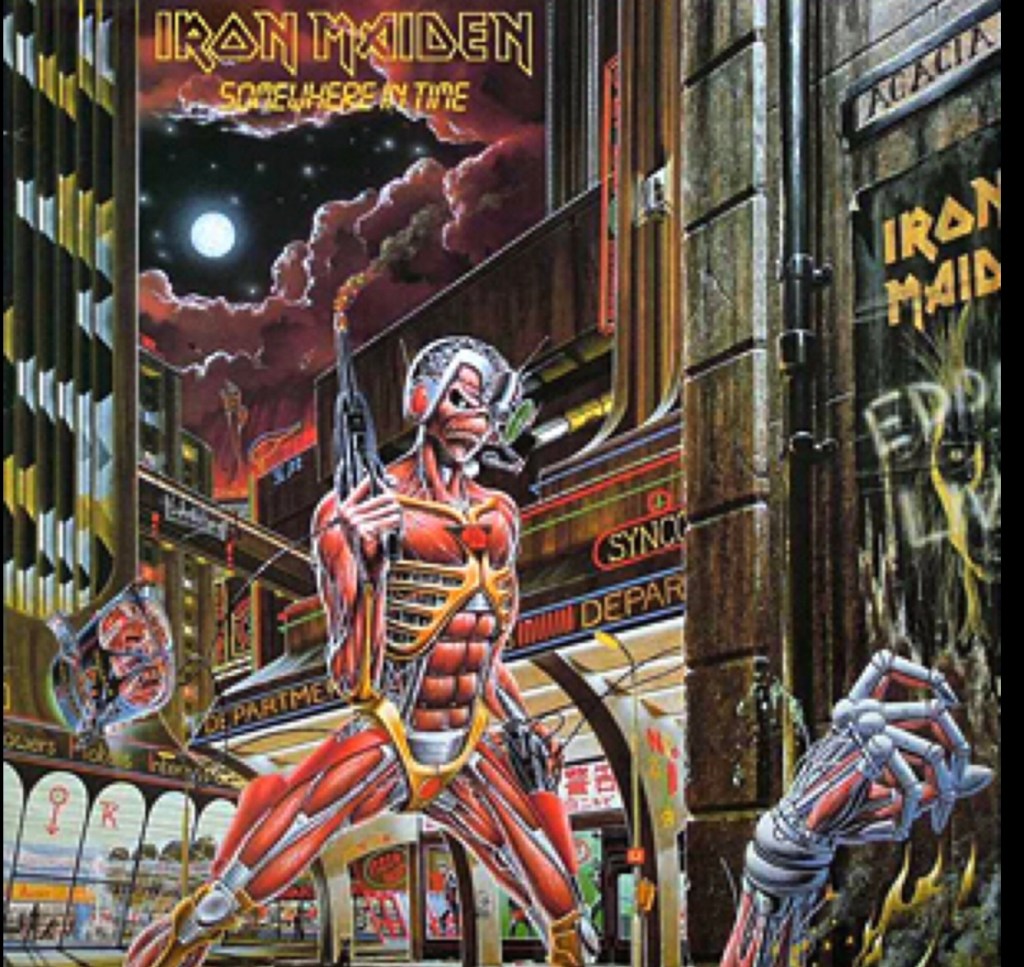
The first thing that grabs you is the Bladerunner style cover. Bruce Dickinson mentions the same in his book, “What Does This Button Do?”

Apart from buying the album, the fan is also buying a great piece of art by Derek Riggs, who took 3 months to come up with the painting.

During this 80s era, the UK government decided to tax the entertainment industry over 80% of what they earn so this meant that the band and other UK artists had to go into exile and were caught somewhere, far away from home for nine months of the year. So the album ended up being written and recorded in different places and in different studios.

When the sessions started, Bruce Dickinson wanted to do something different, which made everyone laugh. He wanted Maiden to lead instead of delivering just another Iron Maiden album.

But, the fans got “just another Maiden album”. And we loved it.

Steve Harris contributed “Caught Somewhere In Time”, “Heaven Can Wait”, “The Loneliness Of The Long Distance Runner” and “Alexander The Great”. Adrian Smith contributed “Wasted Years”, “Sea Of Madness” and “Stranger In A Strange Land” while Dave Murray brought in “Déjà Vu”.

A chord is strummed, a synth chord rings out and a harmony lead is heard. This repeats for a few times and then a drum groove comes in. Subdued it percolates, changes key and at the fifty two second mark, it explodes.

“Caught Somewhere In Time” had really started. And that exploding intro comes back in the solo section at the 4.50 mark. As Harris once said, it’s about a nightmare trip through time due to a malfunction in the time machine.

The iconic open E pedal point riff starts off “Wasted Years”, Maiden’s contribution to the tales of touring and being on the road for a long time. It’s no surprise that this song was written straight after their biggest and longest tour for the “Powerslave” album which resulted in the “Live After Death” album.

The intro lead riff was rejected by Smith but Harris heard it and told him to work on it.

And the whole solo section is head banging, fists in the air, desk breaking material. Check out the way they build up the intro E pedal point riff into the solo section.

The solo section of “Sea Of Madness” is one of my favourite pieces of music on this album.

“Heaven Can Wait” is the story of a person who is struggling to transition to Heaven. The song just moves along, but when the whole “Take my hand, I’ll lead you to the promised land” section starts off, its pay attention time. Then those “woh oh oh” chants kick in and its desk breaking time. And how good is the clean tone guitar riff under the “woh-oh-oh”.

The guitar intro to “The Loneliness Of The Long Distance Runner” is inspiring, There is a film with the same title and Harris once said in an interview something like, “you always have to run in life, move forward, and you do it alone.”

The way Bruce Dickinson carries the vocal melody for the Chorus is excellent, and then the harmony leads kick in while Nicko McBrain is doing double time on the drums.

Then at the 3.30 mark, a blues rock like lead kicks in with pentatonic bends before it morphs into a metal like solo. And the song ends the way it started, with a tonne of memorable harmony leads.

The open E bass shuffle of “Stranger In A Strange Land” gets me interested, but it’s the Adrian Smith riff that seals the deal.

And how good is the lead break.

While the title shares the same name as the Robert Heinlein book, Adrian Smith based it on a story he read about an old sailor John Torrington, a member of the mysterious 1845 Sir John Franklin expedition that attempted to find the Northwest Passage from America to Asia. More than a century later in 1984, he’s perfectly preserved body was found in the ice of the North Pole.

Check out “Déjà Vu” from the 30 second mark, when that harmony lead kicks in. It’s like “The Loneliness Of The Long Distance Runner” part 2 and it morphs into a riff that reminds me of “Die With Your Boots On”.

How good is the pre chorus vocal melody when Dickinson starts to sing, “cause you know this happened before”?

And that harmony lead from the 2.50 mark. Brilliant.

There is blowing wind, a slow military march tempo and a clean guitar solo. That is how the album closer, “Alexander The Great” starts, and it percolates musically, until it explodes into the verses.

The lyrics are somewhat like a children’s encyclopaedia article however there is enough detail there line by line.

And that groove and feel change at the 4.50 mark is excellent, with more leads and more harmonies.

Not bad for just another album.

But.

For all its excellence, the tracks on “Somewhere In Time” (apart from “Wasted Years” and “Heaven Can Wait”) are really underplayed when it comes to the set lists.

P.S. This issue of Guitar Legends is one of my favorites with a heap of information. But that will be for another day.

Standard
Influenced, Music

Angus Young Axology – Guitar World – March 1986

The below is from my March 1986 issue of Guitar World and since AC/DC is about to come back in our lives in a big way with a new album, let’s go back 34 years and see what gear the Young brothers are using.

AN AC/DC AXOLOGY from Angus Young

I have about fifteen Gibson SGs on the road, but I’ve only been playing three of them. People may find it hard to believe, but a lot of my SGs have gotten waterlogged.

I sweat so much during the course of a show that it manages to seep into the guitar. I’ve had many of them sealed off over the years, but when the varnish starts to wear, the moisture from the sweat manages to soak into the wood and the guitars become heavier and lose much of their tone. The only thing you can use them for is surfboards. Wood definitely has a lot to do with how your guitar sounds.

My main SG is a brown one from the late sixties. It s the best one I got. I went into a guitar shop years ago and fell in love with it.

The strings on it were like barbed wire and it had a very nice, thin neck. I’m a small guy, so the guitar sits on me perfectly. It has a great sound—not too toppy and not too bottomy—just perfect.

I’ve always said that when I got more money, I would buy me a better guitar, but I still haven’t found a better one yet. I broke it so many times already—just from touring and running around on stage. The neck is the only original part on it.

I’ve also been using a black SG on tour. One day I was fishing around in New York and I found one that I liked—it s a custom one with three pickups, but I took the middle pickup out. All my SGs have the original Gibson pickups, the same ones that the old Les Pauls used to come with.

Apart from the brown and black SGs, I also use a red one in concert; its one of the newest ones I’ve got. Gibson put it together for me; it’s a bit similar to my brown one, but the neck is a little heavier and fatter.

At home I have other kinds of guitars, some Les Pauls, a Fender Strat and a couple of Telecasters. Besides an SG, the only other guitar I feel comfortable playing is a Telecaster. In the old days me and Malcolm used to share one.

Malcolm just uses Gretsch guitars. He has about nine of them on the road and they re all basically the same. I think they’re the Jet Fire Bird model. Malcolm can get a great biting sound out of them. It’s a sound a lot of guitarists would love to have but could never get.

Neither of us uses any effects devices. We want our sound to be as pure as possible, so we don’t need to use them.

We both use wireless units, though. I use a Schaffer-Vega and Malcolm uses a Sony wireless.

I was one of the first guitarists to use a Schaffer. I started using it back when Ken Schaffer was with the company. He sold it to me and repaired it whenever something went wrong, it gets a lot of beatin’ around, so I pay to have a guitar tech take care of it to make sure it’s in proper working order every night. I have a few of them onstage at the same time, all hooked up and ready to go. This way, just in case something goes wrong, no time is wasted.

Malcolm uses a Sony wireless because he just stands onstage and bangs away on a guitar. The Schaffer has a Diversity System, so if I want to jump into the audience and play guitar, I’m able to do so without losing any signal. The Sony also has a Diversity System, but it’s very sensitive. If it takes a lot of beatin’ and knockin’ around, it can break down very easily. I tried it one night but when I bumped it, it cracked up.

We both use Marshall amps.

At the moment we each have six 100-watt heads hooked up. I also have a specially-made Marshall amp that the company put together for me years ago. I think it was the first one they ever made, so everyone was real excited about it. It can put out between three to four hundred watts. I can even switch it down to fifty watts, if I want to.

Malcolm’s amps sound pretty quiet compared to mine. He doesn ‘t play with as much volume. Malcolm likes a tough, clean sound with no distortion. I like to play very loud.
—As told to Joe Lalaina

Standard
A to Z of Making It, Music, My Stories, Unsung Heroes

Convergence of Forces in 1986/87

After touring with AC/DC and Aerosmith for a year, I felt a little more aggressive. Some nights I would come up with something pretty, but after seeing Angus bash it out, I would say “Fuck pretty”.
Vito Bratta GW September 1989

This quote has remained with me for ages.

Vito Bratta is a guitarist who understands music and loves his instrument. His soloing is liquid joy and his rhythm work is complex.

So how does a musician who uses complex chord inversions and arpeggios to color a song compete for people’s attention against the blues based rock of AC/DC and Aerosmith, especially when those two bands had a head start of 15 plus years building up an audience.

Furthermore while Aerosmith sang about a dude who looks like a lady and a rag doll cutie, White Lion via Mike Tramp sang about the sinking of a Greenpeace ship. While AC/DC sang about woman as fast machines, White Lion sang about broken homes and violence in the home.

I remember a magazine reporter writing about how Mike Tramp introduced “Little Fighter” to metal kids when White Lion was opening for Ozzy. It went something like this;

Tramp: “You like to go to the fuckin’ Jersey Shore?” 
Crowd: “Yeah!” 
Tramp: “Don’t you get pissed off when you can’t swim because of the pollution?
Crowd: “Yeah!” (half-hearted)
Tramp: “Well, here’s a song about a group that’s doing something about it.”

White Lion toured with blues based hard rock bands for 12 months during the “Pride” period and there is no doubt that the rock vibe and party connection with the audience would have influenced Vito with the writing process of “Big Game”. But he didn’t want to just follow blindly what others have done before him so he tried to create something new, something interesting. But the majority of the pop music consumers don’t want interesting. They want carbon copies of what came before, something they can sing too, and something that is very uninteresting.

So “Big Game” was rushed. All because the label wanted to capitalize in the new-found interest in the band. But the label must have forgotten that MTV still controlled the public interest metric. If MTV played your band on the channel, you would sell a million plus. If they didn’t, you wouldn’t sell as much as you expected regardless of the quality of the music.

So with great power, comes great responsibility and MTV became a powerful and corruptible gatekeeper and for all its evil ways, it was still the best marketing tool to turn acts into global superstars.

But MTV didn’t play the video clips from “Big Game” as much as it played the clips from “Pride”.

And it’s funny when you look back to the 1986/87 period, the artists who had their biggest hits and sales during that period, never replicated those numbers again.

Bon Jovi never topped “Slippery When Wet”. Europe never topped “The Final Countdown”. White Lion never topped “Pride”. Whitesnake never topped their “self-titled” debut. Guns N Roses never topped “Appetite For Destruction”. INXS never topped “Kick”. Joe Satriani never topped “Surfing With The Alien”. Def Leppard never topped “Hysteria”. U2 never topped “The Joshua Tree”. Stryper never topped “To Hell With The Devil”.

There was something of a convergence during these years. MTV was well established by 1986 and massive, CD’s had taken hold by 1987, artists that had been around for a while had enough experiences on the board to write their masterpiece and fans of the 60’s/70’s rock movement had teenage families, so suburbia had cash to spend on entertainment due to low employment.

But with all things great, disaster was just around the corner. Black Monday happened on Monday, October 19, 1987, when stock markets around the world crashed. The single day drop was enough to scare people from spending and make people lose their jobs. Maybe it put a dent into the recording business for a few years, because from 1989 to 1999, the labels turned over billions.

Standard
Classic Songs to Be Discovered, Music, My Stories

Thrash Revision

The very first Megadeth song I heard was “Wake Up Dead”. 100% of people would think I heard it via an LP or some other physical format but it was via music television. Yep, Megadeth was a video clip band for me for a few years before I spent my money on their catalogue. And I thought, “what is this rubbish?”

But the next clip that came on was “Peace Sells” and although musically/lyrically it was great, Mustaine’s voice just didn’t resonate. A few years later I saw the film clip to “No More Mr Nice Guy” from the “Shocker” movie and although Desmond Child spoke of all horrors of horrors trying to get Mustaine sober enough to record the Alice Cooper cover, the finished output was nice and polished enough to showcase Mustaine’s voice. It actually sounded pretty good. A few months later, “In My Darkest Hour” came onto the TV and again I was blown away musically and lyrically, but man, Mustaine’s voice and tone was a bit of a miss on it.

All of my doubts got put to “Rust In Peace” in 1990. When “Holy Wars” came out, I was fully converted, musically, lyrically and vocally.

I was in, I was a fan and I was off to the record shop to buy the new album, plus the back catalogue. However, the shop didn’t have “Killing Is My Business”, so I had to make do with “Rust In Peace”, “So Far, So Good, So What” and “Peace Sells… But Who’s Buying”. Apart from the brilliant riffs in “Holy Wars”, the main thing I remember from the video clip is drummer Nick Menza (RIP) pounding the skins and the very MTV friendly looking band appearing on the TV screen.

When Dave Mustaine appeared on “S12 Ep5 of That Metal Show” (in 2013) he was asked to rate his top 5 Megadeth albums. Guess which albums made his top 5.

  1. Countdown To Extinction
  2. Rust In Peace
  3. Peace Sells
  4. Killing Is My Business
  5. So Far, So Good, So What

I think you can take “Killing Is My Business” off the list and add “Dystopia” to it. Isn’t it funny how in 2013, Mustaine viewed his 80’s and early 90’s output as his most superior.

And I started thinking about 1986. 31 years ago. Wow. Has it been that long? The 70’s seemed so far away in the 80’s and in 2017, 1986 seems like a few years ago.

Is 86, the year thrash metal became a commercial force of nature. It’s been well documented that “Master Of Puppets”, “Reign In Blood” and “Peace Sells … But Who’s Buying?” all came out in this period.

Let’s put into context the commercial side of 1986 (based on RIAA certification in the U.S).

“Master Of Puppets” came out in February, 1986 and by November, 1986 in had a Gold Certification. Two years later in July 1988, it was certified Platinum for 1 million records sold. It’s 2x Platinum came on the backs of the “Black” album in 1991 and it wasn’t until 1994 that it was certified 3x Platinum. Currently it is 6x Platinum and that happened in June 2003.

“Peace Sells … But Who’s Buying” came out in September 1986. It didn’t set any charts alight and by November, 1988, it received a Gold certification for 500,000 units sold in the U.S.

By November 1992 and on the backs of the “Countdown To Extinction” album, it was certified platinum.

“Reign In Blood” came out in October 1986 and it was certified Gold in November 1992.

So while 1986 did have some excellent thrash releases, thrash didn’t take the world by storm in the way revisionist writers like to frame it today. Like it or not, it happened after the “Black” album came out. It was a slow build and that’s how great music works. Slowly percolating outside the mainstream until it becomes the mainstream. Then every label wanted in.

For me, I didn’t own (which means buy with cash) my first Metallica record until “… And Justice For All” came out in 1988. I then went back and purchased the earlier stuff. For Megadeth, as mentioned above it was 1990 and for Slayer it was well into the early 2000’s that I got “Seasons In the Abyss” and again based on the film clip. And before owning their albums, I had dubbed copies of their albums.

Standard
A to Z of Making It, Music, My Stories

1986 vs 2013

BON JOVI

In 1986, Jon Bon Jovi was all about the music. He was in debt to his record label and still living with his parents. The “band” Bon Jovi released their biggest seller, Slippery When Wet.

Now, Jon Bon Jovi is all about the money. The band Bon Jovi released their biggest dud, in What About Now, Richie Sambora has been booted because of money and Jon Bon Jovi cancelled a New York Fair concert for an intimate Government concert that paid more.


BLACK SABBATH/OZZY OSBOURNE

In 1986, Black Sabbath released Seventh Star with Glenn Hughes on vocals and Ozzy Osbourne released The Ultimate Sin.

Seventh Star was originally intended to be the first solo album by Iommi, but due to pressures by Warner Bros. Records and the prompting of band manager Don Arden, the record was billed as Black Sabbath featuring Tony Iommi.

The Ultimate Sin featured songwriting contributions from Bob Daisley and Phil Soussan, however due to Sharon Osbourne (Arden) trying to keep as much money as possible in Ozzy’s corner, Bob Daisley was not credited on the initial release and Phil Soussan had an accounting disagreement with Sharon. Everyone got shafted by an Arden.

In 2013, Black Sabbath released 13, their first album with Ozzy since 1978, that also featured the talents of Rage Against The Machine drummer Brad Wilk. Bill Ward said he would not participate until he was offered a “signable contract.” One B.W is out and another B.W is in. Again, someone was shafted by an Arden.

RECORD LABELS

The major labels wanted their artists to have careers. They spent a lot of money to convince the public that they should pay attention to their new artist or the latest release of an existing artist.

The marketing was from the label down to the streets. The labels had so much power and they set the bar. Either a band was signed to a label or they didn’t matter. Major labels were plentiful and the most powerful person in the music business was the Record Label head. Artists could live off the money from their record deal as people had to buy the expensive record to listen to it. Because it was expensive, we played it over and over and over again and eventually became a fan.

Now the marketing is from the streets and the record labels want the hit singles. They have shareholders to please, a board to please and all the label heads are interested in bonuses and short term profits. There is no long term vision anymore as the Record Labels do not have the same power.

The major labels have been reduced to 3, with Sony, Universal and Warner Bros.

In 1986, record companies were cool. In 2013, HBO, Netflix, Showtime, Facebook, Apple, Samsung, Twitter and Amazon are cool. 


LIVE

In 1986, all the acts did the arena and stadium tours because demand was high. If a band opened for a major act, they believed they had made it. The public discovered new acts when those acts opened up for our favourite bands. Look at the list below;

Metallica and Ratt opened up for Ozzy Osbourne.

Anthrax opened up for Metallica.

Marillion opened up for Rush.


Loverboy opened up for Van Halen.

King Kobra, White Lion and W.A.S.P opened up for Kiss.


W.A.S.P also opened up for Iron Maiden.

Cinderella opened up for Bon Jovi in the U.S and Queensryche opened up for Bon Jovi in Europe.


Queensryche also opened up for AC/DC.

Cinderella also opened up for David Lee Roth.

Honeymoon Suite and Glass Tiger opened up for Journey.

Dokken opened up for Accept.

Keel opened up for Dio.

Krokus opened up for Judas Priest.

Now only the classic rock acts of the Seventies and Eighties can sell out the arenas and the few modern superstars. The majority of acts play the club circuit. If bands have a small hard core fan base, they can raise enough money to make an album and own everything about themselves. No one cares who the opening band is.

RANDY JACKSON

In 1986, he played bass with Journey. He appeared on the Raised on Radio album and also toured with them. People judged him on his abilities.

In 2013, he is a judge on American Idol.

CHARTS

Back in 1986, the charts meant everything and albums sold in double digit millions. Slippery When Wet from Bon Jovi went to Number 1 for 1 week in October and then it re-appeared at number 1 for 7 weeks in 1987.

Now the charts are useless and artists are lucky to sell a million units. There are a few, like Adele that go into double digits. Bon Jovi’s What About Now went to Number 1 for 1 week and it didn’t reappear again.

ANTHEMS OF A GENERATION

In 1986, we had Addicted To Love from Robert Palmer, Sledgehammer from Peter Gabriel, Dreams from Van Halen, Livin On A Prayer and Wanted Dead Or Alive from Bon Jovi, Peace Sells from Megadeth, Battery from Metallica, Raining Blood from Slayer and The Final Countdown from Europe.

In 2013, nothing lasts.

THE MUSIC BUSINESS 

In 1986, it was all about the music and if a band was all over traditional media, it meant they had traction and that people would be hearing their music.

Now, our favourite bands are playing to the masses who just don’t care and now it is all about marketing. Look at the marketing campaign for the new Dream Theater album. It looks like the label is trying to monetize every little bit of it. If a band is all over traditional media, it doesn’t mean that they have traction and it doesn’t mean that people have heard their music.

In 1986, everything was expensive and the cost of music was different at every store. Due to the high prices of music, everybody had a little bit of it. We had to buy it to hear it, or we used to tape it of someone who purchased it.

Now, music costs the same everywhere, and it’s cheap and everybody has more than they want. Music is available to hear for free, whether on YouTube or streaming music services like Spotify.

In 1986, albums from our favourite artists would normally come out every two years. Due to this lack of new material, music was scarce, so when we purchased albums we played them to death. We became fans by over playing the music we purchased as it was all about the music.

Now, music is released constantly and it is plentiful. Due to these riches of new material, we don’t spend as much time with the albums we purchased. We become fans by looking for the song that grabs our attention on the first listen.

LADY GAGA

In 1986, Lady Gaga was born. In 2013, Lady Gaga is just Born This Way.

METALLICA

In 1986, Metallica released Master of Puppets and lost bass player Cliff Burton in a bus accident while on tour.

In 2013, Metallica will be released Through The Never a live/concert film and will be losing a lot of money when it doesn’t set the world on fire.

MEGADETH

In 1986, Megadeth released Peace Sells.. But Who’s Buying, which in their case, everyone was buying.

In 2013, Megadeth released Supercollider and no one was buying.

KISS

In 1986, Gene Simmons from Kiss produced and co-wrote songs for the Black N Blue album, Nasty Nasty, that had a certain Tommy Thayer on guitars.

In 2013, Kiss released Monster, that has Tommy Thayer on guitars, as well as lead vocals on one song and a major co-writer of material.

STRYPER

In 1986, Stryper released To Hell With The Devil.

In 2013, Styper will release No More Hell To Pay. It looks they still have hell on their minds.

SLAYER

In 1986, Slayer reigned in blood.

In 2013, Jeff Hanneman’s reign ended. RIP.

QUEENSRYCHE

In 1986, Queensryche was one band that released the a superior album in Rage For Order.

In 2013, Queensryche are two seperate bands that ended up releasing two inferior albums in Frequency Unknown(Geoff Tate version) and Queensryche (Todd LaTorre version).

The fans are screaming for order.

CINDERELLA 

In 1986, Cinderella released Night Songs and proved to the world that they are nobody’s fool.

In 2013, Tom Keifer the singer from Cinderella released The Way Life Goes, an album 9 years in the making with a song called Fools Paradise.

VINNIE VINCENT

In 1986, Vinnie Vincent invaded the charts, with a point to prove.

In 2013, Vinnie Vincent is …..

Standard
Music

Angus Young – Guitar World – March 1986 – Part 1

ANGUS YOUNG – RAW ENERGY IS ALL YOU NEED
Guitar World March 1986
By Joe Lalaina

(All parts in Italics and Quotes are from the March 1986 issue of Guitar World)

The little guy with the big SG is unconcerned with current guitar hero fashions.  His stock in trade has always been the hard rock shuffle to a boogie beat.  Before you drop the needle on any new AC/DC album, you know what to expect. Rarely has a band maintained such a consistent sound as AC/DC, they’ve been pretty much making the same album for the past ten years. Fly On The Wall, the group’s eleventh release, is no exception.

“I’ve heard people say all our music sounds the same,” says soft-spoken lead guitarist Angus Young, “but it’s usually just the people who don’t like us who say it.”

Not true. It’s just that ever since the band’s High Voltage debut back in 76, AC/DC has been playing the same relentlessly raw and straightforward style on every succeeding album. And that’s the way their fans like it.

I like AC/DC.  They are a talisman to consistency.  Each album is the same, however that doesn’t mean that each album was successful.  You need great songs, and that is what AC/DC delivered on High Voltage, Highway To Hell, Let There Be Rock, Back In Black and on The Razors Edge.  Credit both Mutt Lange for Back In Black and Bruce Fairbairn for The Razors Edge.  Actually, The Razors Edge album is the most crucial album AC/DC ever did.  After a steady decline in fortunes and sales since Back In Black, they kicked off the 1990’s with a bang.  It made them relevant again.  The Razors Edge album sustained them throughout the 90’s and into the now.

“We never go overboard and above people’s heads,” says Angus, who took some rare time out from his recent American tour to discuss musical and other matters.

“We strive to retain that energy, that spirit we’ve always had. We feel the more simple and original something is, the better it is. It doesn’t take much for anyone to pick up anything I play, it’s quite simple. I go for a good song. And if you hear a good song, you don’t dissect it, you just listen and every bit seems right.”

For any guitarist that is starting off, AC/DC wrote the book on beginners guitar.  In the process, they also created songs that are timeless and a soundtrack to a whole generation of people in the seventies, eighties and nineties.  I am just teaching my kids to play guitar and the first song i showed them was Long Way To The Top from AC/DC.

Although this stripped-to-the-bone approach has made AC/DC internationally successful, thirty million albums sold worldwide ain’t bad!, Angus is more concerned with having a  good time than with album sales.

“We don’t go around the world counting ticket and record sales,” he says, “nor do we glue our ears to the radio to hear what’s trendy at the moment; we’re not that type of band. We do run our own careers, but we leave the marketing stuff to the record company. We make music for what we know it as, and we definitely have our own style.”

AC/DC defined a style and in the process spawned a million imitators.  What a lot of people don’t understand, especially the international fans, is that Australia rock bands where all playing the same style.  Rose Tattoo, The Angels, Daddy Cool, Stevie Wright all had that pub rock vibe.  AC/DC just stood out a bit more.  Credit Bon Scott and Angus Young.  Brian Johnson walked into the house built by Bon and Angus.

Is there anything Angus considers special about his playing style?

“In some ways, yeah.” he says. “I know what guitar sound I want right away. And if I put my mind to it, I can come up with a few tricks. I mean, I just don’t hit the strings that my
fingers are nearest to. But the most important thing, to me, is I don’t like to bore people. Whenever I play a solo in a song, I make sure that the audience gets off on it as much as I do.”

Angus exerts more energy in the course of one song than most guitarists do in an entire show.

“I’m always very nervy when I play.” he says. I usually settle down after the first few songs, but it’s hard for me to stand still. I suddenly realize where I am, onstage in front of thousands of people; so the energy from the crowd makes me go wild.  I’m always very careful, though. If you bump an arm or twist an ankle, there s no time for healing on the road. You can t tell the crowd. Hey, people, I can t run around tonight I have a twisted ankle.”

I have mentioned before about bands writing great songs and how that is very different to bands that write great songs that go down great live.  AC/DC is another band, that has that foresight.  The songs are all meant for the arena.  To be honest, i don’t really remember a recorded song fading out, i am sure some do, however it is testament to the band that they write a start and an end.

Malcolm Young, AC/DC s rhythm guitarist and Angus older brother, would rather just stand in one spot and bang out the beat with thuddingly repetitive chord structures.  

“Malcolm makes the band sound so full”, says Angus, “and it’s hard to get a big ego if you play in a band with your brother, it keeps your head on the earth. Malcolm is like me, he just wants the two of us to connect. Although he lets me take all the lead breaks, Malcolm’s still a better guitarist than Eddie Van Halen.  Van Halen certainly knows his scales, but I don’t enjoy listening to very technical guitarists who cram all the notes they know into one song.  I mean, Van Halen can do what he does very well, but he’s really just doing finger exercises. If a guitarist wants to practice all the notes he can play, he should do it at home. There’s definitely a place for that type of playing, but it’s not in front of me.”

Big call by Angus.  Dishing on King Eddie.  Back then, I was like WTF?  How dare he?  Eddie was king back in 1986.  He was untouchable.

I didn’t even like AC/DC back in 1986 and I am Australian.  I was so into the U.S. Glam/Hard rock scene, I failed to see the talent that was AC/DC.  I am glad I made up for it in the nineties, when Grunge allowed me to drop out of the mainstream and go searching for classic rock bands.

These days, no one speaks their mind.  They all want to be loved.  No one wants to be hated.  Guess what people, we can see right through it.  We can tell the fakes from the real dealers.  (Nice lyric line by the way, I will keep it)

Angus would much rather listen to old time players like Chuck Berry or B B King. 

“Those guys have great feel, ” says Angus. “They hit the notes in the right spot and they know when not to play. Chuck Berry was never a caring person. He didn’t care whether he was playing his tune, out of tune or someone else’s tune. Whenever he plays guitar, he has a big grin from ear to ear. Everyone always used to rave about Clapton when I was growing up, saying he was a guitar genius and stuff like that. Well even on a bad night Chuck Berry is a lot better than Clapton will ever be.  Clapton just sticks licks together that he has taken from other people – like B B King and the other old blues players—and puts them together in some mish-mashed fashion. The only great album he ever made was the Blues Breaker album he did with John Mayal and maybe a couple of good songs he did with Cream. The guy more or less built his reputation on that. I never saw what the big fuss was about Clapton to begin with.”

That is what made Angus a legend, he always spoke his mind.  The world we have today is all about yes people and making sure that we don’t offend.  We all want to be loved, hence the reason why one person has 5000 Facebook friends.  Yeah Right.  5000 Friends.  What a load of B.S?  No one speaks their mind these days.  The kids grow up these days, being told by mum and dad what a great game they had in football, and how great they are at reading and how great they are at this, when all they did was touch the ball once and play with the grass most of the time.

It’s easy to get lost in those comments against Clapton and Van Halen.  If you do, you miss the point Angus is trying to make.  He has no time for technical players, but he has time for Chuck Berry.  In relation to Eric Clapton, he didn’t really understand what all the fuss was about, he believed that others where better, like Jeff Beck.

“There are guys out there who can play real good without boring people.  Jeff Beck is one of them.  He’s more of a technical guy, but when he wants to rock and roll he sure knows how to do it with guts.  I really like the early albums he did with Rod Stewart.”

There is that name again Jeff Beck.  When I was reading this magazine, Jeff Beck’s name came up a few times.  I had to check him out.  This is 1986.  No internet to Google Jeff Beck.  No YouTube or Spotify to sample him.  I had to walk down to the local record shop and look for it.  Good times.  I am glad I lived them and I am glad they are not coming back.

Standard
Music

What made Bon Jovi’s Slippery When Wet Explode?

What made Slippery When Wet explode?

A lot of people credit Bruce Fairbairn for it.  Others credit the influence of Desmond Child, while others would credit the sound engineering and mix by Bob Rock.  Others put it down to Jon and Richie finally finding their niche as songwriters and finally others put it down to the Pizza Parlour Jury.   Could it have been the labels release schedule and marketing plan?  Could it have been that the scene needed a shake up and this album was right time, right place?

First let’s put into context where the band was at in 1985.  They had just finished a nine-month world tour for 7800 Degrees Fahrenheit.  The band was in debt to the record label for a couple of million bucks.  The guys where living at their mom and dad’s, and wrote most of the songs for Slippery When Wet in Richie’s mom’s basement. 

There is a common myth that once a band is signed, they are showered with untold riches and that they have money coming out of their arse.  That is so far from the truth.   Bon Jovi where in debt and they were lucky that the label gave them a third chance.

From the 90’s onwards, labels didn’t give bands three chances.  One chance was all they had.  If they failed they will get someone else.   These days the labels are irrelevant.  They need to compete on a playing field where the rules change at the same rate technology changes and to be honest, they are so out of touch, it’s almost laughable watching them trying to hold on to the old way of doing things. 

Let’s start with Bruce Fairbairn.  Before he started doing Slippery he was coming off a multi-platinum run of releases with Loverboy and Honeymoon Suite, plus a Gold release with Krokus.   According to Paul Dean from Loverboy, Bruce is super organized.  He charts everything out and every song is broken into parts. 

Slippery would go on to multi – multi platinum sales and New Jersey (also produced by Bruce would do the same).  From Slippery, Bruce would move on to Aerosmith.  Permanent Vacation, Pump and Get A Grip all went multi – multi platinum.  He resurrected AC/DC’s career with the 5x platinum The Razors Edge after a steady decline in sales after Back In Black.  It is safe to say that Bruce had a certain knack for getting the best out of the artists he produced.  His track record is envious to say the least.

Then you have Desmond Child.  

Jon and Richie wanted to write with another song writer, so that other people can perform the songs.  Jon heard Tina Turner singing a song that Bryan Adams had written and wanted to do the same.  That is how Desmond Child came on the scene.  However the plan got skewed, as the songs that came out of those sessions where that good, that it was decided they will be kept for Jovi instead.

The first song Jon and Richie wrote with Desmond in Richie’s mother’s basement was “The Edge Of A Broken Heart”.  The second song they wrote was “You Give Love A Bad Name” by referencing a song he wrote for Bonnie Tyler called If You Were A Woman (And I Was A Man).  The melodies and chord progressions are very similar.

He used the story of his 70’s girlfriend, Maria Vidal who used to work a diner and was called Gina, for Livin On A Prayer.  In interviews, Richie has stated that Jon didn’t want the song on the album, while Richie was trying to convince him it was the best song they had.

I’d Die For You and Without Love where two other songs penned by Jon, Richie and Desmond.  I’d Die For You even has a cult status as a fan favourite.  Desmond brought the pop side to Bon Jovi’s form of hard rock, glam metal overtones. 

The engineer and mixer Bob Rock 

Jon heard Honeymoon Suite’s The Big Prize (another Bruce and Bob production) and that sealed the deal for Bon Jovi to also seek out Bob Rock.

The Pizza Parlour Jury

When Jon and Riche were making the demos in New Jersey, they would go across the street to the pizza parlour. They would ask a bunch of kids to hear some stuff.   As Richie puts it, “It was like a marketing test .  They came in and said, “Yeah, we like this one. This one gets through and that one doesn’t.”

They sure needed it as they wrote a truck load of songs.  Apart from the 10 songs that ended up on the album, other songs that never made it include;

Never Enough For You, Borderline, Edge Of A Broken Heart, Heat Of The Night, Give My Heart, Lonely Is The Night, Too Much Too Soon, Game Of The Heart, Deep Cuts The Night, Stand Up, Walk Don’t Run, Out of Bounds, There Is No Answer, Promise, Take Me All.

Bouncing songs off different independent ears that are not related to the band, helped Bon Jovi focus on the songs that where stronger.

Polygram Records

Doc McGhee the Bon Jovi manager at the time has stated that putting out a record at the right time is very important.  He further mentioned that the label looked at what other labels where releasing and picked a window where there was nothing really there competing against it.

August was the month that was selected and competing against Slippery When Wet where other August releases from Motorhead – Orgasmatron, Vinnie Vincent – Invasion, Warlock – True As Steel and Great White – Shot In The Dark. 

If it was released in July, it would have been up against DLR’s – Eat Em and Smile for listeners’ attention.   If it was released in June, it would have had to compete against Queen – A Kind of Magic, Genesis – Invisible Touch, Rod Stewart – Every Beat of My Heart, Madonna – True Blue and Cinderella – Night Songs.  If it was released in May as originally intended, it would have been up against AC/DC – Who Made Who, Journey – Raised on Radio and Europe – The Final Countdown. 

The Album

Let It Rock kicks it off Side 1.

The weekend comes to this town
Seven days too soon
For the ones who have to make up
What we break up of their rules

This song is written purely for the concert experience.  That is foresight in itself.  Apart from delivering a good album of songs, Jon and Richie are mindful of how they will go down live.  The song is about rebellion, getting that fist pumping in the air, just to let your hair down on the weekend.  Much like Loverboy’s Working for The Weekend.  But in this case the rock is a fire that is burning out of control.  Another analogy to melting rock temperatures (7800 degrees Fahrenheit).  It’s funny where Let It Rock has that keyboard intro, Lay Your Hands On Me from New Jersey, is almost identical riff wise to Let It Rock and it has that long drum intro.  It must be a Bruce thing, as even Turn Me Loose had a long keyboard intro.  A good start by the Jon and Richie song writing team.

“Shot through the heart and you’re to blame, darling you give love a bad name.”  The iconic a capella chorus.  Then the band kicks in and Richie does his vocal melody lead until they start the strip bar sleazy verse riff.

I remember when I saw the clip, I was glued to my TV screen.  I never got the name of the song and I thought it was called Shot Through The Heart, so I purchased the cassette album that had the song Shot Through The Heart.   Of course that was the wrong song.  Right band, but wrong song.   The clincher for me was the chorus part after the guitar solo, where it’s just the voice and the drums (sort of reminded me of Queen’s We Will Rock You).  You Give Love A Bad Name was the one that got the door opened and once the band unleashed Livin On A Prayer, the band started selling 700,000 records a month.    It also featured the song writing talents of Desmond Child, who borrowed the vocal melody and chords from a song he wrote for Bonnie Tyler, called If You Were a Woman (And I Was a Man).

Livin On A Prayer was the song that Jon wasn’t even sure should be on the album. 

Bob Lefsetz posted that Livin On A Prayer is where Bon Jovi got the girls and that is what has kept the band going.  He aint wrong there and Jon knew that, hence the reason why he rewrote the song over and over again for each album that came after.   New Jersey had Born To Be My Baby (again a co-write with Desmond Child).  Keep The Faith had the title track (the chorus chord progression is identical, except in a different key and again a co-write with Desmond Child).  These Days had Hey God, Crush had Its My Life (Max Martin comes into the fold now), Bounce and Have A Nice Day had the title tracks.  The Circle had We Weren’t Born To Follow and the Greatest Hits had This is Love, This is Life.  For What About Now, the whole album is following the themes from Livin On A Prayer.  If you are on a winning formula, do it right again and you will hit pay dirt.

Tommy used to work on the docks
Union’s been on strike
He’s down on his luck…it’s tough, so tough
Gina works the diner all day
Working for her man, she brings home her pay
For love – for love

It’s a movie in words.  Life is tough but as long as we love each other, we will be okay.  A lot of people were not okay, but Livin On A Prayer made them feel that they were, as Tommy and Gina were also living the same life they were living.    

Social Disease is the pure filler that needed to be written so that Bad Medicine could be written. 

So you telephone your doctor
Just to see what pill to take
You know there’s no prescription
Gonna wipe this one away

In never should have ended up on Slippery.  Edge of A Broken Heart is far superior.  I know that Jon apologised for that omission.  To be honest the song never had a chance with the listeners coming off three winners already.  It was a poor song from the Jon and Richie team.  At least they made up for it in the next song.

Wanted Dead or Alive was the 80’s version of Turn The Page which Jon more or less copied again for the Young Guns soundtrack and had another number one hit in Blaze of Glory with a cool Jeff Beck solo.    Wanted was written by Jon and Richie.  This song didn’t reach number one, but it is a number one song.  A cult classic.  A radio staple.  When the song was released as a single, the multi-million fan base had already digested it.  They didn’t need to buy the single to make it No. 1.  It was already that in their hearts and minds.      

Sometimes I sleep, sometimes it’s not for days
And the people I meet always go their separate ways

Life on the road is just that.  I am just finishing off reading a Randy Rhoads bio, and it’s pretty clear that Randy started to hate the road.  He wanted to quit Ozzy’s band and study classical music.  He worked his whole life to achieve rock stardom and now that he had it, he was going to give it all up to follow his dream of classical music.  Sadly he never got there.  That is another thing that seems to be forgotten, the road also kills. 

Raise Your Hands (Let It Rock part 2) kicks off side 2.  Another Jon and Richie composition.  The motto of this song is simply.  Come to the show, raise your hands and get wild.  It doesn’t repeat what Let It Rock started, it takes it into overdrive. 

Raise your hands
When you want to let it go
Raise your hands
And you want to let a feeling show

Without Love is the second track after Raise Your Hands on side 2.  This was a Jon, Richie and Des composition and is forgettable.  The first side was pretty much spot on, that it was hard to get into Side 2.    

I saw a man down on lonely street
A broken man who looked like me
And no one knows the pain that he’s been living
He lost his love and still hasn’t forgiven

I’d Die for You is another Jon, Richie and Des composition.  It has become a cult classic for Bon Jovi, with fans hoping that it gets played each night, like Runaway. 

I might not be a savior
And I’ll never be a king
I might not send you roses
Or buy you diamond rings

We are not perfect in relationships, however we try our best.  A lot of the times our best is not good enough and it all ends bad.

Never Say Goodbye doesn’t get out of second gear

As I sit in this smokey room
The night about to end
I pass my time with strangers
But this bottle’s my only friend

And Wild in the Street is a song that could have ended up on a Bruce Springsteen B sides album.    

In here we got this code of honor
Nobody’s going down

As Bob Lefsetz puts “if you want to relive 1986, if you want to know what it was like way back then… You play “Slippery When Wet.”

Standard