A to Z of Making It, Classic Songs to Be Discovered, Derivative Works, Influenced, Music, My Stories, Unsung Heroes

Australian Method Series: Wolfmother – Wolfmother

The Wolfmother debut.
 
Sometime in 2000, founding members Andrew Stockdale on guitar and vocals, Chris Ross on bass/keyboards and Myles Heskett on drums got together to jam.

But it was in 2004, when Wolfmother was born.

And suddenly things started to happen. After playing a gig in April 2004 in Sydney, they got a record deal with Aussie independent label Modular Recordings with whom they released their (EP) “Wolfmother” in September.

While touring on the EP, Universal Music came in and signed em to an international recording deal.

The self-titled debut produced by Dave Sardy was originally released in Australia via their independent deal on 31 October 2005.

The album was later released internationally by Universal in early 2006.

Like other Aussie artists who got a later international release, the album had an additional track and a rearranged track listing. Spotify carries the international release listing and release date.

As an owner of a book of Frank Frazetta paintings, seeing “The Sea Witch” on the album cover grabbed my attention immediately.

Prior to the release, the band had some serious momentum in Australia. They had the EP out on the charts, they toured and nationwide radio station Triple J, had the band in constant rotation.

Dimension

The bass and drum groove reminds me of an amalgamation of Sweet and Cream in the verses before a Chorus kicks in that sounds like a Sabbath cut.

And a new game is created here in which the listener has to guess which band or song influenced the next song.

And I like games like these.

White Unicorn

You know that section half way through in “Stairway To Heaven” when Jimmy Page starts to play major sounding triads over a droning D note.

Well that’s how “The White Unicorn” starts off. And I like it. Take something that came before and create something new from it.

Woman

Its basically a Sabbath cut with that driving galloping groove from “Children Of The Grave”.

Then again “Roadhouse Blues” comes to mind as well.

The addition of the keyboards makes it sound like a demented Doors cut.

And like other Aussie bands, (Airbourne comes to mind) they capitalized on the video game phenomenon that was happening. “Woman” was licensed to appear in over 12 video games which came out between 2006 and 2008.

Where Eagles Have Been

The beginning reminds of “Goin To California” from Led Zep or “Mother Nature’s Son” from The Beatles or “Brain Damage” from Pink Floyd.

This is the beauty of music. Familiarity is in every song which is created.

Check out the sound effect which increases in intensity at 3.42 and then the guitar solo. This is the best part of the song.

At 4.24 to 4.46 reminds of me of “Dazed and Confused” from Led Zep.

Apple Tree

It has a punk style “My Generation” feel from The Who in the Intro and first verse.

Joker & the Thief

This song has crossed over onto a higher astral plane. It’s everywhere. If you sit down to watch a movie or a TV show, there is a chance you’ll hear it. If you buy a video game, there is a chance you’ll hear it.

When I hear “Detroit Rock City” by Kiss, it reminds me of this song.

“The Hangover” and “Shrek” movies have scenes in the movie, which has this song playing.

Colossal

It feels like a Sabbath cut that hadn’t seen the light of day.

How good is the riff that comes in at the 3.30 mark?

It reminds me of “Ace Of Spades” from Motörhead.

Mind’s Eye

My favorite track.

The arpeggios to start it off are hypnotic. Metallica used a similar progression for “The Day That Never Comes”.

When the verses come in, simplicity at its best. It’s just a single strummed chord and a haunting vocal melody.

I like the simple ascending chord progression just before the Chorus. And it comes back again after the Chorus.

How good is the organ riff?

And they jam on it till the end.

Pyramid

Another song that became a favorite amongst people that didn’t even like this kind of music because it appeared in the “FlatOut 2” car racing game.

Witchcraft

A flute solo. Jethro Tull anyone.

Tales

It’s not a favorite.

Love Train

Listen to “Moby Dick” from Led Zep. Imitation is a form of flattery.

Vagabond

A simple drum metronome style click and an acoustic guitar playing a sort of Country Blues Delta riff start off the song.

Swampy it is and the album is done.

I’ve read reviews that they are copyists and unoriginal. But music is judged on the fun and enjoyment you get out of it. And this album is a whole lotta fun.

Going back to the originality question, the bands that influenced em where also copyists. Led Zeppelin’s first album is a great cover album rebranded as a Zep album.

After all was said and done, the album was certified 5× Platinum in Australia, Gold in Canada, Gold in Germany, Gold in the U.K and Gold in the U.S.

By the time the band started to record album number 2, it was just Andrew Stockdale who remained. But the sound and the songs still remained.

You can read my review on “Cosmic Egg” here.

And spend your weekend cranking Wolfmother.

Standard
A to Z of Making It, Influenced, Music, My Stories, Unsung Heroes

The Week In Destroyer Of Harmony History – August 9 to August 15

4 Years Ago (2017)

Thinking short term hurts us. Every leader thinks about the now and never about what’s around the bend. The majority of people in charge of corporations only care about the now.

What is our bottom line looking like?

There is no care about their environmental footprint or employee well-being.

Record labels are the same. They focus so much on first week sales and charts as they believe it brings in an instant payday, without understanding that the payday they are really earning is from music created 30 plus years ago and it just percolated, slowly rising to the top.

Have you heard of the record labels starting to employ artists as employees and offer them retirement plans?

Of course not. That’s long term thinking.

And while everyone kept complaining that Spotify doesn’t pay, they couldn’t explain how Warner accumulated $360 million dollars in streaming fees from em.

All of those artists who sold their rights to the labels and publishers are losing out in the long run but maybe winning in the short term.

I was writing about the 80s and listening to music those bands released in the early 90s.

And I didn’t see much dumbing down of lyrics in the way the writers of the time claimed. And that’s why grunge took over. Instead I saw better lyrics, more mature lyrics, lyrics that showcased highs and lows.

8 Years Ago (2013)

Music and movies just didn’t seem to last anymore.

So why would artists and film makers spend so much time on making one project every two to three years.

George Lucas once said that the $200 million movie is dead. But in 2013, a lot of blockbusters cost over $200 million and man didn’t they flop big time.

Movies like “R.I.P.D “ (a derivative version of Ghostbusters and Men In Black) and “The Lone Ranger” (a derivative version of The Lone Ranger TV show, National Treasure and Pirates of The Caribbean) came to mind.

For some reason, Hollywood still believes that they need a $200 million movie, meanwhile, the movies that did well in 2013 had lower budgets.

“The Conjuring” cost $20 million and when I wrote the article in 2013 it had made made $140 million and when I checked it today, it was at $319.5 million.

“The Heat” cost $43 million to make and in 2013 it had made $190 million and in 2021 it was at $229.9 million.

“Now You See Me” cost $75 million to make and in 2013 it had made $233 million and in 2021, the figures was at $351.7 million.

So is a $200 million budget movie really worth it or should those big budgets be used to make 5 lower budget movies.

So is social media a way to broadcast to people or connect with people?

And while I was critical of Dream Theater having a listening party with no fans, a few weeks later, they invited a select group of fans to experience the new album.

I was reading a lot about “The Pirate Bay” as it turned 10 years in 2013.

From its inception”TPB” is like a number one act, albeit a controversial act, always on top of the charts.

And it all happened via word of mouth in the same way we used to talk about artists and movies back in the day.

Or you can do like Lady Gaga, who would manipulate the mainstream media to write about her and get her loyal “monsters” to spread the word.

Are deluxe editions just overpriced boxes, offering the same thing over and over again for a higher price or offering something of value to a super fan that no one can get anywhere else?

The “Dream Theater” self-titled deluxe edition box set had the same album on a CD, a VINYL LP version and a FLAC version in a box and they charged over a $100 just to format shift the same music.

Meanwhile for half the price (at $55) Coheed and Cambria’s “The Afterman Limited Edition Deluxe Box Set Amory Award Edition” gives you the albums, the demos, a DVD making of, a VIP pass, a book of the story, and notes about the songs, plus a link to download the album and demos on mp3.

Back in the Eighties, the goal was to work in the music business for a record label while you dreamed of being a rock star. Fast forward thirty years and the goal is to work in technology as the new rock stars are the tech heads.

Artists don’t need a middle man to distribute their music, but artists are in love with the story of fame and wealth however they don’t understand that the aim of the game is to outlast the competition.

The “rock star myth” was a deliberate creation of the major labels. Wannabe musicians bought it hook, line and sinker, signing everything away to be the next star. And the Labels licked their lips at all the talent waiting to be exploited.

Stand Or Walk Away” is an underrated cut from “HellYeah”.

It’s got a “Kashmir” like groove I like. The head nods, the foot starts to tap and the fingers start to lay down the beat. There is a sense of classic rock familiarity that intrigues me and it is modern at the same time.

One last thing, when the future generations write the history of metal guitarists, talented players like Greg Tribbet will be forgotten. But he shouldn’t be.

Tribbet is a sum of his influences.

He can be progressive (Mudvayne’s 2nd album is the piece d resistance in progressive riffage), he can be heavy, he can be a guitar hero and he can be soulful, bluesy and even countrish. He is a great talent.

And since we are in the single music era, go and stream the crap out of this song. It will be worth your time.

And that’s another wrap for another week.

Standard
A to Z of Making It, Classic Songs to Be Discovered, Influenced, Music, My Stories, Unsung Heroes

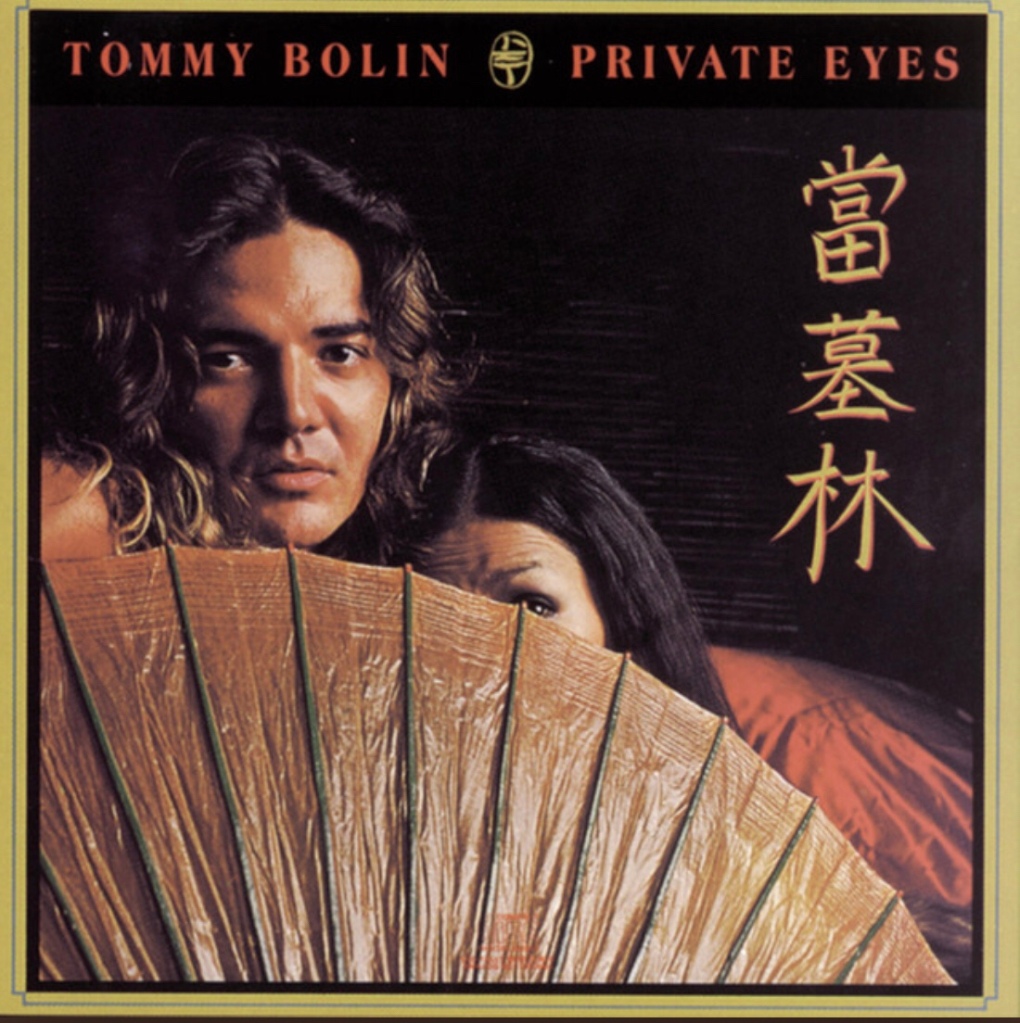
1976 Part 2.5: Tommy Bolin – Private Eyes

I had no idea about Tommy Bolin until Motley Crue covered the song “Teaser” and released it on their “Raw Tracks II” EP which came out in 1990 for the Japanese market and suddenly I was scrolling the used record racks for Tommy Bolin albums or albums that had him playing.

Actually, the Motley Crue version of “Teaser” was officially released on a 1989, compilation album called “Stairway To Heaven/Highway To Hell” which featured the bands who performed at the Moscow Music Peace Festival. And of course the song re-appeared on their “Decade Of Decadence” collection in 1992.

Shock horror to everyone these days who grew up with Wikipedia, I was surprised to read that he was in Deep Purple, but only for a brief moment and that he was in Deep Purple with David Coverdale who was another artist’s back catalogue I was digging deep into during the same period.

The Tommy Bolin “Teaser” album came out in 1975, and while successful he couldn’t really tour behind it due to his Deep Purple commitments, so he kept on writing and over an 8 day period, “Private Eyes” was recorded and released in 1976. This would be his last studio album before he died of a drug overdose on December 4, 1976 at 25 years of age.

It’s worth pointing out that from 1969 to 1976, Bolin was involved in 10 studio albums, with the bands Zephyr, James Gang (he replaced the guitarist who replaced Joe Walsh), Billy Cobham, Alphonse Mouzon, Moxy, Deep Purple (he replaced Ritchie Blackmore) and as a solo artist.

To put into context, Metallica have released 10 studio albums in 38 years. Avenged Sevenfold have released 7 albums in 20 years. The different work ethics of the artists and the labels across different decades is evident.

As a 15 year old, he hitchhiked from his hometown to Denver and met up with a singer called Jeff Cook to form American Standard. Cook would also act as a co-writer for Bolin’s solo output. He then joined Zephyr and after a few albums, he grabbed drummer Bobby Berge to form “Energy” with Jeff Cook on vocals.

But the fusion of styles in the music of “Energy” didn’t resonate with people and the labels. But Bolin did enough to get the attention of Billy Cobham who asked him to play on his record. And then the high profile gigs and studio work started. And by the time he was in Deep Purple he was heavily into drugs and alcohol.

“Bustin’ Out For Rosey”

Its funk rock groove is great to jam to.

The outro jam with the fuzzed out guitar licks and brass section is great listening.

“Sweet Burgundy”

I don’t know who influenced who, but “Wonderful Tonight” from Eric Clapton sounds very similar to this in the intro.

The slide guitar is sublime.

And in the outro, they just jam out the main melody, something that Bruce Springsteen would do to great effect with “Born In The U.S.A” when they keep playing the vocal melody in the outro.

“Post Toastee”

A nine minute song.

So many songs came out between the years of 1968 and 1978 that had similar riffs to either “Cocaine” or “Sunshine Of Your Love”. This is another for the first two minutes and 20 seconds.

Then a bass groove comes in and it’s all funky and soulful. As the bass and drums jam, Bolin starts his lead break. Listen to his phrasing, how he lets certain notes ring and others he deadens.

It’s this fusion of so many different styles which makes Bolin unique.

At the 4.30 mark, the “Cocaine” riff is back in.

Then Bolin shreds away again for the rest of the song.

“Shake The Devil”

It’s a blues jazz fusion cut, like how Joe Walsh played in James Gang.

But at 2.34, the embryo of bands like Iron Maiden is there. Check out the change of pace, the riff and the lead breaks.

“Gypsy Soul”

It’s like a campfire “Love Boat” acoustic cut.

And what I like about this is that Bolin stays within the acoustic guitar and delivers a stellar flamenco lead outro break.

“Someday We’ll Bring Our Love Home”

Carmine Appice filled on drums on this one, as Bobby Berge was unavailable that day. It could have appeared on a Steely Dan album. Its bluesy and full of soul.

“Hello Again”

The strummed chords outline a similar progression like “Free Bird” as the song percolates in that acoustic domain with violins and violas.

“You Told Me That You Loved Me”

A bluesy jazz fusion cut full of sleaze and soul with an ascending walking bass riff.

I like the change at the 3 minute mark, and then the brass instruments come in and the leads starts and its solos to the end.

If you like a lot of guitar playing, this album has it. Crank it.

P.S. Reggie McBride on bass and Bobby Berge on drums are excellent and unsung heroes on this album.

Standard
A to Z of Making It, Derivative Works, Influenced, Music, My Stories

The Week In Destroyer Of Harmony History – August 2 to August 8

4 Years Ago (2017)

Streaming services were challenged.

Netflix had a debt problem. Spotify hadn’t turned a profit and neither had Pandora. Meanwhile, Soundcloud was for sale.

And they had expenses.

They had to pay for content either by creating their own for TV and Film providers, or by licensing content from the labels and movie studios.

The ISP’s then charge all the streaming providers a lot of money for them to use their fast channels without any buffering and then the ISP’s charge us to use the internet and access these streaming services.

But all of these streaming providers have the same issue every other service and artist has.

People can’t slow down their lives long enough to immerse themselves in their content at a rate they would like.

If Netflix has this problem, imagine every up and coming musician or established musician.

1983 was a revolutionary year and the year that metal and rock music became a commercial force and a massive influence on society. Along with the rise of MTV, culture changed dramatically.

Metal and rock music made governments introduce censorship stickers on new releases.

Preachers and TV evangelists became rich and famous when they condemned the art form and told their followers the devil is on the loose, only to be caught with their pants down in seedy motels.

Lawyers took artists to the civil courts because suddenly when records got played backwards people believe they found subliminal messages telling kids to kill themselves.

Band T-shirts had been around before, but nothing like the 80’s. A whole new billion dollar industry came about, because of the imagery. We wanted the T-shirts. It told the world we are a member of the club.

It was just unfortunate that the record labels abandoned these musicians for a newly created record label genre called Grunge.

8 Years Ago (2013)

It’s the music that makes “Learning To Live” from Dream Theater a classic.

“Learning To Live” was released in 1992 on the “Images and Words” album. The song is that good, that Dream Theater even rewrote it and called it “Breaking All Illusions” for the “A Dramatic Turn of Events” album in 2011.

I wrote about artists staying true to their artistic vision and doing what is valuable to them, using bands like Evergrey, Coheed and Cambria, Dream Theater, Digital Summer, Five Finger Death Punch and Protest The Hero as examples.

I compared 2011 and 2013 as it felt like déjà vu again.

In 2011, I was listening to “In Waves” from Trivium and “A Dramatic Turn of Events” from Dream Theater.

And in 2013, I was waiting for “Vengeance Falls” from Trivium and Dream Theater’s self titled album to drop.

We are living in the generation of kids born from 1997 onwards. A generation who consumes music and entertainment digitally. Their sense of community is all online. These kids weren’t alive when the Record Labels ruled the day, so they have no desire for that era, they are all about today and what lays beyond.

The music community has shifted to being a song centric community. We just don’t know it yet. The album format that used to make the most money for the record labels is almost a dead format. However artists still go back and release a collection of songs as an album.

But it’s what gets played over and over again and into the future that matters.

Music is a long road.

Let’s go back in time.

It’s 1982.

The band Bleak House have two highly-regarded releases out in the market and a loyal fan base. One of those releases is a single called “Rainbow Warrior”, that has a movable power chord verse riff that went from B to C to D over an E pedal tone which would go on to form the main riff in Metallica’s “Welcome Home (Sanitarium)”.

And Bleak House struggled to write new material and compete with the other acts releasing music consistently. Eventually they disappeared.

Any artist starting off you need to be creating and releasing. Forget about the 2 to 3 year gap between albums. That is the Record Label standard. It was never the artist standard.

And here is my study on the songs that “Welcome Home” from Metallica borrows from.

And that’s another wrap for another week.

Standard
A to Z of Making It, Classic Songs to Be Discovered, Influenced, Music, My Stories, Unsung Heroes

Australian Method Series: Karnivool – Themata

“Themata” is the debut album by the Australian band Karnivool. The album was released independently on 7 February 2005. In 2007, Bieler Bros. Records picked it up for a U.S release and in 2008 Happy Go Lucky picked it up for a U.K release.

The band has a “progressive rock” label, but they are not a band that plays a million notes per minute with polymath time signatures. They are a band who are progressive in their song writing, as verses could have different riffs, and a groove could be jammed out over different time signatures. Other labels the band is given is “alternative metal” or “alternative rock”. Whatever the label, they created a metal album which got radio air play.

Karnivool are Ian Kenny on lead vocals, Drew Goddard on guitar and string arrangements plus he wrote all of the album’s songs and performed drums on every track, except for “Life Like” which was performed by Ray Hawkins. Mark Hosking on guitar and Jon Stockman on bass.

24 years later it still sounds as fresh as it did back in 2005.

“Cote”

I like the mood this song sets up. It’s a great opener, almost like “A Perfect Circle”.

I suppose this question will be answered
And I suppose the answers are here to save us

“Themata”

The title track that hooked me in.

And Ian Kenny is one talented vocalist who also has a very successful mainstream pop rock act called “Birds Of Tokyo”. His delivery on the title track is “Lead Singer Hero” worthy.

The “Kashmir” like violins that come in towards the end are haunting and hypnotic. It’s a beast of a song and it was doing the rounds on Australian radio.

It’s so good to see
This world is alive

And by the end of the song, Kenny is singing, “it’s so good to see this world I’m in loves me”.

And I was reminded of “The Tea Party” so I listened to this song over and over and over again.

“Shutter Speed”

It’s got a heavy groove that reminds me of Disturbed and a great Chorus.

Check out the small melodic lead riff in the middle of the song, which brings back memories of Mark Tremonti from his Creed days.

“Fear Of The Sky”

The jarring intro reminds me of songs from “The Mars Volta” and “At The Drive In”.

Another song with a great chorus. At the 3 minute mark it quietens down only to build up again. Check it out.

“Roquefort”

It’s a fan favourite.

The intro riff grooves around various time signatures but it still sounds like its in 4/4, almost Tool like.

You want to chase, this rabbit down a hole
You start to slide and lose grip of control

Ian Kenny delivers another great vocal merging Deftones and Tool like vocals.

Listen to the vocal and bass section from about 3.10.

And remember that the drums are played by the guitarist.

“Life Like”

It’s got the embryo of what “Themata” would become. It was released as a single about two years before the album came out.

Its more Nu-Metal than what “Themata” is, almost Linkin Park like musically, but with David Dramain singing.

“Scarabs”

It’s a 2 minute, Groove Nu Metal instrumental, with some frantic drumming and bone crushing riffage.

“Sewn and Silent”

An acoustic guitar led song, comes in at the perfect time, like the eye of the storm.

Check out the section from about 2.30 to 3.01.

“Mauseum”

Djent like riffs before “djent” became a style. At 2.20 it changes to a slower melodic groove.

Press play and listen.

“Synops”

It’s “Themata” part 2 and another highlight with its exotic eastern feel. Another song which reminds me of “The Tea Party”.

Leave no light on, this war, it rages in me
Leave no light on, this war, I fear it won’t end

“Change (Part 1)”

An anti-climax. But like a Marvel movie, it’s an end credits scene to forecast the next album and the style to come.

“Themata” is an excellent example of Australian metal with some progressive overtones. There are pop choruses, big Mesa Boogie riffs or fuzzed out tones, vocals that cover a lot of different styles. Maynard Keenan, Chris Cornell, Chester Bennington, David Draiman, Chino Moreno, Mike Patton, Jonathan Davis, Thom Yorke, Davey Havok and my favourite, Serj Tankian when he’s doing his exotic clean tone melodies are all covered and mixed in with Kenny’s life experiences and emotions.

In between Karnivool albums, Ian Kenny worked on his “Birds Of Tokyo” project with great success.

Fast forward to 2021, Karnivool has been recording new music. It will be their first bit of new music since 2013 and the “Asymmetry” album. And an audience awaits.

Standard
A to Z of Making It, Classic Songs to Be Discovered, Derivative Works, Influenced, Music, My Stories

1976 – Part 2.1: Rush – 2112

Released in 1976.

The album cover captured my attention immediately.

The “Red Star” was easily associated with the Communist governments of the time. Kids these days would have no idea, but in 1976, Eastern Europe and parts of South East Asia, Africa, the Middle East and Central/South America were under Communist governments or military dictatorships. And these kind of governments like to control everything and everyone.

Coming into 2112, Rush was in a predicament. D

o they stay true to themselves and their art or do they give in to what the label wants?

In the Guitar Legends magazine focusing on Rush, Neal Peart said the following;

“Caress didn’t actually do any worse than the albums before it, at that point, all three had sold about 100,000 copies a piece in the U.S.

But if our record company hadn’t been in such turmoil I don’t think we would have been able to keep our recording contract.

By the end of that year we were unable to pay our crews salary or even our own. Things were dire and we were getting a lot of pressure.

Polygram had written us off before “2112” had come out. We’d seen their financial predictions for 1976 and we weren’t even on the list!”

In the same magazine, Alex Lifeson said the following;

“The Fountain Of Lamneth” on “Caress of Steel” was really our first fill concept song and “2112” was an extension of it.

That was a tough period for Rush because “Caress of Steel” didn’t do that well commercially, but we were really happy with it and wanted to develop that style.

Because there was so much negative feeling from the record company and our management was worried, we came back with full force with “2112”. There was a lot of passion and anger on that record. It was about one person standing up against everybody else”.

History shows that they made the right decision.

And for all the hate “Caress Of Steel” got from the label, it was the album that bridged the first era of Rush albums to “2112”.

The entire Side One is all “2112”. Which is broken up into 7 sections.

I. “Overture”

An instrumental that acts as a summary in which you get to hear all of the melodic pieces which appear on the song.

II. “The Temples of Syrinx”

A sombre melody with the words “And the meek shall inherit the Earth” is sung before the distorted guitars kick in for “The Temples of Syrinx”.

This is a future where individualism and creativity are outlawed and the population controlled by a cabal of malevolent Priests who reside in the Temples of Syrinx.

And the way copyright law is going, creativity can be outlawed as every single melody known to the human race has been used and corporations are doing their best to lock them up under ridiculous terms, like life of the creator plus 90 years after death. But they seem to forget that creativity is based on influences.

We’ve taken care of everything
The words you read, the songs you sing
The pictures that give pleasure to your eyes

The schooling system is designed for conformity, a one size fits millions approach. The schools are factories for degrees later on. You can’t even get an Administration role in a Company without a Uni/College degree. And Masters Degrees are the biggest scams ever. A pure profit making product for the colleges.

III. “Discovery”

A classical acoustic guitar announces the arrival of “Discovery”, found inside a cave and the founder rediscovers the lost art of music.

I can’t wait to share this new wonder
The people will all see its light
Let them all make their own music
The Priests praise my name on this night

Creativity and imagination is progress. Without it, we stagnate.

IV. “Presentation”

This is like Zeppelin Rush which tells the story of how the guitar is presented to the priest of the Temple of Syrinx, who then proceed to destroy it and banish the man who found it.

Listen to my music
And hear what it can do
There’s something here as strong as life
I know that it will reach you

But the Priests didn’t want to know about his ancient relic. It was the downfall of The Elders. The emotion and escapism that comes from listening to music.

Just before the song finishes, they go into the “Temples of Syrinx” riff and Lifeson solo’s over it. Check it out, its guitar hero worthy.

V. “Oracle: The Dream”

A shimmering chorus guitar kicks off the song in which the man who found the guitar dreams of another world in which creativity and individualism is allowed and full of song and laughter.

VI. “Soliloquy”

We are back to the sounds of water running down, like how we heard in “Discovery”. But the lyrical theme is heavy. The man who was filled with joy at finding the guitar, is now in despair at living a life that’s cold and empty. So the only way for him to be with the world in his dream is for his life’s blood to spill over.

Make sure you check out Lifeson’s solo. So bluesy, full of bends and emotion. Brilliant.

VII. “Grand Finale”

Major key chords kick off the “Grand Finale”. And it’s up to the listener to decide what happened.

When I first heard the lines “Attention all planets of the Solar Federation, We have assumed control” I presumed that the “Solar Federation” put down some uprising and assumed control again.

Then I thought it meant that the “Solar Federation” was overthrown by someone and they are alerting all the planets that there is a new government in control.

“A Passage to Bangkok”

It kicks off Side 2.

A great riff to start a song about all the places in the world that grow the best weed. The track names a number of cities and countries, including Bogotá, Acapulco, Morocco, Bangkok and Kathmandu, Nepal.

I just finished watching “The Serpent” on Netflix and how the main character preyed on tourists who came to Bangkok and Kathmandu in the late 60s and 70’s to experience those weed highs, kidnapping them, robbing them and then killing them.

“The Twilight Zone”

I like the harmony guitars to kick off the song.

How good is the music in the section, when Lee sings, “you have entered the twilight zone”?

Use the key, unlock the door
See what your fate might have in store…

I never watched “The Twilight Zone” on TV. I’ve read some short stories on it and in the 80’s a documentary was aired on Australian TV’s about strange phenomena and they called it “The Twilight Zone”.

“Lessons”

It’s Lifeson expressing his love for Led Zeppelin. It’s got hard rock distorted chords and clean tone strummed verses.

“Tears”

This is a great song.

How good are the verse riff arpeggios?

“Something for Nothing”

The acoustic guitar intro gets me interested. And the way Lee and Peart come in, they change the groove completely.

The song is about freewill and decision making, a topic I write about regularly on this blog when I’m putting my point of views out there on certain songs and the lyrical message.

You don’t get something for nothing
You can’t have freedom for free

In the end “Freedom isn’t free”.

If you don’t believe me, why does it cost so much to live in a free country.

What you own is your own kingdom
What you do is your own glory
What you love is your own power
What you live is your own story
In your head is the answer
Let it guide you along
Let your heart be the anchor
And the beat of your own song

The lyrics are prophetic. Rush didn’t wait for someone to tell them what to do. They did what they wanted to do and they wrote their own story. In the end, it was a backs against the wall album. If it bombed commercially, they would go down in flames. But it didn’t.

They stuck to their guns, did what was important to them and built a career from it.

3x Platinum in the U.S and 2x Platinum in Canada.

Press Play, relax and “Attention all Planets of the Solar Federation. We have assumed control.”

Standard
A to Z of Making It, Music, My Stories, Unsung Heroes

The Week In Destroyer Of Harmony History – July 19 to July 25

4 Years Ago (2017)

All death is tragic.

David Z, Chris Cornell and Chester Bennington passed away. Ivan Moody was in a dark place at the time.

So many people make money from artists, and some make way more than the artists. The vicious cycles that artists are on from labels and management is borderline negligence.

The show must go on but there is no show when there is no artist.

The Jungle Giants is a band that plays a form of pop rock with dance/techno elements. I’m not a huge fan but in 2017 they were an unsigned artists that racked up over 50 million streams on Spotify. Those stats are impressive and a lot more than artists who actually have label deals.

It’s hard work controlling your own destiny. But you have the freedom to decide what path to take.

And Album number 4 just came out.

When is inspiration/influence just that and when is inspiration/influence copying? 

It is possible to borrow without “stealing”. When ideas appear in ones mind, quite often they are unconsciously inspired by a piece of music the artist has heard.

And it’s perfectly okay and very common to take an existing idea and turn it into something new. 

According to manager Barry McKay, Steve Harris stole an idea. I don’t know how you can steal an idea, but hey it happens.

Legal streaming music at the time was hurting.

Streaming companies need to license music from the legacy players for a substantial fee and then pay royalties to these organizations when the songs are listened/viewed.

And these organizations like the labels and publishers keep the bulk of these payments and pay cents to the artists they represent. 

Then they remain silent when Spotify gets sued for having music on their service.

But.

It was these organizations that approved Spotify to license their catalogues.

And I compared music streaming to Netflix who at that time had no problem growing its subscriber base and making profits, however it produces its own content, which earned it over 90 Emmy nominations.

And it’s monthly fees are identical to music subscription services, even though it costs a lot more to create a TV show or a movie than a song/album.

So how is Netflix profiting and Spotify losing?

8 Years Ago (2013)

I was trying to figure out what the hell was going on in Australia.

Corporations and Unions run this country. The Courts have been compromised by money. The mainstream media is all about half-truths and likes. No one reports with any substance or an opinion anymore as they had served whoever paid them the most.

Game Of Thrones was the most pirated show in the world, with Australia leading the way.

Why?

Unless we pay $300 plus for a PAY TV subscription, we couldn’t watch it.

Nine years later nothing much has changed. We’re still a mess. We can’t get our population vaccinated and we have a leader who just looks for the photo opportunity and has best friends who run QANON sites.

I’m an Amazon Prime Video subscriber and due to a deal they have with another PAY TV provider in this country, I couldn’t watch Bosch S7 on Amazon.

So I downloaded it.

Imagine that. I’m a paying legal subscriber and I couldn’t watch a show that the service created on their platform.

Why did guitarists like Yngwie Malmsteen, Steve Vai, Joe Satriani, Eric Johnson, Alex Skolnick, John Petrucci and Paul Gilbert rise above all the other shredders of the era that came on the scene between 1984 and 1994?

Guitarists like Tony MacAlpine, Greg Howe and Vinnie Moore are all great guitarists, however they are still relatively unknowns outside of their guitar instrumental niche market.

Someone like Vinnie Moore played with Alice Cooper and is holding down the fort with UFO. He’s been there since 2003, 18 years. Michael Schenker only did 11, his first stint between 1973 and 78 was only 5 years.

But a lot of people still don’t Moore.

Jon Bon Jovi seemed to be pissing off his fans.

Perseverance is a massive skill. Especially when it comes to life as a musician in an internet era with information overload each day.

And success happens when you contemplate giving up.

Dream Theater almost called it a day, between 1988 and 1991, when months rolled by and no suitable singer appeared.

Quiet Riot during the Randy Rhoads years, couldn’t get a U.S deal. After Randy left to join Ozzy, Kevin Dubrow persevered under his own surname, only to resurrect the Quiet Riot brand after the death of Randy Rhoads and turn it into a Number 1 act.

George Lynch auditioned for Ozzy’s band on two occasions, losing out to Randy Rhoads once and then to Jake E. Lee. One of his earlier bands “The Boyz” had a showcase gig organised for Gene Simmons to attend. Van Halen opened the show and the rest is history. Gene even said to Lynch, to consider changing his name as he will never make it.

Ronnie James Dio spent 18 years paying his dues before finding success with Rainbow in 1976.

How many musicians starting out today, would put in 18 years of service to music?

Don’t chase trends because what is here today will be gone tomorrow.

The Record Labels aren’t worth much if they don’t have acts. And Artists really don’t need a label deal anymore.

Of course it’s more difficult going your own way, however that is the future. If you are successful you will get label interest and a deal that suits you, because without an artist, there is no profit from music for the labels.

But.

The major labels want radio hits so they find artists that are easy to sell and easily expendable.

The Heat” with Sandra Bullock and Melissa McCarthy was one of the funniest movies I had seen that year.

I provided my thoughts on the Metallica “Death Magnetic” DVD which included footage on the making of the album. It came with the Coffin Edition of the album.

James Hetfield still rules. As much as the documentary tried to paint Lars as this hands on kind of guy, if James didn’t agree or say yes, the musical idea wouldn’t be part of the song. Bob Rock once said that the problem with “St Anger” was that the main songwriter wasn’t there mentally. You can see that he is back for “Death Magnetic”.

And they went on a two year victory lap touring behind the album. They released DVD’s from shows, for the French and Latin America markets. They released live EP’s for certain markets. In Australia we got the “Six Feet Down Under” EP’s part 1 and 2.

When that died down, they orchestrated the “Big 4” shows and the “Orion” festival. They played the summer festivals around the world.

Then they celebrated their 30 years anniversary with a week of shows in San Francisco. When that died down they released the “Beyond Magnetic” EP, which had 4 songs that didn’t make the final cut. Then they released “Quebec Magnetic” and at that point in time they were doing the “Through The Never”movie.

So did anyone remember the debacle of “Lulu”?

It was old news, history. It’s like it never existed.

What a difference two years make?

“The House of Gold and Bones” by Stone Sour was becoming a favorite so I posted my review here and a review of a song “The Uncanny Valley” here.

At the time I was reading about how artists deserve to be paid for their creations because they put their blood, sweat and tears into those works.

Once upon a time, artists created music and that Record Labels looked to profit from this relationship with the artists. It didn’t always happen as making money in any occupation is a tough business.

And that’s another wrap for another week.

Standard
A to Z of Making It, Classic Songs to Be Discovered, Derivative Works, Influenced, Music, Unsung Heroes

Australian Method Series: Airbourne – No Guts No Glory

Released in March 2010, “No Guts. No Glory.” is album number 2 for Airbourne, the follow-up to their 2007 debut “Runnin’ Wild”. While the debut caught a lot of people by surprise, the follow up was anticipated. On the same day of its release, the “Iron Man 2” soundtrack hit the shelves, which is seen as an AC/DC “Greatest Hits”.

You can’t get too much Acca Rock.

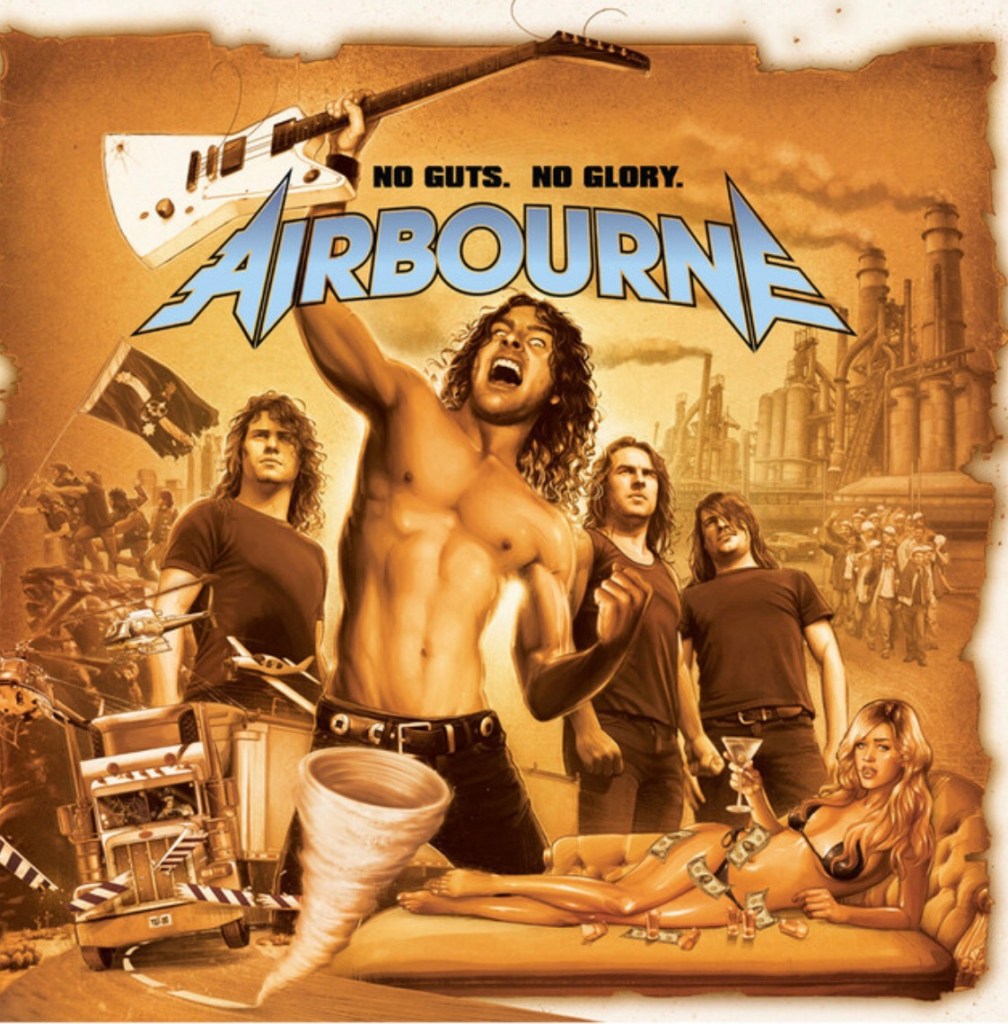
The album cover forecasts what the album would sound like. There is a steel works, an out of control truck driven by Lemmy, alcohol, women, raising the flag at the Eureka Stockade, a twister, the band and an Explorer guitar raised high like a trophy by one of the band members.

Airbourne is Joel O’Keeffe on lead vocals and lead guitar, David Roads on rhythm guitar, Justin Street on bass and Ryan O’Keeffe on drums. Production is handled by Johnny K and mixing is done by Mike Fraser. All songs are written by Joel O’Keeffe and Ryan O’Keeffe.

The album was recorded in Chicago at Johnny K’s studio. The band even slept in the studio.

“Born to Kill”

The intro guitar lick is like an out of tune national anthem. Then the rock and roll power starts, to kick off a song about being in a rock and roll band, being loud and doing what you love.

“No Way But the Hard Way”

It feels like “Rock N Roll Aint Noise Pollution”.

The idea of the song originated when the guys in the band lived together in a house (like a band house), while on welfare payments and trying to get the band up and running, and noticed.

As told by the band members in the track by track breakdown of the album on YouTube, after the album was released they were touring in Canada. The vehicle they were in, skidded off the road. They were stuck in freezing conditions for 24 hours, waiting for help.

No way but the hard way indeed. It’s a very Bon Scott like title.

And the film clip has them taking their rage out on the record labels as they enter the office of one and smash it all to bits. As I read in one interview, the labels are big powerful monsters who get demos from thousands of bands so they could put it in a box and never respond. So it was an F.U to them.

“Blonde, Bad and Beautiful”

“For Those About To Rock” or “Powerage” gets a makeover into a “Blonde, Bad and Beautiful” wrecking ball woman with long legs and the moves to break a man.

“Raise the Flag”

An anthem. Airbourne hit the market at the right time, just when AC/DC’s album output was slowing down and they quickly became the next best thing.

So if you love rock and roll, raise the flag. That’s the simple message of the song.

And how good is the intro?

“Bottom of the Well”

The title is self-explanatory, from being in a crap situation to turning it around. This song is more Kiss than AC/DC.

“White Line Fever”

More Kix like but still sounding like it came from the Aussie Pubs. Lyrically, I guess it’s that time again when you’re feeling stressed out.

“It Ain’t Over Till It’s Over”

The fastest track on the album. Like “Let There Be Rock” just faster.

“Steel Town”

It was written for people from working class towns. Australia has a few “steel cities” so a lot of their fans here can relate.

“Chewin’ the Fat”

Read the lyrics. It sums up oral sex.

“Get Busy Livin'”

It feels like a Free cut at the beginning, but when the whole band kicks in, its AC/DC all the way.

“Armed and Dangerous”

The intro and verse riff rock.

From the words of the band members, just think of a hot chick walking past and you get a hard on, well you’re armed and dangerous. Enough said. Press play.

“Overdrive”

It’s about living hard and no sleep, having a good time and not caring about the next day. Easier said when you’re young.

“Back on the Bottle”

Another fast rocker, to close the album off, and a subject matter about getting on the piss.

I guess I’ll have one more glass of whatever then.

It charted well in Australia and New Zealand, and it also did good business in Austria, Finland, France, Germany, Greece, Sweden, Switzerland, UK and Canada. In the U.S it peaked at number 10 on the Billboard Hard Rock Charts as in some states they rocked and in other states they were unknown.

A shrewd business decision by the band and its management to license a lot of the songs from the album to various video games and movies, which brought in a different source of revenue, much higher than what the sales revenue would have generated.

“Born to Kill” is featured in the film “Jonah Hex”.

“Heads Are Gonna Roll” is featured in the video game “Madden NFL 10” and the official trailer.

“Raise the Flag” is featured in the video game “Twisted Metal”.

“Bottom of the Well” is featured in the video game “NHL 11”.

“Blonde, Bad and Beautiful” is featured in the trailer for the film “Bachelorette”.

“Back on the Bottle” is featured in The Good Guys episode “The Dim Knight”.

It’s not original in anyway and there is no great “hit” song to sell the album. But it’s a fun album, cool to listen to and in the words of Bon Scott, “Let There Be Rock” as the album has its foot on the accelerator pedal from the outset.

P.S.

Here is a little playlist that Joel O’Keefe told Guitar World readers in the July 2010 issue. I guess there are no surprises in the list.

Standard
A to Z of Making It, Classic Songs to Be Discovered, Derivative Works, Influenced, Music, My Stories, Unsung Heroes

Joel Hoekstra 13 – Running Games

I was interested to hear this but I didn’t think I would have liked it as much as I did.

It’s excellent.

I am a Russell Allen fan. I knew of Allen long before I heard of Joel Hoekstra. Allen has a voice which can suit power symphonic bands, metal bands, melodic rock bands, hard rock bands, nu-metal bands and blues rock bands.

And I’m also a Jeff Watson fan, so I wasn’t too thrilled with any Night Ranger version without Watson. Then again Watson hasn’t done much being away from the band and I still want to hear new Night Ranger music.

So I still listened and Hoekstra impressed but I felt he was restrained within that band as Blades and Keagy are the alphas.

And with Whitesnake, Coverdale has two great guitarists to write tunes with but they need to comply with what Coverdale desires.

Which means that Hoekstra 13 is the true Joel Hoekstra.

“Running Games” is album number 2 for his Frontiers label.

The musicians for the album are Russell Allen on vocals, Tony Franklin on bass, Vinny Appice on drums and Derek Sherinian on keyboards with Jeff Scott Soto doing backing vocals. Yep, you read that right, the great JSS is doing backing vocals.

It feels like the 70s ethos, when you see so many guys from different bands jamming together and releasing music.

I was reading some of the interviews Hoekstra did when the album come out and fuck there are some shit interviewers out there, who just do the simple Wikipedia style of interview without even listening to the album.

But the one at “The Rock Pit” is what an interview is about. The interviewer actually listened to the album, liked it and wanted to know more about it. And you get exactly that.

“Finish Line”

“We Rock” from Dio is merged with “I’ll See The Light Tonight” from Malmsteen for the Intro riff and I’m all in.

And that Chorus. Wow. What a hook!

Make sure to check out the lead break as Hoekstra is doing his eight finger tapping.

“I’m Gonna Lose It”

I like the Intro lead. It reminds me of Thin Lizzy.

And just before the Chorus, there is a little snippet of a riff that gets me thinking of “A Touch Of Madness” from Night Ranger.

The lead break again. Wow.

Over at Glide Magazine, Hoekstra said He came up with the song out at Hook City at the Whitesnake studio.

“Hard To Say Goodbye”

The Chorus feels like a Joe Lynn Turner Rainbow Chorus.

“How Do You”

It’s slower and groovy, more in the vein of Adrenaline Mob in the verses with a Euro classical inspired Chorus.

“Heart Attack”

It is a bluesy groovy cut.

“Fantasy”

It feels like ZZ Top added some Metal to their sound in the Intro, and the verses are massive, Kashmir like.

Their is a keyboard solo and then Hoekstra breaks loose.

“Lonely Days”

What a melodic rock Chorus. I’m a sucker for these.

“Reach For the Sky”

Cliched and overused song title.

In an interview over at The Rock Pit, Hoekstra mentions how he wrote the riff on the Whitesnake Tour Bus. Inspiration strikes all the time.

“Cried Enough For You”

It feels like a Y&T cut from the “Black Tiger” album in the acoustic sections before it moves to an Iron Maiden like old school groove.

“Take What’s Mine”

The fast guitar lead and machine gun riff to start off the song gets me to pay attention, but it’s the verse riff that makes me pick up the guitar and bang my head to.

And there’s another anthemic Chorus.

“Running Games”

It feels like a Toto cut.

“Lay Down Your Love”

It feels like ZZ Top has come to town.

Overall Hoekstra’s songwriting is top level and the performances from the guys are excellent.

Check it out.

Standard
A to Z of Making It, Music, Unsung Heroes

Mean Man – The Story Of Chris Holmes

The guitar sound is what hooked me to WASP and when I saw the “Love Machine” clip, Chris Holmes had my attention. Running around and pretend slamming his guitar. He was a maniac.

In the 80s, he was called the new Lemmy, just crazier. He’s come full circle, fronting his own band and sounding like Lemmy when he sings.

Like so many artists, he never understood what he signed in the 80s. All of his publishing money goes to someone else because of it. He mentioned that if he understood what publishing was, Blackie and he would have gone head to head and he would have been out of the band pretty early on.

He mentioned how WASP ceased to be a band after the first album. All you need to do is look at the album covers.

They showed the footage of him in the pool in the “Decline Of Wedtern Civilization”. And Blackie was pissed because of it.

Psycho Squad is mentioned his post WASP band circa 1991 and 1992. But they couldn’t get a record deal after 18 months and broke up.

He’s reunion with Blackie in 1995 and the subsequent albums with WASP. I recently reviewed “Unholy Terror” and Holmes is mentioned as the lead guitarist, but he said he didn’t play a note on it.

He’s touring Europe now, playing small clubs and living in his mother in laws basement. He’s trying to make a name for himself. For his brand.

The “Mean Man” brand.

Check it out.

P.S. thanks to Ken Taylor for recommending the doco on the “Unholy Terror” review.

Standard