A to Z of Making It, Classic Songs to Be Discovered, Influenced, Music, My Stories

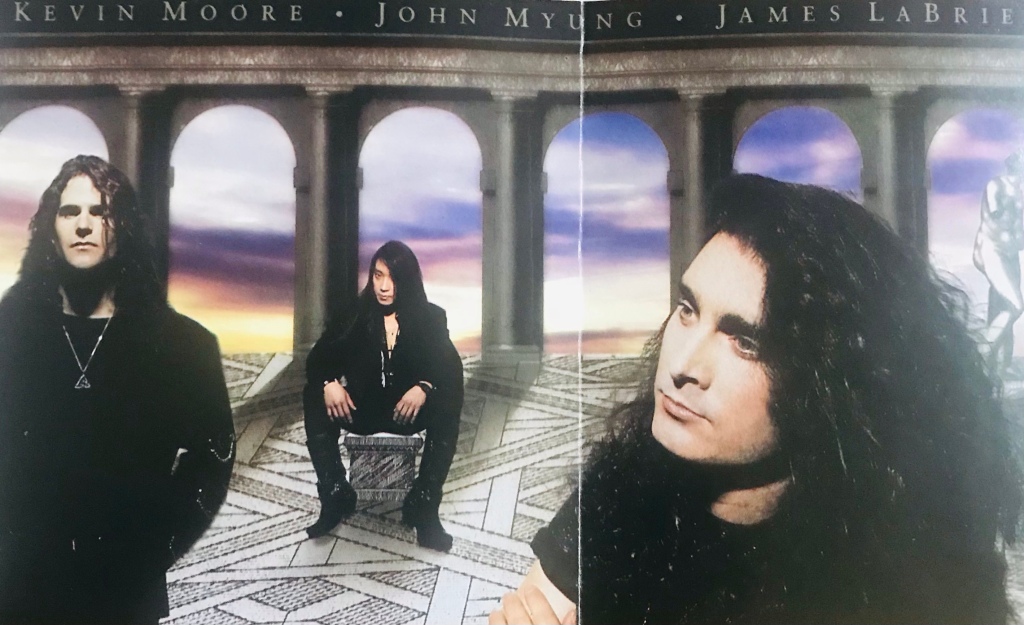
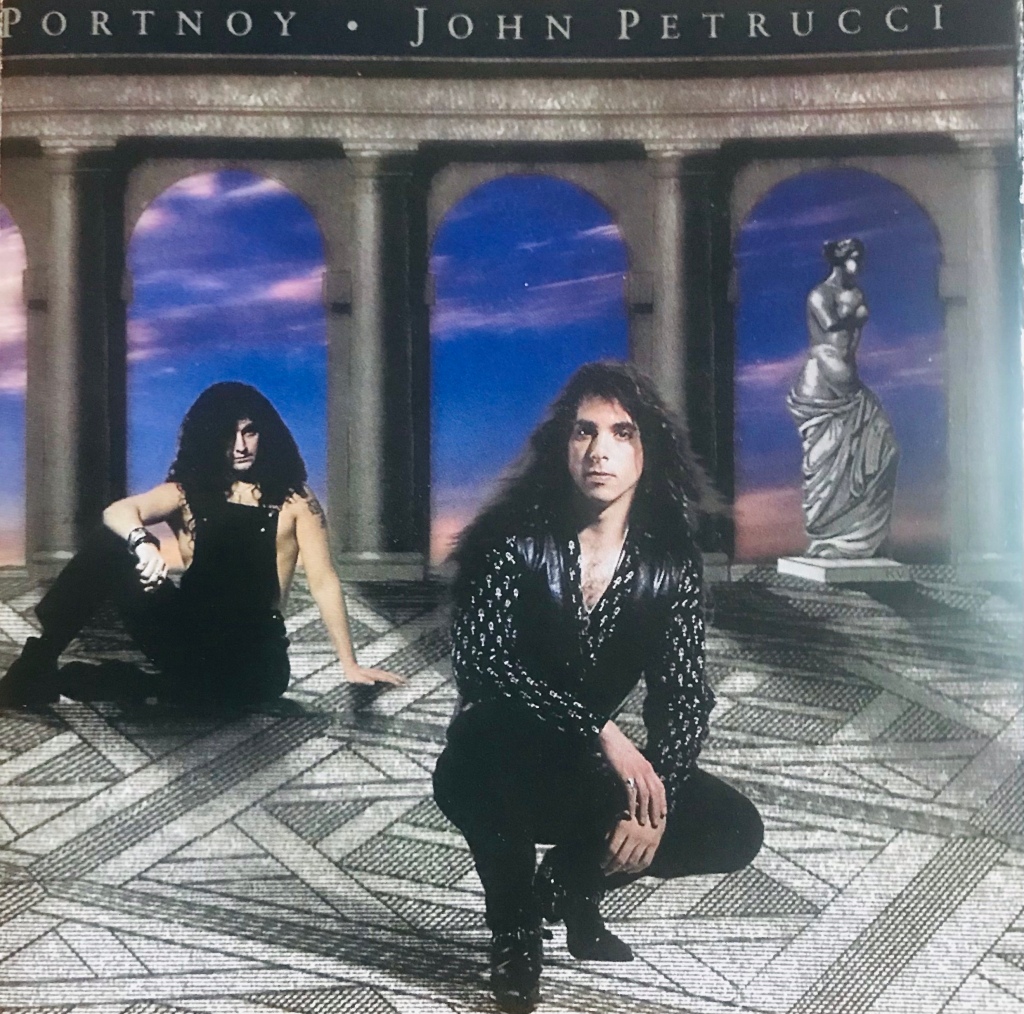
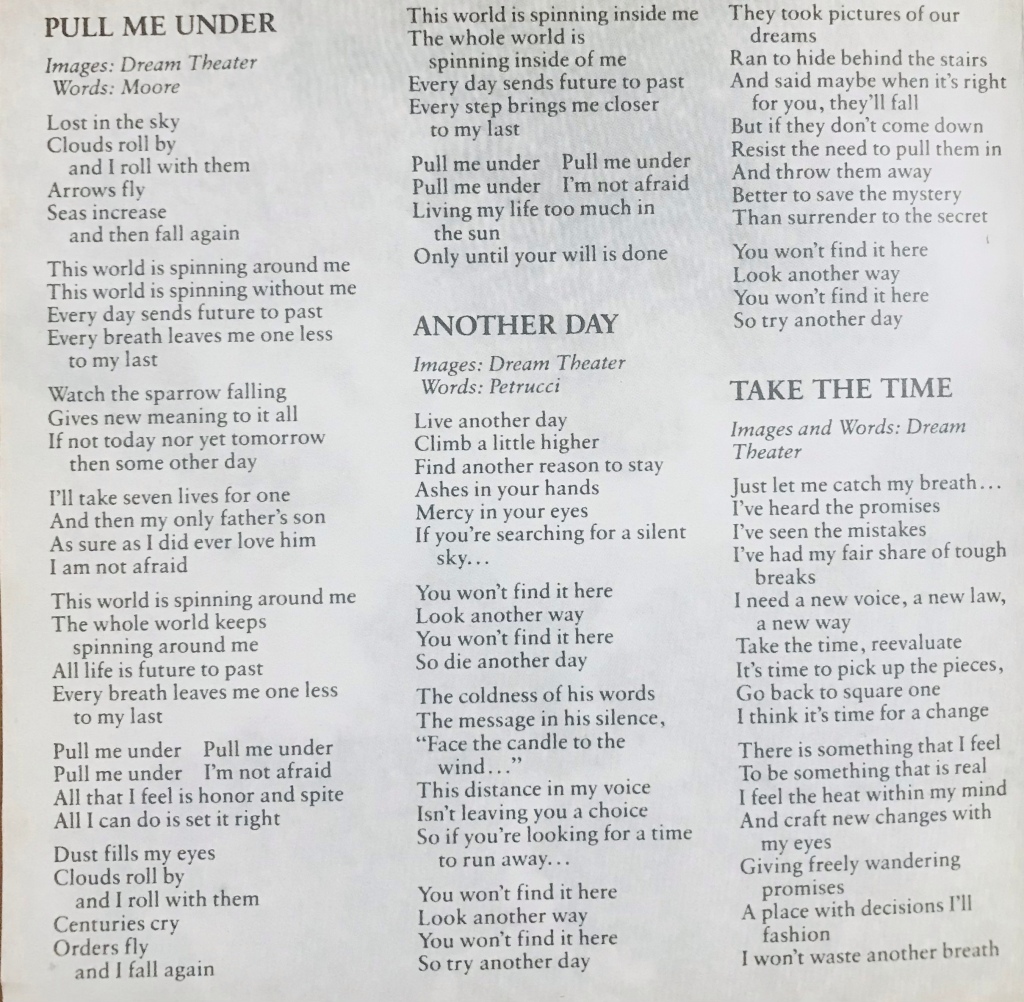
The Record Vault: Dream Theater – When Dream And Day Unite

It was 1992 and the music scene was changing. The record labels started to abandon the music I grew up with and the writing was on the wall for a lot of the hard rock bands, especially the ones that got marginalised as “hair metal” or “glam metal”.

I saw a Geffen ad that promoted White Zombie, Nirvana, Roxy Blue and Guns N Roses. It was a smart marketing move from Geffen. Promote different acts on the same page and see what sticks. I think Galactic Cowboys also appeared on it.

While I was angry that it was getting hard to find releases of bands I liked, I was also a bit lost as to what new music I should spend my money on. At this point in time the CD had overtaken the vinyl LP as the favourable format, so the second hand record shops had a lot of vinyl stock which I was purchasing at insane cheap prices. At first I was buying all the 80’s records I didn’t have money to buy when I first saw em or decided to buy something else instead of that. Like I purchased WASP instead of Britny Fox. Once that 80’s fix was satiated, I went back even further and got my 70’s fix from acts like “Free”, “Bad Company”, “Styx”, “Kansas” and many more.

Then Dream Theater came into my life in 1992.

It all started with the “Images and Words” album and the song “Pull Me Under”. Most of the music I got into was because of friends and family. My cousin Mega (his nickname because he loved Megadeth) was 4 years older than me and he spent every cent he earned on getting new music. He wanted to be known as the guy who had it first and shared it with others. My fandom of Dream Theater is because of him. And Megadeth. And Metallica. And Twisted Sister. And Fates Warning.

The whole intro from “Pull Me Under” is worth the price of the album. And I thought it was the debut album from Dream Theater, until my cousin Mega told me differently. A week later I was back in the record shop to buy the debut. But it wasn’t there nor was it available to buy locally. The only way to get it was via an expensive US Import.

It wasn’t until “Awake” came out in 1994, that I got “When Dream And Day Unite”. At a $27.99 price.

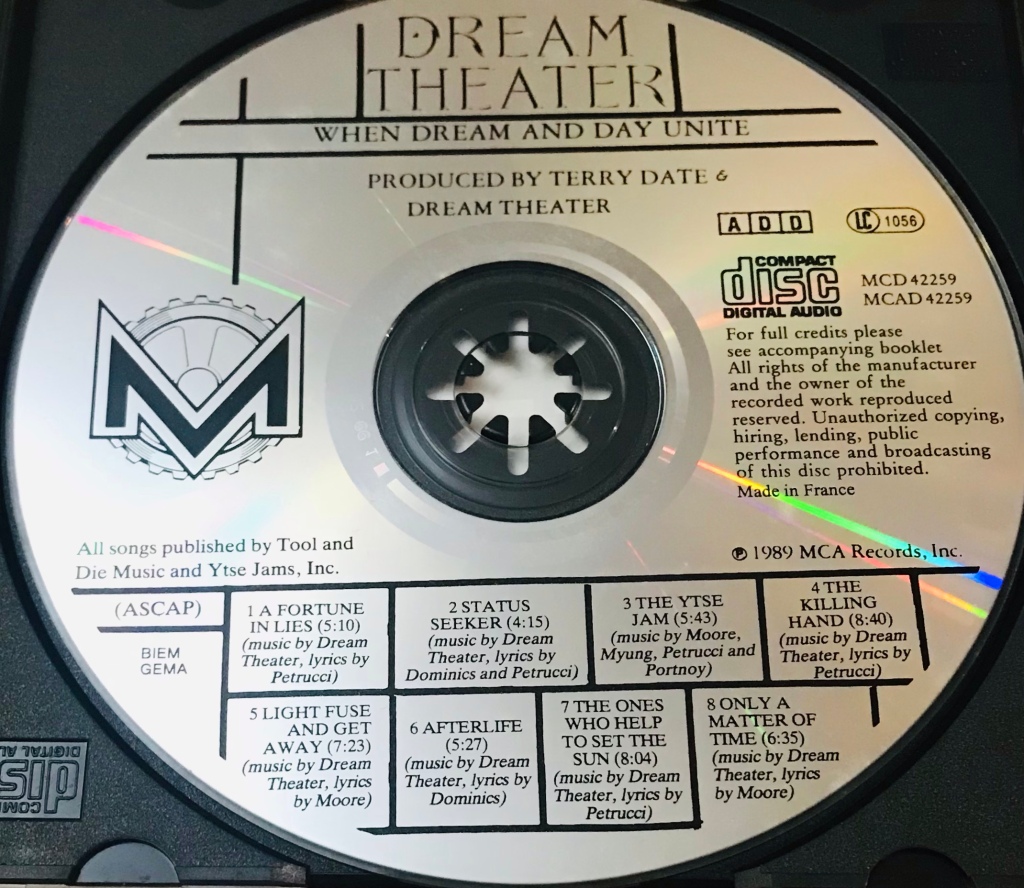
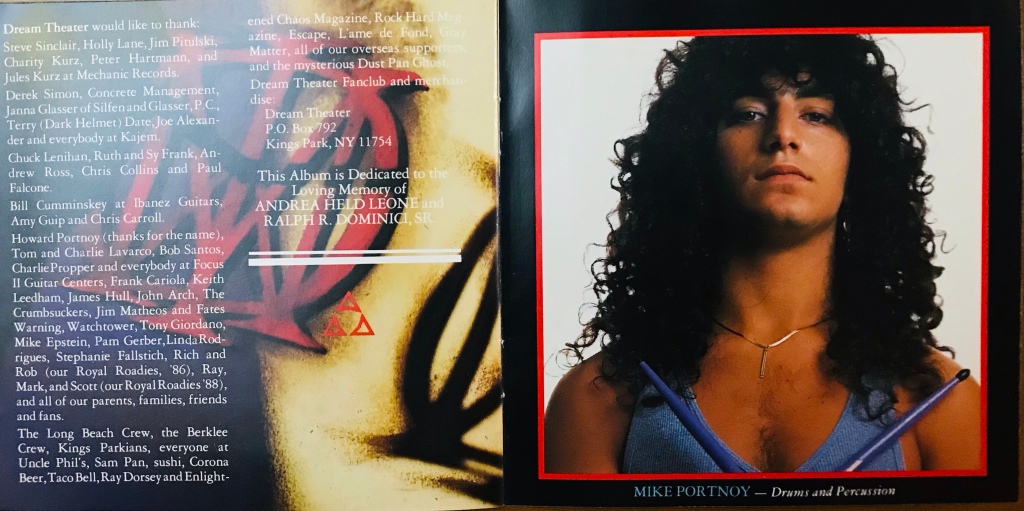
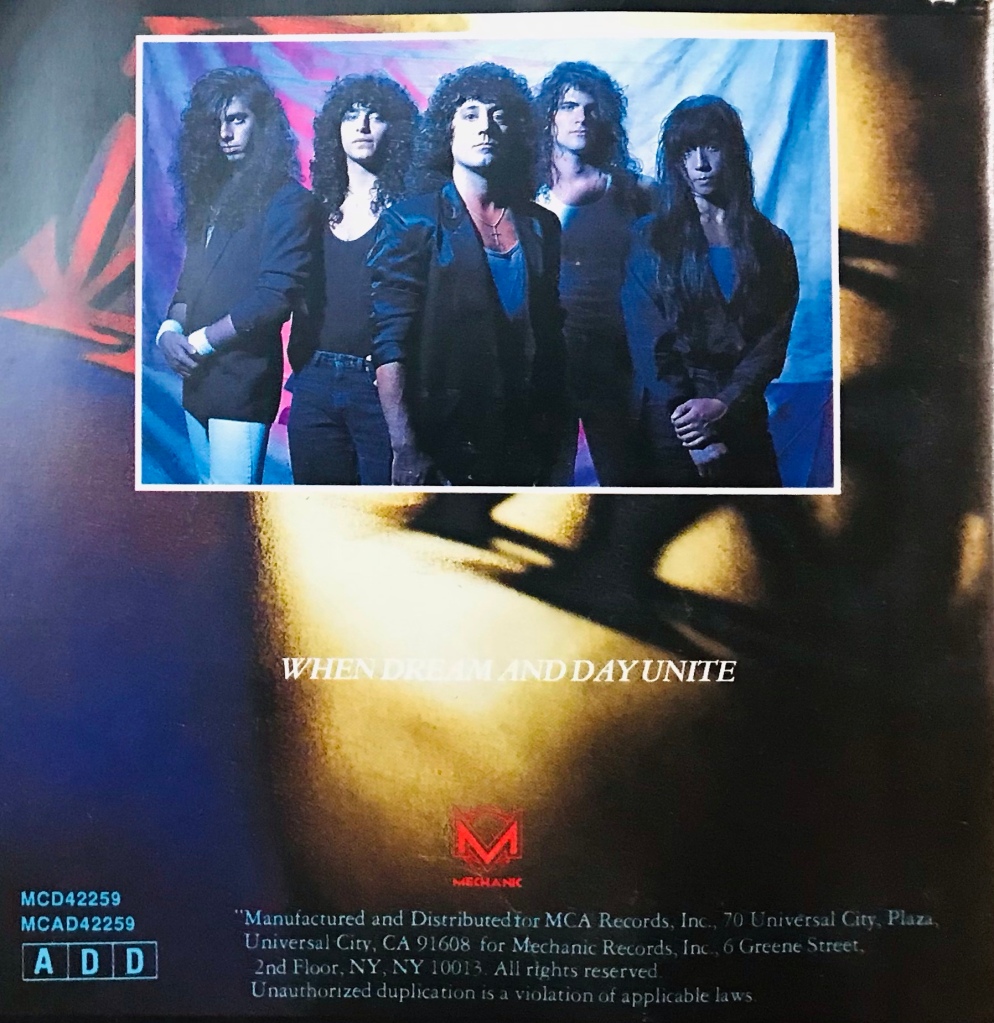
“When Dream and Day Unite” was released on March 6, 1989, through Mechanic/MCA Records. There is a story about how this album came to be and why Dream Theater couldn’t use the Majesty name, but that is for another post, when I get to the release of “The Majesty Demos” release as my Dream Theater record vault is based on release date instead of where the releases fit in.

The production from Terry Date is thin compared to “Images And Words” which Portnoy actually hated because producer David Prater used triggers on his drums, which Portnoy saw as a relic of the 80’s hard rock and glam rock movement. And Date at the time was also making a name for himself as a groove metal pioneer with the “Cowboys From Hell” from Pantera.

The band for the debut is Charlie Dominici on vocals, John Petrucci on guitar, Kevin Moore on keyboard, Mike Portnoy on drums/percussion and John Myung on bass.

The cover art from Amy Guip looks bizarre with “The Majesty” logo being branded into the male model and from what I have read, there are versions of this album out there with “The Majesty” band name. They got a cease and desist from another act called “Majesty” just as the record was getting ready to ship.

All music is by the band members.

A Fortune in Lies

Lyrics are written by John Petrucci.

When I first heard it, I thought it was about writers block, and not being able to write the song to get them a record deal which is basically a contract promising a fortune but with a lot of lies in between.

Then I read the book, “Lifting Shadows” from Rich Wilson and he described it as an “acquaintance of John Petrucci’s who was arrested for theft and Petrucci’s subsequent experiences after that”.

Check out the middle section homage to “Forgotten Sons” from Marillion.

Status Seeker

It was the last track written for the album with lyrics by Charlie Dominici and John Petrucci.

The Rush influences are strong on this. Think of “New World Man”.

I would have liked them to flesh out those kind of pop elements on this however the song is loaded with extra riffs and fills just to make it sound progressive.

The Ytse Jam

Its Majesty (the former name of Dream Theater) spelled backwards.

An instrumental, written by John Petrucci, John Myung, Kevin Moore and Mike Portnoy.

If you like “YYZ” from Rush then you would like this. The intro is excellent and make sure you check out the section in the middle which has the keyboards playing the intro guitar riff, while the guitar plays arpeggios.

The Killing Hand

There are five parts, to this 9 minute song with lyrics written by John Petrucci.

“I The Observance”, “II Ancient Renewal”, “III The Stray Seed”, “IV Thorns” and “V Exodus”.

The acoustic intro in “I – The Observance” is excellent. The middle parts are cool and the keyboard solo from Moore in “IV – Thorns” is worthy, but the last two minutes and thirty seconds of the song which is “V – Exodus” is the best part. The movement between sections is very similar to what they would do on “A Change Of Seasons”.

Light Fuse and Get Away

Lyrics are written by Kevin Moore. The intro is progressive and at the 38 second mark it moves into a Rush like groove, something which they would do similar on “Learning To Live” on the follow up album.

But press play for the riff between from 1.37 and 2.12. It then moves into the verse riff and in between you hear you hear a little bit of a progression that would be used on “Take The Time” and “Home”.

Afterlife

The best song on the album for me as it reminds me of the first two Queensryche albums.

Lyrics are written by Charlie Dominici and maybe the band should have gotten Dominici to write more of the lyrics as they make sense compared to the stuff that Petrucci and Moore were dishing out.

Make sure you check out the guitar lead from Petrucci on this as it’s another Guitar Hero moment which then morphs into a harmony lead with the keyboards.

The Ones Who Help to Set the Sun

The surprise track on the album with lyrics written by John Petrucci.

Press play to hear the intro on this, with the keyboard riff and the natural harmonic bass riff.

Then Portnoy comes in with a drum groove, while Petrucci plays a “Mirror” like riff and Moore plays an exotic keyboard lick over it.

Only a Matter of Time

Lyrics are written by Kevin Moore and I like the intro on this.

Musically, the song has a lot.

I remember reading an interview with Lars Ulrich and James Hetfield, when they were writing the earlier songs for Metallica, and how they would just chuck in riffs to make the song longer.

Well there are plenty of riffs here, but so many different ones and sometimes for a short amount of time so it’s hard to have any familiarity with any of em. Hence the song gets lost.

There is this section between the 4 minute and 6 minute mark which reminds me of Marillion.

The best way to describe this album is as a mix of progressive rock and 80’s arena hard rock and early US metal is the best way to describe this debut. Rush and Marillion are here.

Queensryche and Iron Maiden are here. Metallica is here as well. And very different to acts like Ratt, Bon Jovi, White Lion and Motley Crue, who did great business on the charts.

Derek Oliver from Kerrang gave the band a glowing review and it wasn’t forgotten either, when a few years later, Oliver was the A&R Rep who signed them to their ATCO deal (which then became Elektra).

Charlie Dominici copped some flak for his vocals. Portnoy wanted a hybrid Tate and Dickinson, and got more a Graham Bonnet. The songs that Dominici wrote lyrics to like “Afterlife” and “Status Seeker” also have the best vocal melodies, which makes me wonder how the other songs would have sounded vocally if Dominici was allowed to write the lyrics and melodies instead.

The national and European tour promised by their label Mechanic Records didn’t eventuate, as Mechanic lied about providing funding. The band was left to do a 5 date regional tour in their own state and a small support slot for Marillion when they toured their hometown.

Standard
A to Z of Making It, Music, My Stories, Unsung Heroes

Al Pitrelli – The 80’s

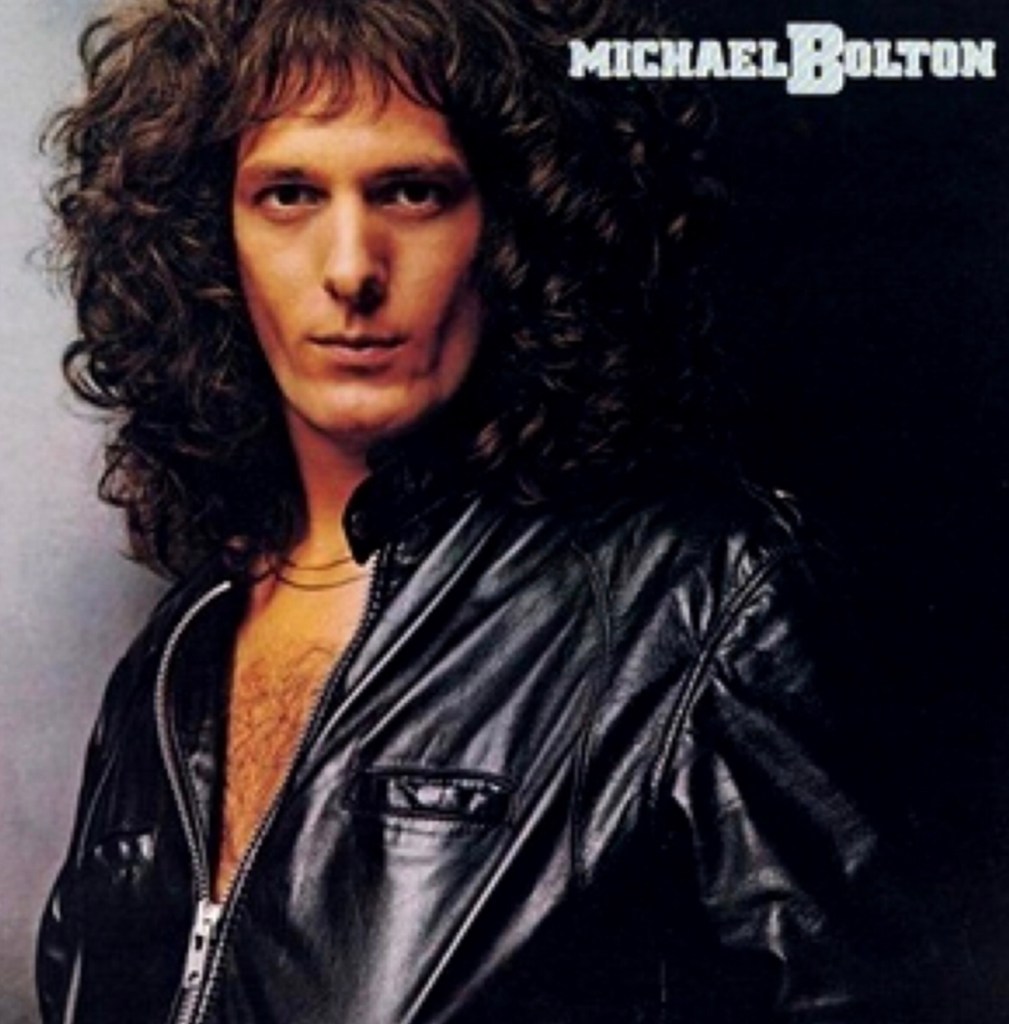
It starts with the “Fools Game” album by Michael Bolton released in 1983, back when Bolton was trying to be Sammy Hagar instead of the soul Bolton we came to know.

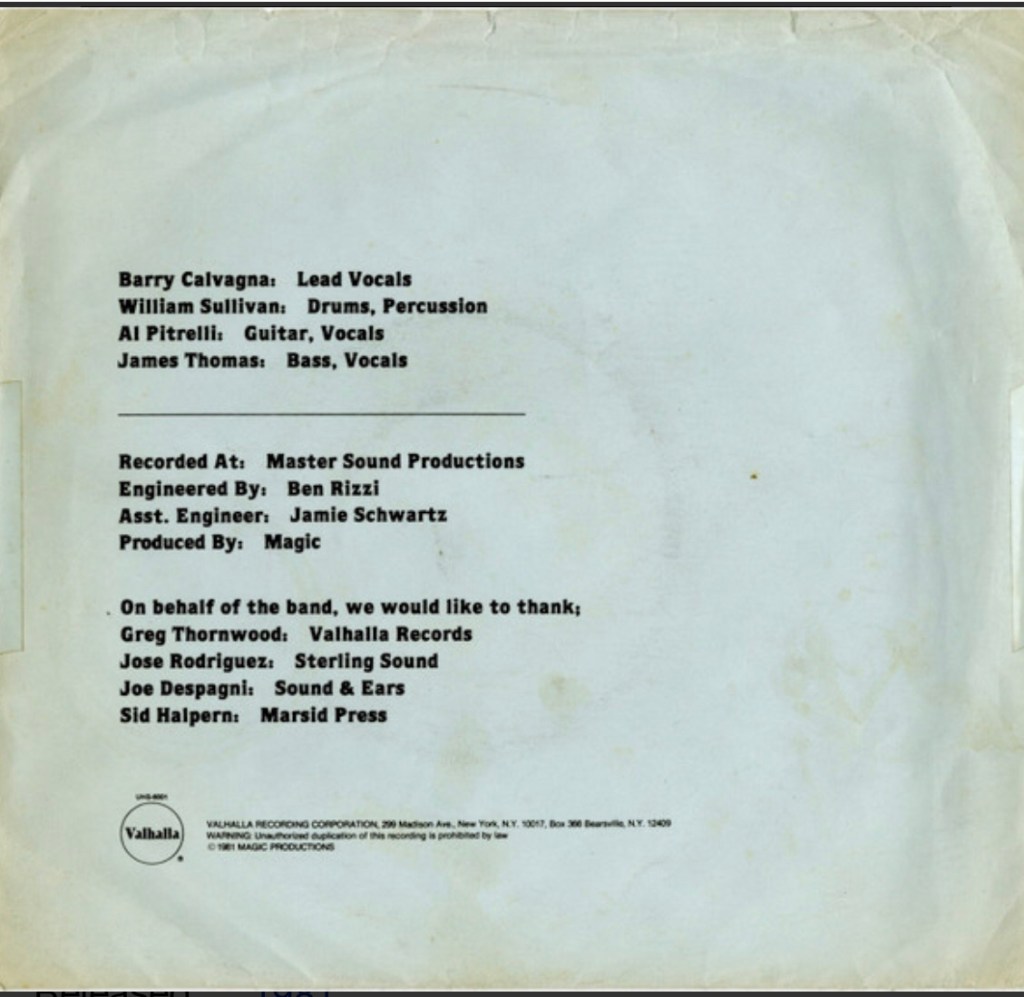
Actually it goes back a few years to 1981 and a band called Magic and a 7 inch single called “Too Much Too Quickly” that had Al Pitrelli playing guitar.

So before Bolton and Berklee there was MAGIC.

They used to rehearse in the basement of a video arcade in East Meadow.

Back to Bolton.

Bruce Kulick and his brother Bob, play guitar on the studio album. Aldo Nova goes a guest solo. Even Bolton shreds a little bit, who started off as a guitarist first, singer second. While the album is a great slab of melodic rock, it didn’t really do anything commercially.

But it gave Bolton enough momentum for the label to fund a follow up in “Everybody’s Crazy” (released in 1985) with Bruce Kulick doing all the lead guitars this time around in the studio. However Bolton was still trying to imitate David Lee Roth, which was a stupid move, as there is only one DLR and Bolton wasn’t it. The album was a financial loss and it did not chart.

However, the label didn’t want to lose too much money on the album, so they put Bolton on the road. However this meant a new backing band was needed as Bruce Kulick accepted the Kiss gig, something which he held until 1996. As a side note, Kulick did got his mate Bolton to co-write a song with the band called “Forever” which was released in 1989 on “Hot In The Shade”.

The new backing band for Bolton would have keyboardist Mark Mangold, who was also the co-writer on the “Fools Game” and “Everybody’s Crazy” albums with Bolton. He also co-wrote “I Found Someone” with Bolton for Cher.

The rest came like this.

Al Pitrelli read the credits on the “Everybody’s Crazy” album and noticed that the people who played on the album had other gigs. He called up his friends, Tony Rey, Chuck Bonafante and another bassist. They learnt a bunch of Bolton tunes, tracked down Bolton’s manager and then offered themselves as his touring band. However the bassist spot went to Bruno Ravel who was called in by Bonafante as Bolton took a disliking to the original bassist brought in by Pitrelli.

For Ravel, it was a dream gig for the 21 year old that lasted six months. On a side note, he had a failed bass gig for an act called “White Lion” because he didn’t like how Bratta and Tramp wouldn’t allow anyone else to write with them.

And if all the names in Bolton’s touring band sound familiar they should, as bands like Danger Danger and Saraya come to mind. Tony Rey would go on to write and produce songs for a lot of mainstream artists.

Pitrelli and Bonfante would also get together regularly in different projects like “Place Called Rage” with Tommy Farese on vocals, “Morning Wood” with Tony Harnell on vocals and “Flesh And Blood” which also included Mark Mangold.

Al Pitrelli by this time had dropped out of Berklee College Of Music. During his time there he became friends with keyboardist Derek Sherinian and drummer Will Calhoun who would go on and join Living Colour.

After he left, he was studying jazz with John Scofield. This is a by-product of growing up in a household that liked Sinatra. Pitrelli’s first Kiss album was thrown out by his dad.

But you can’t keep a rock head down. One thing about rock music is that it is a lifestyle. From Kiss, Pitrelli started to digest Rush, Yes, Led Zeppelin, Aerosmith, Allman Brothers, Mahogany Rush and Hendrix. Then came Eddie Van Halen, an accomplished riff meister and revolutionary shredder.

But Pitrelli’s two biggest influences are Gary Moore and Jeff Beck. Both of these players can move a room full of people with just one note. And that one note is more powerful than a hundred notes. But if they wanted to shred, press the pedal to the metal, they could do that as well. The key word here is balance. Balance between chops and feel.

Suddenly, Pitrelli was seen as a rising star. The Bolton tour (although regional) was his first big break which gave him contacts within the industry. But as the tour progressed, ticket sales stalled and after six months the tour was wrapped up and the touring band sent home.

Ravel was less than impressed with Bolton’s antics and treatment of them, and Pitrelli saw him as mean. In Bolton’s defence, he was pushing 30 and felt that this was his last chance of making it as a solo artist, so he took it out on the people trying to help him make it.

On a sidenote, Bolton also recorded a tape full of demos with just his voice and an acoustic guitar. These demos started to do the rounds with the label execs who wondered why Bolton was singing rock music when his voice was better suited for soul and R&B.

For all of the members, the Bolton tour was a learning experiencing about survival in the music business. Pitrelli knew that survival and making a living in music, depended on playing with anybody and everybody.

Ravel wanted to have his own band but he knew that in order to get to that stage he needed to play with others to make a living.

Enter Talas.

This band was founded by bassist Billy Sheehan in 1971. They went through drummers like Spinal Tap did.

By 1986, Talas lost their founder to David Lee Roth but Talas still had a deal with A&M Records to do one more record. Sheehan gave the band his blessing to go on and meet this commitment.

Vocalist Phil Naro enlisted Jimmy Degrasso on drums, Al Pitrelli on guitar, Bruno Ravel on bass and Gary Bivona on keyboards.

But that final album never got out of the demo stages and Talas was dead when Sheehan did an about face on allowing the band to use the name after word got around that Ravel wore a “Billy Who?” t-shirt that a fan had gave him.

And since the band couldn’t use the name, A&M pulled their deal as well.

While the guys couldn’t use the Talas name, the embryo of what would become Danger Danger was there.

Pitrelli meanwhile jammed and played on the “Funk Me Tender” album from Randy Coven released in 1986. He also did a small club regional tour with Coven.

And then Jimmy DeGrasso left to join Y&T replacing Leonard Haze.

In 1987, a song originally penned by Pitrelli and Ravel called “Temptation” made its way to Phil Kennemore (via Jimmy DeGrasso) and it became track three on the Y&T album “Contagious” which was the bands Geffen debut. If you haven’t heard it, press play on it. It’s a great melodic rock cut.

The first proper incarnation of Danger Danger would have Al Pitrelli on guitars, Steve West on drums, Bruno Ravel on bass and Kaesy Smith on keyboards. Phil Naro was the first vocalist and he was quickly replaced by Mike Pont and then Pont was replaced that same year by Ted Poley. The demo this version of the band recorded got the band its recording contract with Epic Records.

But by 1988, Pitrelli left Danger Danger or he got the boot, depending on who you believe due to having disagreements with the labels A&R rep.

As Pitrelli described it, he was in the band for about 18 months, played a lot of nickel and dime gigs and when the band made a left turn in musical direction, he went the other way. And by the end of it, Danger Danger taught him lessons on what to never do again.

Pitrelli was replaced by Tony Rey who would also leave to join “Saraya” with Andy Timmons taking the guitar slot from 1989 to 1993. You can hear Pitrelli’s playing in Danger Danger on the album “Rare Cuts” released in 2003.

After this Pitrelli re-formed an earlier band he had called “Hotshot” with Pont on vocals and after a very promising six song demo called “The Bomb” failed to get them a label deal he disbanded “Hotshot”.

Pitrelli then got call from an old friend, another Long Island kid called Steve Vai.

Yep that Steve Vai.

He told Pitrelli to audition for David Lee Roth’s band as Vai had just left to join Whitesnake. Vai actually said that he “wanted Pitrelli to take his place in Roth’s band”. Vai even took time out to teach Pitrelli all the guitar parts. Pitrelli nailed the gig and Roth was thrilled.

But whatever went down afterwards was never spoken of again. Roth to this day has never mentioned the Pitrelli audition of the Roth band at all.

In between, Pitrelli was jamming and writing songs with Joe Lynn Turner. Turner had a deal with Elektra who he would rename as Neglektra.

The label kept Turner in development hell between 1988 and 1991, only to drop him and keep the songs he wrote during this period. Because in label land, it’s embarrassing if an artist you dropped makes it with another label on the backs of the songs they had with the previous label. The same thing happened to Dee Snider during this period who was also with Elektra.

In order to get by, Pitrelli did some session work and one of those sessions got a full release. It was a funk soul album by “Philip Michael Thomas” called “Somebody” which did nothing commercially. Thomas is known more as an actor who dabbled in music.

Pitrelli was at the crossroads. He didn’t know what to do anymore. He was in and out of bands, filling in spots perfectly but really struggling to get his own project off the ground. The lack of a reliable income weighed heavily on him. Trying to make it in the music industry was proving tougher than he thought. He had all the chops and players of lesser abilities graced the covers of the magazines. To make some extra cash he was teaching guitarists. He was also married and a conversation with his father-in-law was about him going into carpentry.

But that jam session with Roth impressed drummer Gregg Bissonette a lot and a few months down the track Bissonette recommended Pitrelli to Alice Cooper.

In 1989, Pitrelli got an offer he couldn’t refuse; to become Alice Cooper’s musical director and guitarist in the touring band supporting the album “Trash”.

Musical director meant to rethink the older songs to sound more contemporary so they wouldn’t sound out of place next to the current songs from the “Trash” album. He also got his Berklee roommate Derek Sherinian his first major gig.

On another side note, the students that Pitrelli had would move on to another guitarist called John Petrucci. Yep that same Petrucci from Dream Theater.

As the 80s drew to a close, Al Pitrelli survived in the music business without actually being involved in a full length release. Because one of the lessons he learnt touring was that the real money was made on the road.

Standard
A to Z of Making It, Copyright, Influenced, Music, My Stories, Piracy, Unsung Heroes

The Week In Destroyer Of Harmony History – March 21 to April 3

It’s a two week DOH history this time around as lack of time stopped last weeks edition.

2018 (4 Years Ago)

1984 – Part 1

I was doing a review of the year 1984, Read here for my thoughts on Dokken – “Tooth And Nail”, Van Halen – “1984”, Twisted Sister – “Stay Hungry”, RATT – “Out of the Cellar”, Iron Maiden – “Powerslave”, Bruce Springsteen – “Born In The USA” and Stryper – “The Yellow and Black Attack”.

Ritchie Blackmore

“Being original doesn’t require being the first to do something. It just means being different and better.”
Adam Grant, Originals

History is always written by the winners. If you read any story about Metallica today, it more or less states that “Kill Em All” came out in 1983 and took over the world on release day.

Ritchie Blackmore has been instrumental in influencing guitarists.

But between Deep Purple and Rainbow and three different vocalists, Ritchie Blackmore, blew the paradigm open of what a heavy rock vocalist should sound like. And it’s something he doesn’t credit for.

He pushed Ian Gillian to the limits to record the ohhs and ahhs on “Child In Time” influencing a young Bruce Dickinson to start practicing hard, and getting another unknown singer called Rob Halford to change his vocal style.

Both of these singers would come out with styles that would also influence a generation.

With David Coverdale and Ronnie James Dio he pushed the boundaries even more who influenced another generation of Metal singers.

From a guitarist perspective, it’s hard not to be influenced by Blackmore. Blackmore’s fusion of blues, rock and roll, classical and medieval Influences was so commercially successful, he more or less spawned a new style of guitar playing called Euro Rock/Metal.

And from a band perspective, every single Metal guitarist at that point in time was inspired by Blackmore to find a vocalist who had similar/better talents to the vocalists Blackmore used.

lf the band was started by a drummer and a bassist, they would be looking for a guitarist like Blackmore and a vocalist like Gillian, Coverdale or Dio.

Twitter

“Here’s a challenge for you (and no using the internet for the answer): Can you name all 7 (unsuccessful) albums I’ve done solo or been a part of with a band since I left Twisted Sister in 1987?

A Twitter post from Dee Snider.

For a very long time, the record labels convinced everyone that the only way to define success was by sales. But people might have purchased an album, heard it once and never heard it again.

Dee said further on;

“While I’m proud of all the work I’ve done, YES success is defined by sales. I’m long past “making music for my own head”. Once you’ve had public acceptance of your art, you yearn for it.

The truth is, there is no secret formula for hits.

Artists always had a short life span at the top. Most of the 70’s acts would have been dead and forgotten if there was no MTV television in the 80s.

Which someone else replied that Dee’s album, “We Are The Ones” was excellent with the following questions;

“Do you consider it unsuccessful? Is success only defined by album sales or rather by the quality of the product?”

Another person commented that just because it isn’t popular it doesn’t mean it’s not valid and that music touches people in different ways.

And here we are again wondering what success is.

“Blood and Bullets” from Widowmaker is still Dees best album post Twisted Sister. For me, it’s highly influential.

Dee delivered a stellar vocal performance and Al Pitrelli also produced the goods in the guitar department, while Joey Franco and Marc Russell underpinned it all.

Of course, Desperado (the post TS band that got stiffed by Elektra on release day) guitarist Bernie Torme co-wrote 7 of the 12 songs on the album, so he deserves a huge 10 out of 10 for his stellar riffage and songwriting.

If you’ve read Dee’s book, “Shut Up and Give Me The Mic” Dee had to buy back the Desperado songs from Elektra who claimed ownership of them due to the label financing the demo song writing sessions.

The thing is, a lot of the albums which are really influential to people are rarely commercially successful.

2014 (8 Years Ago)

RANDY RHOADS

I remember the day that I got the “Tribute” tab book.

Studying the style of Randy Rhoads, I learned all about modes and the different scales that are made from each note of the mode, like Ionian, Phyrgian, Dorian, Lydian, Mixolydian, Aeolian and Locrian. I even named my son Dorian after one of the modes. It’s so easy to dismiss musical theory, however when you have an actual song that you can refer to, it makes it so much sense.

Wolf Marshall did an unbelievable job with the book transcription and on the commentary on each song. Actually Wolf Marshall was the transcription god back then. Another was Dave Whitehill. Experienced, super-talented and knowledgeable guitar players that broke down so many doors with their transcriptions and made it easier for young guitar players to pick up the guitar and practice.

“Crazy Train” was the first song I mastered. At the time, Alex Sklonick also had a column in the magazine “Guitar For The Practicing Musician”. In one of those columns, Skolnick also talked about modes and how “Crazy Train” is in the key of A Major and how it switches between the minor and major modes throughout the song. At the time it was a lot to take in however once you get it, you get it. Plus having a song like “Crazy Train” to refer too, who wouldn’t get it.

That one song has all the tools that every guitarist should possess.

And then when you start to go through all of the other songs, you see/hear all of the above tools re-used, which re-enforces all the techniques. Some songs had finger picking and arpeggios. Randy Rhoads was the definition of completeness.

By creating great music, he also taught us how to be better guitar players. Everything made sense. You can take a teacher and make them a rock star, however you can never stop the rock star from being a teacher and that is exactly what Randy Rhoads was. A teacher.

His reach on one song is huge. Add to that all the others and it’s a crazy train alright. Rest in peace brother.

POPCORN TIME

Remember “Popcorn Time”. It had no registrations to use it and there was no restrictions on content. It looked like Netflix and it was free. The user just presses play. It’s easy to use and its design was elegant.

And the entertainment industries killed it instead of employing the people behind it.

“Popcorn Time” was designed by programmers in Argentina, where the movie “There’s Something About Mary” was still classed as a new release by the movie studios in that country.

The development team created an innovative piece of software to meet a service problem for their country because the content industries failed to make content available.

We all know that piracy is wrong, however it opens up the conversation to the larger issue.

For example;

THE BAD – It made the RIAA spend millions suing music customers.

THE GOOD – But, Apple saw a market here and began to turn those Napster digital natives into iTunes buyers by making it easy to grab the latest music, anywhere, at any time. Same deal with Spotify, who put money into a market that didn’t exist before.

ARTIST

Asking Alexandria

They are a hard rock band. When are they going to realise that and drop the stupid screamo vocals.

RECORD LABEL CONTRACTS and ROYALTIES

Fear Factory’s Burton C. Bell had this to say about Roadrunner Records and its founder Cees Wessels;

“I still get royalties. It comes in, but it depends how much we work, how much we tour. If we tour a lot I see better royalties, if we don’t then I don’t.

I have no idea when we’ll get the rights back [to our catalog], because that Roadrunner contract is bullshit.

I literally signed a deal with a Dutch devil. But when you’re young, you don’t care. You’re 23 years-old and ‘we’re going to give you an advance to make your first record, we’re gonna put you on tour, sell your shirts in all the stores. You are gonna to be famous!’’Alright, make it happen!’

Every single label failed their artists by not innovating. The analog dollars vs digital cents mess they got themselves in, is purely of their own doing.

The Macklemore Lessons

Be in it for the long haul. The career of Macklemore has been a long one (21 years and counting). There’s no such thing as an overnight success.

Michael Poulsen from Volbeat started his first death metal band Dominus in 1991. During that time, Dominus released an album called Vol.Beat. When the band broke up in 2001, Volbeat was born. It wasn’t until 2005 that the first Volbeat album dropped. It wasn’t until Metallica picked em up as openers in 2009, that their US career kicked into overdrive. 30 years in the business. That is a lifer.

WORK ETHICS

Work ethics of the current music business.

Check out the list of releases from George Lynch between 2008 and 2014.

2008 – George Lynch – Scorpion Tales
2008 – Souls Of We – Let The Truth Be Known
2009 – Lynch Mob – Smoke And Mirrors
2010 – Raven Quinn – self-titled debut
2010 – George Lynch – Orchestral Mayhem
2011 – George Lynch – Kill All Control
2012 – T & N – Slave To The Empire
2012 – George Lynch – Legacy (EP)
2012 – Lynch Mob – Sound Mountain Sessions (EP)
2013 – Lynch Mob – Unplugged – Live From Sugar Hill Studios
2014 – KXM – KXM

Apart from the high volume output, Lynch is also immersing himself with different band set ups. Different dynamics. Sort of like the seventies musicians who just got together over a weekend and made an album.

The modern internet rule is here today, gone tomorrow. In order to survive, you need to show up and create. The music business is not in trouble. Only dumb labels and artists are.

But all things evolve, and if you are not open to change, you will be forgetten.

Remember John Sykes.

RANTS ON COPYRIGHT, RRHOF and THE WALKING DEAD

BUSINESS MODEL PROTECTIONISM

It’s pretty pathetic how the entertainment industries need to get governments to pass laws every time there is a shift in technology. Back in the Eighties, the boss of the MPAA Jack Valenti proclaimed at a Senate Congressional Hearing that the VCR’s are to the American film producer like the Boston strangler is to the woman home alone.

Fast forward a decade later and VHS sales of movies proved to be a very large income source for the movie industry.

So when it comes to negotiating new laws for copyright, it is these large and cashed up business entities that are lobbying politicians.

Copyright is too distorted and removed from what it was intended to do. It needs a rethink and a massive re-write. The kids of today, the ones that pirate, will one day step up into government and then, change will happen.

THE WALKING DEAD

It’s passed its prime.

The last half of Season 4 was by far the worst. It is a yawn fest of massive proportions.

The main show runners in Frank Darabont and Glen Mazzara got booted for various reasons, with TWD comic creator Robert Kirkman being behind the Mazzara booting.

One thing I can say is that comic book writers should stick to comic books. They are not TV show runners.

ROCK’N’ROLL HALL OF FAME

They call themselves “leaders in the music industry” that joined together to establish the Rock and Roll Hall of Fame Foundation.

Joe Elliott from Def Leppard called it as it is. Elliot called them a “board room of faceless tuxedo-wearing morons” who decide such things based on their own determination of what’s cool.

M SHADOWS

One of the big comparisons that people make is the status of sales right now vs sales more than 30 years ago. And everyone today, especially artists or media personalities, always say that the Eighties was so much better. It is a bold claim to make, especially when the Eighties is known as the era that ripped off artists.

Let’s look at Metallica and Megadeth compared to Avenged Sevenfold.

FIRST ALBUM

Metallica released “Kill Em All” in 1983. It wasn’t until 1989 (yep six years later) that the album was certified GOLD for sales in the U.S. After six months, Metallica was back in the studio recording the follow up.

But, on the back of the Black album juggernaut, by 1999, “Kill Em All” was certified 3 x Platinum, Still it happened, 16 years after it’s release.

Megadeth released “Killing Is My Business (And Business Is Good) in 1985 and to this day it hasn’t been certified at all.

Avenged Sevenfold released “Sounding The Seventh Trumpet” in 2001 and like Megadeth’s debut, it still hasn’t passed the 500,000 Gold barrier.

Compare the first album release of each band and all of them failed to achieve GOLD status within the first five years of release.

But…. Bands had way more sales in the Eighties than today…. The answer is NO, they didn’t.

THIRTY SECONDS TO MARS

Jared Leto was born to be in the arts.

I watched “Thirty Seconds To Mars” live at the Sydney Entertainment Centre on 29 March 2014. Leto had the crowd in his hands from the word go and he manipulated the audience to jump, chant and sing with him throughout the whole performance.

They are a success story.

Sales on the board. Streams. YouTube plays. Box office score. Merchandise.

THE UGLY TRUTH

Record Labels want to sell a lot right now, while an artist is looking to have a career and live forever in the hearts and minds of music lovers.

Hit songs/albums are not made by marketing or an artist telling the world it is their best work. They are made by cultures of people who connect with the song and then share their love of that music with others.

Cheap mediocre goods might sell millions in retail businesses however mediocre doesn’t cut it in music. Hence the death of the album format.

Record Labels are all about the wealth, the Forbes Rich List and flying private. Artists are about the essence and then when they see the talentless executives living it up on the backs of their creations, artists change and become obsessed with the same trappings that consume the Record Label hierarchy.

Record Labels think of how they can monetise the album/song. That is why they strike corporate deals with other entities for crappy pre-release streams and so forth. Artists just want their fans to hear the new music and hit the road to promote it.

Record Labels cease to be when they run out of money, however an artist never stops creating.

Record Labels judge success by how much money the artist made for them. The artist judges their success by how many people their music touched and what impact it had on society and culture.

If a record label exec screws up they could lose their job, however there is a good chance that they will find another high-powered well-paying job. If an artist messes up, there is a good chance they could lose their career.

GUN

Way underrated and way under-appreciated, it’s almost criminal.

In the beginning GUN got lumped in with the hard rock/glam rock style of bands, however GUN had way more substance. Way more character.

Coming from Scotland, they didn’t conform to the LA Sunset Strip scene. The songs didn’t focus on “Cherry Pies” or “Slipped Her The Big One”. They didn’t focus on spelling Rock, ROK. They didn’t have to compete with any band in the scene for the fastest licks and biggest hair.

Instead they focused on their own brand of rock’n’roll. And their lyrical themes didn’t deal with the usual rubbish that the hard rock bands started to serve towards the end of the decade.

Check out my review on “Taking On The World”.

GENE THE WEREWOLF

Check out my review of the “Rock N Roll Animal” album.

I knew nothing about them. Back in the Eighties, we got the press releases, the interviews, the promo spots and the musicians appeared larger than life. Today, we get the music first and then we go back to investigate who the hell created it.

If you are into hard rock, then this is the album for you.

The whole album is an example of progress being derivative.

Taking your influences, blending them and the output is your style and your sound. That is what music is all about. The whole album reminds me of “The Night Flight Orchestra” project. It is a fun album to listen to.

Of course they are on Frontiers Records, who seem to be on a roll surrounding themselves with talent. At first hearing, I thought the band came from Sweden as most of the hard rock bands I have been getting into are from there. However, that is not the case. They are from Pittsburgh, USA.

It is the usual lifer story.

All of the members had done time in previous semi-successful bands from the Pittsburgh area. Some of those bands toured nationally and internationally. There is a lot of history there. A super group from Pittsburgh area bands. In a way like “Night Ranger”. A super group of Californian bands.

Standard
A to Z of Making It, Copyright, Music, My Stories

Albums

The New York Times wrote an article back in August 2020, with the headline “How Much Is An Album Worth in 2020: $3.49? $77? $1,000? Maybe $0.”

Tool announced a price of $810 USD for the “Fear Inoculum” Ultra-Deluxe vinyl version. The version, includes five discs of 180-gram vinyl, with music on one side and etched art on the other. The sets are also autographed, but are only available to fans who bought the Toolarmy VIP tickets to the forthcoming dates on their tour. In other words, they are seriously exclusive.

Go to Discogs and you will see physical albums (vinyl especially) selling for a lot higher than what they are worth or purchased for.

Wu-Tang Clan made just one copy of “Once Upon A Time In Shaolin” and auctioned it off for $2 million dollars in 2015 to Martin Shkreli who lost it when the Feds seized his assets in 2018. While this was more gimmick and marketing and not for every artist, it definitely opened up the minds of artists.

While it was always known by the fans, it also became a common viewpoint amongst the artists that purchasing “physical” music is not always about the listening experience to the fan, but a valuable artefact to own. In other words, if the artists stopped chasing the mass and focused on the core to provide them with Super Deluxe releases, we’ll they could make some serious money.

Ask David Coverdale. He has commemorated major album releases with fantastic box sets for the super fans who all paid higher than expected.

Metallica have been doing the same.

Def Leppard have been doing large box sets of time periods. Slaughter are now doing deluxe Vinyl editions of albums. Gene Simmons unleashed “The Vault”. Sell a 1000 of them at $1000 dollars and that’s a cool million.

Each artist has a fan base who will either pay nothing for music or will pay for the normal album release or would stream or would pay a lot more for a Limited Edition Deluxe version.

Like how I paid $129USD ($259AUD with postage included) for the new Coheed and Cambria Super Deluxe album. The band has no problems moving 20,000 units at that price and that’s a cool $2.58 million.

Standard
Copyright, Influenced, Music, My Stories, Stupidity

The Week In Destroyer Of Harmony History – March 14 to March 20

4 Years Ago (2018)

Nothing was posted during this period back then.

8 Years Ago (2014)

DEMO DAYS

Machine Head had been leading up to a demo release for the song “Killers and Kings” since February. In the lead up, Robb Flynn talked about his youth, the San Francisco thrash scene and how bands used to release demo’s of songs before the album and how the fans would go away and debate it.

Then the marketing started. Machine Head (along with Nuclear Blast) started releasing the different single covers on a weekly basis (which look great by the way) and they got into partnership with the Record Store Day event.

To put it in simply pseudocode;

Where an audience exists and if an artist has new material, release it.

As a collector I got all 4 covers.

FAKTION

They are no more and according to the internet, they barely existed.

Faktion’s self-titled release hit the streets in 2006. I came across it in 2014. It was up against some stiff competition for listener’s attention. The audience that could have gravitated towards Faktion had already devoted their ears to other bands.

Like Breaking Benjamin released “Phobia”, Skillet released “Comatose”, Stone Sour released “Come What(ever) May”, Daughtry released his self-titled debut, 10 Years released “Autumn’s Dream”, Crossfade released “Falling Away”, Pillar released “The Reckoning”, Red released “End Of Silence” and Papa Roach released “The Paramour Sessions”. Already it is a pretty crowded marketplace.

BUT it gets worse.

They had a deal with Roadrunner Records who didn’t know how to promote them in a crowded modern rock scene.

Anyway check out my review.

THINGS THAT BUG ME WITH ROCK AND METAL

RNR Hall Of Fame

Should Dave Mustaine been inducted with Metallica into the RNR Hall of Fame?

Jason Newsted and Rob Trujilio got inducted however there contribution pales to what Mustaine brought to the band. If you make an assessment of early Metallica, the evidence is there for Dave Mustaine to be inducted. The style of technical thrash that Mustaine brought to Metallica would end up influencing their first four albums. Otherwise they were just another NWOBHM copycat.

The induction criteria does state that the committee looks “at the influence and significance of the artists’ contributions to the development and perpetuation of rock and roll” on an official recording, but as you know, the first album was written while Mustaine was in the band. He just didn’t play on it.

Niches

Metal and hard rock are niches. Accept it and focus on it. It can be a lucrative business for you if you do. It will not bring back the glory days of the Seventies and Eighties, however it will give you a career.

Virality

A song takes off because fans start to spread the word. They share links to it, they talk about it, they blog about it. A marketing campaign can never achieve this. Only great music can.

Queensryche

Back in 2014 I wrote, “when are the people involved going to realise that Queensryhce is no more. Move on, forge a new career and a new identity.”

And I still stand by that.

Vinyl, CD’s, Digital Downloads

Streaming has won. The rest of us that actually purchase any music in physical form do it because we are collectors.

I listen to most of my music on Spotify however I still purchase physical product of bands that I like. BUT I haven’t even opened the shrink wrapping as yet. I have no need to.

MONEY IN MUSIC

Back in 2014, I wrote that “there is still a lot of money in the business. Streaming pays the labels well. It’s just doesn’t filter down to the artists. Revenues from streaming services such as Spotify, Pandora and YouTube surpassed the $1bn mark.”

Streaming Revenue is at $22bn in 2022.

ENTERTAINMENT LOBBY GROUPS ASKING GOOGLE TO DO MORE TO PROTECT THEIR BUSINESS MODELS

23 years post Napster we are still hearing about this. It is the usual b.s. about how Google “could do so much more” or that Google has “not been effective” in preventing illegal music downloading.

HELLO, Google is a search engine.

It is not a protector of business models.

2012 ALBUMS THAT NEED TO BE HEARD

The Night Flight Orchestra – Internal Affairs

If you never experienced the Seventies, then this album from a super group of melodic death metal bands recaptures it all.

From the “Immigrant Song/Achilles Last Stand” references in “Siberian Queen” to the “I Was Made For Loving You” references in “West Ruth Avenue” or the “Play That Funky Music/ Stevie Wonder’s Superstitious in “Internal Affairs”.

Play it loud.

Adrenaline Mob – Omerta

It is a balls to the wall metal classic in the style of Accept, Scorpions, Dio merged with the metal stylings of Disturbed and Godsmack. “Undaunted”, “All On The Line”, “Angel Sky”, “Indifferent” and “Hit The Wall” are worthy additions to any metal bands setlist.

The cover of Duran Duran’s “Come Undone” is also a fitting metal tribute to a pop number one hit.

So put aside all of your views on the members that make up the band and from what bands they come from and embrace a great balls to the wall metal project.

Digital Summer – Breaking Point

DIY band from Phonenix, Arizona, getting stronger with each release. “Breaking Point” was a Kickstarter funded project and it didn’t disappoint. The lead single “Forget You” has racked up 1,027,533 views on YouTube. They are great numbers for an independent band, that also manage themselves, record and release their own music and hold down day jobs.

If you like modern rock, then you will like this band.

Richie Sambora – Aftermath Of The Lowdown

The good old Richie Sambora released a great modern rock album that didn’t get the recognition it deserved because at that point in time he was still in Bon Jovi and Bon Jovi (the band) needed him to start the promotional interviews for the “What About Now” album.

Check out “Seven Years Gone”, “Nowadays”, “Every Road Leads Home To You”. Hell, the whole album is good. Give it your time.

Lizzard – Out Of Reach

This band is definitely under the radar for what they do. Think of Earshot meets Tool meets 10 Years meets modern rock. Vocalist, Mathieu Ricou has a voice that crosses between Chad Kroeger, Aaron Lewis and Maynard James Keenan.

There is a feel of Progressive Metal, TOOL, Hard Rock, Trance & hypnotic music, DEFTONES, YES and PINK FLOYD. It’s a potent mix.

Vaudeville – Vendetta

Vaudeville is one band that deserves more recognition for what they do. They merge the styles of Muse and Radiohead with Hard Rock. It sounds beautiful and original.

Check out the song “Restless Souls”.

Hell Or Highwater – Begin Again

The new band from Atreyu drummer Brandon Saller. Hell or Highwater finds Saller stepping away from his drum kit and taking the mic to be the band’s lead vocalist. It’s hard rock people and it rocks real good and it doesn’t sound generic.

One Less Reason – A Blueprint For Writhing

This EP was my first introduction to One Less Reason. I knew nothing about them and when I heard “All Beauty Fades”, I was left speechless. And they are another DIY band. It’s six songs and there is no filler. A very smart decision to release the best.

Corroded – State Of Disgrace

Corroded have a decent following in their own country of Sweden. They are a skilful band that create groove based hard rock. Stand out songs are “Let them Hate As Long As They Fear”, “I Will Not”, and “Believe In Me”.

COPYRIGHT INNOVATION (YEAH RIGHT)

You know Copyright is all wrong, when you have a composer of several Motown hits combining copyright law with divorce law. Seriously, how much more distorted can copyright get.

Smokey Robinson is seeking a declaratory judgement against his ex-wife. You see, Robinson is reclaiming the rights to his pre-1978 songs from Jobete Music Co. Robinson’s main problem is that his ex-wife (since 1985) believes she should be entitled to 50% of whatever income these songs generate and she has filed suit to ensure that happens.

The labels claim that all pre-1978 songs are “works of hire”.

Smokey Robinson claims that his ex-wife isn’t entitled to his profits but his heirs are.

Remember Copyright’s meaning. To give the creator a monopoly on their works for a limited period of time, so they could create more works. Something looks a miss here.

1991 – YEAR OF DISRUPTION

1991.

The smarter acts started building their Ark’s. They saw the warnings while the rest all drowned in the flood. Castle Donnington in August had AC/DC, Metallica, Queensryche, Motley Crue and Black Crowes. All of those bands survived the flood, however Queensryche managed to commit hara-kiri many years after.

But from a hard rock point of view, 1991 had a lot of guitar heroes looking for work.

Jimmy Page announced that he was working with David Coverdale. The media reported it as White Zeppelin and Led Snake. The band was filled out with Denny Carmassi (Heart) on drums, Ricky Phillips (Bad English) on bass with Johnny and Joe Gioeli from the band Brunette rounding out the band. Fast forward to March 1993, “Coverdale/Page” finally came out. The wheels of motion in the recording business travel slowly.

Neal Schon along with Deen Castronovo signed an unnamed band to MCA which also featured Johnny and Joe Gioeli (who apart from being in the band Brunette, had a gig with Coverdale/Page) whom Schon discovered when he started dating their sister. The bands line up was completed by Todd Jensen (DLR) on bass. And that project would become “Hardline”.

Vinnie Vincent was writing songs with Gene and Paul. Most of those songs would end up 1992’s “Revenge” including the excellent “Unholy”.

John Sykes was rumored that he joined Def Leppard to replace Steve Clark and those rumours started to earn some credibility when Carmine Appice and Tony Franklin quit Blue Murder.

Adrian Vandenberg was out of a gig after David Coverdale disbanded Whitesnake. Rumours started circulating that he was forming a project with John Waite as Bad English was done.

Then he had a solo deal with Victory Records. Then rumours persisted that he was tapped to join House Of Lords who also had a deal with Victory.

Adrian Vandenberg went on to be involved in the supergroup “Manic Eden” that had Rudy Sarzo, Tommy Aldridge as well as Little Caesar vocalist Ron Young. The House Of Lords connection was there in the early incarnation of the band, as James Christian was the original vocalist.

Steve Stevens was also between employers. He was also on the radar to fill the guitarist slot with House Of Lords and then he was working on a solo record and then he was announcing plans to work with Michael Monroe which became Jerusalem Slim. And a few years later he would be the guitarist on Vince Neil’s rocking debut album.

Randy Jackson spent 5 years working on the “China Rain” project, assembling a brilliant band that included Brian Tichy on Drums, Ronnie Snow supporting Randy on guitar and Teddy Cook on Bass. Then the label decided to not release it.

Vivian Campbell was in a new hard rock band called Shadow King, with Lou Gramm of Foreigner, Bruce Turgon on bass and Kevin Valentine on drums.

Vito Bratta at that point in time had a solo deal with Atlantic. And then nothing.

Jeff Watson was rumoured to be in a project with Carmine Appice, Bob Daisley and Derek St Holmes. That project ended up becoming “Mother’s Army” and the final line up consisted of vocalist Joe Lynn Turner, guitarist Jeff Watson, bassist Bob Daisley and drummer Carmine Appice.

Richie Sambora didn’t know if Bon Jovi would continue and released a solo album based on the blues infused with a little bit of pop and rock. He never achieved the platinum sales that he got with Bon Jovi, however he got to show a side of himself that could never have been shown in Bon Jovi.

And that’s a wrap for another week.

Standard
A to Z of Making It, Copyright, Music, My Stories, Piracy

The Week In Destroyer Of Harmony History – March 7 to March 13

4 Years Ago (2018)

FORTNITE

While everyone was complaining about freemium and the monies streaming services pay to the rights holders of music, Fortnite “Battle Royale” came out for free and conquered all. It’s already at everyone’s price point. It can’t get any lower so it costs nothing to try it.

But Fortnite was originally a game for purchase. Within six months of its release in 2017, it had over a million users. But then in September 2017, Epic (the game developer behind it) did something different. They released a free-to-play “Battle Royale” mode. Within 2 weeks of its release, it had over 10 million players.

For Epic, the “Battle Royale” mode is a major hit. It’s like Bruce Springsteen, “Born In The USA” style of a hit. And it’s still going strong because the best marketing tool is word of mouth.

Fortnite spread because the people who played it, enjoyed it and then they asked their friends to create an account and play with them online.

And their friends said “why not”, it’s free, let’s give it a try. The game kept growing in popularity because Epic constantly upgraded it on a regular basis.

In other words, the fans of the game are not waiting 2 years for a new upgrade. Like how fans of artists wait years for new products.

I come from the era of the album, but all I want is frequent content. It’s the reason why the bootleg industry was huge in the 80’s and 90’s. Hell, my record collection has hundreds of bootlegs, from live recordings, to demo recordings, to sound check jams and what not. It was the need to fill the gap between albums.

And like all hit’s there is a writ.

8 Years Ago (2014)

MICK MARS and GENERATION SWINE

Mick Mars said that he almost left Motley Crue during the “Generation Swine” sessions and that still to this day, he hates the album.

It was meant to be called “Personality #9” with John Corabi on vocals. But the label was still reeling from the $3 million loss on their accounts from the 1994 self-titled album so they demanded that Vince Neil come back in.

The Crue started working on the follow-up in 1995. Nikki Sixx wanted to road test the songs before they recorded them, in small venues and using different band names, like the Four Skins. It was a back to the seventies approach, when bands used to debut new songs on the road before committing them to tape in a studio. That is why so many songs from the seventies worked well in a live setting. Deep Purple played “Highway Star” for at least 12 months before recording it. Same as Ted Nugent and “Stranglehold”. The list goes on, however today’s rock star doesn’t need to pay their dues on the live circuit.

But they road tested nothing.

The biggest Achilles heel to “Generation Swine” is the lack of the hit song. Like “Kick Start My Heart”.

It wasn’t a hit on the Billboard Charts, however in rock circles it was a song that all the rock heads and the metal heads could latch onto. Even the self-titled album, didn’t have that kind of song that people could latch on to.

MUSIC BUSINESS RULES FOUND IN SONGS

Here is a summary, however each rule is expanded in the blogpost.

On Motley Crue’s 2008 song ‘Welcome To The Machine’ they provided a few general rules about the recording business and the machine that is the music business.

Rule Number 1: “Sign on the x to sell your soul”.

Rule Number 2: “It’s so automatic, Hocking broken plastic, Royalties you’ll never know”.

Rule Number 3: “Give your ass like a whore, Once you take a hit, You need more more more”.

Rule Number 4: “Welcome to the machine, Once it sucks you in you’ll never leave, Grind you up spit you out, After all you’re just a piece of meat”.

Rule Number 5: “Sell out to the rats, Make em rich make em fat”.

On Motley Crue’s 1999 song ‘Fake’ they seem to provide a few more general rules about the recording business.

Rule Number 6 (supporting Rule Number 1 and 2): “Sold my soul while you sold records, I have been your slave forever.”

Rule Number 7 (supporting Rule Number 5): “What are you fat cats doing anyway?, Take our money and flush it down the drain.”

Ugly Kid Joe asked “Mr Recordman” if he knew who they were or if he gave a damn about them or if he was purely there for the dough. Based on their career trajectory, the answer was obvious. Mr Recordman didn’t give a damn about them once they stopped being “commercially viable”

Rule Number 8 – Mr Recordman doesn’t know who you are. Look at the band “Winger”. When Reb Beach called the label after the Beavis and Butthead episode hit TV screens, the label claimed they never knew a band called Winger.

Rule Number 9 comes from Disturbed and their song “Sons Of Plunder”.

Rule Number 9: “You say you’ve found yourself a new sound, one hundred more all have the same sound”

The song Chainsaw Charlie from WASP is littered with music business rules. The first three lines, “Will you gamble your life?, Sign right here on the dotted line, It’s the one you’ve waited for all of your life” fall into Rule Number 1. Then the lyrics of “And tomorrow when I’m gone, Will they whore my image on?” brings us to Rule Number 10.

Rule Number 10: The record label will forever whore your image on after they have dropped you or after you have departed this Earth. There is a lot of money to be made in death.

Rule Number 11: “We’ll sell your flesh by the pound you’ll go, A whore of wrath just like me, We’ll sell ya wholesale, we’ll sell your soul, Strap on your six string and feed our machine.”

Rule Number 12: “Welcome to the morgue boy, Where the music comes to die” is about songs written by a committee. It’s soulless, however it sells.

Rule Number 13: “Ah, trust me boy, I won’t steer you wrong, If you trust me son, You won’t last very long”

Rule Number 14: “The new morgue’s our factory, to grease our lies, Our machine is hungry, it needs your life” is the definition of the recording business.

Rule Number 15: “I’m the tin man, I’ve never had a heart, I’m the tin man, But I’ll make you a star” is the Record Label CEO. All promises and that tin heart doesn’t care if those promises are broken.

Savatage is another band that covers the music business in a bit of detail. Rules 16 to 18 are from the song “Jesus Saves”.

Rule Number 16: “You know Jesus he started changing, Things got really strange, He saw his tee shirts everywhere, He started missing shows, The band came down to blows, But Jesus he just didn’t care.”

Yep, it’s a tough gig keeping a band together, especially when a band member becomes the idol that the fans latch onto.

Rule Number 17: “Things got out of hand, And so he quit the band, Still the critics they would rave”

Rule Number 18: “hear Him cut through the night, On those late night radio waves”

Eventually, we get old and we become “classic rock”. There is no way around out. Embrace it and play to your core audiences.

The final two rules are from the song “When The Crowds Are Gone” from Savatage.

Rule Number 19: “I don’t know where the years have gone, Memories can only last so long, Like faded photographs, forgotten songs”

Rule Number 20: “The story’s over, When the crowds are gone.”

Pretty self-explanatory.

ADRENALINE MOB

Adrenaline Mob are seasoned professionals collaborating on a hard rock project. For some reason they remind me of Night Ranger.

The debut album “Omerta” was number 4 on my list for releases in 2012. I hold the vocal talents of Russell Allen and the guitar talents of Mike Orlando in high regard. Add to those talents the powerhouse drumming from Mike Portnoy on the first album (and the two EPs) and of course the mighty AJ Pero appears on the second album. As a Twisted Sister fan, this is a great thing to see happen. And finally John Moyer from Disturbed is providing the bottom end.

Listening to “Men Of Honour”, it comes across as a band having fun. Check it out and while you’re at it, listen to Mike Orlando.

I don’t know what to call Orlando’s guitar style. One term I have for it is “Technical Chaos”. He has the chops, but he plays with an improvised abandonment that sounds so precise and I like that.

PONO MUSIC

If you remember back to 1998, the recording business became famous for saying that no one will be interested in downloading a crappy mp3. Guess they didn’t know how many billions those no ones came too.

Pono came out at a time when fans of music had decided that YouTube and Spotify are better alternatives.

And that is what Pono Music fails to understand. The fans of music are in control. If they want to pay, they will. If they want to go to a show, they will. If they want to download for free, they will.

But Neil Young’s PR said that mp3s are crap.

So in 2017 it was discontinued.

And that’s another wrap.

Standard
Copyright, Music, My Stories, Stupidity

Nikki Sixx and Martin Popoff

Back in November, 2021, a Crue fan posted their excitement to Nikki Sixx, when a book on Motley Crue called “Kick Start My Heart” by Martin Popoff arrived at their home.

Well, Nikki Sixx responded in a way that took a lot of people by surprise, when he said that Popoff was just “another person making money” off Motley Crue’s legacy, And if you have read books from Martin Popoff, most of us were like ‘WTF’.

It’s pretty obvious that emotional stability is something that the Crue guys struggle with.

And when other people mentioned the good work that Popoff has done for the hard rock and heavy metal industry with his books and reviews, Nikki Sixx replied by calling him a scumbag, a criminal, a leach.

I suppose every artist wants to control their own narrative (and then they hand over the narrative when they seek out interviews with publications to someone else).

But they cannot stop people from publishing works on them.

Is Nikki serious?

People are writing books on dead rock stars and making money in the process. People are writing unauthorized biographies on current rockstars and making money from it. I have seven books on Led Zeppelin from different writers. All of them unauthorized but written brilliantly.

If you want to be in the public eye, these kind of books are part of the territory. And writers like Popoff fill a void because the artists fail to satisfy it. There is demand and no supply.

From my understanding of this book, Popoff even makes mentions of the references he uses to produce this work. It’s just his take on various authorized books.

And while I don’t agree with Nikki Sixx on this, it doesn’t mean I’ll stop listening to his music, but he should step down from his ivory tower once in a while and actually see the body of work that Martin Popoff has produced.

Standard
A to Z of Making It, Copyright, Influenced, Music, My Stories, Piracy, Stupidity, Unsung Heroes

The Week In Destroyer Of Harmony History – February 28 to March 6

2018 (4 Years Ago)

IDEAS

All ideas or If you use the words “intellectual property” for the Copyright maximalists, have an influence from something that came before. We learn to write music by learning the music from others. We learn to write stories by reading the stories of others.

It’s probably why people shouldn’t get all emotional over ideas/intellectual property.

People like familiarity.

Derek Thompson in his book “Hit Makers” mentioned how people are drawn to music that might be new, yet familiar enough to be recognizable.

In other words, that new song we all like has enough variation in it to make it not a carbon copy of its source influence.

And people still like to claim that their song is so original and free from influence and when people have that fixed mindset, well, the courts are busy and the lawyers are making money.

Check out my recent Google alerts on the word Copyright.

A lot of delusional people who believe that their works are so original and free from influence.

Guess what.

All of our ideas have already been stolen. Because there is no such thing as the genius loner. It’s a myth. We are all social people and our creativity is fuelled by our social environments. Every single day, we take in our surroundings, we set meaningful and important goals and we are always thinking of solutions to problems.

A neuroscientist and a psychologist broke down creativity into three main buckets;

  • Bending means you take a previous work and re-model it in some way. “The Walking Dead” and “Night Of The Living Dead”.
  • Blending means merging previous works together so you have multiple melodies and re-cutting it to suit what you want to write. Jimmy Page was great at doing this with Led Zeppelin’s music. Metallica did that with “Sanitarium”.
  • Breaking is taking a short and important musical idea otherwise known as a musical fragment and building on it. Think of my post on “One Riff To Rule Them All”, which covers the A pedal point riff used in songs like “Two Minutes To Midnight”.

The differences between humans and computers is how we store information and how we retrieve information. For the computer, the riff stored on the hard drive will sound exactly the same three years later, however that same riff stored in our head would be different.

Why.

Our brain breaks it down, blends it and bends it with other information. This massive mash up of ideas in our brains is our creativity. And when we play that riff three years later, it has a different feel, different phrasing or something else. Some of them stink and sometimes we create something that breaks through into society.

LIVE ALBUMS

A funny thing started to happen when streaming became the main source of income for the labels.

Live albums started to come out.

You see, streaming services like new content. And since bands like to take their time or need to make time to record new original music, they filled the void for new content by releasing live albums.

Suddenly getting new product out yearly instead of every two to three years became the norm. But it still didn’t solve the problem of people not buying albums.

Whitesnake is a band which keeps firing out live recordings year after year. “Made In Japan”, “Made In England”, “Bad To The Bone 84”, “Castle Donnington 90”, “Live In The Heart Of The City” and “The Purple Tour” have been released as stand-alone albums over the last 10 years.

And David Coverdale knows the value of his super fans.

2014 (8 Years Ago)

AVENGED SEVENFOLD and FIVE FINGER DEATH PUNCH Live

I attended the Five Finger Death Punch and Avenged Sevenfold gig on Tuesday, 25 February 2014 at the Big Top in Luna Park. It was my first time seeing them both live so I didn’t know what to expect.

Read the review here.

And if you get a chance to watch em live, do it.

INNOVATION FROM LABELS (Cough, Cough)

Each week, the sites that enable copyrights to be infringed innovate at a rapid rate to stay ahead of the curve. They are competing against each other for people to use them to illegally access entertainment.

Read the post to see how these sites innovate. Instead of shutting em down, the labels and movie studios should be employing these people.

TRENDS IN ROCK AND METAL

I played Nostradamus and looked into my crystal glass full of whiskey in the jar-o to make some predictions.

ON A DOWN SLOPE

DAUGHTRY

The band leader, Chris Daughtry messed up big time chasing the crowds of “Train” and “Imagine Dragons”.

He is a hard rocker from day dot and rock gave him his legion of fans. For the ill-fated and recent “Baptized” album, he committed career suicide, throwing his lot with the hit songwriters.

The songs are good, however they are not Daughtry songs. It would have been better for him as an artist to have given those songs to other artists that are more electronic pop rock minded. That way he would have been the songwriter, the way Bryan Adams gave songs away to other artists that wouldn’t suit the Adams sound back in the 80’s.

HYPE

We can see through the hype and we hate it.

So much hype was around Dream Theater’s self titled release and it disappeared from the conversation within six weeks.

Megadeth’s brand new album “Super Collider” was being outsold by the Black album.

THE ALBUM FORMAT

Making money is hard. Just because a band releases an album, it doesn’t mean that people would pay for it or would want it.

And when we are inundated with product we tune out, however, it turns out we have time for Metallica’s “Black” album. At this point in time it was still moving two to three thousand units a week and it was expected to pass 16 million by May 2014.

GOING GOING – ALMOST GONE

CLASSIC ROCK

Classic Rock bands have another 10 years left.

ON THE UPSTORYTELLING

That is why TV shows are the most downloaded torrents of all time. Tell a good story and the world will be at your door step.

THE LABELS WANT TO BE THE GOOD GUYS

Read the financial reports on Universal Music Group.

Spotify has propped up their bottom line and that bottom line will get better each year for Universal. And they keep spreading the bull shit that they are out there fighting for the artists. The good guys.

Frontiers has become a major player in the classic rock, melodic rock and hard rock scene. They kept the flag of melodic rock flying high since 1996, when all of the other major labels abandoned the style and put their monies into grunge first and then industrial rock/metal and then nu-metal.

And their business model is all about locking up copyrights for a long time.

They have realised it’s not about sales anymore, and while steaming numbers and revenue are still tiny, in the long term the labels will be able to reap the benefits.

Why?

Because streaming is a regular recurring revenue business. And these Copyrights are valuable?

Let’s put it this way, if Metallica is on Spotify, then the rates paid back to the COPYRIGHT HOLDERS (which in this case is Metallica as they do own their Copyright) must be good, because Lars Ulrich and their manager Cliff Burnstein would not allow Metallica to enter a business arrangement that is not in their favour.

And back in 2014, Tool or AC/DC or Def Leppard were not on Spotify. They all are now.

The real truth is that there is much more music out there than there has ever been, so the issues that are present to artist and labels is how do they get people’s attention directed towards that new music.

Personally, I don’t even know anybody who pirates music anymore. There is no reason to pirate and legitimate customers/fans would always turn to legal alternatives.

Add “Recording Sales Revenue” plus “Streaming Revenue” plus “YouTube Ad Revenue” plus “Ticket Revenue” plus “Merchandise Revenue” plus “Corporate Deals Revenue” plus “Sponsorship Revenue” plus “Publishing Revenue” plus “Licensing Revenue” and then decide if you are winning or not.

Again, if you are not seeing a lot of revenue, then you need to be speaking to your label, because if you have numbers in all of the above Revenue streams then something is a-miss contractually.

SPOTIFY

You know the drill. A new technology comes out and eventually it will start to get some traction. Then the word will spread about and more people would flock to it. It’s new, it’s cool, it’s hip and its innovative. Then when it is at its peak, the people who testified for the new tech, will abandon it, looking for something new and better.

MySpace, Facebook, Twitter are three such platforms that came, peaked and right now are suffering an identity crisis.

MySpace is finished.

Facebook got traction because it connected people in a way that MySpace couldn’t. Now, all of these connected people need to deal with the marketing of products, advertisers, like requests, fake friend requests and spam.

Twitter is well, Twitter. With so many people tweeting or having their tweets connected to their Facebook Posts or their blog posts, everything is getting lost in the mix. When a big news item hits, Twitter is the platform to go to, because people who are directly involved in these big events are the ones that are tweeting.

Spotify has been around for a while now and in the last 3 years it set up base in a number of large music markets like Australia, Canada and of course the US.

The people tried it. Some have stuck to it. Some have abandoned it. The ones that speak out against it have never used it.

Spotify however needs a game changer. Sort of like how the move to APPS changed the iTunes store. And it’s all about the FREE. Fans of music showed the world that they want FREE music to listen to. And don’t say that FREE doesn’t work. How the hell did Free To Air TV exist and grow over the last 60 years.

I am all over the shop when it comes to music. I still purchase product from the bands I like and I stream as well.

And the funny thing is that I don’t use iTunes anymore.

Who would have thought that day would have come?

And that is what Spotify needs to think about it. Once the newness has rubbed off, what’s next. Consolidation. How can you consolidate when the modern paradigm is DISRUPTION?

P.S.

I wrote this in 2014 and since then Spotify has innovated a lot to keep people interested. Putting their lot in with PODCASTS and it looks like they will be moving to Audio Books as well based on a recent survey I undertook with them.

But their algorithms have turned to shite.

COPYRIGHT

It’s all about stopping copyright infringement. It’s all about shaking down internet users. It’s all about a ridiculous and “out of touch with reality” penalty system. For example, if a user downloads one song, the RIAA have argued that the copyright holders are out of pocket between $20 to $10,000. Seriously.

When discussions are had on Copyright, it’s all about the enforcement. It’s all about creating a monopoly. The ones that sit on the innovation fence are shouted down to from the ones that control/hold the Copyrights.

The thing is, people have been “copyright infringers” since day dot. Anyone that remembers cassette tapes, will tell you how they used to copy songs from recordings onto a cassette tape. James Hetfield used to copy Lars Ulrich’s record collection onto cassettes.

We used to copy songs from the radio onto cassettes. We used to copy movies from TV onto VHS cassettes. Then we got even more creative and hooked up two videos at once to make copies of the latest releases. With the advent of the CD and blank discs, we started making mixed CD’s. When Napster exploded, people flocked to it. Because we had been copyright infringing forever.

It is easy to lay the blame on others. However it is the record labels that need to take responsibility. They still don’t get it. People want FREE music. Spotify provides a service that is free, however it is still seen as restrictive and people still go to other torrent sites to download content. YouTube also provides a service that is free.

And then the recording industry claims that these sites make so much money from running ads on their site. If that is the case, then why isn’t the recording industry offering the same service and making that same money.

They don’t want to, because that would mean they would have spent dollars in Information Technology. And they don’t want to do that.

And most artists have never made a living from royalties. The record labels always have.

Well I hope you enjoyed another wrap up of Destroyerofharmony history?

Standard
Classic Songs to Be Discovered, Derivative Works, Influenced, Music, My Stories, Unsung Heroes

Australian Method Series: AC/DC – Dirty Deeds Done Dirt Cheap

Released in 1976. This is the cover we know for the album and not the Hipgnosis one which came out on the International release.

This version of AC/DC rocked hard. Bon Scott is on Vocals, The Young Brothers are on all things guitar related, Mark Evans is on bass and Phil Rudd is on the Drums.

Production is handled by The Easybeats main songwriters in George Young (big brother of Angus and Malcolm) and Harry Vanda.

“Dirty Deeds Done Dirt Cheap” is the third studio album by AC/DC. While it hit the streets in Australia in 1976, it didn’t get a U.S release until 1981.

And that decisions by Atlantic A&R man Doug Morris to release the album proved to be unpopular with the band.

AC/DC had successfully reinvented itself with a new singer, Brian Johnson. The band was working on a new album, which would become “For Those About to Rock We Salute You”, released later that same year.

But Morris saw a financial opportunity to capitalize on the success of “Back in Black” which had already sold over five million copies. And due to those numbers, Morris estimated that “Dirty Deeds” would move at least 2 million.

But it also took away an opportunity for the new album.

“For Those About to Rock” would have sold a lot more if Morris had waited.

So the US release of “Dirty Deeds” was widely seen as damaging the momentum for that album, which it outsold. The band was also forced to add songs from the “Dirty Deeds” album to its set list on its subsequent tour, further taking the focus away from their new album.

But going back to 1976, Atlantic was unhappy with the vocals and the production. This infuriated Malcolm Young because the label was putting shit on his older brother.

Bassist Mark Evans assumed Bon Scott would be fired as a result. The band was on the verge of being dropped.

But “High Voltage” which was also released in the United States in 1976 was still selling and the sales of that album versus what the label paid for it, gave AC/DC a lifeline.

The Young brothers along with Bon Scott were very creative during this period. As was the norm, each year had a new AC/DC album. And they always overwrote for each album.

As a side note a song called “I’m a Rebel” was recorded for this album, with music and lyrics written by Alex Young, another brother of the Young’s. While the song was never released by AC/DC, Accept somehow got their hands on it and released it as a single, and also named their second album after it.

Dirty Deeds

The riff’s simplicity is its magic.

The drum groove was used by Lars Ulrich for the “Enter Sandman” intro.

The lead break is the embryo of the “Thunderstruck”.

And Bon Scott is menacing as he gave us a new phone number to call.

36-24-36.

Love At First Feel

It’s got that Chuck Berry 12 bar blues rock feel, which AC/DC used a lot of. The most notable song being, “Long Way To The Top”.

Press play to hear a very good and underrated Angus Young lead.

And I like how it quietens down after the solo, with the vocal melody of “Love At First Feel” repeated as they build the song back up.

Big Balls

There was a band in Australia called Skyhooks who had this kind of cabaret/stage show delivery in their songs.

Rocker

Well the songs a rocker alright.

It brings back memories of Val Kilmer performing a rockabilly song in the movie “Top Secret”.

Problem Child

A favourite because of the riffs and the vocal delivery. If there is a track to press play on, then this is definitely one of em.

And Angus delivers another underrated lead break.

In concert, Scott would often introduce “Problem Child” as being about Angus.

There’s Gonna Be Some Rockin’

The 12 bar blues is back. Bands like Status Quo would build a career on tracks like this.

The rhythm is also very similar to that of “The Seventh Son” by Willie Dixon.

Ain’t No Fun (Waiting Round To Be A Millionaire)

It follows more of the same “Long Way To The Top” feel. But press play to hear the Chorus riff, as there’s a chord ringing out and then some arpeggios and single notes.

Ride On

It can be supercharged with other slow blues songs they have done, like “The Jack” and “Night Prowler”

Squealer

How good is the intro on this?

The bass plays a groove that is not typical of AC/DC. It’s almost funky like.

And when Bon Scott moves from his lower register to his higher register, the guitars become more aggressive and the drums get louder.

Angus again wails away on the guitar, delivering a very mature lead. It’s one of my favourite AC/DC cuts and it has been largely forgotten.

This is another track you shouldn’t ignore on this album.

In relation to sales it was a hit in Australia when it came out.

In the US, it was a different story.

Following the American success of “Highway to Hell” in late 1979, copies of the album began to appear as imports in the US.

Some of these were the original Australian edition on Albert Productions; however, Atlantic also pressed the international version in Australia, and many of these were also exported to the US.

Strong demand for both versions (in the wake of the even greater success of Back in Black) led the US division of Atlantic to finally authorize an official US release in March 1981. It went straight to No. 3 on the Billboard album charts.

In relation to sales, 6× Platinum in Australia and the US.

Crank it.

Standard
Classic Songs to Be Discovered, Influenced, Music, My Stories

The Record Vault: Def Leppard – Vault: Def Leppard Greatest Hits (1980–1995)

If you had the albums you didn’t really need this unless you are a serious collector, which the majority of Def Leppard fans are. And if you had no albums from the band, then this is one to purchase as its focus is definitely on the big albums of “Pyromania”, “Hysteria” and “Adrenalize”.

“Vault: Def Leppard Greatest Hits (1980–1995)” was released on 23 October 1995.

Pour Some Sugar on Me (Historia Video Edit)

From the “Hysteria” album, written by Clark, Collen, Elliott, Lange and Savage.

The song was treading water in and out of the Top 10 singles charts and 49 weeks after it was released it hit the Number 1 spot. The path to number 1 happened during the European tour. The Strip Clubs of Florida started playing it, then people started requesting it on radio and the song just blew up.

They were done with the album and working on the last song for the album, “Armageddon It”. During a break in the recording, Elliot picked up the acoustic guitar and played the three chords. Lange heard it and liked it. It’s “We Will Rock You” vibe is evident and the Chorus was done first. So they had the big hook and worked backwards from there.

The verses started to have this “Come Together” vocal feel. But they weren’t done, as both Lange and Elliot took small tape recorders and scatted phonetically into. 10 days later the song was completed. The fastest thing they had done for the album.

“Love is like a bomb” okay.

Photograph

From the “Pyromania” album and written by Clark, Elliott, Lange, Savage and Willis.

Collen played the lead break on his Ibanez Destroyer. It was a hybrid hard rock version of AC/DC meets Boston. It had that aggressiveness and the melody.

Love Bites

From the “Hysteria” album, written by Clark, Collen, Elliott, Lange and Savage. The bulk of the song was courtesy of Mutt Lange. When he played it to the band on acoustic guitar in sounded like a Don Henley cut, as Lange’s voice is very similar.

But as the band kept working on it with Lange, it just kept getting bigger and bigger. The Chorus is huge and press play to hear the melodic guitars there.

Also when the song broke through, the band had to learn it while on tour to add it to its set list. And it was daunting due to the multi-layered harmonies.

Let’s Get Rocked

One of the earliest songs written for the “Adrenalize” album by Collen, Elliott, Lange and Savage. Like “Pour Some Sugar On Me”, the Chorus hook was written first and the rest followed after.

Its juvenile and fun and so departed from the “shoe starers” as the Grunge movement was known back then.

Two Steps Behind (Acoustic Version)

Written by Elliott and the song appeared as a B side on one of the “Adrenalize” singles, on the “Retro Active” album and on the “Last Action Hero” soundtrack which was a box office bomb for Arnold Schwarzenegger.

The idea for an acoustic song came together after Joe Elliot started jamming with Hothouse Flowers.

Michael Kamen got involved because he wanted to do strings on a Def Leppard cut. So the band sent him all the tracks that they were using on “Retro Active” and nothing really stood out to Kamen.

However one of his assistants heard the song and kept humming the vocal melody. When Kamen asked her what she was humming, she mentioned it’s one of the Def Leppard songs they sent through and Kamen had his “a-ha” moment and his involvement was sealed.

Animal

From the “Hysteria” album written by Clark, Collen, Elliott, Lange and Savage.

And it was put together so unusually. Joe Elliot sang his vocals to a different backing track and once the vocals were done, Lange took away the music and left the drums and vocals and told Phil and Steve to come up with a new musical track.

Heaven Is

From the “Adrenalize” album and written by Clark, Collen, Elliot, Lange and Savage.

It can be interchanged with a Bryan Adams cut.

Rocket (Visualize video edit)

From the “Hysteria” album written by Clark, Collen, Elliott, Lange and Savage.

It was actually Joe Elliot that came up the African drum loop.

When Love & Hate Collide

Written by Elliot and Savage. It was originally written for “Adrenalize” circa 1989, however it’s seen as the new song for this album. Elliot was going with a “Love Bites” part 2 vibe and they stopped recording the “Slang” album to get this song finished for the “Vault” album at the request of their label.

And the guys had to get re-acquainted with their past recording methods as their mindsets were on the future and the sounds/production of “Slang”.

The vocal melody also reminds of Peter Cetera and “Glory Of Love”.

Action

The love the band has for Sweet is evident on how well they covered this track for a B side, which also appeared on the “Retro Active” album.

It’s full of energy and you can hear the fun dripping from the speakers.

Make Love Like a Man

From “Adrenalize” and written by Clark, Collen, Elliott and Lange. It’s basically “Pour Some Sugar On Me” part 2.

Armageddon It

From “Hysteria” and written by Clark, Collen, Elliott, Lange and Savage.

The guitar part was just power chords when the song was first demoed in 84, and then a few years later, Steve Clark started playing a T-Rex inspired riff over the power chord progressions, which inspired Joe Elliot vocally.

And that whole, “gimme all your loving” section was inspired by ZZ Top and the band were always going to change the words, so it didn’t have “gimme all your loving” but it sounded so good that Mutt Lange told em to leave it.

Have You Ever Needed Someone So Bad?

From “Adrenalize” and written by Collen, Elliott and Lange. They had this and “When Love And Hate Collide” and decided to go with this for the album. The majority of the song was written by Collen and Lange with Elliot contributing lyrics.

Rock of Ages

From “Pyromania” and written by Clark, Elliott and Lange.

It was a Steve Clark riff and the original demo had a slower tempo.

Mutt Lange had the song musical structure mapped out. The verses came first but they still didn’t have a Chorus.

A hymn book in the Control Room left behind by a Choir group gave the song its title.

Hysteria

The title track and written by Clark, Collen, Elliott, Lange and Savage.

But the main guitar part was from the fingers of Rick Savage. And Joe Elliot didn’t like it, because he thought it sounded too much like “Every Breath You Take” from The Police.

Bringin’ On the Heartbreak

From the “High ‘N’ Dry” album and written by Clark, Elliott and Willis. Still a live staple and one of their signature song. Check it out for the harmony guitars.

Initially it was a demo called “A Certain Heartache”. And when they started working with Mutt Lange, Lange had a tendency to rip songs apart and ask the guys to add new bits. But for this, it didn’t really happen as Lange approved.

5× Platinum in the U.S. Not bad for a Best off compilation. Ka-Ching.

Standard