A to Z of Making It, Copyright, Music, My Stories, Piracy, Stupidity, Unsung Heroes

And Comparisons For All….

What a month in the world for new music.

After Bon Jovi withheld “The House Is Not For Sale” for a week from Spotify, the band managed to land the Number 1 spot again and sold over 128,000 units via a concert ticket promotion campaign that included a physical copy of the album with every ticket purchased. And the mainstream press lapped up the news.

While today, both Metallica and Sixx A.M. released new albums. “Hardwired To Self Destruct” and “Prayers For The Blessed” hit the streets. Meanwhile, Avenged Sevenfold’s unexpected album drop “The Stage” has had two consecutive weeks in the Top 10 Billboard charts. But those anyone care about the charts.

Is anyone listening to the albums?

At least Metallica, Sixx A.M. and Avenged Sevenfold didn’t withhold their album from Spotify like Bon Jovi did and treated their paying streaming fans the same as their fans who purchase a physical product.

“Hardwired” is up to 11,526,511 streams on Spotify and 21,076,824 views on YouTube, while “Moth Into Flame” is at 7,531,372 streams on Spotify and 12,859,400 views on YouTube. “Atlas Rise”, a song which came out a week ago has 6,793,498 views on YouTube.

Bon Jovi’s new music on the other hand pales compared to Metallica. The “This House Is Not For Sale” video came out three months on YouTube and it has 5,115,129 views. “Atlas Rise” from Metallica which came out a week ago has already overtaken this song. Other pre-release singles, “Knockout” has 793,789 views on YouTube and “Labor Of Love” has 480,060 views on YouTube.

This tells me that Bon Jovi is not gaining any new fans while Metallica still is. Even Lars Ulrich admitted as much when he was at a loss to explain how their self-titled “Black” album was still moving 2000 units a week 25 years after its release.

Avenged Sevenfold’s “The Stage” video that came out a month ago is up to 9,292,711 views and it has way more than Bon Jovi’s three videos combined.

If you want to compare listens, Avenged Sevenfold’s “Hail To The King” music video released 3 years ago has 67,228,814 views on YouTube. Bon Jovi’s “Because We Can” music video, also released 3 years ago, has 14,483,692 views. So it’s pretty safe to say that Jovi’s last proper album was a dud of epic proportions and it looks like “This House Is Not For Sale” is headed for the same fall. But those charts show it’s a number 1 album and the mainstream press is all over it. That’s the one part the big legacy players still control in music. The news cycle and their belief is he who reaches the most people wins today. But there is no story in Bon Jovi’s Number 1 album.

I heard the album today and it’s already in the rear view, fading fast. It was withheld from Spotify for 7 days and it comes out on the service when Metallica and Sixx A.M release albums that are way better than Bon Jovi’s offering. So my listening attention will be diverted to those bands for the next few weeks.

Streaming services are now the biggest contributors to the record labels bottom line. Streaming has won. The majority of people who like music, listen to recorded music via a streaming service. And if Scott Ian and the other guys from Anthrax can get behind streaming, anyone can be converted. Maybe not Gene Simmons and Paul Stanley.

A scorched earth publicity campaign might get a decent return on first week sales and then what.

Selling a 130,000 copies in a week or even a million copies in week, in a country of 300 plus million is a needle in a haystack. But the news reports it. If the news cycle wants to report on bands selling, they should report on Five Finger Death Punch, Breaking Benjamin, Disturbed, Shinedown, Skillet and Volbeat, who still have their albums on the charts, after months and in same years over a year and half since release date. Yep these artists are still selling units or racking up enough streams to count as a unit sale. But those bands don’t own the news cycle and they didn’t make it big in the 80’s, so why would the media report on them.

There is a common misconception that fans of artists who made it big in the 80’s or the 90’s don’t care about their new music. That’s not true, we do care about their new music. But it needs to be good for us to care and it needs to be good enough to attract a new generation to care as well. An artist’s career is dependent on the need to replenish their fan base as fans drop out and new fans drop in.

Standard
A to Z of Making It, Copyright, Music, My Stories, Piracy, Unsung Heroes

Score Card Inc

Three years ago in November, 2013, I posted a score sheet on certain artists/trends and how they are dealing with the music business.

Three years later, how are the artists fairing.

Robb Flynn
He still understands that it is not all about making records. From Nov 2013 to now, Robb Flynn via Machine Head, kept on releasing his Journals both video and written. In April, 2014, “Killers and Kings” came out for Record Store Day and the band went on tour. He started a clothing range called “Killers and Kings” that didn’t really take off. In November, 2014, “Bloodstone and Diamonds” came out and the band embarked on a lengthy “An Evening With” world tour. In June 1, 2016, “Is There Anybody Out There?” came out as a stand-alone single.

His connection with his audience runs deep. People either dig him or detest him or some people will not just forget him in an orange jumpsuit during the Nu-Metal phase of the band’s career.

Protest The Hero
Back in 2013, “Protest The Hero” showed how the record labels are so out of touch with its customers. PTH was dropped because the label told them they have no audience. However, a fan funding campaign showed a pretty impressive hard-core audience that was willing to cough up some serious dollars for the band. Even the band was blown away at the response.

And they did it again between Nov 2015 and April 2016 with “Pacific Myth” an innovative one song per month release over six months via Bandcamp. Fans had the option of two packages, and I selected the one that also had the six video releases. In between, the guys would upload drum videos, cooking videos, song transcriptions and what not.

Nikki Sixx
In 2013, he talked about a farewell tour. Well that tour finally happened and concluded in 2015. The Crue fan base didn’t really need one more world tour however, they wanted to finish up in their own way and the world tour is what we got, with a new song called “All Bad Things”. The movie is still in the works, they have their own pleasure toys, a rumour of The Dirt 2, plus lawsuits from photographers and opening bands to contend with. Seriously, squirting piss at a bunch of guys who paid $1 million to be on the tour would always end up in the courts.

With Sixx A.M. he has released an albums worth of music and the next album is coming in a few weeks. They are on tour with Five Finger Death Punch, he does his Sixx Sense Radio Show and he doesn’t like to wash his hands after going to the toilet.

Coheed and Cambria
By November, 2013, COCA had been touring non-stop on the back of “The Afterman” two album releases that came out within a 4 month window. Add to that Comic Con appearances, plus Sci-Fi conventions and appearances in Comic Shops and you get the idea that this band realises that it is not just about music and money. It is about creativity.

Since then, Claude Sanchez became a dad. He wrote more comics with his wife called “Translucid” in 2014 and in 2015 managed to release another slab of songs called “The Color Before The Sun” and go on a another world tour.

Metallica
Back in 2013, I wrote;

They need to make new music soon. There are only so many times that a band can go on a worldwide victory lap on the same piece of music. They need to be back in the studio.

Well, we are almost one week away from that new music hitting the streets and in the meantime, we have been treated to three tracks.
It’s a welcome relief to hear Metallica doing what they do best and I believe they have enough new music in their archives for another album to drop within two years this time, instead of eight.

And after hearing the album – yes it is available on the pirate sites, I can honestly say that it’s not worth the 8 year wait at all and maybe 4 song EP’s is the best way to go.

Dream Theater
I wrote in November 2013, that they need a great record soon or they will become yesterday’s news. Dream Theater has a knack for popping up with some goodies, like “Images and Words”, “Scenes From A Memory”, “Systematic Chaos” and “A Dramatic Turn Of Events”.

So in January 2016, they dropped the 130 minute “Astonishing” concept album, about a dystopian future society. Concept albums lead to different revenue spin offs like a stage play, comic book stories, video games, animations, TV series, a movie and so forth. But then again, Slayer are doing a graphic comic book series and have never done a concept album.

Stone Sour
I wrote in 2013, that something went south with their career trajectory. Of course, a beast called Slipknot would devour the creative forces of the band. Their take on modern metal is good, but with Slipknot getting more melodic, is there a reason for Stone Sour to exist.

Five Finger Death Punch
They have an audience who purchases and streams their product. Along the way, each album has received certifications for so many units moved. An onstage meltdown, a record label lawsuit and then a change of label has not slowed the band down in any way. If they can remain together, they will remain a powerhouse.

Trivium
Back in November, 2013, their new album “Vengeance Falls” was called a Disturbed covers album. The truth is, if people are talking about you, it is a good thing. And that album gave Trivium a concert classic in “Strife”. Since then, they released “Silence In The Snow” in 2015. They are always looking to reinvent themselves constantly while staying true to heavy metal. Plus Matt Heafy has a pretty cool Top 10 list of albums that changed his life.

1. Metallica – The Black Album (1991)
“A kid lent me The Black Album at school and it changed my life. I had never heard anything like it before, and I started playing guitar all the time.”

2. In Flames – Whoracle (1997)
“That was at the time of Napster, and I was into the classic great metal bands. I was on Napster and I found In Flames. I had never heard melodic death metal before, and it changed my ear on what kind of music I wanted to play.”

3. Queen – A Night At The Opera (1975)
“What I’ve always loved about Queen is that they’ve never released the same thing twice. Everything is drastically different while still sounding like Queen. Every song on A Night At The Opera sounds different to the next one and they all stand up as fantastic.”

4. Iron Maiden – Seventh Son Of A Seventh Son (1988)
“With Iron Maiden it’s hard, because I love so many of their records. They’re all so important. Seventh Son, though, is the one that really got me into Iron Maiden. It’s one of their more epic records; there’s vivid storytelling going on. Getting into Iron Maiden helped me trace the roots of the music that I love. I could see where so many metal, death metal and black metal bands had taken things from.”

5. Ihsahn – Eremita (2012)
“Emperor changed my life, and Ihsahn changed my life again with this album. He spun the idea of black metal on its head by incorporating jazz chords, interesting production and clean singing. That record taught me to never be afraid of making whatever I want to make. We’ve always done that, but this album drove that home for me.”

6. Boston – Boston (1976)
“The vocal production is insane. Everything about this record epitomises the best things of rock ‘n’ roll.”

7. The Beatles – Abbey Road (1969)
“The Beatles blow my mind in the same way that Queen do in that every song and record is so different to the last. Both of those bands have incredible songwriters as well. It’s not like nowadays where you might have one songwriter in a band.”

8. Emperor – Anthems To The Welkin At Dusk (1997)
“This is where Emperor really changed the dynamic of where black metal was going. Black metal was the rebellion to rock and metal, and was supposed to be different. “When there’s a movement like that, a lot of bands come out playing semi-similar music. That record opened up with clean guitar and there’s this classical singing; it has chaotic moments and beautiful moments all in one. Emperor makes such interesting black metal with these big dramatic moments.”

9. Depeche Mode – Violator (1990)
“Listening to Depeche Mode, you can hear that Rammstein is a combination of Depeche Mode and Metallica. Violator is one of the darkest, scariest records I’ve ever heard. It has this different kind of sadness that you feel in the music.”

10. The London Symphony Orchestra – Mozart’s Requiem (1791)
“The gothic artwork of that record is incredible, and this version for me is just the best. Listening to this, you can hear that out of all contemporary music, metal is the closest living relative to classical. It is the most epic moments of music that have always drawn me in, and I feel that with Mozart’s Requiem that is where you’re getting into the blueprint for everything that was to come.”

Shinedown
They have an audience who want to listen to them and so far, no one’s doing hard rock better than them. Their new album “Threat To Survival” has taken its influences from Adele, Imagine Dragons and other pop artists and they still made it rock hard. Daughtry and James Durbin should take note. Along the way, their fans purchased and streamed all the way to certification after certification.

Avenged Sevenfold
Say what you will about the “influences” on “Hail To The King”, doing that album was a bigger risk for Avenged Sevenfold then their new album and it paid off for them.

Fast forward to 2016, and their new album drops early. It is a creative tour de force but to me it’s already in the rear view. All of the good bits in each song are undone by the creativity of trying to push the boundaries.

Piracy
In 2013, I wrote that piracy is not that large of a problem as the majors and the RIAA make it out to be and with revenues in 2016, approaching the pre-Napster era, it’s further proof that piracy does not affect their bottom lines, especially when there are services out there that can compete with piracy.

Evergrey
The pure definition of perseverance with 20 plus years in the music business and still going strong.

By November 2013, the “new” version of the band that delivered “Glorious Collision” had splintered again and lead vocalist/guitarist Tom Englund was not sure on the next step. A reconnection with drummer Jonas Ekdahl and guitarist Henrik Danhage (who departed before “Glorious Collision”) spawned the excellent “Hymns For The Broken” in 2014 and a few months ago, “The Storm Within” builds on the atmospherics created by “Hymns”.

Megadeth
In 2013, Megadeth’s new album “Supercollider” was outsold by Metallica’s self-titled “Black” album. In 2015, Mustaine got his metal chops back and in 2016, “Dystopia” came out. Another Mustaine Resurrection was at hand.

Tremonti/Alter Bridge
Mark Tremonti knows it’s about putting new music out there and consistently. In 2013, we had “Fortress” from Alter Bridge. In 2015, we had “Cauterize” from Tremonti and 2016 has given us, “Dust” from Tremonti and “The Last Hero” from Alter Bridge. In three years, Tremonti has been part of 4 albums while Metallica ……

The Night Flight Orchestra
The best classic rock side project ever from Soilwork and Arch Enemy band members. The first album “Internal Affairs” came out in 2012 and the second “Skyline Whispers” in 2015. Essential listening to any hard rock fans of the 80’s.

Sales
In 2013, I wrote that sales are not the best metric to measure a bands reach and pull in the market. In 2016, listens are more important than sales.

Bullet For My Valentine
By November 2013, people had lost their “Temper Temper” with them, but in 2015, the band found their “Venom” again, which leads us to new music hitting the net in November 2016.

Revolution Saints
In 2013, this band existed in the head of the Frontiers President. In 2015, they released an excellent melodic AOR rock album. So much potential, so many good songs, great musicians and it all went to hell because Castronovo couldn’t keep his 5555t together. Let’s hope that Jack Blades and Doug Aldrich forgive him and they try for another album. This time with the three of them writing.

TesseracT
One of the hardest working progressive bands out there, building their fanbase, city by city. In 2011, they released “One”. In 2013, they released the excellent “Altered State” and in 2015 we got “Polaris”.

Days Of Jupiter
An unsung Swedish melodic groove rock band, that’s a cross between Evergrey and Disturbed. In 2012 they released “Secrets Brought to Life” and in 2015, “Only Ashes Remain” came out.

Sweet and Lynch
Another album would be sweet.

Muse
They play stadiums but they don’t have the same sales figures as the 70’s and 80’s legends. A perfect example of the modern world, in which massive single songs sell concert tickets.

Live
In 2013, I wrote;
Remember the excitement and the buzz of going to the show. It was uncontrollable. Everyone waiting in line to get inside, to watch a band that rules, in an era that music ruled. Today, it is too expensive to take kids to a concert and that is only for a glimpse in the back. This business needs a reset.

Concert ticket prices are still high, especially for the superstar acts. The price gauge happened as an offset to dwindling revenues from recorded sales, however with recorded music revenue now as high as the pre-Napster era, there is no reason for the high concert ticket prices.

Slash
As an artist, he didn’t need to go back to Gunners. He had enough momentum to keep going as a solo artist and with Myles Kennedy, a better front man than Axl Rose. Slash kept on releasing new music consistently, while Duff and Axl complained of piracy and artistically were dead in the water. Money triumphs over creativity and in this case, it’s really sad.

Album
Back in 2013, I wrote how everyone talks about the money that is lost due to piracy as album sales shrink. Back then 20% of the tracks on Spotify have never been played. So what is the point of the album, when people ignore the songs that are not “hits”. When I go to Spotify and I come across an artist I haven’t heard before, I go to their Spotify page and hear the tracks in their top 10 list. Those tracks in most cases are pulled from many different albums.

And if any of those tracks connect with me, I might dig deeper into the album.

Rodrigo Y Gabriela
Created by their love of metal and rock music and when that same genre put up roadblocks to a career in music, they changed tact and went all flamenco acoustic on the world. Talk about paying their dues and taking risks. They moved from Mexico and took a chance in Europe. Over an 8 year Dublin residence, they honed their style and songs, so when their “official” debut album hit in 2006, what seemed like an overnight sensation was 15 years in the making.

There is nothing more difficult in the world then trying to make it as a musician. You need to show up day after day, week after week, year after year. And your brand or movement might just make some small gains. Then it hits a few speed bumps, like Rodrigo and Gabriela’s metal band losing their recording contract in 1997 and suddenly you are back at the start. But they kept on showing up, on the coast of Mexico and playing their acoustic guitars in the bars. Because showing up day after day, is the hardest part of making a difference. If you look at the history of the artists we like and admire, you will see many years in pursuit of their dreams.

It is a work of a lifetime to create an impact and build something of substance. In 2013, they were riding the highs of their 2012 “Area 52” collaboration, which involved re-working their best songs with a full flamenco band. Then in 2014, “9 Dead Alive” dropped and new music is needed ASAP.

Sebastian Bach/Skid Row
They shouldn’t get back together, because no one cares about Skid Row in the way they used too. They might have a large audience in Japan, like Dokken, but the rest of the “Youth Gone Wild” have moved on. Sebastian Bach is actually bigger than Skid Row and releases way better music than Skid Row have done without him. But, what was he thinking when he approved the photo for his memoir’s cover.

The Kindred
From Canada and the healthy progressive scene. They started off as “Today I Caught The Plague” from the ashes of another band called “A Legend Falls”. In 2011 they released the excellent “Lore” and went on tour with one of my favourite bands in Protest The Hero and their “Scurrilous Tour”. Then in 2013, a name change happened to “The Kindred” and the excellent “Life In Lucidity” came out at the start of 2014.

However, PTH needed a drummer for their “Volition” tour and it was no surprise that they tapped Mike Ieradi (who also co-founded the group) to fill the spot. Then in 2015, vocalist David Journeaux departed, with Johnny McArthur as their new vocalist and Kenny Saunders as their new drummer. So now I wait to see what comes next.

Streaming
Back in 2013, I wrote that everyone talks about the money which isn’t filtering down to the artist and how streaming is too entrenched to be replaced. Since then the record labels have grown their revenues on the back of streaming. Artists who negotiate deals with the streaming services like Metallica and Motley Crue have never complained about streaming. Suddenly, luddites Anthrax are not complaining and Scott Ian even mentioned how he believes streaming is the best thing to have happened to the recording industry.

Streaming is the future and those artist who don’t grow with this future will be too busy shrinking.

The Gaslight Anthem
They do the early 80’s Bruce Springsteen better than Bruce Springsteen these days. It was like a supergroup of independent musicians that came together in New Jersey in 2006. Their 2010 album, “American Slang” spawned an unexpected hit with the title track and “45” from their 2012 album “Handwritten” became their biggest hit. Since then, “Get Hurt” came out in 2014 and by July 2015, the band went on an indefinite hiatus.

Since the hiatus, singer Brian Fallon released a solo album called “Painkillers” in March 2016, and on April, 2016, a vinyl EP called “Georgia” was released for Record Store Day 2016 with a limited pressing run of 2,000 copies on 10″ vinyl. Let’s hope that “The Gaslight Anthem” get together for more music over the next three-year period.

Volbeat
Seen as overnight sensations however they are over 25 years in the business. It all started with “Guitar Gangsters & Cadillac Blood” in 2008 and being added to the Metallica “Death Magnetic U.S. Tour”. Then in 2010, “Beyond Hell/Above Heaven” came out and while that was still selling, they released “Outlaw Gentlemen and Shady Ladies” in 2013 and they hit every major music market over and over again. Since then, they released “Seal the Deal and Let’s Boogie” and are continuing on their merry ways. For all the newbies, check out their streaming numbers. They are huge compared to other major label metal/rock acts.

Killswitch Engage/Times Of Grace
In 2013, Killswitch Engage released “Disarm the Descent”, their comeback album with Jesse Leach on vocals. And how good is “In Due Time” with brutal verses and an arena rock chorus. Then in February 2015, a new track called “Loyalty” appeared on “Catch The Throne: The Mixtape Volume 2” to promote “Game of Thrones”. They then toured and kept on working on “Incarnate” which finally came out on March 11, 2016. Since then, they toured and are planning on releasing a beer. Meanwhile, “Times of Grace” have five songs completed for a new album to come out, with their last one coming out in 2011.

Standard
Music, My Stories, Piracy, Stupidity

Once Upon A Time In The Recording Industry

Once upon a time, the labels ruled the kingdom unchallenged. Transparency was a dirty word as the labels’ hid from their artists how much money came in and how much money they are entitled to, while at the same time, they charged the consumers high prices.

As time went on, there was talk of unrest over the high prices charged. Talks of revolution started to happen in colleges and universities. Then from out of nowhere, a young, revolutionary upstart called Napster rose up in defiance. It wasn’t long until the people adopted Napster as their means to access the vast archives of the labels and what seemed like overnight, the history of the world’s musical output was at the fingertips of the people. Sharing became prominent. Scarcity was replaced by abundance and cultures flourished. Countries and cities that had no recording industry suddenly had thriving musical scenes.

Napster showed the powerful labels how the people of the world really want to consume their product. Tunes were free and previously overpriced albums with few good tracks became unlocked for the masses to share and enjoy. And the labels had lost control because they did not give the people what they wanted.

But the labels didn’t take this defiance too lightly.

There was no way the labels would step down from their thrones and give away their position of power. There was no way the labels would allow the people to dictate terms to them. Along with Messer’s Ulrich and others, the labels went to war against the people. It was bloody and messy. Relationships strained and the labels, artists and industry would never be the same. The law played its dirty green hand and showed the world that it was never about the law but about the people who had the capacity to pay. Copyright infringers got punishments more severe than murderers and drug dealers.

With a lot of money at stake, the labels had their friends in the High Courts of the Lands pass motions to restrict Napster. But it was too late. The cultural movement Napster started would not be put to rest. A fire was lit and the people responded in the millions as they flocked to AudioGalaxy, Kazaa and Limewire. The labels responded to these uprisings via the courts.

Then from the ashes of defiance, in the country of Valhalla, “the one who has stood defiantly” set sail into “The Pirate Bay”. The sharing of culture and the expansion of the public domain became a new belief system. Political parties formed with the same ideology.

In between the nuclear litigation against the defiant entities, the record labels screamed black and blue to the politicians to pass laws to protect their bottom lines. The politicians always responded by writing laws. But the people now had a powerful voice. With the rise of the Internet, demonstrations went from the streets into the cyber age.

Then an offer came from a technology company and a man called Steve Jobs. The iPod needed a digital store and Steve Jobs dragged the record labels into the digital world. EMI had the foresight and signed first, while Sony and Universal held out until the last-minute. But the labels wanted digital rights on each mp3 and suddenly, people who legally purchased music were punished. DRM actually restricted what people could do with music they purchased legally. One label even put DRM onto legally purchased CD’s and infected the computers of the users.

While the record labels tried to protect their business models with laws and DRM, musicians started to be business people, investing in start-ups and what not. And then they signed their souls to the corporation for a pay-day while the people changed from ownership to listens.

Artists and the labels had to reset their goals. Instead of trying to get people to purchase their product, their main goal became to get someone to listen. But the industry still wants sales, especially first week sales. And that’s the problem with the industry. Not Spotify, not piracy. So much money is spent on marketing that fails to deliver anything worth paying attention to.

If the artist (along with their record label) can’t get the consumer on their side, they’re doomed. The recording industry is living proof of an industry that had to change the way they offer their music to suit what the consumers wanted. It started with iTunes and then it went to streaming. However there are labels and acts who believe otherwise, still embracing the old model instead of embracing the new.

Standard
A to Z of Making It, Copyright, Music, My Stories, Piracy, Stupidity

Money Pool

“One of the biggest myths about being a rockstar would probably obviously be the word ‘rockstar’ itself. You know — that everything is given to you. You make free records, or you win a Grammy, or you have a platinum record and then everything’s sort of easy. I remember when we first got signed in 1995 in my mind I thought, ‘Wow, we made it.’ and then I realized that we left our town of Sacramento and went to the Midwest of America and we’re playing for 2-3 people a night sometimes.”
Chino Moreno – DEFTONES 

Def Leppard released two albums before they started to write the songs for “Pyromania”. And to top it off, they had a 700,000 pound debt to the record label. Bon Jovi had a US$500K debt to their label and still living at home with their parents when Jon and Richie started to write the “Slippery When Wet” album in the basement of Sambora’s mothers place.

“I mean, somewhere along the way, people just played music for the love of playing music and somebody else recognizes that you can make money from it, and it’s been a developing thing to the point where, in the ’90s, music business was making so much money that it was bigger than the movie industry, bigger than any of the entertainment industries. There’s the business and there’s the music. I was raised in the business and I remember seeing how there were clashes between people — this is the way to make money and da da da… there was so much money involved. And then the Internet came along and just F–#d the whole thing up. So now the industry is struggling to figure out how to make money off of it and artists have actually gone to the point of conforming to the industry — how they can make money — so they’re all working together. I think there’s still this whole creative side that hasn’t changed which doesn’t really want to fit into that category, but it’s hard to make a living. So a lot of people do that by playing clubs. But it’s just harder, the opportunities are different from when I started.”
SLASH 

All hell broke loose in the late nineties. According to the recording industry and the media outlets that spin their garbage, Napster killed everything. But music is powerful and fans still gave their favourite artist money. It was just a shame the recording industry didn’t know how to deal with it or how to track what was popular via the pirate sites and try to monetize those fans. And we all know how the recording industry responded.

“When we started, being in a rock band was one step away from being an outlaw. No one ever said, ‘Oh good, you’re playing in a rock band, how wonderful!’ But music was so important to the fans, that was our marching music to the revolution. Stuff moves along, technology moves along. I think there’s still going to be an excitement created by seeing your favourite performer live. It might not be the kind of music that you and I like, or Gene likes, but it’s still going to be there.”
Joe Perry – AEROSMITH

And the kerfuffle with bootlegged CD’s at Amazon. That is another recording industry screw up. Fans purchased a product that they believed was legit.

“On a commercial level, rock and roll is all safe, but underneath all that, there is a great hard-core young movement that is doing rock and roll in earnest. It’s just that the way the business is right now, it’s so corporate that none of these bands will get a shot to do what I got to do, you know? Be discovered in a club and have an A&R person develop the band and get them ready to go into the studio and make a record. And then make a second, third record ’till they really come into their own. Now it’s all about commercial one-hit wonders, and it’s a whole different industry now. But there’s a lot of great rock and roll bands out there that have to go the way it should be done; for the passion and not for the money. It’s not for the glamor of it but because you love it. A lot of people are doing it because they have an agenda.”
SLASH 

And almost 20 years later, the song remains the same. The youngsters surge forward into the future with little experience and plenty of hope. The only difference is they document it via social media. Back when I was growing up, we did it anonymously.

“Any useful technology that’s successfully adopted by a culture won’t be abandoned. Ever. The technology might be replaced by a better alternative, but society doesn’t go backwards. After books were accepted, few went back to scrolls. After air conditioning is installed, it’s never uninstalled.”
Seth Godin

Streaming has won and artists are recognizing the difference between “one” sale transaction and the unknown of how many times that person listened to the music vs a person listening to the music multiple times via a streaming site.

Streaming has been adopted and the majority of people are not going back to vinyl, CD’s, cassettes or mp3’s in the same way the majority of people are not going back to Kodak cameras with films or purchasing an expensive camera when their phones will do a job that is “good enough” and “convenient”.

I’m still in between. I love the convenience of streaming however there is a part of me that still yearns to have an actual product of my favourite band on a shelf. I am sure my kids would dump my music collection after I pass, but while I am alive, I am still a collector, but a picky collector.

“It’s really not fair when an artist is making a deal based upon ‘take it or leave it.’ I don’t believe that most artists are getting what they deserve; they’re getting what they can. And that’s a–backwards. That’s the tail wagging the dog. When somebody is, in essence, saying, ‘I will do this with or without you’ — well, you don’t have much to stand on, and that’s the unfairness. That’s the injustice of the Internet.”
Paul Stanley – KISS

With more people streaming and paying for a subscription, the pool of monies will grow.

Money was low when vinyl came out. Not everyone had surplus cash to purchase vinyl in 1948. Eventually as the economies rebuilt post WW2, people started to spend money on “entertainment”. By the time Paul Stanley got into the music business, vinyl was over 20 years in the market and there was a lot of cash to go around. Then the vinyl cash dwindled until CD’s became the cash king and the record labels rode that wave until Napster came and showed them what people want.

Let’s judge streaming in 2030.

Standard
Copyright, Music, My Stories, Piracy, Stupidity, Unsung Heroes

What Is Democracy?

Wikipedia states that “democracy” originates from the Greek word dēmokratía which means “rule of the people” and it’s the opposite to the word aristokratia which means “rule of an elite”.

So how does “democracy” really work for us?

Every three to four years, we tick a box on election day, to elect a leader that has been pre-selected by the ruling elite. In Australia, the Prime Ministers the people have voted in have been thrown out by their own parties ruling elite half way into their terms.

So how does the rule of the people exist?

There is a great post from last year by Ilya Somin on democracy that I have kept in my inbox for a post like this.

Recent debates over the meaning of “one person, one vote” and the lessons of ancient Greek democracy for the modern world highlight an important truth about democracy: it can’t be democratic all the way down. Lincoln famously said that democracy is “government of the people, by the people, for the people.” But before “the people” can govern anything, someone has to decide who counts as a member of the people, what powers they have, and what rules they will vote under. And that someone usually turns out to be a small group of elites.

Yep, democracy has elitism at its heart. Before people can vote, someone has to decide who the people will vote for and how and for which policies.

Before a democratic process can even begin to function, some nondemocratic process has to make the rules. And those rules will have a major impact on the choices available to “the people” once they finally begin to have a say.

While the majority of people don’t care about laws and how they are made, they should care about the elites massaging the laws to benefit them.

All of this brings me to the Trans Pacific Partnership (TPP) Agreement which has been negotiated in secret. Corporations (a form of elitist’s) and their lobby groups (another form of elitist’s) have a seat at the table with the people voted in. The only time the people hears about the terms of the agreement are from leaked documents. And it’s a bad agreement that gives corporations the power to sue Governments, if the sovereign government passes laws that interfere with the corporation’s profits. It’s taking government granted monopolies into the world. If TPP goes through, it would be a government granted world monopoly.

What about Copyright?

Money and wealth are in control of it. The corporations have taken a monopoly granted to a creator and made it into a corporate monopoly that expires 70 to 90 years after the creator’s death. And these corporations are now trying to skew the copyright laws to benefit themselves.

I came across an interesting story about “This Is Spinal Tap”. I had that movie on VHS cassette. Due to video tape destruction and lending it out to people, I purchased the original tape 4 times and eventually got it on DVD.

Harry Shearer from “The Simpsons” fame was one of the main co-creators of “This Is Spinal Tap”. He also starred in it, as the bass player, Derek Smalls. Who can forget the image of Derek stuck in the pod during the concert, unable to get out due to a malfunction or when Derek was going through the airport screens with a cucumber wrapped in foil in his pants?

Shearer and the other creators are meant to get 40 percent of net receipts however he hasn’t been getting paid, so he served papers to Vivendi and StudioCanal for $125 million.

The movie is a classic and it’s hugely popular. The fictional band is also hugely popular. However;

Despite the film’s legacy and Spinal Tap’s enduring success as an actual band able to sell out arenas, Shearer’s company Century of Progress Productions alleges that the four lead creatives have received just $81 in merchandising income and $98 in musical sales income in the past three decades from the franchise.

Have a read of the Hollywood Reporter article for more detail, but it’s these two points that prove copyright is a corporation business.

  • Harry Shearer is NOT ALLOWED to reprise “Derek Smalls”, a character that he created and played due to threats from the studio.
  • Harry Shearer does not have the rights to the songs he wrote and co-wrote for the movie. In other words he cannot do anything to monetise his own songs. However, there is a termination provision in the Copyright Act that allows the creators to cancel the copyright grants to the corporation and regain their rights. However, 35 years needs to pass before it can happen, and the termination claims need to be in by a certain period.

There is a saying in I.T that whatever sticks around long enough will break eventually. Copyright is no different. It’s been around for a long time and due to laws passed to benefit corporations in the 60’s and 70’s, copyright in its current state, is buggy like you wouldn’t believe.

The fact that copyright has given rise to new jobs around “music forensics” is enough to make me break another guitar.

Read the article, even just for the following quote;

“is evidence of one truth about the world of music copyright: There can be a lot of money involved.”

And when there is money involved, the main recipient would do anything to keep that money fountain flowing.

Standard
Music, My Stories, Piracy, Stupidity

Withholding From Spotify

It’s a dumb decision when bands/artists withhold their new album/music from Spotify. Case in point is Bon Jovi and their new album, “This House Is Not For Sale”.

Four days have passed since the album was released and it’s still not on Spotify, however it is all over the pirate sites, on YouTube and I am sure CD manufacturing plants in China are doing up forgeries, ready to sell the damn thing on Amazon or some other site.

Are first week sales so important that it’s become the reason why artists do albums in the first place?

It sure is the main reason why labels exist. Spotify pays the artist per listen while the pirate sites pay nothing. So where does the artist need to be?

Does it ever occur to artists and their label that fans have chosen a paid streaming subscription over purchasing a CD or an LP or an mp3?

The profit and loss statements of the labels show streaming as a big source of revenue, yet, streamers are still victimised as artists and their labels play lip service to the sales charts. The action is in streaming, where we can see if anybody is listening. And if your album is not on there, how can people listen.

Click on the Global top 50 and there is no Bon Jovi there. But they have four songs from the new album out on Spotify as part of their pre-release promotions.

How is it going so wrong?

“What About Now” was a flop and “Burning Bridges” was exactly that. But Jovi’s career was made on the back of a hit, not on an album. It’s all about listens and our on demand culture has a new hero called “Data”. Data tells the people if something will be successful. The data doesn’t lie and it can’t be manipulated. Labels can influence radio with their marketing budgets and the PR companies can write the stories for the media to report, but all of those games mean nothing when it comes to what people are listening to or not.

“This House Is Not For Sale” song is not bad. There is quality there, but not enough. “Born Again Tomorrow” and “Knockout” are also not bad while “Labour Of Love” is poor.

However, Bon Jovi can still sell tickets.

Will there be instant sell outs like in the past?

It’s a question of how many hard-core fans want to pay the big dollars to see the band up close and how many fans on the periphery get caught up in the excitement of the rock and roll show coming to town or in the ticket discounts period.

Standard
A to Z of Making It, Classic Songs to Be Discovered, Copyright, Music, My Stories, Piracy, Stupidity

Metallica – A Lot Has Changed Since 2008.

Seduced by fame
A moth into the flame

I have been listening to “Moth Into Flame” on Spotify daily. I must say it’s one of the their best songs written since we entered the 2000’s. The structure of the song, the brilliant intro, the lyrics, the barking verses and the melodic chorus all stand out.

Infamy
All for publicity
Destruction going viral

It could be about anyone in the entertainment business. Hell, it could be about Metallica’s Napster lawsuit.

For “Hardwired… To Self Destruct”, I like the lyrical message and the story behind the title more than the song in itself.

“Fifteen years ago, when you put out a record, there was a particular way that you did everything. Now it’s just whatever works for you. We’re in the process of putting a new record out this fall, and we’re just doing whatever we feel is right. There’s no particular way that it should be.”
Lars Ulrich – METALLICA

The last time Metallica released an album was in 2008. First week sales of “Death Magnetic” in the U.S market topped half a million units. But back then, streaming didn’t exist in the U.S market. It also didn’t exist in the major European and Asian markets. Now streaming makes up a large portion of the record label revenue however the price points are still debated. The customer has the option to purchase an album digitally, purchase the album on vinyl or CD, subscribe to a paid streaming service, subscribe to Spotify’s free tier or illegally download the album for free. Depending on the country you are in, the price points range from $0 USD to $10 USD.

As the Forbes article states, there is no alternative price in between even though research has shown that a $4.99 USD monthly subscription fee would convert the 60 million free tier streaming users into paid users.

What is better for the recording industry, 30 million users paying $9.99 USD a month or 90 million users paying $4.99 USD a month?

Do the math.

30 million paying users at $9.99 = $299,700,000

90 million paying users at $4.99 = $449,100,000

Metallica are masters of their own destiny, masters of their own recordings. For them, they do not have the high risk unknown that other labels have. They do not spend close to 20% of their revenue on artist development. They can negotiate their own streaming rate with Apple Music, Spotify, Amazon and Google. But they still do it the old way, taking time out to write and record 10 plus songs for a release. They will still judge this album on amount sold, instead of the amount streamed.

The article at Forbes, states what the record labels of the future would look like in six bullet points and one of the points is an artist-run record label.

Metallica own their masters. With the help of their management team, they have set up their own label. This gives the band negotiating power and it allows them to monetise their masters for the best price possible. Spotify has Metallica on it and it was on Metallica’s terms. You don’t hear Metallica complaining about the lack of money given to them by streaming services. Actually Kirk “I need a wah wah pedal for leads” Hammett might complain.

“Back in the day when Sean Parker and Shawn Fanning approached the music industry with a little baby they had called Napster, and the music industry refused to entertain any kind of deal with them on any level. Instead they open-sourced it to the world, and that changed the face of music. And so the industry’s reluctance to go with technology back in the day is something that we’re all, unfortunately, suffering from to this very day. Thankfully, the industry has seen the error of their ways, and they are embracing digital and technology on an unprecedented level, and we’re going through an adjustment period. It’ll take time.”
Dan Draiman – DISTURBED 

Instead of working with Napster, the recording industry got Lars Ulrich on board and went to war against the consumers of music. But in 2016, the recording industry is at another crossroad. It needs to decide on a price point for streaming that converts the 60 million plus free users into paid users. But the record labels want an increase in the current $9.99 price point. As far as the labels are concerned, it needs to be more.

Standard
A to Z of Making It, Classic Songs to Be Discovered, Music, My Stories, Piracy, Unsung Heroes

It’s A Singles World

All of the “billions lost” post Napster can all be tracked back to the SoundScan era. According to Wikipedia, on May 25, 1991, Billboard started to use SoundScan data to work out the Billboard 200 Top Albums. Finally the music industry had a proper sales metric to gauge what was popular.

Prior to the SoundScan era, the charts were formulated by an honesty system from every record shop in the land. This meant that the manager of the record store had the power to decide what was popular. So the record labels swooped in and started corrupting the process.

But when it all went to SoundScan data, the record labels saw a lot of people were buying metal, rock and country than the old corrupted honesty system claimed.

Metallica had a large audience before the “Black” album came out, however their “sales” just didn’t match the concert attendances. Why would a record store manager tell Billboard that a band who had no MTV presence was moving product out especially when the same record store manager is encouraged by record label executives to report something different.

And like everything else in music, the record labels were dragged kicking and screaming into the new SoundScan era. SoundScan actually presented their proposal to the record labels in 1990 and of course the labels rejected their proposal. The MP3 technology was also presented to the record labels once upon a time before Napster and it was also rejected. But when Billboard made the deal with Soundscan a year later, the labels had no choice but to comply, although with much complaining. Gone was the “fixing” of the system by record label executives and “in” was the “people power” of the system, which put the careers of artists in the hands of consumers.

If this sounds familiar, Steve Jobs and Apple did the exact same thing to the record labels with the iTunes store.

Suddenly, the labels and the press had no idea what was happening.

image002

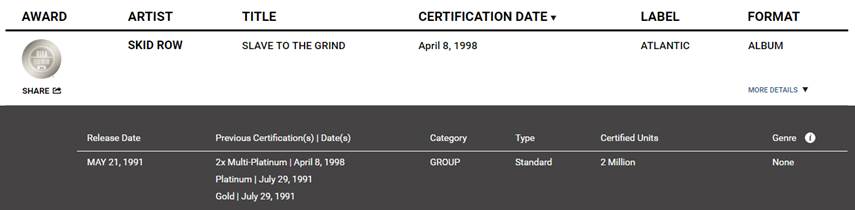
In the first month of the SoundScan era, Skid Row’s “Slave To The Grind” skyrocketed to number 1. In the space of two months, it was purchased over a million times. Trackable purchases, not inflated ones based on a store manager opinion.

For comparison, the self-titled debut album was listed to have sold “3 million” records under the good old honesty system. Really.

image006

And popularity is a monolith that dominates. If the album is selling and doing well, more people will turn to it. And in the internet era, this is so true. The chaos era means we return to what we know. Sure, we might listen to some obscure acts or certain scenes. Like for me, Swedish Hard/Heavy Rock has me hooked at this point in time. But that’s via my choice and not by some flash marketing campaign or by some feature in a magazine.

And the reason those acts are not getting rich is because just a few people are. It’s always been that the one percent of acts that become global underpin the whole industry. And SoundScan showed the recording industry just how global Metallica really is.

“Enter Sandman” comes out two weeks before the album release and it gets added to radio. Metallica have a listening party in Madison Square Garden. The song and the pending album release is building a buzz like never before. MTV takes notice and suddenly mainstream radio stations that play “pop” music have the single in rotation. The album comes out and it debuts at No. 1 on the Billboard 200. Suddenly, the “Black” album is selling by the hundreds of thousands. It’s trackable. And then, the back catalogue of Metallica started selling. Normal rock music lovers couldn’t avoid it. Pop fans couldn’t avoid it. Skater fans couldn’t avoid it. Suddenly fans of all genres are embracing Metallica.

I recently had a look at the recent RIAA certifications and it more or less confirms we are living in a “singles” world.

Check out all of the certifications that Shinedown received recently.

There is a platinum certification for “Simple Man”, a song released in 2004. This is what music is about. The longevity. 12 years later, people are still listening to the song and are still purchasing it. However, the record labels and a lot of misguided artists believe it’s about the instant payday. It’s not.

Next up is a Platinum certification for “The Sound Of Madness” single. Again, it’s been a long time between certifications but this song is a monster and as classic as anything from the classic rock era. Like “Simple Man” before, it’s about the longevity. 7 years later, it’s still listened to and it has close to 26 million streams on Spotify.

It’s just a matter of time before “Call Me” gets a certification and it was never even released as a single, however it has been streamed close to 33 million times on Spotify.

Then you have a few Gold certifications for the songs “Bully”, “The Crow And The Butterfly” and “Diamond Eyes”. “Bully” is a favourite of mine. It’s message is powerful.


Speaking of singles, Disturbed is killing it on the back of “The Sound Of Silence” and their album is moving units on the backs of their cover.

And Muse are now moving into album certification territory on the backs of some very large singles. “Absolution” gets a platinum gong, 12 years after it was released. Again, the longevity is more important than the payday.

So again, on the strength of a few songs here and there, artists are seeing an interest in their back catalogue. It happened to Metallica with “Enter Sandman”. It’s happening to Disturbed with “The Sound Of Silence”. It’s continually happening to Muse and Shinedown. This is music and music is for the lifers.

Standard
A to Z of Making It, Copyright, Music, My Stories, Piracy

The Streaming Wars, iTunes Suspending Downloads Due To Decreased Sales While Bandcamp Sees An Increase in Sales

“It’s (streaming) not the enemy and the thing that frustrates me is the old guys, and I call ’em the old guards; now what a nasty position to be in to be thought of as a gatekeeper. Because you’re a rockstar, you’ve been around 20, 30 years — some of ’em 40 years — and you say, ‘Bah humbug to streaming!’ You say, ‘Bah humbug to rock. Rock is dead. There’s no hope for the future. Put your guitars down and go get a job in a bank.’ It’s, like, that’s not the message that young musicians and fans need to hear. They need to hear, ‘Streaming is your friend. The listening experience is more exciting. Pick up your guitars, there’s a career for you out there. The next Elton John’s out there. The next Metallica’s out there. The next Beatles is out there. The next Muse is out there — they’re out there.’ They’re young, they need to be pushed to be the best they can be; they don’t need to be told there’s no future. There’s money and there’s hope, and what money gives musicians is the opportunity to have stability. And with stability you can continue to create music and, when an artist is creating music, we get to do interviews and talk about it.”
Nikki Sixx 

Suddenly Google has become the baddie when it comes to piracy being. The tech giant is accused of the same crimes that Napster, Limewire, The Pirate Bay, MegaUpload, etc. were accused of previously.

It’s been ongoing for a while, especially around the takedown procedures. Suddenly musicians are now speaking up against the small payments from YouTube. Nikki Sixx and Deborah Harry spoke out against YouTube.

Manager Irving Azoff mentioned YouTube should allow musicians to opt out of the service, and if the musicians via their backers ask for their content to be removed it should be removed permanently and not allowed to be put back up without the consent of said musicians.

And if you have ten minutes, check out the latest rant against YouTube. It is a read of BenHur proportions.

And then there was a rumour of iTunes cancelling music downloads which was denied by Apple. However where there is a rumour, there is also some truth. The article states;

“Whether or not Apple wakes up one day and decides to tear down its iTunes music download store is not the most important thing.  Because they are already starting to get rid of it.  This phase-out is already happening and Apple is definitely assisting this process.  They are definitely not growing their download store and they are doing what it takes to make this die a natural death.”

The article talks about how Apple is blurring the lines between iTunes and Apple Music, by corrupting our iTunes downloads with the Apple Music product, even going as far as replacing your paid iTunes download with the a different version licensed for Apple Music. Apple believes by doing this process, the user would eventually give in and pay for an Apple Music Streaming subscription.

And the major record labels couldn’t care less. They will phase out CD’s and if mp3 downloads are phased out, the only mp3’s pirates can download are the web rips of YouTube songs. Which if you read the above, the labels are really pushing hard to tear down as well. All of this means the labels get back control of the distribution channel that Napster took away.

They have hedged their bets with every digital musical offering, taking decent percentage stakes in each of them, so when they get sold or go public, the labels stand to gain billions. Add to that the millions earned from licensing the songs that they hold copyrights for and you get to see how much money is going to the record labels and not the artists.

But hey, YouTube and Spotify is to blame.

Bandcamp has posted a counter argument to Apples “iTunes problem”.

  • Bandcamp grew by 35% last year.
  • Fans pay artists $4.3 million dollars every month using the site, and they buy about 25,000 records a day.
  • Nearly 6 million fans have bought music through Bandcamp.
  • Digital album sales on Bandcamp grew 14% in 2015 while dropping 3% industry-wide.
  • Track sales grew 11% while dropping 13% industry-wide.
  • Vinyl was up 40%.
  • Cassettes 49%…
  • Even CD sales grew 10% (down 11% industry-wide).

Bandcamp is not just a download store. When a user buys music on Bandcamp, they also get instant, unlimited streaming of that music via Bandcamp’s free apps as well as an optional, high-quality download.

In the past I have always mentioned that fans come in different ways and consume music in different ways and it looks like Bandcamp is positioned to capitalise on that.

Standard
A to Z of Making It, Copyright, Derivative Works, Influenced, Music, My Stories, Piracy, Stupidity

Plagiarism

“There was really just one song ever written and that was by Adam and Eve. We just do variations”

Keith Richards as he was inducted into the Songwriters Hall of Fame in New York in 1993.

That my friends is music in a nutshell. All forms of art is inspired by the past. And then corporations came looking to profit from art and they lobbied the governments of the time to start writing laws. These laws would get enhanced until it got to a stage where the laws only benefit the corporation that controls/holds the copyright of the artist.

The word plagiarism in music is a dirty word.

If you look at a dictionary like the MERRIAM-WEBSTER ONLINE DICTIONARY, plagiarise means;

  • to steal and pass off (the ideas or words of another) as one’s own – Isn’t this what Sharon Osbourne did in Ozzy’s name for “Bark At The Moon”. Bob Daisley and Jake E. Lee wrote the album and Sharon had Ozzy listed as the sole songwriter.
  • to use (another’s production) without crediting the source – Isn’t this what Metallica did with “Enter Sandman” and “Welcome Home”. Kingdom Come did it. Every British Rock Invasion did it with the Blues of the 30’s and 40’s.
  • to commit literary theft – Isn’t this is what Robert Plant did with some of his Led Zeppelin lyrics.
  • to present as new and original an idea or product derived from an existing source – Isn’t this is the whole history of music. There is a pretty good chance that latest album of your favourite artist was influenced in sound and feel by songs of the past.

In music, if you play the notes A, B, C right after each other, you are technically playing the first three notes of a musical scale. And there is a 100% chance that those same three notes will appear in someone else’s song or have already appeared in a song written in the past.

So should we credit the person that came up with the Aeolian scale thousands of years ago for those three notes?

But if I was writing an essay I am required to credit anything that is the same as something that came before.

But what about the millions of songs that have A, B, C in a lead break or in a vocal melody or in a riff?

See how silly it gets when you start to use a scholarly term like plagiarism in music. Based on it’s dictionary meaning, then plagiarism has been around in music since the dawn of time.

But plagiarism is relevant these days because our culture believes it owns everything. We believe our ideas and words and stories are so original, we worry that others will “steal” them from us in some way and make millions of dollars from them, while we make nothing.

The fact that other people in the world are thinking the same ideas or writing similar words or living a life similar to ours, doesn’t even come into the equation.

And while plagiarism does exist in academic/literature circles, it really doesn’t exist in music. Because music is a sum of what came before it. If certain songs sound too similar, then that is copyright infringement and it exists in music.

That is what Vanilla Ice did when he lifted the bass line from “Under Pressure” and called it “Ice, Ice Baby”.

But when I hear Five Finger Death Punch lift the vocal melody from “The Ultimate Sin” and re-use it for two lines in an eight line verse in “Lift Me Up”, I call that “influenced by music that came before to create something new.” In other words, it is a derivative work.

But with so much money in music, especially around hit songs, the lines of inspiration have been reclassified as theft/plagiarism. Copyright infringement is now all about censorship and piracy.

And what you have is a jury of non-music experts setting precedents that blur the lines even more. And you have heirs of artists suing to protect their pension incomes, when the songs their deceased parent or grandparent wrote, should be in the PUBLIC DOMAIN as Copyright intended them to be.

Standard