When I was growing up there’s like a half a dozen or 10 big giant great bands that are super groups you know. Now it’s like there are thousands of bands. Picking through everything is hard. It’s stressful trying to find all the right music you know. George Lynch
It’s a good time for an artist to get their product out and streaming has moved distribution further away from the labels. And it pissed em off because their power came from controlling the distribution. Then the millions started coming in from streaming and suddenly their powerful again. And all they did was moan and complain.
8 Years Ago (2013)
I was writing about my fandom of Tesseract, who just released the excellent “Altered State”.
And it reminded me of an Australian band called Karnivool.
Tesseract also liked Karnivool as they had a few of the Karnivool songs in the Spotify playlists they created to promote the album.
Trivium was also doing the usual PR interviews about their new upcoming album called “Vengeance Falls”, produced by David Draiman from Disturbed.
And from the interviews, the theme was, “Bigger Melodies, Bigger Hooks, Bigger Riffs.”
And in 2021, I can say that the album proved just that, giving us the concert favorite “Strife” with its Judas Priest “Sentinel” Intro.
And the lyrics from Dave Mustaine seemed prophetic to me during this period.
I was questioning why artists would spend a lot of time putting together 12 tracks just to sell them as a packages for $10. It’s an old business model. In 2021, that business model is 55 plus years old.
I can’t recall a lot of companies doing the exact same thing they did 55 years ago and surviving.
But it looks like the album won’t go away anytime soon.
And I think he’s done that. Every FFDP album has a certification. It’s because of the songs, which Bathory said, a song needs to be there for anything else to be added.
And I think my final douche post was written and I was asking the question if having Portnoy in your band is a good thing or a bad thing due to the many projects.
As James Hetfield once said that he is anti-side projects because it dilutes the quality of the main product.
And in the end it is quality that the people want.
I was trying to be a sociologist with the post, “The Old Rock Star Is Dead, It’s Time To Create A New Rock Star”,
You don’t want to be an artist that becomes who others want them to be. It’s okay to not be liked by everybody.
Apart from the great listening experience it also changed the way I played and wrote songs. After this album, I was okay with jamming on a groove instead of soloing.
This album joined albums like “Tribute”, “Powerslave”, “Somewhere In Time”, “Appetite For Destruction”, “Slave To The Grind”, “The Great Radio Controversy”, “And Justice For All”, “Metallica Black Album”, “5150”, “Hysteria”, “Wicked Sensation”, “No More Tears” and “Images And Words” as my “Bible” albums. These “Bible” albums are albums that I devoured, learning the riffs and the licks.
Tool is Maynard James Keenan on vocals, Adam Jones on guitar, Justin Chancellor on bass and Danny Carey on drums. Production is handled by David Bottrill.
The album debuted at No. 1 on the Billboard 200 chart. It went to No. 1 in Australia. In the U.S its certified as 3x Platinum and in Australia it’s also certified as Platinum. People were listening and unable to turn it off. Even on streaming services, the song “Schism” has only been on Spotify just under two years and it’s at 49.3 million streams, And it’s a 8 minute song.
The album is a product of the members being at the peak of their creativity and a four year label dispute.
At the time the band was critical of file sharing, so as part of the marketing for the album, they announced a different album title and a bogus 12 song track list, with stupid titles like “Encephatalis” and “Coeliacus”. Of course, the unregulated Wild West of file sharing sites, were flooded with bogus files bearing the titles’ names. It wasn’t until a month later that the band revealed the real album name and that the name “Systema Encéphale” and the track list had been a bunch of bullshit.
CD’s can pack 79 minutes of music and Tool gave em a few seconds back. Because at 78 minutes and 51 seconds long, it’s got every groove and landscape packed in across the 13 tracks. And to think that they kept editing the album at the mastering stage to get it under 79 minutes.
The Grudge
The whine of a machine starting up and it all comes crashing in, the toms are syncopated with the guitar riff and the bass is unique, taking the lead here to outline a different melody.
Once the vocals kick in with “Wear the grudge like a crown of negativity / Calculate what we will or will not tolerate”, they syncopate with the guitar riff. Maynard is telling ya, don’t let your grudges hold you back.
At 1.22, the song changes. It takes you into uncharted territory. The previous landscape is gone, in the rear-view mirror. And we are into the verse.
Clutch it like a cornerstone Otherwise, it all comes down Terrified of being wrong Ultimatum prison cell
You can’t imagine your life without the grudge you might have against the person who wronged you, the scarlet letterman. And what if your grudge isn’t justified and you have been wrong the whole time. You don’t want to be in that position, so you keep holding onto the grudge.
The song changes again after the bridge, with the vocal melody of “Choose to let this go”. The riff is heavy, Sabbath like heavy.
Give away the stone Let the waters kiss and transmutate These leaden grudges into gold
Let the burden go, it’s okay. Don’t let your hate and prejudices define you anymore.
The song then percolates and builds from 6.25 as the intro riff returns. Then there is silence and just the bass. And then an explosion of music from the 7 minute mark as Maynard belts out a scream that he carries for 24 seconds.
Studio trickery. Maybe.
The last 30 seconds is how you end a song. Listen to it. You will not be disappointed.
The Patient
A creeping guitar riff starts the song off. At the Sydney concert I watched, Maynard did say the song is about the vampires that you come across in your life, who try to get you down.
But I’m still right here Giving blood, keeping faith And I’m still right here
Wait it out Gonna wait it out Be patient (wait it out)
The vampires could be anything. The education system, society, the corporations, the government, a friend, a lover, a family member. Be patient. Everyone comes undone eventually.
Schism
8 power chords are played on the bass, then silence for a few seconds, before the iconic bass riff starts the song. Justin Chancellor announces himself as a bass hero.
I know the pieces fit cause I watched them tumble down No fault, none to blame, it doesn’t mean I don’t desire To point the finger, blame the other, watch the temple topple over To bring the pieces back together, rediscover communication
Once upon a time, all religions were the right one, than, they fell apart. The pieces are now corrupt, moulded shadows of the once great temple. This song says if the pieces don’t communicate with each other than we are doomed.
Parabol/Parabola
They are two tracks on the album. But they exist as one as the last note of “Parabol” flows into “Parabola”
The three minutes of “Parabol” feels like I’m in the vast plains of the Middle East, looking at the night sky.
The Pre Chorus and Chorus of “Parabola” echo Maynard’s work with A Perfect Circle.
This body holding me, reminding me that I am not alone in This body makes me feel eternal All this pain is an illusion
Live in the now people. It’s easier said than done. I know people who can’t let go of the past. It consumes them to the stage of insanity. They feel wronged. But all this pain a person feels focusing on the past is an illusion. It’s not real, it manifests in the brain. The pain that you think you are experiencing will pass.
At 2.04 it changes from being a standard hard rock song into a typical Tool song.
At 3.58 the bass takes over for a brief moment before the band kicks in, setting up the finale, the last 2 minutes.
At 4.40, a Black Sabbath fuzzed out riff kicks in. it plays while the drums play like a ceremonial fill.
Ticks And Leeches
A drum pattern kicks off the song. The bass kicks in, with a riff that is played along with the bass drum. It’s weird and off putting. Then the guitars kick in with some repeating single notes, the bass gets busier and so do the drums. By the 50 second mark, the double kick is frantic.
And then it changes for the verses.
Maynard’s melody is bordering on the periphery like a chainsaw.
Hope this is what you wanted Hope this is what you had in mind Cause this is what you’re getting I hope you’re choking I hope you choke on this
How good is that that Pre Chorus and Chorus riff, when Maynard is singing the melody of “hope this is what you wanted” and “I hope your choking”.
At 3.24 it changes into a clean tone guitar riff that keeps repeating forever. It percolates up to the 5.58 minute mark, before it explodes for the final 2 minutes.
Got nothing left to give to you
Every person with a dream or a goal has ticks and leeches waiting to suck em dry. Even good old Mother Nature will have nothing left to give us except floods, droughts and fire, for the humans are parasites here, sucking the wealth of resources dry for profit.
Then the massive ending from 7.20. The double kick drums are relentless, that Pre Chorus/Chorus riff kicks in and Maynard starts with his “is this what you wanted” melody.
Lateralus
The epic title track at 9 minutes and 22 seconds long.
The clean guitar riff is basic and it keeps repeating. Then the bass comes in and the drums, an explosion of poly rhythms and exploration.
How good is the main riff from 1.15? It’s a metal tour de force.
At 4.50, it’s just the bass, playing a triplet of notes with a brief pause.
And the intro guitar kicks in again.
And it keeps building.
Then at 7.17, the best part of the song kicks in. The drums play a simple beat, while the guitar is staccato like and the bass is doing something different, highlighting the vocal melody with a choice selection of notes.
It needs to be heard to be understood.
Reaching out to embrace the random. Reaching out to embrace whatever may come.
A song in which the “spirit” lives outside the norms but the person is still human and divine at the same time. They touch on these kind of themes with “Forty Six & 2” from the “Aenima” album.
Listen to it and read the lyrics. It’s like a complex novel coming to life.
Disposition/Reflection/Triad/Faaip De Oiad
The final tracks are part of a large suite but separate tracks on the album.
“Disposition” is like a tribal drum groove with a clean tone guitar riff. It only goes for about 3 minutes and 20 seconds.
It carries into “Reflection” which is the centrepiece at 11 minutes. It has a drum groove that evokes the Middle East, another iconic bass line, synths and an exotic guitar and vocal line.
So crucify the ego, before it’s far too late To leave behind this place so negative and blind and cynical And you will come to find that we are all one mind Capable of all that’s imagined and all conceivable Just let the light touch you And let the words spill through And let them pass right through Bringing out our hope and reason
It’s an incredible Tool song.
How good is the line “capable of all that’s imagined and conceivable”?
It’s the same mantra put forward by the self-development industry. You know the one, the 10,000 hours, showing grit, emotional intelligence, a growth mindset, resilience and creating a culture in which people feel safe to express their thoughts and everything will turn out okay.
From 8.28 it really kicks into a groove. Watching it live, is a memorable experience.
“Triad”
A 6 minute conclusion as the vast plains of the Middle East are back.
“Faaip de Oiad” is Enochian for “The Voice of God”. Now if you’re wondering what Enochian is, I also had to look it up when I came across it years ago. It’s basically an occult language that two spiritualists from England came up with, who claim angels divined this language to them.
As for the song, it’s just abstract noise and nothing worth talking about.
I was introduced to Tool in 1998. My best man burnt me the “Aenima” CD. I immediately got it. It was exactly what I was looking for. I didn’t want the album to end.
This album has sustained 20 years. It’s not something you play a track from and then forget about, it’s something you go deeper into. It’s a journey.
They covered so much ground with this album and “Aenima”, that they next two albums that came after in “10,000 Days” and “Fear Inoculum” got stigmatised as sounding like “Aenima” and “Lateralus”.
And progressive rock/metal is meant to be dead. But Tool doesn’t fit into that category. It’s a little bit of metal, a little bit of rock, a little bit of progressive in its time changes and song structures and in its lyrics, they push different boundaries and messages. And Tool doesn’t care what the labels want or what the charts like. They push their own envelope, catering to their own needs first and taking their listeners with them.
Most of Tool’s songs since the “Aenima” album, are over seven minutes long. Their most recent album “Fear Inoculum” has every song over ten minutes. From a streaming point of view, this is a bad idea, as one Tool song from start to finish equates to three to four pop songs. And in an hour, you will hear a 15 minute Tool song 4 times whereas a 3 minute pop song will be heard 20 times.
So when you see a Tool song in the multi-millions, just think of the time invested listening to these songs.
If you hate Tool, then keep ignoring em. If you are into hip-hop only, ignore em. If you like your 3 to 4 minute pop fix, ignore em. But if you are a rocker and you liked how bands used to experiment with a song or two on an album, then you need to check out Tool.
And like Tool, I couldn’t edit this post any shorter. It is what it is, because it is.
I looked at Spotify’s Global Top 50 and I didn’t see a rock artist listed. It was all hip hop and collaborations of other hip hop artists. The Global Viral Top 50 also presented with a list of unknown artists to me. Artists like WhoHeem, Salem Ilese, Ritt Momney, JVKE and I could go on and list so many names and not one of them would be known to me.
And then Spotify releases data reports and tells everyone that hard rock and heavy metal artists are the most listened to. But the Top 50 and Viral lists doesn’t support that.
So people listen to what is popular and they listen a lot while the song is popular and then move on to the next big thing. But in rock and metal, people listen and they keep on listening for years and years.
So the streaming money is in rock. But the labels and the media that supports the labels like to report that hip hop is dominant.
It’s not.
Even in the live arena, rock bands dominate, in ticket sales and merch. And COVID19 has hurt these artists, that’s for sure, but it’s also given these artists an opportunity to get new music done, or a new book, or a new collaboration, or a new side project or something else.
Because music will keep paying forever. Streaming makes that a reality. It scales. As long as you hold the copyrights for your songs, they will pay you and your kids and your grandkids for a long time, because copyright takes a long time to expire these days. And the labels are pushing for never.
And going to a rock and roll show, it’s not all oldsters. There is a whole new audience there, its cyclical and if the kids can’t pay the high prices for the tickets, their parents will.
Remember in the pre-streaming era, a sale was a sale. And if you listened to a record or not was irrelevant. It was still a sale to the label and the artist thought they had a fan. But that was never certain.
But rock is not seen as rock anymore. There is pop rock, classic rock, post rock, hard rock, melodic rock, heavy rock, progressive rock, folk rock, stoner rock, sludge rock, punk rock and I can keep going with the different terms. In other words, there are so many niches and artist are playing to these niches and sustaining.
Hard Rock never went away when grunge came. It was still there albeit at a reduced release schedule and fans of the genre still purchased the albums that got released. And that niche is still there.
For artists, they need to realise it’s about subscriptions. Adobe went to monthly subscriptions and so did Microsoft. Apple is bundling all of their wares into a nice subscription. Netflix is subscription based. So is Amazon. For a small monthly fee, you get a lot of content and in music, you almost get the history of recorded music at your fingertips.
If you still want to create a CD, remember that CD sales thrived because people were rebuying their previous vinyl and cassette albums on CD and people who had computers with CD drives were purchasing CD’s. Computers don’t even come with CD drives anymore.
And for those who are upset that Daniel Ek is a billionaire, remember that without Spotify, Universal and Warner Music would be worth a lot less.
Streaming was gonna happen, because it’s on demand distribution. And people like that.
Based on RIAA certifications (total album units certified by the RIAA) Iron Maiden has 6.5 million sales in the US.
Megadeth and Tesla are also sitting at the same certification amount across their catalogue.
Who do you reckon has the biggest audience when it comes to playing live from the 3 bands?
Which tells me that Iron Maiden must be the most heavily pirated band there is. Their sales of recorded music compared to their sales of concert tickets and merchandise just don’t correlate. They get the same attendance as Metallica would get, yet the difference in certified album units between the bands is huge.
Metallica is at 63 million certified units.
While Megadeth and Tesla do play live, the crowds they get compared to Maiden are very different but they have the same amount of certified album sales.
So sales of recorded music does not correlate to massive concert attendances.
David Lee Roth, Muse and Dokken are sitting at 3.5M certified units but Muse plays gigs to 15,000 people and are headliners for certain European summer festivals.
Dokken even at their height didn’t play venues that big nor did David Lee Roth as a solo artist.
Like with Maiden, the sales of certified units don’t correlate with the concert attendances.
Since the sales don’t correlate to the increased demand for concert tickets, is it illegal downloading or the access to music via streaming driving the growth?
From a streaming point of view, the basic rule of scale is to increase the subscribers, so more artists are sharing the pool of money. This increase of subscribers doesn’t require an increase in resources and there’s no extra effort needed.
And this might mean that each and every stream might be worth less per stream but the lump sum should be higher.
But streaming doesn’t have scale from one company alone.
Combined it might, once you add YouTube to the mix. But have you seen the numbers on YouTube of popular songs compared to their Spotify numbers. Their lower which might correlate that people have made the transition to Spotify streaming.
And entities becomes more valuable as more people use them. It’s a big reason why record labels became valuable, as we had to use them to get our fix of music.
But we don’t need to use the labels today. However streaming companies do need to use them, hence the reason why the streaming companies are the labels biggest client and the labels don’t care the rest, especially us fans.
And the labels profit even more from all the innovations that happen in streaming. But it’s the artists that make the connections with fans.
So are the streaming providers the real problem or the labels?
It’s not even funny how much money the legal fraternity makes from music and Copyright issues. The legal teams of labels, artists and the heirs of artists make money from Copyright disputes. The legal teams of the same group make money from just representing those groups in contract negotiations and so forth.
But depending on what you read, streaming services are the problem because they don’t pay enough. Because these services also make money. While the streaming companies are running at a loss, the value of the people at the top of the Executive doesn’t diminish and their stock value is high.
Everyone is making money from so many different things except the artist. But it’s the artist who creates the content that engages with a person, who then becomes a fan and decides to spend their money on the artist.
This is what happens when artists are never allowed to be in the negotiation room when legislation is being drawn up.
When Corporations like the record labels are involved in the negotiations with their list of politicians on their payroll, well legislation looks very one sided. And when the labels get artists involved like Sonny Bono, these artists gets a handsome payday from the labels for their involvement which is probably a lot more than they would get from sales or even streams of their recorded music at that point in time.
The labels are digging deep with their counter arguments to prove that the termination requests are invalid. There best one is to say that the songs are “works for hire” which means that the label was an employer and the artist an employee, however the label didn’t meet any commitments that an employer needs to meet to be classed as an employer like annual leave, long service leave, sick leave, retirement pension contributions and yearly review of said salary and bonuses and so forth.
And the lawyers make even more money.
Remember when the streaming bodies disagreed with the Copyright Royalty Board on the new rates they need to pay to songwriters for streaming.
The record labels and music news sites that benefit from reporting positive articles about the labels, talk about the billions of dollars the music industry made in the financial year just before Napster hit.
So from a simple viewpoint, when Napster hit, sales of music started to decline. For the RIAA and the record labels, these two events correlate, so it implies that one is causing the other to move. But the sales of music had been falling for some time.
What happened during the 90’s just before Napster went worldwide was a lot of re-purchasing.
People started to re-purchase the music they already owned on vinyl and cassettes on CD’s. These re-purchased items, in most cases re-mastered or super deluxe editions with bonus content at higher prices would skew the record label figures to make it look like new recorded music was bringing in billions of dollars when in fact it was people purchasing old catalogue items. And once we had those albums on CD, we didn’t really need to re-purchase them again.
But Napster also highlighted a gap in the business models of the labels. People liked to have access. If anything, people liked to have terabytes of culture saved on disk drives.
Some artists maintain that it was the right action to go after Napster. Others can’t wait for Spotify to die. They must think that people would just go out and buy their albums on physical again. The hard core always will but the majority won’t. They’ll revert to downloading.
The Napster gap allowed people to share their music collections (bootlegs and original recordings) in a very simple and convenient way. Napster got popular because of it, and the labels should have created something to match it.
But the labels did nothing, and more sharing applications kept coming. Then a small company called YouTube did fill the gap that Napster was really servicing. YouTube allowed people to upload their music collections. And YouTube today, generates billions of dollars. These billions could have been in the profit and loss statements of the record labels but they messed up.
We are 22 years post Napster, and the record labels did absolutely nothing to counter it, except scream for legislation and gestapo like police powers.
You want to know who is the labels biggest client. Spotify and the other streaming services.
You want to know who artists see as their biggest enemy. Spotify, but not the other streaming services..
The arrival of YouTube and eventually streaming services put a dent into the traditional sales model, but did these sharing and access platforms assist in increasing the crowds for artists?
Iron Maiden came back with Bruce Dickinson on “Brave New World”, bigger than ever and played to sold out crowds in countries they’ve hardly sold any recorded product in. Even the album “Brave New World” did nothing sales wise.
Twisted Sister and Motley Crue also came back bigger than ever post Napster and played to their biggest ever crowds until they retired. Then again Motley Crue just faked their retirement.
Did sharing of music assist in these high concert attendances as well?
To use the record label analogy of post Napster sales and pre Napster sales, these two events correlate, so it implies that one is causing the other to move. The same can be said about music being shared illegally and bands playing to their largest audiences ever. One event is causing the other to move.
And here we are in 2020 with a pandemic killing off the live show and no one really knowing how it will look once it is over. And the record labels are winning, making money from streaming revenue while the hard rock artists who have a presence want streaming to die.
But it’s the labels with the greatest share of the streaming revenue.
For the first half of the year, recorded-music revenue reached €2.77 billion ($3.27 billion, up 3.7%), boosted once again primarily by a rise in streaming revenue (€1.81 billion/$2.14 billion, up 12.4%) that offset declines in physical sales (down 22.4%) and digital downloads (down 23.1%).
$2 billion in streaming revenue went to Universal Music Group for the first six months. That’s a lot of coin.
You know who is the labels biggest customer.
It’s Spotify.
If Spotify is the enemy, why have recorded music revenues increased?
How much of those streaming monies went to the artists, well that’s another story?
Only Universal has the answer for that?
Blabbermouth and Loudwire have seized on the tweets from artists and are running with it. It always gets eyeballs and people commenting which sells ads on those sites. But Blabbermouth or Loudwire don’t take a stance either way on the issue, which is shit journalism. Or it’s basically PR journalism.
For a different view, Bob Lefsetz summed it up nicely here and here. And he’s a music fan like all of us who owns physical and likes to stream.
Streaming tells us how big the artist really is and if people are really listening to their music.
And music is a lottery. No one is entitled to make a living from it or to keep making a living from it.
And for the ones who claim no one is buying physical anymore, Taylor Swift just moved 600K in the US of her recent album for one week. So people are buying, but their just not interested in what other artists are selling.
And let’s put some context around what’s happening .
Queen is Number 1 on the list of artists for the Top 40 Most Streamed Artists in the Hard Rock/Metal/Punk, Etc. for the period July 24, 2020 – July 30, 2020 from the site StreamNDestroy..
Queen has 22M streams for “Bohemian Rhapsody”. The data is compiled from a Rolling Stone list which features all genres.
On that list, Queen is actually sitting at Number 63. A long way away from number 1. And the 22 million streams from Queen are dwarfed by Taylor Swift at 300 plus million streams for a week.
What I see is a 44 year old song still earn a lot of coin when once upon a time it was only earning monies from radio plays. And this song will keep earning monies forever and a day, as long as people listen to it.
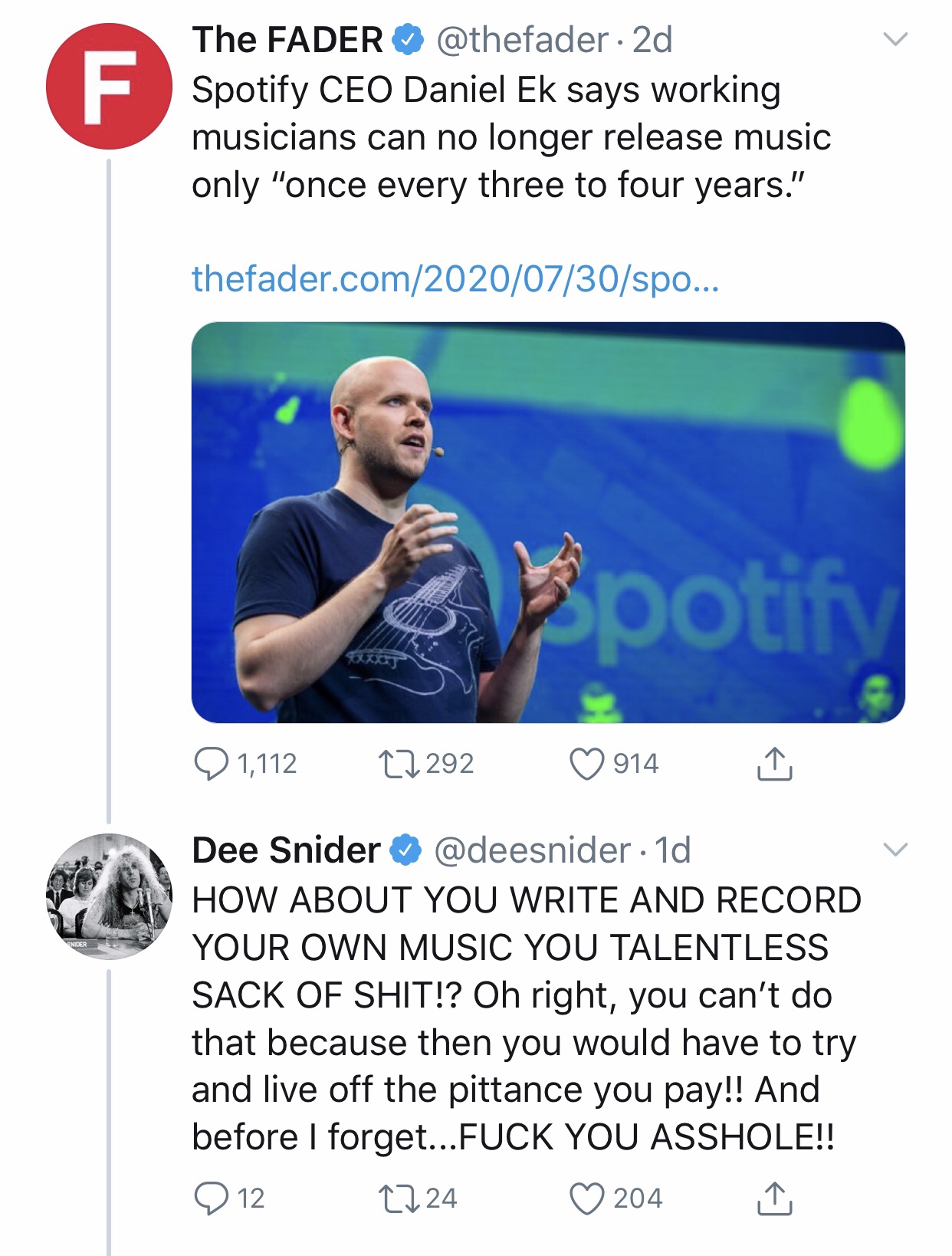
I posted a few days ago about Streaming and some comments from Daniel Ek about what artists should be doing based on the data provided to him.
For example, releasing an album every 2 to 4 years is not a viable solution these days based on the data, and the data tells Spotify that a continuous engagement with fans with frequent releases is more viable.
Spotify thrives if content is delivered, so you need understand that Ek is also playing the role of a sales person in his quarter earnings speech.
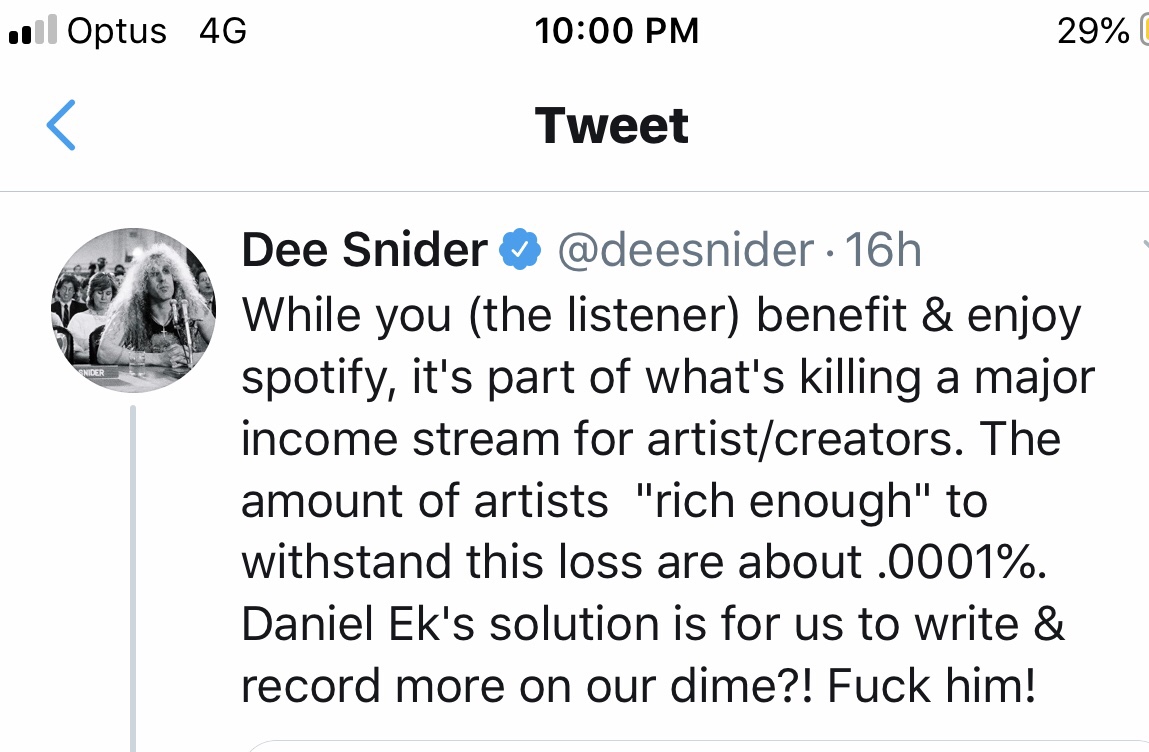
And I’ve been following the reactions of artists on Twitter since Spotify quarter results, just to see what their view is, because the reason why we have Spotify accounts is that we like music and we want to listen to music.
Spotify grants access to music, along with the other streaming providers.
Dee Snider as usual is at his best.
Before streaming providers, consumers had, iTunes, pirate sites, cyber lockers and physical purchases. Artists got paid on a transaction once the label recouped.
But does that one sale equal a true fan.
Most of my record collection is from second hand record shops and market fairs of used records. So the person who purchased the record from a shop is listed as a fan via Soundscan metrics, but in reality, they are not a fan as they sold their record to a second hand shop who then resold it to me. And this sale is not captured as a Soundscan metric. So artists didn’t have any idea who their fans were.
Then came YouTube.
An uproar started there, when music became available on the service. YouTube got traction and to this day it is still the number 1 streaming service. The labels eventually negotiated a license deal and artists got rorted again. And pirate sites never went away.
Then came Spotify. The labels took ages to license the service as they wanted a stake in the company and a profit share arrangement with the service and so many other wonderful ways for the label to make money from the service.
First the labels and the publishing houses get a fee for allowing the service to license the music they hold the copyrights for. And this fee goes straight to the labels/publishers without any distribution to the artists.
And everyone is trying to do the math of how much does an artist get paid per stream?
But it’s the wrong train of thought to have.
Whoever holds the rights, the monies are getting sent there. But, the labels and publishing companies also have a profit share arrangement with the streaming service (and it’s not just Spotify, all streaming services have this arrangement, especially Tidal who have a lot of artists involved with it as investors) where they split the monies between each other.
And are the people at Tidal complaining?
Eventually the streaming market will fragment like the movie and TV streaming market and the streaming companies will start to make their own content and will become labels themselves.
Those 43,000 artists account for the top 10% of the streams on the service. Last year it was a Top 30,000. As the user base grows on streaming services so does the fragmentation. And if artists are thinking that they will dominate in the same way that artists dominated in the MTV monoculture, then they need a mind reset.
“The real thing is that there are more relationships being formed to more artists”
Discovery is happening. You can start off listening to Metallica and end up becoming a fan of a Swedish Rock band in the months ahead. For a consumer, streaming services are enablers, as long as the music of the artist you want to hear is on there.
“Obviously, some artists that used to do well in the past may not do well in this future landscape, where you can’t record music once every three to four years and think that’s going to be enough…
The artists today that are making it realise that it’s about creating a continuous engagement with their fans. It is about putting the work in, about the storytelling around the album, and about keeping a continuous dialogue with your fans.”
I know the album cycle works for a lot of people, because its quantifiable. Release an album and go on tour. Vandenberg released their best album and they can’t tour on it because of COVID-19.
So what’s next for the band to keep the engagement going?
Acoustic releases, some covers of their old stuff or from other bands or another new track in between.
Keep the engagement going. Because that 40,000 artists who make up the top 10% of streamers, will become 50,000 in the next year and then 60,000 and then 70,000.
“I feel, really, that the ones that aren’t doing well in streaming are predominantly people who want to release music the way it used to be released”
That’s fine to do so if you’re happy with that old school release cycle and there is a percentage of your fan base which is also okay with it. But with so much choice, fan devotion to a single artist is not as strong as it was in the past. And even in the past, when the record labels controlled everything pre-Napster, people had hundreds of records and from different artists.
Then again, Taylor Swift’s ‘Folklore’ had 98 million streams in a day. A Spotify streaming record.
The good old day of sales are non-existent and with Copyright terms lasting forever, the person or corporation who holds the rights, will get paid forever for people listening.
This is just on Spotify. The other streaming providers will also have similar numbers and will be paying the rights holders similar amounts for their Top 40,000 artists who make up 10% of the most streamed tracks.
And music is a lottery. No one knows what will stick and break through. Simple economic theory entails that no one is entitled to make a living in music, the same way that every person who sets out to be a professional sports player, doesn’t get there. There are limits to what succeeds and what doesn’t. But at least in music, there is no barrier and everyone can play.