They got their name from a Johnny Warman song called “Screaming Jets”. Peter Gabriel also appears on the song, delivering a haunting vocal. It was a hit in Australia and singer Dave Gleeson was singing it when the rest of the band said, “that’s it. That’s the band name”.
I saw The Screaming Jets live on Friday, July 29. They celebrated the 30 Year Anniversary of their debut album, “All For One” and played it in its entirety. You can read my review of that album here. I got tickets for the concert last year, when it was actually the 30th Year Anniversary, however due to the Delta wave and our third lockdown, the show was postponed.
All I can say is that bassist Paul Woosen is a beast on the groove. His bass rumbled and rocked at the gig, laying down the foundations for the rest of the band to roll.
But let’s go back in time here to 1992.
Following the “All For One” album release, the band relocated to the United Kingdom, which they called home for two and a bit years.
They remained unchanged from the debut album, with Dave Gleeson on vocals, Grant Walmsley and Richard Lara on guitars, Paul Woosen on bass and Brad Heaney on drums. But this would change once the album that carried these songs came out in October 1992. However that is for another post.
“Living in England” was released as an EP, in June 1992. The band was hot and still selling good numbers from their “All For One” album in Australia. So the label thought, why not make some extra cash by offering up an EP before the album “Train Of Thought” is released.
And I was all in.
I love this EP.
It’s got three original songs which would appear on the album, and cover versions of Johnny Cash’s “Folsom Prison Blues” and AC/DC’s “Ain’t No Fun (Waiting Round to Be a Millionaire)” which haven’t appeared anywhere else expect on this EP release.
Actually a live version of “Folsom Prison Blues” appeared on another EP in 2017.
Tunnel
Written by vocalist Dave Gleeson and guitarist Richard Lara.
The riff from Lara is excellent. And the horns in the Pre-Chorus and Chorus enhance the song. Think “Tangled In The Web” from Lynch Mob.
Musically it’s a cross between The Angels, Bad Company and AC/DC.
Meet Anybody
Written by guitarist Grant Walmsley.
It has a vibe from The Angels, but man, the verses sit in the LA Sunset Strip style of writing. Then when the Chorus kicks in, it’s got that Albert Productions sound.
And you know which bands I am talking about when I mention Albert Productions.
There is this bridge section which reminds of how Vita Bratta plays. Press play and just enjoy.
Living in England
Also written by Grant Walmsley, its two minutes of relentless punk speed metal power. It’s heavy and it has a Lemmy/Motorhead vibe all over it. I guess that’s what “Living In England” means to them. You just become influenced by Lemmy. And Brad Heaney on drums is a powerhouse here.
Folsom Prison Blues
Written by the great Johnny Cash. It was my first time hearing this song and yes, it made me a fan of Johnny Cash. The Jets version can be labelled “speed country” if there is such a thing.
Ain’t No Fun (Waiting Round to Be a Millionaire)
Young, Young, Scott. Own any AC/DC album pre “Back In Black” and those were the names that you would see as songwriters.
They could have covered the bigger songs, but they selected an obscure album track and made it there’s, performing it live as well.
From disillusionment with the “Falling Into Infinity” saga, Mike Portnoy got an opportunity via Mike Varney’s “Magna Carta Records” to assemble a supergroup of progressive rock musicians in 1997. The Liquid Tension Experiment was born, consisting of Portnoy on drums, John Petrucci on guitar, Tony Levin on bass, and keyboardist Jordan Rudess, who had finished his commitments with the Dixie Dregs.
Portnoy and Petrucci used this little get together to keep on convincing Rudess to join Dream Theater. If you remember, Rudess was asked to replace Kevin Moore, however he declined that offer and Derek Sherinian was brought in. But in 1999, he accepted the offer to become the third full-time Dream Theater keyboardist, replacing Sherinian.
With Dream Theater assembled, the band would enter the studios with complete creative control for the first time.
They assembled an inspiration corner in the studio, made up of concept albums from The Who (“Tommy”), Genesis (“The Lamb Lies Down on Broadway”), Roger Waters (“Amused to Death”), Radiohead (“OK Computer”) , Queensryche (“Operation: Mindcrime”), The Beatles (“Sgt. Pepper’s Lonely Hearts Club Band”), Marillion (“Misplaced Childhood”) and Pink Floyd (“The Wall” and “The Final Cut”).
The band began by revisiting a song called “Metropolis – Part II”, which had been partially written during the “Falling into Infinity” sessions but not completed or used on that album.
At 21 minutes in length as a demo, they decided to expand the song into a complete concept album.
The album was originally mixed by David Bottrill, but only a few of his mixes made it on the final album. After playing the mixed album to Kevin Shirley, Petrucci kept asking Shirley for his opinion. Shirley kept telling Petrucci that the mixes are fine, however Petrucci did not believe him. Eventually Shirley said that the mixes could be better and suddenly Shirley had a job to remix the album. This of course was of a concern to Elektra who felt that the band was just throwing money away.
The album is seen as a sequel to the song”Metropolis—Part I: ‘The Miracle and the Sleeper'”, but the “Part I” was added by Petrucci as a joke and there was no intention to make a “Part II”.
But in 1999, “Metropolis Pt. 2: Scenes from a Memory” was released on Elektra Records. While it didn’t set the Billboard Charts on fire, it is seen as the bands masterpiece and it did exceed the sales target that Elektra had for it.
The story follows a character called Nicholas, who has recurring dreams, so he visits a hypnotherapist. During the sessions, he discovers that he is the reincarnation of Victoria Page, who was murdered in the 1920’s. The story takes place in the 1920’s and the 1990’s as all the characters are still in each other lives. For example, the person who killed Victoria is called Edward and in his reincarnation, he is the Hypnotherapist treating Nicholas.
Scene One: Regression
A ticking metronomic clock.
“Close your eyes and begin to relax” are the first words you hear. The voice of the Hypnotherapist is Terry Brown (yes that Rush producer Terry Brown) although he is uncredited.
“Take a deep breath, and let it out slowly. Concentrate on your breathing. With each breath you become more relaxed.”
There is a story here as well. Terry recorded his voice as a rough guide. Instead the band put it on the album, didn’t give him credit and then used it in the live setting. This didn’t impress Terry, so he lawyered up and set em a bill for using his voice. The band paid the bill and then had to get a new Hypnotherapist voice for the tour.
As the Hypnotherapist counts down, the acoustic guitar of John Petrucci starts up and gets louder as the countdown gets lower.
Then James LaBrie comes in with the vocal melody.
Safe in the light that surrounds me / Free of the fear and the pain / My subconscious mind / Starts spinning through time / To rejoin the past once again
Scene Two: I. Overture 1928
An instrumental, with a lot of cool riffs and some nuggets from the first Metropolis song.
I like the way it starts off but the best part is the George Lynch influenced tritone riff that cames straight after.
Check out the small lead section at 2.32.
Scene Two: II. Strange Deja Vu
“Overture” segues into “Strange Déjà Vu”.
“In her eyes – I sense a story never told / Behind the disguise – There`s something tearing at her soul”.
Nicholas learns that Victoria was murdered, and that he was actually Victoria in a past life. He believes that he needs to solve her murder.
Check out the “Carry On My Wayward Son” influences at 2.40.
Scene Three: I. Through My Words
The piano riff is haunting and I like it.
“We’re sharing one eternity / Living in two minds”
Scene Three: II. Fatal Tragedy
“This fatal tragedy was talked about for years” / Victoria`s gone forever / Only memories remain / She passed away / She was so young”
The last 40 seconds of the song has this cool open string harmony solo section which I like.
And it ends with the voice of the Hypnotherapist;
“Now it’s time to see how you died. Remember that death is not the end but only a transition.”
Scene Four: Beyond This Life
The opening riff is wicked. Heavy almost grungy in sound yet progressive. And the fast downstroke picking gives way to a single note variation.
“Murder, young girl killed. Desperate shooting at Echoes Hill. Dreadful ending, killer died. Evidently suicide”
The lyrics are written like a newspaper article.
Vocally it feels like a Tool/Maynard vocal melody in the verses. Really focused on the correct syllables.
Scene Five: Through Her Eyes
I’m learning all about my life By looking through her eyes
Petrucci knows how to construct an emotive song and to nail an emotive lead.
Almost countryish in its acoustic strum and Portnoy’s restraint drumming, its Petrucci and LaBrie that shine here.
This is the part of the story where Nicholas realises that he is unable to get on with his life until he solves the murder of his past life.
Scene Six: Home
My favourite song on the album because its Dream Theater taking something contemporary like Tool and making it their own. If you want to press play on a track, this is the one.
The city – it calls to me Decadent scenes from my memory Sorrow – eternity My demons are coming to drown me
From a story point of view, Julian is giving in to his cocaine and gambling addictions, which drives Victoria away from him. Edward feels guilty about deceiving his brother, but decides that his love for Victoria is greater than his guilt, and he seduces her when she is vulnerable following her breakup.
Scene Seven: I. The Dance of Eternity
It’s an instrumental, seen as their best.
Scene Seven: II. One Last Time
Are these her memories Awakened through my eyes
A ballad with lyrics by James LaBrie.
Scene Eight: The Spirit Carries On
I used to be frightened of dying I used to think death was the end But that was before I`m not scared anymore I know that my soul will transcend
The guitar solo on here is excellent and the gospel choir afterwards (orchestrated by Rudess) gives me goose bumps.
Scene Nine: Finally Free
It begins with the voice of the Hypnotherapist.
“You are once again surrounded by a brilliant white light. Allow the light to lead you away from your past and into this lifetime.”
The narrative moves between different perspectives, revealing that Edward wished his romance with Victoria was more than a simple affair. As Victoria begins to reconcile with Julian, Edward confronts the two of them, murders them, then stages the scene and assumes the role of the witness for the newspaper column. The flashback includes Edward telling Victoria to “open [her] eyes” before killing her, echoing the same choice of words the hypnotherapist used to wake Nicholas from his hypnotic trance.
In the present, Nicholas arrives home, followed by the Hypnotherapist. Nicholas is startled by another request to “open [his] eyes”, before the album cuts to (and concludes on) phonographic static. You don’t hear the killing, but the hypnotherapist is Edward’s reincarnation, and he has killed Nicholas to complete the cycle yet again.
The drumming of Mike Portnoy on the last three minutes of this song is essential listening for any drummer on how to add texture and technicality and still sound accessible.
The World Tour to promote the album was their biggest. The whole album was played in its entirety along with actual footage on the big screen.
A show was filmed and released as a DVD in 2002. Even Kevin Moore was invited to participate in this show, to perform “Space Dye Vest” and “Learning To Live”. But he declined the offer and every other Dream Theater offer since his departure.
After battling to make a name for himself on the small Polydor label, Yngwie Malmsteen finally got the big label deal in 1992 with the release of “Fire And Ice” on Elektra. While the album did great business in the Japanese and Eastern/Northern Europe market, it failed in the U.S.
The million plus dollar advance from the label was classed as “unable to be recouped” and he was dropped from Elektra.
One door closes another one opens. A Japanese company called Pony Canyon signed Malmsteen. “The Seventh Sign” came out in 1994, achieving a Platinum certification in Japan, followed by “Magnum Opus” in 1995 which received a Gold Certification in Japan.
“Inspiration” is the ninth studio album by guitarist Yngwie Malmsteen, released on 14 October 1996.
Malmsteen was back to releasing an album a year, in order to remain relevant and in the public conversation during the hostile 90s. If he didn’t do that, obscurity was not too far away. Artists these days whinge about Spotify and how they believe that the service is making them release constant product. It’s not the service, it’s the market. The market demands constant product. It always did.
Yngwie Malmsteen on guitars/bass and Anders Johansson on drums play on every track. The rest is a cast of artists like Jeff Scott Soto, Joe Lynn Turner, Marcel Jacob and various keyboard players.
Carry On Wayward Son
Written by Kerry Livgren.
It shows the reach Kansas had, so that a kid from Sweden would consider the band as an influence.
Jeff Scott Soto is on vocals here and his Talisman buddy, Marcel Jacob is on bass. David Rosenthal is on keyboards. During this same period, Malmsteen also appeared on a Talisman release. A sort of, “scratch my back and I will scratch yours” type of agreement.
Malmsteen makes the song sound like an over-indulgent Malmsteen song with his over the top soloing on any part of the song that doesn’t have vocals.
Pictures of Home
It wouldn’t be an influence album for Malmsteen if there was no Ritchie Blackmore. Malmsteen’s poses and looks are straight from “The Look Of Blackmore”. This is the first of four Blackmore songs. Joe Lynn Turner is on vocals here, who also sang on Malmsteen’s most successful album “Odyssey”. Mats Olausson is on the keys.
The lead breaks are Malmsteen lead breaks full of legato runs and of course, sweep picking. A lot of sweep picking.
Gates of Babylon
From Rainbow and Jeff Scott Soto is on vocals here. His voice and tone is perfect for the song. David Rosenthal plays the keys here.
The song would not be out of place on a Malmsteen album. The riffs are already what Malmsteen plays and as soon as he throws in his sweep picking and fast classical legato lines, it’s basically a Malmsteen song.
Manic Depression
From Jimi Hendrix and like his idol, Malmsteen is on lead vocals. I suppose for all the shredding, Malmsteen doesn’t get credit for being a pretty crazy blues player. Vocally, he doesn’t have the swagger of Hendrix.
In the Dead of Night
From the band U.K., the song is written by Eddie Jobson and John Wetton. Mark Boals is on lead vocals here with Jens Johansson on keyboards. And for those who don’t know John Wetton, he’s appeared in King Crimson, Roxy Music, Uriah Heep, Wishbone Ash and Asia.
But the reason why this track is here is due to Allan Holdsworth being the guitarist. Holdsworth was an unknown name to me until Eddie Van Halen started mentioning him in his interviews in the mid 80’s, which led me to seek out his solo recordings.
Ty Tabor also mentioned in an interview (which can be found on the Wikipedia entry of the U.K album) that the self-titled U.K album is in his “5 Essential Guitar Albums” list, stating that he “had never heard anybody think about playing guitar the way that Holdsworth plays on that record.”
Holdsworth never got mainstream attention. Producers and label heads called his music “without direction”, however to guitarists he was like a god.
You can hear the melodic rock side of Malmsteen here with a bit of progressiveness and how songs like “You Don’t Remember” and “Judas” with the keys and guitars playing great riffs that complement each other.
The solo break groove is excellent, however Malmsteen this time is just too much on the speed, and it just doesn’t fit the groove.
Press play on this track first.
Mistreated
From the David Coverdale era of Deep Purple.
This is the third Blackmore track to appear on this.
Would Malmsteen have covered this, knowing that Coverdale wrote the main riff?
Regardless, the song is perfect for soloing and Malmsteen uses that opportunity to do just that. But if I had to pick a cover version, it is the Whitesnake version with Reb Beach soloing. That solo just hits all the right notes.
Jeff Scott Soto is on vocals here with Mats Olausson on keyboards.
On this version, press play to hear the solo that comes in at the 4.20 minute mark. Malmsteen harmonises, its bluesy like “Still Got The Blues” and I like it.
Also stick around for the ending. It’s excellent. Soto really shines here, as he adds in backing vocals that sound like Gospel vocals and while they are happening he is ad libbing his main vocal while Malmsteen is throwing every lick he knows to the Master Tape.
The Sails of Charon
Another guitar player that influenced Malmsteen heavily was Uli Jon Roth, so it’s no surprise that his most classical sounding metal song with the Scorpions is covered.
Mark Boals is on lead vocals here and does a great job on the vocals, however Malmsteen just solo’s way too much here.
Demon’s Eye
Joe Lynn Turner is on vocals here with Jens Johansson on keyboards. I like how Malmsteen included bluesy Deep Purple here and still added his classical licks with bluesy Chuck Berry’isms.
Anthem
From Rush and Mark Boals sizzles on lead vocals here.
The pace of this song screams energy and I like it. And goddamn it sounds so heavy.
Child in Time
Mark Boals does an excellent job on lead vocals again with David Rosenthal on the keys.
The keys actually take the lead here (i.e. they basically sound like Malmsteen is playing them), carrying the intro and verses. Malmsteen cranks in right when the ohh’s start.
Overall there are six main guitarists that serve as inspiration to Malmsteen. Ritchie Blackmore, Jimi Hendrix, Uli Jon Roth. Alex Lifeson, Kerry Livgren and Alan Holdsworth. Pretty cool inspirations if you ask me.
While the massive North American market still had its back turned to Malmsteen along with the U.K and parts of Western Europe, the Japanese, Scandinavian Countries and Eastern Europe markets kept sustaining him.
If you want to hear two songs from this album, press play on “In The Dead Of Night” and “Mistreated”.
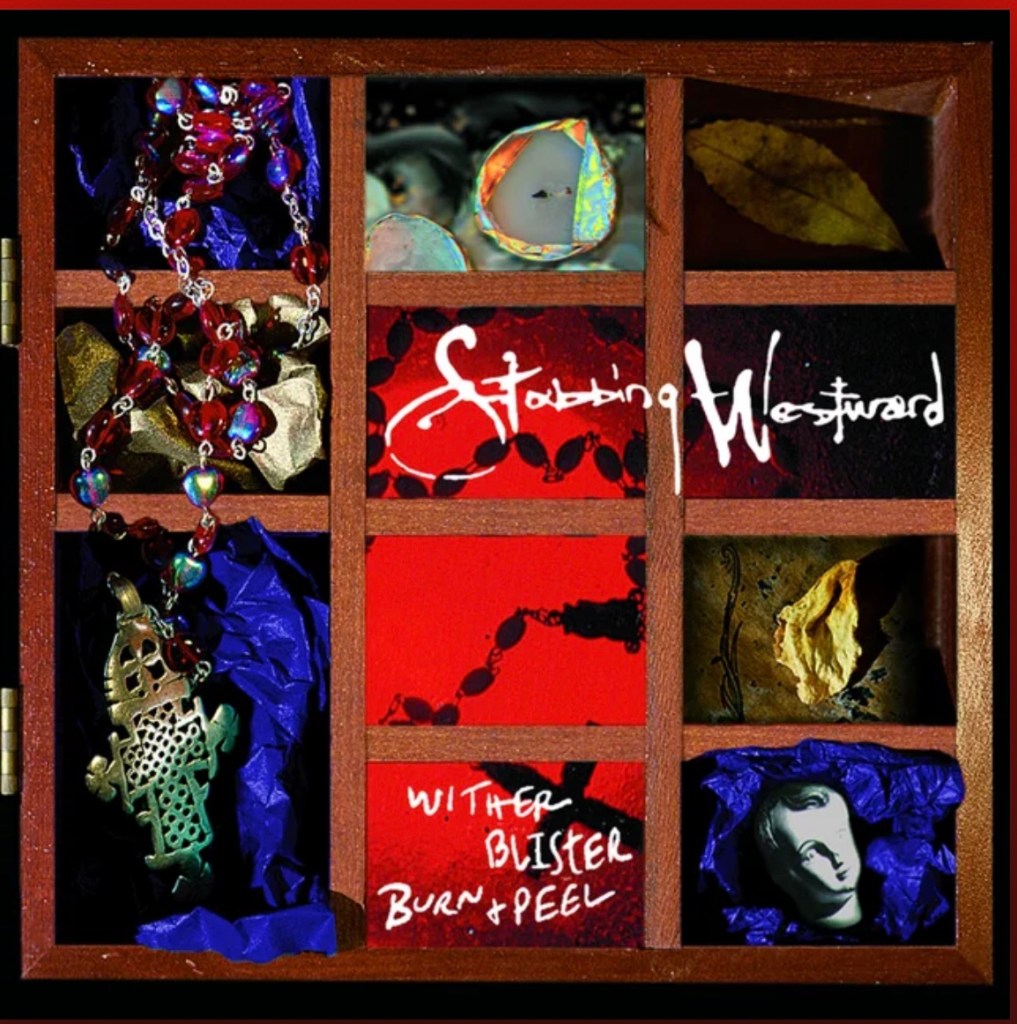
It was their 2001 self-titled album that made me a fan and I went backwards. “Darkest Days” was consumed next and then “Whither Blister Burn & Peel”.
Before writing started for this album, main songwriter and guitarist Stuart Zechman departed the band after the “Ungod” tour due to “personal differences”.
So the band for this album is Christopher Hall on lead vocals, guitar and drum machine programming. Jim Sellers is on bass and guitar. Walter Flakus is on keyboards and programming. Andy Kubiszewski is on drums, guitar and keyboards.
Kubiszewski was actually new as well, and when it came to song writing for this album, he played the band dozens of demos he did. Songs like “What Do I Have to Do?”, “Haunting Me,” “Sometimes It Hurts,” “Crushing Me,” “Slipping Away,” “Desperate Now,” and “Goodbye.” These song would appear on this album and the “Darkest Days” albums.
The band thought about finding another guitarist however they went into the studio without any guitar player and decided to play the guitar parts themselves with Sellers and Kubiszewski taking on most of the guitar duties.
I Don’t Believe
Any song that starts off with the words “I’m such an asshole” and “I just keep fucking up” means business. While rooted in the Industrial sounds of NIN, it has a certain arena rock vibe when the Chorus kicks in which the hook “I don’t believe I could be so stupid and naïve”.
Shame
The big song from the album. The intro riff is infectious, instantly making me pick up the guitar to learn it.
What Do I Have to Do?
The electronic keys riff with the sound effects is unusual and I like it. My favourite song, which shows a real rock vocal.
Press play to hear how the second verse riff crashes in. Brilliant.
And the hook, is so desperate with the words, “what do I have to do if you don’t want me”
Why
The main music is sound effects, electronics and the keys providing a riff. It all feels so desolate and haunting. But I like it.
Why can’t you see that everything is broken?
These kind of artists got blasted by rock audiences at the grim nature of their lyrics, but as a fan of metal bands and thrash metal in particular, these kind of lyrics are nothing new. All of our heroes have fears and doubts.
Inside You
It’s like soundtrack music with a vocal melody over it.
Falls Apart
The album does fall apart with this song. It has a Ministry like riff which starts off the song full of energy, however the verses really let it down.
So Wrong
This could be on a metal album or a rock album and it wouldn’t be out of place because of the main riff.
Actually Fates Warning have a similar song on their “Disconnect” album from 2000.
Crushing Me
It’s like a long lost song from Kurt Cobain. Press play and check out the intro riff. But there are a lot of sections with sound effects, electronics and keys which just take away the good from the intro riff.
Sleep
There is a cool riff in this song, but you would need to listen through a lot of soundscapes and electronics. But when it comes it around the 2.10 mark, it’s worth the wait.
Slipping Away
This one just slipped away from me as the title states, with too much electronica.
The album was a success and supported by the singles “Shame” and “What Do I Have to Do?” they got themselves a Gold certification in the U.S and some heavy MTV rotation. The band also recruited Mark Eliopulos to handle the live element of the main guitar parts.
This is how it was for me between 1995 to about 2005. I would buy an album from a hard rock band I knew and I would be buying albums from so many different artists that looked like they had distorted guitars and played something that could be influenced by metal and rock bands.
Listen to an AC/DC album and write songs that have the vibe from that album. It’s been “Airbourne’s” template for the first four albums, so why change it for album number five.
But on the album, I would like to add a few other Australian bands like Rose Tattoo, Screaming Jets and The Angels to that list of influences.
“Boneshaker” was released on 25 October 2019, produced by Dave Cobb which was a surprise choice, considering his big production credits involve Chris Stapleton and “The Star Is Born” soundtrack. But the band wanted to work with Cobb based on an album he did for a small obscure band called “Black Robot”. Check out their 2009 album to hear a pretty cool slab of AC/DC, Aerosmith, Bad Company and Lynyrd Skynyrd.
Airbourne is still underpinned by brothers Joel O’Keefe on Vocals/Lead Guitar and Ryan O’Keefe on drums. Justin Street is on bass and new dude Matthew Harrison is on guitar.
Boneshaker
This track wouldn’t be out of place on an early Y&T album. Maybe because they have the lyric, “Earthshaker” after “Boneshaker”.
Burnout the Nitro
It has a country twang to it, but played through a distorted amp, in sounds rock and roll.
“Racing down the highway” instantly brings back memories of “Long Way To The Top”. And that’s basically the vibe of the song, a cross between “Long Way”, “Shoot To Thrill”, “Let There Be Rock” and “Whole Lotta Rosie”. If you are going to be influenced by AC/DC, you might as well be influenced by some of their biggest songs.
This Is Our City
“This is our city, lets rock and roll”. And the live show is summed up in a simple line.
Sex To Go
Great title and perfect for the fast paced social media lives we live in. At 2 minutes and 34 seconds, it’s probably just enough time to have fast food take away sex. And how can you not go past a lyric like “all I want is your apple pie”.
In the words of Sammy Hagar in “Good Enough”, I’ll have some of that.
Backseat Boogie
“Long Way To The Top” makes another comeback. And I like it
Blood In The Water
A groovy “Whole Lotta Rosie”.
She Gives Me Hell
Being on the wrong side of a toxic relationship sets up the lyrical foundation over a musical influence from “Highway To Hell”.
Switchblade Angel
The speed rock and roll is back and I like it.
Weapon Of War
The slow blues grit and groove is back for a song about war vets.
Rock ‘n’ Roll For Life
The fast “Let There Be Rock” vibe is back.
Rock and Roll along with all things Metal is a life style. Once you are in. you are always in. You might dabble in other genres but you’ll always come back. Because Rock N Roll is for life.
After 30 minutes and 36 seconds the album is over like fast food. Music on the go. Concise and straight to the point, there is no confusion as to what Airbourne is. A highly efficient and lean rock and roll band.
Accept in the 90’s didn’t exist for me. It wasn’t until 2008/09 that I started to re-listen to Accept and check out their 90’s output.
But the big problem with anything to do with the 90’s was confusion. The 90’s just kept striking out 80’s bands because they felt lost and didn’t know how to fit in. Gone was the label support and the people left around just didn’t know what to do.
If you don’t believe me, press play on Dio’s “Angry Machines” or Dokken’s “Shadowlife” or “Generation Swine” by Motley Crue. Confused. Yep, so was Ronnie and Don and Nikki/Tommy.
And as a fan of hard rock and heavy metal music, I was even more confused why these popular 80s bands couldn’t keep on releasing great albums in the 90’s.
On this album, Accept is mainly staying true to their roots. They have incorporated some 90’s groove and sounds and a little bit of 70’s Scorpions, however their sound is still AC/DC meets Judas Priest.
I read some of the reviews of this album recently and man, people don’t like it. I can hear why people would hate this album as there are musical elements on this album that can be classed as “what the” moments. But this album shows a band trying to survive in a hostile musical climate towards them. And it didn’t matter to me what new musical element they brought in, as it still sounds like Accept and it still sounds like Metal.
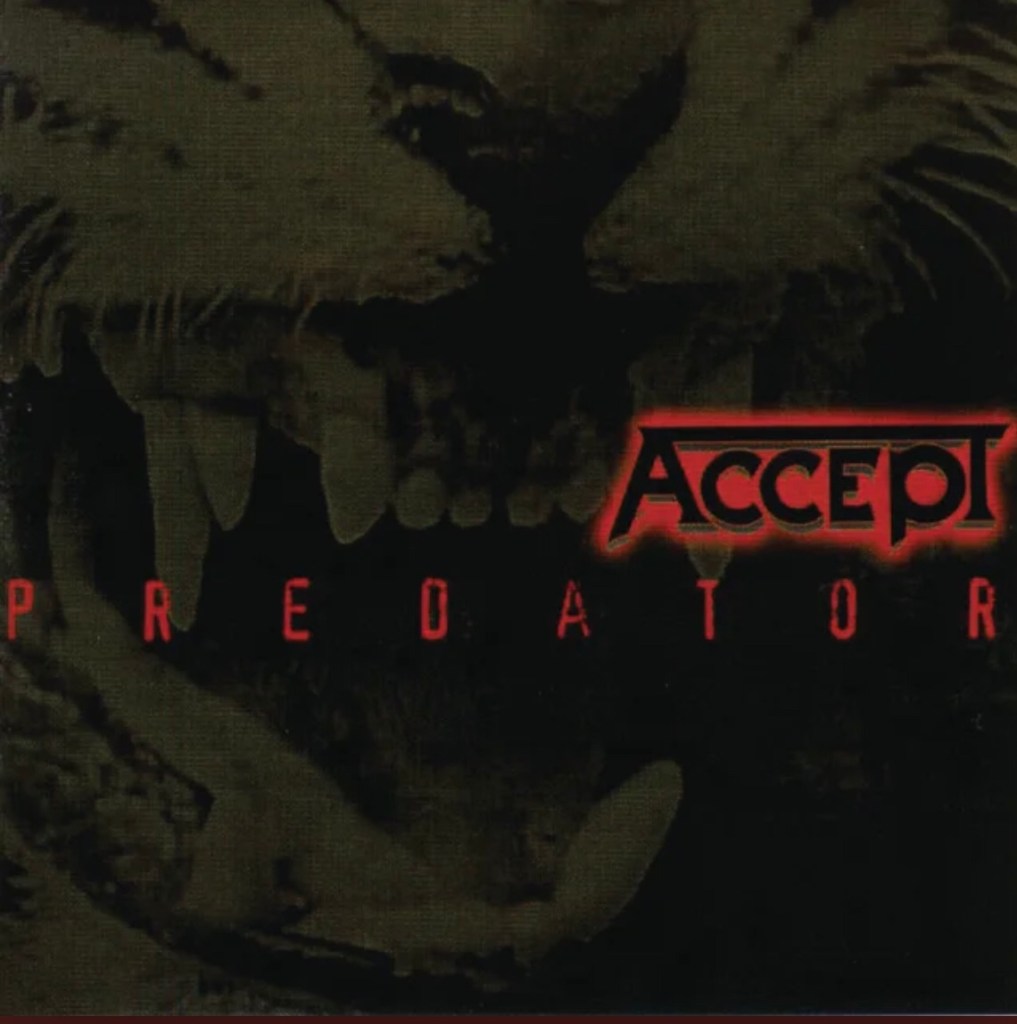
So “Predator” is studio album 11, released in 1996. It was produced by Michael Wagener and it is their last recording with singer Udo Dirkschneider.
Joining Udo here is the great Wolf Hoffmann on guitars, Peter Baltes on bass and drums are played by Michael Cartellone, fresh from his Damn Yankees gig.
Hard Attack
This is Accept doing AC/DC and I like it. A lot.
Crossroads
A head banging riff like “Balls To The Wall” underpins this song.
Baltes and Udo do lead vocals on this and the vocals of Baltes just don’t work for me here.
There is also this country like open sting lick played between the Chorus and Verse which I like.
Making Me Scream
This song has a 90’s alternative metal groove as the rhythm, however the exotic lead over it makes it classic Accept.
You could almost say it’s like the embryo of “Black Label Society”. The heaviness also reminds me of the self-titled Motley Crue album.
Diggin’ in the Dirt
Remember that song “Three Little Pigs”, well it reminds me of that. It has a similar vibe.
Lay It Down
The music on this song is excellent.
Baltes does the lead vocals here and he does a great job.
The Chorus is a rocker and anthemic.
There is no way that Zakk Wylde can say he never heard this song, because it so Black Label Society and that band was a few years away, however Zakk had created his embryonic incarnation with “Pride And Glory”.
If this song doesn’t make you bang your head, check for a pulse.
It Ain’t Over Yet
Baltes does the lead vocals again on this sleazy rocker.
Predator
I’m not a fan of this song at all.
Crucified
Its speed metal, old school and I love it. Just press play to hear the wah riff between 1.08 and 1.12. It’s only four seconds but its excellent.
And the lead break is classic Hoffmann. Press play on that as well.
Take Out the Crime
The love for AC/DC is back here.
Don’t Give a Damn
And you get to hear AC/DC again. And I like it.
Run Through the Night
The intro riff reminds me of “Aint Talking Bout Love” from Van Halen. Press play to hear how a derivative riff is created.
Primitive
The drums sound like they belong on a Gloria Estefan or Janet Jackson album. The song “Black Cat” comes to mind. Baltes does the lead vocals here, but the song is a skip for me. A terrible way to end the album.
“Predator” was the last Accept album for 14-years. Udo would never return.
But I feel they are bigger now than they’ve ever been. “Blood Of The Nations” came first in 2010 and each release afterwards has built on their return.
Mark Tornillo on vocals is excellent and a perfect song writing partner for Wolf Hoffmann. That’s not to say that others didn’t contribute. Bassist Peter Baltes was also a song writing partner while he was in the band and new bassist Martin Motnik contributes along with long time lyricist Deaffy, otherwise known as Gaby Hoffmann.
While hated, do yourself a favour and check out songs like “Hard Attack”, “Crossroads”, “Lay it Down” and “Crucified”. From there you can make up your own mind.
This would start a trend with Dream Theater that after each studio album, a live album would follow from the tour. Kevin Shirley was on hand to produce and record it. But Shirley was stressed as he only had two days to mix and fix it. In the book “Lifting Shadows” by Rich Wilson, Shirley mentioned that on this live album there were a lot of fixes.
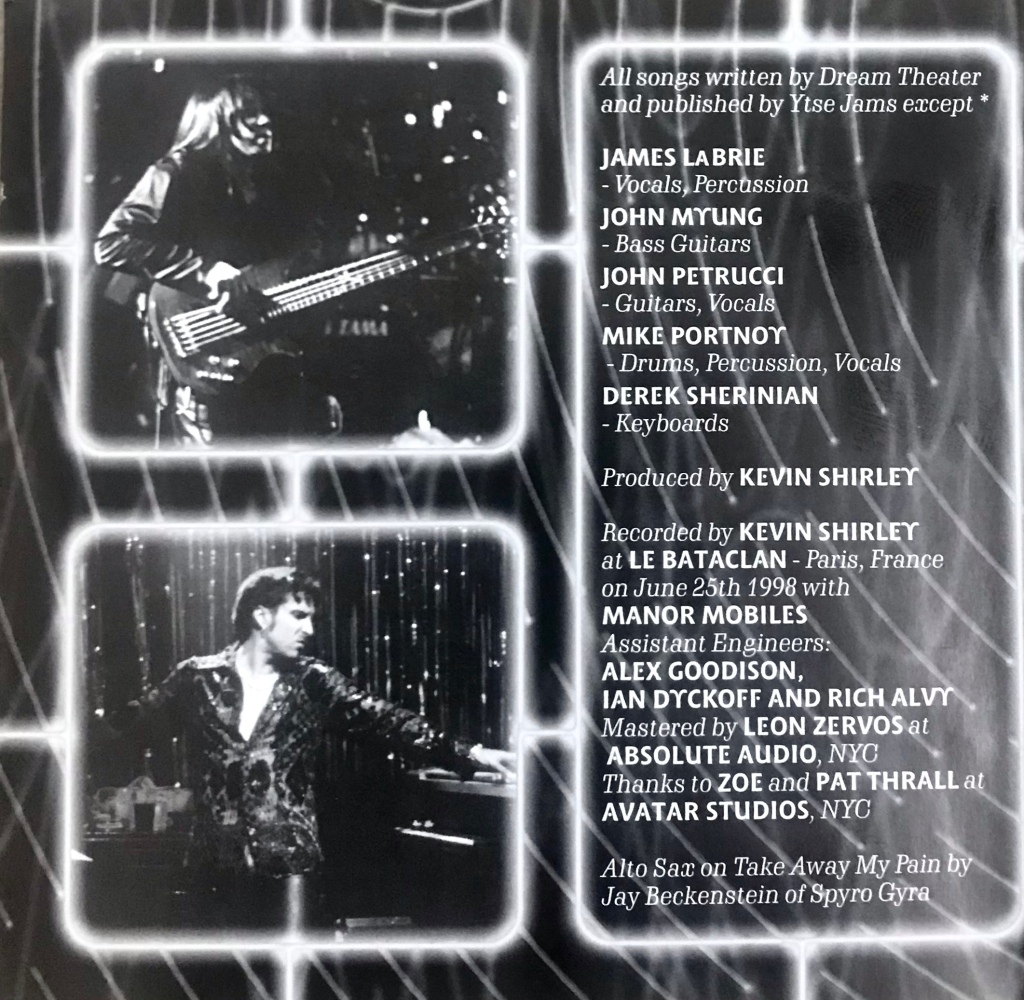
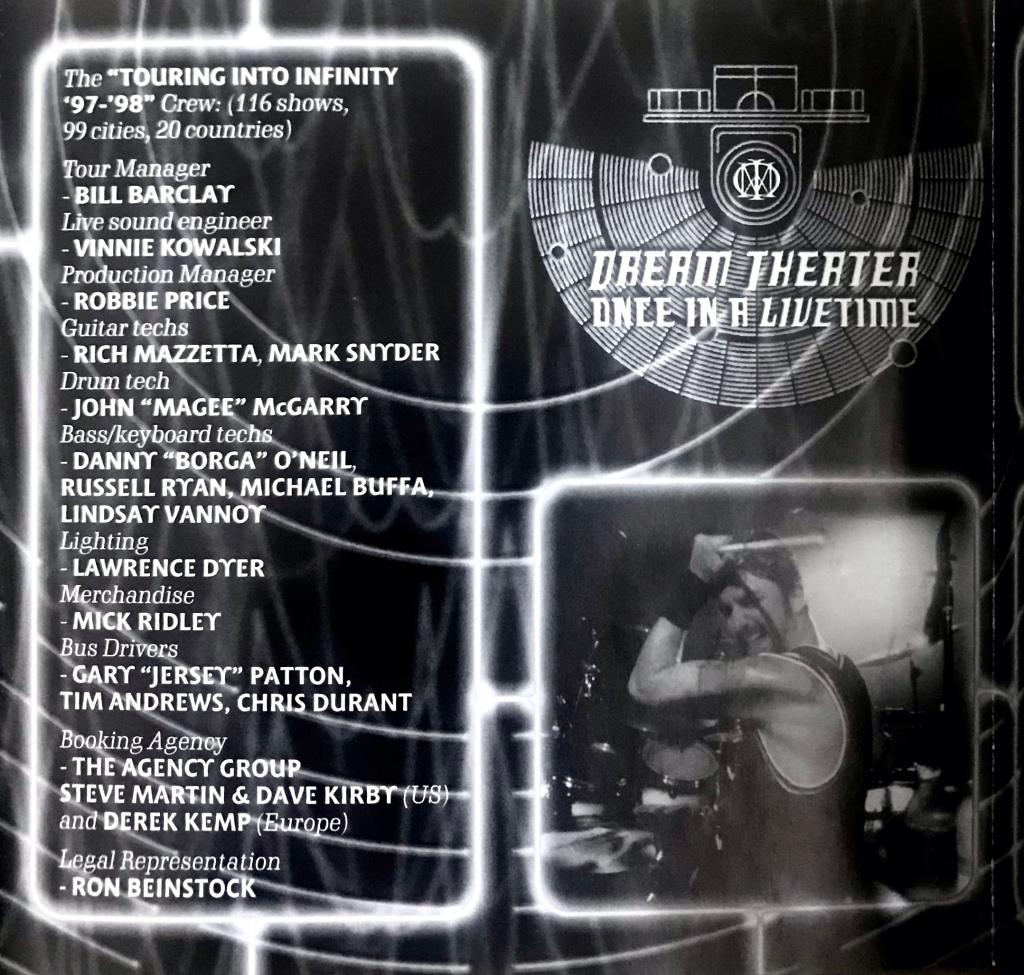
The show was recorded at the Bataclan Theater in Paris however the tour began September 1997 in Brazil. And before it even started, they had to get new management. Remember the manager who won the battle to remain manager, well he left. He wasn’t feeling it anymore. The management team that came in proved so much worse. The band was lost and needed direction. These new guys didn’t provide it, but they had no problem spending money. And when the band fired them the managers sued em.
Furthermore, Petrucci and Portnoy were at loggerheads. Portnoy still had a chip on his shoulder over Petrucci choosing to go with Shirley’s ideas and the disagreements they had over which manager would get the gig. During the tour, Portnoy even fired Petrucci’s guitar tech, which didn’t go down well with Petrucci.
Portnoy also announced to the band that he is quitting once the tour is finished. So in retrospect this live album could have been the last official release.
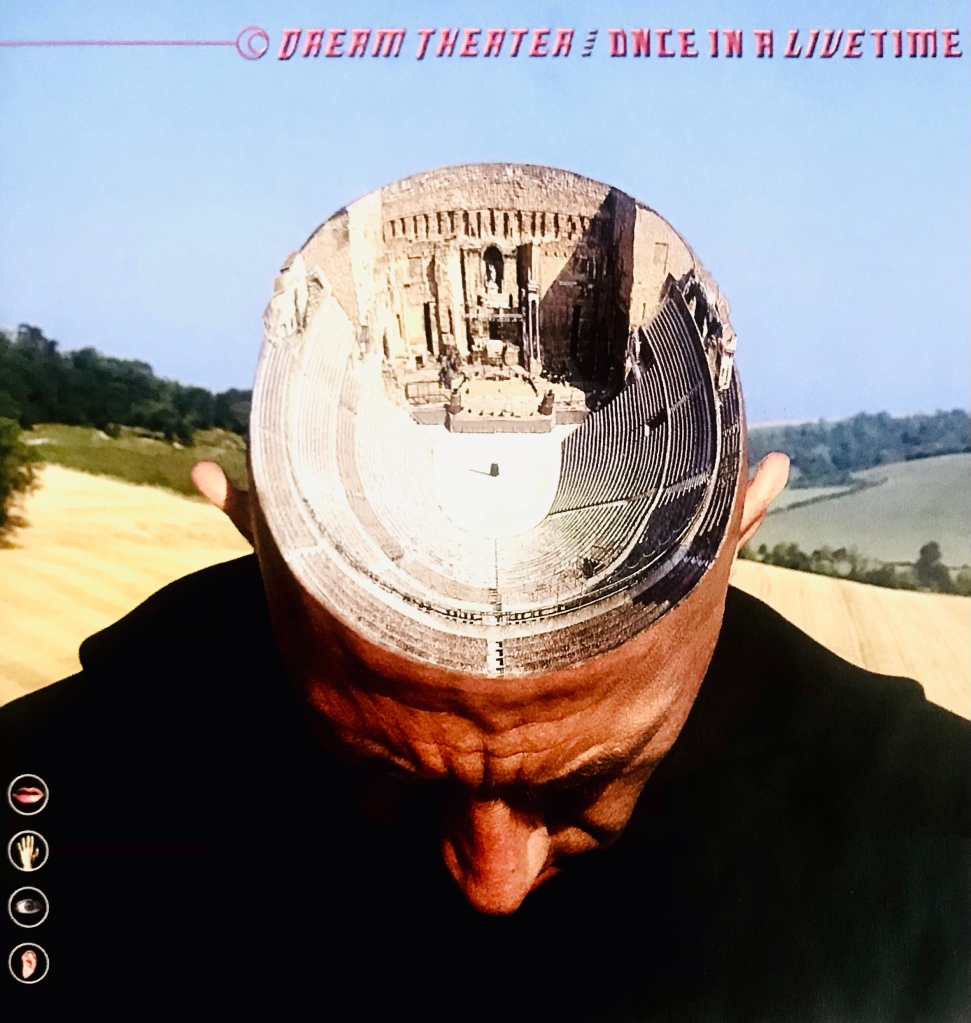
The album cover, one of two designed by Storm Thorgerson for the band, shows an overhead view of the ancient Roman theatre in Orange, France set into a head of a monk. Like “Falling into Infinity” it does not feature the band’s word mark due to Storm’s demand who sees logos as ugly.
This would also be the last album to feature Derek Sherinian on keyboards as his short tenure in the band would come to an end.
A Change of Seasons I: The Crimson Sunrise
So from a concert perspective, they split “A Change Of Seasons” into its separate parts and scattered them throughout the concert.
The acoustic intro gets the crowd singing along, ala Maiden like. Trust the Europeans (and the South Americans) to give a concert a football (soccer) like atmosphere. As soon as the band kicks in, its heavy and precise.
A Change of Seasons II: Innocence
They move into part 2 effortlessly. LaBrie is strained but does a great job. He’s a professional. Sometimes singers have 10 from 10 performances and some days they have 7 from 10. It’s still a good performance.
Puppies on Acid
Is basically “The Mirror” and a bit of “Lie” from the “Awake” album combined to serve as a segue into “Just Let Me Breathe”. Strange choice.
Just Let Me Breathe
From the “Falling To Infinity” album.
The song is great musically. I’m not a super fan of the vocal melodies, but I do like how they had the balls to try melodies like that.
Voices
One of my favourite tracks from the “Awake” album.
Press play to hear the intro, the way the Chorus crashes in musically and the excellent Petrucci solo. If anything, Petrucci’s playing live is even better than the studio recordings. He’s so precise, yet he still creates room for some improvisation. And that my friends is the meaning of a great musician.
LaBrie unfortunately is difficult to listen to, especially the high notes.
Take The Time
The first track from their biggest album so far, “Images and Words”.
Check out the funky first verses. You will feel like you are in the 70’s. It’s the beauty of the band, to be so diverse musically.
The ending contains the solo from Lynyrd Skynyrd’s “Freebird” and the main riff from Led Zeppelin’s “Moby Dick”. This is the kind of improvisation I like.
Derek Sherinian Piano Solo
I hate individual solo spotlights without any backing music to it.
For the purists, the brief solo does contain portions of “Platt Opus” which would be released on the debut Platypus album, (a progressive rock supergroup to which Sherinian and John Myung were members of, and they released their first album a year after this album).
However Sherinian tries to make his solo spotlight tie in with “Lines In The Sand”.
Lines In The Sand
From the “Falling into Infinity” album.
This song works live and LaBrie doesn’t need to strain his voice here as this song is more in the lower registers.
Petrucci again delivers a killer a guitar solo. All the emotion he committed to tape is here, live. The bends, the vibrato and the fast legato lines. Even Labrie at the end, mentioned, “John Petrucci on guitar people”.
The solo segues into my favourite part of the song. A groove is established and LaBrie is in his Pete Gabriel element here. Petrucci decorates like Alex Lifeson on the guitar. Then at 9.36, Petrucci starts to build it up, taking parts of the intro, and adding a lot of grease and blues. Then his Lifeson decorating with power chords and ringing open strings is back. Portnoy gets busier and the band cranks into the main riff of the song.
Scarred
From the “Awake” album.
Ballsy move to play another epic track straight after an epic track, but then again, Dream Theater didn’t get to this stage, playing by the rules.
A Change of Seasons IV: The Darkest of Winters
And this is a perfect example of not playing by the rules. When they go into the instrumental section of “A Change Of Seasons”
Ytse Jam
And after 3 minutes of “The Darkest Of Winters”, they go into their instrumental masterpiece from “When Dream and Day Unite”, the “Majesty” spelt backwards “Ytse Jam”. And as soon as the intro riff kicks in, the crowd is chanting along with them.
This kind of set list is preaching to the converted.
Mike Portnoy Drum Solo
A 5 minute drum solo and the last 2 minutes is the ending of “Ytse Jam”.
But it’s a next for me.
Trial of Tears
From the “Falling into Infinity” album. The first two minutes has Petrucci playing “Close Encounters Of The Third Kind”, with Portnoy channelling Neal Peart from Rush.
Hollow Years
From the “Falling Into Infinity” album.
The “Live At Budokan” version is the definitive version for me. The flamenco Al DiMeola like noodling at the start which is present on the “Budokan” version is here as well, just a bit more embryonic. And the solo sticks to script here, it doesn’t have the long shred solo from “Budokan”.
LaBrie doesn’t need to strain much here, and vocally he’s bringing it.
Take Away My Pain
From the “Falling into Infinity” album. I didn’t think it would end up in a set list as it’s not one of the stronger songs from the album.
Caught in a Web
From the “Awake” album. The tempo is sped up just a little bit and it works perfectly. You can feel the energy hit you from the speakers.
Lie
From the “Awake” album. Like “Caught In A Web” before it, the tempo is sped up a little bit and its perfect for the song. It sounds more energetic and powerful.
Peruvian Skies
From the “Falling into Infinity” album and the band definitely shows which songs influenced the song as they go into portions of “Have a Cigar” from Pink Floyd and “Enter Sandman” from Metallica. Press play to hear it.
John Petrucci Guitar Solo
An 8 minute guitar solo which contains a portion of a song that would become “Paradigm Shift” from a side project called “Liquid Tension Experiment”, which Portnoy and Petrucci would form after this period with future Dream Theater keyboardist Jordan Rudess and bassist Tony Levin.
The ending of the album begins with “Pull Me Under”, “Metropolis” and “Learning To Live”. My three favourite songs from “Images And Words”. And they finish it off how they started, with the final chapter of “A Change Of Seasons”.
For a live album, it is the least favourite live album in the “Dream Theater” catalogue. I don’t go back to it much, however as the title states, it’s a capture of a time, a period. So enjoy it for what it is, a band on the verge of breaking up but keeping it all together for their love of music.
And a DVD release came out as well. But that review is for another day.
Every label head said Schenker was finished, washed up.
It’s 1991 and a supergroup called Contraband drop their debut album. And it keeps on dropping because it is so bad. The nice advance payment that Schenker got to be involved in the project didn’t do much to enhance or move forward his career. In fact his manager and ex-partner took most of it.
But he stays alive, because he’s a lifer. When you have been in the game for this long, the only thing you know how to do is play. And play he did. He jumped on board the unplugged bandwagon and released an album. He called up Robin McAuley and released another McAuley Schenker studio album.
Then he re-unites with Phil Mogg and they start writing. The songs got the labels interested and the “Walk On Water” album from UFO, released in 1995 surprised everyone. Suddenly Schenker was back on the agenda and he’s getting money thrown at him again. He had a lot of bad people in his life at this point in time, from managers and partners, so it was always going to happen that MSG would return.
I didn’t think it would be that quick. Because a year after “Walk On Water”, “Written In The Sand” is released, the eighth full-length studio album that falls under the MSG brand.
The only thing consistent with all of these MSG albums is the name and Michael Schenker himself. The other members are in a constant flux. For this album, Schenker is joined by Leif Sundin on vocals, Shane Gaalaas on drums, and Barry Sparks on bass. All the music is by Michael Schenker and all lyrics by Leif Sundin.
Ron Nevison is doing all the Producing, Engineering and Mixing.
It’s not on Spotify which irks me, but YouTube has it.
Brave New World
It’s got groove, swing and lot of rock and roll. And the first thing that grabs my attention are the vocals from Leif Sundin. His voice is very melodic, fluid and unique. I would say he’s up there as one of the best singers in MSG.
The lead breaks are impressive, with Schenker even soloing over a harmony solo which acts as a rhythm guitar.
Cry No More
Press play to hear the intro. Its heavy and a lot of acts who went alternative to survive weren’t doing riffs like this during this period. The song could have been on a Deep Purple album and it wouldn’t be out pf place.
I Believe
It’s a ballad that turns into a rocker. It’s not original, yet it is an easy listen.
Back to Life
No one was writing riffs like this in 1996. Its old school and I like it. Barry Sparks is massive on the bass here as well.
Written in the Sand
This track is essential MSG. It has a sleazy bluesy riff and a lot of melody. And Schenker delivers a tasty guitar-solo in the middle and for the outro.
Essenz
It wouldn’t be an MSG album without an instrumental. This one has an “Eruption” vibe before moving into a fast blues. Think of “Hot For Teacher” when it picks up.
Love Never Dies
Imagine “Finish What Ya Started” merging with the melodic rock genre. Well this is the outcome. Another close favourite with a killer Schenker lead break.
I Will Be There
Press play to hear the verse riff. Schenker makes it sound technical, yet it rocks so fluidly.
Take Me Through the Night
Its classic heavy metal while the singing is happening and the solo section is barroom blues brawling.
It wouldn’t be out of place on any metal album from the early 80’s.
Down the Drain
The album closer showcases how Schenker decorates in a creative way. You cannot ignore how good it is.
While Schenker’s North American career had stalled, he was still a big draw in Japan and certain European markets. And just like that, the whole “Contraband” affair was forgotten. That is if you heard the album. Which wasn’t easy to do.
A band called Dungeon is opening for Megadeth in Sydney. I knew of the name, but never heard any of their music. The band name just didn’t do it for me. It was my mistake. I listened with my eyes instead of my ears. Well that was to change.
After the gig, Dungeon was definitely on my radar and I did purchase a few of their albums. And as soon as I got into them, they called it quits.
Sort of.
You see, Lord was originally started as a side project for Dungeon guitarist/vocalist Tim Grose, which was meant as something different from his main band sound. Lord’s first album was released in 2003 and it wasn’t so different from Dungeon. After Dungeon disbanded in 2005, Lord just became a continuation of Dungeon’s sound with new members. You could even purchase Dungeon albums at shows Lord did.
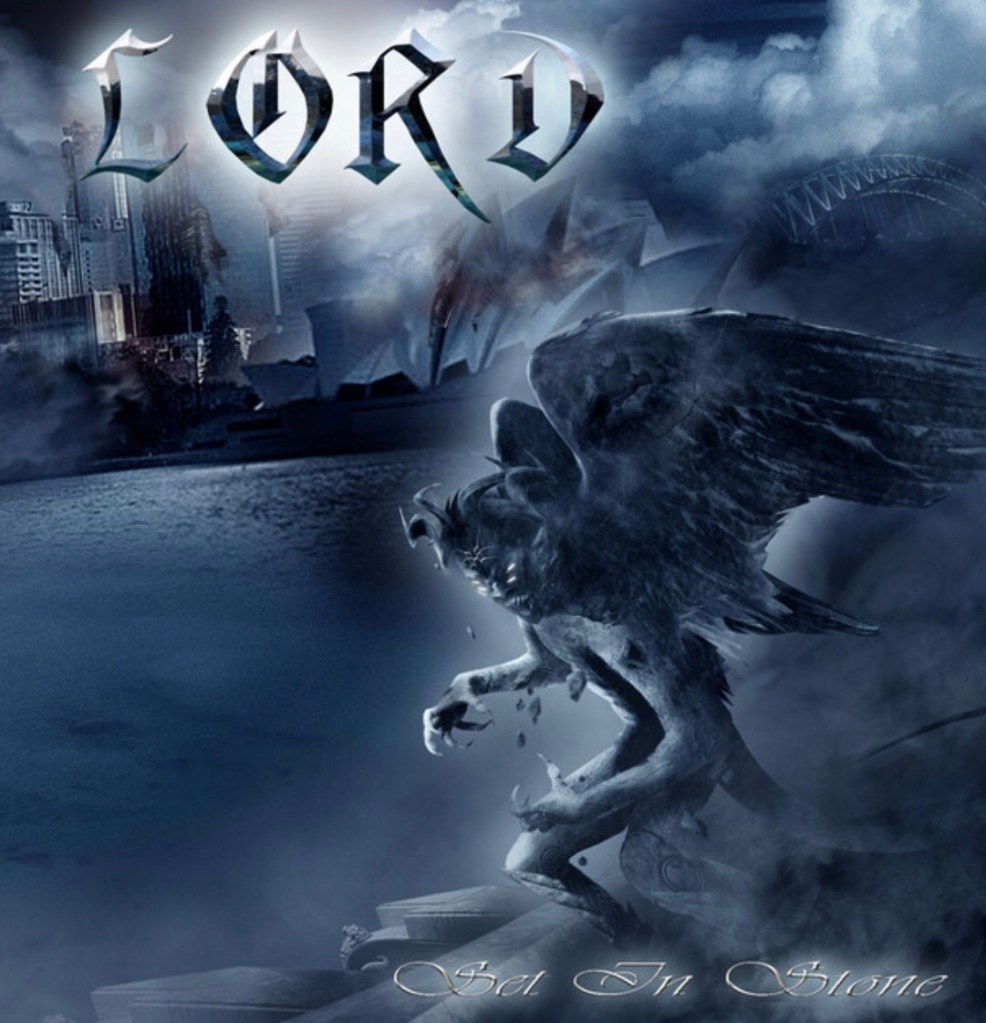
“Set in Stone” is the third album released in September 2009 by the band’s own label Dominus in conjunction with Riot! Entertainment. The album was recorded in my home town of Wollongong, Australia. A small foot note in history, is that a band I was in at the time opened up for Lord when they played Wollongong touring on this album.
The band is Tim Grose (also known as Lord Tim) on vocals and guitars, Tim Yatras on drums, Mark Furtner on guitars and Andrew Dowling on bass.
Spectres of the Ascendant
48 seconds of sound effects to introduce “Redemption”.
Redemption
Written by Tim Grose and drummer Tim Yatras, who would depart the band after the album was completed.
Its face melting speed metal.
100 Reasons
Another Grose and Yatras track.
It’s hard rock, with a major key Arena melodic rock Chorus.
Eternal Storm
Co-guitarist Mark Furtner gets a co-write with Grose and Yatras.
Fast, Malmsteen like from the “Marching Out” album. The solo is very Vinnie Moore like, running through different scalar patterns.
Set in Stone
Another track written by Grose and Yatras.
My favourite song on the album. The intro riff is a brilliant mix of Classic NWOBHM and American metal. Judas Priest and Maiden come to mind, with vocals bordering between a cross between Dickinson and Tate at their classic metal best.
There is this “wo-oh-oh” chant after the solo. I can imagine thousands of people chanting it at a gig.
Someone Else’s Dream
Written by the band.
An 80’s sounding synth and a syncopated guitar line set the foundations. At stages it feels like it’s a song from the Gothenburg metal scene, but the Chorus is huge and melodic.
Forever
It’s almost Maiden like with a lot of musical influences from the “Fear of The Dark” album.
I play air guitar to the harmony guitars.
Written by Tim Grose, Tim Yatras and Andrew Dowling.
The lyrical theme is pretty clear. Boy falls in love, gets rejected and goes all Michael Douglas “Falling Down” on the girl and the world.
The guitar playing in the lead break is brilliant.
Beyond the Light
Written by the band.
Judas Priest and UFO “Lights Out” era comes to mind, vocally and musically. It’s a great song to sing along to.
The End of Days
Written by Grose and Yatras.
It’s like a thrash metal song, with the vocals being a cross between Rob Halford and Tom Araya (in the verses).
Staying true to its title it ends with a nuclear bomb going off.
Be My Guest
Written by Tim Grose, Tim Yatras and ex Dungeon bassist Brendan McDonald.
This is like “Stars” on guitar with a lot of guest solos.
It’s an instrumental track featuring guest solos from Craig Goldy of Dio, Glen Drover from Eidolon, Olof Mörck of Dragonland, Yoshiyasu Maruyama of the Japanese thrash band Argument Soul, Angra’s Felipe Andreoli, the former Enter Twilight member Richie Hausberger, Chris Porcianko from Vanishing Point, Chris Brooks and former Dungeon members Stu Marshall and Justin Sayers.
New Horizons
Written by Grose and Yatras. It’s your typical power ballads.
Pete Lesperance from Harem Scarem plays a solo on this.
On a Night Like This
A Kylie Minogue cover as the bonus track.
The fact that the band would attempt such a cover shows the versatility of the members.
Reviews for Australian artists are difficult to do as I want to highlight influences of their sound without making them sound like copyists, and if people from other continents want to check them out, my aim is to give them a reference point as well.
If you haven’t dabbled in the power metal genre, then let Lord be your entry point.
It’s easy really.
Just press play on the melodic rock tracks first like “100 Reasons” and “Beyond The Light”.
If you like em, then press play on the classic metal track, “Set In Stone”.
If you like that, press play on the more ambitious tracks like “The End Of Days” and “Forever”.
Then you are at the fast speed metal with “Redemption” and “Eternal Storm”.
In 1996, Sammy Hagar left Van Halen. Both camps tried to set the record straight as to why things happened like they did. It made for great reading, the press had a field day and the fans just wanted new music.
Enter an old flame.
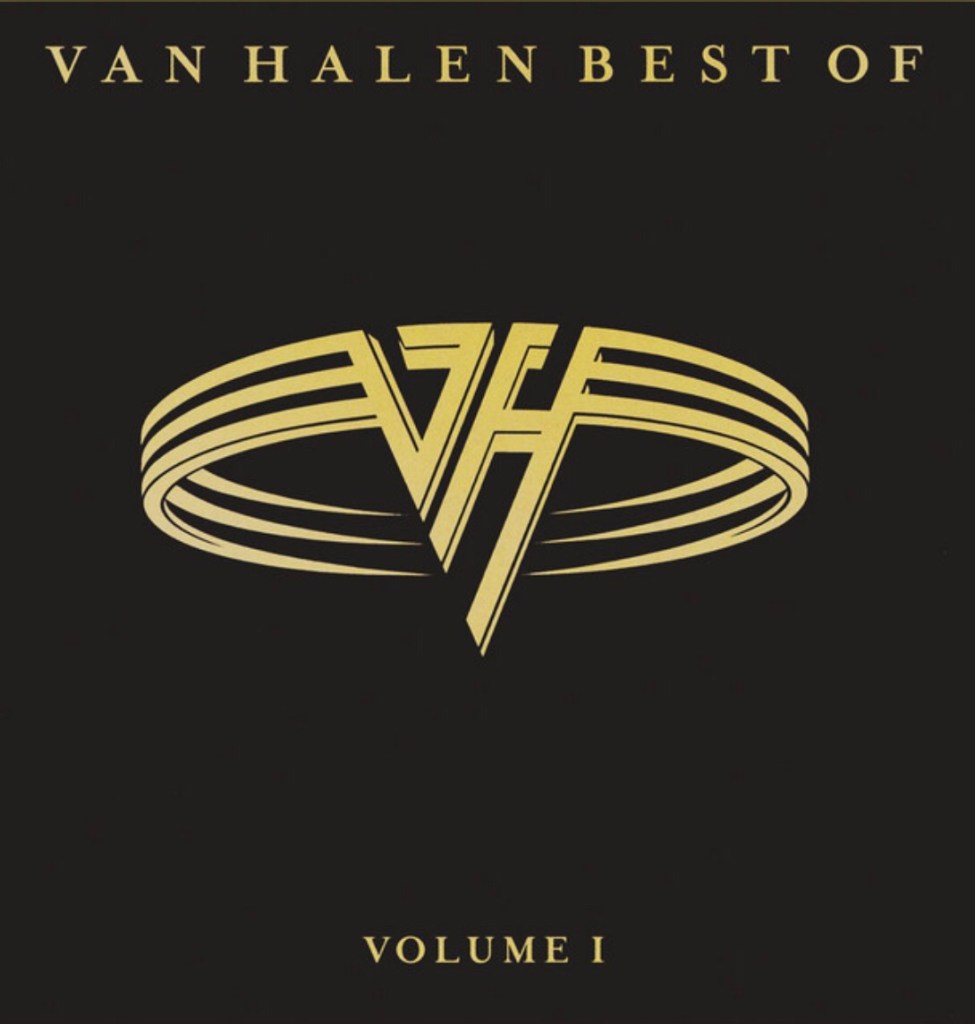
David Lee Roth re-joined briefly and recorded two songs with the band for the 1996 compilation “Best Of – Volume I”. There is a story about this saga as well, but other sites on the web cover it better. As is the norm, Roth and Eddie clashed again and Roth was out, eventually replaced by Gary Cherone from Extreme.
However we got a “Best Of” album. And it sold well. I guess the public’s appetite to hear Roth with Van Halen again was sky high. I know in Australia it got a Platinum certification and in the U.S it was 3x Platinum.
The album was released on October 22, 1996. I basically purchased it for the two newly recorded Roth songs, “Can’t Get This Stuff No More” and “Me Wise Magic” plus “Humans Being” which did appear on the Twister soundtrack, however my first hearing of the song was on this compilation.
And this review would focus on those three songs.
Can’t Get This Stuff No More
I got so used to Sammy Hagar and his melodies.
So I wasn’t totally enthused to hear Roth deliver his vocals about a “date with a super model and how he doesn’t need so much to remember”. But Roth is Roth, and it’s why I am a fan. He never conformed nor did he change his style. And the Chorus is as good as any Van Roth chorus.
Eddie was also getting a lot more progressive with his song writing and bro Alex, did a great job to put a beat and feel to it all.
Check out the lead break rhythms and EVH talk boxing his way before he breaks open the gates of shred. For progressiveness check out the outro that just came from left field as it’s a unique piece of music on its own.
Wikipedia also tells me that the music for this song was based on a track called “Backdoor Shuffle” which was originally part of the sessions for the “Balance” album.
Me Wise Magic
As soon as I heard the intro I was picking up the guitar to learn it. Not sure what came first. “Test For Echo” or this. I can Google it, but who cares, as the intro does remind me of Rush. Roth moves between spoken verse to a frantic pre chorus and a killer Chorus with Michael Anthony nailing the backing vocals.
Both of the Roth tracks were produced by Glen Ballard who had a renaissance of some sort in the mid 90’s thanks to Alanis Morissette and “Jagged Little Pill”.
The way the song started is how it ends.
An example of what I meant with EVH being progressive in his writing. You don’t hear the Intro riff again in the song, until it appears in the Outro.
EVH’s working title was “The Three Faces of Shamus,” for its three sections with “completely different vibes going on”.
Roth was also asked to work with Desmond Child on the lyrics after he discarded (or rewrote) the words that Ballard wrote. But Roth is Roth, and no one tells him what to do.
Humans Being
Produced by Bruce Fairbairn.
The intro Em riff (E to G to A) hooks me instantly. It’s almost Metallica like, but also like Alice Cooper (think “I’m Eighteen”).
My favourite part of the song is when Sammy sings “Shine On”, and of course EVH chimes in with a quick melodic lead, which quietens down and then builds up again, full of octaves, whammy bar manipulations, superhuman bends over a droning E note and legato slides. And none of it would work if it wasn’t for the time keeping of AVH.
And there is a story around this song’s creation, but Wikipedia covers it pretty good.









 destroyerofharmony