A to Z of Making It, Classic Songs to Be Discovered, Influenced, Music, My Stories

The Record Vault: Dream Theater – Awake

Produced and Engineered by Duane Baron and John Purdell who were still riding the wave of success from the “No More Tears” album by Ozzy Osbourne. Dave Prater who produced “Images And Words” was not considered due to the difficult working relationship between the band and producer.

“Awake” is the third studio album but the first album for the band, written knowing that there was an audience for their music. Artists would like us to believe that they write music to please themselves but they are lying. Once an artist experiences public acceptance of their music, their minds want to experience more of it. That in itself leads to a different kind of pressure. And the guys in the band were still young, so they didn’t know how to deal with this pressure and the pressure from the label.

Released on October 4, 1994, the album came out at the peak of the Seattle movement. The heaviness was evident and the label wanted it, but the label also wanted a song like “Pull Me Under” even more, a combination of that Iron Maiden meets Metallica sound. But that song never came.

But with this album, Dream Theater unknowingly went from a progressive rock band with roots in hard rock, to a progressive rock band, with roots in groove metal, paving the way for a fertile new genre known as progressive metal. But the critics were mixed on it and even the fans were split. But the years that have passed have been kind to the album, and now it is seen very differently.

The writing sessions began in February, after a small 4 week break after the “Images And Words” tour. Each song had weird working titles like “Kittens On Crack”, “Blowfish”, “Beach House Reality” and “Squid”. A lot of music was written and when this happens, a band leader would need to decide as to what is kept and what is discarded. Dream Theater had no band leader. So the creative disagreements started.

Once the demos were completed, the tracks were given to their A&R Rep, Derek Oliver to listen to. While the songs were good, Oliver didn’t see a marketability to them, however he still gave the go ahead to record the album, as his boss Sylvia Rhone wanted the album done so she could show orders for the album.

It’s also the last album to feature original keyboardist Kevin Moore, who announced his decision to leave the band during the mixing process of the album.

Larry Freemantle, who had designed the cover of “Images and Words”, provided the artwork for “Awake”. As with “Images and Words”, the band instructed Freemantle to include several lyrical references in the cover, such as a clock showing the time 6:00, a mirror and a spider in the middle of a web.

“It’s 6 o clock on a Christmas morning”.

I’m not sure what I expected from Dream Theater for the follow up to “Images And Words”. But voiceovers saying it’s six o’clock on a Christmas morning was probably not it.

6.00

A Mike Portnoy drum groove kicks it off, rooted more in freeform jazz fusion.

And there is a Rush like groove that reminds me of “Natural Science”.

The lyrics are written by Kevin Moore about routine, duty and commitments in a person’s life, like cutting wood to keep a family warm and working to put food on the table. It’s so far removed from Rat Tailed Jimmy in “Dr Feelgood” or Metallica’s evil Sandman.

Caught In A Web

The 7 string guitar with the Low B string is in action here.

Truth be told, I saw the 7 string as a fad. I never saw a reason why a guitarist would need one. If you wanted a low B, increase the gauge on your strings and tune the E string down to B.

While someone like Iommi tuned down to C# out of necessity to make the strings easier to bend due to cutting off the tips of his fingers in a work accident, I still didn’t get why artists needed to go lower.

Because it sounds muddled when you play fast riffs, but press play to hear the killer lead.

Would you expect anything else from Petrucci?

Innocence Faded

Petrucci wrote the lyrics of “Innocence Faded” with Wikipedia telling me “it was inspired by his deteriorating friendship with Moore”.

When Dream Theater do major melodic rock, they do it well.

Press play to hear the outro.

Petrucci comes in with an outro riff with triads over an E pedal point. And if that wasn’t good enough, he starts to solo over it in a Steve Morse and Paul Gilbert manner.

Next up we have the “A Mind Beside Itself” Trilogy featuring the three separate songs, “Erotomania”, “Voices”, and “The Silent Man”.
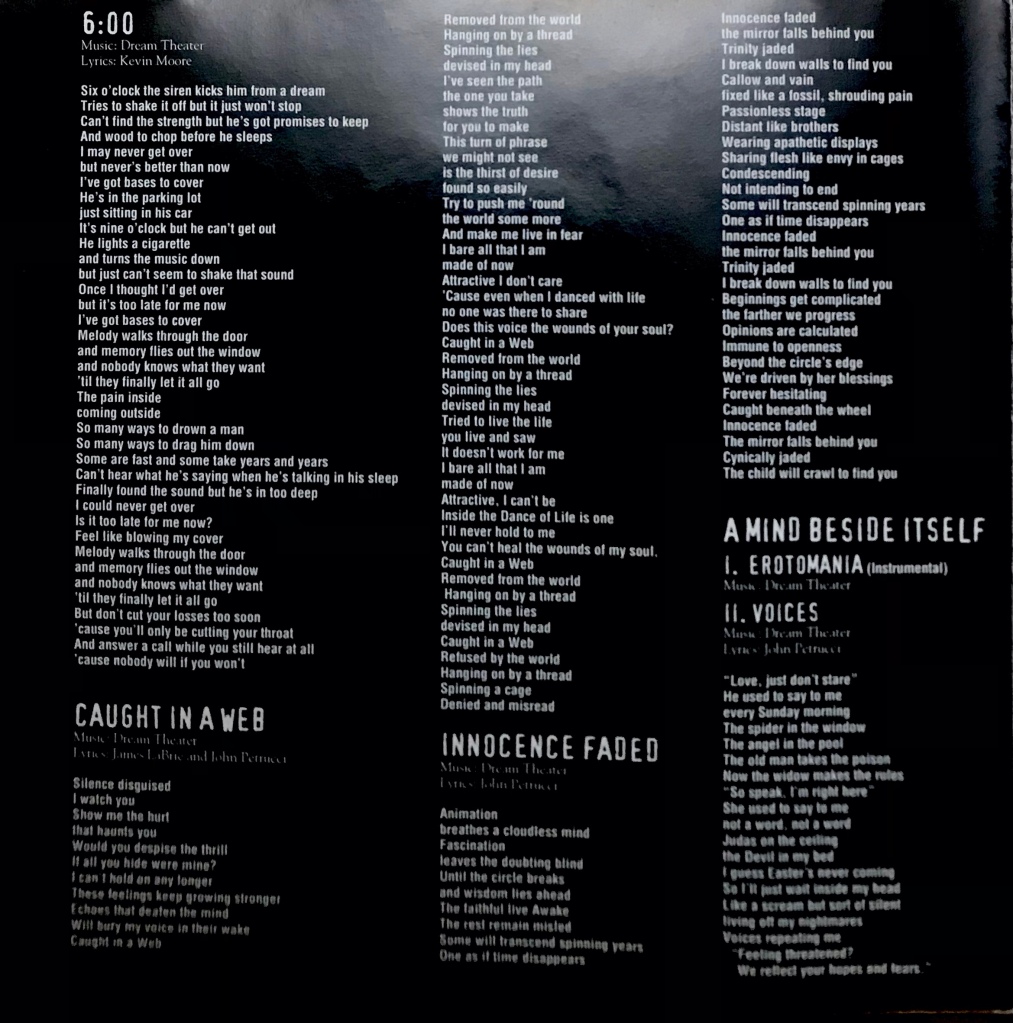
Erotomania

An instrumental.

A large section of this song was written for the song “Pull Me Under” however it was removed from the song before they went into the studio to record it. And those sections which were removed ended up in this song.

Voices

The intro. Press play to hear it.

Silent Man

An acoustic song during the unplugged craze. It deserved more attention.

The Mirror

Its heavy courtesy of the 7 string and its ready to challenge all the groove metallers. Here the 7 string works because the riffs are slower.

There is a section in this song, when they play the main piano riff from “Space Dye Vest”. Brilliant.

Portnoy wrote the lyrics to “The Mirror”, describing his battle with alcoholism. He would return to the subject on later Dream Theater albums with the group’s so-called “Twelve-step Suite.”

Lie

It was the leadoff single. Not sure if this should have been the song as lyrically its poor. “The Mirror” was a better choice.

But the lead is killer.

And it ends the same way “The Mirror” started as the two songs are connected. But this time around the heavy groove sets the foundation for Petrucci to solo over.

Lifting Shadows Of A Dream

It began as a poem and two chords brought to the band by Myung. They worked on it, hated it and the next day they liked it.

This is DT being like U2 and Marillion. Myung sets the foundation with his bass riff and Petrucci brings out his Marillion and The Edge influences with digital delay melodic riffs, while Kevin Moore lays a keyboard riff which is sad but hopeful.

Scarred

The blues jazz fusion intro hooks me. For an 11 minute song there are so m at good sections.

Like the Metal verses and the solo and the outro.

Space Dye Vest

Kevin Moore is listed as the sole writer here, much to the protest of Mike Portnoy who in hindsight wanted to leave this track of it.

But it was one of my favorites because it had a soundtrack like quality to it. I could feel the sadness in the music. And James LaBrie is like Peter Gabriel in his vocal delivery.

It’s a style that I liked from em.

To tour they had to find a keyboard player.

Jens Johansson from Yngwie Malmsteen’s solo band was the first to be approached. While the label and management were keen on Johansson, the band wasn’t.

Jordan Rudess was the second and the band were blown away by him at the audition. Jordan agreed to play a small gig with them (which went terribly) and then rejected the offer to join them at that point in time. He had a gig with the Dixie Dregs, a full time job with Kurzweil and a very young family. He chose to be around his family during this period.

Enter the love child of Paul Stanley and Cher (as described by Gene Simmons), the one known as Derek Sherinian. By this point of time, Sherinian had worked with Lita Ford, Alice Cooper and Kiss.

John Petrucci and Al Pitrellil are both from Long Island and they used to teach at the same guitar store. Pitrelli put a call to Petrucci and basically said to him, “you got to hire this keyboard player”. And Sherinian was hired on a temporary basis to begin with.

In relation to the album, the label considered the album a commercial failure, which would lead to the band being pressured to write more radio-friendly songs on their next studio album. For Dream Theater, the label situation was never easy. Their Atco seven album deal was moved to East West Records, a division of Atlantic Records and then to Elektra.

This would lead to more problems. But that’s for another post.

Standard
Classic Songs to Be Discovered, Influenced, Music, My Stories

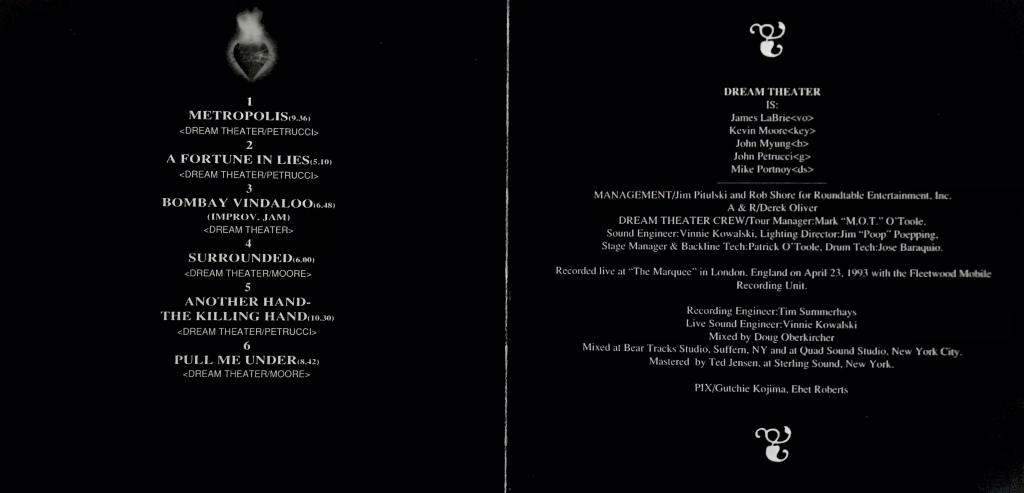
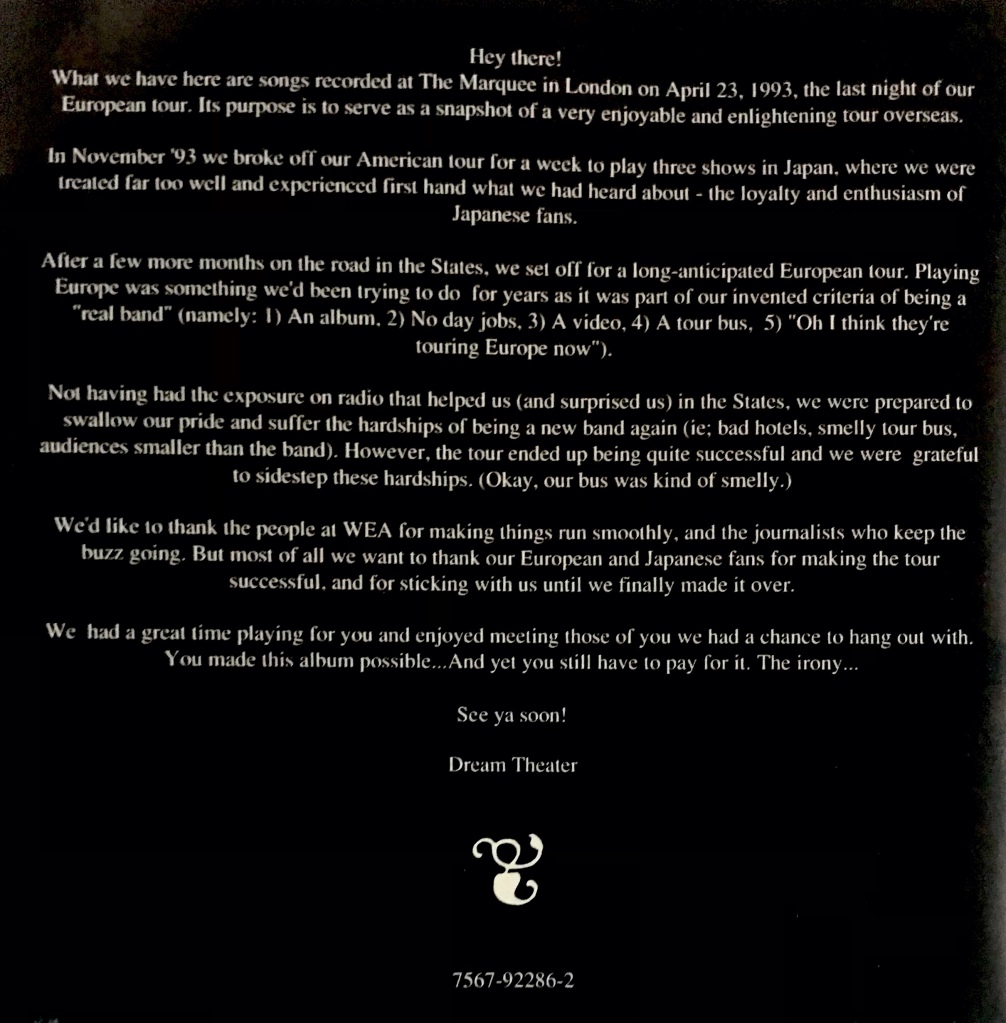
The Record Vault: Dream Theater – Live At The Marquee

The whole “Images and Words” album was a surprise success as it was released in a market that was very anti-technical. But “Pull Me Under” was not technical at all. It was actually pretty simple, with riffs that could have come from a Metallica or Maiden album.

So when an act is successful, the label is keen to capitalise on more sales. The best way to do that between studio albums is to release a live album.

Enter “Live At The Marquee”, released in 1993, on the back of the failure of the “Another Day” single. The music video for “Another Day” was totally ignored by MTV and never played on the music network.

There would also be a live video release of this period called “Live In Tokyo” from this tour. But that release would be covered a bit later.

In case people are not aware, The Marquee Club is a small venue in London. It’s a rite of passage for a lot of artists to play at The Marquee.

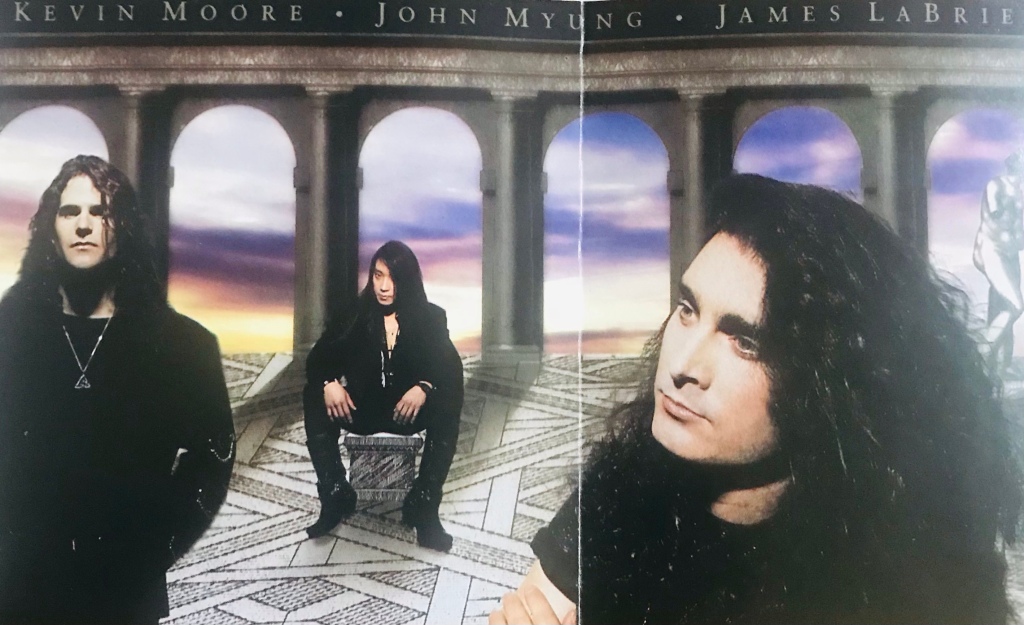
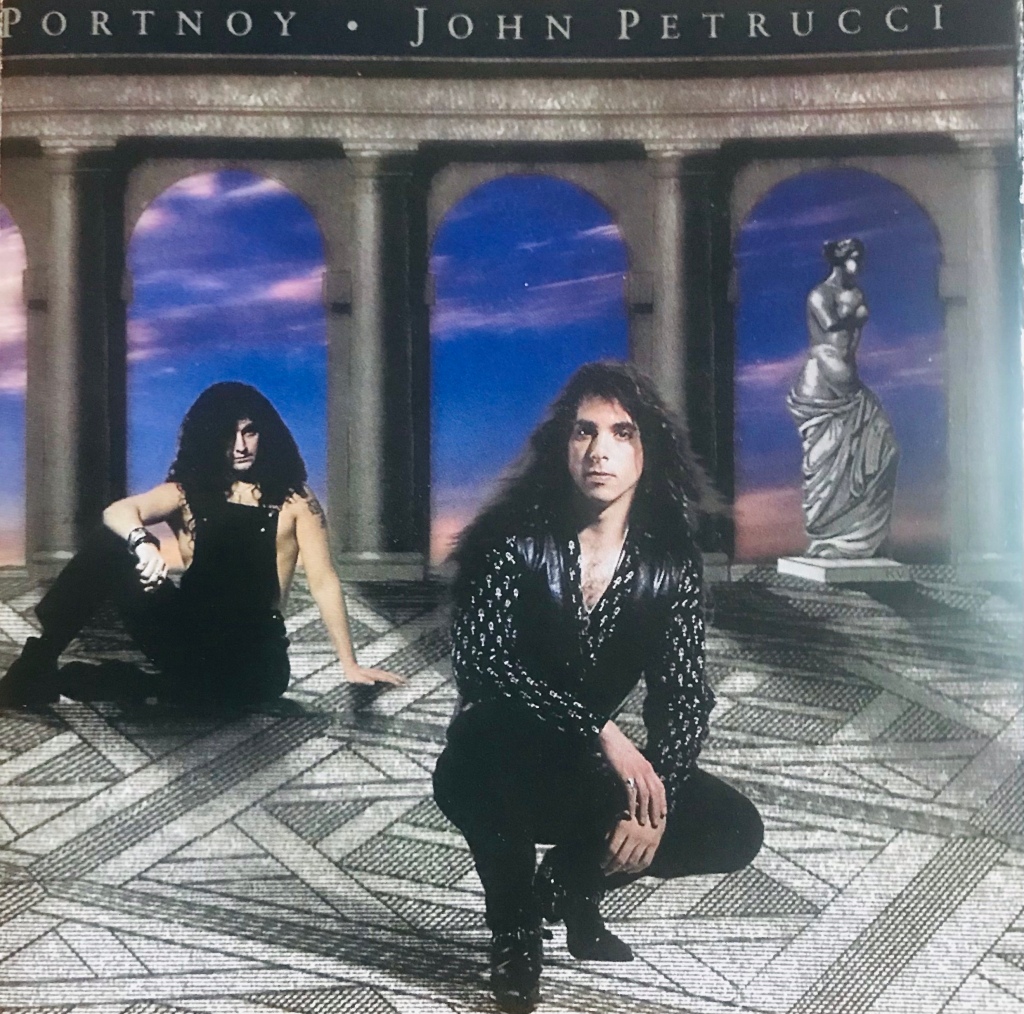
The band is the same as the “Images and Words” album with James LaBrie – vocals, Kevin Moore – keyboards, John Myung – bass, John Petrucci – guitars and Mike Portnoy – drums.

In relation to how live it is. All the music is live as captured on the night and most of James LaBrie’s vocals were actually re-recorded in a studio. In the book “Lifting Shadows”, Portnoy jokingly said the album should have been called “Dream Theater Live At The Marquee But With James LaBrie Live At Bear Tracks”.

The actual set list as found on Mike Portnoy’s concert database is as follows;

  • Metropolis Part I (released on “Live At The Marquee”)
  • A Fortune in Lies (released on “Live At The Marquee”)
  • Under a Glass Moon (not released)
  • Surrounded (released on “Live At The Marquee”)
  • Ytsejam (w/ Drum Solo) (not released)
  • Bombay Vindaloo (released on “Live At The Marquee”)
  • Another Day (only released in Japan, replacing “Surrounded”)
  • Another Hand (released on “Live At The Marquee”)
  • The Killing Hand (released on “Live At The Marquee”)
  • Pull Me Under (released on “Live At The Marquee”)
  • Take the Time (not released)
  • Wait for Sleep (not released)
  • Learning to Live (not released)

Metropolis—Part I: “The Miracle and the Sleeper”

The show opened with this and the CD release also did. The abilities of Petrucci, Portnoy, Myung and Moore are evident here.

The comments I read on a YouTube video of this song all mention the vocal performance of James LaBrie on this track. And it is a great vocal performance, regardless if it was recut in a studio.

A Fortune in Lies

I heard James LaBrie singing the debut album songs before I heard Charlie Dominici. Sort of like how I heard Bruce Dickinson sing the Paul DiAnno songs first.

The production sound of this song is a lot better live than what was captured in the studio. Especially the machine gun snare section before the solo break and then Petrucci nails his lead which has fast tapping, sweep picking, alternate picked lines and legato playing.

Bombay Vindaloo

Named after a vicious curry that played havoc with the band. It’s an improvised instrumental performed live only six times and never recorded in a studio. They really set the mood of India here with the use of exotic scales to highlight the themes of the song.

I’ve read reviews that mention “La Villa Strangiato” as an influence.

Petrucci again shines with his emotive leads as he builds and builds on em, very Al DiMeola like. It’s rare tracks like these, that make these kind of EP’s special.

Surrounded

The best part of this song is Petrucci’s digital delay lead, however the effect wasn’t as prominent live as it was on the studio cut. And for some reason it sounded very Van Halen’ish this time around.

If you are a fan of Marillion, then you will like this.

Another Hand / The Killing Hand

The newly written major key intro titled “Another Hand” that bridges “Another Day” with “The Killing Hand” is beautiful. Press play just for that.

And LaBrie delivers a great vocal on this. And yes, I don’t care if it was recut in the studio.

Pull Me Under

Could there be a Dream Theater set list without “Pull Me Under”?

Of course not. It’s their title winning MVP.

I have seen Dream Theater perform live on a few occasions in Sydney and they are excellent.

This release captures all of that.

Standard
A to Z of Making It, Classic Songs to Be Discovered, Influenced, Music, My Stories, Unsung Heroes

The Record Vault: Dream Theater – Images and Words

“When Dream And Day Unite” came out in 1989, the label Mechanix did nothing with it.

The band didn’t tour and compared to the sale numbers that other bands achieved in 1989, the album was classed a failure. But it’s pretty hard to sell something if no one knows it exists or if it can’t be found in record stores. A little bit of promo during this time would have gotten the album at least 200K sales worldwide. There was a market for the kind of music that Dream Theater was writing. But the market needs to know about it.

It also didn’t help when the A&R Rep who signed the band, left Mechanix to go to a competitor. And when that normally happens in label land, the label in spite, tries to kill off the acts the Rep had signed. Further to that, Mechanix was being taken over by a larger label in MCA and when that normally happens, labels consolidate and focus on winning projects.

Apart from the label issues, the band decided that in order to be successful, they had to change something that was not working.

Vocalist, Charlie Domicini was let go. He was a decade older than the rest of the guys and his image didn’t fit with the band. But they got their manager to break the news to him.

Even a newly inked tattoo of the Dream Theater logo on his shoulder wasn’t enough to save him. According to the band, his vocal style just didn’t suit. While Portnoy and Petrucci wanted a cross between Geoff Tate and Bruce Dickinson, they knew that finding such a vocalist was not going to be an easy task.

Dominici’s lyrics on the first album, a co-write with John Petrucci on “Status Seeker” and the sole lyricist for “Afterlife” resonated more than all of the other lyrics penned by Petrucci and Kevin Moore.

Being a bit older, meant he had a bit more experience with words and story-telling. But his voice is an acquired taste and he did cop some criticism for sounding like a bad imitation of Geddy Lee. But his vocals on “The Killing Hand” are my go to vocals for this song.

But as soon as Dominici was gone, he was back in for a gig, opening for Marillion, who wanted to unveil their new singer Steve Hogarth for his U.S debut. Portnoy was a massive fan of Marillion, so the opening slot was a dream come true. The band was on fire, but it was too little too late for Dominici who was let go again after it.

At first the band focused on trying to find a new singer as they still had six albums to deliver on the Mechanix deal. This process would take 14 months to happen. The book “Lifting Shadows” from Rich Wilson goes into great detail about the “search for a singer”.

John Arch was the first vocalist the band approached. He was out of Fates Warning after the release of “Awaken The Guardian” album in 1986. They rehearsed “The Killing Hand”, “Only A Matter Of Time” and a cover of Fates Warning “The Apparition”. Arch felt uncomfortable about how the band members wanted the vocals to sound. He felt it was too rigid. But the reason Arch left was family circumstances. He was about to become a Dad, he had a long commute to rehearse and he wasn’t comfortable spending so much time away from his family.

John Hendricks was the second vocalist the band rehearsed with after he sent the band a demo from an ad the band put out.

His appearance was more New Kids On The Block and the live audition in December 1989 didn’t go down well. But they kept him around to do vocals on some new demos called “Metropolis”, “To Live Forever” and “Don’t Look Past Me”. When they went back to live rehearsals, Hendricks still didn’t cut it, but his studio work was exceptional. The band wanted to move forward with Hendricks but label and management weren’t convinced. While Petrucci and Portnoy wanted a Tate/Dickinson style of a singer, Hendricks was none of that, more Pete Gabriel than anything and his image was New Wave compared to the Hard Rock and Metal image of Dream Theater.

Next was Steve Stone.

Stone was from Seattle and he had replaced Geoff Tate in the band “Myth”, Tate’s pre Queensryche band. Stone’s manager at the time was journalist Paul Suter, who sent demo tapes of Stone to George Lynch for the Lynch Mob project, to Steve Stevens for his Atomic Playboys project and to Dream Theater. Portnoy liked Stone’s voice, a cross between Tate and Steve Perry. Stone enjoyed the audition but conversations afterwards with the band made him feel that his creativity would be stifled.

However, they did get Stone to do studio vocal versions on “Metropolis” and “To Live Forever” as Mechanix wanted to hear product.

And then they played live. As soon as Stone yelled” Scream For Me Long Beach” and then kept on yelling it throughout the show, he sealed his axing.

By September 1990, the band was still without a singer and with a label that was losing interest in the band (as if they hadn’t lost it already) but wouldn’t release them from their contract.

Enter Chris Cintron. His demo tape was rejected at first but after Hendricks and Stone didn’t work out, Portnoy called Cintron to an audition.

Cintron’s voice was more Steve Walsh from Kansas and he was also the first singer to sing on a new song called “A Change Of Seasons”. The fact that everything was written and Cintron just had to perform what was written, didn’t sit well with him as well. Image and a few other disagreements with Kevin Moore, sealed his fate.

During this time, they also focused on writing better songs. Most bands normally have 3 months to come out with album number 2. Dream Theater in this case had close to 2 years. Furthermore, their sound evolved from the technical derivative metal sound on “When Dream and Day Unite”, to a more warmer sound, rooted in classic progressive rock with nods to Heavy Metal.

As the singer search took time, the seven album deal with Mechanix fizzled out.

But they had an ally in journalist Derek Oliver. Oliver wrote for Kerrang and he was a fan of the band. As fate would have it, Oliver moved into an A&R role at the same time that Dream Theater found themselves searching for a label who would support them.

Enter Kevin James LaBrie. He was part of Canadian glam metal band Winter Rose during this time and he sent the band an audition tape. After a short jam session, he was named Dream Theater’s new lead singer, and has remained with them ever since.

The band was then signed to a seven-album contract by Atco Records, and shortly thereafter, they began recording their new album in late 1991. The album’s production was marred with tensions, as the band clashed with producer David Prater who was chosen by Derek Oliver.

Enter Dream Theater with “Images and Words”. Released in 1992.

The album was unique and innovative to remain rooted to the prog rock niche that Derek Oliver spoke about in 1989 and it was familiar enough to cross over to the hard rock audience, looking for something new and exciting.

Dream Theater originally intended to release a double album, but that plan was rejected by ATCO, causing several songs to be omitted from the album. One of these songs, “A Change of Seasons”, would later be re-recorded by the band and released on an EP of the same name in 1995.

A Billboard review didn’t have great things to say about it;

“Power rock band’s Atco debut shows its members did plenty of listening to Yes, Boston and even Black Sabbath while growing up.

While the material is all well delivered, lead vocalist James LaBrie has a voice that stretches to fit the many different styles represented here, the main problem is the music, which sounds like it was written in the 70’s.

However given that the bands potential fans probably weren’t born until the end of that decade, it shouldn’t serve as any great detriment.”

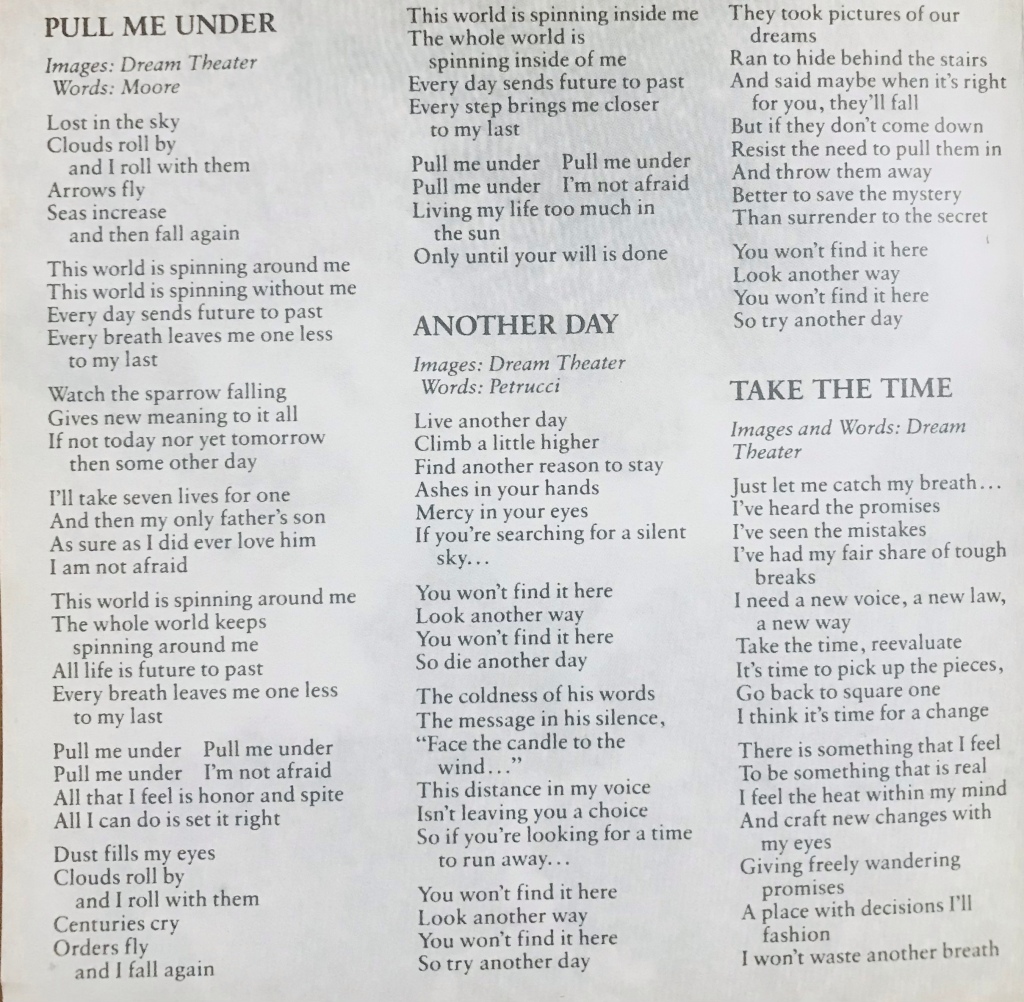
Pull Me Under

Music composed by the band and lyrics written by Kevin Moore.

The lead single, “Pull Me Under”, gained the band a lot of commercial success with its airplay on MTV and radio, garnering them a top 10 hit on Billboard’s Hot Mainstream Rock Tracks chart. When the album was released, it sold at a steady pace, helped by an extensive world tour.

Its original working title was “Oliver’s Twist” as it was a last minute song written at the request of Derek Oliver. The original version also had the unbelievable solo section from “Erotomania” in it.

“Pull Me Under” was so good, that John Petrucci used the 1st verse riff of “Pull Me Under” in “The Count Of Tuscany” 1st Verse from the album, “Black Clouds and Silver Linings” released in 2009.

He also used the structure and dynamics for the song “On The Backs Of Angels” from the album “A Dramatic Turn Of Events” released in 2011.

As soon as the first three notes of the acoustic arpeggio are played, I was hooked. Then Portnoy started with his drum build. Metallica used an approach like this on “Enter Sandman”.

Another Day

Music is by the band with lyrics written by John Petrucci.

It’s like a hard rock ballad, but the guitar playing and the choice of chords by Petrucci is excellent. And the Soprano Sax solos are just perfect.

But press play to hear Petrucci on the lead break. It’s well worked out, it flows brilliantly, its melodic and cruisy and then he steps on the pedal and then brings it back to cruisy.

Take the Time

It’s a team effort on the lyrical front with Moore, Petrucci, Mike Portnoy and John Myung contributing.

How good is that start? The fast riffing is a cross between Van Halen and Metallica.

Then the verses go into a Rock Funk groove.

And the Chorus, its melodic hard rock.

As a guitar player, this song is like a Chord Book on complex chords.

Surrounded

It’s listed as words and music by Kevin Moore.

It starts off as a piano ballad, before it builds up to a funky blues rock tune.

But press play to hear the digital delay lead break from John Petrucci. It feels like The Edge from U2, but a lot better.

Metropolis—Part I: ‘The Miracle and the Sleeper’

It’s a monster of a song that every Metal and Rock fan would enjoy.

The pulsing intro alone is head banging material.

But those verses. Petrucci plays fast palm muted chords like the “Darkness, imprisoning me” part in “One” and keyboardist Moore outlines the chord progression with his riffs, while Portnoy plays a “Kashmir” like beat.

Perfection to my ears.

Under a Glass Moon

What an intro, pushing the envelope of what metal and rock should sound like.

But press play for the groove in the Verses from Petrucci and Myung, while Moore outlines the Chord progression with his keyboards.

And then wait to hear Petrucci on the solo.

Wait for Sleep

A brilliant piano piece from Kevin Moore. It’s like a haunting soundtrack. The main piano idea from here appears in “Learning To Live” and when it comes in, its brilliant.

Learning to Live

At 11.30 it’s the longest song on the album. The music is written by the band and lyrics are written by John Myung.

If I had to recommend one song to a new Dream Theater fan that typified the progressive rock leanings of the band, then this song would be it.

The song is that good, that Dream Theater rewrote it and called it “Breaking All Illusions” for the “A Dramatic Turn of Events” album in 2011.

The Kevin Moore keyboard intro kicks things off with a wicked 15/8 time signature. This same passage re-appears and this time it is played over alternating time signatures, starting off with 14/8 for 2 bars, then 13/8 for one bar and back to 14/8 for another bar. Then it goes back to 13/8, 14/8, 13/8, 7/8.

In between you get a very metal like passage in the vein of “Immigrant Song” from Led Zeppelin, that moves between 7/4,6/4,4/4 and 5/8 time signatures over F#m, C#m and Em root notes. It doesn’t sound forced. It is very fluent like.

The verse is unbelievable. Myung holds it all together with an unbelievable groove over a 7/4 and 6/4 time signature, that is supplemented by Kevin Moore’s choir like voicing’s outlining the Em9, Cmaj9, Amadd9 and Em9 chords. Myung paraphrases the novel “Atlas Shrugged” from Ayn Rand.

There was no time for pain, no energy for anger
The sightlessness of hatred slips away
Walking through winter streets alone, He stops and take a breath
With confidence and self-control

I look at the world and see no understanding
I’m waiting to find some sense of strength
I’m begging you from the bottom of my heart to show me understanding

Petrucci and Portnoy build the song nicely into the chorus. Petrucci begins with normal volume swells, while Portnoy locks in with Myung. As Petrucci’s guitar gets busier with harmonics, chords and arpeggios, Portnoy’s drumming becomes busier.

The second verse has a great progressive groove that keeps within the 7/4 and 6/4 time signature of the first verse. This time it’s all power chords and its heavy as hell. Chugging along on an E5 power cord, Petrucci enhances the riffs by chucking in B5, Bflat5 and F power chords, utilising the devil triton to maximum effect.

The 90s bring new questions
New solutions to be found
I fell in love to be let down

Then when you think they are going to go into the Chorus again, they go into a bridge part with a simple 4/4 groove and then the instrumental break starts. Petrucci is now playing what Moore played in the intro.

The flamenco passage at 5.30 kicks things off. From 6.30 it gets progressive and then the woo ohh ohhs kick in and Petrucci takes over at 7.10 in one of the most heartfelt solos Petrucci has laid to tape. Those bends remind me of Dave Gilmour in “Comfortably Numb”.

The whole “Wait For Sleep” segment that begins at 7.30 and ends at 9.35 includes brilliant jazz bluesy solos from both Moore and Petrucci and the main piano riff from “Wait For Sleep”. It then segues back in to the Chorus.

The way that your heart beats
Makes all the difference in learning to live

Just when you think the song is over, the outro kicks in, again led by an unbelievably groovy and very funky Myung bass line. Then Petrucci joins in with the Natural Harmonics and then the monk style voices take over. As a listener I just sit back with the head phones and allow myself to be taken away. A brilliant song and a brilliant piece of work.

Mike Portnoy has gone on record saying how much he hated working with producer David Prater and the use of drum midi triggers. Portnoy feared that the triggers would make the album sound dated and seen as another generic hard rock album.

One thing is certain.

The album still sounds fresh and current in 2022 as it did back in 1992. As Rush’s “2112” laid the groundwork for what was to come for Rush, “Images and Words” did the same for Dream Theater.

The tour finished in November, 1993. Overall they played 194 shows in 17 countries. “Images And Words” was certified Gold in the U.S. Everything they worked hard and persevered with, had finally happened.

The pressure for a successor was intensified.

Standard
Classic Songs to Be Discovered, Derivative Works, Influenced, Music, Unsung Heroes

The Record Vault: Baby Animals – Baby Animals

The debut Baby Animals album was everywhere in Australia. Before the album was released in September 1991, they had some serious momentum over 15 months coming in to the album. The Angels was one of the biggest bands in Australia during this time and the Baby Animals was the opening act between 1990/91.

The album debuted at number six on the ARIA Album Charts and spent six weeks at number one, eventually going eight times platinum and becoming the highest-selling debut Australian rock album of all time (until the release of Jet’s album, “Get Born” 12 years later).

I saw em live at the Revesby Workers Club on the tour. An up and coming band called Judge Mercy was opening for them. They were excellent, but they unfortunately disappeared when the labels started dropping metal and rock acts in a years’ time.

And the Baby Animals rocked. Drummer Frank Celenza was huge behind the kit, laying down the foundations along with bassist Eddie Parise. Dave Leslie on guitar is so underrated, playing a chicken picking style and Suze DeMarchi on guitar rocks hard. Everyone raves about Lzzy Halestorm, but I’m pretty sure she would have been influenced by DeMarchi. And on vocals, DeMarchi is bluesy and soulful.

The album was produced by task master Mike Chapman and engineered by Kevin Shirley. The personnel alone shows the albums intention.

And my favourite track is “Working For The Enemy”, that whole break down section, lead break and build up is excellent. My second favourite is the metal like “Waste Of Time” with its energetic double kick intro and heavy blues boogie rock riffs.

“One Too Many” is “Rock N Roll Noise Pollution” in spirit and influence, while “Aint Gonna Get” is AC/DC on steroids and highway speed tempos with a Chorus that reminds me of “I Love Rock And Roll”.

And I haven’t even gotten into the singles yet.

How good is the intro to “One Word”?

But DeMarchi didn’t like the song after it was finished and asked the label to keep it off the album. The song went through a transformation, from a country-ish rock feel in the demo (which can be heard on the 25th Anniversary Edition) to the melodic rock beast it became, as Chapman kept asking them to work on it.

Guitarist Dave Leslie paid his dues in a Cold Chisel covers band called Swingshift, playing Australian pub rock classics on a nightly basis and he knew what worked with audiences. His chicken finger picked intro to “One Word” is guitar hero worthy.

“Rush You” is the opener as the power chord crashes down and the cymbals ring before it goes into a double time beat and some series riffage and how cool is that “Back in Black” walking chromatic riff just before the verse.

“Early Warning” begins with the drums while a slide guitar plays a rock riff and the music then stops while DeMarchi sings, “Too Young To Know and Too Old To Listen”.

The band kicks in again. Then the verses come and it’s like a Jimi Hendrix song, before it moves into the power of the Chorus.

“Painless” has this funk blues boogie which I like. If you haven’t heard it, today is a great day for it.

They toured hard on this album, playing all the major cities and regional towns in Australia, and once Bryan Adams heard the album, he added them to his European leg.

The Black Crowes added them to their Australian and New Zealand tour, while Eddie Van Halen, asked for them to be the support act on the “For Unlawful Carnal Knowledge” tour after he heard the album via his wife Valerie Bertinelli.

By the time their touring commitments ended for the album in August 1992, they had played over 500 shows.

Standard
Classic Songs to Be Discovered, Derivative Works, Influenced, Music, My Stories

Australian Method Series: Wolfmother – New Crown

Great cover, it’s the best part of the album.

It’s my second time hearing it, almost 8 years apart.

So “New Crown” is album number three.

It was produced by Andrew Stockdale and self-released on 23 March 2014, initially as a digital download only available on Bandcamp and then reissued physically and everywhere digitally.

Stockdale’s solo album, “Keep Moving” released in 2013 was actually meant to be Wolfmother’s third album but due to the revolving door of musicians during the recording, Stockdale decided to retire the name, only to realise that no one cared or knew who Andrew Stockdale is without the Wolfmother title.

But he did find some calmness with his solo band, so Stockdale, along with bassist and keyboardist Ian Peres, and drummer Vin Steele got together to churn out this album.

Wolfmother to me is a classic hard rock band, with elements of stoner rock and garage rock and punk, but on this album, the stoner rock/garage rock and punk is more pronounced with small elements of hard rock. And it was the hard rock which got me into Wolfmother.

Also the production and audio was a sticking point for a lot of musical fans.

When I first heard it, there wasn’t enough quality to keep me interested. The songs seemed lacking. Hearing it again today, the majority of the songs are still lacking, except for “Tall Ships”, “Heavy Weight”, “Enemy Is In Your Mind” and “How Many Times” which have been added to my playlists.

For those David Lee Roth fans, Gregg Bissonette was originally hired to perform on the album, but after recording one song with the band his drum parts were dropped and he was let go.

How Many Times

The verse riffs remind me of Kiss and “Love Gun” but that main blues rock riff is so generic and derivative, and I still like it.

I like the Sabbath like feel after the Chorus.

Enemy Is In Your Mind

The psychedelic rock intro riff is pretty cool and then it goes into a “Sabbath Bloody Sabbath” like riff. And I like it.

Also check out the bass playing on the lead break.

Heavy Weight

It’s a mixture of Sabbath like grooves and Rolling Stones.

New Crown

It’s a confusing song which drags on for no reason.

Tall Ships

The best song on the album. The intro is very Sabbath like.

And stick around for the first part of the melodic lead at the end.

Feelings

It sounds like something else, more punk rock (Stooges), a little bit like The Rolling Stones vocally, maybe it can be classed as “power pop”. But it’s a skip.

I Aint Got No

“Satisfaction” comes to mind straight away. And it’s a skip.

She Got It

It’s downtuned, however the Stooges/Rolling Stones influences are strong on this album. Another skip.

My Tangerine Dream

I suppose the bands Led Zeppelin and Tangerine Dream come to mind here.

Radio

It’s almost there. But a skip.

One of the reviews I read wrote, “crap band releases a crap album”. A crap album it is and I suppose every band has an album that is lesser than the others. This is Wolfmother’s.

Standard
Classic Songs to Be Discovered, Derivative Works, Influenced, Music, My Stories, Unsung Heroes

2001 – Part 5.1: The Calling – Camino Palmero

The Calling, was formed by Alex Band (lead vocals) and Aaron Kamin (lead guitar, backing vocals).

They weren’t a modern alternative rock band to start off, with David Matthews Band style influences. But, next door to Alex Band, was Ron Fair, a music business executive.

Imagine that, your neighbour was a Chairman at Geffen Records, then Virgin Records and prior to Geffen, he was President of A&M Records and held Senior Positions at RCA Records, Chrysalis Records and EMI Records.

On top of that he was also known as a “mentor” to unsigned artists. Apart from The Calling, other artists he mentored that made it to major label releases are Christina Aguilera, Vanessa Carlton, Keyshia Cole, The Black Eyed Peas and Fergie, and the Pussycat Dolls.

Between 1996 and 1999, the guys kept writing and demoing, and by 1999, Ron Fair was impressed enough to sign them to a deal with RCA.

The name of the band was originally, “Generation Gap”, then “Next Door” and after getting signed, they became “The Calling”.

Their sound through the years morphed to be more influenced by Matchbox Twenty, Third Eye Blind, early Maroon 5, Train and Fastball.

The RCA deal was huge for a band that hadn’t played any shows whatsoever, nor did they have a fan base. I suppose it pays dividends to live in the same suburb as a record label exec.

And Ron Fair, just kept working with em over that two year period until they had the songs ready to record an album.

The players on the album, joining Band and Kamin are Sean Woolstenhulme on rhythm guitar, Billy Mohler on bass and Nate Wood on drums.

The debut album “Camino Palmero” was released in July 2001 and was a commercial success. The cover art of the album represents platforms 5 and 6 of the Santa Maria Novella railway station in Florence, Italy but the name of the album comes from a LA street where the Band and Kamin first met.

All tracks are written by Alex Band and Aaron Kamin, except “Stigmatized” which was co-written with Eric Bazilian.

Unstoppable

As soon as the song starts its recognizable and when I heard the strummed acoustic guitar in the verses, “Alone” from Heart came to mind straight away.

A great opener but it is lost in the world of streaming right now as it doesn’t even rate a mention in their Top 5 streamed songs on Spotify.

Nothing’s Changed

It reminds me of Bush.

Wherever You Will Go

The big hit at 429.6 million streams on Spotify. And the acoustic version of the song has 33.8 million streams.

The vocal melody is catchy and I like the way it moves between acoustic arpeggios, strummed acoustic guitars and then a light distortion in the Chorus.

Could It Be Any Harder

I like the country rock ballad feel on this and the vocal reminds me of Lifehouse. Four songs in, its a 4 punch knockout.

Final Answer

The acoustic alt rock style is evident here, more Tonic and Lifehouse and man, I dig it.

Adrienne

More Matchbox 20 like.

We’re Forgiven

If you are a country then this song would resonate, however it’s a skip for me.

Things Don’t Always Turn Out That Way

It’s got a cool start, with a progression reminiscent to “Glycerine” from Bush and a Fastball “The Way” chorus.

Just That Good

It’s a skip for me.

Thank You

Press play for the Chorus.

Stigmatized

A great closer with a nice vocal. It sounds like a lot of alt rock/soft rock bands, but I don’t care.

In a post Napster world, the album did rack up a few certifications along the way. Brazil is one of the biggest markets when it comes to piracy and the country made the album a Platinum success. So did the UK and Italy. Canada and the US, gave it a Gold certification.

In November 2003, former members Wood and Mohler sued Band, Kamin, and the group’s management, accusing them of mismanagement, fraud, and asking for an audit of the money that was spent during their tenures in The Calling.

They claimed that they were promised a share of the royalties and profits from touring and merchandise. Band and Kamin claimed that the two were not entitled to any records of the royalties.

Their second album “Two”, was released in June 2004.

But the album didn’t perform well commercially compared to the debut. Ron Fair was no longer Executive Producer, replaced by Clive Davis. Davis was all about the hit, right now while Fair was more about career longevity. The record features the original members Alex Band and guitarist Aaron Kamin along with a variety of session musicians.

The band or duo broke up in 2005, but in 2013, The Calling reformed with a new line-up and they still operate today with a new album on the horizon.

But even that was bizarre as Alex Band in that same year, sued Aaron Kamin for “disappearing from the public eye” and Band wanted full rights to “The Calling” name and songs. But the case was dismissed only to resurface later when Band was promoting a “reunion” show which didn’t involve Kamin.

On top of that Band was almost beaten to death after a show that required a jaw bone reconstruction and three implants.

The music business is vicious. But check out the debut. It’s excellent.

Standard
A to Z of Making It, Classic Songs to Be Discovered, Influenced, Music, My Stories

The Record Vault: Dream Theater – When Dream And Day Unite

It was 1992 and the music scene was changing. The record labels started to abandon the music I grew up with and the writing was on the wall for a lot of the hard rock bands, especially the ones that got marginalised as “hair metal” or “glam metal”.

I saw a Geffen ad that promoted White Zombie, Nirvana, Roxy Blue and Guns N Roses. It was a smart marketing move from Geffen. Promote different acts on the same page and see what sticks. I think Galactic Cowboys also appeared on it.

While I was angry that it was getting hard to find releases of bands I liked, I was also a bit lost as to what new music I should spend my money on. At this point in time the CD had overtaken the vinyl LP as the favourable format, so the second hand record shops had a lot of vinyl stock which I was purchasing at insane cheap prices. At first I was buying all the 80’s records I didn’t have money to buy when I first saw em or decided to buy something else instead of that. Like I purchased WASP instead of Britny Fox. Once that 80’s fix was satiated, I went back even further and got my 70’s fix from acts like “Free”, “Bad Company”, “Styx”, “Kansas” and many more.

Then Dream Theater came into my life in 1992.

It all started with the “Images and Words” album and the song “Pull Me Under”. Most of the music I got into was because of friends and family. My cousin Mega (his nickname because he loved Megadeth) was 4 years older than me and he spent every cent he earned on getting new music. He wanted to be known as the guy who had it first and shared it with others. My fandom of Dream Theater is because of him. And Megadeth. And Metallica. And Twisted Sister. And Fates Warning.

The whole intro from “Pull Me Under” is worth the price of the album. And I thought it was the debut album from Dream Theater, until my cousin Mega told me differently. A week later I was back in the record shop to buy the debut. But it wasn’t there nor was it available to buy locally. The only way to get it was via an expensive US Import.

It wasn’t until “Awake” came out in 1994, that I got “When Dream And Day Unite”. At a $27.99 price.

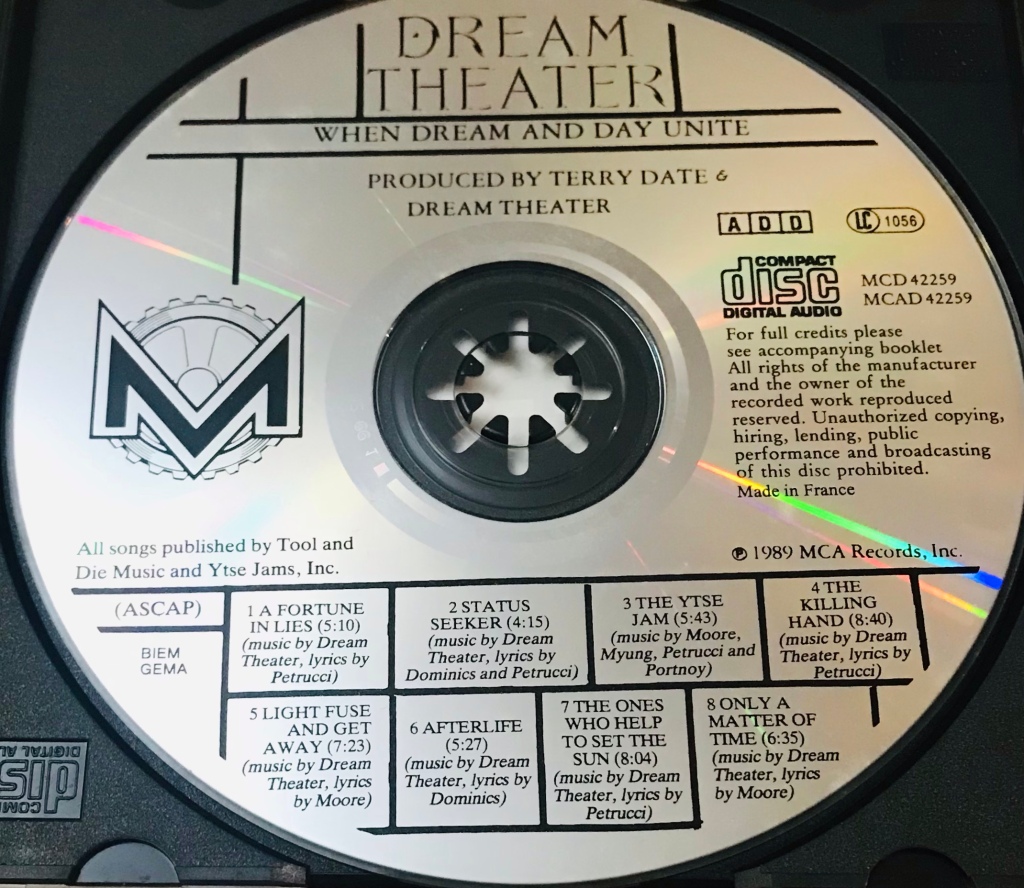
“When Dream and Day Unite” was released on March 6, 1989, through Mechanic/MCA Records. There is a story about how this album came to be and why Dream Theater couldn’t use the Majesty name, but that is for another post, when I get to the release of “The Majesty Demos” release as my Dream Theater record vault is based on release date instead of where the releases fit in.

The production from Terry Date is thin compared to “Images And Words” which Portnoy actually hated because producer David Prater used triggers on his drums, which Portnoy saw as a relic of the 80’s hard rock and glam rock movement. And Date at the time was also making a name for himself as a groove metal pioneer with the “Cowboys From Hell” from Pantera.

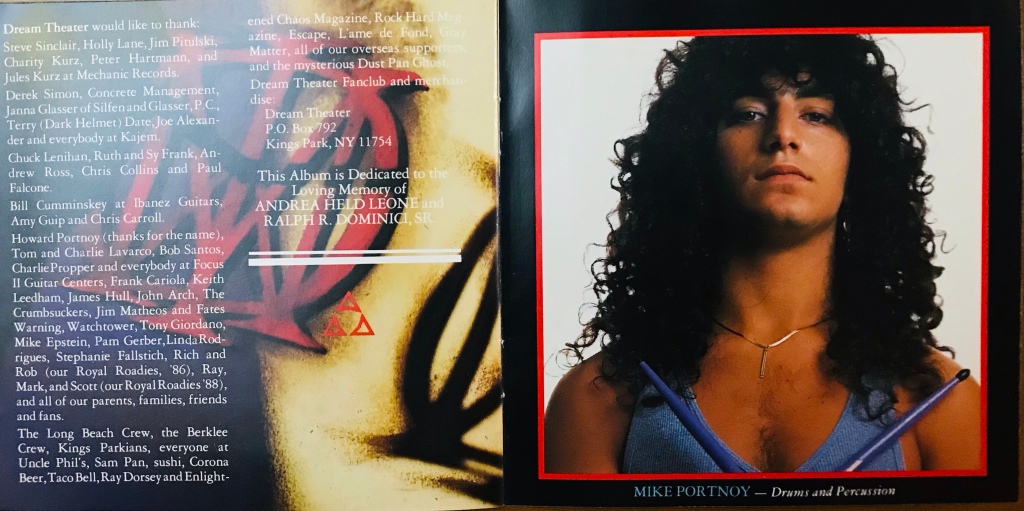
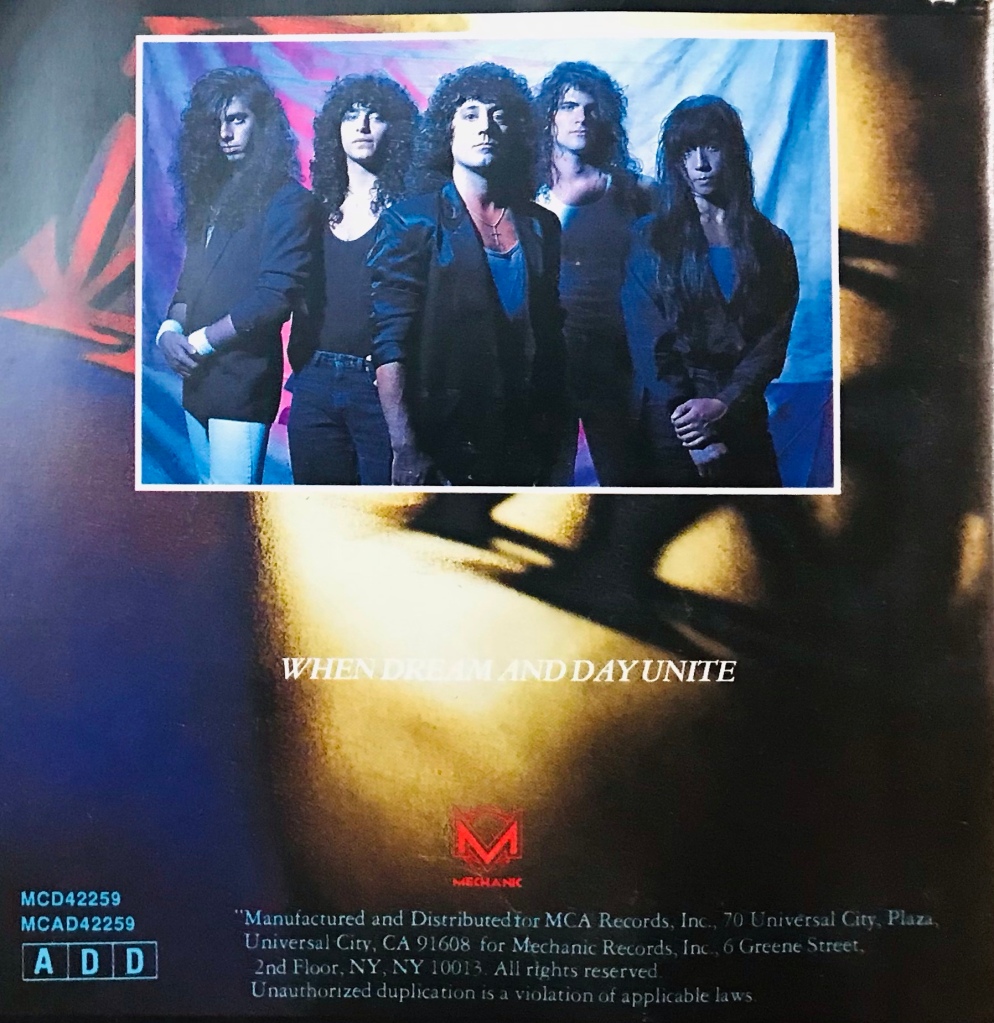
The band for the debut is Charlie Dominici on vocals, John Petrucci on guitar, Kevin Moore on keyboard, Mike Portnoy on drums/percussion and John Myung on bass.

The cover art from Amy Guip looks bizarre with “The Majesty” logo being branded into the male model and from what I have read, there are versions of this album out there with “The Majesty” band name. They got a cease and desist from another act called “Majesty” just as the record was getting ready to ship.

All music is by the band members.

A Fortune in Lies

Lyrics are written by John Petrucci.

When I first heard it, I thought it was about writers block, and not being able to write the song to get them a record deal which is basically a contract promising a fortune but with a lot of lies in between.

Then I read the book, “Lifting Shadows” from Rich Wilson and he described it as an “acquaintance of John Petrucci’s who was arrested for theft and Petrucci’s subsequent experiences after that”.

Check out the middle section homage to “Forgotten Sons” from Marillion.

Status Seeker

It was the last track written for the album with lyrics by Charlie Dominici and John Petrucci.

The Rush influences are strong on this. Think of “New World Man”.

I would have liked them to flesh out those kind of pop elements on this however the song is loaded with extra riffs and fills just to make it sound progressive.

The Ytse Jam

Its Majesty (the former name of Dream Theater) spelled backwards.

An instrumental, written by John Petrucci, John Myung, Kevin Moore and Mike Portnoy.

If you like “YYZ” from Rush then you would like this. The intro is excellent and make sure you check out the section in the middle which has the keyboards playing the intro guitar riff, while the guitar plays arpeggios.

The Killing Hand

There are five parts, to this 9 minute song with lyrics written by John Petrucci.

“I The Observance”, “II Ancient Renewal”, “III The Stray Seed”, “IV Thorns” and “V Exodus”.

The acoustic intro in “I – The Observance” is excellent. The middle parts are cool and the keyboard solo from Moore in “IV – Thorns” is worthy, but the last two minutes and thirty seconds of the song which is “V – Exodus” is the best part. The movement between sections is very similar to what they would do on “A Change Of Seasons”.

Light Fuse and Get Away

Lyrics are written by Kevin Moore. The intro is progressive and at the 38 second mark it moves into a Rush like groove, something which they would do similar on “Learning To Live” on the follow up album.

But press play for the riff between from 1.37 and 2.12. It then moves into the verse riff and in between you hear you hear a little bit of a progression that would be used on “Take The Time” and “Home”.

Afterlife

The best song on the album for me as it reminds me of the first two Queensryche albums.

Lyrics are written by Charlie Dominici and maybe the band should have gotten Dominici to write more of the lyrics as they make sense compared to the stuff that Petrucci and Moore were dishing out.

Make sure you check out the guitar lead from Petrucci on this as it’s another Guitar Hero moment which then morphs into a harmony lead with the keyboards.

The Ones Who Help to Set the Sun

The surprise track on the album with lyrics written by John Petrucci.

Press play to hear the intro on this, with the keyboard riff and the natural harmonic bass riff.

Then Portnoy comes in with a drum groove, while Petrucci plays a “Mirror” like riff and Moore plays an exotic keyboard lick over it.

Only a Matter of Time

Lyrics are written by Kevin Moore and I like the intro on this.

Musically, the song has a lot.

I remember reading an interview with Lars Ulrich and James Hetfield, when they were writing the earlier songs for Metallica, and how they would just chuck in riffs to make the song longer.

Well there are plenty of riffs here, but so many different ones and sometimes for a short amount of time so it’s hard to have any familiarity with any of em. Hence the song gets lost.

There is this section between the 4 minute and 6 minute mark which reminds me of Marillion.

The best way to describe this album is as a mix of progressive rock and 80’s arena hard rock and early US metal is the best way to describe this debut. Rush and Marillion are here.

Queensryche and Iron Maiden are here. Metallica is here as well. And very different to acts like Ratt, Bon Jovi, White Lion and Motley Crue, who did great business on the charts.

Derek Oliver from Kerrang gave the band a glowing review and it wasn’t forgotten either, when a few years later, Oliver was the A&R Rep who signed them to their ATCO deal (which then became Elektra).

Charlie Dominici copped some flak for his vocals. Portnoy wanted a hybrid Tate and Dickinson, and got more a Graham Bonnet. The songs that Dominici wrote lyrics to like “Afterlife” and “Status Seeker” also have the best vocal melodies, which makes me wonder how the other songs would have sounded vocally if Dominici was allowed to write the lyrics and melodies instead.

The national and European tour promised by their label Mechanic Records didn’t eventuate, as Mechanic lied about providing funding. The band was left to do a 5 date regional tour in their own state and a small support slot for Marillion when they toured their hometown.

Standard
Classic Songs to Be Discovered, Derivative Works, Influenced, Music, My Stories, Stupidity

The Record Vault: Eric Clapton – Slowhand

“Slowhand” is the fifth full-length studio album by Eric Clapton, released on 25 November 1977 by RSO Records.

Clapton is in the news these days for the wrong reasons. I was even called a racist at my place of work for listening to his music.

I suppose it’s the age old question.

Do you stop listening to an artists for things they’ve said or done that you don’t agree with?

I have three vaccines in me so I don’t really care if artists I enjoy listening to sprout anti vaccine bullshit. The racist rant he went on in a 1976 concert was bizarre to say the least, especially how he is influenced by black musicians. And I’m a foreigners son but I didn’t care much either way.

It gave rise a Rock Against Racism movement back then and then he dropped “Slowhand” which became a massive seller for him.

And coincidence or not his band is white.

Eric Clapton is on lead vocals and guitars. Dick Sims is on keyboards, George Terry on guitars, Carl Radle on bass, Jamie Oldaker on drums/percussion and Mel Collins is on saxophones. Yvonne Elliman does the excellent harmony and backing vocals. Marcy Levy is also on the harmony and backing vocals, and duets with Clapton on “The Core”.

Glyn Johns expertely captures the sounds as engineer and producer. Clapton really wanted to work with Johns, because of his work with The Rolling Stones and The Eagles, however while in the studio, Johns ran a disciplined ship which discouraged jamming. According to Johns, why take away precious time from recording to jam. Since Clapton and his band were drunk most of the time, Johns had no other choice but to run a tight recording schedule.

Cocaine

Written by J.J. Cale who it seems like was getting covered by everyone. The riff is straight from the songbook of “Sunshine Of Your Love”.

At 333.6 million streams on Spotify, it’s one of his most played. And I don’t care how Clapton spins it, the song is about taking the drug,

Lay Down Sally

Written by Eric Clapton, George Terry and Marcy Levy, I like the 12 bar bluegrass shuffle on this. It reminds me of Dire Straits even though this was written before.

Wonderful Tonight

On Spotify it has 309 million streams but press play for the lead breaks which make up for the lyrics which could be classed as silly.

A live song written by Eric Clapton for his then wife.

Next Time You See Her

Another track written by Eric Clapton which could pass for the embryo of the Hootie And The Blowfish sound.

There is anger here at losing his lover.

We’re All the Way

Written by country artist Don Williams. It’s a slower song with shimmering acoustic lines, a soft brush drum beat and baritone vocals.

And it is this style which dominates the album.

The Core

Written by Eric Clapton and Marcy Levy. At almost 9 minutes long, Clapton is trying to re-create “Crossroads” from Robert Johnson in certain sections however there are lot of riffs to unpack here and all of them are a fun to play.

May You Never

Written by John Martyn.

Clapton breaks out the acoustic guitar here, with a kind of Eagles-style tune that doesn’t disappoint and is one that I enjoyed quite a bit.

Mean Old Frisco

Written by Arthur Crudup

Clapton brings a gangster attitude to this as the song reminds me of something that The Black Crowes would do in the 90’s.

Peaches and Diesel

Written by Eric Clapton and Albhy Galuten.

It’s an instrumental with a guitar hero like solo. Musically it shares elements to “Wonderful Tonight”.

And the album did great business all around the world with various certifications from different regions.

The thing I like about Clapton is that he takes on covers and re-invent those songs for the modern market. In a way, making em his songs.

Standard
Classic Songs to Be Discovered, Influenced, Music, My Stories

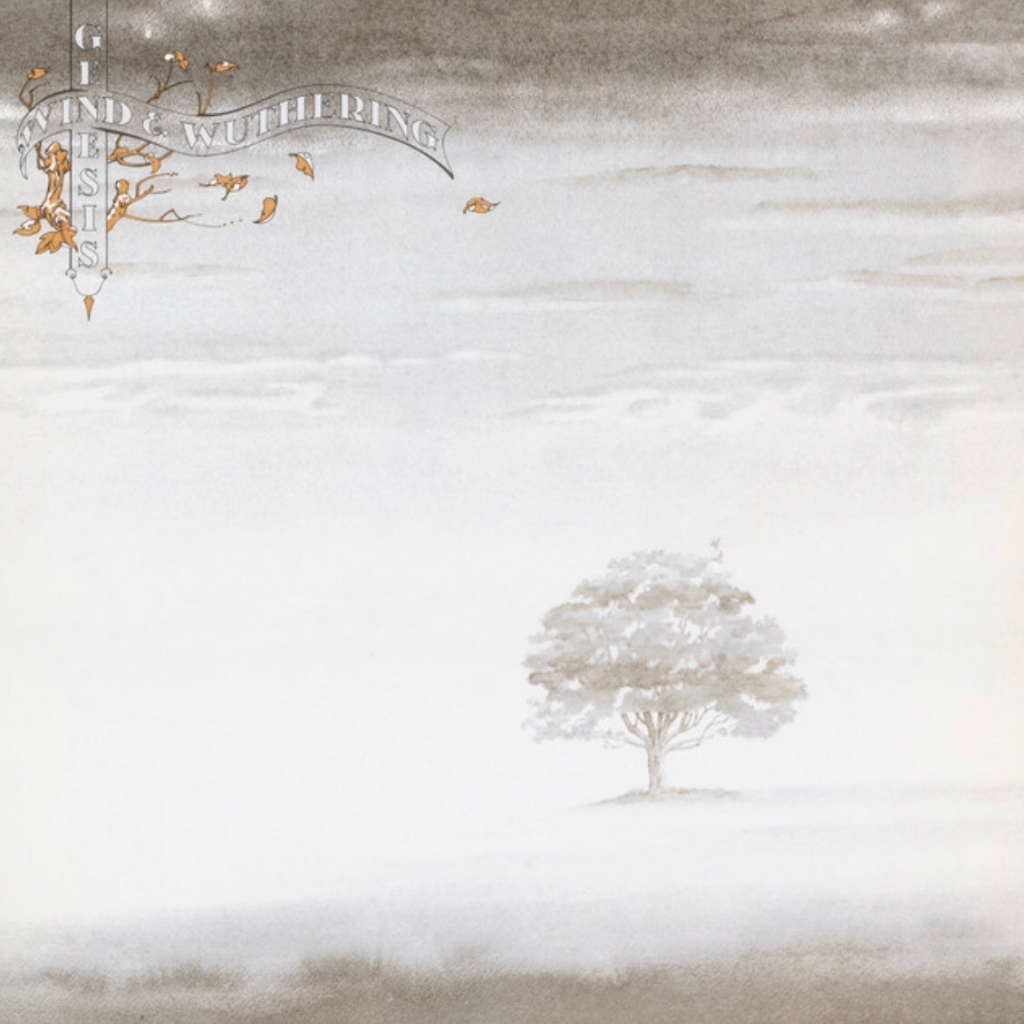
1976 – Part 4.9: Genesis – Wind And Wuthering

Why wait a few years for a new album when the new version of the band became successful with its new singer?

Released in December 1976, the band of Phil Collins, Tony Banks, Mike Rutherford and Steve Hackett remained unchanged, however trouble was brewing on the horizons.

Success leads to the need to create more success. And for Genesis, they had four competent songwriters who thought they all had the songs to create more success. The question was, which songs would get chosen and which songs would be left out.

Eleventh Earl Of Mar

Written by Tony Banks, Steve Hackett and Mike Rutherford. Its progressive, competing with bands like Yes for complex time changes and yet it still sounds like foot tapping rock and roll.

That section that starts with the words “I’m fighting, gravity falling” is my favourite and while brief, the vocal melody from Collins is memorable.

It refers to the historical figure of John Erskine, Earl of Mar, a Scottish Jacobite.

One For The Vine

At 10 minutes, it’s not for everyone. Written solely by Banks, the keys dominate the track.

I like the section from about the 4.40 minute mark. It’s almost soundtrack like something which The Alan Parsons Project would do a lot with his instrumentals. And the quietened down section at 7.21 fits well after the long instrumental passage.

Your Own Special Way

Even though the song is written by Rutherford in open tuning, it’s a typical Phil Collins song. It also reminds me of Coheed and Cambria and a song from the “No World For Tomorrow” album.

Wot Gorilla

An instrumental which Collins brought to the band and one that he said is one of his favourite tracks as it brought in his influences of jazz fusion.

Meanwhile Hackett felt that the song was “good rhythmically, but underdeveloped harmonically” and didn’t want it on the album in place of his song “Please Don’t Touch” which Hackett would later use for his solo album of the same name.

All In A Mouse’s Night

Written by Banks, it’s a silly song lyrically about a 10 foot mouse with big teeth however the music reminds me of a section in Dream Theater’s “Six Degree Of Inner Turbulence” song.

Blood On The Rooftops

Written by Hackett and Collins, I like the classical/flamenco style guitar from Hackett to start off the song. Listen closely and you will hear a bit of “Dee” from Randy Rhoads there. Then again, classical is classical so everyone is borrowing from the same masters.

Banks and Rutherford have said that this was Hackett’s best song as a member of the group.

Unquiet Slumbers for the Sleepers…

Written by Hackett and Rutherford, it’s an instrumental which is in two parts. The guitar playing from Hackett is very flamenco finger picked liked and good enough to rival the masters of the genre.

In That Quiet Earth

Written by the band, this is the second part of the instrumental and Collins is playing a fast jazz fusion beat which allows the rest of the band to dance over.

The heavy metal like section from 2.50 is the reason why I press play.

Afterglow

Written by Banks, this a milestone song for the band, as it proved that they could write short songs that they all liked. And a sign of the direction they would take.

The album was another success and the tour was huge with the gigs in Brazil being attended by over 150,000 people and each member needing armed bodyguards during their stay.

But Hackett was not a happy camper.

The writing process for the album was argumentative and having his songs removed was also contentious. So once the tour ended, Hackett left the bend to pursue a solo career.

Standard
A to Z of Making It, Classic Songs to Be Discovered, Influenced, Music, My Stories, Unsung Heroes

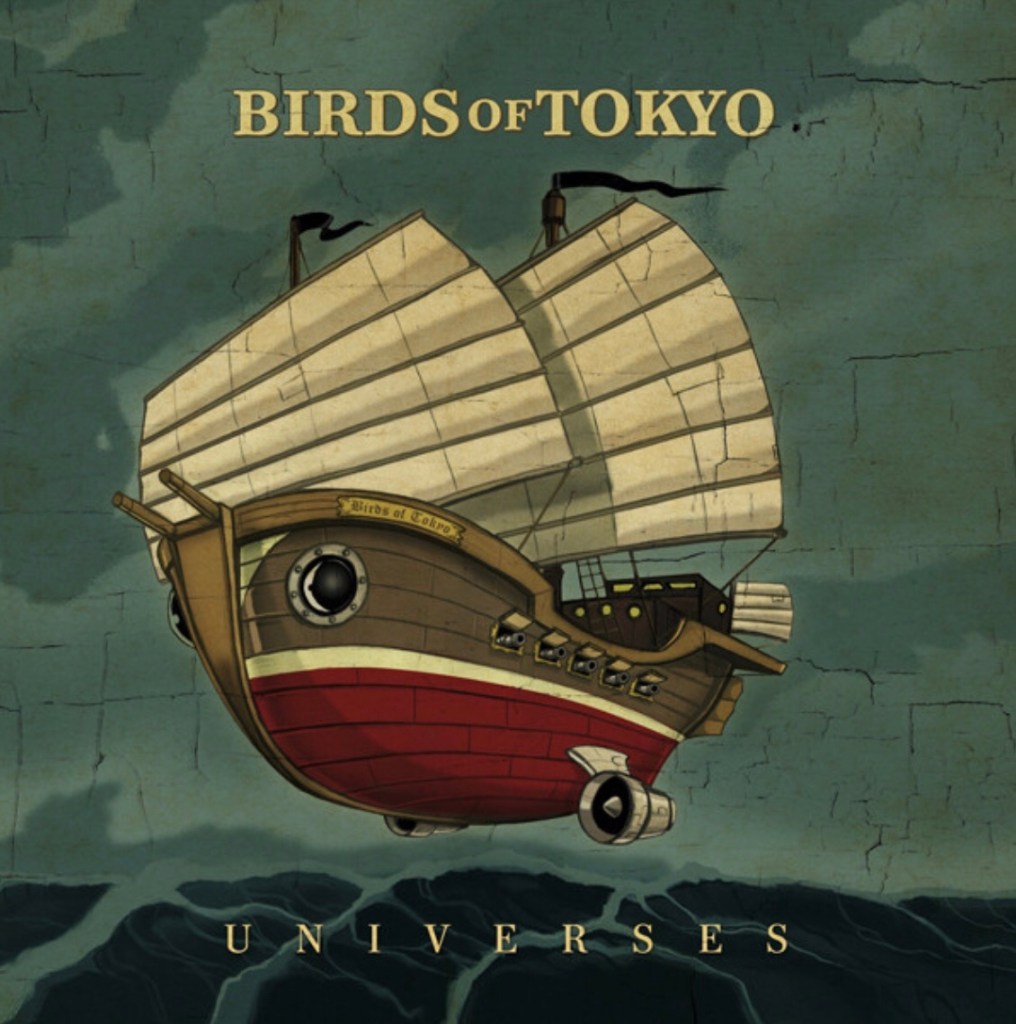
Australian Method Series and The Record Vault: Birds Of Tokyo – Universes

“Universes” is the second album from Birds of Tokyo, independently released on 5 July 2008.

The Personnel for the album is Ian Kenny on vocals, Adam Spark on guitars and keyboards, Adam Weston on drums and Anthony Jackson on bass.

If people are unaware, Birds of Tokyo formed in 2005 as another creative outlet for Karnivool vocalist Ian Kenny who wanted to do something softer and accessible.

There was a period between 2005 to 2012 that both bands operated, however Birds Of Tokyo then took over Ian Kenny’s life until late 2018 when Karnivool got together to play some shows and then COVID-19 hit and it looks like both bands started operating again at the same time.

I am a Karnivool fan first, and my interest to hear Birds Of Tokyo was because of that.

Karnivool plays a certain brand of heavy alternative rock/Metal which I like but even they have added more abstract movements into their songs..

Birds Of Tokyo at the start had this lighter alternative rock vibe happening but as they grew more popular, they more or less became a standard verse and chorus pop act. And a very good one at that.

Uno

Backward tape noises for about a minute leads into the “opening track”.

Broken Bones

Its aggressive in the verses and it could pass as a more pop version of Karnivool, purely because of Ian Kenny’s vocals.

The “I’m on a highway that leads to the end” section and how it builds up is why you should press play on this, because I guess no matter what we do, all of the roads we take lead us to our end.

For humans are born just to die.

Wild Eyed Boy

It’s got a start that reminds me of “The Cure” and “Inxs” but Ian Kenny’s voice and vocals keeps the song rooted in rock territory.

Silhouettic

The triple knock out combo continues with this.

It’s fast rock, hard to describe, but the vocal melodies are so catchy, they remain long after the song is finished, especially the lyric “there goes my baby”.

Head in My Hands

It feels almost like an Icehouse track, with Iva Davies singing. A bit slower, more early 80’s Brit Pop like Joy Division and I can’t get the lyric “I hate my melodies there all the same” out of my head.

But press play to hear the Thin Lizzy like harmonies which mimic the vocal melodies.

White Witch

It reminds me of Jet and “Are You Gonna Be My Girl” in spirit and feel. It also could have come from a Wolfmother album.

An Ode to Death

It’s heavy with a sinister groove and a chord progression that reminds me of “The Way” from Fastball.

Armour for Liars

Its aggressive and super melodic.

“Flowing blood for wealth and oil, the arms race and their toys, Power suits and power ties, corporate armour built for liars” more or less sums up what the song is about.

And I like the repeating line of “hey kid, run on home again, no world news to sell again”.

The Baker’s Son

More like Karnivool than the alternative pop rock on show here and at 6 plus minutes long, the song moves between moods and feels.

Train Wrecks

It feels like its influenced by INXS as it has that vibe with a bit of Radiohead and Muse mixed in.

Medicine

A strummed acoustic and metronomic piano chords with Kenny’s vocals makes up the closer.

If your time is short, then press play to hear the first three tracks in “Broken Bones”, “Wild Eyed Boy” and “Silhouettic” along with the 70’s rocker “White Witch”. While I think of it, stick around for “Armours For Liars” as the deep track.

And it was certified Gold in Australia but it’s not the album you see in their Top 5 Spotify list. Those bigger albums were just around the corner.

Standard