Classic Songs to Be Discovered, Music

Marcie Free’s Hidden Fire: The Soul Behind Ready to Strike

It’s 1985.

The Sunset Strip is still a religion, and every kid with a can of Aqua Net thinks they’re destined for MTV.

Out of the chaos comes King Kobra’s debut “Ready to Strike”.

Led by guitarists David Michael-Philips & Mick Sweda.

David Michael‑Philips briefly joined Keel before being recruited by drummer Carmine Appice for King Kobra in 1984. Mick Sweda had been doing East Coast cover/punk stuff, moved to L.A., and was also tapped by Appice for Kobra.

After Kobra he co-founded Bulletboys with Marq Torien.

Johnny Rod held the low end here and after King Kobra he joined W.A.S.P., appearing on “Inside the Electric Circus”, “Live…in the Raw”, “The Headless Children”.

The season veteran here was drummer Carmine Appice, coming from Vanilla Fudge, Rod Stewart, Ozzy Osborne and the architect behind King Kobra. Post-Kobra he went on to other projects (including Blue Murder with John Sykes).

And a singer named Mark Free, the kind of vocalist who could level you with a single held note.

And now, that voice is gone. Marcie Free (Mark transitioned in the 90s), passed away. No reasons given. Maybe there doesn’t need to be one. Sometimes the world just loses a frequency.

Listen to “Ready to Strike” today and tell me you don’t feel it. That impossible range. That clean, surgical tone cutting through Spencer Proffer’s slightly overcompressed mix.

“Ready To Strike”

Co-written by the band, Proffer, and the mysterious H. Banger, a name that appears on six tracks and nowhere else. Ever. Believed to be a collective pseudonym representing members of Kick Axe, whose fingerprints are all over the Pasha Records era.

“Up here on this tightrope / Tryin’ not to fall / The spotlight is on me tonight / I want to have it all.”

It’s a metaphor for the rock life, hunger, exposure, the weight of wanting everything. The guitars duel, the drums explode, and Free prowls through the mix like a panther who’s just discovered the cage door’s open.

“Hunger”

Written by Kick Axe and Proffer.

“When I see what I want, I’m gonna take it / If it’s against some law, you can bet I’m gonna break it.”

The tempo drops, the groove thickens. Free’s voice walks the line between desire and desperation, the sound of ambition burning too hot to contain.

“Shadow Rider”

“Midnight is my time / I’m the Shadow Rider / I come from the other side.”

It’s the nocturnal anthem, the loner archetype on a chrome horse, riding between light and dark.

“I’ll stand beside you and take the blows” isn’t just a lyric; it’s a code of honor. The song rumbles like an engine idling in a back alley.

“Shake Up”

“You grew up on rock ’n’ roll / So why deny it now?”

This is the youth call, the defiant reminder that rock isn’t fashion, it’s DNA. It’s a fist-in-the-air track, bright and rallying. The message is simple: don’t outgrow what saved you.

“Attention”

“You just want attention, baby, that’s all.”

A riff built for smoke machines and strip lights. But listen closer, there’s bite in Free’s delivery. Sarcasm, empathy, truth. It’s a mirror held up to a scene that fed on validation. Every artist in L.A. wanted the same thing: to be seen, to be loved, to matter.

“Breakin’ Out”

“I’m breakin’ out, gonna make my stand…”

The liberation song, before anyone knew how literal it would become. Appice’s drums hit like battering rams. Free’s vocal swings from defiance to freedom, warrior to wounded bird.

“Tough Guys”

“Tough guys never cry…”

The façade song. What sounds like macho posturing becomes, in Free’s phrasing, heartbreak. The mask slips. The world tells men not to feel; what does it cost to fake it.

“Dancing With Desire”

“I’m losing control tonight…”

The silk thread between danger and devotion. The groove is sleek, the vocal magnetic. Desire becomes identity, the moment you stop pretending and start existing.

“Second Thoughts”

“I had it all planned, then I changed my mind…”

It’s the sound of someone questioning the script.

Behind the arena sheen, it’s a confession: the fear of choosing the wrong version of yourself. Free sings like someone tearing up a contract with fate.

“Piece of the Rock”

“We all want a piece of the rock…”

The closer. It’s ambition reimagined as reckoning. You can hear the disillusionment under the triumph, the realization that success and happiness rarely share the same stage. It ends not in celebration, but transcendence.

King Kobra never quite made it to the top. The songs were there, the image marketable, the talent undeniable. But the breaks never came. One more album, and the curtain fell.

Yet “Ready to Strike” remains, a document of promise, power, and prophecy. The record of a voice that burned too bright to be ordinary.

Mark Free sang like someone fighting for air. Marcie Free lived like someone who finally found it.

RIP.

Standard
Music, My Stories

Live Review: Monolith Festival – Hordern Pavilion, Sydney

Featuring: Leprous, Periphery, Coheed and Cambria

Date: 10 November 2024

I’ve had this post for a while in various drafts and thought it was time to finish it.

The “Monolith Festival” returned to Sydney with a stacked progressive lineup and a reputation for delivering complexity, emotion, and sheer sonic weight.

Held at the iconic Hordern Pavilion, the festival promised more than just performances, it offered artist workshops, communal spaces, and a cultural showcase for fans of progressive rock and metal. But as these things go, time got away from me.

Unfortunately, I missed the first two acts and all of the artist workshops, an all-too-common casualty of Sydney traffic and the general logistics of festival life.

That said, there was still plenty to take in outside the main stage. Within the fenced-off, ticket-holder-only zone, a decent selection of food trucks (Woodfire Pizza and Turkish Gozleme) offered solid sustenance, while the Byron Bay Brewery bar kept spirits high.

Traditional venue options inside were also available, but the atmosphere outside had that kind of low-key camaraderie that festivals like this are great at cultivating.

Leprous

My first time seeing Leprous live.

They landed on my radar thanks to a Spotify algorithm about eight years ago, and since then, they’ve remained a steady presence in my playlists. “The Congregation” (2015) is still my go-to from their discography; cold, mathematical, yet deeply emotive.

Onstage, Leprous radiated a quiet confidence. The Norwegian five-piece walked the tightrope between technical precision and atmospheric build, and for a band that thrives on restraint, they commanded the stage without excess.

Frontman Einar Solberg’s falsetto soared through the room with eerie control, making converts out of any first-timers.

Songs like “The Price” and “Slave” unfolded like emotional equations, each section calculated but still cutting deep. Their set was perhaps the most introspective of the night, and it worked.

Periphery

Cue chaos.

Pop music blares over the speakers until it’s suddenly cut off by the outro to “Crush.”

That abrupt tonal shift was the perfect entry into Periphery’s calculated aggression.

The band launched into “Wildfire,” a spiraling, multi-sectioned assault from their latest album “Periphery V: Djent Is Not A Genre” (2023).

Phones lit the air like tiny lighthouses, struggling to anchor anyone in the seas of down-tuned guitars, polyrhythms, and seizure-inducing strobes.

Aussie drummer David Parkes filled in admirably for Matt Halpern, who stayed home for the birth of his second child. Parkes handled the intricate time signatures and unpredictable shifts with mechanical precision.

The setlist leaned heavily on “P:V”, with highlights like “Atropos”, a personal favorite, offering moments of clarity amidst the chaos. That track’s clean sections created a stark contrast that only made the heavy parts hit harder.

“Reptile,” a 16-minute behemoth from “Periphery IV: Hail Stan”(2019), raised some eyebrows. In a short set window, it was a bold move, equal parts indulgent and impressive. But if you were there for the musicianship, it was a masterclass.

They closed with crowd-pleasers “Marigold” and “Blood Eagle,” with the latter turning the pit into a blur of limbs and hair.

From the last time I saw them at The Annandale Hotel in 2013, the band has evolved. The absence of bassist Nolly Getgood (who stepped away in 2017) hasn’t dulled their low end, but it has reshaped the balance. They’re leaner now—five members, three guitars, all in.

Coheed and Cambria

A concept band doing a concept album at a concept festival. Perfect match.

Coheed delivered “Good Apollo, I’m Burning Star IV, Volume One: From Fear Through the Eyes of Madness” (2005) in full. No cut corners, no medleys. Just front-to-back storytelling, as dense and labyrinthine as their discography demands.

There’s something almost theatrical about Claudio Sanchez’s vocals, part prog-opera, part comic book epic. Whether it was the haunting “Ten Speed (Of God’s Blood and Burial)” or the melancholic “Wake Up,” the band navigated the album’s twists with unwavering energy.

“The Willing Well” suite; four interlinked songs running over 20 minutes total; was ambitious and, frankly, kind of mesmerizing.

But let’s be honest: “Welcome Home” was the showstopper.

That intro riff?

Unstoppable.

The crowd knew it, and the band leaned into the moment like it was their final form.

After the main set, Coheed returned with a two-song encore: the pop-punk tinted “A Favor House Atlantic” and the anthemic “In Keeping Secrets of Silent Earth: 3.”

Everyone screamed the final chorus like they were shouting back at their teenage selves.

Final Thoughts

I didn’t catch everything, but what I did see was worth the trip. Each band brought a different flavour of “monolithic”; Leprous with their glacial precision, Periphery with their controlled chaos, and Coheed with their galactic storytelling.

Monolith Festival isn’t just about music, it’s about endurance, narrative, and the sublime power of sound pushed to its technical limits.

Would I go again? In a heartbeat.

But next time… I’m arriving early. And I’m not missing those damn workshops.

\::/

Standard
Classic Songs to Be Discovered, Influenced, Music

Scorn – Machine Head

Dom Lawson, in Metal Hammer, called it “ostensibly a dark, crestfallen ballad” that builds through synth-drenched haze and emotional swells before erupting in a syncopated, spine-tingling finale.

He’s not wrong.

In fact, “Scorn” might be the most hauntingly beautiful track Robb Flynn has ever penned.

Machine Head is no stranger to monumental album closers, think “The Burning Red,” “Descend the Shades of Night,” “A Farewell to Arms,” “Who We Are,” or “Arrows in Words from the Sky.”

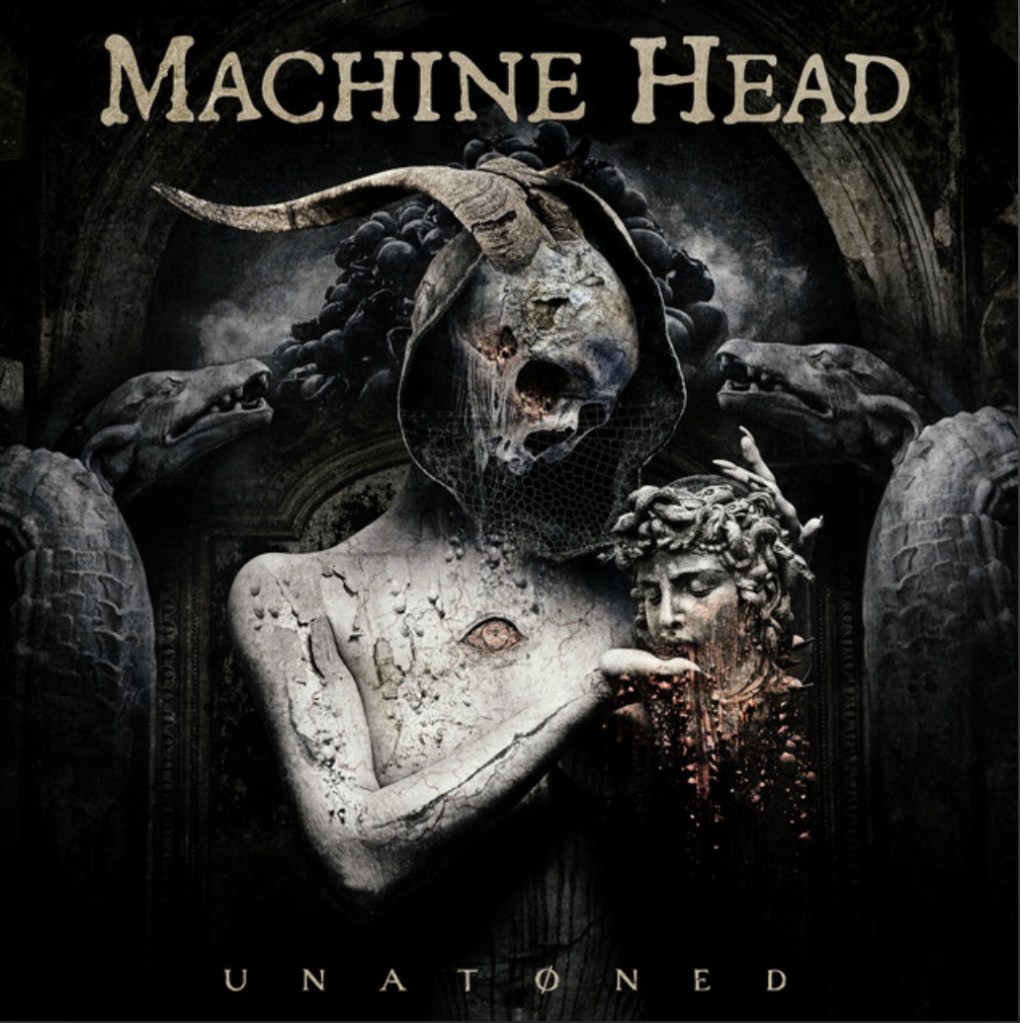
Now, add “Scorn” to that list, lifted from their new record “Unatoned” a fitting name for what feels like both an indictment and a lament.

The opening verse says it all:

“I’m putting you under my spell / ‘Cause I’ve got a Bible to sell
Let go your convictions, restrictions will cost you / Your fiction and all that is well
Distrust all the fable they sell…”

This isn’t subtle. It’s manipulation disguised as salvation. The “Bible to sell” is a loaded metaphor, suggesting the commodification of belief, the weaponization of faith. Convictions and moral boundaries are liabilities here, illusions sold to the weak, while the puppeteers profit.

“I look to the sky / As it won’t be the first / And it won’t be the worst
‘Cause there’s still yet to come / With a nation undone by their Scorn”

Hope?

Maybe.

But not without cynicism. The sky becomes a metaphorical void, once a symbol of transcendence, now indifferent or complicit. The “nation undone” is a clear nod to societal collapse, a warning about the corrosion eating away at public trust, autonomy, and truth.

The chorus drives the point home with venom:

“Scorn / Paranoia seeps through every pore
Scorn / Envenomated eyes emit their scorn”

Yes, “envenomated.”

A rare, brutal word choice. It means poisoned. But more than that, it implies a kind of psychological venom, gazes that don’t just judge but infect. Surveillance becomes psychotropic. The “eyes” don’t just watch; they erode.

“The eye in the sky never rests
Watching to form our arrest
They’re chasing us out of our nests
Keeping tabs as they play us like masters of chess…”

There’s Orwell here, but also something more, this is modern paranoia woven through algorithmic control, deep-state tactics, and manufactured chaos. The image of being driven from nests evokes exile from comfort, from truth, from home.

“I look to the sky / As they give us new rifles / To stifle our words
With a Bible and bulletproof vests / As we suffer their Scorn…”

Weaponized religion. Militarized faith. Truth gets smothered in the name of protection. Resistance becomes treason. Free thought becomes a target.

Thematically, “Scorn” stands shoulder-to-shoulder with:

– Rage Against the Machine’s political fire
– Pink Floyd’s “The Wall” and its suffocating institutional critique
– Dylan’s “Highway 61 Revisited”, where biblical imagery twists through cultural critique
– Metallica’s “…And Justice for All”, where justice is just another rigged game

But “Scorn” isn’t derivative, it’s a culmination. It distills our present-day fears: media manipulation, mass surveillance, the erosion of belief systems, and a creeping spiritual void. It’s a bitter elegy dressed as an anthem.

You don’t just listen to “Scorn”. You endure it, absorb it, and then see the world a little more clearly and perhaps a little more grimly.

Standard
Music, My Stories

Iron Maiden – Live At Qudos Bank Arena, Sydney – 13 September 2024

A proud moment.

2016: My son’s first Iron Maiden concert, “The Book of Souls” tour.

2024: Eight years later, here we are again for “The Days of Future Past” tour.

Of course, we had to buy some merch, again.

And, of course, I had to buy some beers for myself and this time I had the older two riding shotgun. Naturally, this led to the classic “Are you buying alcohol for underage kids?” interrogation.

“Yes, officer, I like to live on the edge, by getting kicked out of an Iron Maiden show before it even starts.”

And let’s not forget the food situation. Kids are always hungry, and I just love paying hundreds of dollars for substandard, borderline offensive stadium meals. But hey, who cares? We weren’t there for the cuisine.

We were there for Maiden.

Iron Maiden’s opening bands don’t get much love in Australia. I remember “Behind Crimson Eyes” getting brutally booed at the “Caught Somewhere Back in Time”Sydney show. But to their credit, they powered through, then covered “Ace of Spades” and just like that, the crowd that wanted them gone was suddenly on their side.

This time, we had Killswitch Engage. Thanks to a heroic battle with traffic and then another war at the merch stalls, I only caught the second half of their set. From what I saw, they were tight, and the crowd gave them a solid response. But everyone was here for one reason.

The ritual begins:

“Doctor Doctor” plays.

The lights go out.

Vangelis’ “Blade Runner” end title starts.

And then—“Caught Somewhere in Time” kicks in.

“Caught Somewhere in Time”

Great opener, but they should’ve played the intro before hitting the fast riff.

Then again, they do the same thing with “Aces High,” so I should’ve seen it coming.

“Stranger in a Strange Land”

A personal favorite. Adrian Smith’s solo is one of those “song within a song” moments. Magic.

“The Writing on the Wall”

Another Adrian masterpiece solo, reminiscent of “Stranger In A Strange Land”.

“Days of Future Past”

Easily one of the best tracks off Senjutsu.

And that verse riff? Adrian again. Starting to see a pattern?

“The Time Machine”

Would you go back in time if you could?

This song has a lot of great riffs, but that harmony section after the first verse stands out.

“The Prisoner”

Wasn’t that excited for this one, until I saw my kids getting into it. Then I had a moment of clarity: open up my mind and enjoy myself.

“Death of the Celts”

Basically Blood Brothers Pt. 2. And I’m 100% okay with that.

“Can I Play With Madness?”

Or as Bruce calls it live: “Can I Play With Agnes?” Apparently, she never answers. Yeah I know, it’s a bad joke.

“Heaven Can Wait”

Wo-oh-oh. Enough said.

“Alexander the Great”

This was the reason I had to be here.

When I dubbed “Somewhere in Time” to cassette, I needed it to fit on a 45-minute side. If I followed the proper tracklist, I’d lose two minutes of “Alexander the Great”.

Unacceptable.

So I recorded Side 2 first, then Side 1, sacrificing part of “Heaven Can Wait” instead. I still got the “woh-oh-ohs’.

“Fear of the Dark”

The crowd sings the leads like it’s “Livin’ on a Prayer”.

“Iron Maiden”

Played at such ridiculous speed, even the term “speed metal” feels inadequate.

“Hell on Earth”

They basically turned the venue into a furnace with all the fire.

But that intro’s clean-tone lead?

Give me a sword and shield, I’m ready for battle.

“The Trooper”

No surprise here. It’s practically a legal requirement for every Maiden setlist.

“Wasted Years”

A perfect closer.

That intro? Instant immortality. Also… yes, I’m a full-blown Adrian Smith fanboy.

No shame.

And then, just like that, it was over.

Who knew this would be Nicko’s last tour behind the kit?

One of the greatest drummers in heavy metal and he did it all with one kick pedal and rock-solid technique.

Another Iron Maiden show in the books. Another legendary night. Another pile of money spent.

Worth every cent.

Standard
Music

Sleep Token – Take Me Back To Eden

I can’t believe I haven’t reviewed this album yet. It is definitely a top 10 album for me in 2023.

I don’t know how to describe it.

At a high level, it is progressive. But it’s not progressive with complex time changes and intricate passages. Its progressive via the songwriting. Each song is varied with different styles and genres thrown in. Verse riffs are different, and the melodies are different between verses on some songs. Some songs don’t even have a Chorus. Just verse after verse. Some songs have a repeating hook that moves between syncopated progressions.

Chokehold

This is the song that grabbed me by the throat and strangled me. It’s that vocal line and that voice, which reminds me of “Take Me To Church” from Hozier.

The Chorus riff crashes in afterwards, but you don’t hear the Chorus words of “you got me in a chokehold” until the next time.

Then the 2nd verse comes in, with arpeggiated lines and another vocal line, different to what came before.

Then the Chorus crashes in and I am hooked. Mesmerized. At 71.2 plus million streams and counting so are a lot of other people.

Even Daughtry covered it for a live performance, just himself and an acoustic guitar. By doing this, Daughtry demonstrated how pop like the melodies are in the song.

The Summoning

This one is almost at 150 plus million streams.

If you jumped into the band because of “Chokehold” this song might change your mind because its got screaming vocals, intricate atmospheric guitar playing which reminds me of “Between The Buried And Me” and other vocal lines that wouldn’t be lost on the “White Pony” Deftones album.

If anything, it follows the vibe of what people recognize as “Djent”.

The section from the minute mark is essential listening because it comes out of nowhere. Its almost soul like, more Imagine Dragons and One Republic than metal or djent.

Brilliant stuff and I like the variation.

Granite

A synth line kicks off the song, which sounds like it was written on the TonePad iPhone app.

And the song lives in this environment, very pop like and I like it. Then a jarring, math like riff kicks in at 2.40 mark. It could get boring, but then the infectious vocal melody from earlier is sung over it and its worth your attention.

Aqua Regia

The synth/keyboards is a very dominant instrument in Sleep Token. It lives in its atmospheric synth world and doesn’t jar me, but that doesn’t mean it’s a crap song. On the contrary.

Vore

It spends the first minutes with ghoul like vocals, almost black metal guttural before it moves into clean tone vocals which makes me feel I am on top of Mt Everest and I am screaming my lungs out.

That section from 3.50. Listen to it.

Ascensionism

The piano line is hypnotic, and it grabs my attention straight away.

Then at 1.50 it’s a hip hop like song, with autotune and all the bells and whistles which comes with that genre.

Then at 3.44 its back to that haunting piano line and then the distortion guitars kick in and I am sick from all the movements within the song.

Progressive it is, purely from blending their influences expertly.

And that riff from 4.44, is doom metal, with a screaming ghostly scream. Then its back to the hypnotic piano line at the 5.25 mark. But there is still 2 minutes to go.

Make sure you stick around for the last 45 seconds. It’s worth it.

Are You Really, Okay?

A clean tone guitar riff and I feel like I am at a campfire. Its heartland like stuff.

The vocals are all clean tone, enhancing the emotion. When the drums come in, it feels like a Neil Young album, but I cant shake the feeling of “Albatross” from Fleetwood Mac that the song gives me.

The Apparition

“Why are you never real whenever you appear?”

It’s the opening line, over a clean tone fingerpicked guitar riff. It’s almost Spanish like in its feel.

Then a synth line kicks in, demanding attention. Hip hop like drums come in and I am paying attention to see what kind of journey this song would take me on. But it percolates in this vibe.

Then at 2.24 it takes off, with soaring vocals over a math like guitar riff. Its catchy and I am on the magic carpet ride the song offers, soaring between galaxies and the afterlife.

DYWTYLM

It stands for “Do You Wish That You Loved Me”.

The main keyboard riff has sonics that remind me of the TonePad app. It wouldn’t be out of place on an Imagine Dragons album or on one of Daughtry’s albums between 2013 and 2017. Its memorable
and dance like and it lives in this vibe for the whole song.

Rain

It’s at 16 million streams on Spotify. Another piano riff and a catchy vocal melody. And the song just builds.

Take Me Back To Eden

The title track is almost at 67.5 million streams on Spotify. You feel like you are at a nature retreat and the start of the song has that vibe, soothing and relaxing. Even the words like crystal waters, dream in phosphorus and perfect ocases

At 2.30 the distortion kicks in and those soaring vocals are back. Its been a theme of the album, to have these kind of soaring vocals. But at 3.23, it goes to hip-hop and you could think that you are ears deep into an Enimen album.

At 4.44 another hanting section comes in with piano and then when the distortion kicks in, its hopeful, iuts sad but still hopeful. And it lives in this vibe until the end. With the last 50 seconds jarring me out of my nature retreat with screaming vocals which came out from nowhere. And I suppoise this is Sleep Token with so many variables and movements in their songs.

Euclid

My favorite track on the album. As soon as the first notes of the piano riff started I was hooked. The vocal line is hypnotic and it’s a cross between Daughtry and Hozier.

And the way the song builds is perfection.

Press play and allow your ears to take you on a journey.

Standard
A to Z of Making It, Influenced, Music, My Stories

The Record Vault: Dream Theater – Master Of Puppets

The cover above is the version I have, released in 2004 via their own YtseJam label.

It was also re-released in 2021 via the “Lost Not Forgotten” Archives with the below cover.

The performance of this album would inspire the writing for their most Metal album in “Train Of Thought”.

The show was recorded live in Barcelona, Spain on February 19th 2002. It was the second night of a two night stand in a city.

And it was the start of a new Dream Theater tradition (while Mike Portnoy was in the band), which was to play an entire album from another band.

This is what Mike Portnoy had to say about it in the CD booklet;

“Dream Theater is playing the 2nd night of a 2 night stand in Barcelona, Spain…

After an almost 2 hour set of DT material and a 15 minute intermission, the lights went out and the opening chords to “Battery”
began…

50 minutes later, the Spanish crowd had no idea what had hit them.

The next day the word was all over the internet and our new tradition to cover a classic album whenever we did a 2 night stand in the same city had been established…but for those 50 minutes in Barcelona, the completely unsuspecting crowd had no way to see it coming…

I remember looking into the crowd by the time we started “The Thing That Should Not Be” and seeing people look at each other like;

“Holy shit…they’re doing the whole
fucking thing!!!”.

Yep, that would have been the same response I would have had.

The band for the recording is James LaBrie on vocals, John Petrucci on guitars, Mike Portnoy on drums, John Myung on bass and Jordan Rudess on keys.

Battery

This is performed exceptionally.

LaBrie also brings out the chainsaw aggression of a youthful Hetfield.

Petrucci and Portnoy nail their sections.

Master Of Puppets

As soon as Petrucci plays the first four chords the crowd responds. If this song is played again in 2024, it will be bigger than ever due to “Stranger Things”.

The Thing That Should Not Be

The Intro with the keys is more ominous.

And LaBrie gives the song a more theatrical vibe with an octave higher vocal line, and I like it. It would have been cool if Dream Theater explored the groove doom Metal domain.

Sanitarium

Masterful.

It’s the only way I can describe Petrucci. The intro, acoustic and lead, played by Petrucci is exactly that.

LaBrie tries but doesn’t have the same demented vocal delivery as Hetfield here.

From 3.36, it’s basically a Dream Theater song, with riffs, leads and sporadic vocals. LaBrie is awesome here, his “fear of living on” delivery; excellent.

Disposable Heroes

The drums sound like machine gun fire in the intro.

But it’s that galloping palm muted E string riff that comes after which seals the deal for me.

LaBrie delivers a great vocal here.

Jordan Rudess in an interview with the Revolver Magazine said this;

“Master of Puppets was an eye opener for me because before we covered this album my Metallica knowledge was not so deep.

Having grown up playing Bach, Liszt and Chopin the idea of technique and virtuosities had a definite place in my mind. I have to admit that upon discovering Metallica my perception of technique opened up to other possibilities outside of the classical world.

A song like ‘Disposable Heroes’ sounds like machine-gun fire to me. The blistering, galloping guitar rhythms that sound like the pick is about to go up in flames is an impressive display of intensity and technique. [James] Hetfield really shows what he is made of in a track like this one and I was very impressed.”

Leper Messiah

I always love the section from 40 seconds to a minute. The groove behind it and the way the guitars are orchestrated so that the bass and drums stand out.

Orion

It’s right up Dream Theater’s alley, a nine minute instrumental. And a classic Metallica song.

Damage Inc

They had covered this song previously during the era between “Awake” and “A Change Of Seasons” and released a version of that live performance.

Overall people can compare this album with the real album and find issues.

When an artist covers another artist, it is purely for fun initially and to show respect to the artist who inspired and influenced them.

This is no different and it sounds like the band is having fun, using the last hour of the their three hour set to pay homage to Metallica.

Press play and enjoy.

Standard
Classic Songs to Be Discovered, Influenced, Music, My Stories

The Case For Cryptic Writings

It’s 1996 and you are writing riffs for your next album. Your first four albums pushed the boundaries of technical thrash metal. Your last two albums went for more accessible song structures, which gave you radio airtime.

Seattle came and went but its cultural changes remained. Industrial Metal was becoming a thing, Alternative Rock, EMO and Goth Metal/Rock were slowly becoming a thing.

Your label wants to sell albums and the only way you can sell albums in their eyes is by having your songs on the radio.

You also fired your previous manager, as you believed that he was also taking a paycheck from the label. He reckons he wasn’t but hey that’s a story for another day.

So what do you do?

These were the questions that Dave Mustaine had to answer in 1996.

This wasn’t the Dave from ten years ago, addicted to drugs and with nothing to lose. This Dave had something to lose now, a family and a corporate machine called Megadeth.

Freedom to do what you want doesn’t come when you have something to lose. In addition, this Dave had been in and out of rehab since 1988, and he just finished another rehab stint just before the “Cryptic Writings” sessions started.

Oh, and by the way, his band was also splintering.

Actually his band was always splintering, but the longest running version of Megadeth was splintering. For those who don’t know, this version involves Marty Friedman, David Ellefson and Nick Menza (RIP).

Dan Huff is producing and the new management company ESP Management was led by Bud Prager, who had guided Foreigner from a small time rock band to an 80 million seller.

Mustaine still had a chip on his shoulder from a certain band he was in and he “wanted what Metallica had even if it meant selling a piece of his soul to the devil” (his exact words on page 276 of his bio).

Trust

The drum intro. Its familiar.

Avenged Sevenfold were very heavily influenced by it for their opening track “Shepherd Of Fire” on the “Hail To The King” album. Metallica had “Enter Sandman” before this and the great AC/DC had “Dirty Deeds (Done Dirt Cheap) before all of em.

Once a great drum hook, it’s always a great drum hook.

If I look into my crystal ball, I can see the heirs of the artists or the Corporations that would end up owning the Copyrights litigating against others for this drum groove in the future.

When that riff kicks in, its head banging time. Yes the tempo is slower, the song is more accessible but it wasn’t a sell out. This was still very much Megadeth.

The Chorus; anthemic.

Apart from becoming a set list staple, it’s also their biggest hit single.

Almost Honest

That intro riff.

It’s bone crunching with a feel and vibe from AC/DC and a Major key Chorus which is a massive no-no to the Minor key Thrash community.

In the end, Mustaine was trying to rewrite “Symphony Of Destruction” and he got a song that sounded similar but different enough to stand on its own.

Very accessible but still very much like Megadeth.

Use The Man

Alternative rock or Grunge. Take your pick as it’s still rock and metal to me.

Plus I always like it when artists take what is popular at the time and still make it sound like their sound.

Mastermind

An intro riff influenced by “Walk This Way”.

The verses are demented, perfect for Mustaines snarling.

The Disintegrators

It’s fast and thrashing like the old Megadeth, but with more melody in the vocals.

If the main riff sounds familiar, Mr Hetfield was obviously influenced as “Lux Aterna” has a similar riff.

Then again, both Mustaine and Hetfield are influenced by the NWOBHM and this riff is from that movements playbook.

And the solo. Brilliant.

At 3:04, it’s over and the only thing left to do is to press play again.

I’ll Get Even

It’s got the same playbook as “Almost Human” but with clean tone in the verses and a psychedelic alternative rock Chorus.

And how good is the bass groove, locked in with the drums.

SIN

It’s accessible but it’s still Megadeth. The riffs are angry and head banging.

A Secret Place

From writing an accessible album, they came up with a classic, a song that still does the rounds in the live show.

As soon as the Intro kicks in, I was hooked.

Have Cool, Will Travel

The harmonica, and a groove reminiscent of “American Woman”, yet it still feels like a Megadeth track.

She-Wolf

A masterpiece.

Make sure you stick around for the Outro harmony section.

Vortex

Another classic but this one gets no love.

It’s a fast cut influenced by the NWOBHM especially Judas Priest, with a demented Mustaine snarl in the verses and an anthemic melodic chorus.

FFF

The fast punk that Megadeth is known for is evidenced here. Definitely a forgotten track.

The Wrap Up

The album achieved a Platinum certification but it didn’t bring in a new audience as Mustaine and his new management team had anticipated.

I read that hard core fans were confused. They liked it but didn’t like it completely. That viewpoint never made sense to me as I see myself as a hard core fan and I like it alot.

Mustaine mentioned in his book that by “trying to become more melodic and still remaining true to their metal roots”, he alienated his core fans with this album as he didn’t get the mixture right.

A terrible Howard Stern interview didn’t help matters either. And during the tour, Nick Menza was booted with Jimmy DeGrasso replacing him. However Menza would still return for the next album.

Overall, “Cryptic Writings” is a great album. The concise songwriting and simple arrangements suited Mustaine and for me, having this album in 1996 was a godsend, compared to some of the other confused albums my favorite artists started delivering during this period.

If you haven’t heard it, hear it. If you have heard it, hear it again.

\::/

Standard
A to Z of Making It, Classic Songs to Be Discovered, Derivative Works, Influenced, Music

The Case For “Unmasked”

Gene Simmons hated it.

Paul Stanley called it wimpy.

Ace Frehley didn’t get the memo that the album was meant to be a pop rock album.

Peter Criss, well he just didn’t participate.

And I was confused why Paul Stanley didn’t use Desmond Child again, since their hit from “Dynasty” was co-written with him.

Instead Vini Poncia, who produced the album, co-wrote most of the tracks.

In case you are confused, I’m writing about “Unmasked” released in 1980.

It didn’t meet commercial expectations in the North American market however it did very good business in Northern Europe.

And in Australia, it sold more than 110,000 copies on the first day of its release and 3,000 more were stolen from a truck on the way to stores. Well, this is according to the Sydney Morning Herald.

You see “Kissmania” or “Kissteria” in Australia was about 4 years behind their U.S. peak.

It didn’t sound like past Kiss, but this record definitely gave the power pop / melodic rock scene a good kick in the ass. You had bands like The Raspberries and Small Faces, but suddenly you could mention Kiss in the same sentence.

Its influence on the Scandinavian market is large and it’s no surprise that a lot of melodic pop and rock artists and songwriters have come from these markets.

Is That You?

The opening track and it’s not even written by a Kiss member.

But it is the parent to “Lick It Up”.

Listen to the verse riffs in both. The feel and groove is the same. The layered backing vocals are also great, something which Def Leppard mastered with Mutt Lange.

And Stanley always challenged himself vocally, the falsettos on the pre-chorus are braver than the ball tearers on “I Was Made Lovin You”.

On a side note, as a solo artist, McMahon’s 15 minutes of fame came with “Cry Little Sister” from “The Lost Boys” movie, 7 years later.

Shandi

Australia was also going through a “disco ABBA mania craze”, so it’s no surprise that a crossover disco/rock pop ballad went huge here.

And if ABBA wasnt doing music like this anymore, fans would always look to others to fill the void.

If you want to hear what inspired it, press play on the song “Tomorrow” from Joe Walsh. Paul basically lifted the first 60 seconds from it. And Joe Walsh is far from wimpy.

Talk To Me

Ace steps up with a rocker, which did good business as a single in Switzerland, Germany, Netherlands and Australia.

It has an intro riff that sounds like it was influenced by Rick Springfield’s “Jessie’s Girl”.

The major key riffage in the Chorus reminds me of “Do Ya” from ELO.

Naked City

My favorite song on the album and one of Gene Simmons best, giving melodic rock music some grit.

It’s written by a committee involving Simmons, Poncia, Bob Kulick and Peppy Castro.

Ace even contributed a solo, while Anton Fig and Bob Kulick did the drums and guitars.

But it all started with Bob Kulick who had the guitar riff and he demoed the song with Peppy Castro.

But the final recorded version didn’t make Bob happy and he has said that “Kiss ruined “Naked City”.

Ruined or not, it’s my favorite. And if the demo is available anywhere, please share it.

What Makes The World Go Round

I always like it when artists take influences from different styles of music.

In this case, Paul is taking inspiration from soul act, The Spinners and fusing hard rock, pop, soul and R&B into a unique style that still sounds like a rock song.

How good is the Chorus?

Tomorrow

My second favorite.

The power pop of 2000’s acts like Wheatus, Good Charlotte and the like is right here.

It might sound light on the rock, but inside the song you’ll hear a feel and vibe from “Coming Home”.

It’s also influenced by “Tonight” from The Raspberries along with Rick Springfield.

And even the most hardened rocker cannot resist singing along to the Chorus.

Two Sides Of The Coin

More ELO meets Free from the Spaceman.

I forgot to mention on “Talk To Me” that Ace employs an Open G tuning, a tuning popular with slide players because with one finger they can play a chord instead of fretting the chord. He also employs this Open G tuning here.

Keith Richards was a well known user of this tuning, however many believed that Keith used this tuning because of how wasted he was. It’s easier to play with one finger than four. And that same view point was held for Ace, however if you look at interviews during this period you cannot see or hear Ace sounding wasted.

The lyrics are dumb but then again Kiss weren’t scholars when it came to lyrics, so that’s what makes their music fun.

She’s So European

Press play for the intro. That’s all you need to listen to here.

Then again Gene Simmons does a good job on the lyrics and melodies as well, about a girl with a glass of pink champagne and well you can read the rest.

Easy As It Seems

Another favorite.

Paul is the star of the song. His bass riff is sinister, yet groovy and his sense of melody elevates the track.

I’m also a fan of The Pretenders and it looks like Paul was influenced by them as their song “Mystery Achievement” came out in January, 1980 and Kiss released their album in May 1980.

Check em out, they are both great songs.

Torpedo Girl

Press play for that rhythm and blues swing drum groove and stick around to hear Ace summon Joe Walsh for the verse riff and The Beach Boys for the Chorus.

You’re All That I Want

It has that feel of early Kiss musically. And somehow it gets no love.

The Wrap Up

They didn’t tour the North American market, but they did hit Europe, Australia and New Zealand. It kept em in business.

On Australian TV they also got a lot of press and interviews.

They appeared on the Australian “60 Minutes”. The segment is on YouTube if you want to see it. Bill Aucion was also interviewed, telling the interviewer how Kiss was turning over $120 million a year, and how he was looking to get the band into movies and comic books.

We sort of know how that turned out with “The Elder”.

A few things to note for 1980.

AC/DC dropped “Back In Black”, a slab of hard and bluesy rock that proved you can be commercially successful during this period playing that style of music.

The NWOBHM was also gaining momentum. This was even harder sounding and more abrasive than AC/DC and it also had an audience that was growing.

Most of the acts who had success in the 70s were either broken up, or on their last legs with the original members and looking to bring in new members.

So I understand the “wimpy” and “not sound like Kiss” comments, but this album has aged well because so many of the songs are so well written.

For a band that was just not functioning anymore they still found a way to deliver a great album.

Standard
A to Z of Making It, Influenced, Music, My Stories, Unsung Heroes

Four For Friday

A short one today.

IN THIS MOMENT

What happened to em?

“The Dream” and “A Star Crossed Wasteland” are great albums of melodic rock/Metal.

And then the transition started to the point where there is nothing recognizable or worth liking on their new album “Godmode”.

DOKKEN

A new album is out but if you can’t put any effort into the singing, why bother.

It’s the same monotone throughout, which is a shame because songs like “Lost In You”, “I Remember”, “Saving Grace”, “Fugitive” and “Gypsy” could have been great if the vocal delivery had emotion.

LYNCH MOB

George Lynch sure keeps busy and as a fan of the 80s, I like it.

And Mr Scary has still got a lot of things to say with his riffs. And Frontiers Records is keen to give him a platform to showcase his riffs.

So here we are with “Babylon”, the 8th Lynch Mob album. The difference between Lynch Mob and other artists from the 80s is the singers.

Gabriel Colon is a great vocalist with a great tone. He is the X Factor here. On the Metal cuts, it feels like Halford. On the rock cuts, its loose, sleazy and rawk.

And if Lynch could keep him around he has a lot of albums with him.

For the Metal check out “How You Fall”.

For the Rock check out “I’m Ready” and it’s nod to the great EVH.

ANY GIVEN SIN

The song “Dynamite” came up on a playlist and I pressed save instantly. It reminded me of Shinedown and it’s a great act to be associated with.

What do you guys think of em?

And that’s a wrap for this week.

Standard
Classic Songs to Be Discovered, Derivative Works, Influenced, Music, My Stories, Unsung Heroes

Tony Martin – Sweet Elyse

“Sweet Elyse” was released on the solo album, “Back Where I Belong” in 1992 on Polydor. Tony Martin decided to do a solo album when his Black Sabbath project was doing its “Dehumanizer/Dio” project.

Production was done by Nick Tauber, who is best know for his work with Thin Lizzy and Marillion.

The album is not on Spotify, which irks me. But YouTube has a lot of uploads from fans, who call Tony Martin the best Sabbath vocalist ever.

And “Back Where I Belong” is not available anywhere to buy these days, unless someone’s selling a second hand copy.

The reason why it’s not available are varied. When Martin rejoined Black Sabbath, Polydor deleted the album from their catalogue and took it off the shelves.

And somehow his manager at the time owns the entire rights to this album, which gets me thinking “how the hell did the manager pull that off” and “how is Copyright protecting the artist at this moment to give the artist an incentive to create”.

But I have seen interviews and posts where Martin mentions how he wants this album re-released and the label Battlegod Productions, which is the label for his solo album “Thorns”, is in negotiations for it.

The track burns from the start and it reminds me of songs like “Highway Star”, “Burn” and “Speed King” from Deep Purple.

And I like the familiarity.

The session line up for the song is also impressive.

Nigel Glockler from Saxon pounds those drums and Neil Murray from Whitesnake is the master of the groove.

Tony Martin also shows off his guitar prowess as he, Paul Wright and Carlo Fragnito play the rhythm guitars with Richard Cottle on the keys.

There are also demos floating around the internet of this album which has Tony Martin playing all the guitars.

For the solo, Adrian Dawson brings out his Blackmore influences. And it’s excellent.

Crank it.

Standard