A to Z of Making It, Classic Songs to Be Discovered, Derivative Works, Influenced, Music

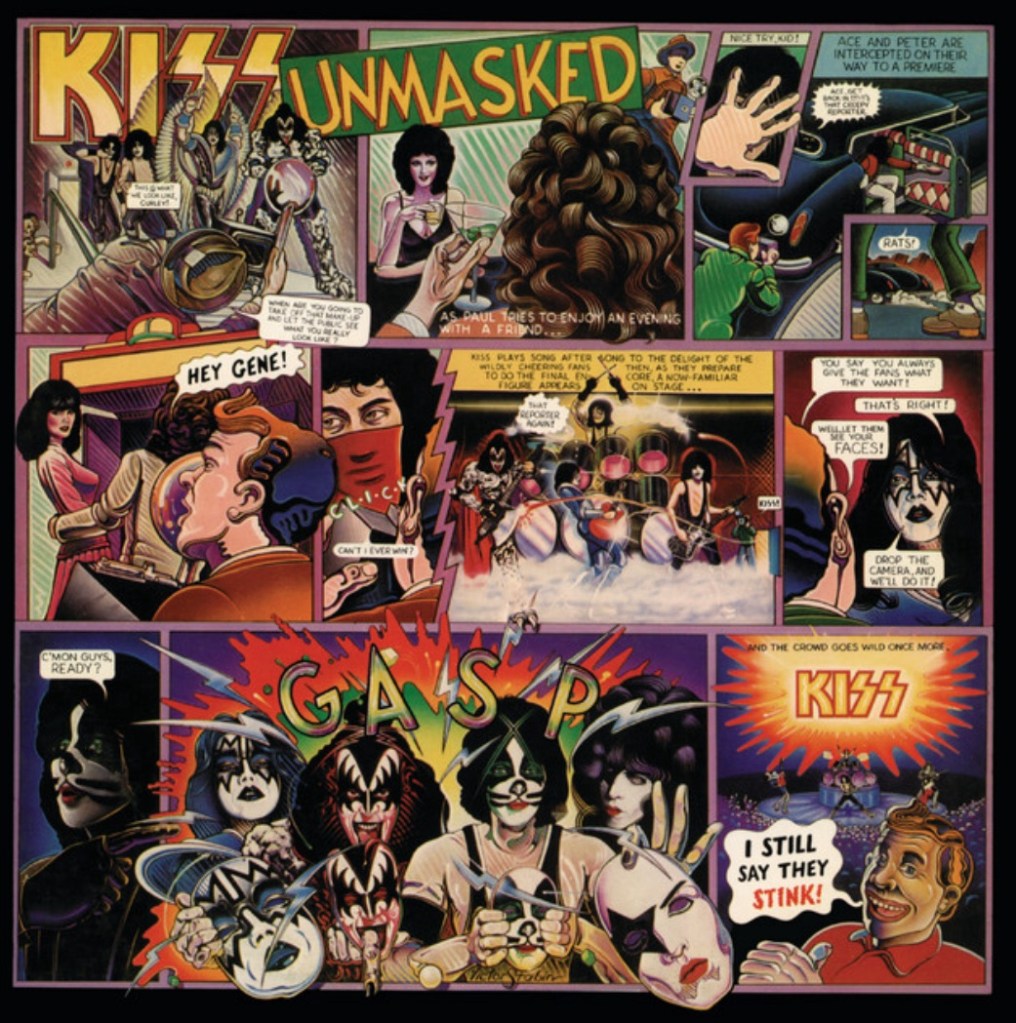
The Case For “Unmasked”

Gene Simmons hated it.

Paul Stanley called it wimpy.

Ace Frehley didn’t get the memo that the album was meant to be a pop rock album.

Peter Criss, well he just didn’t participate.

And I was confused why Paul Stanley didn’t use Desmond Child again, since their hit from “Dynasty” was co-written with him.

Instead Vini Poncia, who produced the album, co-wrote most of the tracks.

In case you are confused, I’m writing about “Unmasked” released in 1980.

It didn’t meet commercial expectations in the North American market however it did very good business in Northern Europe.

And in Australia, it sold more than 110,000 copies on the first day of its release and 3,000 more were stolen from a truck on the way to stores. Well, this is according to the Sydney Morning Herald.

You see “Kissmania” or “Kissteria” in Australia was about 4 years behind their U.S. peak.

It didn’t sound like past Kiss, but this record definitely gave the power pop / melodic rock scene a good kick in the ass. You had bands like The Raspberries and Small Faces, but suddenly you could mention Kiss in the same sentence.

Its influence on the Scandinavian market is large and it’s no surprise that a lot of melodic pop and rock artists and songwriters have come from these markets.

Is That You?

The opening track and it’s not even written by a Kiss member.

But it is the parent to “Lick It Up”.

Listen to the verse riffs in both. The feel and groove is the same. The layered backing vocals are also great, something which Def Leppard mastered with Mutt Lange.

And Stanley always challenged himself vocally, the falsettos on the pre-chorus are braver than the ball tearers on “I Was Made Lovin You”.

On a side note, as a solo artist, McMahon’s 15 minutes of fame came with “Cry Little Sister” from “The Lost Boys” movie, 7 years later.

Shandi

Australia was also going through a “disco ABBA mania craze”, so it’s no surprise that a crossover disco/rock pop ballad went huge here.

And if ABBA wasnt doing music like this anymore, fans would always look to others to fill the void.

If you want to hear what inspired it, press play on the song “Tomorrow” from Joe Walsh. Paul basically lifted the first 60 seconds from it. And Joe Walsh is far from wimpy.

Talk To Me

Ace steps up with a rocker, which did good business as a single in Switzerland, Germany, Netherlands and Australia.

It has an intro riff that sounds like it was influenced by Rick Springfield’s “Jessie’s Girl”.

The major key riffage in the Chorus reminds me of “Do Ya” from ELO.

Naked City

My favorite song on the album and one of Gene Simmons best, giving melodic rock music some grit.

It’s written by a committee involving Simmons, Poncia, Bob Kulick and Peppy Castro.

Ace even contributed a solo, while Anton Fig and Bob Kulick did the drums and guitars.

But it all started with Bob Kulick who had the guitar riff and he demoed the song with Peppy Castro.

But the final recorded version didn’t make Bob happy and he has said that “Kiss ruined “Naked City”.

Ruined or not, it’s my favorite. And if the demo is available anywhere, please share it.

What Makes The World Go Round

I always like it when artists take influences from different styles of music.

In this case, Paul is taking inspiration from soul act, The Spinners and fusing hard rock, pop, soul and R&B into a unique style that still sounds like a rock song.

How good is the Chorus?

Tomorrow

My second favorite.

The power pop of 2000’s acts like Wheatus, Good Charlotte and the like is right here.

It might sound light on the rock, but inside the song you’ll hear a feel and vibe from “Coming Home”.

It’s also influenced by “Tonight” from The Raspberries along with Rick Springfield.

And even the most hardened rocker cannot resist singing along to the Chorus.

Two Sides Of The Coin

More ELO meets Free from the Spaceman.

I forgot to mention on “Talk To Me” that Ace employs an Open G tuning, a tuning popular with slide players because with one finger they can play a chord instead of fretting the chord. He also employs this Open G tuning here.

Keith Richards was a well known user of this tuning, however many believed that Keith used this tuning because of how wasted he was. It’s easier to play with one finger than four. And that same view point was held for Ace, however if you look at interviews during this period you cannot see or hear Ace sounding wasted.

The lyrics are dumb but then again Kiss weren’t scholars when it came to lyrics, so that’s what makes their music fun.

She’s So European

Press play for the intro. That’s all you need to listen to here.

Then again Gene Simmons does a good job on the lyrics and melodies as well, about a girl with a glass of pink champagne and well you can read the rest.

Easy As It Seems

Another favorite.

Paul is the star of the song. His bass riff is sinister, yet groovy and his sense of melody elevates the track.

I’m also a fan of The Pretenders and it looks like Paul was influenced by them as their song “Mystery Achievement” came out in January, 1980 and Kiss released their album in May 1980.

Check em out, they are both great songs.

Torpedo Girl

Press play for that rhythm and blues swing drum groove and stick around to hear Ace summon Joe Walsh for the verse riff and The Beach Boys for the Chorus.

You’re All That I Want

It has that feel of early Kiss musically. And somehow it gets no love.

The Wrap Up

They didn’t tour the North American market, but they did hit Europe, Australia and New Zealand. It kept em in business.

On Australian TV they also got a lot of press and interviews.

They appeared on the Australian “60 Minutes”. The segment is on YouTube if you want to see it. Bill Aucion was also interviewed, telling the interviewer how Kiss was turning over $120 million a year, and how he was looking to get the band into movies and comic books.

We sort of know how that turned out with “The Elder”.

A few things to note for 1980.

AC/DC dropped “Back In Black”, a slab of hard and bluesy rock that proved you can be commercially successful during this period playing that style of music.

The NWOBHM was also gaining momentum. This was even harder sounding and more abrasive than AC/DC and it also had an audience that was growing.

Most of the acts who had success in the 70s were either broken up, or on their last legs with the original members and looking to bring in new members.

So I understand the “wimpy” and “not sound like Kiss” comments, but this album has aged well because so many of the songs are so well written.

For a band that was just not functioning anymore they still found a way to deliver a great album.

Standard
A to Z of Making It, Copyright, Music, My Stories, Treating Fans Like Shit

Four For Friday

TAX THE HELL OUT OF YOU

Motley Crue and Def Leppard came and they left, but not without complaints.

Tommy Lee walked into a 7-Eleven and purchased 4 packets of Marlboro Gold 25s in Melbourne.

The price. $251.96 AUD.

Yep welcome to Australia, Mr Lee, the place that loves to tax the hell out of you on everything and on top of that, has the highest tobacco taxes in the world as well. Basically 77% of the retail price is taxes.

If Tommy Lee purchased four packets in the US, it would have cost him $32USD which translates to $48AUD.

And no I didn’t go watch em. I’ve seen Motley Crue too many times and while I haven’t seen Def Leppard play, the price for the tickets was way too high and it was outdoors which I hate.

REISSUES

Remember when Metallica wanted to release the “Metal Up Your Arse” cassette tape as part of the “Kill Em All” reissue or maybe it was for a special Record Store Day release.

Anyway that got shot down by Dave Mustaine because he wouldn’t accept giving song writing credits to Lars Ulrich on songs he didn’t or was involved in writing.

Fast forward a few years and Linkin Park looks like they are in trouble with a former bassist.

As the Billboard article states;

Linkin Park is facing a lawsuit that claims it has refused to credit or pay royalties to an ex-bassist who played with the band in the late 1990s — a legal battle triggered by an anniversary re-release of the band’s smash hit 2000 debut album.

RE-RECORDINGS

The labels are up to their usual tricks again. They seem to forget that they are irrelevant without the artists.

Their whole business model is making money from music. So when they knew in the 60s that songs would become copyright free they lobbied hard and got laws in place to ensure their business model survives for a long time.

But Taylor Swift really messed with this by redoing her albums under her own control. This made the original recordings held by the labels basically worth a lot less.

And now they want to stop that.

I think if an artist wants to re-record a song or an album they created they should be free to do whatever they want.

And it was standard practice for artists to have re-recording rights either two years after their contract expires, or five to seven years after the original recording is released.

MONEY IN MUSIC

Warner Music Group Corp released its full year earnings.

And the take away is, they have earned over $6 billion in yearly revenue for the first time.

How much of that has filtered down to the creators?

Standard
A to Z of Making It, Copyright, Music, My Stories

Four For Friday

A special Australian edition today.

STREAMING

The one thing I like about streaming services is how songs from the past can come back with a vengeance and dominate.

A lot of the times this happens when an artist passes away but it also happens in other ways.

“RipTide” from Vance Joy is over 10 years old and it’s dominating again on streaming and since the charts include streaming numbers it’s back at number 1.

Not a bad place to be especially when the artist doesn’t have anything new released.

LIVE VENUES

Once upon a time, an artist had to play as many places as they could to build a following.

That worked when those places had people there to watch live music. But when people stopped going out to venues to watch live music, it’s a bit hard to build a following when there is no one watching.

So it’s no surprise that venues in Australia are closing. While the headline alludes that these venues are closing due to the pandemic, the truth is, live music venues have been challenged for years.

The sad thing is that the government doesn’t care about the Arts in Australia. So without tax incentives and funding, the Arts will suffer.

LEAVING THE INDUSTRY

So it’s no surprise that at least 50% of artists currently working are thinking about leaving the industry in Australia.

The mass migration. And from that group, 55% are women. As the article states;

Commonly cited reasons within the survey include financial pressures, time constraints, mental health and burnout, a lack of opportunities and a lack of support.

And live gigs make up 60 percent of their incomes but when the venues get less and less, this will shrink as well, unless they are large enough to play clubs and theatres.

MONEY IN AUSTRALIAN MUSIC

APRA AMCOS collects royalties and licensing for Australian artists. For 2023, they collected $690.5m with $595.2m distributed to artists.

In total, 1,628,107 unique compositions earned money.

For a small market, it’s a lot of money. But it’s a good market. And if the Government showed interest, it could be a great market.

Standard
A to Z of Making It, Influenced, Music, My Stories, Unsung Heroes

Four For Friday

A short one today.

IN THIS MOMENT

What happened to em?

“The Dream” and “A Star Crossed Wasteland” are great albums of melodic rock/Metal.

And then the transition started to the point where there is nothing recognizable or worth liking on their new album “Godmode”.

DOKKEN

A new album is out but if you can’t put any effort into the singing, why bother.

It’s the same monotone throughout, which is a shame because songs like “Lost In You”, “I Remember”, “Saving Grace”, “Fugitive” and “Gypsy” could have been great if the vocal delivery had emotion.

LYNCH MOB

George Lynch sure keeps busy and as a fan of the 80s, I like it.

And Mr Scary has still got a lot of things to say with his riffs. And Frontiers Records is keen to give him a platform to showcase his riffs.

So here we are with “Babylon”, the 8th Lynch Mob album. The difference between Lynch Mob and other artists from the 80s is the singers.

Gabriel Colon is a great vocalist with a great tone. He is the X Factor here. On the Metal cuts, it feels like Halford. On the rock cuts, its loose, sleazy and rawk.

And if Lynch could keep him around he has a lot of albums with him.

For the Metal check out “How You Fall”.

For the Rock check out “I’m Ready” and it’s nod to the great EVH.

ANY GIVEN SIN

The song “Dynamite” came up on a playlist and I pressed save instantly. It reminded me of Shinedown and it’s a great act to be associated with.

What do you guys think of em?

And that’s a wrap for this week.

Standard
A to Z of Making It, Copyright, Music, My Stories, Stupidity

Four For Friday

It’s a SPOTIFY and HIPGNOSIS special today.

The article I am referencing is from Music Business Worldwide.

NEW ROYALTY MODEL

There will be an annual stream count that artists must meet in order to start generating Spotify royalties.

Spotify is targeting a tiny proportion of tracks on its service that are very low in popularity.

In total, the tracks Spotify is targeting, generate royalties that when combined add up to tens of millions of dollars a year. If no action is taken, these tracks accumulated together will generate around $40 million.

SO WHAT HAPPENS TO THE $40 MILLION?

It will go back into Spotify’s ‘Streamshare’ royalty pot.

And the monies in the pot will be re-distributed amongst the tracks that are, more popular.

Take from the poor so that the rich get richer.

Spotify is telling the world that this targets the royalty payouts whose value is being destroyed or who are not even being paid to the creators because they haven’t met the digital aggregator minimum level for payments. And they are sitting in their bank accounts, earning interest.

Spotify seems to forget that every artist begins with low plays/streams.

MMM. SO THIS HELPS THE ARTISTS HOW

So while Spotify is thinking of keeping streaming money in their bank account to pay the larger artists, Hipgnosis who is an investment fund is doing something fishy.

As you probably are aware, Hipgnosis purchased a lot of rights to valuable intellectual properties. It’s share price doesn’t reflect what the company believes it’s worth.

It wanted to do something sneaky to inflate or boost its share price by selling a stake of the company to another entity owned by Hipgnosis and to use the profits of the sale to pay down debt.

This was all contingent on some mathematical equations about retroactive Copyright payments from the US.

Hipgnosis estimated they were due USD$21.7M however when all the dust settled they are only getting $9.9 million.

So they had this share but back scheme which they have now shelved and their share price went down even further.

All of these schemes and creative accounts on the backs of the rights they own from artists.

And Yes, I do know that the artists sold their rights to Hipgnosis for a large fee.

Standard
Classic Songs to Be Discovered, Copyright, Derivative Works, Influenced, Music, My Stories

Four For Friday

I’ve written posts about songs which sound similar to songs which came before, with the lens solely focused on hard rock and heavy metal.

Like.

One Riff To Rule Them All

The Kashmir Effect

The Kashmir Effect 2

The While My Guitar Sleeps Effect

Sanitarium Debate

Just to name a few.

And I’ve always thought that Led Zeppelin and Black Sabbath shared a connection musically but I’ve never verbalized it or wrote about it.

The viewpoint came from a 1995 documentary called “History Of Rock and Roll”, which has Ozzy recalling how “Led Zeppelin I” had a huge impact on him and his bandmates.

Let’s see what kind of impact.

DAZED AND CONFUSED (1969) vs PARANOID (1970)

The authorship of “Dazed and Confused” is heavily disputed and there are various pages out there specifying who wrote what and when.

But, for the sake of this post I will focus on the Led Zeppelin version.

There is a section in “Dazed and Confused” at the 5.02 mark that sounds very similar to the Intro in “Paranoid”.

COMMUNICATION BREAKDOWN (1969) vs PARANOID (1970)

Then the verse riff in “Paranoid” has a running E pedal point played over an E5 power chord for two bars, then a D5 power chord for the third bar and the fourth bar ends with three chords G, D and E at the end.

“Communication Breakdown” has a running E pedal point playing for one bar with three chords of D to A to D played in the second bar.

The similarities here are evident. In the way the three chords are played at the end of each bar and the running E note.

It’s basically musicians influencing each other.

But if the entities who hold the Copyrights to Marvin Gaye’s music had a hold of these rights, then there would be litigation everywhere.

HEARTBREAKER (1969) vs THE WIZARD (1970) and IRON MAN (1970)

These ones are a bit different sonically but they all have a common element, which is the Minor to Major transition.

For example, if it was in the key of E minor, it would be an Em to G transition. If the key was in A minor, it would be Am to C transition.

It’s a common element and a building block for creating but I’m sure if the rights of these songs landed with the heirs of Marvin Gaye there would be a lawsuit.

Bonus – SUNSHINE OF YOUR LOVE (1967) vs NIB (1970)

Check it out and let me know.

The same elements here are also heard in the song “Cocaine” which came out in 1976.

Standard
A to Z of Making It, Classic Songs to Be Discovered, Copyright, Influenced, Music, My Stories, Stupidity

Four For Friday

PET SHOP BOYS vs DRAKE

The Pet Shop Boys need to relax.

The lyric in question is “the west end boys and east side girls”.

The lyrics are the main Chorus words for “West End Girls” by Pet Shop Boys and those same words are said three times in Drake’s song “All The Parties”, which is a shit song by the way.

And the words are not said with any sense of melody or to a backing track of music. They are just said. Spoken like and then auto tuned.

But “East End Girls” is at 239 million streams on Spotify so the Pet Shop Boys are very protective of their intellectual property.

COPYRIGHT TERMS

John Naughton writing for the The Guardian said the following;

…especially copyright – have been monopolised and weaponised by corporate interests and that legislators have been supine in the face of their lobbying.

Authors and inventors need protection against being ripped off.

It’s obviously important that clever people are rewarded for their creativity and the patent system does that quite well.

But if a patent only lasts for 20 years, why on earth should copyright last for life plus 70 years for a novel?

Yes why should it.

When the songs from the 60s were recorded, the Copyright terms for the songs was 28 years with the chance to renew for another 28 years. A total of 56 years.

And yet those songs got retroactively locked up for a long time by a 1978 Amendment to the Copyright Act by Disney which changed the terms to “life of the creator plus 70 years”.

This would mean that Disney’s “Mickey Mouse” created in 1928 and based on the laws of the time, should have been out of Copyright by 1984 however it would be locked up until 2003.

But in the late 90s and with the 2003 date looming, another Disney amendment was made that extended this law for Corporate works to 95 years. So the Mickey Mouse work from 1928 would finally be out of Copyright in 2023.

And 10 months in, Disney hasn’t suffered the financial losses they said they would if they lost the rights to Mickey Mouse.

SITE BLOCKING

In Australia, the Labels and the Movie/TV networks can go to the Federal Court with a list of sites they want blocked and the Federal Court will just approve the lists and the ISPs will then need to block their users from accessing these sites

The Federal Court is meant to review the lists (which they don’t) before rubber stamping the lists (which they immediately do). Because hey, these entities are the good guys, trying to protect Australians from pirates. And the ISPs need to do their bit to protect the business models of the labels and studios.

WHAT I’M CRANKING RIGHT NOW

Savior from Rise Against.

I became a fan because of the Guitar Hero game this song featured on many years ago.

And at 618 million streams it’s definitely making money for whoever holds the rights to it.

Standard
Copyright, Derivative Works, Music, My Stories, Piracy, Stupidity

Four For Friday

When I started these weekly posts it was a means to keep me blogging during a hectic schedule.

And there was no definitive structure as to what I would cover. But I can see that Cooyright issues keep appearing.

And here is another week devoted to that beautiful term. Copyright. Which was designed to give the creator a limited monopoly on their works so they could create more works.

LETS GET IT OVER WITH

Ed Sheeran can’t get a break. Last week, the case against him from the daughter of Ed Townsend was dropped.

But this week, an organization called “Structured Asset Sales”, (SAS) have started their own litigation.

They control a different one-third stake in Townsend’s copyrights. They “own” the basic notation (musical score) filed at the Copyrights Office decades ago.

When the original case was happening, (SAS) was also a part of it, seeking a “monopoly over a basic musical building block.”

Their case was also thrown out.

But they are appealing their part. Because hey, they created nothing and believe they should be paid for creating nothing. And they want a monopoly on a feel and style.

A big reason why Copyright had expiry terms initially was to stop all this crap. Politicians had a foresight back in the early 1900s to see this coming.

And that changed in the 60s when the labels and book publishers started to amass intellectual property and then started to lobby politicians to change laws and bring in new laws to give these corporations a monopoly on the works.

It’s funny now, how the labels are also getting sued from the very laws they sponsored to benefit them.

124 WEEKS

In April 2021, UFC fighter Jake Paul knocked out Ben Askren in less than two minutes.

Soon after, the popular H3 Podcast on YouTube commented on the fight and showed a clip of the fight.

Event promotor Triller wasn’t happy and issued a copyright infringement lawsuit demanding $50 million in damages.

H3 opted for a fair use defense.

The case is now in its 124th week.

The clip of the fight was 119 seconds long.

Who are the real winners here?

URUGUAY

The Uruguayan Government has a bill in motion which would allow artists to go direct to internet platforms like Spotify and social media sites like Facebook for compensation.

Spotify would still need to pay the existing licensing agreements and if this bill goes ahead could be forced to pay again to the artists direct.

I’m all for artists getting paid but the problem lays with the entities who hold the rights to the songs. They get the majority of the streaming pool and they don’t distribute it back to the artists.

This is a perfect example.

Spotify still needs to honor the licensing agreements with the labels and publishers so these organizations will receive their cut.

And if they are aware of the artist going direct, I am sure that some creative accounting will take place to hold back any payments to the artists.

Anyway. Spotify isn’t happy with the bill and unless it’s changed they will pull out of Uruguay.

As a byproduct, the local music industry which has been growing 20% from streaming revenue will have this source of income come to zero.

ALBERT NAMATJIRA

Albert Namatjira died in 1959. He was an Aboriginal artist, painting the Australian landscapes in watercolors.

The copyright in his art is due to expire in 2029, 70 years after his death.

This means the works will be part of the public domain and anyone can use them in their works moving forward.

But lawyers for the family are arguing that Copyright should last in perpetuity. Forever. Never expire.

And they are pissed.

The issue here is that the family were getting royalties for his art up until 1983. At that point in time, the government trust that administered the rights sold them to a private organization and the royalties ceased.

It took the family 34 years to get the rights back in 2017, with the proviso they need to relinquish them again in 2029.

Furthermore in the last 5 years, Namatjira’s art has exploded in popularity and has become a valuable intellectual property.

But Copyright was never meant to be a reversionary pension fund.

Standard
Classic Songs to Be Discovered, Derivative Works, Influenced, Music, My Stories, Unsung Heroes

Tony Martin – Sweet Elyse

“Sweet Elyse” was released on the solo album, “Back Where I Belong” in 1992 on Polydor. Tony Martin decided to do a solo album when his Black Sabbath project was doing its “Dehumanizer/Dio” project.

Production was done by Nick Tauber, who is best know for his work with Thin Lizzy and Marillion.

The album is not on Spotify, which irks me. But YouTube has a lot of uploads from fans, who call Tony Martin the best Sabbath vocalist ever.

And “Back Where I Belong” is not available anywhere to buy these days, unless someone’s selling a second hand copy.

The reason why it’s not available are varied. When Martin rejoined Black Sabbath, Polydor deleted the album from their catalogue and took it off the shelves.

And somehow his manager at the time owns the entire rights to this album, which gets me thinking “how the hell did the manager pull that off” and “how is Copyright protecting the artist at this moment to give the artist an incentive to create”.

But I have seen interviews and posts where Martin mentions how he wants this album re-released and the label Battlegod Productions, which is the label for his solo album “Thorns”, is in negotiations for it.

The track burns from the start and it reminds me of songs like “Highway Star”, “Burn” and “Speed King” from Deep Purple.

And I like the familiarity.

The session line up for the song is also impressive.

Nigel Glockler from Saxon pounds those drums and Neil Murray from Whitesnake is the master of the groove.

Tony Martin also shows off his guitar prowess as he, Paul Wright and Carlo Fragnito play the rhythm guitars with Richard Cottle on the keys.

There are also demos floating around the internet of this album which has Tony Martin playing all the guitars.

For the solo, Adrian Dawson brings out his Blackmore influences. And it’s excellent.

Crank it.

Standard
A to Z of Making It, Copyright, Music, My Stories

Four For Friday

Ahh copyright. It’s the gift that keeps on giving. Well it does really. It gives the writer an incentive to create for their whole life plus 90 years after death. Don’t know how it’s even possible after death, but hey, who am I to judge the intellectuals who wrote and debated this change.

It also gives rise to lawsuits and perpetual payments to corporations for valuable copyrights. It’s also a form of censorship and anti-innovation (remember Napster).

THINKING OUT LOUD

Thank god this silliness has been put to rest.

Remember when Ed Townsend’s estate wanted Ed Sheeran to pay them millions for writing a song with a similar feel to Marvin Gaye’s “Let’s Get It On”. The trial went to jury and they lost. They appealed and then they withdrew their appeal.

This is what happens when people who create nothing of culture believe they are entitled to that culture.

And for the record, “Let’s Get It On” is not so original itself. It’s also influenced by what came before it. Cause that’s how creativity works.

CAN YOU COPYRIGHT A BEAT?

But the madness continues.

Reggaeton is a style of popular and electronic music that originated in Panama during the late 1980s and it was later popularized in Puerto Rico. It’s basically massive in Latin America and from the 2010’s it’s creeped into the mainstream of English speaking countries.

In 1990, a song came out called “Fish Market” from producers Steely & Clevie. In that song there was a drum rhythm.

The lawsuit claims at least 80% of the genres songs have used that drum beat.

Sort of like the 4/4 drum beat and it’s variations.

They are common elements and building blocks to creating. The fact that 80% of the Reggaeton industry use this beat shows how common it is.

AI

What’s people’s view on AI?

We’ve had AI in our lives for a long time, yet many have failed to recognize it. At a basic level which everyone would recognize, remember “Spell Check” in Word docs or Google Search.

For the recent waves of AI to work, they need training. And this training involves material which is under copyright.

So.

If I develop an AI tool and train it with the music and books and movies I’ve purchased, am I breaching Copyright?

If I then release the AI tool for others to be allowed to create, is the tool breaching Copyright?

All the AI knows is how to write and review based on inputs.

Basically it’s a tool, that people can use however they want. It’s innovative at the moment. And the copyright industry doesn’t like innovation if it’s not paying them. So it tries to censor or kill the innovation.

Until the come to an agreement and they accept it.

REVENUES

$8.4 billion in six months was brought into the labels accounts with streaming payments making up 84 percent of that pie.

So if you are an artist or songwriter and you’re not getting a cut, your deal is super shitty. Change it.

Because if there was no value in streaming, all of the Investment House and Hedge Funds wouldn’t be buying up the rights to valuable catalogs.

Standard