A to Z of Making It, Classic Songs to Be Discovered, Derivative Works, Influenced, Music, My Stories, Unsung Heroes

The Record Vault and Australian Method Series: AC/DC – Fly On The Wall

Disaster. That’s how the American magazines described this album.

Released in 1985, the album never stood a chance.

It was fighting for our attention along with a lot of other things.

Like.

The trilogy of Mutt Lange albums were outselling everything else AC/DC put out during this period.

The Sunset Strip gave the charts and MTV a major shake up and sales followed.

The British had invaded the U.S again with Judas Priest, Iron Maiden, a solo Ozzy Osbourne and Def Leppard cementing themselves as arena acts.

The Germans also invaded via a hurricane called The Scorpions.

And finally an underground Speed Metal scene in San Francisco was slowly taking over the U.S.

But in Australia we remained true. Never wavering. And we made it triple platinum.

But let’s go back in time.

The success of “Back In Black” in 1980 showed the labels that their was an appetite for hard rock music. And the labels wanted more of the same.

So it’s no surprise that by 1985, most of the label rosters had a lot of “hard rockers” on the books. But these rockers wore everything that wasn’t denim and their hair kept hair dressers employed for decades.

Even acts from the 70’s started to participate in this new look so they could remain relevant. But AC/DC didn’t change. They stuck true to their denims and Angus still wore the schoolboy outfit.

And the critics found them irrelevant while they still sold out arenas.

Fly On The Wall

The music is infectious and the vocals indecipherable.

Sign me up.

Shake Your Foundations

It was the only song that got a pass back in the day.

How good is that intro and the Chorus is iconic?

Plus it got decent radio play in Australia.

First Blood

Musically, it’s typical of AC/DC.

Lyrically, Brian Johnson is indecipherable and hard to understand.

Danger

“Come Together” comes to mind when I hear this.

“Here come old flat top” is what my ears are expecting when the song begins.

It’s no surprise that the Young brothers are referencing Chuck Berry here as his fingerprints are all over the riffs the Young’s write.

Sink The Pink

The music clip comes to mind here.

Seeing the band playing in a pub/bar again and that pesky fly from the cover getting a hard on (via its nose going from limp to hard) when a women dressed in pink enters the pub.

But it’s the music that seals the deal and Brian Johnson sounds better in the video than the recording.

I like the musical reference to “For Those About To Rock” and The Who’s “Won’t Get Fooled Again”. So I was hooked.

Sink the pink, it’s all the fashion”

It has so meaning meanings.

The Urban Dictionary tells us, sink the pink means to “have sexual intercourse with a virgin, and to pop her cherry”.

But the Urban Dictionary didn’t exist in 1985 and my young impressionable brain saw it as a song about drugs.

And thanks to the Internet, I believe it is.

Welcanol was known during the eighties as the South African Heroin (Pink Heroin). It could be obtained via a Doctor prescription and it came as a pink tablet.

So before OxyContin there was Pink Heroin.

“Drink the drink it’s old fashioned”

I’ll take an old fashioned drink any day.

Playing With Girls

I love the music and the groove here.

But I hate the title and the fact that Johnson is mixed low and indecipherable.

Definitely a missed opportunity here.

Stand Up

I like this song. It’s defiant and it rocks.

If you just listen to the Chorus you would think it’s about standing up and facing the world, but when you read the lines in context with the verses, well, it has a different meaning.

Hell Or High Water

A 4/4 groove and we are off.

But it’s pointless as Johnson is buried in the mix and the song is ruined.

Back In Business

A deep cut. It reminds me of ZZ Top and I like it.

Send For The Man

Musically it rocks but the buried Johnson chainsaw like vocals ruin it.

It’s not a perfect album, then again most of the albums released in 1985 are far from perfect. In other words, the era of more filler than killer was well and truly in motion.

But I would say, it’s an underrated album from a band that enjoys doing their thing without over obsessing about it.

The U.S tour had controversy. It all took place underneath the censorship discussions concerning rock music. Religious groups tried to ban certain shows while city officials wanted to rate each show and give the shows a movie style rating, which would then exclude fans from going. Fire officials would also get in on the act and limit or stop any pyrotechnics.

But the band went on.

In the vinyl album sleeve of the “Fly On The Wall” re-release from 2020, Angus sums up the tour like this;

“This tour’s a little like a series of wrestling matches with the loonies. But what’s the fun of life without an occasional tussle”.

Enough said.

Get to it folks. Crank it and start tussling.

Standard
Classic Songs to Be Discovered, Derivative Works, Influenced, Music, My Stories, Unsung Heroes

Australian Method Series: AC/DC – Dirty Deeds Done Dirt Cheap

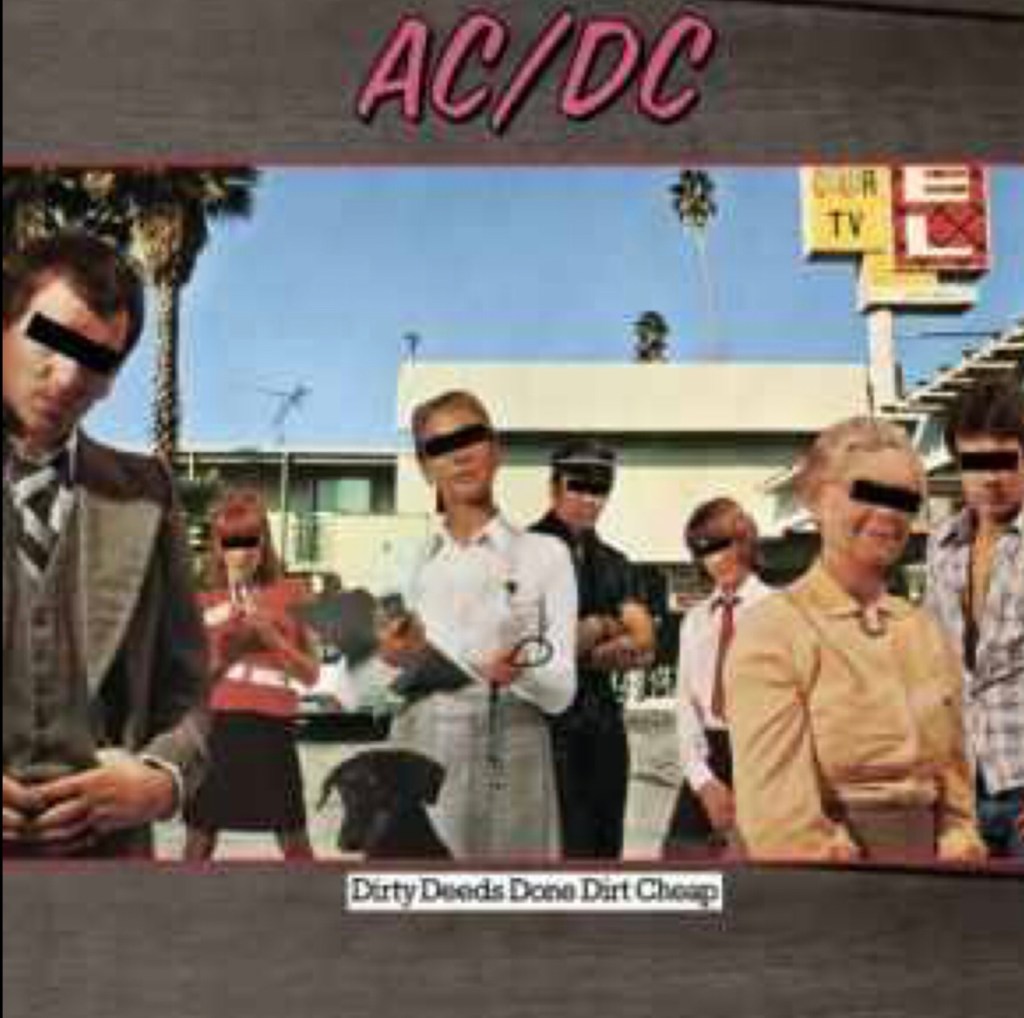
Released in 1976. This is the cover we know for the album and not the Hipgnosis one which came out on the International release.

This version of AC/DC rocked hard. Bon Scott is on Vocals, The Young Brothers are on all things guitar related, Mark Evans is on bass and Phil Rudd is on the Drums.

Production is handled by The Easybeats main songwriters in George Young (big brother of Angus and Malcolm) and Harry Vanda.

“Dirty Deeds Done Dirt Cheap” is the third studio album by AC/DC. While it hit the streets in Australia in 1976, it didn’t get a U.S release until 1981.

And that decisions by Atlantic A&R man Doug Morris to release the album proved to be unpopular with the band.

AC/DC had successfully reinvented itself with a new singer, Brian Johnson. The band was working on a new album, which would become “For Those About to Rock We Salute You”, released later that same year.

But Morris saw a financial opportunity to capitalize on the success of “Back in Black” which had already sold over five million copies. And due to those numbers, Morris estimated that “Dirty Deeds” would move at least 2 million.

But it also took away an opportunity for the new album.

“For Those About to Rock” would have sold a lot more if Morris had waited.

So the US release of “Dirty Deeds” was widely seen as damaging the momentum for that album, which it outsold. The band was also forced to add songs from the “Dirty Deeds” album to its set list on its subsequent tour, further taking the focus away from their new album.

But going back to 1976, Atlantic was unhappy with the vocals and the production. This infuriated Malcolm Young because the label was putting shit on his older brother.

Bassist Mark Evans assumed Bon Scott would be fired as a result. The band was on the verge of being dropped.

But “High Voltage” which was also released in the United States in 1976 was still selling and the sales of that album versus what the label paid for it, gave AC/DC a lifeline.

The Young brothers along with Bon Scott were very creative during this period. As was the norm, each year had a new AC/DC album. And they always overwrote for each album.

As a side note a song called “I’m a Rebel” was recorded for this album, with music and lyrics written by Alex Young, another brother of the Young’s. While the song was never released by AC/DC, Accept somehow got their hands on it and released it as a single, and also named their second album after it.

Dirty Deeds

The riff’s simplicity is its magic.

The drum groove was used by Lars Ulrich for the “Enter Sandman” intro.

The lead break is the embryo of the “Thunderstruck”.

And Bon Scott is menacing as he gave us a new phone number to call.

36-24-36.

Love At First Feel

It’s got that Chuck Berry 12 bar blues rock feel, which AC/DC used a lot of. The most notable song being, “Long Way To The Top”.

Press play to hear a very good and underrated Angus Young lead.

And I like how it quietens down after the solo, with the vocal melody of “Love At First Feel” repeated as they build the song back up.

Big Balls

There was a band in Australia called Skyhooks who had this kind of cabaret/stage show delivery in their songs.

Rocker

Well the songs a rocker alright.

It brings back memories of Val Kilmer performing a rockabilly song in the movie “Top Secret”.

Problem Child

A favourite because of the riffs and the vocal delivery. If there is a track to press play on, then this is definitely one of em.

And Angus delivers another underrated lead break.

In concert, Scott would often introduce “Problem Child” as being about Angus.

There’s Gonna Be Some Rockin’

The 12 bar blues is back. Bands like Status Quo would build a career on tracks like this.

The rhythm is also very similar to that of “The Seventh Son” by Willie Dixon.

Ain’t No Fun (Waiting Round To Be A Millionaire)

It follows more of the same “Long Way To The Top” feel. But press play to hear the Chorus riff, as there’s a chord ringing out and then some arpeggios and single notes.

Ride On

It can be supercharged with other slow blues songs they have done, like “The Jack” and “Night Prowler”

Squealer

How good is the intro on this?

The bass plays a groove that is not typical of AC/DC. It’s almost funky like.

And when Bon Scott moves from his lower register to his higher register, the guitars become more aggressive and the drums get louder.

Angus again wails away on the guitar, delivering a very mature lead. It’s one of my favourite AC/DC cuts and it has been largely forgotten.

This is another track you shouldn’t ignore on this album.

In relation to sales it was a hit in Australia when it came out.

In the US, it was a different story.

Following the American success of “Highway to Hell” in late 1979, copies of the album began to appear as imports in the US.

Some of these were the original Australian edition on Albert Productions; however, Atlantic also pressed the international version in Australia, and many of these were also exported to the US.

Strong demand for both versions (in the wake of the even greater success of Back in Black) led the US division of Atlantic to finally authorize an official US release in March 1981. It went straight to No. 3 on the Billboard album charts.

In relation to sales, 6× Platinum in Australia and the US.

Crank it.

Standard
A to Z of Making It, Classic Songs to Be Discovered, Derivative Works, Influenced, Music, My Stories

Australian Method Series: AC/DC – Ballbreaker

I caught em live on the “Ballbreaker” tour and little did I know that would be the last time I would watch em live.

“Ballbreaker” is a favourite, the same way “Flick Of The Switch” is a favourite. It feels rawer and bluesier. Both albums came after massive periods of success in “Highway To Hell/Back In Black/For Those About To Rock” and “The Razors Edge”.

“The Razors Edge” was that popular that it gave the band a 16 year victory lap. In other words it was still selling when this album and others came out, along with the monster known as “Back In Black”.

Released in 1995, it’s album number thirteen based on the Australian releases. Otherwise its number 12 based on the international releases.

The only change to the band line up was the return of Phil Rudd on drums, replacing Chris Slade.

But the producer this time is Rick Rubin although most of the work is credited to Mike Fraser as Co-Producer, engineer and mixer. And many years later, Malcolm Young said it was a mistake to work with Rubin who was absent for a lot of the sessions.

Hard As A Rock

It’s a favourite. I like the clean tone, droning open string riff to start the song and then it explodes into distortion with the Young brothers jamming on a B5 chord.

Cover You In Oil

The walking guitar riff reminds me of “Ice Cream Man” from Van Halen. And while Brian Johnson was hard as a rock in the first song, now he’s asking if he’s allowed to cover someone in oil.

The Furor

I like the single note riff that Malcom plays in the Verse while Angus strums away in the higher register.

And when the Chorus kicks in, I like what Angus plays on the higher register. And the lyrics are simple, “I’m your furor baby”.

Boogie Man

The riff is derivative and the title is derivative of “Night Stalker”. But hey, AC/DC built a career on being derivative.

The Honey Roll

The riffs in this song are virtually unknown but they are as good as anything that came from the “Back In Black” album.

Burnin’ Alive

A simple riff on a lightly distorted electric kicks off the song. And I like how Rudd builds the intro.

Check out the groove on the verse riff.

Hail Caeser

How good does this start off?

It reminds me of all the things I like about AC/DC like “Dirty Deeds”, “Whole Lotta Rosie” and “TNT”.

I said “Hail”.

Love Bomb

I don’t know what kind of a bomb a love bomb is, but its Wikipedia definition has love bombing as an attempt to influence a person by demonstrations of attention and affection.

The Chorus is catchy, but the lead break is my favourite.

Caught With Your Pants Down

I like the Intro. Sleazy.

In the verses, “Whole Lotta Rosie” went around in the 90’s.

And how good are the chromatics in the Chorus.

Whiskey On The Rocks

This song subliminally makes me drinks whiskey.

Ballbreaker

The riff is excellent, iconic, but when the bass of Williams and Rudd kick in, that’s when you know it’s gonna be a great AC/DC song. A perfect song.

In the end, there are no bad songs here or a skippable track. And seeing em play most of this album on the tour, it’s definitely a favorite.

In Australia it went straight to number 1 (as most albums of AC/DC do here), along with Sweden and Finland.

It was a Top 10 album in Austria, Belgium, Canada, Germany, Norway, New Zealand, Switzerland, UK and US.

Certified 3x Platinum in Australia. 2x Platinum in the U.S. Platinum in France and New Zealand. Gold in Austria, Finland, Germany, Switzerland and the U.K.

In other words, the return of AC/DC was cemented.

Standard
Classic Songs to Be Discovered, Derivative Works, Influenced, Music, My Stories

Australian Method Series: AC/DC – Highway to Hell

Who would have thought that six months after the album release date, Bon Scott would be dead. There is no denying what a massive force he was in the band and since his departure, AC/DC got stuck in recreating the formula that Bon’s intensity brought to the band.

While Bon wrote about sex, parties and relationships, he was also very conscious of what was happening in society and how society was structured and the power struggle between the haves and have nots. AC/DC post Bon, eventually just wrote songs which had knees rhyming with please.

Eddie Kramer was brought in by the label to produce. Malcolm was less than pleased because it meant older brother George, was no longer involved. But the the pressure was on and the band was not delivering what the label wanted.

Malcolm and the bands new manager Peter Mensch then fired Kramer and hired Robert ‘Mutt’ Lange, who wielded his iron fist straight away and made the band work hard for three months. He even made Bon take vocal lessons.

And it was the start of the holy trinity of albums.

I never purchased this album until the early 2000’s. I just went over to a friends place with a bunch of blank cassettes and I taped every album he had, while we drank beers.

Highway To Hell”

“Highway To Hell” is a rite of passage. It might have been about touring, however timeless songs have lyrics that can be interpreted in many different ways. The riff to kick it off is iconic. Credit Malcolm.

Livin’ easy, Livin’ free

Those words are exactly how we want to live life. Easy living. Free living. But it isn’t so. Nothing is free in life and nothing is easy. The people born between 1948 and 1962 inherited a rich country and bankrupted it. They first got into government by the early 80’s and by the mid 90’s they were all in positions to make decisions.

They passed laws and regulations to benefit their bank accounts and the bank accounts of their sponsors. If they did something wrong, the taxpayer would bail them out.

And in these pandemic times, living easy and living free is impossible. Free democratic countries are passing laws to enforce lockdowns that dictatorships don’t even have.

I’m on the highway to hell
On the highway to hell

The Satanic panic begins. If this was played backwards, the subliminal message would say, “lleh ot yawhgih eht no”.

It’s so dangerous.

No stop signs
Speed limit
Nobody’s gonna slow me down

Nobody does this anymore. I tell my kids they go to school to learn, not to get a job. But people I speak to always tell me that schools are there for people to get a job. You see, money is more important than developing yourself and experiencing life. You should be free to spread your wings.

Payin’ my dues
Playin’ in a rockin’ band
Hey, mamma
Look at me
I’m on the way to the promised land

It’s why music was great. People paid their dues. It didn’t mean they would make it, or be global superstars. Hell, it didn’t mean they would make a living wage. But they could have. Bon’s lyrics are a lifestyle and six months later, Bon Scott, would be on his way to the promised land.

“Girls Got Rhythm”

If the intro riff doesn’t get you moving, check for a pulse.

I been around the world
I’ve seen a million girls
Ain’t one of them got
What my lady she got

Only Bon could get away with confessing his cheating ways to his real love back in Oz via a song and still be in a relationship.

Love me till I’m legless
Achin’ and sore

Is this even possible anymore?

Everyone is too busy parading on social media, joining movements of empowerment. There is no time for loving until the morning light, unless your on a Netflix TV series.

“Walk All Over You”

After the slow dirge Intro, a riff kicks in that The Romantics would use for “What I Like About You”.

“Touch Too Much”

How good is the Intro?

Seems like a touch, a touch too much
Too much for my body
Too much for my brain

Only Bon can put his bedroom ways into a song like this. In this case, the woman is just too much for him. He can’t handle her.

“Beating Around The Bush“

It’s the usual fast blues from “Let There Be Rock” which was inspired by the Peter Green Fleetwood Mac version. Check out the song “Oh Well”.

“Shot Down In Flames”

A few chords over a standard drum and bass canvas. It’s the AC/DC way.

“Get It Hot”

It’s like “Rock N Roll Ain’t Noise Pollution” merged with Chuck Berry.

“If You Want Blood (You’ve Got It)”

The Intro gets me playing air guitar. And the drum build, so simple and so sublime.

It’s animal
Livin’ in the human zoo
Animal
The shit that they toss to you
Feelin’ like a Christian
Locked in a cage
Thrown to the lions
On the second page

Quick, call in the political correct activists.

Life is like living in a cage that you pay for, your whole life and you never really own it.

The crap they toss at us, is the wage we get for building someone else’s dream and we have three options, leave and try to build our dreams, stay and work on the side to build our dreams or just stay and be a slave. Because the system is designed to benefit the companies. If you don’t have a weekly wage, you cannot get a loan.

“Love Hungry Man”

It’s funky for an AC/DC song which Angus Young called as the worst AC/DC song ever.

“Night Prowler”

While this song would become popular for all the wrong reasons, in its essence it’s a slow blues dirge and a favorite.

5x platinum in Australia, 7x platinum in the U.S and various other certifications around the world is proof of its longevity.

Standard
Classic Songs to Be Discovered, Derivative Works, Influenced, Music, My Stories

Australian Method Series: AC/DC – Powerage

I’ve already reviewed “TNT” and in The Record Vault post I had “High Voltage”, “Blow Up Your Video”, “For Those About To Rock”, “Let There Be Rock”, “Flick Of The Switch” and “Family Jewels” reviewed.

But.

No AC/DC discussion can be had without mentioning “Powerage”.

Released in 1978. A lot of discussions are had in Australia and around the world, if this is the “album”. It’s not their most famous work and it didn’t chart well but it is seen as their definitive work, like “Sgt Peppers” and “Exile On Main Street”.

Keith Richards and Slash call this their favorite album.

The personnel for the album is Bon Scott on vocals, Angus Young on lead guitar, Malcolm Young on rhythm guitar, Cliff Williams on bass guitar and Phil Rudd on drums.

The label wanted Bon gone as they believed his voice was the reason the band couldn’t get radio play but the Young brothers wouldn’t hear it.

“Let There Be Rock” didn’t do great numbers commercially and bassist Mark Evans was replaced by Cliff Williams, but he couldn’t get a Visa to enter Australia. So because of this, it’s believed that most of the bass tracks are played by George Young.

“Rock N Roll Damnation”

The riff that spawned a thousand copy cat bands.

“Take a chance while you still got the choice”

What a lyric line from a boozer, lover and party animal. AC/DC lost this art when Bon died. Johnson had it in him but the Young brothers took over most of the lyric writing and that was that as AC became sleeker and more corporate.

Burn all your self help development books and listen to Bon Scott’s lyrics in AC/DC. They will motivate you.

“Down Payment Blues”

It’s one of Slash’s favorite songs. And mine too. Especially the riff that would be reused a few years later for “Givin The Dog A Bone” riff.

Living on a shoestring
A fifty cent millionaire
Open to charity
Rock ‘n’ roll welfare

Bon Scott might have portrayed a certain confidence and strut, but he had a soft spot for the broke, bruised and the weak of society. Because he lived what he wrote and we understood what he wrote because we lived it as well.

Get myself a steady job
Some responsibility
Can’t even feed my cat
On social security
Hiding from the rent man
Oh it make me wanna cry
Sheriff knocking on my door
Ain’t it funny how the time flies

Eventually we all fall in line to what governments want. Obedient workers who enslaved to earn and pay taxes. And by the time you know it, your retired and then dying. Ain’t it funny how time flies when your doing routine 9 to 5.

“Gimme A Bullet”

How good is the verse riff?

And if the verse sounds familiar it’s basically the “Highway To Hell” verse riff.

“Riff Raff”

Those open string riffs with smashing power chords and that little riff towards the end that sounds like something that Mick Mars took for “Rattlesnake Shake”.

I never shot nobody
Don’t ever carry a gun
I ain’t done nothin’ wrong
I’m just havin’ fun

I thought of this song and lyric when I came across the video clip to “You Can’t Stop Rock N Roll” from Twisted Sister and how the anti noise or was it anti-fun police kept chasing em.

“Sin City”

One of the best riffs ever.

Where the lights are bright
Do the town tonight
I’m goin’ in
To sin city

And you believed every word of it.

“What’s Next To The Moon”

Lars ripped the drum groove from this song and “Dirty Deeds” for his “Enter Sandman” Intro.

Two awesome songs to use for inspiration in my opinion.

“Gone Shootin”

The tune is bluesy and not as heavy but the subject matter of losing someone close to you to heroin is anything but light.

“I stirred my coffee with the same spoon
Knew her favourite tune
Gone shootin’
My baby gone shootin’…”

“Up To My Neck In You”

It’s that Chuck Berry shuffle they used on “Jailbreak” and “Long Way To The Top”.

“Kicked In The Teeth”

It’s basically “Whole Lotta Rosie” and “Let There Be Rock” musically. And I wouldn’t have it any other way. Bon Scott is channeling his Robert Plant voice.

In Australia it went 3x platinum. In the U.S only Platinum. But to me, it’s the AC/DC album. Here is a review I wrote for the album when I covered the 1978 year.

And for the Brian Johnson era “Flick Of The Switch” is his “Powerage” album.

Crank it.

Standard
Classic Songs to Be Discovered, Derivative Works, Influenced, Music, My Stories, Unsung Heroes

November 2020 – Part 3

Pyramaze

From Denmark. “Epitaph” is album number six.

The album kicks off with the title track “Epitaph”, a 1.40 instrumental that would not be out of place on the “Braveheart” soundtrack or “Game Of Thrones”.

This song bleeds into “A Stroke Of Magic” and that Evergrey djent/syncopated style of riffing captures me. “Steal My Crown” starts off with a catchy piano lick and when the power chords come crashing down, in the words of Rob Halford, “they go tearing through my senses”.

“Knights In Shining Armour” is a power metal cut with a catchy keyboard melody underpinning the Chorus and “Birds Of Prey” is a hard rock sing with an AOR Chorus.

“Particle” reminds of Evergrey and for that memory, it is elevated to stand out status.

“I’m chasing every particle of you”

God damn, even Desmond Child or Max Martin can’t come up with a line that good.

“Indestructible” asks the question “for why we try to die so young” in the Chorus.

“World Foregone” also reminds me of Evergrey and I’m all in with the alternate picked verses and ballad like Chorus with “how long, how long, can we go on”.

It’s about pollution and climate change. An important message that needs to be heard over and over again. Something that White Lion was onto but ignored.

Machine Head

“My Hands Are Empty” keeps the single song drops from Machine Head going.

From a new music point of view, prior to this song, MH released “Do Or Die” in 2019 and in 2020, “Circle The Drain” (and an acoustic version), “Stop The Bleeding” and “Bulletproof” have been released. If any of em end up on a long player, who knows, but as a fan I’ve enjoyed the single drops.

The songs “Stop The Bleeding” and “Bulletproof” appeared like an EP called “Civil Unrest”.

AC/DC

The mighty Acca Dacca return with one of the best album titles ever in “Power Up”. Their return was met with enough fandom, which pushed their album into number 1 and decent sales, something that Bon Jovi couldn’t muster with his 2020 release.

“Realize” storms out of the gate with its “For Those About To Rock” intro before it starts cranking with its “Problem Child/Sin City” vibe. And I’m all in.

“Shot In The Dark” is better than a walk in the park, with its instantly recognisable riff, which people state sounds like “Rock N Roll Train” and “Rock N Roll Train” sounds like other AC/DC songs, because Angus and Malcolm are brilliant at creating derivative versions of the same riff.

Tracks like “Through The Mists Of Time” is AC/DC bringing in something extra and the way the Chorus happens, well it’s just a little bit different. In Australia, a band called Choirboys did songs like this.

“Kick You When You’re Down” makes me pick up the guitar to learn that intro riff.

“Demon Fire” is fast blues. It sounds like Airbourne’s “Blood In The Water”. “Let There Be Rock” comes to mind and so does “Safe in New York City” and “Caught With Your Pants Down”.

Other favourites are “Money Shot” and “Code Red”.

Power up for 2020 and rock on.

Chris Stapleton

This is a real good blues rock album in the style of John Fogerty and Steve Earle. The first three tracks are a triple combo knockout with “Starting Over”, “Devil Always Made Me Think Twice” (which sounds like it came from the same family tree of “Old Man Down The Road” by John Fogerty) and “Cold” which is basically a re-write of a Paolo Nutini song called “Iron Sky”.

“Arkansas” keeps that Delta blues vibe going with its swampy riffs. “Hillbilly Blood” sounds like a Steve Earle track. “Maggie’s Song” feels like “Shooting Star” from Bad Company.

Lunatic Soul

Opening track “Navvie” is an acoustic Celtic like romp, more colonial, tribal and folky sounding than anything modern. And I like it. So I went to Google to find out more about the band.

Lunatic Soul is a progressive rock side-project, founded by Riverside vocalist and bass guitarist Mariusz Duda in 2008. “Through Shaded Woods” is the side projects seventh album.

Riverside has been in my life since the early 2000’s and I had no idea there was a side project. All instruments and vocals are performed by Duda. He found inspiration for the album from his hometown in Poland, which is surrounded by forests and lakes.

“The Passage” is up next. This track clocks in at 8.57 as it weaves its way through its Norse and Slavic folk influences in the riffs, all done in a haunting way.

“Through Shaded Woods” continues the Celtic tribal folk feel from “Navvie” with a tremolo effect vocal melody. “Summoning Dance” clocks in at 9.52 and its underpinned by an acoustic bass riff that reminds me of Tool.

The acoustic finger picked intro to “The Fountain” starts and the melancholy gets me interested.

Volster

I added “Arise” to my playlist because I saw their name in a list of new releases.

Another hard rock band from Sweden.

“Turn The Tide” with its Led Zep like influences immediately grabbed me and “End Of The World” could have been a Dio cut with a Blackmore style solo.

But it’s the hard rock tracks with a little bit of prog thrown in that are my favourites. Check out the Rush influenced “I Wish” and the Kings X influenced “Sign of the Times” and “Highroad to Nowhere”.

Spirit Adrift

From the U.S.

It started off as a solo project in 2015.

And since then, vocalist/guitarist/bassist Nate Garrett has taken his melodic doom metal influences and tweaked them into an old school metal machine, all within four albums and two Eps.

The new album is called “Enlightened in Eternity”. Garrett does everything except the drums, which are carried out by a person called Marcus Bryant.

“Ride Into The Light” could have been on an Accept album and their take on mixing Judas Priest with AC/DC.

“Astral Levitation” has two sections. Section 1 is Sabbath/Dio “Heaven And Hell” era while section 2 is all Iron Maiden and Thin Lizzy with the harmony guitars.

“Cosmic Conquest” has so many riffs in the song, that a whole album could have been written of those riffs got fleshed into individual songs.

I’m interested, let’s see what comes next.

Part 4 is coming up.

Standard
Classic Songs to Be Discovered, Derivative Works, Influenced, Music, My Stories

Thunder Bay Down Under Summertime Spin Series – AC/DC

Summer is a few days away in the Southern Hemisphere, but since we are experiencing a heatwave write now with temperatures in the high 30s and low 40s Celsius (between 100 and 107 Fahrenheit), so it’s time to start the Summertime Series.

So how did this come about?

My blogger pal Deke over at Thunder Bay had a cool Northern Hemisphere Summertime Series between July and August. Each week, he wrote about albums he spun during the summer.

Well, the real Earth summer is between December, January and February in the Southern Hemisphere. So the good act that Thunder Bay is, boarded a Qantas plane, landed in Sydney, survived 14 days quarantine in a Sydney hotel and is finally here to present the “Thunder Bay Down Under Summertime Series”.

And all the acts will be Australian acts.

So based on the high temperatures we are experiencing, lets kick off with a dynamite of an album.

AC/DC – TNT

Released 1 December 1975.

In the 80’s this became my go to record and because of its December release in the 70’s, it was played a fair bit on the various radio stations in the 80s.

It was originally released by Albert Productions in Australia and in some other parts of the world. It was also released in the same year as “High Voltage” the Australian version.

However when Atlantic Records signed the band, they more or less killed the “TNT” and “High Voltage” Australian albums. From “TNT”, they took all the songs they wanted except for “Rocker” and “School Days” and released them on “High Voltage”, which is AC/DC’s first international release on Atlantic Records in May 1976.

From the Australian, “High Voltage” album, the label, took “She’s Got Balls” and “Little Lover”. The other tracks like “Baby Please Don’t Go”, “Soul Stripper”, “You Ain’t Got a Hold On Me” and “Show Business” were later released on ’74 Jailbreak in 1984 much to the disgust of Malcolm Young. “Stick Around” and “Love Song” got an international release on “Backtracks”

Producing the”TNT” album is George Young and Harry Vanda from The Easybeats. George of course is the older brother of guitarists Malcolm Young and Angus Young and he also played a large part in constructing the songs. An uncredited co-writer with his bro’s.

The bass player on the album is Mark Evans. He did his own concert tribute series to his time with AC/DC in Australia in the early 2000’s with guest vocalists from Australian rock bands. It was probably the next best thing to watching AC/DC live.

The three big ones are “It’s a Long Way to the Top (If You Wanna Rock ‘n’ Roll)”, “High Voltage” and “TNT”. “High Voltage” has that A – C – D – C chord progression for the Chorus. A cool little Angus Young nugget. And “TNT” has a similar progression but in E – G – A – G.

But it’s those other derivative album tracks that hooked me.

Like “Rock ‘N’ Roll Singer”. Musically it’s a derivative version of “Long Way To The Top”. Even the story line in the lyrics is derivative of “Long Way To The Top”.

My daddy was working nine to five when my momma was having me.

By the time I was half alive I knew what I was gonna be.

I left school and grew my hair, they didn’t understand, they wanted me to be respected as a doctor or a lawyer man, but I had other plans.

Gonna be a rock and roll singer.

And then it changes with “The Jack”. A foot stomping dirgey 12 bar blues romp, about a sexually transmitted disease told like a card game. Because how was Bon Scott to know that his lady friend had been dealt with before, as she said to him she never had a full house. I guess that was all lies, because she had the card that would bring him down.

It’s brilliant.

“Live Wire” has all the bits and pieces of songs that would come later. “Who Made Who” is there. “Touch Too Much” is there. “You Shook Me All Night Long” is there. “Whole Lotta Rosie” is there. And of course, “Dirty Deeds” is there.

The lead break from Angus, is one of my favourites here. It has so many different techniques and styles all in one cohesive solo.

And Bon Scott was rivalling Gene Simmons in the lyrical department, with “like a hot rod baby, stick this in your fuse box”.

“Rocker” is a 3 minute “Baby Please Don’t Go” on steroids.

“Can I Sit Next to You Girl” has this groove that I call the “Status Quo” groove.

And those little riff fills in the verses.

How good are they?

“School Days” is a Chuck Berry cover. And when you hear the riff, you can appreciate how the Young brothers took all of their different influences and created their Aussie Pub Rock song. Because the main riff in “School Days” can be interchanged with “Long Way To The Top” and it wouldn’t be out of place.

Standard
Influenced, Music

Angus Young Axology – Guitar World – March 1986

The below is from my March 1986 issue of Guitar World and since AC/DC is about to come back in our lives in a big way with a new album, let’s go back 34 years and see what gear the Young brothers are using.

AN AC/DC AXOLOGY from Angus Young

I have about fifteen Gibson SGs on the road, but I’ve only been playing three of them. People may find it hard to believe, but a lot of my SGs have gotten waterlogged.

I sweat so much during the course of a show that it manages to seep into the guitar. I’ve had many of them sealed off over the years, but when the varnish starts to wear, the moisture from the sweat manages to soak into the wood and the guitars become heavier and lose much of their tone. The only thing you can use them for is surfboards. Wood definitely has a lot to do with how your guitar sounds.

My main SG is a brown one from the late sixties. It s the best one I got. I went into a guitar shop years ago and fell in love with it.

The strings on it were like barbed wire and it had a very nice, thin neck. I’m a small guy, so the guitar sits on me perfectly. It has a great sound—not too toppy and not too bottomy—just perfect.

I’ve always said that when I got more money, I would buy me a better guitar, but I still haven’t found a better one yet. I broke it so many times already—just from touring and running around on stage. The neck is the only original part on it.

I’ve also been using a black SG on tour. One day I was fishing around in New York and I found one that I liked—it s a custom one with three pickups, but I took the middle pickup out. All my SGs have the original Gibson pickups, the same ones that the old Les Pauls used to come with.

Apart from the brown and black SGs, I also use a red one in concert; its one of the newest ones I’ve got. Gibson put it together for me; it’s a bit similar to my brown one, but the neck is a little heavier and fatter.

At home I have other kinds of guitars, some Les Pauls, a Fender Strat and a couple of Telecasters. Besides an SG, the only other guitar I feel comfortable playing is a Telecaster. In the old days me and Malcolm used to share one.

Malcolm just uses Gretsch guitars. He has about nine of them on the road and they re all basically the same. I think they’re the Jet Fire Bird model. Malcolm can get a great biting sound out of them. It’s a sound a lot of guitarists would love to have but could never get.

Neither of us uses any effects devices. We want our sound to be as pure as possible, so we don’t need to use them.

We both use wireless units, though. I use a Schaffer-Vega and Malcolm uses a Sony wireless.

I was one of the first guitarists to use a Schaffer. I started using it back when Ken Schaffer was with the company. He sold it to me and repaired it whenever something went wrong, it gets a lot of beatin’ around, so I pay to have a guitar tech take care of it to make sure it’s in proper working order every night. I have a few of them onstage at the same time, all hooked up and ready to go. This way, just in case something goes wrong, no time is wasted.

Malcolm uses a Sony wireless because he just stands onstage and bangs away on a guitar. The Schaffer has a Diversity System, so if I want to jump into the audience and play guitar, I’m able to do so without losing any signal. The Sony also has a Diversity System, but it’s very sensitive. If it takes a lot of beatin’ and knockin’ around, it can break down very easily. I tried it one night but when I bumped it, it cracked up.

We both use Marshall amps.

At the moment we each have six 100-watt heads hooked up. I also have a specially-made Marshall amp that the company put together for me years ago. I think it was the first one they ever made, so everyone was real excited about it. It can put out between three to four hundred watts. I can even switch it down to fifty watts, if I want to.

Malcolm’s amps sound pretty quiet compared to mine. He doesn ‘t play with as much volume. Malcolm likes a tough, clean sound with no distortion. I like to play very loud.
—As told to Joe Lalaina

Standard
Classic Songs to Be Discovered, Derivative Works, Influenced, Music, My Stories, Unsung Heroes

2000 – Part 5

AC/DC – Stiff Upper Lip

Five years after “Ballbreaker” they return with the very underrated “Stiff Upper Lip”.

The title track starts off like blues band jamming at the local pub and then the romp and stomp kick in.

How good is “House Of Jazz”?

That riff groove is so sleazy and foot stomping.

And “Safe In New York City” has this E to G, E to A and E to B flat style chord progression that reminds me of the “Tommy Gunn” riff, but the song vibe is like “Let There Be Rock”.

“Satellite Blues” is an underrated gem in the AC/DC canon.

And its towards the back of the album that it gets bluesy and dirty with “Damned” and “Come And Get It” being excellent additions. Listen to those sharp 7 and flat 9 chords in the Pre Chorus.

“All Screwed Up” is 5 minutes of blues rock while “Give It Up” is a rewrite of “Highway To Hell” but it stands on its own.

Not as big as other albums in sales but it got em on the road again, which is the place that AC/DC rule.

Axel Rudi Pell – The Masquerade Ball

He was labelled a Malmsteen clone, but if anything, he’s more in the mould of German guitarists like Michael Schenker and Uli Jon Roth, along with Matthias Jabs and Rudolf Schenker with a nod to the British rockers of the 70’s which involves, Paul Kossoff from Free, Jimmy Page from Led Zep, Richie Blackmore from Deep Purple and Rainbow and Mick Ralphs plus Jimi Hendrix who is from the US but went to the UK to make it.

Johnny Gioeli is on vocals as well.

And the album is not on Spotify Australia, but it’s on YouTube which pays less.

“Earls Of Black” and that intro lead break. Check it out.

“Voodoo Nights” sounds like “Big City Nights” from Scorpions. Plus Gioeli delivers a vocal performance.

“The Black Masquerade” at 10 minutes doesn’t get boring (especially the violins in the Chorus) while “Tear Down The Walls” reminds me of his other songs like “Warrior” and a melodic lead break after the Chorus.

Scorpions – Moment Of Glory

And this album is also not on Spotify Australia. It’s Scorpions with the Berliner Philharmoniker. It was meant to be Michael Kamen scoring it, but then left to pursue the Metallica project.

“Hurricane 2000” kicks it off, which is basically “Rock You Like A Hurricane” about a bitch being hungry and how Klaus is going to feed her inches and feed her well.

“Crossfire” really kicks in to overdrive when the “Crossfire” section starts. If your not ready to take up swords and go to war than you’re too uptight.

“Deadly Sting Suite” is also an instrumental merging the Scorpions songs, “He’s A Woman, She’s A Man” with “Dynamite”. And it’s done brilliantly.

And the concert ends with “Still Loving You”, “Big City Nights” and “Lady Starlight”. “Big City Nights” is pretty impressive.

The Berlin Philharmoniker really does a great job with it, and how good are the backing vocalists and the symphonic/choir vocalists.

Black Label Society – Stronger Than Death

The title alone makes me laugh and it reminds me of Motorhead’s “Killed By Death”.

Zakk Wylde wrote all the songs, played all the guitars, did all the vocals and also played the bass and piano. Plus he produced it as well. And mixed and mastered it.

“All For You” has basically a riff which the NuMetal movement “used to death”, but Zakk makes it sound “shiny metal fresh”.

“Phoney Smiles And Fake Hellos” is a favourite.

And he went back to the world of “Miracle Man” for the lyrical inspiration on “Counterfeit God” and when the verse riff kicks in, its down tuned and “heavier than death”.

“Just Killing Time” is those Zakk tunes on the piano and delivering a CCR like vocal.

“Stronger Than Death” is a slow dirge, full of grooves, but interchangeable with a few of the other tracks on this album and “Love Reign Down” closes the album, another groove riff laden cut

Mr Big – Get Over It

I heard this album many years after it came out. I was even surprised the band was still recording after “Bump Ahead” which was released in 1993. And I had to see who was still in the band, because I knew Paul Gilbert left to do Racer X again.

So Eric Martin still wails away and on this one, he is very bluesy, sort of like the Badlands second album. On guitars this time around is Richie Kotzen, with Billy Sheehan and Pat Torpey rounding out the rhythm section.

Songwriter Marti Frederiksen is called in and while the bluesy tunes are nice to listen to, they start to become repetitive. Interchangeable in fact.

I suppose I was over it by then.

Dio – Magica

Ronnie James Dio had enough goodwill in my book to warrant eternal fandom. But I didn’t really get into his 90’s output after “Dehumanizer”.

But many years later in the 2000’s (and after Heaven And Hell released “The Devil You Know” album) I started to listen and “Magica” was first because I was always a sucker for a concept album.

The band is a good one for the release with Simon Wright on drums, Jimmy Bain on bass and Craig Goldy on guitars.

“Lord Of The Last Day” is classic Dio, merging his Sabbath time with the dirgy “Egypt (The Chains Are On)” groove.

“Fever Dreams” instantly became a favourite because its riff reminds me of “Dream Evil” and “Long Live Rock N Roll”.

“Challs” is one of the characters in the story and the song is a blues rock groove blended with melodic rock and it’s one of my favourite songs on the album. Maybe because it also sounds like the songs from “Holy Diver” and “The Last In Line” album, like “Rainbow In The Dark” mixed with “Dream Evil”.

“As Long As It’s Not About Love” has this Hendrix “Little Wing” style intro and a haunting vocal line from Dio before it gets into the dirge like groove similar to “Sign Of The Southern Cross” from his Sabbath days.

“Losing My Insanity” is pirate metal and I like it.

“Otherworld” has this Middle Eastern riff, distorted and fuzzed. The riff makes me want to pick up the guitar to learn it. And Dio is telling his stories.

If you like Dio in the 80’s, then you will like this album. There is enough there to keep you interested.

Off to 1985, for Part 5.

Standard