Classic Songs to Be Discovered, Influenced, Music, My Stories, Unsung Heroes

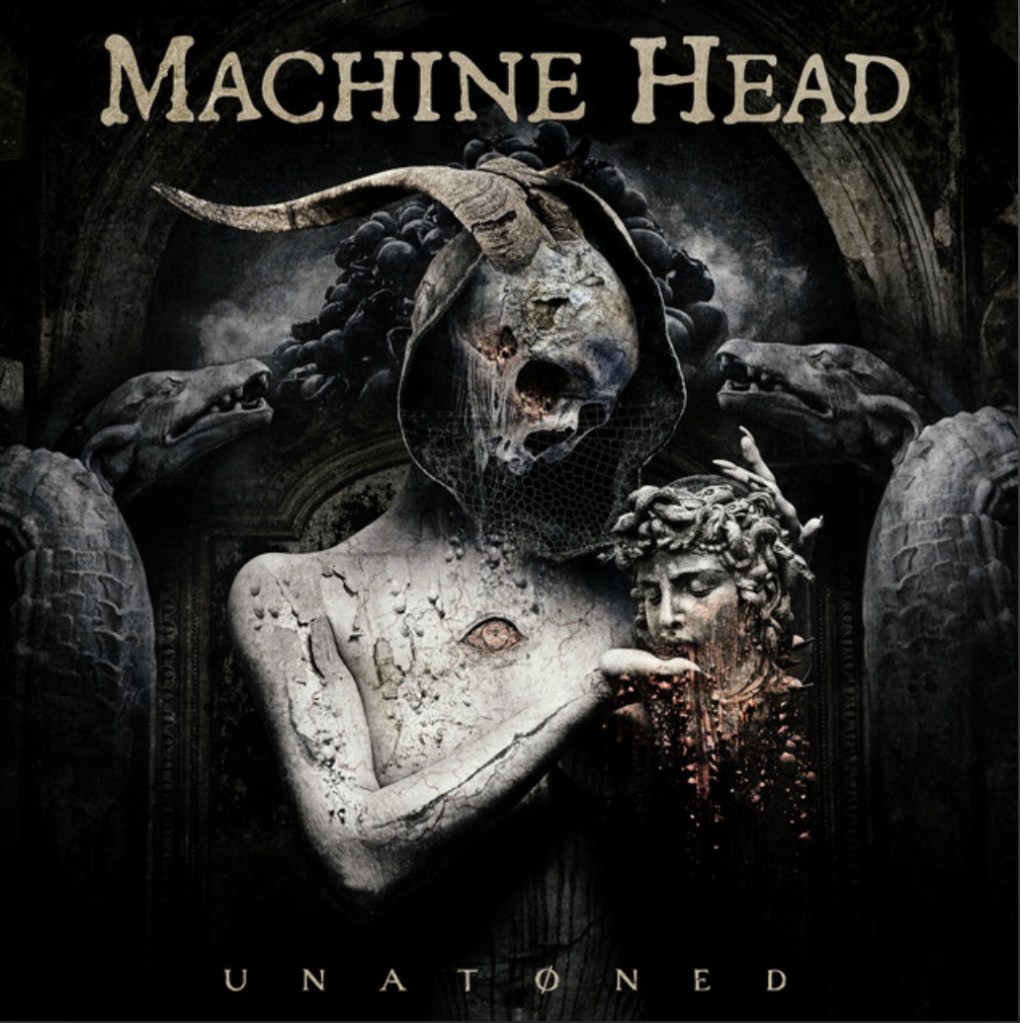
Machine Head’s ‘Unatoned’ Is a 41-Minute Punch in the Soul – Brutally Honest Review (Track-by-Track)

Machine Head’s eleventh studio album, “Unatoned”, released on April 25, 2025, through Nuclear Blast and Imperium Recordings, marks a significant evolution in the band’s discography.

Clocking in at 41 minutes, it’s their shortest album to date.

Landscape of Thorns

A 31-second instrumental opener that is like walking into a post-apocalyptic cathedral made of rust and bad decisions. No lyrics, just vibe.

The vibe?

You’re screwed.

Atomic Revelations

You know that moment when you realize humanity might’ve peaked with sliced bread and everything since is just radioactive garbage?

Yeah, that’s this song.

“Atomic revelations / These cryptic devastations…”

In other words, the future’s here, and it’s wearing a hazmat suit. Think less “technological utopia” and more “Oops, all fallout.”

It’s a poetic bitch slap to our blind optimism. A warning, framing the future not as a bright evolution but as a terrifying construct built from our short-sighted and immoral decisions.

Unbound

This is the sonic equivalent of breaking out of a mental straitjacket while screaming into a hurricane.

Lead single for a reason, it’s the sound of someone clawing their way to freedom, with bloody nails and existential panic.

It’s not about being free. It’s about realizing you’ve been your own prison warden the whole damn time.

Outsider

A love letter to being done. Betrayal, bitterness, burn-it-to-the-ground energy.

All the lying, all the cheating
All you left me was defeated
There could never be forgiveness in the end

No redemption arc. Just someone standing over the wreckage of trust and lighting a cigarette off the flames.

It’s beautiful.

In the way that watching your ex trip over karma is beautiful.

Not Long for This World

Here’s your death anxiety, set to music. Haunting, lyrical, and bleakly gorgeous. The kind of track that makes you text your therapist and also maybe your mom.

Through the struggles life hurls
Behold the heavens unfurl
Not long for this world

You’re gonna die. Everyone you love will die. And this track whispers: “Yup. And?” It’s oddly comforting, like being hugged by a ghost.

These Scars Won’t Define Us

A motivational anthem for people who’ve seen some serious crap and didn’t get a cheesy Instagram quote tattoo about it.

Head to the grindstone, power forward through the endless dark
Focus, determination, on this world I’ll leave a mark
It took so long for any confidence to get in here
And now the question that I need to know, I cannot hear

It’s not saying “you’re special.” It’s saying “you survived, now do something with it.” Less “self-love,” more “self-discipline.”

Dustmaker

“Dustmaker” is a little musical intermission.

A breather.

Kind of. It’s the metal equivalent of a weird dream sequence in a war movie. You’re not dying yet, but your brain’s doing weird crap.

Sip some water. You’ll need it.

Bonescraper

It’s a head banger with themes of self-destruction and a side of guilt.

We scrape our bones to numb the pain

If you’ve ever tried to drink your problems away, punch your trauma into silence, or sleep with someone just to feel something, this one’s your anthem. Congrats, you’re the problem and the solution.

Addicted to Pain

This one goes out to everyone who keeps dancing with the same demons and calling it “growth.” Spoiler: it’s not.

We’ll never know what could’ve been
Cravings pulled you deep within
Thrown into the hit machine
Feed the beast, start the routine
You gave it all just to chase this flame
The dotted line, a puppet in the game now
Twisted and cheating
The fame we chase is bleating
Turned against brother for acclaim that is fleeting

The fame-chasing, dopamine-looping, clout-sucking treadmill of modern life, and how it turns people into hollowed-out achievement junkies.

No wonder you’re tired.

Bleeding Me Dry

This one’s a gut-punch, a slow-motion collapse of a relationship that started with dreams and ended with pill bottles and silence.

There’s no pain without living life
This liquor helps cope with the strife
We talked of you being my wife
Picket fences, some kids, and two bikes
But all that was a fantasy lost in our haze
Through all of the weed smoke and piles of cocaine
A pharmacy of Vicodin, Percs, refillers
You and I were worst friend’s best painkillers

Jesus.

That line alone deserves a Pulitzer in “Emotional Damage”.

It’s not a love song, it’s a eulogy for what could’ve been. And it hurts because it’s true.

They’re not lovers, not saviors, just each other’s favorite painkillers in a life too painful to face sober.

Shards of Shattered Dreams

More heartbreak. More poetic destruction. Think of it like picking glitter out of a crime scene.

It’s raining
Shards of shattered dreams
This love divine
Ruins everything
Left to pick up the pieces
Of my dejected heart
I’m breaking and I’m ripping at the seams
These shards of shattered dreams

When hope becomes a weapon. When dreams cut deeper than knives. This one will haunt you at 3 a.m., probably while scrolling through old texts you should’ve deleted.

Scorn

The final exhale.

Closing the album, “Scorn” is a haunting ballad that delves into themes of manipulation and societal decay, featuring piano-driven melodies that contrast its dark lyrical content.

The music says “reflection,” but the lyrics say “everything’s broken.”

The Wrap Up

It’s short, sharp, and swinging a sledgehammer. Less an album, more a therapy session set to blast beats. It’s a bleak, beautiful middle finger to false hope and a mosh pit for your emotional baggage. If you’re looking for easy answers, you’re in the wrong pit, buddy.

Joining Robb Flynn and Jared MacEachern is drummer Matt Alston and guitarist Reece Scruggs, injecting fresh energy into their sound, making “Unatoned” a noteworthy entry in their discography.

Final Score:
5 existential crises out of 5.

Now go scream into the void or your pillow, whichever’s closer.

\::/

Standard
Influenced, Music, My Stories

Is Metal in Crisis?

The idea that metal is in crisis, whether due to oversaturation, a lack of originality, or changing audience engagement, seems to be a recurring sentiment among older generations of fans.

But is metal truly in decline, or is this perspective more a symptom of aging, nostalgia, and shifts in how we consume music?

The Age Factor: Fatigue vs. Fresh Ears

A young listener coming into metal today wouldn’t think the genre is in crisis. If anything, they’re encountering a landscape full of new music, endless subgenres, and countless bands to discover. They don’t have the same point of reference as someone who grew up when there were fewer metal bands, more gatekeeping, and a greater emphasis on full-album experiences.

For older fans, like me, there’s often a sense of fatigue. Over decades of listening, many metalheads feel me like we’ve “heard it all before.”

Riffs, song structures, and production styles that once felt groundbreaking might now seem derivative. This isn’t necessarily because metal has gotten worse, rather, it’s a byproduct of familiarity. The more you consume, the harder it is to be surprised.

But each new wave of fans is excited about something that may seem repetitive or uninspired to those who have already lived through multiple cycles of innovation.

I had to actively seek out metal, often through record stores, tape trading, and word of mouth. This process required time, effort, and sometimes even risk, buying an album based on cover art alone, waiting weeks for an import to arrive, or discovering new bands through underground zines.

That level of commitment created a deep connection between listener and music. There was an emotional investment in the experience. When you spent your hard-earned money on a single album, you had to give it multiple listens, even if you weren’t hooked right away. That patience often led to a greater appreciation for the depth of the music.

Compare that to today’s streaming era, where music is instantly accessible. While this allows anyone to explore niche genres with minimal effort, it’s also led to an endless sea of content.

Listeners can skip tracks within seconds, constantly moving on to something new without letting an album sink in. This convenience fosters a different kind of relationship with music, one that can feel less “earned” to those who grew up under the old system.

For an older fan, it can seem like metal has lost its soul, not necessarily because the music is worse, but because the ritual of discovery has changed.

Oversaturation vs. Opportunity

There’s no denying that metal, like all genres, is more saturated than ever. Advances in technology mean that anyone with a laptop can record and distribute music, leading to an overwhelming volume of releases.

But is that really a bad thing?

For young listeners, this means more diversity, more experimentation, and more ways to find exactly what speaks to them.

While an older fan might lament that there are “too many bands that sound the same,” a younger fan may see an ecosystem where they can explore an endless array of niche styles.

It’s also worth noting that every generation has had complaints about oversaturation.

In the late ‘80s, thrash metal had so many similar bands that many critics claimed the genre was becoming stagnant. The same was said about hard rock towards the end on the 80s/start of 90s, death metal in the early ‘90s, metalcore in the 2000s, and djent in the 2010s. Yet metal has always found ways to reinvent itself.

The Role of Nostalgia in Perceived Decline

It’s human nature to view the past as a golden era. This is particularly true in music, where people tend to romanticize the bands they grew up with. Metal fans who came of age in the ‘80s often see that as the peak, just as those who started in the ‘90s might champion that era, and so on.

However, if you ask a 16-year-old today, they might argue that metal has never been stronger. They’re discovering bands without any baggage, without comparisons to the past, and without the weight of decades of listening experience making them jaded.

What might seem “unoriginal” to an older listener could feel fresh and exciting to them.

Similarly, the tendency to view the past as superior is amplified by the way we remember things. The weak or generic bands of the ‘80s and ‘90s have largely been forgotten, while the legends remain in cultural memory. If you judge the current scene by its mediocre bands while remembering the past only through its icons, of course it will seem like metal has declined.

The perception that metal is struggling isn’t new, it’s been a conversation since at least the late ‘80s. But in reality, metal isn’t in crisis; it’s simply evolving in ways that can be harder for long-time fans to appreciate.

Young listeners today don’t think metal is dead because they aren’t burdened by nostalgia or fatigue. To them, the sheer abundance of music is an opportunity, not a problem. The old model of discovery, where commitment was required, has been replaced by one of limitless accessibility, and while that changes the experience, it doesn’t necessarily make it worse.

Ultimately, metal will continue to thrive as long as there are new generations of fans who are excited by it. The real crisis isn’t in the music itself, it’s in whether long-time fans can adapt their perspective and find new ways to engage with the genre.

Standard
Classic Songs to Be Discovered, Influenced, Music

Scorn – Machine Head

Dom Lawson, in Metal Hammer, called it “ostensibly a dark, crestfallen ballad” that builds through synth-drenched haze and emotional swells before erupting in a syncopated, spine-tingling finale.

He’s not wrong.

In fact, “Scorn” might be the most hauntingly beautiful track Robb Flynn has ever penned.

Machine Head is no stranger to monumental album closers, think “The Burning Red,” “Descend the Shades of Night,” “A Farewell to Arms,” “Who We Are,” or “Arrows in Words from the Sky.”

Now, add “Scorn” to that list, lifted from their new record “Unatoned” a fitting name for what feels like both an indictment and a lament.

The opening verse says it all:

“I’m putting you under my spell / ‘Cause I’ve got a Bible to sell
Let go your convictions, restrictions will cost you / Your fiction and all that is well
Distrust all the fable they sell…”

This isn’t subtle. It’s manipulation disguised as salvation. The “Bible to sell” is a loaded metaphor, suggesting the commodification of belief, the weaponization of faith. Convictions and moral boundaries are liabilities here, illusions sold to the weak, while the puppeteers profit.

“I look to the sky / As it won’t be the first / And it won’t be the worst
‘Cause there’s still yet to come / With a nation undone by their Scorn”

Hope?

Maybe.

But not without cynicism. The sky becomes a metaphorical void, once a symbol of transcendence, now indifferent or complicit. The “nation undone” is a clear nod to societal collapse, a warning about the corrosion eating away at public trust, autonomy, and truth.

The chorus drives the point home with venom:

“Scorn / Paranoia seeps through every pore
Scorn / Envenomated eyes emit their scorn”

Yes, “envenomated.”

A rare, brutal word choice. It means poisoned. But more than that, it implies a kind of psychological venom, gazes that don’t just judge but infect. Surveillance becomes psychotropic. The “eyes” don’t just watch; they erode.

“The eye in the sky never rests
Watching to form our arrest
They’re chasing us out of our nests
Keeping tabs as they play us like masters of chess…”

There’s Orwell here, but also something more, this is modern paranoia woven through algorithmic control, deep-state tactics, and manufactured chaos. The image of being driven from nests evokes exile from comfort, from truth, from home.

“I look to the sky / As they give us new rifles / To stifle our words
With a Bible and bulletproof vests / As we suffer their Scorn…”

Weaponized religion. Militarized faith. Truth gets smothered in the name of protection. Resistance becomes treason. Free thought becomes a target.

Thematically, “Scorn” stands shoulder-to-shoulder with:

– Rage Against the Machine’s political fire
– Pink Floyd’s “The Wall” and its suffocating institutional critique
– Dylan’s “Highway 61 Revisited”, where biblical imagery twists through cultural critique
– Metallica’s “…And Justice for All”, where justice is just another rigged game

But “Scorn” isn’t derivative, it’s a culmination. It distills our present-day fears: media manipulation, mass surveillance, the erosion of belief systems, and a creeping spiritual void. It’s a bitter elegy dressed as an anthem.

You don’t just listen to “Scorn”. You endure it, absorb it, and then see the world a little more clearly and perhaps a little more grimly.

Standard
A to Z of Making It, Influenced, Music

Joel Hoekstra on The Jay Jay French Connection Podcast (Sept 19, 2023)

Steve Lukather has nothing but the highest praise for Hoekstra, and it’s easy to see why.

Born in Iowa City, Joel moved to Chicago as a kid, then later spent time in L.A., working at Cherokee Studios in 1991 and 1992. By that time, legendary producers Tom Werman and Geoff Workman had already moved on, but their legacy lingered.

Hoekstra studied at the Musicians Institute (GIT) in L.A., though he had a head start, his local teacher had already introduced him to the curriculum before he even arrived. On day one, he found himself among 500 other guitarists in the main hall, an intimidating experience.

Growing up with classically trained parents, he learned to read music early on, though he admits it’s only occasionally useful in his current work. It did, however, come in handy when he landed “Rock of Ages” and other theater gigs.

Unlike many of his peers, the ’80s shred scene didn’t have a huge impact on him, he was too young for it to be a major influence.

He did, however, run in circles with some serious musicians, including drummer Scott Coogan, guitarist Pete Thorn (well-known for gear demos), and Joy Basou (who found success in pop music, working with artists like Jessica Simpson and Nick Lachey).

When asked about his guitar heroes, Hoekstra named Steve Morse (High Tension Wires), Steve Vai (Passion and Warfare), and Joe Satriani (Flying in a Blue Dream, Surfing With the Alien).

While Eric Clapton wasn’t a big influence, he admired Jimmy Page for his rhythmic licks, Jeff Beck for, well, everything, and Jimi Hendrix for his showmanship. He also loved everything “Rush” did, as well as Trevor Rabin’s “Yes” era, he still follows Rabin’s work, including his latest album “Rio”.

Jay Jay French mentioned for his generation, Johnny Winter and Alvin Lee were the Yngwie Malmsteens of their time.

Over the years, Hoekstra transitioned from playing Floyd Rose-equipped Jacksons and Kramers to a Fender Telecaster, then a Gibson SG, before settling on a Gibson Les Paul in 2004. He admitted that while playing a Les Paul means sacrificing about 10% of your technique, each note is worth it. Initially, he avoided Les Pauls because he’d heard they had tuning issues.

As a solo artist, Hoekstra has released three instrumental albums covering various styles. However, when he shifted into hard rock and heavy metal, fans wanted more of that sound.

Instead of branding it as a solo project, he launched “Joel Hoekstra’s 13”, where he writes all the music and lyrics while bringing in powerhouse rock musicians to jam with him. At the time of the interview he was onto his third release with “JH13”, along with “Eagle Flight” from Revolution Saints.

Speaking of collaborations, Hoekstra has another project called “Iconic”, featuring Michael Sweet (guitar), Marco Mendoza (bass), Tommy Aldridge (drums), and Nathan James (vocals). At the time of the interview, new releases from Iconic and Revolution Saints are on the way.

Since then, Revolution Saints dropped “Against The Winds” in 2024 however Iconic hasn’t been released yet.

As for Whitesnake, the future remains uncertain. Everything depends on David Coverdale, with the band currently in a holding pattern. Their European tour had a few canceled dates, and the U.S. tour was ultimately called off due to Coverdale’s sinus infection.

If you like to hear a good story, check out Joel Hoekstra.

Standard
A to Z of Making It, Music, My Stories

Is Rock Really Dead? Let’s Talk About It.

So, my Release Day playlist on Spotify one week was packed with tracks like “Who Said Rock N Roll Is Dead” by Crazy Lixx, “Rock N Roll Survivors” by Bonfire, and “Gods Of Rock N Roll” by Billy Morrison, Ozzy Osbourne, and Steve Stevens.

Then the next week it had “Rock And Roll Party Cowboy” from The Darkness. And my train of thought moves to “Rock And Roll Deserves To Die”, one of my favorite songs from em.

Naturally, it got me thinking about the ever-recurring debate:

Is rock actually dead?

Lenny Kravitz released a song titled “Rock and Roll Is Dead” on his 1995 album “Circus”, a cynical take on the state of rock music at the time.

Marilyn Manson, has a song “Rock Is Dead” from the 1998 album “Mechanical Animals” which is critical of the commercialization and his perceived decline of rock’s rebellious spirit.

L.A. Guns released a song titled “Rock and Roll Is Dead” on their 2005 album “Tales from the Strip”, about the genre’s struggles in the modern era.

Even The Doors’ had a track “Rock Is Dead” (recorded in 1969, released posthumously).

Gene Simmons is the guy most often quoted on this. In a 2022 statement, he told “Metal Hammer”, “I stand by my words, rock is dead and the fans killed it,” blaming file-sharing and the decline of record industry support for new rock talent. He also elaborated on this in a 2014 “Esquire” interview, pointing to the lack of new iconic bands since the Beatles era and the economic challenges for emerging artists.

However plenty of legacy artists share a similar sentiment.

Jay Jay French fromTwisted Sister had made a few forays into this. You can read his latest here.

He makes a good argument about rock’s decline in cultural relevance, essentially claiming that rock is “dead” because it no longer produces massive young stars like it did in the late ’60s and ’70s.

He also points out that rock doesn’t define youth identity in the way hip-hop, pop, and country do today. It’s a compelling argument, but it’s not the full picture.

So where does Jay Jay have a point.

Rock isn’t the dominant force in youth culture anymore. Streaming, social media, and internet-driven virality have helped hip-hop and pop thrive while rock has struggled to keep up.

Since exact weekly numbers aren’t available, I’ll estimate based on monthly listener counts and annual streams, dividing by 52 for a rough weekly average, adjusted for current trends.

The top 50 metal and rock artists generate 70-100M weekly streams. This is a fraction of the broader streaming landscape, where total weekly streams across all genres exceed 4-5 billion (based on Spotify’s 2023 global totals of 200B+ annual streams).

Pop/Hip-Hop genres account for 50-60% of streams. Their top 50 artists alone could hit 400-500M weekly, 4-5x higher than metal/rock.

Metal and rock, despite passionate fanbases, remain a smaller player in the streaming game, punching above their weight culturally but not numerically.

The days of four kids in a garage forming a band and becoming icons by 25 is way harder to pull off now. Labels and streaming platforms push polished, solo acts over traditional bands.

Just like jazz and big band had their golden eras before becoming niche genres, rock’s mainstream heyday as a youth movement may simply be over.

So where does Jay Jay’s argument fall short?

Sure, rock isn’t a monoculture anymore, but it’s alive and well in subgenres like metal, indie, punk, and prog. Just because it’s not topping the Billboard Hot 100 doesn’t mean it’s dead.

Even in those subgenres, there are further subgenres and even more splintering.

In Latin America, Japan, and Scandinavia, rock and metal are huge. Just because the major markets aren’t as tuned in doesn’t mean the genre is extinct.

Back in the day, you were either a rock and metal fan or a hip-hop fan.

Now?

A single playlist might have Metallica, Bon Jovi, Kendrick Lamar, Whitesnake, Shinedown, Taylor Swift, and Bring Me The Horizon. Genre loyalty is weaker than ever.

As much as the internet was meant to level the playing field and remove the gatekeepers, streaming algorithms and major labels still push what’s easy to market.

Rock isn’t dying; it’s just not the industry’s priority.

French isn’t wrong. Rock doesn’t dominate pop culture like it used to, and we’re unlikely to see another Beatles-level rock phenomenon.

But calling it “dead” is an oversimplification.

The genre is evolving, diversifying, and thriving in different ways. It might never reclaim its past mainstream dominance, but it’s far from irrelevant.

Standard
Music, My Stories

Iron Maiden – Live At Qudos Bank Arena, Sydney – 13 September 2024

A proud moment.

2016: My son’s first Iron Maiden concert, “The Book of Souls” tour.

2024: Eight years later, here we are again for “The Days of Future Past” tour.

Of course, we had to buy some merch, again.

And, of course, I had to buy some beers for myself and this time I had the older two riding shotgun. Naturally, this led to the classic “Are you buying alcohol for underage kids?” interrogation.

“Yes, officer, I like to live on the edge, by getting kicked out of an Iron Maiden show before it even starts.”

And let’s not forget the food situation. Kids are always hungry, and I just love paying hundreds of dollars for substandard, borderline offensive stadium meals. But hey, who cares? We weren’t there for the cuisine.

We were there for Maiden.

Iron Maiden’s opening bands don’t get much love in Australia. I remember “Behind Crimson Eyes” getting brutally booed at the “Caught Somewhere Back in Time”Sydney show. But to their credit, they powered through, then covered “Ace of Spades” and just like that, the crowd that wanted them gone was suddenly on their side.

This time, we had Killswitch Engage. Thanks to a heroic battle with traffic and then another war at the merch stalls, I only caught the second half of their set. From what I saw, they were tight, and the crowd gave them a solid response. But everyone was here for one reason.

The ritual begins:

“Doctor Doctor” plays.

The lights go out.

Vangelis’ “Blade Runner” end title starts.

And then—“Caught Somewhere in Time” kicks in.

“Caught Somewhere in Time”

Great opener, but they should’ve played the intro before hitting the fast riff.

Then again, they do the same thing with “Aces High,” so I should’ve seen it coming.

“Stranger in a Strange Land”

A personal favorite. Adrian Smith’s solo is one of those “song within a song” moments. Magic.

“The Writing on the Wall”

Another Adrian masterpiece solo, reminiscent of “Stranger In A Strange Land”.

“Days of Future Past”

Easily one of the best tracks off Senjutsu.

And that verse riff? Adrian again. Starting to see a pattern?

“The Time Machine”

Would you go back in time if you could?

This song has a lot of great riffs, but that harmony section after the first verse stands out.

“The Prisoner”

Wasn’t that excited for this one, until I saw my kids getting into it. Then I had a moment of clarity: open up my mind and enjoy myself.

“Death of the Celts”

Basically Blood Brothers Pt. 2. And I’m 100% okay with that.

“Can I Play With Madness?”

Or as Bruce calls it live: “Can I Play With Agnes?” Apparently, she never answers. Yeah I know, it’s a bad joke.

“Heaven Can Wait”

Wo-oh-oh. Enough said.

“Alexander the Great”

This was the reason I had to be here.

When I dubbed “Somewhere in Time” to cassette, I needed it to fit on a 45-minute side. If I followed the proper tracklist, I’d lose two minutes of “Alexander the Great”.

Unacceptable.

So I recorded Side 2 first, then Side 1, sacrificing part of “Heaven Can Wait” instead. I still got the “woh-oh-ohs’.

“Fear of the Dark”

The crowd sings the leads like it’s “Livin’ on a Prayer”.

“Iron Maiden”

Played at such ridiculous speed, even the term “speed metal” feels inadequate.

“Hell on Earth”

They basically turned the venue into a furnace with all the fire.

But that intro’s clean-tone lead?

Give me a sword and shield, I’m ready for battle.

“The Trooper”

No surprise here. It’s practically a legal requirement for every Maiden setlist.

“Wasted Years”

A perfect closer.

That intro? Instant immortality. Also… yes, I’m a full-blown Adrian Smith fanboy.

No shame.

And then, just like that, it was over.

Who knew this would be Nicko’s last tour behind the kit?

One of the greatest drummers in heavy metal and he did it all with one kick pedal and rock-solid technique.

Another Iron Maiden show in the books. Another legendary night. Another pile of money spent.

Worth every cent.

Standard
A to Z of Making It, Copyright, Influenced, Music, Unsung Heroes

Derek Schulman

On October 15, 2020, Derek Schulman appeared on the Bob Lefsetz Podcast.

I first heard of Schulman as the guy responsible for signing Bon Jovi and Cinderella. But before becoming a label executive, he was a member of Gentle Giant (GG), a band that has a bigger fan base today than when they originally broke up.

When Lefsetz asked why GG had grown in popularity, Schulman explained: “We wrote music for ourselves, didn’t follow trends, and the music held up.” Interestingly, GG never considered themselves a progressive rock band. Rock, yes, but not prog. They simply pushed themselves musically.

I believe GG’s resurgence is largely due to the internet. Their music isn’t locked away in a vault, it’s widely accessible. If we were still in the pre-Napster era, their catalog might have remained buried, since labels wouldn’t see the financial incentive to print CDs. Labels have always believed they know what fans want, but they’ve often been wrong. Had they continued releasing hard rock in the ’90s, the genre could have still produced acts selling close to 500,000 units. Instead, they abandoned it.

It always comes back to the music. People return for the music, not for record sales, labels, executives, or streaming numbers.

From Musician to Executive

Before Gentle Giant, Schulman played in a band with a few hit singles, but by 1969, he was burned out from the pressure to keep churning out commercial hits. He wanted to form a band that was the opposite of pop, so GG was born.

But by 1980, after 14 years in bands, Schulman was done. GG had become a job, and he had lost enthusiasm for recording and touring. With nothing lined up, he spent a year feeling lost. Fortunately, he had savings, thanks to his role as GG’s quasi-manager in the mid-’70s.

A friend at PolyGram called with a job offer. Schulman moved from California to New York and joined the label as a Promotions/A&R rep, though his role was mostly promotions. He was hired because two of PolyGram’s heads of radio promotion were huge Gentle Giant fans.

At the time, PolyGram was a mess. The label had major acts like KISS and Def Leppard, but they drained a lot of resources. Schulman’s break came when artists and managers started bringing him albums. Uriah Heep was shopping a new record, and Schulman helped organize a deal to release it.

Then came Bon Jovi.

Bon Jovi’s Breakthrough

Schulman met Jon Bon Jovi and was impressed by his focus and drive. Jon wanted to be bigger than Elvis. He even introduced Schulman to his parents, who told him: “Take care of our son.”

At the time, no other labels were bidding on Bon Jovi. Schulman also had a strict policy, he refused to get into bidding wars.

The key move was bringing in Doc McGhee. Doc originally came to Schulman’s office pushing Pat Travers, but Schulman told him to check out Bon Jovi instead. Schulman saw in Doc the same relentless drive that Jon had.

Jon met Doc, they struck a deal, and just like with Schulman, Jon’s parents needed to approve.

McGhee put Bon Jovi on tour with Ratt and Scorpions. Their debut album was a success, but their second record, “7800° Fahrenheit”, was considered a sophomore slump. Schulman hated the album title, the recording process was a mess, and the overall vibe felt off. But the album did its job, it kept the band on the road while McGhee worked overtime to book shows.

Schulman, meanwhile, had started working with producers Bob Rock and Bruce Fairbairn, who had just finished albums with Loverboy and Honeymoon Suite. Jon and Doc knew they needed great producers to reach the next level.

Schulman suggested co-writing with others. Paul Stanley and Gene Simmons had already introduced Jon to Desmond Child. The rest is history.

The label knew they had something big as soon as “Slippery When Wet” was mastered. The original album cover was scrapped, and Jon designed the new one himself. “You Give Love a Bad Name” and “Livin’ on a Prayer” were immediate hits, and the album shot to No. 1. Schulman had a percentage point on the album, but when he left the label, his royalties ended.

Cinderella

Schulman was introduced to Cinderella by an agent, a lawyer, and Jon Bon Jovi, who knew Tom Keifer.

He went to see them play a club in Philadelphia. The band wasn’t great, Tom Keifer stood out, Jeff LaBar was solid on guitar, but the other two members weren’t up to par. Then Schulman listened to a 90-song demo of Keifer’s original material. He was blown away by Keifer’s songwriting.

Schulman told the lawyer: “Get Tom to replace the other two with better musicians, and I’ll give you a deal.”

Andy Johns was brought in to produce “Night Songs”. The album dropped shortly after “Slippery When Wet” exploded, and “Night Songs” shot into the Top 10. Suddenly, Schulman was on fire, he had two bands in the Top 10.

When Lefsetz asked why Cinderella never released another big album, Schulman pointed out that they did, “Long Cold Winter”, but he had briefly forgotten the title.

Tom Keifer eventually lost his voice, which Schulman confirmed was true. Schulman also helped shape Cinderella’s albums with his artist experience, though he didn’t contribute to Bon Jovi’s records in the same way. He even co-wrote songs with Tom but never took credit.

Dream Theater

Derek Oliver, an A&R representative at Atco Records and a passionate fan of progressive rock, was the key figure in discovering Dream Theater.

In the late 1980s, Dream Theater had self-released their debut album, “When Dream and Day Unite”, through Mechanic/MCA Records, but the album failed to gain much traction due to poor promotion and distribution.

Meanwhile, Oliver, who had interviewed and reviewed the band during the period as part of Kerrang was impressed by their technical proficiency and songwriting.

Recognizing their potential, he brought Dream Theater to the attention of Derek Schulman, the head of Atco Records at the time.

After meeting the band and seeing their dedication, Schulman agreed to sign them to Atco. Under his guidance, Dream Theater recorded their breakthrough album, Images and Words (1992), which featured the hit single “Pull Me Under.” The album’s success helped establish them as a leading force in progressive metal, proving that Schulman and Oliver’s instincts were right.

Running Labels

Schulman also played a key role in launching Bob Rock’s production career, giving him his first gig with Kingdom Come, another band that went on to dominate the charts.

In 1989, Schulman left PolyGram to run Atco Records. PolyGram wanted to keep him, offering him control of Vertigo and Mercury, but he wanted a change, even if it meant losing his Bon Jovi and Cinderella royalties.

Doug Morris was hesitant about Schulman at first and saw him as a potential replacement. But Schulman built an impressive roster, signing Pantera and The Rembrandts. He had actually planned to sign Pantera to PolyGram but knew he was leaving, so he told their attorney to wait until he moved to Atco.

At first, Atco thrived. Schulman put together a strong team, and the first three years were fantastic. But eventually, he started losing perspective. One day, he heard a No. 1 song on the radio and liked it. When he asked a work colleague who had signed the artist, they said: “You did.” That moment shook him.

Doug wanted him out, but Schulman quit. He even attempted a coup while on a trip to Russia.

Roadrunner Records and the Rise of Metal

Schulman took a break before getting a call from an old friend, Case Wessels, at Roadrunner Records. Initially consulting for a year, he eventually became president.

Roadrunner was independent, which Schulman loved—no board to answer to. He scrapped some of Wessels’ ideas and focused on breaking bands like Coal Chamber and Fear Factory, both signed by Monte Conner.

Then he saw Slipknot live and knew they would be massive.

He also signed Nickelback. Their first album (with Roadrunner) featuring “Leader of Men”, got some airplay, but when “Silver Side Up” dropped, Schulman immediately recognized its potential. The moment he heard “How You Remind Me”, he knew it would be huge.

Roadrunner was suddenly rolling in cash. Wessels wanted another “Silver Side Up”, but Schulman knew those albums don’t appear every six months, more like every 5 to 10 years.

Lefsetz asked why Nickelback gets so much hate. Schulman believes they’re a guilty pleasure, many people who claim to hate them secretly enjoy their music.

Finally, Schulman pointed out that while the industry panicked over piracy during Napster, hip-hop thrived by giving music away for free.

When streaming took over, hip-hop was already dominant—and it still is.

If you like your hard rock and metal history, then Derek Schulman is an unsung hero and this podcast is one to listen to.

Standard
Music

Sleep Token – Take Me Back To Eden

I can’t believe I haven’t reviewed this album yet. It is definitely a top 10 album for me in 2023.

I don’t know how to describe it.

At a high level, it is progressive. But it’s not progressive with complex time changes and intricate passages. Its progressive via the songwriting. Each song is varied with different styles and genres thrown in. Verse riffs are different, and the melodies are different between verses on some songs. Some songs don’t even have a Chorus. Just verse after verse. Some songs have a repeating hook that moves between syncopated progressions.

Chokehold

This is the song that grabbed me by the throat and strangled me. It’s that vocal line and that voice, which reminds me of “Take Me To Church” from Hozier.

The Chorus riff crashes in afterwards, but you don’t hear the Chorus words of “you got me in a chokehold” until the next time.

Then the 2nd verse comes in, with arpeggiated lines and another vocal line, different to what came before.

Then the Chorus crashes in and I am hooked. Mesmerized. At 71.2 plus million streams and counting so are a lot of other people.

Even Daughtry covered it for a live performance, just himself and an acoustic guitar. By doing this, Daughtry demonstrated how pop like the melodies are in the song.

The Summoning

This one is almost at 150 plus million streams.

If you jumped into the band because of “Chokehold” this song might change your mind because its got screaming vocals, intricate atmospheric guitar playing which reminds me of “Between The Buried And Me” and other vocal lines that wouldn’t be lost on the “White Pony” Deftones album.

If anything, it follows the vibe of what people recognize as “Djent”.

The section from the minute mark is essential listening because it comes out of nowhere. Its almost soul like, more Imagine Dragons and One Republic than metal or djent.

Brilliant stuff and I like the variation.

Granite

A synth line kicks off the song, which sounds like it was written on the TonePad iPhone app.

And the song lives in this environment, very pop like and I like it. Then a jarring, math like riff kicks in at 2.40 mark. It could get boring, but then the infectious vocal melody from earlier is sung over it and its worth your attention.

Aqua Regia

The synth/keyboards is a very dominant instrument in Sleep Token. It lives in its atmospheric synth world and doesn’t jar me, but that doesn’t mean it’s a crap song. On the contrary.

Vore

It spends the first minutes with ghoul like vocals, almost black metal guttural before it moves into clean tone vocals which makes me feel I am on top of Mt Everest and I am screaming my lungs out.

That section from 3.50. Listen to it.

Ascensionism

The piano line is hypnotic, and it grabs my attention straight away.

Then at 1.50 it’s a hip hop like song, with autotune and all the bells and whistles which comes with that genre.

Then at 3.44 its back to that haunting piano line and then the distortion guitars kick in and I am sick from all the movements within the song.

Progressive it is, purely from blending their influences expertly.

And that riff from 4.44, is doom metal, with a screaming ghostly scream. Then its back to the hypnotic piano line at the 5.25 mark. But there is still 2 minutes to go.

Make sure you stick around for the last 45 seconds. It’s worth it.

Are You Really, Okay?

A clean tone guitar riff and I feel like I am at a campfire. Its heartland like stuff.

The vocals are all clean tone, enhancing the emotion. When the drums come in, it feels like a Neil Young album, but I cant shake the feeling of “Albatross” from Fleetwood Mac that the song gives me.

The Apparition

“Why are you never real whenever you appear?”

It’s the opening line, over a clean tone fingerpicked guitar riff. It’s almost Spanish like in its feel.

Then a synth line kicks in, demanding attention. Hip hop like drums come in and I am paying attention to see what kind of journey this song would take me on. But it percolates in this vibe.

Then at 2.24 it takes off, with soaring vocals over a math like guitar riff. Its catchy and I am on the magic carpet ride the song offers, soaring between galaxies and the afterlife.

DYWTYLM

It stands for “Do You Wish That You Loved Me”.

The main keyboard riff has sonics that remind me of the TonePad app. It wouldn’t be out of place on an Imagine Dragons album or on one of Daughtry’s albums between 2013 and 2017. Its memorable
and dance like and it lives in this vibe for the whole song.

Rain

It’s at 16 million streams on Spotify. Another piano riff and a catchy vocal melody. And the song just builds.

Take Me Back To Eden

The title track is almost at 67.5 million streams on Spotify. You feel like you are at a nature retreat and the start of the song has that vibe, soothing and relaxing. Even the words like crystal waters, dream in phosphorus and perfect ocases

At 2.30 the distortion kicks in and those soaring vocals are back. Its been a theme of the album, to have these kind of soaring vocals. But at 3.23, it goes to hip-hop and you could think that you are ears deep into an Enimen album.

At 4.44 another hanting section comes in with piano and then when the distortion kicks in, its hopeful, iuts sad but still hopeful. And it lives in this vibe until the end. With the last 50 seconds jarring me out of my nature retreat with screaming vocals which came out from nowhere. And I suppoise this is Sleep Token with so many variables and movements in their songs.

Euclid

My favorite track on the album. As soon as the first notes of the piano riff started I was hooked. The vocal line is hypnotic and it’s a cross between Daughtry and Hozier.

And the way the song builds is perfection.

Press play and allow your ears to take you on a journey.

Standard
A to Z of Making It, Influenced, Music, My Stories

The Record Vault: Dream Theater – Master Of Puppets

The cover above is the version I have, released in 2004 via their own YtseJam label.

It was also re-released in 2021 via the “Lost Not Forgotten” Archives with the below cover.

The performance of this album would inspire the writing for their most Metal album in “Train Of Thought”.

The show was recorded live in Barcelona, Spain on February 19th 2002. It was the second night of a two night stand in a city.

And it was the start of a new Dream Theater tradition (while Mike Portnoy was in the band), which was to play an entire album from another band.

This is what Mike Portnoy had to say about it in the CD booklet;

“Dream Theater is playing the 2nd night of a 2 night stand in Barcelona, Spain…

After an almost 2 hour set of DT material and a 15 minute intermission, the lights went out and the opening chords to “Battery”
began…

50 minutes later, the Spanish crowd had no idea what had hit them.

The next day the word was all over the internet and our new tradition to cover a classic album whenever we did a 2 night stand in the same city had been established…but for those 50 minutes in Barcelona, the completely unsuspecting crowd had no way to see it coming…

I remember looking into the crowd by the time we started “The Thing That Should Not Be” and seeing people look at each other like;

“Holy shit…they’re doing the whole
fucking thing!!!”.

Yep, that would have been the same response I would have had.

The band for the recording is James LaBrie on vocals, John Petrucci on guitars, Mike Portnoy on drums, John Myung on bass and Jordan Rudess on keys.

Battery

This is performed exceptionally.

LaBrie also brings out the chainsaw aggression of a youthful Hetfield.

Petrucci and Portnoy nail their sections.

Master Of Puppets

As soon as Petrucci plays the first four chords the crowd responds. If this song is played again in 2024, it will be bigger than ever due to “Stranger Things”.

The Thing That Should Not Be

The Intro with the keys is more ominous.

And LaBrie gives the song a more theatrical vibe with an octave higher vocal line, and I like it. It would have been cool if Dream Theater explored the groove doom Metal domain.

Sanitarium

Masterful.

It’s the only way I can describe Petrucci. The intro, acoustic and lead, played by Petrucci is exactly that.

LaBrie tries but doesn’t have the same demented vocal delivery as Hetfield here.

From 3.36, it’s basically a Dream Theater song, with riffs, leads and sporadic vocals. LaBrie is awesome here, his “fear of living on” delivery; excellent.

Disposable Heroes

The drums sound like machine gun fire in the intro.

But it’s that galloping palm muted E string riff that comes after which seals the deal for me.

LaBrie delivers a great vocal here.

Jordan Rudess in an interview with the Revolver Magazine said this;

“Master of Puppets was an eye opener for me because before we covered this album my Metallica knowledge was not so deep.

Having grown up playing Bach, Liszt and Chopin the idea of technique and virtuosities had a definite place in my mind. I have to admit that upon discovering Metallica my perception of technique opened up to other possibilities outside of the classical world.

A song like ‘Disposable Heroes’ sounds like machine-gun fire to me. The blistering, galloping guitar rhythms that sound like the pick is about to go up in flames is an impressive display of intensity and technique. [James] Hetfield really shows what he is made of in a track like this one and I was very impressed.”

Leper Messiah

I always love the section from 40 seconds to a minute. The groove behind it and the way the guitars are orchestrated so that the bass and drums stand out.

Orion

It’s right up Dream Theater’s alley, a nine minute instrumental. And a classic Metallica song.

Damage Inc

They had covered this song previously during the era between “Awake” and “A Change Of Seasons” and released a version of that live performance.

Overall people can compare this album with the real album and find issues.

When an artist covers another artist, it is purely for fun initially and to show respect to the artist who inspired and influenced them.

This is no different and it sounds like the band is having fun, using the last hour of the their three hour set to pay homage to Metallica.

Press play and enjoy.

Standard
Music, My Stories

Machine Head – Live at the Enmore Theatre, Enmore: 16 March 2024

I haven’t missed a show since they came out on “The Blackening” tour, a tour which lasted close to 3 years.

And my Best Man was in tow again who also hasn’t missed a show with me, along with my eldest son this time, who likes only three Machine Head songs in “Darkness Within”, “Bastards” and “Circle The Drain”.

“Do you reckon they’ll play em Dad”, he kept asking me.

“I am sure they will as those songs are up there in streams, so why not”, I lied back.

I had already checked the last 10 shows they had done via Setlist.fm and I couldn’t see those songs in the set. But I wasn’t going to tell him the truth. And selfishly, I wanted him to come and experience a “Machine Fucking Head” concert.

But before Machine Head took the stage, Fear Factory did.

It’s not the classic Fear Factory line up but then again which band these days is touring with the original members.

Guitarist Dino Cazares is the only original member, joined by new vocalist Milo Silvestro who replaced the much loved Burton C. Bell. Pete Webber on drums is also a new addition, then again Fear Factory have had more drummers than Spinal Tap. Rounding out the line up is bassist Tony Campos, who has been with the band since 2015.

I’m not a massive fan but I do like to go nuts on “Archetype”, “Shock” and “Resurrection”. And man, they did play em.

They opened with “Shock”, they closed with “Resurrection” and in the middle they dropped “Archetype”.

“Archetype” was written in the version of Fear Factory without Dino and it wasn’t played live when Dino returned, however once it was added to the setlist in 2013, it never really left.

But I was here to watch Machine Head.

Machine Head is a different beast these days from the first time I saw them. Robb Flynn is basically Machine Head, in the same way Dave Mustaine is Megadeth.

In 2010, joining Rob was Phil Demmel on guitars, Adam Duce on bass and Dave McClain on drums.

Fast forward 14 years, joining Rob this time is Jared MacEachern on bass, Matt Alston on drums and HAVOK guitarist Reece Scruggs, who stepped in for Waclaw “Vogg” Kletyka, who was the recording guitarist but couldn’t make the touring commitments as he was touring with his long time band DECAPITATED.

If you’ve been to a Machine Head concert, you know when “Diary Of A Madman” starts, the concert is about to begin (much like when “Doctor Doctor” plays at a Maiden concert).

And as soon as the outro of “Diary” kicks in, the lights go down and once it plays out, Rob Flynn starts “Imperium”.

It’s a great opener, it sets the tempo, the mood and the aggression.

And the aggression continued with “Ten Ton Hammer”, “Choke On The Ashes Of Your Hate”, “Now We Die”, “Aesthetics Of Hate” and “Old”.

“Locusts” was up next and it didn’t disappoint. It was also probably the most melodic song of the night.

The frantic energy and aggression continued with “Take My Scars”, “No Gods, No Masters”, “Slaughter The Martyr”, “Bulldozer”, “From This Day” and “Davidian”.

And the closer was the usual “Halo”.

Till next time.

Standard