Alternate Reality, Derivative Works, Music, My Stories, Stupidity

Matrix Resurrection

It’s always someone else’s fault.

There are no spoilers in this post as I watched “Matrix Resurrections” and stopped half way through it.

And I was thinking, what was its purpose?

If they needed more time to develop the story, Netflix, Amazon, HBO, Disney, and any other streaming service would have been okay to give them a budget to develop the story over 10 episodes or over a couple of seasons.

Because the story needs to be engaging. The plot needs air.

If the creators wanted to capitalise on the existing fan base they should have looked at shows like “Cobra Kai”, “The Mandalorian” and “The Book Of Boba Fett” to see how it’s done. These shows are appealing to the existing fan base and as a by-product, a whole new fan base is also being created at the same time. But those franchises also had some false starts with the movies.

And sometimes, a movie trilogy just doesn’t need another movie.

On a different note, and if you haven’t watched it yet, make sure you check out “Sense 8” from The Wachowski’s on Netflix. One of the best TV shows that did the rounds between 2018 and 2019.

Standard
Copyright, Influenced, Music, My Stories, Piracy

The Week In Destroyer Of Harmony History – February 14 to February 20

2018 (8 Years Ago)

SPEAKING UP

When artists write lyrics that reflect society and our politics back at us, people get upset. When I think about the past, people who made real change persisted even when others tried their best to silence them.

Artists once formed the chorus of dissent to social ills and corruption. It’s probably a reason why we got so many songs that still stand the test of time today.

Artists told the record label heads what to do, not the other way around.

Machine Head’s new album at the time “Catharsis” was causing division amongst their American fan base. Europe, Asia and Australia didn’t really care about its Anti-Trump stance. Fans of any artist come from different sides of the political debate. It’s expected. No one can agree on everything. If people did, everyone would wear the same outfit. The world would be pretty bland if people all agreed. Wouldn’t it.

It never would occur to me to stop listening to an artist because of a stance they have on an topic.

Artists are not the enemy. They are mirrors, reflecting the world back to us. What we choose to do with the reflection is a different story.

CASSETTE COPYING INCORPORATED

Copying of music has always been there. We used to listen to the radio and record songs from it. We used to record video clips from TV music stations. We would make a copy of an LP from a friend or a family member. We would even re-copy a copied album. The music industry grew because of copying.

So if we used the buzzword of the modern era, piracy was rampant back in the 80’s. Most of my music collection during that period was made up of music copied onto blank cassettes.

You know that peak year of sales for the recording business in 1998. Well there is research out there which suggests it was due to two reasons. One reason was people replacing their vinyl collections with CD’s and the other reason is the people who had music copied on blank cassettes in the 80’s had enough disposable income to buy those albums on CD.

If I didn’t borrow and copy (which the labels call stealing and piracy), I probably never would have become the fan of music I am. As my Dad would always say, “I probably would have had four houses paid off, instead I have a tonne of grey concert T-Shirts, ticket stubs and a wall to wall record collection.” I wouldn’t have it any other way, because the memories are the stories I tell.

1979

Here is the kick off from 1979.

AC/DC – Highway to Hell

Six months after the album release date, Bon Scott would be dead. Mutt Lange is on board to produce at the strong insistence of their U.S record label and it was the start of the holy trinity of albums. Malcolm was less than pleased because it meant older brother George, was no longer involved.

“Highway To Hell” is a rite of passage. It might have been about touring, however timeless songs have lyrics that can be interpreted in many different ways. Plus the riff to kick it off is iconic. Credit Malcolm.

Livin’ easy, Livin’ free

Pink Floyd – The Wall

“The Wall” is Roger Waters lasting legacy. But the best song on the album to me is “Comfortably Numb” written by Gilmour and Waters. Credit producer Bob Ezrin for persisting to get Gilmour’s music on the record. However, it was “Another Brick In The Wall Part 2” that was all over the radio.

Check out “Goodbye Blue Sky” as well, which served as the inspiration for “Fade To Black” from Metallica.

And that outro solo in “Comfortably Numb”. Perfection.

Judas Priest – Hell Bent for Leather/Killing Machine

The first time I heard “Delivering The Goods” was via Skid Row’s “B-Side Ourselves” EP. I enjoyed the Skid’s live take on it, so I went seeking for the album in the second hand record stores. I actually own both copies, the “Killing Machine” version and the “Hell Bent For Leather” version.

Or the iconic riff in “Hell Bent For Leather” which is so derivative that many other bands had a similar riff before and after this song, like the opening riff in “2 Minutes To Midnight”. They even used it again for “Running Wild”.

In relation to guitar playing, Glenn Tipton always kept an eye and ear out for what was hot in guitar circles and he would go away, master these new styles and incorporate those influences and styles into his guitar playing. In this case, he breaks out a tapping lick which was obviously influenced by EVH. On albums from the mid 80’s, Tipton would start to incorporate sweep picking courtesy of Yngwie Malmsteen’s influence.

“The Green Manalishi (With The Two Pronged Crown)” is a great cover of a Fleetwood Mac song, which is written by their original and largely forgotten guitarist Peter Green (RIP), and it works pretty cool in the hands of Judas Priest.

Journey – Evolution

It has “Lovin, Touchin’ Squeezin’” but it’s not my favourite. The three listed songs are for various reasons.

“Lovin’ You Is Easy” has upbeat music and it’s always good to hear Schon rocking out.

“Do You Recall” has melodies which appear in Jovi songs.

“Lady Luck” grooves, taking its cues from Led Zeppelin.

The Police – Reggatta de Blanc

The Police didn’t really write a perfect album from start to finish, but they could write classic tracks.

The intro to “Message In A Bottle” hooks me. And it’s guitarist Andy Summers who saves the day with his add9 chord voicings over a simple bass groove.

Whitesnake – Lovehunter

I didn’t hear this album until very late in the 90’s. During this time I was buying so many second hand LP’s from record fairs and second hand book shops, I can’t even place a memory as to when I purchased it. But I do know I was always a sucker for the 3 for $5 bins.

Press play to hear “Walking In The Shadow Of The Blues” which is written by David Coverdale and the underrated Bernie Marsden.

It all started with the blues. Rock was built on the bones of the 30/40’s blues artists. Metal was also built on the bones of those same artists, along with the defiance and rebellion of rock music. Without the blues, the music I listen to, would not be possible.

KISS – Dynasty

One of the first albums I owned from Kiss and I played it to death, so it’s no surprise I have a few songs from it on my list.

“I Was Made for Loving You” was the obvious single, but it was still an unexpected hit, written by Paul Stanley, Vini Poncia and Desmond Child. Stanley also performs bass duties on this one.

“Sure Know Something” is a mixture between melodic rock, disco and new wave. In the end, it’s still Kiss. The bass groove is unique and the lead guitar break from Stanley is worth the listen.

“Dirty Livin’” is an excellent track. It could have been on a Steely Dan album or a Doobie Brothers record. Instead it’s on a Kiss record and it rocks. Peter Criss sings, it and he co-wrote it with Stan Penridge and Vini Poncia. It’s actually the only track that Peter Criss drums on. Anton Fig played drums on all of the other songs.

“Magic Touch” is solely written by Paul Stanley, which comes loaded with a melodic riff and a pop melody. Still to this day it’s a favourite, purely for its sense of melody.

“Hard Times” is from Ace Frehley and its another Kiss rocker.

2014 (8 Years Ago)

MORE RECORD LABEL INNOVATION

The record labels just kept getting my attention like trying to get the Courts to set a precedent in which the Internet Service Providers act as the Police to monitor music pirates based on the labels say so.

And my favourite was Principle Management (U2’s Management Company) losing money for the fourth year in a row, so its Chairman Paul McGuiness was quick to blame Google for his losses. Talk about sense of entitlement.

BADLANDS

With Jake E Lee excommunicated from the Osbourne camp no one was sure what he would do next. But in 1988, Badlands formed.

The original Badlands line up was Ray Gillen on vocals, Eric Singer on drums, Greg Chaisson on bass and of course Jake E Lee on guitar. And we will never be able to see the band that cut the self-titled debut album reunite. Ray Gillen has passed and Eric Singer said in an interview on the “Daves on Tour” website that his memories of Badlands aren’t good ones.

Eric Singer auditioned for Ozzy back in 1985 and he didn’t get the gig. Greg Chaisson also auditioned for Ozzy around the same period and he also didn’t get the gig. Both of them lost out to Randy Castillo and Phil Soussan. The outcome for both Singer and Chaisson was that they got to meet Jake E Lee and have a jam with him.

Eric Singer also did a stint in Black Sabbath during the Glenn Hughes/Ray Gillen era. Music is a relationship business and it was these relationships, albeit small ones once upon a time, that ended up getting together to create one hell of a debut album.

In an interview with Kerrang from May 1989, this is what Ray Gillen had to say on the bands beginnings;

“I was particularly keen on the project because I had to pick myself up off the floor after my involvement with the Blue Murder project had gone sour. I was basically asked to leave the band due to outside record company pressure. John Kalodner, one of the top people at Geffen Records, simply said that I couldn’t sing!”

Wearing their Seventies classic rock influences on their sleeves and very cleverly merging the minor key riff remnants of the mid-Eighties heavy metal sound, Badlands hit the target. Each song was unique.

The standout song on the debut is “High Wire”. It cemented Jake’s reputation. You can’t keep a super star down and what a great way to open the album.

Seriously, how good is that opening riff?

The beauty of the song is the simplicity. It is a simple A to C, A to D riff, the cornerstone to all classic blues/classic rock songs.

“Winter’s Call” is the most Zeppelinesque song on the album, especially in the verses, combining Middle Eastern drones with Celtic modes. It is also one of the oldest songs on the album, as the song’s roots go back to 1983.

“Streets Cry Freedom” is the next gem and a great way to close off side one. When vinyl was king, albums got sequenced by having a great opening track and a great closing track. The comparisons to Led Zeppelin, Humble Pie and Bad Company are prevalent in this song. The song’s verses are a typical 12 bars blues. Instead of playing it in the standard way, Jake E Lee shows his guitar smarts by arpeggiating the verses.

“Seasons” is the gem on the second side. It reminds me a lot of Led Zeppelin’s “Kashmir”.

This was 1989 and MTV ruled. Bands needed a hit to get recognition. So while “Dreams In The Dark” did the video rounds, as the record label decided it had the most “hit” potential, songs like “Winters Call”, “Seasons” and “Streets Cry Freedom” slipped under the radar.

The self titled album is brilliant. While other artists went with the one hit single per album and the rest as filler, Badlands delivered an album strong from start to finish.

THE WALKING DEAD

So how did a TV show, based on a niche Zombie comic, explode into the mainstream and into people’s consciousness.

In order to understand the answer you need to go back to the beginning. And the beginning for “The Walking Dead” goes back to 1968 and a movie called “Night Of The Living Dead”.

“The Walking Dead” is a classic case of building on works already in the public domain as well as building on existing copyrighted works by creating derivative works.

First the whole Zombie genre owes a large debt to George A. Romero’s classic “Night Of The Living Dead”. Many of the accepted Zombie formulas started here. Something that is quite common to us in 2014, was all brand new to audiences in 1968.

Due to a late name change from “Night Of The Flesh Eaters” to “Night Of The Living Dead”, the distributor forgot to include a copyright symbol on the release and due to this omission, the movie entered the Public Domain on its actual release date. That meant that anyone could do derivative works and also build on the existing story.

The whole opening scene from “The Walking Dead” of Rick Grimes waking up in the hospital alone, is a combination of what has come before.

In “The Day of The Triffids, the main character awakes to a silent hospital to find that his town has been overrun with blinded people.

In “28 Days Later”, a bicycle courier awakens from a coma to find the hospital and the city, completely deserted and overrun by people infected by the rage virus.

In “The Walking Dead”, Rick Grimes wakes from a coma in the hospital to find his town overrun with walking corpses, referred to as ‘walkers’.

Romero did miss out on a hefty payday due to the copyright bungle with “Night of The Living Dead”, but Romero’s story ends well. The film’s popularity OPENED UP MORE OPPORTUNITIES. Romero continued to create movies and the fame that his Public Domain movie gave him, opened up other offers around comics and novels.

In the end, the lack of copyright around one movie, grew and helped define the zombie genre in the same way that the lack of copyright around earlier blues and folk standards helped define the classic rock genre. So next time someone tells you they need stronger copyrights or longer copyrights, point them to the “Night Of The Living Dead” example.

SHARING MUSIC

I got a 8GB USB stick of music given to me recently by a musician friend who told me that I need to check out the bands on the stick. When I was growing up we used to these kinds of trades on cassettes. Back then we had an hours or hour and a half worth of music. Today 8 gigs worth of music is about 270 songs at 320kbps. Yep, that is how it is done today.

Some of the bands on that key are still favourites today like Degreed and Riverside.

RECLAIMING YOUR RECORDINGS

In between solo albums, Henley was busy with the Eagles, Geffen contract issues, Copyright issues against Record Labels, termination rights on songs and the Eagles again.

Henley knows his rights.

While people criticise musicians who turn into business people, it was inevitable that musicians would end up taking the business path.

The great record label rip off/exploitation made them seek this path. It is just unfortunate that a lot of the musicians that didn’t achieve world-wide domination still don’t realise their rights on their songs. Not a lot of hard rock and heavy metal artists are serving notice to their record label to reclaim songs they had written 35 years ago.

While I don’t agree on everything Henley does, like sending a cease and desist letter to an independent band or trying to get a remix law taken off the radar, the bottom line is this, he is a musician that looks out for his own interests. And that is why we loved our heroes.

And that’s a wrap for another week.

Standard
Classic Songs to Be Discovered, Influenced, Music, My Stories

The Record Vault: Def Leppard – Let’s Get Rocked (CD Single)

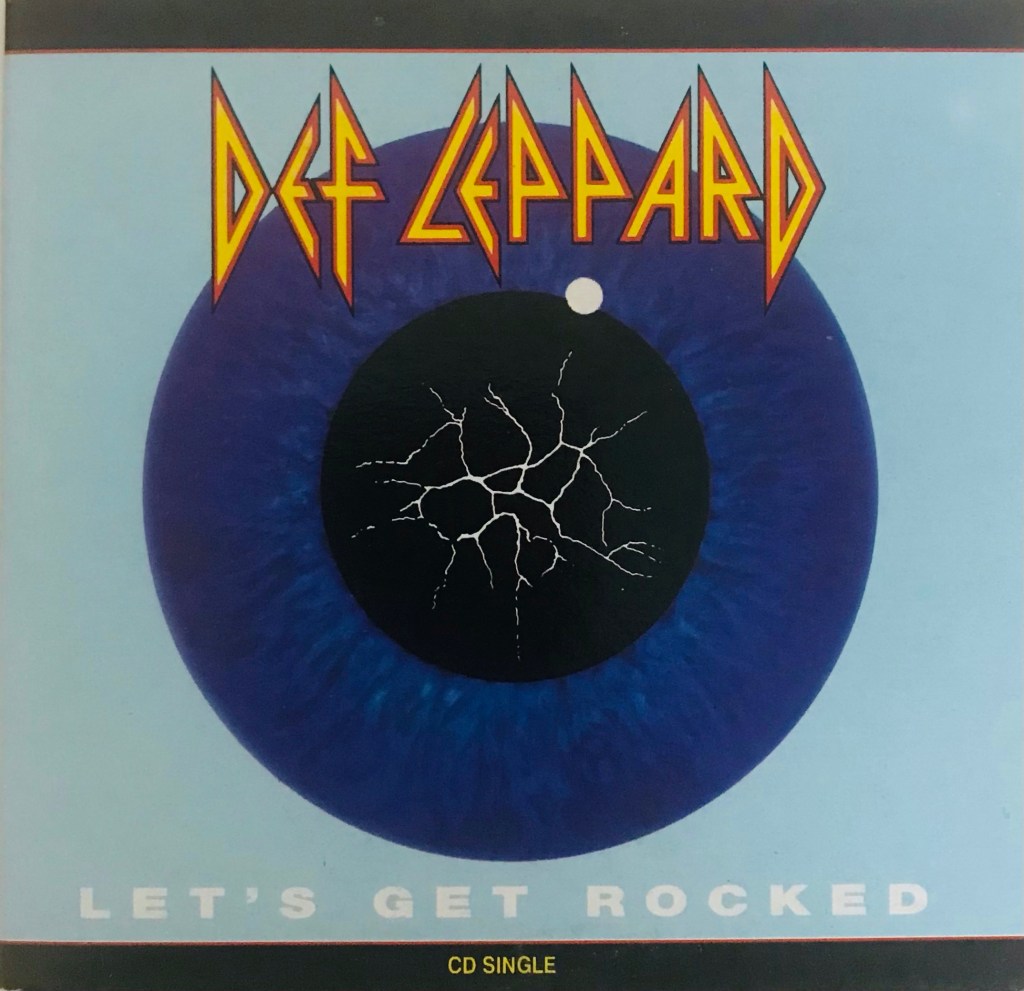
You hold on your hands the first single from our new album, ADRENALIZE. A simple little ditty, LET’S GET ROCKED just about sums up our feelings about life.

Also check out ONLY AFTER DARK, a Mick Robson song we’ve always liked. Mick’s been I’ll and this track is our acknowledgment of his microphone.

It sure feels good to be back. Play it LOUD!

I should have written about the CD single first if I was chronological with my posts on Def Leppard.

Well “Let’s Get Rocked” is part of pop culture at this point in time. It’s Chorus is massive and instantly recognizable in the same way “We Will Rock You” from Queen is.

Only After Dark

Their tribute to Mick Ronson.

If I had to pick between the original and the cover I would go for the original Ronson version. It just feels loose, raw and fun.

Def Leppard stays faithful to the original, so what we hear with the Def Lep version is an updated sound and Joe Elliot vocals.

Women – Live

Now this sounds massive.

Each snare hit and pulsing bass note is perfect.

And check out the Chorus riff with those extra pinch harmonics added. The beauty of playing live and feeding off the energy of the crowd.

Standard
Classic Songs to Be Discovered, Derivative Works, Influenced, Music, My Stories, Unsung Heroes

1976 – Part 4.1: Peter Frampton – Frampton Comes Alive!

Its listed as one of the definitive live albums ever.

“Frampton Comes Alive!” was released in 1976. It’s weird how his trajectory is so similar to Kiss. Following four solo albums with little commercial success, “Frampton Comes Alive!” was a breakthrough for Frampton, the same way “Alive” was for Kiss.

The album is mostly live except for the first verse of “Something’s Happening”, the rhythm electric guitar on “Show Me the Way” and the intro piano on “I Wanna Go to the Sun”. These were fixed in the studio.

In a genius marketing move, the double album was released in the US with a reduced list price of $7.98, only $1.00 more than the standard $6.98 of most single-disc albums in 1976.

And the band is on fire.

Peter Frampton is on Vocals, Lead guitar, but Bob Mayo fills up a lot of the space with his Rhythm Guitar work, plus he plays the Piano and Hammond Organ. Stanley Sheldon on Bass Guitar and John Siomos on Drums provide a solid foundation.

There is crowd noise, fake or real, I’m not sure and the GM of Winterland, Jerry Pompili starts off the concert with the words “If there was ever a musician who was an honorary member of San Francisco society, Mr. Peter Frampton”

Somethings Happening

The blues rock groove is clichéd and heard in many different songs, but it’s always cool to hear it.

This track and the next are from the “Something’s Happening” album released in 1974.

Doobie Wah

It follows on from the blues rock groove from the opening song. And with Doobie in the title, it does sound like Doobie Brothers.

Show Me The Way

From the “Frampton” album released in 1975.

When people talk about talk-boxes, this is the song that was listed as the definitive talk-box song, until an Italian American called Richie Sambora changed the game with “Livin On A Prayer”.

Musically, its excellent, a strummed guitar progression, a hooky vocal melody and that talk-box melodic lead.

It’s a Plain Shame

A blues rock dirge from the “Wind of Change” album released in 1972.

At this point in the set, it sounds okay and fresh.

All I Want to Be (Is by Your Side)

The album goes into ballad rock territory for the next three songs. This one is from the album “Wind of Change” released in 1972.

Wind of Change

An acoustic folk rock song.

Baby, I Love Your Way

From the “Frampton” album released in 1975.

It’s a song that I’ve heard on radio and TV commercials and movies and when I heard it here, I was like, ahhh, it’s from Frampton.

The song flopped when it was released in 1975, but it took on a new life when it was released as a single from this live album a year later.

I Wanna Go to the Sun

From the “Somethin’s Happening” album released in 1974, it could have come from any Southern Rock album released at the time. And Frampton is wailing away throughout the song in various solo spotlight moments.

Penny for Your Thoughts

The shortest track here at 1:23 and along with the next track are from the “Frampton” album released in 1975. It’s one of those major key finger picked campfire tunes. It doesn’t sound like “Albatross” from Fleetwood Mac, however it has this feel.

(I’ll Give You) Money

From the album “Frampton”, released in 1975 and its back to the hard blues rock.

I dig the “Stormbringer” and “Mississippi Queen” feel in the song. And 80’s Y&T comes to mind when I listen to this.

Check it out.

Shine On

From the “Rock On” album released in 1971. The blues rock dirge is sounding too much same/same.

Jumpin’ Jack Flash

A Rolling Stones cover which was released on “Wind of Change” from 1972 and given the 7 minute live treatment here. .

Lines on My Face

From the “Frampton’s Camel” album released in 1973. The fingerpicked clean tone intro hooks me. It’s very Eagles like when they played Folk Rock.

Do You Feel Like We Do

From “Frampton’s Camel” album released in 1973. The 14 minute closer of the album.

The intro riff will grab ya straight away. It’s Santana like, its bluesy and its rocking. But that whole section in the middle is unnecessary.

In Australia it charted to the top spot and was certified 3x Platinum. In the U.S, it also went to Number 1 and is certified 8x Platinum.

There is a theory that this album became so big in 1976, because the year was insignificant when it came to rock music and most of the artists who had fame prior to 76 had either stalled their careers with drugs or breakups or if they were still together they were running on fumes.

And Frampton never captured this glory again and the subsequent albums didn’t do anything great either.

It’s because his face and looks got more time than his guitar skills. Suddenly, his audience was more female than male and his musical credibility was questioned. All of those years honing his guitar chops and song writing abilities were ignored by a vicious press who saw him as a disposable teenage idol.

And while this was happening, he was hooked on morphine and his manager was ripping him off, leaving him bankrupt, along with a terrible decision to star in a film version of “Sgt Pepper” and to pose a certain way for the album cover of the follow up, “I’m In You”.

Standard
Classic Songs to Be Discovered, Derivative Works, Influenced, Music, My Stories

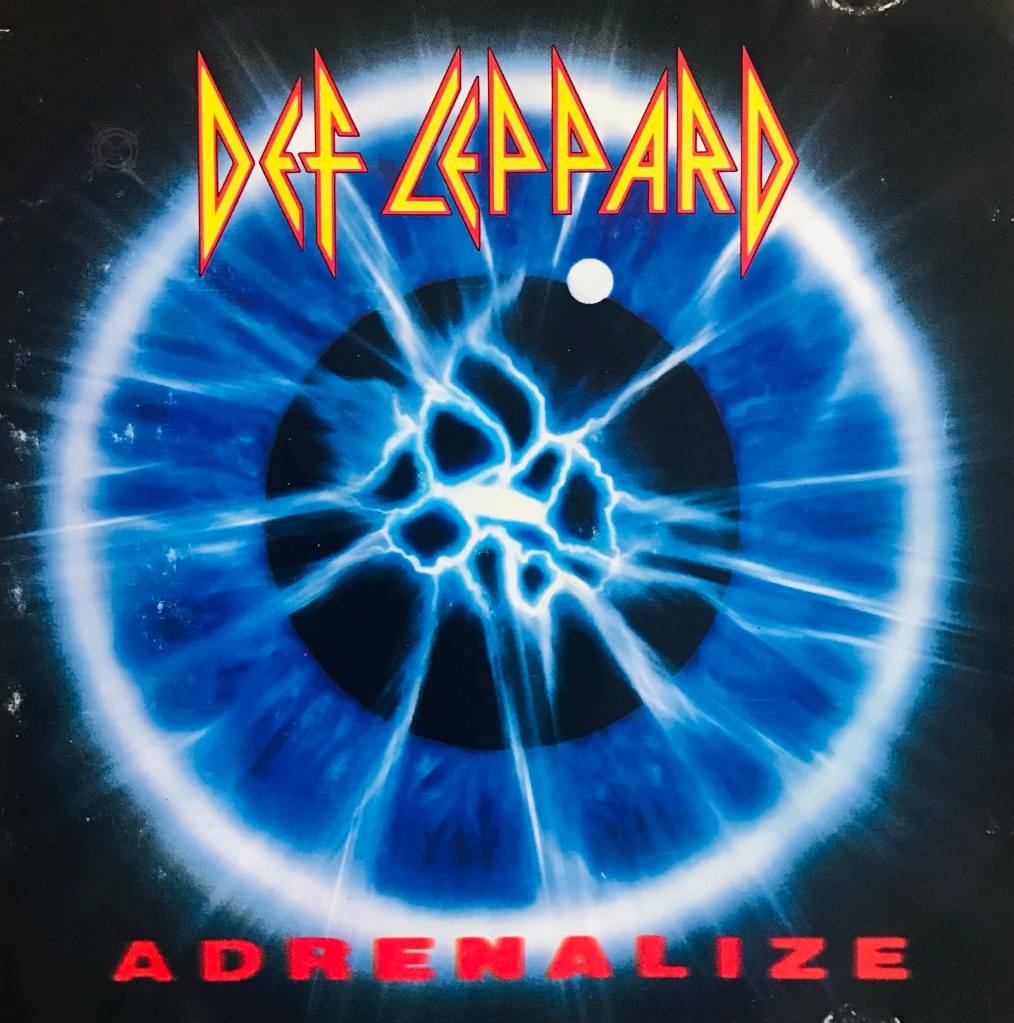
The Record Vault: Def Leppard – Adrenalize

“Adrenalize” came out on 31 March 1992 through Mercury Records.

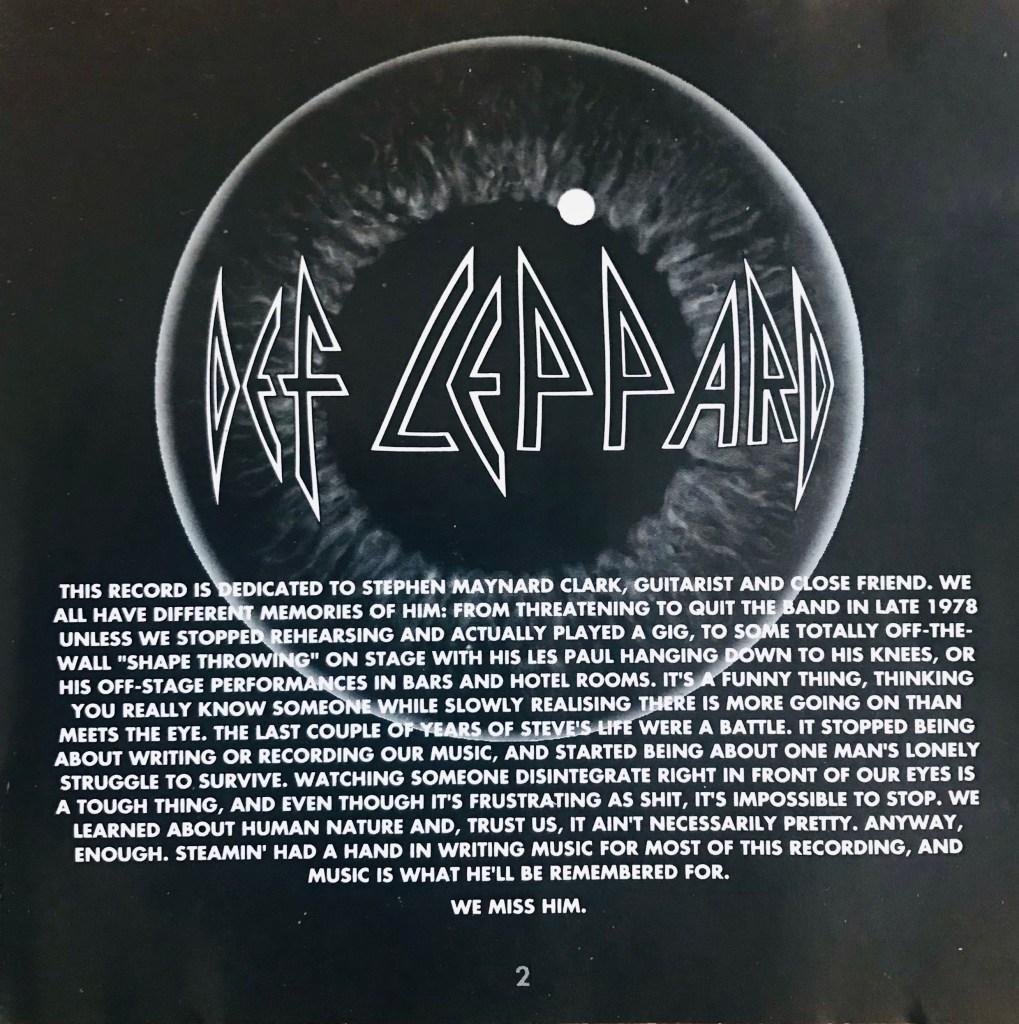
I was a first day buyer because of Steve Clark (RIP). I heard it a couple of times and put it on the shelf. It stayed there for a long time. I wanted to like it but my bias and loyalty to Steve Clark was making me not like it. And I kept telling anyone who listened to me that it was missing the special melodic decorations that Clark was well known for.

Many years later, I did come across various interviews in which Phil Collen stated that he recreated Clark’s parts from the demos because Collen was there with Clark when he played his original ideas for the songs.

And “sort of gone” from the ship was Mutt Lange as he decided it was time to drive Bryan Adams crazy. After three albums, AC/DC didn’t want to work with Lange again. Malcolm Young hated him because he felt his methodical studio takes sucked the life out of the music. Foreigner stopped working with him but Def Leppard still wanted to work with him, and they did the pre-production with him as Lange is there in the song writing department as the fifth member.

I’m not sure what the point of the above is. Is it an eulogy or a “hey, we tried to save him but couldn’t”?

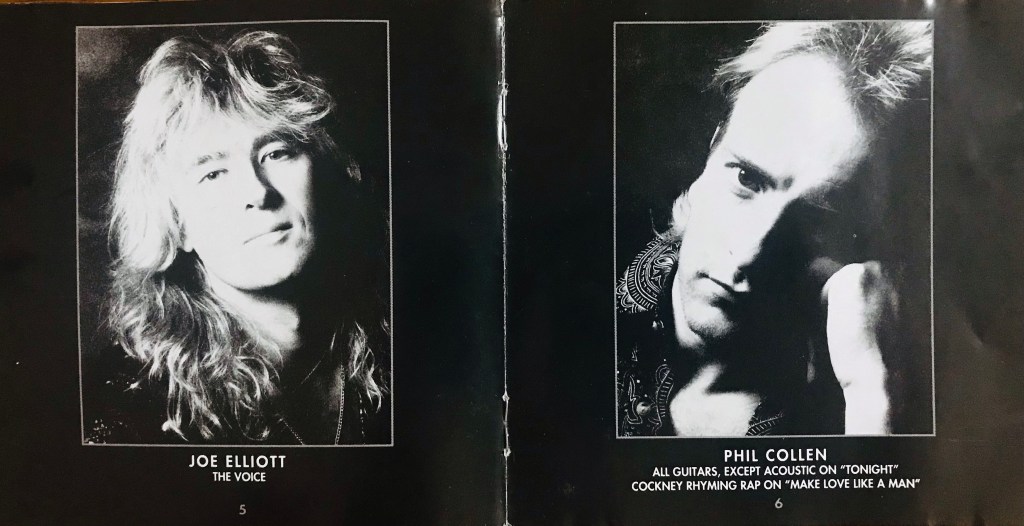
The recording band was Joe Elliott, Phil Collen, Rick Savage and Rick Allen. Interesting to note that backing vocals includes a certain John Sykes who was heavily rumoured by the magazines to be the new guitarist.

Let’s Get Rocked

I couldn’t shake the “Pour Some Sugar On Me” vibe in the verses. And I liked the cleverness in the lyrics, like “I suppose a rock’s out of the question”.

Heaven Is

The music is derivative of Def Lep songs that came before, like “Photograph”, “Armageddon It” and “Let It Go” and I like it.

Make Love Like a Man

It was only a matter of time before a song title would come about to challenge “Dude Looks Like A Lady”. And this one is it. While the song lyrically does nothing for me, the song is great to jam along with.

Tonight

One of my favourite tracks as it has a feel from “High N Dry” and “Pyromania”.

White Lightning

The tribute to Steve Clark.

It’s long droning guitar intro gives way to a “Billy’s Got A Gun” style groove.

Stand Up (Kick Love into Motion)

How good is the start?

It reminds me so much of “Hysteria” and I like it.

And press play to hear the lead break.

Personal Property

It’s back to the AC/DC style riffage on this but the track could have been interchange with any Bryan Adams cut during this time.

Press play to hear that section from 2.17 to 2.38. its classic early Def Leppard.

Have You Ever Needed Someone So Bad

Lange is rewriting, “Everything I Do” here. And it’s a big reason why I was off this album. Like how much Mutt Lange can we really have in our lives. According to the charts and sales of Adams and Twain in the 90’s, a lot of Lange.

I Wanna Touch U

Typical Lange style of song, with a clichéd un-inspired riff that mimics AC/DC.

Tear It Down

My favourite song on the album and it’s an oldie, a B-side from “Hysteria”. It rocks hard and I like the simplicity of the Chorus, which reminds me of “Let It Go”.

In Australia it went to number 1 and to a Platinum award. In the U.S, it went to number 1 and its 3x Platinum. In Canada, it also went to Number 1 and a 4x Platinum award. In the U.K, it also went to number 1 and a Platinum certification. And the trend continued in other countries like Finland, Sweden, Norway, Switzerland, Germany, New Zealand and France.

The tour for “Adrenalize” went for 18 months, beginning in April 1992 and finishing in October 1993. After it, we got the excellent “RetroActive” in 1993 (a collection of unreleased tracks to close off the Steve Clark era) and a Greatest Hits package in 1995 called “Vault”. And the music scene kept changing but we didn’t think that Def Leppard would change that much. Then they dropped “Slang” in 1996 and man, they changed. But that’s another story.

Standard
Copyright, Music, My Stories, Stupidity

The Week In Destroyer Of Harmony History – February 7 to February 13

2018 (4 Years Ago)

REMEMBERING THE MUSIC

The problem with writing about 80’s music is those who remember it, care about it and those who don’t remember it or did not grow up in it, don’t really care about it. Well not all people. There are some.

But for those of us who lived it, the artists inhabit a special place inside us, where our memories are triggered by the melodies and distortion. Play a Top 100 Rock list from the 80’s and you’ll be surprised how many songs you can sing along to.

2014 (8 Years Ago)

MUSIC BUSINESS INNOVATION

The Music Business launches an Anti-Piracy Game App to educate young people on piracy while at the same time copyright infringement of music is declining each year due to decent and well-priced legal alternatives.

The game allows players to select an aspiring artist from a list of hopefuls, compose tracks from a roster of song-writers, producers and studio technicians and balance the books by keeping an eye on how radio play, streaming and piracy impact on profits. But the game doesn’t show the players how much an artist REALLY gets for a song and how much the labels keep for themselves.

In the metal and rock sphere, two record labels come to mind, where I feel that their intentions are motivated by having a copyright monopoly on certain songs.

One is Frontiers and the other is Rock Candy. Frontiers are getting a lot of the Eighties greats to create forgeries of their hits, while Rock Candy is buying up albums from the Eighties and re-releasing them with expanded packaging, so that all these forgeries and new versions of the Eighties albums fall under a new copyright term.

MORE INNOVATION (take that word with a lot of sarcasm) FROM THE ENTERTAINMENT INDUSTRIES

Remember when Voltage Pictures went after people sharing the “Dallas Buyers Club” movie.

IN THIS MOMENT AND ATLANTIC

I wrote back in 2014 that “In This Moment” would regret signing with Atlantic Records.

Remember “Bush”. After three successful releases on a smaller label, “Bush” signed a big dollar deal with Atlantic for their fourth release and in return they had their least successful album. And the label wasn’t happy. So with no mainstream success and a lack of label support, “Bush” called it quits.

“Winger” was signed by Atlantic and they had success with them and Atlantic reaped in millions from the first two “Winger” albums while the band was classed as still in debt. After “Winger” delivered their best album “Down Incognito”, “Beavis and Butthead” also happened, and after the dui lynched a Winger loving family in one of their episodes, Atlantic Records suddenly developed amnesia and claimed that they had never heard of “Winger”.

“Collective Soul” already had a demo version of their massive hit “Shine” doing the rounds on radio for about six months before Atlantic picked them up and re-released the same demo album under the Atlantic brand. What an artist and development program at Atlantic. While the band kept selling, Atlantic loved them. Then when the sales started to decline (although still great numbers compared to other bands), the label started to lose interest and after 7 years of making Atlantic wealthy, once their contract ended, it wasn’t renewed.

“Pride” from White Lion broke out and Atlantic pushed them to write more hit singles for the next record. This pressure to create “hit songs” caused a conflicted Vito Bratta even more conflict and when that attempt at “hit songs” failed to provide an increase in sales for “Big Game”, the label just stopped caring. As a last resort, they gave them a lot of money for the “Mane Attraction” album but the band took their time and they were out of the music scene for 12 months recording that album. And Atlantic had already moved on. The album was released with no marketing budget and within 5 months, the band was over. No one from the label even called them.

“Twisted Sister” had a huge local following, however US labels just kept on rejecting them. Eventually, they went looking for a deal in Europe and after a false start with Secret Records, they ended up getting signed to Atlantic Europe. So of course, Atlantic US came knocking, signed them (even though they ignored and rejected them for ten years prior to that), made a huge amount of money of the “Stay Hungry” album and then dropped them three years later.

“Zebra” had a huge local following before they got signed with Atlantic Records. Then the “Zebra” debut album became one of the fastest selling releases on the Atlantic roster. Three years later, Atlantic dropped the band, however they kept an option open on Randy Jackson. So Jackson finished the “China Rain” record in 1990 and Atlantic Records decided not to release it but they wouldn’t allow him to take the masters and release it with a different label.

“Badlands” was signed by Atlantic. The self-titled debut came out and it achieved cult like status among the jaded metal community. “Voodoo Highway” came next however Atlantic was not impressed as the label wanted hit songs for MTV and they wanted those songs written to a strict radio formula. Ray Gillen apparently had songs that suited what the label was looking for. Those frustrations came to a head when Jake E. Lee accused Ray Gillen of going behind his back. In the end, Atlantic broke the band up and then dropped them when they went chasing the grunge dollars. And there albums will never see the light of day on digital services or re-releases because of Ray Gillen infecting the daughter of an Atlantic Exec with HIV.

DAVE MUSTAINE

Dave Mustaine will never have to spend another dollar on marketing. I have a Google Alert set up for Dave Mustaine, and man, what can I say, the web is a flux with Dave Mustaine news. Because he likes to express his opinions. And people either hate him or love him.

In an interview on the FasterLouder website, Mustaine is asked questions, around the then recent album “Super Collider” and how it is seen as a failure. Mustaine responded by saying it debuted at No 6 on the Billboard charts, so he wouldn’t call that a failure.

It’s important to note that the charts do not have the same meaning and influence as they once did. When someone comes up with a chart that combines sales, streaming counts, YouTube views along with the conversation occurring on social media, only then can we call the charts sensible.

And the album “Super Collider” is a failure.

In the end, we are mainly interested in what is great and it is better to release great more frequently instead of an album every 2 years that has a couple of great tracks.

THE WORLD ACCORDING TO NIKKI SIXX

“When you spend nine months working on an album, all the work that goes into it and recording it, mixing it, mastering it, then you release it and it falls on deaf ears.”

“I’d rather work on two songs under that plan (exploring the idea of placing their songs in films, or signing sponsorships deals through integrated marketing with other types of companies that want to use their song specifically to reach tens of millions of people) than do eleven songs that only reach 100,000 people.”

Nikki Sixx from Motley Crue said the above in an interview on the Classic Rock website back in 2014. The link to the story is in the original blog post.

The record labels and the RIAA will say that artists would stop recording less because people pirate/copyright infringe. They will call for stronger copyright enforcement.

Sociologist would say that sales of recorded music have declined due to the rise of other desirables, like apps and gaming in general. Look at the sales of the “Halo” games series by Microsoft. “Halo 4” made $220 million in 24 hours. Overall, the whole series has grossed over $3.4 billion.

Have any rock bands reached that many people or made $220 million in sales in one day?

And artists are still creating and still releasing and still breaking through. Just not the big artists from yesteryear.

Critics will say, that Motley Crue should release something worth buying and that they will buy it.

Musicians took risks and stood for something. They made money, they blew money, some did drugs, and they made money again. Basically rock stars did it their way. There was no safety net. That is why we flocked to them. That is why we became fans. They represented an attitude, a sense of freedom that connected with us.

That’s a wrap for another week.

Standard
Classic Songs to Be Discovered, Derivative Works, Influenced, Music, My Stories, Unsung Heroes

1986 – Part 4.7: Ratt – Dancing Undercover

I missed this album in 1986, picking it up a few years later. I’m glad I did pick it up, because as soon as I dropped the needle I liked what I head musically.

It had groove, it was heavy and it was music I was familiar with, like the “Van Halen II” album.

“Dancing Undercover” is the third studio album.

Ratt was on an album per year cycle, as the label knew that time at the top is fleeting, so they capitalized as much as they can.

Produced by Beau Hill, he kept the Ratt’sters of Stephen Pearcy (Vocals), Robbin Crosby (Guitar), Warren DeMartini (Guitar), Juan Croucier (Bass) and Bobby Blotzer (Drums) in line to deliver another Platinum album.

However it’s important to remember that Platinum awards were given out to artists based on shipments alone before Soundscan became a thing.

Did they really sell a million?

I don’t think they did. Then again in a country of 332 million, what is a million in sales.

It’s less than 1 percent. 0.3 to be exact.

That’s the reach.

Anyway.

Dance

Written by Crosby, Pearcy, DeMartini and producer Beau Hill.

Before “Girls, Girls, Girls” there was “Dance”.

Check out the digital delay melodic lead at the start is perfect.

Does it remind you of the piano riff on “Bat Out Of Hell”?

One Good Lover

Written by Crosby and Pearcy.

Check out the “Somebody Get Me A Doctor” riff in the Intro and Chorus. Crosby was a master at taking something that came before and making it Ratt’N’Roll material. And he also took the feel, the key and groove of “You Really Got Me” in the verses as well.

Drive Me Crazy

Written by Crosby, Pearcy, DeMartini and Blotzer.

The dudes borrow from another L.A shredder in Mr George Lynch with the Intro/Chorus riff and a certain EVH in the Verses and Pre.

Slip Of The Lip

Written by DeMartini, Croucier and Pearcy.

Its blues rock groove was better than anything that AC/DC was releasing and DeMartini was in pentatonic heaven with his leads.

Body Talk

“Light Up The Sky” comes to mind immediately.

So press play and enjoy that main riff from DeMartini, which is something he had written a while ago, but never knew what to do with it.

Until Croucier heard it, wrote some more music for it and arranged the song, with Pearcy contributing lyrics.

A perfect Side 1 closer.

Looking for Love

The Side 2 opener written by Crosby, Croucier and Pearcy.

How catchy is the vocal line in the Chorus on this?

But press play to check out the NWOBHM riff in the intro.

It’s heavy fucking metal.

7th Avenue

Written by DeMartini and Pearcy.

The metal blues groove on this is perfection, something which Izzy and Slash would use a lot on the debut GNR album.

It Doesn’t Matter

Written by Croucier and Pearcy.

Musically it’s very VH like.

The Chorus lyrics are great with the message to let your individual freak flag fly, as it doesn’t matter at all the clothes you wear.

But the Verse lyrics are not in sync.

Take a Chance

Written by DeMartini, Croucier and Pearcy.

CC DeVille would be inspired for “Unskinny Bop” and DeMartini would re-use some of the riffs for “Way Cool Jnr”. It could even pass as a derivative version of “Slip Of The Lip” or a track on a David Lee Roth album.

Enough Is Enough

Written by DeMartini, Crosby, Croucier and Pearcy it’s basically “You’re In Love” in clean tone.

Croucier is all over this album, with co-writes on almost every track. Pearcy was never Shakespeare when it came to lyrics, but there is always room for dumb party sex songs.

Then again, not if your Eddie Vedder.

Press play.

Standard
Classic Songs to Be Discovered, Derivative Works, Influenced, Music, My Stories, Unsung Heroes

The Record Vault: Def Leppard – Hysteria (7 inch US Version)

“Hysteria” is the title track of the album, released in 1987 as the third single. Its perfection was lost in Australia as a single.

But we became reacquainted with it after the album started to get traction on the back of “Pour Some Sugar On Me”.

“Ride Into The Sun” is an oldie, originally released on the rare Def Leppard EP from 1979. The song just kept coming back into the mix for an album release, but never officially made it.

And that rare EP from 1979 is still rare if you have the original pressing, however if you don’t have the original pressing, the EP has been released on various Def Leppard Box sets and reissued as a RSD purchase in 2017.

Riff wise, its Def Leppard at their metal best. The riff actually reminds me of “Aint Talking Bout Love”, just beefed up.

There is this little riff in G major, in between the E minor riffs that I like. When you hear it, you will know what I mean. It’s those little things that hook me in.

And the Chorus is very British rock, like Sweet and Slade, something which Def Leppard wear on their sleeves with pride. There’s even a pretty unflattering photo of the band in Union Jack T-shirts and small shorts around the “Pyromania” period. I’m surprised a testicle didn’t pop out, that’s how short the shorts were.

For the song “Hysteria”, well it’s one of those songs that can be classed as a perfect mix of hard rock and soft rock. I mentioned in the album review one word for the song.

Perfection.

Press play and enjoy.

Standard
Classic Songs to Be Discovered, Derivative Works, Influenced, Music, My Stories

1986 – Part 4.6: The Rolling Stones – Dirty Work

I liked the 80’s Stones. They were like a pseudo melodic rock band. But Keith Richards hated it.

You see, Mick Jagger had just released his first solo album, “She’s the Boss” in 1985 and Richards saw this as a betrayal. Richards believed that Jagger’s first priority should be the Rolling Stones and not to pursue a career as a pop star.

“Dirty Work” was released on 24 March 1986. Produced by Steve Lillywhite, he didn’t have an easy job to do as he had to call in various other musicians to get the album done. It was also rare that all the band was in the studio at once.

The band for the album is listed as Mick Jagger on vocals, Keith Richards and Ronnie Wood on all things guitars, Bill Wyman on bass and Charlie Watts on drums.

But.

Jagger was often absent from the sessions while Richards recorded with Ronnie Wood, Bill Wyman and Charlie Watts.

Jagger added his parts after.

And Charlie Watts was addicted to heroin and alcohol so Steve Jordan and Anton Fig played drums on some tracks (uncredited) and Ronnie Wood on others.

One Hit (To The Body)

It’s that “Rockin In The Free World” vibe in the verses that hooks me.

The song is written by Jagger, Richards and Wood and Jimmy Page also plays on it. The best song on the album.

Fight

This is old Stones, with 80’s production and I like it. The song is written by Jagger, Richards and Wood.

Harlem Shuffle

This sounds like Mick and Keith turned up to a Blues whiskey bar and started jamming with the house band and I like it.

You can feel the soul and blues drip off every note and every melody. It’s a cover from Bob & Earl, written by Bob Relf and Ernest Nelson.

Hold Back

This Jagger and Richards cut feels like a mess.

The only thing that isn’t a mess is the metronomic drumming from Sir Watts (RIP). Then again I don’t know if it was him or the other uncredited drummers.

Too Rude

It feels like a track from the “Cocktail” movie or a Beach Boys track.

It’s also a cover from Half Pint, a Jamaican Reggae artist who released the song (called “Winsome”) on his 1984 album. Lead vocals are handled by Richards on this and drums are played by Ronnie Wood.

It’s also a skip.

Winning Ugly

It’s a Jagger and Richards composition. Musically, it’s got a bass riff which is like a 12 bar blues, but the soul feels like a soul rock track.

Back To Zero

It’s a funk rock tune, written by Jagger, Richards and Chuck Leavell who was a member of The Allman Brothers during their 70’s heyday. A bit different, but by this stage, the album is more filler than killer.

Dirty Work

The tempo is increased and the band is rocking out of the gate. The song is written by Jagger, Richards and Wood.

Had It With You

A 12 bar blues track, bringing back their 60’s output into the 80’s. Aerosmith is another band that would write tracks like this in the 80’s and well into the 90’s. The song is written by Jagger, Richards and Wood.

Sleep Tonight

A ballad written by Jagger and Richards, which feels like a jam at a Roadhouse Bar late at night when everyone has had too many drinks. Lead vocals are handled by Richards on this and drums are played by Ronnie Wood.

In the end, the first three tracks set the bar high, the title track joins them and the rest of the tracks are there as filler.

And because of the animosity between members, there was no supporting tour for this album. Jagger would later say that it was Watts’ personal state as one of the reasons he vetoed a tour but Richards reckons it was vetoed so that Jagger could start working on his second solo album, “Primitive Cool”. The way Richards saw it, they toured in worse states previously.

The critics panned it, however the album sold well.

In Australia it was a number 2 album, going Platinum on the backs of the singles.

It was a Top 10 album in Austria, Canada, Holland, France, Germany, New Zealand, Japan, Norway, Spain, Sweden, Switzerland, the U.K and the U.S.

It was also certified Platinum in Canada, New Zealand and the U.S. It was certified Gold in France, Germany, the Netherlands and the UK.

If you haven’t heard it, give it a listen. If you’ve heard it, give it a re-listen.

Standard
A to Z of Making It, Classic Songs to Be Discovered, Derivative Works, Influenced, Music, My Stories, Unsung Heroes

1986 – Part 4.5: Krokus – Change Of Address

“Change of Address” came out in 1986 and its listed as album number 9 for Krokus.

The band for the album is Marc Storace on Vocals, Fernando von Arb on Lead Guitar, Mark Kohler on Rhythm Guitar, Tommy Keiser on Bass and Jeff Klaven on drums. Paul Fox and Jan Winding contribute keyboards.

Production is handled by Tom Werman as Producer and Mixer, with Duane Baron as the engineer and von Arb as Co-Producer.

A special mention to the outfits on the back cover. The 80’s are well known for the wardrobe choices of artists. And Krokus play into this as well.

Check em out in jump suits that mechanics would wear at a Formula 1 race. But they are in a bunker, to highlight the demolition of a building that looks like the White House.

Now (All Through the Night)

Written by Fernando von Arb, Jeff Klaven and Marc Storace.

How good is the Chorus?

It’s like Journey vocally and melodic hard rock musically.

One of my favourite tracks on the album but the midi drum sounds bother me.

You can blame ZZ Top for this, but at least when ZZ did it, it was still sounding like it belonged in the rock domain, whereas, the drum sound here feels like it belongs on a Gloria Estefan and Miami Sound Machine album.

Hot Shot City

Written by Tommy Keiser, Mark Kohler, Jeff Klaven and Marc Storace.

I’m not sure what’s happening with this song.

It’s like they wanted to bring in influences from Robert Palmer and Huey Lewis into their sound. It could have worked.

School’s Out

This is like old school Krokus and after hearing AOR Krokus on the first two tracks, this is a welcome relief of rock and roll.

For those that don’t know, this is a cover of the classic Alice Cooper cut.

But it’s also not necessary to have this on the album. Then again, most 80’s album had a cover of a 60’s or 70’s track on it. For some bands it was pure filler and for others, it was their biggest song.

Let This Love Begin

Written by von Arb and Klaven.

An acoustic guitar arpeggio riff starts it all off, very Malmsteen like with a bit of Vinnie Vincent and “I Still Love You” from Kiss. Once the distorted riffs kick in, its more Foreigner than Malmsteen.

Check out the lead break, bluesy and emotive, which reminds me of Jimmy Page and “Stairway To Heaven”.

Burning Up the Night

The side 1 closer is written by von Arb and Storace.

Its AC/DC “Long Way To The Top” like in the verses and the Chorus could have come from a REO Speedwagon album.

Say Goodbye

Side 2 opens up with this track, written by Fernando von Arb, Jeff Klaven and Marc Storace.

At 5.18, its length shows that it wasn’t written for radio. It has this reggae feel in the verses which I like and the backing vocals remind me of “Black Diamond” from Kiss.

The major key Chorus is like those major key Power Metal choruses.

This is the side to listen to first if you are a Krokus fan. There isn’t a bad song on this side.

And if the intro riff sounds familiar, it should as it was used by Krokus on “Tokyo Nights” from the “Metal Rendezvous” album.

World on Fire

My favourite track of the album at 6 plus minutes long, written by Fernando von Arb, Jeff Klaven and Marc Storace.

While the riffs are metal and hard rock like, the vocal delivery in the verses is very Robert Plant like and I like it.

If you want to press play on a track from this album, start with this track.

Hard Luck Hero

Written by Fernando von Arb, Jeff Klaven and Marc Storace it feels like it’s a cross between Bryan Adams, Night Ranger, early Foreigner and Autograph.

And I like it.

There is this section just before the solo, when Def Leppard also comes to mind.

Long Way from Home

5 plus minutes long and written by Fernando von Arb, Jeff Klaven and Marc Storace.

It’s another Krokus classic song, rooted in their past and perfect to move with into the future.

The Chorus has this Kiss feel which I like and Allan Holdsworth also does the guitar solo a fusion of string skipping and whammy bar madness.

The album did decent business in Switzerland and Sweden, but in the U.S it was up against some decent competition and it failed.

The band would later admit the change in style and sound was due to the label Arista not approving the recording until they heard more radio friendly songs.

But this wasn’t a problem tied to Krokus alone.

All of the bands during this period had albums that sounded radio friendly.

Judas Priest and “Turbo”.

Quiet Riot and “QRIII”.

To name a few.

Overall, the album still sounds like a hard rock album once you get past the first two tracks.

Werman has copped some flak from artists he’s worked with, but one thing is certain. The bands he produces, sound good. Even though I don’t like the midi drum triggers, the album still sounds good.

And if you purchased a Krokus album expecting to hear Shakespearean lyrics, well, it ain’t going to happen.

Enjoy Krokus for what they are, a hard rock band trying to survive in an ever changing market place.

And Krokus does change well.

When all the rage in the scene was about the NWOBHM and AC/DC they gave us “Headhunter” and “The Blitz”.

And when the rage shifted to AOR and midi triggers and synths, well they gave us “Change Of Address”.

Standard