A to Z of Making It, Copyright, Music, My Stories, Piracy

The Week In Destroyer Of Harmony History – August 16 to August 22

4 Years Ago (2017)

NEW JERSEY

“New Jersey” from Bon Jovi was doing the rounds.

“Slippery When Wet” was written while Jovi and Sambora still lived at home and had a million dollar debt to the record label. The start of the “New Jersey” song writing process began as soon as the band came off a gigantic 18 month world tour with millions to their name.

A double album was demoed and rejected.

Desmond Child was brought in again and a few more songs got written. Other outside songwriters like Dianne Warren and Holly Knight also contributed. The double album then became a single album and months after the conclusion of the “Slippery” tour, Bon Jovi had a new album ready to release and another 18 month world tour on the cards.

In between the tour, Jon escaped to Vegas and got married.

Once the tour ended, Jon the went on a road trip, released a solo album for a movie and achieved even more success. Richie Sambora was left in limbo, picked up the pieces and also released a solo album.

While “Jersey” didn’t have the same sales success as “Slippery”, it is a solid album and the band earned its keep as one of the best live shows.

THE LABELS

Customers of music showed the recording industry what they wanted via Napster. When other services stepped in, music customers showed the labels what choice brings to the conversation.

Choice for fans to decide and make their own decisions and the power to demonstrate what they believe something should be worth.

But the labels ignored it.

It wasn’t until a hardware company created iTunes and then techies created streaming services that customers started to get what they want, digitally.

So are the the record labels and the publishers doing their best for artists in the long term or are they just focused on the short term profits?

Instead of following a path that leads to better standards/outcomes for artists in the long term they seek a litigious path that only benefits them in the short term.

The labels and artists should understand that there are fans who don’t pay for recorded music because they don’t believe they should, however these same fans have no problem coughing up $200 plus dollars for a concert ticket for a larger act and these same fans have no problems coughing up $20 to $70 for independent acts. It’s their choice how they choose to interact with music.

And then there are the fans who have large LP and CD collections, who don’t pay for music anymore, but still pay for concert tickets and what not.

And then there are fans like me who have large LP and CD collections and decided that streaming is the way forward. So I pay for a family account and I have no problems forking out cash for a concert ticket. And I still add to my physical collection when I feel like it and when I see it as worthwhile for my collection.

And then there are fans who have large LP and CD collections who have decided that purchasing physical is what they want to do.
And these fans also have no problem paying for a concert ticket.

The recording industry has never been more powerful. There’s all this crap about piracy, streaming rates and the techies taking over. But the techies make tools, not stories or music.

Life is a struggle for everyone, not just creators.

THE WAY OF THE WORLD

If you risk, you could lose. There’s no safety net in life. And we don’t hear from those who risked everything and failed and now have nothing. Hell, we don’t even know their names. Only the winners get their story told.

It’s a “winner-take-all” economy and we plod on, trying to make it. But we don’t know where to start, so we take all the roads on offer, only to get back to the start.

Making music is great, but making connections is better. It’s the way of the world today.

MONEY FROM THE OLD

Did you know that Book publishers make more than 90% of their profit from books they published years ago. And yet they put 2% of their effort into promoting and selling those books.

Would it be fair to say that 90% of the income that the record labels get comes from music that came out years ago compared to what is new.

The majority of music consumers don’t normally purchase creative content all the time but when they do, they buy what is popular.

It’s the reason why the “Black” album from Metallica still sells. It’s the reason why “IV” from Led Zeppelin still sells. It’s the reason why “No More Tears” still sells. It’s the reason why “Slippery When Wet” still sells.

However we are living in a different era, one controlled by consumers. And the new stuff released by artists is originally purchased by a smaller hard-core super fan group. Much like the 70’s. Then in time as word spreads, people will check out the release and keep it in the conversation. Much like the 70’s.

Recognition doesn’t come on day one or week one or month one or year one. It percolates year after year after year until it boils to the surface. Will you be around to capitalise and monetise?

HOW THE LABELS ROB CREATORS

YouTube tells the world that the service pays more in the U.S for Ad-Supported Streaming than other services like Spotify and Pandora.
The record labels via their lobby group RIAA disagree with YouTube’s math. 

But the record labels and the publishing/licensing companies are the first to get paid. And nowhere in this debate have these organisations mentioned what they get.

But there are thousands of news articles showing what the artists or the song writers get from YouTube streams in their bank account, but the artists are the last ones to be paid, once the labels and publishing companies take their cuts.

But whose robbing who.

8 Years Ago (2013)

TRIAL OF TEARS

“Trial of Tears” is from the “Falling Into Infinity” album released in 1997.

The album is a controversial subject for Dream Theater fans. Some say it is incredible, others say that it was a sell out and others say it’s crap. Mike Portnoy said he hated it, and that by releasing the Official Bootleg of the album on a Double CD format, he felt that he has corrected that hate and given the album its due justice.

If the other members agree with that statement is an entirely different matter.

“Trial of Tears” is a three movement song. John Myung owns this song. His groovy bass lines are all over it and for any aspiring bass player, this is a song that should be in your bible of bass songs to learn.

This song is not the heaviest Dream Theater song however it is one song that has heaps of melody around it. Words can’t describe the emotions this song stirs, so let your ears do the listening and give it the time of day.

LIFEHOUSE

Lifehouse just seems to hang around in my life. Maybe it is because my wife played the “No Name Face” album to death at home and in the car when it came out in 2000. While the lead-off single “Hanging By A Moment” had the traction, it was cuts like “Cling and Clatter”, “Quasimodo” and “Everything” that hooked me in.

“No Name Face” was the pinnacle. “Stanley Climbfall” and the self titled album didn’t even come close. I was starting to lose interest.

“Who We Are” in 2007 got my attention with the sorrowful “Storm”, the soul searching rock of “Disarray” and the Johnny Cash vibe of “Broken” .

Then in 2010, came “Smoke and Mirrors”. Tracks 1 to 8 are top notch. They should have stopped the album right there. It would have been perfection. “Almeria” has the song “Moveonday”, which reminds me of “When The Levee Breaks” from Led Zeppelin.

The rest however pales compared to “No Name Face” and “Smoke and Mirrors”. Crank em.

ZARA

I wrote a little story about what artists could learn from Rosalia Mera the co-founder of fashion giant Zara.

REALITY

Piracy can never be handled with a one size fits all business model.

Piracy is hard to be stopped however it can be competed against. Piracy is a service issue. Pure and simple.

The internet is just another disruptive service to the entertainment industries; like the time the VCR was going to destroy Hollywood. Instead the VCR opened up a whole new ownership and rental income stream for Hollywood. With all new technologies, the entertainment power brokers try to destroy it at first. When they realize that they are going to fail, it then becomes part of the new market. In 2012, recorded music had its first year of small growth. Since then it’s been growing.

And music-streaming services will reduce piracy.

And that’s another wrap for another week.
Standard
Music, My Stories, Piracy

The Week In Destroyer Of Harmony History – March 29 to April 4

4 Years Ago (2017)

I was writing about the recording industry trying to rebrand/sell itself as the “music” industry.

The Recording Industry is a section of the “music industry.”

But the Recording Industry likes to sell and market itself as the Music Industry.

The Music Industry is everything.

There is the recording industry who are involved in getting artists to recording and releasing music. The release can be via vinyl, CD’s and mp3’s and streaming.

But there is also licensing, touring (and people involved with touring like drivers, road crew), merchandise, publishing, musical instruments (sellers, manufacturers and buyers), music hardware, music software, video production and many more.

And a lot of movement was happening within governments around internet privacy. So I was asking the question, where is the outrage from artists.

There is a lot of press about outraged artists due to streaming and piracy but when it came to their internet privacy being sold to a corporation, there was nothing. Not even a word.

Governments deny that climate change exists and people scream in protest. Governments take away more of our privacy and there is silence.

8 Years Ago (2013)

I wrote about how DRM in games was hindering the real paying customers and how it really doesn’t stop people from copying the game. But the game makers want stronger DRM and enforcement as they believe they are losing money due to pirated copies.

Circa 2011, the MPAA stated that piracy losses amounted to $58 billion.  

How did they quantify the amount?

They didn’t, but they used it over and over again when they spoke to politicians about getting new laws written up.

I remember seeing that Transformers 1 (T1) and (T2) where the most pirated movies over Bit Torrent. T1 made $710M and T2 made $840M. T3 wasn’t on any torrent list and it made $1.3 Billion.

Maybe because the people that downloaded a torrent of T1 and T2 became fans and paid to watch T3. Maybe those little kids that downloaded T1 and T2 became fans and are now old enough to go to the cinema on their own and watch it.

One thing is certain, piracy is designed by the lobby groups so that they can get stupid legislation passed that puts them back in control of the distribution.

Standard
Copyright, Music, My Stories, Piracy

So…. You Want A Record Deal

“Contracts are a bitch, and we’ve signed some raw ones. And we need to start trying to make some money off of our catalog, which is 10 albums deep, plus all the side stuff. We haven’t made any money from record sales, album sales. It’s all gone to the major labels. A lot of people make money off of us; we just don’t make money the way the deals are structured. We just aren’t excited to get back into any kind of contract. So if we find a new home at a new label, wherever it is, it’s gotta be a special deal where you get something for your hard work.

Vocalist/Guitarist Pete Loeffler from Chevelle

Music sells because artists create. As much as the labels would like to believe it’s about them, it isn’t. They are faceless nobodies to the majority of music consumers.

But the A&R reps and CEO’s of these labels fly private, while the artists that make them millions tour via vans. Which in the last 12 months, hasn’t been much, as all touring has ceased.

So the artists do what they normally do when they have downtime. They create more art for release.

CHEVELLE just finished their recording contract with EPIC. A deal signed in 2001, when there was no streaming, no iPhones and no YouTube.

With each label release, the advance they got for the album was bigger than the last advance, which for the label, would have been small change.

“We’ve sold six million albums for Epic Records, and they’ve made 50 million dollars. It’s lopsided.”

Vocalist/Guitarist Pete Loeffler from Chevelle

Their first album, released in 1999, was produced by Steve Albini and released on an independent label. Albini was always warning bands about signing to major labels back in the very early 90’s.

It was their second album, “Wonder What’s Next” that was the catalyst to make me a fan and many others as well. It was released on Epic.

But I got it a few years after it came out.

The first time I heard their music was when I picked up the “Music As A Weapon II” CD, a live collection from the Disturbed run of shows in which the opening bands all got a song or two featured on the CD. And that was when I heard “The Red”. It was like Tool learned how to write concise groove rock songs and I was all in.

“The fact of the matter is when you sign a record deal with a major, they own it for, like, 20-something years. We said, ‘We’d re-sign with you if you just sent some of it through the pipeline to us.’ All the profits, they’re keeping everything. And if they just send a little bit through, maybe we can talk about this, continuing on.”

Vocalist/Guitarist Pete Loeffler from Chevelle

Once upon a time, a major label deal was an opportunity to participate in the music business. 99% of the bands made zero money off the deal.

With the turn of the century, every label claimed that piracy killed the recording business. But acts still moved units.

Chevelle are not the first nor will they be the last who had been ripped off on the pay as Bon Scott would put it. Thirty Seconds To Mars and EMI went to war over a similar unfair contract after “A Beautiful Lie” blew up everywhere.

Maybe we need to look at the labels in the same we see businesses. There are laws which prevent businesses from merging because of the large market monopoly they would hold. There is a great story over at WIRED.COM called “Big Music Needs to Be Broken Up to Save the Industry”.

The article talks about how bad government policy in the U.S over a long period of time left mergers unchecked and this led to the creation of three major labels financing 70% of the music consumed. In other words the release less than other labels but because of their market power dominance it’s consumed more.

And the new recent proposed laws to rein in Apple, Amazon, Google and Facebook will also affect Sony, Universal and Warner. Because as streaming gets bigger so do the labels.

The article mentions research conducted in 2019 on streaming payments and the three major labels get $1 million an hour from streaming payments combined.

Think about that $1 million per hour. And this was 2 years ago. It will be more right now as streaming grew exponentially last year.

Streams are cheap for the labels. They don’t have to ship streams or store streams and there’s no breakage of streams like physical. All of the cost of the infrastructure is on the streaming service.

Labels are making money. And the artists….

Standard
Copyright, Music, My Stories, Piracy

The Week In Destroyer Of Harmony History – February 13 to February 19

4 Years Ago (2017)

It was busy during this period as I got my mojo back for writing.

I started writing a series of “Score Card” posts a few years before this and within three years I rechecked in with some of the artists I wrote about to see what was happening with them.

Because three years in the music business is a long time.

Bands like Vanishing Point, Harem Scarem, Rev Theory, Adrenaline Mob, Lizzard, Thirty Seconds To Mars, Audrey Horne, Stryper, Nonpoint, Breaking Benjamin, Sound Of Contact and Kingdom Come all got mentioned.

I wrote about how fast we move on to other things. The BlackBerry was “the phone” with emails and phone capabilities and then iPhone’s launch with apps in 2007 changed the game.

People wanted to do more with their phones and that more came from apps which put tools into the hands of their users. Developers and companies rose up all around the world, to create apps for the iPhone. But they couldn’t do the same on the Blackberry.

In 2007, Blackberry was number 8 in global smartphones sold. By 2017 it had zero market share. The speed at which people abandon one thing and move on to another is huge. Remember MySpace. Remember Yahoo. Remember dot-matrix printers. Remember film cameras.

The Pirate Bay (TPB) was about to turn 14 years this year. From its inception, it was a facilitator, spreading the disruption caused by Napster years earlier to even larger audiences. It showed the entertainment industries how they needed to change.

But they didn’t change and it took companies like Netflix and Spotify to make this happen. And they did it by using the same technology made famous by The Pirate Bay. While Netflix realised that the money is in producing your own content, Spotify and other streaming providers have not.

Licensing content from someone is not a satisfactory business model. Just ask HBO, formerly known as Home Box Office. Their early business model was all licensed content and they lost money year after year, while the movie studios got richer. It wasn’t until HBO went into original content, that they started making some serious cash.

TPB stood strong against the pressure put on it by the MPAA and the RIAA and their sister organisations throughout the world. It has stood firm against government officials (loaded up in lobbyist dollars) trying to prosecute it. It was taken down, raided and it still survives. And it keeps on innovating even when court orders become the new normal, requesting ISP’s to block the web address or domain registries to deny any applications for TPB domains. Even in it’s home country of Sweden, court appeals and cases are still ongoing. Google was even pressured to alter (in my view censor) its search algorithm, so TPB doesn’t come up.

But TPB is still alive. It has become a vessel for people to access content they normally wouldn’t have access too. In the process, it has made the world a better place.

Metal music in general has grown to all corners of the world. Suddenly, every country has a metal scene and the larger metal bands that have the means to tour are suddenly hitting markets they’ve never hit before.

The high rates of software piracy in Eastern Europe caused an IT skills explosion.

The high rates of music creation software piracy led to the electronic dance explosion coming out of Europe.

The Pirate Bay spread via word of mouth. It didn’t embark on a scorched earth marketing policy. Maybe there’s lessons there for all.

And I went down memory lane for a post called “In The Name Of Metal”, writing about the record shop days and how all the bands I like got labeled as Metal.

If you wanted to find their music, you had to go to the heavy metal section of the record shop. Even Bon Jovi could be found in the metal section.

And I wrote about Metal history and how it was to be a metal fan, in the 80s.

8 Years Ago (2013)

The labels were trying to destroy radio by getting it to pay more. And if listeners went to streaming services, that would be okay for the labels because they get most of the streaming money, pus they have a percentage stake in these organizations.

I was cranking the Journey catalogue and I couldn’t resist not writing about how similar “Seperate Ways” and Measage Of Love” are similar in the Chorus.

I went 2000 plus words on a Mane Attraction review from White Lion that covers some back story, the year 1991, the competition, some hindsight views from artists after 1991 and the album review itself.

And what it means to be the main songwriter in a band and other band members wanting a songwriting credit for doing sweet fa.

And finally I was pissed about CDs.

Lyric booklets became non existent and if they did come with lyrics it would be something like fitting the lyrics of 12 songs on two pages.

We still had those stupid FBI Anti Piracy Warnings.

Did the labels and the FBI seriously believe that these labels work or deter people from piracy?

You couldn’t even skip those ads on DVDs.

Well that’s my DoH history for the week?

Standard
A to Z of Making It, Copyright, Music, My Stories, Piracy

Certified Sales And Reach

I’m digging the data that comes from Stream N Destroy.

Based on RIAA certifications (total album units certified by the RIAA) Iron Maiden has 6.5 million sales in the US.

Megadeth and Tesla are also sitting at the same certification amount across their catalogue.

Who do you reckon has the biggest audience when it comes to playing live from the 3 bands?

Which tells me that Iron Maiden must be the most heavily pirated band there is. Their sales of recorded music compared to their sales of concert tickets and merchandise just don’t correlate. They get the same attendance as Metallica would get, yet the difference in certified album units between the bands is huge.

Metallica is at 63 million certified units.

While Megadeth and Tesla do play live, the crowds they get compared to Maiden are very different but they have the same amount of certified album sales.

So sales of recorded music does not correlate to massive concert attendances.

David Lee Roth, Muse and Dokken are sitting at 3.5M certified units but Muse plays gigs to 15,000 people and are headliners for certain European summer festivals.

Dokken even at their height didn’t play venues that big nor did David Lee Roth as a solo artist.

Like with Maiden, the sales of certified units don’t correlate with the concert attendances.

Since the sales don’t correlate to the increased demand for concert tickets, is it illegal downloading or the access to music via streaming driving the growth?

Standard
A to Z of Making It, Copyright, Music, My Stories, Piracy, Stupidity

Streaming Hate Continues

The record labels and music news sites that benefit from reporting positive articles about the labels, talk about the billions of dollars the music industry made in the financial year just before Napster hit.

So from a simple viewpoint, when Napster hit, sales of music started to decline. For the RIAA and the record labels, these two events correlate, so it implies that one is causing the other to move. But the sales of music had been falling for some time.

What happened during the 90’s just before Napster went worldwide was a lot of re-purchasing.

People started to re-purchase the music they already owned on vinyl and cassettes on CD’s. These re-purchased items, in most cases re-mastered or super deluxe editions with bonus content at higher prices would skew the record label figures to make it look like new recorded music was bringing in billions of dollars when in fact it was people purchasing old catalogue items. And once we had those albums on CD, we didn’t really need to re-purchase them again.

But Napster also highlighted a gap in the business models of the labels. People liked to have access. If anything, people liked to have terabytes of culture saved on disk drives.

Some artists maintain that it was the right action to go after Napster. Others can’t wait for Spotify to die. They must think that people would just go out and buy their albums on physical again. The hard core always will but the majority won’t. They’ll revert to downloading.

The Napster gap allowed people to share their music collections (bootlegs and original recordings) in a very simple and convenient way. Napster got popular because of it, and the labels should have created something to match it.

But the labels did nothing, and more sharing applications kept coming. Then a small company called YouTube did fill the gap that Napster was really servicing. YouTube allowed people to upload their music collections. And YouTube today, generates billions of dollars. These billions could have been in the profit and loss statements of the record labels but they messed up.

We are 22 years post Napster, and the record labels did absolutely nothing to counter it, except scream for legislation and gestapo like police powers.

You want to know who is the labels biggest client. Spotify and the other streaming services.

You want to know who artists see as their biggest enemy. Spotify, but not the other streaming services..

The arrival of YouTube and eventually streaming services put a dent into the traditional sales model, but did these sharing and access platforms assist in increasing the crowds for artists?

Iron Maiden came back with Bruce Dickinson on “Brave New World”, bigger than ever and played to sold out crowds in countries they’ve hardly sold any recorded product in. Even the album “Brave New World” did nothing sales wise.

Twisted Sister and Motley Crue also came back bigger than ever post Napster and played to their biggest ever crowds until they retired. Then again Motley Crue just faked their retirement.

Did sharing of music assist in these high concert attendances as well?

To use the record label analogy of post Napster sales and pre Napster sales, these two events correlate, so it implies that one is causing the other to move. The same can be said about music being shared illegally and bands playing to their largest audiences ever. One event is causing the other to move.

And here we are in 2020 with a pandemic killing off the live show and no one really knowing how it will look once it is over. And the record labels are winning, making money from streaming revenue while the hard rock artists who have a presence want streaming to die.

But it’s the labels with the greatest share of the streaming revenue.

Standard
A to Z of Making It, Copyright, Music, My Stories, Piracy

Streaming Continued

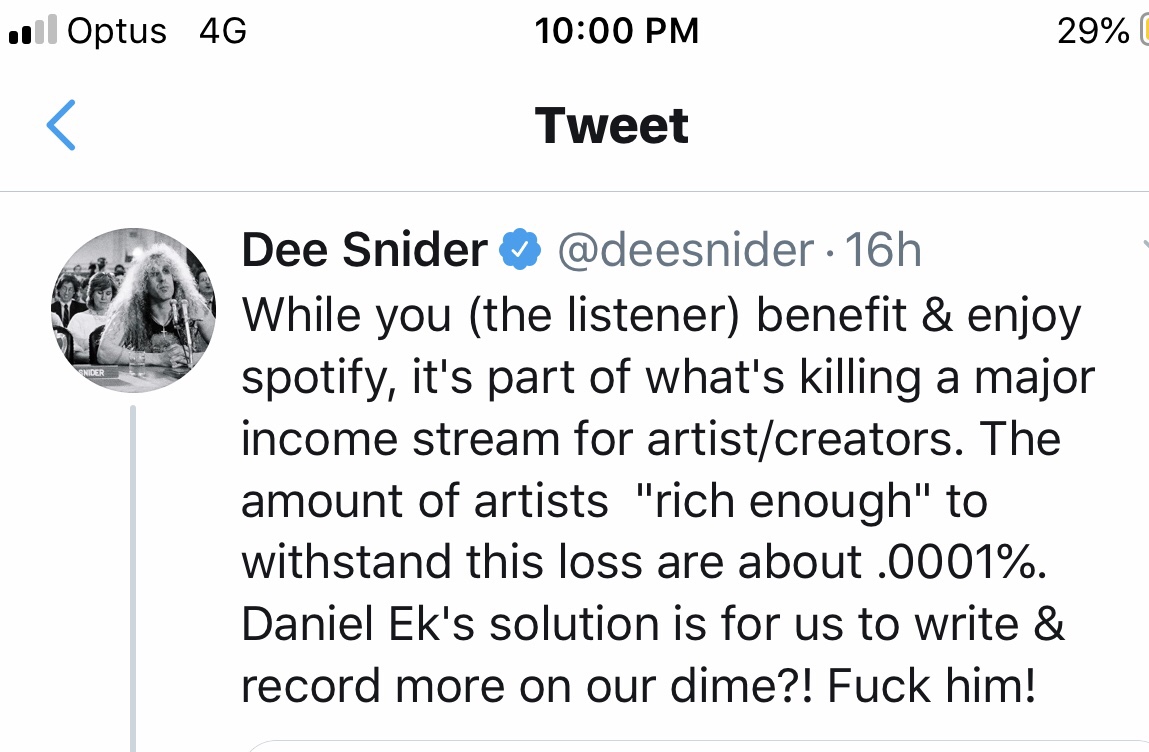
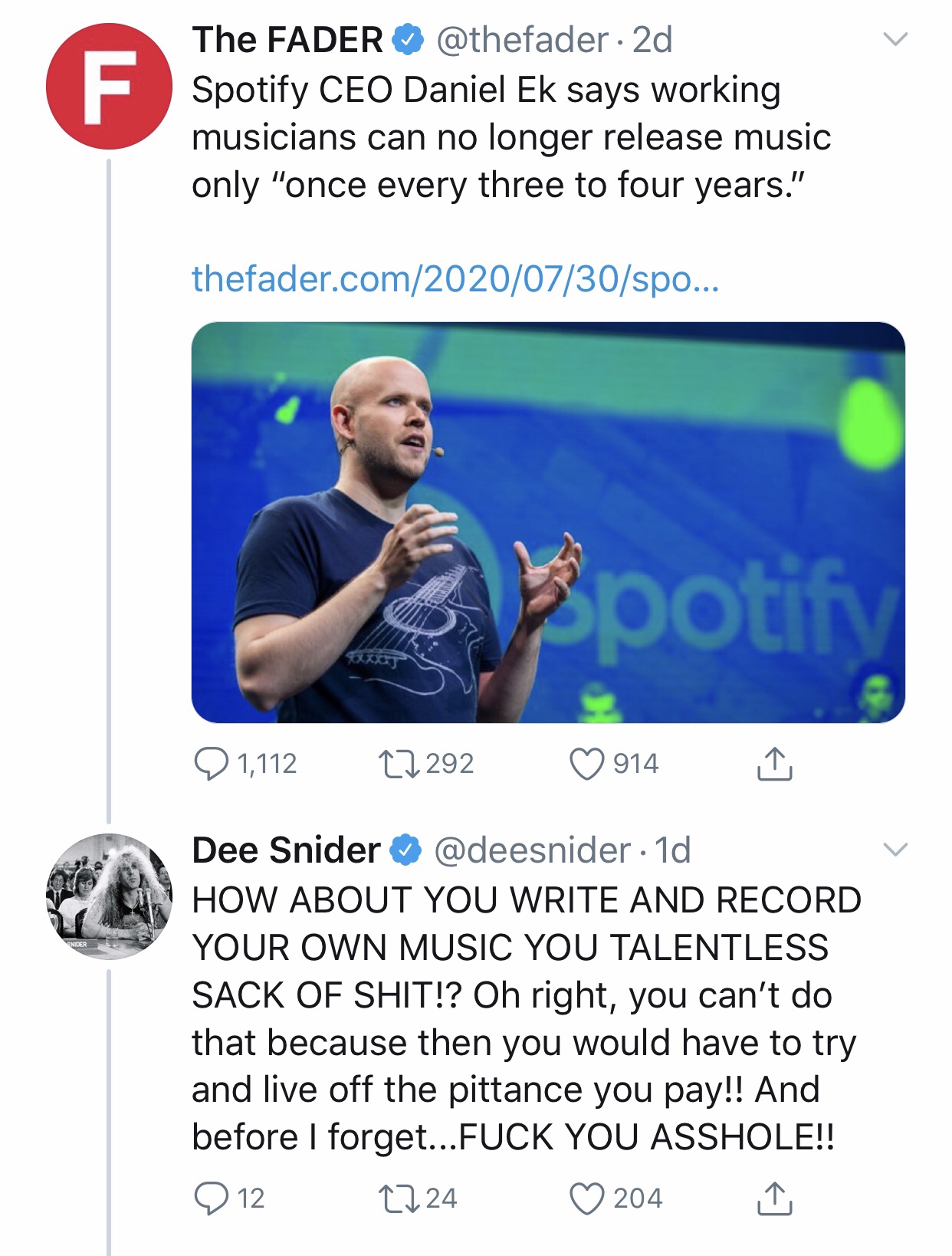
I posted a few days ago about Streaming and some comments from Daniel Ek about what artists should be doing based on the data provided to him.

For example, releasing an album every 2 to 4 years is not a viable solution these days based on the data, and the data tells Spotify that a continuous engagement with fans with frequent releases is more viable.

Spotify thrives if content is delivered, so you need understand that Ek is also playing the role of a sales person in his quarter earnings speech.

And I’ve been following the reactions of artists on Twitter since Spotify quarter results, just to see what their view is, because the reason why we have Spotify accounts is that we like music and we want to listen to music.

Spotify grants access to music, along with the other streaming providers.

Dee Snider as usual is at his best.

Before streaming providers, consumers had, iTunes, pirate sites, cyber lockers and physical purchases. Artists got paid on a transaction once the label recouped.

But does that one sale equal a true fan.

Most of my record collection is from second hand record shops and market fairs of used records. So the person who purchased the record from a shop is listed as a fan via Soundscan metrics, but in reality, they are not a fan as they sold their record to a second hand shop who then resold it to me. And this sale is not captured as a Soundscan metric. So artists didn’t have any idea who their fans were.

Then came YouTube.

An uproar started there, when music became available on the service. YouTube got traction and to this day it is still the number 1 streaming service. The labels eventually negotiated a license deal and artists got rorted again. And pirate sites never went away.

Then came Spotify. The labels took ages to license the service as they wanted a stake in the company and a profit share arrangement with the service and so many other wonderful ways for the label to make money from the service.

First the labels and the publishing houses get a fee for allowing the service to license the music they hold the copyrights for. And this fee goes straight to the labels/publishers without any distribution to the artists.

And everyone is trying to do the math of how much does an artist get paid per stream?

But it’s the wrong train of thought to have.

Whoever holds the rights, the monies are getting sent there. But, the labels and publishing companies also have a profit share arrangement with the streaming service (and it’s not just Spotify, all streaming services have this arrangement, especially Tidal who have a lot of artists involved with it as investors) where they split the monies between each other.

And are the people at Tidal complaining?

Eventually the streaming market will fragment like the movie and TV streaming market and the streaming companies will start to make their own content and will become labels themselves.

Then we’ll have a different conversation.

Standard
Copyright, Music, My Stories, Piracy, Stupidity

Silliness

I pay for Prime Video, but I had to download Bosch S6 from other sources to watch it, as it’s not available in Australia at the moment, even though it was released in the U.S on April 17, 2020.

What the.

I paid for a PS4 game disc (the NBA one) and then the kids had to spend three hours downloading something from the PS4 web store before they could even play it. It sure takes the joy out of it. There is no way that you can just buy a game and play it straight away.

The game makers are using a legally purchased disc as a piracy protection measure. No wonder people download games illegally on jailbroken consoles as well. Look at the work they do to get around these measures.

Remember DRM (Digital Rights Management) platform Denuvo. They got a lot of game makers to sign on and pay huge amounts for its unbreakable anti-piracy software.

The game makers put this DRM on their games and then they released the games. The unbreakable DRM was cracked on the day the games were released. But some game makers got even more creative by putting on another layer of DRM to some of their games, which basically made the legally purchased game unplayable for the consumer.

What a great way to treat a law abiding customer?

But piracy is still an issue.

Yeah right. More like dumb organisations are an issue.

The major labels tried this exercise back in 2003 to 2005. They even went further. Those legally purchased discs had malware on them and if you put the disc into your computer it would install malware on your hard drive, which led to a class action lawsuit against Sony and the other labels.

I was catching up on some movies I purchased a while back. So I put on a legally purchased DVD or Blu-ray (in this case it was the movie “Children Of Men”) and I am confronted by those stealing movie ads. Remember those.

They would say, you wouldn’t steal a car so don’t steal movies because piracy is a crime. So the movie studios are creatively trying to link the downloading of copies to actually stealing a physical product.

And I can’t skip it. I need to watch it.

So this is the punishment that people get for doing the right thing?

No wonder people go and download illegally as the ads are removed and as soon as you press play, you get to watch. No advertisements and no copyright rules on a black screen.

Standard
A to Z of Making It, Music, My Stories, Piracy

Streaming in COVID-19

It’s strange how things work out.

In reality, most artists and the labels wanted a return to the old sales model for recorded music.

This meant that the labels acted as gatekeepers and they decided who got a chance to come into the walled gardens of a record deal.

As we know, then came Napster and everything changed. iTunes, torrents, YouTube, Pandora, Spotify and other streaming services all came.

The recording labels hated digital services, in the same way the book business and the movie business, and they all did everything in their power to stifle or kill the digital book and streaming services.

All because it meant they had lost control.

The record labels kept arguing about rising prices on monthly steaming rates and then they kept running stories everywhere about limited edition vinyl and record stores and the tradition of seeking out a vinyl and dropping the needle.

And now, COVID-19 is everywhere and suddenly physical sales are non existent and even online orders will not be delivered.

But this is when people can listen the most or read the most. And if you are championing physical, the problem is you can’t really buy anything as all of the stores are closed.

Suddenly streaming services are a source of income. In some cases the main source of income since all postal services are prioritizing essential deliveries over non essential. Somehow physical albums don’t matter when life and death is at stake.

Is this when streaming really takes over the world?

Because if there is a winner here, it’s the record labels, as they hold the majority of the copyrights, so they will keep getting paid forever. Yeah, I still see articles from the labels RIAA about people still obtaining music illegally, but hey, those people will never pay for recorded music in the first place.

And I haven’t heard of any label executive taking a pay cut during these unprecedented times.

But I have heard of artists doing it tough. And now we are getting artists dying as well from COVID complications.

And the labels are doing nothing to help their artists or even their former artists, the ones they still hold the copyrights for.

Standard
A to Z of Making It, Copyright, Music, My Stories, Piracy, Treating Fans Like Shit

How Much Should Streaming Services Pay?

A lot of people hate Corey Taylor, but I’m not one of em. I enjoy the music he creates, more with Stone Sour than Slipknot and he has a point of view, a stance, which he shares with the world.

In an interview with the Irish Times which Blabbermouth grabbed and ran with a few months ago, Taylor was asked if SLIPKNOT could live just on royalties from listens.

He said, no they couldn’t survive at the current rates but if the streaming services paid the same publishing rate as radio stations than they could.

In Australia that equates to about $6 per song (for the main cities), as regional cities have a lower fee and then there are separate fees paid for when the song is played, like prime time hours or graveyard hours. In some cases the artists pay to get themselves played and they don’t even know it as it’s charged back to them by the label via miscellaneous expenses.

Also the $6 fee is paid just to the songwriters not the recording act. Since Taylor writes his own songs, he is okay in that department as he would get the payment.

But streaming services charge us $9.99 per month to access a catalogue of music. The math doesn’t work and suddenly piracy looks more appealing of that fee goes up.

Taylor doesn’t have a problem with streaming services for what they are trying to do, but he has a problem with them, when they spend millions of dollars on buildings and then more millions on decking out those buildings for offices and then more millions on flying private and more millions on wages while the artists who bring people to their service are not experiencing the same share of those millions.

But hang on a second, the label he’s signed deals with also spend millions of dollars meant for the artists on the same thing.

Steve Miller said something similar about the recording industry and the RNR Hall Of Fame people at his RNR HoF induction, how they take so much money from the artists and they don’t compensate the artist fairly.

The problem that I have as a fan of music is this;

Artists on a label sell their masters to the record labels for a fee. They are compensated at that point in time. Some for a lot more if they are successful and others for peanuts because they didn’t know any better.

The labels are aware of this power they have and since they are offering the cash, they want a return on investment. So the label benefits in this streaming era because they hold the masters.

Get your masters back like Motley and Metallica and suddenly you will benefit as well.

Standard