Classic Songs to Be Discovered, Derivative Works, Influenced, Music, My Stories

1986 – Part 4.3: Journey – Raised On Radio

Its album number 9 for Journey, released in 1986. But no one was sure if it would get made.

After “Frontiers” (1983), Steve Perry got a massive offer to do a solo album, “Street Talk” and Neal Schon got a similar offer to do “HSAS” with Sammy Hagar. Both albums did well however

Perry’s album would probably still not be listed as recouped based on the dollars spent on session musicians (there was a lot), the dollars spent writing with other writers, the dollars spent in the various studios and the massive advance given to him to even do it. Schon meanwhile got a chance to really show what an awesome hard rock guitarist he is.

But Jonathan Cain wasn’t finished for Journey. He just kept on writing and writing. A lot of his songs ended up on Jimmy Barnes albums, which led to massive success in Australia. And it was Cain who called up Perry to sing on a few demoes he was working on.

That get together led to this album and it also led to Journey falling under Perry’s control.

He fired bassist Ross Valory and drummer Steve Smith, even though Journey’s manager Herbie Herbet told em not to do it.

Perry then replaced them with studio musicians, in Randy Jackson (from American Idol fame) and Bob Glaub on bass with Mike Baird and Larrie Londin on drums (with Smith still performing on a few cuts).

Perry expressed his regret at this many years later and for Valory and Smith, they still received income from the album and the subsequent tour even though they didn’t need to leave their house.

It was probably why their manager Herbet was against their firing. It meant the pie would need to be distributed to even more people.

And Perry broke with tradition of the single word album titles. The album was meant to be called “Freedom” until Perry said it would be called “Raised On Radio”.

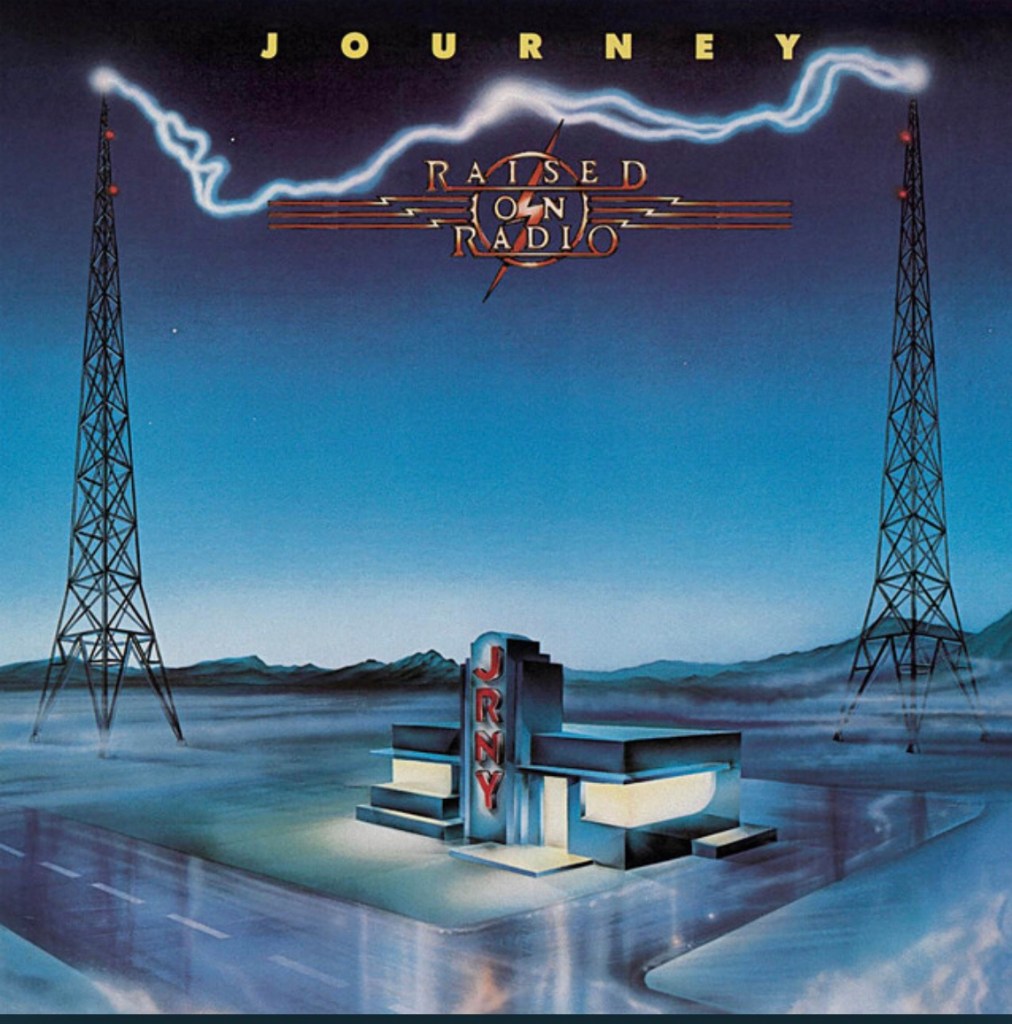
How good is the cover by Priarie Prince who built his career as a drummer in The Tubes and Jefferson Starship, along with his work as a graphic artist and set designer for various music videos. Simply and effective.

Girl Can’t Help Out

How can you not like Perry’s silky and smooth voice?

And Neal Schon gets some slack for going missing in Journey during this period, but he became a master decorator, doing enough to give the songs the MTV and Radio edge.

Positive Touch

It’s got that David Bowie “Modern Love” vibe from his 1983 album, “Let’s Dance” merged with “I’m So Excited” from The Pointer Sisters album of the same name which came out in 1982.

And I like it.

This is how music works. Take what has come before, tweak it, merge it with something else, tweak it again and what comes out is something new.

Suzanne

A monster melodic rock cut, with an arena rock Chorus.

Be Good To Yourself

It’s that feel-good summer vibe typical of the 80’s. Press play and let the sounds wash over you.

The solo from Schon, so simple and singalong.

Once You Love Somebody

This song would not be out of place on a Sting solo album or an album from The Police. Even Van Halen would have a cut like this many years later on “Balance”.

Press play for the Chorus. It sounds like it came from a soundtrack.

Happy To Give

I like the keyboard riff which starts it off but overall the song is a skip for me.

Raised On Radio

Schon is centre on this after the harmonica intro. It’s a rocker with the keys decorating.

I’ll Be Alright Without You

I’m not sure if John Sykes or David Coverdale were listening to this because it’s got that “Is This Love” feeling, which Coverdale would reuse for “The Deeper The Love”.

It Could Have Been You

While Cain plays chords, Schon plays this pentatonic riff which is memorable and full of groove.

The Eyes Of A Woman

Killer bass line on this and Steve Perry just nailing a vocal.

But press play to hear Schon wail away.

Why Can’t This Night Go On Forever

“Faithfully” part 2 comes to mind. Next.

In the end, six singles got released and by 1989, it was certified double platinum in the U.S.

I also wasn’t surprised to read that this album did good business in Sweden as a lot of the melodic rock acts coming out from Sweden many years later had this albums vibe and sound.

It was also the last Journey album for over a decade. While Perry lived off the royalties, Schon and Cain went to work with Bad English, with John Waite on vocals and to further platinum glory.

Standard
Classic Songs to Be Discovered, Derivative Works, Influenced, Music, My Stories

The Record Vault: Def Leppard – High ‘N’ Dry

I don’t have the vinyl anymore. It was in a box that went missing in one of my many house moves. I’ve been meaning to replace it, but I just haven’t gotten around to it. And then Def Leppard announced those marvellous box sets that would cover their career a few years ago, and I’ve seen a few of em reviewed on the blogs I follow, so I’m thinking, it’s time to part with some monies and get em.

Spotify also has em to listen and man, listen I did. For those who reckon that once you’ve heard an album, you don’t need to purchase it, well those people have never understood the collectors mentality.

Anyway, let’s get to the album, released in 1981.

The band is the same as the debut with Joe Elliot on vocals, Steve Clark and Pete Willis on lead and rhythm guitars, Rick Savage on bass and Rick Allen on drums.

The album cover by Hipgnosis is smart and done well, but my 80’s mind, made me ignore it for quite some time. It wasn’t as good as the debut cover, and nothing like the covers of the other albums I was purchasing.

Let It Go

It’s written by Pete Willis, Steve Clark and Joe Elliott.

Many would say its AC/DC influenced and I would agree, but then again a lot of British acts like Queen, Sweet, Mott The Hoople and T Rex who influenced Def Leppard had songs with riffs like this. But producer Mutt Lange did work with AC/DC and during this period, “Back In Black” and “Highway To Hell” were selling like crazy.

Most Def Lep fans would know that it was originally titled “When the Rain Falls” with different lyrics and performed live during the “On Through The Night” tour.

I wouldn’t be surprised if Mutt Lange had something to do with the song title change.

Another Hit And Run

Written by Rick Savage and Joe Elliot. It’s one of my favourite tracks from when I dropped the needle on this. I can never get enough of the Chorus riff and the Verse Riff.

High ‘N’ Dry

The song is written by Steve Clark, Rick Savage and Joe Elliot. If you want to hear the embryo of the “Photograph” riff, then press play on this and enjoy.

And it also became famous when it made a list called the “Filthy Fifteen”, which is a list of songs criticised by the Parents Music Resource Center (PMRC), for having explicit lyrics that describe alcohol use and intoxication.

Seriously the subject matter on this song is meek compared to some other song. But then again what would a bunch of politicians wives know about hard rock music.

Bringin’ On The Heartbreak

One of Def Lep’s best slower tempo songs. Written by Steve Clark, Pete Willis and Joe Elliot. If those harmony guitars in the Intro don’t grab your attention, then please check for a pulse.

And that Chorus. Wow. The multi layered vocals that would become synonymous with the “Pyromania”, “Hysteria” and “Adrenalize” albums are all here.

Steve Clark also owns this song in the lead department. He didn’t have the top hat of Slash to give him that certain unique look, but his pentatonic playing is exceptional.

In relation to the videos, the live recording with Pete Willis is my go to version, but the video with the boat on a lake featuring Phil Collen is the more well-known one. And the 1984 remix version with the synths is a misstep. There was nothing wrong with the original at all.

Switch 625

An instrumental and it was the song playing in the end credits of “Cobra Kai” Season 4 finale. Written by Steve Clark and all solos are handled by him as well.

Just press play, close your eyes and let the music take you to the places your mind conjures up.

You Got Me Runnin’

Side 2 kicks off with this, written by Pete Willis, Steve Clark and Joe Elliot. I’ve read some reviews that basically ignore Side 2, but man, some of my favourites are here.

I like the 70’s vibe this song gives and the hooks keep coming with the Chorus vocal melody. And press play for the “you got me running” section just before the Pete Willis pentatonic bluesy solo.

Lady Strange

Written by Pete Willis, Steve Clark, Rick Allen and Joe Elliot.

How good is this song?

If it had a different title, it would still be in the set lists today.

The intro harmonies get me hooked and the Chorus riff with the melodic lead gets me moving and tapping my foot.

The verse riff has some sped up chords that would be slowed down in a few years’ time for a song called “Pour Some Sugar On Me”.

But it’s that metal riff just before the Chorus that seals the deal. Press play to hear that and then to hear Clark wail.

And as they come out of the Chorus, there is this arpeggio riff which is excellent, Elliot starts singing and the music morphs into the verse riff and then we are back to the Chorus and that infectious vocal melody, of “lady strange I need you, lady strange I want you”.

On Through The Night

Written by Steve Clark, Rick Savage and Joe Elliot. The song has the same title as the debut album.

It’s another killer riff (which also becomes the verse riff) to start the song off. It’s very Blackmore like.

But press play to hear those Randy Rhoads style arpeggios in the Bridge just before the Chorus. For a band who wanted to rule the charts, they definitely kept their fingers on what was hot and what wasn’t.

Mirror Mirror (Look Into My Eyes)

Written by Steve Clark and Joe Elliot.

A very underappreciated cut.

Press play to hear how the verses are constructed. The drivers are the bass and drums.

Rick Savage plays a pulsing bass riff with Rick Allen providing a thundering beat and then the guitars start to decorate with chords at low volume and then at a more aggressive volume. Joe Elliot showcases his vocals chops moving between metal god and rock god melodies.

The Chorus has a catchy vocal melody with multi layered vocals.

And those harmonies in the solo. Just so many good sections in the song that words can’t describe.

I also like how in the last 40 seconds, it starts off with the pulsing bass and drums for a few seconds before the Chorus riff thunders in to close out the song.

No No No

Written by Rick Savage, Pete Willis and Joe Elliot.

I feel like its “Ballroom Blitz” merged with “Tie Your Mother Down” and I like it.

Def Leppard will always be known for “Pyromania” and “Hysteria”. Those albums have moved over 40 million in sales combined and they make up Def Lep’s streaming Top 10 lists as well. But I’ve never judged albums on how many units sold. It’s based on songs and riffs, and the quality and influence of this album cannot be ignored.

Standard
Classic Songs to Be Discovered, Derivative Works, Influenced, Music, My Stories, Unsung Heroes

1986 – Part 4.2: Quiet Riot – QR III

“QR III” or “Quiet Riot III” is actually the fifth studio album from Quiet Riot if you can the “QRI” and “QRII” albums with Randy Rhoads.

It was released in 1986 on Pasha/CBS and it is the last album to feature lead singer Kevin DuBrow until the 1993 album “Terrified” which got a zero skull review in an Australian mag and the word “Terrible” as part of the review.

It’s produced by Spencer Proffer again with John Purdell.

A funny thing was happening in 1986. For some strange reason, artists who had massive sales in 1983 and 1984, struggled to match those sales a few years later.

Twisted Sister had big sales in 1983 and 1984 and they played to half empty venues on the “Come Out And Play” tour in 1985 and by 86, no one really cared about em and by 87 they had broken up.

Judas Priest had declining album sales by 1986, but still proved to be a big drawcard on the live circuit.

Ratt couldn’t match the success of their 1984 debut and by 1986, “Dancing Undercover” was just a blimp on the charts.

And then we have Quiet Riot.

Following the massive success of “Metal Health” and the more modest reception of “Condition Critical”, sales of “QR III” were even lower and it did not achieve any certification.

This Quiet Riot album is also the first album to feature Chuck Wright, formerly of Giuffria, on bass as an official member replacing Rudy Sarzo.

Wright joins Kevin DuBrow, Frankie Banali and Carlos Cavazo.

Before I get into the album, it’s worth mentioning that I never understood the argument put forward about bands rocking less when keyboards are involved. This album has a lot of keys but it still rocks.

Main Attraction

It’s a songwriting committee of Carlos Cavazo, Frankie Banali, Kevin DuBrow, Spencer Proffer, John Purdell and Chuck Wright.

They keys are prominent and the track could be mistaken for a Styx or Toto track.

The Wild and the Young

The song is written by Proffer, Banali, Cavazo, DuBrow and Wright.

Behind “Bang Your Head”, “The Wild and the Young” is the next best original.

The drum groove from Banali starts things off. Then the guitars and the keys play in unison until Cavazo overdubs a memorable little lead.

And the vocals start. While DuBrow is more miss with his lyrics, on this song he’s perfect with his message and delivery.

The music video for the song wasn’t cheap as it shows a dystopian future under control by a totalitarian militarist government and they are trying to round up anyone who is listening to rock music.

Twilight Hotel

Written by Wright, Banali, Cavazo, DuBrow and Proffer. I was drawn to this song immediately because it was different musically.

Down and Dirty

Written by Dubrow, Banali, Cavazo and Wright. It’s written as “Dow And Dirty” on Spotify. It’s typical hard rock and of the times.

Rise or Fall

Written by Dubrow, Banali, Cavazo and Wright.

I dig the opening riff on this. And Cavazo goes to town on the lead break.

Put Up or Shut Up

Written by Dubrow, Banali, Cavazo and Wright.

CC DeVille would have been listening to this as the main riff sounds like something that DeVille tweaked for “Nothin But A Good Time”.

Still of the Night

It’s written by the same songwriting team that wrote “Main Attraction”.

The cut is excellent, a soft rocker but so far removed from the “power ballad” formula.

Bobby Kimball from Toto performs backing vocals on the track, however the “backing” vocals are really cranked up in the Chorus, so it’s safe to say that Kimball was brought in to be the lead vocal there.

Bass Case

It’s an Instrumental written by Wright and all bass. For a minute length, I’m not sure why this is here.

The Pump

Written by Banali, Cavazo, DuBrow and Wright. It’s an attempt to capture “The Stroke” from Billy Squier.

I’m surprised that this song hasn’t been sampled by the rappers as it’s got a lot of good bits in it.

Slave to Love

The mighty Stan Bush is here as a songwriter, along with the committee of Banali, Cavazo, DuBrow, Proffer and Wright.

Musically it’s excellent. It’s almost melodic Metal The melodies are also excellent. Lyrically it’s crap.

Helping Hands

Written by Dubrow, Banali, Cavazo and Wright. It’s an underrated cut with a heavy 70s influence with a killer lead by Cavazo.

While a lot of people were off the QR train by the time this album hit the streets I wasn’t one of em. I was hooked by the music video for “The Wild And The Young” and when I saw the High Syme cover I was happy to part with my money.

Musically it’s a very mature album and an album that’s aged well.

Check out and be wild and young again.

Standard
Classic Songs to Be Discovered, Derivative Works, Influenced, Music, My Stories

The Record Vault: Def Leppard – On Through The Night

“On Through The Night” will turn 42 this year.

It’s the debut album from Joe Elliot, Pete Willis, Steve Clark, Rick Savage and Rick Allen, otherwise known as Def Leppard.

I would love to say I purchased this when it came out, but it was after “Adrenalize” that I went back and got this.

Rock Brigade

It brings the standard hard rock blues vibes to the album but it’s got all the glitter from Sweet added to it.

Pete Willis takes the solo spotlight on this.

Look out for the rock brigade is the catch cry and look out we did.

Hello America

After the “hello America” chants, a “Strutter” style beat and feel kicks in.

I like the Beach Boys vibe, especially after the solo section which Steve Clark nails.

Sorrow Is A Woman

Press play to hear the “Stairway To Heaven” inspired lead break.

And how good is that harmony solo section from the 2.40 mark, which leads to the Outro.

It Could Be You

It shows their love of UFO, Mott The Hoople, Sweet and hard rock Queen.

Hell, the song wouldn’t be out of place on a Judas Priest album.

Satellite

Listen to that tasty palm muted arpeggio riff from Steve Clark in the verses after the first Chorus and how good is that “staring up at the sky” section) which shows the adventurous and melodic spirit of the band.

Press play to hear the solo. It’s Pentatonic heaven and the section straight after the lead.

When The Walls Came Tumbling Down

How good is the clean tone intro?

And then it morphs into those galloping style riffs which was a big part of the NWOBHM and something Iron Maiden would use a lot, “The Trooper” comes to mind immediately.

With a Chorus that reminds me of New Wave acts.

Press play to hear the riff after the Chorus at 2.34.

Wasted

What a headbanging riff to kick off the song.

For anyone who wanted to question the metal credentials of Def Leppard, I always pointed them to this song.

Rocks Off

It’s interchangeable with “It Could Be You” with very similar riffs being the main riffs. Then again the whole blues hard rock movement was based on the same riffs being re-used by each individual artist.

It Don’t Matter

It could have come from the fingertips of Michael Schenker as “Rock Bottom” comes to mind. And how good is that Chorus, just a simple, “It don’t matter” line repeated in a simple AC/DC style backing vocal.

Answer To The Master

How good are those harmony leads in the Chorus?

And the song has a little drum solo before it moves into a section that reminds me of U.F.O.

But press play to hear, the lead break courtesy of Clark, with an open string lick before it morphs into the pentatonic lines.

Overture

It’s 7 plus minutes long and it doesn’t feel laboured and boring. At the 2 minute mark it starts to go into a Thin Lizzy style of song, full of energy and harmonies.

But my favourite part is the stop start harmony section from the 4.20 mark and at 4.40, Joe Elliot starts singing a haunting melody, before a wah solo kicks in.

And from here to the end, it’s that good, that the only thing I could do is press repeat.

For all the multi-platinum and Diamond certifications that came afterwards, there is something simple and organic about the debut.

Check it out.

P.S.

Pete Willis will be forgotten in the future when Def Leppard is mentioned and written about, however his songwriting chops and guitar playing on this album is at a high level.

And let’s not forget Steve Clark. Together they formed a formidable guitar team.

Post Def Leppard, check out the excellent band Roadway in which Willis wrote most of the tracks. The album came out in 1991 and it’s a melodic rock gem, a continuation of the work he started with “Pyromania”.

Standard
Classic Songs to Be Discovered, Derivative Works, Influenced, Music, My Stories, Unsung Heroes

1986 – Part 4.1: Robert Tepper – No Easy Way Out

If you watched “Rocky IV” in the 80’s, you would have heard it’s melodic rock soundtrack.

At its essence, the “Rocky IV” movie is a combination of music videos segments.

The “Apollo vs Drago” pre fight has 4 minutes devoted to “Living In America”. There are two training scenes, with “Hearts On Fire” and “Training Montage” taking up 8 minutes in total. Then there is the final fight scene, which takes up another 4 minutes.

There is also a scene in the movie, which involves Rocky driving his sports car, with the song “No Easy Way Out” playing and various scenes of Rocky’s time with Apollo flashing before his eyes. It happened at a pivotal time in the time, with Apollo dying in the ring, Rocky then organising a fight against Drago (Apollo’s killer) and Adrian telling him, “you can’t win”.

Close to 30 minutes of a 90 minute movie is devoted to musical scenes.

So it was only a matter of time before an album came out from Robert Tepper.

But before that, another Stallone movie came out in 1986 called “Cobra” which had the song “Angel In The City”, another Tepper cut.

So Tepper had momentum with the soundtrack songs, released the album and nothing. Back when sales was the metric of success, the album stiffed and charted low.

But it doesn’t mean the album is crap. It’s actually very good melodic rock album.

First check out the studio band, as it has some experience.

While Tepper does the vocals, Dan Huff and Guy Marshall play the guitars.

Myron Grombacher is on drums.

Tim Landers on bass and a range of keyboardists in Kim Bullard, Alan Pasqua and Richard Gibbs.

You can Google their names and see their body of work as band members and session musos.
 
Let’s get to the album.

“No Easy Way Out” was released in 1986 by Scotti Brothers Records.

And it’s no surprise, that the album starts off with the two soundtrack songs.

No Easy Way Out

The bass riff to start it off is iconic. The feel of it reminds me of the bass riff in “Living On A Prayer”.

The vocal melody from Tepper is emotive and how good is the outro solo.

There’s no easy way out
There’s no short cut home

Truth right there.

Angel Of The City

The bass groove is simple, yet memorable as it drives the song with the synth chords.

The song will always bring back memories of the”Cobra” movie. Brigitte Nielsen is doing a photo shoot while “The Night Slasher” and his entourage get ready to kill another victim.

Whip it cracks just like thunder
Some survive her, most go under

The lyrics deal with the survival of the 9 to 5 grind by looking for some mythical Angel to save us.

Don’t Walk Away

Another classic. Latin like but with a bit of New Wave and a whole slab of melodic rock. It basically could be on a melodic rock, a Duran Duran album or a Ricky Martin album.

Once we had a purpose
Once, once we had a song
Once the feeling disappears
It’s all gone

Can love ever come back if disappears?

Your Love Hurts

It has this “Purple Rain” vibe which I like.

Press play to hear the synth melody.

Restless World

It’s got this Bruce Springsteen spirit which I like.

A restless spirit
Looking for a chance
In this restless world

Aren’t we all.

Hopeless Romantic

It’s like mid 80s Rush and I like it.

Soul Survivor

It’s a favorite. Very pop rock like.

Check out the arpeggios in the Intro which also reappear in the Chorus.

My soul survivor
Without you, what do I have left
My soul survivor
Cannot make it by myself

Press play to hear the vocal melody in the Chorus. It reminds me of the band Gun.

If That’s What You Call Lovin’

The balladeer career of Michael Bolton would be proud of this one.

The song fits on the album however I’m not a huge fan of songs like these.

Domination

Almost soul funk rock. Mid 80s Rush definitely comes to mind.

After the second album “Modern Madness” (1988), Tepper got put on ice by his label. They weren’t interested to release any new music from him, nor did they want to release him from his contract.

He finally got out of this deal in the mid 90s and his third album came out in 1996.

Standard
A to Z of Making It, Classic Songs to Be Discovered, Copyright, Derivative Works, Influenced, Music, My Stories, Piracy, Unsung Heroes

The Week In Destroyer Of Harmony History – December 26 to January 8

Well it’s been two weeks since the last DoHh post.

Here we go.

4 Years Ago (2017 going into 2018)

2018 STARTED WITH SOME RANDOM LISTENING

Yngwie Malmsteen’s “Trilogy” album is full of great riffs and leads.

When the U.S record labels went anti shred in the 90’s, the Japanese and South American markets kept his career going.

There is no denying his 80’s output and it’s a shame that a rumoured collaboration with Ronnie James Dio never happened.

Then I moved to “Trash” from Alice Cooper. It’s commercial sounding, but it’s still Alice Cooper singing.

How can it not be good?

The real gems are “Spark In The Dark”, “This Maniac Is In Love With You”, “I’m Your Gun”, “Why Trust You” and “Trash”.

Afterwards, “Operation Mindcrime” from Queensryche got a listen.

It’s loaded with excellent guitar playing and the album gave me a tonne of great riff ideas to use as influences in my own song writing.

“Flesh and Blood” from Poison was next.

“Valley Of Lost Souls” is one hell of a good song and the best on the album.

“Let It Play” could have been on a John Cougar Mellencamp or Bryan Adams album while “Life Goes On” is a good power ballad and CC plays a tasty intro lead. “Come Hell or High Water” is another underrated tune in the vein of the Classic Rock of the 70’s that doesn’t get its dues.

“Ride The Wind” is another sleeper, while “Something To Believe In” copies the “Every Rose Has It’s Thorn” country bluesy vibe, however this time, the piano is the main driver instead of the acoustic guitar.

“Blow My Fuse” from Kix was up next. Now this album is a perfect example of the “progress is derivative model”.

It starts off with “Red Lite, Green Lite, TNT” which sounds very familiar like something from “The Rocky Horror Picture Show”. “Get It While It’s Hot” is heavily influenced by “You Shook Me All Night Long” from AC/DC. Actually it’s very heavily, heavily influenced by that song.

“No Ring Around Rosie” is a beefed up “La Grange” from ZZ Top in the verses. “Don’t Close Your Eyes” is taking its cues from “Home Sweet Home” and “Dream On”. “She Dropped Me The Bomb” is again heavily influenced by AC/DC with a touch of The Who.  “Cold Blood” is a very similar to “Long Way To The Top” from AC/DC in the verses.

“Piece Of The Pie” is very heavily influenced by Aerosmith. “Boomerang” is influenced by Led Zeppelin. “Blow My Fuse” is such a good track where the influences are not as obvious as the other tracks. “Dirty Boys” is influenced by “Let There Be Rock” by AC/DC.

Finally, Winger is up.

The groovy “Can’t Get Enough” kicks off the album.

When “Miles Away” came on, I wasn’t sure if it was Bad English or Def Leppard. It’s one of those slow tempo melodic rock songs. “Easy Come Easy Go” has a cool groove and I dig the horn section in the verses.

The next two songs are two of my favourite songs. “Rainbow In The Rose” and “In The Day We’ll Never See”.

RANDY RHOADS AND THE BLIZZARDS

The project could have been called that.

It all started when Ozzy auditioned Randy in LA. Afterwards they jammed for a few days with Dana Strum and Frankie Banali.

Then Ozzy went back to England and he met with Bob Daisley. Ozzy and Daisley jammed with another guitarist and drummer however Daisley mentioned that they needed better players.

Ozzy mentioned Randy Rhoads, however the label wanted a well-known British guitarist, but no one was interested to join because of Ozzy’s reputation. Gary Moore was Ozzy’s first choice and he rejected the offer to audition. Eventually the label relented and Randy was flown over to London. Rhoads and Daisley started writing music and it worked well. Lee Kerslake came towards the end of the writing process.

Here are some summaries of what I wrote about the songs.

Crazy Train

You can call this song Ozzy’s biggest hit but it never registered on the charts back in the day. But on Spotify and YouTube it’s huge. The new paradigm shows us what is being listened too.

Bob Daisley provided the title while Randy Rhoads had the riff and the chord structure. For the lyrics, Bob Daisley used Ozzy’s vocal melodies and referenced what was happening in 1979/80. The Berlin Wall was still up and the Cold War between the USSR and USA was still going on.

Goodbye To Romance

It was Ozzy’s title and it came from an Everly Brothers song called “Bye Bye Love.”

The lyrics were written by Bob Daisley and the subject matter was Ozzy’s “divorce” from Black Sabbath.

On the “Don’t Blame Me” video, Ozzy mentions he was humming the vocal melody, and Randy heard it and developed the chords around the melody. Ozzy’s revisionist take makes it sound that Bob Daisley was not involved at all in the song writing process, which is obviously not true at all.

CRITICAL MASS

There are always different kinds of audiences.

You have the early adopters, the first to hear about an artist. These early adopters are looking and wanting a different experience than the people who identify as the critical mass market.

Early adopters want something fresh, exciting, new and interesting.

The critical mass market don’t. They want something that is familiar.

Metallica when they started had an audience that adopted them early. Some of those fans stood by them all the way, even when they broke through to the critical mass market in the 90’s and some of those early day fans just moved on to something new and different.

And who should the artist please, the early adopters of their music or the mass market?

Profits are fine as they allow the artist to invest back into their art. But if profit becomes the main aim, well, nothing and no one benefits if profits are the only thing the artist seeks.

And yes, there are routes to popularity which are random or accidental or luck or being in the right place at the right time.

BOB ROCK AND METALLICA

Bob Rock knew exactly what every song needed.

The demo of “Sad But True” (I had a drummer in a band who thought it was called “Sad Patrol”) was heaps quicker. Bob heard a “Kashmir” feel and asked James to slow it down and make it crunchy.

Rock kept telling James to re-write lyrics to songs. He told him to use fewer words in the choruses and to use stronger words. He questioned James on what the song was about. He asked him how the verse lyrics referenced the song message. James didn’t like this line of questioning. If James couldn’t explain it back to Rock, it meant he hadn’t nailed the lyric.

Rock told Lars to take drum lessons and he told James to take singing lessons. He told Kirk to rewrite solos.

And as a side note, in “Get Him To The Greek”, Lars gets told by Russel Brand to “Go sue Napster and your fans”, and unfortunately that is the stigma that will forever stick with Metallica. They got so out of touch with reality that they sued their own fans for sharing their music.

Nicko McBrain sums up piracy in “Flight 666”when he said “We sold out in Costa Rica but haven’t sold an album in this country…”

8 Years Ago (2013 going into 2014)

GRAMMY’S

From when Jethro Tull won the first metal award at the Grammy’s, the whole awards has been a joke for metal and hard rock music.

Having Metallica then win the “Best Metal Performance” in 1990 for “One” and then in 1991 for “Stone Cold Crazy” just added to the Grammy metal jokes.

“One’s” fate was tied with the “…And Justice For All” album and that was meant for the 1989 Grammy ceremony.

And seriously, for the 1991 awards, a cover song was the best that was on offer in the metal world for releases released from October 1989 to September 1990. I don’t think so.

Even in 1999, Metallica won again for “Better Than You”.

For which song, I hear you say.

“Better Than You.”

Does anyone know from which album it was on or how the riff goes or the vocal melody?

I bet that most people will answer NO.

HEADED FOR A HEARTBREAK

Billy Squire made one ridiculous video with a pink top. And just like that an amazing voice, with a catalog of songs was gone.

Winger had Kip Winger. A Playgirl pictorial was too outlandish and as glam music was committing suicide by cloning itself over and over again, Beavis and Butthead came along and trashed the band.

Metallica even threw darts at Kip Winger while they recorded the “Black” album.

But.

“Headed For A Heartbreak” is a hell of a good song.

Winger’s debut didn’t come from out of nowhere. Kip Winger did his time as a songwriter and studio session musician working very closely with Beau Hill who would of course go on to produce the first two Winger albums that went platinum.

Guitarist Reb Beach is a graduate from the esteemed Berklee College of Music. He also did his time in backing bands and studio work, until he met up with Kip Winger and started writing demos.

Drummer Rod Morgenstein was the most experienced. Active since joining jazz fusion legends “The Dixie Dregs” in 1974, he was a very accomplished drummer to bring into the fold.

Keyboard player and back up guitarist Paul Taylor was the x factor. He was the touring keyboardist for Aldo Nova during his “Fantasy” success. He did his time with Alice Cooper’s backing band at the same time with Kip Winger and played on the “Constrictor” and “Raise Your Fist and Yell” albums.

Go on Spotify and check them out. Go on YouTube and check them out. Focus on the music and not on the pretty boy images put out there in the video clips.

DONT KNOW WHAT YOU GOT UNTIL ITS GONE

Andy Johns (RIP) was on deck again to deliver another big sounding album.

Drummer, Fred Coury didn’t even play on the album as Johns just kept on finding timing issues.

The end result is an album which is seen as a blues rock classic that can rival all the best output from seventies bands like Bad Company.

Hearing them again today, it sure brought back a lot of memories. Guess you don’t know what you got until it’s gone.

SEMI – OBSCURE BON JOVI SONGS PART 1

Everyone knows the singles and even some of those songs have now slipped into obscurity but if you dig deep enough you’ll hear some cult classics.

Tracks like;

THE HARDEST PART IS THE NIGHT

From the “7800 Degrees Fahrenheit” album released in 1985.

“Stay alive, the hardest part is the night”

SHOT THROUGH THE HEART

From the debut album released in 1984. “Runaway” took most of the glory as it became a radio staple however “Shot Through The Heart” was the reason I got into Bon Jovi.

It was good to see the song get some concert time during “The Circle” tour.

HOMEBOUND TRAIN

It’s written by Jon Bon Jovi and Richie Sambora and it’s got this heavy blues rock swagger that just connects.

The magic is at the three minute mark when it goes into this Elvis Presley meets James Brown meets Rolling Stones vibe.

The guitar drops out and it is the bass and drums that keep the groove going and Jon does a few voice impersonations, while Sambora keeps it funky and they build up the song again while Jon keeps singing “Here I Come”. The interlude is filled with church organ and harmonica lead breaks.

On “The Circle” tour, “Homebound Train” came back into the mix with Richie Sambora on vocals.

STARTING ALL OVER AGAIN

It’s got this “Rock N Roll Aint Noise Pollution” style intro written by the Jon Bon Jovi, Richie Sambora and Desmond Child song writing team.

THE RADIO SAVED MY LIFE TONIGHT

Another tune written for the “Keep The Faith” album that never made it.

To buy all the music that I liked was expensive, so I always purchased blank cassettes and kept my finger ready on the record button to record the latest song from the radio.

SEMI – OBSCURE BON JOVI SONGS PART 2

RIVER OF LOVE

It never made the “New Jersey” album and it is a tragedy that it didn’t get fleshed out and recorded properly. It’s got a basic foot tapping riff that sticks with you from the outset. For those keen fans, you will hear the riff groove re-used in “Save A Prayer”.

“Pretend we’re in some movie instead of faded jeans”

Listen to the “Raise Your Hands” reference in the interlude. You could write a whole song based on that riff. Wait, they already did.

Progress is derivative.

JUDGEMENT DAY and GROWING UP THE HARD WAY

Both songs begin with that whole “Na Na NaNaNa” in the same vein as “Born To Be My Baby”, “Rosie” and “Hide Your Heart” from Kiss. Both songs also share the same riff. Both songs are written by Jon Bon Jovi and Richie Sambora.

As with “River Of Love” these songs were recorded for the “New Jersey” album and they failed to make the cut. When a band is at their peak, they are able to churn out some great songs. The motivation is there to keep the machine rolling to see if the first round of success can be repeated.

In relation to the three demos mentioned above, I really thought that they would have seen the light of day “officially” when Bon Jovi released “100,000,000 Fans Cant Be Wrong” Box Set.

IF I WAS YOUR MOTHER

Man, this song is heavy and it has got some serious groove.

What a great vocal melody.

I saw them play it live on the “Keep The Faith Tour” and it rocked hard. The subject matter is weak and it hampers the song from being a powerhouse.

LETS MAKE IT BABY

It didn’t make the “New Jersey” album, however the bass line was used again in “Diamond Ring” (which was also originally written for the “New Jersey” album however it was officially released on the “These Days” album.

WEDDING DAY

“Wedding Day” was written for the “These Days” album, however it didn’t make the final cut.

The song is like a sleeper demo hit on YouTube.

Some of the lyrics made it into another Jon Bon Jovi song called “Janie Don’t Take Your Love To Town”.

SEMI – OBSCURE BON JOVI SONGS PART 3

DAMNED

It has a soul like funky blues groove very similar to what Lenny Kravitz was putting out.

“These Days” from 1995 is a very misunderstood album, released in a very confusing time.

Hard/Glam rock as we knew it was dead, Grunge was fading and alternative rock was rising, along with a form of industrial rock/metal.

LOVE IS WAR

Of course it sounds like “You Give Love A Bad Name” because Jon tried really hard to recreate the same vibe and the same kind of hit.

Is that a bad thing?

I’D DIE FOR YOU

“Slippery When Wet” was a monster of an album. And it was easy for other songs to get missed.

It’s got that Judas Priest “Breaking The Law” guitar line.

Did anyone pick up on that?

On YouTube, “I’d Die For You” is a cult hit. The fan’s have taken the song and made their own film clips, lyric videos and so on.

MY GUITAR LIES BLEEDING IN MY ARMS

The title is a take on the George Harrison classic, “While My Guitar Gently Weeps”.

ONLY LONELY

The bottom line is this; it is a fan favourite.

THE PRICE OF LOVE

“We live, we learn, we lieFor the price of love”

Aint that the truth.

WITHOUT LOVE

Written by the Jon Bon Jovi, Richie Sambora and Desmond Child song writing team for the Slippery When Wet album.

BURNING FOR LOVE

Sambora goes to town during the lead breaks, showcasing his abilities as a melodic shredder. He never went too over the top, always focusing on enhancing the song, instead of enhancing his ego.

RIVER RUNS DRY

It is a Jon Bon Jovi and Desmond Child composition that begins as a derivative version of Led Zeppelin’s “Stairway To Heaven”.

Remember, progress is derivative.

SAVE A PRAYER

No one knows this song even exist, but they should.

THE BALLAD OF BOB DAISLEY

The music business is tough.

However, what happens when an artist in a position of power and mainstream success, does their best to undermine the work of previous people in their career.

This is what the Osbourne’s are doing to Bob Daisley.

They are trying to re-write history to show that Ozzy Osbourne himself was the main reason why his solo career progressed.

They are omitting important facts that when Randy Rhoads and Bob Daisley signed on, it was always spoken of as a band. They are omitting important facts that the band was actually called Blizzard Of Ozz. They are omitting important facts of Ozzy punching Randy, because Randy didn’t want to do a live covers album of Black Sabbath songs.

Most importantly, they are omitting the main fact, that Bob Daisley served as the lyricist for for six albums.

The sad thing is that if anyone reads the credits to the “Bark At The Moon” album, you will see it listed as “All music and lyrics by Ozzy Osbourne.”

Like, yeah right, Ozzy really churned out all of those riffs.

It is sad at to what level the Osbourne’s stooped at that stage. One more thing, read the book from Ozzy and tell me how many times he mentions Jake E. Lee in the book.

But that is a story for another day.

VITO BRATTA

I did a Top 10 of Bratta killer riffs or moments.

All The Fallen Men

Wait

Love Dont Come Easy

Fight To Survive

Hungry

When The Children Cry

Cry For Freedom

Lady Of The Valley

Little Fighter

Warsong

In the end I had a hard time picking 10 songs for this post as each song that Vito has played on all have unbelievable sections.

BATM SONGWRITING CONTROVERSY

Coming into the “Bark At The Moon” sessions, the Blizzard of Ozz band was finished.

Bob Daisley and Lee Kerslake were fired before “Diary of A Madman” came out and the other driving force, Randy Rhoads died tragically when the plane he was on crashed into a mansion and burst into flames on March 19th, 1982.

Ozzy Osbourne as usual was at his drunken best but he still delivered the “Speak/Talk Of The Devil” album, and by doing so he was free from his Jet Records contract, ready to sign a major label deal with CBS.

Jake E Lee joined during the “Speak of the Devil” tour. Once that tour ended, the song writing process began for the next album.

Most of the writing was done by Lee and Bob Daisley.

“Bark At the Moon” was a title that Ozzy came up with. Jake E. Lee came up with the riffs and Bob Daisley wrote the lyrics.

While Bob Daisley got a buy out for “Bark At The Moon”, it looks like Jake E.Lee got screwed over. There are no royalty checks for the songwriting and no publishing monies either.

COPYRIGHT INC

I just finished watching the Rush documentary, “Beyond The Lighted Stage” and in the documentary, Neal Peart is talking about their “Vapor Trail” tour of South America and how they didn’t know what to expect because they never had big sales there and in the end they played to their biggest ever concert attendance at Sao Paulo.

The Brazil tour took place in November 2002. File sharing started in June 1999. Maybe copyright breaches by fans is not a bad thing.

And that’s another wrap for these last two weeks.

Standard
A to Z of Making It, Classic Songs to Be Discovered, Derivative Works, Influenced, Music, My Stories, Unsung Heroes

Australian Method Series: Jet – Shine On

My first post on Jet was “Shaka Rock”, their third album. Then it was the debut “Get Born”.

And I wrap up their output with their much anticipated second album, “Shine On” released on 30 September 2006, in Australia and on 2–3 October 2006, internationally.

When you Google the album name and review, the Pitchfork review is the first one that Google brings back.

Pitchfork gave the album an 0.0 review and the page had an embedded YouTube video of a monkey peeing in its own mouth. I’m presuming to state it’s a “piss poor” album.

But Aussie’s don’t care about expectations and artists development. We care about fun and Jet just made another fun album rooted in good old fashioned Blues Rock.

Holiday

There’s no way that people can’t like this song.

It has all the trademarks of what Jet is. A hooky riff, dumb lyrics and a fun attitude. There is this small riff between the main riff that reminds me of QOTSA.

Makes no difference what they say
We’re goin’ on holiday

It sounds too good to be true these days. Going on a holiday.

Put Your Money Where Your Mouth Is

If there’s one thing us Aussies like, is a good punt. We’ll bet on anything. But this song isn’t about betting.

It continues the catchy riffs and themes from “Are You Gonna Be My Girl”.

She goes down
Like a setting sun

It leaves little to the imagination.

You can be the sinner and I’ll be the sin

Best lyric in the song.

Bring It On Back

The Beatles (as a byproduct Oasis as well) and Bad Company come to mind here.

For all that you said
Would you take it all back?

Even if it’s taken back, it’s been said and words sting deeper than actions.

That’s All Lies

It’s more Punk Rolling Stones like, in a 12 bar blues sense.

Kings Horses

It’s a country folk rock cut.

In the morning i swear i will tell you the truth
How you receive it, well, that’s up to you

Everyone has their own version of the truth.

Shine On

A tribute to the Cesters’ father, who passed away from cancer while they toured on the “Get Born” album.

Oasis and “Stop Crying Your Heart Out” comes to mind here.

Everything will be okay
We will meet again one day

It’s impossible but people believe it’s possible.

Come On, Come On

It’s very ELO meets Rolling Stones.

If they ask you to stand, well they just want you to kneel

So if you stand based on someone else’s command, then you will kneel when they tell you to kneel.

Stand Up

It’s a basic blues rock song in a Rolling Stones “Sympathy For The Devil” and “Revolution” from The Beatles vibe with the message from the 80s, like “Stand Up And Shout” and “We’re Not Gonna Take It”.

Stand up, you got to live while you can
Stand up, burn up before you fade out
Stand up, don’t you follow the crowd
Stand up, you got to live in the now

Rip It Up

Might as well call it “Wipeout” as it has that 60s Beach feel.

Rip it up, rip it up if your ever gonna make it!

Skin And Bones

It starts off with that “Shooting Star” and “Werewolf In London” riff.

Shiny Magazine

It’s that whole Beatles/Oasis feel.

Eleanor

Strummed acoustics and a campfire “Rubber Soul” feel.

All You Have To Do

And the album ends.

They recorded a shit load of songs for this album and there are so many versions of the album with a lot of bonus tracks and demos.

It didn’t sell anywhere near the debut but that doesn’t mean it’s a crap album.

Check it out.

Standard
Classic Songs to Be Discovered, Derivative Works, Influenced, Music, My Stories

The Record Vault: Deep Purple – Perfect Strangers

Mark 2 was back.

It made perfect business sense to have one of the premier bands of the early 70’s come back in the 80s MTV era.

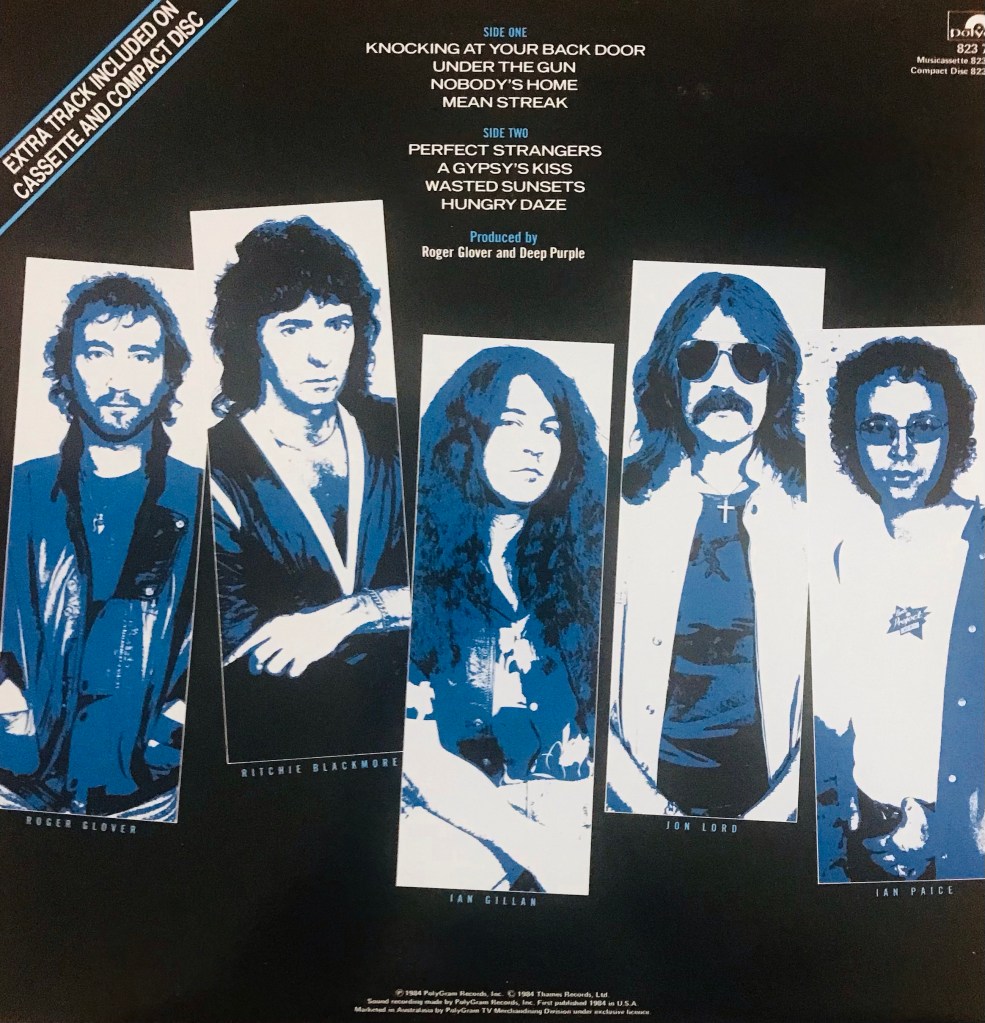
“Perfect Strangers” is album number 11, released in 29 October 1984 and it became the most successful album from the ‘Mark II’ line-up.

Like nomads, they all arrived from different directions. Ritchie Blackmore and Roger Glover arrived from Rainbow, Ian Gillan from Black Sabbath and his solo band, Jon Lord from Whitesnake and Ian Paice from Whitesnake and Gary Moore’s backing band.

But problems existed from the outset. Business problems.

Gillan and Glover wanted the credits to be of the collective. Blackmore didn’t. As the main writer, he didn’t want to share any song writing credits with people who didn’t write anything. After years in the business, Blackmore knew how valuable the publishing is.

It wasn’t until Blackmore left the group in 1993 that the issue was finally resolved within Deep Purple.

I missed this in 1984 because I was into the whole Motley Crue, Twisted Sister, Iron Maiden, Quiet Riot and Judas Priest phenomenon. These guys were just old dudes. Just look at the “mo” on Jon Lord. It’s classic 70’s.

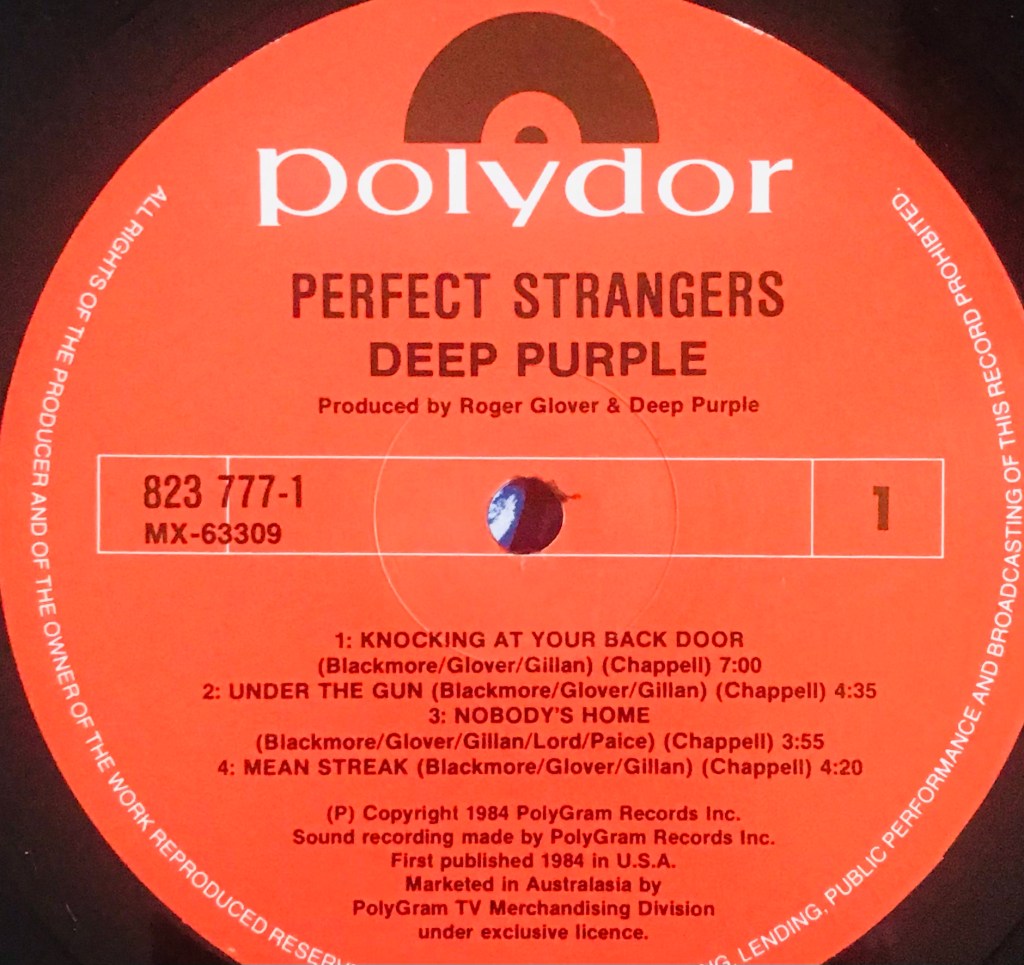
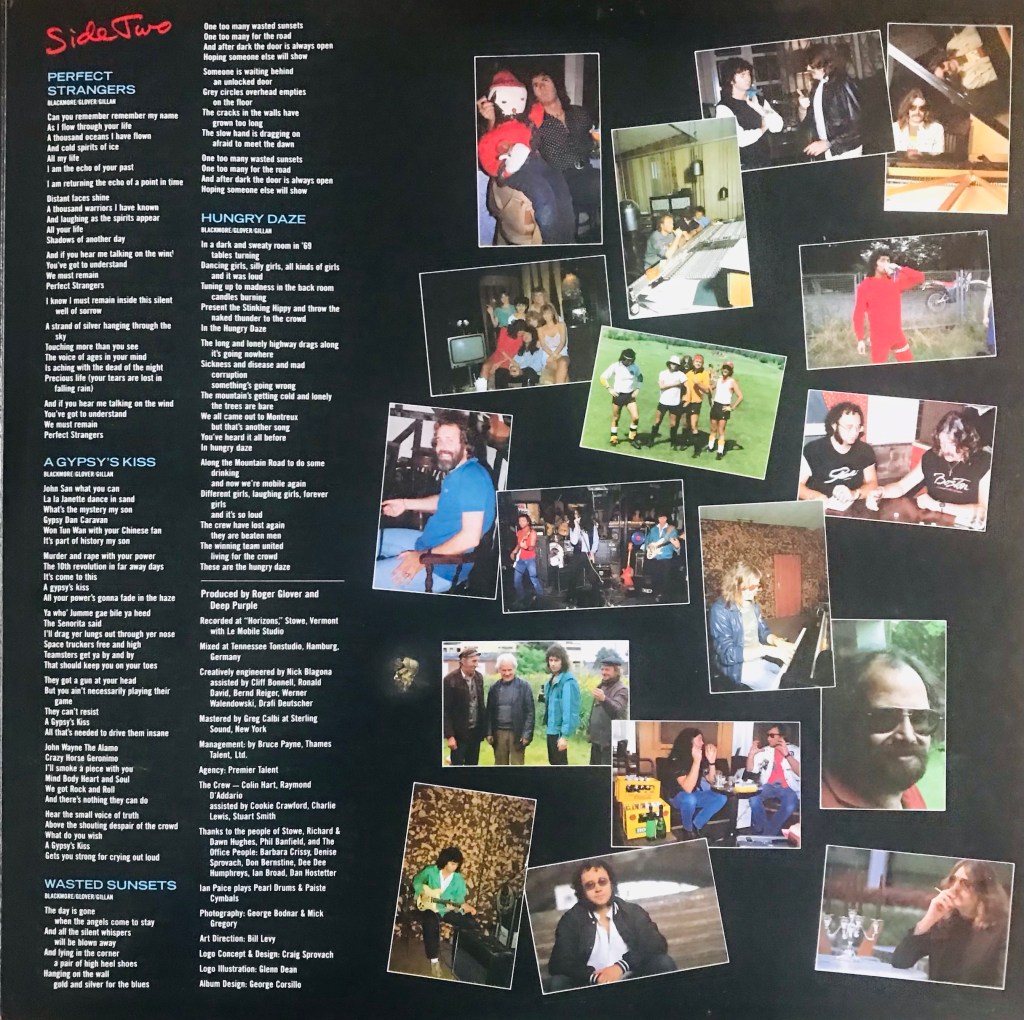
All songs are written by Ritchie Blackmore, Ian Gillan and Roger Glover except where noted.

Knocking at Your Back Door

By now Blackmore had the experience of Rainbow and the commercial success that came with that, so when this song exploded out of the gate you get the best of Blackmore’s influences from Deep Purple and Rainbow.

If you don’t believe me, listen to the Verses, which is very similar to other Deep Purple verses like the one on “Smoke On The Water” and then the Chorus riff which has that Rainbow melodic rock feel, circa Graham Bonnet and Joe Lynn Turner.

And Ian Gillan has a smile on his face as he feels it coming while he’s knocking at someone’s back door, while probably cool for Motley Crue or Ratt, this is Deep Purple we are talking about.

But stick around for the outro solo.

Under the Gun

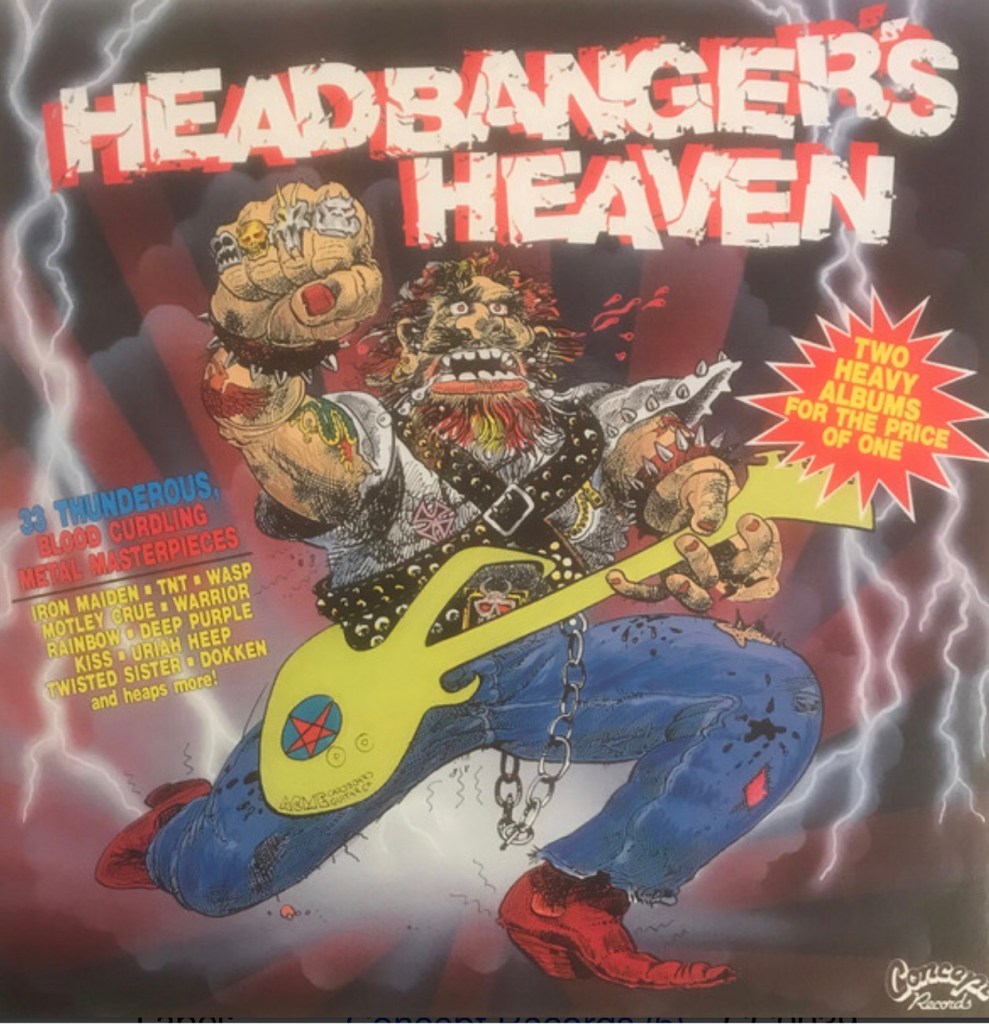
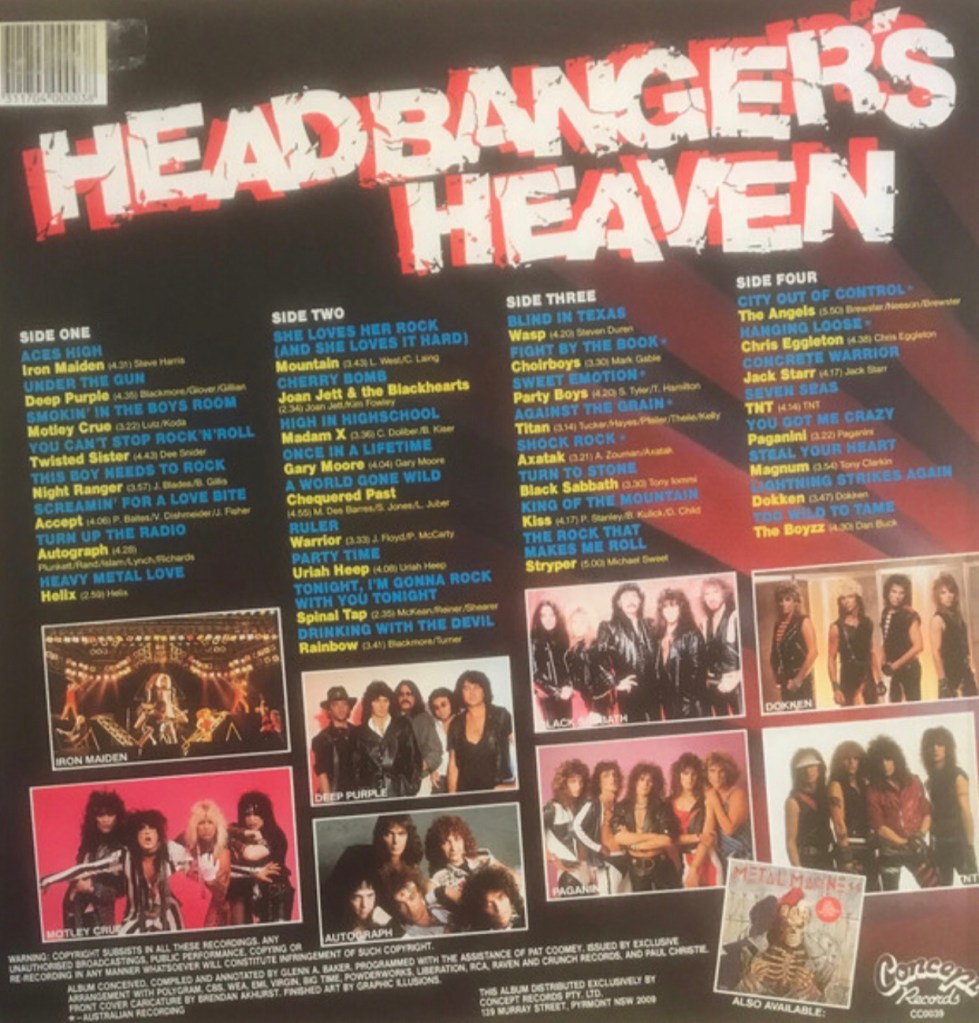
It was the first track I heard via a double compilation LP called “Headbangers Heaven”.

The intro riff grabs my attention right away, making me think of Rainbow and I like the way it all works with the Jon Lord’s keys.

But Ian Gillan is in form here, as it’s not an easy riff to sing over which then gets me thinking of his Gillan project.

Nobody’s Home

It’s a blues rock number and the only song listed as written by all Deep Purple members.

It’s like the band never left and continued to make albums after “Who Do We Think We Are?”

And if it sounds familiar, it should. “Lay Down, Stay Down” comes to mind.

Mean Streak

But press play to hear the Chorus Riff as Blackmore shows he can compete with the LA bands and do it better by taking “Schools Out” from Alice Cooper and making it sound a bit modern.

In the verses I am reminded of “Black Night” and in the solo break, the riff behind it like “Roadhouse Blues” from The Doors.

And I like it.

Perfect Strangers

The side 2 opener.

It’s a classic and one of their best songs.

How good is the “Kashmir” style groove when it kicks in at the 2.30 minute mark?

Whatever Jimmy Page could do, Blackmore could do as well, at a time when Page was not as prolific as he used to be.

A Gypsy’s Kiss

It could have come from “Rising” but “Highway Star” also comes to mind. Gillan’s bluesy delivery suits.

Check out the unison keyboard and guitar riff/melodies. It brings back memories of the work that Lord and Blackmore did on “Burn”.

And Ian Paice behind the kit. He is relentless.

Wasted Sunsets

Remember in the 70’s when these kind of slow blues rock ballads sounded progressive and epic and then in the 80’s they morphed into clichéd power ballads.

While this song isn’t a 70s classic, Blackmore is in his element here with his emotive soloing.

Hungry Daze

That exotic Eastern European melody hooks me. It could have come from the Balkans, maybe Hungary or even Russia.

Not Responsible

I don’t have this on the album, but how good is that intro. It reminds of “A Light In The Black”. It’s an extra track on the cassette and CD release. And Spotify has it.

Son of Alerik

At 10 minutes, this Blackmore penned instrumental is for the diehards.

The song appeared on the 1999 CD issue as a bonus track and it also appeared in an edited form on the 7″ B-side of the “Perfect Strangers” single, or in full on the 12″ “Perfect Strangers” single and the European version of the compilation “Knocking at Your Back Door: The Best of Deep Purple in the 80’s”.

The thing is, if a band reforms these days, or in the last 30 years, it would have been quite a media show, but their comeback in 1984, didn’t cause a ripple in the news outlets who had jumped on board the LA Sunset Strip Train or the San Francisco NWOBHM Thrash Scene.

But their comeback was met with success in the European markets which loved em back in the 70’s. The U.K, Switzerland, West Germany, Norway, Sweden, France, Austria, Finland and Holland jumped back on board the Deep Purple train.

Japan never left em. Australia and New Zealand also provided em with a certification.

And The Boss was the only artist on the touring circuit that out grossed out em.

Crank it.

Standard
A to Z of Making It, Classic Songs to Be Discovered, Derivative Works, Influenced, Music, My Stories, Unsung Heroes

The Record Vault: Deep Purple – Come Taste The Band

It took Deep Purple seven years to make it to the top and two years to break up. The air is thin at the mountain top.

Deep Purple had lost their lead singer Ian Gillan and bassist Roger Glover in 1973 and replaced them with David Coverdale and Glen Hughes. This MK3 version recorded two albums and then guitarist Richie Blackmore left at the start of 1975. This was weird as Deep Purple was seen as “his” band. And from looking at it, it’s like the owner of the house vacating their premises for the guests to take over running the house.

But Deep Purple would soldier on, replacing Blackmore with a young guitar hero from the U.S. known as Tommy Bolin. Rounding out the band is the rest of MK3, David Coverdale, Glenn Hughes, Jon Lord and Ian Paice.

And MK4 was created.

“Come Taste The Band” came out in 1975. It’s the usual production team of the band and Martin Birch.

The name Tommy Bolin came into my life because of Motley Crue. The Crue covered the song “Teaser” for a Compilation album and they also released it on a Raw Tracks CD made for the Japanese market, which I got my hands on. The song is so good and sleazy it sounded like a Crue original and I was curious to hear more from Bolin.

So as I was going back into the career of David Coverdale because of Whitesnake’s attention grabbing 87 LP, I was doing the same for Tommy Bolin.

So I got my hands on the “Teaser” and “Private Eyes” album first and imagine my surprise when I came across an album that had both Coverdale and Bolin on it.

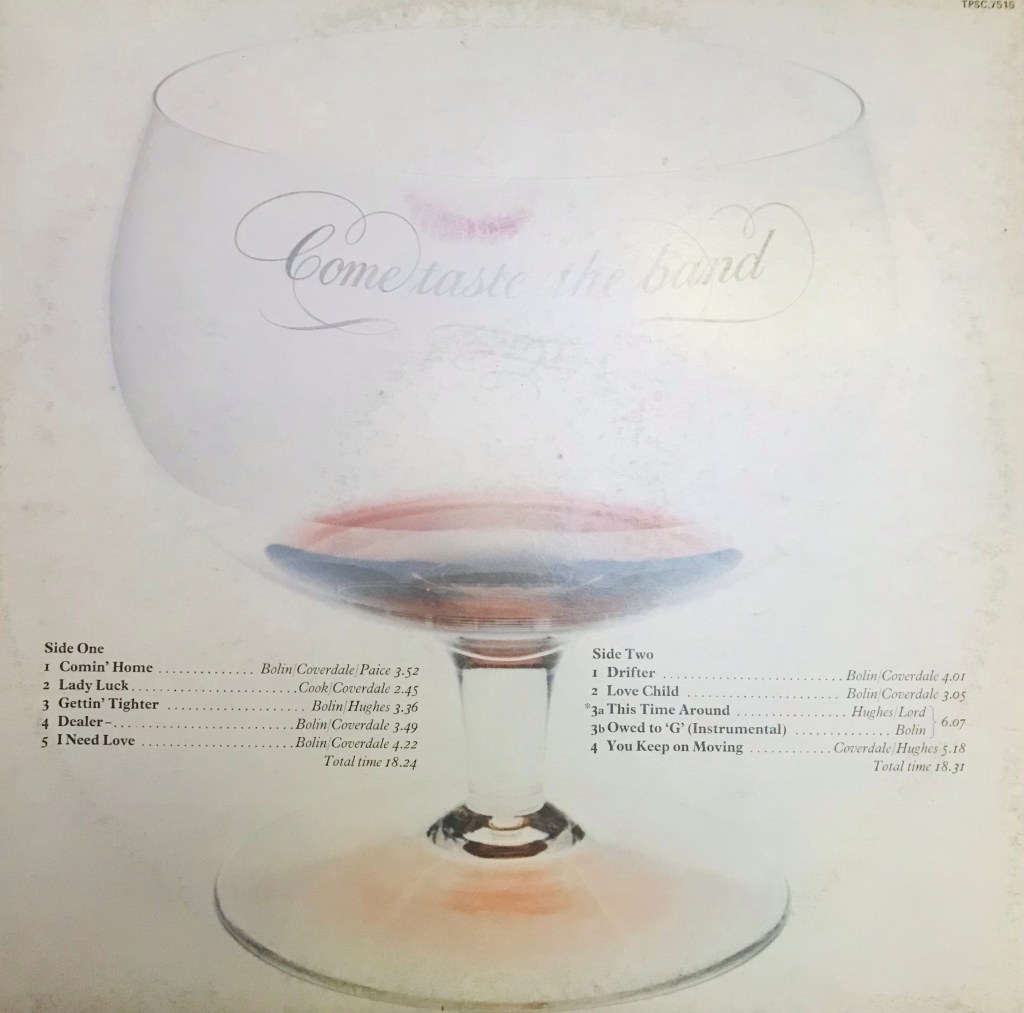
Comin’ Home

Written by Tommy Bolin, David Coverdale and Ian Paice with vocals provided by Coverdale.

This song rocks out of the gate paying homage to the fast rock sounds of Deep Purple MK1, MK2 and MK3. But it was more Grand Funk, like “We’re An American Band”.

Lady Luck

Written by Jeffrey Cook who co-wrote songs with Bolin for the “Teaser” record with lyrical contributions from Coverdale.

Vocals are provided by Coverdale. In didn’t really do much for me.

Gettin’ Tighter

Written by Bolin and Hughes with vocals provided by Hughes.

This song is funky out of the gate, and sleazy once the whole band comes in.

Dealer

Written by Bolin and Coverdale with vocals provided by Coverdale and Bolin.

It’s very Hendrix “Purple Haze” like in the riff departments with a Beatles like Folk Rock interlude which Bolin sung.

I Need Love

Written by Bolin and Coverdale with vocals provided by Coverdale.

I like the groove on this, and the way the verse riffs are played out with the heavy synth from Lord.

Drifter

Side 2 begins with this song written by Bolin and Coverdale with vocals provided by Coverdale.

It’s got a great Intro which reminds of “You Really Got Me” or “American Woman” and check out the groove that comes in once the drums and bass kick in.

Coverdale’s bluesy voice is a highlight.

At 2.36 there is just a bass and keys section over a drum groove. It reminds me of things that Rush would do.

Then Bolin comes in, with volume swells and a solo begins. The drums and bass become busy as they build it up, and the vocals come back in. Its brilliant, it gives me goose bumps all the time, so press play just to hear that.

Love Child

“Heartbreaker” anyone. Press play and listen to the intro.

Written by Bolin and Coverdale with vocals provided by Coverdale.

The verse groove and riff are my favourites even though the whole “love child driving me wild” lyric didn’t set the world on fire.

At 1.50, they go into a progressive rock style groove and Lord solos over it.

This Time Around / Owed to ‘G’

Written by Hughes, Lord and Bolin with vocals provided by Hughes.

It’s very progressive sounding, like ELO and it moves into a great instrumental jam over a 12/8 groove with excellent lead guitar from Mr Bolin himself.

You Keep On Moving

Written by Coverdale and Hughes with vocals provided by Coverdale and Hughes.

This is the standout track. Its haunting and melancholic and it was written during the “Burn” sessions but not used.

Norway, Sweden, Denmark, Holland, Czechoslovakia and West Germany all got behind this version of the band. The Japanese still loved em and New Zealand loved em even more.

But.

The classical progressions and jams had been replaced with groove, soul and funk. It could be seen as an early Whitesnake album, as a few tracks have “Love” in the title, which is similar to every Whitesnake album.

Also in 1975, Tommy Bolin had two records competing against each other, which probably wasn’t the best scenario for Deep Purple however I have seen “Teaser” album pictures with a sticker on em that said “Guitarist Of Deep Purple”. Since most of the songs were written by Coverdale and Bolin, the project could have been billed as Coverdale/Bolin.

After the tour for this album finished in March, 1976, Deep Purple MK4 was no more. Glen Hughes was already having issues and was in and out of rehab. David Coverdale would form Whitesnake and get Jon Lord and Ian Paice into the project. And Tommy Bolin by December 1976, was dead from drug intoxication as morphine, cocaine, lidocaine and alcohol were all found in his system.

But the music lives on.

Standard
Classic Songs to Be Discovered, Derivative Works, Influenced, Music, My Stories, Unsung Heroes

1996 – Part 4.3: In Flames – The Jester Race

In Flames was founded in 1990 by Jesper Stromblad as a side project from his then-current death metal band, Ceremonial Oath as he wanted to write more melodic songs.

Three years later, he quit Ceremonial Oath due to the overused “musical differences” reason and began focusing on In Flames.

By 1995, Stromblad grew tired of using session musicians to record an album or to do live shows, and the first version of the band was assembled.

“The Jester Race” released in February 1996, is the second studio album. The album is considered a classic album of the melodic death metal genre, along with At the Gates “Slaughter of the Soul” and Dark Tranquillity’s “The Gallery”, exhibiting the dual guitar leads, growled vocals and acoustic sections typical of the genre.

The band for the album is Anders Friden on vocals, Jesper Stromblad on Lead Guitar, Acoustic Guitar and Keyboards, Glenn Ljungstrom on Lead Guitar, Johan Larsson on bass and Bjorn Gelotte on Drums and Additional guitars. Yep, a drummer who also plays guitar, and this is a common thing in Sweden to have musicians who can play multiple instruments in a component manner as they promote the Arts sector in schools.

It’s produced by Fredrik Nordstrom (who also plays additional keyboards) along with the band members.

Moonshield

The Medieval sounding acoustic guitars to start the song sets the tone of a journey to come. After about a minute the distorted guitars crash in.

Musically speaking, it is similar in melody and structure to bands such as Iron Maiden or Judas Priest. However, the death metal influence lies within the vocals.

The Jester’s Dance

It’s an instrumental.

Full of different moods like “The Call Of Ktulu” and a bass groove that could have come from the fingers of Eddie Jackson from Queensryche.

There is even a section that reminds me of “Wasting Love”.

So if you want to press play on a song without vocals, press play on this or on the other instrumental “Wayfaerer”.

Artifacts of the Black Rain

I like the twin harmony melodic riffs on this.

Graveland

It’s fast very “Ride The Lightning” like.

Lord Hypnos

How good is the intro on this?

It’s some of the best metal music written in the 90’s, reminding me of 80’s Judas Priest and Queensryche.

And the subject matter this time around are Greek Gods.

Listen to the musical section between 1.33 and 2.43.

Dead Eternity

It’s very Iron Maiden like when it starts off, before it moves into a power metal like riff with blast beats. Something which Parkway Drive uses a lot of.

Its spoken word intro is haunting; about death, and how once you die you never have to worry about dying again, as you are stuck in a purgatory known as dead eternity.

The Jester Race

The intro is like a “Top 10 Hard Rock riff with a bullet” like. And throughout the song, its littered with melodic riffs and harmonies.

December Flower

Fast, angry with a lot of tremolo riffing and blast beats.

Check out the guitar leads between Verses and the guitar lead itself is “guitar hero” worthy.

Wayfaerer

An instrumental.

Very Judas Priest and Helloween like.

And then at the 1.50 mark, there is this Van Halen “Dance The Night Away” vibe with a bit of Joe Satriani “Crushing Day” and “Lords Of Karma” chucked in.

Dead God in Me

The closer.

It’s almost thrash metal like, with disturbing lyrics about a recollection of a molestation that took place.

The album took some criticisms from being too melodic in its riffs and harmonies from Melodeath purists, but that’s why I listened to it.

For me, that melodic element was the selling point.

Standard