Classic Songs to Be Discovered, Copyright, Derivative Works, Influenced, Music, My Stories

The Riff That Spawned a Dynasty

Some riffs are one-and-done. Others breed. The “Burn” riff, G minor, 1974, Deep Purple Mk III, isn’t just a classic. It’s a genetic code that’s been mutating for half a century, producing bastard children across bands, decades, and egos.

At the center?

Glenn Hughes and David Coverdale. The co-vocalists on “Burn.” One carried it like DNA in his blood (Hughes), the other twisted it into new forms with fresh partners (Coverdale).

The Glenn Hughes Line

Hughes/Thrall – “I Got Your Number” (1982): the first clear mutation, transposed into F♯m, slicker but still the gallop of “Burn.”

Gary Moore – “Run for Cover” (1985): Hughes on vocals again, Moore’s firepower channeling the same pulse.

John Norum – “Face the Truth” (1992): Hughes back at it, the riff sharpened into a darker ’90s hard rock blade.

Glenn doesn’t just sing. He drags the riff’s DNA forward, project after project, like a courier smuggling contraband across borders.

The David Coverdale / John Sykes Line

Coverdale didn’t let it die either. Teaming with John Sykes during Whitesnake’s MTV conquest, they bastardized the “Burn” riff into:

“Children of the Night” (1987, Gm): sleeker and turbocharged for the arenas of the late ’80s. Still “Burn”, just wearing more eyeliner.

Sykes wasn’t done. When he launched Blue Murder, he cloned his own mutation:

“Black Hearted Woman” (1989, Gm): “Burn” reborn again, heavier, moodier, drenched in Sykes’ Les Paul tone.

Coverdale and Hughes may have split paths, but both carried that same fire. One kept it soulful, elastic, shifting keys and contexts. The other turned it into arena thunder and hard rock melodrama.

But the story doesn’t stop there.

“Burn” didn’t come out of thin air. Nothing does. Ritchie Blackmore was reaching backward, too, straight into Gershwin.

Go spin “Fascinating Rhythm.” The horn stabs, the syncopation, the way it jerks forward like it’s about to combust. That’s the skeleton. Purple just plugged it into an amp and let it roar. Suddenly the city’s ablaze, the town’s on fire.

And it wasn’t just Hughes and Coverdale carrying the torch.

The infection spread further. Paul Stanley, yeah, the Starchild, was listening.

You can hear it in “I Stole Your Love.” Same pulse, same fire, dressed up in sequins and pyrotechnics.

Don’t take my word for it. Don’t argue. Hit play. The riff tells you everything.

The Family Tree

– “Fascinating Rhythm” (1924, George Gershwin) – the Jazz Standard

– “Burn” (1974, Deep Purple, Gm) – the hard rock origin.

– “I Stole Your Love” (1977, Kiss, C#m) – the first descendant

– “I Got Your Number” (1982, Hughes/Thrall, F♯m) – the second descendant.

– “Run for Cover” (1985, Gary Moore, F♯m, feat. Hughes) – the third generation.

– “Face the Truth” (1992, John Norum, F♯m, feat. Hughes) – the echo in the ’90s.

– “Children of the Night” (1987, Whitesnake, Gm, Coverdale/Sykes) – Coverdale’s bastard child.

– “Black Hearted Woman” (1989, Blue Murder, Gm, Sykes) – Sykes cloning himself.

It’s a family tree of riffs, sprouting new branches every time one of its carriers stepped into a studio.

Because this isn’t plagiarism, it’s proof of how riffs behave like living organisms. They survive by mutating, jumping bands, crossing decades. Glenn Hughes and David Coverdale, often painted as rivals in Purple, ended up as co-parents of a riff dynasty.

And every time that riff comes back, whether in Stanley’s face paint, Hughes’ soulful howl, Sykes’ molten Les Paul tone, or Coverdale’s snake-charmer swagger, you feel it. G minor or F♯ minor, it doesn’t matter. It’s still “Burn”.

The riff refuses to die. It just keeps coming back, louder, slicker, dirtier.

Standard
A to Z of Making It, Classic Songs to Be Discovered, Derivative Works, Influenced, Music

The Case For “Unmasked”

Gene Simmons hated it.

Paul Stanley called it wimpy.

Ace Frehley didn’t get the memo that the album was meant to be a pop rock album.

Peter Criss, well he just didn’t participate.

And I was confused why Paul Stanley didn’t use Desmond Child again, since their hit from “Dynasty” was co-written with him.

Instead Vini Poncia, who produced the album, co-wrote most of the tracks.

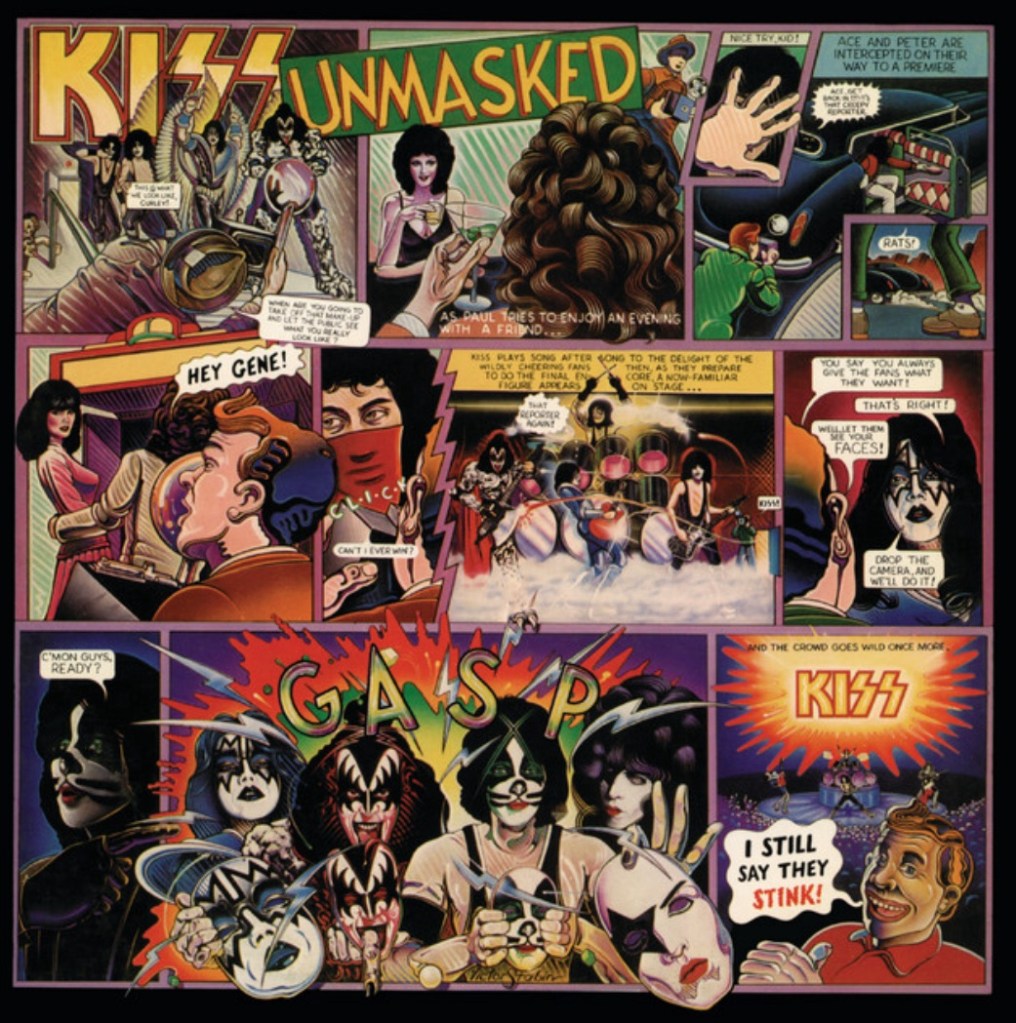
In case you are confused, I’m writing about “Unmasked” released in 1980.

It didn’t meet commercial expectations in the North American market however it did very good business in Northern Europe.

And in Australia, it sold more than 110,000 copies on the first day of its release and 3,000 more were stolen from a truck on the way to stores. Well, this is according to the Sydney Morning Herald.

You see “Kissmania” or “Kissteria” in Australia was about 4 years behind their U.S. peak.

It didn’t sound like past Kiss, but this record definitely gave the power pop / melodic rock scene a good kick in the ass. You had bands like The Raspberries and Small Faces, but suddenly you could mention Kiss in the same sentence.

Its influence on the Scandinavian market is large and it’s no surprise that a lot of melodic pop and rock artists and songwriters have come from these markets.

Is That You?

The opening track and it’s not even written by a Kiss member.

But it is the parent to “Lick It Up”.

Listen to the verse riffs in both. The feel and groove is the same. The layered backing vocals are also great, something which Def Leppard mastered with Mutt Lange.

And Stanley always challenged himself vocally, the falsettos on the pre-chorus are braver than the ball tearers on “I Was Made Lovin You”.

On a side note, as a solo artist, McMahon’s 15 minutes of fame came with “Cry Little Sister” from “The Lost Boys” movie, 7 years later.

Shandi

Australia was also going through a “disco ABBA mania craze”, so it’s no surprise that a crossover disco/rock pop ballad went huge here.

And if ABBA wasnt doing music like this anymore, fans would always look to others to fill the void.

If you want to hear what inspired it, press play on the song “Tomorrow” from Joe Walsh. Paul basically lifted the first 60 seconds from it. And Joe Walsh is far from wimpy.

Talk To Me

Ace steps up with a rocker, which did good business as a single in Switzerland, Germany, Netherlands and Australia.

It has an intro riff that sounds like it was influenced by Rick Springfield’s “Jessie’s Girl”.

The major key riffage in the Chorus reminds me of “Do Ya” from ELO.

Naked City

My favorite song on the album and one of Gene Simmons best, giving melodic rock music some grit.

It’s written by a committee involving Simmons, Poncia, Bob Kulick and Peppy Castro.

Ace even contributed a solo, while Anton Fig and Bob Kulick did the drums and guitars.

But it all started with Bob Kulick who had the guitar riff and he demoed the song with Peppy Castro.

But the final recorded version didn’t make Bob happy and he has said that “Kiss ruined “Naked City”.

Ruined or not, it’s my favorite. And if the demo is available anywhere, please share it.

What Makes The World Go Round

I always like it when artists take influences from different styles of music.

In this case, Paul is taking inspiration from soul act, The Spinners and fusing hard rock, pop, soul and R&B into a unique style that still sounds like a rock song.

How good is the Chorus?

Tomorrow

My second favorite.

The power pop of 2000’s acts like Wheatus, Good Charlotte and the like is right here.

It might sound light on the rock, but inside the song you’ll hear a feel and vibe from “Coming Home”.

It’s also influenced by “Tonight” from The Raspberries along with Rick Springfield.

And even the most hardened rocker cannot resist singing along to the Chorus.

Two Sides Of The Coin

More ELO meets Free from the Spaceman.

I forgot to mention on “Talk To Me” that Ace employs an Open G tuning, a tuning popular with slide players because with one finger they can play a chord instead of fretting the chord. He also employs this Open G tuning here.

Keith Richards was a well known user of this tuning, however many believed that Keith used this tuning because of how wasted he was. It’s easier to play with one finger than four. And that same view point was held for Ace, however if you look at interviews during this period you cannot see or hear Ace sounding wasted.

The lyrics are dumb but then again Kiss weren’t scholars when it came to lyrics, so that’s what makes their music fun.

She’s So European

Press play for the intro. That’s all you need to listen to here.

Then again Gene Simmons does a good job on the lyrics and melodies as well, about a girl with a glass of pink champagne and well you can read the rest.

Easy As It Seems

Another favorite.

Paul is the star of the song. His bass riff is sinister, yet groovy and his sense of melody elevates the track.

I’m also a fan of The Pretenders and it looks like Paul was influenced by them as their song “Mystery Achievement” came out in January, 1980 and Kiss released their album in May 1980.

Check em out, they are both great songs.

Torpedo Girl

Press play for that rhythm and blues swing drum groove and stick around to hear Ace summon Joe Walsh for the verse riff and The Beach Boys for the Chorus.

You’re All That I Want

It has that feel of early Kiss musically. And somehow it gets no love.

The Wrap Up

They didn’t tour the North American market, but they did hit Europe, Australia and New Zealand. It kept em in business.

On Australian TV they also got a lot of press and interviews.

They appeared on the Australian “60 Minutes”. The segment is on YouTube if you want to see it. Bill Aucion was also interviewed, telling the interviewer how Kiss was turning over $120 million a year, and how he was looking to get the band into movies and comic books.

We sort of know how that turned out with “The Elder”.

A few things to note for 1980.

AC/DC dropped “Back In Black”, a slab of hard and bluesy rock that proved you can be commercially successful during this period playing that style of music.

The NWOBHM was also gaining momentum. This was even harder sounding and more abrasive than AC/DC and it also had an audience that was growing.

Most of the acts who had success in the 70s were either broken up, or on their last legs with the original members and looking to bring in new members.

So I understand the “wimpy” and “not sound like Kiss” comments, but this album has aged well because so many of the songs are so well written.

For a band that was just not functioning anymore they still found a way to deliver a great album.

Standard
Classic Songs to Be Discovered, Copyright, Derivative Works, Influenced, Music, My Stories

Four For Friday

I’ve written posts about songs which sound similar to songs which came before, with the lens solely focused on hard rock and heavy metal.

Like.

One Riff To Rule Them All

The Kashmir Effect

The Kashmir Effect 2

The While My Guitar Sleeps Effect

Sanitarium Debate

Just to name a few.

And I’ve always thought that Led Zeppelin and Black Sabbath shared a connection musically but I’ve never verbalized it or wrote about it.

The viewpoint came from a 1995 documentary called “History Of Rock and Roll”, which has Ozzy recalling how “Led Zeppelin I” had a huge impact on him and his bandmates.

Let’s see what kind of impact.

DAZED AND CONFUSED (1969) vs PARANOID (1970)

The authorship of “Dazed and Confused” is heavily disputed and there are various pages out there specifying who wrote what and when.

But, for the sake of this post I will focus on the Led Zeppelin version.

There is a section in “Dazed and Confused” at the 5.02 mark that sounds very similar to the Intro in “Paranoid”.

COMMUNICATION BREAKDOWN (1969) vs PARANOID (1970)

Then the verse riff in “Paranoid” has a running E pedal point played over an E5 power chord for two bars, then a D5 power chord for the third bar and the fourth bar ends with three chords G, D and E at the end.

“Communication Breakdown” has a running E pedal point playing for one bar with three chords of D to A to D played in the second bar.

The similarities here are evident. In the way the three chords are played at the end of each bar and the running E note.

It’s basically musicians influencing each other.

But if the entities who hold the Copyrights to Marvin Gaye’s music had a hold of these rights, then there would be litigation everywhere.

HEARTBREAKER (1969) vs THE WIZARD (1970) and IRON MAN (1970)

These ones are a bit different sonically but they all have a common element, which is the Minor to Major transition.

For example, if it was in the key of E minor, it would be an Em to G transition. If the key was in A minor, it would be Am to C transition.

It’s a common element and a building block for creating but I’m sure if the rights of these songs landed with the heirs of Marvin Gaye there would be a lawsuit.

Bonus – SUNSHINE OF YOUR LOVE (1967) vs NIB (1970)

Check it out and let me know.

The same elements here are also heard in the song “Cocaine” which came out in 1976.

Standard
Copyright, Derivative Works, Music, My Stories, Piracy, Stupidity

Four For Friday

When I started these weekly posts it was a means to keep me blogging during a hectic schedule.

And there was no definitive structure as to what I would cover. But I can see that Cooyright issues keep appearing.

And here is another week devoted to that beautiful term. Copyright. Which was designed to give the creator a limited monopoly on their works so they could create more works.

LETS GET IT OVER WITH

Ed Sheeran can’t get a break. Last week, the case against him from the daughter of Ed Townsend was dropped.

But this week, an organization called “Structured Asset Sales”, (SAS) have started their own litigation.

They control a different one-third stake in Townsend’s copyrights. They “own” the basic notation (musical score) filed at the Copyrights Office decades ago.

When the original case was happening, (SAS) was also a part of it, seeking a “monopoly over a basic musical building block.”

Their case was also thrown out.

But they are appealing their part. Because hey, they created nothing and believe they should be paid for creating nothing. And they want a monopoly on a feel and style.

A big reason why Copyright had expiry terms initially was to stop all this crap. Politicians had a foresight back in the early 1900s to see this coming.

And that changed in the 60s when the labels and book publishers started to amass intellectual property and then started to lobby politicians to change laws and bring in new laws to give these corporations a monopoly on the works.

It’s funny now, how the labels are also getting sued from the very laws they sponsored to benefit them.

124 WEEKS

In April 2021, UFC fighter Jake Paul knocked out Ben Askren in less than two minutes.

Soon after, the popular H3 Podcast on YouTube commented on the fight and showed a clip of the fight.

Event promotor Triller wasn’t happy and issued a copyright infringement lawsuit demanding $50 million in damages.

H3 opted for a fair use defense.

The case is now in its 124th week.

The clip of the fight was 119 seconds long.

Who are the real winners here?

URUGUAY

The Uruguayan Government has a bill in motion which would allow artists to go direct to internet platforms like Spotify and social media sites like Facebook for compensation.

Spotify would still need to pay the existing licensing agreements and if this bill goes ahead could be forced to pay again to the artists direct.

I’m all for artists getting paid but the problem lays with the entities who hold the rights to the songs. They get the majority of the streaming pool and they don’t distribute it back to the artists.

This is a perfect example.

Spotify still needs to honor the licensing agreements with the labels and publishers so these organizations will receive their cut.

And if they are aware of the artist going direct, I am sure that some creative accounting will take place to hold back any payments to the artists.

Anyway. Spotify isn’t happy with the bill and unless it’s changed they will pull out of Uruguay.

As a byproduct, the local music industry which has been growing 20% from streaming revenue will have this source of income come to zero.

ALBERT NAMATJIRA

Albert Namatjira died in 1959. He was an Aboriginal artist, painting the Australian landscapes in watercolors.

The copyright in his art is due to expire in 2029, 70 years after his death.

This means the works will be part of the public domain and anyone can use them in their works moving forward.

But lawyers for the family are arguing that Copyright should last in perpetuity. Forever. Never expire.

And they are pissed.

The issue here is that the family were getting royalties for his art up until 1983. At that point in time, the government trust that administered the rights sold them to a private organization and the royalties ceased.

It took the family 34 years to get the rights back in 2017, with the proviso they need to relinquish them again in 2029.

Furthermore in the last 5 years, Namatjira’s art has exploded in popularity and has become a valuable intellectual property.

But Copyright was never meant to be a reversionary pension fund.

Standard
Classic Songs to Be Discovered, Derivative Works, Influenced, Music, My Stories, Unsung Heroes

Tony Martin – Sweet Elyse

“Sweet Elyse” was released on the solo album, “Back Where I Belong” in 1992 on Polydor. Tony Martin decided to do a solo album when his Black Sabbath project was doing its “Dehumanizer/Dio” project.

Production was done by Nick Tauber, who is best know for his work with Thin Lizzy and Marillion.

The album is not on Spotify, which irks me. But YouTube has a lot of uploads from fans, who call Tony Martin the best Sabbath vocalist ever.

And “Back Where I Belong” is not available anywhere to buy these days, unless someone’s selling a second hand copy.

The reason why it’s not available are varied. When Martin rejoined Black Sabbath, Polydor deleted the album from their catalogue and took it off the shelves.

And somehow his manager at the time owns the entire rights to this album, which gets me thinking “how the hell did the manager pull that off” and “how is Copyright protecting the artist at this moment to give the artist an incentive to create”.

But I have seen interviews and posts where Martin mentions how he wants this album re-released and the label Battlegod Productions, which is the label for his solo album “Thorns”, is in negotiations for it.

The track burns from the start and it reminds me of songs like “Highway Star”, “Burn” and “Speed King” from Deep Purple.

And I like the familiarity.

The session line up for the song is also impressive.

Nigel Glockler from Saxon pounds those drums and Neil Murray from Whitesnake is the master of the groove.

Tony Martin also shows off his guitar prowess as he, Paul Wright and Carlo Fragnito play the rhythm guitars with Richard Cottle on the keys.

There are also demos floating around the internet of this album which has Tony Martin playing all the guitars.

For the solo, Adrian Dawson brings out his Blackmore influences. And it’s excellent.

Crank it.

Standard
A to Z of Making It, Classic Songs to Be Discovered, Derivative Works, Influenced, Music, My Stories, Unsung Heroes

Vandenberg – Sin

Adrian Vandenberg has come full circle.

When John Kalodner met with him in 1987, Kalodner had two propositions; one was to replace all the Dutch members of the Vandenberg band with American musicians and the other was for Vandenberg to join Whitesnake.

Morally Adrian Vandenberg couldn’t do that to his Vandenberg members and he also couldn’t pass up on a position to work with a vocalist like David Coverdale.

So he chose Whitesnake.

But when he tried to resurrect Vandenberg circa 2014/15, those Dutch 80s members didn’t have the same moral conviction as Adrian did and they took him to court so he couldn’t use his own surname anymore.

Six lawsuits later and a lot of money spent, Vandenberg was allowed to use his surname again.

But while all of the lawsuits were happening, Vandenberg’s Moonkings was created and they released three albums.

Then Vandenberg returned, dropping the excellent 2020 album with former Rainbow vocalist Ronnie Romero on vocals, Rudy Sarzo on bass, and Brian Tichy on drums.

And here we are in 2023, with another excellent album called “Sin”. This time around Adrian is joined by vocalist Mats Levén, drummer Koen Herfst and bassist Randy Van Der Elsen and the album is produced by Bob Marlette.

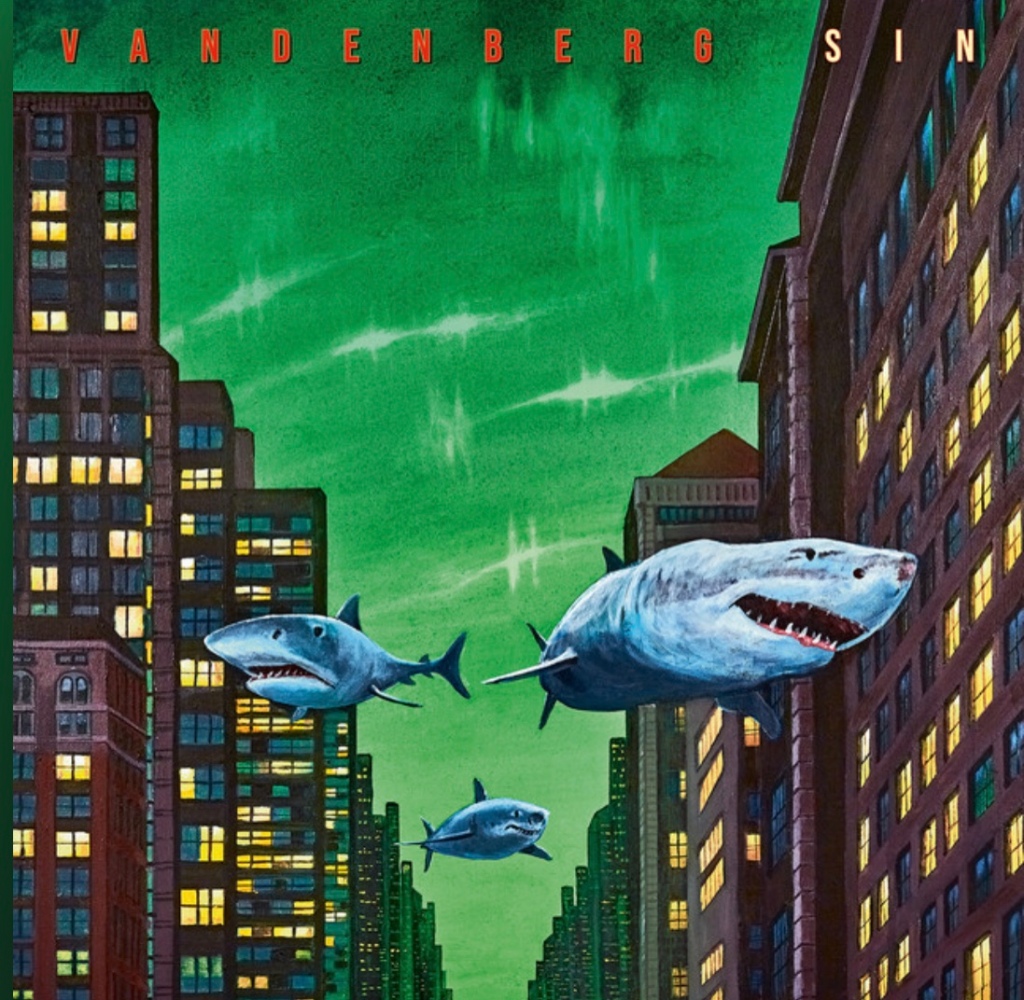
How cool is the cover art?

Once again, created by Adrian, he wanted to show an actual destination for the flying sharks who made their appearance on the “Heading For A Storm” album.

Instead of flying over a road in the desert, they are now flying into New York, the city of sin.

Thunder And Lightning

This is a person writing songs for the love of it. No pressure to write hits and no pressure to conform.

For those who grew up in an era of driving with the window down and cranking the music from the stereo, well this song is perfect for it.

Vocally, Mats Leven is channeling David Coverdale. Musically the song channels the spirit of Eddie Van Halen and the Euro blues rock of Michael and Rudolf Schenker.

Stick around for the guitar solo.

House On Fire

Heavy palm muted arpeggios start it all off with Leven singing in a low bass/baritone. Then it goes into a sleaze like riff.

This is a straight ahead rock and no one is doing it better in 2023 than Adrian Vandenberg.

Sin

This sounds so good. Vandenberg rewrote “Judgement Day” and I like it?

Then again “Judgement Day” is heavily based on “Kashmir”. And I still like it.

Alot of legacy artists keep saying “what is the point in writing new music as no one cares about it”. Tell that to Vandenberg.

Light It Up

Love the swagger on this.

Walking On Water

Ooh, that guitar intro and the vocal. Very 70s Free like.

And stick around for another masterful guitar solo.

Burning Skies

The album keeps going, sounding different from cut to cut. Like “Back In Black”. This one feels like a classic Scorpions cut.

Hit The Ground Running

It’s all about the vocal.

This one has Leven channeling Coverdale and the groove sits nicely on your lap.

Baby You’ve Changed

It’s intimate.

A ballad that rolls along like “Is This Love” and “The Deeper The Love”. But it’s not a copycat.

Out Of The Shadows

The arpeggio riff in the Intro reminds me of Coverdale/Page and their song, “Whisper A Prayer For The Dying” but the song is nothing like that.

It’s got this classic 70s Rainbow Dio era vibe and I like it.

It’s just 9 songs clocking in at 41 minutes. Like old school albums, pre CD.

Mats Leven is one hell of a vocalist. A journeyman like so many other vocalists from the late eighties and early nineties.

He came to my attention with the band Swedish Erotica in 1989.

He has then performed (just to name a few) with Treat, Yngwie Malmsteen, Candlemass, At Vance, Firewind, Trans Siberian Orchestra and Therion.

By doing so and picking up whatever work he could get, he found a way to survive the wastelands of the 90s and early 2000’s which were not very kind to hard rock vocalists. Jeff Scott Soto and Johnny Gioeli are two others that come to mind.

Finally, Adrian Vandenberg is 69. He still rocks as hard as he did when he was 29. He hasn’t mellowed out at all. He’s actually gotten heavier and he is free to write the music that he wants to write.

If you want to read my review of Vandenberg’s recorded output up to a certain point in time (it was up to 2014 and the first Vandenberg Moonkings album), you can read it here.

Standard
A to Z of Making It, Classic Songs to Be Discovered, Derivative Works, Influenced, Music, Unsung Heroes

Tony Martin – It Ain’t Worth Fighting For

Tony Martin never wanted to be a singer.

When he went to an audition with a band called “Legend”, he took his guitar.

But they said to him that they need a singer and wouldn’t let him play.

And then he gets the vocalist gig for Black Sabbath, who were going through an identity crisis between 1984 and 1987.

And as soon as he righted the Sabbath ship, he was out and Dio was back in for the “Dehumanizer” album.

And while that was happening on the Sabbath front, Tony Martin kept writing until he had enough material for a solo album.

“Back Where I Belong” was released in 1992 on Polydor.

“It Ain’t Worth Fighting For” is the opening track from the album.

The musicians are seasoned professionals.

Nigel Glockler from Saxon is on drums. Neil Murray from Whitesnake is on bass. Richard Cottle is a session pro, and he plays the keys and also performs the saxophone solo. Carlo Fragnito is on guitars.

A bit if trivia, Fragnito and his brother Anthony formed a band called Blacklace, with vocalist Maryann Scandiffio.

Hailing from Canada, their music is best described as NWOBHM. They released “Unlaced” in 1984 and “Get It While It’s Hot” in 1985. Like a lot of bands who didn’t see success right away, they struggled and eventually broke up.

Carlo then became a session pro.

As soon as you press play, the riff that smacks you in the face is reminiscent to “Headless Cross”.

But the track feels like a heavy blues rock track instead of a metal track.

If it ain’t worth fightin’ for
It ain’t worth having
And I just gotta have your love

The Chorus is Arena Rock. Make sure you pay attention to the melodic guitars underneath the vocal melody.

Bad Company comes to mind here and the feel from “Rock ‘N’ Roll Fantasy.”

Vocally, Martin comes across as a combination of Lou Gramm and Paul Rodgers.

And that Sax solo works perfectly. It outlines the Chorus vocal melody with some improv.

Press play.

Standard
A to Z of Making It, Classic Songs to Be Discovered, Derivative Works, Influenced, Music, My Stories, Unsung Heroes

The Record Vault and Australian Method Series: AC/DC – Fly On The Wall

Disaster. That’s how the American magazines described this album.

Released in 1985, the album never stood a chance.

It was fighting for our attention along with a lot of other things.

Like.

The trilogy of Mutt Lange albums were outselling everything else AC/DC put out during this period.

The Sunset Strip gave the charts and MTV a major shake up and sales followed.

The British had invaded the U.S again with Judas Priest, Iron Maiden, a solo Ozzy Osbourne and Def Leppard cementing themselves as arena acts.

The Germans also invaded via a hurricane called The Scorpions.

And finally an underground Speed Metal scene in San Francisco was slowly taking over the U.S.

But in Australia we remained true. Never wavering. And we made it triple platinum.

But let’s go back in time.

The success of “Back In Black” in 1980 showed the labels that their was an appetite for hard rock music. And the labels wanted more of the same.

So it’s no surprise that by 1985, most of the label rosters had a lot of “hard rockers” on the books. But these rockers wore everything that wasn’t denim and their hair kept hair dressers employed for decades.

Even acts from the 70’s started to participate in this new look so they could remain relevant. But AC/DC didn’t change. They stuck true to their denims and Angus still wore the schoolboy outfit.

And the critics found them irrelevant while they still sold out arenas.

Fly On The Wall

The music is infectious and the vocals indecipherable.

Sign me up.

Shake Your Foundations

It was the only song that got a pass back in the day.

How good is that intro and the Chorus is iconic?

Plus it got decent radio play in Australia.

First Blood

Musically, it’s typical of AC/DC.

Lyrically, Brian Johnson is indecipherable and hard to understand.

Danger

“Come Together” comes to mind when I hear this.

“Here come old flat top” is what my ears are expecting when the song begins.

It’s no surprise that the Young brothers are referencing Chuck Berry here as his fingerprints are all over the riffs the Young’s write.

Sink The Pink

The music clip comes to mind here.

Seeing the band playing in a pub/bar again and that pesky fly from the cover getting a hard on (via its nose going from limp to hard) when a women dressed in pink enters the pub.

But it’s the music that seals the deal and Brian Johnson sounds better in the video than the recording.

I like the musical reference to “For Those About To Rock” and The Who’s “Won’t Get Fooled Again”. So I was hooked.

Sink the pink, it’s all the fashion”

It has so meaning meanings.

The Urban Dictionary tells us, sink the pink means to “have sexual intercourse with a virgin, and to pop her cherry”.

But the Urban Dictionary didn’t exist in 1985 and my young impressionable brain saw it as a song about drugs.

And thanks to the Internet, I believe it is.

Welcanol was known during the eighties as the South African Heroin (Pink Heroin). It could be obtained via a Doctor prescription and it came as a pink tablet.

So before OxyContin there was Pink Heroin.

“Drink the drink it’s old fashioned”

I’ll take an old fashioned drink any day.

Playing With Girls

I love the music and the groove here.

But I hate the title and the fact that Johnson is mixed low and indecipherable.

Definitely a missed opportunity here.

Stand Up

I like this song. It’s defiant and it rocks.

If you just listen to the Chorus you would think it’s about standing up and facing the world, but when you read the lines in context with the verses, well, it has a different meaning.

Hell Or High Water

A 4/4 groove and we are off.

But it’s pointless as Johnson is buried in the mix and the song is ruined.

Back In Business

A deep cut. It reminds me of ZZ Top and I like it.

Send For The Man

Musically it rocks but the buried Johnson chainsaw like vocals ruin it.

It’s not a perfect album, then again most of the albums released in 1985 are far from perfect. In other words, the era of more filler than killer was well and truly in motion.

But I would say, it’s an underrated album from a band that enjoys doing their thing without over obsessing about it.

The U.S tour had controversy. It all took place underneath the censorship discussions concerning rock music. Religious groups tried to ban certain shows while city officials wanted to rate each show and give the shows a movie style rating, which would then exclude fans from going. Fire officials would also get in on the act and limit or stop any pyrotechnics.

But the band went on.

In the vinyl album sleeve of the “Fly On The Wall” re-release from 2020, Angus sums up the tour like this;

“This tour’s a little like a series of wrestling matches with the loonies. But what’s the fun of life without an occasional tussle”.

Enough said.

Get to it folks. Crank it and start tussling.

Standard
A to Z of Making It, Classic Songs to Be Discovered, Derivative Works, Influenced, Music, My Stories, Unsung Heroes

The Night Flight Orchestra – Death To False AOR Tour: Crowbar, Sydney (Leichhardt)

I remember the kids asking me around 2019, if The Night Flight Orchestra (TNFO) would ever tour Australia as they are massive fans but they couldn’t come as it was an over 18s gig.

I said to them that Bjorn Strid as part of Soilwork tours here, so it’s a possibility but it all depends on a promoter who wants to bring them out and it also depends on fans. Streams and sales are key here.

Fast forward 4 years later, TNFO arrived on our shores. Hardline Media was the promoter who got em out here. I’ve purchased stuff from the site before and Doug does a great job/deed for Metal and Rock music in Australia.

Their first gig was at Brisbane, on Thursday 3rd August at a venue called “The Zoo”.

And on Friday, 4th August, they had their show in Sydney at a venue called “Crowbar”.

Their final show was on Saturday, 5th August in Melbourne at a venue called “Max Watts”.

It’s like waking into a time warp and coming out 40 years ago when you enter “The Crowbar”. The pub was formerly known as “The Bald Face Stag” (it was a venue I played with one of my former bands) and in 2018, it relaunched as “The Crowbar”. The furnishings are still very 80s retro, it’s painted black and I like it. Plus their is a decent selection of boutique beers on tap and in cans. Their is also a decent sized live room inside the pub, which they utilize for live music.

I purchased two VIP Meet and Greet packages.

This included:

  • early access to the show and merch stand,
  • a photo on my phone/device with the band
  • an Australian tour poster to get signed by the band
  • exclusive VIP lanyard/laminate
  • plus I was able to bring along 3 personal items to get signed.

And the prices at $160 each were reasonable.

I was thinking of what merch to take for signing. And I settled on the vinyl album, “Sometimes The World Ain’t Enough”. It’s a gatefold album, with a massive picture of the band on the inside, so it would be cool to get them to sign it. Plus I had two copies of the albums as I forgot I purchased it and then purchased it again.

The meet and greet was very relaxed. They signed our items including the tour poster and then we got the photo.

The band is Sharlee D’Angelo on bass, Sebastian Forslund on guitar, percussion and congas, Anna Brygard on backup vocals, John Lonnmyr on the keys, Bjorn Strid on vocals, Asa Lundman on backup vocals, Jonas Kallsback on drums and Rasmus Ehrnborn on guitar. In the middle, ruining the photo is yours truly.

Midnight Flyer

It was the first song recorded for the “Amber Galactic” album and the first single released to promote the album.

It’s a great opener.

Then again so is “Siberian Queen”, “Sail On”, “This Time” (which sounds like the twin of “Midnight Flyer”), “Servants Of The Air” and “Violent Indigo”.

I remember reading an early interview from the band that Deep Purple’s “Made In Japan” and “Made In Europe” are favourites.

And I can hear it in “Midnight Flyer”, how it builds from the keyboard intro, similar to how “You Fool No One” builds on the “Europe” live album or “Speed King” on the “Japan” live album.

I’m not leaving
I’m just going somewhere else
Far from the sighs and whispers
And the weakness of myself
Now is not the time
To think of all I’ve lost
There are skylines left to conquer
There are oceans left to cross

The work ethic of the TNFO members is high. Multiple bands means more touring, more time in recording studios, more time song writing and lots of champagne. Meanwhile they are all trying to keep relationships going.

I’m a midnight flyer rushing through the storm
I got lost without your loving and I can’t find my way home

Such a great lyric for the Chorus hook.

They went straight into “Sometimes The World Ain’t Enough” and we were moving and singing.

That keyboard Intro is from what David Coverdale calls “Hook City”, a mythical place of arena-like choruses and riffs.

And I love the drum beat which I call the “Deuce” beat. I know other 70s acts did this kind of beat, but I’m a Kiss fan so I’ll associate it with Kiss.

Every song TNFO played got us moving. My order of the songs is wrong compared to the live show, but here they are.

“Divinyls” rocked. It grabs your attention as soon as the guitar intro starts and it builds nicely with the drums. Rasmus Ehrnborn filled in for TNFO when Dave Andersson couldn’t tour. Now he is the guitarist in the band.

“Gemini”, “Paralyzed”, “White Jeans”, “Burn For Me”, “The Sensation”, “If Tonight Is Our Only Chance” and “Satellite” all followed with lots of grooving, people dancing and some head banging.

“Something Mysterious” (which reminds me of “Burning Heart” from Survivor) was dedicated to guitarist Dave Andersson, who passed away in 2022. For those who are not aware, Andersson was a co-founding member of TNFO along with vocalist Bjorn Strid. A lot of the TNFO songs have his riffs and lyrics. He also wrote this.

They closed the set with the 9 minute long “The Last Of The Independent Romantics”. As Bjorn said in the Intro, let’s go on a journey. And we did.

The band went off stage and we went into a football chant.

It was encore time.

“Josephine”, “Stiletto” and “West Ruth Avenue” closed the night.

“West Ruth Avenue” deserves special mention as Bjorn got a decent Conga Train happening which resembled a circle pit. Instead of people running, people were dancing.

It was also this song from the debut album which made me a fan. And the tempo was slightly increased. Which I like.

I am biased but this gig is a 10. They never let up on the energy and the setlist was perfect.

Moving forward, current single “The Sensation” is doing the rounds. A new album is expected in April/May 2024 and I’m looking forward to adding it to the collection.

Hopefully another Australian tour as well. They put down some roots here so let’s see what grows.

\::/

Standard
A to Z of Making It, Classic Songs to Be Discovered, Derivative Works, Influenced, Music, My Stories, Unsung Heroes

The Record Vault: When Dream And Day Unite Demos 1987-1989

It was released in 2004 on Ytse Jam Records, the official bootleg label of the band created by Mike Portnoy and John Petrucci, but Portnoy was the main driver.

Yep, the thing that bands are doing right now, Dream Theater has been doing it since 2003. Marillion, one of Portnoy’s favorite bands have been doing it even earlier via their fan club.

This was also released as part of their Inside Out record deal via the “Lost Not Forgotten Archives” on 12 May, 2023.

The CD contains pre-production demos as well as instrumental versions of the songs and songs that did not make it on to the album, or were recorded around the same time. Also included are six tracks the band recorded as a Christmas gift for their friends.

The band started this recording process as Majesty. By the end of it they would be Dream Theater.

They started it with Chris Collins as the vocalist. Then a whole year would pass before Charlie Dominici would join Mike Portnoy, John Petrucci, Johnny Myung and Kevin Moore. This is the band that recorded the debut album.

Afterlife – Instrumental Demo

It’s my favorite track from the debut album and it was the first new track they wrote upon returning home from Berklee in the Summer of 1986.

It’s straight ahead speed technical Metal and the instrumental demo highlights it.

And Johnny Myung is one hell of a bassist.

The harmony solo between the keys and guitar is still here, however the solo before is different to the recorded version.

The song was performed live with vocalist Chris Collins however it had different lyrics and melodies.

The Killing Hand – Instrumental Demo

It’s weird how my two favorite songs on the debut are the first two songs written.

You can say this song is the start of the Dream Theater epics.

That section after the solo still hooks me.

The Ones Who Help to Set the Sun – Instrumental Demo

The working title of this song was “Death Of Spock”.

It’s the most progressive of the tracks so far and the Arabic Metal feel is very prominent in the demo.

The Rush influence is also prominent when you hear the song instrumentally.

Ytse Jam – Instrumental Demo

Well the song was written to be an instrumental so instrumental demo doesn’t make sense.

Regardless, it’s a fan favorite and that Intro gets peoples attention immediately.

Cry for Freedom – Instrumental Demo

I needed to rehear it to remember it. A leftover from their Berklee jams.

Standard riffing that seems lost without a vocal melody.

But I do like the Sunset Strip riff from about 2.40 and then the change in feel at 3.00. The drums play a simple groove, the synth takes the lead and it sounds like “Stranger Things” took it for their intro. Or maybe the band was heavily influenced by the “Signals” album from Rush.

It’s also been preformed live with Chris Collins.

Resurrection of Ernie – Instrumental Demo

It’s like a John Carpenter soundtrack piece and I like it.

The music here has never been used or rewritten for another song, so it’s a true rarity.

Drum Solo – Instrumental Demo

I hate drum solos in concert and I hate them on albums. If they add some music to it and have the drums doing intricate things then I’m all in.

Portnoy created it for a contest that Modern Drummer magazine was running. The prize, “Neal Peart’s Tama Drum Set”.

Portnoy submitted it under the title “Peartnoy’s Complaint”.

He didn’t win.

A Fortune in Lies – Instrumental Demo

It is the opening track on the album. I still get hooked on the verse riff and how the keys decorate it.

And in the demo here, there’s no Chorus

Only A Matter of Time – Instrumental Demo

It’s missing the excellent synth lead which defines it.

A Fortune in Lies – Early Charlie Demo

Charlie Dominici is a great vocalist.

But at 36 years of age when he joined the band, he was always on borrowed time with the Dream Theater guys.

Mike Portnoy said it was like having Billy Joel singing in Queensrÿche. In this case it was more Steve Perry singing in Dream Theater.

A good singer in the wrong band, they would amicably part ways after this album.

Afterlife – Early Charlie Demo

My favorite track with a killer chorus. But you had to wait for it.

The Ones Who Help to Set the Sun – Early Charlie Demo

You hear a lot of Marillion in the demo and I like it.

These “Early Charlie” Demos are the ones that got the band signed. A friend of Portnoy’s had an ex-band mate who left Combat Records to start Mechanic Records and on June 23 of 1988, Majesty signed their deal.

Once signed, Terry Date was selected as Producer, who at the time had a reputation for making albums sound great on a low budget.

Portnoy’s 4 track came out and away they went with the Pre-Production demos.

  • A Fortune in Lies
  • Afterlife
  • Ytse Jam
  • Only A Matter of Time
  • The Ones Who Help to Set the Sun
  • The Killing Hand
  • Light Fuse and Get Away

All of the pre-production demos are more polished than the instrumental demos.

The solos are still a work in progress however most of the elements are there.

“Light Fuse And Get Away” was newly written during this phase.

“Status Seeker” was written just before they entered the studio and never demoed.

The entire album was recorded and mixed in 3 weeks.

Shortly before the release, the guys were informed of another unsigned band who held the registered trademark for the name Majesty. So they had to change their name.

And Dream Theater was born.

The album dropped on March 6, 1989 to little promotion and fanfare. The label reneged on their promise to fund a video and provide touring support.

It was dead on arrival as the guys retreated back to their basement rehearsal studio and their day jobs at delis, Chinese food places and music stores.

To Live Forever – Xmas Demo

The song was written after the guys watched “Rattle and Hum” from U2.

It’s stuff like this which I like from Dream Theater. They would take all kind of influences and still make it sound like Dream Theater.

On here, you can really here the pop vocals in Dominici.

Mission Impossible – Xmas Demo

A little jam with Portnoy losing his shit at the end of the song at Petrucci who was wailing away.

Golden Slumbers/Carry that Weight/The End – Xmas Demo

A Beatles medley.

O Holy Night – Xmas Demo

It’s not a Xmas demo with a Xmas song.

A Vision ’89 – Xmas Demo

I like Dominici’s vocals as well. Then again I’m a fan of this song, so I enjoy all versions of it.

This one is very Queensryche like.

And there you have it.

If you want to hear Dream Theater as a technical speed Metal band with various influences of other styles then this is the album.

Crank it.

Standard