A to Z of Making It, Classic Songs to Be Discovered, Derivative Works, Influenced, Music, My Stories, Unsung Heroes

The Fall

Six years between albums.

“Distant Is The Sun” came out in 2014 and now we have “Dead Elysium”.

Before “Distant Is The Sun”, “The Fourth Season” came out in 2007, a seven year wait.

The thing with Vanishing Point is that they write the music that makes them happy. With Silvio Massaro behind the mic and Chris Porcianko on guitars, they act as the mainstays and the main writers within the band which came to my attention in 1997 with their debut album “In Thought”.

And while Massaro was on vocals for the debut the guitarist wasn’t Porcianko. The guitarist’s on the debut were handled by Andrew Whitehead and founder Tom Vucur. Porcianko joined the band after the debut album was done and never left.

Vucur left during the writing of “Distant To The Sun”, which meant they had to restart again as they couldn’t use his riffs.

And here we are in 2020, so far removed from normality. Our grandkids will be asking us, what was it like in the pandemic.

While the title track could have come from an Evergrey album, it’s tracks like “The Fall”, “Salvus” and “Count Your Days” which provide the variation.

I should of seen the signs

Foresight is a wonderful thing but in real time we aren’t the best at seeing the subtle signs.

“I can make believe or I can take the fall”

How I would love to escape sometimes instead of facing reality.

Throughout my life I’ve been knocked on my arse so many times by people and by society in general, that once I’ve fallen the only way up, is to stand again.

Slowly.

Sometimes with broken bones.

“I won’t give up, give in”

It’s repeated in the outro, like a mantra, a new awakening and a new awareness.

Don’t give up and don’t give in. I swear by these words.

And the guitar work from Porcianko is brilliant. A true guitar hero.

Standard
A to Z of Making It, Copyright, Music, My Stories, Unsung Heroes

Originality And Competing With The History Of Recorded 🎶

Everyone who wants to play can play in the music industry. It doesn’t mean you’ll get paid for it. It doesn’t mean that you are entitled to be paid for it.

Creating art and finding connections with art happens at curious times for people. When we lived in the monoculture created by MTV, the chances were high for an artist to connect based on their music video being put on rotation.

How long those connections lasted was a different thing entirely?

And the system of the old legacy players would like to tell artists that if they don’t chart they don’t exist, but if you look at what’s in the streaming top 50 it doesn’t correlate to the Billboard charts top 50 or any other chart. And what was old and done is back again. “Bohemian Rhapsody” is back and so is “In The Air Tonight”. And the Black album outsells them all.

Previously the general viewpoint was that the artists new release was competing against other artists new releases for people’s attention. Now, the new release is competing against the whole history of recorded music for people’s attention.

It’s always been about longevity.

The first week numbers in 10 years are irrelevant, but whether you can last and sustain, is important.

How relevant are the first week numbers for Dokken, Quiet Riot, Skid Row, Ratt and White Lion today?

Zilch.

And there will be heirs of artists and failed artists who believe that someone else’s hit song is from an idea of theirs.

To quote Adam Grant, “Originality doesn’t mean being first, it means being different and better.”

Standard
A to Z of Making It, Copyright, Music, My Stories, Piracy, Stupidity

Streaming Hate Continues

The record labels and music news sites that benefit from reporting positive articles about the labels, talk about the billions of dollars the music industry made in the financial year just before Napster hit.

So from a simple viewpoint, when Napster hit, sales of music started to decline. For the RIAA and the record labels, these two events correlate, so it implies that one is causing the other to move. But the sales of music had been falling for some time.

What happened during the 90’s just before Napster went worldwide was a lot of re-purchasing.

People started to re-purchase the music they already owned on vinyl and cassettes on CD’s. These re-purchased items, in most cases re-mastered or super deluxe editions with bonus content at higher prices would skew the record label figures to make it look like new recorded music was bringing in billions of dollars when in fact it was people purchasing old catalogue items. And once we had those albums on CD, we didn’t really need to re-purchase them again.

But Napster also highlighted a gap in the business models of the labels. People liked to have access. If anything, people liked to have terabytes of culture saved on disk drives.

Some artists maintain that it was the right action to go after Napster. Others can’t wait for Spotify to die. They must think that people would just go out and buy their albums on physical again. The hard core always will but the majority won’t. They’ll revert to downloading.

The Napster gap allowed people to share their music collections (bootlegs and original recordings) in a very simple and convenient way. Napster got popular because of it, and the labels should have created something to match it.

But the labels did nothing, and more sharing applications kept coming. Then a small company called YouTube did fill the gap that Napster was really servicing. YouTube allowed people to upload their music collections. And YouTube today, generates billions of dollars. These billions could have been in the profit and loss statements of the record labels but they messed up.

We are 22 years post Napster, and the record labels did absolutely nothing to counter it, except scream for legislation and gestapo like police powers.

You want to know who is the labels biggest client. Spotify and the other streaming services.

You want to know who artists see as their biggest enemy. Spotify, but not the other streaming services..

The arrival of YouTube and eventually streaming services put a dent into the traditional sales model, but did these sharing and access platforms assist in increasing the crowds for artists?

Iron Maiden came back with Bruce Dickinson on “Brave New World”, bigger than ever and played to sold out crowds in countries they’ve hardly sold any recorded product in. Even the album “Brave New World” did nothing sales wise.

Twisted Sister and Motley Crue also came back bigger than ever post Napster and played to their biggest ever crowds until they retired. Then again Motley Crue just faked their retirement.

Did sharing of music assist in these high concert attendances as well?

To use the record label analogy of post Napster sales and pre Napster sales, these two events correlate, so it implies that one is causing the other to move. The same can be said about music being shared illegally and bands playing to their largest audiences ever. One event is causing the other to move.

And here we are in 2020 with a pandemic killing off the live show and no one really knowing how it will look once it is over. And the record labels are winning, making money from streaming revenue while the hard rock artists who have a presence want streaming to die.

But it’s the labels with the greatest share of the streaming revenue.

Standard
A to Z of Making It, Classic Songs to Be Discovered, Derivative Works, Influenced, Music, My Stories, Unsung Heroes

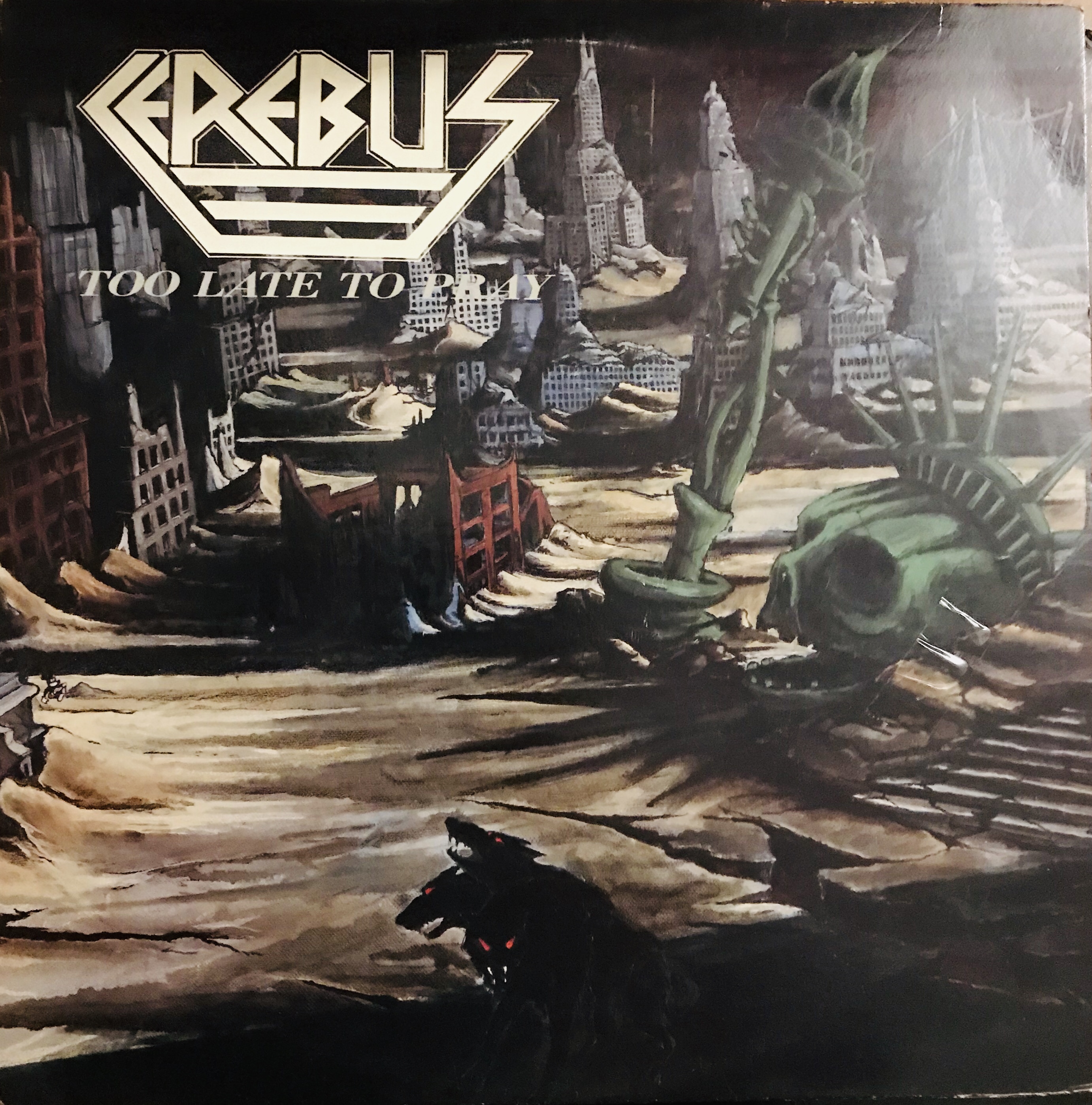
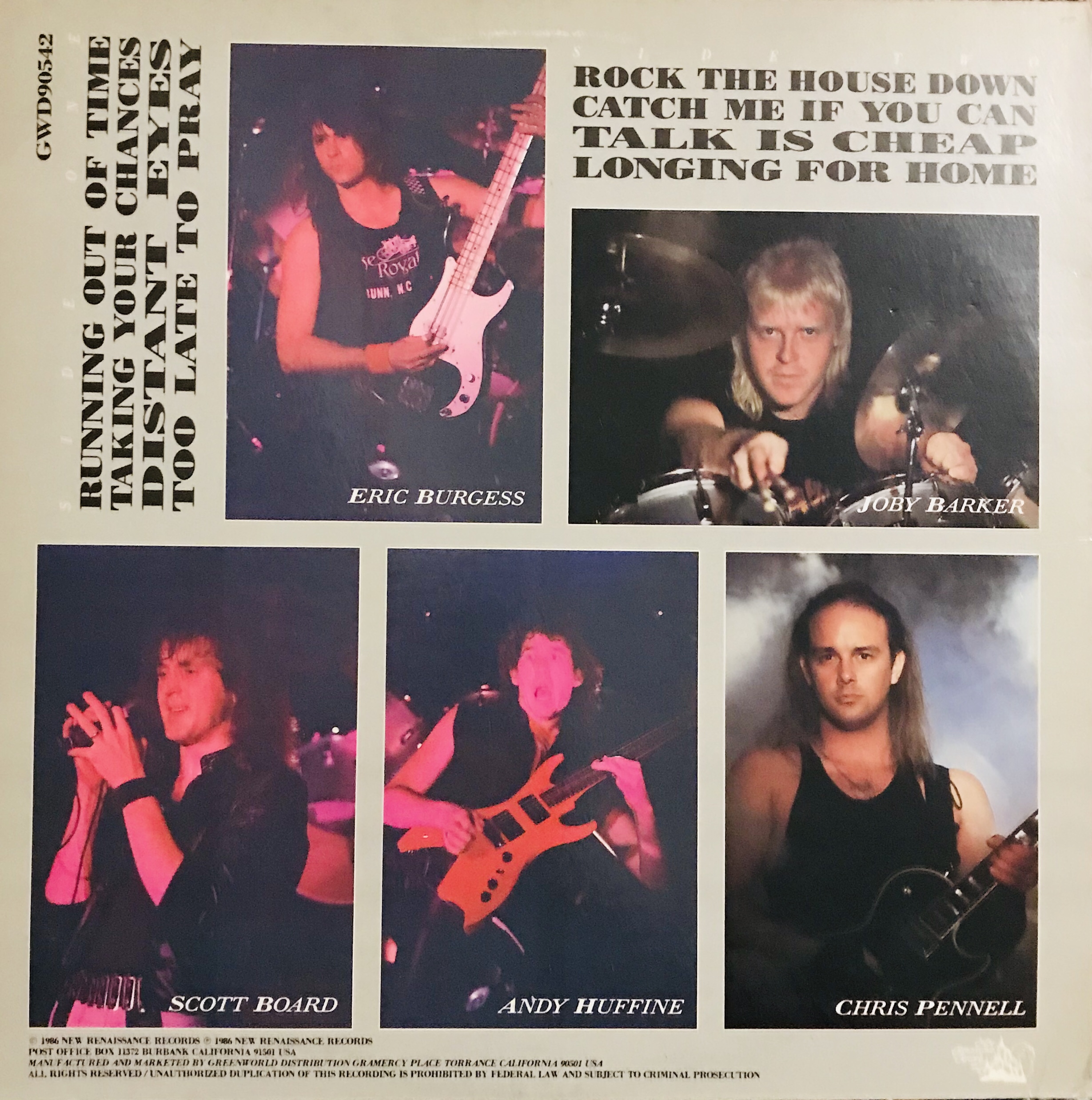
The Record Vault – Cerebus


It was a random purchase at a record fair in the 90’s. The bin had a large sign that said 7 records for $10.

How could I refuse that offer?

The dystopian landscape cover painting got my attention, as its reminded me of various movies.

I dropped the needle and I was pleasantly surprised.

I was hearing early Judas Priest, Saxon, Motorhead, Deep Purple, Thin Lizzy and Riot.

The raw production and the treble biased mix had me thinking of those Metallica albums. Which means that the bass player is hardly heard, which is a shame as Eric Burgess is the main songwriter in the band.

Cerebus is an American act. There is also a deathcore band with the same name that came out in the 2000’s who have nothing to do with this 80’s version.

They released a Demo in 1985, a full length album “Too Late To Pray” in 1986 on a label called New Renaissance Records, an EP in 1987 called “Like a Banshee On The Loose” on a local North Carolina label, another demo in 1988, another EP in 1991 called “Regression Progression” on a local label and a best of album in 2019 called “From Beyond The Vault Door” on a label called “Heaven And Hell”.

And their label “New Renaissance Records” was created by Ann Boleyn after her band Hellion had a record in the British Music Charts, but was unable to find an American deal. So Boleyn sold her car and musical instruments to fund the initial pressings of compilation albums and eventually full releases by bands. King Kobra (the band founded by Carmine Appice and Mark Free) was an act that was on the label as well.

So the label signed the band to an 2 album deal, but the label offered no tour support. Cerebus played an extensive US tour on their own budget but going to Europe proved impossible as they didn’t have the means, which is a shame, as the majority of their sales were in Germany and Western Europe. After the U.S run of shows, the band and label parted ways.

The band kept writing and releasing, but in a market dominated by gatekeepers, they needed a label and a distributor. Which didn’t come as easy as they thought.

And as the EP releases kept coming, the band kept tweaking their sound, moving from their Iron Maiden/Saxon style to a more Deep Purple, Whitesnake and UFO sound.

Running Out Of Time

Its speed metal and those harmony leads from Andy Huffine and Chris Pennell (RIP) in the solo section sound like they came from a Saxon album.

The vocal lines from Scott Board are like the chainsaw vocals of James Hetfield from the first two Metallica albums, with the Rob Halford banshee wail.

And the double bass drumming from Joby Barker just keeps pummelling along.

Taking Your Chances

A different style of cut, in the hard rock vein with a melodic rock style chorus.

Distant Eyes

Acoustic arpeggios kick it off with a guitar solo before it explodes into a UFO style cut merging “Lights Out” and “Too Hot To Handle”.

Too Late To Pray

It also starts off with acoustic guitar arpeggios, before it moves into a military style drum beat. Then the harmony guitars kick in, but it’s all part of a long intro, before the main song kicks in with a head banging riff.

And the vocal line is ball tearing.

Rock The House Down

It has the “One Riff To Rule Em All”, which a lot of people would know as “Two Minutes To Midnight” but it goes back all the way to the 70’s.

Catch Me If You Can

Sounds like “Running Out Of Time”.

Talk Is Cheap

It sounds like “Running Out Of Time”, but with no singing, and bass solos which you can actually hear.

Longing For Home

It has these “I Still Love You” arpeggios in the intro which I like.

Standard
A to Z of Making It, Music, My Stories

Rock Rap

Rock was/is built on sex.

Like “Slide It In”, “Slow And Easy” from Whitesnake style of sex. Or the “Liquor And Poker” tour from Whitesnake on the back of the “Slip Of The Tongue” album.

Or “She Goes Down” for some “Sticky Sweet” from Motley Crue.

Or pulling the trigger of someone’s “Love Gun” while getting a “Plaster Caster” done from Kiss.

Or how she’s got the “Big Guns” from Skid Row.

But Rap is also built on sex and it has taken over rock when it comes to the mainstream.

Rap artists used any means necessary to spread the word and they embraced the internet.

They had their tracks on SoundCloud for people to listen to and they gave away mix tapes for free to download. This Vice story covers what a mixtape is/means in the world of rap.

In case you don’t read the article, MixTapes are “street albums,” that don’t use the label distribution process for albums. In comparison, albums are designed to move units and issue singles. They are designed to chart. And depending on the artist/label, an approval is needed from the label, before the artist can start recording it.

MixTapes are not designed to do that. They operate outside this sphere.

Mixtapes bring in new fans and provide something for the core fan base to talk about on social media.

MixTapes give the artist a reason to tour.

MixTapes can be jams with other arists.

Basically in the rap world, MixTapes move a rapper’s career forward and it’s done without selling a single copy. Although Bootleg copies of these MixTapes do make their way to iTunes and Spotify from opportunistic people. But the rappers don’t care.

“Embrace the future and don’t complain about it”, is a phrase I hear a lot. The general view from journalists is that rock and metal artists didn’t embrace this future and that’s why the genre is in the rear view mirror but it makes bank on touring.

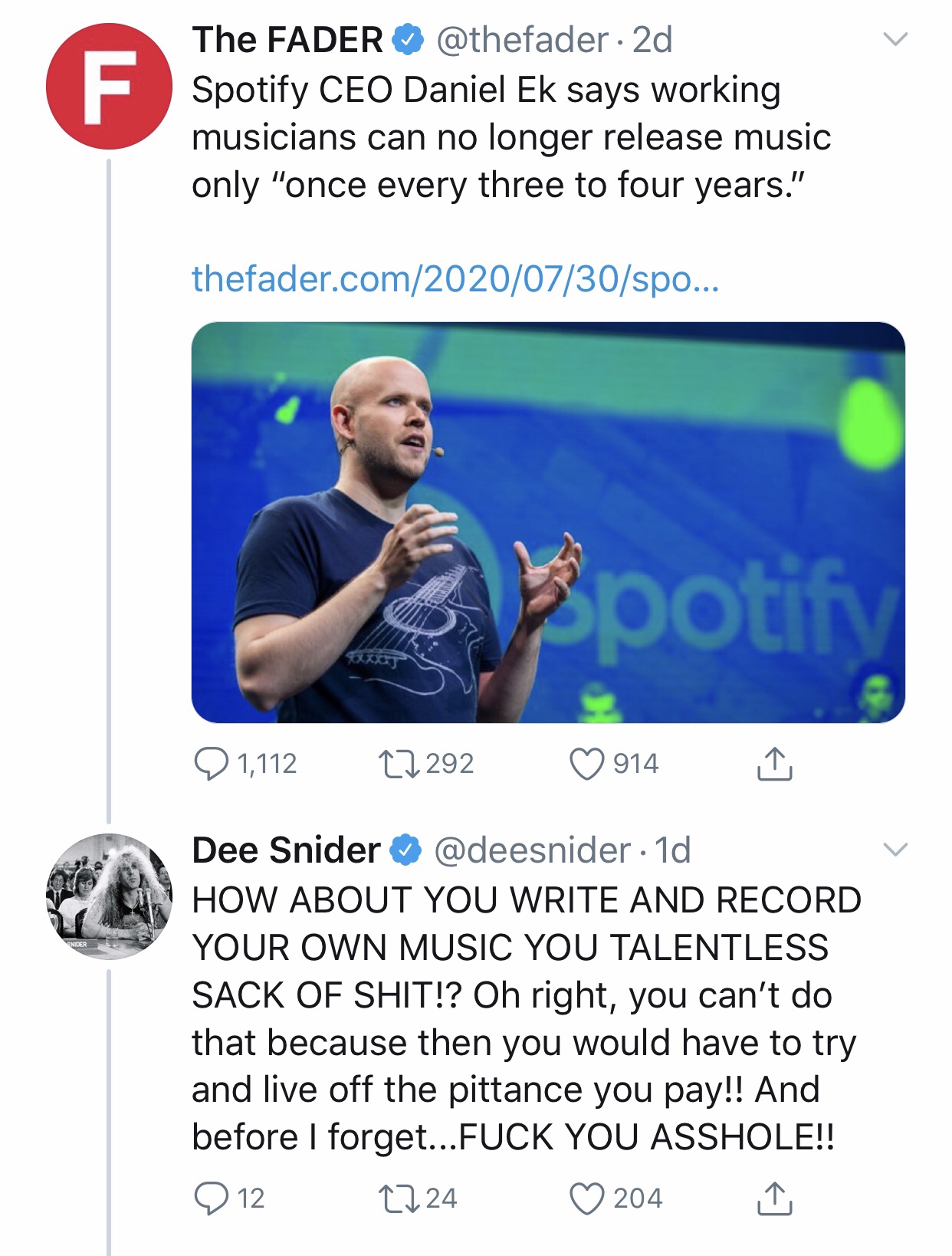
And there’s been a lot of discussions recently on social media about the comments of Daniel Ek for artists to create more content.

But rock and metal fans are loyal and if they have the means, they will find a way to support the artists they like.

There’s a cool post at Seth’s Blog about deliberate lo-fi.

He talks about communication and how it’s gone downhill.

Like face to face contact went to landline phone calls to cell phone calls to text messaging and to Zoom calls.

And how music went from a live setting to vinyl to cassettes to CD’s to mp3 to streams.

This transition is because people want more and more, so things get condensed to fit this new norm.

But there’s always a shift. Because something that was better in the past will always be better in the future.

Maybe it’s a pretty good reason as to why vinyl has a Cult following. It won’t overtake streaming revenues but it will exist because it’s better.

Standard
A to Z of Making It, Copyright, Music, My Stories, Piracy

Streaming Continued

I posted a few days ago about Streaming and some comments from Daniel Ek about what artists should be doing based on the data provided to him.

For example, releasing an album every 2 to 4 years is not a viable solution these days based on the data, and the data tells Spotify that a continuous engagement with fans with frequent releases is more viable.

Spotify thrives if content is delivered, so you need understand that Ek is also playing the role of a sales person in his quarter earnings speech.

And I’ve been following the reactions of artists on Twitter since Spotify quarter results, just to see what their view is, because the reason why we have Spotify accounts is that we like music and we want to listen to music.

Spotify grants access to music, along with the other streaming providers.

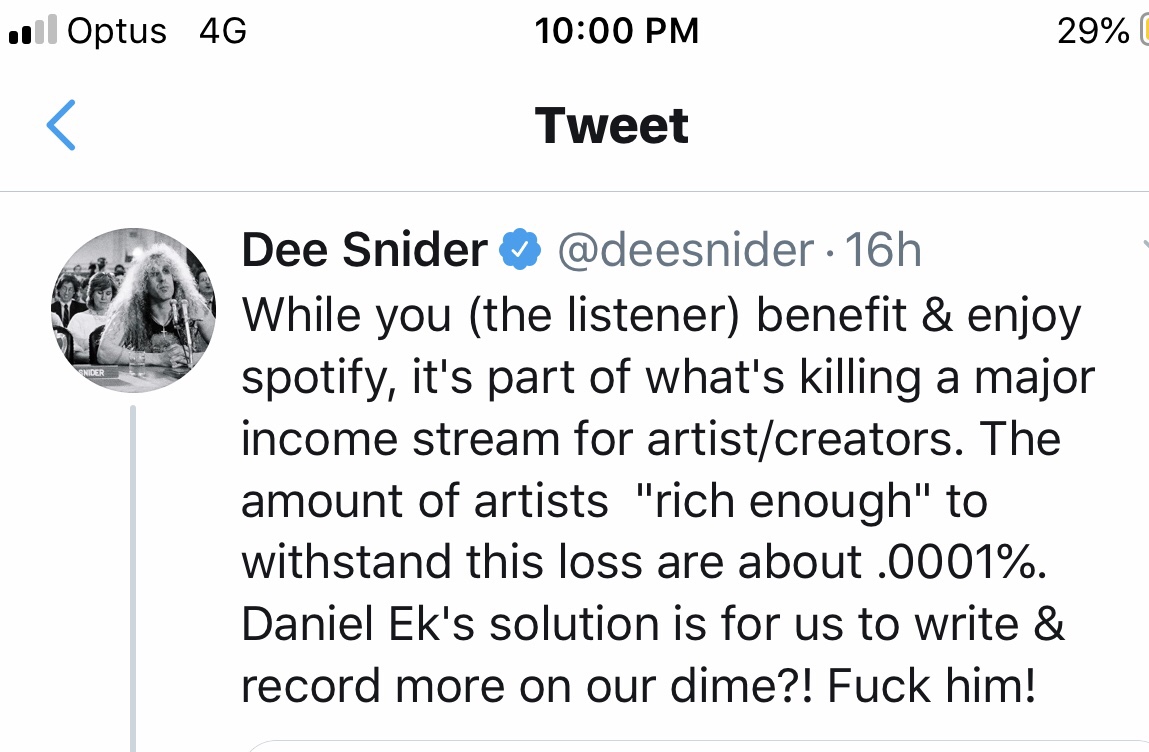
Dee Snider as usual is at his best.

Before streaming providers, consumers had, iTunes, pirate sites, cyber lockers and physical purchases. Artists got paid on a transaction once the label recouped.

But does that one sale equal a true fan.

Most of my record collection is from second hand record shops and market fairs of used records. So the person who purchased the record from a shop is listed as a fan via Soundscan metrics, but in reality, they are not a fan as they sold their record to a second hand shop who then resold it to me. And this sale is not captured as a Soundscan metric. So artists didn’t have any idea who their fans were.

Then came YouTube.

An uproar started there, when music became available on the service. YouTube got traction and to this day it is still the number 1 streaming service. The labels eventually negotiated a license deal and artists got rorted again. And pirate sites never went away.

Then came Spotify. The labels took ages to license the service as they wanted a stake in the company and a profit share arrangement with the service and so many other wonderful ways for the label to make money from the service.

First the labels and the publishing houses get a fee for allowing the service to license the music they hold the copyrights for. And this fee goes straight to the labels/publishers without any distribution to the artists.

And everyone is trying to do the math of how much does an artist get paid per stream?

But it’s the wrong train of thought to have.

Whoever holds the rights, the monies are getting sent there. But, the labels and publishing companies also have a profit share arrangement with the streaming service (and it’s not just Spotify, all streaming services have this arrangement, especially Tidal who have a lot of artists involved with it as investors) where they split the monies between each other.

And are the people at Tidal complaining?

Eventually the streaming market will fragment like the movie and TV streaming market and the streaming companies will start to make their own content and will become labels themselves.

Then we’ll have a different conversation.

Standard
A to Z of Making It, Classic Songs to Be Discovered, Derivative Works, Influenced, Music, My Stories, Unsung Heroes

1985 – Part 4

Kiss – Asylum

My son asked me yesterday, “what decade of Kiss do I like for new music released?”

I grew up on the 80’s Kiss, with the exception of the “Dynasty” and “Unmasked” albums. So my go to albums from Kiss are the 80’s albums, along with “Revenge”.

My first proper “Alive” experience was “Alive III”, then “IV” and then I went back to listen to “I” and “II”. But I like “III” better.

In the last 20 years, Kiss haven’t really set the world alight with new music (“Hell Or Hallelujah” will beg to differ and it’s up there as one of the best tracks for me), nor have they really dug into the vaults. Then again, Gene Simmons did raid his vault and from the reviews I read over at 2Loud2OldMusic, Simmons did a pretty good job at it.

Now in Australia, Kiss was larger than life. They always had an interview on TV or a music video clip on TV or a song played on radio. And they had their loyal following, plus any fly by nighters who would fall in and out of fandom with the band.

This album has Paul Stanley pulling quadruple duty on song writing, guitar playing, production duties (which even though Gene is listed as co-producer, Stanley did 90% of it) and bass playing. And I gravitated to the Stanley tracks, because they were just better.

This album also sticks out because it’s part of the era of bad jackets. Like very bad glam like jackets. If you’ve seen posters or press photos of bands during this era, you would know what I mean.

And it needs to be said, that Bruce Kulick is a guitar hero. He doesn’t get the “shred cred” he derserves, maybe because he played with Kiss. But his solos, from “Animalize” to “Revenge” are nothing short of guitar hero shred.

“King Of The Mountain” is written by Stanley, Kulick and Desmond Child and it gets the album off to a good start.

“Tears Are Falling” is a Stanley cut and although generic, it proved very popular for Kiss on MTV. “Who Wants To Be Lonely” is another cut that sticks around, this one being a co-write with Stanley, Child and Jean Beauvoir who would become well-known with the song, “Feel The Heat” from the Cobra soundtrack.

And let’s not talk about “Uh! All Night” even though some brain dead label rep thought it was a good idea to also release it as a single.

White Lion – Fight To Survive

I didn’t hear this until the 2000’s post Napster era was happening.

It wasn’t available at all in Australia and I didn’t know anyone who had a copy of it.

And it’s a forgotten album but it shouldn’t be, because it showcases Vito Bratta. While Bratta didn’t get back into the music business once White Lion broke up, his recorded output and musical legacy is down to the four White Lion albums and the backroom label dealings and stabbings which would affect Bratta.

They got signed to Elektra in 1984 and they record the album. Elektra refuses to release the album and terminates the bands contract. So now they have an album recorded, which they can’t access as its owned by Elektra and they have no deal.

Then a Japanese label releases it in Japan, and another label in the US release it under license to Elektra and the band tours on it, but the label in the U.S goes bankrupt. And the band is going through changes in the bass and drum department.

They did get singed to Atlantic in 1987, but that’s another story for another year.

Stand Outs with Great Bratta Moments

“Fight To Survive” is brilliant musically. Lyrically it’s about street life and fighting to be alive each day.

Great tapping intro that breaks down into the bass groove for the verse, with the volume swells and then it picks up for the big chorus and I love the delay in the solo section.

“All The Fallen Men” is influenced by “Rocking in the Free World” in the verses. Then again this came before Neil Young, and it’s a pretty generic chord progression, so..

“El Salvador” is the best song on this first album. The flamenco intro moving into the distortion riff is brilliant. You can hear Al DiMeola’s “Mediterranean Sundance”. And once the song kicks it’s all Thin Lizzy. Phil Lynott would be proud.

Clichéd Songs with Great Bratta Moments

“Broken Heart” has typical 80’s lyrics from Mike Tramp. Bratta shreds in the solo section with finger tapping and tap bends.

“All Burn In Hell” reminded me of Twisted Sister’s “Burn in Hell”. Musically it is typical of the 80’s. But the syncopated interlude before the solo. Brilliant.

There is a modern alternative rock metal vibe. And the solo section to me is a song within a song. A great Bratta moment.

Bad Songs with Great Bratta Moments

“Where Do We Run” – reminds of a 100th rate AC/DC song in the verse. Tramps lyrics and melodies are lame. It’s a shame because it has a killer solo, very much in the vein of Randy Rhoads – “Flying High Again” and George Lynch – “Tooth and Nail”.

“In The City” – up until the interlude and solo section, where Bratta wails, the song sounds like a Y&T rip off lyrically.

Firehouse also did a song, where the vocal melody was similar.

Does anyone remember “The Dream”?

Actually does anyone remember Firehouse the band?

Filler Songs

“Cherokee” – The lyrics are tacky, “Cherokee, riding free”. Maybe because I heard it after Europe’s “Cherokee”, which I also didn’t like.

“Kid of a 1000 Faces” – the less said about this song the better.

“The Road To Valhalla” – with that title I was expecting something epic.

AC/DC – Fly On The Wall

I love the cover art. I drawed it in Art Class. I wish I still have my art journals. The teacher hated it, as he was anti-rock/metal.

Malcolm tried really hard to remove AC/DC from the overproduced and super focused Lange albums. And although their worldwide sales especially in the U.S market didn’t set the world on fire post Lange, in the land of Oz, they couldn’t do no wrong.

We lapped up the 7 inch singles, their songs got played on radio and the music video clips for “Shake Your Foundations” and “Sink The Pink” got played relentlessly.

See me leaning, on the bar
I got my head in a whiskey jar

It’s the Australian way of life to be leaning on the bar, intoxicated. I wouldn’t have it any other way. And maybe it’s a big reason why the music videos resonated with Australian fans. They are both filmed in a bar/pub and people are playing pool while drinking. It’s the Australian way of life.

ZZ Top – Afterburner

How do you follow up “Eliminator”?

By continuing on with using synths, sequenced beats and midi samples with their blues boogie riffs.

A new take on an old sound.

I called it “New Wave Blues” (NWB). And I meant it as a compliment.

How good is the cover?

It was enough to hook me in.

And while “Sleeping Bag” kept in that NWB department, “Stages” is a melodic rock gem that I didn’t see coming.

“Rough Boy” has some of Billy Gibbons most melodic and emotive lead breaks. Check out the intro lead break and the outro lead break. He brought long guitar solos to the mainstream.

“Can’t Stop Rockin’” is “Got Me Under Pressure” a 12 bar blues boogie with sequenced drum beats. “Planet Of Women” rocks out of the gate, and man, this song has Gibbons putting in some serious playing in the riffage department.

The album is a product of its time and era, and I wouldn’t have it any other way.

Gary Moore – Run For Cover

It was the mid 90’s when I heard this album. And it’s one of his best albums.

“Empty Rooms” and that lead break is one of his best lead breaks, better than “Parisienne Walkways” and “Still Got The Blues”. “Military Man” has Phil Lynott singing, while “Out In The Fields” is a duet between Lynott and Moore.

The mighty Glen Hughes sings on “Reach For The Sky”, “Nothing To Lose” and “All Messed Up”, while Moore sings on “Run For Cover”, “Empty Rooms”, “Once In A Lifetime” and “Listen To Your Heartbeat”.

And Moore also has Lynott, Hughes and Bob Daisley playing bass on the album. Four different producers in Andy Johns, Peter Collins, Beau Hill and Mike Stone. In other words it’s an expensive album, but it did nothing sales wise in the U.S, while in Europe, it did a lot better.

But the piece d’resistance is “Empty Rooms”. The lead break from Moore was talked about a lot in guitar circles. And it’s a re-recording. He released it on “Victims Of The Future”. A longer version of 6 plus minutes. This one is more concise at 4 minutes.

And the way “Run For Cover” starts off, you know that Moore means business,. There isn’t a bad song on this album. The cuts that Hughes does vocals on are favourites and I need to do a playlist of songs Hughes has done over his career, like how I did with Ronnie James Dio, covering Rainbow, Sabbath and his solo career. The only album missing on that list is the “Heaven And Hell” band album from the two thousands because it’s not on Spotify Australia.

Phil Collins – No Jacket Required

His voice is one of the best.

It’s like Soul Rock and I like Collins when his also bluesy with a touch of rock.

The “hit songs” on this album are not my favourites. The brass instruments are just too much for me on those. But with any Collins release, there is always something to sink your ears into.

“Long Long Way To Go” is a favourite. It’s the mood and the repeating guitar/synth lick.

Then there is “I Don’t Wanna Know” which is a melodic rock masterpiece, with a great outro guitar solo.

“Don’t Lose My Number” reminds me of Marillion for some reason. It has a feel that Marillion would explore later on when they changed vocalists.

“Doesn’t Anybody Stay Together Anymore” has this driving beat to kick it off before it subdues in the verses, but the drums still roll on.

And there’s so much more music to get through for 1985, but that will be for other posts.

So into the time machine we go and I’ll see ya at 1977 for Part 4.

Standard
A to Z of Making It, Copyright, Music, My Stories

Friday Rambles

Another Dokken track was released today from the album is known as “The Lost Tapes” which is more or less modern day re-recordings of these songs, instead of the original tracks re-mixed and mastered.

So far it’s a zero from two strike rate.

And of course, Don Dokken’s ex band mate, is also Re-Imagining his early works, in this case, George Lynch is redoing “Wicked Sensation”. Its him and Oni Logan, with the help of Robbie Crane on bass and Brian Tichy on drums.

“The term ‘re-record’ makes me cringe, this is not that. We re-invented the wheel on this record. It’s really a different animal than the original! Fans won’t be disappointed!”
George Lynch

Interesting to hear what reinvention he’s talking about. I remember a Lynch Mob album called “Revolution” in which Lynch reinvented some Dokken songs with different grooves. It’s not something which I have played a lot since I purchased it.

Since I have every single thing Lynch has released on my shelf, I would probably buy this, but I will wait to hear it on Spotify.

You see, when a different artist does a song from another artist, it’s known as a cover, but for some reason, when the same artist re-does their earlier stuff, it was always seen as a forgery.

The only time a forgery was done to an excellent standard was with the 1987 self-titled Whitesnake album. John Kalodner cracked that whip and David Coverdale along with Sykes on “Crying In The Rain” and Sykes/Vandenberg on “Here I Go Again” or Dan Tuff on the radio friendly version delivered in gold. Because two years later, the Steve Vai version of “Fool For Your Loving” didn’t cut it.

Then again, every artist from the 80’s who has a deal with Frontiers is encouraged to re-record their successful 80’s music for the label.

Even Def Leppard did it them selves while they had that ongoing dispute with their label over what they should pay the band to have their music on digital services.

And in relation to payments and digital services, Don Henley wants the U.S Government to pass laws so that anyone who plays his music, pays money for the use of his songs.

Regardless.

He mentioned how his label, Universal has over 60 people patrolling the internet to take down unauthorised uses of his songs. On occasions these automated takedowns, take down legitimate uses as well.

And I’m thinking, their wages are paid by the monies the label receives from exploiting record music. Shouldn’t those monies be paid to the artists who create the music.

Then there is the other side of the debate, people who actually use music from artists to promote the artists music on YouTube.

What is fair use, and when should their popular YouTube video earnings be handed over to the label?

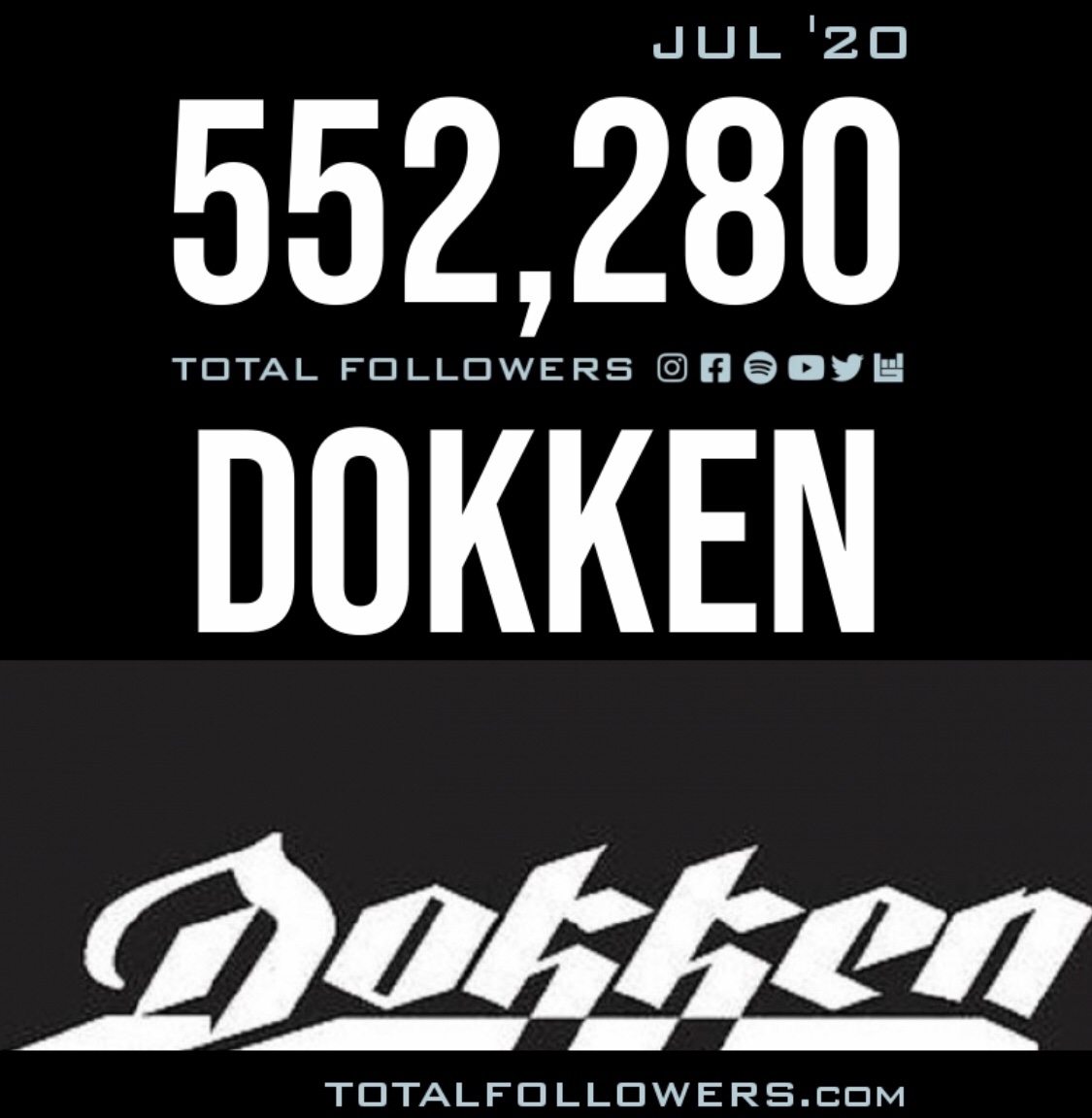
A site I follow, made mention of another site called totalfollowers.com, which I checked out. Since I was writing about Dokken, Lynch Mob And Def Leppard, I thought I should check out their reach.

I typed in Lynch Mob and there are 240,313 followers.

I typed in Dokken and there are 552,280 followers.

I typed in Def Leppard and there are 11,571,109 followers.

I guess that’s the difference between having diamond certifications to platinum certifications to no certification.

Standard
A to Z of Making It, Classic Songs to Be Discovered, Derivative Works, Influenced, Music, My Stories, Unsung Heroes

11th May 1992 Australian Hard Rock and Heavy Metal Charts Snapshot

I posted last week about the albums that made up the Top 20 in Australia back in 1992.

Here is the Singles List.

Number 1
Under The Bridge – Red Hot Chilli Peppers

The Hendrix “Little Wing” inspired intro from Frusciante converted a lot of rock heads to the RHCP. Their album was on top and their single was on top.

Number 2
To Be With You – Mr Big

Their worst song by far, but it cashed in on the Unplugged acoustic craze. It worked for Extreme and it worked for Mr Big. But those ballad fans who cross over for the song are fly by nighters.

Number 3
Nothing Else Matters – Metallica

The variety on the self-titled “Black” album is a big reason why it sold. There was enough there to please metal heads, rock heads, thrash heads, country heads and pop heads. And this song is a perfect example of it. Plus it has a killer James Hetfield lead break.

Number 4
Alive – Pearl Jam

I get why it was popular, but I didn’t like it when it came out and after I purchased the album, I preferred a lot of the other tracks to this.

Number 5
Let’s Get Rocked – Def Leppard

So you wanna get rocked…. I guess we still wanted to get rocked.

Number 6
Thought I’d Died And Gone To Heaven – Bryan Adams

This is from the “Waking Up The Neighbours” album that went to number 1 everywhere.

Adams has a lot of fans down under, so it’s no surprise his songs chart well. And what a run he had between 1983 and 1999. And he made some big choices, like moving from Jim Vallance to Mutt Lange and the momentum just kept getting bigger.

Number 7
November Rain – Guns N Roses

You get three emotive Slash solos.

What more could you want?

Number 8
Viva Las Vegas – ZZ Top

It’s a cover song, but at this point in time there was nothing that ZZ Top could do wrong. This is one of the two new tracks, the other being “Gun Love”. Like Adams, they were on a winning plus decade.

Number 9
Dream Alone – Killing Time

An Australian hard rock band, which had a band name, the same as the U.S hardcore band and after this single release they would change it to Mantissa.

They supported bands like Janes Addiction, Baby Animals and Pantera on National tours but they had a constant turnover of musicians which felt like a momentum killer.

Number 10
Sister’s Crazy – Candy Harlots

This band story is a combination of Anvil and Motley Crue.

They had a deal offered in 1987 but their manager refused to sign it, because he wanted a bigger cut and then signed the band to a four year management deal, which suppressed the band from signing the record deal themselves. No other label wanted to get involved in this legal mess. They finally did sign a deal in 1991.

They had a massive Club following like Motley Crue. There was tragedy when one of their main songwriters Ron Barrett died before they even got their deal. In the 90’s, Barrett’s death was reported as a drug overdose, while these days, its reported as an asthma attack. And the evolving door of musicians just kept on happening, with drummer Tony Cardinal being the only founding musician in the band when they got their deal.

And as soon as they released their “Five Wicked Ways” album in 1992, within a year it was over.

Standard
A to Z of Making It, Influenced, Music, My Stories, Unsung Heroes

11th May 1992 Australian Hard Rock and Heavy Metal Charts Snapshot

Number 1
BloodSugerSexMagik
RHCP

I’m not an overall fan of RHCP albums but I am a fan of some of their songs and their resilience to keep at it, and to create a whole soundtrack of music for people.

On this album, the groove riff in “Suck My Kiss” and the Hendrix inspired intro in “Under The Bridge” got my attention.

Number 2
Adrenalize
Def Leppard

While it wasn’t as strong as the previous two albums, they still had enough goodwill with their fans.

Number 3
Ten
Pearl Jam

A slow burner, this album would be around for a few more years, on the backs of album cuts like “Black”.

Number 4
Vulgar Display Of Power
Pantera

I heard this album and totally avoided it for a very long time. I couldn’t believe that after “Cowboys For Hell”, the vocals turned into hard core screaming. But I gave it a shot, circa 2005, and although I hate Anselmo’s vocal delivery, Dimebag delivers musically.

Number 5
The End Complete
Obituary

My cousin is a Death Metal fan. I liked the cover, heard it and forgot it.

Number 6
Nevermind
Nirvana

Like it or not, there is some good riffage on this album. The psychedelic “Come As You Are” still gets me.

Number 7
Wasted In America
Love/Hate

I still haven’t heard it.

Number 8
The End Of Silence
Rollins Band

I still haven’t heard it.

Number 9
Badmotorfinger
Soundgarden

This was my first introduction to Chris Cornell and his voice. And I liked it.

Number 10
Baby Animals
Baby Animals

One of my favourite hard rock records. Suze DeMarchi and crew deliver on this debut.

Number 11
Metallica
Metallica

This album is still charting. In 2020.

Number 12
Bleach
Nirvana

No one cared for this album, until “Nevermind”. Sort of like the old Whitesnake and Metallica catalogues after “1987” and “Black” album. We all went back to listen.

Number 13
Body Count
Body Count

Ice T stirred the pot with “Cop Killer” but it’s the 70’s Classic Rock influenced “The Winner Loses” which grabs me. If you haven’t heard, you should get to it. The whole 6 minutes.

Number 14
User Your Illusion II
Guns N Roses

There was always the debate, which album is better. The first one or the second one. Based on sales in Australia, the second one.

Number 15
Hysteria
Def Leppard

Five years later, this was still selling in the land of Oz.

Number 16
Fire and Ice
Yngwie Malmsteen

Australia has a Power Metal fan base and Malmsteen at this point in time serviced it well. And you couldn’t tell the Elitist Power Metallers about any blues based players. They would change their views years later.

Number 17
Use Your Illusion 1
Guns N Roses

I like the first album better.

Number 18
Vae Solis
Scorn

I haven’t heard it nor do I know anything about the band.

Number 19
America Must Be Destroyed
GWAR

I just saw them as a fad, but they had a career that spanned over 20 plus years. And I still haven’t listened to em.

Number 20
Blind
Corrosion Of Conformity

There isn’t a stand out cut, but each cut has a groove that I can latch onto.

Standard