A to Z of Making It, Classic Songs to Be Discovered, Music, My Stories

The Case For Ozzmosis

I have an issue of Metal Edge from October 1995.

There is a feature with the headline “Ozzy Osbourne’s Cyber Diary – Life In The Studio”. It goes something like this;

February 28, 1995 – Recording in Paris, France with Zakk Wylde on guitar, Geezer Butler on bass, Deen Castronovo on drums and Michael Beinhorn producing.

March 2, 1995 – “Tomorrow”, “See You On The Other Side” and “Old LA Tonight” have all the rhythms and drums done.

March 3, 1995 – “The Whole Worlds Falling Down” and “Can’t Get Up” are added to the list.

March 6, 1995 – “Fallin’ Up”, “I Just Want You”, “Denial”, “Rasputin” and “Mothers Crying” are added to the list.

March 13, 1995 – “My Little Man” and “Back On Earth” have been tracked. After a Saturday night bender, Zakk was locked out of his room and he punched a hole through the door. The hotel has refused to fix it until Zakk leaves. 4 days later, the hotel declares bankruptcy.

March 20, 1995 – All tracking is complete with the songs “Perry Mason”, “Ghost Behind My Eyes”, “Thunder Underground” and “My Jekyll Doesn’t Hide” being the last and the project moves to New York.

March 31, 1995 – Zakk lays down solos for “Back On Earth”.

April 3, 1995 – Beinhorn makes Ozzy sing “See You On The Other Side” 85 times, before he was happy with one take.

April 6, 1995 – Zakk had finished all guitar parts for the songs and solos for 7 songs. New lyrics are written for “Back On Earth”.

April 10, 1995 – The album title of “Ozzmosis” is finally decided.

April 14, 1995 – Lead vocals are finished for “Tomorrow”, “See You On The Other Side”, “I Just Want You”, “Back On Earth” and “Ghost Behind My Eyes”.

April 17, 1995 – They are working on a new song called “Thunder Underground”, written by Geezer and Zakk before they started the backing tracks in Paris.

April 18, 1995 – Ozzy lays down more vocals for “Ghost Behind My Eyes”.

April 19, 1995 – Ozzy lays down vocals for “Denial”. It takes 7 hours to get the take that Beinhorn is happy with.

April 20, 1995 – Ozzy’s throat is inflamed and is asked by the Doctor to get some rest and not sing for a few weeks.

April 28,1995 – Beinhorn gets the band to come back in and redo “Old LA Tonight” and “Back On Earth” as he wasn’t happy with how they turned out earlier. They also redo “The Whole Worlds Falling Down”.

May 2, 1995 – Zakk is laying down more guitar solos and Rick Wakeman is hired to come out in a few weeks to play keyboards.

May 5, 1995 – Zakk finishes up all of his guitar parts.

May 15, 1995 – Rick Wakeman goes from the airport to the studio and he has two days to do all of his parts.

May 17, 1995 – Ozzy is singing “Thunder Underground”.

May 18, 1995 – Ozzy finishes the vocals for “My Jekyll Can’t Hyde”.

May 19, 1995 – Beinhorn made Ozzy sing another vocal for “See You On The Other Side”.

The album recording process is done. The mixing process is next. The final track listing is also decided and “Back On Earth” at this point in time was part of the album’s 11 tracks.

But.

The story of the album and how it came to be goes back even further.

Let’s rewind.

It’s late 1992. Ozzy Osbourne just wrapped his so-called “No More Tours” farewell run. Diagnosed, wrongly, with multiple sclerosis, he tells the world he’s retiring. Done. Finished. Hanging up the mic.

Yeah, right.

Turns out, retirement sucks. Especially when madness is your brand.

Between 1992 and 1995, Ozzy quietly laid the groundwork for what would become “Ozzmosis”. It wasn’t a straight line. It was messy. Chaotic. Weirdly brilliant. He demoed dozens of tracks with a rotating cast of rock royalty. Most of it never officially saw daylight.

Early sessions in a London studio produced what fans now call the “Ozzmosis Demos”, a bootleg CD loaded with unreleased cuts:

1. Feels So Good to Be Bad
2. Denial
3. Too Far Gone
4. Ghost Behind My Eyes
5. Frustrated Yes I’m Hated
6. Dream for Tomorrow
7. Say Yeah Yeah
8. Oh No the Bitch Won’t Go
9. My New Rock and Roll
10. Perry Mason
11. Old L.A. Tonight
12. See You on the Other Side

Five of these tracks, “Perry Mason,” “Old L.A. Tonight,” “Denial,” “Ghost Behind My Eyes,” and “See You on the Other Side”, made it to the official album. The rest? Still lurking in the shadows.

Ozzy collaborated at first with Zakk Wylde. The songs “Perry Mason”, “See You On The Other Side, “Tomorrow”, “Aimee”, “Living With The Enemy” and “Old LA Tonight” are products of these sessions. 

Then came Steve Dudas, Mark Hudson, and even Lemmy Kilmister, who probably wrote more than he ever got credit for.

“Denial” and “Ghost Behind My Eyes” = Ozzy, Hudson, Dudas.

“Feels So Good to Be Bad” = Bluesy glam rock, think T-Rex. Writer unknown.

“Frustrated Yes I’m Hated” = Sabbath-ish, standard E tuning.

“Dream for Tomorrow” = Beatles vibes.

“Oh No the Bitch Won’t Go” = Beach Boys meets Ozzy in a bar fight.

“My New Rock and Roll” = Pure psych trip.

“Say Yeah Yeah” = Tries to be dark, ends up karaoke catchy.

Who wrote what? Hard to say. Fans point fingers at Hudson and Dudas. Dudas likely played guitar, too.

Among the many ghosts of the “Ozzmosis” era, a handful of tracks remain shrouded in mystery: “Fallin’ Up,” “Can’t Get Up,” “Rasputin,” and “Mother’s Crying”.

Whispers in fan circles credit Steve Dudas and Mark Hudson as the writers. But here’s where it gets weird, rumor has it these songs were part of a bigger vision: a full-blown theatrical rock opera called “Rasputin”.

Yep. Ozzy. On stage. In a play.

But the curtains never rose. The project was quietly killed, and instead, “Ozzfest” was born, a louder, messier, more Ozzy version of theater.

The songs?

Shelved. Forgotten. Still sitting in a vault somewhere, waiting for their moment… or maybe waiting to be lost forever.

Producers came and went, Duane Baron and John Purdell started it off, then got replaced by Michael Wagener, who got bumped by Michael Beinhorn. It was a revolving door of creative chaos.

Then came “The Lost Vai” Album, cue mythological music.

Steve Vai came onboard for a full-blown project called “X-Ray”. Only one track, “My Little Man,” survived (Lemmy wrote the lyrics, uncredited).

According to Bob Daisley in his book:

“It wasn’t working. Instead of just being honest with Vai, Sharon told him Sony pulled the plug. Total BS. It was just a move to ditch him quietly. We all saw through it.”

Vai was out. Zakk was back. Daisley got ghosted. Geezer Butler showed up. Business as usual.

Then came the outside hires:

Jack Blades & Tommy Shaw wrote “Voodoo Dancer” and “The Whole World’s Falling Down”.

Taylor Rhodes and Richard Supa wrote “Back On Earth”.

Jim Vallance wrote “Walk on Water,” and “I Just Want You.

Geezer & Zakk wrote “Thunder Underground” and “My Jekyll Doesn’t Hide”.

By early ’95, Ozzy’s misdiagnosis was corrected. He was sober. Still dark, but sharp. Creative. Driven. He wasn’t chasing success, he was clawing back himself.

So when you hear Ozzmosis, remember this:

It’s not just an album.

It’s a resurrection.

Built from fragments.

Forged in chaos.

Sung by a man who couldn’t stop, even when he tried.

Standard
A to Z of Making It, Influenced, Music

Joel Hoekstra on The Jay Jay French Connection Podcast (Sept 19, 2023)

Steve Lukather has nothing but the highest praise for Hoekstra, and it’s easy to see why.

Born in Iowa City, Joel moved to Chicago as a kid, then later spent time in L.A., working at Cherokee Studios in 1991 and 1992. By that time, legendary producers Tom Werman and Geoff Workman had already moved on, but their legacy lingered.

Hoekstra studied at the Musicians Institute (GIT) in L.A., though he had a head start, his local teacher had already introduced him to the curriculum before he even arrived. On day one, he found himself among 500 other guitarists in the main hall, an intimidating experience.

Growing up with classically trained parents, he learned to read music early on, though he admits it’s only occasionally useful in his current work. It did, however, come in handy when he landed “Rock of Ages” and other theater gigs.

Unlike many of his peers, the ’80s shred scene didn’t have a huge impact on him, he was too young for it to be a major influence.

He did, however, run in circles with some serious musicians, including drummer Scott Coogan, guitarist Pete Thorn (well-known for gear demos), and Joy Basou (who found success in pop music, working with artists like Jessica Simpson and Nick Lachey).

When asked about his guitar heroes, Hoekstra named Steve Morse (High Tension Wires), Steve Vai (Passion and Warfare), and Joe Satriani (Flying in a Blue Dream, Surfing With the Alien).

While Eric Clapton wasn’t a big influence, he admired Jimmy Page for his rhythmic licks, Jeff Beck for, well, everything, and Jimi Hendrix for his showmanship. He also loved everything “Rush” did, as well as Trevor Rabin’s “Yes” era, he still follows Rabin’s work, including his latest album “Rio”.

Jay Jay French mentioned for his generation, Johnny Winter and Alvin Lee were the Yngwie Malmsteens of their time.

Over the years, Hoekstra transitioned from playing Floyd Rose-equipped Jacksons and Kramers to a Fender Telecaster, then a Gibson SG, before settling on a Gibson Les Paul in 2004. He admitted that while playing a Les Paul means sacrificing about 10% of your technique, each note is worth it. Initially, he avoided Les Pauls because he’d heard they had tuning issues.

As a solo artist, Hoekstra has released three instrumental albums covering various styles. However, when he shifted into hard rock and heavy metal, fans wanted more of that sound.

Instead of branding it as a solo project, he launched “Joel Hoekstra’s 13”, where he writes all the music and lyrics while bringing in powerhouse rock musicians to jam with him. At the time of the interview he was onto his third release with “JH13”, along with “Eagle Flight” from Revolution Saints.

Speaking of collaborations, Hoekstra has another project called “Iconic”, featuring Michael Sweet (guitar), Marco Mendoza (bass), Tommy Aldridge (drums), and Nathan James (vocals). At the time of the interview, new releases from Iconic and Revolution Saints are on the way.

Since then, Revolution Saints dropped “Against The Winds” in 2024 however Iconic hasn’t been released yet.

As for Whitesnake, the future remains uncertain. Everything depends on David Coverdale, with the band currently in a holding pattern. Their European tour had a few canceled dates, and the U.S. tour was ultimately called off due to Coverdale’s sinus infection.

If you like to hear a good story, check out Joel Hoekstra.

Standard
A to Z of Making It, Music, My Stories

Is Rock Really Dead? Let’s Talk About It.

So, my Release Day playlist on Spotify one week was packed with tracks like “Who Said Rock N Roll Is Dead” by Crazy Lixx, “Rock N Roll Survivors” by Bonfire, and “Gods Of Rock N Roll” by Billy Morrison, Ozzy Osbourne, and Steve Stevens.

Then the next week it had “Rock And Roll Party Cowboy” from The Darkness. And my train of thought moves to “Rock And Roll Deserves To Die”, one of my favorite songs from em.

Naturally, it got me thinking about the ever-recurring debate:

Is rock actually dead?

Lenny Kravitz released a song titled “Rock and Roll Is Dead” on his 1995 album “Circus”, a cynical take on the state of rock music at the time.

Marilyn Manson, has a song “Rock Is Dead” from the 1998 album “Mechanical Animals” which is critical of the commercialization and his perceived decline of rock’s rebellious spirit.

L.A. Guns released a song titled “Rock and Roll Is Dead” on their 2005 album “Tales from the Strip”, about the genre’s struggles in the modern era.

Even The Doors’ had a track “Rock Is Dead” (recorded in 1969, released posthumously).

Gene Simmons is the guy most often quoted on this. In a 2022 statement, he told “Metal Hammer”, “I stand by my words, rock is dead and the fans killed it,” blaming file-sharing and the decline of record industry support for new rock talent. He also elaborated on this in a 2014 “Esquire” interview, pointing to the lack of new iconic bands since the Beatles era and the economic challenges for emerging artists.

However plenty of legacy artists share a similar sentiment.

Jay Jay French fromTwisted Sister had made a few forays into this. You can read his latest here.

He makes a good argument about rock’s decline in cultural relevance, essentially claiming that rock is “dead” because it no longer produces massive young stars like it did in the late ’60s and ’70s.

He also points out that rock doesn’t define youth identity in the way hip-hop, pop, and country do today. It’s a compelling argument, but it’s not the full picture.

So where does Jay Jay have a point.

Rock isn’t the dominant force in youth culture anymore. Streaming, social media, and internet-driven virality have helped hip-hop and pop thrive while rock has struggled to keep up.

Since exact weekly numbers aren’t available, I’ll estimate based on monthly listener counts and annual streams, dividing by 52 for a rough weekly average, adjusted for current trends.

The top 50 metal and rock artists generate 70-100M weekly streams. This is a fraction of the broader streaming landscape, where total weekly streams across all genres exceed 4-5 billion (based on Spotify’s 2023 global totals of 200B+ annual streams).

Pop/Hip-Hop genres account for 50-60% of streams. Their top 50 artists alone could hit 400-500M weekly, 4-5x higher than metal/rock.

Metal and rock, despite passionate fanbases, remain a smaller player in the streaming game, punching above their weight culturally but not numerically.

The days of four kids in a garage forming a band and becoming icons by 25 is way harder to pull off now. Labels and streaming platforms push polished, solo acts over traditional bands.

Just like jazz and big band had their golden eras before becoming niche genres, rock’s mainstream heyday as a youth movement may simply be over.

So where does Jay Jay’s argument fall short?

Sure, rock isn’t a monoculture anymore, but it’s alive and well in subgenres like metal, indie, punk, and prog. Just because it’s not topping the Billboard Hot 100 doesn’t mean it’s dead.

Even in those subgenres, there are further subgenres and even more splintering.

In Latin America, Japan, and Scandinavia, rock and metal are huge. Just because the major markets aren’t as tuned in doesn’t mean the genre is extinct.

Back in the day, you were either a rock and metal fan or a hip-hop fan.

Now?

A single playlist might have Metallica, Bon Jovi, Kendrick Lamar, Whitesnake, Shinedown, Taylor Swift, and Bring Me The Horizon. Genre loyalty is weaker than ever.

As much as the internet was meant to level the playing field and remove the gatekeepers, streaming algorithms and major labels still push what’s easy to market.

Rock isn’t dying; it’s just not the industry’s priority.

French isn’t wrong. Rock doesn’t dominate pop culture like it used to, and we’re unlikely to see another Beatles-level rock phenomenon.

But calling it “dead” is an oversimplification.

The genre is evolving, diversifying, and thriving in different ways. It might never reclaim its past mainstream dominance, but it’s far from irrelevant.

Standard
A to Z of Making It, Copyright, Influenced, Music, Unsung Heroes

Derek Schulman

On October 15, 2020, Derek Schulman appeared on the Bob Lefsetz Podcast.

I first heard of Schulman as the guy responsible for signing Bon Jovi and Cinderella. But before becoming a label executive, he was a member of Gentle Giant (GG), a band that has a bigger fan base today than when they originally broke up.

When Lefsetz asked why GG had grown in popularity, Schulman explained: “We wrote music for ourselves, didn’t follow trends, and the music held up.” Interestingly, GG never considered themselves a progressive rock band. Rock, yes, but not prog. They simply pushed themselves musically.

I believe GG’s resurgence is largely due to the internet. Their music isn’t locked away in a vault, it’s widely accessible. If we were still in the pre-Napster era, their catalog might have remained buried, since labels wouldn’t see the financial incentive to print CDs. Labels have always believed they know what fans want, but they’ve often been wrong. Had they continued releasing hard rock in the ’90s, the genre could have still produced acts selling close to 500,000 units. Instead, they abandoned it.

It always comes back to the music. People return for the music, not for record sales, labels, executives, or streaming numbers.

From Musician to Executive

Before Gentle Giant, Schulman played in a band with a few hit singles, but by 1969, he was burned out from the pressure to keep churning out commercial hits. He wanted to form a band that was the opposite of pop, so GG was born.

But by 1980, after 14 years in bands, Schulman was done. GG had become a job, and he had lost enthusiasm for recording and touring. With nothing lined up, he spent a year feeling lost. Fortunately, he had savings, thanks to his role as GG’s quasi-manager in the mid-’70s.

A friend at PolyGram called with a job offer. Schulman moved from California to New York and joined the label as a Promotions/A&R rep, though his role was mostly promotions. He was hired because two of PolyGram’s heads of radio promotion were huge Gentle Giant fans.

At the time, PolyGram was a mess. The label had major acts like KISS and Def Leppard, but they drained a lot of resources. Schulman’s break came when artists and managers started bringing him albums. Uriah Heep was shopping a new record, and Schulman helped organize a deal to release it.

Then came Bon Jovi.

Bon Jovi’s Breakthrough

Schulman met Jon Bon Jovi and was impressed by his focus and drive. Jon wanted to be bigger than Elvis. He even introduced Schulman to his parents, who told him: “Take care of our son.”

At the time, no other labels were bidding on Bon Jovi. Schulman also had a strict policy, he refused to get into bidding wars.

The key move was bringing in Doc McGhee. Doc originally came to Schulman’s office pushing Pat Travers, but Schulman told him to check out Bon Jovi instead. Schulman saw in Doc the same relentless drive that Jon had.

Jon met Doc, they struck a deal, and just like with Schulman, Jon’s parents needed to approve.

McGhee put Bon Jovi on tour with Ratt and Scorpions. Their debut album was a success, but their second record, “7800° Fahrenheit”, was considered a sophomore slump. Schulman hated the album title, the recording process was a mess, and the overall vibe felt off. But the album did its job, it kept the band on the road while McGhee worked overtime to book shows.

Schulman, meanwhile, had started working with producers Bob Rock and Bruce Fairbairn, who had just finished albums with Loverboy and Honeymoon Suite. Jon and Doc knew they needed great producers to reach the next level.

Schulman suggested co-writing with others. Paul Stanley and Gene Simmons had already introduced Jon to Desmond Child. The rest is history.

The label knew they had something big as soon as “Slippery When Wet” was mastered. The original album cover was scrapped, and Jon designed the new one himself. “You Give Love a Bad Name” and “Livin’ on a Prayer” were immediate hits, and the album shot to No. 1. Schulman had a percentage point on the album, but when he left the label, his royalties ended.

Cinderella

Schulman was introduced to Cinderella by an agent, a lawyer, and Jon Bon Jovi, who knew Tom Keifer.

He went to see them play a club in Philadelphia. The band wasn’t great, Tom Keifer stood out, Jeff LaBar was solid on guitar, but the other two members weren’t up to par. Then Schulman listened to a 90-song demo of Keifer’s original material. He was blown away by Keifer’s songwriting.

Schulman told the lawyer: “Get Tom to replace the other two with better musicians, and I’ll give you a deal.”

Andy Johns was brought in to produce “Night Songs”. The album dropped shortly after “Slippery When Wet” exploded, and “Night Songs” shot into the Top 10. Suddenly, Schulman was on fire, he had two bands in the Top 10.

When Lefsetz asked why Cinderella never released another big album, Schulman pointed out that they did, “Long Cold Winter”, but he had briefly forgotten the title.

Tom Keifer eventually lost his voice, which Schulman confirmed was true. Schulman also helped shape Cinderella’s albums with his artist experience, though he didn’t contribute to Bon Jovi’s records in the same way. He even co-wrote songs with Tom but never took credit.

Dream Theater

Derek Oliver, an A&R representative at Atco Records and a passionate fan of progressive rock, was the key figure in discovering Dream Theater.

In the late 1980s, Dream Theater had self-released their debut album, “When Dream and Day Unite”, through Mechanic/MCA Records, but the album failed to gain much traction due to poor promotion and distribution.

Meanwhile, Oliver, who had interviewed and reviewed the band during the period as part of Kerrang was impressed by their technical proficiency and songwriting.

Recognizing their potential, he brought Dream Theater to the attention of Derek Schulman, the head of Atco Records at the time.

After meeting the band and seeing their dedication, Schulman agreed to sign them to Atco. Under his guidance, Dream Theater recorded their breakthrough album, Images and Words (1992), which featured the hit single “Pull Me Under.” The album’s success helped establish them as a leading force in progressive metal, proving that Schulman and Oliver’s instincts were right.

Running Labels

Schulman also played a key role in launching Bob Rock’s production career, giving him his first gig with Kingdom Come, another band that went on to dominate the charts.

In 1989, Schulman left PolyGram to run Atco Records. PolyGram wanted to keep him, offering him control of Vertigo and Mercury, but he wanted a change, even if it meant losing his Bon Jovi and Cinderella royalties.

Doug Morris was hesitant about Schulman at first and saw him as a potential replacement. But Schulman built an impressive roster, signing Pantera and The Rembrandts. He had actually planned to sign Pantera to PolyGram but knew he was leaving, so he told their attorney to wait until he moved to Atco.

At first, Atco thrived. Schulman put together a strong team, and the first three years were fantastic. But eventually, he started losing perspective. One day, he heard a No. 1 song on the radio and liked it. When he asked a work colleague who had signed the artist, they said: “You did.” That moment shook him.

Doug wanted him out, but Schulman quit. He even attempted a coup while on a trip to Russia.

Roadrunner Records and the Rise of Metal

Schulman took a break before getting a call from an old friend, Case Wessels, at Roadrunner Records. Initially consulting for a year, he eventually became president.

Roadrunner was independent, which Schulman loved—no board to answer to. He scrapped some of Wessels’ ideas and focused on breaking bands like Coal Chamber and Fear Factory, both signed by Monte Conner.

Then he saw Slipknot live and knew they would be massive.

He also signed Nickelback. Their first album (with Roadrunner) featuring “Leader of Men”, got some airplay, but when “Silver Side Up” dropped, Schulman immediately recognized its potential. The moment he heard “How You Remind Me”, he knew it would be huge.

Roadrunner was suddenly rolling in cash. Wessels wanted another “Silver Side Up”, but Schulman knew those albums don’t appear every six months, more like every 5 to 10 years.

Lefsetz asked why Nickelback gets so much hate. Schulman believes they’re a guilty pleasure, many people who claim to hate them secretly enjoy their music.

Finally, Schulman pointed out that while the industry panicked over piracy during Napster, hip-hop thrived by giving music away for free.

When streaming took over, hip-hop was already dominant—and it still is.

If you like your hard rock and metal history, then Derek Schulman is an unsung hero and this podcast is one to listen to.

Standard
A to Z of Making It, Influenced, Music, My Stories

The Record Vault: Dream Theater – Master Of Puppets

The cover above is the version I have, released in 2004 via their own YtseJam label.

It was also re-released in 2021 via the “Lost Not Forgotten” Archives with the below cover.

The performance of this album would inspire the writing for their most Metal album in “Train Of Thought”.

The show was recorded live in Barcelona, Spain on February 19th 2002. It was the second night of a two night stand in a city.

And it was the start of a new Dream Theater tradition (while Mike Portnoy was in the band), which was to play an entire album from another band.

This is what Mike Portnoy had to say about it in the CD booklet;

“Dream Theater is playing the 2nd night of a 2 night stand in Barcelona, Spain…

After an almost 2 hour set of DT material and a 15 minute intermission, the lights went out and the opening chords to “Battery”
began…

50 minutes later, the Spanish crowd had no idea what had hit them.

The next day the word was all over the internet and our new tradition to cover a classic album whenever we did a 2 night stand in the same city had been established…but for those 50 minutes in Barcelona, the completely unsuspecting crowd had no way to see it coming…

I remember looking into the crowd by the time we started “The Thing That Should Not Be” and seeing people look at each other like;

“Holy shit…they’re doing the whole
fucking thing!!!”.

Yep, that would have been the same response I would have had.

The band for the recording is James LaBrie on vocals, John Petrucci on guitars, Mike Portnoy on drums, John Myung on bass and Jordan Rudess on keys.

Battery

This is performed exceptionally.

LaBrie also brings out the chainsaw aggression of a youthful Hetfield.

Petrucci and Portnoy nail their sections.

Master Of Puppets

As soon as Petrucci plays the first four chords the crowd responds. If this song is played again in 2024, it will be bigger than ever due to “Stranger Things”.

The Thing That Should Not Be

The Intro with the keys is more ominous.

And LaBrie gives the song a more theatrical vibe with an octave higher vocal line, and I like it. It would have been cool if Dream Theater explored the groove doom Metal domain.

Sanitarium

Masterful.

It’s the only way I can describe Petrucci. The intro, acoustic and lead, played by Petrucci is exactly that.

LaBrie tries but doesn’t have the same demented vocal delivery as Hetfield here.

From 3.36, it’s basically a Dream Theater song, with riffs, leads and sporadic vocals. LaBrie is awesome here, his “fear of living on” delivery; excellent.

Disposable Heroes

The drums sound like machine gun fire in the intro.

But it’s that galloping palm muted E string riff that comes after which seals the deal for me.

LaBrie delivers a great vocal here.

Jordan Rudess in an interview with the Revolver Magazine said this;

“Master of Puppets was an eye opener for me because before we covered this album my Metallica knowledge was not so deep.

Having grown up playing Bach, Liszt and Chopin the idea of technique and virtuosities had a definite place in my mind. I have to admit that upon discovering Metallica my perception of technique opened up to other possibilities outside of the classical world.

A song like ‘Disposable Heroes’ sounds like machine-gun fire to me. The blistering, galloping guitar rhythms that sound like the pick is about to go up in flames is an impressive display of intensity and technique. [James] Hetfield really shows what he is made of in a track like this one and I was very impressed.”

Leper Messiah

I always love the section from 40 seconds to a minute. The groove behind it and the way the guitars are orchestrated so that the bass and drums stand out.

Orion

It’s right up Dream Theater’s alley, a nine minute instrumental. And a classic Metallica song.

Damage Inc

They had covered this song previously during the era between “Awake” and “A Change Of Seasons” and released a version of that live performance.

Overall people can compare this album with the real album and find issues.

When an artist covers another artist, it is purely for fun initially and to show respect to the artist who inspired and influenced them.

This is no different and it sounds like the band is having fun, using the last hour of the their three hour set to pay homage to Metallica.

Press play and enjoy.

Standard
A to Z of Making It, Classic Songs to Be Discovered, Derivative Works, Influenced, Music

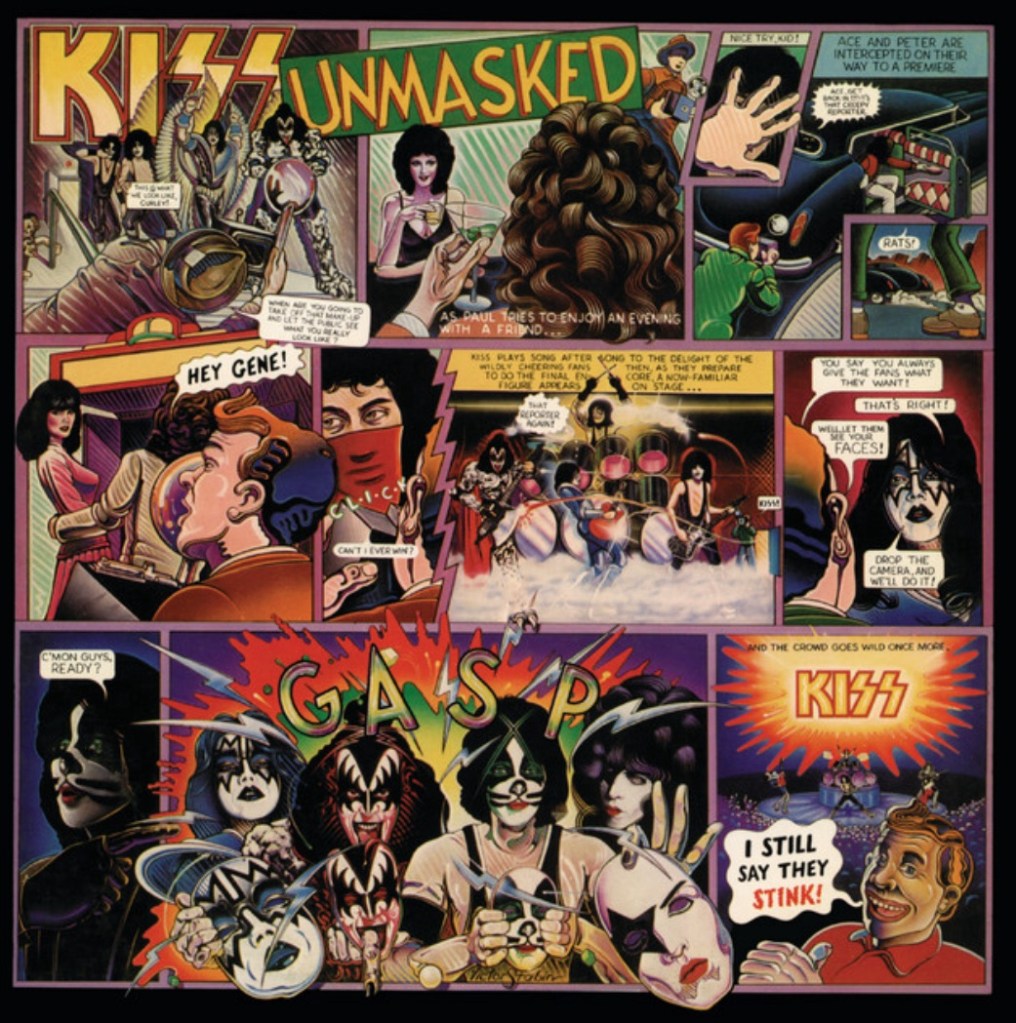
The Case For “Unmasked”

Gene Simmons hated it.

Paul Stanley called it wimpy.

Ace Frehley didn’t get the memo that the album was meant to be a pop rock album.

Peter Criss, well he just didn’t participate.

And I was confused why Paul Stanley didn’t use Desmond Child again, since their hit from “Dynasty” was co-written with him.

Instead Vini Poncia, who produced the album, co-wrote most of the tracks.

In case you are confused, I’m writing about “Unmasked” released in 1980.

It didn’t meet commercial expectations in the North American market however it did very good business in Northern Europe.

And in Australia, it sold more than 110,000 copies on the first day of its release and 3,000 more were stolen from a truck on the way to stores. Well, this is according to the Sydney Morning Herald.

You see “Kissmania” or “Kissteria” in Australia was about 4 years behind their U.S. peak.

It didn’t sound like past Kiss, but this record definitely gave the power pop / melodic rock scene a good kick in the ass. You had bands like The Raspberries and Small Faces, but suddenly you could mention Kiss in the same sentence.

Its influence on the Scandinavian market is large and it’s no surprise that a lot of melodic pop and rock artists and songwriters have come from these markets.

Is That You?

The opening track and it’s not even written by a Kiss member.

But it is the parent to “Lick It Up”.

Listen to the verse riffs in both. The feel and groove is the same. The layered backing vocals are also great, something which Def Leppard mastered with Mutt Lange.

And Stanley always challenged himself vocally, the falsettos on the pre-chorus are braver than the ball tearers on “I Was Made Lovin You”.

On a side note, as a solo artist, McMahon’s 15 minutes of fame came with “Cry Little Sister” from “The Lost Boys” movie, 7 years later.

Shandi

Australia was also going through a “disco ABBA mania craze”, so it’s no surprise that a crossover disco/rock pop ballad went huge here.

And if ABBA wasnt doing music like this anymore, fans would always look to others to fill the void.

If you want to hear what inspired it, press play on the song “Tomorrow” from Joe Walsh. Paul basically lifted the first 60 seconds from it. And Joe Walsh is far from wimpy.

Talk To Me

Ace steps up with a rocker, which did good business as a single in Switzerland, Germany, Netherlands and Australia.

It has an intro riff that sounds like it was influenced by Rick Springfield’s “Jessie’s Girl”.

The major key riffage in the Chorus reminds me of “Do Ya” from ELO.

Naked City

My favorite song on the album and one of Gene Simmons best, giving melodic rock music some grit.

It’s written by a committee involving Simmons, Poncia, Bob Kulick and Peppy Castro.

Ace even contributed a solo, while Anton Fig and Bob Kulick did the drums and guitars.

But it all started with Bob Kulick who had the guitar riff and he demoed the song with Peppy Castro.

But the final recorded version didn’t make Bob happy and he has said that “Kiss ruined “Naked City”.

Ruined or not, it’s my favorite. And if the demo is available anywhere, please share it.

What Makes The World Go Round

I always like it when artists take influences from different styles of music.

In this case, Paul is taking inspiration from soul act, The Spinners and fusing hard rock, pop, soul and R&B into a unique style that still sounds like a rock song.

How good is the Chorus?

Tomorrow

My second favorite.

The power pop of 2000’s acts like Wheatus, Good Charlotte and the like is right here.

It might sound light on the rock, but inside the song you’ll hear a feel and vibe from “Coming Home”.

It’s also influenced by “Tonight” from The Raspberries along with Rick Springfield.

And even the most hardened rocker cannot resist singing along to the Chorus.

Two Sides Of The Coin

More ELO meets Free from the Spaceman.

I forgot to mention on “Talk To Me” that Ace employs an Open G tuning, a tuning popular with slide players because with one finger they can play a chord instead of fretting the chord. He also employs this Open G tuning here.

Keith Richards was a well known user of this tuning, however many believed that Keith used this tuning because of how wasted he was. It’s easier to play with one finger than four. And that same view point was held for Ace, however if you look at interviews during this period you cannot see or hear Ace sounding wasted.

The lyrics are dumb but then again Kiss weren’t scholars when it came to lyrics, so that’s what makes their music fun.

She’s So European

Press play for the intro. That’s all you need to listen to here.

Then again Gene Simmons does a good job on the lyrics and melodies as well, about a girl with a glass of pink champagne and well you can read the rest.

Easy As It Seems

Another favorite.

Paul is the star of the song. His bass riff is sinister, yet groovy and his sense of melody elevates the track.

I’m also a fan of The Pretenders and it looks like Paul was influenced by them as their song “Mystery Achievement” came out in January, 1980 and Kiss released their album in May 1980.

Check em out, they are both great songs.

Torpedo Girl

Press play for that rhythm and blues swing drum groove and stick around to hear Ace summon Joe Walsh for the verse riff and The Beach Boys for the Chorus.

You’re All That I Want

It has that feel of early Kiss musically. And somehow it gets no love.

The Wrap Up

They didn’t tour the North American market, but they did hit Europe, Australia and New Zealand. It kept em in business.

On Australian TV they also got a lot of press and interviews.

They appeared on the Australian “60 Minutes”. The segment is on YouTube if you want to see it. Bill Aucion was also interviewed, telling the interviewer how Kiss was turning over $120 million a year, and how he was looking to get the band into movies and comic books.

We sort of know how that turned out with “The Elder”.

A few things to note for 1980.

AC/DC dropped “Back In Black”, a slab of hard and bluesy rock that proved you can be commercially successful during this period playing that style of music.

The NWOBHM was also gaining momentum. This was even harder sounding and more abrasive than AC/DC and it also had an audience that was growing.

Most of the acts who had success in the 70s were either broken up, or on their last legs with the original members and looking to bring in new members.

So I understand the “wimpy” and “not sound like Kiss” comments, but this album has aged well because so many of the songs are so well written.

For a band that was just not functioning anymore they still found a way to deliver a great album.

Standard
A to Z of Making It, Copyright, Music, My Stories, Treating Fans Like Shit

Four For Friday

TAX THE HELL OUT OF YOU

Motley Crue and Def Leppard came and they left, but not without complaints.

Tommy Lee walked into a 7-Eleven and purchased 4 packets of Marlboro Gold 25s in Melbourne.

The price. $251.96 AUD.

Yep welcome to Australia, Mr Lee, the place that loves to tax the hell out of you on everything and on top of that, has the highest tobacco taxes in the world as well. Basically 77% of the retail price is taxes.

If Tommy Lee purchased four packets in the US, it would have cost him $32USD which translates to $48AUD.

And no I didn’t go watch em. I’ve seen Motley Crue too many times and while I haven’t seen Def Leppard play, the price for the tickets was way too high and it was outdoors which I hate.

REISSUES

Remember when Metallica wanted to release the “Metal Up Your Arse” cassette tape as part of the “Kill Em All” reissue or maybe it was for a special Record Store Day release.

Anyway that got shot down by Dave Mustaine because he wouldn’t accept giving song writing credits to Lars Ulrich on songs he didn’t or was involved in writing.

Fast forward a few years and Linkin Park looks like they are in trouble with a former bassist.

As the Billboard article states;

Linkin Park is facing a lawsuit that claims it has refused to credit or pay royalties to an ex-bassist who played with the band in the late 1990s — a legal battle triggered by an anniversary re-release of the band’s smash hit 2000 debut album.

RE-RECORDINGS

The labels are up to their usual tricks again. They seem to forget that they are irrelevant without the artists.

Their whole business model is making money from music. So when they knew in the 60s that songs would become copyright free they lobbied hard and got laws in place to ensure their business model survives for a long time.

But Taylor Swift really messed with this by redoing her albums under her own control. This made the original recordings held by the labels basically worth a lot less.

And now they want to stop that.

I think if an artist wants to re-record a song or an album they created they should be free to do whatever they want.

And it was standard practice for artists to have re-recording rights either two years after their contract expires, or five to seven years after the original recording is released.

MONEY IN MUSIC

Warner Music Group Corp released its full year earnings.

And the take away is, they have earned over $6 billion in yearly revenue for the first time.

How much of that has filtered down to the creators?

Standard
A to Z of Making It, Copyright, Music, My Stories

Four For Friday

A special Australian edition today.

STREAMING

The one thing I like about streaming services is how songs from the past can come back with a vengeance and dominate.

A lot of the times this happens when an artist passes away but it also happens in other ways.

“RipTide” from Vance Joy is over 10 years old and it’s dominating again on streaming and since the charts include streaming numbers it’s back at number 1.

Not a bad place to be especially when the artist doesn’t have anything new released.

LIVE VENUES

Once upon a time, an artist had to play as many places as they could to build a following.

That worked when those places had people there to watch live music. But when people stopped going out to venues to watch live music, it’s a bit hard to build a following when there is no one watching.

So it’s no surprise that venues in Australia are closing. While the headline alludes that these venues are closing due to the pandemic, the truth is, live music venues have been challenged for years.

The sad thing is that the government doesn’t care about the Arts in Australia. So without tax incentives and funding, the Arts will suffer.

LEAVING THE INDUSTRY

So it’s no surprise that at least 50% of artists currently working are thinking about leaving the industry in Australia.

The mass migration. And from that group, 55% are women. As the article states;

Commonly cited reasons within the survey include financial pressures, time constraints, mental health and burnout, a lack of opportunities and a lack of support.

And live gigs make up 60 percent of their incomes but when the venues get less and less, this will shrink as well, unless they are large enough to play clubs and theatres.

MONEY IN AUSTRALIAN MUSIC

APRA AMCOS collects royalties and licensing for Australian artists. For 2023, they collected $690.5m with $595.2m distributed to artists.

In total, 1,628,107 unique compositions earned money.

For a small market, it’s a lot of money. But it’s a good market. And if the Government showed interest, it could be a great market.

Standard
A to Z of Making It, Influenced, Music, My Stories, Unsung Heroes

Four For Friday

A short one today.

IN THIS MOMENT

What happened to em?

“The Dream” and “A Star Crossed Wasteland” are great albums of melodic rock/Metal.

And then the transition started to the point where there is nothing recognizable or worth liking on their new album “Godmode”.

DOKKEN

A new album is out but if you can’t put any effort into the singing, why bother.

It’s the same monotone throughout, which is a shame because songs like “Lost In You”, “I Remember”, “Saving Grace”, “Fugitive” and “Gypsy” could have been great if the vocal delivery had emotion.

LYNCH MOB

George Lynch sure keeps busy and as a fan of the 80s, I like it.

And Mr Scary has still got a lot of things to say with his riffs. And Frontiers Records is keen to give him a platform to showcase his riffs.

So here we are with “Babylon”, the 8th Lynch Mob album. The difference between Lynch Mob and other artists from the 80s is the singers.

Gabriel Colon is a great vocalist with a great tone. He is the X Factor here. On the Metal cuts, it feels like Halford. On the rock cuts, its loose, sleazy and rawk.

And if Lynch could keep him around he has a lot of albums with him.

For the Metal check out “How You Fall”.

For the Rock check out “I’m Ready” and it’s nod to the great EVH.

ANY GIVEN SIN

The song “Dynamite” came up on a playlist and I pressed save instantly. It reminded me of Shinedown and it’s a great act to be associated with.

What do you guys think of em?

And that’s a wrap for this week.

Standard
A to Z of Making It, Copyright, Music, My Stories, Stupidity

Four For Friday

It’s a SPOTIFY and HIPGNOSIS special today.

The article I am referencing is from Music Business Worldwide.

NEW ROYALTY MODEL

There will be an annual stream count that artists must meet in order to start generating Spotify royalties.

Spotify is targeting a tiny proportion of tracks on its service that are very low in popularity.

In total, the tracks Spotify is targeting, generate royalties that when combined add up to tens of millions of dollars a year. If no action is taken, these tracks accumulated together will generate around $40 million.

SO WHAT HAPPENS TO THE $40 MILLION?

It will go back into Spotify’s ‘Streamshare’ royalty pot.

And the monies in the pot will be re-distributed amongst the tracks that are, more popular.

Take from the poor so that the rich get richer.

Spotify is telling the world that this targets the royalty payouts whose value is being destroyed or who are not even being paid to the creators because they haven’t met the digital aggregator minimum level for payments. And they are sitting in their bank accounts, earning interest.

Spotify seems to forget that every artist begins with low plays/streams.

MMM. SO THIS HELPS THE ARTISTS HOW

So while Spotify is thinking of keeping streaming money in their bank account to pay the larger artists, Hipgnosis who is an investment fund is doing something fishy.

As you probably are aware, Hipgnosis purchased a lot of rights to valuable intellectual properties. It’s share price doesn’t reflect what the company believes it’s worth.

It wanted to do something sneaky to inflate or boost its share price by selling a stake of the company to another entity owned by Hipgnosis and to use the profits of the sale to pay down debt.

This was all contingent on some mathematical equations about retroactive Copyright payments from the US.

Hipgnosis estimated they were due USD$21.7M however when all the dust settled they are only getting $9.9 million.

So they had this share but back scheme which they have now shelved and their share price went down even further.

All of these schemes and creative accounts on the backs of the rights they own from artists.

And Yes, I do know that the artists sold their rights to Hipgnosis for a large fee.

Standard