Classic Songs to Be Discovered, Music, My Stories, Unsung Heroes

The Pirate Vault #5

The Pirate Vault box keeps on producing some great memories.

Richie Kotzen – Fever Dream and Cacophony – Metal Symphony

I was in a shred mindset between 1989 and 1992 and I was buying CD’s and albums from Shrapnel artists. And I got these albums dubbed a few years after they came out and i picked em up on CD and LP not soon after.

I heard about Cacophony from interviews I read about Jason Becker and Marty Friedman, who of course at the time had gigs with David Lee Roth and Megadeth. And the music world only got to see a brief appearance of an unbelievable musician in Jason Becker, who still writes music via his eye movements and a system his dad has set up for him due to Lou Gehrig’s disease otherwise known as ALS.  

And of course, Richie Kotzen had the Poison guitar slot, in which he co-write a brilliant blues, rock and soul album called “Native Tongue” (which could have been his solo album) and the busy man he was, he also took Ricki Rockett’s fiancé mid tour. “Layla” from Eric Clapton comes to mind right now.

Dinosaur Jr – Without A Sound and Hand It Over

I was in a hard rock band with a drummer who was into grungy sounding bands, so while I exposed him to Dream Theater, he told me to sink my teeth into Dinosaur Jr.

I was hooked from the opening arpeggios and single note lines in “Feel The Pain” from the “Without A Sound” album released in 1994. And the heaviness of opening track “I Don’t Think” from the “Hand It Over” album released in 1997.

Fuel – Sunburn and Santana – 3

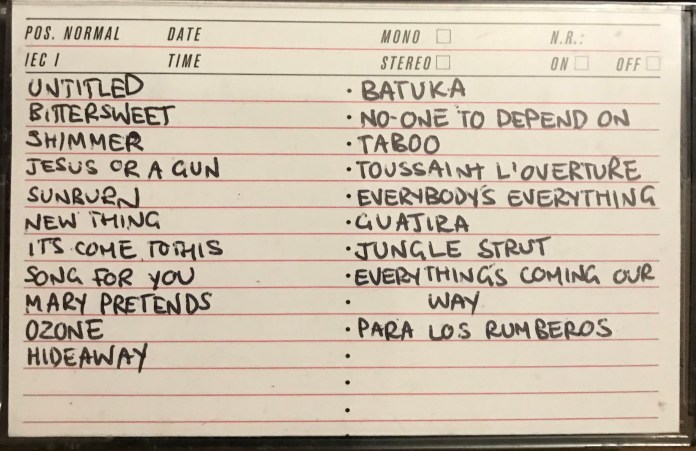
Fuel had significant chart success in Australia with “Shimmer”, however I didn’t commit financially until the second album came out. Another band member did commit, so it was a no brainer to copy this album from them, while another band member really enjoyed the jam aspects of Santana – 3, so in order to understand what they meant at band practice, I had to dub this album.

And it’s funny how in the early 2000’s, I was experiencing a new release and a release more than 30 years old. The beauty of music is that everyone forms a connection at different times.

And the songs “Taboo” and “Toussaint L’Overture” have some of the best and emotive guitar solo work Carlos has recorded on tape. They still make the hairs on the back of my neck rise.

AC/DC – Bon Scott compilation

My mate, Mick is a mad ACCA fan. When he lived in NY for about 12 years, he saw them on every tour, every night. When they come to Australia, he sees the Sydney shows.

One day in a suburban street in Australia, at a time far away sometime in the 80s, I asked him if he was keen to make our own Best Off compilation of Bon Scott material while we polished off a box of beer.

So off to work we went, debating which song should make it and which song shouldn’t. And a few hours later the holy grail of Bon Scott material that we classified as essential was ready to be blasted in the car stereo.

And I still hold that view to this day.

We were meant to meet and eventually do a Brian Johnson compilation, but life got in the way and we never did.

Standard
A to Z of Making It, Music, My Stories, Piracy

Metallica: Hot Metal – June 1992, the “Through The Never” Stage Idea Goes Back To This Period and Staying Power

I have been re-reading a lot of the magazines I have accumulated during the Eighties and the Nineties. I just finished reading a story about Metallica from the Australian magazine “Hot Metal”. It is the June 1992 issue.

The article is written by Robyn Doreian, who was the editor once however when this story hit the press, she had moved on to Metal Hammer. The story was a combination of two days she spent with the band, plus separate interviews with James Hetfield and Lars Ulrich.

The first part that got me interested was the following answers from James Hetfield;

RD – First up, I ask him about the new stage design, which not only challenges conventional rock shows but also has consider-able advantages for the fans.

JH – “We sat down and talked about what we wanted to do. For instance, Lars has his travelling drum kit that was all his thing. I have to make that clear,” he scoffs, “because I find it a little silly. As much as he wants to be in the spotlight, he also gets to travel. He’s basically a front man on drums. We should have thought of it earlier in our careers, I guess.”

“The snake-pit was a combination of ideas from band members and management. Initially that hole in the middle of the stage was meant to be a special effects area, with things like little crosses rising up, or a blow-up ‘Justice’ lady or something.” sniggers Hetfield.

“We said no’ Why not put some kids in there, some fans. That would be cool. We usually put between 40 and 90 kids in there, depending on each city’s fire regulations and stuff.”

RD – What about the area set aside for taping?

JH – “Fans have to buy a special ticket for the tape section. It’s like five bucks more, and there are like 20 or 30 kids who can get in there and video, audio or whatever they want to do. It’s a cool thing to do, to flood the market with bootlegs. And it makes it a little more personal.”

The above got my interest for two reasons;

1. The stage design.
2. Bootlegs.

First, the stage design. The grand stage design that is seen in the movie “Through the Never” was conceived back in 1991 for the tour in support of the Black album. Of course, an idea is just an idea until it is executed and with the exponential rise of technologies, that idea finally came to fruition in 2012.

The point of this is that no one should ever give up on an idea. If it doesn’t work at a particular given point in time, keep it filed away as it could work at a later time.

Second, the bootlegs. The Black tour did something great for the hard core fans that no other band had really done up until then.

Metallica in 1992, wanted to flood the market with bootlegs. Metallica in 2013 has the following disclaimer on their Live Metallica website “Terms of Use”;

Any violation of copyright laws may result in severe civil and criminal penalties. Violators will be prosecuted to the maximum extent possible.

Compare the above to the comments from Hetfield. What a difference between Metallica and the Metallicorporation? This is why Metallica messed up big time with Napster by handing over names of fans at the Senate Hearings.

Next up in the interview was Lars Ulrich. Knowing what we know now, words from the past is always interesting.

RD – Seizing the opportunity I ask him whether, seeing as Metallica have now been so firmly embraced by the mainstream, it’s possible that they are becoming what they once rebelled against.

LU – “I don’t disagree with that, but we were always more into doing our own thing, never about being shocking for its own sake or pissing people off. You should always be yourself.”

Lars admits that he and Metallica are becoming the entity that they rebelled against. Is there anything wrong with that? Of course not. Can a band remain the same after they accumulate millions? No chance.

RD – Do you ever think that in years to come there is a danger of Metallica being viewed as a dinosaur band, some sort of corporate rock giant similar to what happened to bands like Zeppelin in the 70s?

LU – “I think there are a lot of people in the States right now who, simply because we have gained confidence in what we’re doing, are saying that we are doing the same arena rock clichés that these other bands were doing. My attitude is basically that if people come and see us and think its arena rock crap then that’s fine. It doesn’t affect me; because I know what we’re doing is distinctly different from what everyone else is doing.”

RD – With Grammy awards, cumulative record sales in the millions and adulation the whole world over, what is there left for the band to achieve?

LU – “Staying power. In terms of numbers, it’s not going to get much bigger but its important not to burn out. A lot of bands don’t have the confidence for a long term career, so they try and milk everything while they can. We plan to be around for quite a while, so when this tour is over we’re going to have a long period of inactivity.”

The above is interesting to me for the following two reasons;

1. Be Yourself / Stay true to yourself
2. Staying Power

I was a fan of Metallica coming before the Black album came out. It was “Ride the Lightning” that did it for me. I cannot recall how many arguments I got into over what is the better album between “Master Of Puppets” and “Ride The Lightning”.

Then the Black album comes out and I really liked it. I thought it was perfect. The songs hammered the ear drums from start to finish and the groove was undeniable. Metallica wrote and recorded an album that they wanted to write. It was never designed to have a hit single whereas “Load” and “Reload” to me, feels like Metallica had that single idea in the backs of their mind.

The comments about staying power ring true. As Lars said, in terms of numbers, it wouldn’t get any bigger than the Black album. However reaching the top is not the end of the journey. That is when a new journey begins.

Twisted Sister failed after “Stay Hungry” exploded.

Motley Crue fired Vince Neil after “Dr Feelgood”.

Guns N Roses became Adler-less after “Appetite for Destruction” and after “Use Your Illusion,” Guns N Roses became an Axl Rose solo project.

Motorhead had Fast Eddie Clarke play on one more album (“Iron Fist”) after “Ace of Spades.”

Skid Row got one more album out in “Subhuman Race” after the massive “Slave To The Grind” and disappeared.

Van Halen released “1984” and then fired David Lee Roth. They are one of the rare bands that changed lead singers and went on to bigger success, with the Van Hager era.

Poison got “Flesh and Blood” out after the mega successful “Open and Say Ahh” and it was curtains, even though “Native Tongue” with Richie Kotzen was a great album.

White Lion never recovered from the mega success of “Pride”.

Warrant released the excellent and heavy “Dog Eat Dog”, however it was no “Cherry Pie” and they got dropped after Jani Lane left.

Also when a band reaches the top, it opens up the opportunity for some time off. Metallica had been on an album and tour cycle since “Kill Em All” was released in 1983. After 11 constant years, by 1994, they had some time off, before they regrouped for the “Load” albums.


Standard
Music, My Stories, Stupidity

Is Having Mike Portnoy in your band a good thing or a bad thing these days?

There’s never been any doubt about Mike Portnoy’s work ethic. The man is a machine. He doesn’t just play in bands, he spawns them, shepherds them, fuels them, and somehow finds time to tour, record, rehearse, and still show up like it’s day one and he’s got something to prove.

But here’s the inconvenient question no one wants to ask out loud:

At what point does doing everything start to feel like doing nothing?

Not because the passion isn’t real.

Not because the talent isn’t there.

But because even the hungriest creators face the same truth: quality doesn’t scale.

And that’s where things get uncomfortable. Because quality, real, signature, unmistakable quality, comes from the furnace, not the assembly line. It comes from the chemistry of the right creative partners. Not fame, not legacy, not sheer hours logged.

Look at the pattern.

Dream Theater

Portnoy wasn’t just a drummer in Dream Theater. He was plugged into a once-in-a-generation creative engine, John Petrucci, the guitarist every metal kid secretly wished they could be. That partnership was lightning in a bottle, and lightning doesn’t strike twice on command. Leaving that team wasn’t sabotage, it was a gamble. A hard reset. A leap into the unknown with no guarantee the muse would follow.

Adrenaline Mob

Here, the spark came from sheer brute force.

Mike Orlando, raw, volatile, borderline unhinged in the best way, felt like the spiritual cousin of the great riff architects. You could hear the Iommi DNA in the walls. You could picture a classic record forming if the universe cooperated. There was potential. Serious potential.

Transatlantic

A different beast entirely. Roine Stolt and Neal Morse aren’t minor-league players, they’re specialists. They live in a very specific musical ecosystem: grandiose, sprawling, prog epics for people who want forty-minute tracks. That’s a lane, not a flaw. But it’s also a place where “quality control” can blur into “more is more,” where ambition outraces cohesion. It’s a world with its own rules, and its own ceilings.

Flying Colors

Steve Morse is a legend. Full stop. But legends age, and even titans spread thin eventually feel the pull. Deep Purple, Dixie Dregs, solo work… it’s not burnout, it’s bandwidth. Greatness doesn’t vanish, it just becomes … diffuse.

The Winery Dogs

And here we hit the pressure point.

If a project wants to stand out in a landscape already saturated with Portnoy’s fingerprints, it has to bring something unmistakably new.

Something with teeth.

Richie Kotzen is skilled, no debate. But that’s not the question. The question is: does he bring a signature?

A sonic identity that doesn’t feel like déjà vu from the Shrapnel era?

Because being good isn’t enough for a trio built on presence and personality. When the guitarist is the vocalist and the main songwriter, the entire organism lives or dies on distinctiveness.

And Kotzen, for all his technical fluency and vocal punch, often feels like a man shaped by the ghosts of his influences. The shred era’s fingerprints are all over him. The blues-rock revival too. Even his vocals echo Cornell’s silhouette. None of this makes him bad. but it makes him familiar. And when you’re leading a three-piece with two virtuosos behind you, familiar might not be enough.

This is where the truth gets even sharper.

Portnoy and Sheehan are phenomenal at what they do, but neither has ever been the primary architect of timeless songs on their own. That’s not an insult. It’s an observation about creative ecosystems. They thrive when partnered with a defining voice, a guitarist or songwriter who stamps the work with something unmistakably singular.

Look at Sheehan: a monster on his instrument, a pioneer even. But the biggest hits of his career came when he was orbiting giants, Vai, Gilbert, Roth. Leaders need other leaders.

Portnoy’s no different. He’s an amplifier. A catalyst. A force multiplier. He enhances the right team. That’s his genius.

But genius still requires the right partner.

James Hetfield once said that side projects dilute the core product. He understood something most musicians don’t want to face:

Attention is finite.

Energy is finite.

The muse plays favorites.

When the creative radar is pointed everywhere, it points nowhere with the same intensity.

Portnoy’s output is enormous. Admirable. Occasionally brilliant. But the law of diminishing returns doesn’t care about effort. It only cares about focus.

So maybe the point isn’t whether Kotzen is special enough. Or whether Sheehan should shoulder more. Or whether prog epics should be shorter or longer.

Maybe the real question is this:

Has Portnoy been chasing the feeling he once had with Petrucci and does he know it?

Because that’s the paradox:

A great creative partnership isn’t something you replace.

It’s something you spend the rest of your life trying to rediscover.

And maybe that’s not a flaw.

Maybe that’s the whole point.

Because the audience doesn’t want “more.”

They want magic.

And magic only happens when the right people collide at the right moment with the right hunger.

Everything else?

Noise.

Standard
Music

Mike Portnoy

I’m not a casual listener. My name sits in the liner notes of “Lifting Shadows”. I chased the bootlegs, bought the club editions, stood in the crowd in Australia. I saw Petrucci and Portnoy together on stages where the electricity felt like a revelation. I paid for that music because it was the songs that grabbed me, not the spectacle.

So let’s be straight: technique is everywhere now. Virtuosity used to be a miracle; now it’s a YouTube commodity. A kid can learn a sweep pick and a double bass blast between breakfast and lunch. What still separates the great from the merely flashy is songcraft, melody, arrangement, that singular idea that lodges in your skull and refuses to leave.

That’s why I struggle with some of Portnoy’s post-Dream Theater output. Not because he’s a bad drummer, he’s not, but because being prolific isn’t the same as being precise. When someone spreads their creative capital across a dozen plates, the best work can get crumbs.

Dream Theater worked because the band added up to more than the sum of parts. Petrucci’s riffing and compositional voice gave those albums a spine. The drums were essential, sure, but they were the heartbeat of something built around guitars, keys and bass. “Pull Me Under” hooked me because the music did more than impress; it told a story.

Does that make Portnoy small-minded?

No.

Does it make him the wrong man for every project?

Also no.

The point is structural: some players are catalysts. They need the right chemistry to make magic. Portnoy amplifies greatness. He doesn’t always manufacture it on his own. That’s an observation, not an insult.

Adrenaline Mob is the closest thing he’s had to raw, no-nonsense heavy rock that actually lands. Those songs hit. The riffs bite. The singer cuts through. That project finds a balance: muscle and melody. It’s proof that when focus and songcraft align, everything else follows.

Flying Colors? Not my cup. The ambition’s there, but ambition without bite becomes languid. It’s like watching a celebrity-level practice session and being asked to call it an album. That’s okay to say. We want fewer filler projects and more full-blooded records.

Now The Winery Dogs. The concept, three masters in a room, sounds promising on paper. But promise isn’t product. When the guitarist is also the frontman and the primary songwriter, the record needs a distinct voice that wasn’t borrowed from other eras. Technical chops are table stakes. The question is: does the music say something new, or just recycle yesterday’s influences?

Richie Kotzen can play, no argument there, but the job at hand isn’t to impress other players. It’s to write songs that refuse to be background music. To front a trio, you need a personality that sings through the riffs, not a voice that echoes familiar silhouettes. Again: not an attack, just a reality check.

And the final point, because this is where the truth lands hard: a career built on collaboration requires choices. Spread yourself across side projects and the core product decays. That’s not celebrity shade; that’s simple math. Attention and intention are limited resources. Pick where they matter most.

If Portnoy wants to recapture that lightning, he doesn’t need to be “the guy” in every headline. He needs to be the guy who brings his full attention to one record, one song, one uncompromising statement that can stand beside the true classics. Focus. Patience. Let the songs breathe.

Because at the end of the day, fans like me didn’t sign up for fills and bombast. We signed up for the songs that make you feel something you can’t name. Deliver those, and the rest writes itself.

Standard
Music

VITO BRATTA – Guitar World September 1989 – Part 1

VITO BRATTA – Guitar World September 1989 – Part 1

It’s a different experience when you open a Guitar World issue from September 1989 and re-read it in 2013.

It’s a who’s who of where are they now.  Marty Friedman and Jason Becker are hot off the press with their Cacophony releases and are endorsing ADA Amps, Jeff LeBar from Cinderella is endorsing Ernie Ball Strings, Richie Kotzen is endorsing Ibanez, Kip Winger is endorsing Peavey and Brian Forsythe is promoting Kix’s fourth album Blow My Fuse, before it exploded with the song Don’t Close Your Eyes.  Johnny Diesel  is well known in Australian circles and he is in there promoting Johnny Diesel and the Injectors that went on to make a big splash on the Australian scene during this period.  To a kid starting out playing guitar it just looked like one big hard rock, metal party was going on in the U.S.  I wanted to be part of it.

Marty Friedman went on to join Megadeth and found success.  Then he left to follow his muse writing Japanese pop music.

Jason Becker’s story is a sad one.  He went on to replace Steve Vai in David Lee Roth’s band only to be struck down with a rare disease at the age of 20 called Lou Gehrig’s Disease.  From recording the A Little Ain’t Enough album in 1989 to being given three to five years to live.  He is still alive now and communicates via eye movements.

Richie Kotzen has had a varied career.  Apart from being a solo artist, he went on to replace CC Deville in Poison.  The album Native Tongue was a brilliant album funk, blues rock album and it is a shame it didn’t get the recognition it did.  He also replaced Paul Gilbert in Mr Big between 1998 and 2004.

However, the reason for this story is Vito Bratta.  He is on the cover.  The hot shot guitarist and songwriter from White Lion, promoting their latest release.   Big Game was the follow up album to the mega successful breakthrough album Pride that spawned the hits Wait and When the Children Cry.

Since then White Lion went on to release Mane Attraction in May 1991 and by September that same year they called it a day.  Vito Bratta hasn’t released anything musical since Mane Attraction in 1991.  Brad Tolinski interviewed Vito.

“Guitarist Vito Bratta’s work is immediately distinctive for its strong sense of melody, thoughtful use of dynamics and pick attack, as well as a graceful near-metronomic sense of time that sounds neither forced nor rigid.  Although he’s definitely not from the Malmsteen School of high baroque, Bratta’s liquid phrasing is in spirit reminiscent of certain passages from Bach’s Sonatas and Partitas for Solo Violin.  The elegant trills over the A chord in the ninth measure of the solo in “Wait” and the call and response of the alternating legato/dettache phrasing in “Don’t Give Up” suggest a player who understands music in a classic, rather than classical sense.”

To add to that, Vito’s grasp of melody and modes to me was at a very high level.  Songs written by Vito cover a lot of different musical styles.  His choice of notes, different chord voices and harmonies was a pleasure on the ear palette.

“I’ve been developing a more personalized approach to chord voicings and inversions.  The problem is these voicings don’t always sound good through a distorted amp.  So instead of using more conventional inversions, I’ll arpeggiate the chord.  This allows me to mute certain notes within the chord, eliminating some of the ugly overtones you get when you play close harmonies with distortion.  Al DiMeola once said his muting technique was a result of not wanting to wake anyone when he was practicing late at night!  Sometimes good things come out of compromise and determination.”

Apart from being a guitarist in a successful rock band, he was also an artist.  To Vito it was all about the music.

The mention of Al DiMeola and how he came to have an unbelievable muting technique shows that he knows his stuff, he has listened widely, he has studied what others have offered before him and incorporated it all into what he does.

Vito also talks about the limitations of playing through a distorted amp and how he circumvented those limitations, by changing the way he plays.  Instead of standard power chords, he is arpeggiating inversions of that chord and muting the strings at the same time.

GW Brad Tolinski:  Another unusual aspect of your rhythm technique is the extensive use of fingerpicking, particularly on the new record.   How did that evolve?

Bratta: That was another outgrowth of my song writing.  I usually write songs by myself, then play then for Mike so that he can write lyrics.  Because I want to give Mike the most accurate picture, I’m forced into creating a fairly complete sketch with my guitar alone.  I know an easier way would be to use multi-track tape machines, but I’m not into that.  So when I start thinking of the basic feel, I’ll come up with a bass part and play it on the low strings with my thumb.  Next, I’ll try and create a chord progression and try to coordinate the chordal movement so that I can play the bass line simultaneously.  Finally I’ll add a suggested melody line on the top.  The only way to have all three things happening at once is through some form of fingerpicking. 

Since this approach really excites me, I didn’t want to drop it when we went into the studio.  That’s why my rhythm guitar parts have a lot of movement.  If I was going to use the typical heavy metal approach on something like Little Fighter, I would just chunk away on the low E and A strings.

These days, artists would multi track everything in the demo stages.  Hell, I do, it’s easy.  Vito developed a fingerpicking style that combined what classical, blues, country and bluegrass players do however he applied it in a pop sense.   Imagine being the singer and you get given a demo that has the bass parts, the chords and the melody lines all on one track as an acoustic guitar piece.  To me this is what made Vito different to the other players.  He was a guitar nerd and I mean that in a good way.  He knew his shit, but he wasn’t textbook.  I know that the 90’s served up the argument against players with technical ability not playing with feel.  Bullshit I say.  Just because a technical player can step on the gas when they want to and drive at 200km per hour, it doesn’t mean they have no feel.  I was doing something similar like Vito, however as soon as I got my multi track recorder, I stopped doing it and took up the technological alternative.  Looking back, I do regret it, as it is a skill now that has been relegated to beginner’s level again, instead of remaining at an advanced level.  Technology has made us lazy, and it has made us cover up how bad we really are.  If we can’t sing, we auto tune, if we make mistakes, we fix up the note/s.

GW Brad Tolinski:  Many of these concepts were evident on Pride, but the execution was more rigid.

Bratta: The reason for that is kind of complicated.  I wrote the whole Pride record on acoustic guitar.  Then I went into the studio and started playing all these wonderful chord inversions through a Marshall, and it came out sounding like shit.  So instead of rewriting the whole album I kept the voicings, but did a whole lot of muting.  Big Game on the other hand was written on my Steinberger in dressing rooms across the U.S., so I had a chance to audition all my ideas on an amp way ahead of time.  As a result, I was able to create sympathetic voicings so I didn’t have to mute the strings as much.  The overall sound is more legato and less staccato, and the pre-production made me more at ease in general.

I can totally relate to that.  I write every song on acoustic guitar and when it comes time to electrify it, I end up changing it a lot of it and it loses its soul.  Just by replacing an arpeggiated part with a power chord, it is enough to lose the feel you are trying to convey.  I then try and fix this problem by adding multi guitar lines which could either muddle the song even more or bring clarity.  It’s a hit and miss game, and previously when I have been in studios where time is money, it’s being more miss than hit.

One thing that Vito shows is that he is a persistent artist.  He is prepared to persevere for his art.  Not many artists these days, have those attributes.  To use an analogy, a lot of artists will dig away in the mines for years on end, only to stop a few centimetres dirt short from the gold or diamonds waiting on the other side.  And then you have one artist that just keeps on digging and they reach it.  Never give up on your dreams and walk away.  If there is a lesson to be learned here, persevere and keep on getting better.

GW Brad Tolinski: Your latest work doesn’t sound as heavy as it did in the past, yet it does sound more aggressive.

Bratta: After touring with AC/DC and Aerosmith for a year, I felt a little more aggressive.  Some nights I would come up with something pretty, but after seeing Angus bash it out, I would say “Fuck pretty”.

Again the fan in Vito comes to the fore.  He is letting the bands that White Lion is playing shows with influence him.  He is watching what they do, he is seeing what songs and riffs work in a concert atmosphere, because in the end, bands sink or swim based on the live show they deliver.   He is letting their sound, their aggression influence him.  Song writing isn’t just about musical notes and words.  It is about attitude and feeling.  What sound is needed to convey love or hate?  Minor key songs are sadder, major key songs are happier.   Crazy Train from Randy Rhoads is a perfect example, where major and minor combine in a glorious display.  The intro is F#m, the verses are A major and trippy, the chorus is back to F#m as the root.  The song is both pretty and aggressive.   Vito was a master of both.  Like Randy Rhoad’s he was bigger than the band he was in.

Part 2 will be a review of Big Game, plus more from the interview where Vito also talks about Big Game.


Standard