Classic Songs to Be Discovered, Derivative Works, Influenced, Music, My Stories

The Record Vault: Deep Purple – Perfect Strangers

Mark 2 was back.

It made perfect business sense to have one of the premier bands of the early 70’s come back in the 80s MTV era.

“Perfect Strangers” is album number 11, released in 29 October 1984 and it became the most successful album from the ‘Mark II’ line-up.

Like nomads, they all arrived from different directions. Ritchie Blackmore and Roger Glover arrived from Rainbow, Ian Gillan from Black Sabbath and his solo band, Jon Lord from Whitesnake and Ian Paice from Whitesnake and Gary Moore’s backing band.

But problems existed from the outset. Business problems.

Gillan and Glover wanted the credits to be of the collective. Blackmore didn’t. As the main writer, he didn’t want to share any song writing credits with people who didn’t write anything. After years in the business, Blackmore knew how valuable the publishing is.

It wasn’t until Blackmore left the group in 1993 that the issue was finally resolved within Deep Purple.

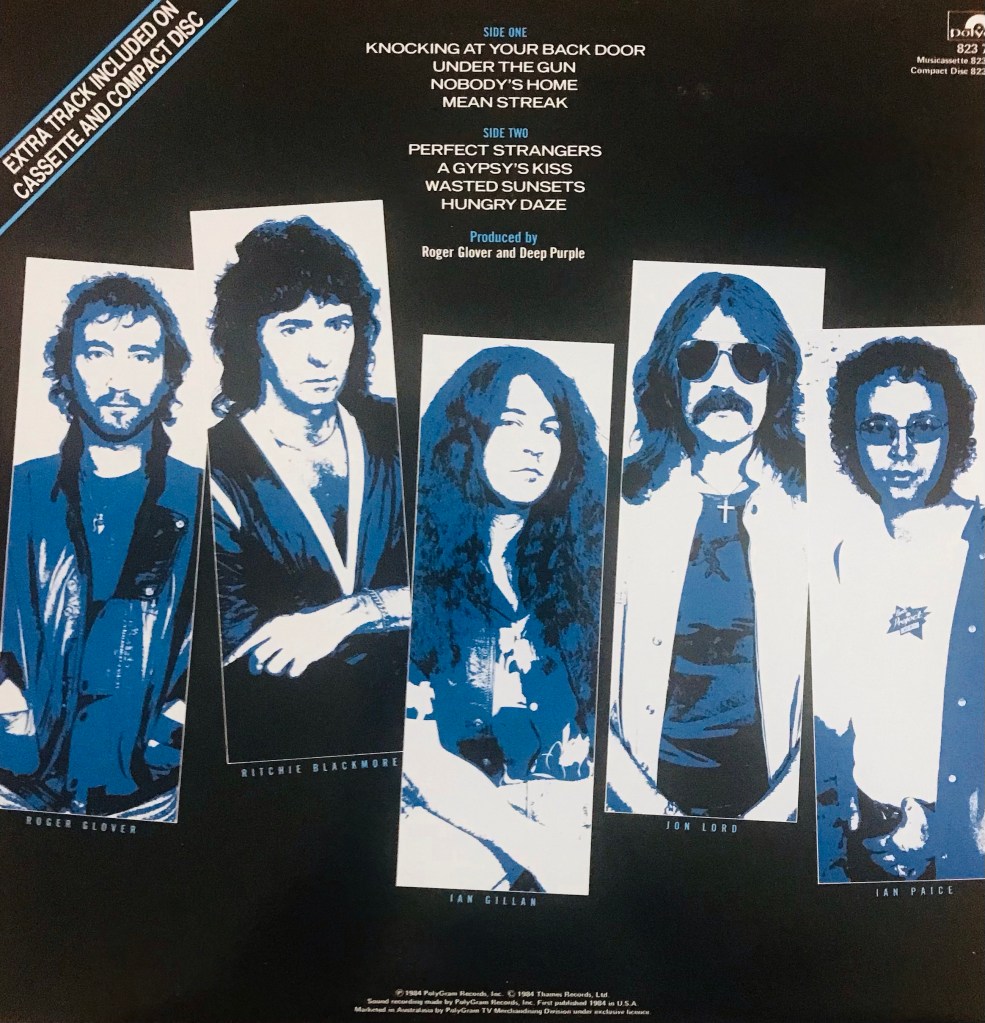
I missed this in 1984 because I was into the whole Motley Crue, Twisted Sister, Iron Maiden, Quiet Riot and Judas Priest phenomenon. These guys were just old dudes. Just look at the “mo” on Jon Lord. It’s classic 70’s.

All songs are written by Ritchie Blackmore, Ian Gillan and Roger Glover except where noted.
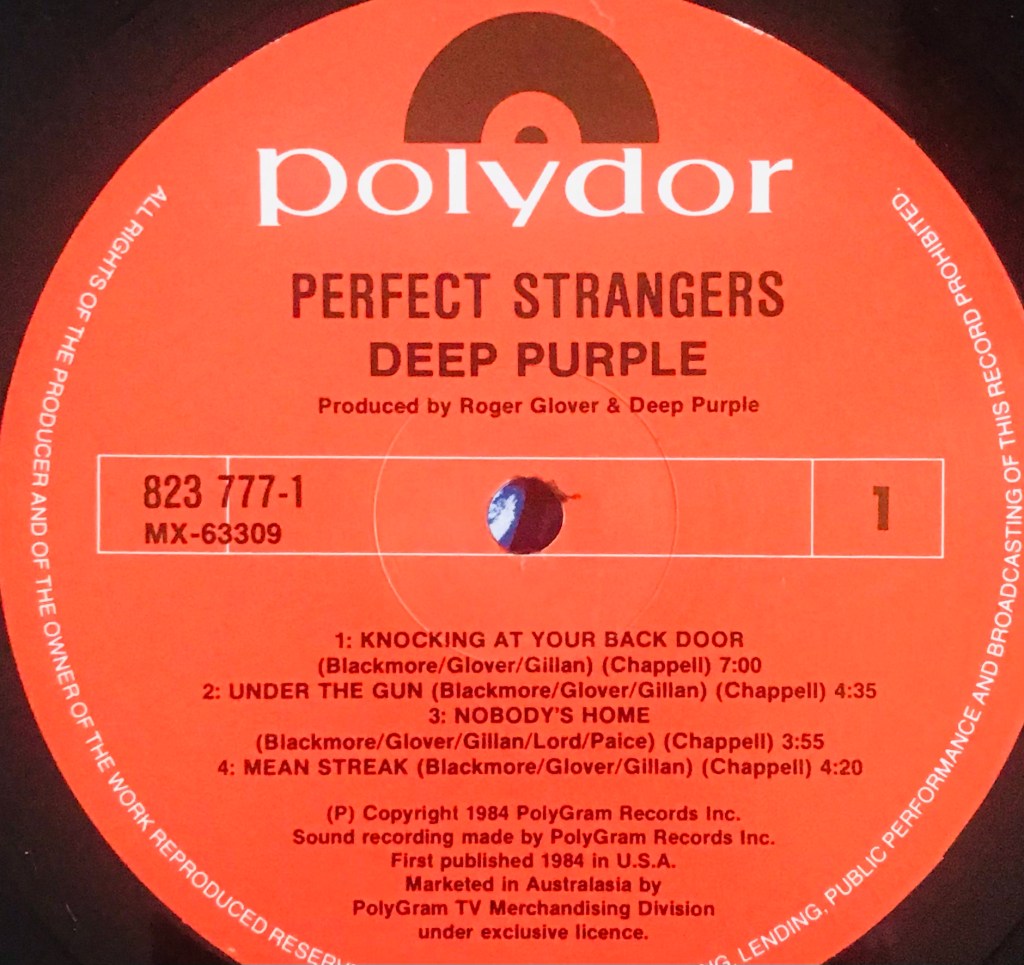
Knocking at Your Back Door

By now Blackmore had the experience of Rainbow and the commercial success that came with that, so when this song exploded out of the gate you get the best of Blackmore’s influences from Deep Purple and Rainbow.

If you don’t believe me, listen to the Verses, which is very similar to other Deep Purple verses like the one on “Smoke On The Water” and then the Chorus riff which has that Rainbow melodic rock feel, circa Graham Bonnet and Joe Lynn Turner.

And Ian Gillan has a smile on his face as he feels it coming while he’s knocking at someone’s back door, while probably cool for Motley Crue or Ratt, this is Deep Purple we are talking about.

But stick around for the outro solo.

Under the Gun

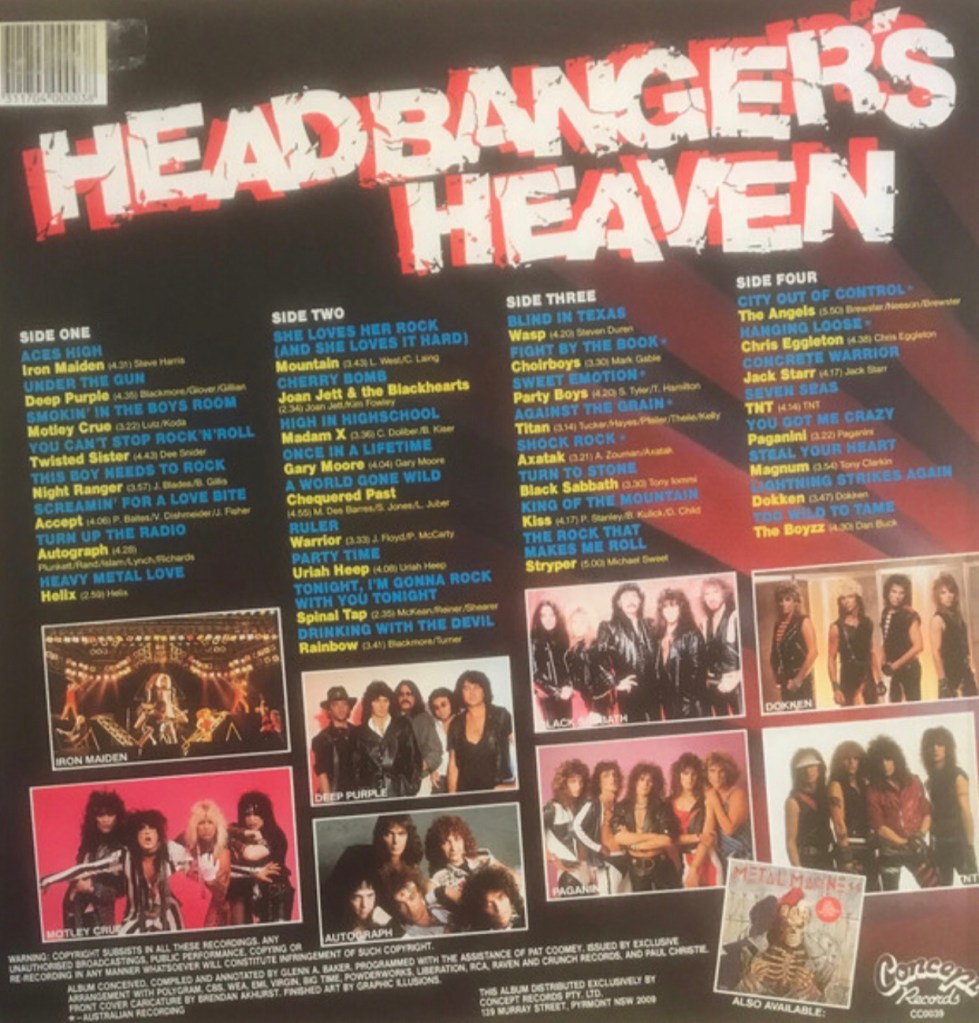
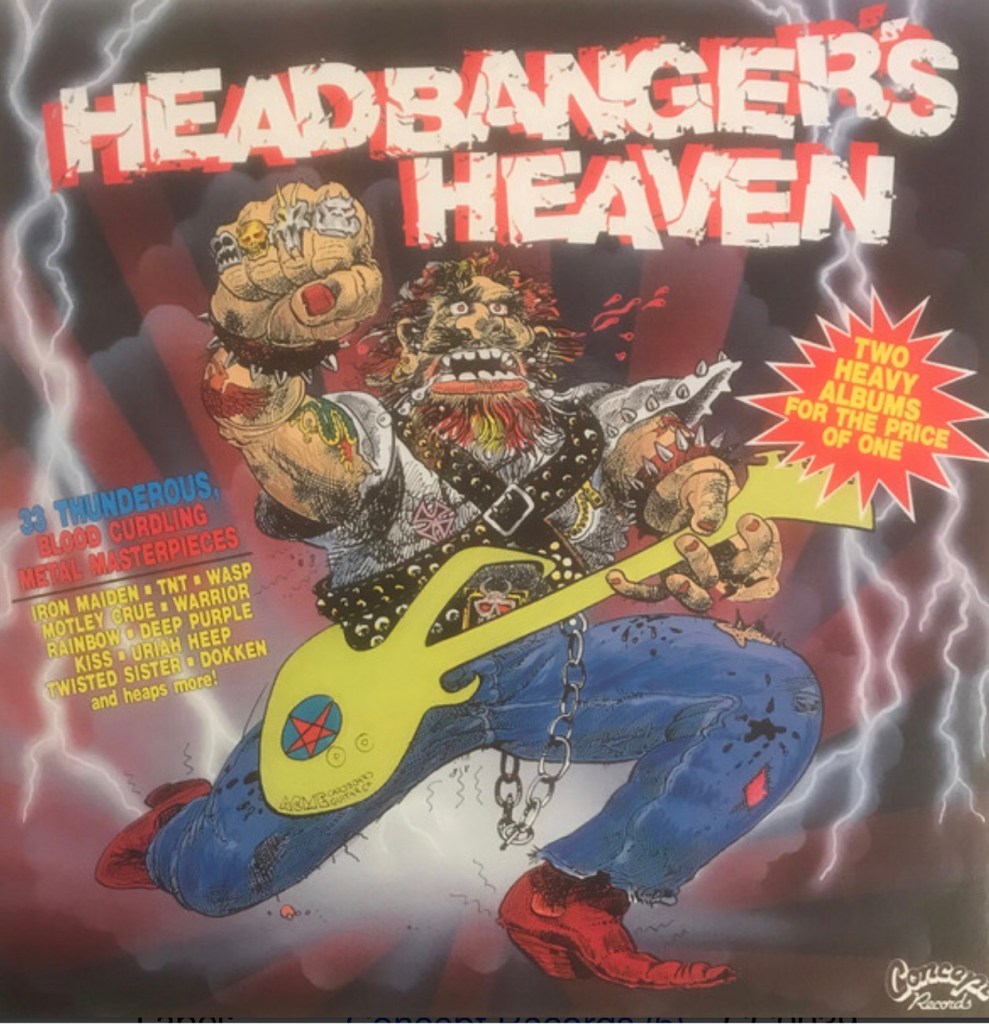
It was the first track I heard via a double compilation LP called “Headbangers Heaven”.
The intro riff grabs my attention right away, making me think of Rainbow and I like the way it all works with the Jon Lord’s keys.

But Ian Gillan is in form here, as it’s not an easy riff to sing over which then gets me thinking of his Gillan project.

Nobody’s Home

It’s a blues rock number and the only song listed as written by all Deep Purple members.

It’s like the band never left and continued to make albums after “Who Do We Think We Are?”

And if it sounds familiar, it should. “Lay Down, Stay Down” comes to mind.

Mean Streak

But press play to hear the Chorus Riff as Blackmore shows he can compete with the LA bands and do it better by taking “Schools Out” from Alice Cooper and making it sound a bit modern.

In the verses I am reminded of “Black Night” and in the solo break, the riff behind it like “Roadhouse Blues” from The Doors.

And I like it.

Perfect Strangers

The side 2 opener.

It’s a classic and one of their best songs.

How good is the “Kashmir” style groove when it kicks in at the 2.30 minute mark?

Whatever Jimmy Page could do, Blackmore could do as well, at a time when Page was not as prolific as he used to be.

A Gypsy’s Kiss

It could have come from “Rising” but “Highway Star” also comes to mind. Gillan’s bluesy delivery suits.

Check out the unison keyboard and guitar riff/melodies. It brings back memories of the work that Lord and Blackmore did on “Burn”.

And Ian Paice behind the kit. He is relentless.
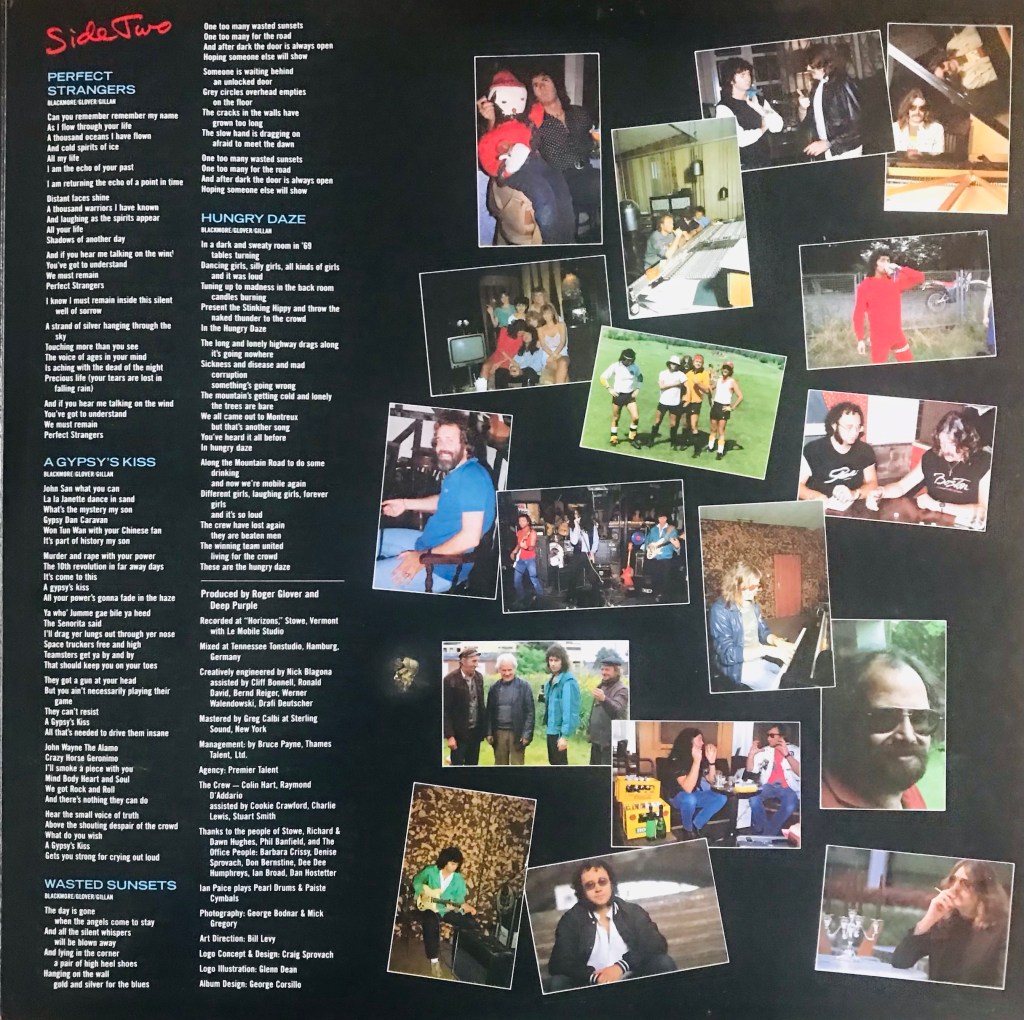
Wasted Sunsets

Remember in the 70’s when these kind of slow blues rock ballads sounded progressive and epic and then in the 80’s they morphed into clichéd power ballads.

While this song isn’t a 70s classic, Blackmore is in his element here with his emotive soloing.

Hungry Daze

That exotic Eastern European melody hooks me. It could have come from the Balkans, maybe Hungary or even Russia.
Not Responsible

I don’t have this on the album, but how good is that intro. It reminds of “A Light In The Black”. It’s an extra track on the cassette and CD release. And Spotify has it.

Son of Alerik

At 10 minutes, this Blackmore penned instrumental is for the diehards.

The song appeared on the 1999 CD issue as a bonus track and it also appeared in an edited form on the 7″ B-side of the “Perfect Strangers” single, or in full on the 12″ “Perfect Strangers” single and the European version of the compilation “Knocking at Your Back Door: The Best of Deep Purple in the 80’s”.

The thing is, if a band reforms these days, or in the last 30 years, it would have been quite a media show, but their comeback in 1984, didn’t cause a ripple in the news outlets who had jumped on board the LA Sunset Strip Train or the San Francisco NWOBHM Thrash Scene.

But their comeback was met with success in the European markets which loved em back in the 70’s. The U.K, Switzerland, West Germany, Norway, Sweden, France, Austria, Finland and Holland jumped back on board the Deep Purple train.

Japan never left em. Australia and New Zealand also provided em with a certification.

And The Boss was the only artist on the touring circuit that out grossed out em.

Crank it.
Standard
A to Z of Making It, Classic Songs to Be Discovered, Influenced, Music, My Stories, Unsung Heroes

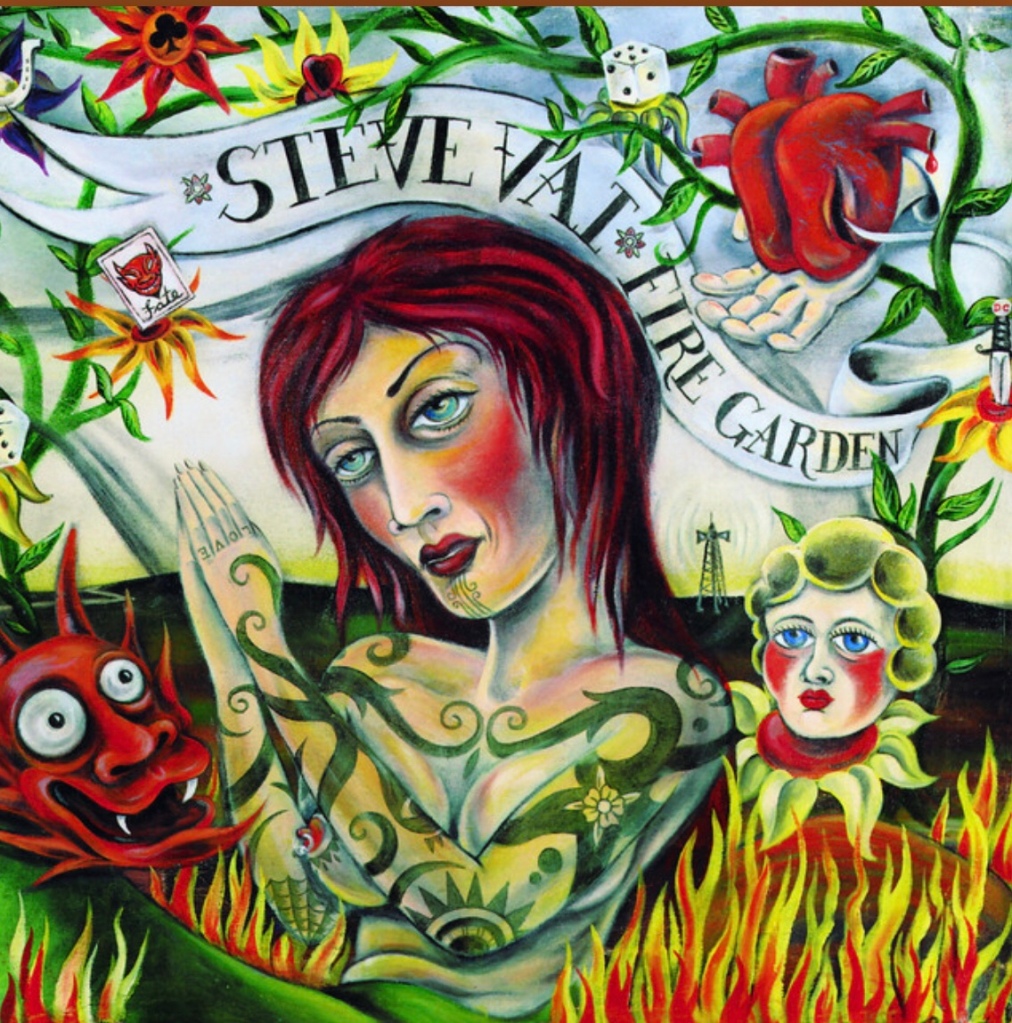
1996 – Part 4.6: Steve Vai – Fire Garden

I sort of lost track of Steve Vai in the mid 90’s along with all the other instrumental guitarists I was into.

“Fire Garden” is his fourth studio album, released on September 17, 1996 through Epic Records.

As described by Vai in the liner notes, Fire Garden is a concept album divided into two “phases”.

“Phase 1” comprises tracks 1–9 and is entirely instrumental while “Phase 2”, features Vai on vocals on every song except the instrumental “Warm Regards”.

There’s a Fire in the House

The start of Phase 1.

This feels like it could have come from a Whitesnake album. David Coverdale would have had a nice time coming up with lyrics to the riffs here as it’s got that heavy rock feel from the “Slip Of The Tongue” album which although Steve Vai didn’t co-write, he recorded all the guitars for.

The Crying Machine

I like the funky rock on this and Vai’s lead for what I call the “verses” is excellent.

Then it moves into a Blues and Funk Rock fusion solo section.

Dyin’ Day

This song is listed as a co-write with Ozzy Osbourne as it was written during the writing sessions for Osbourne’s 1995 album “Ozzmosis”.

Another song from those sessions, “My Little Man”, made its way onto the “Ozzmosis” record and is credited on that album as being co-written by Vai.

I don’t know what Osbourne could have written on an instrumental song, however I am pretty sure contractually Vai had to add him as a co-writer.

How good is the acoustic guitar riff to start it off?

Whookam

Useless track of backward vocals.

Blowfish

Great track, with a groovey riff which wouldn’t be out of place on a Joe Satriani album.

The Mysterious Murder of Christian Tiera’s Lover

A minute of Steve Vai doodling and it’s somehow a track. More like a solo section spot light.

Hand on Heart

It’s a romantic power ballad instrumental. Press play on it.

Bangkok

Written by Benny Andersson, Björn Ulvaeus and Tim Rice. Yep it’s those Abba dudes. The sound of flies starts it all off and the flies get louder and louder and louder and then the music comes in, more soundtrack like with a classical exotic feel.

It’s a great track which segues into the best track on the album.

Fire Garden Suite

It clocks in at 9.56 and it has four parts in “Bull Whip”, “Pusa Road”, “Angel Food” and “Taurus Bulba”.

It reminds me of the progressive rock fusion of Al DiMeola and Dream Theater. It’s some of his best music.

Definitely press play on this.

This song also has Mike Mangini playing drums on it.

And Phase 1 ends here.

Deepness

Phase 2 begins here.

A 47 second song that features some vocals from Devin Townsend, actually more yeahs and ahhs then vocals.

Little Alligator

Vai’s take on the Blues is very Mixolydian and Lydian like instead of Pentatonic.

All About Eve

Vocally, Vai sounds very Alternative Rock like. But musically, it feels like I am listening to a Dream Theater album.

Aching Hunger

It sounds like a Prince song, like “When Doves Cry”.

Brother

Emotional song, with Vai’s attempt on Southern Country Rock sounding modern and great.

Damn You

I like the riff that starts it, and before bands like Stone Temple Pilots blew us away, I guess Steve Vai was already doing it.

When I Was a Little Boy

It’s a skip for me.

Genocide

It’s a weird title for a song which sounds like a stadium rock song.

Warm Regards

A relaxed ballad instrumental jam to end the album.

And the personnel for the album is extensive. Steve Vai plays a lot of instruments plus he produced it and engineered it and wrote it. He had five drummers come in. The bulk of the drums are done by Deen Castronovo, with Mike Mangini playing a couple of tracks and Chris Frazier, Greg Bissonette and Robin DiMaggio providing drums on a track each. Steve Vai plays most of the bass, but that funky bass on “The Crying Machine” is played by John Avila and Stuart Hamm appears on “Dyin’ Day”.

Phase 1 is exceptional.

Phase 2 is Vai trying to do things a bit different and add vocals to his solo career which didn’t connect.

In the end, the album is a fusion of so many different styles that it almost can be labelled a prog rock record.

Standard
A to Z of Making It, Classic Songs to Be Discovered, Copyright, Music, My Stories, Unsung Heroes

The Week In Destroyer Of Harmony History – December 5 to December 11

4 Years Ago (2017)

1983

The final blog post of my devotion to the year known as 1983 involved an eclectic bunch of artists.

Like “Modern Love” from David Bowie,
“One Of The Few” from Pink Floyd, “Sirens” from Savatage and “Cuts Like a Knife” from Bryan Adams.

“Alpha” from Asia which sold a lot but it was still seen as a failure by the record label because it didn’t match the sales of the debut album a year before.

“Head First” from Uriah Heep, another 70’s act that had to re-establish itself in the 80’s MTV world. So it was no surprise the band delivered a very pop sounding 15th album.

“Nemesis” from Axe was also on the list. Remember “Rock ‘N’ Roll Party In The Streets”. It’s from Axe’s 1982 album “Offering”. The name “Axe” didn’t really market the band to its full potential.

Axe was touring with Mötley Crüe in 1984 when their guitarist was killed in a vehicle accident. Another member was badly injured and the band broke up after the accident.

Michael Bolton was a rocker first and a balladeer later. He was in a hard rock band called Blackjack with Bruce Kulick between 79/80, so it was no surprise to see Bruce Kulick on lead guitar when Bolton went solo on his self-titled debut. Even Bruce’s bro, Bob Kulick makes an appearance. Another favourite guitarist of mine, Al Pitrelli replaced Kulick for the tour which was cancelled after four shows.

U2 and the “War” album was on the list along with Divinyls and the “Desperate” album. The song “Boys In Town” was all over the TV and the radio in Australia.

Eurythmics had me hooked with “Sweet Dreams (Are Made of This)”, “Here Comes The Rain Again” and “Who’s That Girl”.

Being the long haired lout I was, I hated the way Spandau Ballet looked, but man they could write a good pop tune that worked well in a rock context. “Pleasure”, “Gold” and “True” are such songs. Great to re-interpret on guitar for a rock setting and it was interesting learning sax solos for lead guitar.

Elton John along with Bernie Taupin wrote pop songs that worked well as rock songs. “Kiss The Bride” and “I’m Still Standing” are two such songs I covered in various bands I was in.

Jim Steinman moved from Meatloaf to Bonnie Tyler. Big production, big songs and a lot of piano lines ripped off from classical music. But the best song on the album is “Have You Ever Seen The Rain” a cover of a Creedence Clearwater Revival song.

“90125” from Yes was album number 11 and the band was a very different beast from its Seventies incarnation.

SAYING ONE THING AT A TIME

If an artist is creating songs and making those songs difficult to get, the audience would surely move on to something else.

If a person talks for 70 minutes we will hear nothing. If an artist releases 70 minutes of music, we will remember some of it and forget the rest.

Most of my favorite albums lasted between 30 to 40 minutes in total.

All new music is competing with the history of music, plus TV shows with movie budgets, plus blockbuster movies, plus technologies and social media, plus AI created news stories and the history of print.

Maybe music is better when it is released frequently and when an artist tries to say one thing at a time, instead of 10 different things at once.

8 Years Ago (2013)

SALES

Spotify came into the market with the idea that they need to compete with free. And compete they did. The service even started to break artists to the masses, something that the record labels couldn’t do or were clueless to do.

But the mass media still focuses on the sales in the first week and the chart position. This is so old school and not a great measuring tool of reach or success, especially for new acts starting out.

But we get headlines like this.

Loudwire: Dream Theater’s new DVD ‘Live At Luna Park’ recently entered at No 1 on the Soundscan music DVD chart.

Loudwire: Volume 2 of Five Finger Death Punch’s ‘Wrong Side Of Heaven; lands at No. 2 on Billboard 200.

Blabbermouth: “Wretched and Divine: The Story of the Wild Ones” sold 42,000 copies in the United States in its first week of release to debut at position No. 7 on The Billboard 200 chart.

DOES A BAND HAVE CUSTOMERS OR FANS?

“Our audience are fans first and customers second. We really try not to annoy them.”
The above quote is from Stefan Mennerich, Bayern Munich Director of New Media, Media Rights & IT.

So how can a band turn fans into satisfied customers that keep on coming back, again and again?

DREAM THEATER

My favorite tracks from the DT album are still…
“The Bigger Picture” and “Illumination Theory”.

MEGADETH

Megadeth was in the news sections of the metal and rock websites a fair bit back then.

Regardless of what people think about Dave Mustaine or Megadeth, they can never take away the historical fact that Megadeth were early web pioneers.

Does anyone remember their old “Megadeth, Arizona” site that was launched in 1994 and then re-designed and re-launched for the “Cryptic Writings” release two years later?

Apart from the normal pieces of information, it was also a place for fans to check in, hang out and interact with the band along with other fans. Something that social media has built on and improved.

2013

Well the year was almost over and it was time to look back at the albums that connected and hit the mark for 2013 for me.

  1. Protest The Hero – Volition
  2. Avenged Sevenfold – Hail To The King
  3. Five Finger Death Punch – The Wrong Side Of Heaven And The Righteous Side Of Hell Vol 1
  4. Killswitch Engage – Disarm The Descent
  5. TesserAcT – Altered State
  6. Trivium – Vengeance Falls
  7. Coheed and Cambria – The Afterman – Descension
  8. Five Finger Death Punch – The Wrong Side Of Heaven And The Righteous Side Of Hell Vol 2
  9. Volbeat – Outlaw Gentlemen and Shady Ladies
  10. Alter Bridge – Fortress

Notable Mentions

Audrey Horne – Youngblood
Mutiny Within – Synchronicity
Hearts And Hands – My Own Machine
Love and Death – Between Here and The Lost
Sound Of Contact – Dimensionaut
Faith Circus – Turn Up The Band

Final Notable Mentions

Due to my kids overdosing on the music I placed on their iPods certain classic rock albums have come back into my life.

Twisted Sister – You Cant Stop Rock N Roll
Twisted Sister – Stay Hungry
Kiss – Lick It Up
Kiss – Asylum
Kiss – Destroyer
Deep Purple – Machine Head
Bon Jovi – Slippery When Wet
Survivor – Eye Of The Tiger
Europe – The Final Countdown

CRY FOR FREEDOM

White Lion had the balls to tackle the subject of apartheid.

The Eighties mainstream Metal and rock had degenerated into a state of generic and clichéd derivative lyrical themes and subjects involving sex, partying and drugs.

When bands branched away from that, it was very hit and miss.

White Lion fell into that crowd of misses as the label “Atlantic” would still push them as pop metal or pop rock.

The tours and marketing had White Lion sandwiched amongst bands like Motley Crue, Skid Row, Kiss, Whitesnake, Alice Cooper, Blue Murder and Badlands.

RANDY RHOADS

Randy Rhoads is a huge influence.

My first introduction to Randy Rhoads was the “Tribute” album and the tablature book that came with it formed my bible for a long time.

He was just unique.

Rhoads formed Quiet Riot when he was 16 years old however as good as Randy Rhoads was, the band couldn’t get a record deal in the U.S and they ended up releasing two albums (QR I and QR II) in Japan. Of course this incarnation of Quiet Riot was a totally different line up that sang “Cum On Feel The Noize” which in turn brought metal to the mainstream.

Most people know his musical legacy from the two landmark albums he made with Ozzy Osbourne.

The post covers my Top 10 songs from Randy Rhoads.

And that’s another wrap for another week.

Standard
Classic Songs to Be Discovered, Influenced, Music, My Stories, Unsung Heroes

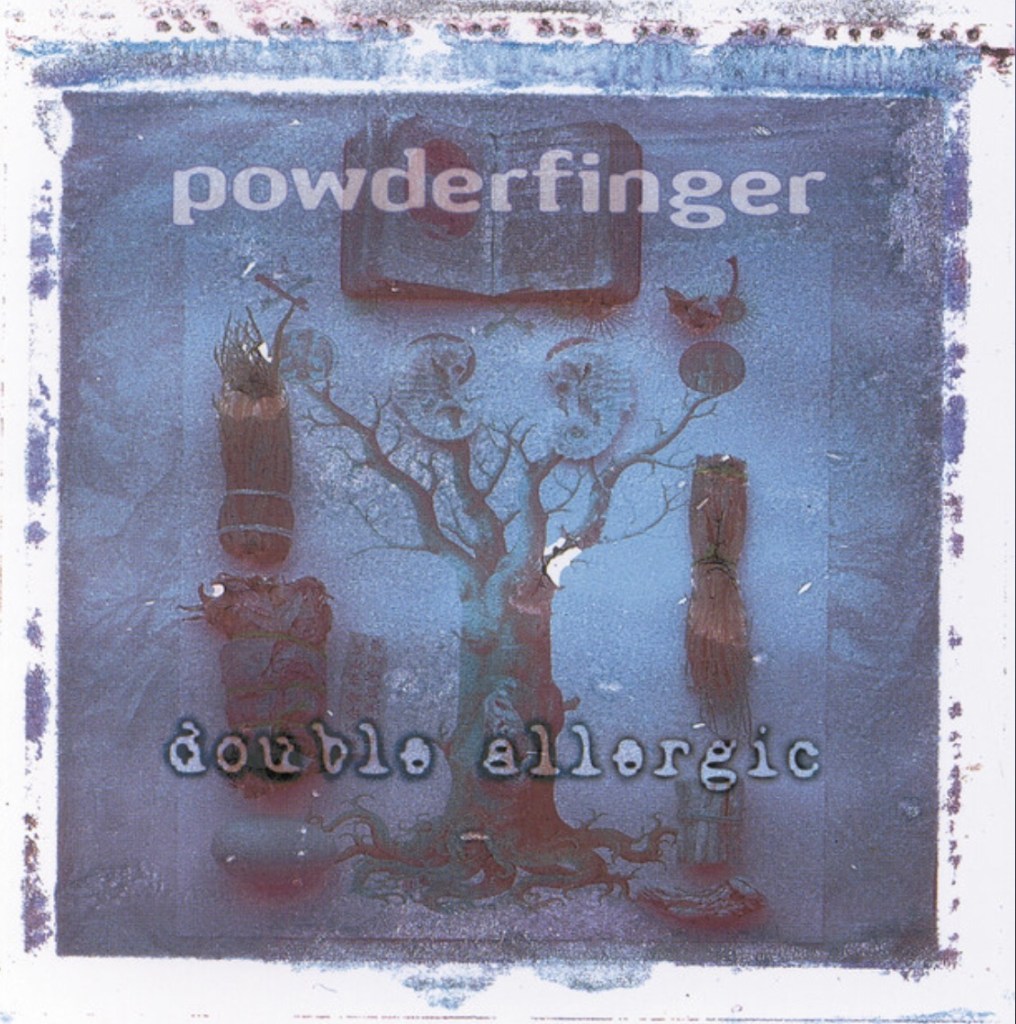
Australian Method Series and 1996 – Part 4.5: Powderfinger – Double Allergic

“Double Allergic” is their second album released in 1996.

It peaked at No. 4 on the ARIA Albums Chart and was certified triple platinum by ARIA for shipment of 210,000 units by 2007.

Like all second albums it contained material that had been written for the debut album.

You know the saying. Artists have their whole lifetime to write their first and second album and only a few months to write their third.

They worked with an expensive producer on their first album but worked with a less well known producer for this.

From 1992 until their break-up in 2010, the line-up consisted of vocalist Bernard Fanning on vocals, guitarists Darren Middleton and Ian Haug, bass guitarist John Collins and drummer Jon Coghill.

“Pick You Up” was the first single and is by far the best pop song on the album.

“D.A.F.” is the the second single, and it’s title is the chord progression.

“Living Type” was the third single written about the Manson Family cult, and came with an X-Files style music video.

But if you want to press play on a song, then press play on “Oipic” and let the Led Zep exotic Sounds take you away.

By the way, this isn’t the album that got me interested. It was the next one “Internationalist” and the song “Passenger”. But that’s for another post.

Standard
Influenced, Music, My Stories

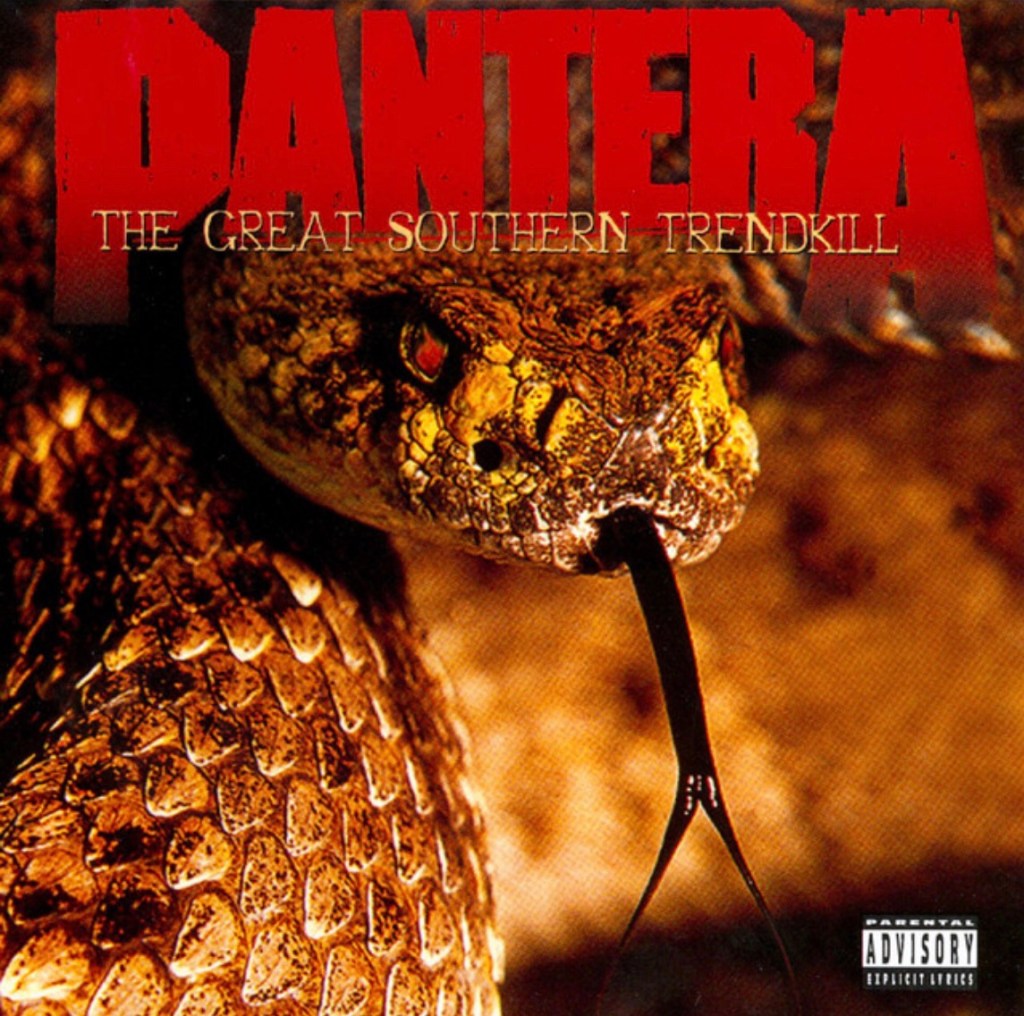
1996 – Part 4.4: Pantera – The Great Southern Trendkill

Pantera was popular in Australia. Once they broke into our market, they stayed until they remained as a band.

“The Great Southern Trendkill” came out in May, 1996. It went to number 2 on our ARIA charts and it reached number 4 on the Billboard 200 chart.

It’s listed as their eighth album, however for the Phil Anselmo, Dimebag Darrell, Rex Brown and Vinnie Paul version of Pantera its album number 5 as their first album begins with “Power Metal” but it’s number four from their major label debut “Cowboys From Hell”. And that’s when the Pantera I know really started.

Terry Date and Vinnie Paul are producing, recording and mixing the album.

Coming in to the album, even a band like Pantera was on the outer. The marketing machines of the labels had put their dollars in Grunge and Industrial Metal acts like NIN and Ministry.

Internally, the Abbott brothers were not too impressed when Anselmo took time out to do the “Down” project and then do a 13 date tour with the group. And to top it off, Anselmo moved out of Texas and back home to New Orleans so his vocals were done on his own.

Anyway to the music.

The Great Southern Trendkill

It’s like Death Metal.

I like the riffs and the guitar solo, but the song doesn’t really resonate with me.

War Nerve

It’s very Black Sabbath like, doom sludge metal.

Drag the Waters

The main riff is bone crunching.

10’s

Iommi would be proud of this riff. Actually Zakk Wylde in Black Label Society would be proud of this riff. Vocally, Anselmo is strong here.

But press play on this to hear the acoustic arpeggio passages and Dimebag’s unbelievable solo over em.

13 Steps to Nowhere

It’s weird to explain this song. It’s experimental, a mixture of blues like grooves with a lot of distortion and Sabbath like doom breakdowns.

Suicide Note Pt. I

Synths and backwards effects and then the acoustic guitar kicks in. It’s almost Led Zeppelin like, with a bit of Southern Rock and I like it.

Suicide Note Pt. II

And then what happened. It’s death metal like, with blast beats and fast riffing, with some heavy metal like riffs chucked in here and there.

Living Through Me (Hells’ Wrath)

The riffs on this are “fists in the air, head banging” riffs.

Vocally I’m not a huge fan and halfway through it goes into a weird spoken interlude with weird industrial like effects.

Then a cathartic scream from Anselmo and the head banging riffs are back in.

Floods

The clean tone intro with the acoustic guitar under it, grabs my attention immediately. It’s almost Alice In Chains like, even though the band was critical of the Grunge movement.

Then again, Pantera songs like “Cemetery Gates” and “This Love” come to mind.

The whole “Die” section is heavy and demented but there is no denying the power of Dimebag and his bro Vinnie. These dudes nail every syncopated beat and lick down.

It’s been written extensively that the solo on this song is Dimebag’s best. And it is. If you need to press play on a track, then make this the one.

It’s composed of all these little guitar solo ideas he used for his live guitar spot, while Brown and Paul are simple in their foundations, letting Dimebag fill up the space with his leads.

The Underground in America

Musically, I like it. Vocally I hate it.

(Reprise) Sandblasted Skin

Dimebag brings the riffs again.

In the end it was certified Platinum in the U.S and it charted well in a lot of other countries.

And while the relationships were strained during the recording, things got even more estranged when Brown decided to leave the tour bus he was sharing with the Abbott brothers to share a tour bus with Anselmo. Brown described it as a way to feel comfortable, because Dimebag would be up early and start cranking the guitar, which upset Brown who wanted to sleep.

During the tour, Anselmo overdosed on heroin and was legally dead for four to five minutes. According to Anselmo, he started using heroin for relief of his chronic back pain. Mick Mars has a degenerative spine issue and never turned to heroin, but then again, he did turn to alcohol and lots of it.

For the record, I hate the hardcore death metal vocals that Anselmo resorted to. His clean tone voice is one of the best. He could move between James Hetfield and Tom Araya style vocals to Rob Halford and Bruce Dickinson siren wails. It’s why I became a fan of the “Cowboys From Hell” album.

And I don’t know the exact specifics of what happened with Anselmo and the white power salute he gave at a gig he did about 5/6 years ago. Robb Flynn from Machine Head called him out on it. Which led to a lot of issues for Robb Flynn, receiving death threats and venue owners who supported Anselmo refused to book Machine Head.

One more album would come from Pantera and that would be the end. The air is thin at the top of the mountain, which means that you are not meant to hang around at the summit for long. Anselmo would put the band on hold because he wanted to deal with the back pain and then went on to record and tour with his side projects with the band officially finished in 2003.

Dimebag recently had a 17th Anniversary from when he was tragically shot dead at a gig on Dec 8, 2004. And it’s been three and bit years since Vinnie Paul died from heart disease.

While Anselmo wanted to reconnect, Vinnie Paul didn’t. And that’s how it ended.

Standard
A to Z of Making It, Classic Songs to Be Discovered, Derivative Works, Influenced, Music, My Stories, Unsung Heroes

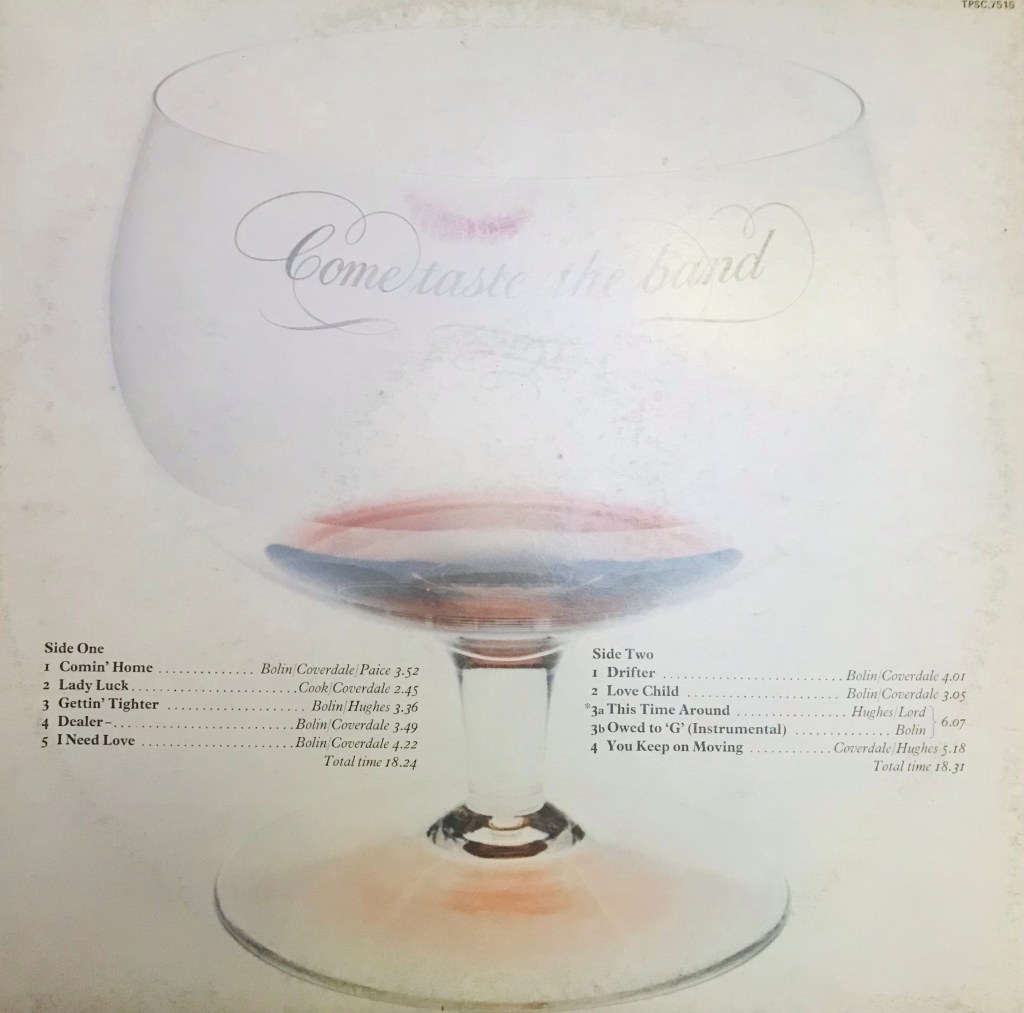
The Record Vault: Deep Purple – Come Taste The Band

It took Deep Purple seven years to make it to the top and two years to break up. The air is thin at the mountain top.

Deep Purple had lost their lead singer Ian Gillan and bassist Roger Glover in 1973 and replaced them with David Coverdale and Glen Hughes. This MK3 version recorded two albums and then guitarist Richie Blackmore left at the start of 1975. This was weird as Deep Purple was seen as “his” band. And from looking at it, it’s like the owner of the house vacating their premises for the guests to take over running the house.

But Deep Purple would soldier on, replacing Blackmore with a young guitar hero from the U.S. known as Tommy Bolin. Rounding out the band is the rest of MK3, David Coverdale, Glenn Hughes, Jon Lord and Ian Paice.

And MK4 was created.

“Come Taste The Band” came out in 1975. It’s the usual production team of the band and Martin Birch.

The name Tommy Bolin came into my life because of Motley Crue. The Crue covered the song “Teaser” for a Compilation album and they also released it on a Raw Tracks CD made for the Japanese market, which I got my hands on. The song is so good and sleazy it sounded like a Crue original and I was curious to hear more from Bolin.

So as I was going back into the career of David Coverdale because of Whitesnake’s attention grabbing 87 LP, I was doing the same for Tommy Bolin.

So I got my hands on the “Teaser” and “Private Eyes” album first and imagine my surprise when I came across an album that had both Coverdale and Bolin on it.

Comin’ Home

Written by Tommy Bolin, David Coverdale and Ian Paice with vocals provided by Coverdale.

This song rocks out of the gate paying homage to the fast rock sounds of Deep Purple MK1, MK2 and MK3. But it was more Grand Funk, like “We’re An American Band”.

Lady Luck

Written by Jeffrey Cook who co-wrote songs with Bolin for the “Teaser” record with lyrical contributions from Coverdale.

Vocals are provided by Coverdale. In didn’t really do much for me.

Gettin’ Tighter

Written by Bolin and Hughes with vocals provided by Hughes.

This song is funky out of the gate, and sleazy once the whole band comes in.

Dealer

Written by Bolin and Coverdale with vocals provided by Coverdale and Bolin.

It’s very Hendrix “Purple Haze” like in the riff departments with a Beatles like Folk Rock interlude which Bolin sung.

I Need Love

Written by Bolin and Coverdale with vocals provided by Coverdale.

I like the groove on this, and the way the verse riffs are played out with the heavy synth from Lord.

Drifter

Side 2 begins with this song written by Bolin and Coverdale with vocals provided by Coverdale.

It’s got a great Intro which reminds of “You Really Got Me” or “American Woman” and check out the groove that comes in once the drums and bass kick in.

Coverdale’s bluesy voice is a highlight.

At 2.36 there is just a bass and keys section over a drum groove. It reminds me of things that Rush would do.

Then Bolin comes in, with volume swells and a solo begins. The drums and bass become busy as they build it up, and the vocals come back in. Its brilliant, it gives me goose bumps all the time, so press play just to hear that.

Love Child

“Heartbreaker” anyone. Press play and listen to the intro.

Written by Bolin and Coverdale with vocals provided by Coverdale.

The verse groove and riff are my favourites even though the whole “love child driving me wild” lyric didn’t set the world on fire.

At 1.50, they go into a progressive rock style groove and Lord solos over it.

This Time Around / Owed to ‘G’

Written by Hughes, Lord and Bolin with vocals provided by Hughes.

It’s very progressive sounding, like ELO and it moves into a great instrumental jam over a 12/8 groove with excellent lead guitar from Mr Bolin himself.

You Keep On Moving

Written by Coverdale and Hughes with vocals provided by Coverdale and Hughes.

This is the standout track. Its haunting and melancholic and it was written during the “Burn” sessions but not used.

Norway, Sweden, Denmark, Holland, Czechoslovakia and West Germany all got behind this version of the band. The Japanese still loved em and New Zealand loved em even more.

But.

The classical progressions and jams had been replaced with groove, soul and funk. It could be seen as an early Whitesnake album, as a few tracks have “Love” in the title, which is similar to every Whitesnake album.

Also in 1975, Tommy Bolin had two records competing against each other, which probably wasn’t the best scenario for Deep Purple however I have seen “Teaser” album pictures with a sticker on em that said “Guitarist Of Deep Purple”. Since most of the songs were written by Coverdale and Bolin, the project could have been billed as Coverdale/Bolin.

After the tour for this album finished in March, 1976, Deep Purple MK4 was no more. Glen Hughes was already having issues and was in and out of rehab. David Coverdale would form Whitesnake and get Jon Lord and Ian Paice into the project. And Tommy Bolin by December 1976, was dead from drug intoxication as morphine, cocaine, lidocaine and alcohol were all found in his system.

But the music lives on.

Standard
Classic Songs to Be Discovered, Derivative Works, Influenced, Music, My Stories, Unsung Heroes

1996 – Part 4.3: In Flames – The Jester Race

In Flames was founded in 1990 by Jesper Stromblad as a side project from his then-current death metal band, Ceremonial Oath as he wanted to write more melodic songs.

Three years later, he quit Ceremonial Oath due to the overused “musical differences” reason and began focusing on In Flames.

By 1995, Stromblad grew tired of using session musicians to record an album or to do live shows, and the first version of the band was assembled.

“The Jester Race” released in February 1996, is the second studio album. The album is considered a classic album of the melodic death metal genre, along with At the Gates “Slaughter of the Soul” and Dark Tranquillity’s “The Gallery”, exhibiting the dual guitar leads, growled vocals and acoustic sections typical of the genre.

The band for the album is Anders Friden on vocals, Jesper Stromblad on Lead Guitar, Acoustic Guitar and Keyboards, Glenn Ljungstrom on Lead Guitar, Johan Larsson on bass and Bjorn Gelotte on Drums and Additional guitars. Yep, a drummer who also plays guitar, and this is a common thing in Sweden to have musicians who can play multiple instruments in a component manner as they promote the Arts sector in schools.

It’s produced by Fredrik Nordstrom (who also plays additional keyboards) along with the band members.

Moonshield

The Medieval sounding acoustic guitars to start the song sets the tone of a journey to come. After about a minute the distorted guitars crash in.

Musically speaking, it is similar in melody and structure to bands such as Iron Maiden or Judas Priest. However, the death metal influence lies within the vocals.

The Jester’s Dance

It’s an instrumental.

Full of different moods like “The Call Of Ktulu” and a bass groove that could have come from the fingers of Eddie Jackson from Queensryche.

There is even a section that reminds me of “Wasting Love”.

So if you want to press play on a song without vocals, press play on this or on the other instrumental “Wayfaerer”.

Artifacts of the Black Rain

I like the twin harmony melodic riffs on this.

Graveland

It’s fast very “Ride The Lightning” like.

Lord Hypnos

How good is the intro on this?

It’s some of the best metal music written in the 90’s, reminding me of 80’s Judas Priest and Queensryche.

And the subject matter this time around are Greek Gods.

Listen to the musical section between 1.33 and 2.43.

Dead Eternity

It’s very Iron Maiden like when it starts off, before it moves into a power metal like riff with blast beats. Something which Parkway Drive uses a lot of.

Its spoken word intro is haunting; about death, and how once you die you never have to worry about dying again, as you are stuck in a purgatory known as dead eternity.

The Jester Race

The intro is like a “Top 10 Hard Rock riff with a bullet” like. And throughout the song, its littered with melodic riffs and harmonies.

December Flower

Fast, angry with a lot of tremolo riffing and blast beats.

Check out the guitar leads between Verses and the guitar lead itself is “guitar hero” worthy.

Wayfaerer

An instrumental.

Very Judas Priest and Helloween like.

And then at the 1.50 mark, there is this Van Halen “Dance The Night Away” vibe with a bit of Joe Satriani “Crushing Day” and “Lords Of Karma” chucked in.

Dead God in Me

The closer.

It’s almost thrash metal like, with disturbing lyrics about a recollection of a molestation that took place.

The album took some criticisms from being too melodic in its riffs and harmonies from Melodeath purists, but that’s why I listened to it.

For me, that melodic element was the selling point.

Standard
A to Z of Making It, Classic Songs to Be Discovered, Derivative Works, Influenced, Music, My Stories, Unsung Heroes

The Record Vault: Deep Purple – Stormbringer

“Stormbringer” came out about 9 months after “Burn”. In the space of a year, Deep Purple were busy writing and recording frequently.

What a novel idea.

Try and tell that to a lot of acts, who want to record an album every three to five years. And the usual argument of ‘no money from recordings’ doesn’t work, because even back in the 70’s, the acts were getting ripped off on the sales part. So they had to tour to make coin. Then again it was normal in the 70’s to release an album a year. It was expected.

The album cover also has a story, about a tornado in a U.S town during the 1920s which was photographed and added to the Copyright free archives, which allowed the image to be used.

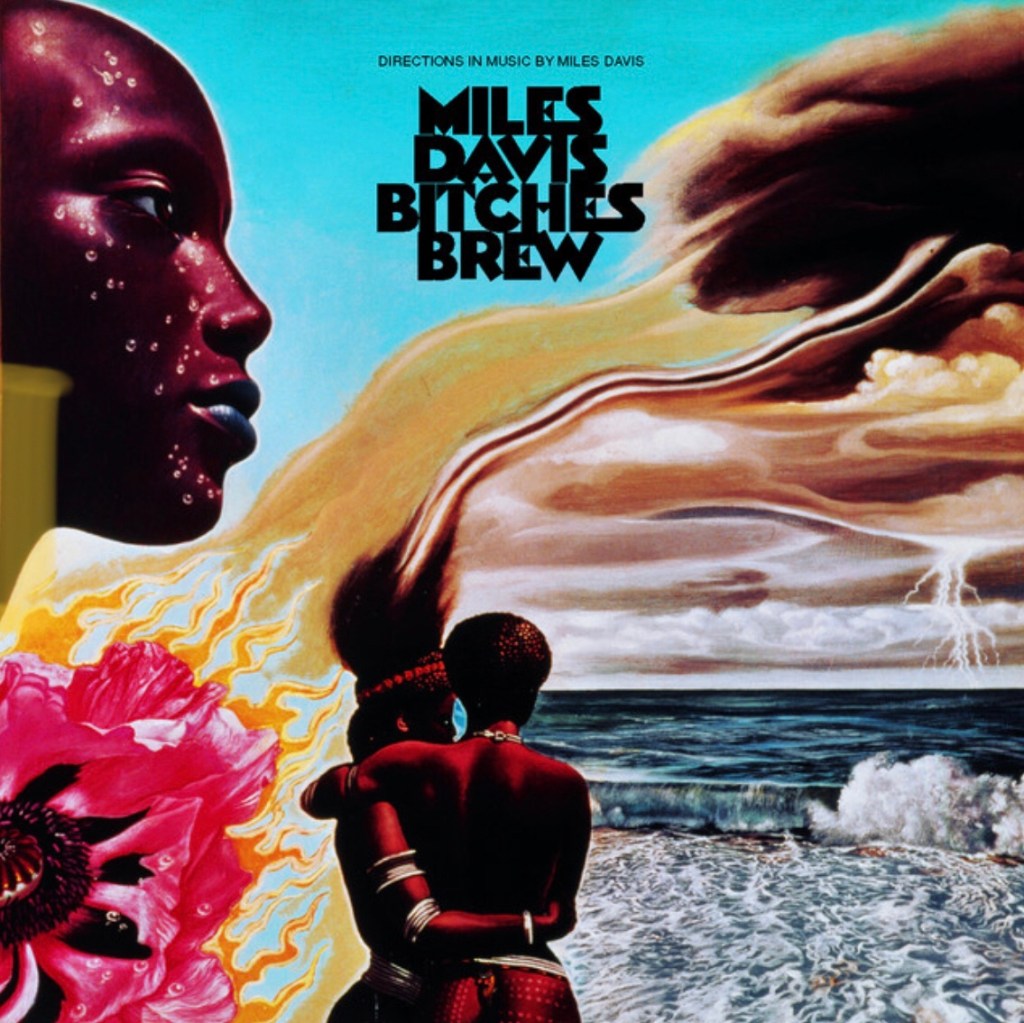
And the same photograph was used for Miles Davis’ album “Bitches Brew” in 1970.

And Siouxsie and the Banshees’ album “Tinderbox” in 1986.

MK3 Deep Purple is Ritchie Blackmore on Guitars, David Coverdale on Vocals (except “Holy Man”), Glenn Hughes on Bass and Vocals (except “Soldier of Fortune”), Jon Lord on Organ and Keys and Ian Paice on Drums.

Its Produced by Deep Purple and Martin Birch again.

Stormbringer

Another thunderous opener written by Blackmore and Coverdale.

If there wasn’t a Heavy Metal movement before, well there was one now. By 1974, each major rock act like Led Zeppelin, Free, Bad Company and Black Sabbath had a heavy song or two on each album that young blue collared youths would take and run with to create even heavier tracks.

I like the exotic flavouring in the solo. It’s not fast, but goddamn, it sounds progressive.

Love Don’t Mean A Thing

Written by Blackmore, Coverdale, Glenn Hughes, Jon Lord and Ian Paice.

This is the whole funk blues soul jam that Glenn Hughes brings. In saying that, the riffs here work so well within the Deep Purple sound.

Holy Man

The Bad Company/Free brand of hard rock had caught on and suddenly Deep Purple was doing a cut that wouldn’t be out of place on the first two Bad Company albums or Free albums.

If the intro sounds familiar, it should, as it’s a common progression used throughtout the 70s, but it went missing a bit in the 80s and came back in the 90s.

I recall Motley Crue using it for “Misunderstood”.

And Blackmore was not the main writer anymore as this song was written by Coverdale, Hughes and Lord.

Hold On

The funk blues rock in the verses grooves and the Chorus is like Soul Rock Music. Blackmore again is missing from the song writing credits, with Coverdale, Hughes, Lord and Paice listed as the writers.

Coverdale and Hughes share vocal duties here and Blackmore brings out his rockabilly Chuck Berry licks which gives way to a Jon Lord solo.

Lady Double Dealer

It’s that fast blues rock that Deep Purple was known for and something that David Coverdale would do a fair bit with the early versions of Whitesnake.

There is a cool Blackmore solo as well.

You Can’t Do It Right

Play that funky blues music white boys.

High Ball Shooter

I like the Intro as it always reminds me of another song which I can’t thing off right now.

The Gypsy

The riffs on this are metal like, but the way Blackmore delivers em, it’s almost progressive like, with a fusion of blues, southern rock and metal like grooves.

Soldier Of Fortune

A great acoustic ballad to end the album, something which David Coverdale would recreate with “Sailing Ships”.

The long jam sessions from the past had disappeared. Replaced with a more structured song arrangement. It’s a bridge between this album and their next album.

Blackmore obviously didn’t like this new direction and left after the tour. And he wasn’t one to keep his thoughts to himself, so he publicly declared his dislike for the funky direction the band was taking and made it clear that was the reason why he left.

But Scandinavian Melodic Rock and Metal was being born with the MK3 albums as they did big business in Sweden, Norway, Denmark and Finland. Austria and Germany also liked this era, along with the UK, France and the U.S.

Check it out.

Standard
A to Z of Making It, Classic Songs to Be Discovered, Influenced, Music, My Stories, Unsung Heroes

1996 – Part 4.2: Slayer – Undisputed Attitude

“Undisputed Attitude” is the seventh studio album by American thrash metal band Slayer, released on May 28, 1996.

The album consists almost entirely of covers of punk rock and hardcore punk songs. It also includes two tracks written by guitarist Jeff Hanneman in 1984 and 1985 for a side project called Pap Smear and its closing track, “Gemini”, is the only original track.

The album was largely the brainchild of guitarist Kerry King, who stated that the songs chosen were from highly influential bands who “made Slayer what it is”.

The album was initially to feature material from classic heavy metal artists such as Judas Priest, UFO and Deep Purple. However, after several rehearsals “things didn’t pan out” according to King, so the band instead elected to cover punk songs. Then again, maybe Tom Araya’s rough bark just didn’t suit the Judas Priest, UFO and Deep Purple style of songs.

The band for this album is Tom Araya on Bass and Vocals, Kerry King on Guitars, Jeff Hanneman (RIP) on Guitars and Paul Bostaph on Drums. The way Araya sounds vocally on this is how James Hetfield would sound on “St Anger” in six to seven years’ time.

The album is produced by Dave Sardy with Rick Rubin listed as an Executive Producer, whatever an Exec Producer means.

“Disintegration/Free Money”

The original artist is Verbal Abuse and its 1.41 of fast and aggressive metal punk.

“Verbal Abuse/Leeches”

And its followed up by another Verbal Abuse cover, which clocks in at 1.58. While its fast and aggressive punk, there is a small breakdown section which slows things down a little.

“Abolish Government/Superficial Love”

A T.S.O.L. cover and it’s a full 1:48 in length.

Three songs in and it’s like listening to one song.

“Can’t Stand You”

Written by Jeff Hanneman and listed as a Pap Smear cover which clocks in at 1:27. And Tom Araya doesn’t take a breath as he spits out the verses.

“DDAMM (Drunk Drivers Against Mad Mothers)”

Another track written by Jeff Hanneman and listed as a Pap Smear cover which clocks in at the super long length of 1:01.

“Guilty of Being White”

A cover from Minor Threat and it clocks in at another super long time of 1:07.

When the album was released in 1996, there was no controversy over the song or any possible message of white supremacy.

But the internet and social networks are different beasts and people take a moral high ground.

The other controversy was changing the lyrics in the songs ending from “guilty of being white” to “guilty of being right”.

This little changed didn’t go down well with Minor Threat front man Ian MacKaye, who found this change “offensive”.

“I Hate You”

Verbal Abuse makes another appearance on this album with a song that goes into the 2 minute range. This one is more punk like, with a rock tempo and Sex Pistols “Anarchy” style attitude.

“Filler/I Don’t Want to Hear It”

And Minor Threat makes another appearance with a super-fast punk hardcore song.

“Spiritual Law”

A cover from D.I. and its pushing at being the longest song on the album at 3 minutes long. Press play to hear the intro which is very Metal like, otherwise the rest is stock standard fast beats, vocals that cover the microphone in spit and fast alternate picked punk metal riffs.

But at 1.20 a Sabbath like doom groove comes in, before it picks back up into the fast punk metal at the 2.10 mark.

“Mr. Freeze”

A cover from Dr Know. Its 2.24 in length and at times when the song goes into its rock riffs I feel like I am listening to Beatsie Boys, “Fight For Your Rights”.

“Violent Pacification”

A cover from D.R.I. at 2:38 in length.

All I can say about this song is chaos until the 46 second mark, when the drums start a rock style groove and the tempo of the song goes down a notch for the band to rock out. And Tom Araya is barking out “Violent Pacification” over and over and over again.

“Richard Hung Himself”

A cover from D.I. and this song takes the title for the longest song of the cover songs at 3:22.

And for a song with a grisly title it’s actually a catchy rock song.

“I’m Gonna Be Your God” (“I Wanna Be Your Dog”)

A song from The Stooges, clocking in over the 3 minute mark and it received a makeover and some slightly modified lyrics and a faster tempo.

It’s by far my favorite cover and it leads in perfectly to the original track.

“Gemini”

Written by Kerry King and Tom Araya, and it is the longest song on the album at 4.53.

The song begins as a sludge/doom number reminding me of “Season In The Abyss”, before becoming a more typical Slayer song.

But being added to the end, doesn’t do this song proper justice. It’s one of their best tracks written in the 90’s.

And Tom Araya is evil reincarnated with his melodic but sinister vocal melody.

In the end, this is a 33-minute-long release and Slayer wouldn’t have it any other way. It’s not a classic album but the song “Gemini” makes up for it.

Standard
A to Z of Making It, Copyright, Influenced, Music, My Stories

The Week In Destroyer Of Harmony History – November 28 to December 4

4 Years Ago (2017)

OUR BEST WORK

When you create your most important work, it could be ignored by the audience because it’s ahead of its time. It requires people to change their thoughts and beliefs. But all important work ends up rising above the noise.

Black Sabbath’s debut album didn’t reach platinum in the U.S until October 13, 1986. Yep 16 years later, the most influential heavy metal album had moved a million units in the U.S.

But their tours sold out, which goes to show that people didn’t always buy recorded music.

You could be an artist creating work which is popular, and it resonates with the audience who already like what you do. “Dr Feelgood” was always going to be Motley’s best seller. They spent 7 plus years building an audience with each release and tour.

In addition, it spawned a new production sound that would become known as the “Black” sound after Metallica’s self-titled album destroyed our senses and the charts.

Our best work is the heart of what we do and sometimes getting it out there is a long difficult journey full of scams and rip offs, highs and lows, good and bad people, rejection and acceptance.

But you will not get there if you quit. It’s what you do in the dark, which will make you shine in the light.

8 Years Ago (2013)

CONCERT ATTENDANCES

The highs of success and fame are brief. The air at the top of the mountain is thin, so you’re not expected to hang around for a long time.

Vince Neil

On July 6, 2013, Vince Neil played a solo show in Mexico City.

The venue was Jose Cuervo Salon.

The capacity of the venue is 1,500. The attendance was 64 people.

That’s right, less than 5% of the total venue size.

Total Gross sales for the night was $2,286.

Does anyone really care about Vince Neil outside of Motley Crue?

Based on the ticket sales, Mexico sure don’t.

What a hard truth that is.

His debut album “Exposed” celebrated 20 years in 2013, but Vince went out and played Motley songs.

Power Metal Rules In Europe

On April 18, 2013, Helloween, Gamma Ray and Shadowside played a Power Metal feast in Hamburg, Germany. The venue was the Docks.

The capacity of the venue is 1,500. The attendance was 1,171.

Total Gross sales for the night was $51,299.

The thing with power metal bands is that they know the size of their audience. It is a niche and it has a hard core and devoted fan base.

The Black Crowes still do good business

On July 19, 2013, The Black Crowes, Tedeschi Trucks Band and The London Souls played a show in Nashville, Tennesse.

The venue was the Woods Amphitheater at Fontanel.

The capacity of the venue is 4,056. The attendance was 3,273.

Total Gross sales for the night was $215,641.

In the end there is plenty of money available in music and the more people that have access to recorded music means more fans that could turn into customers.

COPYRIGHT TERMS

In Australia (and a lot of other countries) a copyright for a sound recording lasts for the life of the creator + 70 years after death.

If the creator lives to 80, then the Total Copyright is a 150 year term.

And since the large Corporations control a lot of the copyrights, a 150 year term benefits them.

Keith Richards famously said that you can’t copyright the blues.

The acts from the Sixties and Seventies, brazenly borrowed and built upon songs that already existed.

And didn’t we got a lot of glorious music.

RED DRAGON CARTEL

As a fan of Jake E. Lee and the work he did with Ozzy and Badlands, it was cool to hear that he made the decision to record music again.

Frontiers Records signed the project.

Are there any Classic Eighties metal/rock bands or stars that Frontiers haven’t signed?

And “Feeder” was doing the rounds and i didn’t like it because there was no classic riff that stuck around forever to haunt my eardrums.

The expectation that most artists have is that since they have talent, can write a song and love what they do, they should be able to charge people to listen.

The reality is that there are thousands of artists trying to reach the same fans that are very careful with the money they spend on music.

Music is never a sure thing.

LOYALTY PROGRAM

We live in a world of loyalty schemes. If you shop at any major retailer there is a pretty good chance that you have signed up to their loyalty scheme and after you spend a certain amount of dollars with them, you get a discount or some other reward for your next purchase.

So why isn’t this happening in the music business.

THE BATTLE FOR QUEENSRYCHE

Back in 2013, two Queensryche bands did the rounds.

The Geoff Tate version is on Cleopatra Records and the Todd LaTorre version is on Century Media Records.

And there wasn’t a demand for two versions of Queensryche?

Then again demand for Queensryche was diminishing since Chris DeGarmo left.

And that’s another wrap for another week.

Standard