Classic Songs to Be Discovered, Derivative Works, Influenced, Music, My Stories, Unsung Heroes

Australian Method Series: AC/DC – Dirty Deeds Done Dirt Cheap

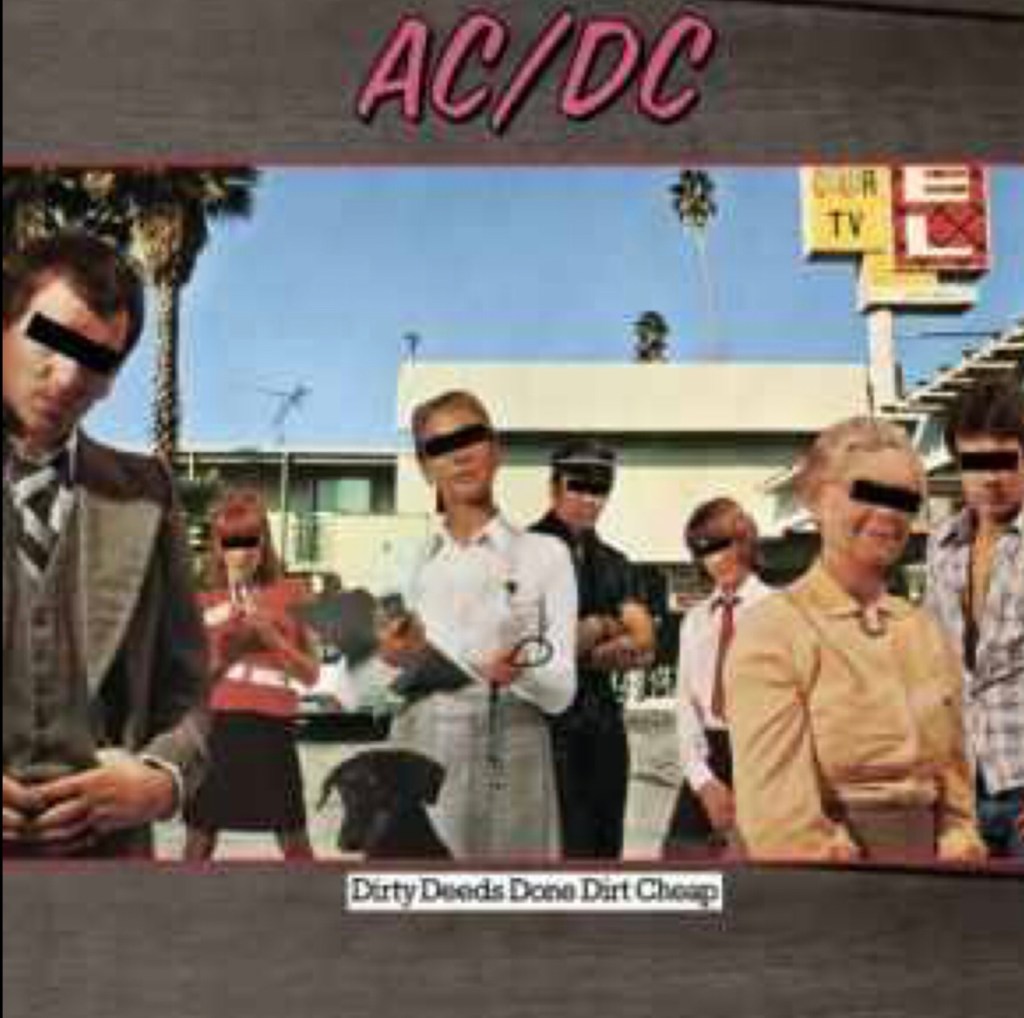
Released in 1976. This is the cover we know for the album and not the Hipgnosis one which came out on the International release.

This version of AC/DC rocked hard. Bon Scott is on Vocals, The Young Brothers are on all things guitar related, Mark Evans is on bass and Phil Rudd is on the Drums.

Production is handled by The Easybeats main songwriters in George Young (big brother of Angus and Malcolm) and Harry Vanda.

“Dirty Deeds Done Dirt Cheap” is the third studio album by AC/DC. While it hit the streets in Australia in 1976, it didn’t get a U.S release until 1981.

And that decisions by Atlantic A&R man Doug Morris to release the album proved to be unpopular with the band.

AC/DC had successfully reinvented itself with a new singer, Brian Johnson. The band was working on a new album, which would become “For Those About to Rock We Salute You”, released later that same year.

But Morris saw a financial opportunity to capitalize on the success of “Back in Black” which had already sold over five million copies. And due to those numbers, Morris estimated that “Dirty Deeds” would move at least 2 million.

But it also took away an opportunity for the new album.

“For Those About to Rock” would have sold a lot more if Morris had waited.

So the US release of “Dirty Deeds” was widely seen as damaging the momentum for that album, which it outsold. The band was also forced to add songs from the “Dirty Deeds” album to its set list on its subsequent tour, further taking the focus away from their new album.

But going back to 1976, Atlantic was unhappy with the vocals and the production. This infuriated Malcolm Young because the label was putting shit on his older brother.

Bassist Mark Evans assumed Bon Scott would be fired as a result. The band was on the verge of being dropped.

But “High Voltage” which was also released in the United States in 1976 was still selling and the sales of that album versus what the label paid for it, gave AC/DC a lifeline.

The Young brothers along with Bon Scott were very creative during this period. As was the norm, each year had a new AC/DC album. And they always overwrote for each album.

As a side note a song called “I’m a Rebel” was recorded for this album, with music and lyrics written by Alex Young, another brother of the Young’s. While the song was never released by AC/DC, Accept somehow got their hands on it and released it as a single, and also named their second album after it.

Dirty Deeds

The riff’s simplicity is its magic.

The drum groove was used by Lars Ulrich for the “Enter Sandman” intro.

The lead break is the embryo of the “Thunderstruck”.

And Bon Scott is menacing as he gave us a new phone number to call.

36-24-36.

Love At First Feel

It’s got that Chuck Berry 12 bar blues rock feel, which AC/DC used a lot of. The most notable song being, “Long Way To The Top”.

Press play to hear a very good and underrated Angus Young lead.

And I like how it quietens down after the solo, with the vocal melody of “Love At First Feel” repeated as they build the song back up.

Big Balls

There was a band in Australia called Skyhooks who had this kind of cabaret/stage show delivery in their songs.

Rocker

Well the songs a rocker alright.

It brings back memories of Val Kilmer performing a rockabilly song in the movie “Top Secret”.

Problem Child

A favourite because of the riffs and the vocal delivery. If there is a track to press play on, then this is definitely one of em.

And Angus delivers another underrated lead break.

In concert, Scott would often introduce “Problem Child” as being about Angus.

There’s Gonna Be Some Rockin’

The 12 bar blues is back. Bands like Status Quo would build a career on tracks like this.

The rhythm is also very similar to that of “The Seventh Son” by Willie Dixon.

Ain’t No Fun (Waiting Round To Be A Millionaire)

It follows more of the same “Long Way To The Top” feel. But press play to hear the Chorus riff, as there’s a chord ringing out and then some arpeggios and single notes.

Ride On

It can be supercharged with other slow blues songs they have done, like “The Jack” and “Night Prowler”

Squealer

How good is the intro on this?

The bass plays a groove that is not typical of AC/DC. It’s almost funky like.

And when Bon Scott moves from his lower register to his higher register, the guitars become more aggressive and the drums get louder.

Angus again wails away on the guitar, delivering a very mature lead. It’s one of my favourite AC/DC cuts and it has been largely forgotten.

This is another track you shouldn’t ignore on this album.

In relation to sales it was a hit in Australia when it came out.

In the US, it was a different story.

Following the American success of “Highway to Hell” in late 1979, copies of the album began to appear as imports in the US.

Some of these were the original Australian edition on Albert Productions; however, Atlantic also pressed the international version in Australia, and many of these were also exported to the US.

Strong demand for both versions (in the wake of the even greater success of Back in Black) led the US division of Atlantic to finally authorize an official US release in March 1981. It went straight to No. 3 on the Billboard album charts.

In relation to sales, 6× Platinum in Australia and the US.

Crank it.

Standard
Classic Songs to Be Discovered, Influenced, Music, My Stories

The Record Vault: Def Leppard – Vault: Def Leppard Greatest Hits (1980–1995)

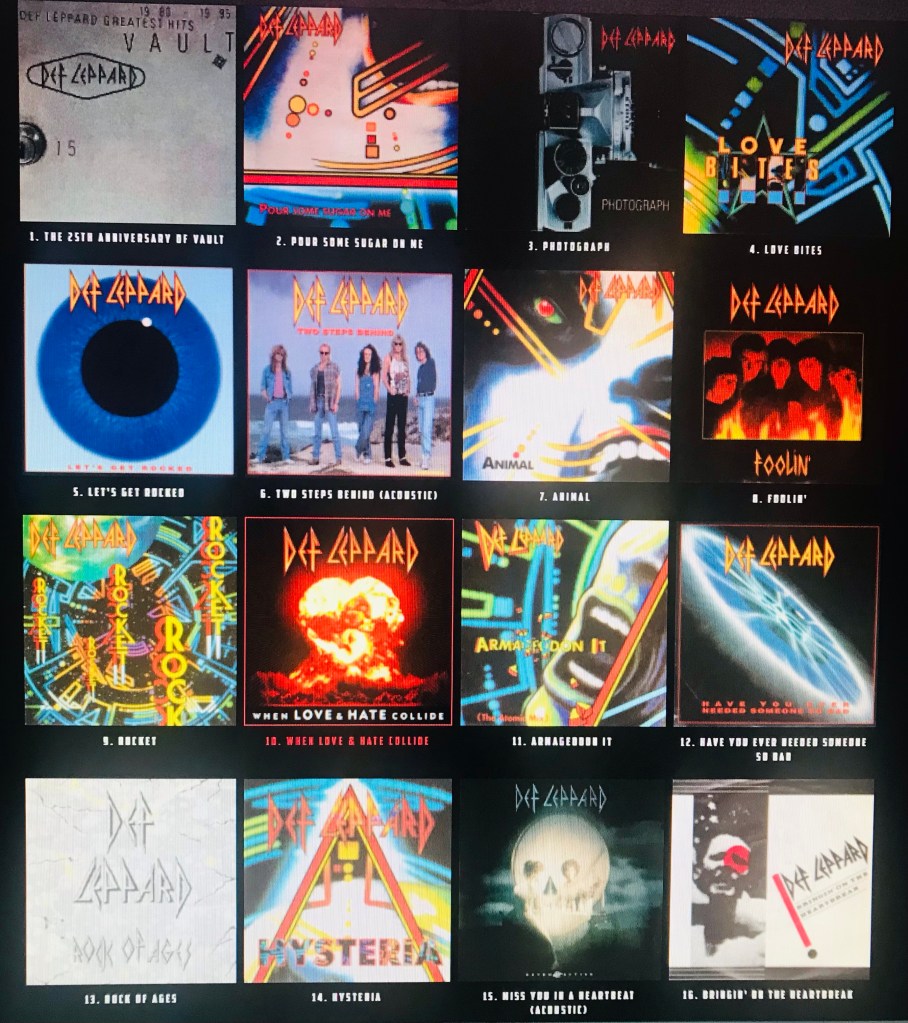
If you had the albums you didn’t really need this unless you are a serious collector, which the majority of Def Leppard fans are. And if you had no albums from the band, then this is one to purchase as its focus is definitely on the big albums of “Pyromania”, “Hysteria” and “Adrenalize”.

“Vault: Def Leppard Greatest Hits (1980–1995)” was released on 23 October 1995.

Pour Some Sugar on Me (Historia Video Edit)

From the “Hysteria” album, written by Clark, Collen, Elliott, Lange and Savage.

The song was treading water in and out of the Top 10 singles charts and 49 weeks after it was released it hit the Number 1 spot. The path to number 1 happened during the European tour. The Strip Clubs of Florida started playing it, then people started requesting it on radio and the song just blew up.

They were done with the album and working on the last song for the album, “Armageddon It”. During a break in the recording, Elliot picked up the acoustic guitar and played the three chords. Lange heard it and liked it. It’s “We Will Rock You” vibe is evident and the Chorus was done first. So they had the big hook and worked backwards from there.

The verses started to have this “Come Together” vocal feel. But they weren’t done, as both Lange and Elliot took small tape recorders and scatted phonetically into. 10 days later the song was completed. The fastest thing they had done for the album.

“Love is like a bomb” okay.

Photograph

From the “Pyromania” album and written by Clark, Elliott, Lange, Savage and Willis.

Collen played the lead break on his Ibanez Destroyer. It was a hybrid hard rock version of AC/DC meets Boston. It had that aggressiveness and the melody.

Love Bites

From the “Hysteria” album, written by Clark, Collen, Elliott, Lange and Savage. The bulk of the song was courtesy of Mutt Lange. When he played it to the band on acoustic guitar in sounded like a Don Henley cut, as Lange’s voice is very similar.

But as the band kept working on it with Lange, it just kept getting bigger and bigger. The Chorus is huge and press play to hear the melodic guitars there.

Also when the song broke through, the band had to learn it while on tour to add it to its set list. And it was daunting due to the multi-layered harmonies.

Let’s Get Rocked

One of the earliest songs written for the “Adrenalize” album by Collen, Elliott, Lange and Savage. Like “Pour Some Sugar On Me”, the Chorus hook was written first and the rest followed after.

Its juvenile and fun and so departed from the “shoe starers” as the Grunge movement was known back then.

Two Steps Behind (Acoustic Version)

Written by Elliott and the song appeared as a B side on one of the “Adrenalize” singles, on the “Retro Active” album and on the “Last Action Hero” soundtrack which was a box office bomb for Arnold Schwarzenegger.

The idea for an acoustic song came together after Joe Elliot started jamming with Hothouse Flowers.

Michael Kamen got involved because he wanted to do strings on a Def Leppard cut. So the band sent him all the tracks that they were using on “Retro Active” and nothing really stood out to Kamen.

However one of his assistants heard the song and kept humming the vocal melody. When Kamen asked her what she was humming, she mentioned it’s one of the Def Leppard songs they sent through and Kamen had his “a-ha” moment and his involvement was sealed.

Animal

From the “Hysteria” album written by Clark, Collen, Elliott, Lange and Savage.

And it was put together so unusually. Joe Elliot sang his vocals to a different backing track and once the vocals were done, Lange took away the music and left the drums and vocals and told Phil and Steve to come up with a new musical track.

Heaven Is

From the “Adrenalize” album and written by Clark, Collen, Elliot, Lange and Savage.

It can be interchanged with a Bryan Adams cut.

Rocket (Visualize video edit)

From the “Hysteria” album written by Clark, Collen, Elliott, Lange and Savage.

It was actually Joe Elliot that came up the African drum loop.

When Love & Hate Collide

Written by Elliot and Savage. It was originally written for “Adrenalize” circa 1989, however it’s seen as the new song for this album. Elliot was going with a “Love Bites” part 2 vibe and they stopped recording the “Slang” album to get this song finished for the “Vault” album at the request of their label.

And the guys had to get re-acquainted with their past recording methods as their mindsets were on the future and the sounds/production of “Slang”.

The vocal melody also reminds of Peter Cetera and “Glory Of Love”.

Action

The love the band has for Sweet is evident on how well they covered this track for a B side, which also appeared on the “Retro Active” album.

It’s full of energy and you can hear the fun dripping from the speakers.

Make Love Like a Man

From “Adrenalize” and written by Clark, Collen, Elliott and Lange. It’s basically “Pour Some Sugar On Me” part 2.

Armageddon It

From “Hysteria” and written by Clark, Collen, Elliott, Lange and Savage.

The guitar part was just power chords when the song was first demoed in 84, and then a few years later, Steve Clark started playing a T-Rex inspired riff over the power chord progressions, which inspired Joe Elliot vocally.

And that whole, “gimme all your loving” section was inspired by ZZ Top and the band were always going to change the words, so it didn’t have “gimme all your loving” but it sounded so good that Mutt Lange told em to leave it.

Have You Ever Needed Someone So Bad?

From “Adrenalize” and written by Collen, Elliott and Lange. They had this and “When Love And Hate Collide” and decided to go with this for the album. The majority of the song was written by Collen and Lange with Elliot contributing lyrics.

Rock of Ages

From “Pyromania” and written by Clark, Elliott and Lange.

It was a Steve Clark riff and the original demo had a slower tempo.

Mutt Lange had the song musical structure mapped out. The verses came first but they still didn’t have a Chorus.

A hymn book in the Control Room left behind by a Choir group gave the song its title.

Hysteria

The title track and written by Clark, Collen, Elliott, Lange and Savage.

But the main guitar part was from the fingers of Rick Savage. And Joe Elliot didn’t like it, because he thought it sounded too much like “Every Breath You Take” from The Police.

Bringin’ On the Heartbreak

From the “High ‘N’ Dry” album and written by Clark, Elliott and Willis. Still a live staple and one of their signature song. Check it out for the harmony guitars.

Initially it was a demo called “A Certain Heartache”. And when they started working with Mutt Lange, Lange had a tendency to rip songs apart and ask the guys to add new bits. But for this, it didn’t really happen as Lange approved.

5× Platinum in the U.S. Not bad for a Best off compilation. Ka-Ching.

Standard
A to Z of Making It, Classic Songs to Be Discovered, Derivative Works, Influenced, Music, My Stories

The Record Vault: Def Leppard – Retro Active

I had this on CD but I don’t have it anymore.

Against my better judgement (and pressure from my older brothers), I gave it to a local DJ (a family friend as well) to play at a party he was MC at, but he had a chequered history of not returning peoples music.

And as per the script, when I asked him for the CD back after the party, he told me that his DJ gear and the music he had was stolen after the party. But it appeared “somehow” magically the following fortnight for another party.

I also dubbed it on cassette before I lent it, so I might have had an inkling that it would never come back.

So what is “Retro Active”?

Released in 1993 to the slogan of “We’ve pretty much cleared out the shelves with this album”, “Retro Active” is a compilation album featuring re-worked versions of B-sides and previously unreleased recordings from the band’s recording sessions between 1984 to 1993. The creativity of the band members during this period was an all time high.

The press release for the album wanted to make clear, that;

“This is not a new Def Leppard album – nor is it an old Def Leppard record. It is “Retro-Active”, a collection of songs that have appeared in hard to find places or, in certain cases, never made it out of the studio until now.

The band wanted to do this kind of album after “Hysteria”, with a release in 1989, however those plans didn’t eventuate.

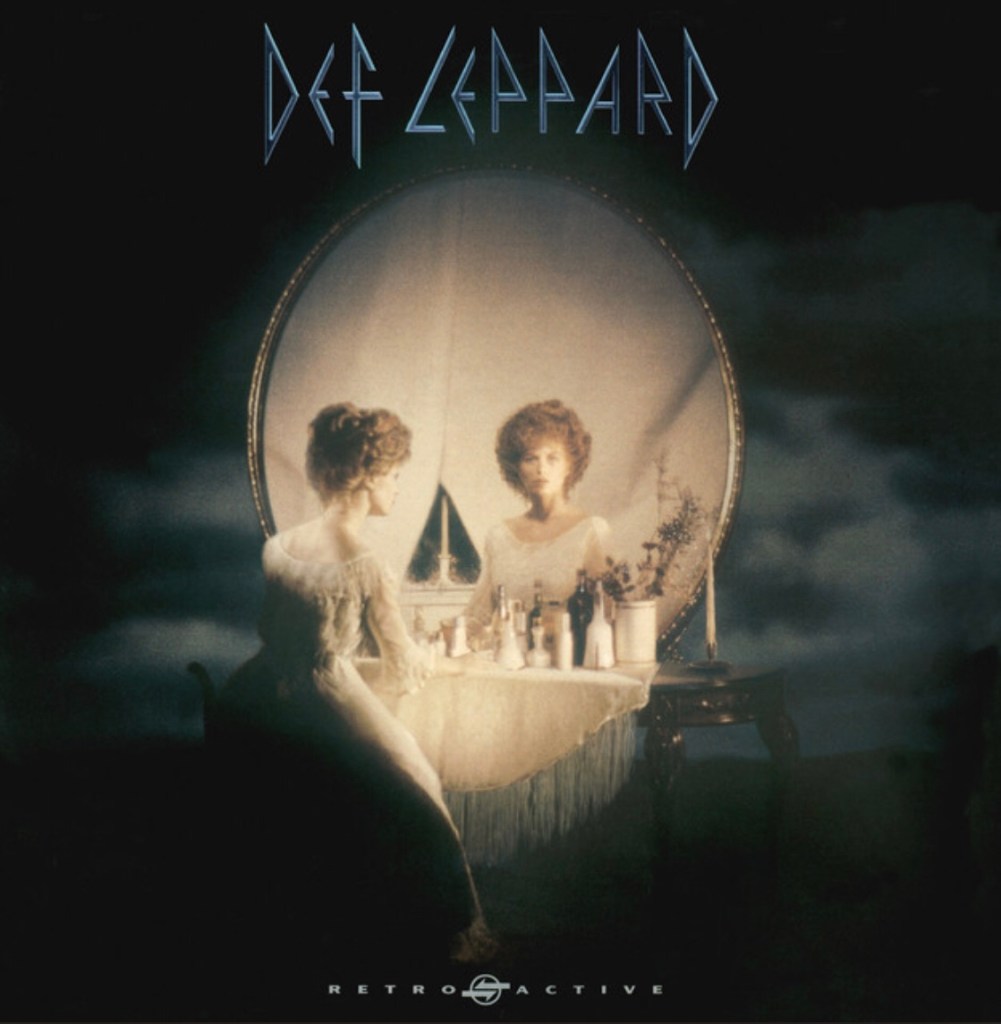
Pretty cool album cover as well by Nels Israelson and Hugh Syme and how two different images can be seen when viewed from a distance.

Vivian Campbell gets a chance to adding his own textures of electric guitars, acoustic guitars and backing vocals, on top of everything else that was already there by Rick Allen, Steve Clark, Phil Collen, Joe Elliot and Rick Savage.

Desert Song

Michael Schenker came to mind when I saw this title.

And this is a great opening track, written by Clark, Elliott and Savage. Listed as an unreleased outtake from the “Hysteria” sessions.

The Arabic/Dio/Blackmore feel of the main riff reminds me of early Def Leppard. And when the Pre-Chorus (or is it the Chorus) kicks in, you get smacked in the face by the “Hysteria” multi-layered vocals.

There is this quietened down section in the middle of the song, which reminds me of the 70’s and the arrangements that bands used to do back then. The middle section gives way to a lead break and to an outro with has minimal singing, however Elliot is using his voice like another instrument.

Fractured Love

My favourite song on this album and another unreleased outtake from the “Hysteria” sessions.

Written by Clark, Elliott and Savage. It was part of the original “Hysteria” track listing in the Spring of 1985, but once Mutt Lange returned, the song was shelved.

The drum like intro was actually recorded by Elliot, by tapping his fingers on the studio vocal booth “baffles”. The sound was then enhanced and looped to form the atmospheric intro.

The E-bow effects by Collen are haunting. The open string build up in the verses reminds me of Queensryche and songs from “Operation Mindcrime”.

And when the whole band crashes in for the multi-layered Chorus, its head banging time.

Action

A Sweet cover written by Andy Scott, Brian Connolly, Steve Priest and Mick Tucker. It was originally released on the “Make Love Like a Man” single; this version has re-recorded snare drums.

While the band Sweet had some traction in Australia, it was artists covering their songs in the 80’s and 90’s that got me interested to check them out.

And I like how Def Leppard just made it their own, rocking out, shredding out and in sections bringing in the multi-layered vocals.

Two Steps Behind

Written by Elliot. The unexpected hit.

This is the acoustic version and an electric version is further down the track list. It’s very Bryan Adams sounding.

It got some traction from the film “Last Action Hero” and it was originally released on the “Make Love Like a Man” single.

She’s Too Tough

Another cut written by Elliott and I dig it when his voice gets all Bon Scott throaty. Press play to hear him rock and roll in the verses like this.

This was a B-side included as a bonus track on the Japanese pressings of “Adrenalize”. Written in 1985, the song first appeared on the Helix album “Wild in the Streets” in 1987.

It was redone by the Lep and also released on the singles for “Heaven Is”, “Tonight”, and “Stand Up (Kick Love into Motion)”.

Miss You in a Heartbeat

This acoustic version has this gospel feel which I like.

The song was released on the “Make Love Like a Man” single as well as the Japanese versions of “Adrenalize”.

Phil Collen wrote it and it first appeared on an album by “The Law” featuring Paul Rodgers, released in 1991.

Only After Dark

A Mick Ronson cover, written by Ronson and Scott Richardson.

The song previously appeared on the “Let’s Get Rocked” single, and extra guitars were added for this release.

And the groove is still funky.

Ride Into The Sun (1987 re-recording)

This cut is listed as coming from the “Hysteria” sessions, however it goes back to “The Def Leppard E.P” from 1979.

It’s also listed as being written by Clark, Collen (I’m not sure what he added musically to get a credit as he wasn’t in the band when this song was originally written), Elliot and Savage.

And it’s pretty close to the original version in the verses and chorus.

Slight differences are from the “Hysteria” era cut is that it featured a Rick Allen drum solo intro, whereas the version here has a honky tonk piano intro provided by Ian Hunter.

From the Inside (with the Hothouse Flowers)

Another cut written by Joe Elliott for the “Adrenalize” album. I actually like the R.E.M vibe they have happening here.

It appeared as a B side to the “Have You Ever Needed Someone So Bad” single and some single releases of “Stand Up (Kick Love into Motion)”.

Ring of Fire

How this song never made the cut for “Hysteria” is a tragedy. It’s a pure hard rocker that borders on the early NWOBHM sound of the first two albums.

It will forever be known as a B side from the “Hysteria” sessions.

The song writing gang is also back with Clark, Collen, Elliot, Lange and Savage listed as writers.

It was originally released on the 1988 singles “Pour Some Sugar on Me” in the U.S and “Armageddon It” in the UK.

Press play and let the hard rock sounds wash over you.

I Wanna Be Your Hero

Another cut forever known as a B side from the “Hysteria” sessions and also written by the gang of Clark, Collen, Elliot, Lange and Savage.

It was originally released on the 1987 singles “Animal” in the U.S and “Pour Some Sugar on Me” in the UK.

Miss You in a Heartbeat (Electric Version)

How many versions of the same song could you want?

Well for this song, we get three versions.

Two Steps Behind (Electric Version)

Squeezing more mileage out of this one. And while I said the acoustic version sounds like Bryan Adams, this version seals the deal. It could be interchanged with another ballad from a Bryan Adams album.

Miss You in a Heartbeat (Piano Version)

It’s listed as a hidden track.

In relation to “Miss You In A Heartbeat” and “Two Steps Behind”, it goes to show how Def Leppard tried many different ways to bring the song to life. It’s not easy re-doing and re-creating a song.

And with this album, an era was done and the band was ready to start fresh.

Standard
Classic Songs to Be Discovered, Copyright, Influenced, Music, My Stories

The Week In Destroyer Of Harmony History – February 21 to February 27

4 Years Ago (2018)

THE CRIMSON IDOL

It’s a favourite.

Back in 1992, “The Crimson Idol” ended up being a perfect album for me, in a time when the labels started to put all of their marketing monies into Seattle. I played it a lot, learned riff after riff and lick after lick and it didn’t matter how much time passed between listens, I still knew every lick, every drum roll and every word.

Fast forward many years later (circa 2008) and “The Crimson Idol” was released as a Double special edition CD, with two new tracks. “Phantoms In The Mirror” (which I would place after “The Invisible Boy” in the story arc) and “The Eulogy” (which I would place at the end).

Fast forward another decade (2018) and “The Crimson Idol” has been “Re-Idolized” with additional songs added to the storyline however, “Phantoms In The Mirror” and “The Eulogy” have been left off.

Confused. Me too.

But the review might clarify some things for ya.

8 Years Ago (2014)

RICHIE SAMBORA – Live At The Enmore Theatre, Sydney; 26 February 2014

It renewed my faith in live music.

The previous night to this, I watched Five Finger Death Punch and Avenged Sevenfold. While that was a great concert, the songs got played more or less “note for note” as per the album recordings.

But, Richie Sambora was “communicating musically”. The sheriff was back in town. With three different hand motions he led the band into jams, out of jams and into sing a longs.

Sambora engraved himself into our hearts. He stopped and he talked. Sometimes it felt like for ages. I haven’t seen a lot of people do that kind of a rock show for a while as they are scared in case they lose the audience. Sambora was a true pro. He was endearing himself, creating a bond. And what a show he delivered.

Read the review here.

JAKE E LEE

A lot of people don’t know who Jake E Lee is. Do a survey and you will see?

US sales for week ending February 5, 2014 had Red Dragon Cartel listed with 5,300 sold. The hard-core fans. The niche. And then it didn’t show up on any of the sales charts the following week.

Then again sales of recorded music is not a true measure of success these days. Streaming is.

Are people still listening to the music?

Red Dragon Cartel has a small audience of approx. 2600 who are listening on Spotify.

But there isn’t a song on the Red Dragon Cartel album that can market/sell/push the album.

“Bark At The Moon” marketed the album that carried its title, while “Shot In The Dark” marketed “The Ultimate Sin” album. When Badlands released their self-titled debut, “High Wire” was the song that marketed the album, while “The Last Time” marketed “Voodoo Highway”.

Opening track “Deceived” has a riff, very similar in style and structure. So it is fitting that the vocal melodies are styled from the Ozzy Osbourne vocal phrasing book. I have no issue with artists referencing the past.

“Shout It Out” sounds like it belongs on a Saliva album. Not that it’s a bad thing, it just wasn’t what I was expecting from Jake E Lee.

“War Machine” sounded like a joke as the “War Pigs” intro moves over into “N.I.B”. I guess progress is derivative.

“Fall From The Sky” has a solo that is very reminiscent to the “You’re No Different” outro solo from Jake’s Ozzy’s days and “Redeem Me” captures the Badlands vibe.

Unfortunately, the Robin Zander (Feeder), Maria Brink (Big Mouth) and Paul DiAnno (Wasted) vocal songs just don’t resonate.

If there is a song to comes close to being “the song” to push the debut, that honour goes to “Slave”.

It has the best of Jake E Lee. Metallic riffing, fast single note picking, tritone melodic infusions and it encompasses what Jake E Lee is all about.

WHEN WOULD “SMOKE ON THE WATER” ENTER THE PUBLIC DOMAIN?

The majority of the music that I like will still be under copyright by the time I die. And it’s a tragedy.

Let’s use “Smoke On The Water” as an example.

It was released in 1972.

Copyright on the work is meant to last the lifetime of the songwriters plus 70 years. The male life expectancy is 80 years. The songwriters listed for “Smoke On The Water” are Richie Blackmore, Ian Gillan, Ian Paice, Roger Glover and Jon Lord (RIP).

Let’s start with Jon Lord. Due to his death in 2012, his copyright in the song will expire in 2082. However the song will still remain under copyright due to the later deaths of the other members.

Let’s assume that all of the members live to the life expectancy age of 80 years old. That would mean Richie Blackmore, Ian Gillan and Roger Glover would have an end date of 2025. Add another 70 years to that and the copyright that they hold in the song would expire in 2095.

In other words the copyright monopoly held by the corporations on “Smoke On The Water” will finally expire in 120 plus years after the song was released. It is at this time, the public (provided that no more retroactive extensions are added) are allowed to use the song to build other works on or to create derivative versions or to cover it without any penalty.

But when the artists created this work, the copyright term was 56 years. And the short copyright didn’t stop them from creating.

THE ROCK DREAM

The days of rocking all night and partying every day are gone, replaced by social media/gaming/surfing all night and going to work every day. Rockers are not drinking heavily anymore, nor are they doing copious amounts of drugs.

The sound of a stereo is now captured in expensive headphones.

The days of becoming the legends of the local scene first and then the world are gone. If a band/act is doing great in a city, the whole world will know about it. But you can have a career within a niche.

And it’s not a rockers world anymore. The new rockers are the technologists. The podcasters. They are the ones that everyone is listening too. Check out the applause they get when they hit the stage.

Once upon a time, guitar heroes mattered. They broke ground in song writing, technique, sound and guitar making, inspiring us by demonstrating simplicity in complexity.

I remember when a record could bring about change. When “Shout At The Devil” broke, every band dressed up in leather and studs. When “Slippery When Wet” broke out, all the bands went to pop metal. When “Appetite For Destruction” broke out, bands moved to a more blues based sound. When Metallica broke out twice, bands moved to a faster dirtier sound and then moved to a big heavy groove orientated sound.

The rock dream was never about the money. It was about a lifestyle.

And that’s a wrap for another week.

Standard
Copyright, Influenced, Music, My Stories, Piracy

The Week In Destroyer Of Harmony History – February 14 to February 20

2018 (8 Years Ago)

SPEAKING UP

When artists write lyrics that reflect society and our politics back at us, people get upset. When I think about the past, people who made real change persisted even when others tried their best to silence them.

Artists once formed the chorus of dissent to social ills and corruption. It’s probably a reason why we got so many songs that still stand the test of time today.

Artists told the record label heads what to do, not the other way around.

Machine Head’s new album at the time “Catharsis” was causing division amongst their American fan base. Europe, Asia and Australia didn’t really care about its Anti-Trump stance. Fans of any artist come from different sides of the political debate. It’s expected. No one can agree on everything. If people did, everyone would wear the same outfit. The world would be pretty bland if people all agreed. Wouldn’t it.

It never would occur to me to stop listening to an artist because of a stance they have on an topic.

Artists are not the enemy. They are mirrors, reflecting the world back to us. What we choose to do with the reflection is a different story.

CASSETTE COPYING INCORPORATED

Copying of music has always been there. We used to listen to the radio and record songs from it. We used to record video clips from TV music stations. We would make a copy of an LP from a friend or a family member. We would even re-copy a copied album. The music industry grew because of copying.

So if we used the buzzword of the modern era, piracy was rampant back in the 80’s. Most of my music collection during that period was made up of music copied onto blank cassettes.

You know that peak year of sales for the recording business in 1998. Well there is research out there which suggests it was due to two reasons. One reason was people replacing their vinyl collections with CD’s and the other reason is the people who had music copied on blank cassettes in the 80’s had enough disposable income to buy those albums on CD.

If I didn’t borrow and copy (which the labels call stealing and piracy), I probably never would have become the fan of music I am. As my Dad would always say, “I probably would have had four houses paid off, instead I have a tonne of grey concert T-Shirts, ticket stubs and a wall to wall record collection.” I wouldn’t have it any other way, because the memories are the stories I tell.

1979

Here is the kick off from 1979.

AC/DC – Highway to Hell

Six months after the album release date, Bon Scott would be dead. Mutt Lange is on board to produce at the strong insistence of their U.S record label and it was the start of the holy trinity of albums. Malcolm was less than pleased because it meant older brother George, was no longer involved.

“Highway To Hell” is a rite of passage. It might have been about touring, however timeless songs have lyrics that can be interpreted in many different ways. Plus the riff to kick it off is iconic. Credit Malcolm.

Livin’ easy, Livin’ free

Pink Floyd – The Wall

“The Wall” is Roger Waters lasting legacy. But the best song on the album to me is “Comfortably Numb” written by Gilmour and Waters. Credit producer Bob Ezrin for persisting to get Gilmour’s music on the record. However, it was “Another Brick In The Wall Part 2” that was all over the radio.

Check out “Goodbye Blue Sky” as well, which served as the inspiration for “Fade To Black” from Metallica.

And that outro solo in “Comfortably Numb”. Perfection.

Judas Priest – Hell Bent for Leather/Killing Machine

The first time I heard “Delivering The Goods” was via Skid Row’s “B-Side Ourselves” EP. I enjoyed the Skid’s live take on it, so I went seeking for the album in the second hand record stores. I actually own both copies, the “Killing Machine” version and the “Hell Bent For Leather” version.

Or the iconic riff in “Hell Bent For Leather” which is so derivative that many other bands had a similar riff before and after this song, like the opening riff in “2 Minutes To Midnight”. They even used it again for “Running Wild”.

In relation to guitar playing, Glenn Tipton always kept an eye and ear out for what was hot in guitar circles and he would go away, master these new styles and incorporate those influences and styles into his guitar playing. In this case, he breaks out a tapping lick which was obviously influenced by EVH. On albums from the mid 80’s, Tipton would start to incorporate sweep picking courtesy of Yngwie Malmsteen’s influence.

“The Green Manalishi (With The Two Pronged Crown)” is a great cover of a Fleetwood Mac song, which is written by their original and largely forgotten guitarist Peter Green (RIP), and it works pretty cool in the hands of Judas Priest.

Journey – Evolution

It has “Lovin, Touchin’ Squeezin’” but it’s not my favourite. The three listed songs are for various reasons.

“Lovin’ You Is Easy” has upbeat music and it’s always good to hear Schon rocking out.

“Do You Recall” has melodies which appear in Jovi songs.

“Lady Luck” grooves, taking its cues from Led Zeppelin.

The Police – Reggatta de Blanc

The Police didn’t really write a perfect album from start to finish, but they could write classic tracks.

The intro to “Message In A Bottle” hooks me. And it’s guitarist Andy Summers who saves the day with his add9 chord voicings over a simple bass groove.

Whitesnake – Lovehunter

I didn’t hear this album until very late in the 90’s. During this time I was buying so many second hand LP’s from record fairs and second hand book shops, I can’t even place a memory as to when I purchased it. But I do know I was always a sucker for the 3 for $5 bins.

Press play to hear “Walking In The Shadow Of The Blues” which is written by David Coverdale and the underrated Bernie Marsden.

It all started with the blues. Rock was built on the bones of the 30/40’s blues artists. Metal was also built on the bones of those same artists, along with the defiance and rebellion of rock music. Without the blues, the music I listen to, would not be possible.

KISS – Dynasty

One of the first albums I owned from Kiss and I played it to death, so it’s no surprise I have a few songs from it on my list.

“I Was Made for Loving You” was the obvious single, but it was still an unexpected hit, written by Paul Stanley, Vini Poncia and Desmond Child. Stanley also performs bass duties on this one.

“Sure Know Something” is a mixture between melodic rock, disco and new wave. In the end, it’s still Kiss. The bass groove is unique and the lead guitar break from Stanley is worth the listen.

“Dirty Livin’” is an excellent track. It could have been on a Steely Dan album or a Doobie Brothers record. Instead it’s on a Kiss record and it rocks. Peter Criss sings, it and he co-wrote it with Stan Penridge and Vini Poncia. It’s actually the only track that Peter Criss drums on. Anton Fig played drums on all of the other songs.

“Magic Touch” is solely written by Paul Stanley, which comes loaded with a melodic riff and a pop melody. Still to this day it’s a favourite, purely for its sense of melody.

“Hard Times” is from Ace Frehley and its another Kiss rocker.

2014 (8 Years Ago)

MORE RECORD LABEL INNOVATION

The record labels just kept getting my attention like trying to get the Courts to set a precedent in which the Internet Service Providers act as the Police to monitor music pirates based on the labels say so.

And my favourite was Principle Management (U2’s Management Company) losing money for the fourth year in a row, so its Chairman Paul McGuiness was quick to blame Google for his losses. Talk about sense of entitlement.

BADLANDS

With Jake E Lee excommunicated from the Osbourne camp no one was sure what he would do next. But in 1988, Badlands formed.

The original Badlands line up was Ray Gillen on vocals, Eric Singer on drums, Greg Chaisson on bass and of course Jake E Lee on guitar. And we will never be able to see the band that cut the self-titled debut album reunite. Ray Gillen has passed and Eric Singer said in an interview on the “Daves on Tour” website that his memories of Badlands aren’t good ones.

Eric Singer auditioned for Ozzy back in 1985 and he didn’t get the gig. Greg Chaisson also auditioned for Ozzy around the same period and he also didn’t get the gig. Both of them lost out to Randy Castillo and Phil Soussan. The outcome for both Singer and Chaisson was that they got to meet Jake E Lee and have a jam with him.

Eric Singer also did a stint in Black Sabbath during the Glenn Hughes/Ray Gillen era. Music is a relationship business and it was these relationships, albeit small ones once upon a time, that ended up getting together to create one hell of a debut album.

In an interview with Kerrang from May 1989, this is what Ray Gillen had to say on the bands beginnings;

“I was particularly keen on the project because I had to pick myself up off the floor after my involvement with the Blue Murder project had gone sour. I was basically asked to leave the band due to outside record company pressure. John Kalodner, one of the top people at Geffen Records, simply said that I couldn’t sing!”

Wearing their Seventies classic rock influences on their sleeves and very cleverly merging the minor key riff remnants of the mid-Eighties heavy metal sound, Badlands hit the target. Each song was unique.

The standout song on the debut is “High Wire”. It cemented Jake’s reputation. You can’t keep a super star down and what a great way to open the album.

Seriously, how good is that opening riff?

The beauty of the song is the simplicity. It is a simple A to C, A to D riff, the cornerstone to all classic blues/classic rock songs.

“Winter’s Call” is the most Zeppelinesque song on the album, especially in the verses, combining Middle Eastern drones with Celtic modes. It is also one of the oldest songs on the album, as the song’s roots go back to 1983.

“Streets Cry Freedom” is the next gem and a great way to close off side one. When vinyl was king, albums got sequenced by having a great opening track and a great closing track. The comparisons to Led Zeppelin, Humble Pie and Bad Company are prevalent in this song. The song’s verses are a typical 12 bars blues. Instead of playing it in the standard way, Jake E Lee shows his guitar smarts by arpeggiating the verses.

“Seasons” is the gem on the second side. It reminds me a lot of Led Zeppelin’s “Kashmir”.

This was 1989 and MTV ruled. Bands needed a hit to get recognition. So while “Dreams In The Dark” did the video rounds, as the record label decided it had the most “hit” potential, songs like “Winters Call”, “Seasons” and “Streets Cry Freedom” slipped under the radar.

The self titled album is brilliant. While other artists went with the one hit single per album and the rest as filler, Badlands delivered an album strong from start to finish.

THE WALKING DEAD

So how did a TV show, based on a niche Zombie comic, explode into the mainstream and into people’s consciousness.

In order to understand the answer you need to go back to the beginning. And the beginning for “The Walking Dead” goes back to 1968 and a movie called “Night Of The Living Dead”.

“The Walking Dead” is a classic case of building on works already in the public domain as well as building on existing copyrighted works by creating derivative works.

First the whole Zombie genre owes a large debt to George A. Romero’s classic “Night Of The Living Dead”. Many of the accepted Zombie formulas started here. Something that is quite common to us in 2014, was all brand new to audiences in 1968.

Due to a late name change from “Night Of The Flesh Eaters” to “Night Of The Living Dead”, the distributor forgot to include a copyright symbol on the release and due to this omission, the movie entered the Public Domain on its actual release date. That meant that anyone could do derivative works and also build on the existing story.

The whole opening scene from “The Walking Dead” of Rick Grimes waking up in the hospital alone, is a combination of what has come before.

In “The Day of The Triffids, the main character awakes to a silent hospital to find that his town has been overrun with blinded people.

In “28 Days Later”, a bicycle courier awakens from a coma to find the hospital and the city, completely deserted and overrun by people infected by the rage virus.

In “The Walking Dead”, Rick Grimes wakes from a coma in the hospital to find his town overrun with walking corpses, referred to as ‘walkers’.

Romero did miss out on a hefty payday due to the copyright bungle with “Night of The Living Dead”, but Romero’s story ends well. The film’s popularity OPENED UP MORE OPPORTUNITIES. Romero continued to create movies and the fame that his Public Domain movie gave him, opened up other offers around comics and novels.

In the end, the lack of copyright around one movie, grew and helped define the zombie genre in the same way that the lack of copyright around earlier blues and folk standards helped define the classic rock genre. So next time someone tells you they need stronger copyrights or longer copyrights, point them to the “Night Of The Living Dead” example.

SHARING MUSIC

I got a 8GB USB stick of music given to me recently by a musician friend who told me that I need to check out the bands on the stick. When I was growing up we used to these kinds of trades on cassettes. Back then we had an hours or hour and a half worth of music. Today 8 gigs worth of music is about 270 songs at 320kbps. Yep, that is how it is done today.

Some of the bands on that key are still favourites today like Degreed and Riverside.

RECLAIMING YOUR RECORDINGS

In between solo albums, Henley was busy with the Eagles, Geffen contract issues, Copyright issues against Record Labels, termination rights on songs and the Eagles again.

Henley knows his rights.

While people criticise musicians who turn into business people, it was inevitable that musicians would end up taking the business path.

The great record label rip off/exploitation made them seek this path. It is just unfortunate that a lot of the musicians that didn’t achieve world-wide domination still don’t realise their rights on their songs. Not a lot of hard rock and heavy metal artists are serving notice to their record label to reclaim songs they had written 35 years ago.

While I don’t agree on everything Henley does, like sending a cease and desist letter to an independent band or trying to get a remix law taken off the radar, the bottom line is this, he is a musician that looks out for his own interests. And that is why we loved our heroes.

And that’s a wrap for another week.

Standard
Copyright, Music, My Stories, Stupidity

The Week In Destroyer Of Harmony History – February 7 to February 13

2018 (4 Years Ago)

REMEMBERING THE MUSIC

The problem with writing about 80’s music is those who remember it, care about it and those who don’t remember it or did not grow up in it, don’t really care about it. Well not all people. There are some.

But for those of us who lived it, the artists inhabit a special place inside us, where our memories are triggered by the melodies and distortion. Play a Top 100 Rock list from the 80’s and you’ll be surprised how many songs you can sing along to.

2014 (8 Years Ago)

MUSIC BUSINESS INNOVATION

The Music Business launches an Anti-Piracy Game App to educate young people on piracy while at the same time copyright infringement of music is declining each year due to decent and well-priced legal alternatives.

The game allows players to select an aspiring artist from a list of hopefuls, compose tracks from a roster of song-writers, producers and studio technicians and balance the books by keeping an eye on how radio play, streaming and piracy impact on profits. But the game doesn’t show the players how much an artist REALLY gets for a song and how much the labels keep for themselves.

In the metal and rock sphere, two record labels come to mind, where I feel that their intentions are motivated by having a copyright monopoly on certain songs.

One is Frontiers and the other is Rock Candy. Frontiers are getting a lot of the Eighties greats to create forgeries of their hits, while Rock Candy is buying up albums from the Eighties and re-releasing them with expanded packaging, so that all these forgeries and new versions of the Eighties albums fall under a new copyright term.

MORE INNOVATION (take that word with a lot of sarcasm) FROM THE ENTERTAINMENT INDUSTRIES

Remember when Voltage Pictures went after people sharing the “Dallas Buyers Club” movie.

IN THIS MOMENT AND ATLANTIC

I wrote back in 2014 that “In This Moment” would regret signing with Atlantic Records.

Remember “Bush”. After three successful releases on a smaller label, “Bush” signed a big dollar deal with Atlantic for their fourth release and in return they had their least successful album. And the label wasn’t happy. So with no mainstream success and a lack of label support, “Bush” called it quits.

“Winger” was signed by Atlantic and they had success with them and Atlantic reaped in millions from the first two “Winger” albums while the band was classed as still in debt. After “Winger” delivered their best album “Down Incognito”, “Beavis and Butthead” also happened, and after the dui lynched a Winger loving family in one of their episodes, Atlantic Records suddenly developed amnesia and claimed that they had never heard of “Winger”.

“Collective Soul” already had a demo version of their massive hit “Shine” doing the rounds on radio for about six months before Atlantic picked them up and re-released the same demo album under the Atlantic brand. What an artist and development program at Atlantic. While the band kept selling, Atlantic loved them. Then when the sales started to decline (although still great numbers compared to other bands), the label started to lose interest and after 7 years of making Atlantic wealthy, once their contract ended, it wasn’t renewed.

“Pride” from White Lion broke out and Atlantic pushed them to write more hit singles for the next record. This pressure to create “hit songs” caused a conflicted Vito Bratta even more conflict and when that attempt at “hit songs” failed to provide an increase in sales for “Big Game”, the label just stopped caring. As a last resort, they gave them a lot of money for the “Mane Attraction” album but the band took their time and they were out of the music scene for 12 months recording that album. And Atlantic had already moved on. The album was released with no marketing budget and within 5 months, the band was over. No one from the label even called them.

“Twisted Sister” had a huge local following, however US labels just kept on rejecting them. Eventually, they went looking for a deal in Europe and after a false start with Secret Records, they ended up getting signed to Atlantic Europe. So of course, Atlantic US came knocking, signed them (even though they ignored and rejected them for ten years prior to that), made a huge amount of money of the “Stay Hungry” album and then dropped them three years later.

“Zebra” had a huge local following before they got signed with Atlantic Records. Then the “Zebra” debut album became one of the fastest selling releases on the Atlantic roster. Three years later, Atlantic dropped the band, however they kept an option open on Randy Jackson. So Jackson finished the “China Rain” record in 1990 and Atlantic Records decided not to release it but they wouldn’t allow him to take the masters and release it with a different label.

“Badlands” was signed by Atlantic. The self-titled debut came out and it achieved cult like status among the jaded metal community. “Voodoo Highway” came next however Atlantic was not impressed as the label wanted hit songs for MTV and they wanted those songs written to a strict radio formula. Ray Gillen apparently had songs that suited what the label was looking for. Those frustrations came to a head when Jake E. Lee accused Ray Gillen of going behind his back. In the end, Atlantic broke the band up and then dropped them when they went chasing the grunge dollars. And there albums will never see the light of day on digital services or re-releases because of Ray Gillen infecting the daughter of an Atlantic Exec with HIV.

DAVE MUSTAINE

Dave Mustaine will never have to spend another dollar on marketing. I have a Google Alert set up for Dave Mustaine, and man, what can I say, the web is a flux with Dave Mustaine news. Because he likes to express his opinions. And people either hate him or love him.

In an interview on the FasterLouder website, Mustaine is asked questions, around the then recent album “Super Collider” and how it is seen as a failure. Mustaine responded by saying it debuted at No 6 on the Billboard charts, so he wouldn’t call that a failure.

It’s important to note that the charts do not have the same meaning and influence as they once did. When someone comes up with a chart that combines sales, streaming counts, YouTube views along with the conversation occurring on social media, only then can we call the charts sensible.

And the album “Super Collider” is a failure.

In the end, we are mainly interested in what is great and it is better to release great more frequently instead of an album every 2 years that has a couple of great tracks.

THE WORLD ACCORDING TO NIKKI SIXX

“When you spend nine months working on an album, all the work that goes into it and recording it, mixing it, mastering it, then you release it and it falls on deaf ears.”

“I’d rather work on two songs under that plan (exploring the idea of placing their songs in films, or signing sponsorships deals through integrated marketing with other types of companies that want to use their song specifically to reach tens of millions of people) than do eleven songs that only reach 100,000 people.”

Nikki Sixx from Motley Crue said the above in an interview on the Classic Rock website back in 2014. The link to the story is in the original blog post.

The record labels and the RIAA will say that artists would stop recording less because people pirate/copyright infringe. They will call for stronger copyright enforcement.

Sociologist would say that sales of recorded music have declined due to the rise of other desirables, like apps and gaming in general. Look at the sales of the “Halo” games series by Microsoft. “Halo 4” made $220 million in 24 hours. Overall, the whole series has grossed over $3.4 billion.

Have any rock bands reached that many people or made $220 million in sales in one day?

And artists are still creating and still releasing and still breaking through. Just not the big artists from yesteryear.

Critics will say, that Motley Crue should release something worth buying and that they will buy it.

Musicians took risks and stood for something. They made money, they blew money, some did drugs, and they made money again. Basically rock stars did it their way. There was no safety net. That is why we flocked to them. That is why we became fans. They represented an attitude, a sense of freedom that connected with us.

That’s a wrap for another week.

Standard
Classic Songs to Be Discovered, Derivative Works, Influenced, Music, My Stories, Unsung Heroes

1986 – Part 4.7: Ratt – Dancing Undercover

I missed this album in 1986, picking it up a few years later. I’m glad I did pick it up, because as soon as I dropped the needle I liked what I head musically.

It had groove, it was heavy and it was music I was familiar with, like the “Van Halen II” album.

“Dancing Undercover” is the third studio album.

Ratt was on an album per year cycle, as the label knew that time at the top is fleeting, so they capitalized as much as they can.

Produced by Beau Hill, he kept the Ratt’sters of Stephen Pearcy (Vocals), Robbin Crosby (Guitar), Warren DeMartini (Guitar), Juan Croucier (Bass) and Bobby Blotzer (Drums) in line to deliver another Platinum album.

However it’s important to remember that Platinum awards were given out to artists based on shipments alone before Soundscan became a thing.

Did they really sell a million?

I don’t think they did. Then again in a country of 332 million, what is a million in sales.

It’s less than 1 percent. 0.3 to be exact.

That’s the reach.

Anyway.

Dance

Written by Crosby, Pearcy, DeMartini and producer Beau Hill.

Before “Girls, Girls, Girls” there was “Dance”.

Check out the digital delay melodic lead at the start is perfect.

Does it remind you of the piano riff on “Bat Out Of Hell”?

One Good Lover

Written by Crosby and Pearcy.

Check out the “Somebody Get Me A Doctor” riff in the Intro and Chorus. Crosby was a master at taking something that came before and making it Ratt’N’Roll material. And he also took the feel, the key and groove of “You Really Got Me” in the verses as well.

Drive Me Crazy

Written by Crosby, Pearcy, DeMartini and Blotzer.

The dudes borrow from another L.A shredder in Mr George Lynch with the Intro/Chorus riff and a certain EVH in the Verses and Pre.

Slip Of The Lip

Written by DeMartini, Croucier and Pearcy.

Its blues rock groove was better than anything that AC/DC was releasing and DeMartini was in pentatonic heaven with his leads.

Body Talk

“Light Up The Sky” comes to mind immediately.

So press play and enjoy that main riff from DeMartini, which is something he had written a while ago, but never knew what to do with it.

Until Croucier heard it, wrote some more music for it and arranged the song, with Pearcy contributing lyrics.

A perfect Side 1 closer.

Looking for Love

The Side 2 opener written by Crosby, Croucier and Pearcy.

How catchy is the vocal line in the Chorus on this?

But press play to check out the NWOBHM riff in the intro.

It’s heavy fucking metal.

7th Avenue

Written by DeMartini and Pearcy.

The metal blues groove on this is perfection, something which Izzy and Slash would use a lot on the debut GNR album.

It Doesn’t Matter

Written by Croucier and Pearcy.

Musically it’s very VH like.

The Chorus lyrics are great with the message to let your individual freak flag fly, as it doesn’t matter at all the clothes you wear.

But the Verse lyrics are not in sync.

Take a Chance

Written by DeMartini, Croucier and Pearcy.

CC DeVille would be inspired for “Unskinny Bop” and DeMartini would re-use some of the riffs for “Way Cool Jnr”. It could even pass as a derivative version of “Slip Of The Lip” or a track on a David Lee Roth album.

Enough Is Enough

Written by DeMartini, Crosby, Croucier and Pearcy it’s basically “You’re In Love” in clean tone.

Croucier is all over this album, with co-writes on almost every track. Pearcy was never Shakespeare when it came to lyrics, but there is always room for dumb party sex songs.

Then again, not if your Eddie Vedder.

Press play.

Standard
Classic Songs to Be Discovered, Derivative Works, Influenced, Music, My Stories, Unsung Heroes

The Record Vault: Def Leppard – Hysteria (7 inch US Version)

“Hysteria” is the title track of the album, released in 1987 as the third single. Its perfection was lost in Australia as a single.

But we became reacquainted with it after the album started to get traction on the back of “Pour Some Sugar On Me”.

“Ride Into The Sun” is an oldie, originally released on the rare Def Leppard EP from 1979. The song just kept coming back into the mix for an album release, but never officially made it.

And that rare EP from 1979 is still rare if you have the original pressing, however if you don’t have the original pressing, the EP has been released on various Def Leppard Box sets and reissued as a RSD purchase in 2017.

Riff wise, its Def Leppard at their metal best. The riff actually reminds me of “Aint Talking Bout Love”, just beefed up.

There is this little riff in G major, in between the E minor riffs that I like. When you hear it, you will know what I mean. It’s those little things that hook me in.

And the Chorus is very British rock, like Sweet and Slade, something which Def Leppard wear on their sleeves with pride. There’s even a pretty unflattering photo of the band in Union Jack T-shirts and small shorts around the “Pyromania” period. I’m surprised a testicle didn’t pop out, that’s how short the shorts were.

For the song “Hysteria”, well it’s one of those songs that can be classed as a perfect mix of hard rock and soft rock. I mentioned in the album review one word for the song.

Perfection.

Press play and enjoy.

Standard
A to Z of Making It, Classic Songs to Be Discovered, Derivative Works, Influenced, Music, My Stories, Unsung Heroes

1986 – Part 4.5: Krokus – Change Of Address

“Change of Address” came out in 1986 and its listed as album number 9 for Krokus.

The band for the album is Marc Storace on Vocals, Fernando von Arb on Lead Guitar, Mark Kohler on Rhythm Guitar, Tommy Keiser on Bass and Jeff Klaven on drums. Paul Fox and Jan Winding contribute keyboards.

Production is handled by Tom Werman as Producer and Mixer, with Duane Baron as the engineer and von Arb as Co-Producer.

A special mention to the outfits on the back cover. The 80’s are well known for the wardrobe choices of artists. And Krokus play into this as well.

Check em out in jump suits that mechanics would wear at a Formula 1 race. But they are in a bunker, to highlight the demolition of a building that looks like the White House.

Now (All Through the Night)

Written by Fernando von Arb, Jeff Klaven and Marc Storace.

How good is the Chorus?

It’s like Journey vocally and melodic hard rock musically.

One of my favourite tracks on the album but the midi drum sounds bother me.

You can blame ZZ Top for this, but at least when ZZ did it, it was still sounding like it belonged in the rock domain, whereas, the drum sound here feels like it belongs on a Gloria Estefan and Miami Sound Machine album.

Hot Shot City

Written by Tommy Keiser, Mark Kohler, Jeff Klaven and Marc Storace.

I’m not sure what’s happening with this song.

It’s like they wanted to bring in influences from Robert Palmer and Huey Lewis into their sound. It could have worked.

School’s Out

This is like old school Krokus and after hearing AOR Krokus on the first two tracks, this is a welcome relief of rock and roll.

For those that don’t know, this is a cover of the classic Alice Cooper cut.

But it’s also not necessary to have this on the album. Then again, most 80’s album had a cover of a 60’s or 70’s track on it. For some bands it was pure filler and for others, it was their biggest song.

Let This Love Begin

Written by von Arb and Klaven.

An acoustic guitar arpeggio riff starts it all off, very Malmsteen like with a bit of Vinnie Vincent and “I Still Love You” from Kiss. Once the distorted riffs kick in, its more Foreigner than Malmsteen.

Check out the lead break, bluesy and emotive, which reminds me of Jimmy Page and “Stairway To Heaven”.

Burning Up the Night

The side 1 closer is written by von Arb and Storace.

Its AC/DC “Long Way To The Top” like in the verses and the Chorus could have come from a REO Speedwagon album.

Say Goodbye

Side 2 opens up with this track, written by Fernando von Arb, Jeff Klaven and Marc Storace.

At 5.18, its length shows that it wasn’t written for radio. It has this reggae feel in the verses which I like and the backing vocals remind me of “Black Diamond” from Kiss.

The major key Chorus is like those major key Power Metal choruses.

This is the side to listen to first if you are a Krokus fan. There isn’t a bad song on this side.

And if the intro riff sounds familiar, it should as it was used by Krokus on “Tokyo Nights” from the “Metal Rendezvous” album.

World on Fire

My favourite track of the album at 6 plus minutes long, written by Fernando von Arb, Jeff Klaven and Marc Storace.

While the riffs are metal and hard rock like, the vocal delivery in the verses is very Robert Plant like and I like it.

If you want to press play on a track from this album, start with this track.

Hard Luck Hero

Written by Fernando von Arb, Jeff Klaven and Marc Storace it feels like it’s a cross between Bryan Adams, Night Ranger, early Foreigner and Autograph.

And I like it.

There is this section just before the solo, when Def Leppard also comes to mind.

Long Way from Home

5 plus minutes long and written by Fernando von Arb, Jeff Klaven and Marc Storace.

It’s another Krokus classic song, rooted in their past and perfect to move with into the future.

The Chorus has this Kiss feel which I like and Allan Holdsworth also does the guitar solo a fusion of string skipping and whammy bar madness.

The album did decent business in Switzerland and Sweden, but in the U.S it was up against some decent competition and it failed.

The band would later admit the change in style and sound was due to the label Arista not approving the recording until they heard more radio friendly songs.

But this wasn’t a problem tied to Krokus alone.

All of the bands during this period had albums that sounded radio friendly.

Judas Priest and “Turbo”.

Quiet Riot and “QRIII”.

To name a few.

Overall, the album still sounds like a hard rock album once you get past the first two tracks.

Werman has copped some flak from artists he’s worked with, but one thing is certain. The bands he produces, sound good. Even though I don’t like the midi drum triggers, the album still sounds good.

And if you purchased a Krokus album expecting to hear Shakespearean lyrics, well, it ain’t going to happen.

Enjoy Krokus for what they are, a hard rock band trying to survive in an ever changing market place.

And Krokus does change well.

When all the rage in the scene was about the NWOBHM and AC/DC they gave us “Headhunter” and “The Blitz”.

And when the rage shifted to AOR and midi triggers and synths, well they gave us “Change Of Address”.

Standard
A to Z of Making It, Alternate Reality, Copyright, Music, My Stories

The Week In Destroyer Of Harmony History – January 31 to February 6

4 Years Ago (2018)

CATHARSIS

I have no issues with lyrics of any kind. I also have no issue with artists taking a stance and commenting on what they see is the state of the world. Opinions are important whether I agree or disagree with them.

So it’s no surprise that on “Catharsis”, Robb Flynn is giving his take on the world. It’s not pretty, but no one said the six o’clock news is pretty.

Check out my review of the album.

APPETITE FOR COPYRIGHT

Seriously you can’t make up the madness that Copyright comes up.

The labels get richer as they keep making licensing deals with techies. Facebook was another techie who made a deal back then.

None of the licensing fee goes back to the musicians, even though it’s the musicians works the labels used in the negotiations. So far Universal and Sony have made the deal and Warner Music Group is in conversation.

And music creators believe a government bill increasing the royalty rate services that play music need to pay, will increase the payments get back. Umm, it won’t. The record labels and publishers will have more money in their bank account and the creators will still get the payments they always get based on their publishing and label contract.

You see, this is what happens when you create a law that creates a monopoly, which in turn gives rise to corporations who become powerful entities. They are all about their own pockets. People who have created no value and no art are living high, from the hard work of artists.

8 Years Ago (2014)

ROADWAY

I was listening to their self-titled EP from 2011.

They had a song on it called “This Is Why” which is a derivative version of “Soldier of Fortune” from the David Coverdale era of Deep Purple.

“This Is Why” is a great song and no one has even heard it. By the way, it features Doogie White and it actually made me call up “Soldier Of Fortune” on Spotify. Yep, “This Is Why” made me want to revisit the Coverdale era of Purple. I even set up a playlist with both of the songs. It is also their most played song on Spotify, however at 60,000 streams it’s virtually unknown.

Roadway does Seventies hard rock vibe. They have it down and it is so refreshing to hear a current band be influenced by that era, especially when the main songwriter Ross McEwen was born in 1988.

And in 2013, they released another EP called “Set In Stone”.

Check em out on Spotify. You will not be disappointed.

THE METAL MANIFESTO

So without further delay, here is The Metal Manifesto;

  • Metal music is a way to belong. We wear the patches/colours of our favourite bands on t-shirts.
  • Metal heads question everything, as we strive to find our own place in society and our own road to walk on.
  • Metal music is a lifestyle. We live it and we breathe it.
  • Metal music is empowerment. It is freedom. It is release.
  • Metal music has its own heavy metal salute, a call to arms, in which the pinkie and forefinger are raised over a clenched fist. Credit Ronnie James Dio for the salute.
  • Metal music is confrontational. Deal with it.
  • Metal music is diversity. It doesn’t matter what colour, religion or country you are from. We are all one.
  • Metal will never fade into obscurity. It is always there, a survivor of the times.

ALTERNATE HISTORY

What kind of musical history would we have if Randy Rhoads didn’t get on that plane?

The “Bark At The Moon” album would still have been written as Ozzy Osbourne had the song titles already and lyricist Bob Daisley was on board to write lyrics again. The big difference would be the music. Instead of hearing the Jake E Lee riff we would be hearing a Randy Rhoads riff instead.

It is pretty clear from all interviews that Randy Rhoads was growing tired with the touring and the Osbourne camp. And that he would leave Ozzy.

So if Randy Rhoads walks away from Ozzy after the “Bark At The Moon” album, Jake E Lee could still be a candidate for the Ozzy job, as Rough Cutt was nowhere near the level of a platinum selling act.

But Dio might have picked him up after Vivian Campbell left. So how different would the “Dream Evil” album be if Jake E Lee brought the riffs that made up the Ozzy BATM album.

But would the Badlands project have existed if Jake E Lee didn’t get a guitarist gig with a high profile act?

And that’s another wrap for another week.

Standard