Classic Songs to Be Discovered, Influenced, Music, My Stories, Unsung Heroes

1986 – Part 1.2: David Lee Roth – Eat Em And Smile

I had no idea who Steve Vai was until I saw him in the “Yankee Rose” clip, making his guitar answer questions that Dave Lee Roth put forward. And if you think it was a fluke, make sure you check out the cat/kitten noises Vai did for the intro on “Kittens Got Claws” on the Whitesnake “Slip Of The Tongue” album a few years later. The way Vai could manipulate the guitar with the whammy bar, bends and slides and effects to create animal and human like voices is unique.

“Eat ‘Em and Smile” is the debut full-length solo album by original Van Halen vocalist David Lee Roth, released on July 7, 1986. The band on the album is Steve Vai on guitars, Billy Sheehan on bass and Gregg Bissonette on drums.

Produced by Ted Templeman, it’s got all the bells and whistles of a party about to go out of control.

“Yankee Rose”

Penned by David Lee Roth and Steve Vai. The intro is iconic with the walking bass line and of course the “talking guitar” which seems to have a conversation with David Lee Roth.

From a musical viewpoint, Vai is in cruise control here, making a very simple guitar riff sound interesting with his additions of arpeggios, legato lines, bends and whammy bar manipulations towards the end of the fourth bar of the riff.

The video clip was also designed with MTV in mind, with moves orchestrated to show the technical abilities of the individual band members.

“Shyboy”

The Talas track penned by Billy Sheehan got some added muscle on this album with Vai’s virtuosic playing complimenting Sheehan. And of course, Gregg Bissonette on drums is in his element here.

“I’m Easy”

From Aussie artist, Billy Field who he co-write the song with Tom Price. The whole big band sho-be-bop is not my thing however I don’t mind when rock artists take a song from that style and rock-ify it.

But this isn’t really rock-i-fied.

“Ladies’ Nite In Buffalo?”

Another Roth and Vai cut, this one sounds like it came from the fingertips of Joe Walsh.

The blues rock boogie from Sheehan and Bissonette is excellent and the funky guitar riff by Vai compliments it perfectly. It’s tracks like this that made Dave Lee Roth’s solo career interesting and exciting.

And that lead break from Vai is outta this world.

“Goin’ Crazy!”

It’s another Roth/Vai penned song.

Vai brings the goods with an iconic guitar riff to kick it off. If you think the riff sounds like something you’ve heard before, I always said that the riff in “Finish What Ya Started” which came a few years after, is very similar to this.

The synths compliment instead of detracting.

Check out Vai’s solo and then go to YouTube to watch the video clip put together from the movie that never came to see the light of day.

“Tobacco Road”

A cover song written by John D. Loudermilk, it’s got that big blues rock feel and the way the DLR and the guys in the band do it, is excellent.

“Elephant Gun”

Another track penned by Roth/Vai and this one is full of great Van Halen inspired riffs. Vocally, Roth sings in a deep baritone, something which Axl Rose would do a lot within the Guns catalogue.

The solo section starts off with an impressive bass solo, which keeps happening, when Vai starts shredding the guitar lead.

“Big Trouble”

The “Big Trouble In Little China” film always come to mind when I see this song title.

Does anyone remember the Kurt Russel and Kim Cattral film?

The song has nothing to do with the film except that it’s a sleazy little rumble, written by Roth/Vai with a rap like vocal melody in the verses and a progressive like Chorus.

Check out the blistering Vai solo full of his trademarks fast legato lines with finger taps.

“Bump And Grind”

Another Roth/Vai composition.

Great title with a riff which bumps and grinds its way through the song and Roth is being Roth, having fun and talking his way through the song.

“That’s Life”

A big band cover song written by Dean Kay and Kelly Gordon. What can I say, is Roth being Roth.

And this line up wouldn’t do another album again or perform together once the tour ended. However a reunion show was planned recently, and it was killed seconds before the band took the stage by a fire marshal who was worried at the size of the venue and the amount of people in the venue.

The free spirited nature of “Eat ’Em and Smile” is attractive and exciting as it feels like the whole album could just go off the rails and crash at any time.

At 31 minutes, man, its short for a release, which was strange for a highly anticipated and expected album. But the impact it left behind is huge, introducing Steve Vai and Billy Sheehan to large rock audiences, along with drummer Gregg Bissonette.

After this, Vai and Roth would do one more album in “Skyscraper” while Sheehan formed Mr Big with another ace guitarist in Paul Gilbert. Both acts had huge success with their releases.

Vai would finally release his second solo album “Passion and Warfare” and he also got a chance to decorate the songs that Adrian Vandenberg wrote for the “Slip Of The Tongue” album after a cool million dollar advance.

Meanwhile Roth hooked up with various guitarist to write the follow up, eventually settling on 19-year-old guitar virtuoso Jason Becker to replace Vai.

“A Little Ain’t Enough” was released in 1991, produced by Bob Rock. It did okay business in sales but before the tour started, Becker was diagnosed with Lou Gehrig’s disease, rendering him unable to perform onstage. Guitarist Joe Holmes stood in for Becker during the tour.

But the audience just wasn’t there for DLR to fill arenas in 1991, After 15 years in the spotlight, Roth’s brand of hard rock became unfashionable.

And the original era of Roth’s solo career fractured shortly after.

P.S. this is the second part of a post that was meant to be just one post. Here is the link to the Maiden post covering “Somewhere In Time”.

Standard
Derivative Works, Influenced, Music, My Stories, Unsung Heroes

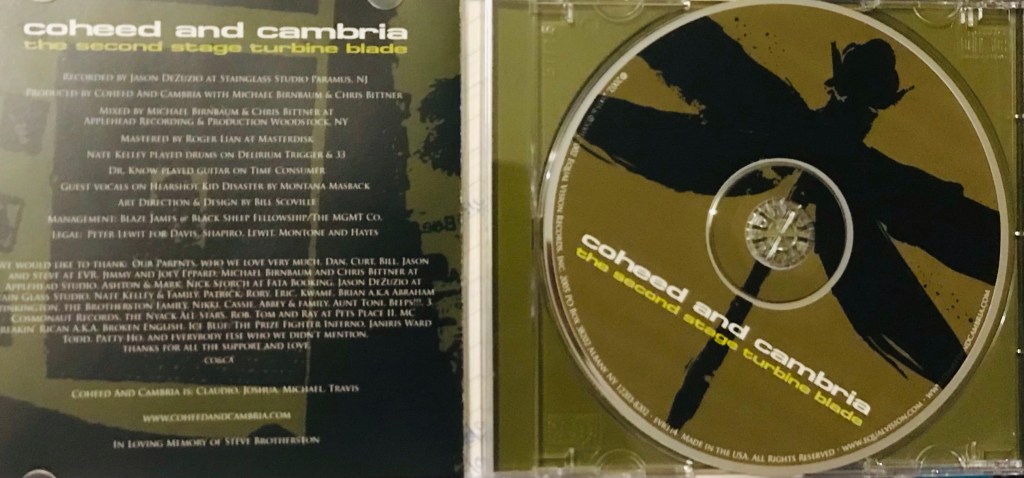
The Record Vault: Coheed and Cambria – Second Stage Turbine Blade

I was waiting for my CD to come in before I did this post.

The debut album was released in 2002, but the story goes back to 1995 when Claudio Sanchez and Travis Stever had a band called “Toxic Parents” which then became “Beautiful Loser”.

Three months later, Stever left and the remaining members renamed the band, “Shabutie”.

Michael Todd was recruited in 1996 and would remain the bassist until his arrest for break and enter circa 2010/11.

As Shabütie, the band released their first studio demo “Plan to Take Over the World” in 1999 and “The Penelope EP” in 1999, shortly after which Stever rejoined the band.

The original drummer left in 1999 and Josh Eppard was the replacement. He would be the drummer on the first three Coheed albums and while he was out of the band between 2006 and 2011 he returned for “The Afterman” albums and is still the drummer at this point in time.

The band went on to release another EP called “Delirium Trigger” in 2000 and several songs that appeared on it, were based on a series of science fiction comics written by Claudio Sanchez called “The Bag.On.Line Adventures”, which were later renamed “The Amory Wars”.

This science fiction story was Sanchez’s side project. Eventually, the band would rename themselves as Coheed and Cambria, after two of the story’s protagonists.

From a story point of view, there is a great summary over at the Coheed and Cambria fan wiki.

In a nutshell, and spoiler alert, Coheed and Cambria are dead by the end of it. Coheed by now had already killed off his children except Claudio and Cambria had to kill Coheed as he unleashed a virus and then unable to live without Coheed, she killed herself. In the process her energy/sacrifice then saved the dying star that Coheed was trying to destroy. Their son Claudio, is left to pick up the pieces.

A lot of pieces of the puzzle are put into place, and backstory’s are told. The fan wiki page does a great job detailing it.

“Second Stage Turbine Blade”

It’s a minute of ambient noise and an ominous sombre piano riff.

“Time Consumer”

The feel of this song in the first minute feels like a Pink Floyd/U2 jam mash up. It is raw and gritty as it grooves its way to the exploding of distorted guitars at the 1.14 mark.

“Devil In Jersey City”

It’s got that pop punk feel, almost happy like but the subject matter is disturbing involving a bashing and a rape by the gang called “Jersey City Devils” on the daughter of Coheed and Cambria and her partner.

“Everything Evil”

This moves into “Everything Evil,” which is arguably the most proggy track on the album. The ending of the song has that piano riff which becomes the first song on subsequent albums

Delirium Trigger”

The heaviest song on the album.

“Hearshot Kid Disaster”

It has a funky riff.

“33”

A pop song which is 3.30 long. Coincidence.

“Junesong Provision”

“Junesong Provision” Heavy guitar and impressive vocals and lyrics make up this noteworthy song.

“Neverender”

The bass is excellent and the riffs are rooted in hard rock. Claudio’s vocals are the most confident on this one and it shows.

“God Send Conspirator”
A clean guitar riff starts the song off, which sounds like an indie song. The bass grooves and funks it’s way throughout.

Standard
Classic Songs to Be Discovered, Derivative Works, Influenced, Music, My Stories

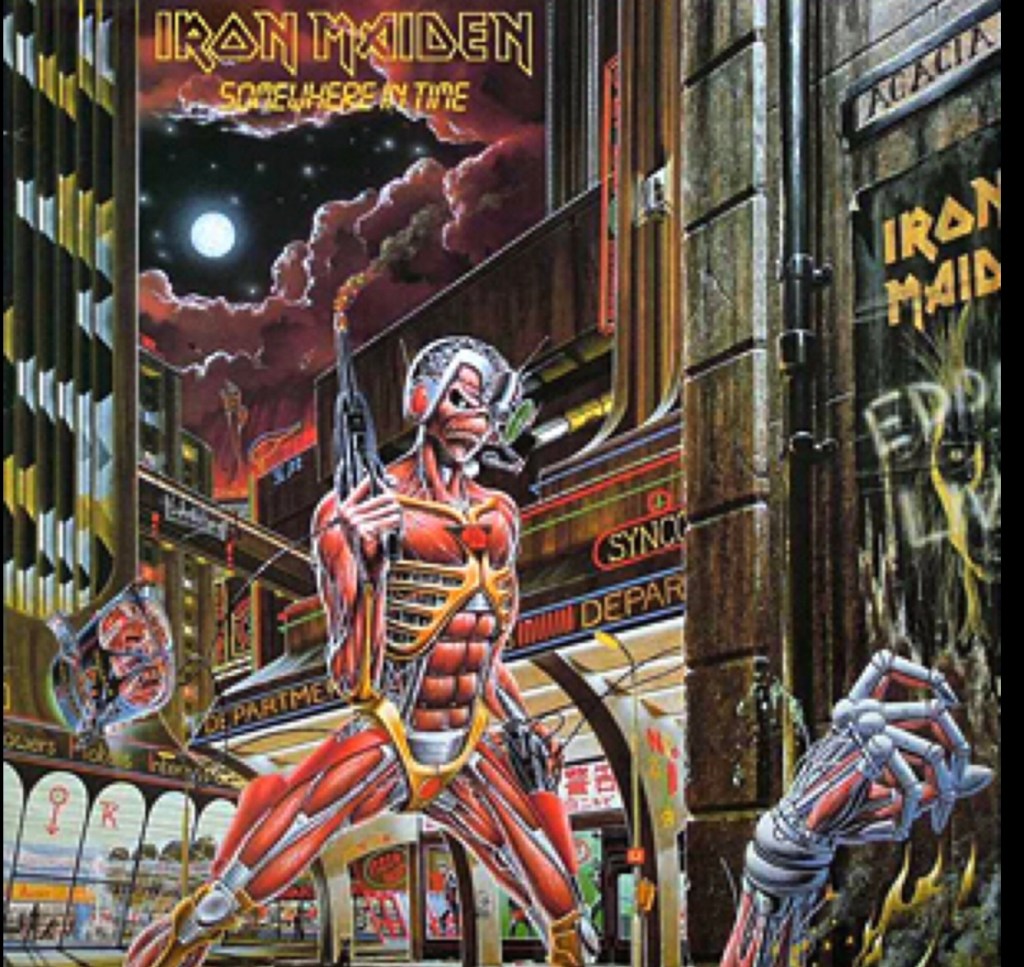
1986 – Part 1.1: Iron Maiden – Somewhere In Time

The first thing that grabs you is the Bladerunner style cover. Bruce Dickinson mentions the same in his book, “What Does This Button Do?”

Apart from buying the album, the fan is also buying a great piece of art by Derek Riggs, who took 3 months to come up with the painting.

During this 80s era, the UK government decided to tax the entertainment industry over 80% of what they earn so this meant that the band and other UK artists had to go into exile and were caught somewhere, far away from home for nine months of the year. So the album ended up being written and recorded in different places and in different studios.

When the sessions started, Bruce Dickinson wanted to do something different, which made everyone laugh. He wanted Maiden to lead instead of delivering just another Iron Maiden album.

But, the fans got “just another Maiden album”. And we loved it.

Steve Harris contributed “Caught Somewhere In Time”, “Heaven Can Wait”, “The Loneliness Of The Long Distance Runner” and “Alexander The Great”. Adrian Smith contributed “Wasted Years”, “Sea Of Madness” and “Stranger In A Strange Land” while Dave Murray brought in “Déjà Vu”.

A chord is strummed, a synth chord rings out and a harmony lead is heard. This repeats for a few times and then a drum groove comes in. Subdued it percolates, changes key and at the fifty two second mark, it explodes.

“Caught Somewhere In Time” had really started. And that exploding intro comes back in the solo section at the 4.50 mark. As Harris once said, it’s about a nightmare trip through time due to a malfunction in the time machine.

The iconic open E pedal point riff starts off “Wasted Years”, Maiden’s contribution to the tales of touring and being on the road for a long time. It’s no surprise that this song was written straight after their biggest and longest tour for the “Powerslave” album which resulted in the “Live After Death” album.

The intro lead riff was rejected by Smith but Harris heard it and told him to work on it.

And the whole solo section is head banging, fists in the air, desk breaking material. Check out the way they build up the intro E pedal point riff into the solo section.

The solo section of “Sea Of Madness” is one of my favourite pieces of music on this album.

“Heaven Can Wait” is the story of a person who is struggling to transition to Heaven. The song just moves along, but when the whole “Take my hand, I’ll lead you to the promised land” section starts off, its pay attention time. Then those “woh oh oh” chants kick in and its desk breaking time. And how good is the clean tone guitar riff under the “woh-oh-oh”.

The guitar intro to “The Loneliness Of The Long Distance Runner” is inspiring, There is a film with the same title and Harris once said in an interview something like, “you always have to run in life, move forward, and you do it alone.”

The way Bruce Dickinson carries the vocal melody for the Chorus is excellent, and then the harmony leads kick in while Nicko McBrain is doing double time on the drums.

Then at the 3.30 mark, a blues rock like lead kicks in with pentatonic bends before it morphs into a metal like solo. And the song ends the way it started, with a tonne of memorable harmony leads.

The open E bass shuffle of “Stranger In A Strange Land” gets me interested, but it’s the Adrian Smith riff that seals the deal.

And how good is the lead break.

While the title shares the same name as the Robert Heinlein book, Adrian Smith based it on a story he read about an old sailor John Torrington, a member of the mysterious 1845 Sir John Franklin expedition that attempted to find the Northwest Passage from America to Asia. More than a century later in 1984, he’s perfectly preserved body was found in the ice of the North Pole.

Check out “Déjà Vu” from the 30 second mark, when that harmony lead kicks in. It’s like “The Loneliness Of The Long Distance Runner” part 2 and it morphs into a riff that reminds me of “Die With Your Boots On”.

How good is the pre chorus vocal melody when Dickinson starts to sing, “cause you know this happened before”?

And that harmony lead from the 2.50 mark. Brilliant.

There is blowing wind, a slow military march tempo and a clean guitar solo. That is how the album closer, “Alexander The Great” starts, and it percolates musically, until it explodes into the verses.

The lyrics are somewhat like a children’s encyclopaedia article however there is enough detail there line by line.

And that groove and feel change at the 4.50 mark is excellent, with more leads and more harmonies.

Not bad for just another album.

But.

For all its excellence, the tracks on “Somewhere In Time” (apart from “Wasted Years” and “Heaven Can Wait”) are really underplayed when it comes to the set lists.

P.S. This issue of Guitar Legends is one of my favorites with a heap of information. But that will be for another day.

Standard
Classic Songs to Be Discovered, Derivative Works, Influenced, Music, My Stories, Unsung Heroes

Australian Method Series – BB Steal

BB Steal was Australia’s entry for world domination in the hard rock movement. But did the world need a new Def Leppard.

Their association with the band wasn’t just inspiration. They opened up for Def Leppard during the “Adrenalize” Tour and Def Leppard guitarist Phil Collen produced the title song on their “Heartbeat Away” EP and co-produced their first full-length album “On The Edge”, which also features a version of the song “Heartbeat Away”. Collen also played some guitar and sang backing vocals on the album, but is not credited.

BB Steal (otherwise known as Beg Borrow Steal) was spawned from the NWOBHM sounding “Boss” band. In typical Australian hard rock fashion, they lived in development EP hell for at least 4 years before the album came out. 4 years is a long time in the music and recording industry.

And the album definitely racked up the bills as recording took place in Los Angeles and Montreal with various engineers and studio players.

Formed in 1987, they released the 4 song EP “Heartbeat Away” in 1988. The title track of this EP set the tone for the sound and feel the band would pursue. The Def Leppard “Hysteria” album sound.

So, “On The Edge” was released in 1991. It’s one of those should have and would have and could have stories. It should have done better commercially, and it would have if Grunge didn’t come, and it could have done great numbers if it came out a few years earlier.

If you love Def Leppard then you will love BB Steal. Critics praised em and also drilled em, calling em a poor version of Def Leppard. But the band was a lot more than the Def Leppard comparisons.

“On The Edge (Lizzy Town)” has this “Led Zeppelin III” acoustic vibe before it moves into a Def Leppard like groove and vocal.

“Big On Love” is probably the best song not written by Def Leppard that sounds like it belonged on “Hysteria”. At one stage I thought it was “Animal”.

Then “Hysteria” starts. Wait, it’s called “Ride On”. They are similar but derivative enough to stand on its own.

“Suffer In Silence” is another track which is very Def Leppard like.

“Live It Up” has a guitar intro that could have come from a Van Halen album, before it goes into an AC/DC like groove. The vocals of Craig Csongrady on this album are just too much like Joe Elliot, in the same way that Marc Storace from Krokus was too much like Bon Scott.

“Shot Full Of Love” feels like a cut from Babylon AD. “Precious Love” has that “Stand Up” vibe.

“Don’t You Love Me and Leave Me” is an AC/DC song musically, with a bit of The Cult added in vocally and musically.

“Heartbeat Away” is from the Phil Collen produced EP, released in 1988 and “Troubled Child” closes the album, with a Journey like feel musically and a Joe Elliot like vocal.

In the 2019, re-issue, it comes with three songs from the original 1988 EP in “I Believe” (very Journey like), “Hold On” (has a guitar hero solo moment) and “Heartbeat Away” (the Phil Collen produced and the song which set the stone for the album to come a few years after).

And when the album did nothing commercially, the band disappeared along with thousands of other hard rock bands.

But in 2012, they returned with a new album called “Resurrection”. But that’s for another day and another “Australian Method Series” post.

Standard
Classic Songs to Be Discovered, Influenced, Music, My Stories, Unsung Heroes

2001 – Part 1.1: Evergrey – In Search Of Truth

It’s time to start a new year in review.

And I normally have about six to ten records on a post but in this case it had to be one album as it’s one of my favorite Evergrey albums.

So Part 1 is broken up into 1.1 and 1.2.

“In Search of Truth” is the third studio album and first concept album by Evergrey. It is the first album to feature guitarist Henrik Danhage and bassist Michael Håkansson, as well as the only one to feature keyboardist Sven Karlsson. Founder and mainstay, Tom Englund is on vocals and guitars with the very underrated Patrick Carlsson on drums.

Produced by Andy LaRocque, who had produced all the band’s previous albums up to now.

The album deals with alien abductions, based on the allegedly factual account of alien abduction victim Whitley Strieber’s book “Communion”.

The album cover was created by Swedish graphic designer Mattias Norén, who I once contacted for a possible album cover for an album I was involved in, before I decided to go with Brazilian artist, Gustavo Sazes.

An alien abduction story can be sort of blah, but Englund is the master at showcasing his personal side in the lyrics. So what we hear lyrically is how the main character struggles to understand what is happening and how scared and confused they are.

“The Masterplan”

Less than 5 minutes and what an opener. One of my favourite songs from Everygrey. Make sure you check out the live version on “A Night To Remember”. They do a Maiden “Running Free” singalong after the lead section which is perfect.

And the music video clip, with people painted to blend in the walls is unsettling as their eyes open, as the main character is being watched at all times.

“I have decided to keep this tape recorder with me at all times. Just so that I maybe one day can explain all the strange things happening to me. The lack of sleep…the loss of time. But most of all, the sensation of never being lonely…always being watched…”

And then the 7/8 syncopated intro blasts off.

Then that Chorus. The constant double kick, the power chords and the vocal melody which sings;

We are all a part off, forced to live within, a conspiracy for ages, the masterplan

The next time the second chorus rolls around, there is a little melodic lead before it. It’s a “why not” moment, to break up the verse and chorus structure.

The instrumental section in the interlude, the lead break and how they come out of this interlude and back into the Chorus. A masterpiece.

Make sure you check out Henrik Danhage’s outro lead break.

“Rulers Of The Mind”

It has another memorable intro.

The stomping drumming in the verses reminds me of “Kashmir”.

There is this orchestral choir happening over one of the lead breaks, which is unsettling.

And how good is the Chorus vocal melody and we had to live through an intro, two verses and a solo before we got to it. And then there is silence and a piano line. And slowly, it rebuilds up.

Make sure to check out the lead break at the 3.50 mark. Then at 4.21 those orchestral choirs come back in. They are cinematic and desperate. And the last 50 seconds, the Chorus reappears.

At 6 minutes long it didn’t get boring and I press repeat.

“Watching The Skies”

It feels like a Malmsteen or Dream Theater cut with the keyboard solo. And the double kick drumming from Patrick Carlsson is relentless, fast when it needs to be and syncopated when it needs to be.

Check out the section from 4.05 and the excellent lead break kicks in at 4.45.

“State Of Paralysis”

It has a haunting piano riff to kick it off and Englund is in theatre mode as he plays a fearful and confused abductee.

“They’re coming, they’re coming”

Englund keeps repeating those words.

“The Encounter”

“State of Paralysis” and “The Encounter” are basically the same song split into two different tracks. This one is progressive. Like Dream Theater “Awake” style of album.

Make sure you check out the guitar solo at the 3 minute mark and there is this ten second guitar melody that plays between 3.50 and 4.00.

And those same words, “they’re coming” keep reappearing.

“Mark Of The Triangle”

This is probably Evergrey at its progressive best, with tempo changes and technical playing. But still accessible.

The start alone has the bass locking in with the kick drum while the synth plays chords and the guitars play a lead.

This morphs into the guitars syncopating, with double kick drumming and the keyboard playing a melodic lead.

And it quietens down to the verse, which is just bass, piano and drums with a vocal melody.

At 1.30 the trademark Evergrey syncopated riff kicks in. It’s their style.

The whole guitar solo section from 3.55. Listen to the piano riff that kicks it off. All the pop songs from Max Martin use it. It’s a Sweden thing.

At the 5 minute mark the synths become dominant and its cinematic.

“Dark Waters”

The symphonic choir is haunting.

At 2.44 there is a different symphonic choir for a few seconds that reminds me of “Suite Sister Mary” from Queensryche. Which isn’t surprising as Queensryche is listed as an influence.

And the last three minutes of the song is epic, reminding me of songs like “The Aftermath” and “The Storm Within” from their recent albums.

“Different World’s”

How good is the piano intro?

And then Englund sings, with all his emotion.

The piano takes centre stage again at the 50 second mark with another iconic riff.

Then it goes back to the piano intro and an acoustic guitar with more vocals.

At 3.26, it’s the tape narrative again about, “oh god, it’s happening again”. The piano is haunting and at the 4 minute the guitar solo begins with big bends.

“Misled”

The album closer. It starts off with a piano riff and then the band cranks in.

Listen to the ahh choir before the Chorus and then there is a blast beat section of furious double kick before the Chorus kicks in.

Each verse has a different riff but within the same chord structure. Its creative and a progressive way of thinking.

At 2.59, it’s the style of Evergrey that they have carried to this day, syncopated staccato guitar riffs with a keyboard melody over the top.

The whole guitar solo section and coming out of it needs to be heard.

And then its silence, with a taped piano riff playing and Englund singing, “I’m crawling back to sleep” before the whole band kicks in.

I have to mention again that Tom Englund is a very underrated vocalist. Each song bears his emotion and soul. You hear anger, sadness, hope, fear and happiness. His voice is strong, ballsy, unique to him and it avoids sounding like a Geoff Tate or Ray Adler or Bruce Dickinson or David Coverdale copycat which a lot of artists started doing to get a break in the market. And throughout this album, his voice moves between strong and bold to panic, crying and whimpering in “Different Worlds” as he narrates, “Oh, god, it’s happening again / I don’t wanna be here / I wanna go home”.

This was also Evergrey’s first release on German label, “Inside Out”, a move up to a bigger label from their previous independent label. For the label, Inside Out, 2001 was a big year as they released “Burn the Sun” from Ark, “Terria” from Devin Townsend and “In Search Of Truth” from Evergrey, all seen as defining albums in the progressive metal genre.

Standard
A to Z of Making It, Influenced, Music, My Stories, Unsung Heroes

Phil Demmel on The Jasta Show

Here’s the link to the Jasta Show interview with Phil Demmel.

Phil Demmel, lead guitar player for VIO-LENCE, formerly of Machine Head is on The Jasta Show. For hard rock fans, Jamey Jasta is the person who wrote the majority of material for Dee Snider’s “For The Love Of Metal” album and working with Dee on a new album. Plus he has albums out as a solo artist and as part of Hatebreed.

I didn’t know of Demmel until he joined Machine Head and I then saw a past link between him and Robb Flynn, when they both did time in the band VIO-LENCE.

It’s a great easy chat between em. Just two muso’s talking and catching up.

Demmel talks about the moment he passed out on stage in Europe at the same time his Dad passed away in the U.S. And he’s spiritual, taking into his life the concepts he likes from Christianity, Buddhism and other religions.

He talks about children.

He found out he has a 33 year old daughter who messaged him via Facebook while he was on tour with Machine Head in the 2000’s and is a product of a 1987 one night high school romance. He has another child from a previous relationship as well.

He also had a vasectomy in 2009, which he then reversed when he got engaged to Bleeding Through keyboardist Marta Peterson in 2012. They have one kid via IVF and another one which “is a miracle”, according to Demmel.

Demmel laughed about never taking the easy route in life.

And both Jasta and Demmel talk about how kids give them focus. Jasta got into podcasting because his daughter wanted to get into it. And I can relate. My kids wanted to make stop motion mini movies so I learned about stop motion. I started to blog because my kids wanted to blog and I did it to show them how. They blogged a few times and stopped.

He talked about his earlier high school bands playing covers of Maiden, AC/DC and Def Leppard. He plays aggressive music and is known for his work with Machine Head but his influences are the same as all of ours, when everything was known as Metal before the labels made up different titles for every sound.

He joined Machine Head in 2002 and he was still working a tradie job, up until 2011. Once the Jackson endorsement money started coming in, he could become a full time musician.

Think about that for a second.

He played and toured the world for a 9 year period and in downtime, had to hustle on a building site for a payday. He remained in Machine Head up until 2018 and he laid down a lot of crushing riffs and a lot of iconic solos, ala Randy Rhoads song within song solo moments.

A listener asked him some of his favourite tracks he’s been involved in.

Demmel mentioned “Farewell To Arms” as he wrote the intro and outro and those sections still give him chills, the Chorus to “Locust” and some of the melodic contributions to “Darkness Within”. “Killers and Kings” was also mentioned as a song he wrote 95% of music to.

He loved being in Machine Head, it was a band he wanted to be in and stay in, but it got to the point where Robb Flynn was going in one direction musically and Phil Demmel was going in another direction musically. So he bailed.

He’s still emotional about the way it ended, the awkward tour and the goodbyes. It wasn’t a clean break, and Demmel mentioned how none of his past break ups have been clean. They’ve all been pretty professional in relation to the departures. He spent 16 years in the band and 98% of it was good, so he’s not going to let the 2% take over the 98%.

If you havent heard him play check out “Darkness Within” and “Locust”.

Standard
A to Z of Making It, Classic Songs to Be Discovered, Influenced, Music, My Stories, Unsung Heroes

Albums That Influenced Jake E Lee

The great Martin Popoff released a book a while ago called “10 Albums That Changed My Life”.

Jake E Lee was one of the artists who gave Popoff his top 10.

The albums “Bark At The Moon” and “The Ultimate Sin” with Ozzy Osbourne introduced Jake E Lee to the masses, but its “Badlands” and “Voodoo Highway” which really showed what Jake E Lee is all about.

But that all ended by 1991.

Since Badlands, he became a recluse and did a few solo releases here and there and he sold some gear for extra cash. He eventually re-appeared with the “Red Dragon Cartel” which didn’t set my world on fire, but as a fan, it was great to have him back, recording and releasing music. And with every release he does I’m still interested to hear it.

So here are the 10 albums which changed Jake E Lee’s life?

Ozzy Osbourne – Bark At The Moon

His first album with Ozzy Osbourne, who told the world he wrote the album with one finger and a piano.

Lee said that this record changed his life. It was exciting to work with pro musicians like Bob Daisley and Tommy Aldridge and to write with Bob Daisley (but Ozzy is credited as the only songwriter on the album) and to record in a foreign country.

The song “Bark At The Moon” is almost at 72 million streams on Spotify. And who can forget that intro riff and the outro solo.

Scorpions – Virgin Killer

This is what Lee said about the album.

“I was in bands by this point. I was going through a lot of different bands.

I was in a funk band and we had a full horn section and I loved playing that stuff.

I was also in a fusion band, where we did a lot of Return To Forever and Mahavishnu Orchestra. It wasn’t a popular band, but it was a fun one to play in.

I was in a rock band and for me, at that point, Ted Nugent was huge but he was not really my cup of tea. He sort of simplified everything and it was making it less interesting and I was getting a little bit tired of rock.

So I think the only band I really enjoyed back then at that moment was Scorpions. Uli Jon Roth was a beast on guitar. But like I say, I was not 100% in rock. I was in other bands that interested me more.”

When “Bark At The Moon” came out, Lee came across as very accomplished and experienced, but when you look at the hours he put in with different styles and different bands, you get an idea of the work ethic in place to expand his mind outside of just rock music.

Led Zeppelin – III

Lee saved up his allowance to buy this album and it became his favourite Led Zeppelin album. This is what he had to say on it.

“I heard “Immigrant Song” on the radio and it was such a nasty riff and a spooky song and I was like, great, this album’s going to be bitchin’.

And I took it home and that’s the only song like it on the whole record. It pissed me off.

I tried to take the record back and they wanted to know why.

And I said, “Because I don’t like it”.

“You can’t bring a record back just because you don’t like it”. And I was stuck with it for the next month, until I could buy another new album. So it was the only new music I could listen to then.

And then it grew on me.

After a month, it was and still to this day is, my favourite Led Zeppelin record. And the reason I wanted to address that is, I kind of feel like our Red Dragon Cartel record “Patina” is like that, most of the songs on there aren’t immediately accessible.”

That’s how it was when you had to buy a physical album. Like it or not, you were stuck with it, so you listen to it a little bit more and you start to like it a little bit more. But from the mid 80’s, a lot of filler started coming onto records and it didn’t matter how many times you listened to the album, you just couldn’t like all of it.

And what are people’s views of “Patina”?

I listened to it once and filed it away. It’s time to get it out and give it a re-listen.

Deep Purple – Machine Head

Lee listened to “Machine Head” a lot as he liked Ritchie’s blues influence and how he made a Strat sound so big and powerful. At this stage, Lee was a Gibson guy.

But when he made his debut to the world with Ozzy he was a Strat guy.

Montrose – Montrose

Lee talks about Ronnie Montrose and how he should have been more applauded than he was, because he was a monster guitar play, with a great tone who could write solid songs.

Aerosmith – Rocks

The first record he got from Aerosmith was “Get Your Wings”. It made him a fan, but it was “Rocks” that became his favourite because of the looseness in the guitar playing of Joe Perry.

Van Halen – Van Halen

Lee basically said, when Van Halen came along, they changed his life.

When this record first came out, he quit the other bands he was in and just stayed within the rock bands. They did a lot of Van Halen covers and he started to write songs in this style.

He goes on to say “Eddie’s playing really turned everybody’s thoughts on how to play guitar upside down”.

Long live the King. RIP. EVH.

Jimi Hendrix Experience – Band Of Gypsies

Lee mentions how “Are You Experienced” is the reason he picked a guitar up, but “Band Of Gypsies” is the album he can’t get enough of.

Lee mentioned how Hendrix was so much harder to learn than the other guys like Page and Clapton, and I agree with him. The other guitar players stuck within normal shapes and patterns when it came to leads and playing, whereas Hendrix was different. Lee called him “John Coltrane on guitar”.

Iron Butterfly – In A Gadda Da Vida

This was Lee’s first rock record he purchased. Before that, he was exposed to James Bond soundtracks. He thought it was the heaviest thing he ever heard.

Black Sabbath – Black Sabbath

Lee thought Iron Butterfly was the heaviest thing he ever heard and then he heard the Black Sabbath debut. Nobody sounded like that according to Lee.

I posted another post previously when Jake E Lee mentioned his Top 5 guitar solos in a July 1989 Guitar World interview. And he more or less has stayed true to what his top 10 albums are.

The list is Jimi Hendrix and “Red House” from the “Hendrix In The West” album released in 1971.

“Crossroads” from Cream’s “Wheels Of Fire” featuring Eric Clapton.

“Since I’ve Been Loving You” from Led Zeppelin “III” featuring Jimmy Page which shouldn’t be a surprise.

“Mean Town Blues” from Johnny Winter and “Stratus” from a Spectrum album featuring Tommy Bolin.

Standard
Classic Songs to Be Discovered, Derivative Works, Influenced, Music, My Stories, Unsung Heroes

As Daylight Dies

From Killswitch Engage, released in 2006.

It hasn’t stopped selling.

Not bad for an album that Dutkiewicz once said in a Guitar World interview, “had riffs in it, so he could play and drink beer at the same time”.

Last week it moved 2,000 copies on vinyl. It was already certified Gold in 2009 by the RIAA and the song “My Curse,” was certified Platinum in 2020. At the moment it has over 122 million streams on Spotify.

Howard Jones was on lead vocals with the usual crew of Adam Dutkiewicz on lead guitar, vocals, keyboards and Joel Stroetzel on rhythm guitar. Mike D’Antonio on bass and Justin Foley on drums.

“Daylight Dies” (the song) was also certified Gold in 2009 and their cover of “Holy Diver” was certified Gold in 2020 and at the moment it has over 75 million streams on Spotify.

“This Fire” is at 49.2 million streams. It’s basically “Fixation On The Darkness” just shorter. And it’s used as CM Punks theme song in WWE.

Combining all things great from the Swedish Melodic Death Metal scene with the American thrash scene and a nod to hard rock and classic rock bands, “As Daylight Dies” captures it all.

The album kept the band on the road for three years. But it also strained the relationship between Dutkiewicz and Jones, which eventually led to the departure of Jones and the return of original vocalist, Jesse Leach.

If you like your melodic metal then check out tracks like “Arms Of Sorrow” (it has this “Back In The Village” solo section) and “My Curse” (the big radio single) which has aggressive hardcore verses and a massive arena rock Chorus. Make sure you listen to the head banging verse riff.

“For You” moves between some of the darkest, progressive and heaviest riffs in the verses to the most melodic riffs in the Chorus.

Check out the intro to “Break The Silence” and if you’re not a fan of the screaming verses, stick around for the Chorus.

“Reject Yourself” is loaded with a lot of good riffs.

P.S. There is no way you could play the riffs on this album and drink beer at the same time, as there is a lot of LH movement.

Standard
Classic Songs to Be Discovered, Influenced, Music, My Stories, Unsung Heroes

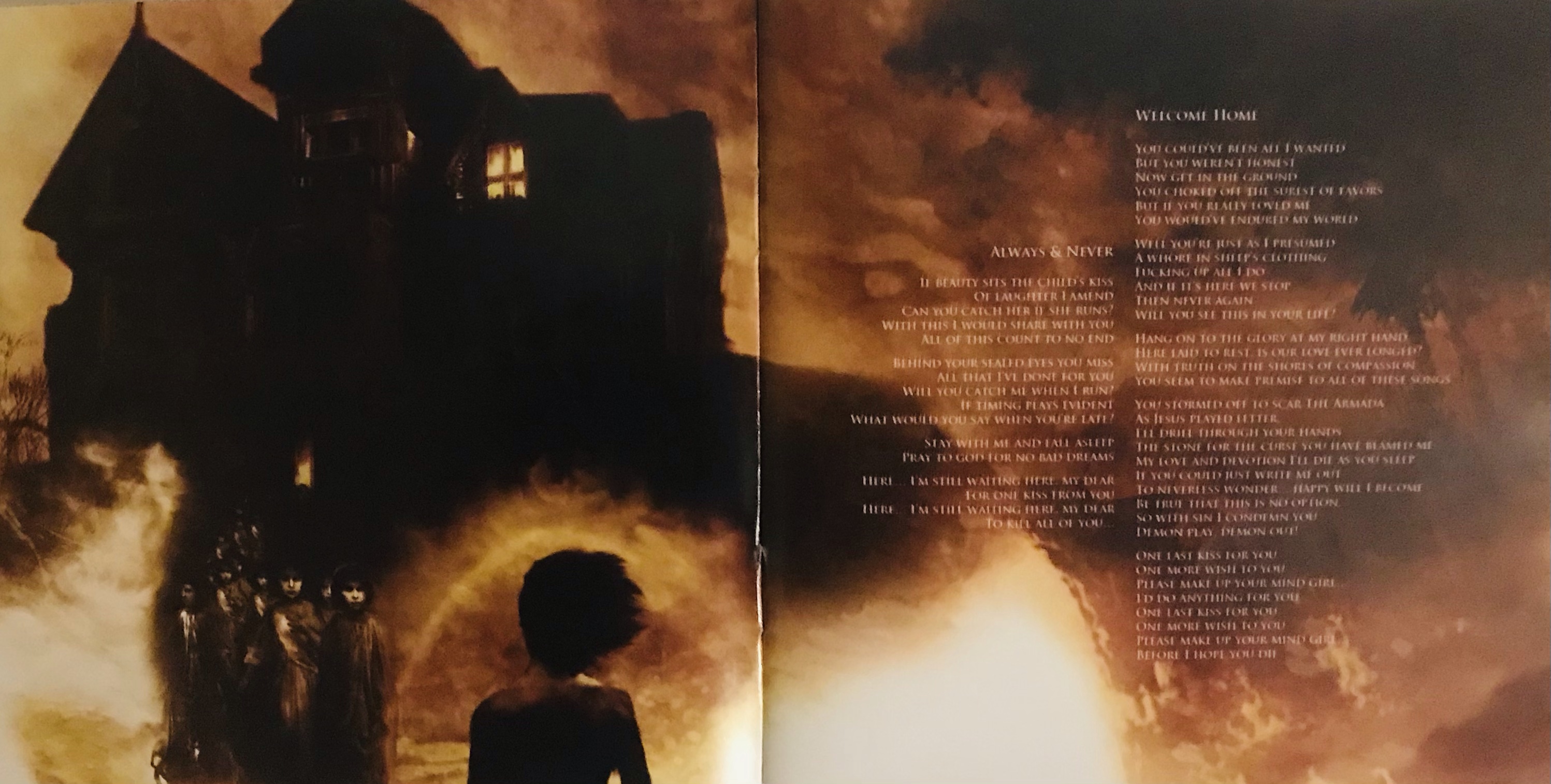
The Record Vault: Coheed and Cambria – Good Apollo, I’m Burning Star IV, Volume One: From Fear Through the Eyes of Madness

Released in 2005, Claudio Sanchez, Travis Stever, Michael Todd and Josh Eppard are back for “Good Apollo, I’m Burning Star IV, Volume One: From Fear Through the Eyes of Madness”, putting in a serious challenge to Meatloaf on the length of album titles.
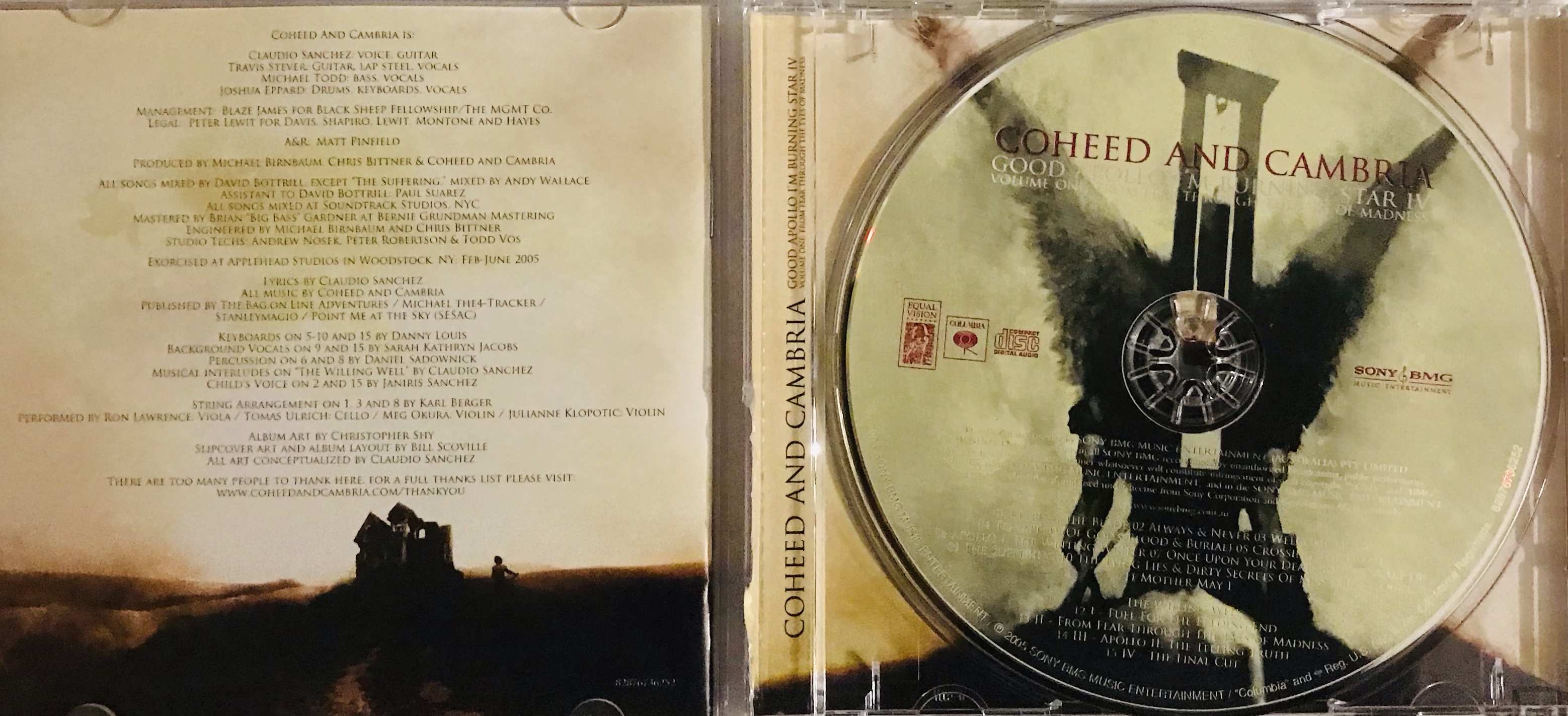
I call it “Good Apollo IV”.

“Keeping The Blade”/”Always And Never”

It starts off with violins and an ominous piano riff. After about 90 seconds, a piece of music which is familiar appears.

Then an acoustic guitar riff starts for “Always And Never”, while Sanchez sings a haunting vocal melody. But these tracks are a set up for what is about to come.

“Welcome Home”

This is the big one, at 73.7 million streams on Spotify.

That intro. Listen to it.

Then the Kashmir like feel and riff comes in which ends up being the main riff. Listen to it.

That outro. With the Kashmir riff, the lead break and the whoa, oh chants. Listen to it.

And when the song ends, listen to it again.

“Ten Speed (of God’s Blood & Burial)”

It’s a major key rock song with a funky bass groove. Songs like these keep popping up on their albums and most reviewers call em EMO songs, which never made sense to me. They are just great rock songs.

“Crossing the Frame”

It continues the major key pop rock vibe of “Ten Speed”.

“Apollo I: The Writing Writer”

After some synths, the riff which kicks off the song is excellent, based on palm muted arpeggios and single notes, with a progressive bass groove.

And the major key Chorus, so catchy and poppy.

The song moves between these progressive verses and poppy choruses, never losing my interest.

“Once Upon Your Dead Body”

The song continues some of those major key pop vibes from earlier songs.

“Wake Up”

At 12.2 million streams on Spotify, the song is another star from the album.

It’s a ballad, but with no cliches. And seriously the hook is around the words “Kill anyone for you“.

Take that, pop singles with 15 writers.

“The Suffering

“The Suffering” is the next high point after “Welcome Home” and at 22 million Spotify streams, it’s also one of the big songs from the album.

The most catchiest, especially the vocal line, “listen well, will you marry me and are you well in the suffering” which sounds like the hook from Three Evils’s, “pull the trigger and the nightmare stops“.

And we like it.

“The Lying Lies & Dirty Secrets of Miss Erica Court”

Nothing really connected with me on this one.

“Mother May I”

It’s probably the best Police song written in the 2000’s, that Sting, Copeland and Summers didn’t write.

The final 4 songs are part of a suite called “The Willing Well”.

“The Willing Well I: Fuel for the Feeding End”

Not one of their best.

“The Willing Well II: From Fear Through the Eyes of Madness”

At the 3.15 mark there is this section with whoa oh oh backing vocals that reminds me of Maiden. Musically it’s got all these other little Maiden sections.

“The Willing Well III: Apollo II: The Telling Truth”

The guitar and bass both play unique progressions and it works so good together, all held tight by the unorthodox drumming of Josh Eppard.

“The Willing Well IV: The Final Cut”

“The Final Cut” closes it nicely, more slower, doomy even. There’s a church organ in the background and the guitars sound like they came from the 70s.

And that wah drenched solo needs to be heard. After it goes into a Gilmour like clean tone solo, which again needs to be heard.

Vocally Sanchez is in the zone.

Press repeat on this one as well.

And now for the story, if you’re interested. Plot spoiler warning.

It takes place in the real world of “The Writer”, the person writing the story and it mixes up the reality of The Writer with the fictional story and I’m not a fan of stories that are written like this.

But in the process of the two stories being told, the sci-fi story progresses as the mental health of The Writer regresses. And I will do my best to summarise what it’s all about.

So from the story point of view, Claudio works out that the Keywork is powered by the energy of enslaved souls who want to be set free, and the only way to free them is by destroying Heaven’s Fence.

From The Writer’s point of view, he wants to do bad things to his cheating ex, Erica Court and his mental health deteriorates even further.

Back to the story, a rebel strike team has disabled a generator on a planet, which allows a rebel spaceship to land.

Sound familiar.

Claudio realises he’s “The Crowing” which is sort of like “The Chosen One” to bring peace to the galaxy.

But the bad guys in the story, Wilhelm (aka The Emperor) and his General (aka Darth Vader) have a trap waiting.

Back to The Writer, he has become like Caligula, and is now talking to his bike called “Ten Speed” (Caligula spoke to his horse and made the horse a Senator). Ten Speed tells the Writer not to murder his ex, but to exact his vengeance metaphorically by killing Ambellina, who represents Erica’s good side in the story, and is the love interest for Claudio, which will in turn cause Claudio to accept his destiny as the Crowing and destroy the Keywork.

Back to the story, Claudio and Ambellina arrive at a meeting place, the Willing Well, in which they can see the Writer’s argument with Ten Speed take place.

The Writer eventually uses the Willing Well to pass into his own story. The Writer explains to Claudio he must kill Ambellina for his own peace of mind, so that the story may have an ending. Claudio refuses and The Writer (who has God like powers in his own story) kills Ambellina, and walks off into the distance with his bicycle, Ten Speed, leaving Claudio with the message “all worlds from here must burn,” implying that it is the Crowing’s duty to destroy the Keywork.

And the next album “No World For Tomorrow” is set up.

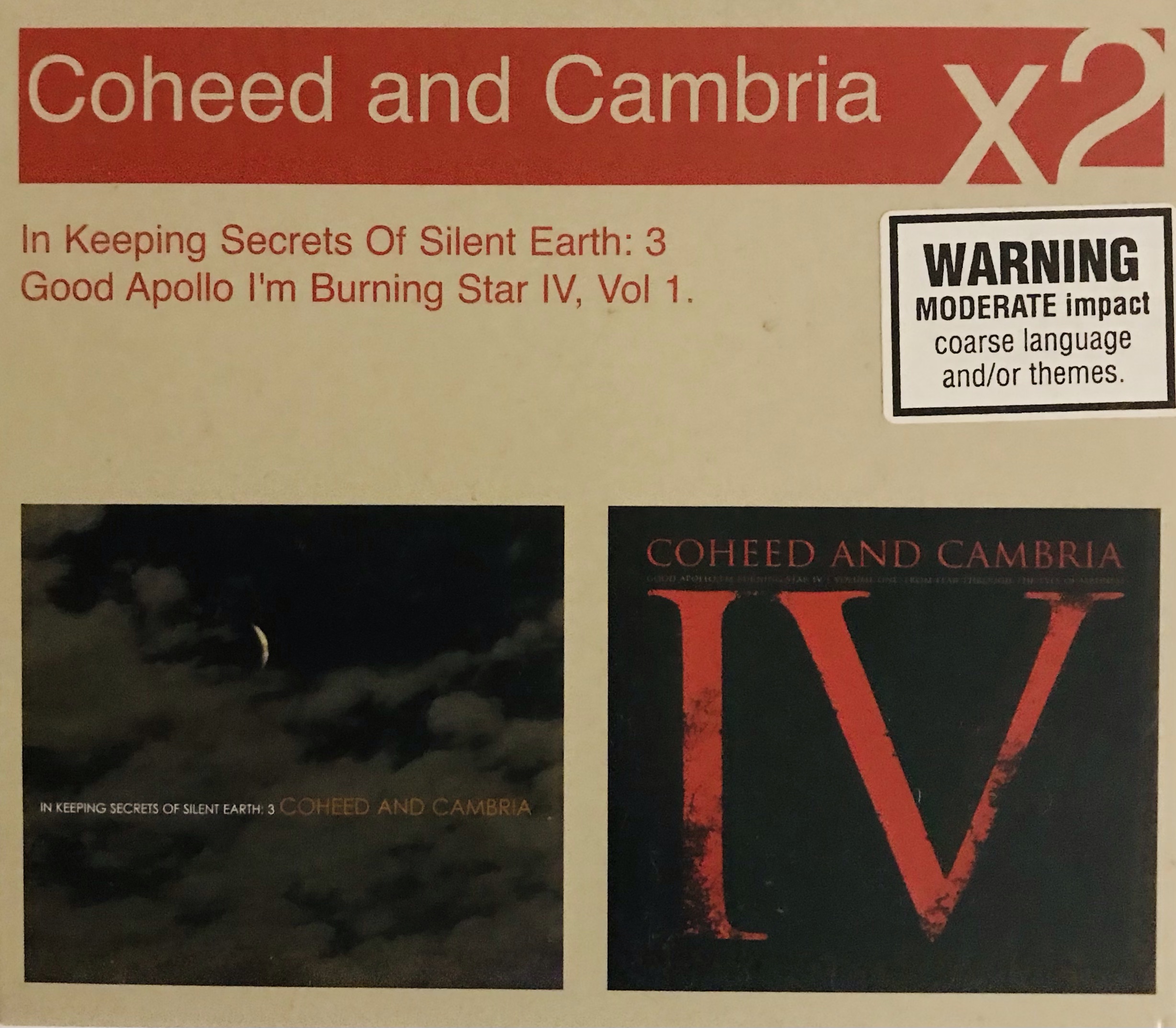
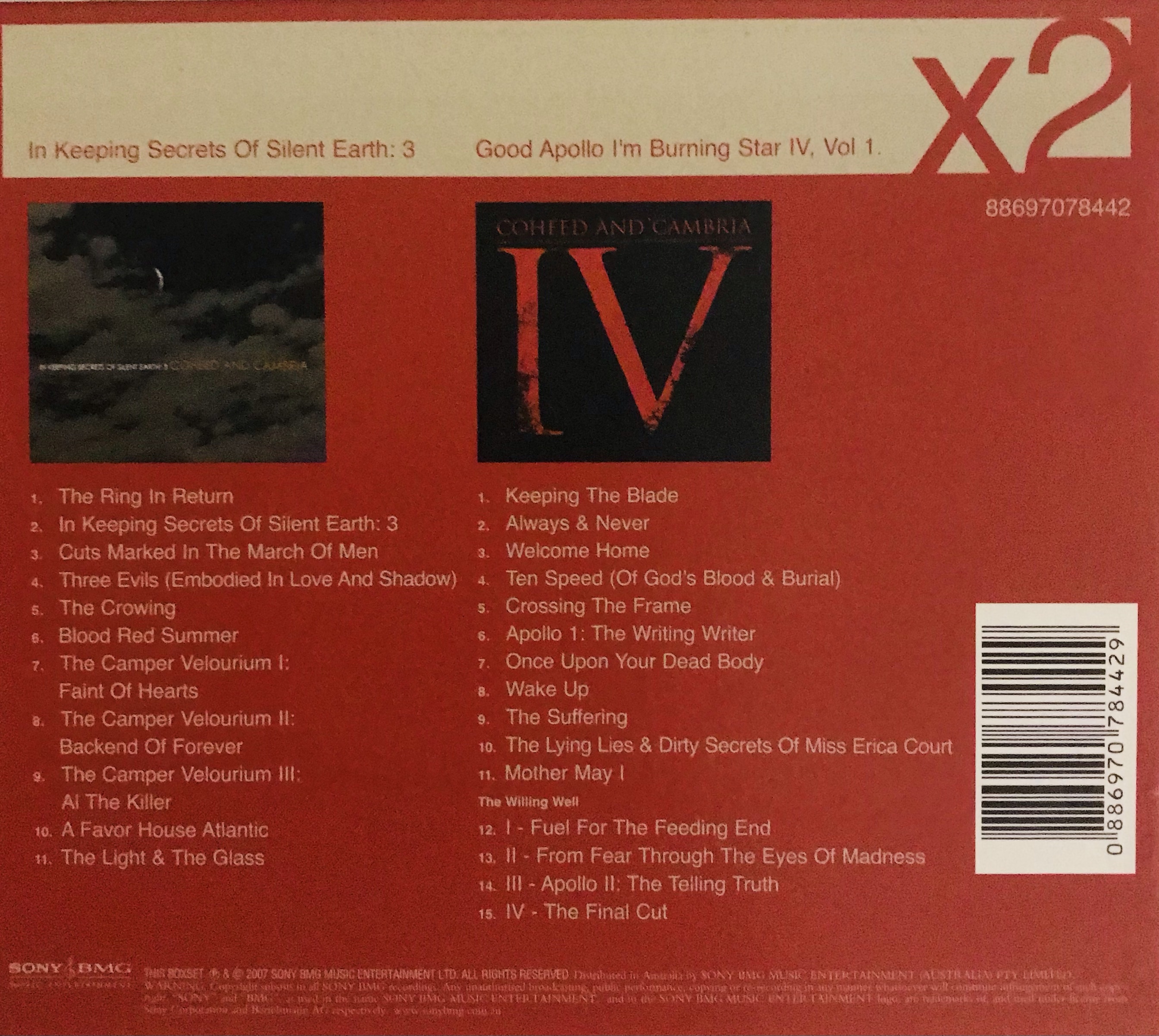
Here is the box set the two albums came in.

Standard
Music, My Stories

The Week In Destroyer Of Harmony History – March 1 to March 7

4 Years Ago (2017)

This period is always busy for me, with getting the football season up and running in Australia, so as a volunteer to my local club, there’s no time for blogging.

“All The Right Reasons” from Nickelback is certified Diamond for sales of over 10 million copies in the United States. Not bad for a Canadian band who started out as a Metallica copy cat in the garage.

8 Years Ago (2013)

Like 2017, this period is always busy for me, with getting the football season up and running in Australia, so as a volunteer to my local club, there’s no time for blogging.

Also in 2013 an important case happened in a Czech court.

Lamb Of God singer Randy Blythe was charged with manslaughter, stemming from a 2010 gig in Prague in which a fan went onto his stage to stage dive and Blythe pushed him off, which is the norm at these kind of concerts.

In this instance, the fan sustained head injuries during the fall, however he still finished watching the concert, but after the concert he didn’t feel well, fell into a coma and died. When LoG toured Prague again, Blythe was arrested and held in jail.

This happened in June 2012.

After spending more than 8 months in jail Blythe was acquitted of manslaughter and returned home to the U.S.

And here is some other music history.

2003 (18 Years Ago)

Who didn’t hear the “Fallen” album from Evanescence (which came out during this period)?

2002 (19 Years Ago)

“The Osbournes” premiered on MTV which showcased a very high or intoxicated Ozzy trying to work out how to use a remote control and his family at home. In the process it became the most-viewed series on MTV.

1999 (22 Years Ago)

It pisses me off when labels do this to artists, because without the artists the labels would have nothing. In this instance, (and according to Wikipedia) Trauma Entertainment filed a $40 million breach-of-contract lawsuit against the band Bush for their failure to deliver a new album.

1994 (27 Years Ago)

Lemmy wrote some of his best lyrics on “I Don’t Want to Change the World” which appeared on “No More Tears”. And it got Ozzy Osbourne a Best Metal Performance with Vocal.

1991 (30 Years Ago)

“The Doors” biopic from Oliver Stone is released, with Val Kilmer playing the role of Jim Morrison. I watched the movie and I felt like it was the real people, compiled of intimate footage found.

I need to rewatch it and see if it’s stood the test of time.

1986 (35 Years Ago)

Some people call it their greatest album. For me, it’s always “Ride The Lightning”. But during this period, “Master Of Puppets” from Metallica was released.

1984 (37 Years Ago)

“This Is Spinal Tap” is released, one of the best movies I have seen. Well at the time, I thought it was a movie, I must have missed the part at the end that said it was fictional and all that.

1974 (47 Years Ago)

Rush (with no Neil Peart) release their debut album, a blues rock influenced album with some progressive overtones. “Working Man” become the anthem.

1973 (48 Years Ago)

“Dark Side Of The Moon” from Pink Floyd is released. It didn’t set the world on fire initially, but word of mouth kept promoting it and its biggest sales happened between 1977 and 1988.

And that’s it for this week.

Standard