Netflix had a debt problem. Spotify hadn’t turned a profit and neither had Pandora. Meanwhile, Soundcloud was for sale.
And they had expenses.
They had to pay for content either by creating their own for TV and Film providers, or by licensing content from the labels and movie studios.
The ISP’s then charge all the streaming providers a lot of money for them to use their fast channels without any buffering and then the ISP’s charge us to use the internet and access these streaming services.
But all of these streaming providers have the same issue every other service and artist has.
People can’t slow down their lives long enough to immerse themselves in their content at a rate they would like.
If Netflix has this problem, imagine every up and coming musician or established musician.
1983 was a revolutionary year and the year that metal and rock music became a commercial force and a massive influence on society. Along with the rise of MTV, culture changed dramatically.
Metal and rock music made governments introduce censorship stickers on new releases.
Preachers and TV evangelists became rich and famous when they condemned the art form and told their followers the devil is on the loose, only to be caught with their pants down in seedy motels.
Lawyers took artists to the civil courts because suddenly when records got played backwards people believe they found subliminal messages telling kids to kill themselves.
Band T-shirts had been around before, but nothing like the 80’s. A whole new billion dollar industry came about, because of the imagery. We wanted the T-shirts. It told the world we are a member of the club.
It was just unfortunate that the record labels abandoned these musicians for a newly created record label genre called Grunge.
8 Years Ago (2013)
It’s the music that makes “Learning To Live” from Dream Theater a classic.
“Learning To Live” was released in 1992 on the “Images and Words” album. The song is that good, that Dream Theater even rewrote it and called it “Breaking All Illusions” for the “A Dramatic Turn of Events” album in 2011.
I wrote about artists staying true to their artistic vision and doing what is valuable to them, using bands like Evergrey, Coheed and Cambria, Dream Theater, Digital Summer, Five Finger Death Punch and Protest The Hero as examples.
I compared 2011 and 2013 as it felt like déjà vu again.
In 2011, I was listening to “In Waves” from Trivium and “A Dramatic Turn of Events” from Dream Theater.
And in 2013, I was waiting for “Vengeance Falls” from Trivium and Dream Theater’s self titled album to drop.
We are living in the generation of kids born from 1997 onwards. A generation who consumes music and entertainment digitally. Their sense of community is all online. These kids weren’t alive when the Record Labels ruled the day, so they have no desire for that era, they are all about today and what lays beyond.
The music community has shifted to being a song centric community. We just don’t know it yet. The album format that used to make the most money for the record labels is almost a dead format. However artists still go back and release a collection of songs as an album.
But it’s what gets played over and over again and into the future that matters.
The band Bleak House have two highly-regarded releases out in the market and a loyal fan base. One of those releases is a single called “Rainbow Warrior”, that has a movable power chord verse riff that went from B to C to D over an E pedal tone which would go on to form the main riff in Metallica’s “Welcome Home (Sanitarium)”.
And Bleak House struggled to write new material and compete with the other acts releasing music consistently. Eventually they disappeared.
Any artist starting off you need to be creating and releasing. Forget about the 2 to 3 year gap between albums. That is the Record Label standard. It was never the artist standard.
Orianthi’s breakthrough was “Believe”, her second album, which came out in 2009 and the hit single “According To You” which she didn’t write as the album had a star studded line up of songwriters and producers either writing songs for Orianthi or working with Orianthi to write songs.
“O” was released in 2020, after her collaboration with Richie Sambora known as RSO finished up or put on hold.
It’s on Frontiers, produced by Marti Fredericksen and it’s great to see Orianthi back out on her own.
And from reading interviews it looks likes the drumming is created/programmed by Evan Frederiksen.
“Contagious”
It’s got a riff that reminds me of Sixx A.M and DJ Ashba like “Lies Of The Beautiful People”.
The song is written by Orianthi and Marti Fredericksen, who has worked with a lot of artists and since I was listening to Motley Crue a few weeks ago, he co write all the tracks on the “Saints Of Los Angeles” album.
And “Contagious” has that sound. It gets me rocking, as it amalgamates blues rock with a bit of Muse chucked in and a modern rock mix.
Lyrically it’s about hatred, and how easily we could all be infected with it.
“They shall not break us ‘cause hate is contagious”
Check out the guitar lead. It’s short but good.
“Sinners Hymn”
It’s is a nice amalgamation of the devils blues music with modern rock to create a sinners anthem.
Check out the section after the solo. It gets all quite with a riff that reminds me of “The Bleeding” and “Prayers Of The Damned” as it builds up again.
“Rescue Me”
This track could appear on a Rag’N’Bone album. It’s got that “Human” feel.
Orianthi is all soul in her vocal melodies on this and delivers an emotive lead break.
“Blow”
It’s a sleazy, sexy and sultry groove that percolates until it explodes in the Chorus.
“Sorry”
It’s a contemporary pop song with a funky hip hop beat. There are synths and a killer vocal delivery from Orianthi.
And I like the mix between merging hip hop beats with a melodic rock vocal melodies and in the Chorus it’s pop rock.
The solo is very Santana inspired and I like it.
“Crawling Out Of The Dark”
It’s on acoustic cut, quite, subdued and melancholic. It wouldn’t be out of place on a country rock record.
Lyrically it’s about a relationship break down and how she’s crawling out of the dark. And when she got out, she didn’t know she had fallen that far.
And check out the blues influenced solo.
“Impulsive”
It’s got this Rolling Stones/Free inspired riff that I like.
The lead break is very SRV influenced.
“Streams Of Consciousness”
It starts off with a music box.
It’s a co-write with Nikki Sixx and Marti Frederiksen. Modern rock at its best with some good rock riffs.
Nikki Sixx delivered lyrics about the glamorous but filthy side of Los Angeles.
The solo starts off with a Nu-Metal riff before she breaks out the wah-wah and it sounds very Slash like.
“Company”
It has blues guitar but the background foundation is very synth dance driven.
And a chorus that would not be out of place on an album from “The Cure”.
The best way to sum it up is an amalgamation of different music genres. And because the melodies sound melodic and soulful, it all works together.
“Moonwalker”
It’s got this Latin vibe with a bit of an Enya feel. And the song and overall album gets me thinking about Queen, who also incorporated so many different styles into their albums.
In other words there is a lot of variation here and a little bit for everyone.
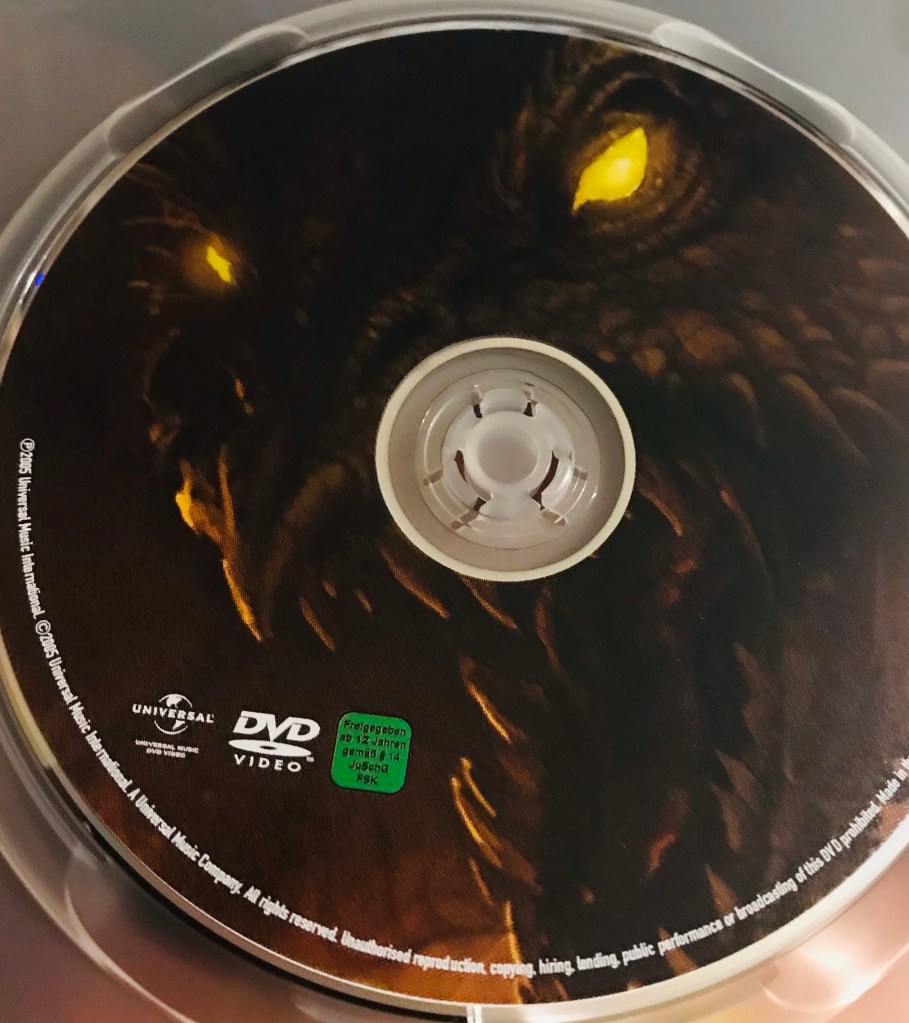
“We Rock” (the DVD) was released in 2005. It collects two VHS releases from the early 80’s and brings them forth into the 2000’s. The sound is still rooted in the 80s with a bit of a clean up.
The early 2000’s became a period of re-invention for Dio. After experimenting with Nu-Metal in the mid 90’s, he went back to his roots, to his kind of metal and rock and re-established the “Dio” brand as a commercial force.
For studio albums, in 2000, we got the “Magica” studio album, “Killing The Dragon” came out in 2002 and “Master Of The Moon” in 2004. In addition, “The Devil You Know” from Heaven and Hell hit the streets in 2009.
For live albums, in 2005, we got the “We Rock” DVD and “Evil or Divine – Live In New York City”, “Holy Diver – Live” in 2006 and “Live From Radio City Music Hall” in 2007 from Heaven and Hell.
But it was the live show which brought in the money. His audience from the 80’s remained faithful and they turned up with their adult kids.
Through placement in movies and certain bands covering his songs, Dio was also generating revenue from licensing, sales and streams. And while artists have their views on piracy, having the Dio catalogue available to download for free, increased his supporter base, which led to an increase in the audience to the live show. This happened for a lot of bands who did it tough during the 90’s. Motley Crue and Twisted Sister come to mind.
In the link, the research suggests that every ten music albums pirated leads to three extra concert or festival visits. However, at the same time, it leads to a significant drop in physical album sales and digital downloads.
Dio – Live In Concert 1984
The show was recorded in Holland/The Netherlands on 4 December 1983.
The stage show is massive, with Vinny Appice sporting a very unpleasant looking red leather jumpsuit is sent up on the second level of the building. In other words, the drum riser is very high.
“Stand Up And Shout” is the opener, with Vivian Campbell playing a black Les Paul shaped guitar, running around like a madman on stage, while Jimmy Bain holds it all together, especially when Campbell drops out for the lead breaks. And of course, Dio is nailing his melodies, as the tempo at which they play the song live wouldn’t have helped vocally.
“Stand Up And Shout” feedbacks into the groove riff of “Straight Through The Heart” and I like it. Dio’s voice is like an instrument here itself, especially in the verses.
“The Pink Panther” like riff kicks off “Shame On The Night”, which gets the audience clapping along, before it moves into the doom riff. It’s slower tempo is perfectly placed in the set list.
How good is the bass and drums on the verses, as they carry the music along with Dio’s melodies?
And the outro riff reminds me of the “Escape From New York” main theme.
“Children Of The Sea” is next and a nice recognition of his Black Sabbath output. Dio and Appice really shine on this track, while Campbell and Bain carry out what needs to be done musically. Then the solo comes and Campbell shines, staying faithful for a bar or two and improvising after that.
“Holy Diver” is the pinnacle of the show. The band is on fire and the audience is loving it.
When the song ends, a “Drum Solo” starts.
I hate lone drum solos and guitar solos in concerts. I see no point in them, especially when the artist has enough material to play songs. But I do like it when a drum solo or a guitar solo is within the song, which I’ve seen some artists do.
After the “Drum Solo”, one of my favourite cuts starts in “Heaven And Hell”. As soon as Dio starts with the “sing me a song” line, the whole crowd is in the palm of his hand, singing along with him. It sounds like Claude Schnell came out of hibernation to add some synth licks but he’s nowhere to be seen on the stage.
Campbell is faithful to Tony Iommi as much as he can and when it comes time for the lead breaks he does improvise a lot, but then again so does Dio, adding new vocals over the jam grooves.
As they are jamming along, with Campbell soloing, the music stops and we get a “Guitar Solo”. As mentioned, I hate it when they take up time in a concert, however you do get to hear how accomplished Campbell is as he pulls out all the licks and tricks from his arsenal.
Bain and Appice then kick in with the “Heaven And Hell” groove and Campbell keeps soloing with music as the background and this I like.
Dio then comes in and gets the crowd involved in a sing-a-long.
The issue I have is that it does go on and on and on and on.
Finally the fast outro kicks in, however it is ultra-fast here, with my favourite lyrics in “the moon is just the sun at night”.
After about 20 plus minutes of the song, (including the guitar solo), the song ends. And the Dutch are screaming “Dio”.
Band introductions take place and Dio says something like “I like to introduce the next song, which has rainbow in it but nothing to do with the band of the same name”. Since no Rainbow songs are included on the release, you can presume the bad blood between Richie and Dio was still too much. But I do think he played a couple of em, but just didn’t include them.
“Rainbow In The Dark” cranks in and how can you not sing when Dio starts with “when there’s lightning”.
Once the song ends, the crowd chants again “Dio” over and over again.
It’s all black, then red eyes light up from Dio’s mascot and an encore is happening.
“Don’t Talk To Strangers” closes the gig, the embryo to “The Last In Line” and “We Rock”.
Dio – A Special From The Spectrum
The opening track “Stand Up And Shout” is not included in the DVD release, but you can see it on YouTube if you want.
The stage show is a bit different, going with the theme of “The Last In Line” album cover, however Appice still remains on the second floor, so high up from the rest of the band.
This time around Campbell is sporting the red leathers and his playing a Charvel/Fender style guitar. Dio as usual is nailing it vocally and Bain is always reliable with his bass rumbling away and then carrying the music when Campbell drops out for the lead break.
And the band is ferocious this time around. They have the “Holy Diver” album and tour behind them and their out promoting “The Last In Line”.
“Don’t Talk To Strangers” is song number 2 and it opens up the DVD concert version. On the “Holy Diver” tour, this was the closer. And it’s a great decision to open the album with two songs they have played a lot because their delivery is so fluent.
“Mystery” is up next, the first song played from “The Last In Line” album. It’s major key vibe and Hard Rock Mainstream style Chorus works well in the set, after the two metal cuts before it.
Then my favourite Dio song starts in “Egypt (The Chains Are On)”. That riff from Campbell and the slow “Heaven And Hell” drum groove from Appice is all I need. Suddenly I’m singing, “in the land of the lost horizon” and “when the world was milk and honey”.
Half way through the song, a “Drum Solo” starts and as you know, I hate these moments in concerts.
And like the previous show, they go into “Heaven And Hell” and this time Campbell is playing an Explorer shaped guitar. And like the previous show, as soon as Dio starts singing the first verse, the crowd is singing with him. The song is played similar to the previous concerts with a lot of jamming in the lead break.
And then the music stops and we get a “Guitar Solo”. You know my views on these lone solo pieces. I don’t know why Campbell would need to have this moment as he was wailing away on the “Heaven And Hell” groove and it sounded so good. Anyway, like the previous show, Appice and Bain then kick in with the “Heaven And Hell” groove and Campbell keeps soloing and this little piece I like.
Dio comes out, and yells, “Vivian Campbell and his magic guitar” and the crowd roars their approval. Then he gets the crowd involved a sing-along. And I’m bummed that the fast outro of the song doesn’t get played.
But they do go into “The Last In Line”.
The medieval fingerpicked intro hides the metal cut that the song would become.
“We are coming”, silence, “hoooooome” as the riffs kick in. The band is nailing everything and Appice is thundering. And for such a new song, the crowd is singing along with him. I guess you can’t keep a good song down.
Once the song ends, something unexpected happen. They go into the fast outro section of “Heaven And Hell” and I’m not bummed anymore as this is my favourite section of the song. Campbell is wailing away here on the guitar again, which makes me question why there had to be a lone “Guitar Solo” spotlight.
“Rainbow In The Dark” cranks in, with Dio sending out his devil horns salute at the end of every fourth bar. They know what needs to be done and they deliver.
Campbell’s playing is excellent and I like how he adds a few extra fills here and there in his lead break, letting the energy of the show take over and command his performance. And Appice can play a metal cut with just his snare, he’s that good on it.
“Mob Rules” kicks in. It’s full of energy, and Campbell goes all shred in the lead break, totally playing his thing, sort of like how Randy Rhoads did with the old Black Sabbath cuts.
The show ends, it goes to black, only for the band to come out and tell the audience they deserve another one.
And what a closer.
“We Rock” kicks in and that opening guitar riff is head banging, circle pit like. And there’s fireworks going off like crazy, lasers and did I mention that Appice can carry a song with a bass drum and snare. He can.
And the show is done.
If you want to see the classic era Dio band at its best, this DVD is a must have. Press play and enjoy, as half of the band has come home and I guess we’ll never know if they were evil or divine. RIP Ronnie James Dio and Jimmy Bain and thanks for the music and memories.
I was reading Guitar Legends and there was a feature on each decade from the 60s to the first 2000’s decade.
So in the 70s decades they covered some important and influential albums.
“Paranoid” by Black Sabbath, “IV” and “Physical Graffiti “ from Led Zeppelin, “Machine Head” by Deep Purple, “A Night At The Opera” by Queen, “Destroyer” by Kiss, Boston’s self-titled debut and “Never Mind The Bollocks” by The Sex Pistols are mentioned.
Thin Lizzy didn’t even get a mention. Written out of history. If there is a band that brought harmony guitars to the masses, it’s Thin Lizzy.
But they didn’t have a guitar hero in the band and a front man who wasn’t a pretty boy.
The band is Phil Lynott on vocals and bass, Scott Gorham and Brian Robertson on guitars and Brian Downey on drums.
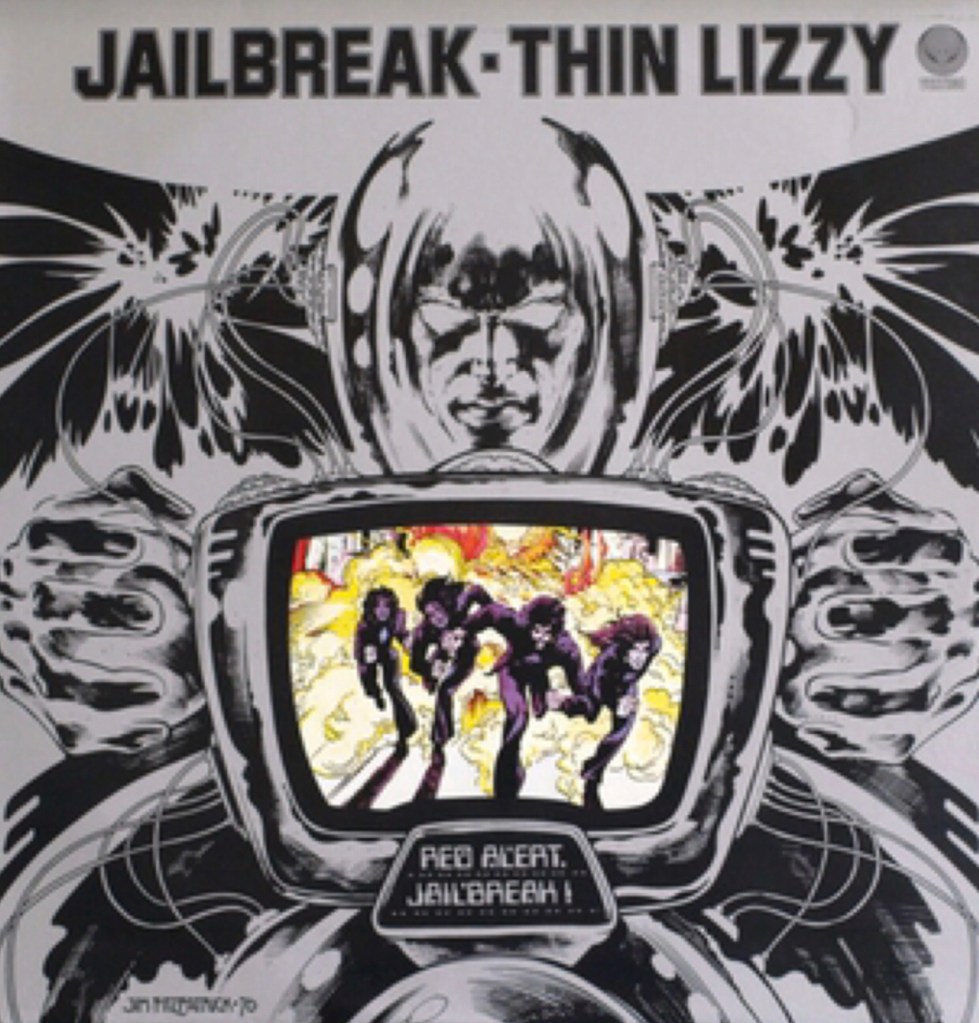
“Jailbreak” is the only Thin Lizzy album which has a certification in the U.S, a Gold one for 500,000 copies sold. But they never really toured behind the album as Lynott was fighting hepatitis.
It was also their last chance as “Nightlife” and “Fighting” didn’t meet the commercial expectations their label had.
And while Robertson felt the production was too restricted which led to less improvisation, it was exactly the tight ship that was needed to push them into the arenas.
Press play and have fun.
Jailbreak
How good is the main riff?
When the sirens start, listen to the riffs under it, it’s like the rumble/fight riffs in stage play soundtracks. Alice Cooper did something similar with “Gutter Cats vs The Jets”.
It’s a 41.5 million streams on Spotify.
Angel From The Coast
Downey on the drums is a star. Listen to how he swings, not a beat out of place.
Great lyrics about the boys playin poker and the joker being their favorite card and the middle section reminds of Hendrix and the Lizzy boys are swinging with the best of em.
Running Back
It’s a blues melodic rock cut inspired by Van Morrison and the first single from the album.
And it’s the little things, like the keyboard, saxophone, and overdubbed guitar lines from Scott Gorham that all add up.
Romeo And The Lonely Girl
What a great guitar solo in a song dedicated to those right girls that come at the wrong times.
And the solo keeps going when Lynott starts singing again.
Warriors
Lynott’s way of defining heavy drug takers was by describing them as warriors.
The Intro riff shuffles along.
Great soloing from Brain Robertson with a lot of wah wah.
But the piece d’resistance starts from the drum improv section at 2.53 and continues to the end. It’s progressive rock and a wow moment.
The Boys Are Back In Town
The big hit single, at 247.2 million streams, which still gets played on radio and licensed to movies, TV shows and advertisements in 2021 generating millions in royalties.
But no certification in the U.S market, however you would be hard pressed to find a person who doesn’t know the song.
So do you really need a sale or a plaque on the wall to show off your success or the success of a song?
And it did something massive for songwriters, making twin guitar harmonies an actual thing in popular songs.
Fight Or Fall
It’s got this Rod Stewart “Maggie May” feel, a strummed soul blues number.
Cowboy Song
The slow acoustic intro doesn’t foretell the rocker to come. 14.7 million streams on Spotify.
Emerald
The embryo and foundations of what Iron Maiden would be is in this song.
The Irish influences are here as well, something that Gary Moore would use a lot of on the “Wild Frontier” album.
It’s one of my favorite Lizzy albums of the Robertson and Gorham era on guitars. Lynott is unique but it’s Downey who owns this album. His drumming is superb and very underrated.
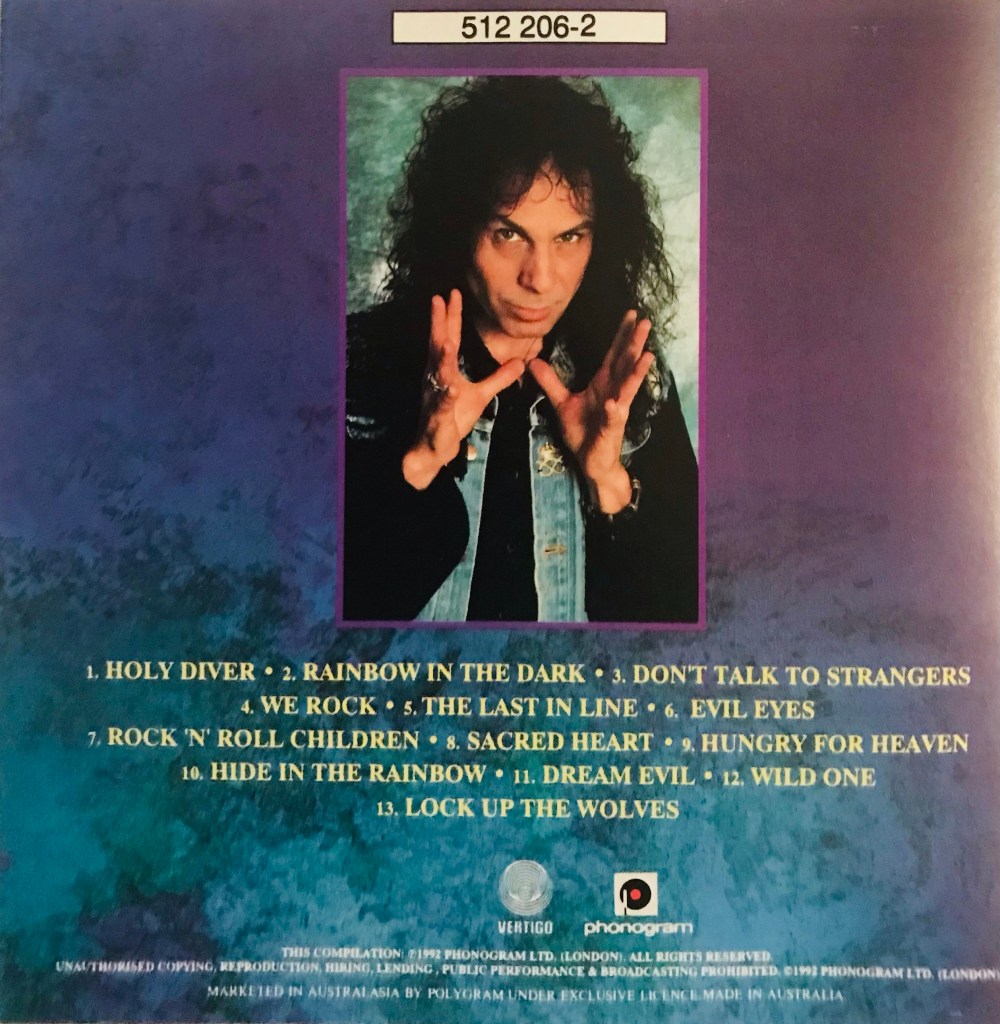
“Diamonds – The Best of Dio” was marketed as a “greatest hits” collection. I remember the ads. But the title says, “best off”. I guess marketing people don’t know the difference between “greatest hits” and “best of”.
And Ronnie James Dio is one of those artists who didn’t sit don’t to write hits. He just wrote songs that he liked.
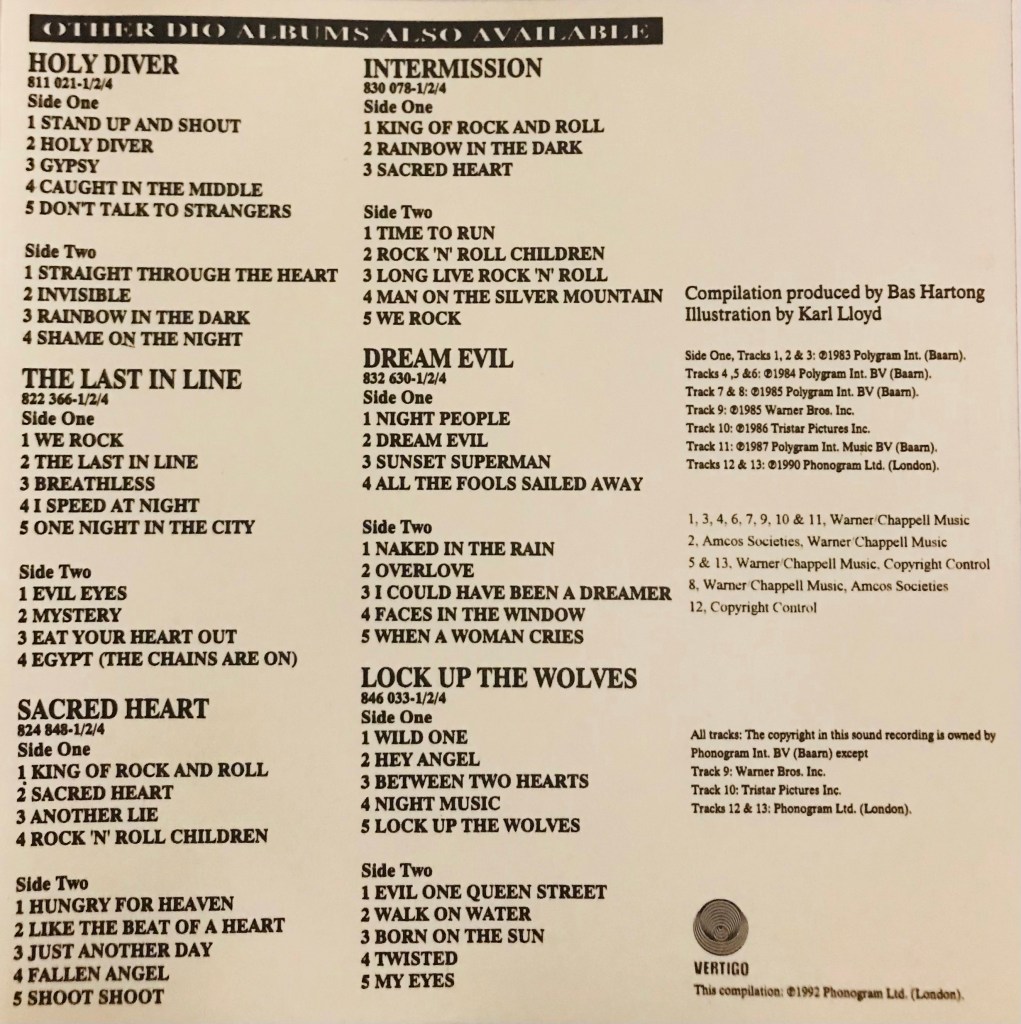
It was released internationally in 1992, and never released in the U.S. And there was no effort with the CD. Just check out the no frills booklet.
I got this compilation because of the track “Hide In The Rainbow”, which was never released on a Dio studio album before. A rare EP called “The Dio E.P” (original title) was released in 1986 with the song, but like all things physical, it wasn’t readily available.
Back then no one was really sure who played on the track.
Was “Hide In The Rainbow” Vivian Campbell’s last studio recording with the band or did Craig Goldy play on the track?
The booklet states Craig Goldy.
But, history and the benefit of hindsight has shown that the CD booklets notes and credits are not a good source of truth sometimes.
In relation to the album, it covers the well-known songs in chronological order based on year of release.
“Holy Diver”, “Rainbow in the Dark” and “Don’t Talk to Strangers” are from the “Holy Diver” album, released in 1983.
“We Rock”, “The Last in Line” and “Evil Eyes” are from “The Last In Line” album, released in 1984.
“Rock ‘n’ Roll Children”, “Sacred Heart” and “Hungry for Heaven” are from the “Sacred Heart” album, released in 1985.
“Hide in the Rainbow” is from “The Dio E.P” released in 1986.
Listen to the intro. I wish they continued it a bit longer.
And is it just me, or does the Chorus riff remind you of “No More Tears” from Ozzy. Then again this is 5 years before “No More Tears”, so maybe young Zakk was listening. Anyway, all music is derivative. Take what came before and make it a bit different.
“Dream Evil” is the title track, released in 1987.
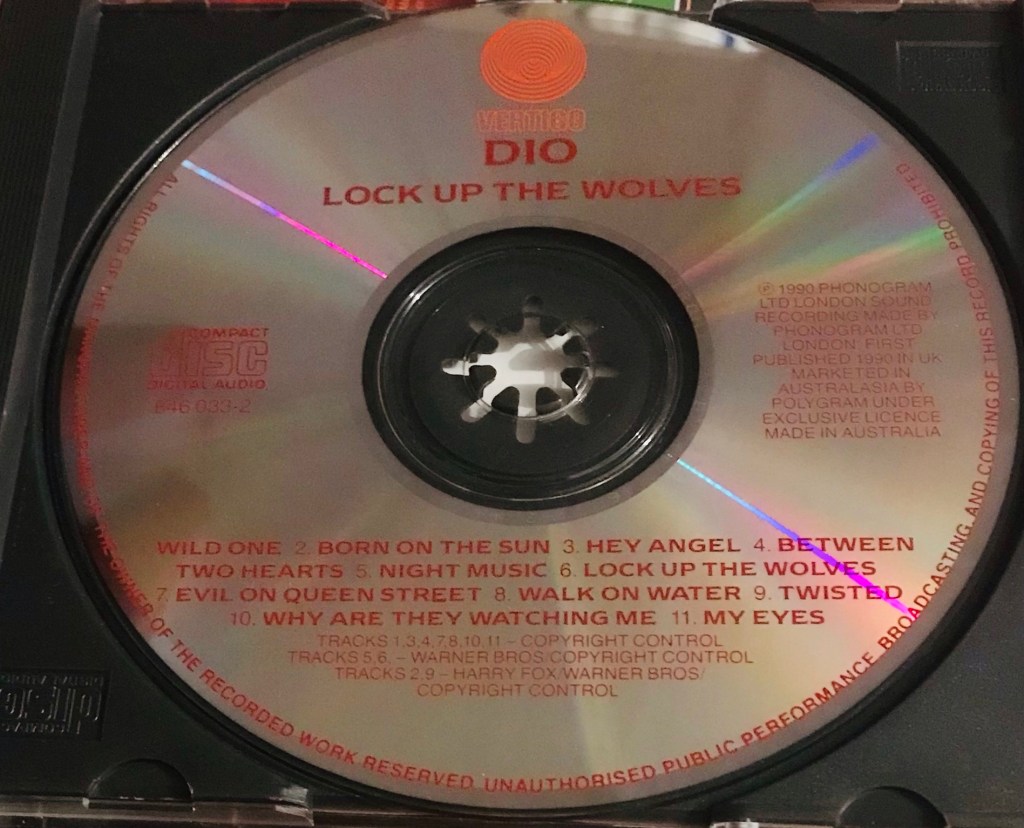
“Wild One” and “Lock Up the Wolves” are from the “Lock Up The Wolves” album, released in 1990.
You could argue that “Stand Up And Shout”, “Egypt (The Chains Are On)”, “All the Fools Sailed Away” and “Born On The Sun” are better songs and should be included.
If you have the albums mentioned above, there is no need for this compilation. But if you didn’t have any of those albums, this collection is an excellent addition.
At the time I was still buying Dio product to keep my collection up to date, however this ended up being the last purchase for my CD/Vinyl/Tape collection.
The studio albums which came in the 90’s and 2000’s were not available easily in Australia and had to be imported in at a higher price. So I ignored em, but my mate “Nick The Stick” is a massive fan, so he had em and he burned em on a CD for me.
I did buy a couple of DVD’s in the 2000’s called “Holy Diver Live” and “We Rock”. Those reviews will be coming soon.
“Run With The Pack” dropped in 1976. Ron Nevison engineered it and Eddie Kramer mixed it. Two names who appeared on a lot of hard rock and metal release I acquired in the 80’s.
For Bad Company, this is three albums in three years but when Daniel Ek from Spotify said that artists need to release more frequently, there was an uproar.
Did anyone see the recorded output from Ronnie James Dio?
From Elf, to Rainbow, to Black Sabbath and his solo career, he was doing a release a year.
“Run With The Pack” is not as solid as the first two albums from start to finish, but there is still enough quality to get people’s attention and it also helps when the first two albums are still selling and being played on radio.
LIVE FOR THE MUSIC
Great title.
The chord and a vocal line, the chord again and another vocal line. And that funky riff in the chorus.
“But when the night time comes I’m ready to rock”
The night is my domain. I feel I’m at my most creative then.
Check out the guitar solo. It’s a simple three note melody, repeated over three bars, with just a small change on the last bar. So simple, but effective. And it pissed me off when writers in the 90’s wrote about how simple and effective the Seattle solos were. I guess they never checked out Bad Company.
Unsung hero here is Boz Burrell on the bass. His holding down the groove but also playing the melody and towards the end of the song, it’s just Simon Kirke and Burrell, grooving away.
SIMPLE MAN
As good as anything from the first two albums.
I love the way the song just rolls after those opening arpeggios. It’s an anthem. So many good lyrical lines like;
“I’m just a simple man trying to be free” “Freedom is the only thing that means a damn to me”
Ralphs use of acoustic and electric guitars is the same technique he employed on “Feel like Makin’ Love” from the “Straight Shooter” album.
HONEY CHILD
It’s “Can’t Get Enough” part 2.
LOVE ME SOMEBODY
A country blues piano ballad. Songs like these showcase the variation of the 70’s acts. An album purchase would give the listener so many different styles.
RUN WITH THE PACK
It starts off as a rocker and roller.
But the slow-down in the chorus. I love it.
Listen, especially when the violins come in towards the end.
SILVER, BLUE AND GOLD
It’s a fan favourite, with a sweet solo.
YOUNG BLOOD
A rock-a-billy cover. Not my favorite.
DO RIGHT BY YOUR WOMAN
Another country rock cut.
SWEET LIL’ SISTER
It’s “Movin On” part 2. The chord progression was overused. “Sweet Home Alabama” comes to mind.
FADE AWAY
The piano riff is excellent.
They tried to rewrite “Bad Company” and they did a good job with it. It has enough variation to make it sound unique. U.F.O sounded like this on the “Lights Out” album. And Check out the emotive solo.
“The Hymn Of A Broken Man” came out in 2011 and in 2021, we get “Songs Of Loss And Seperation”.
The band for the album is Adam Dutkiewicz on vocals, guitar and bass, Jesse Leach on vocals and Dan Gluszak on drums.
The Burden Of Belief
It’s got a blues country groove, more like southern country rock.
Fall down to your knees / Wash me clean of all my grief
Mend You
Taking its cues from alternative metal.
I lost a lot of sleep with my restless mind
There is no rest, when you’re left alone with your thoughts especially when your relationship is breaking down or if a loved one is doing it tough with addictions or mental illness.
The riffs in the last 50 seconds. It’s wall breaking time.
Rescue
Its classic Killswitch Engage.
After the screaming verses, the anthemic Chorus smacks you in the face.
Dutkiewicz is a great riff meister, who showcases his talents with each album release.
The last 50 seconds, with the swelling sounds and backwards effects, is haunting and soothing at the same time. A paradox but it works.
Far From Heavenless
A simple arpeggio guitar riff starts the song off, with Leach singing about feeling far from heaven. And there is an ascending guitar line underneath it all, which makes it feel like we are rising.
The power in the next section, when Leach is singing “I’m not heavenless”. And the power house drumming from Gluszak hammers the message home.
Then the dynamic shifts again to subtle and serene arpeggios.
At 3.30 there is just a clean tone guitar riff that reminds me of “Living On The Edge” riff from Aerosmith.
Then listen to how the distorted guitars, bass and drums build it up, over the spoken sermon from Leach.
It’s gloom and doom, but inspirational as well.
Bleed Me
Atmospheric cut about looking for the medicine to bleed you and satisfy the demons.
Medusa
How good is the riff to kick off Medusa?
It’s so Iommi and Zakk Wylde like.
And this nod to classic metal gives way to syncopated verses, more in the vein of Meshuggah and TesseracT.
Currents
The intro riff is familiar. The vocal melody very Maynard like in the verses, as the rage explodes in the Chorus.
Lost in a Dream / Dark waves crash over me
This tension between dark and light, carries the song.
To Carry The Weight
The intro arpeggios and vocal melody could have come from Aaron Lewis and Staind. Maybe even Brent Smith and Shinedown. And I like it.
The song percolates in that sombre mood until it explodes and Jesse Leach delivers a worthy vocal performance.
The riff from 2.25. So melodic, yet heavy.
Cold
It starts off like a country tune. A simple acoustic guitar riff and vocal melody. It’s campfire material.
And from the 3 minute mark, it explodes. The melodies are hypnotic and the music inspirational.
Have I mentioned that Dutkiewicz is a great riff meister?
Forever
The closer. 6.30 minutes long.
All different musical roads lead to here. A combination of country, blues, metal and rock.
For those looking about positive messages, this isn’t the album for you. It’s melancholy lyrics and metal like riffage is music to make you crash your car. You can feel the sadness, a pain at the world, society and the various demons within the mind.
The album title is indicative of the theme. And having gone through loss recently this album is becoming my companion, riding shotgun with me.
I was listening to “Promised Land”, which at that time was the new single from the Sweet & Lynch project.
For those that don’t know, Michael Sweet from Stryper joined forces with George Lynch to create Sweet & Lynch. They are supported by one of the best rhythm sections in the business in James Lomenzo on bass and Brian Tichy on drums. Underpinning or financing it all is melodic rock label Frontiers.
Their first album, “Only To Rise” was released in 2014. It’s a great throwback to the 80s style I remember well, but with modern touches and production.
3 years later, they are about to drop the “Unified” album.
The first thing that hooks me from “Promised Land” is the tempo. It’s basically a speed metal song.
A cross between Dokken’s “Lightning Strikes Again” and “Tooth And Nail” in some sections and Stryper’s “The Way” in other sections.
The lead break is one of Lynch’s finest metal moments in 2017. It’s got melody, hammer ons, pull offs, sweep picking and string skipping. All at 140 plus clicks a minute.
Unfortunately “Promised Land” is just another song lost in the 30 million plus songs on streaming services, along with other Sweet & Lynch gems like “Love Stays”, “Me Without You” and “Recover”.
Ed Sheeran writes songs which become popular. Then he gets hit with a lawsuit because his songs are making money and the family members of a departed artist, or the business entity that owns the copyright of an artist who is departed or has not creating anything worthwhile anymore wants a cut.
If Copyright terms remained how they were originally, this would not be a problem. First, the creator had a 14 year monopoly, with a chance to renew for another 14 years for a total of 28 years. However, once the creator died, all of their works became public property, free to be used by any other artist/creator to create derivative versions. So if the creator passed away during a term, the works ceased to be under copyright and went straight into the public domain.
The British 60’s Rock invasion happened because of these rules.
So who is copyright benefiting once the person who is meant to have the monopoly (the creator) to create works has passed on?
The corporations and estates who control the copyrights of long-dead artists. That’s who.
Frequency is a bad word for rock and metal artists.
Release music frequently is another bad phrase for artists.
It’s a concept artists are struggling with. It’s even more troublesome for bands. The singer/songwriter can make it happen, but for bands it’s a different story.
Netflix wouldn’t be able to grow their subscriber base if they released one TV show every two years?
It’s a streaming world. The youngsters, the ones who replenish the music base are signed up to streaming. And artists who don’t want to be part of the streaming group are still debating the payouts.
The money will come. But you need to control your copyrights so you get maximum royalties.
The paradigm is different. Your musical output lives online and the money is in what lasts. Success is based upon cumulative streams, not sales of albums, and the streams go on forever.
8 Years Ago (2013)
I watched Dream Theater in Australia on the “Systematic Chaos” Tour and they played for three hours (with an intermission of about 10 minutes in between). For some reason that was perfect, however when I saw them again on the “Black Clouds and Silver Linings” Tour, they played just over 2 hours and it was too much.
I think hitting the same market too quickly and the flow of the set list was the problem. The 2009 show took place almost 12 months since the 2008 show.
They did “Solitary Shell” with extended solos. It is not the strongest song in the Dream Theater catalogue, so what happens when you take a song that isn’t your best and make it longer?
You get a yawn fest, a toilet break or a beer/smoke break.
And at the time did we really need a live album from Metallica?
They had released four DVD packages of Live Concerts during the Death Magnetic tour, as well as the Six Feet Down Under EP’s plus all the stuff they release on Live Metallica.
When Metallica created the “Black” album, the main members were 27 years of age and the producer was 36. Life experiences were on their side.
The main classic rock bands were all about individuality. The Eagles, Boston, Styx, Deep Purple, Black Sabbath, Led Zeppelin, Kiss, Rush, Bad Company, Foreigner, Aerosmith and Cheap Trick all had a unique sound.
The Eighties gave us Metallica, Motley Crue, Guns N Roses, Bon Jovi, Def Leppard, U2, Duran Duran, AC/DC, Journey, Whitesnake, Van Halen (and yes i know that some of these bands formed in the seventies), Aerosmith again and Foreigner.
Metallica played fast speed metal that was labelled thrash, Motley Crue played a hybrid version of pop, punk, rock and metal. Van Halen wrote the book on the nuclear band, Guns N Roses rewrote the seventies classic rock period with a dash of punk and Def Leppard merged Queen, with Bowie with Mott The Hoople with their NWOBM leanings into a pop rock format. Each band spawned thousands of imitators.
Rush could have recorded a mainstream radio friendly album in 1976 just to please the record label. Instead they recorded “2112”, an album that set up a very lucrative future for Rush and an album that made the record label very nervous when they heard it. As guitarist Alex Lifeson has stated in numerous interviews, “2112” set up a career for Rush.
What happened to the uniqueness?
“Kill Em All” Metallica’s first album was celebrating 30 years in July 2013. At the time of its release it didn’t really set the world on fire, however if you look at the reviews and praises the album is getting now, it is like the album came out and created a movement called thrash metal right off the bat. In other words a lot of revisionist history was taking place.
Let’s put into context the lifespan of “Kill Em All”.
It came out on July 25, 1983. By February 1984, seven months after “Kill Em All” was released, Metallica was in the studio, writing and recording the “Ride The Lightning” album.
The victory lap of “Kill Em All” was seven months. That’s it. If the band wanted to have a career, they needed to get back into the studio and record a new album.
Motley Crue, Twisted Sister and Def Leppard had break through albums with “Shout At The Devil”, “You Can’t Stop Rock N Roll” and “Pyromania”. Quiet Riot’s “Metal Health” was the first American heavy metal debut album to ever reach No. 1 in the United States on the Billboard album charts.
But RNR history is written by the winners. Since Metallica is now inducted into the Hall of Fame, everyone that can put fingers to letters on a keyboard is rewriting their back story.
Bands like Quiet Riot will be written out. Artists like Vinnie Vincent and Jake E.Lee will be forgotten. The impact of other bands will be diminished because Metallica won.
History is written by the winners.
And does anyone know what the Metallica movie, “Through The Never” is about.
Dream Theater were promoting their new album with webisodes which didn’t feature any musical snippets from their new album.
Has anyone purchased a Dream Theater album because Billboard Magazine rated it highly or poorly or from a Village Voice review?
The answer would be a definite NO.
Dream Theater built their career outside of the mainstream. It was the mainstream that came knocking on the door for Dream Theater and they let them in.
Remember back in 1991, Metallica had arena sized listening parties for their fans before the release of the Black album.
Connect with fans first and they will support you.
The band changed. There was no one left except for Ronnie James Dio. 18 year old guitar wiz, Rowan Robertson was on guitars, Jens Johansson on keys, Teddy Cook on bass and Simon Wright on drums who left his AC/DC gig that he held from 1983 to 1989 to join.
Actually Robertson was only 17 when Dio announced to the world that he was the new guitarist in July 1989 after more than 5,000 guitarist submitted audition tapes.
“I saw an item in Kerrang! about Craig Goldie leaving Dio, so I knew they needed a guitarist. I sent in a tape just for the hell of it, you know, not expecting much, but figuring I had nothing to lose.
I was 16, learnt to play guitar in my bedroom by banging around to Bad Company records and the only stage experience I had was with a couple of pub bands that were going nowhere. I thought if I was lucky, maybe I’d get an audition”. Rowan Robertson
I was surprised to see that Jimmy Bain was out. But he was fired (along with Claude Schnell) in mid-1989 and Vinny Appice was let go two weeks before work began on the album.
The production team also changed a little bit, with Tony Platt in the producers and engineer’s chair along with Ronnie. Suddenly the sound became better thanks to Tony Platt’s engineering experience.
According to guitarist Rowan Robertson and mentioned on Wikipedia, two more songs were written and demoed for the album but left off at the decision of Wendy Dio: “Hell Wouldn’t Take Her” and “The River Between Us”. Maybe she felt the songs were too personal.
In 1990, MTV still ruled.
It was simple. You get a music video in mass rotation and watch the album go Platinum. And the Dio camp tried. They really tried.
The photos of the band had them with a bit of a tease and hairspray in their hair. They spent some decent money on a clip for “Wild One”.
And MTV still avoided Dio, who at 48 years of age was seen as a relic of the past with nothing new to offer. My Dad turned 46 that year and I saw him as old.
Also Dio’s lyrics of jesters, clowns, gypsies and rainbows had run its course for the TV station but not for the fans.
While I ignored the “Dream Evil” album when it came out in 1987, I purchased this one.
It was a tab of “Wild One” in the “Guitar School” magazine which got me interested. I was playing along to the song before I even heard it and the guitar solo was a highlight. And I was like, “man, this dude is of a similar age and he’s smoking on the guitar, I need to get practicing”.
Wild One
Written by Dio and Robertson, it’s a great fast song to kick off the album and announce the new guy in town.
That Pre-Chorus, reminds me so much of Savatage.
And the lead break starts off as a blues-a-metal-thon, almost jazz fusion like. Then it goes into the super-fast tapping section. Another great way to announce the new gun slinger .
Check out the head banging outro. How can you not like it?
Lyrically, it was another “stand your ground and be who you want to be” message, although done in a very Dio way full of riddles.
Born On The Sun
A mixture of “Egypt (The Chains Are On)” and “Holy Diver” but with Rowan Robertson providing a more EVH approach to decorating simple grooves.
Check out the drumming on this.
The song is credited to Dio, Robertson, Bain and Appice. It sounds like Appice wrote the drum parts but its Wright who plays em.
You can hide in a circle It’s a way to survive Be another number At least you’d be alive
Great lyrics. So much truth in the words.
Scared to be different or speak our minds because of the resistance and the blowback. Especially these days, with social media and how a point of view can blow up and suddenly we have trolls and haters all spamming our inboxes.
Hey Angel
Written by Dio and Robertson.
The majority of stories I read when Grunge came, was how the lyrics from the Seattle bands were more deeper and darker, focusing on depression and anxiety and rooted in real life. It’s like the Seattle artists were the only artists doing stuff like that. Sort of like how the heirs to Marvin Gaye believe he was so original that they sue everyone to oblivion.
Well, heavy metal and hard rock artists did have songs dealing with isolation, loneliness, depression, conformity and being in dark places after a relationship breakdown.
How do you feel right now? How does it feel to be alone?
My parents never asked me how I feel. These kind of emotions and questions are frowned upon when your ancestry comes from Eastern Europe.
I also grew up in life being told that angels are these all powerful beings that shine a bright light and can’t be hurt.
I suppose if you feel, you can get hurt. If you bleed, you can die. Or in the words of Schwarzenegger in “Predator”, “if it bleeds, we can kill it”.
The solo is excellent on this.
From just one album, Robertson was given a chance to do an instructional tape. His “Speed Picking” VHS tape is out there on the Net.
Between Two Hearts
Another song written by Dio and Robertson. It starts off with an acoustic arpeggio riff that reminds me of “Children Of The Sea”.
Then the slow groove kicks in, it’s almost like a blues dirge.
Check out the way Robertson plays the riffs in the second verse, combine palm muted arpeggios, diads and pedal tones.
Put on your party faces and come along Join in the big parade Here comes the camera Do you look as good as your sister Smile at the animals They should be the ones in the cages Turn the pages
A photo for Instagram before it was even invented.
Or a song about the paparazzi and the price of fame when we lived in a monoculture. These days, we live with many different sources informing us, and a person could be making millions from music and be walking the streets and shopping aisles with us and we wouldn’t even know.
Night Music
This one is written by Dio, Robertson and Bain.
So open up your arms Let the night time in Say the word and it begins
I love the night. I feel the most inspired then and there was nothing better than listening to music at night, reading the lyrics and singing out aloud, like the lyrics to this song, “Night music, you’re singer and I’m the song”.
Lock Up The Wolves
Another song written by Dio, Robertson and Bain.
The sound of a clock ticking. Its normal paced. Then it picks up in speed, almost frantic like. The music is ominous, giving the listener a feeling that time is running out. By the time the distorted guitars kick in, the ticking is relentlessly fast.
And the doom feel of the song reminds me of “Sign Of The Southern Cross”.
In the houses of the holy To the middle of the mystic sea At the cradle of the world
Its back to his fantasy places, about wolves, screaming for sanctuary and how there is no back door to heaven, just a front door to hell. I guess we’ll meet again.
Evil On Queen Street
Written by Dio, Robertson and Cook. It’s like a 12 bar blues dirge with another killer solo by Robertson.
Walk On Water
Written by Dio, Robertson and Johansson, it reminds me of “Stand Up And Shout” but while “Stand Up And Shout” screams rebellion, “Walk On Water” tells ya to not even try because you can’t “Walk On Water”.
The lead break is guitar hero worthy.
Twisted
A Dio, Robertson, Bain and Appice cut.
And when I told the truth They were sure it was a lie
What would you do if no one believes you?
When your truth is seen as a lie.
Why Are They Watching Me
A Dio and Robertson cut.
It’s confusing lyrically, about being ready to rock and someone watching.
My Eyes
A Dio, Robertson and Johansson cut.
I’ve seen it from heaven and hell I’ve seen it from the eyes of a stargazer
Great song titles to drop into a song.
Rock and roll eyes Tell rock and roll lies And rock and roll lies Never end
I guess what happens in rock and roll stays in rock and roll.
“I think obviously, my defining moment is the “Lock Up the Wolves” album, and I feel very fortunate for it. It was a good album…it captured excitement and I played really well on it.” Rowan Robertson
From memory it’s Robertson’s only album.
As soon as the album was released it was met with mixed reviews. Early sales were positive in the U.S and then the album spiralled down the charts as it disappeared altogether.
But it had longevity in the European markets as Dio’s brand was still big business there. So it was no surprise that the first leg of the tour was in Europe.
And Black Sabbath was a just a phone call away, and when that call came, the “Lock Up The Wolves” band was put on ice and never re-awakened after the Sabbath gig fell apart.
The album cover captured my attention immediately.
The “Red Star” was easily associated with the Communist governments of the time. Kids these days would have no idea, but in 1976, Eastern Europe and parts of South East Asia, Africa, the Middle East and Central/South America were under Communist governments or military dictatorships. And these kind of governments like to control everything and everyone.
Coming into 2112, Rush was in a predicament. D
o they stay true to themselves and their art or do they give in to what the label wants?
In the Guitar Legends magazine focusing on Rush, Neal Peart said the following;
“Caress didn’t actually do any worse than the albums before it, at that point, all three had sold about 100,000 copies a piece in the U.S.
But if our record company hadn’t been in such turmoil I don’t think we would have been able to keep our recording contract.
By the end of that year we were unable to pay our crews salary or even our own. Things were dire and we were getting a lot of pressure.
Polygram had written us off before “2112” had come out. We’d seen their financial predictions for 1976 and we weren’t even on the list!”
In the same magazine, Alex Lifeson said the following;
“The Fountain Of Lamneth” on “Caress of Steel” was really our first fill concept song and “2112” was an extension of it.
That was a tough period for Rush because “Caress of Steel” didn’t do that well commercially, but we were really happy with it and wanted to develop that style.
Because there was so much negative feeling from the record company and our management was worried, we came back with full force with “2112”. There was a lot of passion and anger on that record. It was about one person standing up against everybody else”.
History shows that they made the right decision.
And for all the hate “Caress Of Steel” got from the label, it was the album that bridged the first era of Rush albums to “2112”.
The entire Side One is all “2112”. Which is broken up into 7 sections.
I. “Overture”
An instrumental that acts as a summary in which you get to hear all of the melodic pieces which appear on the song.
II. “The Temples of Syrinx”
A sombre melody with the words “And the meek shall inherit the Earth” is sung before the distorted guitars kick in for “The Temples of Syrinx”.
This is a future where individualism and creativity are outlawed and the population controlled by a cabal of malevolent Priests who reside in the Temples of Syrinx.
And the way copyright law is going, creativity can be outlawed as every single melody known to the human race has been used and corporations are doing their best to lock them up under ridiculous terms, like life of the creator plus 90 years after death. But they seem to forget that creativity is based on influences.
We’ve taken care of everything The words you read, the songs you sing The pictures that give pleasure to your eyes
The schooling system is designed for conformity, a one size fits millions approach. The schools are factories for degrees later on. You can’t even get an Administration role in a Company without a Uni/College degree. And Masters Degrees are the biggest scams ever. A pure profit making product for the colleges.
III. “Discovery”
A classical acoustic guitar announces the arrival of “Discovery”, found inside a cave and the founder rediscovers the lost art of music.
I can’t wait to share this new wonder The people will all see its light Let them all make their own music The Priests praise my name on this night
Creativity and imagination is progress. Without it, we stagnate.
IV. “Presentation”
This is like Zeppelin Rush which tells the story of how the guitar is presented to the priest of the Temple of Syrinx, who then proceed to destroy it and banish the man who found it.
Listen to my music And hear what it can do There’s something here as strong as life I know that it will reach you
But the Priests didn’t want to know about his ancient relic. It was the downfall of The Elders. The emotion and escapism that comes from listening to music.
Just before the song finishes, they go into the “Temples of Syrinx” riff and Lifeson solo’s over it. Check it out, its guitar hero worthy.
V. “Oracle: The Dream”
A shimmering chorus guitar kicks off the song in which the man who found the guitar dreams of another world in which creativity and individualism is allowed and full of song and laughter.
VI. “Soliloquy”
We are back to the sounds of water running down, like how we heard in “Discovery”. But the lyrical theme is heavy. The man who was filled with joy at finding the guitar, is now in despair at living a life that’s cold and empty. So the only way for him to be with the world in his dream is for his life’s blood to spill over.
Make sure you check out Lifeson’s solo. So bluesy, full of bends and emotion. Brilliant.
VII. “Grand Finale”
Major key chords kick off the “Grand Finale”. And it’s up to the listener to decide what happened.
When I first heard the lines “Attention all planets of the Solar Federation, We have assumed control” I presumed that the “Solar Federation” put down some uprising and assumed control again.
Then I thought it meant that the “Solar Federation” was overthrown by someone and they are alerting all the planets that there is a new government in control.
“A Passage to Bangkok”
It kicks off Side 2.
A great riff to start a song about all the places in the world that grow the best weed. The track names a number of cities and countries, including Bogotá, Acapulco, Morocco, Bangkok and Kathmandu, Nepal.
I just finished watching “The Serpent” on Netflix and how the main character preyed on tourists who came to Bangkok and Kathmandu in the late 60s and 70’s to experience those weed highs, kidnapping them, robbing them and then killing them.
“The Twilight Zone”
I like the harmony guitars to kick off the song.
How good is the music in the section, when Lee sings, “you have entered the twilight zone”?
Use the key, unlock the door See what your fate might have in store…
I never watched “The Twilight Zone” on TV. I’ve read some short stories on it and in the 80’s a documentary was aired on Australian TV’s about strange phenomena and they called it “The Twilight Zone”.
“Lessons”
It’s Lifeson expressing his love for Led Zeppelin. It’s got hard rock distorted chords and clean tone strummed verses.
“Tears”
This is a great song.
How good are the verse riff arpeggios?
“Something for Nothing”
The acoustic guitar intro gets me interested. And the way Lee and Peart come in, they change the groove completely.
The song is about freewill and decision making, a topic I write about regularly on this blog when I’m putting my point of views out there on certain songs and the lyrical message.
You don’t get something for nothing You can’t have freedom for free
In the end “Freedom isn’t free”.
If you don’t believe me, why does it cost so much to live in a free country.
What you own is your own kingdom What you do is your own glory What you love is your own power What you live is your own story In your head is the answer Let it guide you along Let your heart be the anchor And the beat of your own song
The lyrics are prophetic. Rush didn’t wait for someone to tell them what to do. They did what they wanted to do and they wrote their own story. In the end, it was a backs against the wall album. If it bombed commercially, they would go down in flames. But it didn’t.
They stuck to their guns, did what was important to them and built a career from it.
3x Platinum in the U.S and 2x Platinum in Canada.
Press Play, relax and “Attention all Planets of the Solar Federation. We have assumed control.”










 destroyerofharmony