A to Z of Making It, Influenced, Music, My Stories

The Record Vault: Dream Theater – Master Of Puppets

The cover above is the version I have, released in 2004 via their own YtseJam label.

It was also re-released in 2021 via the “Lost Not Forgotten” Archives with the below cover.

The performance of this album would inspire the writing for their most Metal album in “Train Of Thought”.

The show was recorded live in Barcelona, Spain on February 19th 2002. It was the second night of a two night stand in a city.

And it was the start of a new Dream Theater tradition (while Mike Portnoy was in the band), which was to play an entire album from another band.

This is what Mike Portnoy had to say about it in the CD booklet;

“Dream Theater is playing the 2nd night of a 2 night stand in Barcelona, Spain…

After an almost 2 hour set of DT material and a 15 minute intermission, the lights went out and the opening chords to “Battery”
began…

50 minutes later, the Spanish crowd had no idea what had hit them.

The next day the word was all over the internet and our new tradition to cover a classic album whenever we did a 2 night stand in the same city had been established…but for those 50 minutes in Barcelona, the completely unsuspecting crowd had no way to see it coming…

I remember looking into the crowd by the time we started “The Thing That Should Not Be” and seeing people look at each other like;

“Holy shit…they’re doing the whole
fucking thing!!!”.

Yep, that would have been the same response I would have had.

The band for the recording is James LaBrie on vocals, John Petrucci on guitars, Mike Portnoy on drums, John Myung on bass and Jordan Rudess on keys.

Battery

This is performed exceptionally.

LaBrie also brings out the chainsaw aggression of a youthful Hetfield.

Petrucci and Portnoy nail their sections.

Master Of Puppets

As soon as Petrucci plays the first four chords the crowd responds. If this song is played again in 2024, it will be bigger than ever due to “Stranger Things”.

The Thing That Should Not Be

The Intro with the keys is more ominous.

And LaBrie gives the song a more theatrical vibe with an octave higher vocal line, and I like it. It would have been cool if Dream Theater explored the groove doom Metal domain.

Sanitarium

Masterful.

It’s the only way I can describe Petrucci. The intro, acoustic and lead, played by Petrucci is exactly that.

LaBrie tries but doesn’t have the same demented vocal delivery as Hetfield here.

From 3.36, it’s basically a Dream Theater song, with riffs, leads and sporadic vocals. LaBrie is awesome here, his “fear of living on” delivery; excellent.

Disposable Heroes

The drums sound like machine gun fire in the intro.

But it’s that galloping palm muted E string riff that comes after which seals the deal for me.

LaBrie delivers a great vocal here.

Jordan Rudess in an interview with the Revolver Magazine said this;

“Master of Puppets was an eye opener for me because before we covered this album my Metallica knowledge was not so deep.

Having grown up playing Bach, Liszt and Chopin the idea of technique and virtuosities had a definite place in my mind. I have to admit that upon discovering Metallica my perception of technique opened up to other possibilities outside of the classical world.

A song like ‘Disposable Heroes’ sounds like machine-gun fire to me. The blistering, galloping guitar rhythms that sound like the pick is about to go up in flames is an impressive display of intensity and technique. [James] Hetfield really shows what he is made of in a track like this one and I was very impressed.”

Leper Messiah

I always love the section from 40 seconds to a minute. The groove behind it and the way the guitars are orchestrated so that the bass and drums stand out.

Orion

It’s right up Dream Theater’s alley, a nine minute instrumental. And a classic Metallica song.

Damage Inc

They had covered this song previously during the era between “Awake” and “A Change Of Seasons” and released a version of that live performance.

Overall people can compare this album with the real album and find issues.

When an artist covers another artist, it is purely for fun initially and to show respect to the artist who inspired and influenced them.

This is no different and it sounds like the band is having fun, using the last hour of the their three hour set to pay homage to Metallica.

Press play and enjoy.
Standard
Classic Songs to Be Discovered, Influenced, Music, My Stories, Unsung Heroes

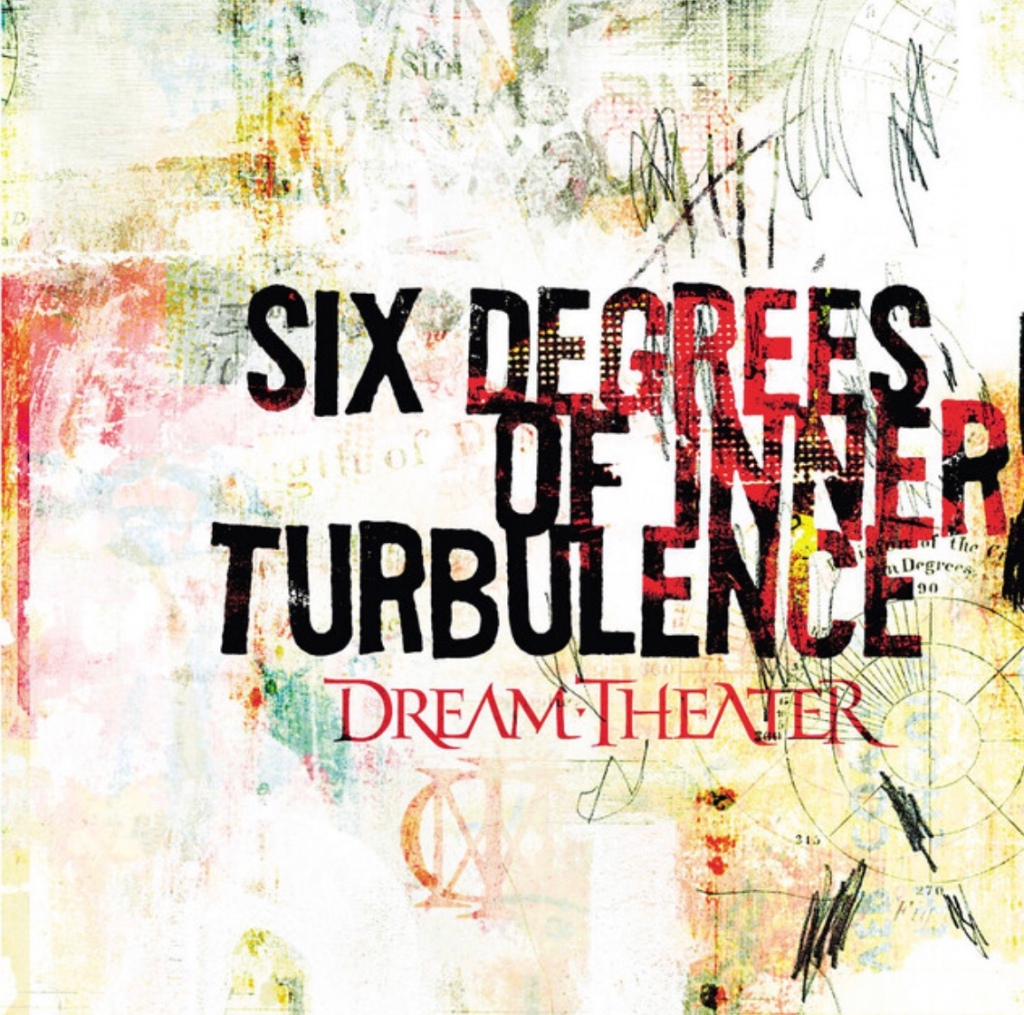
The Record Vault – Dream Theater – Six Degrees Of Inner Turbulence

Dream Theater was redeemed. Their previous album “Scenes From A Memory” renewed their fan base while also satisfying the existing fan base.

I was interested at what was next.

A double album. This is something the band tried to do with “Images And Words” and “Falling Into Infinity” however the label both times said “no”. But this time around, they said yes.

With the same personnel of James LaBrie, John Petrucci, Jordan Rudess, John Myung and Mike Portnoy locked in, the band released “Six Degrees of Inner Turbulence” on January 29. 2002. The first disc is made up of 5 songs that total 54 minutes and 18 seconds. The second disc is one song, which clocks in at 42 minutes, however that one song has 8 sections in it, which are sequenced as individual songs.

On the Wikipedia page for the album, it tells me that the influences for the album’s writing and recording, according to the authors, include Metallica’s “Master of Puppets”, Radiohead’s “OK Computer” (and also a Radiohead bootleg Portnoy brought in), Pantera’s “Far Beyond Driven” and the song “Mouth for War”, Megadeth’s “Rust in Peace”, U2’s “Achtung Baby”, Tool’s “Ænima”, Nine Inch Nails’ “The Downward Spiral”, Soundgarden’s “Superunknown”, Alice in Chains’ “Dirt”, Kevin Gilbert’s “Thud”, King’s X’s “Faith Hope Love” and Galactic Cowboys’ “Space in Your Face”, Béla Bartók, Rage Against the Machine’s “The Battle of Los Angeles”, and Maria Tipo’s “Chopin Nocturnes”.

As a fan of the influences mentioned, I can definitely hear their sounds and textures.

The Glass Prison

The opening track.

It’s 14 minutes long, consisting of three parts called “I. Reflection”, “II. Restoration” and “III. Revelation”. The lyrics are written by Mike Portnoy and it’s the beginning of his “Twelve-Step Suite”. This song covers the first three steps of the AA program. The other steps would appear on subsequent albums.

The static phonograph noise that ends “Finally Free” on “Metropolis Pt. 2: Scenes from a Memory” (1999) begins this song. Then the arpeggiated bass riff starts the song. Press play to hear it. It’s essential listening, especially when the band starts to crash in and build it up.

At 5.487 million Spotify streams, the track is forgotten. But there are so many good bits in the song, like the thrash metal riff in the Verses which reminds me of “Disposable Heroes” by Metallica, or the Groove Metal riff at 5.55 which reminds me of Pantera or the riff at 11.10 which reminds me of King Crimson.

Blind Faith

Lyrics are written by James LaBrie. For a vocalist, he doesn’t get a chance to write the words he sings for the band. John Petrucci does most of em these days. Previously he shared this duty with Kevin Moore and then Mike Portnoy.

1.802 million streams on Spotify. Another forgotten track, however its dreamy Pink Floydish meets Marillion vibe gets me interested. The verses are a cross between Pink Floyd, U2 and Marillion.

Pink Floyd is a band that people either get or don’t get, hence why they come up in a lot of overrated lists.

For a song that’s almost 11 minutes long, the riff at 5.45 is to be heard.

Misunderstood

Lyrics are written by John Petrucci.

It percolates slowly until it explodes. Just over 9 minutes long, check out the acoustic guitar intro, which again reminds me of Pink Floyd and you need to stick around for the Chorus distorted riff at 4.08.

As part of the solo, Petrucci played the guitar solo, and then reversed it with the DAW software. He then learned how to play this reversed version, and recorded it that way. The listener gets a very unsettling effect.

The Great Debate

Tool immediately comes to mind. Lyrics are by Petrucci and at almost 14 minutes long, the song has a lot of great movements.

A bass guitar riff starts the song off, with Portnoy building it up to a crescendo while voices from various news reports talk about stem cell research while the keys/guitars decorate.

Then it cranks into the Tool riff and for about 5 minutes it follows a Verse/Pre/Chorus structure. Make sure you stick around for the riffs when Labrie is singing “Are you justified” and “Life to save life”. It’s basically Tool without Maynard, then again, Fates Warning released a Tool meets Porcupine Tree sounding album in 2000 with “Disconnect”. Jim Matheos showcased then that he can groove and decorate with the best of em.

Disappear

It’s rare that LaBrie gets two song writing credits. But here it is. The original title was “Move On”. The piano riff in the Intro hooks me, but man, that section from 4.37, it’s so heavy with depression and sadness, which I suppose goes with the “death” theme lyrics.

Disc two is the entire song “Six Degrees of Inner Turbulence”. Thank god Portnoy decided to sequence the CD so you can skip to the desired part.

The song explores the stories of six individuals suffering from various mental illnesses. Particularly represented are bipolar disorder, post-traumatic stress disorder, schizophrenia, post-partum depression, autism, and dissociative identity disorder. The “Unbreakable” trilogy from M. Night Shyamalan comes to mind here.

Overture

It all starts here, the Jorden Rudess composed instrumental, clocking in at 6.50.

While listening to these orchestral piece I find it boring, however when the band heard it, they took various melodies and ideas contained within this version and expanded them into segments of the complete piece. So what you hear here end up in the songs to come. But I still don’t like it.

For “Overtures”, I will take “The Titanic Overture” any day.

About to Crash

Lyrics written by Petrucci. This section clocks in at 5:50 and it’s very Genesis like.

“War Inside My Head” and “The Test That Stumped Them All “

They go together as the heavy/thrash metal pieces of the song with lyrics written by Portnoy.

Together the songs clock in at 7:11 in length. It has to be a special Portnoy nugget to have these two songs come in at 7/11. Press play to hear the Main Riff of “The Test That Stumped Them All”.

Goodnight Kiss

It’s a skip for me.

Solitary Shell

How good is the major key strummed intro from Petrucci who also wrote the lyrics.

About to Crash (Reprise)

The intro riff is a favourite. The first words I said were “fuck yeah”.

Lyrics are written by Petrucci and the song also has this Celtic section at 2.20 that I like along with the piano riff after it.

Losing Time/Grand Finale

A forgettable ending.

It’s never forgotten to me how Dream Theater carved out a career in a musical hostile label and promoters environment between 1992 and 2003.

When they broke big with “Images And Words”, Seattle was the scene. 10 years later, “Nu-Metal” and its various offspring’s like “Post Grunge” and “Alternative Rock” were a thing and acts like Creed, Limp Bizkit, Slipknot, Offspring, Disturbed and Nickelback were getting platinum albums thrown at em from every corner of the world. And yet they never abandoned their style. While they would incorporate some of the mainstream sounds into their music, they still kept their Dream Theater identity.

And this album was the springboard for bigger and more metallic things to come.

Standard
Derivative Works, Influenced, Music, My Stories

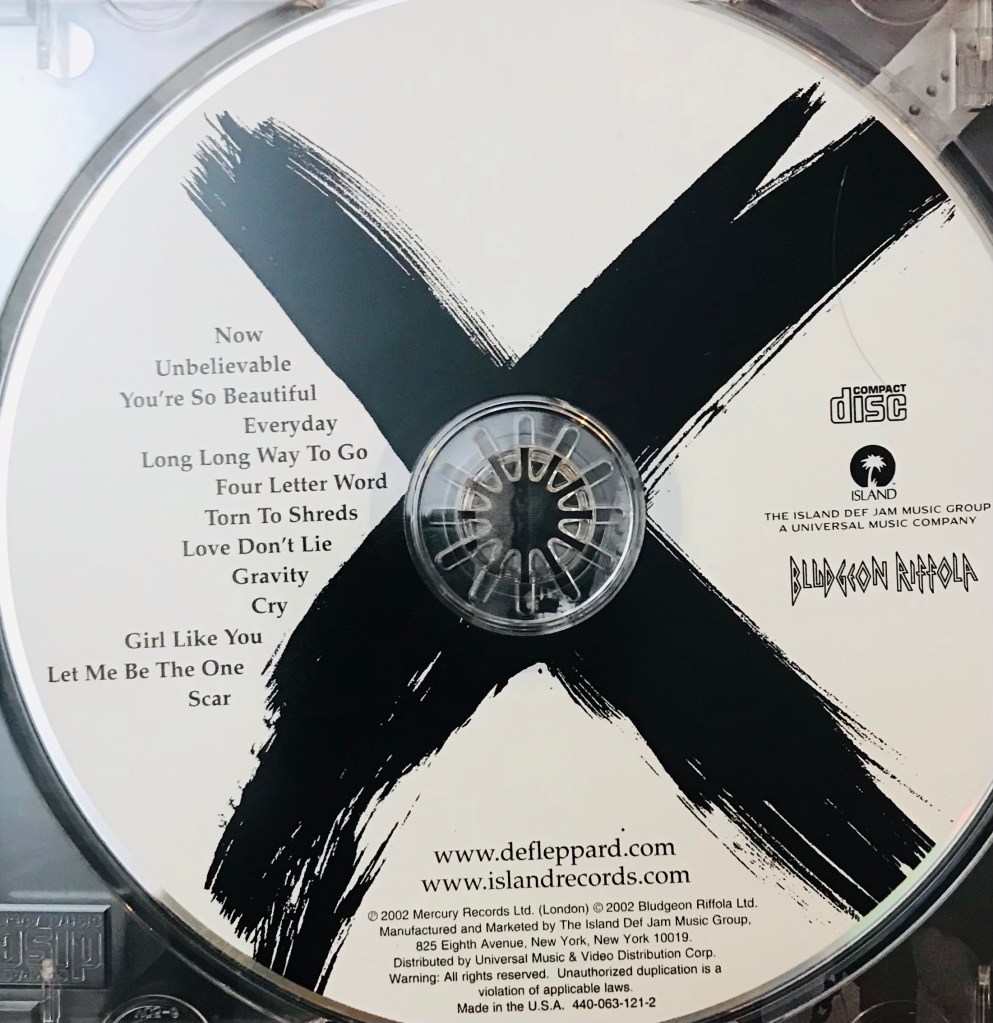
The Record Vault: Def Leppard – X

With “Slang” and “Euphoria”, Def Leppard re-invented themselves and the Two Thousands was there for the taking. The answer to their world domination is “X”, released in 2002.

And yes, it’s studio album number 8, but when you add “Retro Active” and “Vault” it is number 10 or X.

So “X”.

It stands for many things, like the Roman number for Ten or an MPAA rating for extreme explicitness, but it also stands for a maniacal mid-life crisis Def Leppard album.

Now

Written by Def Leppard with the help of songsmith, Marti Frederiksen.

The music of Def Leppard has evolved, incorporating the “Slang” influences with the traditional Def Leppard sound. This song captures some of it along with the whole Alanis Morrisette/Matchbox 20 pop rock vibe.

Unbelievable

It feels like a Backstreet Boys track. And I wasn’t surprised when I saw the writers. Per Aldeheim, Andreas Carlsson and Max Martin, who together had written a lot of hits for artists like Backstreet Boys, Nsync and Britney Spears.

But it was a skip for me.

And very disappointing as well, especially when Carlsson can rock hard. When he worked with Europe many years later, we got “Last Look At Eden”. When he worked with Paul Stanley, we got “Live To Win”. When he worked with Bon Jovi we got “Everyday”, “Misunderstood” and “Hook Me Up”. And Max Martin was a rocker to being with. When Martin worked with Jovi, we got “It’s My Life”. And guitarist Per Aldeheim can also rock hard, however none of the writers rocked hard at all on this.

“Unbelievable”, I say.

You’re So Beautiful

Another song written by Def Leppard with Marti Frederiksen.

The pop rock is back with this, which has the feel of “Animal” with new melodic elements.

Everyday

A cut written by Def Leppard with Marti Frederiksen, its lightweight “Photograph” even down to the syllables for the Chorus.

Long, Long Way to Go

Written by Wayne Hector and Steve Robson who I had to Google to see what their history is.

Wayne Hector is renowned for working with artists like Westlife, Nicki Minaj, The Wanted and The Pussycat Dolls. Steve Robson back in 2002 had worked with Westlife, Atomic Kitten, Honeyz and Faith Hill. All pop song writers.

And Def Leppard took a pop ballad and gave it the Def Leppard treatment, however it still sounds like a Backstreet Boys song. But it’s the most catchiest song on the album.

Four Letter Word

Written by Def Leppard, this is best track on the album. The bluesy AC/DC or ZZ Top style riff definitely gets me interested. It could have easily fit on the Adrenalize album.

At times you would be able to hear some “Back In Black” and “Armageddon It”.

Torn to Shreds

Written by Def Leppard and Joe Elliot in the lower registers singing a ballad is pretty cool to listen to. The way it starts off, it reminds me of the “Slang” album.

Love Don’t Lie

Written by Def Leppard. It sounds like “The Real Thing” from Russell Morris.

Gravity

Written by Def Leppard and Pete Woodroffe, this is by far the worst track on the album. While I give the band 5/5 for having the balls to experiment, the dance beat programmed bass and drums don’t do it for me and the vocal delivery did nothing to captivate the NWOBHM child within and I don’t think the teenybopper crowd took to it either.

Maybe if One Direction covered this many years later it would have been a hit.

Cry

Written by Def Leppard.

Stone Temple Pilots comes to mind here.

And I like it when hard rock artists take something which is contemporary and add their own hard rock touch.

Girl Like You

Written by Def Leppard.

It’s a skip from me when you middle aged men singing lyrics like “I’m on fire, and you’re the flame”.

Let Me Be the One

Written by Def Leppard. Next.

Scar

Written by Def Leppard and Pete Woodroffe

The best track on the album. It has this “Paper Sun” vibe in the Intro, a “Desert Song” vibe in the Chorus and an “Animal” style Chorus.

While it’s not an excellent Def Leppard record it’s also not that bad, and it kept the band on the road which was the key back then.

But for me, I haven’t purchased any Def Leppard product post this album.

Standard
Classic Songs to Be Discovered, Influenced, Music, My Stories, Unsung Heroes

The Record Vault: Disturbed – Believe

Album number 2, released in September 2002. David Draiman is on vocals, Dan Donegan is on guitar and keyboards, Steve “Fuzz” Kmak is on bass and Mike Wengren is on drums. It’s also the last album to feature original “Fuzz” before he was booted from the band in 2003.

It’s also produced by Johnny K and the band members. And the mix from Andy Wallace is excellent.

The lyrical focus is different this time around. While “The Sickness” dealt with violence, “Believe” is more of a spiritual album.

Prayer

As soon as the opening staccato riff for “Prayer” starts off, in syncopation with the kick drum, I was hooked.

One thing that was clear to me when I played it, was the anthemic melodic rock Chorus in which Draiman soars, and this vocal style would appear across all of the songs on the album.

Liberate

It could have come from the first album as the verses follow the staccato singing with the catchcry of “liberate your mind, motherfucker you’re so narrow minded, narrow minded”.

The Pre-Chorus has Draiman doing fast spoken vocals on one track and on another he’s doing middle eastern ohhhs and ahhhs.

But the Chorus. Anthemic.

Wengren on the drums deserves special mention here. Its percussive and frantic.

Awaken

It’s a heavy rock song with a foot stomping groove and as Wikipedia tells me, it deals with America’s never-ending obsession with “wallpaper music”. I didn’t get that impression from the lyrics but…

The vocal style from “The Sickness” is prevalent here as he spits out the words like a machine gun.

Check out the outro riffing and how the bass drum is in unison with it.

Believe

Another staccato style riff in the vein of “Prayer”.

The Chorus. Brilliant.

All your belief cannot absolve your sin

Check out Donegan’s multi-layered guitar parts after the second Chorus.

At 2.36 it goes into a Tool/Deftones style groove. Instead of head banging, you sway.

Remember

One of the best Disturbed songs. The opening riff grooves and man its heavy.

And vocally, David Draiman really announces himself here as a force to be reckoned with.

The Chorus you don’t get to hear until half way through as the song goes, Verse, Pre, Verse, Pre and then the Chorus. But when it comes in, it explodes out of the speakers and totally worth the wait.

Wikipedia tells me that “Remember” delves into the cutthroat nature of the music industry as well as Draiman’s resistance to indulgent partying. But I don’t get that view by looking at the lyrics.

Check out the multi-layered guitar parts in the last Chorus.

Intoxication

It’s more of the same style from the debut album, with the vocal line and guitar line and bass drum pattern all syncopated in unison.

The Chorus is massive and it rhymes vilify with sanctify and I like it.

Rise

The intro riff is metal at its best.

There is another riff in the song which I always called the Chorus riff, but I think it’s played just after the Chorus.

Mistress

The riffs are cool to jam on.

At 2.09, a change of groove comes in, with slightly distorted arpeggios. It percolates before it crashes back in to the main riff.

Breathe

The intro/verse riff is a great riff to jam to. And checkout the bass riff which compliments it.

At 2.56, this Tool “Schism” like groove kicks in and I’m jamming it.

Bound

A flanged/phased wah riff kicks off the song, before the effects are taken off and its good old distortion cranking through.

You can call this a relationship song.

At 2.33, the song goes into a few grooves which they use for an interlude. No solos are allowed on Johnny K produced albums.

Devour

Great riffs in this song, especially the riff just before the anthemic Chorus.

At 2.35, a simple riff kicks in which they build back up into the Chorus.

Darkness

And for the fans who said Disturbed sold out with their cover of “The Sound Of Silence” must have forgotten about this song, which is just acoustic guitar, piano and strings. And one of their best.

In Australia and Canada, it went Platinum. In the U.S it went 2x Platinum. In New Zealand and the U.K it went Gold.

Crank it and believe.

I guess the word “motherfucker” was too much for the censors, so they felt the need to sticker it.
Standard
Classic Songs to Be Discovered, Derivative Works, Influenced, Music, My Stories, Unsung Heroes

The Record Vault: Dokken – Long Way Home

Nothing is easy when it comes to Dokken.

At the peak of making it from a B level act to an A level act in the late 80’s, they broke up. Then they realised that they are better together than apart, so in the mid 90’s they gave us one of their best records in “Dysfunctional” and one of their worst in “Shadowlife”. Lynch was subsequently booted or he left, depending on whose story you believe, and Reb Beach was hired to “Erase The Slate” and kick start a new era for Dokken in 1999.

But that version of the band didn’t last long. Beach was out and Pilson went to court against Don Dokken over his actual departure and the dissolution of the partnership band agreement. Dictator Don was finally in full control of his name.

In 2002, “Long Way Home” was released. It is the only Dokken album to feature Europe guitarist John Norum, who also worked with Don on his solo project “Up From The Ashes” and the first to feature bassist Barry Sparks who had done time with Michael Schenker, UFO and Yngwie Malmsteen. This album also started a “sort of” trend on using song titles from earlier albums as album titles on future releases.

Production duties on the album were handled by Don Dokken.

“Sunless Days”

Looking at the credits, its written by Don Dokken, John Norum and Kelly Keeling.

Keeling had previously done work with Norum on one of his albums and was enlisted here to help write the album and do some vocal production duties. Also if you are a fan of Blue Murder, Keeling spent over 2 years with John Sykes on the “Nothing But Trouble” album, only to leave the band or be fired, on the day of the shoot for the “We All Fall Down” video.

A foot stomping riff, similar to “Change The World” from the “Erase The Slate” album kicks off this song. It’s a riff that Norum would tweak and use in “Start From The Dark” from Europe.

And this is the first album, when Don decided to keep his voice in the bass/lower baritone range.

“Little Girl”

Written by Dokken, Keeling and Mick Brown. Dokken was fascinated by adding sounds which I call, “The Beatles” sounds or the “Led Zep” sounds. This song is evidence of that fascination.

“Everybody Needs (To Be with Someone)”

A cut written by Dokken and Brown.

It has a vocal melody that is inspired by “Action” from Sweet. Instead of singing “everybody needs a piece of the action”, you just sing, “everybody needs to be with someone”.

“You”

Written by Dokken, Norum and Keeling, the heavy groove gets me interested.

“Goodbye My Friend”

A cut written by Don. It’s just an acoustic guitar and an excellent piano riff which sticks around after the song is finished because it mimics the vocal melody on occasion’s.

If anything, Don sounds very Eric Clapton’ish, like the Unplugged Clapton.

“Magic Road”

A Dokken and Norum cut.

One of my favourites.

Musically, Norum brings his love of 70’s classic rock to the song with his bluesy riffs. Something which he would also do with Europe, especially on the “War Of Kings” album.

“There Was a Time”

Its written by Dokken and Keeling. Another song with a strummed acoustic guitar, a simple drum beat and an catchy vocal melody.

“Heart Full of Soul”

An excellent cover from The Yardbirds.

“Under the Gun”

Written by Dokken, Norum and Keeling it’s a classic Dokken cut, with a feel and tempo like “Lightning Strikes Again”. Another favorite.

“I’ve Found”

Written by Dokken and Keeling. It’s another great track, just acoustic guitars and Beatles like vocal melodies.

If there is a fault on this album, it is the lack of opportunities Norum has to fly, because like most albums in the early 2000’s it suffered from a lack of lead guitar.

But it’s still a good listen and tracks like “Sunless Days” and “Under The Gun” could be in a best of set list.

Standard