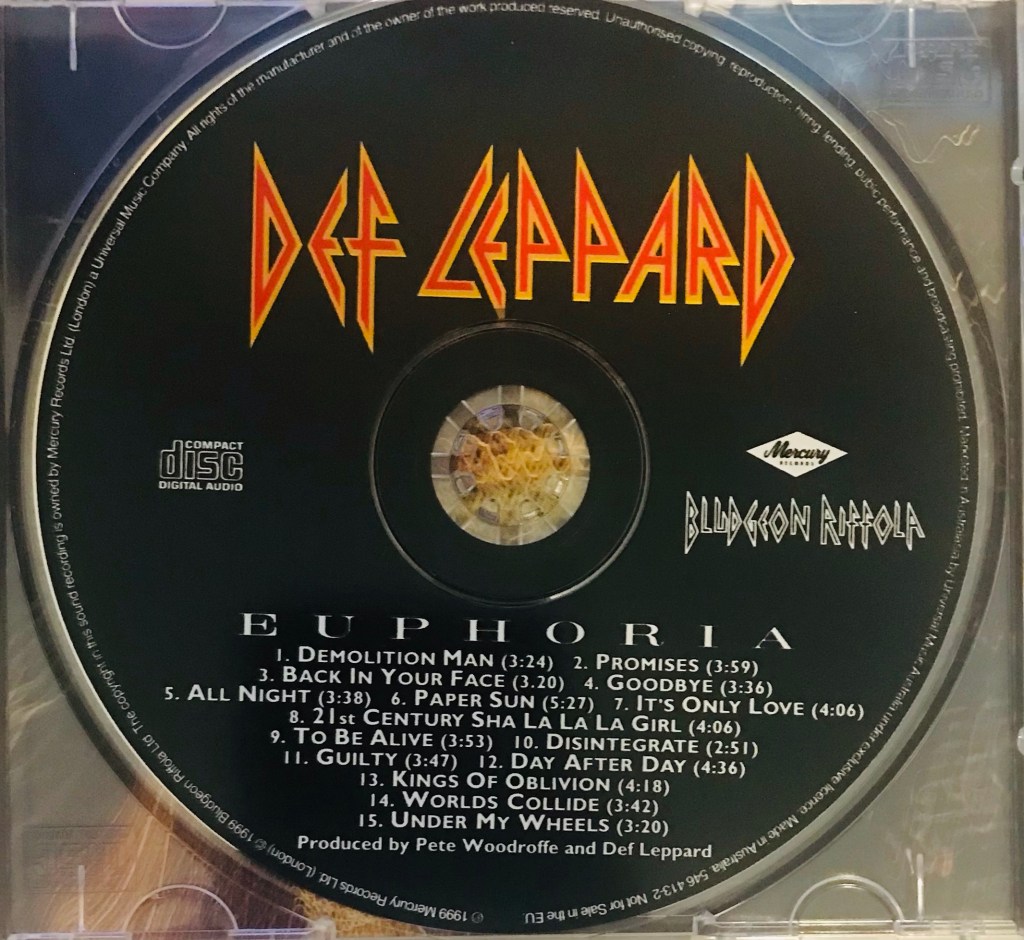
I was interested to hear what Def Leppard would do next after “Slang”.
And the answer was “Euphoria”. Released in 1999, the title alone was an indication to me that they were back to the “Pyromania” and “Hysteria” vibe.
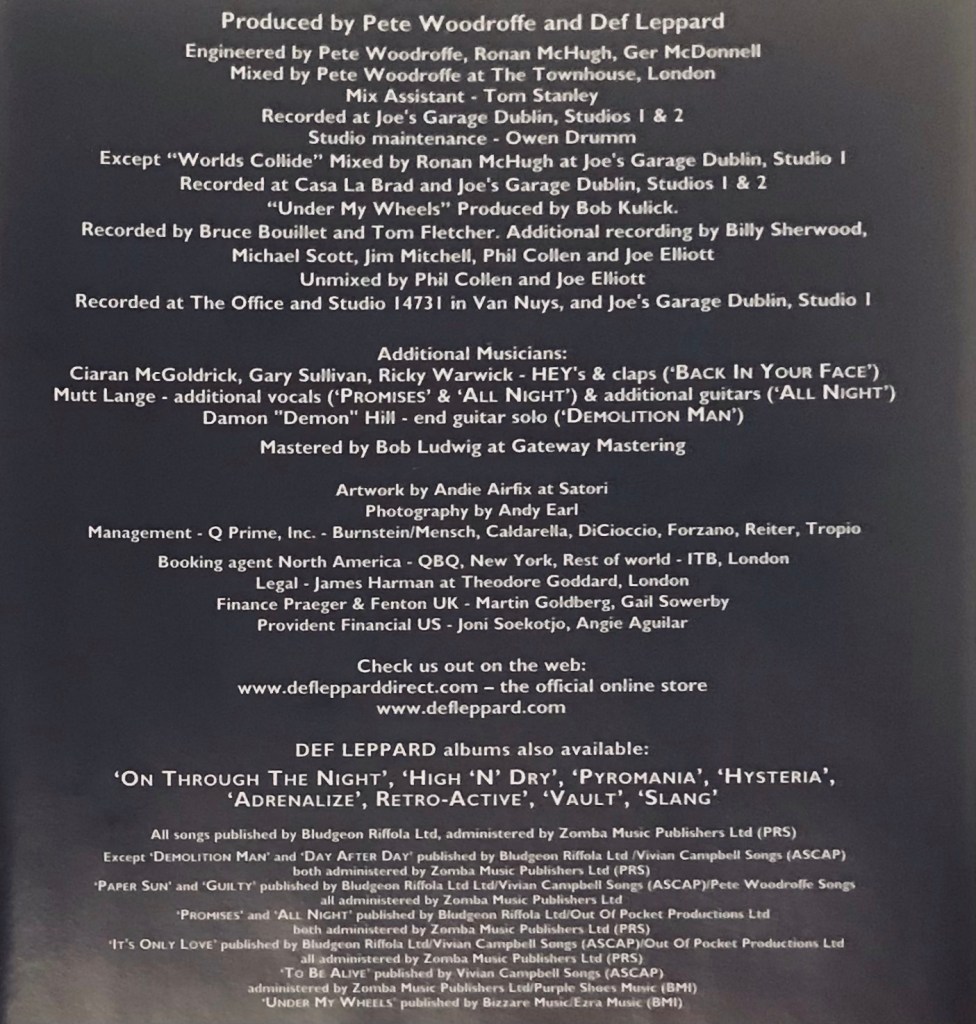
The album is produced by Pete Woodroofe.
Demolition Man
Written by Phil Collen, Vivian Campbell and Joe Elliot, it’s an energetic rocker to kick off the album, reminding me of their supercharged cover of “Action” from Sweet in the early 90’s.
Promises
Written by Phil Collen and Mutt Lange, this is a great track in the vein of songs like “Photograph” and “Animal”.
And press play to hear the guitar solo.
Back In Your Face
Written by Joe Elliot and Phil Collen, it has a 70’s style vibe, processed drums, a bass guitar riff that has the vibe of “Under Pressure” from Queen and a rap like vocal line reminiscent to “Pour Some Sugar On Me”.
With the title, it definitely announces the bands intention.
The band was back in my face like jumping jack flash and the Union Jack.
Goodbye
Written by Rick Savage, the song is interchangeable with “Have You Ever Needed Someone So Bad?” and “When Love And Hate Collide”.
All Night
A funky Prince like tune done the Def Leppard way and written by Phil Collen and Mutt Lange.
It wouldn’t take up a place in a set list, but it’s cool to hear the band experiment and have fun with tunes like this.
Paper Sun
Written by Phil Collen, Rick Savage, Joe Elliot, Vivian Campbell and Pete Woodroffe.
My favourite song on the album and one of the best songs to appear on a Def Lep album in the 90’s.
The intro riff, with it’s Middle Eastern feel already hooks me in, bringing back memories of songs like “Desert Song” and “Fractured Love”. The song could have easily appeared on the first two albums as well.
This is the Def Leppard I like.
It’s Only Love
Yeah, it’s a slow rocker written by Joe Elliot, Mutt Lange, Rick Savage and Vivian Campbell, which didn’t captivate me.
So it’s a skip.
21st Century Sha La La La Girl
Written by Phil Collen, Joe Elliot and Rick Savage.
This is Def Leppard with a vocal line which borders on rap-rock.
What can go wrong?
Nothing when it comes to Def Leppard.
They do these things cool but sometimes they overuse this method.
To Be Alive
This is a great ballad written by Vivian Campbell and a P.J Smith.
The song was first recorded by Vivian Campbell’s side band “Clock”, which was active between 1996 and 1998 and released one album in 1998.
Disintegrate
An instrumental written by Phil Collen, which feels like it’s part 2 of “Switch 462”. And I like it.
Guilty
Written by Phil Collen, Rick Savage, Joe Elliot, Vivian Campbell and Pete Woodroffe.
It starts off like “Hysteria” and that familiarity immediately gets me interested.
Day After Day
Written by Phil Collen, Joe Elliot and Vivian Campbell. It’s “Deliver Me” from “Slang”, updated to rock hard.
A favourite just behind “Paper Sun”.
Kings Of Oblivion
Written by Phil Collen, Joe Elliot and Rick Savage. They bring their love of 70’s Rock and Metal into this. It could easily appear on the first three albums.
We laugh at the wardrobe choices of the 80s but goddamn the 90s didn’t really endear itself to people either.
The CD that I have is known as the “Australia Bonus Tracks Edition”. So I have two bonus tracks in “Worlds Collide” and another fun energetic cover in “Under My Wheels” from Alice Cooper.
Worlds Collide
It made an appearance on the “Slang” reissue from 2014 so it was written for that album.
It’s heavy and I like it. Press play to hear the main riff. It’s head banging Metal the way I like it.
Sales of the album didn’t match the earlier stuff, but that doesn’t mean it’s a dud. Check it out.
P.S
While it was refreshing to hear “Slang” and it grew on me to be a good album, I was more than happy to have Def Leppard return to their sound.
All ideas or If you use the words “intellectual property” for the Copyright maximalists, have an influence from something that came before. We learn to write music by learning the music from others. We learn to write stories by reading the stories of others.
It’s probably why people shouldn’t get all emotional over ideas/intellectual property.
People like familiarity.
Derek Thompson in his book “Hit Makers” mentioned how people are drawn to music that might be new, yet familiar enough to be recognizable.
In other words, that new song we all like has enough variation in it to make it not a carbon copy of its source influence.
And people still like to claim that their song is so original and free from influence and when people have that fixed mindset, well, the courts are busy and the lawyers are making money.
Check out my recent Google alerts on the word Copyright.
A lot of delusional people who believe that their works are so original and free from influence.
Guess what.
All of our ideas have already been stolen. Because there is no such thing as the genius loner. It’s a myth. We are all social people and our creativity is fuelled by our social environments. Every single day, we take in our surroundings, we set meaningful and important goals and we are always thinking of solutions to problems.
A neuroscientist and a psychologist broke down creativity into three main buckets;
Bending means you take a previous work and re-model it in some way. “The Walking Dead” and “Night Of The Living Dead”.
Blending means merging previous works together so you have multiple melodies and re-cutting it to suit what you want to write. Jimmy Page was great at doing this with Led Zeppelin’s music. Metallica did that with “Sanitarium”.
Breaking is taking a short and important musical idea otherwise known as a musical fragment and building on it. Think of my post on “One Riff To Rule Them All”, which covers the A pedal point riff used in songs like “Two Minutes To Midnight”.
The differences between humans and computers is how we store information and how we retrieve information. For the computer, the riff stored on the hard drive will sound exactly the same three years later, however that same riff stored in our head would be different.
Why.
Our brain breaks it down, blends it and bends it with other information. This massive mash up of ideas in our brains is our creativity. And when we play that riff three years later, it has a different feel, different phrasing or something else. Some of them stink and sometimes we create something that breaks through into society.
A funny thing started to happen when streaming became the main source of income for the labels.
Live albums started to come out.
You see, streaming services like new content. And since bands like to take their time or need to make time to record new original music, they filled the void for new content by releasing live albums.
Suddenly getting new product out yearly instead of every two to three years became the norm. But it still didn’t solve the problem of people not buying albums.
Whitesnake is a band which keeps firing out live recordings year after year. “Made In Japan”, “Made In England”, “Bad To The Bone 84”, “Castle Donnington 90”, “Live In The Heart Of The City” and “The Purple Tour” have been released as stand-alone albums over the last 10 years.
And David Coverdale knows the value of his super fans.
I attended the Five Finger Death Punch and Avenged Sevenfold gig on Tuesday, 25 February 2014 at the Big Top in Luna Park. It was my first time seeing them both live so I didn’t know what to expect.
Each week, the sites that enable copyrights to be infringed innovate at a rapid rate to stay ahead of the curve. They are competing against each other for people to use them to illegally access entertainment.
Read the post to see how these sites innovate. Instead of shutting em down, the labels and movie studios should be employing these people.
I played Nostradamus and looked into my crystal glass full of whiskey in the jar-o to make some predictions.
ON A DOWN SLOPE
DAUGHTRY
The band leader, Chris Daughtry messed up big time chasing the crowds of “Train” and “Imagine Dragons”.
He is a hard rocker from day dot and rock gave him his legion of fans. For the ill-fated and recent “Baptized” album, he committed career suicide, throwing his lot with the hit songwriters.
The songs are good, however they are not Daughtry songs. It would have been better for him as an artist to have given those songs to other artists that are more electronic pop rock minded. That way he would have been the songwriter, the way Bryan Adams gave songs away to other artists that wouldn’t suit the Adams sound back in the 80’s.
HYPE
We can see through the hype and we hate it.
So much hype was around Dream Theater’s self titled release and it disappeared from the conversation within six weeks.
Megadeth’s brand new album “Super Collider” was being outsold by the Black album.
THE ALBUM FORMAT
Making money is hard. Just because a band releases an album, it doesn’t mean that people would pay for it or would want it.
And when we are inundated with product we tune out, however, it turns out we have time for Metallica’s “Black” album. At this point in time it was still moving two to three thousand units a week and it was expected to pass 16 million by May 2014.
GOING GOING – ALMOST GONE
CLASSIC ROCK
Classic Rock bands have another 10 years left.
ON THE UP – STORYTELLING
That is why TV shows are the most downloaded torrents of all time. Tell a good story and the world will be at your door step.
Read the financial reports on Universal Music Group.
Spotify has propped up their bottom line and that bottom line will get better each year for Universal. And they keep spreading the bull shit that they are out there fighting for the artists. The good guys.
Frontiers has become a major player in the classic rock, melodic rock and hard rock scene. They kept the flag of melodic rock flying high since 1996, when all of the other major labels abandoned the style and put their monies into grunge first and then industrial rock/metal and then nu-metal.
And their business model is all about locking up copyrights for a long time.
They have realised it’s not about sales anymore, and while steaming numbers and revenue are still tiny, in the long term the labels will be able to reap the benefits.
Why?
Because streaming is a regular recurring revenue business. And these Copyrights are valuable?
Let’s put it this way, if Metallica is on Spotify, then the rates paid back to the COPYRIGHT HOLDERS (which in this case is Metallica as they do own their Copyright) must be good, because Lars Ulrich and their manager Cliff Burnstein would not allow Metallica to enter a business arrangement that is not in their favour.
And back in 2014, Tool or AC/DC or Def Leppard were not on Spotify. They all are now.
The real truth is that there is much more music out there than there has ever been, so the issues that are present to artist and labels is how do they get people’s attention directed towards that new music.
Personally, I don’t even know anybody who pirates music anymore. There is no reason to pirate and legitimate customers/fans would always turn to legal alternatives.
Add “Recording Sales Revenue” plus “Streaming Revenue” plus “YouTube Ad Revenue” plus “Ticket Revenue” plus “Merchandise Revenue” plus “Corporate Deals Revenue” plus “Sponsorship Revenue” plus “Publishing Revenue” plus “Licensing Revenue” and then decide if you are winning or not.
Again, if you are not seeing a lot of revenue, then you need to be speaking to your label, because if you have numbers in all of the above Revenue streams then something is a-miss contractually.
You know the drill. A new technology comes out and eventually it will start to get some traction. Then the word will spread about and more people would flock to it. It’s new, it’s cool, it’s hip and its innovative. Then when it is at its peak, the people who testified for the new tech, will abandon it, looking for something new and better.
MySpace, Facebook, Twitter are three such platforms that came, peaked and right now are suffering an identity crisis.
MySpace is finished.
Facebook got traction because it connected people in a way that MySpace couldn’t. Now, all of these connected people need to deal with the marketing of products, advertisers, like requests, fake friend requests and spam.
Twitter is well, Twitter. With so many people tweeting or having their tweets connected to their Facebook Posts or their blog posts, everything is getting lost in the mix. When a big news item hits, Twitter is the platform to go to, because people who are directly involved in these big events are the ones that are tweeting.
Spotify has been around for a while now and in the last 3 years it set up base in a number of large music markets like Australia, Canada and of course the US.
The people tried it. Some have stuck to it. Some have abandoned it. The ones that speak out against it have never used it.
Spotify however needs a game changer. Sort of like how the move to APPS changed the iTunes store. And it’s all about the FREE. Fans of music showed the world that they want FREE music to listen to. And don’t say that FREE doesn’t work. How the hell did Free To Air TV exist and grow over the last 60 years.
I am all over the shop when it comes to music. I still purchase product from the bands I like and I stream as well.
And the funny thing is that I don’t use iTunes anymore.
Who would have thought that day would have come?
And that is what Spotify needs to think about it. Once the newness has rubbed off, what’s next. Consolidation. How can you consolidate when the modern paradigm is DISRUPTION?
P.S.
I wrote this in 2014 and since then Spotify has innovated a lot to keep people interested. Putting their lot in with PODCASTS and it looks like they will be moving to Audio Books as well based on a recent survey I undertook with them.
It’s all about stopping copyright infringement. It’s all about shaking down internet users. It’s all about a ridiculous and “out of touch with reality” penalty system. For example, if a user downloads one song, the RIAA have argued that the copyright holders are out of pocket between $20 to $10,000. Seriously.
When discussions are had on Copyright, it’s all about the enforcement. It’s all about creating a monopoly. The ones that sit on the innovation fence are shouted down to from the ones that control/hold the Copyrights.
The thing is, people have been “copyright infringers” since day dot. Anyone that remembers cassette tapes, will tell you how they used to copy songs from recordings onto a cassette tape. James Hetfield used to copy Lars Ulrich’s record collection onto cassettes.
We used to copy songs from the radio onto cassettes. We used to copy movies from TV onto VHS cassettes. Then we got even more creative and hooked up two videos at once to make copies of the latest releases. With the advent of the CD and blank discs, we started making mixed CD’s. When Napster exploded, people flocked to it. Because we had been copyright infringing forever.
It is easy to lay the blame on others. However it is the record labels that need to take responsibility. They still don’t get it. People want FREE music. Spotify provides a service that is free, however it is still seen as restrictive and people still go to other torrent sites to download content. YouTube also provides a service that is free.
And then the recording industry claims that these sites make so much money from running ads on their site. If that is the case, then why isn’t the recording industry offering the same service and making that same money.
They don’t want to, because that would mean they would have spent dollars in Information Technology. And they don’t want to do that.
And most artists have never made a living from royalties. The record labels always have.
Well I hope you enjoyed another wrap up of Destroyerofharmony history?
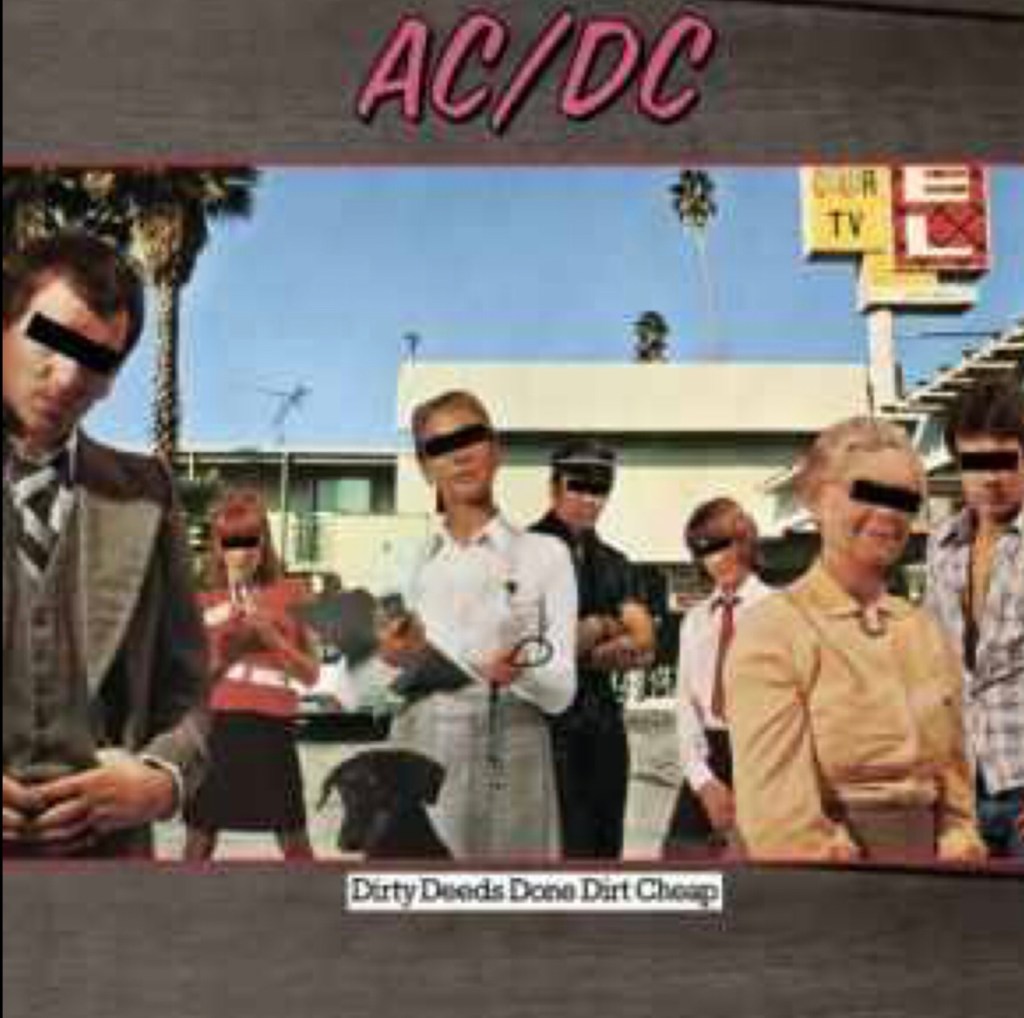
Released in 1976. This is the cover we know for the album and not the Hipgnosis one which came out on the International release.
This version of AC/DC rocked hard. Bon Scott is on Vocals, The Young Brothers are on all things guitar related, Mark Evans is on bass and Phil Rudd is on the Drums.
Production is handled by The Easybeats main songwriters in George Young (big brother of Angus and Malcolm) and Harry Vanda.
“Dirty Deeds Done Dirt Cheap” is the third studio album by AC/DC. While it hit the streets in Australia in 1976, it didn’t get a U.S release until 1981.
And that decisions by Atlantic A&R man Doug Morris to release the album proved to be unpopular with the band.
AC/DC had successfully reinvented itself with a new singer, Brian Johnson. The band was working on a new album, which would become “For Those About to Rock We Salute You”, released later that same year.
But Morris saw a financial opportunity to capitalize on the success of “Back in Black” which had already sold over five million copies. And due to those numbers, Morris estimated that “Dirty Deeds” would move at least 2 million.
But it also took away an opportunity for the new album.
“For Those About to Rock” would have sold a lot more if Morris had waited.
So the US release of “Dirty Deeds” was widely seen as damaging the momentum for that album, which it outsold. The band was also forced to add songs from the “Dirty Deeds” album to its set list on its subsequent tour, further taking the focus away from their new album.
But going back to 1976, Atlantic was unhappy with the vocals and the production. This infuriated Malcolm Young because the label was putting shit on his older brother.
Bassist Mark Evans assumed Bon Scott would be fired as a result. The band was on the verge of being dropped.
But “High Voltage” which was also released in the United States in 1976 was still selling and the sales of that album versus what the label paid for it, gave AC/DC a lifeline.
The Young brothers along with Bon Scott were very creative during this period. As was the norm, each year had a new AC/DC album. And they always overwrote for each album.
As a side note a song called “I’m a Rebel” was recorded for this album, with music and lyrics written by Alex Young, another brother of the Young’s. While the song was never released by AC/DC, Accept somehow got their hands on it and released it as a single, and also named their second album after it.
Dirty Deeds
The riff’s simplicity is its magic.
The drum groove was used by Lars Ulrich for the “Enter Sandman” intro.
The lead break is the embryo of the “Thunderstruck”.
And Bon Scott is menacing as he gave us a new phone number to call.
36-24-36.
Love At First Feel
It’s got that Chuck Berry 12 bar blues rock feel, which AC/DC used a lot of. The most notable song being, “Long Way To The Top”.
Press play to hear a very good and underrated Angus Young lead.
And I like how it quietens down after the solo, with the vocal melody of “Love At First Feel” repeated as they build the song back up.
Big Balls
There was a band in Australia called Skyhooks who had this kind of cabaret/stage show delivery in their songs.
Rocker
Well the songs a rocker alright.
It brings back memories of Val Kilmer performing a rockabilly song in the movie “Top Secret”.
Problem Child
A favourite because of the riffs and the vocal delivery. If there is a track to press play on, then this is definitely one of em.
And Angus delivers another underrated lead break.
In concert, Scott would often introduce “Problem Child” as being about Angus.
There’s Gonna Be Some Rockin’
The 12 bar blues is back. Bands like Status Quo would build a career on tracks like this.
The rhythm is also very similar to that of “The Seventh Son” by Willie Dixon.
Ain’t No Fun (Waiting Round To Be A Millionaire)
It follows more of the same “Long Way To The Top” feel. But press play to hear the Chorus riff, as there’s a chord ringing out and then some arpeggios and single notes.
Ride On
It can be supercharged with other slow blues songs they have done, like “The Jack” and “Night Prowler”
Squealer
How good is the intro on this?
The bass plays a groove that is not typical of AC/DC. It’s almost funky like.
And when Bon Scott moves from his lower register to his higher register, the guitars become more aggressive and the drums get louder.
Angus again wails away on the guitar, delivering a very mature lead. It’s one of my favourite AC/DC cuts and it has been largely forgotten.
This is another track you shouldn’t ignore on this album.
In relation to sales it was a hit in Australia when it came out.
In the US, it was a different story.
Following the American success of “Highway to Hell” in late 1979, copies of the album began to appear as imports in the US.
Some of these were the original Australian edition on Albert Productions; however, Atlantic also pressed the international version in Australia, and many of these were also exported to the US.
Strong demand for both versions (in the wake of the even greater success of Back in Black) led the US division of Atlantic to finally authorize an official US release in March 1981. It went straight to No. 3 on the Billboard album charts.
In relation to sales, 6× Platinum in Australia and the US.
I didn’t know who T-Rex or Marc Bolan was until Nikki Sixx kept mentioning him as an influence between 1987 and 1990. And I had heard “Get It On” and “Children Of The Revolution” on radio before but the radio announcer never announced who the artist was and with so much hard rock coming my way, T-Rex just kept slipping from my mind.
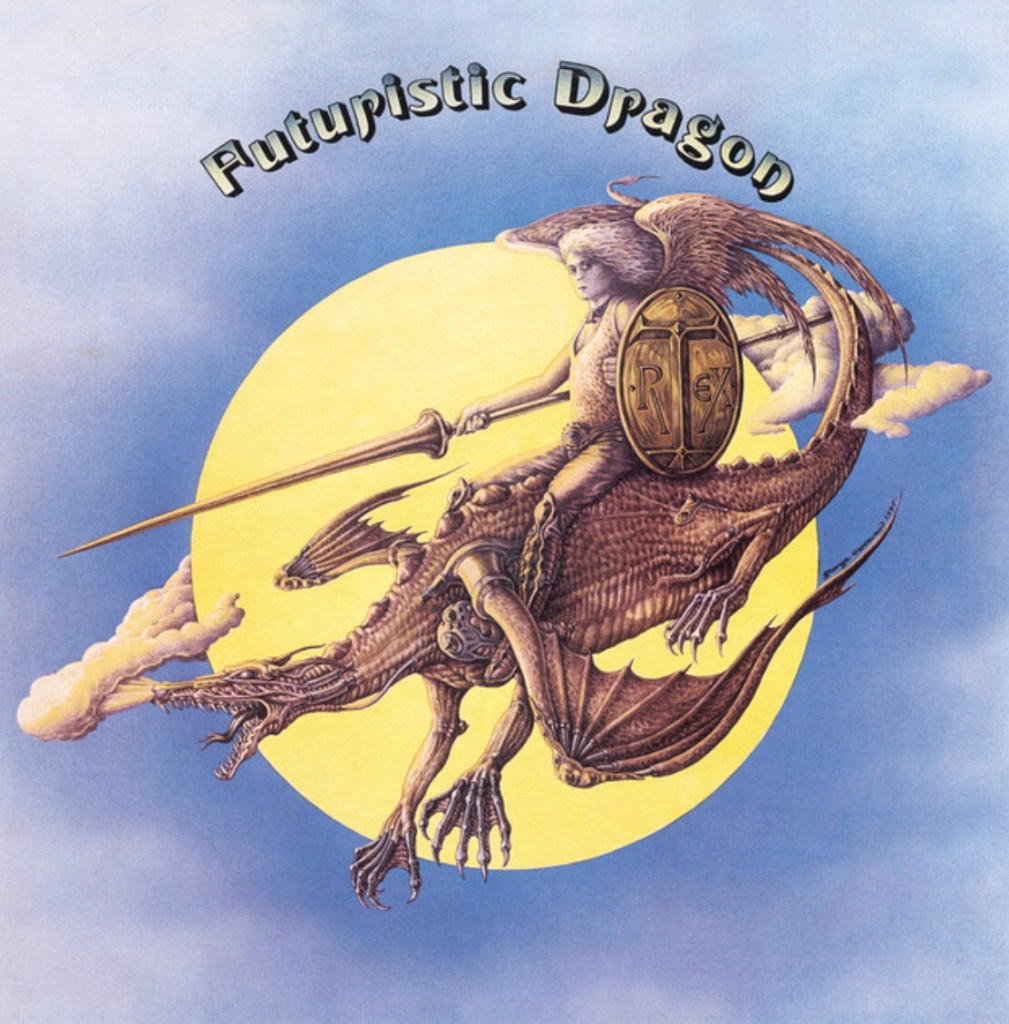
“Futuristic Dragon” is studio album number 11 released in January 1976 everywhere else in the world except the U.S. The U.S release didn’t happen until 1987.
It’s listed as a T-Rex album, however when Mickey Finn left the band the previous year, Bolan said that “T-Rex no longer exists”. But the labels are always wise and they wouldn’t release it unless it was T-Rex.
The band is Marc Bolan on Vocals, Guitars and Moog, his partner Gloria Jones on Backing Vocals and Clavinet, Steve Currie on Bass, Davy Lutton on Drums, Dino Dines on Keyboards and Jimmie Haskell on Strings.
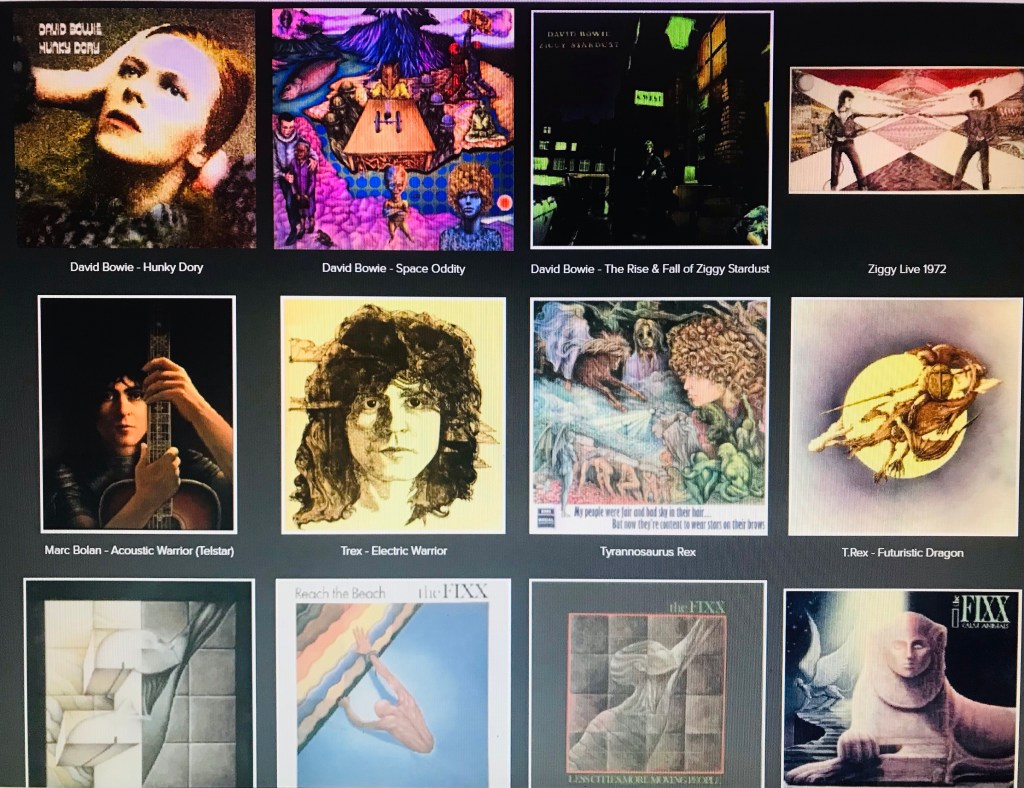
George Underwood did the cover artwork who also covers for other T-Rex albums, along with Bowie, Mott The Hoople and alot of book covers.
Here is a snapshot of some from his website.
All tracks are written by Marc Bolan.
Futuristic Dragon
It’s almost two minutes of a bass groove like the one in “Crazy Train”, guitars on cocaine and a voice over from Marc Bolan. But part from the bass groove, I was like “what the…”
Jupiter Liar
The “Get It On” style riff is back as Bolan is vamping on a F5 power chord.
But this time there are gospel/soul like backing vocalists. And Marc Bolan has a talent for creating a catchy song without a proper Chorus.
Chrome Sitar
The groove on this song is addictive. It’s almost metal like in the riff, however the horns give it a blues/soul rock vibe.
All Alone
It’s a Blues Rock Soul cut, very Rolling Stones like in the blues rock department.
If the verse vocal melody and progression sounds familiar, it should as Nikki Sixx took for when Frankie died. “On With The Show” I say.
New York City
It was a single, a blues rockabilly tune with catchy gospel like backing vocals.
And there is a vocal melody here (the “I did, don’t you know” lyric) which reminds me of another song from another artist, which I can’t remember right now. I like it when that happens, but also hate it when I can’t remember the other artist.
My Little Baby
Another catchy tune, mixing blues rock with soul and a bit of ELO like strings. The vocal melody was definitely used by other artists in the 80’s and beyond.
Calling All Destroyers
The verse vocal melody inspired Phil Lynott for the verse vocal melody on “Cold Sweat”.
Theme for a Dragon
It’s soundtrack like with the strings carrying the melody.
Sensation Boulevard
This could have been on any 80’s pop album it’s that catchy. Press play to hear to bass groove that rumbles throughout the song.
Ride My Wheels
This one has too much soul and less rock. The first slip up on the album, but I still appreciate it for the experimentation of soul based rhythms.
Dreamy Lady
Another experimenting song, however the sugary 60’s pop works here. It’s even disco-esque. Was disco even a thing in 76.
Dawn Storm
It’s a perfect blend of soul and rock.
Casual Agent
A small misstep with too much soul and not enough rock and blues.
Overall, the album is enjoyable to listen to. Marc Bolan is very underrated as an artist and on this album, you will hear a lot of melodies and riffs that other artists have used afterwards.
The blend of rock and blues was always there in T-Rex’s music, and the strings also appeared, however with the addition of soul and a bit of disco, the album was definitely ahead of its time.
Futuristic. Yes.
But it was no match against “A Night At The Opera” from Queen. While T-Rex toured on this album, the overall turnout at the gigs was poor and the album didn’t do that great on the charts either. The glory days of just a few years ago seemed like decades ago.
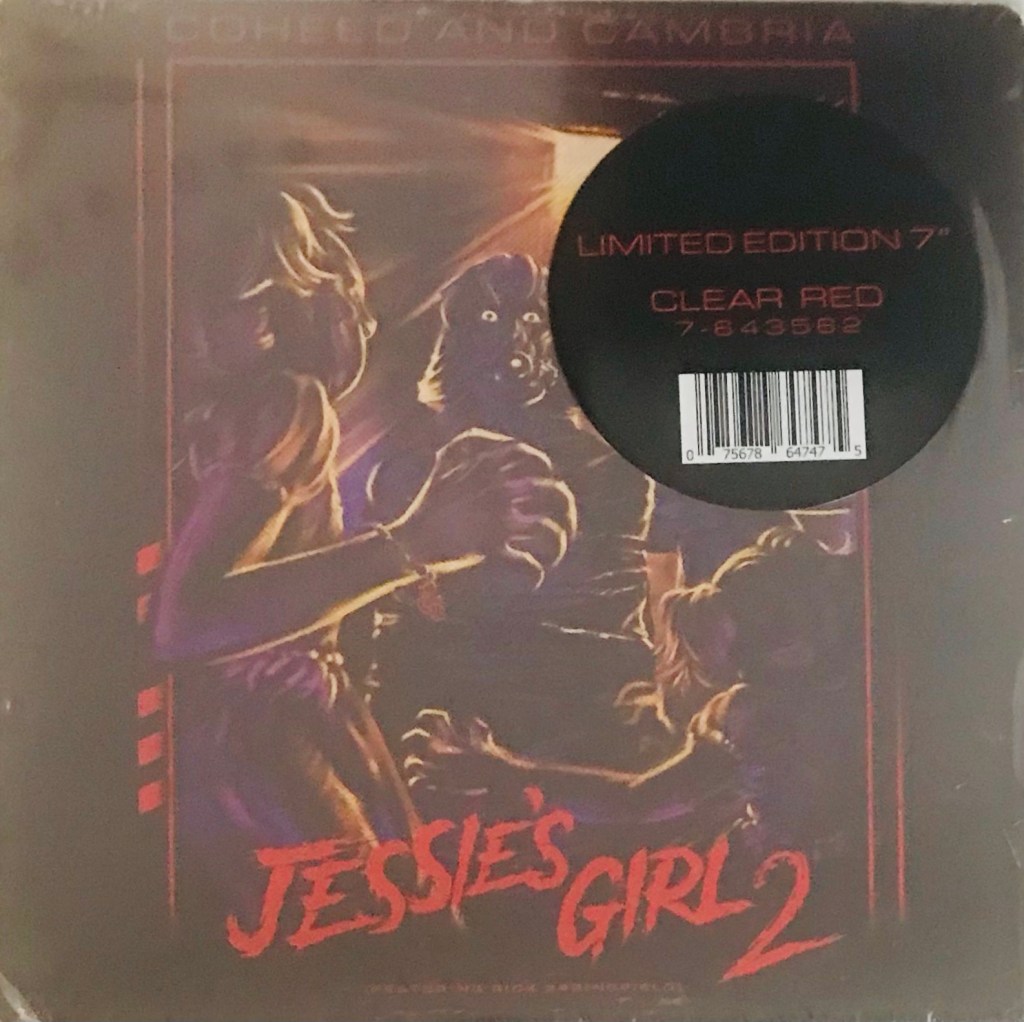
“Jessie’s Girl 2” was released as a standalone single on August 21, 2020 by Coheed and Cambria featuring Rick Springfield.
The original “Jessie’s Girl,” tells the story about jealousy and the song went huge in 1981, turning Springfield into a superstar. And the song is still played today, generating a nice income stream for Springfield or for the Corporation who holds his Copyrights.
Like all hits, it felt that someone should write a sequel.
Enter Coheed And Cambria.
Coheed and Cambria have this power pop rock vibe in their music. So back in 2019, the band was jamming on a riff, when Sanchez sang the melody from “Jessie’s Girl”.
Claude Sanchez said in the press release;
“Has anyone ever written a sequel to another artist’s song?
I don’t think so.
As a fan of movies, it just seemed like a really interesting idea… It’s kind of like a “National Lampoon’s” movie meets “So I Married an Axe Murderer”.
And this also triggered an idea to do a sequel to a famous song, and a grander idea to do an album called “Sequels”. They reached out to Springfield and he was keen to be involved.
This song is from the perspective from “Jessie’s Girl” narrator and things just didn’t turn out the best for him.
While he did get the girl, he regrets it. The girl is out of her mind, has a sinister side as she stalks him and wants to kill him for leaving him, has dirty habits and he regrets burning a friendship to get her.
As I was doing my Super Deluxe pre-order for the new album, I saw the 7 inch vinyl single, so I added it to the cart.
Oh, so I changed my number To 867-5305 That didn’t, that didn’t, that didn’t stop her She wouldn’t let me leave her house alive She’s out of, she’s out of, she’s out of her mind
But it’s not the correct word either as the album is full of melody and atmospheric melodic passages.
The voice even acts as an extra instrument in some songs with the Ohhhs and ahhs.
Karnivool are pushing boundaries here. There are no genres you can use except the word progressive.
But progressive in the sense of how the songs are stuctured and arranged. Because when people think of progressive rock, they think of virtuosos playing super fast passages over complex time changes.
Even progressive is not the correct word.
The band was burnt after a massive worldwide tour in support of their second album, “Sound Awake”, so they took a break in 2010.
Vocalist Ian Kenny started work on his, Birds of Tokyo project.
The band would get together on occasions over a two year period and write the album.
“Asymmetry” is the third studio album by Karnivool released in 2013.
Produced by Nick DiDia, he got the band of Ian Kenny (Vocals), Drew Goddard (Guitar), Mark Hosking (Guitar), Jon Stockman (Bass) and Steve Judd (Drums) to fire on all cylinders and record the album in 3 months.
It divided people.
One review I read said that the band needed someone to tell them “No”. Another review said to “listen to this album with headphones to fully appreciate the album”.
Aum
It’s a short atmospheric ambient introduction that’s hard to even hear.
Nachash
The words “Hash” and “Nac” is backwards for Can and it sounds like they used hash writing this.
A.M.War
The drumming is dominant, the bass is distorted and progressive while the guitars feel jagged and grey.
Vocally, Kenny is channeling his love of Maynard from Tool.
At some stages it’s hard to keep track of the beat as the tempo competes with the other instruments.
There is a lot happening so press play.
We Are
The single.
If you like funk and the kind of funk that Omar Rodriguez is known for, then you will like this.
Stockman rumbles throughout on the bass and Kenny is singing with passion.
Goddard and Hosking are going nuts decorating on guitars.
Like all albums that are classed as progressive, this song is like the commercial song. If you want to call it that.
The Refusal
Bass guitarist Jon Stockman does the screaming vocals. It feels dystopian and industrial. Almost like early Tool.
Aeons
It’s atmospheric and echoey with fast picked guitar notes in the beginning.
The song moves between full heavy sounds and clean tone sounds. And by the time the 6th minute rolls around and Kenny is singing about chemical fires signaling our death, you can only press repeat.
Eidolon
It’s like Muse but like the other songs, there is so much going on.
Sky Machine
This is how the live child of Tool and U2 would sound like.
Amusia
A little interlude that sets up the next song.
The Last Few
The love child of Tool and The Mars Volta.
It feels frantic yet restrained.
Float
Psychedelics are back. Kenny’s vocal is like an instrument throughout the song.
Alpha Omega
Tool and Led Zeppelin this time get together and out comes “Alpha Omega”.
Om
A weird way to finish the album with a spacey instrumental
In Australia it went to number 1 and a Gold certification.
Its listed as one of the definitive live albums ever.
“Frampton Comes Alive!” was released in 1976. It’s weird how his trajectory is so similar to Kiss. Following four solo albums with little commercial success, “Frampton Comes Alive!” was a breakthrough for Frampton, the same way “Alive” was for Kiss.
The album is mostly live except for the first verse of “Something’s Happening”, the rhythm electric guitar on “Show Me the Way” and the intro piano on “I Wanna Go to the Sun”. These were fixed in the studio.
In a genius marketing move, the double album was released in the US with a reduced list price of $7.98, only $1.00 more than the standard $6.98 of most single-disc albums in 1976.
And the band is on fire.
Peter Frampton is on Vocals, Lead guitar, but Bob Mayo fills up a lot of the space with his Rhythm Guitar work, plus he plays the Piano and Hammond Organ. Stanley Sheldon on Bass Guitar and John Siomos on Drums provide a solid foundation.
There is crowd noise, fake or real, I’m not sure and the GM of Winterland, Jerry Pompili starts off the concert with the words “If there was ever a musician who was an honorary member of San Francisco society, Mr. Peter Frampton”
Somethings Happening
The blues rock groove is clichéd and heard in many different songs, but it’s always cool to hear it.
This track and the next are from the “Something’s Happening” album released in 1974.
Doobie Wah
It follows on from the blues rock groove from the opening song. And with Doobie in the title, it does sound like Doobie Brothers.
Show Me The Way
From the “Frampton” album released in 1975.
When people talk about talk-boxes, this is the song that was listed as the definitive talk-box song, until an Italian American called Richie Sambora changed the game with “Livin On A Prayer”.
Musically, its excellent, a strummed guitar progression, a hooky vocal melody and that talk-box melodic lead.
It’s a Plain Shame
A blues rock dirge from the “Wind of Change” album released in 1972.
At this point in the set, it sounds okay and fresh.
All I Want to Be (Is by Your Side)
The album goes into ballad rock territory for the next three songs. This one is from the album “Wind of Change” released in 1972.
Wind of Change
An acoustic folk rock song.
Baby, I Love Your Way
From the “Frampton” album released in 1975.
It’s a song that I’ve heard on radio and TV commercials and movies and when I heard it here, I was like, ahhh, it’s from Frampton.
The song flopped when it was released in 1975, but it took on a new life when it was released as a single from this live album a year later.
I Wanna Go to the Sun
From the “Somethin’s Happening” album released in 1974, it could have come from any Southern Rock album released at the time. And Frampton is wailing away throughout the song in various solo spotlight moments.
Penny for Your Thoughts
The shortest track here at 1:23 and along with the next track are from the “Frampton” album released in 1975. It’s one of those major key finger picked campfire tunes. It doesn’t sound like “Albatross” from Fleetwood Mac, however it has this feel.
(I’ll Give You) Money
From the album “Frampton”, released in 1975 and its back to the hard blues rock.
I dig the “Stormbringer” and “Mississippi Queen” feel in the song. And 80’s Y&T comes to mind when I listen to this.
Check it out.
Shine On
From the “Rock On” album released in 1971. The blues rock dirge is sounding too much same/same.
Jumpin’ Jack Flash
A Rolling Stones cover which was released on “Wind of Change” from 1972 and given the 7 minute live treatment here. .
Lines on My Face
From the “Frampton’s Camel” album released in 1973. The fingerpicked clean tone intro hooks me. It’s very Eagles like when they played Folk Rock.
Do You Feel Like We Do
From “Frampton’s Camel” album released in 1973. The 14 minute closer of the album.
The intro riff will grab ya straight away. It’s Santana like, its bluesy and its rocking. But that whole section in the middle is unnecessary.
In Australia it charted to the top spot and was certified 3x Platinum. In the U.S, it also went to Number 1 and is certified 8x Platinum.
There is a theory that this album became so big in 1976, because the year was insignificant when it came to rock music and most of the artists who had fame prior to 76 had either stalled their careers with drugs or breakups or if they were still together they were running on fumes.
And Frampton never captured this glory again and the subsequent albums didn’t do anything great either.
It’s because his face and looks got more time than his guitar skills. Suddenly, his audience was more female than male and his musical credibility was questioned. All of those years honing his guitar chops and song writing abilities were ignored by a vicious press who saw him as a disposable teenage idol.
And while this was happening, he was hooked on morphine and his manager was ripping him off, leaving him bankrupt, along with a terrible decision to star in a film version of “Sgt Pepper” and to pose a certain way for the album cover of the follow up, “I’m In You”.
I missed this album in 1986, picking it up a few years later. I’m glad I did pick it up, because as soon as I dropped the needle I liked what I head musically.
It had groove, it was heavy and it was music I was familiar with, like the “Van Halen II” album.
“Dancing Undercover” is the third studio album.
Ratt was on an album per year cycle, as the label knew that time at the top is fleeting, so they capitalized as much as they can.
Produced by Beau Hill, he kept the Ratt’sters of Stephen Pearcy (Vocals), Robbin Crosby (Guitar), Warren DeMartini (Guitar), Juan Croucier (Bass) and Bobby Blotzer (Drums) in line to deliver another Platinum album.
However it’s important to remember that Platinum awards were given out to artists based on shipments alone before Soundscan became a thing.
Did they really sell a million?
I don’t think they did. Then again in a country of 332 million, what is a million in sales.
It’s less than 1 percent. 0.3 to be exact.
That’s the reach.
Anyway.
Dance
Written by Crosby, Pearcy, DeMartini and producer Beau Hill.
Before “Girls, Girls, Girls” there was “Dance”.
Check out the digital delay melodic lead at the start is perfect.
Does it remind you of the piano riff on “Bat Out Of Hell”?
One Good Lover
Written by Crosby and Pearcy.
Check out the “Somebody Get Me A Doctor” riff in the Intro and Chorus. Crosby was a master at taking something that came before and making it Ratt’N’Roll material. And he also took the feel, the key and groove of “You Really Got Me” in the verses as well.
Drive Me Crazy
Written by Crosby, Pearcy, DeMartini and Blotzer.
The dudes borrow from another L.A shredder in Mr George Lynch with the Intro/Chorus riff and a certain EVH in the Verses and Pre.
Slip Of The Lip
Written by DeMartini, Croucier and Pearcy.
Its blues rock groove was better than anything that AC/DC was releasing and DeMartini was in pentatonic heaven with his leads.
Body Talk
“Light Up The Sky” comes to mind immediately.
So press play and enjoy that main riff from DeMartini, which is something he had written a while ago, but never knew what to do with it.
Until Croucier heard it, wrote some more music for it and arranged the song, with Pearcy contributing lyrics.
A perfect Side 1 closer.
Looking for Love
The Side 2 opener written by Crosby, Croucier and Pearcy.
How catchy is the vocal line in the Chorus on this?
But press play to check out the NWOBHM riff in the intro.
It’s heavy fucking metal.
7th Avenue
Written by DeMartini and Pearcy.
The metal blues groove on this is perfection, something which Izzy and Slash would use a lot on the debut GNR album.
It Doesn’t Matter
Written by Croucier and Pearcy.
Musically it’s very VH like.
The Chorus lyrics are great with the message to let your individual freak flag fly, as it doesn’t matter at all the clothes you wear.
But the Verse lyrics are not in sync.
Take a Chance
Written by DeMartini, Croucier and Pearcy.
CC DeVille would be inspired for “Unskinny Bop” and DeMartini would re-use some of the riffs for “Way Cool Jnr”. It could even pass as a derivative version of “Slip Of The Lip” or a track on a David Lee Roth album.
Enough Is Enough
Written by DeMartini, Crosby, Croucier and Pearcy it’s basically “You’re In Love” in clean tone.
Croucier is all over this album, with co-writes on almost every track. Pearcy was never Shakespeare when it came to lyrics, but there is always room for dumb party sex songs.
“Hysteria” is the title track of the album, released in 1987 as the third single. Its perfection was lost in Australia as a single.
But we became reacquainted with it after the album started to get traction on the back of “Pour Some Sugar On Me”.
“Ride Into The Sun” is an oldie, originally released on the rare Def Leppard EP from 1979. The song just kept coming back into the mix for an album release, but never officially made it.
And that rare EP from 1979 is still rare if you have the original pressing, however if you don’t have the original pressing, the EP has been released on various Def Leppard Box sets and reissued as a RSD purchase in 2017.
Riff wise, its Def Leppard at their metal best. The riff actually reminds me of “Aint Talking Bout Love”, just beefed up.
There is this little riff in G major, in between the E minor riffs that I like. When you hear it, you will know what I mean. It’s those little things that hook me in.
And the Chorus is very British rock, like Sweet and Slade, something which Def Leppard wear on their sleeves with pride. There’s even a pretty unflattering photo of the band in Union Jack T-shirts and small shorts around the “Pyromania” period. I’m surprised a testicle didn’t pop out, that’s how short the shorts were.
For the song “Hysteria”, well it’s one of those songs that can be classed as a perfect mix of hard rock and soft rock. I mentioned in the album review one word for the song.
“Change of Address” came out in 1986 and its listed as album number 9 for Krokus.
The band for the album is Marc Storace on Vocals, Fernando von Arb on Lead Guitar, Mark Kohler on Rhythm Guitar, Tommy Keiser on Bass and Jeff Klaven on drums. Paul Fox and Jan Winding contribute keyboards.
Production is handled by Tom Werman as Producer and Mixer, with Duane Baron as the engineer and von Arb as Co-Producer.
A special mention to the outfits on the back cover. The 80’s are well known for the wardrobe choices of artists. And Krokus play into this as well.
Check em out in jump suits that mechanics would wear at a Formula 1 race. But they are in a bunker, to highlight the demolition of a building that looks like the White House.
Now (All Through the Night)
Written by Fernando von Arb, Jeff Klaven and Marc Storace.
How good is the Chorus?
It’s like Journey vocally and melodic hard rock musically.
One of my favourite tracks on the album but the midi drum sounds bother me.
You can blame ZZ Top for this, but at least when ZZ did it, it was still sounding like it belonged in the rock domain, whereas, the drum sound here feels like it belongs on a Gloria Estefan and Miami Sound Machine album.
Hot Shot City
Written by Tommy Keiser, Mark Kohler, Jeff Klaven and Marc Storace.
I’m not sure what’s happening with this song.
It’s like they wanted to bring in influences from Robert Palmer and Huey Lewis into their sound. It could have worked.
School’s Out
This is like old school Krokus and after hearing AOR Krokus on the first two tracks, this is a welcome relief of rock and roll.
For those that don’t know, this is a cover of the classic Alice Cooper cut.
But it’s also not necessary to have this on the album. Then again, most 80’s album had a cover of a 60’s or 70’s track on it. For some bands it was pure filler and for others, it was their biggest song.
Let This Love Begin
Written by von Arb and Klaven.
An acoustic guitar arpeggio riff starts it all off, very Malmsteen like with a bit of Vinnie Vincent and “I Still Love You” from Kiss. Once the distorted riffs kick in, its more Foreigner than Malmsteen.
Check out the lead break, bluesy and emotive, which reminds me of Jimmy Page and “Stairway To Heaven”.
Burning Up the Night
The side 1 closer is written by von Arb and Storace.
Its AC/DC “Long Way To The Top” like in the verses and the Chorus could have come from a REO Speedwagon album.
Say Goodbye
Side 2 opens up with this track, written by Fernando von Arb, Jeff Klaven and Marc Storace.
At 5.18, its length shows that it wasn’t written for radio. It has this reggae feel in the verses which I like and the backing vocals remind me of “Black Diamond” from Kiss.
The major key Chorus is like those major key Power Metal choruses.
This is the side to listen to first if you are a Krokus fan. There isn’t a bad song on this side.
And if the intro riff sounds familiar, it should as it was used by Krokus on “Tokyo Nights” from the “Metal Rendezvous” album.
World on Fire
My favourite track of the album at 6 plus minutes long, written by Fernando von Arb, Jeff Klaven and Marc Storace.
While the riffs are metal and hard rock like, the vocal delivery in the verses is very Robert Plant like and I like it.
If you want to press play on a track from this album, start with this track.
Hard Luck Hero
Written by Fernando von Arb, Jeff Klaven and Marc Storace it feels like it’s a cross between Bryan Adams, Night Ranger, early Foreigner and Autograph.
And I like it.
There is this section just before the solo, when Def Leppard also comes to mind.
Long Way from Home
5 plus minutes long and written by Fernando von Arb, Jeff Klaven and Marc Storace.
It’s another Krokus classic song, rooted in their past and perfect to move with into the future.
The Chorus has this Kiss feel which I like and Allan Holdsworth also does the guitar solo a fusion of string skipping and whammy bar madness.
The album did decent business in Switzerland and Sweden, but in the U.S it was up against some decent competition and it failed.
The band would later admit the change in style and sound was due to the label Arista not approving the recording until they heard more radio friendly songs.
But this wasn’t a problem tied to Krokus alone.
All of the bands during this period had albums that sounded radio friendly.
Judas Priest and “Turbo”.
Quiet Riot and “QRIII”.
To name a few.
Overall, the album still sounds like a hard rock album once you get past the first two tracks.
Werman has copped some flak from artists he’s worked with, but one thing is certain. The bands he produces, sound good. Even though I don’t like the midi drum triggers, the album still sounds good.
And if you purchased a Krokus album expecting to hear Shakespearean lyrics, well, it ain’t going to happen.
Enjoy Krokus for what they are, a hard rock band trying to survive in an ever changing market place.
And Krokus does change well.
When all the rage in the scene was about the NWOBHM and AC/DC they gave us “Headhunter” and “The Blitz”.
And when the rage shifted to AOR and midi triggers and synths, well they gave us “Change Of Address”.






 destroyerofharmony