A to Z of Making It, Music, My Stories

Genre Labels

When you upload music to Spotify as an artist, the service via the digital distributor an artist uses, asks what kind of genre you are in, because for an algorithm to work it needs a label to refer to. And the genres an independent artist has to pick from are Metal or Rock or Alternative Rock and a host of other ones that are not relevant if you play music with distorted guitars.

But what genre would you be, if you see yourself as progressive, with a little bit of metal, a little bit or rock, a little bit of blues, a little bit of country, a little bit of soul, a little bit of classical, a little bit of folk and a little bit of pop.

 And why wouldn’t the lyrics play a part. You could sing about death and depression or you could sing about censorship and oppression or you could sing about dungeons and dragons or you could sing about history.

Seriously, look at the genre names that the labels and music writers of the past have come up with.

Metal, rock, blues, country, soul, classical, folk and pop.

If “Thrash” was a genre to select from, I would add that to the list as well.

So how would people promote all of this different music if it was just labelled “music” without any word before it like metal or pop?

Well marketeers knew that genre labels work for people. In life we more or less label everything. Our ethnicity, first name and our surname is a label we get from the start. Because if a sheet of paper doesn’t exist stating our name or birth, we obviously don’t exist according to official records.

And we keep building on labelling?

We develop labels for suburbs like that is a “good place to live vs bad place to live”, people like fat people vs skinny people to nice people vs rude people, races, schools (public vs private vs religious school), workplaces (government vs private), sporting teams and family/friends. So it’s pretty obvious that labels in music work for pushing the product. And it makes it easier for people because they don’t feel overwhelmed.

But as the article states, labels are for cans, not people. Always be curious and don’t fall into the label/categorisation trap. Keep exploring.

Standard
A to Z of Making It, Music, My Stories, Unsung Heroes

A Bit More Tool

I realised in the last week, I haven’t written anything about Tool since this blog started in 2013. And the reasons I could come up with is because their music didn’t exist digitally in any legal way for me to access and I really hate using YouTube, putting up with their ads and how I could come across a song with the audio quality being hit and miss. Plus since I pay for Spotify, I’m not interested to pay for YouTube. And even though I own a lot of vinyl and CD’s, I don’t play em anymore. And Tool, up until a few weeks ago, were a band that existed in the physical world.

So out of sight, out of mind.

And then Tool is suddenly back in.

And for a lot of people Tool is known as an “acquired taste”. Tool writes music that is progressive, but not a thousand notes style progressive. It’s elements are more about exploring and building grooves, some of them in 4/4 and others in 7/8, 6/8 and so forth. They have elements of styles known as rock and metal in there. Vocally, it is a bit harder to categorize. On the “Aenima” album, just check out “Stinkfist” and the lyric, “Elbow deep beyond the borderline”. I don’t recall too many bands who sell out arenas singing about fisting.

And people talk about the band and people come back for more and people pay more for their product. Because Tool is a unique artist. Most of the other artists in the major music markets are lumped into a few genres, while Tool lives without category, regardless of what the marketeers want from them.

Go left when everyone wants you to go right. Be the “none of the above” answer when everyone wants you to be part of the above.

Standard
A to Z of Making It, Music, My Stories

Building Small Communities

Music is spread from person to person. Someone would come across an artist they liked and they would put the effort in to spread the word.

And once we got exposed from someone, we made it our mission to find another artist and talk about them and insist that people pay attention. It’s why music magazines became popular.

The true fans. They are the ones who will go ahead and spread an artists music and it’s not because an artist wants them to, it’s because they want to.

Algorithms try to do music discovery but they are nowhere near close to the human emotion of music. And the programmers have no idea how to write code that connects with the human curation.

And the labels are all about short-term profits which is a terrible way to build a proper and sustainable industry. There’s always a shortcut like scalping tickets or cooking the charts, a rule to be bent by being creative on the accounting and by not paying the artists their share. And when they don’t get their way, they pay politicians enough money to pass laws to give them their way.

So artists are on their own, building their small sustainable communities.

Standard
A to Z of Making It, Copyright, Music, My Stories, Stupidity

Who Should Watch Over The Royalties?

Last year, the Music Modernization Act became law, in an attempt to fix some aspects of Copyright. While it had a nice clause about moving some very old music into the public domain, the issue that got all the artists excited was the changes required to the mechanical licensing process for songwriters, making it easier for songwriters to get the royalties they are owed.

But.

In all the excitement no one thought to read the details. The law gives birth to a new collection society for these mechanical royalties. So companies/organizations had to submit their proposals to The Copyright Office. And the one that looks like it could win the “bid” (the National Music Publishers’ Association (NMPA)) is one of the organizations which caused part of the current mess with royalties.

In other words, it’s another system created to move money to the big music publishers and away from independent artists.

The publishers have the PR down, telling people how they represent all songwriters which is not quite true.

And independent songwriters make up 99% of the music business, but they are all confused about what is going on and what they need to do to collect their royalties. Trusting in organizations to do the right thing is not really a good business model. And in times of confusion, the one that benefits most, is the one in power, which is the NMPA.

As the Techdirt article explains:

There is a pot of unclaimed royalties that have already been paid by music services that is estimated to be between $1.5 and $2.5 billion.

With so much money at play, the new organization will need to create some fancy algorithms to match the monies to the songwriters. However, the new law also gives the new organization a POWER to distribute any unclaimed royalties to themselves after a three year period.

So how proactive do you think this new organization would be to find these independent songwriters?

And this kind of conflict of interest isn’t new. SoundExchange is a good example. In 2005, this new body was formed, a spin off from the labels to collect online royalties and by 2009 it had a lot billions of unclaimed royalties to couldn’t match, even to well known artists.

If the NMPA gets the green light from the Copyright Office they will control billions of dollars in royalties. It’s more power to the old legacy players.

As the are Techdirt article states, the biggest challenge to being a successful independent musician is not piracy, but rather the legacy industry getting in the way and keeping money it owes independent musicians.

The Techdirt article.

Standard
A to Z of Making It, Copyright, Music, My Stories, Piracy, Stupidity

Gaming The System

If there is demand for an artists music then why aren’t the artists servicing the demand.

Because there are people putting up bootleg and demo recordings of popular artists on digital services and making money from it in the process. In some cases they even uploading fake recordings which somehow manage to get onto the artists homepage.

Actually that homepage part crap needs to be sorted by Apple and Spotify quickly because how the fuck can you fuck that up. Too much reliance on algorithms and not enough human eyes and ears.

I got a song in my Spotify Release Radar from Tommy Lee and instead of seeing the aged, white tattooed T-Bone, I see a young black rapper. Same deal with names like Dio, Ratt, Rush, Badlands, UFO, Keel, Vandenberg, Cinderella, Icon, KISS and Journey.

The process to game the system is simply.

You just set up an account with a digital distribution company and start releasing music.

Now these distribution companies are set up for independent artists to release music. But we have bullshit artists using it to game the system and fuck it up for legitimate independent artists.

And the digital distribution companies do have fraud prevention methods but people who are gaming the system are just getting smarter than the algorithms coded by people who are not as smart as the con artists.

One fraudulent leaker earned $60K in royalties by putting unreleased tracks from a popular artist on their Spotify and Apple Music accounts.

What the fuck were the artists record labels reps doing?

Didn’t they see these unreleased songs go up.

I guess not because, they were too busy fighting stream ripping sits, pirate sites, website blocking and anything else that involves censorship of the Net instead of developing artists and taking care of their artists and paying them on time and fairly.

The way the payments work for is that Spotify or Apple or Pandora will pay the digital distributor royalties for the artists. This normally happens three months after. So for royalties earned in January, the payments to the distributor happen in March/April.

And then the distributor will hold these payments as they “clear” the royalties from being free of any copyright claims. This takes another three months.

So for a fraudulent uploader to earn $60K, it means many people were asleep at the wheel.

And legitimate independent artists get punished even further as they wait over six months for a royalty payment. All because people want to game the system and the system has too many people asleep at the wheel.

Read this article over at Pitchfork.

Standard
A to Z of Making It, Classic Songs to Be Discovered, Derivative Works, Influenced, Music, My Stories

Help

My kids had one of my Beatles guitar books out and it was opened to “Help”. And once upon a time I was learning The Beatles songs because they sounded good. I never really paid attention to the lyrics, especially to their mid 60s output. But today, the lyrics of “Help” grabbed me instantly, so I had to call it up on Spotify.

When I was younger, so much younger than today
I never needed anybody’s help in any way

I felt invincible when I was younger. Although I hung out with people, I didn’t think at all that I would need to ask them for help or seek help from them. Especially any help that involved manual labour. Actually there was no way I was wasting my time/days on manual labour when there was metal music to be listened to or waves to be caught.

But now these days are gone, I’m not so self-assured

Man, these words are from 1965. So much truth.

Getting older means greater analysis and every decision needs our attention and I remember reading somewhere how exhausting attention is.

And we can handle this in a few ways.

We can ignore making decisions and seek help from self-improvement books or we can spend time on a website and even move further away from making decisions.

Now I find I’ve changed my mind and opened up the doors

If my mind feels fear, I act differently. If I feel like it’s been overloaded with life’s challenges, I act differently. If I am curious or connected, I acted differently. If I feel inspired, I act differently. I feel like the mind is so powerful and it dictates how my day will go.

Do I want that small lizard part of the brain controlling my day or the whole part of the brain?

Help me get my feet back on the ground

There is a saying that our existence is defined by what we struggle for. And these days, are people willing to struggle for anything.

No one wants to have their feet off the ground. There needs to be a safety net in everything.

If you want to make an impact, you need to be a lifer. This means being a lifer in the game you want to play and a lifer in learning.

Remember, a University/College degree will put you on the path to earning a living, but things you learn that are not taught at school (like smoking in the boys room), your own self-education will put you on the path to making a difference. But there is no safety net on this path.

And now my life has changed in oh so many ways
My independence seems to vanish in the haze

When you are a member of the biggest rock band and part of a cultural craze, your independence is limited. It’s a choice.

So many people want the fame and stardom, but then complain when people hound them for a photograph or a selfie. Its part of the territory. These days, not so much. A rock star could be walking the streets and no one would notice.

Standard
A to Z of Making It, Music, My Stories, Stupidity

Music Distributor or Internet Brand

Spotify is the largest streaming provider today but YouTube did have that title unofficially in the past. So with any service that is used by the masses, it’s no surprise that Spotify now takes most of the punches while YouTube becomes a takedown haven for anyone who has created anything or wants to suppress free speech.

I’m sure you’ve seen all the headlines.

Spotify should pay more, Spotify is appealing the royalty rate rise, Spotify is getting sued, Spotify settles class action suit against it.

Maybe another take on those headlines might be;

  • How much does the record label keep from Spotify’s licensing and royalty payments?
  • Artists are appealing the low royalty payments they get from their label?
  • Record labels get sued for banking billions from using the Copyrights of artists to negotiate high licensing fees.
  • Artists settle class action suit against the Record Labels for keeping Copyrights longer than they should and for murky creative accounting.

Major labels no longer develop artists but they can make artists bigger. It all depends on how much an artist is willing to give up.

Because the labels will give the artist that large advance, however it will be probably be the last payment an artist will ever see from them.

Just recently, Italian composer Ennio Morricone (Metallica uses his music as a concert intro, plus he wrote the soundtracks to a lot of popular movies) won back his Copyrights. In his termination suit, it was mentioned how in the late 70s he made a deal with a label for an upfront payment in exchange for low royalties which never got renegotiated and of course by the 90s his music was being used for concerts, it became popular again as those 70s movies got re-released on DVD and so forth.

Metallica’s licensing fee would go all to the label and nothing to the Composer. A perfect example of getting a large upfront payment and then nothing in return.

The labels are greedy, who operate on intimidation and since MTV, they have been short-term thinkers. It’s all about the profits.

So what’s next for music distribution and a company living in two worlds. Spotify has a bad rep for its payments models but also a good rep because it’s useful to artists and fans, plus it pays for life.

But Spotify still doesn’t make a profit doing what it does and it still gets extra funding, to invest and grow the business. Their podcasts is a growing business as there are a lot of people who would rather listen to non-musical content than musical.

Maybe the problem with Spotify is that it doesn’t want to be just a music distribution platform. Music is seen as a means to become a global internet brand. Sort of like Apple, who used music to sell hardware.

And all you need to do is have a look at what’s happening with Netflix. The big studios who laughed off streaming once upon a time, are setting up their own streaming services. Expect the labels to do the same, because they want control of the distribution and the murky creative accounting.

And by then Spotify would be in a position to not care, because they would have repurposed the business to be a digital brand and the artists would have it even worse, because if they think Spotify is bad, wait until the labels get control of the distribution.

Standard
A to Z of Making It, Classic Songs to Be Discovered, Derivative Works, Influenced, Music, My Stories, Unsung Heroes

The Record Vault – All That Remains

The Pirate Bay introduced me to All That Remains circa 2008.

It actually happened in a more complex, funny kind of way, so for any label rep who thinks that scorched earth promotions is the key to get people’s attention, well check out this Discovery. (Spotify Discovery are you reading as well).

I got into Killswitch Engage because the bass player in a band I was in liked em, so I asked him to give me some of their music. He burnt me “The End Of Heartache” and I dug it. This was circa 2005. The hardcore screamo vocals didn’t set my world on fire, but the melodic vocals sure did, the way the songs were constructed hooked me and the music is melodic and heavy at the same time. 

Suddenly I am seeing interviews with Killswitch Engaged founder, guitarist, producer and songwriter, Adam Dutkiewicz in the Guitar mags. And Adam produces other bands. Unearth, As I Lay Dying and All That Remains came into my headspace because of Adam.

So almost three years after getting into Killswitch Engaged, off I went to TPB, typed in All That Remains and their catalogue from start to 2008 was available.

And the first track on the “Overcome” album (released in 2008) is called “Before The Damned”. It’s brutal death metal in the verses and when the Chorus kicks in, its arena rock. I was hooked straight away. “Two Weeks” from the same album is their most streamed song with over 40 million streams on Spotify and 26,644,942 views on YouTube.

In 2010, “For We Are Many” came out and I liked it, but I didn’t commit financially until the 2012 album “A War You Cannot Win”.
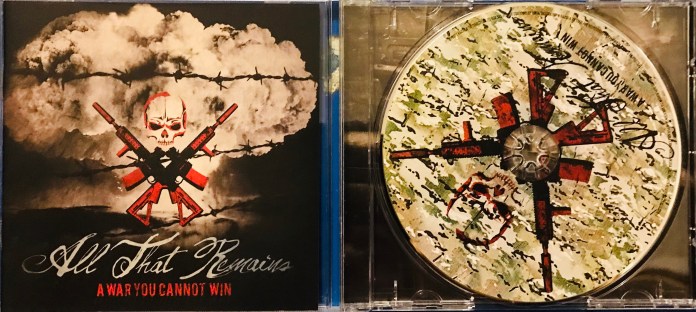
Opening track, “Down Through The Ages” has some of the best thrash metal riffage (along with some deep growls)

“So many fall away” indeed. The most likeable kid at school has bi-polar now and looks like Crusty The Clown, all because of too much drugs. But he’s made it, while others have either spent time in jail or hanging on the end of a rope or struggling to breathe, surrounded by carbon monoxide.

Check out the lead break. It’s a hum a long, until the whammy dive kicks in.

“You Can’t Fill My Shadow” has a lead break that keeps me coming back.

“Stand Up” is pretty accessible, with clean tone melodic vocals throughout and great riffage throughout. Stand up and be proud of the choices you made.

To me, this song is a big FU to the people who criticised the band for bringing in some melodic rock influences into their songs. Well if it wasn’t for those influences, I wouldn’t be a fan.

“Asking Too Much” is another hard rock song, easily digested. “Just Moments In Time” is brutal and heavy, with screaming death metal vocals and lyrics which state, “We are all just moments in time, We come from nothing and we’re nothing when we die”. 

“What If I Was Nothing” is almost country’ish in the intro, but a hard rock relationship song in the end. Super melodic, with 24.6 million streams.

“Sing For Liberty” tells people to take back their freedoms.

“A War You Cannot Win” has so many lyrical lines that resonate.

One voice can silence the masses, One voice just scream these words say, No, hell no

“The Order Of Things” was released in 2015 and this album is very accessible for people who like hard rock music but don’t like too much hardcore style vocals or death metal style vocals. 

The piano line intro in the opening track “This Probably Won’t End Well” reminds me of the Paradise Lost “Draconian Times” album, albeit for 45 seconds. Then it’s back to the hard rock/metal that All That Remains does well.

“The Greatest Generation” is a favourite, with a lyric of “remember what made us great”. And we have forgotten that.

“For You” is personal, about a relationship breakdown, and that lyric line of “I won’t wait for you”. “A Reason For Me To Fight” is about making a promise to fight for something you believe in. “Bite My Tongue” has this Jazzy style breakdown which I dig, and when Phil starts singing, “You’re Right, You’re Wrong” it’s time to bang that head.

My favourite track on this album is the closer, “Criticism And Self Realization”. For starters the title hooked me, so it was the first song I listened to. And after that 45 second clean tone intro, the metal arrives. And the verses are heavy with hardcore style vocals, while the Chorus is melodic and emotional. The whole thing connects instantly.

And at 3.20, it goes back to the clean tone intro and it feels like the song is repeating. But it’s not. Its segueing into a new section. And from 4.20, that clean tone intro becomes an outro, with harmony guitars and then lead guitars. By 5.12 the loudness is replaced by a piano, which is playing the same intro music, but slower, sadder, more solemn. And I just want it to continue. But by the 7 minute mark it’s over.

Since, 2015, they released “Madness” in 2017 and “Victim Of The New Disease” in 2018. After the release of this album, founding guitarist Oli Herbert (who also laid down some wicked soloing and riffage on Dee Snider’s “For The Love Of Metal” album) was found dead in a pond. While early reports suggested accidental drowning, an investigation is still pending for foul play. 

And I am glad that vocalist Phil Labonte (also the back up Five Finger Death Punch singer when Ivan Moody goes off the rails) is carrying the All That Remains flame.

And with this post, the record vault for the letter A ends (at this point in time) and I am onto the letter B. My kids reckon I won’t get to Z.

Standard
A to Z of Making It, Music, My Stories

Why Do People Get Into Music These Days?

Don Dokken once said that he and the rest of the Dokken band members thought that they would get rich once they signed a recording contract and started selling records.

He then goes on to say that for every dollar the band made, they had twenty cents to split four ways.

Since Don Dokken signed the original contract, Don was forced to sign a contract that was a equal four way split.

Lynch blamed Dokken for using songs that Lynch wrote, to get a record deal under the name of Dokken. And Dokken hated Lynch because Lynch wanted to change the name of the band. And in the end, their hate and blame led to solo careers.

A wise man once said to me that if I’m involved in something which goes wrong, to never blame others. The only person I can blame is myself. Because if I blame myself, then I am in a situation do something about it.

So going back to the original question, why do people get into music?

The answer to me is always the same. There is a need to create and write. As a byproduct, money might come in, but the need to create will always remain.

Going back to Lynch and Dokken, George Lynch hasn’t stopped creating. Don Dokken on the other hand has.

Standard
A to Z of Making It, Music, My Stories

The Destination

There is a post I read on Seth Godin’s blog, called “The Compass And The Map” about a soldier who escaped a Japanese prison in Burma during World War 2.

For five months, he used a map and a compass that he had found to get him to India as he was too suspicious to ask the Burmese for help. He scribbled on the map, his turns and marked down the rivers he crossed.

When he showed the Intelligence Officers in India his map, it was a map of the streets of London. As Seth Godin concludes, “if you’ve got the wrong map, the right compass will get you home, if you know how to use it.

In other words you need to know where you want to go and be flexible with the route.

Do artists have these same ideals?

The days of a record label A&R person signing you and employing people around you to do the work, while you write and record and tour and make lots of money are long gone. For that era, the artists had the map which was controlled by a gatekeeper, as it was a step by step guide on how to get from playing to your bedroom wall to maybe getting an A&R rep to see you play live, to signing a deal and then playing to thousands of people.

But that map will not serve you well in the music world today. You need that compass that takes you in the direction you want to go, as long as you know your destination.

Standard