There will be an annual stream count that artists must meet in order to start generating Spotify royalties.
Spotify is targeting a tiny proportion of tracks on its service that are very low in popularity.
In total, the tracks Spotify is targeting, generate royalties that when combined add up to tens of millions of dollars a year. If no action is taken, these tracks accumulated together will generate around $40 million.
SO WHAT HAPPENS TO THE $40 MILLION?
It will go back into Spotify’s ‘Streamshare’ royalty pot.
And the monies in the pot will be re-distributed amongst the tracks that are, more popular.
Take from the poor so that the rich get richer.
Spotify is telling the world that this targets the royalty payouts whose value is being destroyed or who are not even being paid to the creators because they haven’t met the digital aggregator minimum level for payments. And they are sitting in their bank accounts, earning interest.
Spotify seems to forget that every artist begins with low plays/streams.
MMM. SO THIS HELPS THE ARTISTS HOW
So while Spotify is thinking of keeping streaming money in their bank account to pay the larger artists, Hipgnosis who is an investment fund is doing something fishy.
As you probably are aware, Hipgnosis purchased a lot of rights to valuable intellectual properties. It’s share price doesn’t reflect what the company believes it’s worth.
It wanted to do something sneaky to inflate or boost its share price by selling a stake of the company to another entity owned by Hipgnosis and to use the profits of the sale to pay down debt.
This was all contingent on some mathematical equations about retroactive Copyright payments from the US.
Hipgnosis estimated they were due USD$21.7M however when all the dust settled they are only getting $9.9 million.
So they had this share but back scheme which they have now shelved and their share price went down even further.
All of these schemes and creative accounts on the backs of the rights they own from artists.
And Yes, I do know that the artists sold their rights to Hipgnosis for a large fee.
The lyric in question is “the west end boys and east side girls”.
The lyrics are the main Chorus words for “West End Girls” by Pet Shop Boys and those same words are said three times in Drake’s song “All The Parties”, which is a shit song by the way.
And the words are not said with any sense of melody or to a backing track of music. They are just said. Spoken like and then auto tuned.
But “East End Girls” is at 239 million streams on Spotify so the Pet Shop Boys are very protective of their intellectual property.
…especially copyright – have been monopolised and weaponised by corporate interests and that legislators have been supine in the face of their lobbying.
Authors and inventors need protection against being ripped off.
It’s obviously important that clever people are rewarded for their creativity and the patent system does that quite well.
But if a patent only lasts for 20 years, why on earth should copyright last for life plus 70 years for a novel?
Yes why should it.
When the songs from the 60s were recorded, the Copyright terms for the songs was 28 years with the chance to renew for another 28 years. A total of 56 years.
And yet those songs got retroactively locked up for a long time by a 1978 Amendment to the Copyright Act by Disney which changed the terms to “life of the creator plus 70 years”.
This would mean that Disney’s “Mickey Mouse” created in 1928 and based on the laws of the time, should have been out of Copyright by 1984 however it would be locked up until 2003.
But in the late 90s and with the 2003 date looming, another Disney amendment was made that extended this law for Corporate works to 95 years. So the Mickey Mouse work from 1928 would finally be out of Copyright in 2023.
And 10 months in, Disney hasn’t suffered the financial losses they said they would if they lost the rights to Mickey Mouse.
In Australia, the Labels and the Movie/TV networks can go to the Federal Court with a list of sites they want blocked and the Federal Court will just approve the lists and the ISPs will then need to block their users from accessing these sites
The Federal Court is meant to review the lists (which they don’t) before rubber stamping the lists (which they immediately do). Because hey, these entities are the good guys, trying to protect Australians from pirates. And the ISPs need to do their bit to protect the business models of the labels and studios.
WHAT I’M CRANKING RIGHT NOW
Savior from Rise Against.
I became a fan because of the Guitar Hero game this song featured on many years ago.
And at 618 million streams it’s definitely making money for whoever holds the rights to it.
Sina Estavi is a crypto entrepreneur. He purchased an NFT of Jack Dorsey’s first tweet for $2.9M. It’s now worth $4.
Or check out this research which claims that 95% of NFT’s are worthless.
Not sure how owning a chunk of digital art on a blockchain is a valuable investment. Even Justin Beiber is down 95% on his Bored Ape NFT.
Non-Fungible Tokens (NFTs) are unique chunks of cryptographic data that connect to a digital object.
Let’s say we have a picture and its copy. If these objects are turned into NFTs, they will be distributed with unique identification codes, and will, be considered unique apart from the other. From this moment, the object that was once just a copy gained its own determined proof of existence, separating from its source.
Although the two NFTs now have an identical visual appearance, they cannot be treated as one thing and can have different financial values, hence the name ‘non-fungible’.
And somehow people came to the conclusion that these are good investments.
THE LABELS vs X
You know when you go on X(Twitter) and you see a music snippet shared by an account. It could be part of a video clip or a live performance.
And since X basically ignores the takedowns from the labels, as a result, the labels sued, asking for $250 million and an ongoing licensing fee.
But X put in a motion to dismiss. The labels then counter argued and a judge in Nashville needs to decide if it goes to trial.
ROLLING STONES
Taylor Swift has shown other artists the financial windfall that could happen if you own your masters.
When Swift realized that she would never get her masters back, she went about and re-recorded the whole albums and made those albums, the versions people should stream and license.
This puts the power of Copyright back in her hands.
It’s just another case of a person who’s never made any art in their life, claiming it as their own and using it to for financial advantage. Geez, it sounds like a record label. Then again, labels did come up with the cash that most artists could never pay back.
As “The Rolling Stones” grew in popularity, they hired music-business accountant Allen Klein.
Klein negotiated a new deal with Decca and he also got a million-pound advance payment for their next album.
But he wasn’t paying Keith Richards and Mick Jagger their songwriting royalties. So they ended the partnership however as part of the severance, Klein managed to keep ownership of the Rolling Stones music for the years he managed them from 1965 to 1970.
But the Stones did receive millions of dollars in royalties from Klein but not as much as if they’d owned their music outright.
STALLONE
After writing the script of Rocky, Sylvester Stallone was offered $360K to not play the role.
The production company that was interested didn’t want him to play the role.
And since 1976, the rights to the Rocky franchise (which Stallone created) are in the hands of producer Irvin Winkler.
Ahh copyright. It’s the gift that keeps on giving. Well it does really. It gives the writer an incentive to create for their whole life plus 90 years after death. Don’t know how it’s even possible after death, but hey, who am I to judge the intellectuals who wrote and debated this change.
It also gives rise to lawsuits and perpetual payments to corporations for valuable copyrights. It’s also a form of censorship and anti-innovation (remember Napster).
Remember when Ed Townsend’s estate wanted Ed Sheeran to pay them millions for writing a song with a similar feel to Marvin Gaye’s “Let’s Get It On”. The trial went to jury and they lost. They appealed and then they withdrew their appeal.
This is what happens when people who create nothing of culture believe they are entitled to that culture.
And for the record, “Let’s Get It On” is not so original itself. It’s also influenced by what came before it. Cause that’s how creativity works.
Reggaeton is a style of popular and electronic music that originated in Panama during the late 1980s and it was later popularized in Puerto Rico. It’s basically massive in Latin America and from the 2010’s it’s creeped into the mainstream of English speaking countries.
In 1990, a song came out called “Fish Market” from producers Steely & Clevie. In that song there was a drum rhythm.
The lawsuit claims at least 80% of the genres songs have used that drum beat.
Sort of like the 4/4 drum beat and it’s variations.
They are common elements and building blocks to creating. The fact that 80% of the Reggaeton industry use this beat shows how common it is.
AI
What’s people’s view on AI?
We’ve had AI in our lives for a long time, yet many have failed to recognize it. At a basic level which everyone would recognize, remember “Spell Check” in Word docs or Google Search.
For the recent waves of AI to work, they need training. And this training involves material which is under copyright.
So.
If I develop an AI tool and train it with the music and books and movies I’ve purchased, am I breaching Copyright?
If I then release the AI tool for others to be allowed to create, is the tool breaching Copyright?
All the AI knows is how to write and review based on inputs.
Basically it’s a tool, that people can use however they want. It’s innovative at the moment. And the copyright industry doesn’t like innovation if it’s not paying them. So it tries to censor or kill the innovation.
Until the come to an agreement and they accept it.
REVENUES
$8.4 billion in six months was brought into the labels accounts with streaming payments making up 84 percent of that pie.
So if you are an artist or songwriter and you’re not getting a cut, your deal is super shitty. Change it.
Because if there was no value in streaming, all of the Investment House and Hedge Funds wouldn’t be buying up the rights to valuable catalogs.
It’s cool how copyright makes money for valuable Intellectual Property. And you can’t get a bigger and more valuable IP than “The Beatles”.
The thing is, not one of the members from The Beatles held or even hold their rights. At one stage, Michael Jackson was the sole holder of the rights.
And with all the transfers and sell offs, The Beatles catalog settled at Round Hill Music Royalty Fund. But like all companies on the stock exchange, the share price just didn’t reflect the true value of the Company.
In this case, shares in the company were trading around $0.70. And share prices this low don’t make share holders and board members happy.
So in comes Alchemy Copyrights with a $496 million buyout offer which means shareholders in Round Hill Music will get $1.15 in cash per share. Suddenly, you have happy shareholders and board members, who get a nice payday for holding shares in culture.
They created nothing culturally and yet still benefit. But I keep hearing how stronger copyright is needed to protect the creators.
Mmmm.
SHARE PRICE 2
Hipgnosis Songs Fund is also selling some of its catalogues for $465 million. This is to pay down debt and increase its share price
And as expected, the share price increased,
Again, you have an organization that created nothing culturally and yet it still benefits. And I keep hearing how stronger copyright is needed to protect the creators.
COPYRIGHT FAMILY DISPUTE
Motown songwriter and producer Ron Miller died in 2007. If Copyright expired on the death of the creator like it once did, then this would be a non issue.
But, Copyright doesn’t expire at this point. It’s still valid for another 70 to 90 years, depending on the country.
Fast forward to 2022, Sony Music Publishing signs a deal with Lisa Miller, for rights to 130 of her fathers songs.
But Ron’s other children Julie Moss and Mark Miller from Ron’s first wife didn’t like this and are now going to court.
They allege that Lisa Miller tricked her mother, Aurora Miller (Ron’s second wife) to sign away her claim to the songs.
The claim further states;
“As Aurora’s health continued to decline, Lisa began forging Aurora’s signature on notices of copyright termination.”
And I keep hearing how stronger copyright is needed to protect the creators. In this case a dead creator.
SHOWCASE
Spotify’s new marketing tool.
Artists can buy dedicated space on listeners home pages to promote new releases, deep cuts, etc.
Each click from a fan on the showcase button will cost the artist 40 cents per click until their campaign budget is maxed.
Spotify believes that people who see these ads are six times more likely to stream the release.
It shits me how artists always have to cough up cash.
Back in the label days, if the label marketed you, they billed you to recoup their costs.
If an independent act marketed themselves, they paid for a marketing campaign themselves.
When John Kalodner met with him in 1987, Kalodner had two propositions; one was to replace all the Dutch members of the Vandenberg band with American musicians and the other was for Vandenberg to join Whitesnake.
Morally Adrian Vandenberg couldn’t do that to his Vandenberg members and he also couldn’t pass up on a position to work with a vocalist like David Coverdale.
So he chose Whitesnake.
But when he tried to resurrect Vandenberg circa 2014/15, those Dutch 80s members didn’t have the same moral conviction as Adrian did and they took him to court so he couldn’t use his own surname anymore.
Six lawsuits later and a lot of money spent, Vandenberg was allowed to use his surname again.
But while all of the lawsuits were happening, Vandenberg’s Moonkings was created and they released three albums.
Then Vandenberg returned, dropping the excellent 2020 album with former Rainbow vocalist Ronnie Romero on vocals, Rudy Sarzo on bass, and Brian Tichy on drums.
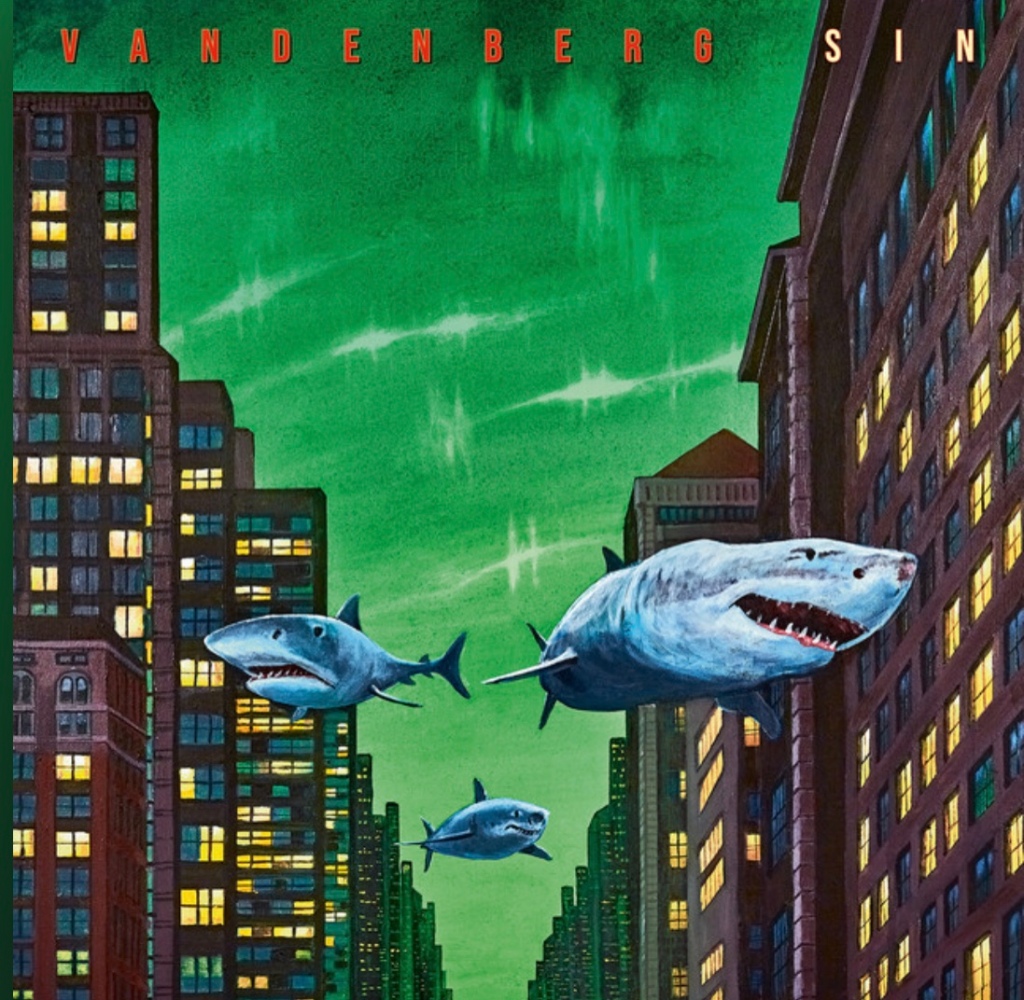
And here we are in 2023, with another excellent album called “Sin”. This time around Adrian is joined by vocalist Mats Levén, drummer Koen Herfst and bassist Randy Van Der Elsen and the album is produced by Bob Marlette.
How cool is the cover art?
Once again, created by Adrian, he wanted to show an actual destination for the flying sharks who made their appearance on the “Heading For A Storm” album.
Instead of flying over a road in the desert, they are now flying into New York, the city of sin.
Thunder And Lightning
This is a person writing songs for the love of it. No pressure to write hits and no pressure to conform.
For those who grew up in an era of driving with the window down and cranking the music from the stereo, well this song is perfect for it.
Vocally, Mats Leven is channeling David Coverdale. Musically the song channels the spirit of Eddie Van Halen and the Euro blues rock of Michael and Rudolf Schenker.
Stick around for the guitar solo.
House On Fire
Heavy palm muted arpeggios start it all off with Leven singing in a low bass/baritone. Then it goes into a sleaze like riff.
This is a straight ahead rock and no one is doing it better in 2023 than Adrian Vandenberg.
Sin
This sounds so good. Vandenberg rewrote “Judgement Day” and I like it?
Then again “Judgement Day” is heavily based on “Kashmir”. And I still like it.
Alot of legacy artists keep saying “what is the point in writing new music as no one cares about it”. Tell that to Vandenberg.
Light It Up
Love the swagger on this.
Walking On Water
Ooh, that guitar intro and the vocal. Very 70s Free like.
And stick around for another masterful guitar solo.
Burning Skies
The album keeps going, sounding different from cut to cut. Like “Back In Black”. This one feels like a classic Scorpions cut.
Hit The Ground Running
It’s all about the vocal.
This one has Leven channeling Coverdale and the groove sits nicely on your lap.
Baby You’ve Changed
It’s intimate.
A ballad that rolls along like “Is This Love” and “The Deeper The Love”. But it’s not a copycat.
Out Of The Shadows
The arpeggio riff in the Intro reminds me of Coverdale/Page and their song, “Whisper A Prayer For The Dying” but the song is nothing like that.
It’s got this classic 70s Rainbow Dio era vibe and I like it.
It’s just 9 songs clocking in at 41 minutes. Like old school albums, pre CD.
Mats Leven is one hell of a vocalist. A journeyman like so many other vocalists from the late eighties and early nineties.
He came to my attention with the band Swedish Erotica in 1989.
He has then performed (just to name a few) with Treat, Yngwie Malmsteen, Candlemass, At Vance, Firewind, Trans Siberian Orchestra and Therion.
By doing so and picking up whatever work he could get, he found a way to survive the wastelands of the 90s and early 2000’s which were not very kind to hard rock vocalists. Jeff Scott Soto and Johnny Gioeli are two others that come to mind.
Finally, Adrian Vandenberg is 69. He still rocks as hard as he did when he was 29. He hasn’t mellowed out at all. He’s actually gotten heavier and he is free to write the music that he wants to write.
If you want to read my review of Vandenberg’s recorded output up to a certain point in time (it was up to 2014 and the first Vandenberg Moonkings album), you can read it here.
When he went to an audition with a band called “Legend”, he took his guitar.
But they said to him that they need a singer and wouldn’t let him play.
And then he gets the vocalist gig for Black Sabbath, who were going through an identity crisis between 1984 and 1987.
And as soon as he righted the Sabbath ship, he was out and Dio was back in for the “Dehumanizer” album.
And while that was happening on the Sabbath front, Tony Martin kept writing until he had enough material for a solo album.
“Back Where I Belong” was released in 1992 on Polydor.
“It Ain’t Worth Fighting For” is the opening track from the album.
The musicians are seasoned professionals.
Nigel Glockler from Saxon is on drums. Neil Murray from Whitesnake is on bass. Richard Cottle is a session pro, and he plays the keys and also performs the saxophone solo. Carlo Fragnito is on guitars.
A bit if trivia, Fragnito and his brother Anthony formed a band called Blacklace, with vocalist Maryann Scandiffio.
Hailing from Canada, their music is best described as NWOBHM. They released “Unlaced” in 1984 and “Get It While It’s Hot” in 1985. Like a lot of bands who didn’t see success right away, they struggled and eventually broke up.
Carlo then became a session pro.
As soon as you press play, the riff that smacks you in the face is reminiscent to “Headless Cross”.
But the track feels like a heavy blues rock track instead of a metal track.
If it ain’t worth fightin’ for It ain’t worth having And I just gotta have your love
The Chorus is Arena Rock. Make sure you pay attention to the melodic guitars underneath the vocal melody.
Bad Company comes to mind here and the feel from “Rock ‘N’ Roll Fantasy.”
Vocally, Martin comes across as a combination of Lou Gramm and Paul Rodgers.
And that Sax solo works perfectly. It outlines the Chorus vocal melody with some improv.
Disaster. That’s how the American magazines described this album.
Released in 1985, the album never stood a chance.
It was fighting for our attention along with a lot of other things.
Like.
The trilogy of Mutt Lange albums were outselling everything else AC/DC put out during this period.
The Sunset Strip gave the charts and MTV a major shake up and sales followed.
The British had invaded the U.S again with Judas Priest, Iron Maiden, a solo Ozzy Osbourne and Def Leppard cementing themselves as arena acts.
The Germans also invaded via a hurricane called The Scorpions.
And finally an underground Speed Metal scene in San Francisco was slowly taking over the U.S.
But in Australia we remained true. Never wavering. And we made it triple platinum.
But let’s go back in time.
The success of “Back In Black” in 1980 showed the labels that their was an appetite for hard rock music. And the labels wanted more of the same.
So it’s no surprise that by 1985, most of the label rosters had a lot of “hard rockers” on the books. But these rockers wore everything that wasn’t denim and their hair kept hair dressers employed for decades.
Even acts from the 70’s started to participate in this new look so they could remain relevant. But AC/DC didn’t change. They stuck true to their denims and Angus still wore the schoolboy outfit.
And the critics found them irrelevant while they still sold out arenas.
Fly On The Wall
The music is infectious and the vocals indecipherable.
Sign me up.
Shake Your Foundations
It was the only song that got a pass back in the day.
How good is that intro and the Chorus is iconic?
Plus it got decent radio play in Australia.
First Blood
Musically, it’s typical of AC/DC.
Lyrically, Brian Johnson is indecipherable and hard to understand.
Danger
“Come Together” comes to mind when I hear this.
“Here come old flat top” is what my ears are expecting when the song begins.
It’s no surprise that the Young brothers are referencing Chuck Berry here as his fingerprints are all over the riffs the Young’s write.
Sink The Pink
The music clip comes to mind here.
Seeing the band playing in a pub/bar again and that pesky fly from the cover getting a hard on (via its nose going from limp to hard) when a women dressed in pink enters the pub.
But it’s the music that seals the deal and Brian Johnson sounds better in the video than the recording.
I like the musical reference to “For Those About To Rock” and The Who’s “Won’t Get Fooled Again”. So I was hooked.
“Sink the pink, it’s all the fashion”
It has so meaning meanings.
The Urban Dictionary tells us, sink the pink means to “have sexual intercourse with a virgin, and to pop her cherry”.
But the Urban Dictionary didn’t exist in 1985 and my young impressionable brain saw it as a song about drugs.
And thanks to the Internet, I believe it is.
Welcanol was known during the eighties as the South African Heroin (Pink Heroin). It could be obtained via a Doctor prescription and it came as a pink tablet.
So before OxyContin there was Pink Heroin.
“Drink the drink it’s old fashioned”
I’ll take an old fashioned drink any day.
Playing With Girls
I love the music and the groove here.
But I hate the title and the fact that Johnson is mixed low and indecipherable.
Definitely a missed opportunity here.
Stand Up
I like this song. It’s defiant and it rocks.
If you just listen to the Chorus you would think it’s about standing up and facing the world, but when you read the lines in context with the verses, well, it has a different meaning.
Hell Or High Water
A 4/4 groove and we are off.
But it’s pointless as Johnson is buried in the mix and the song is ruined.
Back In Business
A deep cut. It reminds me of ZZ Top and I like it.
Send For The Man
Musically it rocks but the buried Johnson chainsaw like vocals ruin it.
It’s not a perfect album, then again most of the albums released in 1985 are far from perfect. In other words, the era of more filler than killer was well and truly in motion.
But I would say, it’s an underrated album from a band that enjoys doing their thing without over obsessing about it.
The U.S tour had controversy. It all took place underneath the censorship discussions concerning rock music. Religious groups tried to ban certain shows while city officials wanted to rate each show and give the shows a movie style rating, which would then exclude fans from going. Fire officials would also get in on the act and limit or stop any pyrotechnics.
But the band went on.
In the vinyl album sleeve of the “Fly On The Wall” re-release from 2020, Angus sums up the tour like this;
“This tour’s a little like a series of wrestling matches with the loonies. But what’s the fun of life without an occasional tussle”.
It’s all about the money in music and the lawsuits which come about because of it.
THE GREAT 78 PROJECT
The “Great 78 Project” from the Internet Archive is digitizing 78-rpm records from the early 1900s until the 1950s.
78rpm records are some of the earliest musical recordings, and were produced from 1898 through the 1950s when they were replaced by 33 1/3rpm and 45rpm vinyl records.
The Archives asked people to donate their albums so that the cultural past survives for future generations to study and enjoy.
At the moment the collection is at 400,000 plus recordings. The majority of these 78s are forgotten and the 78rpm versions are not on streaming services.
Sounds great right. Preserve some cultural history from donated records and provide access to people to enjoy.
But the labels don’t get paid when this happens and suddenly don’t like it.
The labels’ have used colorful phrases to describe the “78 Project”, as an “illegal record store”.
From the 400K plus songs, the labels named close to 3K sound-recording copyrights that the Archive allegedly infringed.
And they want $412 million for it because as far as the labels are concerned the music is available on streaming services.
The Great78 project, is not a substitute for music streaming services like Spotify or Apple Music.
When you listen to it, you hear that the music was digitized from the 78rpm record.
You get the crackle and the hiss of the record. It is a totally different version from the clean remastered versions you hear on music streaming services.
It’s ridiculous that it’s even an issue.
SIRIUS XM
SoundExchange, is responsible for collecting and distributing digital music royalties.
Sirius XM is responsible for playing music and paying digital royalties.
SoundExchange claims that Sirius XM is performing some creative accounting by inflating the revenue from its webcasts so it pays less in music royalties to the tune of $150 million.
Isn’t it funny how the labels and publishers go straight to litigation when someone else like Sirius XM does the exact same thing that they did to artists for 80 plus years.
Twitter/X
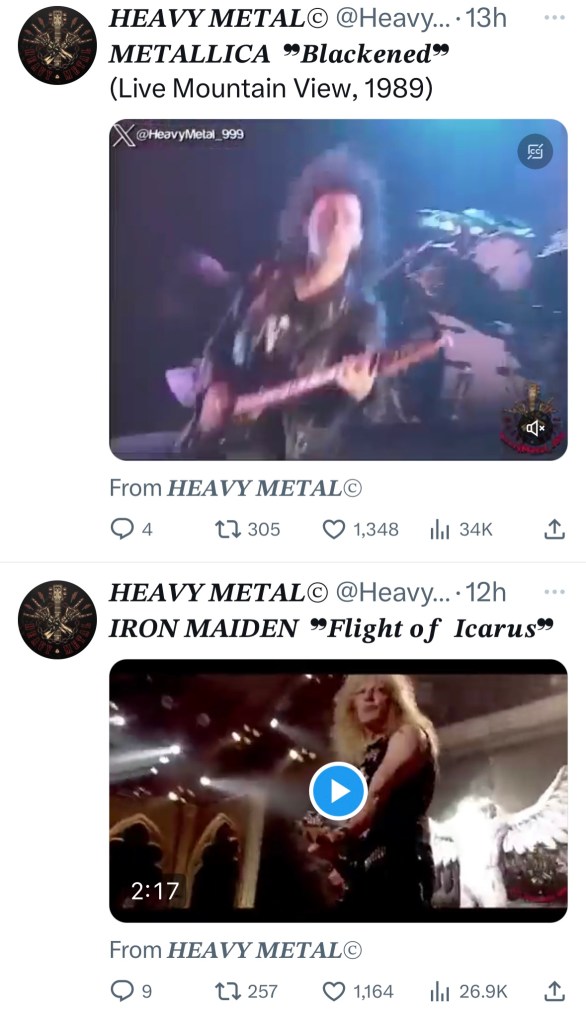
Twitter/X users put up snippets of live concerts, music videos, interviews and basically themselves jamming to their favorite music or playing the vinyl or CD of their favorite music.
Posts like these.
Two minute snippets of live performances that someone recorded which isn’t the user.
Or something like this.
Footage from a concert that the user attended and shared on the platform.
The users on other social media sites do the same thing.
But the RIAA, the labels lobbyist and litigation arm don’t like it.
They have accused X Corp of breeding mass copyright infringement because the company fails to respond to takedown notices and lacks a proper termination policy.
For this crime, the labels want $250 million from X Corp.
Elon Musk wants the case dismissed and his legal team have asked the courts to consider it as the labels have no hard proof of any wrong doing.
$3 MILLION PER HOUR
It’s the combined amount of how much the labels made in the first six months of 2023.
And they made that money because they have schemed, paid or legislated their way into owning the rights of a lot of music.
The music created by artists in bedrooms, parents basements, hotels, tour buses and at soundchecks, the labels now own.
And they will own these rights for the life of the artist plus 70 years after their death. In some jurisdictions, it’s 90 years after their death.
Final Note
The artists who create culture and value are never in the conversation. Even if the labels (and the RIAA) get all the monies paid to them, they will not share any of it with the artists.
And it is the artists who gave them this power to litigate, by signing away their rights in shitty contracts so they could have a recording career. And maybe a chance to make it big.
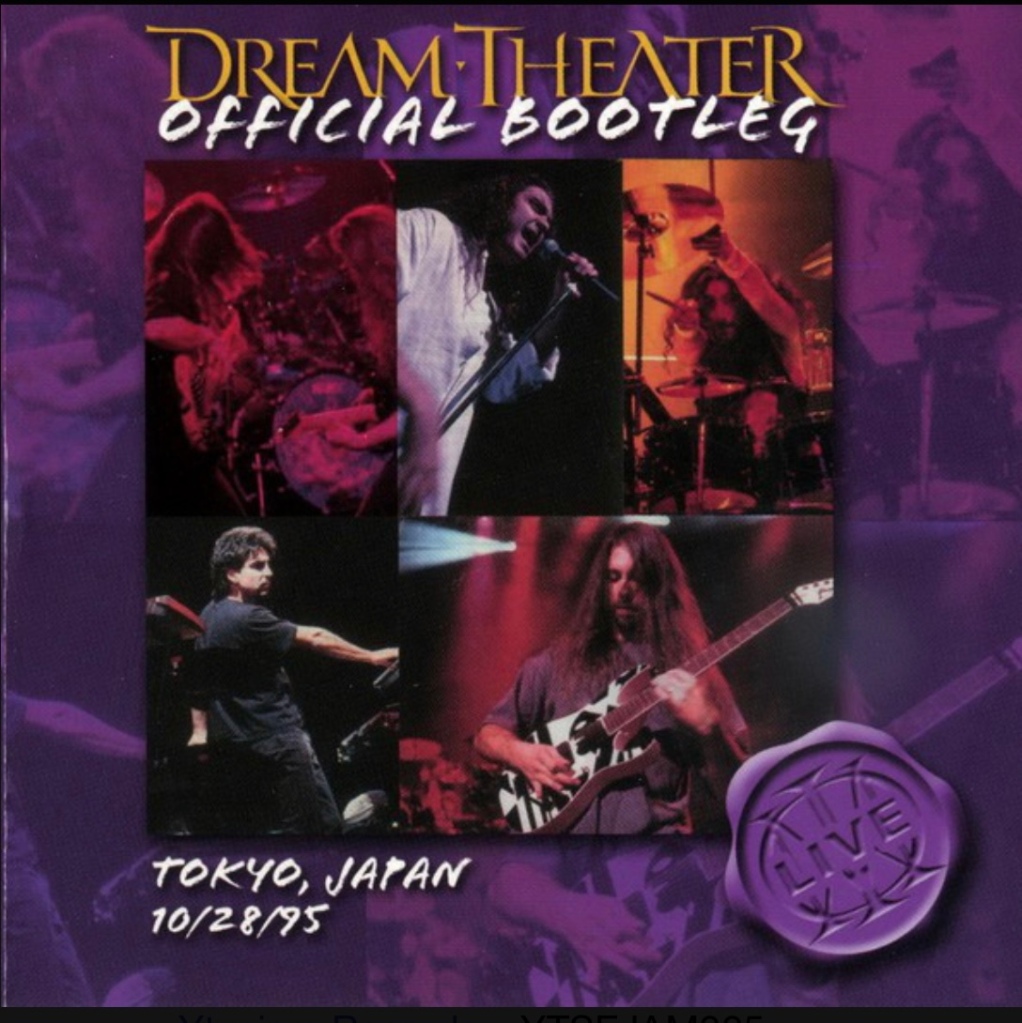
All at once in 2004, Dream Theater dropped three bootlegs under the sub headings of DEMO, COVER and LIVE.
The DEMO release was reviewed here, and it covered the “When Dream And Day Unite” period between 1987 and 1989.
The COVER release is their play through from start to finish of the “Master Of Puppets” album and will be reviewed next.
This review is on the LIVE release and as I’m writing this review it has not been re-released as part of the Inside Out re-releases/new releases.
So all we have at the moment is the Ytse Jam Records release.
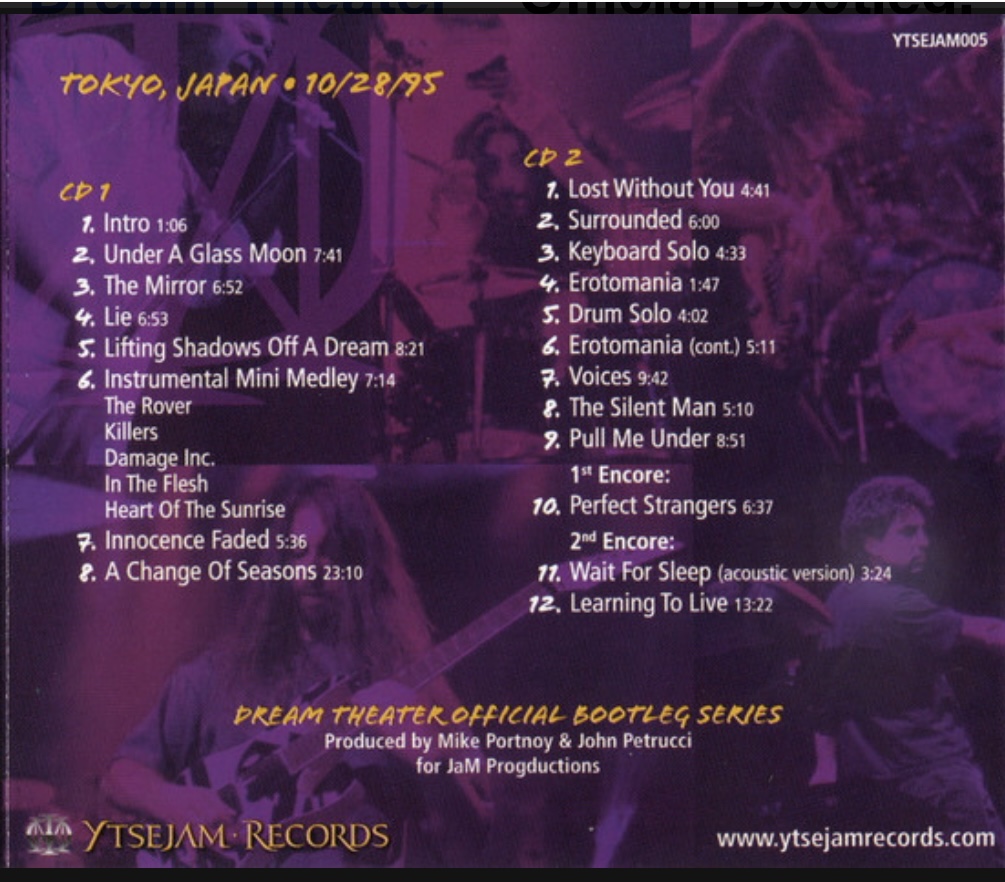
The full 2 hours and 20 minutes, recorded live on the run of shows used to promote the “A Change Of Seasons” EP.
This is from October 28th, 1995 at NHL Hall, Tokyo, Japan.
The band is John Petrucci on guitars, Mike Portnoy on drums, John Myung on bass, James LaBrie on vocals and Derek Sherinian on keys.
Intro
There is a tape intro that goes for about 1 minute. It’s got a clock ticking and the sad piano lines from “Space Dye Vest” are played.
Then there is a voice over, some backwards sound effects and the octave notes from “Under A Glass Moon” kick in.
Under A Glass Moon
I like the surrealist title.
The verse riff on this song with the keys playing Chords over it. Perfection.
Stick around for the solo as it’s one of Petrucci’s best.
The Mirror
It’s a heavy song with Petrucci deploying the 7-string. Its intricate arrangements and dynamic shifts are interesting.
Lie
It goes together with “The Mirror” as some musical sections appear in both songs. This was a single from the “Awake” album, however it didn’t have the same success as “Pull Me Under” from the album previously.
The mix of heavy riffs and melodic moments, highlights their versatility.
Petrucci as usual delivers a few killer solo sections.
Lifting Shadows Off A Dream
It starts off like a slow jazz blues fusion jam before it goes into the well recognized bass intro.
It feels like a cross between U2, ballad like Marillion and 80s synth Rush.
Instrumental Medley
You get to hear “The Rover” from Led Zeppelin, “Killers” from Iron Maiden, “Damage Inc.” from Metallica, “In The Flesh” from Pink Floyd and “Heart Of The Sunrise” from Yes.
Press play to hear the way they fuse all these different songs into one cohesive track.
Innocence Faded
It’s in a major key. While it rocks it does have pop sensibilities.
But it’s the outro that you should listen to.
Because if you worship at the altar of guitar gods then the outro is for you. Even James LaBrie screams “John Petrucci” when it starts.
If you can’t find this track, then any other official live version or even the studio cut will suffice.
A Change Of Seasons
You get the full 23 minutes.
The way this piece is written is that each part can be played separately in the set list amongst other songs or it can be played as one song, like it is here.
And like all multi-part epics, it serves as the grand centerpiece of the show, displaying their songwriting prowess and technical skills in a live setting.
Lost Without You
“Lost Without You” was officially released in 2005 on John Petrucci’s solo album “Suspended Animation”.
But here it is, live in 1995.
Its an intimate and introspective moment within the setlist, very blues/jazz fusion like and I’m all in.
Petrucci nails it and the emotion drips from the strings.
Surrounded
The “Images And Words” album is all killer.
And this song is largely out of the conversation, however the band does a stellar job playing tracks from the back catalogue in the live setting.
After the piano intro and verses, the song picks up. Listen to how Petrucci decorates.
Derek Sherinian Keyboard Solo
I’m not a huge fan of solos in concert like this, but this one actually rocked and kept me interested.
It was a mixture of ragtime, blues, classical and cinematic/video game like music.
Erotomania
Mike Portnoy takes over the middle of the song with a drum solo.
But at least they go back into the song and to one of my favorite instrumental sections.
Voices
This is another song that seems like it’s out of the conversation when it comes to Dream Theater songs.
But it’s a classic
The Chorus is arena rock.
And that solo is what guitar heroes are made of.
The Silent Man
It’s a great acoustic song.
And they bring the 70s Classic Rock vibes (which is known as Country Rock these days) to it live.
Pull Me Under
Closing the main set with their most recognizable hit, leaves the audience energized.
The 1st Encore begins with a cover.
Perfect Strangers (Deep Purple cover):
The Deep Purple cover sounds like it came from the minds of Dream Theater.
You can hear the fun in the music and they definitely jam it out.
The 2nd Encore begins with the last two tracks of the “Images And Words” album. And for a 1995 set list it’s perfect.
Wait For Sleep (Acoustic version)
An acoustic version of “Wait For Sleep” is excellent.
Learning To Live
The grand finale. The whole song is a masterpiece.
And then that outro section. Wow.
In summary, its raw as a bootleg should be.
The setlist is diverse and it showcases their instrumental virtuosity and ability to navigate complex musical compositions.
There are mistakes and pitch issues but hey, if I wanted the studio recordings I would play them.
The inclusion of covers and acoustic moments also adds depth to the overall concert experience.




 destroyerofharmony