Copyright, movies, Music, My Stories

Bands

Bands, the way we have known them will be no more.

It will be the era of the songwriter. It might look like a band on the outside but really it will be the main person or two and the supporting musicians. Sort of like how it was in the 50s and 60s up to a certain point. Until The Beatles changed everything.

For example, like James Hetfield and The Metallica Band or like Jon Bon Jovi and The BJ Band or like David Lee Roth and The Van Halen Band or Rob Halford and The Judas Priest Band.

Maybe they will just use their name like Bryan Adams, Keith Urban, Don Henley, Neil Young or Ozzy Osbourne.

Even Alice Cooper started off as a band and morphed into a solo artist with musicians supporting the artist.

Maybe a return to the Crosby, Stills and Nash kind of names.

These are just examples of using artists that I know. The new artist could use just their name or their name with a backing band or a group name but the reality will be that the group is really just the artist with other musicians supporting the artist.

If you look at bands right now and in the past, most of their songs are written by one main member. Sometimes two or three members, especially when bands had artists who paid their dues and had experiences before joining.

Ignore pop songs for the moment who seem to have 10 writers to start with, and if the songs are a hit, there is a writ and more songwriters are added to the list.

Yeah I know what your saying, U2, Def Leppard, Black Sabbath and Van Halen just to name a few, have albums saying that the songs are written by all the members.

But the truth is, what is in print for us to see on the lyric sheet or album, is not always the truth. Songs are complicated beasts when it comes to a band setting. It didn’t used to be that way but it is that way now. Especially when there is money involved.

For example ASCAP is a music publisher in the US, had total revenues of $1.226 billion dollars in 2018. They paid $1.109 million in royalties back to artists. And they kept $117 million in administration costs. Basically money for nothing and the chicks for free to the publishing company.

That’s just one of many in the US. Then there is BMI who had total revenues of $1.283 billion and paid out $1.196 billion to artists by 30 June 2019. And they kept $87 million for administration costs.

And each country has multiple publishing companies. And each country has record labels. And everyone is making multi millions from music for nothing.

The actual copyright registration and the splits associated with the song plus the band agreement which also has percentage splits determine who is entitled to what. Van Halen even took Michael Anthony off the songwriting credits when they renegotiated a multi million dollar publishing deal in the early 2000’s.

COVID-19 has changed the game.

A normal band makes their money on the road.

Some bands might have streams in the billions and own their own copyrights, but if they are that level, they will have a team of people in their organization like managers, legal, accountants and other employees who do fan club and website.

Right now, no one can tour and they don’t know when they can start touring again because having so many people in a room, theatre, arena or stadium is a problem when it comes to social distancing. And even if concerts are allowed, will people just go back to life as normal or be cautious. Maybe concerts will resume with a cap of 500 people max.

And no one gets into bands or starts writing songs to get paid. They do it because they love it and there is a need within them to create. But with any artist that starts to become popular, money is a byproduct of creating something which resonates.

And then it becomes about the revenue streams and how is the artist going to make money.

Streams will pay and the artist will get more if they own their rights. And the person who wrote the song will get two bites of that revenue. One from the streaming service to the Copyright owners account and another from the Rights Organization which administers their catalogue. This always causes resentment between members because one person has more than others.

Especially when the band agreement in place favors one over the other. And the other member feels like their songs should be considered but they are not up to standard.

Remember when Kirk Hammet told everyone he lost his phone with riffs and that’s why he had no song writing contributions on the “Hardwired” album but James set the record straight when he said that Kirk’s riffs just weren’t there, meaning they weren’t good enough to James and Lars to consider.

We wait to see what live music will look like post COVID-19.
Standard
A to Z of Making It, Music, My Stories, Piracy

Streaming in COVID-19

It’s strange how things work out.

In reality, most artists and the labels wanted a return to the old sales model for recorded music.

This meant that the labels acted as gatekeepers and they decided who got a chance to come into the walled gardens of a record deal.

As we know, then came Napster and everything changed. iTunes, torrents, YouTube, Pandora, Spotify and other streaming services all came.

The recording labels hated digital services, in the same way the book business and the movie business, and they all did everything in their power to stifle or kill the digital book and streaming services.

All because it meant they had lost control.

The record labels kept arguing about rising prices on monthly steaming rates and then they kept running stories everywhere about limited edition vinyl and record stores and the tradition of seeking out a vinyl and dropping the needle.

And now, COVID-19 is everywhere and suddenly physical sales are non existent and even online orders will not be delivered.

But this is when people can listen the most or read the most. And if you are championing physical, the problem is you can’t really buy anything as all of the stores are closed.

Suddenly streaming services are a source of income. In some cases the main source of income since all postal services are prioritizing essential deliveries over non essential. Somehow physical albums don’t matter when life and death is at stake.

Is this when streaming really takes over the world?

Because if there is a winner here, it’s the record labels, as they hold the majority of the copyrights, so they will keep getting paid forever. Yeah, I still see articles from the labels RIAA about people still obtaining music illegally, but hey, those people will never pay for recorded music in the first place.

And I haven’t heard of any label executive taking a pay cut during these unprecedented times.

But I have heard of artists doing it tough. And now we are getting artists dying as well from COVID complications.

And the labels are doing nothing to help their artists or even their former artists, the ones they still hold the copyrights for.

Standard
Alternate Reality, movies, My Stories

Catching Up

It’s strange.

Is it right to even say I am using this free time I have at night to catch up. Everything is just strange. The new normal in a strange land.

I’ve watched movies like this, then walked away from the movie, talking about the movie and then going on to live life again. And movies like “Outbreak” and “Contagion”, it feels like we are living in the script. As Morpheus said to Neo, in a construct.

And COVID-19 is keeping me home. I have been working from home for two weeks and now it is indefinite. So has my wife and I’ve kept my kids home from school since Thursday last week.

And the rules the government is applying are confusing. One person per 4 squared metres, social distancing but school with 30 kids in a class room is still on.

And all of my sporting commitments are on hold as every sport is either postponed or suspended to a date. So I’ve done what everyone else seems to be doing. Catch up on my Netflix and Amazon Prime shows.

All Or Nothing – Brazil National Football Team
There is a quote in this movie from the coach Tite, about courage.

How you need to have the courage to try things, do something new, the courage to help a teammate in need and if you fail, the courage to rise back up and try again.

And we need courage today more than ever to survive the madness around us. Life as we know it, is changing.

Very fast.

Things that we took for granted are just not the same anymore. And it never will be.

Altered Carbon – Season 2
I really like the concept of this show. It covers a lot of technology and science concepts, plus it uses our history.

In the show, Earth humans travelled decades to occupy a new world which had extra-terrestrial lifeforms on it, but the humans didn’t tell planet Earth about it, so they went about cleansing the world of “The Elders” as the original inhabitants are known. The occupation of a lot of lands in the world happened like this by the British, French and Spanish

Then there is the concept of immortality and cloning.

Memories/life experiences are saved on stacks, which are then backed up and if the sleeve (the body) dies, a new one is “spun up”. Of course, this is if you have money. The poor don’t have this luxury. And what I mean by “spun up” is that they already have a cloned body ready, on ice, waiting to have the memories downloaded into it, and its business as usual.

And the scientist who came up with the technology saw how it could it was used for evil and decided to destroy it and became a terrorist.

Then there is the concept of AI helpers and virtual constructs.

The First Purge – Movie

The NFFA (New Founding Fathers of America), had to come up with a creative way to get their economy and unemployment back on track.

So they designed a 12 hour event, called “The Purge” where all forms of murder are legal. And they did a social experiment in a suburb full of housing projects and derelict buildings, which was also populated by dark skin residents. Of course the NFFA have only white skin in their ranks.

But when the people of the area, didn’t really start killing each other, the NFFA brought in mercenaries with machine guns and rocket launchers to increase the body count and make the night a success, so the day could become a yearly event.

All in the name to get rid of the old, the homeless, the sick and the poor. And today, we have a virus doing the exact same thing. Except this virus takes the wealthy as well.

It doesn’t discriminate.

John Wick 3 – Parabelum – Movie

I like the John Wick movies. The first one is brilliant and they haven’t topped that, but this one is cool as well.

And the concept of “living under the high table” is mentioned a lot here. We have our society and our governments and the laws which come from that.

Then you have a secret society which has its own set of rules. But it still retains a hierarchy structure and even the High Table has an Elder who sits above the table.

And the question the movie asks is; what kind of life do you want to live and be remembered by?

A life under the control of someone and doing their deeds for them or a life that you see as free to make your own choice.

Standard
A to Z of Making It, Copyright, Music, My Stories, Piracy, Treating Fans Like Shit

How Much Should Streaming Services Pay?

A lot of people hate Corey Taylor, but I’m not one of em. I enjoy the music he creates, more with Stone Sour than Slipknot and he has a point of view, a stance, which he shares with the world.

In an interview with the Irish Times which Blabbermouth grabbed and ran with a few months ago, Taylor was asked if SLIPKNOT could live just on royalties from listens.

He said, no they couldn’t survive at the current rates but if the streaming services paid the same publishing rate as radio stations than they could.

In Australia that equates to about $6 per song (for the main cities), as regional cities have a lower fee and then there are separate fees paid for when the song is played, like prime time hours or graveyard hours. In some cases the artists pay to get themselves played and they don’t even know it as it’s charged back to them by the label via miscellaneous expenses.

Also the $6 fee is paid just to the songwriters not the recording act. Since Taylor writes his own songs, he is okay in that department as he would get the payment.

But streaming services charge us $9.99 per month to access a catalogue of music. The math doesn’t work and suddenly piracy looks more appealing of that fee goes up.

Taylor doesn’t have a problem with streaming services for what they are trying to do, but he has a problem with them, when they spend millions of dollars on buildings and then more millions on decking out those buildings for offices and then more millions on flying private and more millions on wages while the artists who bring people to their service are not experiencing the same share of those millions.

But hang on a second, the label he’s signed deals with also spend millions of dollars meant for the artists on the same thing.

Steve Miller said something similar about the recording industry and the RNR Hall Of Fame people at his RNR HoF induction, how they take so much money from the artists and they don’t compensate the artist fairly.

The problem that I have as a fan of music is this;

Artists on a label sell their masters to the record labels for a fee. They are compensated at that point in time. Some for a lot more if they are successful and others for peanuts because they didn’t know any better.

The labels are aware of this power they have and since they are offering the cash, they want a return on investment. So the label benefits in this streaming era because they hold the masters.

Get your masters back like Motley and Metallica and suddenly you will benefit as well.

Standard
A to Z of Making It, Copyright, Music, My Stories, Piracy

Getting Paid

I’m seeing news articles that Spotify’s payment rate is declining.

But there never was a set payment rate per stream. It was always based on your streams in a pool of streams and what percentage you take in the pool of streams based on countries and the pool of money of available to be paid out and your percentage stake in those monies.

Yep it sounds simple, but it’s creative accounting at its best and the music industry is well known for it.

However there is an argument that with Spotify’s subscribers growing, the payments to artists for the same amount of streams they had in previous years is lower. A normal person would assume that a growing membership, would mean more money in the pool and that would mean a higher payment for the same amount of streams.

As much as I am a fan of Spotify and streaming services in general, all of these organizations also deal in the murky world of creative accounting like the labels.

And Spotify should be worried.

Their business model is based on licensing agreements. Like Netflix’s original business model. But Netflix started doing original content over 10 years ago. Spotify hasn’t.

Because Netflix knew that the companies they license content from, will form their own streaming service one day. In this case, Disney created Disney TV. And I reckon the labels are watching this with interest. If it works out okay for Disney TV, and the costs are low to host a steaming service, then the labels will consider their own streaming service. It’s just a matter of time.

So imagine a world with Universal deciding to do the same as Disney.

Because the labels never cared that people accessed the music of their artists illegally. They used that as part of their PR, to show that they cared about their artists and to get politicians to pass laws to protect their businesses.

What the labels really cared about was losing control of the distribution and the gatekeeper monopoly they had for so long.

So if the labels go into their own streaming offering, they will get back control of the distribution and a sort of monopoly again. And the only way for Spotify to exist if this happens, is to become a label themselves and pay people to generate content instead of paying organizations to access content.

Spotify might not pay artists what they think they should be paid but at least they are getting paid because Spotify has to pay based on the agreements they have with the labels and the legislation in place around royalty rates. If the label and the publishers keep the monies, then the artist has to negotiate a better deal when they sign up for that initial advance payment.

But once the distribution goes back under the labels control, good luck in getting paid because the labels will get all creative and will work out that the artist owes them money instead. And if the labels do work out that there are payments due to the artists, then those payments are based on the contract artists sign with the label.

Standard
Classic Songs to Be Discovered, Music, My Stories, Unsung Heroes

My Streaming Decade

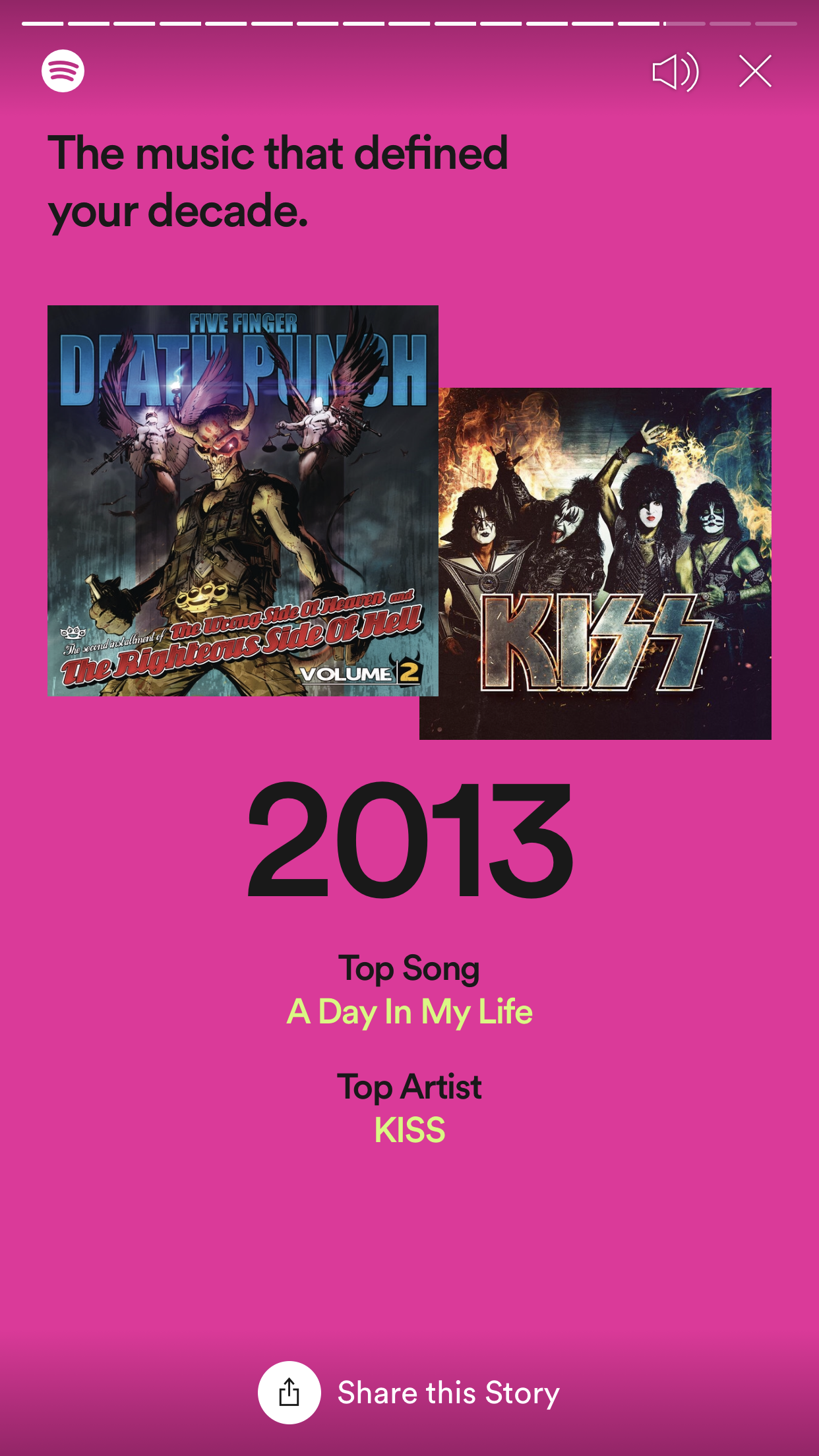
So Spotify has collated all of my data since I joined in 2013 and here it is.

In 2013, my favourite artist was KISS and the song I listened to most was “A Day In My Life” from Five Finger Death Punch.

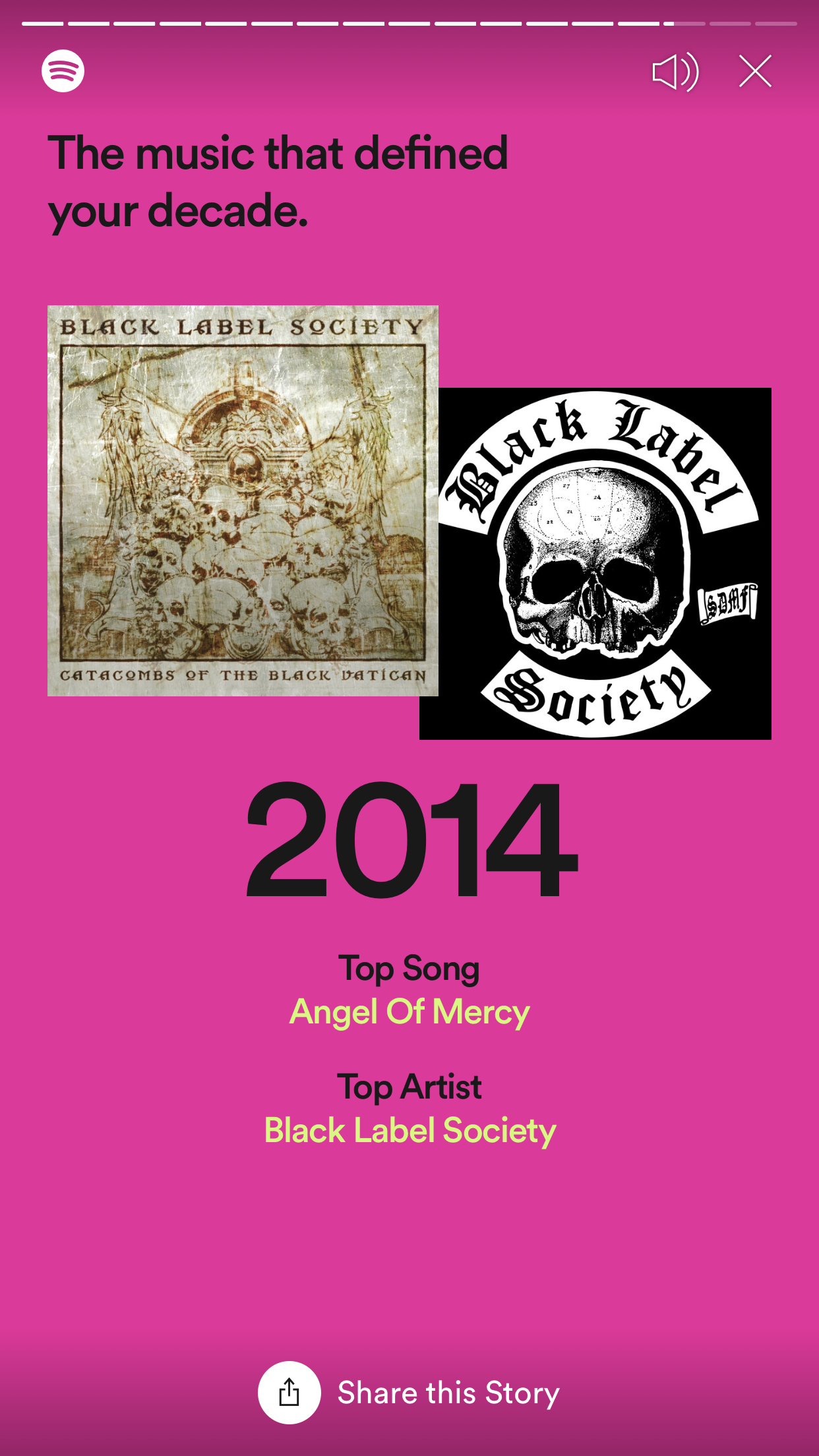
In 2014, my favourite artist was Black Label Society and the song I listened to most was “Angel Of Mercy” from Black Label Society.

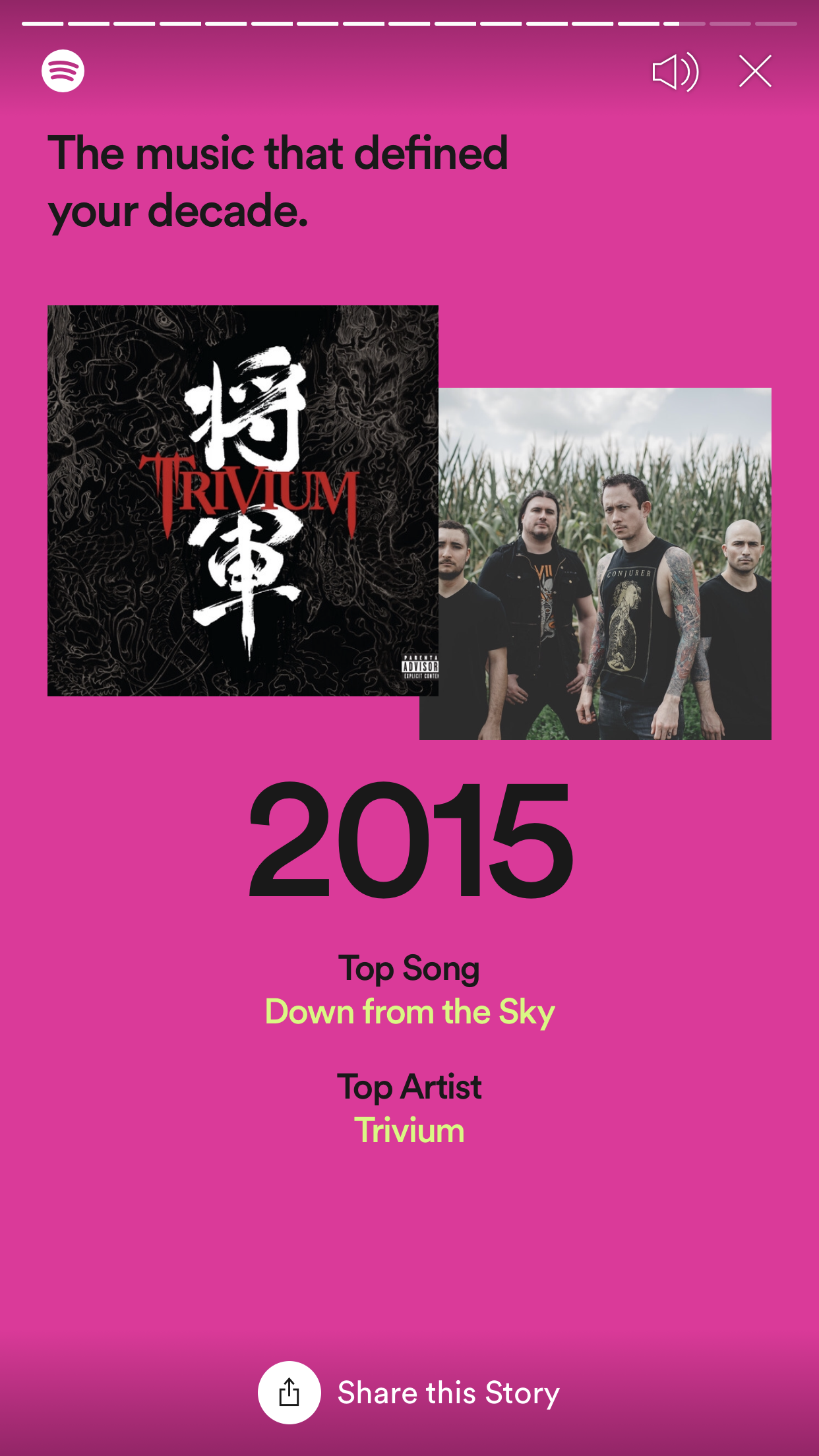
In 2015, my favourite artist was Trivium and the song I listened to most was “Down From The Sky” from Trivium.

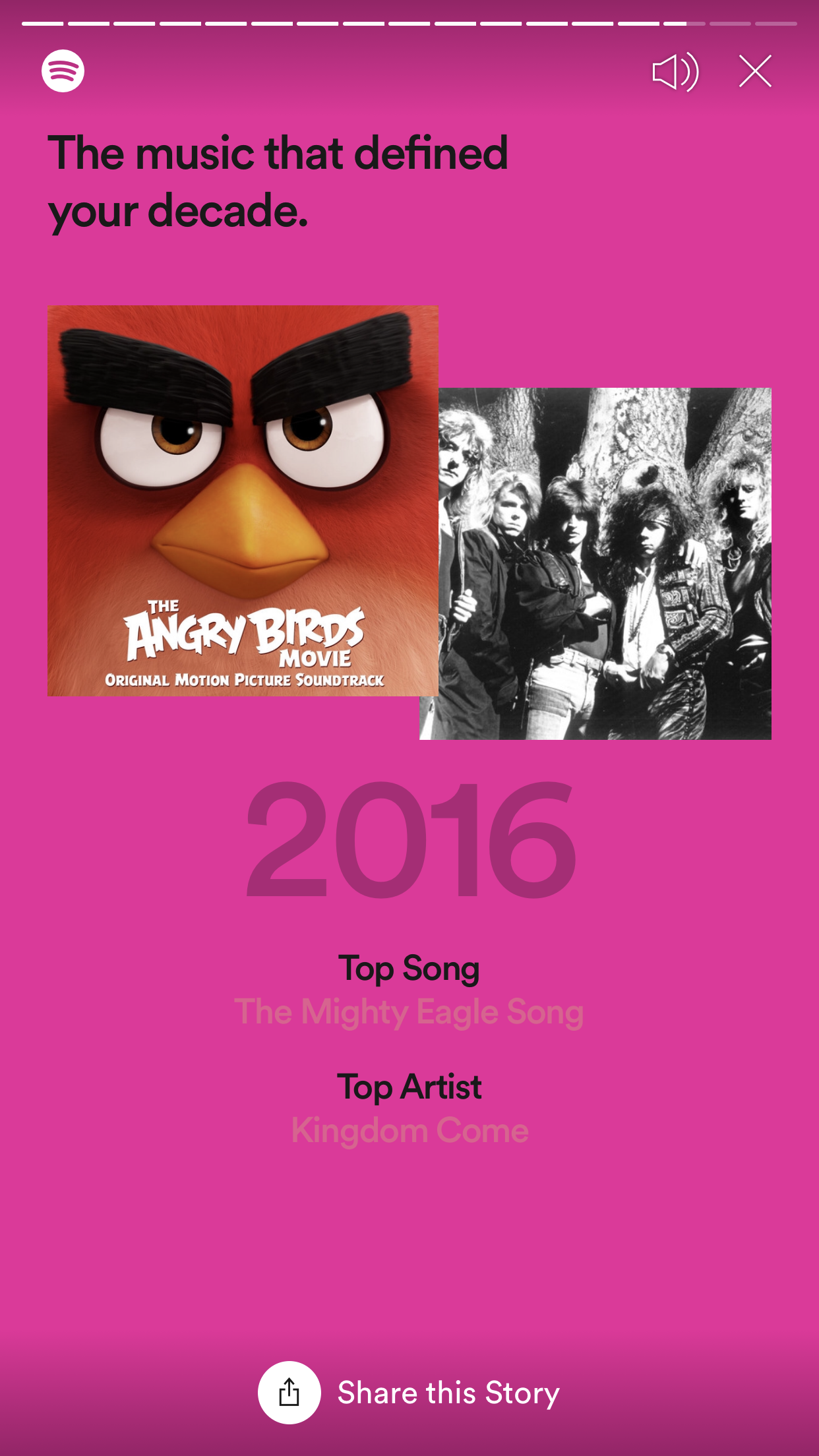
In 2016, my favourite artist was Kingdom Come and the song my 5 year old listened to most was “The Mighty Eagle Song” from The Angry Birds Movie. And this was the reason why I went to a Spotify Family Account.

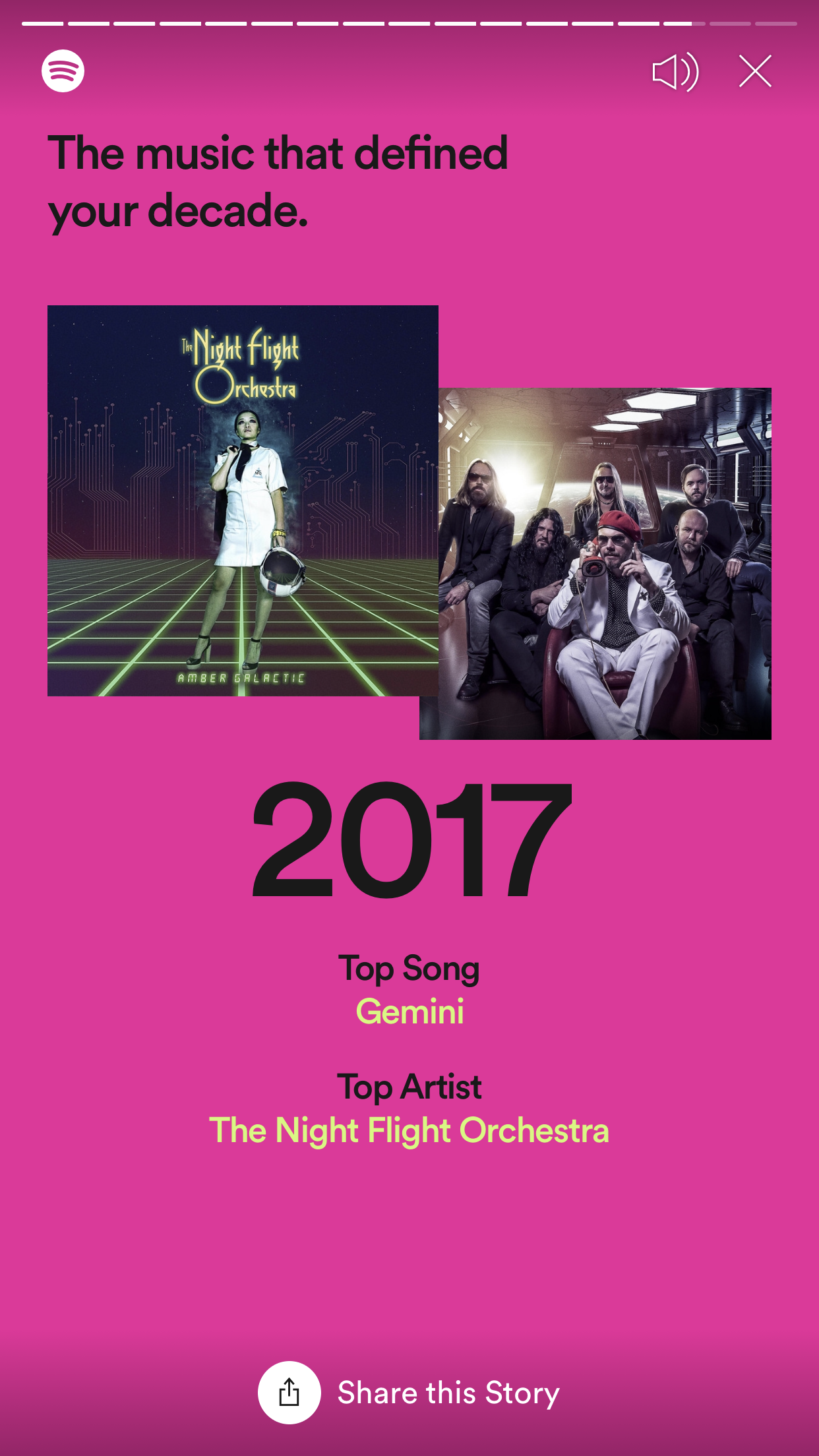
In 2017, my favourite artist was The Night Flight Orchestra and the song I listened to most was “Gemini”.

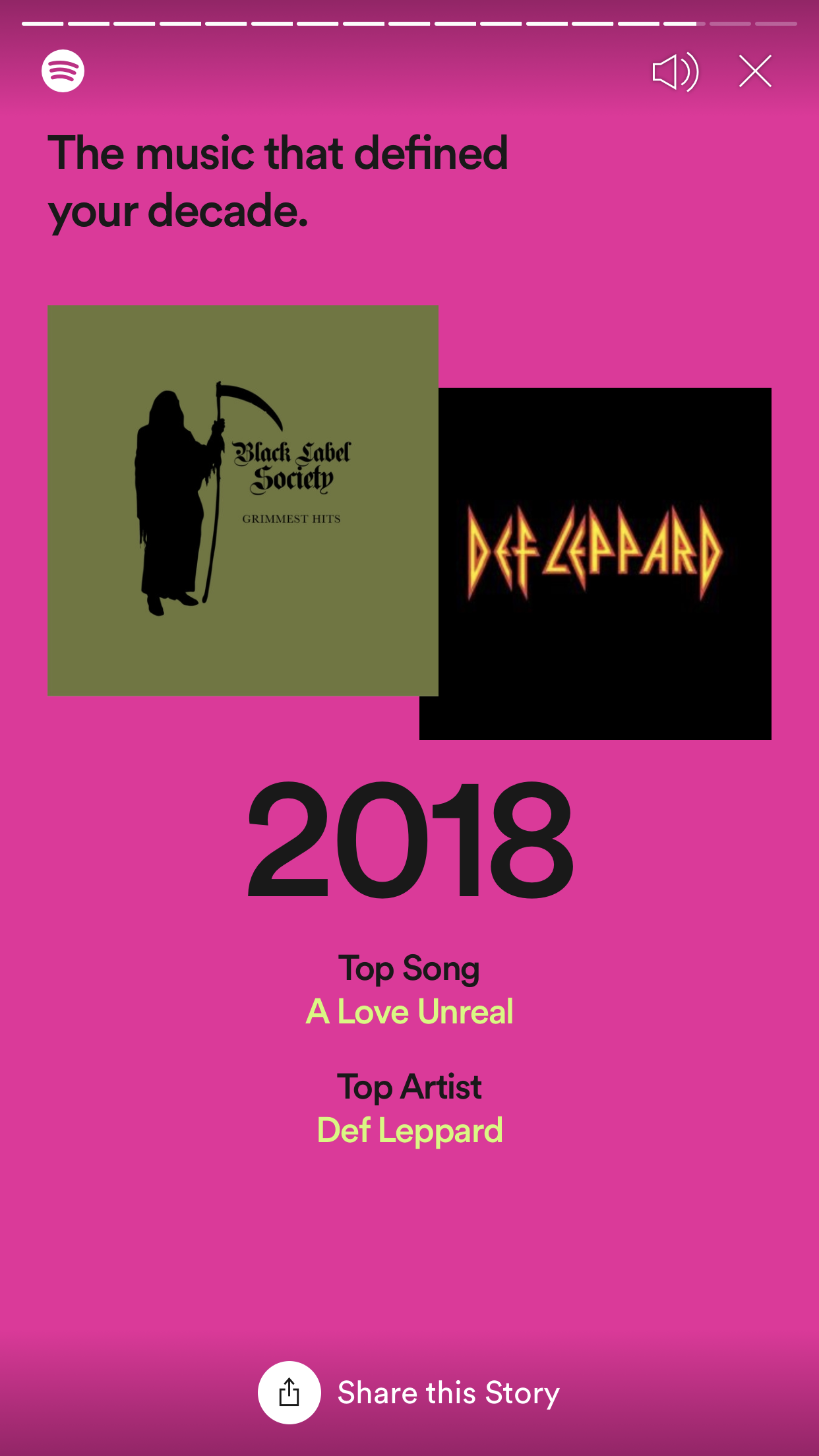
In 2018, my favourite artist was Def Leppard, which is no surprise as their catalogue was finally issued on digital services, but the song I listened to most was “A Love Unreal” from Black Label Society.

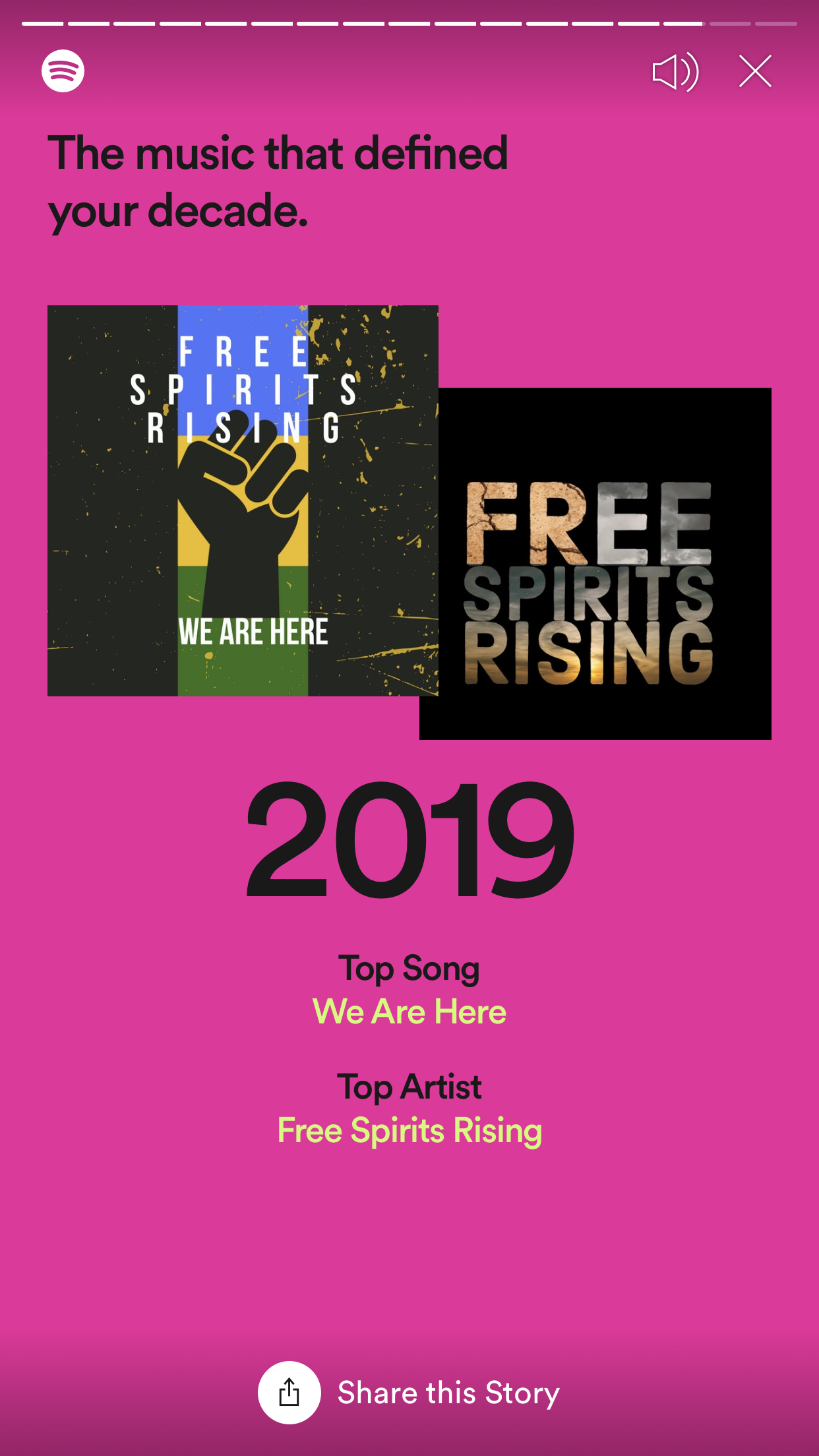
Finally, in 2019, Free Spirits Rising is listed as my favourite artist and “We Are Here” from Free Spirits Rising is the top song.

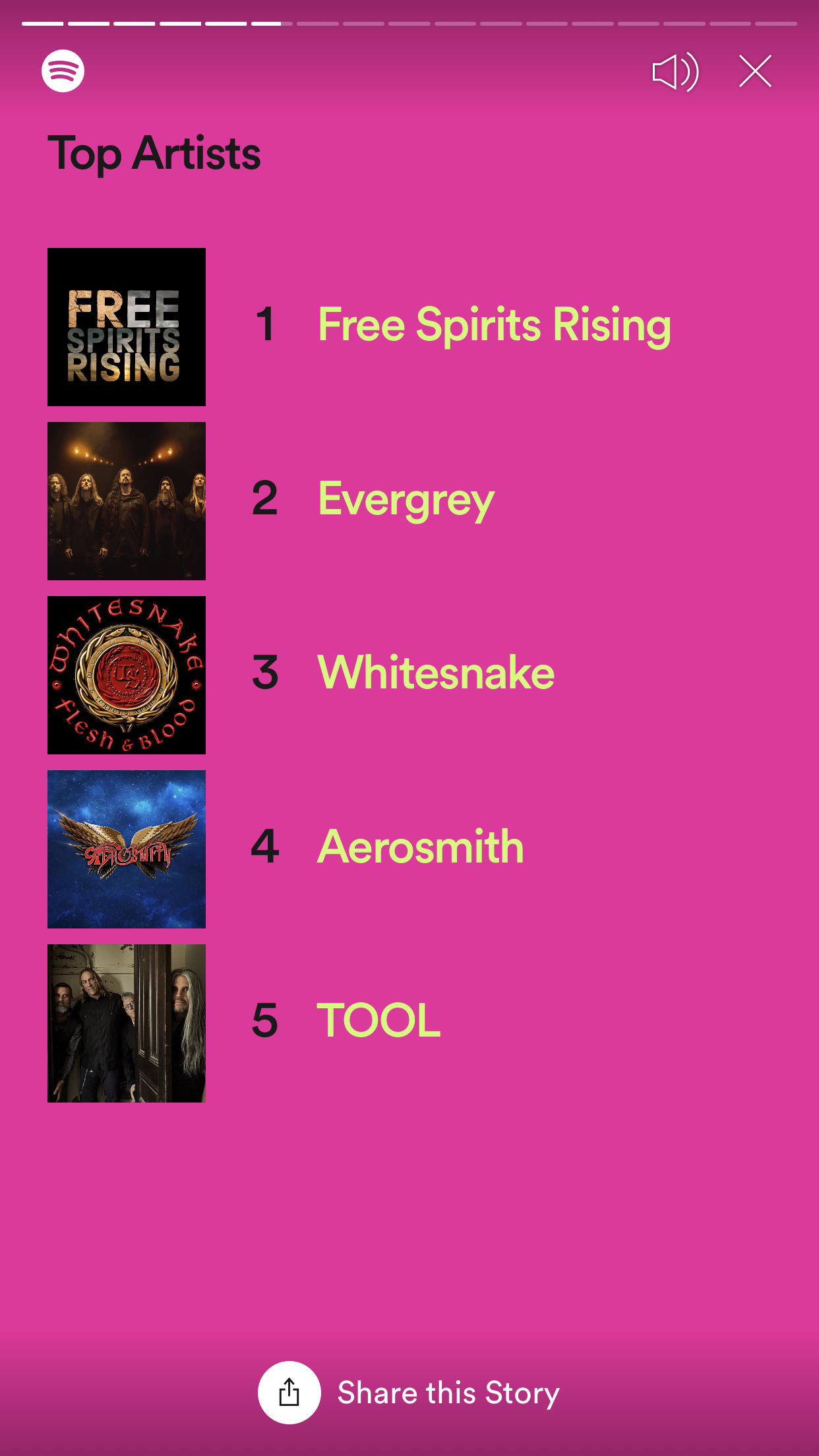
Overall, my top five artists for 2019 are, Free Spirits Rising, Everygrey, Whitesnake, Aerosmith and Tool.

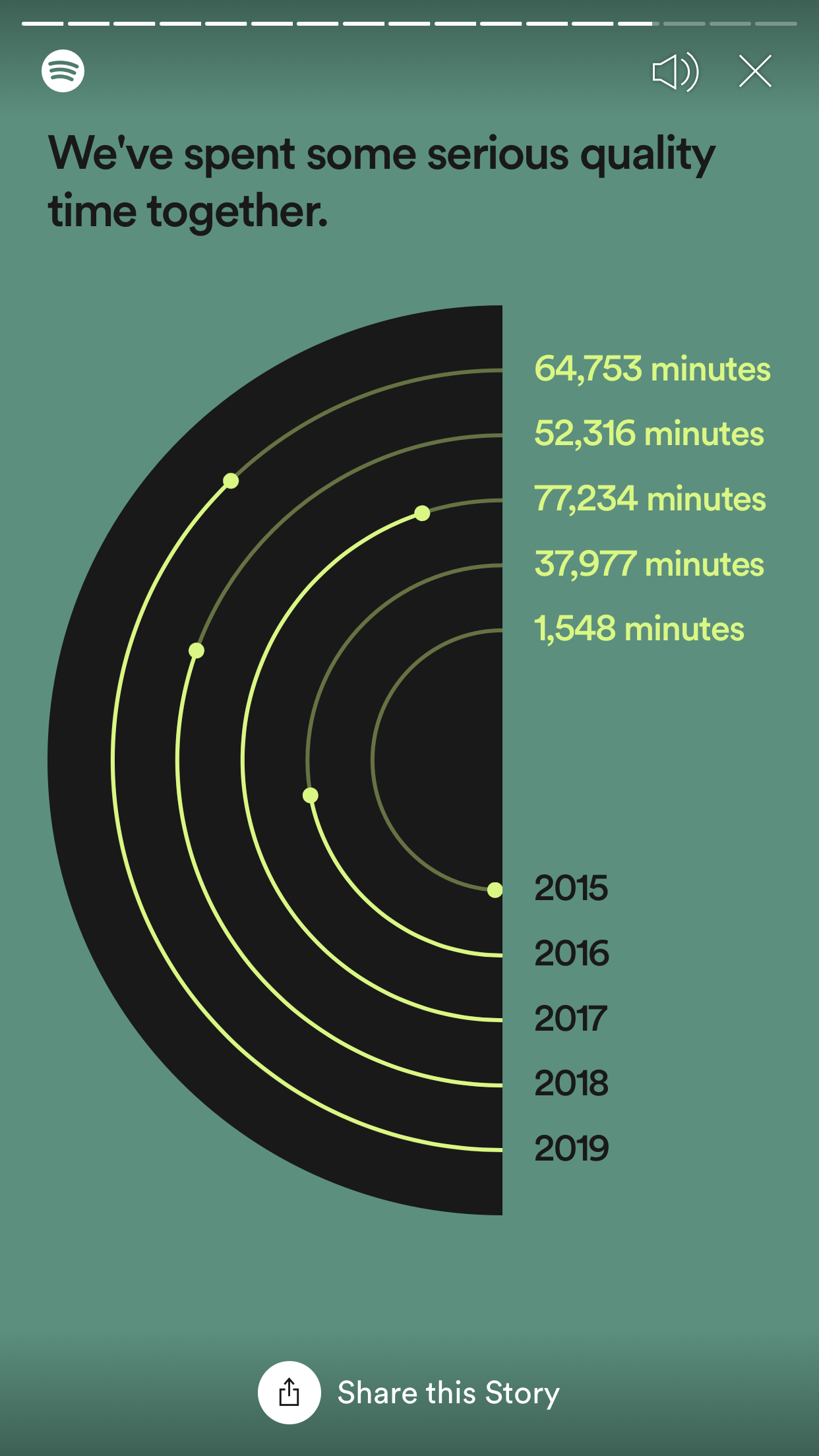
But my favourite stat is the time spent listening to music on the service.

  • In 2016, it was 37,977 minutes.
  • In 2017, it was 77,234 minutes.
  • In 2018, it was 52,316 minutes.
  • In 2019, it was 64,753 minutes.

Let’s put some of these numbers into context.

A 38 hour working week equates to 2,280 minutes.

So 64,753 minutes divided by 2,280 minutes equates to 29 working weeks of listening. Over half a working week year of listening to music and somehow working at the same time.

Standard
A to Z of Making It, Music, My Stories, Piracy

Listening Habits

It’s a tough crazy world.

Artists spend their blood, sweat and tears into their new product and no one seems to be paying attention.

How can they, with all the music coming out.

For 2019, I listened to 5,783 different songs on Spotify. To put that number into context that is roughly 16 different songs, each day, for 365 days. In the old vinyl LP days of 8 songs each, this would be two albums every day of different artists.

Streaming allows this diverse listening experience and for the fan, this is a good thing.

It’s also a good solution compared to peer to peer downloading. But people complain about the payments they receive, however there is no denying that streaming services have put some serious money back into the recording industry.

Prior to Spotify, the recording labels got nothing. And it’s a shame that those same labels don’t funnel those monies back to their artists. Because if wasn’t for the artists, the recording labels would not be in the position of power to negotiate anything. And if it wasn’t for the artists forming connections with people, then the labels would have no business model.

If you take streaming services out of the industry, people will not start buying CD’s again en masse.

Standard
A to Z of Making It, Music, My Stories

Fans

Fans maketh the artist and the fans taketh the artist.

For all artists, the need to create music is enough of a reason to start. Then some artists will have acceptance of their music. And suddenly artists have a thousand plus hard core fans.

Artists are normally happy to sell out the limited run of super deluxe editions of albums.

For the medium to larger acts, this is about 20,000 copies of an album between the prices of $50 to $200 each, and you can see a cool gross income between $1 million and $4 million. If the artists own their rights and are in control of their masters, then the deluxe editions if done right, can be a nice little supplement.

And streaming also gives the artist control of where their fans are, in which cities they live and which songs these fans are listening to. If the artists have the resources, then they can tour these places. Scorpions and Whitesnake are coming to Australia and I am pretty sure it’s on the back of some impressive streaming numbers, because it wouldn’t be on sales.

More so than ever, the fans decide how they want to commit to their relationship with the artist. And a lot of fans of music are also pretty content to listen to music at home, without feeling the need to go out and watch an artist live.

It’s part of the new world.

Standard
Music, My Stories

Metal And Streaming

What does a metal head and a rocker need to do to play the music game, especially when streaming is dominated by hip-hop/pop?

Metal heads are not 100% into streaming. But a few years back Spotify shocked the world when it said that metal is most loved genre.

But metal doesn’t even exist when it comes to the weekly streaming charts Which are dominated by dance and hip hop tracks. But, when you combine the numbers from the different metal acts, metal music rules streaming because of fan loyalty.

Turns out, that when Spotify analysed the number of streams divided by the number of listeners per artist, the Metal genre is way ahead of hip-hop, country and even rock. It basically means that metal fans listen to their favourite artist over and over and over and over again, until we overdose on their music, while fans of other genre’s hop and pop all over the place.

And metal music still moves vinyl and CD’s, especially deluxe packages or limited edition packages. But the biggest thing that no one picks up is the regeneration of metals fan base. People who are not involved in the metal lifestyle believe it is an aging fan base, but that is so far removed from the truth. It is a fan base that regenerates with each generation and it keeps on growing.

And if you’re in the metal game and you have a small but loyal fan base, then there’s absolutely no reason to sign with a major label. And if you need management, make sure you still own your tracks and pay management a percentage.

And metal acts sell tickets. They may not be big on the radio or streaming, but they’ve got live audiences, and that’s where the money is.

And metal music is going through another re-invention. There is a modern version of the old sound and there are artists who were around when the old sound was the new sound. Regardless, while metal music is not mainstream, it percolates, waiting for the time to rise up.

Like embracing streaming.

As mentioned above, it’s the main genre with the most loyal listeners.

In addition, streaming has removed the costly barriers to acquiring music. Prospective new fans can instantly access the whole history of metal music. And the metal head consumer decides what is popular to them. It’s a beautiful utopian democracy. But metal purists will point out that you don’t own the music you pay Spotify for and how you are basically leasing it. Sound purists will argue the low sound quality of streaming music. But in the end, the 320kbps setting will satisfy 99% of people.

And based on our listening habits, it satisfies us a lot of times.

Streaming Up Your Arse…

Standard
A to Z of Making It, Music, My Stories, Piracy, Stupidity, Treating Fans Like Shit

The Power Of The Record Labels

It’s 1992.

Hard rock bands are becoming too generic and soulless, especially the newer breed from 1989 and onwards. The fans are looking for something new, but they still have their taste buds all over the hard rock/metal distorted cream.

Meanwhile, the labels are signing Seattle bands, left, right and centre, while they start dropping hard rock bands left, right and centre. Not only could the labels make an artist famous, they could also make an artist destitute. And back then, without the money and power of the label behind an artist, an artist would go unnoticed.

The power the record labels had to kill careers or to destroy styles of music.

So the artist would sign a deal and get a small royalty payment from the label. Today the artists would still sign a deal because they see the label as their ticket to riches, but instead the artists are now complaining of the low royalty payment of streaming services, but it is still the label keeping the lion share.

In other words, you give to get.

You give your rights to the label in order to get a chance at fame and riches. And there’s no use yelling at streaming services. They are not record labels, they are technology companies, using music to influence culture and grow their brand. Once their brand is big enough, they will do away with music.

Because seriously, which company wants to pay billions in licensing and be constantly in the courts?  

HBO paid billions in licensing, until it got to a stage where it was unfeasible and they had to start creating their own content. Netflix at first had only licensed content. And like HBO they saw that it was unfeasible, so they started investing in creating their own, and slowly doing away with the licensing.

Now, more than any time in modern recording history, an artist can do it themselves. They can record cheaply, distribute and get paid. So artists should build their own leverage and then they can decide what is next.

But we have lived in a world where the labels have controlled the narrative for way too long and MTV made everyone think that if they learnt how to play an instrument they will be rich and famous. The majority still hold this view and the minority that don’t, are the ones making it.

People talk up Record Day sales like they matter, when only the label is winning, while digital distribution can offer an artist new audiences in places where brick-and-mortar stores would be impossible or unsustainable, like foreign countries or rural areas. The end result is growth across the board. Nowadays it’s about reaching as many people as possible and eventually the money will flow in if you do it right. That should have been the role of the labels but instead it’s up to the techies.

Standard