A to Z of Making It, Copyright, Influenced, Music, Unsung Heroes

Derek Schulman

On October 15, 2020, Derek Schulman appeared on the Bob Lefsetz Podcast.

I first heard of Schulman as the guy responsible for signing Bon Jovi and Cinderella. But before becoming a label executive, he was a member of Gentle Giant (GG), a band that has a bigger fan base today than when they originally broke up.

When Lefsetz asked why GG had grown in popularity, Schulman explained: “We wrote music for ourselves, didn’t follow trends, and the music held up.” Interestingly, GG never considered themselves a progressive rock band. Rock, yes, but not prog. They simply pushed themselves musically.

I believe GG’s resurgence is largely due to the internet. Their music isn’t locked away in a vault, it’s widely accessible. If we were still in the pre-Napster era, their catalog might have remained buried, since labels wouldn’t see the financial incentive to print CDs. Labels have always believed they know what fans want, but they’ve often been wrong. Had they continued releasing hard rock in the ’90s, the genre could have still produced acts selling close to 500,000 units. Instead, they abandoned it.

It always comes back to the music. People return for the music, not for record sales, labels, executives, or streaming numbers.

From Musician to Executive

Before Gentle Giant, Schulman played in a band with a few hit singles, but by 1969, he was burned out from the pressure to keep churning out commercial hits. He wanted to form a band that was the opposite of pop, so GG was born.

But by 1980, after 14 years in bands, Schulman was done. GG had become a job, and he had lost enthusiasm for recording and touring. With nothing lined up, he spent a year feeling lost. Fortunately, he had savings, thanks to his role as GG’s quasi-manager in the mid-’70s.

A friend at PolyGram called with a job offer. Schulman moved from California to New York and joined the label as a Promotions/A&R rep, though his role was mostly promotions. He was hired because two of PolyGram’s heads of radio promotion were huge Gentle Giant fans.

At the time, PolyGram was a mess. The label had major acts like KISS and Def Leppard, but they drained a lot of resources. Schulman’s break came when artists and managers started bringing him albums. Uriah Heep was shopping a new record, and Schulman helped organize a deal to release it.

Then came Bon Jovi.

Bon Jovi’s Breakthrough

Schulman met Jon Bon Jovi and was impressed by his focus and drive. Jon wanted to be bigger than Elvis. He even introduced Schulman to his parents, who told him: “Take care of our son.”

At the time, no other labels were bidding on Bon Jovi. Schulman also had a strict policy, he refused to get into bidding wars.

The key move was bringing in Doc McGhee. Doc originally came to Schulman’s office pushing Pat Travers, but Schulman told him to check out Bon Jovi instead. Schulman saw in Doc the same relentless drive that Jon had.

Jon met Doc, they struck a deal, and just like with Schulman, Jon’s parents needed to approve.

McGhee put Bon Jovi on tour with Ratt and Scorpions. Their debut album was a success, but their second record, “7800° Fahrenheit”, was considered a sophomore slump. Schulman hated the album title, the recording process was a mess, and the overall vibe felt off. But the album did its job, it kept the band on the road while McGhee worked overtime to book shows.

Schulman, meanwhile, had started working with producers Bob Rock and Bruce Fairbairn, who had just finished albums with Loverboy and Honeymoon Suite. Jon and Doc knew they needed great producers to reach the next level.

Schulman suggested co-writing with others. Paul Stanley and Gene Simmons had already introduced Jon to Desmond Child. The rest is history.

The label knew they had something big as soon as “Slippery When Wet” was mastered. The original album cover was scrapped, and Jon designed the new one himself. “You Give Love a Bad Name” and “Livin’ on a Prayer” were immediate hits, and the album shot to No. 1. Schulman had a percentage point on the album, but when he left the label, his royalties ended.

Cinderella

Schulman was introduced to Cinderella by an agent, a lawyer, and Jon Bon Jovi, who knew Tom Keifer.

He went to see them play a club in Philadelphia. The band wasn’t great, Tom Keifer stood out, Jeff LaBar was solid on guitar, but the other two members weren’t up to par. Then Schulman listened to a 90-song demo of Keifer’s original material. He was blown away by Keifer’s songwriting.

Schulman told the lawyer: “Get Tom to replace the other two with better musicians, and I’ll give you a deal.”

Andy Johns was brought in to produce “Night Songs”. The album dropped shortly after “Slippery When Wet” exploded, and “Night Songs” shot into the Top 10. Suddenly, Schulman was on fire, he had two bands in the Top 10.

When Lefsetz asked why Cinderella never released another big album, Schulman pointed out that they did, “Long Cold Winter”, but he had briefly forgotten the title.

Tom Keifer eventually lost his voice, which Schulman confirmed was true. Schulman also helped shape Cinderella’s albums with his artist experience, though he didn’t contribute to Bon Jovi’s records in the same way. He even co-wrote songs with Tom but never took credit.

Dream Theater

Derek Oliver, an A&R representative at Atco Records and a passionate fan of progressive rock, was the key figure in discovering Dream Theater.

In the late 1980s, Dream Theater had self-released their debut album, “When Dream and Day Unite”, through Mechanic/MCA Records, but the album failed to gain much traction due to poor promotion and distribution.

Meanwhile, Oliver, who had interviewed and reviewed the band during the period as part of Kerrang was impressed by their technical proficiency and songwriting.

Recognizing their potential, he brought Dream Theater to the attention of Derek Schulman, the head of Atco Records at the time.

After meeting the band and seeing their dedication, Schulman agreed to sign them to Atco. Under his guidance, Dream Theater recorded their breakthrough album, Images and Words (1992), which featured the hit single “Pull Me Under.” The album’s success helped establish them as a leading force in progressive metal, proving that Schulman and Oliver’s instincts were right.

Running Labels

Schulman also played a key role in launching Bob Rock’s production career, giving him his first gig with Kingdom Come, another band that went on to dominate the charts.

In 1989, Schulman left PolyGram to run Atco Records. PolyGram wanted to keep him, offering him control of Vertigo and Mercury, but he wanted a change, even if it meant losing his Bon Jovi and Cinderella royalties.

Doug Morris was hesitant about Schulman at first and saw him as a potential replacement. But Schulman built an impressive roster, signing Pantera and The Rembrandts. He had actually planned to sign Pantera to PolyGram but knew he was leaving, so he told their attorney to wait until he moved to Atco.

At first, Atco thrived. Schulman put together a strong team, and the first three years were fantastic. But eventually, he started losing perspective. One day, he heard a No. 1 song on the radio and liked it. When he asked a work colleague who had signed the artist, they said: “You did.” That moment shook him.

Doug wanted him out, but Schulman quit. He even attempted a coup while on a trip to Russia.

Roadrunner Records and the Rise of Metal

Schulman took a break before getting a call from an old friend, Case Wessels, at Roadrunner Records. Initially consulting for a year, he eventually became president.

Roadrunner was independent, which Schulman loved—no board to answer to. He scrapped some of Wessels’ ideas and focused on breaking bands like Coal Chamber and Fear Factory, both signed by Monte Conner.

Then he saw Slipknot live and knew they would be massive.

He also signed Nickelback. Their first album (with Roadrunner) featuring “Leader of Men”, got some airplay, but when “Silver Side Up” dropped, Schulman immediately recognized its potential. The moment he heard “How You Remind Me”, he knew it would be huge.

Roadrunner was suddenly rolling in cash. Wessels wanted another “Silver Side Up”, but Schulman knew those albums don’t appear every six months, more like every 5 to 10 years.

Lefsetz asked why Nickelback gets so much hate. Schulman believes they’re a guilty pleasure, many people who claim to hate them secretly enjoy their music.

Finally, Schulman pointed out that while the industry panicked over piracy during Napster, hip-hop thrived by giving music away for free.

When streaming took over, hip-hop was already dominant—and it still is.

If you like your hard rock and metal history, then Derek Schulman is an unsung hero and this podcast is one to listen to.

Standard
A to Z of Making It, Copyright, Music, My Stories, Treating Fans Like Shit

Four For Friday

TAX THE HELL OUT OF YOU

Motley Crue and Def Leppard came and they left, but not without complaints.

Tommy Lee walked into a 7-Eleven and purchased 4 packets of Marlboro Gold 25s in Melbourne.

The price. $251.96 AUD.

Yep welcome to Australia, Mr Lee, the place that loves to tax the hell out of you on everything and on top of that, has the highest tobacco taxes in the world as well. Basically 77% of the retail price is taxes.

If Tommy Lee purchased four packets in the US, it would have cost him $32USD which translates to $48AUD.

And no I didn’t go watch em. I’ve seen Motley Crue too many times and while I haven’t seen Def Leppard play, the price for the tickets was way too high and it was outdoors which I hate.

REISSUES

Remember when Metallica wanted to release the “Metal Up Your Arse” cassette tape as part of the “Kill Em All” reissue or maybe it was for a special Record Store Day release.

Anyway that got shot down by Dave Mustaine because he wouldn’t accept giving song writing credits to Lars Ulrich on songs he didn’t or was involved in writing.

Fast forward a few years and Linkin Park looks like they are in trouble with a former bassist.

As the Billboard article states;

Linkin Park is facing a lawsuit that claims it has refused to credit or pay royalties to an ex-bassist who played with the band in the late 1990s — a legal battle triggered by an anniversary re-release of the band’s smash hit 2000 debut album.

RE-RECORDINGS

The labels are up to their usual tricks again. They seem to forget that they are irrelevant without the artists.

Their whole business model is making money from music. So when they knew in the 60s that songs would become copyright free they lobbied hard and got laws in place to ensure their business model survives for a long time.

But Taylor Swift really messed with this by redoing her albums under her own control. This made the original recordings held by the labels basically worth a lot less.

And now they want to stop that.

I think if an artist wants to re-record a song or an album they created they should be free to do whatever they want.

And it was standard practice for artists to have re-recording rights either two years after their contract expires, or five to seven years after the original recording is released.

MONEY IN MUSIC

Warner Music Group Corp released its full year earnings.

And the take away is, they have earned over $6 billion in yearly revenue for the first time.

How much of that has filtered down to the creators?

Standard
A to Z of Making It, Classic Songs to Be Discovered, Copyright, Influenced, Music, My Stories, Stupidity

Four For Friday

PET SHOP BOYS vs DRAKE

The Pet Shop Boys need to relax.

The lyric in question is “the west end boys and east side girls”.

The lyrics are the main Chorus words for “West End Girls” by Pet Shop Boys and those same words are said three times in Drake’s song “All The Parties”, which is a shit song by the way.

And the words are not said with any sense of melody or to a backing track of music. They are just said. Spoken like and then auto tuned.

But “East End Girls” is at 239 million streams on Spotify so the Pet Shop Boys are very protective of their intellectual property.

COPYRIGHT TERMS

John Naughton writing for the The Guardian said the following;

…especially copyright – have been monopolised and weaponised by corporate interests and that legislators have been supine in the face of their lobbying.

Authors and inventors need protection against being ripped off.

It’s obviously important that clever people are rewarded for their creativity and the patent system does that quite well.

But if a patent only lasts for 20 years, why on earth should copyright last for life plus 70 years for a novel?

Yes why should it.

When the songs from the 60s were recorded, the Copyright terms for the songs was 28 years with the chance to renew for another 28 years. A total of 56 years.

And yet those songs got retroactively locked up for a long time by a 1978 Amendment to the Copyright Act by Disney which changed the terms to “life of the creator plus 70 years”.

This would mean that Disney’s “Mickey Mouse” created in 1928 and based on the laws of the time, should have been out of Copyright by 1984 however it would be locked up until 2003.

But in the late 90s and with the 2003 date looming, another Disney amendment was made that extended this law for Corporate works to 95 years. So the Mickey Mouse work from 1928 would finally be out of Copyright in 2023.

And 10 months in, Disney hasn’t suffered the financial losses they said they would if they lost the rights to Mickey Mouse.

SITE BLOCKING

In Australia, the Labels and the Movie/TV networks can go to the Federal Court with a list of sites they want blocked and the Federal Court will just approve the lists and the ISPs will then need to block their users from accessing these sites

The Federal Court is meant to review the lists (which they don’t) before rubber stamping the lists (which they immediately do). Because hey, these entities are the good guys, trying to protect Australians from pirates. And the ISPs need to do their bit to protect the business models of the labels and studios.

WHAT I’M CRANKING RIGHT NOW

Savior from Rise Against.

I became a fan because of the Guitar Hero game this song featured on many years ago.

And at 618 million streams it’s definitely making money for whoever holds the rights to it.

Standard
Copyright, Derivative Works, Music, My Stories, Piracy, Stupidity

Four For Friday

When I started these weekly posts it was a means to keep me blogging during a hectic schedule.

And there was no definitive structure as to what I would cover. But I can see that Cooyright issues keep appearing.

And here is another week devoted to that beautiful term. Copyright. Which was designed to give the creator a limited monopoly on their works so they could create more works.

LETS GET IT OVER WITH

Ed Sheeran can’t get a break. Last week, the case against him from the daughter of Ed Townsend was dropped.

But this week, an organization called “Structured Asset Sales”, (SAS) have started their own litigation.

They control a different one-third stake in Townsend’s copyrights. They “own” the basic notation (musical score) filed at the Copyrights Office decades ago.

When the original case was happening, (SAS) was also a part of it, seeking a “monopoly over a basic musical building block.”

Their case was also thrown out.

But they are appealing their part. Because hey, they created nothing and believe they should be paid for creating nothing. And they want a monopoly on a feel and style.

A big reason why Copyright had expiry terms initially was to stop all this crap. Politicians had a foresight back in the early 1900s to see this coming.

And that changed in the 60s when the labels and book publishers started to amass intellectual property and then started to lobby politicians to change laws and bring in new laws to give these corporations a monopoly on the works.

It’s funny now, how the labels are also getting sued from the very laws they sponsored to benefit them.

124 WEEKS

In April 2021, UFC fighter Jake Paul knocked out Ben Askren in less than two minutes.

Soon after, the popular H3 Podcast on YouTube commented on the fight and showed a clip of the fight.

Event promotor Triller wasn’t happy and issued a copyright infringement lawsuit demanding $50 million in damages.

H3 opted for a fair use defense.

The case is now in its 124th week.

The clip of the fight was 119 seconds long.

Who are the real winners here?

URUGUAY

The Uruguayan Government has a bill in motion which would allow artists to go direct to internet platforms like Spotify and social media sites like Facebook for compensation.

Spotify would still need to pay the existing licensing agreements and if this bill goes ahead could be forced to pay again to the artists direct.

I’m all for artists getting paid but the problem lays with the entities who hold the rights to the songs. They get the majority of the streaming pool and they don’t distribute it back to the artists.

This is a perfect example.

Spotify still needs to honor the licensing agreements with the labels and publishers so these organizations will receive their cut.

And if they are aware of the artist going direct, I am sure that some creative accounting will take place to hold back any payments to the artists.

Anyway. Spotify isn’t happy with the bill and unless it’s changed they will pull out of Uruguay.

As a byproduct, the local music industry which has been growing 20% from streaming revenue will have this source of income come to zero.

ALBERT NAMATJIRA

Albert Namatjira died in 1959. He was an Aboriginal artist, painting the Australian landscapes in watercolors.

The copyright in his art is due to expire in 2029, 70 years after his death.

This means the works will be part of the public domain and anyone can use them in their works moving forward.

But lawyers for the family are arguing that Copyright should last in perpetuity. Forever. Never expire.

And they are pissed.

The issue here is that the family were getting royalties for his art up until 1983. At that point in time, the government trust that administered the rights sold them to a private organization and the royalties ceased.

It took the family 34 years to get the rights back in 2017, with the proviso they need to relinquish them again in 2029.

Furthermore in the last 5 years, Namatjira’s art has exploded in popularity and has become a valuable intellectual property.

But Copyright was never meant to be a reversionary pension fund.

Standard
A to Z of Making It, Copyright, Influenced, My Stories

Four For Friday

A bit of Copyright, NFTs and Stallone.

NFTs

Remember when they were all the rage.

Sina Estavi is a crypto entrepreneur. He purchased an NFT of Jack Dorsey’s first tweet for $2.9M. It’s now worth $4.

Or check out this research which claims that 95% of NFT’s are worthless.

Not sure how owning a chunk of digital art on a blockchain is a valuable investment. Even Justin Beiber is down 95% on his Bored Ape NFT.

Non-Fungible Tokens (NFTs) are unique chunks of cryptographic data that connect to a digital object.

Let’s say we have a picture and its copy. If these objects are turned into NFTs, they will be distributed with unique identification codes, and will, be considered unique apart from the other. From this moment, the object that was once just a copy gained its own determined proof of existence, separating from its source.

Although the two NFTs now have an identical visual appearance, they cannot be treated as one thing and can have different financial values, hence the name ‘non-fungible’.

And somehow people came to the conclusion that these are good investments.

THE LABELS vs X

You know when you go on X(Twitter) and you see a music snippet shared by an account. It could be part of a video clip or a live performance.

Well the labels see this as “breeding” mass copyright infringement.

And since X basically ignores the takedowns from the labels, as a result, the labels sued, asking for $250 million and an ongoing licensing fee.

But X put in a motion to dismiss. The labels then counter argued and a judge in Nashville needs to decide if it goes to trial.

ROLLING STONES

Taylor Swift has shown other artists the financial windfall that could happen if you own your masters.

When Swift realized that she would never get her masters back, she went about and re-recorded the whole albums and made those albums, the versions people should stream and license.

This puts the power of Copyright back in her hands.

The Rolling Stones wished they could have done something similar because they lost their rights to all of their pre-1971 albums to their manager Allen Klein.

It’s just another case of a person who’s never made any art in their life, claiming it as their own and using it to for financial advantage. Geez, it sounds like a record label. Then again, labels did come up with the cash that most artists could never pay back.

As “The Rolling Stones” grew in popularity, they hired music-business accountant Allen Klein.

Klein negotiated a new deal with Decca and he also got a million-pound advance payment for their next album.

But he wasn’t paying Keith Richards and Mick Jagger their songwriting royalties. So they ended the partnership however as part of the severance, Klein managed to keep ownership of the Rolling Stones music for the years he managed them from 1965 to 1970.

But the Stones did receive millions of dollars in royalties from Klein but not as much as if they’d owned their music outright.

STALLONE

After writing the script of Rocky, Sylvester Stallone was offered $360K to not play the role.

The production company that was interested didn’t want him to play the role.

And since 1976, the rights to the Rocky franchise (which Stallone created) are in the hands of producer Irvin Winkler.

Standard
A to Z of Making It, Copyright, Music, My Stories

Four For Friday

Ahh copyright. It’s the gift that keeps on giving. Well it does really. It gives the writer an incentive to create for their whole life plus 90 years after death. Don’t know how it’s even possible after death, but hey, who am I to judge the intellectuals who wrote and debated this change.

It also gives rise to lawsuits and perpetual payments to corporations for valuable copyrights. It’s also a form of censorship and anti-innovation (remember Napster).

THINKING OUT LOUD

Thank god this silliness has been put to rest.

Remember when Ed Townsend’s estate wanted Ed Sheeran to pay them millions for writing a song with a similar feel to Marvin Gaye’s “Let’s Get It On”. The trial went to jury and they lost. They appealed and then they withdrew their appeal.

This is what happens when people who create nothing of culture believe they are entitled to that culture.

And for the record, “Let’s Get It On” is not so original itself. It’s also influenced by what came before it. Cause that’s how creativity works.

CAN YOU COPYRIGHT A BEAT?

But the madness continues.

Reggaeton is a style of popular and electronic music that originated in Panama during the late 1980s and it was later popularized in Puerto Rico. It’s basically massive in Latin America and from the 2010’s it’s creeped into the mainstream of English speaking countries.

In 1990, a song came out called “Fish Market” from producers Steely & Clevie. In that song there was a drum rhythm.

The lawsuit claims at least 80% of the genres songs have used that drum beat.

Sort of like the 4/4 drum beat and it’s variations.

They are common elements and building blocks to creating. The fact that 80% of the Reggaeton industry use this beat shows how common it is.

AI

What’s people’s view on AI?

We’ve had AI in our lives for a long time, yet many have failed to recognize it. At a basic level which everyone would recognize, remember “Spell Check” in Word docs or Google Search.

For the recent waves of AI to work, they need training. And this training involves material which is under copyright.

So.

If I develop an AI tool and train it with the music and books and movies I’ve purchased, am I breaching Copyright?

If I then release the AI tool for others to be allowed to create, is the tool breaching Copyright?

All the AI knows is how to write and review based on inputs.

Basically it’s a tool, that people can use however they want. It’s innovative at the moment. And the copyright industry doesn’t like innovation if it’s not paying them. So it tries to censor or kill the innovation.

Until the come to an agreement and they accept it.

REVENUES

$8.4 billion in six months was brought into the labels accounts with streaming payments making up 84 percent of that pie.

So if you are an artist or songwriter and you’re not getting a cut, your deal is super shitty. Change it.

Because if there was no value in streaming, all of the Investment House and Hedge Funds wouldn’t be buying up the rights to valuable catalogs.

Standard
A to Z of Making It, Copyright, Music, My Stories, Stupidity

Four For Friday

Copyright and Spotify again.

SHARE PRICE

It’s cool how copyright makes money for valuable Intellectual Property. And you can’t get a bigger and more valuable IP than “The Beatles”.

The thing is, not one of the members from The Beatles held or even hold their rights. At one stage, Michael Jackson was the sole holder of the rights.

And with all the transfers and sell offs, The Beatles catalog settled at Round Hill Music Royalty Fund. But like all companies on the stock exchange, the share price just didn’t reflect the true value of the Company.

In this case, shares in the company were trading around $0.70. And share prices this low don’t make share holders and board members happy.

So in comes Alchemy Copyrights with a $496 million buyout offer which means shareholders in Round Hill Music will get $1.15 in cash per share. Suddenly, you have happy shareholders and board members, who get a nice payday for holding shares in culture.

They created nothing culturally and yet still benefit. But I keep hearing how stronger copyright is needed to protect the creators.

Mmmm.

SHARE PRICE 2

Hipgnosis Songs Fund is also selling some of its catalogues for $465 million. This is to pay down debt and increase its share price

And as expected, the share price increased,

Again, you have an organization that created nothing culturally and yet it still benefits. And I keep hearing how stronger copyright is needed to protect the creators.

COPYRIGHT FAMILY DISPUTE

Motown songwriter and producer Ron Miller died in 2007. If Copyright expired on the death of the creator like it once did, then this would be a non issue.

But, Copyright doesn’t expire at this point. It’s still valid for another 70 to 90 years, depending on the country.

Fast forward to 2022, Sony Music Publishing signs a deal with Lisa Miller, for rights to 130 of her fathers songs.

But Ron’s other children Julie Moss and Mark Miller from Ron’s first wife didn’t like this and are now going to court.

They allege that Lisa Miller tricked her mother, Aurora Miller (Ron’s second wife) to sign away her claim to the songs.

The claim further states;

“As Aurora’s health continued to decline, Lisa began forging Aurora’s signature on notices of copyright termination.”

And I keep hearing how stronger copyright is needed to protect the creators. In this case a dead creator.

SHOWCASE

Spotify’s new marketing tool.

Artists can buy dedicated space on listeners home pages to promote new releases, deep cuts, etc.

Each click from a fan on the showcase button will cost the artist 40 cents per click until their campaign budget is maxed.

Spotify believes that people who see these ads are six times more likely to stream the release.

It shits me how artists always have to cough up cash.

Back in the label days, if the label marketed you, they billed you to recoup their costs.

If an independent act marketed themselves, they paid for a marketing campaign themselves.

Standard
Copyright, Music, My Stories

Four For Friday

It’s all about Spotify today.

MONEY LAUNDERING

This time around Swedish criminal gangs are using Spotify launder money.

The scheme is interesting.

The drug money they have is converted to bitcoin.

Bitcoin is then used to pay “fake stream” entities to do exactly that, create fake streams on Spotify for an artist.

The artist in question is linked or involved with the gang.

By creating the fake streams, the artists would end up on top of the charts and as a byproduct, those fake streams would lead to real streams.

As the Guardian article explains:

Higher streams lead to higher payouts from Spotify. The newspaper said that in Sweden, amassing a million streams pays about 40,000 to 60,000 kronor (£2,800 to £4,300).

WHITE NOISE

Have you ever come across a Podcast that’s just white noise.

It’s definitely annoying and I don’t care what people say about it, it’s basically streaming spam.

The rule was if the podcast got over a 100 listens (it can be from the same user) they would qualify for ad supported payments.

Well now it’s 1000 unique listeners before they qualify. Hopefully they just filter out.

SONGS AND SPAM

In 2018, 20,000 songs would get uploaded to Spotify. In 2023, it’s at 120,000. A large majority of those uploads are via bots and they are basically the same as email spam

AI COVERS

AI-generated “covers” of popular songs using artists’ voices are still being released on Spotify.

Universal’s trying to partner with Google on a tool that lets fans create these songs without infringing copyright.

Universal has also partnered with Deezer to ensure that music created by breathing people gets a higher preference on the service than AI created music.

It’s a start, however AI is really making streaming economics even trickier.

Standard
A to Z of Making It, Copyright, Music, My Stories, Treating Fans Like Shit

Four For Friday

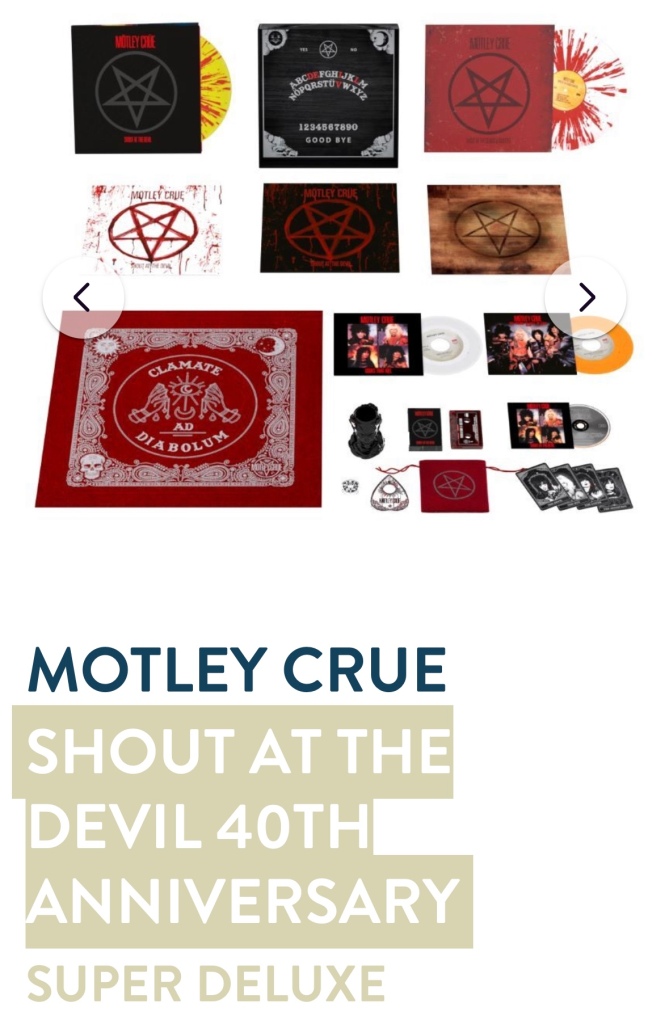
MOTLEY CRUE

How many times can they release the same album?

All the music here has been released before circa 2003 when the band remastered their albums on their own Motley Records label.

But let me highlight how many issues of the album they have done recently.

In 2022, they released a Limited Edition, Reissue, Black/Clear Split Vinyl edition. The music on this edition was just the normal album.

In 2018, they released a Limited Edition, Reissue, Remastered, Clear With Red Swirl Vinyl Edition. The music on this edition was just the normal album.

In 2016, they released a Limited Edition, Reissue, Remastered, Red With Black Swirl, 180g Vinyl edition. The music on this edition was just the normal album.

In 2011, they released a Limited Edition, Reissue, Remastered, Mini Vinyl Replica edition. The music on this edition was just the normal album.

Again in 2011, they also released a Reissue, 180g, Gatefold edition. And again, the music on this edition was just the normal album.

Between 2003 and 2023, they also released various CD versions of the album with wording like, HDCD, Club Edition, Limited Edition, Enhanced, Reissue, Remastered and SHM-CD (for Japanese Releases). Apart from the 2003 edition, it’s been the same album re-released.

But, it’s selling for $370AUD. It looks like a nice collectors piece and if you don’t have this album, you’ll be thinking “why not”, but at that price I would have expected something to be included that hasn’t been released as yet.

Take a cue from Mr Coverdale, who puts the effort in with his evolution compositions, different jams/rehearsals of the songs and live recordings.

STEVE JOBS

At 12 years old Jobs called Bill Hewlett (the co-founder of Hewlett-Packard) to ask for spare computer parts.

Jobs got the parts and a summer job working the assembly line at Hewlett-Packard.

Steve Jobs, believes asking is the single thing that “separates the people that do things from the people that just dream about them.”

METALLICA

Brian Slagel is putting together the Metal Massacre compilation album.

Slagel met Lars Ulrich a year ago at a Michael Schenker concert. Lars calls him up and asks him, “if he puts together a band can he be on the record?”

BON JOVI

It’s 1982 and Jon Bon Jovi has just finished writing and recording “Runaway”.

He shopped it around and couldn’t get a record deal. He couldn’t get a band together to play live because original bands didn’t make enough money.

Luck would have it that a brand-new radio station would open in New York. It was so new it didn’t have a receptionist so nobody was there to stop Jon from walking straight to the DJ and asking him to play “Runaway”.

The song quickly gained traction and Hobart entered Bon Jovi into a contest the radio station was running for the best unsigned band.

Jon won, he got his Mercury deal and by the summer of 1983, the song had become a huge hit.

It’s amazing what could happen from asking.

SONG ON REPEAT

“Crime Of The Century” by Revolution Saints.

That Chorus hook is undeniable. It’s from the new album “Eagle Flight” which has Joel Hoekstra and Jeff Pilson joining Deen Castronovo.

Check it out.

BONUS SONG I’M LISTENING TO

“Burn For Me” by The Night Flight Orchestra. It’s the Bowie “Modern Love” feel which hooks me in and then that feel gets put in the TNFO blender and what comes out is an infectious AOR Rock song.

And that Chorus hook. Wow.

Standard
A to Z of Making It, Copyright, Music, My Stories, Piracy, Stupidity

Four For Friday

RIAA POWERS

How much power is too much power?

Two years ago, the RIAA won a piracy lawsuit against two sites that offered YouTube-rippers. For those that don’t know, these sites allow the user to turn a YouTube video into an mp3.

After the verdict, the RIAA demanded $83 million in damages from the site owners.

And suddenly, there was an appeal.

As the TorrentFreak article explains;

“If the record companies can really get multi-million dollar judgments without having to prove a single instance of infringement within the United States, then no one who operates a website is safe,” Gurvits (Defense Lawyer) said at the time.

There has to be some onus on the RIAA to prove infringement.

And they can’t because they don’t know who infringed.

It’s easy to get a techie to run a report and say that the YouTube ripping sites were accessed by U.S IP addresses. But. It’s not easy to prove who is responsible when their evidence is made up of IP addresses.

But accessing the sites doesn’t constitute Copyright infringement. And the RIAA cannot prove what infringement took place or what videos from YouTube were turned into mp3s.

So why is the law allowing them to bring cases to trial without this proof.

JASON ALDEAN

The song “Try That In A Small Town” came out in May 2023 and it was out of the public conversation. It was a dud and no one cared enough to listen to it. His true fans did but no one else.

Then someone (Critic Zero) started the backlash against the song in the middle of July, 2023 and by doing so, they amplified the song by providing much needed free marketing.

The criticism then spread to other blogs and news outlets faster than Covid and as a by product the streams and downloads of the song kept going up. In the space of two weeks the songs Spotify numbers went from 1.5 million to 12.3 million.

To top off the controversy, Aldean and his team had to edit the music video because it contained footage which was copyrighted.

SPOTIFY INCREASE

The price of Premium Family is changing from A$18.99/month to A$20.99/month.

My favorite part is the reason Spotify gives for the increase, which is word for word to what Netflix gave a year ago;

We’re increasing the price of Premium Family so that we can continue to invest in and innovate on our product offerings and features, and bring you the best experience.

Really.

It’s nice to know that Spotify is using subscription money to pay people for podcasts that a lot of their customers don’t like.

BAND I’M SEEING

I’ve got tickets to watch “The Night Flight Orchestra” in Sydney next Friday. Readers of the blog will know that I am a fan. Each album has been reviewed glowingly.

In case you are interested.

You can read the debut album “Internal Affairs” (2012) review here.

“Skyline Whispers” (2015) is here.

“Amber Galactic” (2017) is here.

“Sometimes The World Ain’t Enough” (2018) is here.

“Aeromantic” (2020) is here.

“Aeromantic II” (2021) is here.

SONG IM LISTENING TO

“Crime Of The Century” by Revolution Saints. It’s a great piece of melodic rock and that Chorus just sticks around forever.

My review of the recent album is here.

Standard