A to Z of Making It, Copyright, Music, My Stories, Unsung Heroes

Originality And Competing With The History Of Recorded 🎶

Everyone who wants to play can play in the music industry. It doesn’t mean you’ll get paid for it. It doesn’t mean that you are entitled to be paid for it.

Creating art and finding connections with art happens at curious times for people. When we lived in the monoculture created by MTV, the chances were high for an artist to connect based on their music video being put on rotation.

How long those connections lasted was a different thing entirely?

And the system of the old legacy players would like to tell artists that if they don’t chart they don’t exist, but if you look at what’s in the streaming top 50 it doesn’t correlate to the Billboard charts top 50 or any other chart. And what was old and done is back again. “Bohemian Rhapsody” is back and so is “In The Air Tonight”. And the Black album outsells them all.

Previously the general viewpoint was that the artists new release was competing against other artists new releases for people’s attention. Now, the new release is competing against the whole history of recorded music for people’s attention.

It’s always been about longevity.

The first week numbers in 10 years are irrelevant, but whether you can last and sustain, is important.

How relevant are the first week numbers for Dokken, Quiet Riot, Skid Row, Ratt and White Lion today?

Zilch.

And there will be heirs of artists and failed artists who believe that someone else’s hit song is from an idea of theirs.

To quote Adam Grant, “Originality doesn’t mean being first, it means being different and better.”

Standard
Copyright, Music, My Stories, Stupidity

Feed The Copyright

It’s not even funny how much money the legal fraternity makes from music and Copyright issues. The legal teams of labels, artists and the heirs of artists make money from Copyright disputes. The legal teams of the same group make money from just representing those groups in contract negotiations and so forth.

But depending on what you read, streaming services are the problem because they don’t pay enough. Because these services also make money. While the streaming companies are running at a loss, the value of the people at the top of the Executive doesn’t diminish and their stock value is high.

Everyone is making money from so many different things except the artist. But it’s the artist who creates the content that engages with a person, who then becomes a fan and decides to spend their money on the artist.

This is what happens when artists are never allowed to be in the negotiation room when legislation is being drawn up.

When Corporations like the record labels are involved in the negotiations with their list of politicians on their payroll, well legislation looks very one sided. And when the labels get artists involved like Sonny Bono, these artists gets a handsome payday from the labels for their involvement which is probably a lot more than they would get from sales or even streams of their recorded music at that point in time.

So artists are now waiting for a judge to clarify whether they can reclaim their rights from record labels, even though the Copyright legislation states that they can.

The labels are digging deep with their counter arguments to prove that the termination requests are invalid. There best one is to say that the songs are “works for hire” which means that the label was an employer and the artist an employee, however the label didn’t meet any commitments that an employer needs to meet to be classed as an employer like annual leave, long service leave, sick leave, retirement pension contributions and yearly review of said salary and bonuses and so forth.

And the lawyers make even more money.

Remember when the streaming bodies disagreed with the Copyright Royalty Board on the new rates they need to pay to songwriters for streaming.

Well this disagreement went to an Appeals Tribunal and it’s all going back to the Copyright Royalty Board to renegotiate/review and to be a bit more transparent as to how the CRB do things or come up with things. Of course, this will be another public relations nightmare for Spotify, but then again they are the labels biggest client.

And it’s more money from the artists diverted to lawyers.

Standard
Classic Songs to Be Discovered, Derivative Works, Influenced, Music, My Stories

1985 – Part 5

Megadeth – Killing Is My Business

My relationship with Megadeth started with the “Rust In Peace” album in 1990. That was a wow moment for me, in relation to song construction, guitar playing and pushing the boundaries of thrash metal even further and more progressive.

So I started collecting more Megadeth albums. “So Far So Good So What” and then “Countdown To Extinction” was released. Then I went back to “Peace Sells” and then “Youthanasia” came out.

Then I went back to the debut, and it was the mid 90’s. And I thought it was average. I couldn’t hear a song that I liked but each song had sections/riffs which got me interested. And it infuriated me.

I suppose that’s what you get, when you spend half of your $8K recording budget on drugs and alcohol and then had to fire the producer because you couldn’t afford him, which meant you had to produce the album.

“Loved To Deth” has this open string pull off riff that I like. “Killing Is My Business” is the NWOBHM movement on steroids and speed and other hallucinogens. The first 90 seconds of “The Skull Beneath The Skin” is groove metal mixed with speed. “Rattlehead” is so fast, it’s a speed metal anthem. 

Whatever Metallica was, Megadeth was going to be faster and more aggressive.

“Chosen Ones” has this “Jump In The Fire” style riff and it’s probably their slowest song. “Mechanix” is 4 minutes of relentless anger. And I’m sure everyone knows that this song became “The Four Horseman” when Mustaine was in Metallica. When he played it live with Megadeth at a Sydney concert he merged the two songs and it was a perfect homage to both.

And Mustaine didn’t want to sing, but after spending six months searching for a vocalist, he took on the reins. It was like Deja-vu as James Hetfield also didn’t want to sing, but did it due to a lack of suitable vocalists.  

Savatage – Power Of The Night

There is a Savatage before “Gutter Ballet” and a Savatage post the death of Criss Oliva for me.

This album is pre “Gutter Ballet” and it’s a band trying to find their sound and style. Max Norman is producing. 5 years before, he was doing Ozzy with Randy and 5 years later he would do Megadeth and Lynch Mob albums.

I like the intro riff to “Power Of The Night”. “Hard As Love” has a title which is a product of its time, but while this kind of title would have worked for Danger Danger or Bulletboys, it felt wrong with Savatage. But musically, its brilliant, catchy.

“Fountain Of Youth” is the embryo of what Savatage would become. The musical structure and different grooves would become more prominent on the albums that came after.

But the album is hit and miss in the lyrics department.

Kick Axe – Welcome To The Club

I picked up their first two albums in the 90’s because I saw that Spencer Proffer was involved.

They are a very underrated band from Canada and I like “Welcome To The Club” more than the debut album “Vices”.

“Welcome To The Club” is a different kind of track, rooted in hard rock, but those clean tone arpeggios give the song a very UK Pop sound. Then you have a song like “Feels Good Don’t Stop” which swings, grooves and rocks its way all the way while “Comin’ After You” feels like a Marillion song while “Make Your Move” is a hard rock song through and through.

How good is the intro to “Never Let Go”? And overall, I feel like I am listening to a Y&T cut merged with Triumph.

“Hellraisers” has some serious good riffage in the intro and verses.

“Can’t Take It With You” has those big “I Love It Loud” drums but the riffage and vocal melodies would have given birth to the recent Swedish Melodic Rock movement. It sounds like H.E.A.T built a career on songs like these.

“Too Loud… Too Old” sounds like an unchained and frantic VH song and it also reminds me of a blog I visit regularly called 2Loud2OldMusic.

The way the staccato bass rolls in “Feel The Power” gets the foot tapping. Check out those harmony leads as well.

And the album closes with a cover song, “With A Little Help From My Friends” but even though Lennon and McCartney wrote it, the definitive version is from Joe Cocker.

Keel – The Right To Rock

Gene Simmons is producing under his label Gold Mountain Records while Steve Riley plays drums on the album but left to join WASP.

The band had three songs written before they got sent to the studio (“The Right To Rock”, “Back To The City” and “Electric Love”), so they covered three Gene Simmons demos (“Easier Said Than Done”, “So Many Girls, So Little Time” and “Get Down”) and re-recorded three songs from the debut album (“Speed Demon”, “Tonight You’re Mine” became “You’re The Victim (I’m The Crime)” and the Rolling Stones cover “Let’s Spend The Night Together”).

I still like the intro to “The Right To Rock”, it’s perfect for the time.

“All of my life I’ve been fighting for the right to make my stand” and we are still fighting to make our stand. It will never stop.

“I’m gonna do it my way or not do it all” sounded so easy back then, but as you grow up, you start to realise that it’s not that easy to do things your way and still participate in society. In order to live, you need money and to get money you need to work. If doing things your way, generates money, great, if it doesn’t, then you need to work for someone else and suddenly you are not doing it your way.

“Back To The City” is interchangeable with their other songs and I really like the Rolling Stones cover “Let’s Spend The Night Together”.

The verse riff of the Gene Simmons penned “So Many Girls, So Little Time” is pure heavy metal. “Electric Love” is melodic rock, with Ron Keel delivering a vocal line at 11. “Speed Demon” is pure NWOBHM with Ron Keel again delivering a vocal line at 11. There’s just 11 in his delivery and that’s it. 

“Get Down” is another Simmons cut which feels like a re-write of “I Love It Loud” but lyrically, its dumb. “You’re The Victim (I’m The Crime)” is another cut inspired by the NWOBHM, with fast “Overkill” double kick drumming in the intro.

Even though the album is a mixture of new songs, re-recordings and Gene Simmons penned songs, Keel earned “The Right To Rock” after it.

Also if you’ve seen a Y&T cover on A&M Records, a Foreigner cover or some different posters around the Mad Max and Star Wars movies, then there is a pretty good chance you’ve seen the artwork of John Taylor Dismukes.

Autograph – That’s The Stuff 

Autograph were either loathed or liked. There was no in between.

I liked the first album “Sign In Please” and loathed the second album “That’s The Stuff” which really wasn’t the stuff.

And the second track “Take No Prisoners” is a rewrite of “Turn Up The Radio”. This is an album that is lacking in ideas and very hard to listen to.

Standard
A to Z of Making It, Copyright, Music, My Stories, Piracy, Stupidity

Streaming Hate Continues

The record labels and music news sites that benefit from reporting positive articles about the labels, talk about the billions of dollars the music industry made in the financial year just before Napster hit.

So from a simple viewpoint, when Napster hit, sales of music started to decline. For the RIAA and the record labels, these two events correlate, so it implies that one is causing the other to move. But the sales of music had been falling for some time.

What happened during the 90’s just before Napster went worldwide was a lot of re-purchasing.

People started to re-purchase the music they already owned on vinyl and cassettes on CD’s. These re-purchased items, in most cases re-mastered or super deluxe editions with bonus content at higher prices would skew the record label figures to make it look like new recorded music was bringing in billions of dollars when in fact it was people purchasing old catalogue items. And once we had those albums on CD, we didn’t really need to re-purchase them again.

But Napster also highlighted a gap in the business models of the labels. People liked to have access. If anything, people liked to have terabytes of culture saved on disk drives.

Some artists maintain that it was the right action to go after Napster. Others can’t wait for Spotify to die. They must think that people would just go out and buy their albums on physical again. The hard core always will but the majority won’t. They’ll revert to downloading.

The Napster gap allowed people to share their music collections (bootlegs and original recordings) in a very simple and convenient way. Napster got popular because of it, and the labels should have created something to match it.

But the labels did nothing, and more sharing applications kept coming. Then a small company called YouTube did fill the gap that Napster was really servicing. YouTube allowed people to upload their music collections. And YouTube today, generates billions of dollars. These billions could have been in the profit and loss statements of the record labels but they messed up.

We are 22 years post Napster, and the record labels did absolutely nothing to counter it, except scream for legislation and gestapo like police powers.

You want to know who is the labels biggest client. Spotify and the other streaming services.

You want to know who artists see as their biggest enemy. Spotify, but not the other streaming services..

The arrival of YouTube and eventually streaming services put a dent into the traditional sales model, but did these sharing and access platforms assist in increasing the crowds for artists?

Iron Maiden came back with Bruce Dickinson on “Brave New World”, bigger than ever and played to sold out crowds in countries they’ve hardly sold any recorded product in. Even the album “Brave New World” did nothing sales wise.

Twisted Sister and Motley Crue also came back bigger than ever post Napster and played to their biggest ever crowds until they retired. Then again Motley Crue just faked their retirement.

Did sharing of music assist in these high concert attendances as well?

To use the record label analogy of post Napster sales and pre Napster sales, these two events correlate, so it implies that one is causing the other to move. The same can be said about music being shared illegally and bands playing to their largest audiences ever. One event is causing the other to move.

And here we are in 2020 with a pandemic killing off the live show and no one really knowing how it will look once it is over. And the record labels are winning, making money from streaming revenue while the hard rock artists who have a presence want streaming to die.

But it’s the labels with the greatest share of the streaming revenue.

Standard
Classic Songs to Be Discovered, Influenced, Music, My Stories, Unsung Heroes

Banali and WASP

It’s his work with Blackie Lawless that I really like as it covers some of my favorite WASP albums.

“The Headless Children” released in 1989, “The Crimson Idol” released in 1992, “Still Not Black Enough” released in 1995, “Unholy Terror” released in 2001, “Dying for the World” released in 2002 and “The Neon God: Part 1 – The Rise” released in 2004 are some of WASPs best releases.

And Bob Kulick who has left for the great gig in the sky appears on quite a few of em as well.

Check out “The Headless Children”. Banali’s drum groove in the intro came straight from the depths of hell in its intensity and power.

It feels like the song is built on the drum pattern. And the piece d resistance is from 4.12. I call it the Iron Maiden section.

Listen to it and be moved by it.

And “The Real Me” introduced the drum fills that would give Stet Howland a bad name. Is it really Howland’s fault or Keith Moon’s since “The Real Me” is a cover?

On “The Crimson Idol”, Banali provides the drumming on the actual songs and Howland provides drum fill percussion on each song.

Check out the power of “Doctor Rockter”.

The same deal is worked out for the follow up “Still Not Black Enough” but this time Howland is credited as the percussionist. And Blackie more or less rewrote “The Crimson Idol”.

Check out the restraint and build on “Scared To Death”.

In 2001, “Unholy Terror” came out and Banali plays on five tracks. Check out “Charisma” and the Kashmir style groove laid down.

Check out “My Wicked Heart” from “Dying For The World” in 2002 for some epic drumming.

And “The Neon God Part 1” released in 2004 closed his WASP career. My favorite is the ballad “What I’ll Never Find”.

Rest In Peace.

Standard
A to Z of Making It, Classic Songs to Be Discovered, Derivative Works, Influenced, Music, My Stories, Unsung Heroes

The Record Vault – Cerebus


It was a random purchase at a record fair in the 90’s. The bin had a large sign that said 7 records for $10.

How could I refuse that offer?

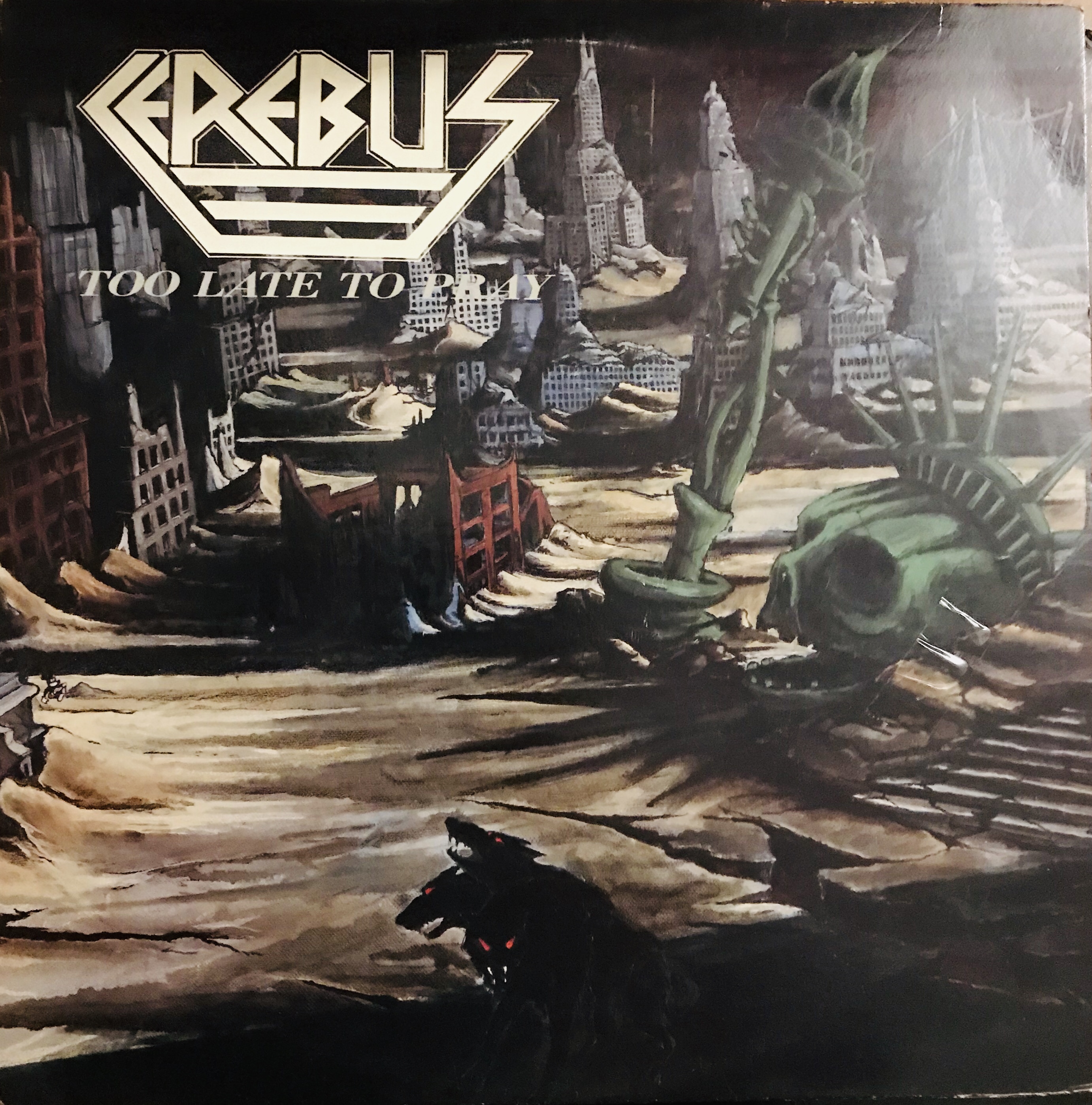
The dystopian landscape cover painting got my attention, as its reminded me of various movies.

I dropped the needle and I was pleasantly surprised.

I was hearing early Judas Priest, Saxon, Motorhead, Deep Purple, Thin Lizzy and Riot.

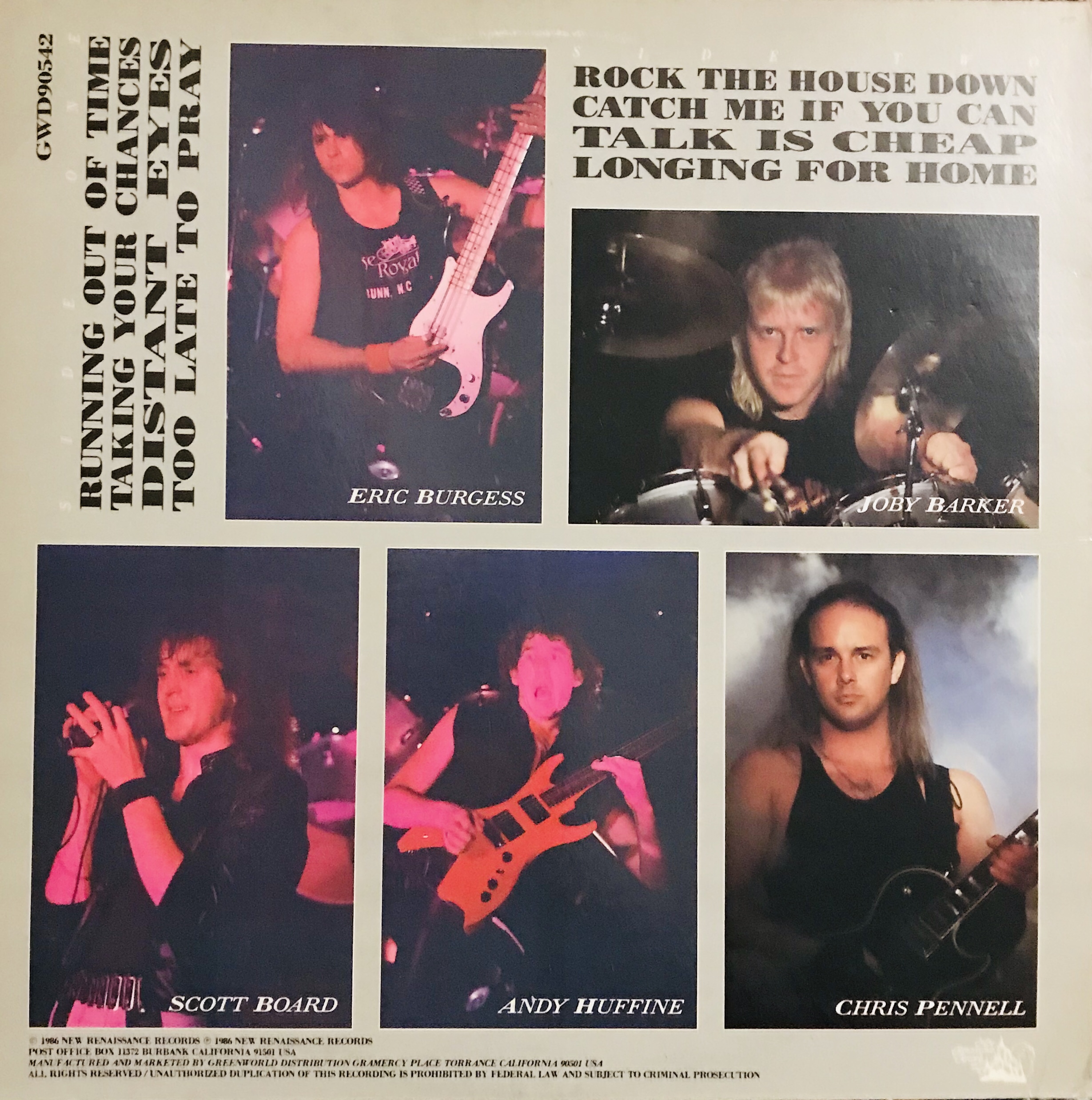
The raw production and the treble biased mix had me thinking of those Metallica albums. Which means that the bass player is hardly heard, which is a shame as Eric Burgess is the main songwriter in the band.

Cerebus is an American act. There is also a deathcore band with the same name that came out in the 2000’s who have nothing to do with this 80’s version.

They released a Demo in 1985, a full length album “Too Late To Pray” in 1986 on a label called New Renaissance Records, an EP in 1987 called “Like a Banshee On The Loose” on a local North Carolina label, another demo in 1988, another EP in 1991 called “Regression Progression” on a local label and a best of album in 2019 called “From Beyond The Vault Door” on a label called “Heaven And Hell”.

And their label “New Renaissance Records” was created by Ann Boleyn after her band Hellion had a record in the British Music Charts, but was unable to find an American deal. So Boleyn sold her car and musical instruments to fund the initial pressings of compilation albums and eventually full releases by bands. King Kobra (the band founded by Carmine Appice and Mark Free) was an act that was on the label as well.

So the label signed the band to an 2 album deal, but the label offered no tour support. Cerebus played an extensive US tour on their own budget but going to Europe proved impossible as they didn’t have the means, which is a shame, as the majority of their sales were in Germany and Western Europe. After the U.S run of shows, the band and label parted ways.

The band kept writing and releasing, but in a market dominated by gatekeepers, they needed a label and a distributor. Which didn’t come as easy as they thought.

And as the EP releases kept coming, the band kept tweaking their sound, moving from their Iron Maiden/Saxon style to a more Deep Purple, Whitesnake and UFO sound.

Running Out Of Time

Its speed metal and those harmony leads from Andy Huffine and Chris Pennell (RIP) in the solo section sound like they came from a Saxon album.

The vocal lines from Scott Board are like the chainsaw vocals of James Hetfield from the first two Metallica albums, with the Rob Halford banshee wail.

And the double bass drumming from Joby Barker just keeps pummelling along.

Taking Your Chances

A different style of cut, in the hard rock vein with a melodic rock style chorus.

Distant Eyes

Acoustic arpeggios kick it off with a guitar solo before it explodes into a UFO style cut merging “Lights Out” and “Too Hot To Handle”.

Too Late To Pray

It also starts off with acoustic guitar arpeggios, before it moves into a military style drum beat. Then the harmony guitars kick in, but it’s all part of a long intro, before the main song kicks in with a head banging riff.

And the vocal line is ball tearing.

Rock The House Down

It has the “One Riff To Rule Em All”, which a lot of people would know as “Two Minutes To Midnight” but it goes back all the way to the 70’s.

Catch Me If You Can

Sounds like “Running Out Of Time”.

Talk Is Cheap

It sounds like “Running Out Of Time”, but with no singing, and bass solos which you can actually hear.

Longing For Home

It has these “I Still Love You” arpeggios in the intro which I like.

Standard
Classic Songs to Be Discovered, Influenced, Music, My Stories, Unsung Heroes

World On Fire

Welcome back to the world of hard rock, Mr Chris Daughtry.

It’s so good to hear you rocking out again, with heavy distorted guitars and one of your best vocal melodies over the last 7 years.

In case you are not aware, Daughtry just dropped “World On Fire” and I’ve racked up some time streaming it.

It’s a perfect example of how we fall in and out with the artists we support. I was all in between 2006 and 2012. Then “Baptized” came out in 2013 and I wasn’t really a fan of it and “Cage To Rattle” in 2018 also proved disappointing to me.

But I stuck around, because the artists we support need to mature and they need to grow and try different sounds.

Then certain events happen.

Unfortunate events.

And it makes them angry.

If you watched George Floyd scream “I can’t breathe” while a Police Officer kept the pressure on his neck and didn’t get angry, then you are part of the problem.

Can you hear the crowd like a thousand sirens?
In the night like thunder striking
The sickness is rising
The angels are crying
That’s the sound of a world on fire

Every single person has a right to live to old age. The fact that brutality still exists in societies which are meant to be “civilised” and “understanding” is frightening, especially when the brutality comes from the people who swore to protect society. Instead of protecting, they are inflaming the situation and causing a revolution.

I saw photos and videos of the protests in Belarus. The Belarus Police are protecting a corrupt dictatorship hiding behind fake/rigged elections and the Police answer the protests for change with tear gas, stun grenades, water canons and batons.

And the same response happened when people protested against police brutality in democratic societies.

That’s the sound of a world on fire.

Put it on and listen.

Standard
Derivative Works, Influenced, Music, My Stories, Unsung Heroes

The Record Vault – Cacophony

“Go Off” is the second album from the Marty Friedman and Jason Becker project known as Cacophony, released in 1989.

The first one, “Speed Metal Symphony” was released in 1987.

It’s basically like Racer X but a bit more on the technical side of thrash, like Watchtower. And like Racer X, the guitarists in the band would go on to explore other outlets. Marty Friedman with Megadeth and Jason Becker with David Lee Roth, which was cut short by a terminal disease which took away all movement.

“X-Ray Eyes” feels like it came from a Testament album. The lead section has Becker and Friedman trading sections for over a minute and raw thrash like vocals.

“E.S.P” starts off with a finger picked intro and lead that resembles Baroque. You feel like you are in a castle watching the jester perform, before it rips into a thrash metal riff which reminds of Annihilator. Listen to the outro (the last minute), and the riffs and the harmony leads.

“Stranger” attempts to be groovy with Van Halen like riffs while “Go Off” is an instrumental, with a lot of fast guitar solos. Not my favourite cuts.

“Black Cat” has this Oriental feel in the first minute, before it moves to a Thin Lizzy style harmony merged with Gary Moore’s “Over The Hills And Far Away”. At 7 minutes long, it’s the first two minutes I like.

“Sword Of The Warrior” is another thrash-a-thon, with symphonic harmony sweeps. But when the steroid infused “Peace Sells” inspired bass riff kicks in, the song gets even faster. This track could have come from “Kill Em All” or the “Peace Sells” album.

“Floating World” is a lot slower, more rock like with Thin Lizzy harmonies. And when it’s at that level I am a fan.

“Images” is a slower tempo song, which sounds like it came from the soundtrack of an Italian Spaghetti Western. This one is an instrumental and at 3 minutes long, it’s perfect.

So if you like guitar playing with flawless technique and songs with a lot of riffs and leads and raw vocals then you should give it a listen. Or if you want to hear a great instrumental track, then just go straight to “Images”. You will not be disappointed.

Standard
Classic Songs to Be Discovered, Derivative Works, Influenced, Music, My Stories, Unsung Heroes

2000 – Part 5

AC/DC – Stiff Upper Lip

Five years after “Ballbreaker” they return with the very underrated “Stiff Upper Lip”.

The title track starts off like blues band jamming at the local pub and then the romp and stomp kick in.

How good is “House Of Jazz”?

That riff groove is so sleazy and foot stomping.

And “Safe In New York City” has this E to G, E to A and E to B flat style chord progression that reminds me of the “Tommy Gunn” riff, but the song vibe is like “Let There Be Rock”.

“Satellite Blues” is an underrated gem in the AC/DC canon.

And its towards the back of the album that it gets bluesy and dirty with “Damned” and “Come And Get It” being excellent additions. Listen to those sharp 7 and flat 9 chords in the Pre Chorus.

“All Screwed Up” is 5 minutes of blues rock while “Give It Up” is a rewrite of “Highway To Hell” but it stands on its own.

Not as big as other albums in sales but it got em on the road again, which is the place that AC/DC rule.

Axel Rudi Pell – The Masquerade Ball

He was labelled a Malmsteen clone, but if anything, he’s more in the mould of German guitarists like Michael Schenker and Uli Jon Roth, along with Matthias Jabs and Rudolf Schenker with a nod to the British rockers of the 70’s which involves, Paul Kossoff from Free, Jimmy Page from Led Zep, Richie Blackmore from Deep Purple and Rainbow and Mick Ralphs plus Jimi Hendrix who is from the US but went to the UK to make it.

Johnny Gioeli is on vocals as well.

And the album is not on Spotify Australia, but it’s on YouTube which pays less.

“Earls Of Black” and that intro lead break. Check it out.

“Voodoo Nights” sounds like “Big City Nights” from Scorpions. Plus Gioeli delivers a vocal performance.

“The Black Masquerade” at 10 minutes doesn’t get boring (especially the violins in the Chorus) while “Tear Down The Walls” reminds me of his other songs like “Warrior” and a melodic lead break after the Chorus.

Scorpions – Moment Of Glory

And this album is also not on Spotify Australia. It’s Scorpions with the Berliner Philharmoniker. It was meant to be Michael Kamen scoring it, but then left to pursue the Metallica project.

“Hurricane 2000” kicks it off, which is basically “Rock You Like A Hurricane” about a bitch being hungry and how Klaus is going to feed her inches and feed her well.

“Crossfire” really kicks in to overdrive when the “Crossfire” section starts. If your not ready to take up swords and go to war than you’re too uptight.

“Deadly Sting Suite” is also an instrumental merging the Scorpions songs, “He’s A Woman, She’s A Man” with “Dynamite”. And it’s done brilliantly.

And the concert ends with “Still Loving You”, “Big City Nights” and “Lady Starlight”. “Big City Nights” is pretty impressive.

The Berlin Philharmoniker really does a great job with it, and how good are the backing vocalists and the symphonic/choir vocalists.

Black Label Society – Stronger Than Death

The title alone makes me laugh and it reminds me of Motorhead’s “Killed By Death”.

Zakk Wylde wrote all the songs, played all the guitars, did all the vocals and also played the bass and piano. Plus he produced it as well. And mixed and mastered it.

“All For You” has basically a riff which the NuMetal movement “used to death”, but Zakk makes it sound “shiny metal fresh”.

“Phoney Smiles And Fake Hellos” is a favourite.

And he went back to the world of “Miracle Man” for the lyrical inspiration on “Counterfeit God” and when the verse riff kicks in, its down tuned and “heavier than death”.

“Just Killing Time” is those Zakk tunes on the piano and delivering a CCR like vocal.

“Stronger Than Death” is a slow dirge, full of grooves, but interchangeable with a few of the other tracks on this album and “Love Reign Down” closes the album, another groove riff laden cut

Mr Big – Get Over It

I heard this album many years after it came out. I was even surprised the band was still recording after “Bump Ahead” which was released in 1993. And I had to see who was still in the band, because I knew Paul Gilbert left to do Racer X again.

So Eric Martin still wails away and on this one, he is very bluesy, sort of like the Badlands second album. On guitars this time around is Richie Kotzen, with Billy Sheehan and Pat Torpey rounding out the rhythm section.

Songwriter Marti Frederiksen is called in and while the bluesy tunes are nice to listen to, they start to become repetitive. Interchangeable in fact.

I suppose I was over it by then.

Dio – Magica

Ronnie James Dio had enough goodwill in my book to warrant eternal fandom. But I didn’t really get into his 90’s output after “Dehumanizer”.

But many years later in the 2000’s (and after Heaven And Hell released “The Devil You Know” album) I started to listen and “Magica” was first because I was always a sucker for a concept album.

The band is a good one for the release with Simon Wright on drums, Jimmy Bain on bass and Craig Goldy on guitars.

“Lord Of The Last Day” is classic Dio, merging his Sabbath time with the dirgy “Egypt (The Chains Are On)” groove.

“Fever Dreams” instantly became a favourite because its riff reminds me of “Dream Evil” and “Long Live Rock N Roll”.

“Challs” is one of the characters in the story and the song is a blues rock groove blended with melodic rock and it’s one of my favourite songs on the album. Maybe because it also sounds like the songs from “Holy Diver” and “The Last In Line” album, like “Rainbow In The Dark” mixed with “Dream Evil”.

“As Long As It’s Not About Love” has this Hendrix “Little Wing” style intro and a haunting vocal line from Dio before it gets into the dirge like groove similar to “Sign Of The Southern Cross” from his Sabbath days.

“Losing My Insanity” is pirate metal and I like it.

“Otherworld” has this Middle Eastern riff, distorted and fuzzed. The riff makes me want to pick up the guitar to learn it. And Dio is telling his stories.

If you like Dio in the 80’s, then you will like this album. There is enough there to keep you interested.

Off to 1985, for Part 5.

Standard
Classic Songs to Be Discovered, Derivative Works, Influenced, Music, My Stories, Unsung Heroes

The Record Vault – Creed

Mark Tremonti is a big reason why Creed became a favourite.

To anyone who listened to me after “Weathered”, I called him the modern day Jimmy Page, as he can move between fast metal riffs, to blues rock riffs, to heavy groove rock riffs to folk rock and even classical. Plus he did it by using various open string tunings. There was a lot of variation on the albums.

Similar to how Page moved between so many different styles, so when you got a Led Zeppelin album, you had a lot of variation between each song. And Page did it by using various open string tunings.

My Own Prison

The debut released in 1997.

It took me a while to get used to Scott Stapp’s “Vedder Voice”, but from the outset the music made me want to pick up the guitar and play it.

Album opener “Torn” moves between the light in the verses and dark in the Chorus. Plus it’s got two breakdowns. And at 6 minutes long, I was in.

The intro in “Ode” has got some serious Metal overtones. Plus it’s got a head banging chromatic riff in the interlude.

“My Own Prison” deals with being responsible for creating your own prison.

“In America” almost sounds folky and Chilli Peppers like with all the open tunings that Tremonti employs. The Chorus sounds like it came from the British Rock explosion.

“Unforgiven” has a groove metal riff which could have come from Pantera.

“What’s This Life For” is a favourite. The way it starts off with the clean tone strumming, it could have come from the 70’s folk rock movement. But it’s the 2 minute outro that really hooks me.

And the album closes with “One”, a pure Creed classic.

Two of their best songs to close out.

Human Clay
The follow up, released in 1999.

I don’t think anyone had any idea as to how big this album would get, like 11 x Platinum in the US and 4 x Platinum in Australia.

And “Are You Ready?” kicks it all off. The heaviness of the groove riff had me ready to listen to more and “What If” continues the groove metal set with the opener.

How good does “Beautiful” start off?

“Say I” musically is a metal song. It could come from a thrash album. The clean tones just keep percolating until it explodes into a Tool like riff for the Chorus.

“Faceless Man” is one of those fan favourite cuts, as it moves between hard rock and groove metal, between light and shade and dark. And Tremonti even pulls out an open string lick.

“With Arms Wide Open” and “Higher” are up next and these songs sold the album to the masses, but its “Wash Away Those Years” which I like more. Its cuts like this, “Faceless Man”, “Say I” and “What If” which really made this album for me.

“Inside Us All” closes the album and it’s another cut which moves between a clean tone verse and distorted chorus which I like. Plus there is another cool and fast melodic lick which Tremonti chucks in at the outro of the song, a precursor to the things to come in the shred department.

Weathered

Released in 2001, and it blows me away from the outset with “Bullets”.

That riff from Tremonti, with the fast alternate picking, palm muting and open strings is addictive. They opened with this song when I saw em live in Sydney.

Bassist Brian Marshall was out and Tremonti did the bass parts for the album.

Then “Freedom Fighter” has this Texan blues groove but done in a Pantera style for the verses.

“Who’s Got My Back” is typical of the style of the Creed songs I like, with atmospheric finger picked riffs in clean tone percolating in the verses, which leads to open string tuned chords and eventually crunching and distorted chords.

How heavy is that verse riff in “Signs”?

Then you are treated to the excellent finger picked lines of “One Last Breath”.

“My Sacrifice” pushed this album to multi-platinum status in Australia and the U.S and the streaming counts for this song are huge, way higher than “Higher” and “With Arms Wide Open”. And while I liked the song when I heard it on the album, it wasn’t until I saw Creed live that I really enjoyed the song and the way they played it. It was the closer, it was delivered with power and a lot of pyro and they made sure they left you wanting more.

“Stand Here With Me” came next and its similarity to “My Sacrifice” made me ignore it, but the riff stands on its own. And there is a lead break in this song, which got me paying attention.

“Weathered” is my favourite track, especially that whole interlude/bridge section from the 3.27 mark and that riff. It reminds me of heavy metal from the 80’s.

“Hide” is “My Sacrifice” part 3 and although it is derivative, it doesn’t get boring. “Don’t Stop Dancing” has a nice little melodic lead from Tremonti, who really picks his small lead break spots to perfection.

Full Circle

It came out in 2009.

Alter Bridge had traction by now, releasing “One Day Remains” in 2004 and the excellent “Blackbird” in 2007 and I was like, why would Tremonti get back with Stapp. But it’s a fitting way to go out, the four dudes who were in the initial band to come full circle.

The anti-Creed press made sure they kept repeating how the sales of the album didn’t match the sales of the previous albums and that the album is a dud.

But it’s not a dud and the tour did well at the box office.

“Overcome” kicks it off in typical Creed fashion, but this time around the band is angrier and a bit more weathered from life. “A Thousand Faces” and “Rain” are my favourites. “On My Sleeve” is also worthy.

“Away In Silence”, “Full Circle” and “Time” round up the album for me.

Standard