I was working as an Insurance Broker in Sydney during this time. And everytime I went for a walk during lunch time to the record shops, the flyers for Disturbed always grabbed my attention, but I didn’t buy.
Then they got added to the Ozzfest festival. Ozzy apparently said, he’s seen the future of heavy metal and that is “Disturbed”. Then I got a transcription of “Voices” in one of the guitar magazines I subscribed to and after playing through what I thought the song sounded like, I was very interested.
So in 2001, I made the purchase.
And I looked at the band member names. Totally unrecognisable.
From Chicago, they formed in 1994. The band currently (2021) is vocalist David Draiman, guitarist/keyboardist Dan Donegan, bassist John Moyer and drummer Mike Wengren.
Donegan and Wengren have been involved in the band since the start, with Moyer replacing former bassist Steve Kmak and Draiman replacing original lead vocalist Erich Awalt.
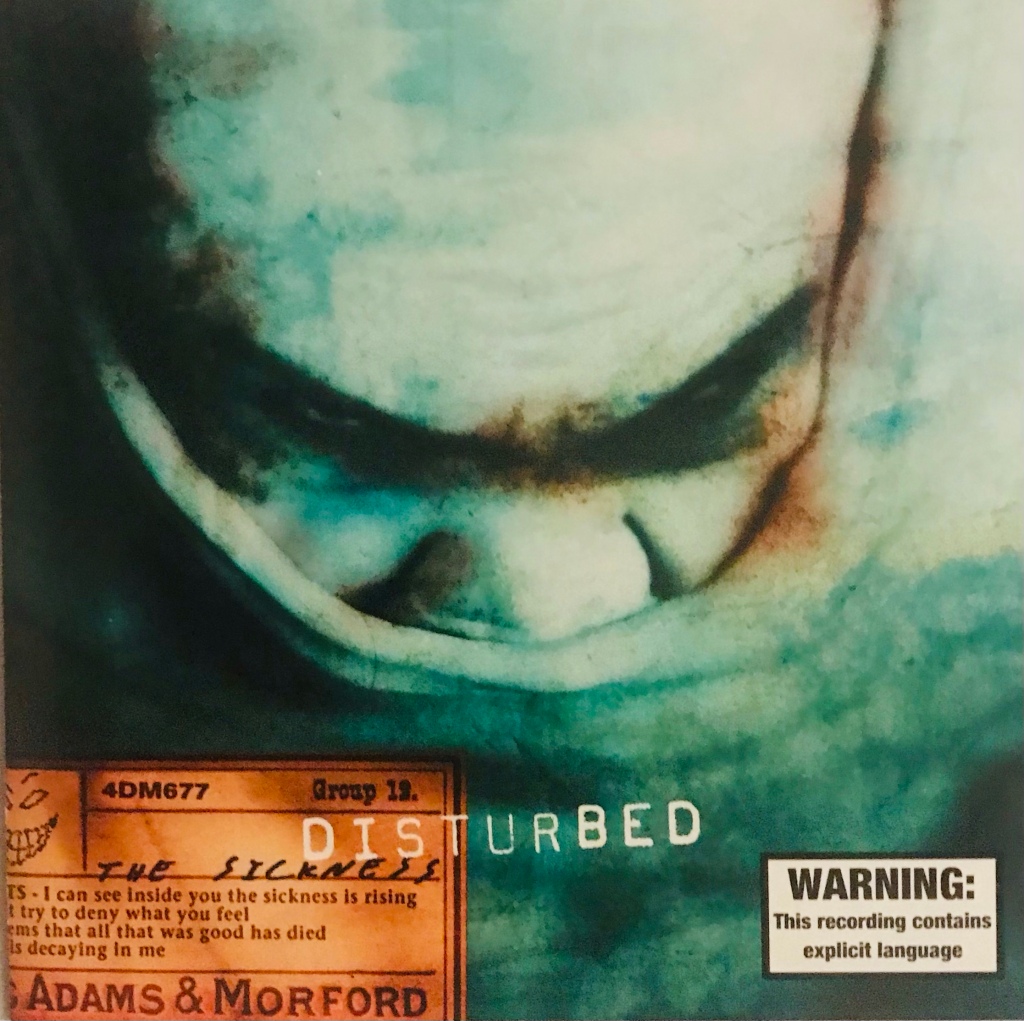
In 2000, the band released its debut album, “The Sickness”.
In the U.S alone (and if you like to use the RIAA sales metric as a gauge for success) it went Gold by August, 2000.
Platinum by November, 2000.
2x Platinum by October 2001.
3 x Platinum by March 2003.
4 x Platinum by September 2008.
5x Platinum by June, 2018.
It went Platinum in Australia, 2x Platinum in Canada, Gold in the U.K
“Voices”
“Are you breathing?”
“Soooooo”.
And a new trademark is born.
The metal groove of the riff became known as the “Nu-Metal” riff.
And Draiman talks about some freaky shit, and the staccato vocal delivery from Draiman was so unique it got me interested. It was just so different from the 80’s type of singers I was so used to.
“The Game”
The NIN electronics plus bass drum acting like a metronome and a catchy vocal melody hooks me in.
And those dog barks from David Draiman. WTF. But I liked it. It was different. Very different.
Also the syncopation of vocal melody, guitar riff and bass drum was insane when I first heard it.
“Stupify”
The groove on this. And the vocal style of Draiman was bizzare, it was like he had a health issue the way he was singing. But I couldn’t turn it off. I wanted to hear what he would come with up with next.
At 2.33, this Middle East style vibe kicks in, before the heaviest part of the song kicks in when Draiman is singing “Don’t deny me”.
The guitar riff takes the style of Korn and guitarist Dan Donegan has this ability to take influences from what was current like NIN, Korn, Limp Bizkit, Tool and put it all into his metal influenced blender, and out comes the magic brew of Disturbed.
“Down With The Sickness”
The drum pattern and riff to kick off this song is now iconic, along with Draiman’s bird like calls “Oo Wahahahah” and the disturbing Bridge, which has Draiman talking and screaming at an abuser.
In the live arena, there are a sea of faces jumping up and down and head banging, like an ocean swell about to hit the stage.
“Violence Fetish”
The riff is jarring.
“Bring the violence its significant”
“Fear”
It’s like soundtrack music at the start but when the riff kicks in, it’s more of the same.
“Numb”
It has this Deftones/Tool like feel in the music which I like as it offers some variation from the previous tracks.
“Want”
The verse riff is cool to jam to.
“Conflict”
It feels like a re-write of the first four songs with “en-e-me” as the catchcry.
“Shout 2000”
I really like what Disturbed did with this “Tears For Fears” song and how Dan Donegan created the heavy palm muted riff.
“Dropping Plates”
A groove metal cut, a fan favorite.
“Meaning Of Life”
It starts with electronica and the riffs from Donegan build nicely while Draiman is singing “I wanna get psycho”.
Lyrically there wasn’t anything that grabbed me, but the music, the grooves and staccato vocals definitely got me thinking differently when it came to writing riffs.
Disturbed would nail it with the next two albums, “Believe” and “Ten Thousand Fists” which I consider superior to “The Sickness” and both of them did good business in the multi-platinum figures. But those stories are for a different post.
I had no idea about Tommy Bolin until Motley Crue covered the song “Teaser” and released it on their “Raw Tracks II” EP which came out in 1990 for the Japanese market and suddenly I was scrolling the used record racks for Tommy Bolin albums or albums that had him playing.
Actually, the Motley Crue version of “Teaser” was officially released on a 1989, compilation album called “Stairway To Heaven/Highway To Hell” which featured the bands who performed at the Moscow Music Peace Festival. And of course the song re-appeared on their “Decade Of Decadence” collection in 1992.
Shock horror to everyone these days who grew up with Wikipedia, I was surprised to read that he was in Deep Purple, but only for a brief moment and that he was in Deep Purple with David Coverdale who was another artist’s back catalogue I was digging deep into during the same period.
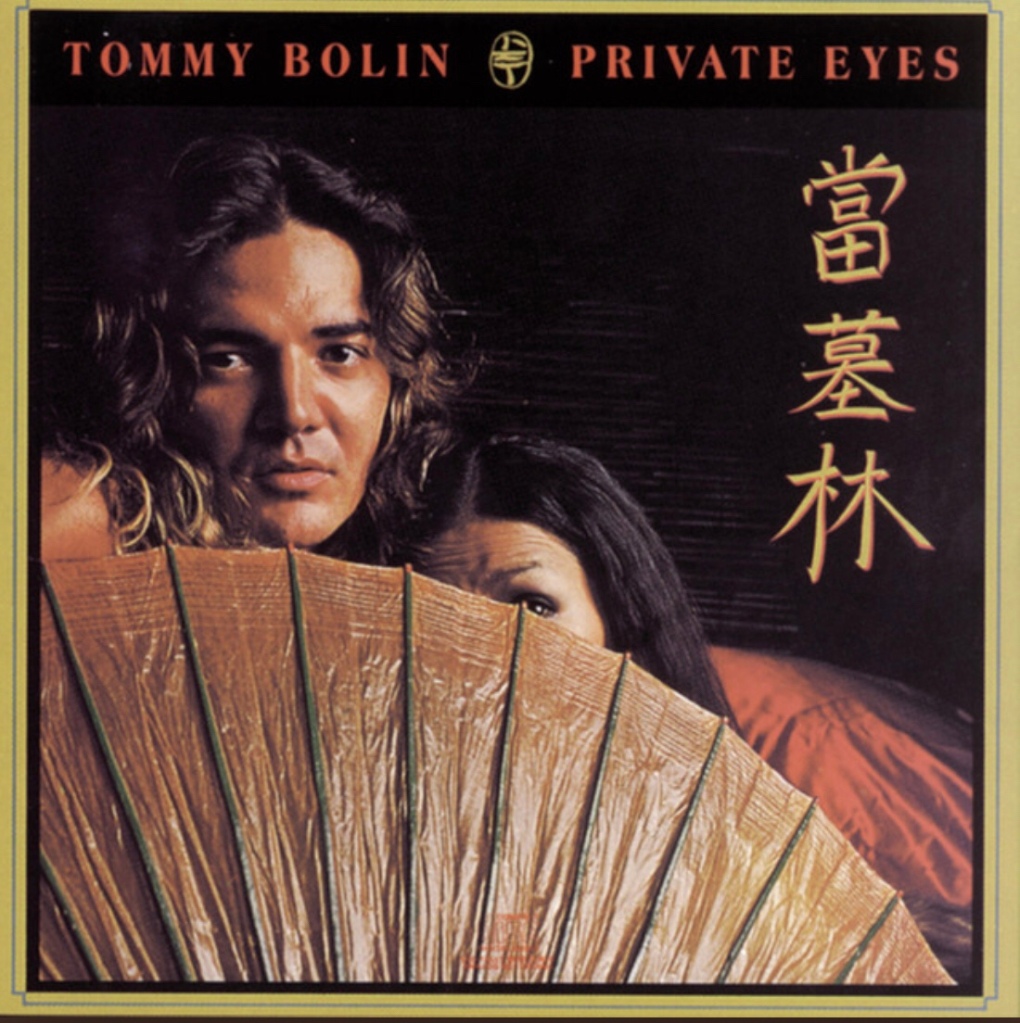
The Tommy Bolin “Teaser” album came out in 1975, and while successful he couldn’t really tour behind it due to his Deep Purple commitments, so he kept on writing and over an 8 day period, “Private Eyes” was recorded and released in 1976. This would be his last studio album before he died of a drug overdose on December 4, 1976 at 25 years of age.
It’s worth pointing out that from 1969 to 1976, Bolin was involved in 10 studio albums, with the bands Zephyr, James Gang (he replaced the guitarist who replaced Joe Walsh), Billy Cobham, Alphonse Mouzon, Moxy, Deep Purple (he replaced Ritchie Blackmore) and as a solo artist.
To put into context, Metallica have released 10 studio albums in 38 years. Avenged Sevenfold have released 7 albums in 20 years. The different work ethics of the artists and the labels across different decades is evident.
As a 15 year old, he hitchhiked from his hometown to Denver and met up with a singer called Jeff Cook to form American Standard. Cook would also act as a co-writer for Bolin’s solo output. He then joined Zephyr and after a few albums, he grabbed drummer Bobby Berge to form “Energy” with Jeff Cook on vocals.
But the fusion of styles in the music of “Energy” didn’t resonate with people and the labels. But Bolin did enough to get the attention of Billy Cobham who asked him to play on his record. And then the high profile gigs and studio work started. And by the time he was in Deep Purple he was heavily into drugs and alcohol.
“Bustin’ Out For Rosey”
Its funk rock groove is great to jam to.
The outro jam with the fuzzed out guitar licks and brass section is great listening.
“Sweet Burgundy”
I don’t know who influenced who, but “Wonderful Tonight” from Eric Clapton sounds very similar to this in the intro.
The slide guitar is sublime.
And in the outro, they just jam out the main melody, something that Bruce Springsteen would do to great effect with “Born In The U.S.A” when they keep playing the vocal melody in the outro.
“Post Toastee”
A nine minute song.
So many songs came out between the years of 1968 and 1978 that had similar riffs to either “Cocaine” or “Sunshine Of Your Love”. This is another for the first two minutes and 20 seconds.
Then a bass groove comes in and it’s all funky and soulful. As the bass and drums jam, Bolin starts his lead break. Listen to his phrasing, how he lets certain notes ring and others he deadens.
It’s this fusion of so many different styles which makes Bolin unique.
At the 4.30 mark, the “Cocaine” riff is back in.
Then Bolin shreds away again for the rest of the song.
“Shake The Devil”
It’s a blues jazz fusion cut, like how Joe Walsh played in James Gang.
But at 2.34, the embryo of bands like Iron Maiden is there. Check out the change of pace, the riff and the lead breaks.
“Gypsy Soul”
It’s like a campfire “Love Boat” acoustic cut.
And what I like about this is that Bolin stays within the acoustic guitar and delivers a stellar flamenco lead outro break.
“Someday We’ll Bring Our Love Home”
Carmine Appice filled on drums on this one, as Bobby Berge was unavailable that day. It could have appeared on a Steely Dan album. Its bluesy and full of soul.
“Hello Again”
The strummed chords outline a similar progression like “Free Bird” as the song percolates in that acoustic domain with violins and violas.
“You Told Me That You Loved Me”
A bluesy jazz fusion cut full of sleaze and soul with an ascending walking bass riff.
I like the change at the 3 minute mark, and then the brass instruments come in and the leads starts and its solos to the end.
If you like a lot of guitar playing, this album has it. Crank it.
P.S. Reggie McBride on bass and Bobby Berge on drums are excellent and unsung heroes on this album.
The rebuild of the Dio brand in the 2000’s involved a revolving cast of musicians.
Tracy G served as the guitarist from 1993 to 1999. He brought in different elements to the band and assisted it keeping the band going throughout the 90’s.
Craig Goldy came back in between 1999 and 2002 to help with a new album “Magica” and keep the live show going.
Doug Aldrich came in between 2002 and 2003 for the album “Killing The Dragon” and to keep the live show going. Warren DeMartini did a small stint in 2003 for the live show, with Craig Goldy to return for a new album called “Master Of The Moon” in 2004.
Doug Aldrich returned again as a touring musician for 2005.
Interest in Dio was high, as “Master Of The Moon” was highly praised and recommended. The 1983 “Holy Diver” was also reissued by Rock Candy during this time.
The band for the tour was Ronnie James Dio on vocals, Doug Aldrich on guitar, Scott Warren on keyboards, Rudy Sarzo on bass and Simon Wright on drums. The show was filmed at London’s Astoria Theatre on October 22, 2005 and released in 2006. The DVD booklet describes the concert as “one of the best hard rock gigs of all time”.
The stage show is not as extravagant as the 1983/84 stage shows. Wright is only 70cm off the ground, instead of the 3 metre drum riser that Vinny Appice had to contend with.
“Tarot Woman”
From Rainbow.
When I saw it as the opener, I was surprised, but goddamn, the song is full of energy and the riffs in the song are perfect foot stomping live riffs. Blackmore wouldn’t create anything else.
Aldrich’s tone is stellar and is faithful to Blackmore as much as possible with a bit of improvisation in the lead break.
“The Sign of The Southern Cross”
From Black Sabbath.
How heavy does this sound on this recording?
A perfect addition to the set list and the crowd responds.
“One Night in the City”
From “The Last In Line” album. I used to mix up “Caught In The Middle” and “One Night In The City” and intertwine the lyrics of the songs.
Then we get the whole “Holy Diver” album.
“Stand up and Shout”
The band is on fire. Sarzo and Wright own the foundations while Aldrich comes across like he’s been in the band forever. Dio is vocally good, singing in a lower range, so he doesn’t overstretch those vocal chords knowing that as you get older, they seem to disappear.
At 3.32 long, its fast and relentless.
“Holy Diver”
The feedback leads into the riff of “Holy Diver”. The tempo feels a bit slower compared to the previous live performances I’ve watched.
Dio’s voice is gravelly and perfect. Wright is a monster on the drums and Rudy Sarzo is still making love to his bass. Aldrich here remains as close to faithful to Campbell’s licks and leads. And there is no better singer at ad-libbing on the outro’s than Dio.
“Gypsy”
It’s got a groove riff that’s like a “let’s get this party started” riff. Aldrich here is given the freedom to do his own thing in the lead break. And the song morphs into a “Drum Solo” and you all know my views on these kind of lone solos in concerts.
“Caught in the Middle”
How good is the intro riff?
And I love that melodic rock chorus?
Just press play to hear Dio ad-libbing the outro.
“Don’t Talk to Strangers”
A great song to listen to and Dio is all gravelly on this one as well, giving it a different vibe. By now, Aldrich is sweating and his rock hard abs are on show for the predominantly male audience.
“Straight Through the Heart”
The groove riff to kick it off and the verse vocal melodies are my favourites. Aldrich also shines on the lead break while Wright and Sarzo, along with Warren on the keys and peculiar dance moves, provide a great foundation
“Invisible”
Once the clean tone arpeggios are done, a distorted riff kicks in and it sounds similar to “Shout At The Devil” from Motley Crue.
It’s amazing how many albums released around the same time (1983/1984) had similar songs.
“Rainbow in the Dark”
As soon as the Am chord comes crashing in and the synth lick starts playing, the crowd is involved and loving it.
In the ending part of the song, Dio is saying to his audience, “you are all my rainbow in the dark”.
“Shame on the Night”
The bluesy Pink Panther crime noir style riff always gets my foot tapping.
And just before the Outro of the song kicks in, there is a “Guitar Solo” moment, but done as part of a jam with the band which is a lot better than just the “lone ranger” style of solo. And you can hear how exotic Aldrich is, with his melodic minor soloing.
Then the “Escape From New York” influenced outro kicks in.
And for some strange reason, they reprise “Holy Diver” again, maybe as a way to musically say to the audience that this is the end of the “Holy Diver” album play through.
“Gates of Babylon”
From Rainbow and how can you not like it. It’s got an exotic riff, pentatonic riffs and a killer Dio vocal. Warren on the keys is excellent, Sarzo and Wright bring the power, while Aldrich is excellent especially in the lead break, which goes to show how complex Blackmore can get.
“Heaven and Hell”
The best Black Sabbath song and we get 11 minutes of it.
This time around, the crowd is chanting the opening riff with Dio and they are all in when Dio’s starts singing, as he waves his devil horns salute around.
Rudy Sarzo is one hell of a bassist. Very underrated.
The middle section lead break is faithful to Iommi.
And we get four minutes of the fast outro section with Aldrich wailing away.
I guess the world is full of kings and queens who blind our eyes and steal our dreams.
“Man on the Silver Mountain”
The first song of the encore is from the Rainbow days. And Aldrich nails the song riff, using the pick and his fingers to sort of chicken pick the intro riff.
If you listen closely, you will notice how Dave Sabo was influenced to write “Youth Gone Wild” and “Monkey Business” from this riff.
And I like how they go into the “Little Wing” influenced “Catch The Rainbow”.
“Long Live Rock and Roll”
And those Rainbow days are back again for 3 minutes and 30 seconds of energy and crowd sing-alongs. And if this was the end of the concert, it would have been a worthy end.
But there was one more track to come.
“We Rock”
The closer, which became a standard closer for Dio but with the fast metal riff, it could easily be an opener.
At almost 2 hours, the show is done and Dio leaves the building.
P.S. From start to finish the set list flows like a classic metal album, a one stop overview of Dio’s career and if you’re a fan, you will see a lot of songs missing that maybe should have been in, such was Dio’s quality output.
P.S.S. Doug Aldrich is faithful to the past material and the riffs/leads of Vivian Campbell, Richie Blackmore and Tony Iommi. In Whitesnake, he also did an admirable job in being faithful to the past and assisting David Coverdale to keep the brand going.
P.S.S.S. Dio at 63 is aged and his voice is not the same but if you went to the show you wouldn’t be disappointed. He still delivers a worthy performance befitting a man of his age.
P.S.S.S.S. I can’t believe how many great songs Dio wrote/co-wrote across three different bands and over three decades.
All of my Thin Lizzy listening experiences happened well into the 90’s, when the second hand vinyl market was cheap and rocking, with most of it priced less than $5.
And I was snapping it up.
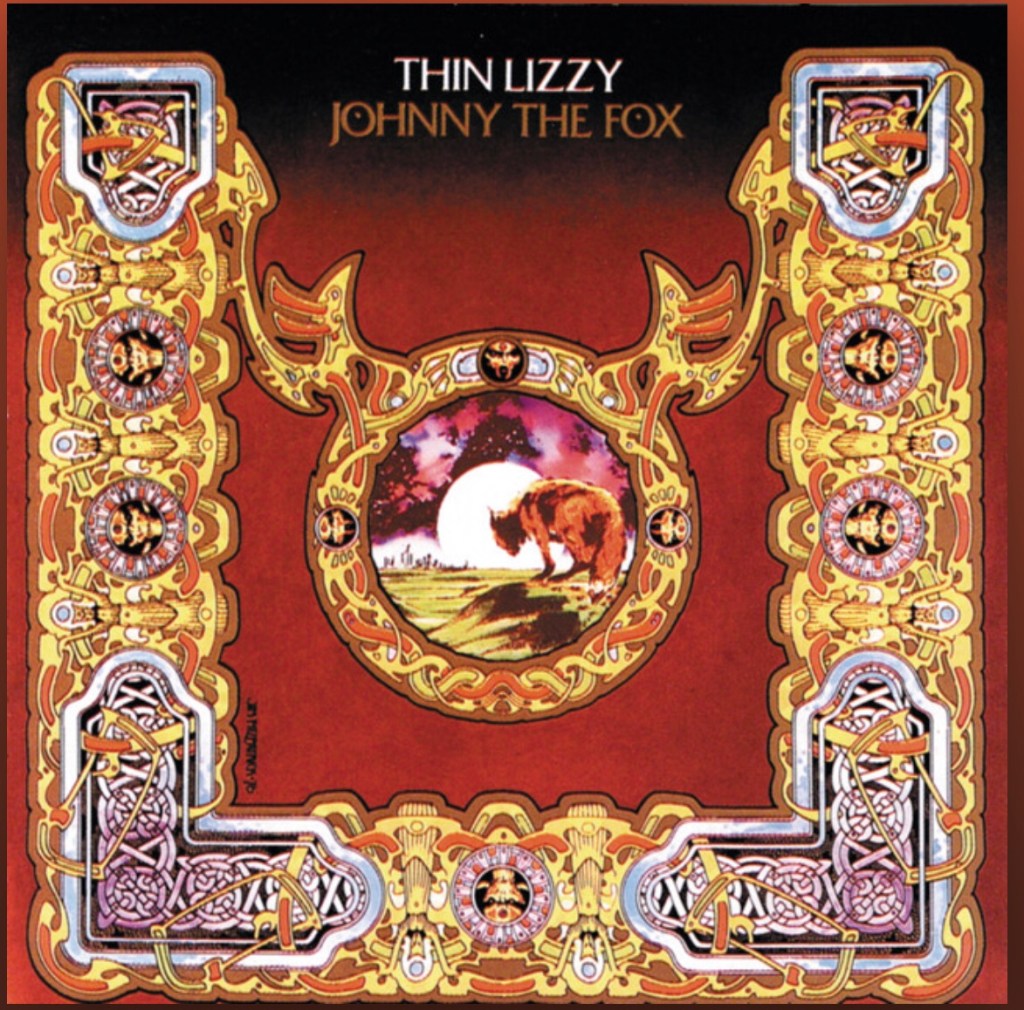
“Johnny the Fox” came out in 1976 and the last Thin Lizzy album to have guitarist Brian Robertson featured as a full member of the band. Clashes over songs and personalities led to Robertson being sacked, reinstated, and later sacked again.
It was an album of convenience as “Jailbreak” came out at the start of the year and due to Phil Lynott’s illness with hepatitis, they couldn’t really tour behind it, so “Johnny The Fox” was created.
Thin Lizzy was Phil Lynott on bass guitar and vocals, Scott Gorham on lead and rhythm guitar, Brian Robertson on lead and rhythm guitar and Brian Downey on drums.
Johnny
The intro is just so simple and groovy, how can you not like it. I swear it gave birth to the New Wave bands that came out in the 80’s.
And the iconic phrasing and voice of Phil Lynott is unique, it makes you pay attention to the story he’s trying to tell.
The lead breaks are excellent.
And the drumming is so underrated. Its powerful and make sure you check out the fills.
Rocky
“He’s got all the tricks to pull the chicks”, is Lynott at his best.
The harmony solos are nice and delicate before the angry and sleazy pentatonic licks start to wail away.
Borderline
It’s like a bluesy country rock song. Check out the bass lines on this.
Don’t Believe A Word
I was hooked from the opening riff which Robertson re-interpreted after Lynott presented the song in a slow 12 bar blues format.
The faster upbeat, was based on a Downey shuffle. If you want to hear Lynott’s original bluesy version, it’s on Gary Moore’s “Back On The Streets”, released in 1978.
The actual lead break with the wah wah sounds like it’s getting strangled out of the guitar.
Robertson wasn’t happy when the song was only credited to Lynott.
Fool’s Gold
The major key vibe is something that Thin Lizzy used a lot and man, they made it rock hard.
Johnny The Fox Meets Jimmy The Weed
Seriously what a great title for a funk blues rock tune. Phil Lynott was a fan of “The O’Jays” and their song “For the Love of Money.
Old Flame
It’s like a love rock song with a lot of harmony guitars.
Massacre
The best track on the album.
This could appear on an Iron Maiden album and not be out of place. It’s basically a metal cut.
The whole band is on fire. The drums are fast, jazz like, while the guitars and bass syncopate, to play some fast palm muted pentatonic grooves.
Sweet Marie
After the madness of “Massacre”, “Sweet Marie” is like “Love Boat” music, as you’re lying on a beach drinking Pina Colada’s. Vocally, John Sykes borrowed heaps from this song. In some sections, I believed I was listening to Sykes.
Boogie Woogie Dance
It’s got a musical feel similar to “Massacre” but with a stupid title. Then again, it goes with “Johnny The Fox Meets Jimmy The Weed”.
But it wasn’t strong enough to be on the album.
It didn’t get any certifications in the North American markets. But what it did do was put the band on the road. And as long as they could stay healthy, they would make coin.
But they didn’t.
Robertson was fired during the tour, replaced by Gary Moore and back in the studio they went.
Finally, drummer Brian Downey is the unsung hero on this album, delivering so many different rhythms and feels.
P.S. For their second album in the year it’s still solid and some stellar cuts like “Massacre” and “Johnny”.
I never heard “Castles” the debut album which came out in 2019.
So “Ruins” the “reimagined” album, which came out in December 2020, is my first album experience from Daniel Tompkins.
Tompkins was in Tesseract, then he left to be replaced by Ashe O’Hara, only to return again circa 13/14. In between and before and after, he’s lended his talents to many different projects and collaborations.
So the songs on “Ruins” are a reworking of the 7 songs on “Castles” with “The Gift” (featuring Matt Heafy from Trivium) as the only new track.
Wounded Wings
It feels like a soundtrack for the first 90 seconds as a piano plays an arpeggio like riff, while the synths swirl around, building in intensity. The drumming kicks in along with the ohhhs and ahhs from Tompkins.
Check out the head banging groove from 3.15.
At 3.54 it becomes quiet and it feels like the sad part of a movie, the death scene. And at 4.20 it picks up with a guitar lead.
Australian guitar hero PLINI is here to lend a helping hand. His biggest influence is Satriani and Steve Vai described him as “the future of exceptional guitar playing”.
Tompkins’s voice is hypnotic throughout.
Ruins
A synth riff on a loop keeps repeating and like “Wounded Wings” it keeps building in intensity.
How good is the section when Tompkins sings “We are the stars, the lords of a new age”, etc.
Stains Of Betrayal
It feels like a ballad as the synth plays chords. Then from the 37 second mark, it starts. A TesseracT style cut, progressive metal based on a feel and a groove.
It’s source material is the track “Cinders”.
The whole “my fire still burns, but was it ever really gone?” sections are essential listening.
Empty Vows
The albums standout track. It’s source song is “Saved” but it sounds nothing like it.
A looping synth is present, as the guitars chop in and out while the bass and drums set a poly rhythmic groove.
At only 4 minutes long, it packs a lot.
A Dark Kind Of Angel
A repeating guitar riff, that sounds like it’s on a loop kicks it off, as the bass and drums set a groove reminiscent of “A Perfect Circle”.
The lead break section from 2.58. It’s head banging and emotive. I’m all in.
The Gift
The closer.
The synth in the verses is excellent.
And that Chorus is anthemic.
It’s almost metalcore but it’s not.
And the closing 30 seconds. Wow. The only thing I could do is press play again.
For an album that’s reimagined from an album released a year ago, I’m a fan. And I didn’t think I would be, because I was not a fan of Lynch Mob’s reimagined “Wicked Sensation”.
Netflix had a debt problem. Spotify hadn’t turned a profit and neither had Pandora. Meanwhile, Soundcloud was for sale.
And they had expenses.
They had to pay for content either by creating their own for TV and Film providers, or by licensing content from the labels and movie studios.
The ISP’s then charge all the streaming providers a lot of money for them to use their fast channels without any buffering and then the ISP’s charge us to use the internet and access these streaming services.
But all of these streaming providers have the same issue every other service and artist has.
People can’t slow down their lives long enough to immerse themselves in their content at a rate they would like.
If Netflix has this problem, imagine every up and coming musician or established musician.
1983 was a revolutionary year and the year that metal and rock music became a commercial force and a massive influence on society. Along with the rise of MTV, culture changed dramatically.
Metal and rock music made governments introduce censorship stickers on new releases.
Preachers and TV evangelists became rich and famous when they condemned the art form and told their followers the devil is on the loose, only to be caught with their pants down in seedy motels.
Lawyers took artists to the civil courts because suddenly when records got played backwards people believe they found subliminal messages telling kids to kill themselves.
Band T-shirts had been around before, but nothing like the 80’s. A whole new billion dollar industry came about, because of the imagery. We wanted the T-shirts. It told the world we are a member of the club.
It was just unfortunate that the record labels abandoned these musicians for a newly created record label genre called Grunge.
8 Years Ago (2013)
It’s the music that makes “Learning To Live” from Dream Theater a classic.
“Learning To Live” was released in 1992 on the “Images and Words” album. The song is that good, that Dream Theater even rewrote it and called it “Breaking All Illusions” for the “A Dramatic Turn of Events” album in 2011.
I wrote about artists staying true to their artistic vision and doing what is valuable to them, using bands like Evergrey, Coheed and Cambria, Dream Theater, Digital Summer, Five Finger Death Punch and Protest The Hero as examples.
I compared 2011 and 2013 as it felt like déjà vu again.
In 2011, I was listening to “In Waves” from Trivium and “A Dramatic Turn of Events” from Dream Theater.
And in 2013, I was waiting for “Vengeance Falls” from Trivium and Dream Theater’s self titled album to drop.
We are living in the generation of kids born from 1997 onwards. A generation who consumes music and entertainment digitally. Their sense of community is all online. These kids weren’t alive when the Record Labels ruled the day, so they have no desire for that era, they are all about today and what lays beyond.
The music community has shifted to being a song centric community. We just don’t know it yet. The album format that used to make the most money for the record labels is almost a dead format. However artists still go back and release a collection of songs as an album.
But it’s what gets played over and over again and into the future that matters.
The band Bleak House have two highly-regarded releases out in the market and a loyal fan base. One of those releases is a single called “Rainbow Warrior”, that has a movable power chord verse riff that went from B to C to D over an E pedal tone which would go on to form the main riff in Metallica’s “Welcome Home (Sanitarium)”.
And Bleak House struggled to write new material and compete with the other acts releasing music consistently. Eventually they disappeared.
Any artist starting off you need to be creating and releasing. Forget about the 2 to 3 year gap between albums. That is the Record Label standard. It was never the artist standard.
Orianthi’s breakthrough was “Believe”, her second album, which came out in 2009 and the hit single “According To You” which she didn’t write as the album had a star studded line up of songwriters and producers either writing songs for Orianthi or working with Orianthi to write songs.
“O” was released in 2020, after her collaboration with Richie Sambora known as RSO finished up or put on hold.
It’s on Frontiers, produced by Marti Fredericksen and it’s great to see Orianthi back out on her own.
And from reading interviews it looks likes the drumming is created/programmed by Evan Frederiksen.
“Contagious”
It’s got a riff that reminds me of Sixx A.M and DJ Ashba like “Lies Of The Beautiful People”.
The song is written by Orianthi and Marti Fredericksen, who has worked with a lot of artists and since I was listening to Motley Crue a few weeks ago, he co write all the tracks on the “Saints Of Los Angeles” album.
And “Contagious” has that sound. It gets me rocking, as it amalgamates blues rock with a bit of Muse chucked in and a modern rock mix.
Lyrically it’s about hatred, and how easily we could all be infected with it.
“They shall not break us ‘cause hate is contagious”
Check out the guitar lead. It’s short but good.
“Sinners Hymn”
It’s is a nice amalgamation of the devils blues music with modern rock to create a sinners anthem.
Check out the section after the solo. It gets all quite with a riff that reminds me of “The Bleeding” and “Prayers Of The Damned” as it builds up again.
“Rescue Me”
This track could appear on a Rag’N’Bone album. It’s got that “Human” feel.
Orianthi is all soul in her vocal melodies on this and delivers an emotive lead break.
“Blow”
It’s a sleazy, sexy and sultry groove that percolates until it explodes in the Chorus.
“Sorry”
It’s a contemporary pop song with a funky hip hop beat. There are synths and a killer vocal delivery from Orianthi.
And I like the mix between merging hip hop beats with a melodic rock vocal melodies and in the Chorus it’s pop rock.
The solo is very Santana inspired and I like it.
“Crawling Out Of The Dark”
It’s on acoustic cut, quite, subdued and melancholic. It wouldn’t be out of place on a country rock record.
Lyrically it’s about a relationship break down and how she’s crawling out of the dark. And when she got out, she didn’t know she had fallen that far.
And check out the blues influenced solo.
“Impulsive”
It’s got this Rolling Stones/Free inspired riff that I like.
The lead break is very SRV influenced.
“Streams Of Consciousness”
It starts off with a music box.
It’s a co-write with Nikki Sixx and Marti Frederiksen. Modern rock at its best with some good rock riffs.
Nikki Sixx delivered lyrics about the glamorous but filthy side of Los Angeles.
The solo starts off with a Nu-Metal riff before she breaks out the wah-wah and it sounds very Slash like.
“Company”
It has blues guitar but the background foundation is very synth dance driven.
And a chorus that would not be out of place on an album from “The Cure”.
The best way to sum it up is an amalgamation of different music genres. And because the melodies sound melodic and soulful, it all works together.
“Moonwalker”
It’s got this Latin vibe with a bit of an Enya feel. And the song and overall album gets me thinking about Queen, who also incorporated so many different styles into their albums.
In other words there is a lot of variation here and a little bit for everyone.
“We Rock” (the DVD) was released in 2005. It collects two VHS releases from the early 80’s and brings them forth into the 2000’s. The sound is still rooted in the 80s with a bit of a clean up.
The early 2000’s became a period of re-invention for Dio. After experimenting with Nu-Metal in the mid 90’s, he went back to his roots, to his kind of metal and rock and re-established the “Dio” brand as a commercial force.
For studio albums, in 2000, we got the “Magica” studio album, “Killing The Dragon” came out in 2002 and “Master Of The Moon” in 2004. In addition, “The Devil You Know” from Heaven and Hell hit the streets in 2009.
For live albums, in 2005, we got the “We Rock” DVD and “Evil or Divine – Live In New York City”, “Holy Diver – Live” in 2006 and “Live From Radio City Music Hall” in 2007 from Heaven and Hell.
But it was the live show which brought in the money. His audience from the 80’s remained faithful and they turned up with their adult kids.
Through placement in movies and certain bands covering his songs, Dio was also generating revenue from licensing, sales and streams. And while artists have their views on piracy, having the Dio catalogue available to download for free, increased his supporter base, which led to an increase in the audience to the live show. This happened for a lot of bands who did it tough during the 90’s. Motley Crue and Twisted Sister come to mind.
In the link, the research suggests that every ten music albums pirated leads to three extra concert or festival visits. However, at the same time, it leads to a significant drop in physical album sales and digital downloads.
Dio – Live In Concert 1984
The show was recorded in Holland/The Netherlands on 4 December 1983.
The stage show is massive, with Vinny Appice sporting a very unpleasant looking red leather jumpsuit is sent up on the second level of the building. In other words, the drum riser is very high.
“Stand Up And Shout” is the opener, with Vivian Campbell playing a black Les Paul shaped guitar, running around like a madman on stage, while Jimmy Bain holds it all together, especially when Campbell drops out for the lead breaks. And of course, Dio is nailing his melodies, as the tempo at which they play the song live wouldn’t have helped vocally.
“Stand Up And Shout” feedbacks into the groove riff of “Straight Through The Heart” and I like it. Dio’s voice is like an instrument here itself, especially in the verses.
“The Pink Panther” like riff kicks off “Shame On The Night”, which gets the audience clapping along, before it moves into the doom riff. It’s slower tempo is perfectly placed in the set list.
How good is the bass and drums on the verses, as they carry the music along with Dio’s melodies?
And the outro riff reminds me of the “Escape From New York” main theme.
“Children Of The Sea” is next and a nice recognition of his Black Sabbath output. Dio and Appice really shine on this track, while Campbell and Bain carry out what needs to be done musically. Then the solo comes and Campbell shines, staying faithful for a bar or two and improvising after that.
“Holy Diver” is the pinnacle of the show. The band is on fire and the audience is loving it.
When the song ends, a “Drum Solo” starts.
I hate lone drum solos and guitar solos in concerts. I see no point in them, especially when the artist has enough material to play songs. But I do like it when a drum solo or a guitar solo is within the song, which I’ve seen some artists do.
After the “Drum Solo”, one of my favourite cuts starts in “Heaven And Hell”. As soon as Dio starts with the “sing me a song” line, the whole crowd is in the palm of his hand, singing along with him. It sounds like Claude Schnell came out of hibernation to add some synth licks but he’s nowhere to be seen on the stage.
Campbell is faithful to Tony Iommi as much as he can and when it comes time for the lead breaks he does improvise a lot, but then again so does Dio, adding new vocals over the jam grooves.
As they are jamming along, with Campbell soloing, the music stops and we get a “Guitar Solo”. As mentioned, I hate it when they take up time in a concert, however you do get to hear how accomplished Campbell is as he pulls out all the licks and tricks from his arsenal.
Bain and Appice then kick in with the “Heaven And Hell” groove and Campbell keeps soloing with music as the background and this I like.
Dio then comes in and gets the crowd involved in a sing-a-long.
The issue I have is that it does go on and on and on and on.
Finally the fast outro kicks in, however it is ultra-fast here, with my favourite lyrics in “the moon is just the sun at night”.
After about 20 plus minutes of the song, (including the guitar solo), the song ends. And the Dutch are screaming “Dio”.
Band introductions take place and Dio says something like “I like to introduce the next song, which has rainbow in it but nothing to do with the band of the same name”. Since no Rainbow songs are included on the release, you can presume the bad blood between Richie and Dio was still too much. But I do think he played a couple of em, but just didn’t include them.
“Rainbow In The Dark” cranks in and how can you not sing when Dio starts with “when there’s lightning”.
Once the song ends, the crowd chants again “Dio” over and over again.
It’s all black, then red eyes light up from Dio’s mascot and an encore is happening.
“Don’t Talk To Strangers” closes the gig, the embryo to “The Last In Line” and “We Rock”.
Dio – A Special From The Spectrum
The opening track “Stand Up And Shout” is not included in the DVD release, but you can see it on YouTube if you want.
The stage show is a bit different, going with the theme of “The Last In Line” album cover, however Appice still remains on the second floor, so high up from the rest of the band.
This time around Campbell is sporting the red leathers and his playing a Charvel/Fender style guitar. Dio as usual is nailing it vocally and Bain is always reliable with his bass rumbling away and then carrying the music when Campbell drops out for the lead break.
And the band is ferocious this time around. They have the “Holy Diver” album and tour behind them and their out promoting “The Last In Line”.
“Don’t Talk To Strangers” is song number 2 and it opens up the DVD concert version. On the “Holy Diver” tour, this was the closer. And it’s a great decision to open the album with two songs they have played a lot because their delivery is so fluent.
“Mystery” is up next, the first song played from “The Last In Line” album. It’s major key vibe and Hard Rock Mainstream style Chorus works well in the set, after the two metal cuts before it.
Then my favourite Dio song starts in “Egypt (The Chains Are On)”. That riff from Campbell and the slow “Heaven And Hell” drum groove from Appice is all I need. Suddenly I’m singing, “in the land of the lost horizon” and “when the world was milk and honey”.
Half way through the song, a “Drum Solo” starts and as you know, I hate these moments in concerts.
And like the previous show, they go into “Heaven And Hell” and this time Campbell is playing an Explorer shaped guitar. And like the previous show, as soon as Dio starts singing the first verse, the crowd is singing with him. The song is played similar to the previous concerts with a lot of jamming in the lead break.
And then the music stops and we get a “Guitar Solo”. You know my views on these lone solo pieces. I don’t know why Campbell would need to have this moment as he was wailing away on the “Heaven And Hell” groove and it sounded so good. Anyway, like the previous show, Appice and Bain then kick in with the “Heaven And Hell” groove and Campbell keeps soloing and this little piece I like.
Dio comes out, and yells, “Vivian Campbell and his magic guitar” and the crowd roars their approval. Then he gets the crowd involved a sing-along. And I’m bummed that the fast outro of the song doesn’t get played.
But they do go into “The Last In Line”.
The medieval fingerpicked intro hides the metal cut that the song would become.
“We are coming”, silence, “hoooooome” as the riffs kick in. The band is nailing everything and Appice is thundering. And for such a new song, the crowd is singing along with him. I guess you can’t keep a good song down.
Once the song ends, something unexpected happen. They go into the fast outro section of “Heaven And Hell” and I’m not bummed anymore as this is my favourite section of the song. Campbell is wailing away here on the guitar again, which makes me question why there had to be a lone “Guitar Solo” spotlight.
“Rainbow In The Dark” cranks in, with Dio sending out his devil horns salute at the end of every fourth bar. They know what needs to be done and they deliver.
Campbell’s playing is excellent and I like how he adds a few extra fills here and there in his lead break, letting the energy of the show take over and command his performance. And Appice can play a metal cut with just his snare, he’s that good on it.
“Mob Rules” kicks in. It’s full of energy, and Campbell goes all shred in the lead break, totally playing his thing, sort of like how Randy Rhoads did with the old Black Sabbath cuts.
The show ends, it goes to black, only for the band to come out and tell the audience they deserve another one.
And what a closer.
“We Rock” kicks in and that opening guitar riff is head banging, circle pit like. And there’s fireworks going off like crazy, lasers and did I mention that Appice can carry a song with a bass drum and snare. He can.
And the show is done.
If you want to see the classic era Dio band at its best, this DVD is a must have. Press play and enjoy, as half of the band has come home and I guess we’ll never know if they were evil or divine. RIP Ronnie James Dio and Jimmy Bain and thanks for the music and memories.
I was reading Guitar Legends and there was a feature on each decade from the 60s to the first 2000’s decade.
So in the 70s decades they covered some important and influential albums.
“Paranoid” by Black Sabbath, “IV” and “Physical Graffiti “ from Led Zeppelin, “Machine Head” by Deep Purple, “A Night At The Opera” by Queen, “Destroyer” by Kiss, Boston’s self-titled debut and “Never Mind The Bollocks” by The Sex Pistols are mentioned.
Thin Lizzy didn’t even get a mention. Written out of history. If there is a band that brought harmony guitars to the masses, it’s Thin Lizzy.
But they didn’t have a guitar hero in the band and a front man who wasn’t a pretty boy.
The band is Phil Lynott on vocals and bass, Scott Gorham and Brian Robertson on guitars and Brian Downey on drums.
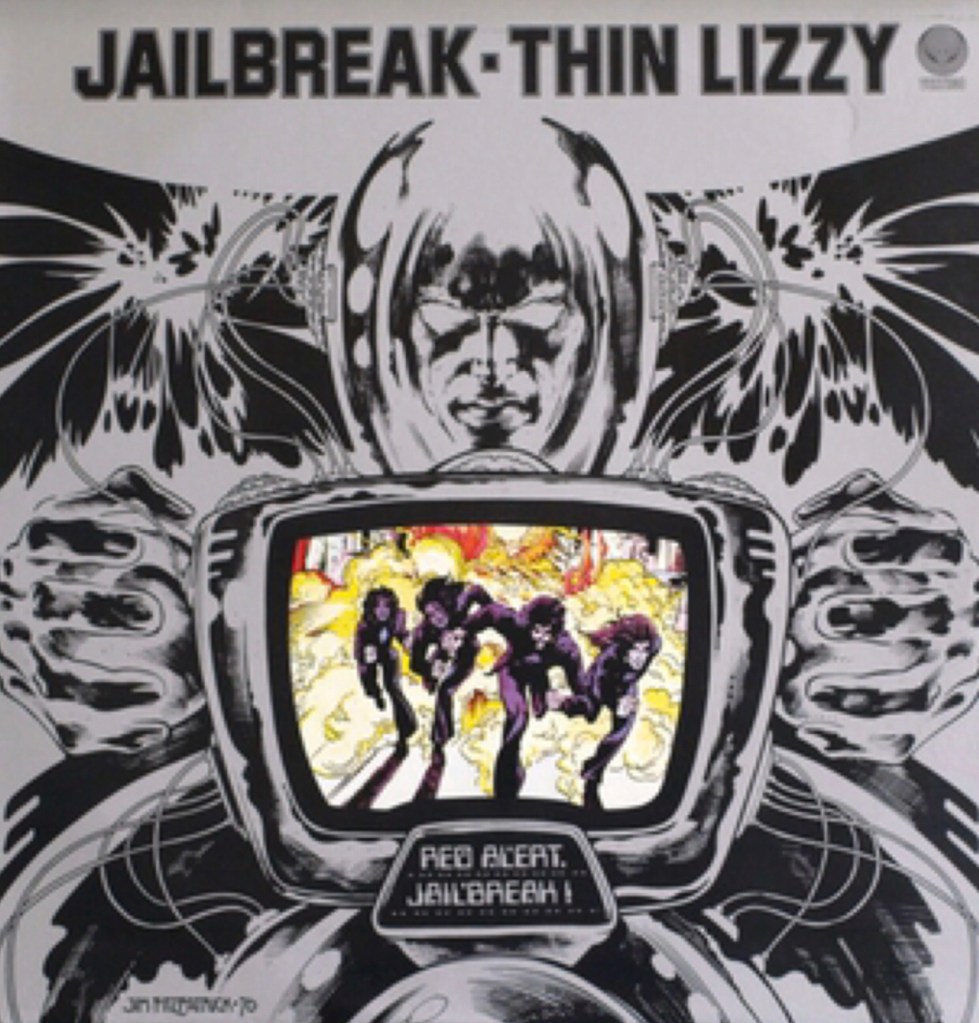
“Jailbreak” is the only Thin Lizzy album which has a certification in the U.S, a Gold one for 500,000 copies sold. But they never really toured behind the album as Lynott was fighting hepatitis.
It was also their last chance as “Nightlife” and “Fighting” didn’t meet the commercial expectations their label had.
And while Robertson felt the production was too restricted which led to less improvisation, it was exactly the tight ship that was needed to push them into the arenas.
Press play and have fun.
Jailbreak
How good is the main riff?
When the sirens start, listen to the riffs under it, it’s like the rumble/fight riffs in stage play soundtracks. Alice Cooper did something similar with “Gutter Cats vs The Jets”.
It’s a 41.5 million streams on Spotify.
Angel From The Coast
Downey on the drums is a star. Listen to how he swings, not a beat out of place.
Great lyrics about the boys playin poker and the joker being their favorite card and the middle section reminds of Hendrix and the Lizzy boys are swinging with the best of em.
Running Back
It’s a blues melodic rock cut inspired by Van Morrison and the first single from the album.
And it’s the little things, like the keyboard, saxophone, and overdubbed guitar lines from Scott Gorham that all add up.
Romeo And The Lonely Girl
What a great guitar solo in a song dedicated to those right girls that come at the wrong times.
And the solo keeps going when Lynott starts singing again.
Warriors
Lynott’s way of defining heavy drug takers was by describing them as warriors.
The Intro riff shuffles along.
Great soloing from Brain Robertson with a lot of wah wah.
But the piece d’resistance starts from the drum improv section at 2.53 and continues to the end. It’s progressive rock and a wow moment.
The Boys Are Back In Town
The big hit single, at 247.2 million streams, which still gets played on radio and licensed to movies, TV shows and advertisements in 2021 generating millions in royalties.
But no certification in the U.S market, however you would be hard pressed to find a person who doesn’t know the song.
So do you really need a sale or a plaque on the wall to show off your success or the success of a song?
And it did something massive for songwriters, making twin guitar harmonies an actual thing in popular songs.
Fight Or Fall
It’s got this Rod Stewart “Maggie May” feel, a strummed soul blues number.
Cowboy Song
The slow acoustic intro doesn’t foretell the rocker to come. 14.7 million streams on Spotify.
Emerald
The embryo and foundations of what Iron Maiden would be is in this song.
The Irish influences are here as well, something that Gary Moore would use a lot of on the “Wild Frontier” album.
It’s one of my favorite Lizzy albums of the Robertson and Gorham era on guitars. Lynott is unique but it’s Downey who owns this album. His drumming is superb and very underrated.
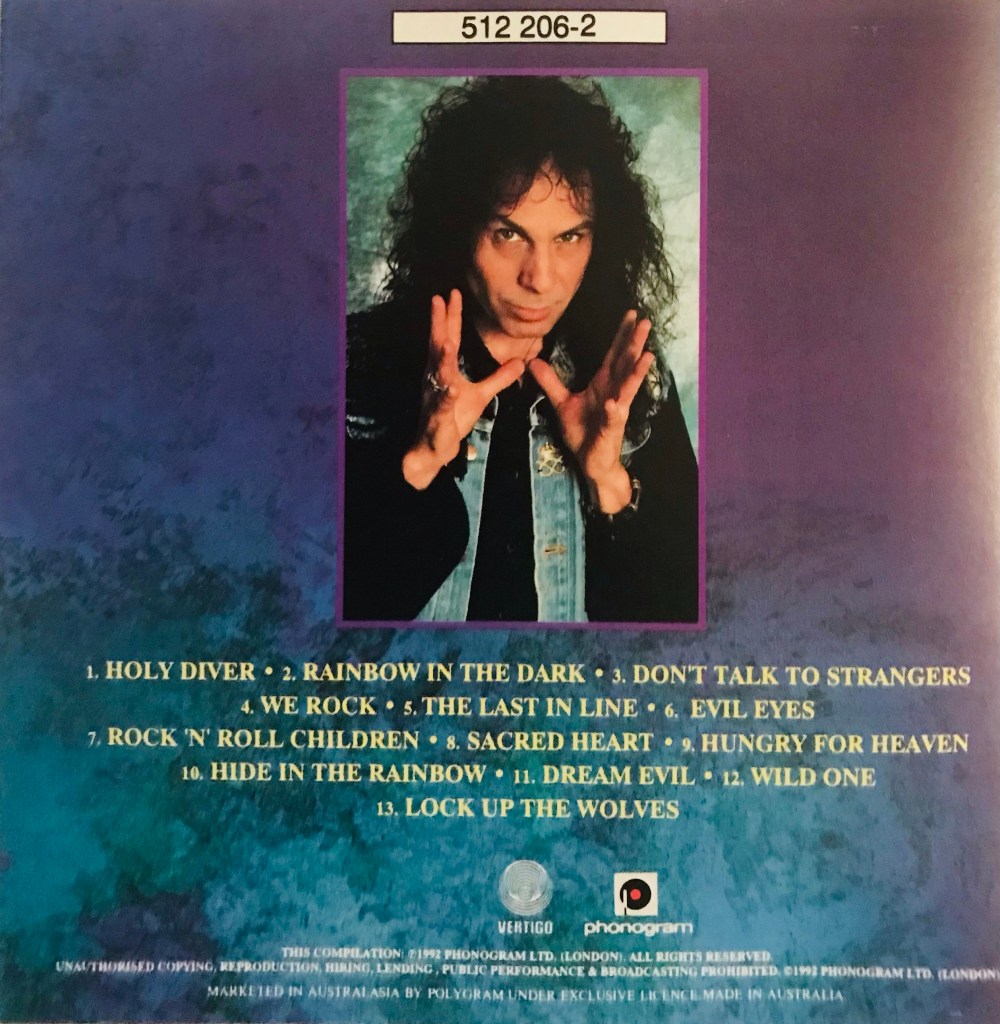
“Diamonds – The Best of Dio” was marketed as a “greatest hits” collection. I remember the ads. But the title says, “best off”. I guess marketing people don’t know the difference between “greatest hits” and “best of”.
And Ronnie James Dio is one of those artists who didn’t sit don’t to write hits. He just wrote songs that he liked.
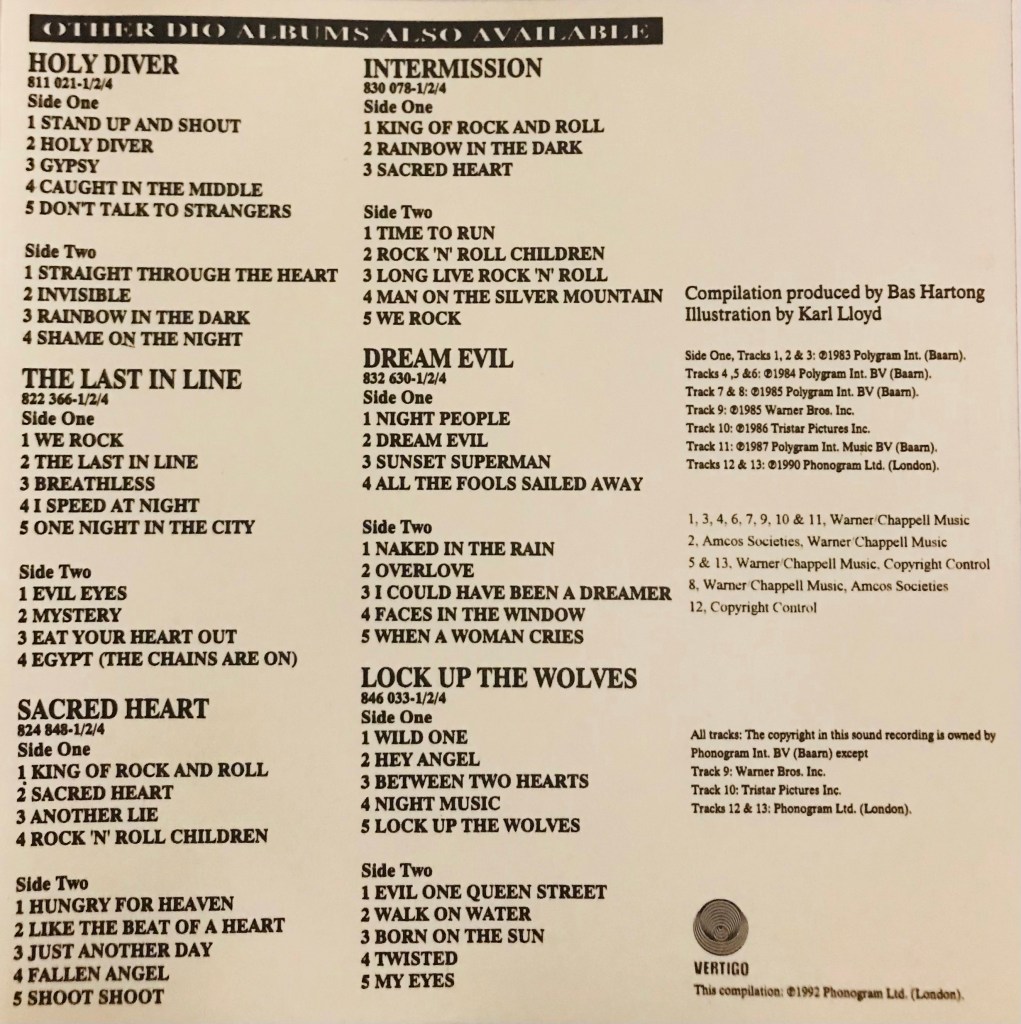
It was released internationally in 1992, and never released in the U.S. And there was no effort with the CD. Just check out the no frills booklet.
I got this compilation because of the track “Hide In The Rainbow”, which was never released on a Dio studio album before. A rare EP called “The Dio E.P” (original title) was released in 1986 with the song, but like all things physical, it wasn’t readily available.
Back then no one was really sure who played on the track.
Was “Hide In The Rainbow” Vivian Campbell’s last studio recording with the band or did Craig Goldy play on the track?
The booklet states Craig Goldy.
But, history and the benefit of hindsight has shown that the CD booklets notes and credits are not a good source of truth sometimes.
In relation to the album, it covers the well-known songs in chronological order based on year of release.
“Holy Diver”, “Rainbow in the Dark” and “Don’t Talk to Strangers” are from the “Holy Diver” album, released in 1983.
“We Rock”, “The Last in Line” and “Evil Eyes” are from “The Last In Line” album, released in 1984.
“Rock ‘n’ Roll Children”, “Sacred Heart” and “Hungry for Heaven” are from the “Sacred Heart” album, released in 1985.
“Hide in the Rainbow” is from “The Dio E.P” released in 1986.
Listen to the intro. I wish they continued it a bit longer.
And is it just me, or does the Chorus riff remind you of “No More Tears” from Ozzy. Then again this is 5 years before “No More Tears”, so maybe young Zakk was listening. Anyway, all music is derivative. Take what came before and make it a bit different.
“Dream Evil” is the title track, released in 1987.
“Wild One” and “Lock Up the Wolves” are from the “Lock Up The Wolves” album, released in 1990.
You could argue that “Stand Up And Shout”, “Egypt (The Chains Are On)”, “All the Fools Sailed Away” and “Born On The Sun” are better songs and should be included.
If you have the albums mentioned above, there is no need for this compilation. But if you didn’t have any of those albums, this collection is an excellent addition.
At the time I was still buying Dio product to keep my collection up to date, however this ended up being the last purchase for my CD/Vinyl/Tape collection.
The studio albums which came in the 90’s and 2000’s were not available easily in Australia and had to be imported in at a higher price. So I ignored em, but my mate “Nick The Stick” is a massive fan, so he had em and he burned em on a CD for me.
I did buy a couple of DVD’s in the 2000’s called “Holy Diver Live” and “We Rock”. Those reviews will be coming soon.











 destroyerofharmony