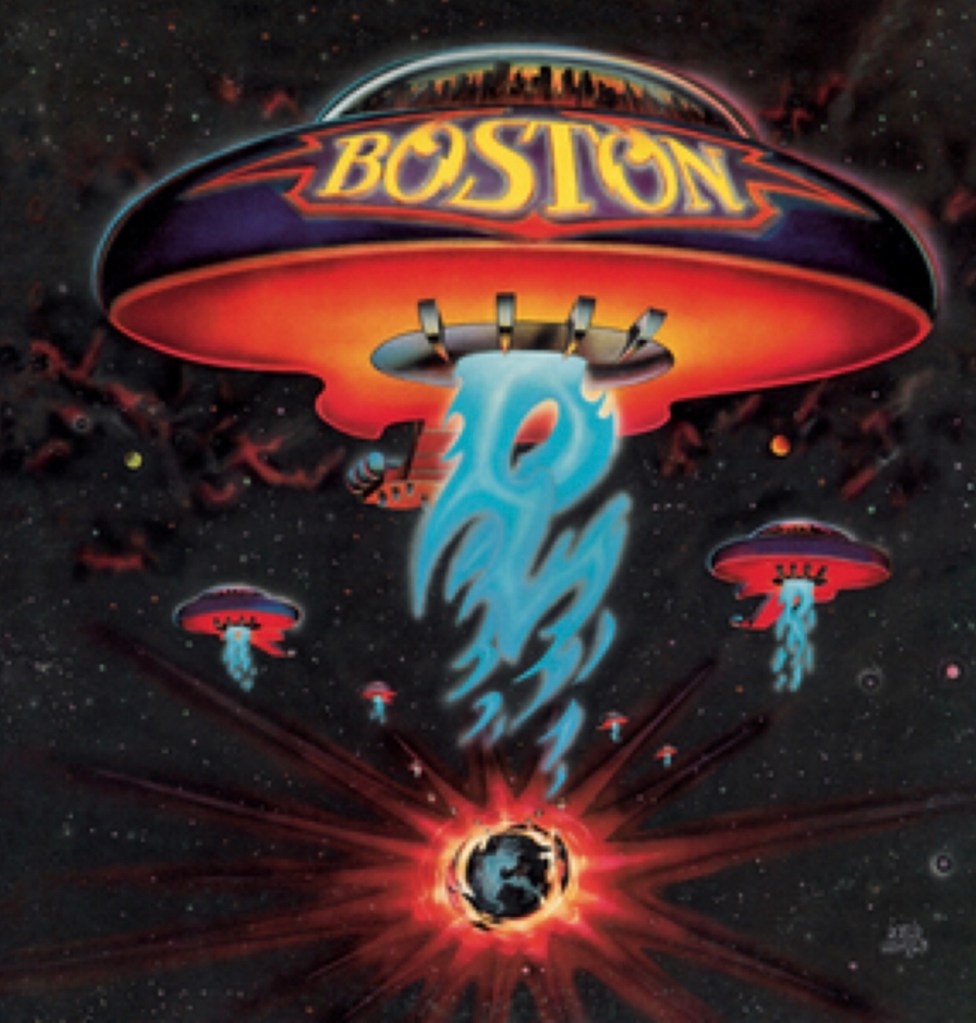
It’s another band I really got into during the 90’s and I’ve posted my record collection of Boston here.
It was a Guitar World issue that got me interested to hear Boston as it spoke about the making of the album, Tom Scholz diligence to sound and it also had a transcription of the opening track, “More Than A Feeling”. At 445.7 million plus streams on Spotify, it’s a monster track.
At 29 years of age when the album was released, Tom Scholz wasn’t your typical rock star in waiting, working as a project manager for Polaroid with a Master’s degree in engineering and writing songs that he liked to hear in his basement when he wasn’t working. And as good as Scholz is, he needed a voice for his songs, and that voice came from Brad Delp.
Disco also ruled the airwaves when this album hit the record stores. Most labels passed on the band because they didn’t believe a guitar heavy rock record could even chart. But Scholz stumbled onto a sound that would be imitated by all bands since.
My favourite is “Peace Of Mind” purely for the guitar leads in the intro and the outro. On Spotify, its sitting at 117.8 million streams.
I then ignored the rest of the album for a long time, finding it generic. An Epic A&R rep even said to the band in one of the rejection letters that they have nothing new to offer and sounded generic, but then credited himself as discovering the band when they broke big.
Then in the 2000’s I revisited the album.
“Foreplay/Long Time” came into my life and I didn’t notice it before but it has a similar riff in it as “More Than A Feeling. On Spotify, its sitting at 74.4 million streams.
“Rock And Roll Band” and “Smokin” are your standard blues rock fares, with “Smokin” having a more ELP vibe in the middle section. It’s also sitting at 47.3 million streams on Spotify.
And the other tracks are “Hitch A Ride”, “Something About You” and “Let Me Take You Home Tonight” showcase a more of blues country rock feel, but compared to the massive first two songs, they are lost in the “deep album cut” landscape. And it’s those first two tracks which sold the album throughout the world.
17 million sales in the U.S alone. Not bad for an album recorded in a basement.
In 2013, Scholz filed a termination notice to claim back his copyrights to the debut album and “Dont Look Back” as per the clause in Copyright Law which allows him to do so after 35 years. And it ended up in the courts.
My UFO experiences started in the 90’s. The band UFO, just in case anyone was wondering.
“Lights Out” (released in 1977) is the gold standard along with the live album “Strangers In The Night” (released in 1979).
But.
“No Heavy Petting” deserves more love.
The band for the album is Phil Mogg on vocals, Michael Schenker on guitar, Danny Peyronel on keyboards, Pete Way on bass and Andy Parker on drums.
Any idea about the monkey on the cover.
“Natural Thing”
The intro riff is great to play and one of the best committed to tape.
And I was pointed towards “Rock N Roll Queen” from Mott The Hoople as an influence. The guitar player on that is Mick Ralphs before Bad Company.
“I’m A Loser”
Written by Schenker and Mogg. The acoustic intro riff has influenced a lot of the 80’s bands.
How good is the piano melody in the section when “hard times, out on the streets” is sung?
And the lead break from Michael Schenker is guitar hero worthy and I’m pretty sure forgotten by all.
“Can You Roll Her”
The song is written by Peyronet, Mogg and Parker.
A stupid title which doesn’t do the fast paced and frantic music any justice. The guitar riffs in the intro/verses and little guitar melodies in the Chorus are excellent.
Schenker goes to town when it comes to the lead spotlight, combining his brilliant pentatonic playing with fast picked Aeolian Minor runs. The way it is constructed would influence countless of other guitarist to “work out” their leads.
“Belladonna”
Written by Schenker and Mogg.
When I hear this song, I think of “Soldier Of Fortune”. It more or less follows the same pattern. But I also think of “Try Me” which would come on the album after. And Scorpions would write songs like this in a few years’ time.
The Schenker solo is memorable, but on “Try Me” it’s outta this world.
Make sure you check out the classical like guitar melody that Schenker starts playing after the solo.
“Reasons Love”
What a great funky, sleazy and bluesy guitar riff to kick off the song.
“Highway Lady”
It’s your standard blues rock fare with Schenker wailing away in the solo.
“On With The Action”
Written by Schenker and Mogg.
The riff to kick this song off is like doom metal, if downtuned. Its heavy.
The groove in the song makes it a favorite of mine but the song is forgotten by the masses when it comes to discussions about UFO.
And if you are a fan of excellent guitar playing, make sure you check out the solo here as well. All of the 80’s guitar heroes copied it.
“A Fool In Love”
It’s written by Frankie Miller and Andy Fraser and it’s a “Honky Tonk Woman” meets “All Right Now” blues romp.
“Martian Landscape”
Written by Peyronel, Mogg and Parker. It’s one of those songs that the 70’s bands put on albums that was a bit progressive and experimental. And sometimes it worked and sometimes it didn’t. This song worked for UFO and it’s the precursor to “Love To Love”. And a riff in “Love To Love” gave birth to “Desert Song”
In other words, “No Heavy Petting” is an underrated hard rock record, a link between the derivative 12 bar blues and hard rock as I know it.
I’ve already written about Choirboys previously, especially their 80’s album in the self-titled debut released in 1983 and “Big Bad Noise” which had the monster hit, “Run To Paradise” released in 1987.
So how do you follow up a monster album released in 1987. Well after all the touring, opening up for large U.S acts and going back into the studio to write and record, the gap was 4 years.
That’s right, 4 years.
It’s a long time.
Instead of recording in Australia, they went to Cherokee Studios in L.A with producer Marc Tanner who used to be an Elektra recording artist.
“Midnight Sun” hit the streets in 1991. And compared to “Big Bad Noise” which was certified double platinum in Australia, “Midnight Sun” has no certification.
For a great album, it gets no love or attention. Even on Spotify, there are no songs from this album in the Top 5 of most listened songs from The Choirboys.
“Midnight Sun”
It’s got this AC/DC style groove (think of “Live Wire” with a bit of a Springsteen/Mellencamp vibe.
Lyrically they are the devils boy, is walking the streets of society as the keeper of the midnight sun.
“Our Empire Falls”
This song should have been a hit.
Standing with her back to the ocean Is this the final curtain call? Still trying to make a deal with the sunshine It′s over, it’s over
Once bathed in glory But now your image is fading
And check out the lyrics, which deal with faded glories and contemplating suicide. This from an act who was expected to write party anthems.
Tonight is the night our empire falls
“Rise Up”
Their blend of different rock styles is perfect. This song is a great example of how a song can still sound hard rock but be catchy and commercial. It’s a mixture of an AC/DC (that “Live Wire vibe again), Bryan Adams and “Jessie’s Girl” from Rick Springfield with a bit of Def Leppard.
The intro alone has the drums and bass playing a simple hard rock groove.
It’s no surprise that Mellencamp’s music is heard in Australian artists, as the “Scarecrow” album was massive.
‘Cos I see the best of things Lies somewhere in the kiss of knowledge Bullshit ends when faith begins If you’re down at the bottom, at the end
Rise up
“Place With No Love”
A great ballad with a weird music video featuring a character in a leather fetish mask.
“Rendezvous”
It’s got this “Radar Love” style drum groove and a film clip with people hitting the road to meet up somewhere.
Now we’re on the road to our Rendezvous With nothing, there’s nothing to lose
These lyrics connect straight away.
Australia is a massive place with vast distances between towns. The only way we used to be connected was via the motorways and suburban roads and railways. So hitting the road to meet up is part of the Australian psyche.
How can you fly with your feet on the ground Take all of your dreams, let’s get out of this town
We all wanted to escape our hometowns to try and achieve our dreams. These days the kids are okay to live at home we’ll into their 30’s.
“Only In America”
This song melts. When I hear it, I think of The Cult, AC/DC crashing with Springsteen.
Only in America you read my rights to me Only in America I watch my trial on TV Only in America only in America I won’t ever be alone Then why do I feel so lonely
“Battle Boulevard”
Check out the intro.
It’s just bass and drums and then the guitars come crashing in with power chords and a nice little lead.
I hear the guitars playing My Generation That used to be our song And I can feel the beat down on the boulevard
“Going Home”
This feels like a hard rock “Need You Tonight” from INXS.
But I’ve lived a dreamer and I’ve lived in hope But I don’t want to stay here on my own
I’m going home
“Romance Street”
A rocking ballad if that ever could be a thing. To me, it’s an awesome cut in the vein of “Born To Run” Springsteen.
“We Believed”
When “The Killers” came out, I thought of this song. Because it felt like “The Killers” sounded like this.
In the end, The Choirboys was just another Australian band trying to break into the larger U.S market, which didn’t pan out as expected. And while the first two albums sounded “Australian” (whatever that means, but the label reps kept saying shit like this), the “American” sound was here on this album, and the song writing is mature and the lyrics get you thinking.
Useless fact, fast forward a few years from this, I was in a band opening up for Choirboys in a small pub with about 200 hundred people in attendance.
And vocalist/guitarist Mark Gable along with bassist Ian Hulme were the only original members, but they still brought it live.
The band is still going today with the line up that did this album. Jamming with Gable and Hulme, is guitarist Brett Williams and drummer Lindsay Tebbutt.
The media loved to play off Bon Jovi and Europe against each other, but they operated in different spheres. Europe always had the Euro/classical vibe to their music. Even at their commercial zenith, this Euro/classical vibe was still prevalent.
In Australia, the album was double platinum. In other parts of the world, it was the same, if not more.
Apart from the mainstays in vocalist Joey Tempest and bassist Jon Leven, “The Final Countdown” is the first album to feature keyboardist Mic Michaeli and drummer Ian Haugland, and the last to feature original guitarist John Norum until Europe’s 2000’s reboot.
“The Final Countdown”
At 294.7 million streams on Spotify, it’s a monster track. It’s on every Spotify playlists when it comes to hard rock and the 80’s and number ones and what not.
That intro. Iconic and memorable.
Wikipedia tells me it was a riff composed by Joey Tempest in 1981/82. It sat on the backburner until 1985, when bassist Jon Leven, asked Tempest to bring it back in the mix and write a song around it.
An interview that Tempest did with the BBC he mentions the following;
“I was in college and keyboards had started to make their way into rock music. I thought that could be a good idea and so I borrowed this keyboard from the only guy in school that had a keyboard. I went home and tried a few sounds on it and I came up with that riff. I thought it was very special and I kept it in the drawer until we did the third album many years later.
By then, there were some other bands experimenting with keyboards, like Van Halen with “Jump”. So on the third album, I gave this demo to the guys and said maybe we can do something nice with the demo and then we had an opening for the show.
I can trace bands like UFO in it, sort of a galloping theme like Iron Maiden had on “The Number of the Beast” album on quite a few songs.”
I like how Tempest mentions the influences of the song. It’s how we create. Take something that came before and make it better. And it also shows how ballsy the move was from EVH to create a song based around a synth riff. It inspired other bands to do the same.
How good is that lead break from John Norum?
He left the band as the album was being released. The original album cover has him on it, however subsequent versions afterwards had Kee Marcello, his replacement.
“Rock The Night”
50.46 million streams on Spotify.
A great “Rock You Like A Hurricane” inspired intro kicks off this song.
It was already a fan favourite, as it was played live on the “Wings Of Tomorrow” tour, and in Sweden, it was on the soundtrack of a Swedish film called “On The Loose”, along with the songs “On The Loose” and “Broken Dreams”.
Just don’t watch the video clip.
“Carrie”
123.96 million streams on Spotify. It’s also on a lot of playlists from Spotify, with the main one being the “Power Ballads” playlist.
Listen to the lead break from Norum. It’s the style of lead breaks that Vito Bratta would become known for.
“Danger On The Track”
The lyrics are silly but the vocal melodies are infectious.
But the interlude. It’s got everything. Norum plays a bluesy riff while the keyboard solos, and when he gets his chance, he delivers.
“Ninja”
The intro melodic lead hooks me in straight away. Or maybe it was the “Lights Out” groove from UFO.
This song, along with “Rock The Night” were the first songs written for the album and played live during the “Wings Of Tomorrow” tour.
Make sure you check out the lead break. Norum brings his Michael Schenker and Uli John Roth influences to the table on this one.
It’s a perfect closer for Side A.
“Cherokee”
Artists that weren’t American, were writing about American issues and the treatment of the Native Indian tribes. The idea for this song came from a book that the wife of producer Kevin Elson had and it was the last song written for the album.
The intro riff, which is also the Chorus riff is excellent.
And how good are the small leads in the Outro chorus. Tempest sings “Cher-o-kee” and Norum plays three notes after it, to mimic it.
“Time Has Come”
It’s like a soundtrack song. “Drive” from The Cars comes to mind.
But the bomb in this song is the whole solo movement. It is orchestrated brilliantly. It starts off with a Def Leppard like inspired riff before it goes into the lead.
“Heart Of Stone”
This track is one of those “deep album cuts” which is a fan favourite. The riffs are heavy metal like and that Chorus vocal melody is infectious.
And the solo.
Man, check it out as Norum pours his creativity in it.
“On The Loose”
It’s the “Blackout” feel from Scorpions that gets me to pay attention.
“Love Chaser”
It’s a combination of “The Final Countdown” riff and “Danger On The Track”.
And what a shred-a-licious lead break to close the album with.
Europe would go on and release the excellent “Out Of This World” in 1988 which had more of a classic rock and metal vibe to it, and after a lot of delays and demanded re-writes by the label, “Prisoners In Paradise” in 1991, before calling it quits for the rest of the 90’s. But when they returned in the 2000’s, they returned with power, fully in control of their masters and their careers.
Part 1.1 on Iron Maiden – Somewhere In Time is here.
Part 1.2 on David Lee Roth – Eat Em And Smile is here.
It’s the album that defined the Hetfield, Ulrich, Hammett and Burton line up. By 1986, they had been together for three years and the musical creativity between the guys was at an all-time high.
I can’t believe I haven’t posted any Metallica reviews at all. When I started this blog I tried to focus on artists who didn’t get a lot of love and stayed away from acts like Metallica because the internet is littered with stories and reviews. But each story and review is personal to the person who wrote it.
For me, Hetfield and his commitment to down picking and writing killer riffs is a huge influence when it comes to guitar playing. The lyrics he wrote, living in corporate Reagenomics showed a maturity far surpassed for his young years. There is and never was, no tease and please in his lyrical lines.
The cover foreshadows that other unseen masters control our lives from the cradle to the grave. Designed by Metallica and Peter Mensch and painted by Don Brautigam, it depicts a cemetery field of white crosses tethered to strings, manipulated by a pair of hands in a blood-red sky.
With “Master Of Puppets”, Metallica took the diverse musical elements of “Ride The Lightning” and raised the bar even higher. Live, they performed even faster and looked like your friend standing next to you watching the show, so far removed from the image put out by Ratt and Motley Crue, to name a few.
“Battery”
The ominous Ennio Morricone themed intro kicks off this monster track. It’s even classical sounding in nature as James Hetfield creates a melody that moves from F to E to D while the low notes move up chromatically from E to F to F# and to G. And while those chords ring out, a subtle harmony guitar outlines a different melodic idea.
Eventually, the power chords start crashing in and those subtle harmony guitar licks come to the fore.
Then all hell breaks loose at the 1.05 mark, when a chainsaw galloping riff smashes through the boundaries and James starts singing with his four day alcohol infested throat. The song isn’t pretty, but its message is about a light that burns within despite the violence and darkness around.
It could be seen as a bastard, a collision between punk and metal.
“Smashing through the boundaries / lunacy has found me / cannot stop the battery”
And a sea of bodies run, circle and smash each other into bits, creating scars to prove that the battery cannot be stopped.
How good is that hard rock like groove and lead from 2.58 to 3.18 before the breakneck solo section.
And make sure you bang your head on the military foot stomping chromatic riff from 3.49 to 4.00.
Which also closes the song. I guess battery is found in me.
“Master Of Puppets”
They wanted to write another “Creeping Death”.
Hetfield grew up in a Christian Science house. The person here is controlled by the religion first, then the family, the social circles of the family and the cultural values of the family and their circle of friends. Hetfield explored these themes of control and subjugation in “Dyers Eve” and “The Unforgiven”.
In its essence, it’s asking for sanity to prevail in a control-freak society/world. Then again, it could be seen as a band saying to their audience, “taste our music and you will see, more is all you need”, because once everyone got a taste of em, they more or less stayed hooked and agreed with Hetfield.
After a few descending and chromatic power chords, the intro riff kicks in at the 3 second mark. Hetfield’s combination of syncopated chromatic lines with a driving low E pedal at 220 beats per minute creates an urgent feeling.
The verse riff has so much power because of the vocal line. They complement each other.
The song could have ended at the 3.32 mark. A 3 minute thrash-a-thon. But this was Metallica, and suddenly we get a haunting Em arpeggio riff, with harmony guitars and James Hetfield breaking out into an individual solo before joining back up with the harmony lead.
Then the clean tone arpeggio riff is played menacingly with distortion while power chords crash down around your senses, while Lar’s just keeps building into the “master, master” chant section.
“The Thing That Should Not Be”
An ominous D to E clean tone chord rings out. On this they drop the E down to D and all the other strings remain the same. It was my first exposure to the DADGBE tuning.
Lyrically, I read a track by track analysis book from Mick Wall and Malcolm Dome, who said the song is about the madness that lives at the bottom of the well of all human souls. And it stuck with me, because even though it could be about the mythical creature Cthulhu, I always saw lyrics from a personal and social point of view.
“Welcome Home (Sanitarium)”
This song is the definition of taking the best things of what has come before and merging those things all together to come up with something unique, original and innovative.
INTRO (0.00 to 0.20) Back in 1971, Yes released “Roundabout”. The intro is more or less a droning note, with some harmonics and a hammer on/pull off lick on the E string.
Take something from the past and make it better.
INTRO 2 and VERSE (0.21 to 1.48) and (2.10 to 3.10) Anyone heard of a New Wave of British Heavy Metal (NWOBHM) band called Bleak House?
If the answer is NO, then you are in the majority. However, a certain person called Lars Ulrich has heard of this band. James Hetfield has even said in an interview that the band shall remain anonymous.
So Bleak House release a song called “Rainbow Warrior” as a seven-inch single in 1980 via Buzzard Records. By 1982, the band called it a day. The intro riff of “Rainbow Warrior” is catchy. It was so good that James Hetfield and Lars Ulrich are influenced by it. They start to jam on it and they start to tweak it into “Welcome Home (Sanitarium)”.
Hetfield and Ulrich made this riff the centrepiece, as Hetfield arpeggiates a serious of 5th power chords on the A and D strings, surrounding them with the Open G and E strings, which forms like a double pedal point. The lead break from Hammett is phrased perfectly.
Metaphorically, I saw the world as a lunatic asylum and you know how truth is meant to set you free, but in this song, truth actually imprisons you. In a cruel twist of fate, knowledge is maddening, instead of being powerful. I’ve definitely overanalyzed the lyrics, but god damn, what else was I meant to do during this time except listen to music, analyse the music, read the interviews in the mags I purchased and since I played an instrument, learn the music and write my own music.
In the “Guitar Legends” #108 issue, Hetfield said that the idea for the song came from the move “One Flew Over The Cuckoo’s Nest” and that “the riff was lifted from some other band, who shall remain anonymous.”
OUTRO (4.05 to 4.26) and (04.48 to end) Metallica have taken the intro from “Tom Sawyer” and used it as their outro. The feel and the phrasing of the two songs are almost identical.
Again, take what has come before and make something new.
“Disposable Heroes”
One of the most underrated cuts on the album. This song is a blast to play on guitar with so many different movements and bone crunching riffs, like the open string palm muted chugging riff after the power chords intro.
And that open string palm muted riff comes back in the verses.
At 8 plus minutes, it’s a tour de force, another metal classic, the way metal should sound.
“Back to the front / you will die / when I say / you must die” as even in war, the soldiers are controlled by masters. These kind of concepts Hetfield explores a little bit more in “One”.
Make sure you stick around for the various lead breaks between the 4.50 and 5.25 mark.
And the lyric, “I was born for dying” scared the hell out of me, because it’s true. Everything that is born will die eventually.
“Leper Messiah”
The song is written by James Hetfield and Lars Ulrich. The title comes from a David Bowie lyric in “Ziggy Stardust”.
It’s worth noting that Dave Mustaine claimed he wrote the song’s main riff and was not given credit by Metallica. Hammett denies this, saying that just before the guitar solo there is a less than 10 seconds of music that could be his and that it was actually Lars Ulrich that came up with the main motif.
For all of those haters that said Metallica had sold out with the “Black” album obviously didn’t know that Metallica had similar style songs on their earlier albums. “Leper Messiah” is one of those songs.
The best part comes in around the 30 second mark. Cliff’s trademark bass lines just rumble along while James lays down palm muted staccato power chords.
“Send me money, send me green / Heaven you will meet / Make a contribution / And you’ll get a better seat / Bow to leper messiah”
Turn on the TV and you see some evil right there. These TV evangelists made some serious bank, using heavy metal and hard rock music as topics of discussion, while spending a lot of their time in seedy motels doing drugs and hookers.
Make sure you check out the section between the 3.20 to 3.35 mark.
“Orion”
The drums are stock standard while the bass plays phased out chords, but when the distorted guitars kick in, that riff is head banging, back breaking and desk breaking worthy.
At the 4 minute mark, the song slows down into a Sabbath like blues rock riff courtesy of Burton and the guitars really shine here, with their harmonies. From the 5.13 mark, a lone lead starts but its quickly harmonised. This whole section was written by Burton.
At the 5.41 mark, there is another melodic lead which keeps on repeating and it builds into a single lead break. Then you get a bass solo. At the 7 minute mark its back to the thrashing mad lead sections, but here Hammett is all Michael Schenker like.
“Damage Inc.”
I will leave this review with the following lines from “Damage Inc.”;
“Following our instinct / not a trend / go against the grain / until the end”
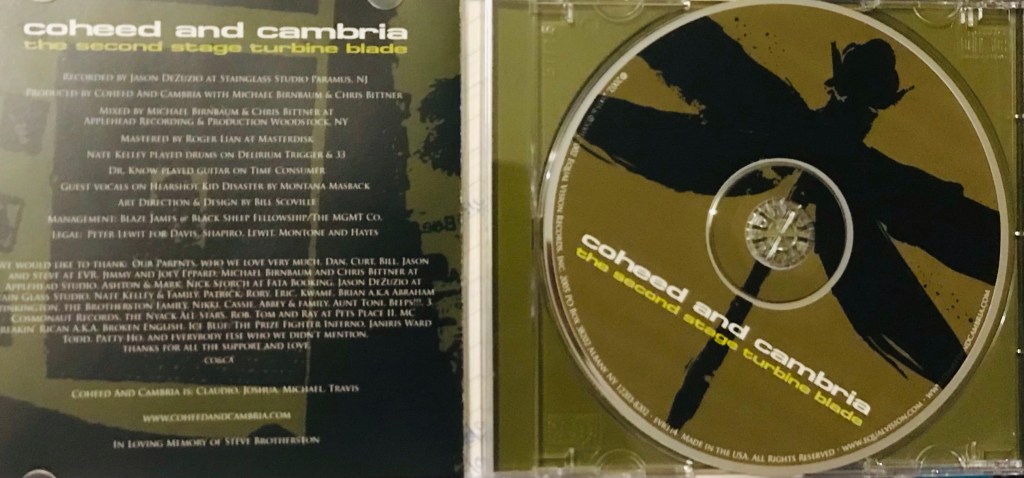
I was waiting for my CD to come in before I did this post.
The debut album was released in 2002, but the story goes back to 1995 when Claudio Sanchez and Travis Stever had a band called “Toxic Parents” which then became “Beautiful Loser”.
Three months later, Stever left and the remaining members renamed the band, “Shabutie”.
Michael Todd was recruited in 1996 and would remain the bassist until his arrest for break and enter circa 2010/11.
As Shabütie, the band released their first studio demo “Plan to Take Over the World” in 1999 and “The Penelope EP” in 1999, shortly after which Stever rejoined the band.
The original drummer left in 1999 and Josh Eppard was the replacement. He would be the drummer on the first three Coheed albums and while he was out of the band between 2006 and 2011 he returned for “The Afterman” albums and is still the drummer at this point in time.
The band went on to release another EP called “Delirium Trigger” in 2000 and several songs that appeared on it, were based on a series of science fiction comics written by Claudio Sanchez called “The Bag.On.Line Adventures”, which were later renamed “The Amory Wars”.
This science fiction story was Sanchez’s side project. Eventually, the band would rename themselves as Coheed and Cambria, after two of the story’s protagonists.
In a nutshell, and spoiler alert, Coheed and Cambria are dead by the end of it. Coheed by now had already killed off his children except Claudio and Cambria had to kill Coheed as he unleashed a virus and then unable to live without Coheed, she killed herself. In the process her energy/sacrifice then saved the dying star that Coheed was trying to destroy. Their son Claudio, is left to pick up the pieces.
A lot of pieces of the puzzle are put into place, and backstory’s are told. The fan wiki page does a great job detailing it.
“Second Stage Turbine Blade”
It’s a minute of ambient noise and an ominous sombre piano riff.
“Time Consumer”
The feel of this song in the first minute feels like a Pink Floyd/U2 jam mash up. It is raw and gritty as it grooves its way to the exploding of distorted guitars at the 1.14 mark.
“Devil In Jersey City”
It’s got that pop punk feel, almost happy like but the subject matter is disturbing involving a bashing and a rape by the gang called “Jersey City Devils” on the daughter of Coheed and Cambria and her partner.
“Everything Evil”
This moves into “Everything Evil,” which is arguably the most proggy track on the album. The ending of the song has that piano riff which becomes the first song on subsequent albums
“Delirium Trigger”
The heaviest song on the album.
“Hearshot Kid Disaster”
It has a funky riff.
“33”
A pop song which is 3.30 long. Coincidence.
“Junesong Provision”
“Junesong Provision” Heavy guitar and impressive vocals and lyrics make up this noteworthy song.
“Neverender”
The bass is excellent and the riffs are rooted in hard rock. Claudio’s vocals are the most confident on this one and it shows.
“God Send Conspirator” A clean guitar riff starts the song off, which sounds like an indie song. The bass grooves and funks it’s way throughout.
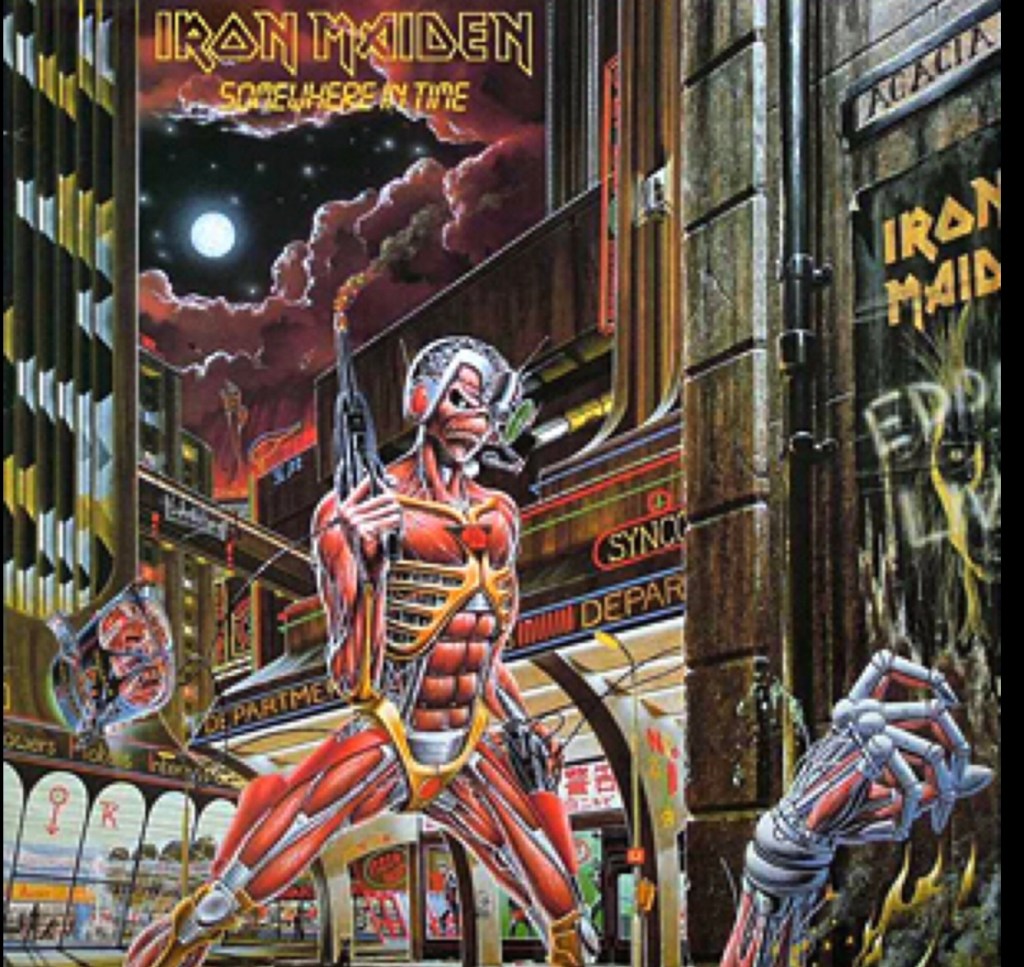
The first thing that grabs you is the Bladerunner style cover. Bruce Dickinson mentions the same in his book, “What Does This Button Do?”
Apart from buying the album, the fan is also buying a great piece of art by Derek Riggs, who took 3 months to come up with the painting.
During this 80s era, the UK government decided to tax the entertainment industry over 80% of what they earn so this meant that the band and other UK artists had to go into exile and were caught somewhere, far away from home for nine months of the year. So the album ended up being written and recorded in different places and in different studios.
When the sessions started, Bruce Dickinson wanted to do something different, which made everyone laugh. He wanted Maiden to lead instead of delivering just another Iron Maiden album.
But, the fans got “just another Maiden album”. And we loved it.
Steve Harris contributed “Caught Somewhere In Time”, “Heaven Can Wait”, “The Loneliness Of The Long Distance Runner” and “Alexander The Great”. Adrian Smith contributed “Wasted Years”, “Sea Of Madness” and “Stranger In A Strange Land” while Dave Murray brought in “Déjà Vu”.
A chord is strummed, a synth chord rings out and a harmony lead is heard. This repeats for a few times and then a drum groove comes in. Subdued it percolates, changes key and at the fifty two second mark, it explodes.
“Caught Somewhere In Time” had really started. And that exploding intro comes back in the solo section at the 4.50 mark. As Harris once said, it’s about a nightmare trip through time due to a malfunction in the time machine.
The iconic open E pedal point riff starts off “Wasted Years”, Maiden’s contribution to the tales of touring and being on the road for a long time. It’s no surprise that this song was written straight after their biggest and longest tour for the “Powerslave” album which resulted in the “Live After Death” album.
The intro lead riff was rejected by Smith but Harris heard it and told him to work on it.
And the whole solo section is head banging, fists in the air, desk breaking material. Check out the way they build up the intro E pedal point riff into the solo section.
The solo section of “Sea Of Madness” is one of my favourite pieces of music on this album.
“Heaven Can Wait” is the story of a person who is struggling to transition to Heaven. The song just moves along, but when the whole “Take my hand, I’ll lead you to the promised land” section starts off, its pay attention time. Then those “woh oh oh” chants kick in and its desk breaking time. And how good is the clean tone guitar riff under the “woh-oh-oh”.
The guitar intro to “The Loneliness Of The Long Distance Runner” is inspiring, There is a film with the same title and Harris once said in an interview something like, “you always have to run in life, move forward, and you do it alone.”
The way Bruce Dickinson carries the vocal melody for the Chorus is excellent, and then the harmony leads kick in while Nicko McBrain is doing double time on the drums.
Then at the 3.30 mark, a blues rock like lead kicks in with pentatonic bends before it morphs into a metal like solo. And the song ends the way it started, with a tonne of memorable harmony leads.
The open E bass shuffle of “Stranger In A Strange Land” gets me interested, but it’s the Adrian Smith riff that seals the deal.
And how good is the lead break.
While the title shares the same name as the Robert Heinlein book, Adrian Smith based it on a story he read about an old sailor John Torrington, a member of the mysterious 1845 Sir John Franklin expedition that attempted to find the Northwest Passage from America to Asia. More than a century later in 1984, he’s perfectly preserved body was found in the ice of the North Pole.
Check out “Déjà Vu” from the 30 second mark, when that harmony lead kicks in. It’s like “The Loneliness Of The Long Distance Runner” part 2 and it morphs into a riff that reminds me of “Die With Your Boots On”.
How good is the pre chorus vocal melody when Dickinson starts to sing, “cause you know this happened before”?
And that harmony lead from the 2.50 mark. Brilliant.
There is blowing wind, a slow military march tempo and a clean guitar solo. That is how the album closer, “Alexander The Great” starts, and it percolates musically, until it explodes into the verses.
The lyrics are somewhat like a children’s encyclopaedia article however there is enough detail there line by line.
And that groove and feel change at the 4.50 mark is excellent, with more leads and more harmonies.
Not bad for just another album.
But.
For all its excellence, the tracks on “Somewhere In Time” (apart from “Wasted Years” and “Heaven Can Wait”) are really underplayed when it comes to the set lists.
P.S. This issue of Guitar Legends is one of my favorites with a heap of information. But that will be for another day.
BB Steal was Australia’s entry for world domination in the hard rock movement. But did the world need a new Def Leppard.
Their association with the band wasn’t just inspiration. They opened up for Def Leppard during the “Adrenalize” Tour and Def Leppard guitarist Phil Collen produced the title song on their “Heartbeat Away” EP and co-produced their first full-length album “On The Edge”, which also features a version of the song “Heartbeat Away”. Collen also played some guitar and sang backing vocals on the album, but is not credited.
BB Steal (otherwise known as Beg Borrow Steal) was spawned from the NWOBHM sounding “Boss” band. In typical Australian hard rock fashion, they lived in development EP hell for at least 4 years before the album came out. 4 years is a long time in the music and recording industry.
And the album definitely racked up the bills as recording took place in Los Angeles and Montreal with various engineers and studio players.
Formed in 1987, they released the 4 song EP “Heartbeat Away” in 1988. The title track of this EP set the tone for the sound and feel the band would pursue. The Def Leppard “Hysteria” album sound.
So, “On The Edge” was released in 1991. It’s one of those should have and would have and could have stories. It should have done better commercially, and it would have if Grunge didn’t come, and it could have done great numbers if it came out a few years earlier.
If you love Def Leppard then you will love BB Steal. Critics praised em and also drilled em, calling em a poor version of Def Leppard. But the band was a lot more than the Def Leppard comparisons.
“On The Edge (Lizzy Town)” has this “Led Zeppelin III” acoustic vibe before it moves into a Def Leppard like groove and vocal.
“Big On Love” is probably the best song not written by Def Leppard that sounds like it belonged on “Hysteria”. At one stage I thought it was “Animal”.
Then “Hysteria” starts. Wait, it’s called “Ride On”. They are similar but derivative enough to stand on its own.
“Suffer In Silence” is another track which is very Def Leppard like.
“Live It Up” has a guitar intro that could have come from a Van Halen album, before it goes into an AC/DC like groove. The vocals of Craig Csongrady on this album are just too much like Joe Elliot, in the same way that Marc Storace from Krokus was too much like Bon Scott.
“Shot Full Of Love” feels like a cut from Babylon AD. “Precious Love” has that “Stand Up” vibe.
“Don’t You Love Me and Leave Me” is an AC/DC song musically, with a bit of The Cult added in vocally and musically.
“Heartbeat Away” is from the Phil Collen produced EP, released in 1988 and “Troubled Child” closes the album, with a Journey like feel musically and a Joe Elliot like vocal.
In the 2019, re-issue, it comes with three songs from the original 1988 EP in “I Believe” (very Journey like), “Hold On” (has a guitar hero solo moment) and “Heartbeat Away” (the Phil Collen produced and the song which set the stone for the album to come a few years after).
And when the album did nothing commercially, the band disappeared along with thousands of other hard rock bands.
But in 2012, they returned with a new album called “Resurrection”. But that’s for another day and another “Australian Method Series” post.
Coheed and Cambria were back in the Amory Wars universe when they announced the 5 part Vaxis series.
This is Act 1.
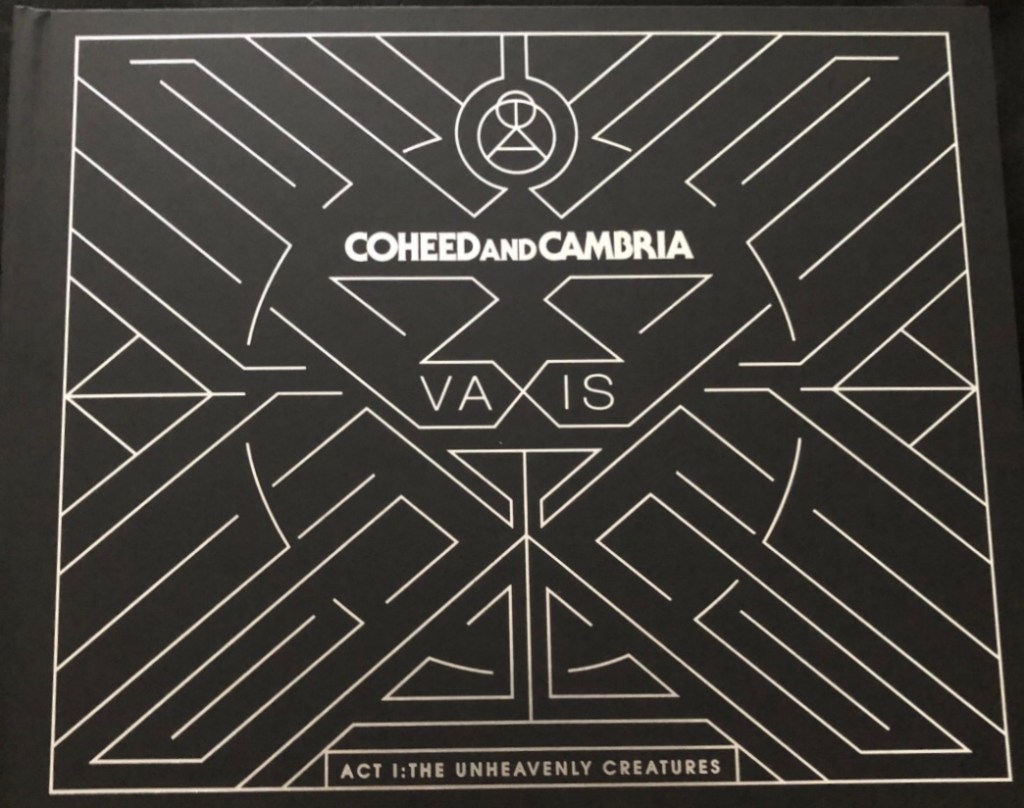
Otherwise known as “Vaxis – Act I: The Unheavenly Creatures”, the ninth album, released on October 5, 2018.
As soon as it was announced, I was interested and Pre-Ordered the limited edition deluxe box set which includes an 80+ page hardcover, full color book with custom illustrations and complete ACT I story.
The Book also houses the CD of “The Unheavenly Creatures” as well as the exclusive BONUS CD, “The Crown Heights Demos”.
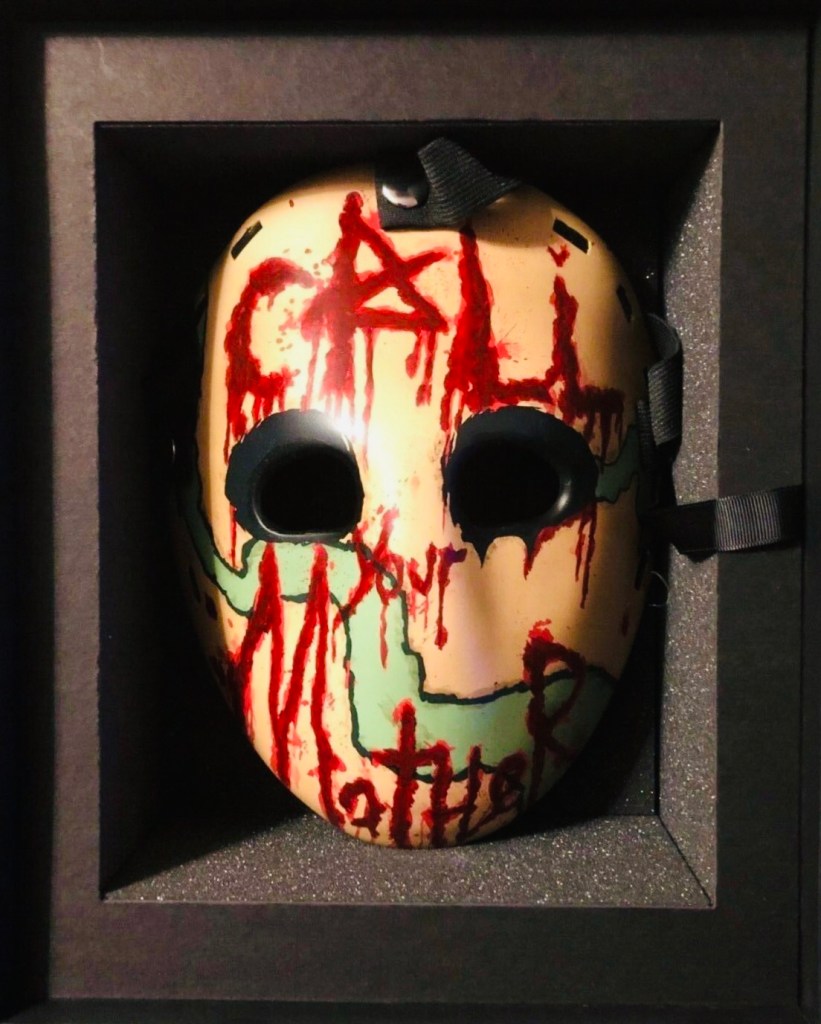
The box set also includes a replica Creature mask, a fold out poster of the cover art, the usual VIP/Black Card which allows card holders early access to tickets and early entry to Coheed and Cambria headline shows.
And the pre order also came with access to a digital site to download the album and the demos on release day.
So, the story.
Set sometime after the events of “No World for Tomorrow”, (their 2007 album, as the three subsequent albums were all prequels), the planets that formally made up Heaven’s Fence are scarred and cracked after an event known as “The Great Crash.”
A group of elites known as the Five Houses of the Star Supremacy have converted these worlds into prison planets, with one planet being called The Dark Sentencer.
The album tells the tale of two new characters, Sister Spider and Creature as they struggle with being imprisoned on The Dark Sentencer and fight to secure the safety of their unborn son, Vaxis.
At 78 minutes, it’s a monster of an album.
The album opens as usual, with a short music and spoken intro called “Prologue”. The voice over talks about “the five houses”, “the planet prisons”, and “a love story”. And the voice ends the narrative with, “It begins with them, but ends with me, their son, Vaxis.”
Then the “Domino The Destitute” inspired riff kicks off “The Dark Sentencer”. You get the big chants like a prison riot is taking place, the big rock riffs and the progressive feel of the arrangement. Like all Coheed albums, song number 2 is the epic.
The title track “Unheavenly Creatures” has a riff that sounds like it was written on the TonePad app. When the guitars come crashing in, it’s major key pop rock.
I like how Coheed always makes riffs in a major key sound heavy, like in “Toys”. If anything it could have come from the fingertips of Mark Tremonti.
The spirit of “Mother Superior” is evident on “Black Sunday”.
“Queen Of The Dark” starts off with a sad piano riff and then a digital delay strummed riff comes in before the window shattering drum groove sets the mood and tone.
“True Ugly” feels like a power pop punk song, full of melody and aggression.
“Love Protocol” has an arena rock Chorus that needs to be heard.
“The Pavilion (A Long Way Back)” has a simple palm muted arpeggio guitar riff and a drum groove that demands attention. It’s one of the best songs on the album and it was the first song written for the album.
“Night-Time Walkers” feels like a “Halloween” or “Escape From New York” soundtrack in the intro. Or a scene from “Stranger Things”. Then the crunching guitars kick in and the drumming becomes more dominant before it moves into a massive Chorus.
“The Gutter” could have come from “A Night at the Opera”. And how good are the violins in this song.
“All On Fire” feels like “No World For Tomorrow”.
“It Walks Amongst Us” has this Middle Eastern exotic soundscape to start off, before it moves into a metal like riff that is played with an 80s keyboard synth sound.
“Old Flames”, is the second last track, and it’s a massive song. You can see it in the same way that the second last episode of each season of “Game Of Thrones” was the biggie.
This feels like classic rock as a piano starts it, before the Cheap Trick like riff kicks in and a massive Arena rock Chorus.
The whole “Naa / Na na na na na-ah” feels like a Cheap Trick song. Even My Chemical Romance have sections like this. As the guitars and drums end, the piano riff starts and it’s the “Prologue” riff.
“Lucky Stars” is an acoustic number that closes the record. It’s like the aftermath. Make sure you stick around for the Clapton like lead break.
And the guys toured hard on this album and now we wait for “Act 2”, in between Claudio’s side project The Prize Fighter Inferno, named after a character in the Amory Wars story.
Steve Perry was back with Jonathan Cain, Neal Schon, Ross Valory and Steve Smith and Journey was rocking again after a 10 year gap, thanks to no small part to John Kalodner. Kevin Shirley is producing and this album is a return to form.
“Message Of Love” has a Chorus inspired by “Separate Ways”. As far as opening tracks go, it’s excellent, a great way to re-introduce the band in the 90’s and while other bands were removing guitar solos, no one told Neal Schon about it as he goes to town on this one and re-introduces the world to guitar solos.
“One More” has a groove that could have come from a Faith No More album. And what made Journey famous originally is how they could change styles within an album, as “When You Love A Woman” shows a their R&B Ballad roots.
“Forever In Blue” has this “Best Of Both Worlds” style riff to kick it off before a familiar Journey like Chorus kicks in.
“Castles Burning” has the guitar front and centre. A sleazy bluesy rock song with an arena rock like Chorus. It’s by far the heaviest track on the album.
“Still She Cries” has some wonderful guitar playing on it for a ballad and Perry as usual delivers a stellar vocal.
The second half of the album didn’t rock as hard as the first half, but each song has some cool Schon moments.
“When I Think Of You” is a ballad, and not a favourite, but Schon is playing some memorable melodic licks.
“Can’t Tame the Lion” is a great rock song with excellent guitar passages that remind me of Vito Bratta.
“Trial By Fire” feels like a jam over a Smith/Valory groove with Schon playing jazz like leads and chords.
A back/hip injury to Perry derailed the subsequent tour and by 1998, Perry was out of the group and Journey went into different versions before settling in with Arnel Pineda.
Then there was a fight over the Journey brand, as Ross Valory and Steve Smith tried to take control of the band name. While that was happening, Neal Schon and Jonathan Cain also fell out as Cain found religion and didn’t want to play the Journey songs anymore as it went against his faith, which infuriated Schon.
But hey, money talks and they made up and Journey is rocking again.







 destroyerofharmony