Copyright, Music, My Stories

Scale

From a streaming point of view, the basic rule of scale is to increase the subscribers, so more artists are sharing the pool of money. This increase of subscribers doesn’t require an increase in resources and there’s no extra effort needed.

And this might mean that each and every stream might be worth less per stream but the lump sum should be higher.

But streaming doesn’t have scale from one company alone.

Combined it might, once you add YouTube to the mix. But have you seen the numbers on YouTube of popular songs compared to their Spotify numbers. Their lower which might correlate that people have made the transition to Spotify streaming.

And entities becomes more valuable as more people use them. It’s a big reason why record labels became valuable, as we had to use them to get our fix of music.

But we don’t need to use the labels today. However streaming companies do need to use them, hence the reason why the streaming companies are the labels biggest client and the labels don’t care the rest, especially us fans.

And the labels profit even more from all the innovations that happen in streaming. But it’s the artists that make the connections with fans.

So are the streaming providers the real problem or the labels?

Standard
A to Z of Making It, Copyright, Music, My Stories, Unsung Heroes

Originality And Competing With The History Of Recorded 🎶

Everyone who wants to play can play in the music industry. It doesn’t mean you’ll get paid for it. It doesn’t mean that you are entitled to be paid for it.

Creating art and finding connections with art happens at curious times for people. When we lived in the monoculture created by MTV, the chances were high for an artist to connect based on their music video being put on rotation.

How long those connections lasted was a different thing entirely?

And the system of the old legacy players would like to tell artists that if they don’t chart they don’t exist, but if you look at what’s in the streaming top 50 it doesn’t correlate to the Billboard charts top 50 or any other chart. And what was old and done is back again. “Bohemian Rhapsody” is back and so is “In The Air Tonight”. And the Black album outsells them all.

Previously the general viewpoint was that the artists new release was competing against other artists new releases for people’s attention. Now, the new release is competing against the whole history of recorded music for people’s attention.

It’s always been about longevity.

The first week numbers in 10 years are irrelevant, but whether you can last and sustain, is important.

How relevant are the first week numbers for Dokken, Quiet Riot, Skid Row, Ratt and White Lion today?

Zilch.

And there will be heirs of artists and failed artists who believe that someone else’s hit song is from an idea of theirs.

To quote Adam Grant, “Originality doesn’t mean being first, it means being different and better.”

Standard
Copyright, Music, My Stories, Stupidity

Feed The Copyright

It’s not even funny how much money the legal fraternity makes from music and Copyright issues. The legal teams of labels, artists and the heirs of artists make money from Copyright disputes. The legal teams of the same group make money from just representing those groups in contract negotiations and so forth.

But depending on what you read, streaming services are the problem because they don’t pay enough. Because these services also make money. While the streaming companies are running at a loss, the value of the people at the top of the Executive doesn’t diminish and their stock value is high.

Everyone is making money from so many different things except the artist. But it’s the artist who creates the content that engages with a person, who then becomes a fan and decides to spend their money on the artist.

This is what happens when artists are never allowed to be in the negotiation room when legislation is being drawn up.

When Corporations like the record labels are involved in the negotiations with their list of politicians on their payroll, well legislation looks very one sided. And when the labels get artists involved like Sonny Bono, these artists gets a handsome payday from the labels for their involvement which is probably a lot more than they would get from sales or even streams of their recorded music at that point in time.

So artists are now waiting for a judge to clarify whether they can reclaim their rights from record labels, even though the Copyright legislation states that they can.

The labels are digging deep with their counter arguments to prove that the termination requests are invalid. There best one is to say that the songs are “works for hire” which means that the label was an employer and the artist an employee, however the label didn’t meet any commitments that an employer needs to meet to be classed as an employer like annual leave, long service leave, sick leave, retirement pension contributions and yearly review of said salary and bonuses and so forth.

And the lawyers make even more money.

Remember when the streaming bodies disagreed with the Copyright Royalty Board on the new rates they need to pay to songwriters for streaming.

Well this disagreement went to an Appeals Tribunal and it’s all going back to the Copyright Royalty Board to renegotiate/review and to be a bit more transparent as to how the CRB do things or come up with things. Of course, this will be another public relations nightmare for Spotify, but then again they are the labels biggest client.

And it’s more money from the artists diverted to lawyers.

Standard
A to Z of Making It, Copyright, Music, My Stories, Piracy, Stupidity

Streaming Hate Continues

The record labels and music news sites that benefit from reporting positive articles about the labels, talk about the billions of dollars the music industry made in the financial year just before Napster hit.

So from a simple viewpoint, when Napster hit, sales of music started to decline. For the RIAA and the record labels, these two events correlate, so it implies that one is causing the other to move. But the sales of music had been falling for some time.

What happened during the 90’s just before Napster went worldwide was a lot of re-purchasing.

People started to re-purchase the music they already owned on vinyl and cassettes on CD’s. These re-purchased items, in most cases re-mastered or super deluxe editions with bonus content at higher prices would skew the record label figures to make it look like new recorded music was bringing in billions of dollars when in fact it was people purchasing old catalogue items. And once we had those albums on CD, we didn’t really need to re-purchase them again.

But Napster also highlighted a gap in the business models of the labels. People liked to have access. If anything, people liked to have terabytes of culture saved on disk drives.

Some artists maintain that it was the right action to go after Napster. Others can’t wait for Spotify to die. They must think that people would just go out and buy their albums on physical again. The hard core always will but the majority won’t. They’ll revert to downloading.

The Napster gap allowed people to share their music collections (bootlegs and original recordings) in a very simple and convenient way. Napster got popular because of it, and the labels should have created something to match it.

But the labels did nothing, and more sharing applications kept coming. Then a small company called YouTube did fill the gap that Napster was really servicing. YouTube allowed people to upload their music collections. And YouTube today, generates billions of dollars. These billions could have been in the profit and loss statements of the record labels but they messed up.

We are 22 years post Napster, and the record labels did absolutely nothing to counter it, except scream for legislation and gestapo like police powers.

You want to know who is the labels biggest client. Spotify and the other streaming services.

You want to know who artists see as their biggest enemy. Spotify, but not the other streaming services..

The arrival of YouTube and eventually streaming services put a dent into the traditional sales model, but did these sharing and access platforms assist in increasing the crowds for artists?

Iron Maiden came back with Bruce Dickinson on “Brave New World”, bigger than ever and played to sold out crowds in countries they’ve hardly sold any recorded product in. Even the album “Brave New World” did nothing sales wise.

Twisted Sister and Motley Crue also came back bigger than ever post Napster and played to their biggest ever crowds until they retired. Then again Motley Crue just faked their retirement.

Did sharing of music assist in these high concert attendances as well?

To use the record label analogy of post Napster sales and pre Napster sales, these two events correlate, so it implies that one is causing the other to move. The same can be said about music being shared illegally and bands playing to their largest audiences ever. One event is causing the other to move.

And here we are in 2020 with a pandemic killing off the live show and no one really knowing how it will look once it is over. And the record labels are winning, making money from streaming revenue while the hard rock artists who have a presence want streaming to die.

But it’s the labels with the greatest share of the streaming revenue.

Standard
Copyright, Music, My Stories

Streaming x3

Did you see the numbers at Universal?

For the first half of the year, recorded-music revenue reached €2.77 billion ($3.27 billion, up 3.7%), boosted once again primarily by a rise in streaming revenue (€1.81 billion/$2.14 billion, up 12.4%) that offset declines in physical sales (down 22.4%) and digital downloads (down 23.1%).

$2 billion in streaming revenue went to Universal Music Group for the first six months. That’s a lot of coin.

You know who is the labels biggest customer.

It’s Spotify.

If Spotify is the enemy, why have recorded music revenues increased?

How much of those streaming monies went to the artists, well that’s another story?

Only Universal has the answer for that?

Blabbermouth and Loudwire have seized on the tweets from artists and are running with it. It always gets eyeballs and people commenting which sells ads on those sites. But Blabbermouth or Loudwire don’t take a stance either way on the issue, which is shit journalism. Or it’s basically PR journalism.

For a different view, Bob Lefsetz summed it up nicely here and here. And he’s a music fan like all of us who owns physical and likes to stream.

Streaming tells us how big the artist really is and if people are really listening to their music.

And music is a lottery. No one is entitled to make a living from it or to keep making a living from it.

And for the ones who claim no one is buying physical anymore, Taylor Swift just moved 600K in the US of her recent album for one week. So people are buying, but their just not interested in what other artists are selling.

And let’s put some context around what’s happening .

Queen is Number 1 on the list of artists for the Top 40 Most Streamed Artists in the Hard Rock/Metal/Punk, Etc. for the period July 24, 2020 – July 30, 2020 from the site StreamNDestroy..

Queen has 22M streams for “Bohemian Rhapsody”. The data is compiled from a Rolling Stone list which features all genres.

On that list, Queen is actually sitting at Number 63. A long way away from number 1. And the 22 million streams from Queen are dwarfed by Taylor Swift at 300 plus million streams for a week.

What I see is a 44 year old song still earn a lot of coin when once upon a time it was only earning monies from radio plays. And this song will keep earning monies forever and a day, as long as people listen to it.

Standard
A to Z of Making It, Copyright, Music, My Stories, Piracy

Streaming Continued

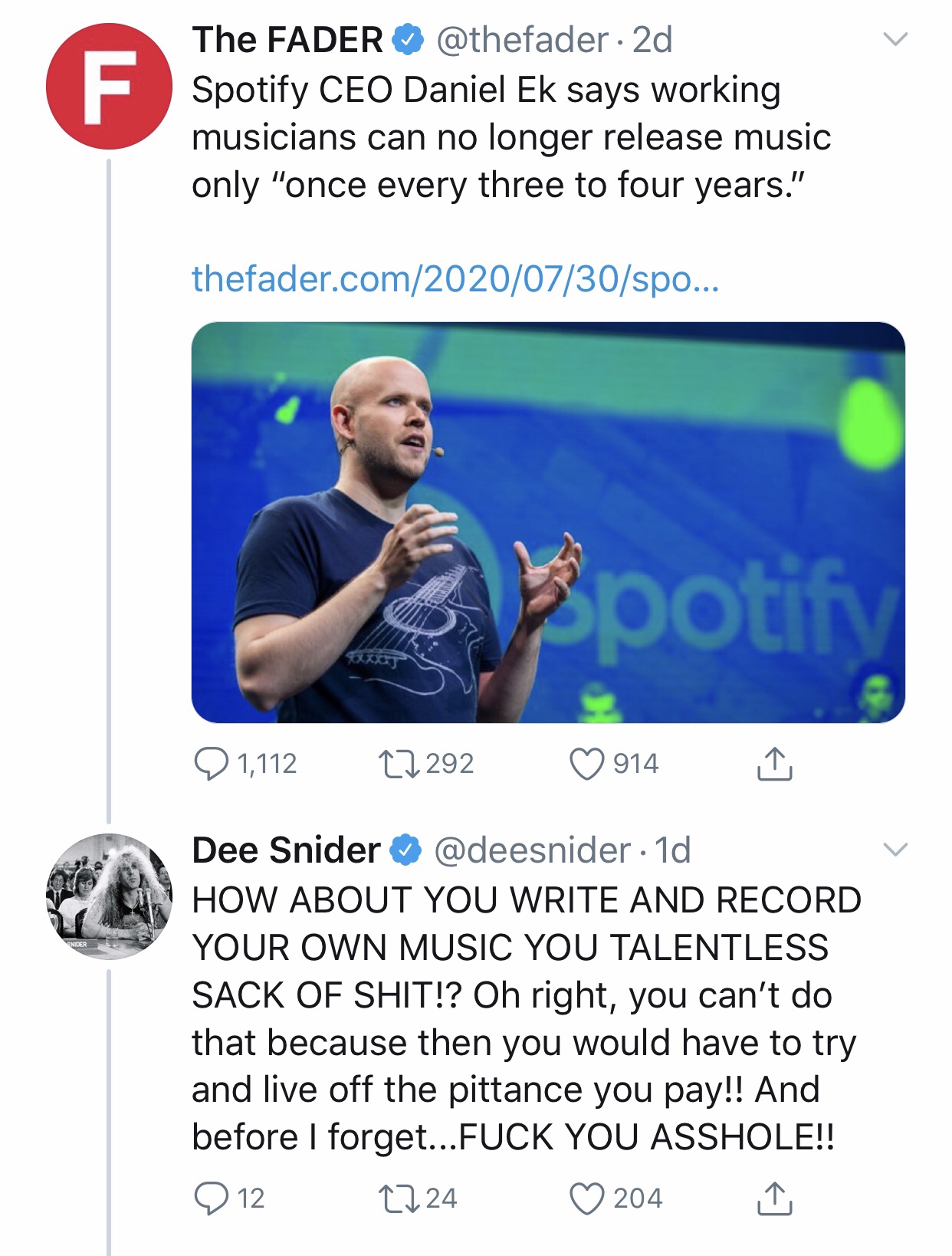
I posted a few days ago about Streaming and some comments from Daniel Ek about what artists should be doing based on the data provided to him.

For example, releasing an album every 2 to 4 years is not a viable solution these days based on the data, and the data tells Spotify that a continuous engagement with fans with frequent releases is more viable.

Spotify thrives if content is delivered, so you need understand that Ek is also playing the role of a sales person in his quarter earnings speech.

And I’ve been following the reactions of artists on Twitter since Spotify quarter results, just to see what their view is, because the reason why we have Spotify accounts is that we like music and we want to listen to music.

Spotify grants access to music, along with the other streaming providers.

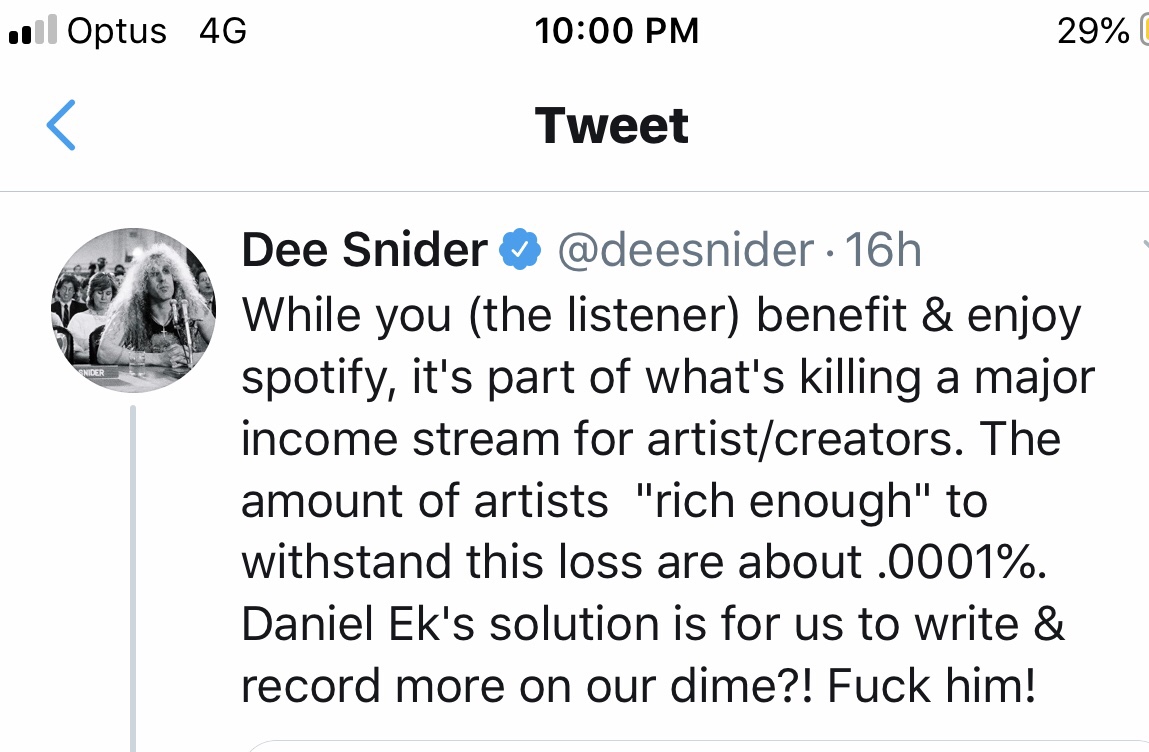
Dee Snider as usual is at his best.

Before streaming providers, consumers had, iTunes, pirate sites, cyber lockers and physical purchases. Artists got paid on a transaction once the label recouped.

But does that one sale equal a true fan.

Most of my record collection is from second hand record shops and market fairs of used records. So the person who purchased the record from a shop is listed as a fan via Soundscan metrics, but in reality, they are not a fan as they sold their record to a second hand shop who then resold it to me. And this sale is not captured as a Soundscan metric. So artists didn’t have any idea who their fans were.

Then came YouTube.

An uproar started there, when music became available on the service. YouTube got traction and to this day it is still the number 1 streaming service. The labels eventually negotiated a license deal and artists got rorted again. And pirate sites never went away.

Then came Spotify. The labels took ages to license the service as they wanted a stake in the company and a profit share arrangement with the service and so many other wonderful ways for the label to make money from the service.

First the labels and the publishing houses get a fee for allowing the service to license the music they hold the copyrights for. And this fee goes straight to the labels/publishers without any distribution to the artists.

And everyone is trying to do the math of how much does an artist get paid per stream?

But it’s the wrong train of thought to have.

Whoever holds the rights, the monies are getting sent there. But, the labels and publishing companies also have a profit share arrangement with the streaming service (and it’s not just Spotify, all streaming services have this arrangement, especially Tidal who have a lot of artists involved with it as investors) where they split the monies between each other.

And are the people at Tidal complaining?

Eventually the streaming market will fragment like the movie and TV streaming market and the streaming companies will start to make their own content and will become labels themselves.

Then we’ll have a different conversation.

Standard
Copyright, Music, My Stories

Streaming

“Gone are the days of Top 40, it’s now the Top 43,000,”

Daniel Ek

Those 43,000 artists account for the top 10% of the streams on the service. Last year it was a Top 30,000. As the user base grows on streaming services so does the fragmentation. And if artists are thinking that they will dominate in the same way that artists dominated in the MTV monoculture, then they need a mind reset.

“The real thing is that there are more relationships being formed to more artists”

Discovery is happening. You can start off listening to Metallica and end up becoming a fan of a Swedish Rock band in the months ahead. For a consumer, streaming services are enablers, as long as the music of the artist you want to hear is on there.

But there are a limited set of artists as Ek puts it, that are negative.

“Obviously, some artists that used to do well in the past may not do well in this future landscape, where you can’t record music once every three to four years and think that’s going to be enough…

The artists today that are making it realise that it’s about creating a continuous engagement with their fans. It is about putting the work in, about the storytelling around the album, and about keeping a continuous dialogue with your fans.”

I know the album cycle works for a lot of people, because its quantifiable. Release an album and go on tour. Vandenberg released their best album and they can’t tour on it because of COVID-19.

So what’s next for the band to keep the engagement going?

Acoustic releases, some covers of their old stuff or from other bands or another new track in between.

Keep the engagement going. Because that 40,000 artists who make up the top 10% of streamers, will become 50,000 in the next year and then 60,000 and then 70,000.

“I feel, really, that the ones that aren’t doing well in streaming are predominantly people who want to release music the way it used to be released”

That’s fine to do so if you’re happy with that old school release cycle and there is a percentage of your fan base which is also okay with it. But with so much choice, fan devotion to a single artist is not as strong as it was in the past. And even in the past, when the record labels controlled everything pre-Napster, people had hundreds of records and from different artists.

Then again, Taylor Swift’s ‘Folklore’ had 98 million streams in a day. A Spotify streaming record.

The good old day of sales are non-existent and with Copyright terms lasting forever, the person or corporation who holds the rights, will get paid forever for people listening.

This is just on Spotify. The other streaming providers will also have similar numbers and will be paying the rights holders similar amounts for their Top 40,000 artists who make up 10% of the most streamed tracks.

And music is a lottery. No one knows what will stick and break through. Simple economic theory entails that no one is entitled to make a living in music, the same way that every person who sets out to be a professional sports player, doesn’t get there. There are limits to what succeeds and what doesn’t. But at least in music, there is no barrier and everyone can play.

So start playing.

Standard
Copyright, Music, My Stories, Stupidity

Snider and Palmer

It was Al Pitrelli, his Widowmaker guitarist that pointed out to him (in the early 90s) that every time he heard “We’re Not Gonna Take It” back in the 80’s, it reminded him of the Christmas song “O Come All Ye Faithful”.

Then of course, Twisted Sister did a Christmas album In the two thousands and they re-did the “We’re Not Gonna Take It” music with the words of “O Come All Ye Faithful”.

So fast forward a decade and bit later from that Christmas album and you have one of the most hated business people in Australia, deciding that his “Australia’s Not Gonna Cop It” is based on the Christmas Carol.

Umm no.

It’s based on “We’re Not Gonna Take It”.

But like other business people in the world, he lies. Clive Palmer just continues to lie. Nothing is his fault, he can’t admit any wrong doing nor does he know how to apologise. But to lie and not pay his workers, god damn it, Palmer is good at it. Very good at it.

And I hate Copyright lawsuits, but I’m all in with the Snider camp on this one, because Palmer’s camp asked to use the song from Twisted Sister but they didn’t want to pay the license fee for it. So it all comes down to Palmer not paying for something, again. Sort of like how he didn’t pay his workers.

It’s a showdown in August.

Standard
A to Z of Making It, Copyright, Music, My Stories

Friday Rambles

Another Dokken track was released today from the album is known as “The Lost Tapes” which is more or less modern day re-recordings of these songs, instead of the original tracks re-mixed and mastered.

So far it’s a zero from two strike rate.

And of course, Don Dokken’s ex band mate, is also Re-Imagining his early works, in this case, George Lynch is redoing “Wicked Sensation”. Its him and Oni Logan, with the help of Robbie Crane on bass and Brian Tichy on drums.

“The term ‘re-record’ makes me cringe, this is not that. We re-invented the wheel on this record. It’s really a different animal than the original! Fans won’t be disappointed!”
George Lynch

Interesting to hear what reinvention he’s talking about. I remember a Lynch Mob album called “Revolution” in which Lynch reinvented some Dokken songs with different grooves. It’s not something which I have played a lot since I purchased it.

Since I have every single thing Lynch has released on my shelf, I would probably buy this, but I will wait to hear it on Spotify.

You see, when a different artist does a song from another artist, it’s known as a cover, but for some reason, when the same artist re-does their earlier stuff, it was always seen as a forgery.

The only time a forgery was done to an excellent standard was with the 1987 self-titled Whitesnake album. John Kalodner cracked that whip and David Coverdale along with Sykes on “Crying In The Rain” and Sykes/Vandenberg on “Here I Go Again” or Dan Tuff on the radio friendly version delivered in gold. Because two years later, the Steve Vai version of “Fool For Your Loving” didn’t cut it.

Then again, every artist from the 80’s who has a deal with Frontiers is encouraged to re-record their successful 80’s music for the label.

Even Def Leppard did it them selves while they had that ongoing dispute with their label over what they should pay the band to have their music on digital services.

And in relation to payments and digital services, Don Henley wants the U.S Government to pass laws so that anyone who plays his music, pays money for the use of his songs.

Regardless.

He mentioned how his label, Universal has over 60 people patrolling the internet to take down unauthorised uses of his songs. On occasions these automated takedowns, take down legitimate uses as well.

And I’m thinking, their wages are paid by the monies the label receives from exploiting record music. Shouldn’t those monies be paid to the artists who create the music.

Then there is the other side of the debate, people who actually use music from artists to promote the artists music on YouTube.

What is fair use, and when should their popular YouTube video earnings be handed over to the label?

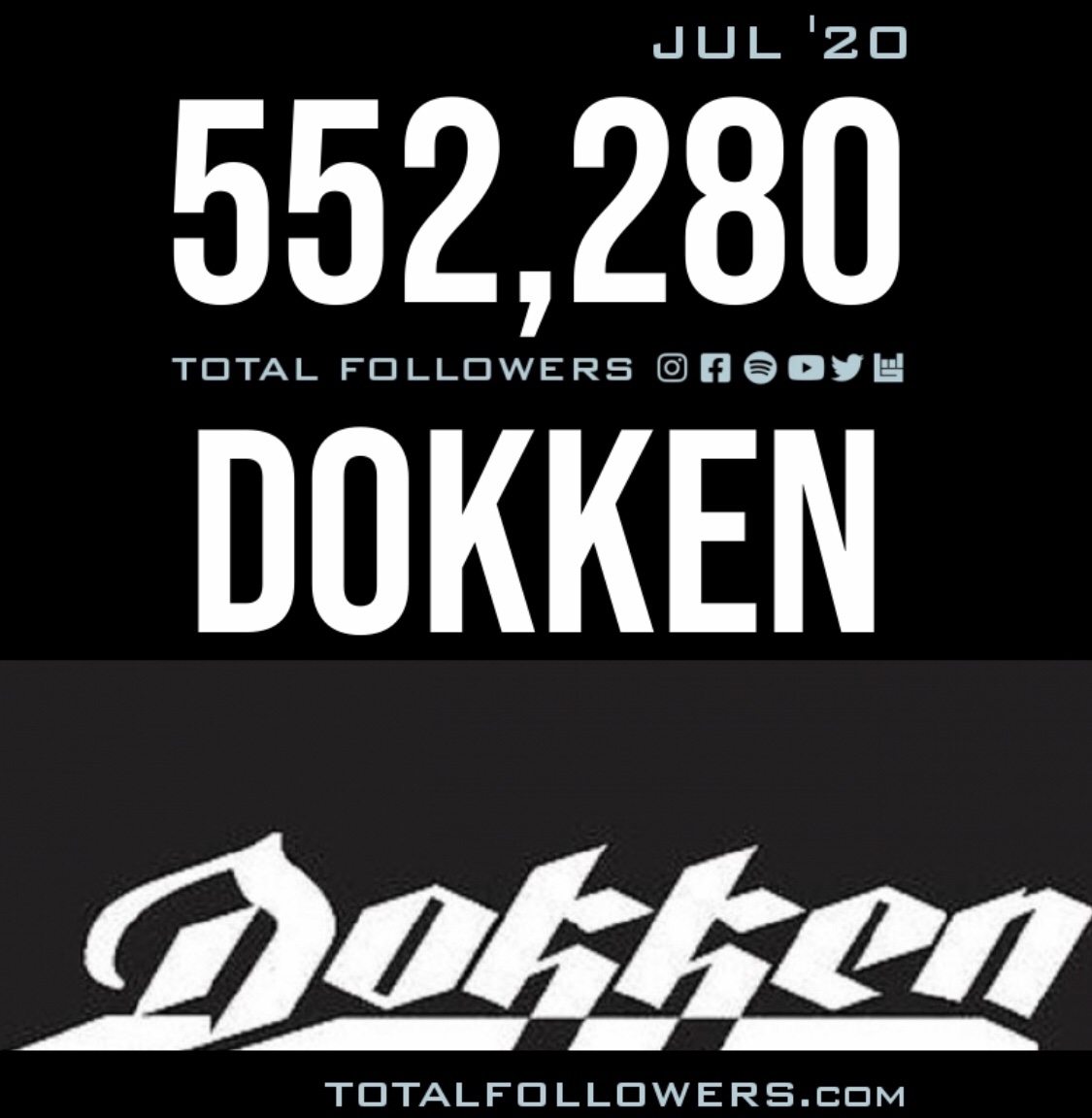
A site I follow, made mention of another site called totalfollowers.com, which I checked out. Since I was writing about Dokken, Lynch Mob And Def Leppard, I thought I should check out their reach.

I typed in Lynch Mob and there are 240,313 followers.

I typed in Dokken and there are 552,280 followers.
I typed in Def Leppard and there are 11,571,109 followers.

I guess that’s the difference between having diamond certifications to platinum certifications to no certification.

Standard
A to Z of Making It, Copyright, Music, My Stories, Unsung Heroes

Volbeat

I’ve been following a site called “Stream N Destroy” for a while now and I dig these emails, full of numbers about stream counts, YouTube views and sales for artists in the metal and rock genre. I subscribe to the free tier and of course there is a paid tier which goes even more in depth.

So in the current email, which can be found here, there is a mention of VOLBEAT and how their 2013 album “Outlaw Gentlemen & Shady Ladies“ is certified Gold.

And that’s important to note, because he music from artists used to take a while to break through. Black Sabbath didn’t set the world on fire with sales of their 70’s albums.

  • “Black Sabbath” released in 1970 was certified Gold a year later in 1971, and then Platinum in 1986.
  • “Paranoid” released in 1971 was certified Gold that same year and then Platinum in 1986 and by 1995 it was 4x Platinum.
  • “Master Of Reality” released in 1971 was certified Gold that same year and by 2001 it was 2x Platinum.
  • “Volume IV” released in 1972 was certified Gold that same year and then in 1986 it was certified Platinum.
  • “Sabbath Bloody Sabbath” released in 1973 was certified Gold in 1974 and Platinum in 1986.
  • “Sabotage” released in 1975 was certified Gold in 1997.
  • “Technical Ecstasy” released in 1976 was certified Gold in 1997.
  • “Never Say Die” released in 1978 was certified Gold in 1997.

“Ride The Lightning” from Metallica took two years to get a Gold certification while “Kill Em All” took six years to get a Gold certification.

For Volbeat, this is a 7 year case.

And it doesn’t look like they will disappear anytime soon. Their 2012 album, “Beyond Hell, Above Heaven” was certified Gold in 2016, 4 years since its release. Their streaming numbers are high, although Queen takes the trophy this week, with 15.9 million streams of “Bohemian Rhapsody”. Not bad for a track released in 1975.

Their current album, is still selling, it’s up to 45,500 sales in the U.S. It’s anaemic compared to the past, but then again, how many of the past artists that had big sales in the 80’s are still around and selling these kind of numbers today. Hell, the 80s artists couldn’t even get these numbers in the 90’s.

Their song “Leviathan” is also in the Billboard charts.

People are still interested in the band.

It’s a longer road than before, but it’s a road still worth taking. You just need to be patient and you will need to have another line of income to pay the bills. For a lot of artists, this was the road, but that will change.

The labels don’t like it because they got used to making a quick buck, especially when MTV turned culture into a monoculture, the labels wanted every release to be an instant pay day.

And when it wasn’t, heads rolled.

Artists would get dropped and A&R department heads would also disappear. Because the labels didn’t want to waste time on artist development. And today, that is even more prevalent.

In relation to the weekly streams, while Queen is on top of the world, “Thunderstruck” from AC/DC is sitting at 11.8 million streams for the week.

And what I took out of it all, is that the big streaming songs (apart from some Five Finger Death Punch, Avenged Sevenfold and Disturbed) are all pre 2006, with “Stairway To Heaven” the oldest track at 1971.

Music lives on for a long time, hence the reason why the labels wanted Copyright terms to last 70 years after the creators death. And that same rule that they wanted is also getting em undone in court cases from the heirs of the artists.

Keep creating because you’ll never know when it’s time for your creation to take over the world.

Standard