A to Z of Making It, Copyright, Influenced, My Stories

Four For Friday

A bit of Copyright, NFTs and Stallone.

NFTs

Remember when they were all the rage.

Sina Estavi is a crypto entrepreneur. He purchased an NFT of Jack Dorsey’s first tweet for $2.9M. It’s now worth $4.

Or check out this research which claims that 95% of NFT’s are worthless.

Not sure how owning a chunk of digital art on a blockchain is a valuable investment. Even Justin Beiber is down 95% on his Bored Ape NFT.

Non-Fungible Tokens (NFTs) are unique chunks of cryptographic data that connect to a digital object.

Let’s say we have a picture and its copy. If these objects are turned into NFTs, they will be distributed with unique identification codes, and will, be considered unique apart from the other. From this moment, the object that was once just a copy gained its own determined proof of existence, separating from its source.

Although the two NFTs now have an identical visual appearance, they cannot be treated as one thing and can have different financial values, hence the name ‘non-fungible’.

And somehow people came to the conclusion that these are good investments.

THE LABELS vs X

You know when you go on X(Twitter) and you see a music snippet shared by an account. It could be part of a video clip or a live performance.

Well the labels see this as “breeding” mass copyright infringement.

And since X basically ignores the takedowns from the labels, as a result, the labels sued, asking for $250 million and an ongoing licensing fee.

But X put in a motion to dismiss. The labels then counter argued and a judge in Nashville needs to decide if it goes to trial.

ROLLING STONES

Taylor Swift has shown other artists the financial windfall that could happen if you own your masters.

When Swift realized that she would never get her masters back, she went about and re-recorded the whole albums and made those albums, the versions people should stream and license.

This puts the power of Copyright back in her hands.

The Rolling Stones wished they could have done something similar because they lost their rights to all of their pre-1971 albums to their manager Allen Klein.

It’s just another case of a person who’s never made any art in their life, claiming it as their own and using it to for financial advantage. Geez, it sounds like a record label. Then again, labels did come up with the cash that most artists could never pay back.

As “The Rolling Stones” grew in popularity, they hired music-business accountant Allen Klein.

Klein negotiated a new deal with Decca and he also got a million-pound advance payment for their next album.

But he wasn’t paying Keith Richards and Mick Jagger their songwriting royalties. So they ended the partnership however as part of the severance, Klein managed to keep ownership of the Rolling Stones music for the years he managed them from 1965 to 1970.

But the Stones did receive millions of dollars in royalties from Klein but not as much as if they’d owned their music outright.

STALLONE

After writing the script of Rocky, Sylvester Stallone was offered $360K to not play the role.

The production company that was interested didn’t want him to play the role.

And since 1976, the rights to the Rocky franchise (which Stallone created) are in the hands of producer Irvin Winkler.

Standard
Classic Songs to Be Discovered, Derivative Works, Influenced, Music, My Stories, Unsung Heroes

Tony Martin – Sweet Elyse

“Sweet Elyse” was released on the solo album, “Back Where I Belong” in 1992 on Polydor. Tony Martin decided to do a solo album when his Black Sabbath project was doing its “Dehumanizer/Dio” project.

Production was done by Nick Tauber, who is best know for his work with Thin Lizzy and Marillion.

The album is not on Spotify, which irks me. But YouTube has a lot of uploads from fans, who call Tony Martin the best Sabbath vocalist ever.

And “Back Where I Belong” is not available anywhere to buy these days, unless someone’s selling a second hand copy.

The reason why it’s not available are varied. When Martin rejoined Black Sabbath, Polydor deleted the album from their catalogue and took it off the shelves.

And somehow his manager at the time owns the entire rights to this album, which gets me thinking “how the hell did the manager pull that off” and “how is Copyright protecting the artist at this moment to give the artist an incentive to create”.

But I have seen interviews and posts where Martin mentions how he wants this album re-released and the label Battlegod Productions, which is the label for his solo album “Thorns”, is in negotiations for it.

The track burns from the start and it reminds me of songs like “Highway Star”, “Burn” and “Speed King” from Deep Purple.

And I like the familiarity.

The session line up for the song is also impressive.

Nigel Glockler from Saxon pounds those drums and Neil Murray from Whitesnake is the master of the groove.

Tony Martin also shows off his guitar prowess as he, Paul Wright and Carlo Fragnito play the rhythm guitars with Richard Cottle on the keys.

There are also demos floating around the internet of this album which has Tony Martin playing all the guitars.

For the solo, Adrian Dawson brings out his Blackmore influences. And it’s excellent.

Crank it.

Standard
A to Z of Making It, Copyright, Music, My Stories

Four For Friday

Ahh copyright. It’s the gift that keeps on giving. Well it does really. It gives the writer an incentive to create for their whole life plus 90 years after death. Don’t know how it’s even possible after death, but hey, who am I to judge the intellectuals who wrote and debated this change.

It also gives rise to lawsuits and perpetual payments to corporations for valuable copyrights. It’s also a form of censorship and anti-innovation (remember Napster).

THINKING OUT LOUD

Thank god this silliness has been put to rest.

Remember when Ed Townsend’s estate wanted Ed Sheeran to pay them millions for writing a song with a similar feel to Marvin Gaye’s “Let’s Get It On”. The trial went to jury and they lost. They appealed and then they withdrew their appeal.

This is what happens when people who create nothing of culture believe they are entitled to that culture.

And for the record, “Let’s Get It On” is not so original itself. It’s also influenced by what came before it. Cause that’s how creativity works.

CAN YOU COPYRIGHT A BEAT?

But the madness continues.

Reggaeton is a style of popular and electronic music that originated in Panama during the late 1980s and it was later popularized in Puerto Rico. It’s basically massive in Latin America and from the 2010’s it’s creeped into the mainstream of English speaking countries.

In 1990, a song came out called “Fish Market” from producers Steely & Clevie. In that song there was a drum rhythm.

The lawsuit claims at least 80% of the genres songs have used that drum beat.

Sort of like the 4/4 drum beat and it’s variations.

They are common elements and building blocks to creating. The fact that 80% of the Reggaeton industry use this beat shows how common it is.

AI

What’s people’s view on AI?

We’ve had AI in our lives for a long time, yet many have failed to recognize it. At a basic level which everyone would recognize, remember “Spell Check” in Word docs or Google Search.

For the recent waves of AI to work, they need training. And this training involves material which is under copyright.

So.

If I develop an AI tool and train it with the music and books and movies I’ve purchased, am I breaching Copyright?

If I then release the AI tool for others to be allowed to create, is the tool breaching Copyright?

All the AI knows is how to write and review based on inputs.

Basically it’s a tool, that people can use however they want. It’s innovative at the moment. And the copyright industry doesn’t like innovation if it’s not paying them. So it tries to censor or kill the innovation.

Until the come to an agreement and they accept it.

REVENUES

$8.4 billion in six months was brought into the labels accounts with streaming payments making up 84 percent of that pie.

So if you are an artist or songwriter and you’re not getting a cut, your deal is super shitty. Change it.

Because if there was no value in streaming, all of the Investment House and Hedge Funds wouldn’t be buying up the rights to valuable catalogs.

Standard
A to Z of Making It, Copyright, Music, My Stories, Stupidity

Four For Friday

Copyright and Spotify again.

SHARE PRICE

It’s cool how copyright makes money for valuable Intellectual Property. And you can’t get a bigger and more valuable IP than “The Beatles”.

The thing is, not one of the members from The Beatles held or even hold their rights. At one stage, Michael Jackson was the sole holder of the rights.

And with all the transfers and sell offs, The Beatles catalog settled at Round Hill Music Royalty Fund. But like all companies on the stock exchange, the share price just didn’t reflect the true value of the Company.

In this case, shares in the company were trading around $0.70. And share prices this low don’t make share holders and board members happy.

So in comes Alchemy Copyrights with a $496 million buyout offer which means shareholders in Round Hill Music will get $1.15 in cash per share. Suddenly, you have happy shareholders and board members, who get a nice payday for holding shares in culture.

They created nothing culturally and yet still benefit. But I keep hearing how stronger copyright is needed to protect the creators.

Mmmm.

SHARE PRICE 2

Hipgnosis Songs Fund is also selling some of its catalogues for $465 million. This is to pay down debt and increase its share price

And as expected, the share price increased,

Again, you have an organization that created nothing culturally and yet it still benefits. And I keep hearing how stronger copyright is needed to protect the creators.

COPYRIGHT FAMILY DISPUTE

Motown songwriter and producer Ron Miller died in 2007. If Copyright expired on the death of the creator like it once did, then this would be a non issue.

But, Copyright doesn’t expire at this point. It’s still valid for another 70 to 90 years, depending on the country.

Fast forward to 2022, Sony Music Publishing signs a deal with Lisa Miller, for rights to 130 of her fathers songs.

But Ron’s other children Julie Moss and Mark Miller from Ron’s first wife didn’t like this and are now going to court.

They allege that Lisa Miller tricked her mother, Aurora Miller (Ron’s second wife) to sign away her claim to the songs.

The claim further states;

“As Aurora’s health continued to decline, Lisa began forging Aurora’s signature on notices of copyright termination.”

And I keep hearing how stronger copyright is needed to protect the creators. In this case a dead creator.

SHOWCASE

Spotify’s new marketing tool.

Artists can buy dedicated space on listeners home pages to promote new releases, deep cuts, etc.

Each click from a fan on the showcase button will cost the artist 40 cents per click until their campaign budget is maxed.

Spotify believes that people who see these ads are six times more likely to stream the release.

It shits me how artists always have to cough up cash.

Back in the label days, if the label marketed you, they billed you to recoup their costs.

If an independent act marketed themselves, they paid for a marketing campaign themselves.

Standard
Copyright, Music, My Stories

Four For Friday

It’s all about Spotify today.

MONEY LAUNDERING

This time around Swedish criminal gangs are using Spotify launder money.

The scheme is interesting.

The drug money they have is converted to bitcoin.

Bitcoin is then used to pay “fake stream” entities to do exactly that, create fake streams on Spotify for an artist.

The artist in question is linked or involved with the gang.

By creating the fake streams, the artists would end up on top of the charts and as a byproduct, those fake streams would lead to real streams.

As the Guardian article explains:

Higher streams lead to higher payouts from Spotify. The newspaper said that in Sweden, amassing a million streams pays about 40,000 to 60,000 kronor (£2,800 to £4,300).

WHITE NOISE

Have you ever come across a Podcast that’s just white noise.

It’s definitely annoying and I don’t care what people say about it, it’s basically streaming spam.

The rule was if the podcast got over a 100 listens (it can be from the same user) they would qualify for ad supported payments.

Well now it’s 1000 unique listeners before they qualify. Hopefully they just filter out.

SONGS AND SPAM

In 2018, 20,000 songs would get uploaded to Spotify. In 2023, it’s at 120,000. A large majority of those uploads are via bots and they are basically the same as email spam

AI COVERS

AI-generated “covers” of popular songs using artists’ voices are still being released on Spotify.

Universal’s trying to partner with Google on a tool that lets fans create these songs without infringing copyright.

Universal has also partnered with Deezer to ensure that music created by breathing people gets a higher preference on the service than AI created music.

It’s a start, however AI is really making streaming economics even trickier.

Standard
A to Z of Making It, Classic Songs to Be Discovered, Derivative Works, Influenced, Music, My Stories, Unsung Heroes

Vandenberg – Sin

Adrian Vandenberg has come full circle.

When John Kalodner met with him in 1987, Kalodner had two propositions; one was to replace all the Dutch members of the Vandenberg band with American musicians and the other was for Vandenberg to join Whitesnake.

Morally Adrian Vandenberg couldn’t do that to his Vandenberg members and he also couldn’t pass up on a position to work with a vocalist like David Coverdale.

So he chose Whitesnake.

But when he tried to resurrect Vandenberg circa 2014/15, those Dutch 80s members didn’t have the same moral conviction as Adrian did and they took him to court so he couldn’t use his own surname anymore.

Six lawsuits later and a lot of money spent, Vandenberg was allowed to use his surname again.

But while all of the lawsuits were happening, Vandenberg’s Moonkings was created and they released three albums.

Then Vandenberg returned, dropping the excellent 2020 album with former Rainbow vocalist Ronnie Romero on vocals, Rudy Sarzo on bass, and Brian Tichy on drums.

And here we are in 2023, with another excellent album called “Sin”. This time around Adrian is joined by vocalist Mats Levén, drummer Koen Herfst and bassist Randy Van Der Elsen and the album is produced by Bob Marlette.

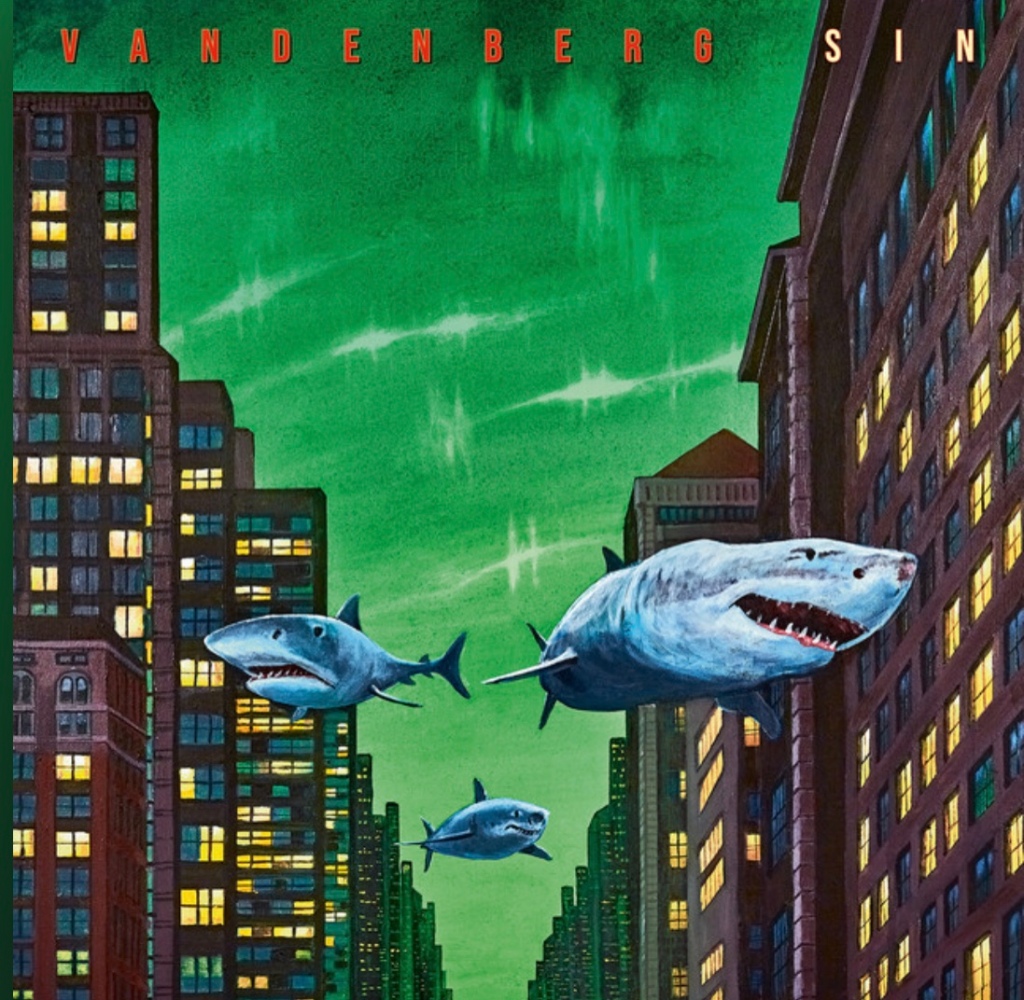
How cool is the cover art?

Once again, created by Adrian, he wanted to show an actual destination for the flying sharks who made their appearance on the “Heading For A Storm” album.

Instead of flying over a road in the desert, they are now flying into New York, the city of sin.

Thunder And Lightning

This is a person writing songs for the love of it. No pressure to write hits and no pressure to conform.

For those who grew up in an era of driving with the window down and cranking the music from the stereo, well this song is perfect for it.

Vocally, Mats Leven is channeling David Coverdale. Musically the song channels the spirit of Eddie Van Halen and the Euro blues rock of Michael and Rudolf Schenker.

Stick around for the guitar solo.

House On Fire

Heavy palm muted arpeggios start it all off with Leven singing in a low bass/baritone. Then it goes into a sleaze like riff.

This is a straight ahead rock and no one is doing it better in 2023 than Adrian Vandenberg.

Sin

This sounds so good. Vandenberg rewrote “Judgement Day” and I like it?

Then again “Judgement Day” is heavily based on “Kashmir”. And I still like it.

Alot of legacy artists keep saying “what is the point in writing new music as no one cares about it”. Tell that to Vandenberg.

Light It Up

Love the swagger on this.

Walking On Water

Ooh, that guitar intro and the vocal. Very 70s Free like.

And stick around for another masterful guitar solo.

Burning Skies

The album keeps going, sounding different from cut to cut. Like “Back In Black”. This one feels like a classic Scorpions cut.

Hit The Ground Running

It’s all about the vocal.

This one has Leven channeling Coverdale and the groove sits nicely on your lap.

Baby You’ve Changed

It’s intimate.

A ballad that rolls along like “Is This Love” and “The Deeper The Love”. But it’s not a copycat.

Out Of The Shadows

The arpeggio riff in the Intro reminds me of Coverdale/Page and their song, “Whisper A Prayer For The Dying” but the song is nothing like that.

It’s got this classic 70s Rainbow Dio era vibe and I like it.

It’s just 9 songs clocking in at 41 minutes. Like old school albums, pre CD.

Mats Leven is one hell of a vocalist. A journeyman like so many other vocalists from the late eighties and early nineties.

He came to my attention with the band Swedish Erotica in 1989.

He has then performed (just to name a few) with Treat, Yngwie Malmsteen, Candlemass, At Vance, Firewind, Trans Siberian Orchestra and Therion.

By doing so and picking up whatever work he could get, he found a way to survive the wastelands of the 90s and early 2000’s which were not very kind to hard rock vocalists. Jeff Scott Soto and Johnny Gioeli are two others that come to mind.

Finally, Adrian Vandenberg is 69. He still rocks as hard as he did when he was 29. He hasn’t mellowed out at all. He’s actually gotten heavier and he is free to write the music that he wants to write.

If you want to read my review of Vandenberg’s recorded output up to a certain point in time (it was up to 2014 and the first Vandenberg Moonkings album), you can read it here.

Standard
Copyright, Music, My Stories, Treating Fans Like Shit

Four For Friday

A bit about this and a bit about that.

MOVIES/TV SHOWS

I watched “Oppenheimer”. I don’t recommend it.

Which is tough to say as I’m a fan of Christopher Nolan.

I’m surprised that Nolan thought it should be made into a movie, then again, creative people are inspired by things that others don’t see as inspiring. In this case it was a the 2005 biography “American Prometheus” by Kai Bird and Martin J. Sherwinx

The story focuses on Oppenheimer’s studies, his direction of the Manhattan Project during World War II, and his eventual fall from grace due to his 1954 security hearing.

Since the last hour was like a “Law and Order” episode, maybe a limited TV series would have been better. But a TV series doesn’t have the gross takings that a cinematic release has.

It’s approaching the $800 million mark from a $100 million budget. It will be seen as a success, but its not re-watchable.

I also finally got around to watching “Avatar: The Way Of Water” on Disney+.

I didn’t think a sequel was necessary however James Cameron has a habit of surprising people and he sure did it with this movie. It’s long run time didn’t feel that long and the story flowed.

By the end of it, I made a commitment to watch the third one in the Cinemas. And it hooked my kids as well.

“Painkiller” on Netflix is a must watch. OxyContin destroyed many families and the series does a good job of telling the story.

SHOWS MADE AND THEN CANCELLED OR REMOVED TO SAVE ON TAX

In May, Disney+ said it would cut US$1.5bn of content from its streaming platform, so the company’s value is reduced which means they pay a lot less tax.

This involves axing current programs which are or were popular like “Willow” and not releasing other big budget series’s like “Nautilus”.

Paramount+ also did the same removing “The Pink Ladies” and Jordan Peele’s “Twilight Zone”. Warner Bros also removed “Westworld” along with others.

Time will tell how subscribers will respond to the streamers removing shows when they need to save a bit of cash.

CEASE AND DESIST

There is a high chance that a fan of the artist will have a different political view to that of the artist.

And the artists are okay with this when they are taking the money from these fans because at that point in time they don’t know the political view of the fan.

Suddenly, a politician plays the music of an artist at a rally, there are fans of the artist in that rally and the artist then sends a cease and desist letter to the politician to stop.

How much say or veto rights can an artist really have in how their music is used?

NOTHING ELSE MATTERS

James Hetfield wasn’t sure he wanted to go there and explore themes of vulnerability. Bob Rock insisted that he explore this path of being vulnerable and urged Hetfield to take vocal lessons.

Well that song just surpassed a billion streams on Spotify.

Standard