A to Z of Making It, Music, Unsung Heroes

When Trixter Thought the Party Would Never End – Guitar World June 1991

June 1991.  

Hair spray was a performance enhancing drug, MTV still played music, and four kids from Paramus, New Jersey had just hacked the suburban‑teen lottery.

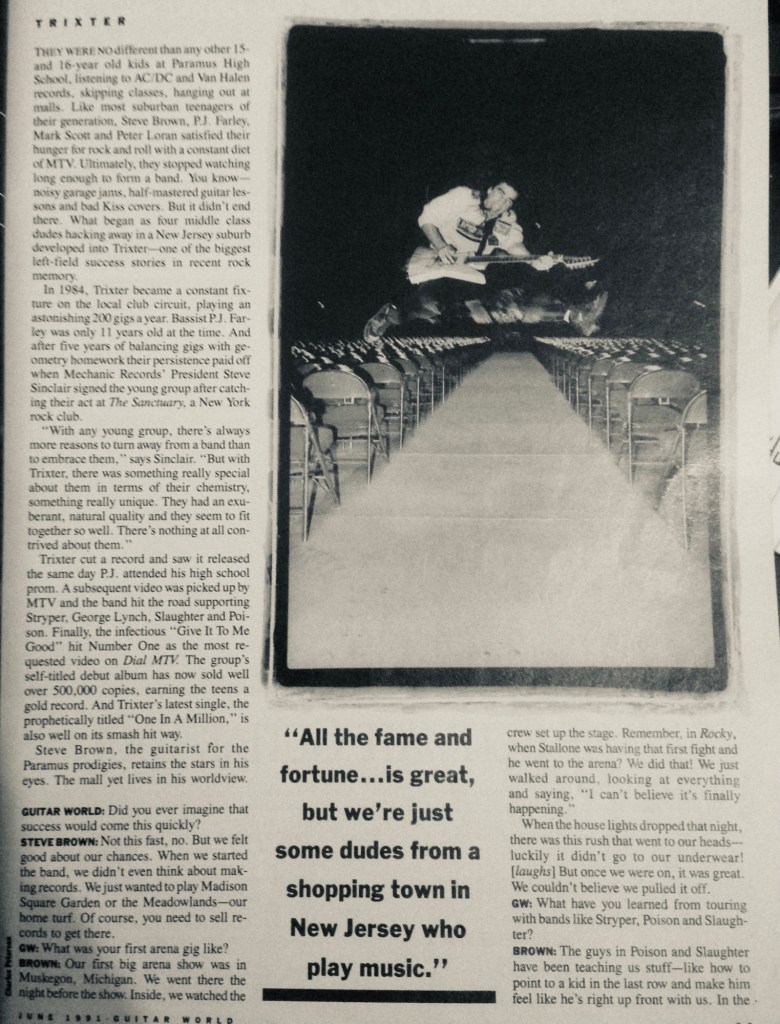
Trixter weren’t supposed to “make it.” They were mall rats from a shopping town, grinding 200 shows a year, aiming no higher than the Meadowlands and maybe, if the gods were drunk, Madison Square Garden. Then the planets lined up: a grimy New York club called The Sanctuary, a label guy in the room, a contract on the table a week later, and suddenly they’re on MTV every hour pretending this is all just happening to them. 

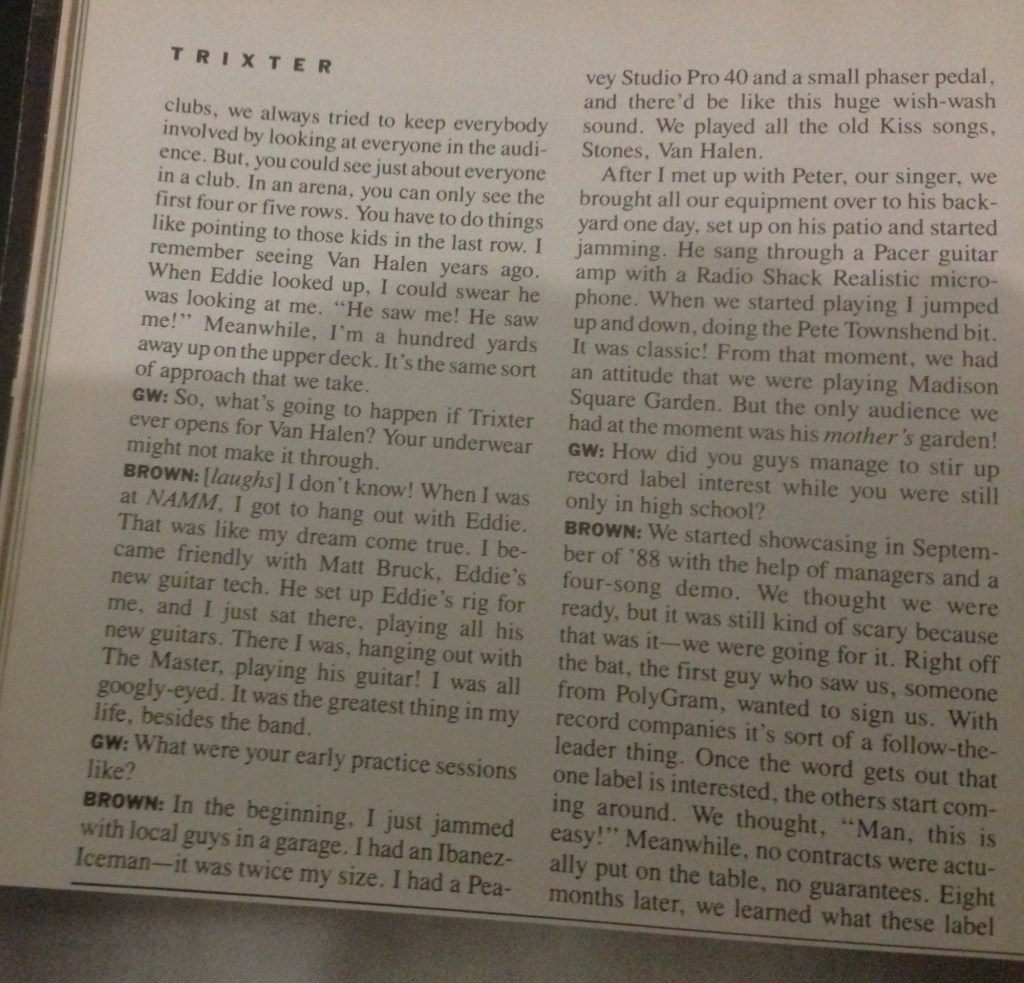
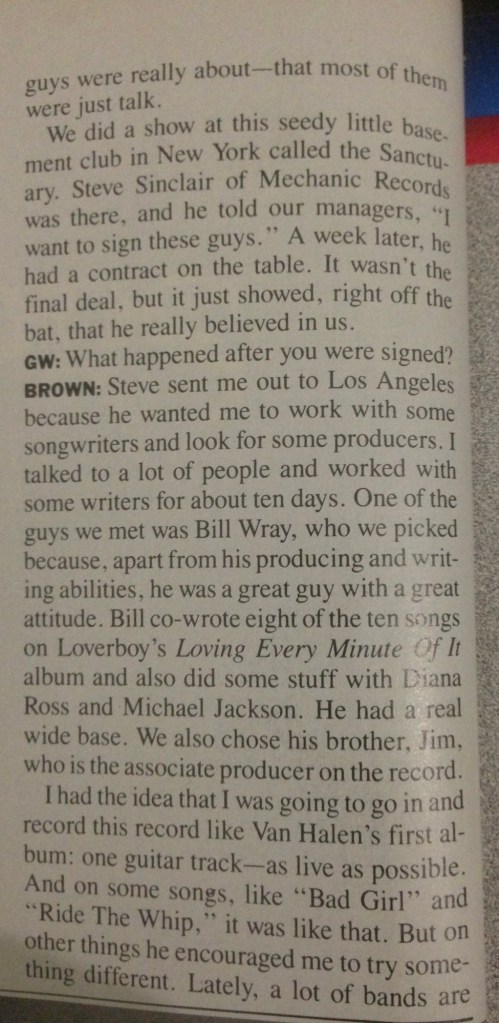
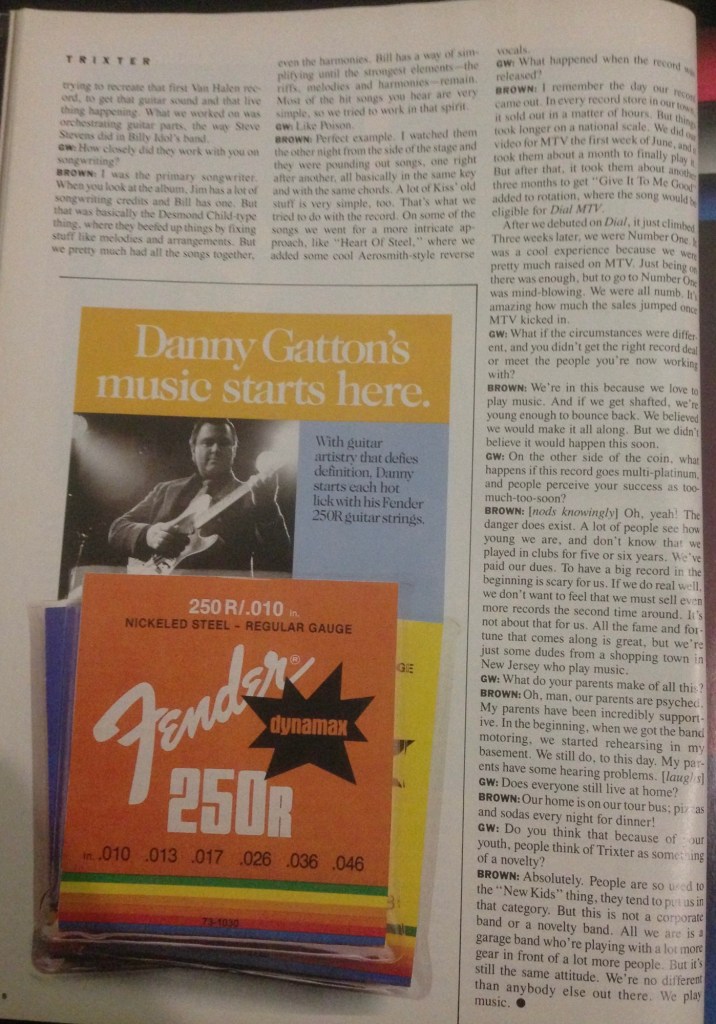
That’s the moment frozen in this Guitar World interview: the exact second where the rollercoaster is still climbing and nobody hears the chain starting to rattle.

On the surface, it reads like standard early-’90s rock-mag candy.

Origin myth.

Garage rehearsals.

High-school sleep deprivation.

Parents pretending they’re annoyed but secretly proud.

Then the montage: endless club gigs, the one basement venue that matters, the industry guy who changes everything. Numbers follow, sales, tour slots, rotation, framed as disbelief.

And the quote. The wall-poster quote.

“All the fame and fortune… is great, but we’re just some dudes from a shopping town in New Jersey who play music.”

That line isn’t accidental. It’s the formula.

The band must be aspirational and accessible at the same time. Superheroes who still feel like kids from homeroom. Big enough to worship. Small enough to imagine becoming.

That’s the business model.

So is the GW interview a PR piece?

Of course it is. This is Guitar World, 1991. The structure is pure promo:

Build the myth (kids + garages + malls + mishaps).

Flex the numbers (MTV, tour slots, sales).

Humanize the product (parents, girlfriends, pizza on the bus).

End with some variation of, “We’re just grateful to be here, man.”

But buried under the sugar, Steve Brown keeps slipping you protein.

He admits they designed themselves as a teen band after reading about Def Leppard. He talks about carefully arranging guitar parts, thinking in terms of Desmond Child‑style songcraft instead of just riff‑vomiting. He’s obsessed with Van Halen’s first record and wants to capture that “as live as possible” energy on a big‑budget debut. He knows MTV rotation is a once‑in‑a‑lifetime weather pattern and they’re trying to build as many houses as possible before the storm passes.

That’s not just PR. That’s a 20‑year‑old already thinking like a lifer.

The tragic part is that no one knows the meteor is already in the air. Grunge is loading in at the other end of the decade while he’s still talking about opening for Poison. Everyone in the piece sounds certain they’ve cracked the code forever, when in reality they’ve rented a very small window in a very specific era.

It’s not deep journalism, but it accidentally becomes deep nostalgia: a time capsule of what it feels like to be young, ascending, and completely wrong about how long the ascent lasts.

So what happened when the lights finally came up?

The short version: the wave crested, then physics did what physics always does.

Trixter rode that first record hard. Tours, videos, magazine covers, the full package. Then the wheel turned. The second album didn’t hit the same, the climate shifted, radio and MTV moved on. The band dissolved in the mid‑’90s, another casualty of a genre that went from omnipresent to punchline in about as much time as it takes hair spray to dry.

Steve Brown didn’t vanish into the suburbs to sell insurance and tell bar stories about “that one time on tour.” He kept going. Other bands. Side projects. Session work. Cover gigs. Tribute projects. Reunion tours. New Trixter records. The guy turned being “that dude from Trixter” into a 30‑plus‑year career by refusing to treat the early ’90s as the peak.

This is what nobody tells kids in bands: the story doesn’t end when your video falls out of rotation. It keeps going, just on smaller stages with fewer free drinks and way more self‑awareness. It stops being about winning the rock‑star lottery and starts being about whether you actually like the work enough to do it without confetti cannons.

Steve clearly does.

So why did I bother digging through a yellowing Guitar World piece in 2026?

Because it’s the perfect diagram of how the machine used to work and, honestly, still does, just with different haircuts and platforms.

You can see:

The fantasy: four normal kids “accidentally” becoming rock stars.

The marketing: humble‑brag quotes, carefully curated struggle, the illusion that this is reproducible.

The truth leaking out the sides: obsessive grind, calculated image choices, a main songwriter already thinking like a producer.

It’s easy to mock bands like Trixter from the safe distance of hindsight. The clothes, the lyrics, the Aqua Net. But when you strip away the clichés, what’s left is familiar: talented kids trying to turn obsession into a life, trapped inside a trend they don’t control.

The interview captures the moment right before they discover a hard rule the industry never prints in glossy pull‑quotes:

You are not your chart position.  

You are not your MTV slot.  

You are what you keep doing after the world stops caring.

In 1991, Trixter thought the party would last forever.  

In 2026, Steve Brown is still playing guitar for a living.

Turns out that’s the better ending anyway.
Standard
Classic Songs to Be Discovered, Derivative Works, Influenced, Music, My Stories, Unsung Heroes

November 2020 – Part 5

Stan Bush

If you’ve watched any 80’s movie with a hard rock soundtrack, there is a very high chance that you would have heard a song from Stan Bush.

My first encounter was “The Touch” from “The Transformers” cartoon movie, when Hot Rod grabbed the matrix of leadership, opened it and became “Rodimus Prime”.

And Jean Claude Van Damme was a big name once upon a time in the action genre, and Stan Bush songs appeared in his movies. But apart from soundtracks, there was nothing else I could get my hands on and information on him was scarce.

So here we are in 2020 and “Dare To Dream” is released.

“Born To Fight” is more melodic metal than AOR rock, with a guitar solo section that reminds of “The Final Countdown” from Europe. And the song is being used to promote a few anime shows on Netflix.

“Dare To Dream” is more in vein with his AOR rock with a bit of Rick Springfield chucked in.

“The Times Of Your Life” is basically the guitar verse riff from “Run To You” from Bryan Adams, played on a piano. And I like it.

“A Dream Of Love” is a cross between Whitesnake and Def Leppard. Think of “The Deeper The Love” and “Hysteria” with a guitar solo that is John Norum level quality, very Euro influenced.

So I had to Google who is playing guitar. And that person is Holger Fath, a German guitarist. He basically does all the guitars and bass, as well as the production.

“The 80’s” sounds like it came from the 80’s. A cross between “Summer Of 69”, “Hysteria”, “Animal” and various Night Ranger songs. It’s a fun clichéd track to listen to.

“Live And Breathe” sounds like those Heart piano ballads with a bit of Michael Bolton thrown in.

“Heat Of Attack” has a bass groove like “Heaven And Hell” which is a perfect canvas for Stan Bush to take over with his melodic rock vocals, about fighting to stay alive and keeping the flame burning inside.

“Dream Big” has a lot of keyboard hooks and an outro guitar solo which I like and “True Believer” has a groovy bass riff with a staccato keyboard riff in the Chorus.

“Never Give Up” has a keyboard riff that reminds me of Bush’s biggest song, “The Touch”, which is very similar to “Jump” from Van Halen.

“Home” closes the album. A ballad straight from the Mutt Lange written cuts, like “All I Wanna Do Is Make Love To You”.

In the end, it’s all these old sounds from the 80’s done in a modern way and I like it.

Wytch Hazel

“III: Pentecost” is the album. The feel is a throwback to those 70’s acts that current bands like Audrey Horne do.

So I did some digging and took in some interviews and reviews about how the band sounds like a cross between Angelwitch and Thin Lizzy. I haven’t heard Angelwitch, so I can’t comment there, but I can hear Thin Lizzy. In the interviews, it was mentioned that Fleetwood Mac and the “Rumours” album was being spun while the writing was happening.

“He is the Fight” kicks off the album with harmony leads and its followed by “Spirit And Fire”. It’s a one two knockout punch musically, so I did some more digging to see who these guitar heroes are. Alex Haslam and Colin Hendra. I’m sure like me, no one has heard of em, but the point of writing blogs is to spread the word. Let the “spirit and fire” lead the way. And listening to the lyrics, it’s a very Christian album. The real Pentecostal kind, so when you hear the lyrics, you know that every word is meant with heart.

“I Am Redeemed” starts off with a bass riff similar to “Wrathchild” from Iron Maiden but once the harmony guitars kick in, its living in Thin Lizzy territory with nods to Maiden in the verses.

“Archangel” has an excellent clean tone intro before it moves into a riff that reminds me of “Ghost BC”. Then the chorus kicks in and it’s memorable straight from the outset. “Dry Bones” has this interlude/solo riff which is just head banging material.

“Sonata” has church organs and a cello/violin before the clean tone arpeggios kick in. And it’s a moody 2 minute instrumental which bleeds into “I Will Not” and that riff. It’s time to pick up the guitar and learn it.

The album closes the way it started with “Ancient Of Days” a high energy hard rock song with harmony guitars and the drumming from “The Ides Of March”.

Within Temptation

I’ve been a fan of this band since the early 2000’s. Their blend of Euro metal and symphonies into cohesive 4 minute hard rock songs is just to my liking.

“The Purge” is a pre-release single drop of a new album. And as soon as it started, I was hooked. It has the riffs, the synths, the almost metronomic drums and the powerhouse vocals of Sharon den Adel.

Avandra

I saw the cover on a blog, liked the way it looked and added the album to my November playlist. Going in blind, the music is progressive rock, with touches of metal and other styles.

“Life Is Not A Circle, But A Sphere” got me to pay attention. It’s track three.

And then “Eternal Return” starts, with its Pink Floyd style of digital delay riffing.

And while I was listening, I did some more digging.

From Puerto Rico.

The beauty of the internet and allowing everyone to create. As a fan of music, I am exposed to artists from all over the world.

“Procgen” has these various moods which I like and then there is this vocal melody that goes with the harmony guitars towards the end of the song, which makes me press repeat.

“Afferent Realms” starts off with some serious shred, which makes me want to break my guitar. It’s all over a polyrhythm riff and drum beat.

Here’s a review for ya from the blog manofmuchmetal, that I agree with (plus it’s the blog that I saw the cover on).

Volbeat

“Die To Live” was a favourite from the album, and the same energy captured there is captured live. It’s just a powerhouse rock-a-billy metal cut.

Crank and let it intoxicate you.

Black Veil Brides

“Scarlett Cross” is the new pre-release single of a forthcoming album. If you read this blog, you will know that I am a fan of the band, especially guitarists Jinxx and Jake Pitts.

These two dudes can play and are modern day guitar heroes.

So I wait..

Trixter

Trixter got labelled pretty quick when they came out with the glam/hair metal tag. Unfortunately labels stick, which in reality wasn’t a right label for them, as they had more of a blues rock sound with AOR rock choruses now and then. After a few albums in the early 90’s they disappeared for a long time only to be resurrected on Frontiers around 2010.

“New Audio Machine” was released in 2012 on Frontiers Records and it features the original line up of the band which is Pete Loran on lead vocals, Steve Brown on lead guitar, P. J. Farley on bass guitar and Mark “Gus” Scott on drums and percussion.

I liked the album then and in 2020 it got a remaster, plus a bonus track thrown in, hence the reason why it appears in my 2020 list.

“Drag Me Down” is a blues southern rock ditty while “Get On It” has this foot stomping blues rock groove. The riffs in “Dirty Love” are influenced from Pasadena and a certain EVH. Steve Brown on guitars is another excellent guitarist who remains ignored by the wider public. Listen to his lead break on “Dirty Love” to get a feel for his abilities.

When Trixter did AC/DC, they did it an way that is more melodic. Listen to the excellent guitar riffs in “Machine” from Brown with arpeggios, palm muted chromatic lines and double stops with an AC/DC feel.

“Live for the Day” is an acoustic/electric ballad, which bands like Matchbox 20, Live and Tonic would be proud to call their own.

“Ride” is a rocker with a heavy riff. “Physical Attraction” and the lead break. Give it a listen.

“Tattoos & Misery” could have come from a Lifehouse album and one of my favourite tracks on the album.

“Walk With a Stranger” is an unused Skid Row song written by Bolan and Sabo, before Sebastian Bach even joined the band. There is a demo of Matt Fallon singing it, released in 1987 on YouTube. It’s a great melodic rock song which has been on the Skid Row backburner for a long time, until Trixter brought it officially back. Coming from the same area as the Skid Row guys, guitarist Steve Brown remembered it from back in the day and this cover is brilliant. One of my favourite tracks.

“Find a Memory” is the European Bonus track and it sounds like “Love Me Back To Life” from Bon Jovi’s “Bounce” album in the intro. Another favourite track for me. “Heart of Steel” is an acoustic cover from a song on their debut album released in 1990. It’s listed as a U.S Bonus track.

If you haven’t heard Trixter before, start with this album. If you like it, then dig deeper.

Stay tuned for part 6 as November was a huge month for releases.

Standard