
You don’t find Marillion. They find you.
Or more accurately, you hear about them sideways.
For me it wasn’t some critic, not some curated “essential albums” list. It was Dream Theater blowing up with “Images and Words”, and Mike Portnoy talking like a fan, not a technician. That’s the tell. When a virtuoso stops talking about chops and starts talking about feeling, you pay attention.
So I went digging. Early ’90s. Second-hand record store. Dust, cracked plastic CD cases, history stacked alphabetically.
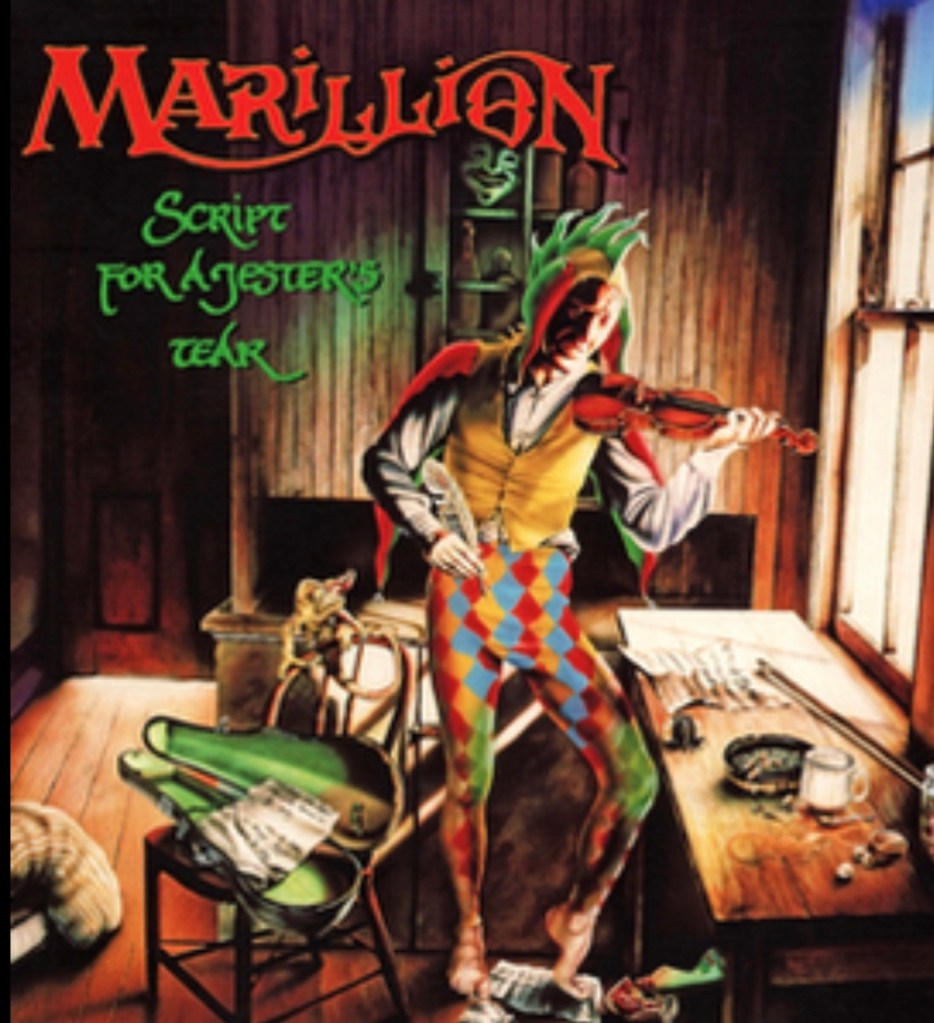
And there it was: “Script for a Jester’s Tear”.
I’d seen it before. That cover lingered. You don’t forget it. The Jester, fragile, theatrical, cracked open emotionally. The kind of image that promises something deeper than hooks. Conceived by Fish, brought to life by Mark Wilkinson. Not decoration, invitation.
Still, I didn’t buy it the first time. Two bucks felt like a commitment when you’re chasing every other ’80s record you think you “need.” Funny how that works. You chase quantity until something forces you to sit still and actually feel.
This record does that.
It doesn’t care about your verse-chorus expectations. It doesn’t ask permission. It builds moods. It stretches. It circles back. It trusts you to stay.
And then there’s that middle section. Around the two-minute mark through four. That’s where the mask slips.
The structure shouldn’t work on paper, verse feel, then a lead break, then back again, but emotionally it locks in. Not because it’s clever. Because it’s honest. The music doesn’t resolve, it returns. Like memory. Like regret. Same place, slightly different weight.
And then the words hit:
So here I am once more in the playground of the broken hearts.
That’s not just a line. That’s a pattern. That’s someone recognizing they’ve been here before and still walked back in. No illusion of progress. Just awareness.
One more experience, one more entry in a diary, self-penned.
That’s the quiet brutality of self-reflection. Nobody else to blame. You wrote this chapter.
Yet another emotional suicide overdosed on sentiment and pride.
That’s the real tell. Not heartbreak. Ego. You didn’t just feel too much, you chose it. You leaned into it. Pride kept you there.
Too late to say I love you, too late to re-stage the play.
There’s no rewrite. No director’s cut. The window closed while you were thinking about it.
Abandoning the relics in my playground of yesterday.
That’s the only move left. Not victory. Not redemption. Just… leaving.
That’s why the playground imagery works. Swings. Roundabouts. Motion without progress. Up and down, but you end up where you started. And the line:
I’m losing on the swings, I’m losing on the roundabouts.
It cuts because it strips the illusion. There’s no winning version of this cycle.
And that’s the thing about this song. It doesn’t pretend resolution. Even “The game is over” doesn’t feel triumphant. It feels like someone finally putting the controller down because they’re tired of losing the same level.
The Jester’s tear? That’s the whole thesis. Not just sadness. Not just regret. It’s the awareness of both. The performance and the truth colliding. Smiling while something inside you caves in.
And then that quiet confession:
I never did write that love song, the words just never seemed to flow.
That’s the line that lingers. Because it’s not about writing. It’s about saying the thing when it mattered. And not doing it.
No guitar heroics fix that. No structure saves it. No time rewinds it.
That’s why this record sticks. It doesn’t overwhelm you with complexity, it traps you with recognition.
You’ve been in that playground.
You just didn’t have the words for it yet.

