I’m not the biggest Bowie fan, but his music got a second life in the late 90’s and onwards and I kept checking his albums out. I go in with an open mind with the hope to find something that I could use in my song writing.
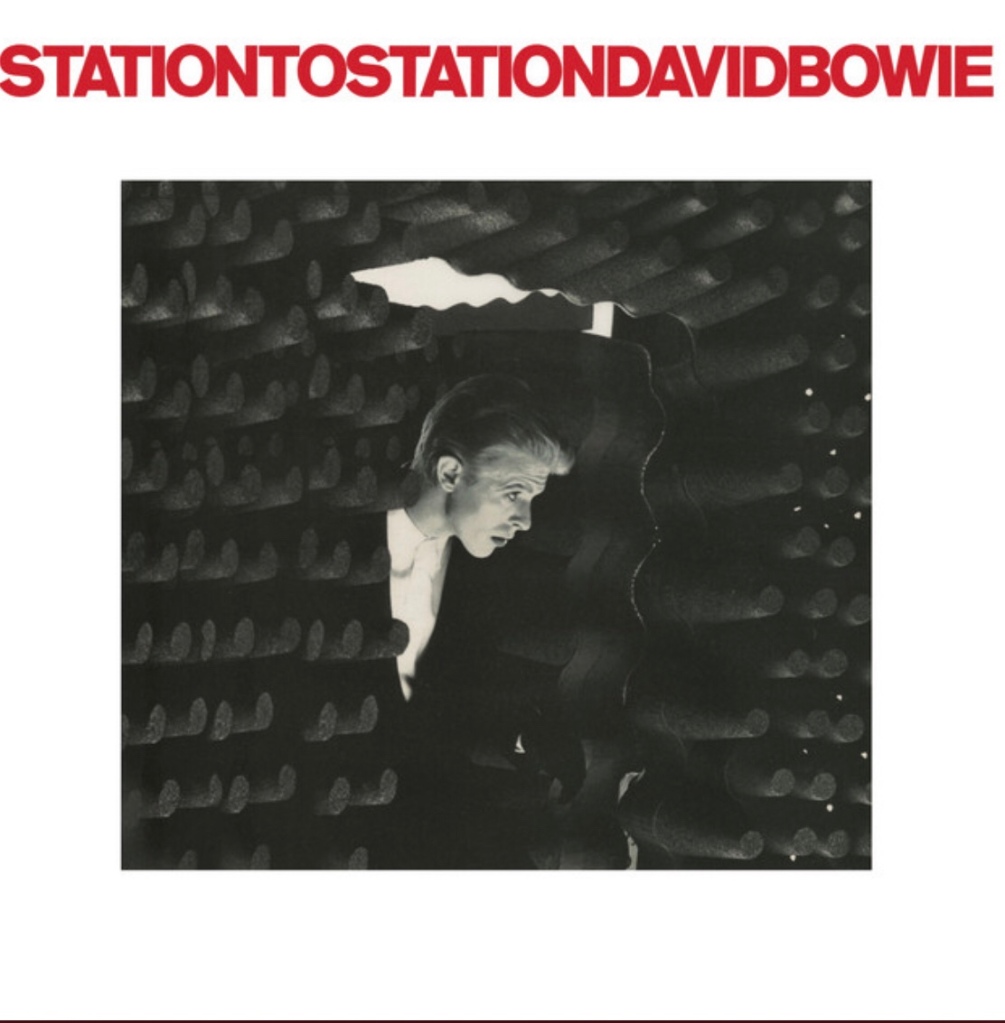
Now, “Station to Station” is album number 10 for Bowie, released in 1976. It has been regarded as one of his most significant works, so it was on a list of album’s to check out for me.
The band for the album is stellar and on fire. Guitarist Carlos Alomar, bassist George Murray and drummer Dennis Davis all bring it, and guitarist Earl Slick contributes along with pianist Roy Bittan.
Bowie was too drugged out during this time and his memory of the album is vague. And with all the drugs artists do, they always find a way to create and the people around them, always find a way to get them to create. As their livelihoods depend on Bowie.
Station To Station
A 10 plus minute opening track which starts off with train noises created by the guitar. And somehow when it was released as a single, the song was creatively edited down to 3 minutes.
It’s typical of the era, blues rock and with arrangements that didn’t stick to a radio formula, because the artists ruled and the label execs didn’t really have a say, until they became more powerful than the artists in the 80’s because of MTV.
In keeping with the Blues Rock theme, Bowie was loaded up with cocaine and he kept asking Earl Slick to keep repeating a Chuck Berry lead over and over again.
Golden Years
This could have ended up on a Steely Dan album as it has this jazz rock fusion vibe.
Word On A Wing
It’s like a mid-tempo rock ballad, with a vocal delivery that reminds me of Joy Division.
TVC15
Bowie wrote this while he was filming “The Man Who Fell To Earth”. But it’s a skip for me.
Stay
I like the riff, it’s almost Santana like with a bit of Doobie Brothers thrown in and you should definitely press play to hear the bass groove.
But man, Bowie’s vocals are really not connecting with me at all on this album and in this song in particular, because musically, this song is gold.
Wild Is The Wind
Musically, the song is great. It’s like a rock ballad. Like all the previous songs, the vocals and melodies from Bowie just don’t connect with me on any level.
And while this album is held in high regard amongst Bowie’s fans, there isn’t enough there to make me a fan. Although there are a lot of lyrics to digest.
Its listed as one of the definitive live albums ever.
“Frampton Comes Alive!” was released in 1976. It’s weird how his trajectory is so similar to Kiss. Following four solo albums with little commercial success, “Frampton Comes Alive!” was a breakthrough for Frampton, the same way “Alive” was for Kiss.
The album is mostly live except for the first verse of “Something’s Happening”, the rhythm electric guitar on “Show Me the Way” and the intro piano on “I Wanna Go to the Sun”. These were fixed in the studio.
In a genius marketing move, the double album was released in the US with a reduced list price of $7.98, only $1.00 more than the standard $6.98 of most single-disc albums in 1976.
And the band is on fire.
Peter Frampton is on Vocals, Lead guitar, but Bob Mayo fills up a lot of the space with his Rhythm Guitar work, plus he plays the Piano and Hammond Organ. Stanley Sheldon on Bass Guitar and John Siomos on Drums provide a solid foundation.
There is crowd noise, fake or real, I’m not sure and the GM of Winterland, Jerry Pompili starts off the concert with the words “If there was ever a musician who was an honorary member of San Francisco society, Mr. Peter Frampton”
Somethings Happening
The blues rock groove is clichéd and heard in many different songs, but it’s always cool to hear it.
This track and the next are from the “Something’s Happening” album released in 1974.
Doobie Wah
It follows on from the blues rock groove from the opening song. And with Doobie in the title, it does sound like Doobie Brothers.
Show Me The Way
From the “Frampton” album released in 1975.
When people talk about talk-boxes, this is the song that was listed as the definitive talk-box song, until an Italian American called Richie Sambora changed the game with “Livin On A Prayer”.
Musically, its excellent, a strummed guitar progression, a hooky vocal melody and that talk-box melodic lead.
It’s a Plain Shame
A blues rock dirge from the “Wind of Change” album released in 1972.
At this point in the set, it sounds okay and fresh.
All I Want to Be (Is by Your Side)
The album goes into ballad rock territory for the next three songs. This one is from the album “Wind of Change” released in 1972.
Wind of Change
An acoustic folk rock song.
Baby, I Love Your Way
From the “Frampton” album released in 1975.
It’s a song that I’ve heard on radio and TV commercials and movies and when I heard it here, I was like, ahhh, it’s from Frampton.
The song flopped when it was released in 1975, but it took on a new life when it was released as a single from this live album a year later.
I Wanna Go to the Sun
From the “Somethin’s Happening” album released in 1974, it could have come from any Southern Rock album released at the time. And Frampton is wailing away throughout the song in various solo spotlight moments.
Penny for Your Thoughts
The shortest track here at 1:23 and along with the next track are from the “Frampton” album released in 1975. It’s one of those major key finger picked campfire tunes. It doesn’t sound like “Albatross” from Fleetwood Mac, however it has this feel.
(I’ll Give You) Money
From the album “Frampton”, released in 1975 and its back to the hard blues rock.
I dig the “Stormbringer” and “Mississippi Queen” feel in the song. And 80’s Y&T comes to mind when I listen to this.
Check it out.
Shine On
From the “Rock On” album released in 1971. The blues rock dirge is sounding too much same/same.
Jumpin’ Jack Flash
A Rolling Stones cover which was released on “Wind of Change” from 1972 and given the 7 minute live treatment here. .
Lines on My Face
From the “Frampton’s Camel” album released in 1973. The fingerpicked clean tone intro hooks me. It’s very Eagles like when they played Folk Rock.
Do You Feel Like We Do
From “Frampton’s Camel” album released in 1973. The 14 minute closer of the album.
The intro riff will grab ya straight away. It’s Santana like, its bluesy and its rocking. But that whole section in the middle is unnecessary.
In Australia it charted to the top spot and was certified 3x Platinum. In the U.S, it also went to Number 1 and is certified 8x Platinum.
There is a theory that this album became so big in 1976, because the year was insignificant when it came to rock music and most of the artists who had fame prior to 76 had either stalled their careers with drugs or breakups or if they were still together they were running on fumes.
And Frampton never captured this glory again and the subsequent albums didn’t do anything great either.
It’s because his face and looks got more time than his guitar skills. Suddenly, his audience was more female than male and his musical credibility was questioned. All of those years honing his guitar chops and song writing abilities were ignored by a vicious press who saw him as a disposable teenage idol.
And while this was happening, he was hooked on morphine and his manager was ripping him off, leaving him bankrupt, along with a terrible decision to star in a film version of “Sgt Pepper” and to pose a certain way for the album cover of the follow up, “I’m In You”.
I liked the 80’s Stones. They were like a pseudo melodic rock band. But Keith Richards hated it.
You see, Mick Jagger had just released his first solo album, “She’s the Boss” in 1985 and Richards saw this as a betrayal. Richards believed that Jagger’s first priority should be the Rolling Stones and not to pursue a career as a pop star.
“Dirty Work” was released on 24 March 1986. Produced by Steve Lillywhite, he didn’t have an easy job to do as he had to call in various other musicians to get the album done. It was also rare that all the band was in the studio at once.
The band for the album is listed as Mick Jagger on vocals, Keith Richards and Ronnie Wood on all things guitars, Bill Wyman on bass and Charlie Watts on drums.
But.
Jagger was often absent from the sessions while Richards recorded with Ronnie Wood, Bill Wyman and Charlie Watts.
Jagger added his parts after.
And Charlie Watts was addicted to heroin and alcohol so Steve Jordan and Anton Fig played drums on some tracks (uncredited) and Ronnie Wood on others.
One Hit (To The Body)
It’s that “Rockin In The Free World” vibe in the verses that hooks me.
The song is written by Jagger, Richards and Wood and Jimmy Page also plays on it. The best song on the album.
Fight
This is old Stones, with 80’s production and I like it. The song is written by Jagger, Richards and Wood.
Harlem Shuffle
This sounds like Mick and Keith turned up to a Blues whiskey bar and started jamming with the house band and I like it.
You can feel the soul and blues drip off every note and every melody. It’s a cover from Bob & Earl, written by Bob Relf and Ernest Nelson.
Hold Back
This Jagger and Richards cut feels like a mess.
The only thing that isn’t a mess is the metronomic drumming from Sir Watts (RIP). Then again I don’t know if it was him or the other uncredited drummers.
Too Rude
It feels like a track from the “Cocktail” movie or a Beach Boys track.
It’s also a cover from Half Pint, a Jamaican Reggae artist who released the song (called “Winsome”) on his 1984 album. Lead vocals are handled by Richards on this and drums are played by Ronnie Wood.
It’s also a skip.
Winning Ugly
It’s a Jagger and Richards composition. Musically, it’s got a bass riff which is like a 12 bar blues, but the soul feels like a soul rock track.
Back To Zero
It’s a funk rock tune, written by Jagger, Richards and Chuck Leavell who was a member of The Allman Brothers during their 70’s heyday. A bit different, but by this stage, the album is more filler than killer.
Dirty Work
The tempo is increased and the band is rocking out of the gate. The song is written by Jagger, Richards and Wood.
Had It With You
A 12 bar blues track, bringing back their 60’s output into the 80’s. Aerosmith is another band that would write tracks like this in the 80’s and well into the 90’s. The song is written by Jagger, Richards and Wood.
Sleep Tonight
A ballad written by Jagger and Richards, which feels like a jam at a Roadhouse Bar late at night when everyone has had too many drinks. Lead vocals are handled by Richards on this and drums are played by Ronnie Wood.
In the end, the first three tracks set the bar high, the title track joins them and the rest of the tracks are there as filler.
And because of the animosity between members, there was no supporting tour for this album. Jagger would later say that it was Watts’ personal state as one of the reasons he vetoed a tour but Richards reckons it was vetoed so that Jagger could start working on his second solo album, “Primitive Cool”. The way Richards saw it, they toured in worse states previously.
The critics panned it, however the album sold well.
In Australia it was a number 2 album, going Platinum on the backs of the singles.
It was a Top 10 album in Austria, Canada, Holland, France, Germany, New Zealand, Japan, Norway, Spain, Sweden, Switzerland, the U.K and the U.S.
It was also certified Platinum in Canada, New Zealand and the U.S. It was certified Gold in France, Germany, the Netherlands and the UK.
If you haven’t heard it, give it a listen. If you’ve heard it, give it a re-listen.
I always saw Barnesy as indestructible, taking the world head on, with no fucks given.
But there was fear. He was like all of us. Unsure of choices and decisions.
He had the uncertainty and fear of going it alone after Cold Chisel broke up. He had fear incase he couldn’t come up with songs for his first solo album as Don Walker was the main writer in Cold Chisel.
But he persevered and he wrote and wrote and delivered.
Once the songs were written he had to assemble a band.
He got people he felt “safe with”.
Drummer Ray Arnott recorded with Barnes on Cold Chisel’s final album, Twentieth Century.
Bruce Howe was the bass player in Fraternity a band that Barnes had sung in for a short time in 1975 after Bon Scott left to join AC/DC.
Bruce Howe was a hard taskmaster and he should be credited for pushing Bon Scott and Barnesy vocally, as they did develop their high octane vocal style with Howe.
Mal Eastick had played with Stars which was a Country Rock band in Australia who did the rounds in the late 70s.
Seeking a second guitarist to make the band more “hard rock”, Barnes chose ex-Dingoes guitarist Chris Stockley, who played, “old-style rock, like Little Richard and Gene Vincent”. The Dingoes are also a country rock band.
And then they went on the road, playing small pubs. Something unheard of these days for a band to road test songs.
The more shows they played the better the songs became and when they went into the studio to record, the energy of the band and their tightness transferred onto the tape.
And the rest is history.
The album dropped in 1984 and went straight to Number 1 in Australia. Jimmy Barnes was reborn as a solo artist.
Listen to the riff and groove of “Vision”.
Or check out the Soul Rock style of “Daylight” which reminds me of songs like “Mustang Sally” but with a hard rock guitar riff that wouldn’t be out of place on an AC/DC album.
“Promise Me You’ll Call” is a slower tempo song, ballad like with a soul rock vocal melody. And that Chorus with the Gospel like backing vocals. Press play to hear it.
“No Second Prize” has that “Stand By Me” progression, all rocked up, 80s style. And it became an Aussie pub rock classic.
“Boys Cry Out For War” has a riff which reminds me of “Let’s Stick Together” from Bryan Ferry and a little bit of “Get It On” from T Rex. And I like it.
“Paradise” is a rewrite of the song “Rising Sun” song from his Cold Chisel days. A 12 bar rockabilly blues romp.
“A Change Is Gonna Come” is a cover, a blues like ballad written by American singer-songwriter Sam Cooke. It came out in 1964 as a B-side and then became part of the Civil Rights Movement.
“Thick Skinned” is a southern country rock cut.
“Piece Of My Heart” is another cover. It feels misplaced here.
“Fire” has this “Strutter” vibe in the verses and a Melodic Rock chorus.
And “World On Fire” is another rocker to close the album with a bass groove which thunders along while the guitars decorate.
My first post on Jet was “Shaka Rock”, their third album. Then it was the debut “Get Born”.
And I wrap up their output with their much anticipated second album, “Shine On” released on 30 September 2006, in Australia and on 2–3 October 2006, internationally.
When you Google the album name and review, the Pitchfork review is the first one that Google brings back.
Pitchfork gave the album an 0.0 review and the page had an embedded YouTube video of a monkey peeing in its own mouth. I’m presuming to state it’s a “piss poor” album.
But Aussie’s don’t care about expectations and artists development. We care about fun and Jet just made another fun album rooted in good old fashioned Blues Rock.
Holiday
There’s no way that people can’t like this song.
It has all the trademarks of what Jet is. A hooky riff, dumb lyrics and a fun attitude. There is this small riff between the main riff that reminds me of QOTSA.
Makes no difference what they say We’re goin’ on holiday
It sounds too good to be true these days. Going on a holiday.
Put Your Money Where Your Mouth Is
If there’s one thing us Aussies like, is a good punt. We’ll bet on anything. But this song isn’t about betting.
It continues the catchy riffs and themes from “Are You Gonna Be My Girl”.
She goes down Like a setting sun
It leaves little to the imagination.
You can be the sinner and I’ll be the sin
Best lyric in the song.
Bring It On Back
The Beatles (as a byproduct Oasis as well) and Bad Company come to mind here.
For all that you said Would you take it all back?
Even if it’s taken back, it’s been said and words sting deeper than actions.
That’s All Lies
It’s more Punk Rolling Stones like, in a 12 bar blues sense.
Kings Horses
It’s a country folk rock cut.
In the morning i swear i will tell you the truth How you receive it, well, that’s up to you
Everyone has their own version of the truth.
Shine On
A tribute to the Cesters’ father, who passed away from cancer while they toured on the “Get Born” album.
Oasis and “Stop Crying Your Heart Out” comes to mind here.
Everything will be okay We will meet again one day
It’s impossible but people believe it’s possible.
Come On, Come On
It’s very ELO meets Rolling Stones.
If they ask you to stand, well they just want you to kneel
So if you stand based on someone else’s command, then you will kneel when they tell you to kneel.
Stand Up
It’s a basic blues rock song in a Rolling Stones “Sympathy For The Devil” and “Revolution” from The Beatles vibe with the message from the 80s, like “Stand Up And Shout” and “We’re Not Gonna Take It”.
Stand up, you got to live while you can Stand up, burn up before you fade out Stand up, don’t you follow the crowd Stand up, you got to live in the now
Rip It Up
Might as well call it “Wipeout” as it has that 60s Beach feel.
Rip it up, rip it up if your ever gonna make it!
Skin And Bones
It starts off with that “Shooting Star” and “Werewolf In London” riff.
Shiny Magazine
It’s that whole Beatles/Oasis feel.
Eleanor
Strummed acoustics and a campfire “Rubber Soul” feel.
All You Have To Do
And the album ends.
They recorded a shit load of songs for this album and there are so many versions of the album with a lot of bonus tracks and demos.
It didn’t sell anywhere near the debut but that doesn’t mean it’s a crap album.
It took Deep Purple seven years to make it to the top and two years to break up. The air is thin at the mountain top.
Deep Purple had lost their lead singer Ian Gillan and bassist Roger Glover in 1973 and replaced them with David Coverdale and Glen Hughes. This MK3 version recorded two albums and then guitarist Richie Blackmore left at the start of 1975. This was weird as Deep Purple was seen as “his” band. And from looking at it, it’s like the owner of the house vacating their premises for the guests to take over running the house.
But Deep Purple would soldier on, replacing Blackmore with a young guitar hero from the U.S. known as Tommy Bolin. Rounding out the band is the rest of MK3, David Coverdale, Glenn Hughes, Jon Lord and Ian Paice.
And MK4 was created.
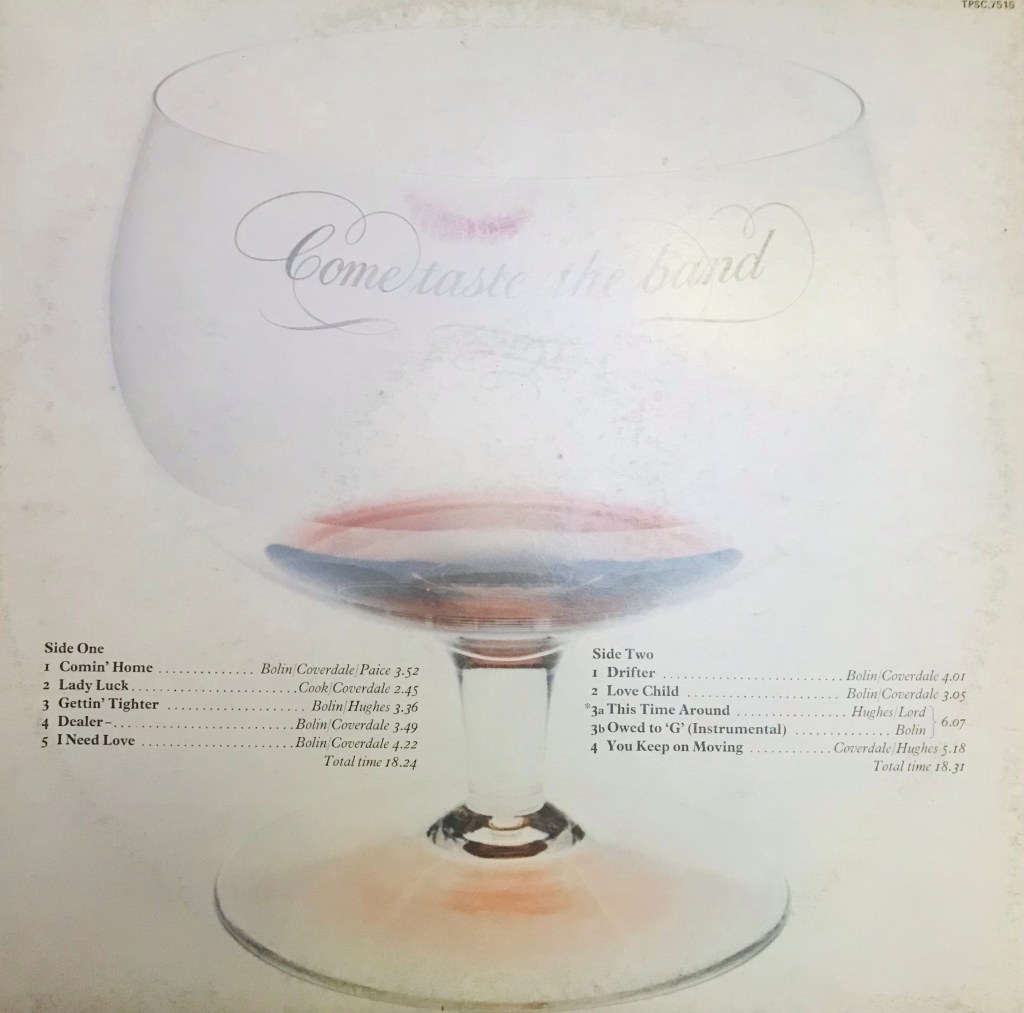
“Come Taste The Band” came out in 1975. It’s the usual production team of the band and Martin Birch.
The name Tommy Bolin came into my life because of Motley Crue. The Crue covered the song “Teaser” for a Compilation album and they also released it on a Raw Tracks CD made for the Japanese market, which I got my hands on. The song is so good and sleazy it sounded like a Crue original and I was curious to hear more from Bolin.
So as I was going back into the career of David Coverdale because of Whitesnake’s attention grabbing 87 LP, I was doing the same for Tommy Bolin.
So I got my hands on the “Teaser” and “Private Eyes” album first and imagine my surprise when I came across an album that had both Coverdale and Bolin on it.
Comin’ Home
Written by Tommy Bolin, David Coverdale and Ian Paice with vocals provided by Coverdale.
This song rocks out of the gate paying homage to the fast rock sounds of Deep Purple MK1, MK2 and MK3. But it was more Grand Funk, like “We’re An American Band”.
Lady Luck
Written by Jeffrey Cook who co-wrote songs with Bolin for the “Teaser” record with lyrical contributions from Coverdale.
Vocals are provided by Coverdale. In didn’t really do much for me.
Gettin’ Tighter
Written by Bolin and Hughes with vocals provided by Hughes.
This song is funky out of the gate, and sleazy once the whole band comes in.
Dealer
Written by Bolin and Coverdale with vocals provided by Coverdale and Bolin.
It’s very Hendrix “Purple Haze” like in the riff departments with a Beatles like Folk Rock interlude which Bolin sung.
I Need Love
Written by Bolin and Coverdale with vocals provided by Coverdale.
I like the groove on this, and the way the verse riffs are played out with the heavy synth from Lord.
Drifter
Side 2 begins with this song written by Bolin and Coverdale with vocals provided by Coverdale.
It’s got a great Intro which reminds of “You Really Got Me” or “American Woman” and check out the groove that comes in once the drums and bass kick in.
Coverdale’s bluesy voice is a highlight.
At 2.36 there is just a bass and keys section over a drum groove. It reminds me of things that Rush would do.
Then Bolin comes in, with volume swells and a solo begins. The drums and bass become busy as they build it up, and the vocals come back in. Its brilliant, it gives me goose bumps all the time, so press play just to hear that.
Love Child
“Heartbreaker” anyone. Press play and listen to the intro.
Written by Bolin and Coverdale with vocals provided by Coverdale.
The verse groove and riff are my favourites even though the whole “love child driving me wild” lyric didn’t set the world on fire.
At 1.50, they go into a progressive rock style groove and Lord solos over it.
This Time Around / Owed to ‘G’
Written by Hughes, Lord and Bolin with vocals provided by Hughes.
It’s very progressive sounding, like ELO and it moves into a great instrumental jam over a 12/8 groove with excellent lead guitar from Mr Bolin himself.
You Keep On Moving
Written by Coverdale and Hughes with vocals provided by Coverdale and Hughes.
This is the standout track. Its haunting and melancholic and it was written during the “Burn” sessions but not used.
Norway, Sweden, Denmark, Holland, Czechoslovakia and West Germany all got behind this version of the band. The Japanese still loved em and New Zealand loved em even more.
But.
The classical progressions and jams had been replaced with groove, soul and funk. It could be seen as an early Whitesnake album, as a few tracks have “Love” in the title, which is similar to every Whitesnake album.
Also in 1975, Tommy Bolin had two records competing against each other, which probably wasn’t the best scenario for Deep Purple however I have seen “Teaser” album pictures with a sticker on em that said “Guitarist Of Deep Purple”. Since most of the songs were written by Coverdale and Bolin, the project could have been billed as Coverdale/Bolin.
After the tour for this album finished in March, 1976, Deep Purple MK4 was no more. Glen Hughes was already having issues and was in and out of rehab. David Coverdale would form Whitesnake and get Jon Lord and Ian Paice into the project. And Tommy Bolin by December 1976, was dead from drug intoxication as morphine, cocaine, lidocaine and alcohol were all found in his system.
“Stormbringer” came out about 9 months after “Burn”. In the space of a year, Deep Purple were busy writing and recording frequently.
What a novel idea.
Try and tell that to a lot of acts, who want to record an album every three to five years. And the usual argument of ‘no money from recordings’ doesn’t work, because even back in the 70’s, the acts were getting ripped off on the sales part. So they had to tour to make coin. Then again it was normal in the 70’s to release an album a year. It was expected.
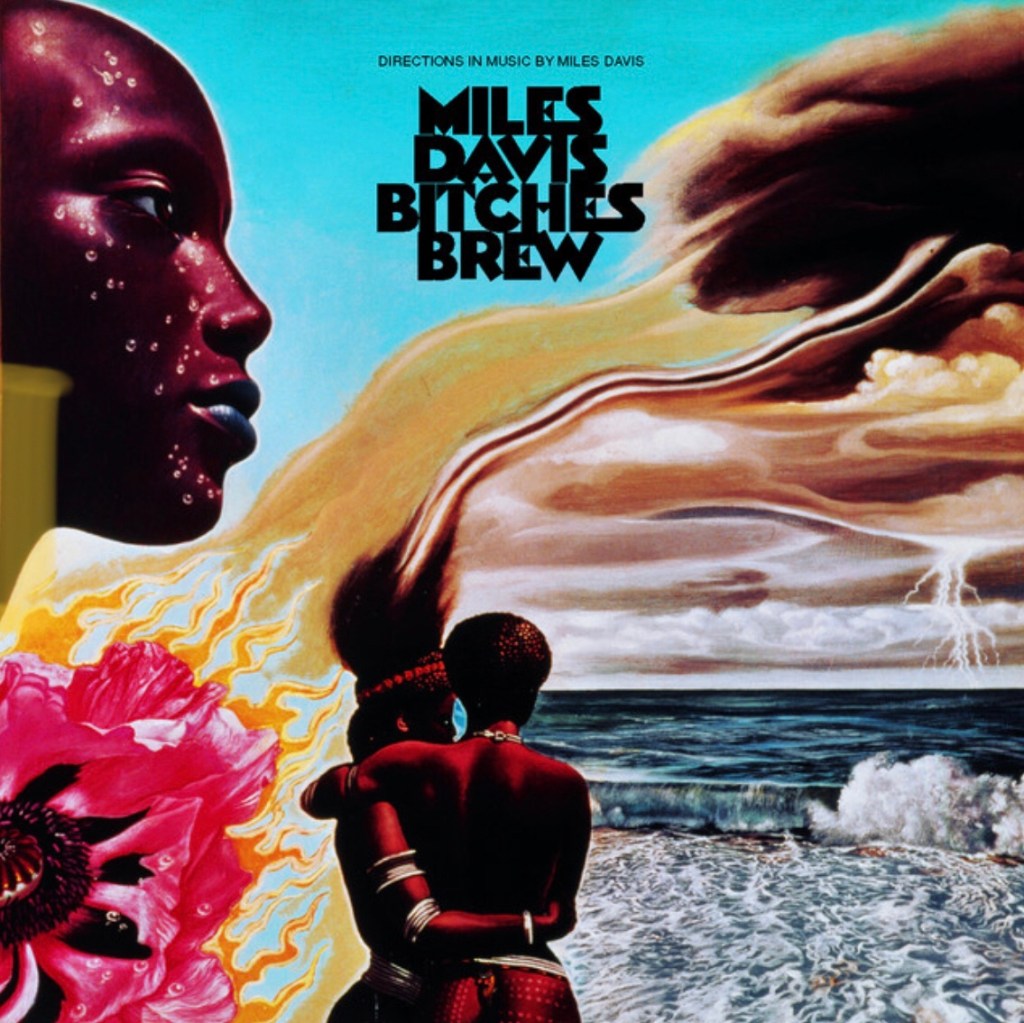
The album cover also has a story, about a tornado in a U.S town during the 1920s which was photographed and added to the Copyright free archives, which allowed the image to be used.
And the same photograph was used for Miles Davis’ album “Bitches Brew” in 1970.
And Siouxsie and the Banshees’ album “Tinderbox” in 1986.
MK3 Deep Purple is Ritchie Blackmore on Guitars, David Coverdale on Vocals (except “Holy Man”), Glenn Hughes on Bass and Vocals (except “Soldier of Fortune”), Jon Lord on Organ and Keys and Ian Paice on Drums.
Its Produced by Deep Purple and Martin Birch again.
Stormbringer
Another thunderous opener written by Blackmore and Coverdale.
If there wasn’t a Heavy Metal movement before, well there was one now. By 1974, each major rock act like Led Zeppelin, Free, Bad Company and Black Sabbath had a heavy song or two on each album that young blue collared youths would take and run with to create even heavier tracks.
I like the exotic flavouring in the solo. It’s not fast, but goddamn, it sounds progressive.
Love Don’t Mean A Thing
Written by Blackmore, Coverdale, Glenn Hughes, Jon Lord and Ian Paice.
This is the whole funk blues soul jam that Glenn Hughes brings. In saying that, the riffs here work so well within the Deep Purple sound.
Holy Man
The Bad Company/Free brand of hard rock had caught on and suddenly Deep Purple was doing a cut that wouldn’t be out of place on the first two Bad Company albums or Free albums.
If the intro sounds familiar, it should, as it’s a common progression used throughtout the 70s, but it went missing a bit in the 80s and came back in the 90s.
I recall Motley Crue using it for “Misunderstood”.
And Blackmore was not the main writer anymore as this song was written by Coverdale, Hughes and Lord.
Hold On
The funk blues rock in the verses grooves and the Chorus is like Soul Rock Music. Blackmore again is missing from the song writing credits, with Coverdale, Hughes, Lord and Paice listed as the writers.
Coverdale and Hughes share vocal duties here and Blackmore brings out his rockabilly Chuck Berry licks which gives way to a Jon Lord solo.
Lady Double Dealer
It’s that fast blues rock that Deep Purple was known for and something that David Coverdale would do a fair bit with the early versions of Whitesnake.
There is a cool Blackmore solo as well.
You Can’t Do It Right
Play that funky blues music white boys.
High Ball Shooter
I like the Intro as it always reminds me of another song which I can’t thing off right now.
The Gypsy
The riffs on this are metal like, but the way Blackmore delivers em, it’s almost progressive like, with a fusion of blues, southern rock and metal like grooves.
Soldier Of Fortune
A great acoustic ballad to end the album, something which David Coverdale would recreate with “Sailing Ships”.
The long jam sessions from the past had disappeared. Replaced with a more structured song arrangement. It’s a bridge between this album and their next album.
Blackmore obviously didn’t like this new direction and left after the tour. And he wasn’t one to keep his thoughts to himself, so he publicly declared his dislike for the funky direction the band was taking and made it clear that was the reason why he left.
But Scandinavian Melodic Rock and Metal was being born with the MK3 albums as they did big business in Sweden, Norway, Denmark and Finland. Austria and Germany also liked this era, along with the UK, France and the U.S.
“Black Dog Barking” is album number three, released in May 2013 via Roadrunner Records.
By now, everyone knew that Airbourne sounds like AC/DC.
But on this album, they amped up the AC/DC sounds with a bit of 80s rock like Cinderella and the first two albums from Def Leppard along with some Euro Metal like Scorpions.
And those backing vocals.
The Personnel for the album is Joel O’Keeffe on Vocals and Lead Guitar, David Roads on Rhythm Guitar, Justin Street on ass and Ryan O’Keeffe on Drums.
Producer Brian Howes has worked on the slick productions with Nickelback and Puddle Of Mudd, but on this album he captures the energy of the band performing live.
Ready to Rock
The blast out of the gate with it. It’s loud, aggressive and it feels like a circle pit punch up in a pub.
Animalize
I think of Kiss and Paul Stanley singing this tune.
No One Fits Me (Better Than You)
A take on “Let Me Put My Love Into You”.
Back in the Game
This one is the best song, bringing that Acca Rock and Euro/80s Rock vibe. There are Whitesnake, Cinderella, AC/DC and Scorpions influences.
Firepower
This one reminds me of “Let It Go” from Def Leppard in the verses and I like it.
Live It Up
The whole Intro is Acca Dacca with that open string acting as a pedal point while a melodic riff is played on the other notes. Think of the Intro to “For Those About To Rock”.
Woman Like That
This could be on a Bon Jovi album or a Cinderella album and not be out of place.
Hungry
Another favorite, which borders on speed rock.
More WASP like and it has a cool Spanish like guitar lead,
Cradle to the Grave
Crank it and enjoy. While the verses are stock standard hard rock, the Chorus has some of that Euro arpeggios.
Black Dog Barking
It closes with the barking and aggressive title track.
Airbourne does what they’re good at, the same way that AC/DC does what they’re good at.
Its better produced and the songwriting is concise, as the album is done in under 38 minutes.
This is rock’n’roll, the way it should be. Loud, aggressive, dumb and no ballads.
And Joel O’Keeffe gets a lot of credit for his vocal chops, i also believe that his Lead Guitar playing should also get some notice.
The problems began with a project tentatively titled “Tall”. This project was being produced by Chris Robinson, which his brother Rich objected to. And as brothers do, they got into a huge fight.
The reason for the fight was that Chris wanted to strip back the sound of the Black Crowes. More horns and percussion and less guitars. But his bro, Rich is the guitarist.
In the end, Rich won the argument and the result of this project are the re-recorded songs that Rich Robinson predominantly wrote, which made up the “Amorica” album. This pissed Chris off as his songs were ignored.
So it’s no surprise that during the “Amorica or Bust” Tour of 1995, the relationships within The Black Crowes soured even further, and the Robinson brothers basically hated each other.
But they made it through somehow.
And the band began planning their fourth album in 1995. “Three Snakes and One Charm” was eventually released in July 1996. Recorded in a house that they shared together, the album captures a relaxed band, ready to plug in and jam with friends.
The Black Crowes for this album are Chris Robinson on Vocals, Rich Robinson on Guitar, Marc Ford on Guitar, Johnny Colt on Bass, Steve Gorman on Drums and Eddie Harsch on Keyboards.
The Dirty Dozen horn group appears, along with banjo players, pedal steel players and various backing vocalists. Basically some of the stuff that Chris Robinson wanted to implement earlier was being brought in.
Under A Mountain
I like the exotic Zep vibe on this.
Good Friday
I disliked this song when I first heard it and when I covered The Black Crowes in The Record Vault post a while ago, I ignored it, but goddamn, time passes, moods change and suddenly the Country Soul Rock vibe of the song is hooking me in.
Nebekanezer
If the title doesn’t capture me, I’ve already formed a bias against the song. And while the song has a sludgy Blues groove with a little bit of a Beatles influence in the vocals, there isn’t enough meat to satisfy.
One Mirror Too Many
The Yardbirds, The Rolling Stones and the psychedelic 60’s and 70’s are re-incarnated into this song.
Blackberry
Soul Rock was big around this time in Australia because of the movie “The Commitments” which came out in 1991.
Girl From A Pawnshop
It was my favourite track when I first heard the album and it still is today.
The whole country ballad rock vibe just connected with me and the vocal delivery from Chris Robinson is excellent.
Only Halfway To Everywhere
With the horns, guest vocalists and Chris Robinson bordering between BB King and Steven Tyler vocally, this song feels like a group of musos getting together and having a jam session, with a lot of booze flowing.
Bring On, Bring On
Like other songs on this album, it’s the Led Zep acoustic influence which shines through on this track that hooks me in.
How Much For Your Wings?
The reddest of lights shine on you, young man, let God be with you..
And the acoustic guitars start and there is something about the vocals when Chris Robinson sings, “how much for your wings?” that captures me.
Let Me Share The Ride
A blues groove, but the horns give it that soul rhythm and blues feel.
Better When You’re Not Alone
More acoustic guitars and then the band kicks in. And I feel like I’m driving on the open road out of my town, hopeful and excited.
Evil Eye
It’s too psychedelic for me.
And they went on tour for this album, which took em towards the end of 1997. After this, the band got together and recorded another album with the working title of “Band”.
Which was also scrapped.
Guitarist Marc Ford was fired and bassist Johnny Colt subsequently left the group, dissolving the Crowes’ line-up of the previous three albums.
The unreleased tracks from the “Tall” and “Band” sessions surfaced among tape trading circles and were later officially released on the 2006 compilation “The Lost Crowes”.
The success of “Hush” in 1968 was more luck than anything. After that they struggled while Richie Blackmore kept evolving the band and the sound. Once the MKII version was in place, things started to change.
“In Rock” was released in 1970 and it definitely got people really interested. “Fireball” came quickly in 1971 and is often overlooked, but it kept the momentum going. “Machine Head” broke the band to a bigger audience in 1972 and in order to capture that success, the label released a live album called “Made In Japan” in December 1972.
Four albums in three years.
And then at the height of their fame, they dropped “Who Do We Think We Are” in 1973, their seventh studio album overall and fifth album in four years.
It would also be Deep Purple’s last album with singer Ian Gillan and bassist Roger Glover until 1984’s “Perfect Strangers”.
Fame is definitely a funny thing. You bust your ass to get there and then break up once you there.
Because of the touring, the album was recorded in two stages.
In July, 1972, they had some time in Rome to write and record new songs via the Rolling Stones Mobile Studio. The songs from these sessions that are known are “Woman From Tokyo” and an outtake known as “Painted Horse”.
In October, 1972, they had some time to do the same in Frankfurt, West Germany. This is where the remainder of the songs were completed.
Woman From Tokyo
It was the first track recorded in July, written about their life on the road and touring Japan for the first time. It’s also their best track from this album.
As soon as the drum groove started I was thinking of “Run To The Hills” from Maiden.
Mary Long
Ian Gillan combined the names of two people who represented things he hated in the prudish older generation of the time, which made him question how they even had sex.
How did you lose your virginity Mary Long?
It feels like a Lynyrd Skynyrd cut. But this is Deep Purple, the masters of speed, heavy and melodic rock, with a flourish of blues.
Super Trouper
It’s almost like early AOR blues rock, something that bands like Foreigner and Survivor would use on their earlier albums.
It’s short but it gets me interested.
Smooth Dancer
The comparison to “Speed King” was always going to happen.
And Jon Lord owns this track with his honky tonk piano and neo-classical Hammond organ solos.
Rat Bat Blue
I like the blues rock riff that starts this song off. A young Jake E Lee, would have been woodshedding this riff, ready to unleash it with Badlands.
Then the keyboard solo kicks in, over another groovy riff by Blackmore and suddenly power metal is born in Finland.
Place in Line
ZZ Top comes to mind here. It’s got that Texan strut, which is a bit different to the way the Brits did the blues.
Our Lady
It reminds me of The Beatles and I like it.
Actually it reminds me of the song “The Real Thing” from Russel Morris who was an Australian artist from the mid 60’s. The song was a hit in Australia and the U.S and it’s got that Beatles influence.
Painted Horse
This track was released on the Anniversary edition.
Blackmore would also use the riff from this for “Man On The Silver Mountain” with some minor tweaks.
Musically, it was a move to a more blues-based sound, and the album was criticized for its American sounding songs in the U.K, for “Super Trouper” and “Smooth Dancer”.
And when Gillan and Glover left, everyone thought the band was done. But not Richie Blackmore. He had other ideas and MK3 was about to be born.
This version would release two of my favorite albums would be released.






 destroyerofharmony