Music, My Stories, Piracy, Stupidity, Treating Fans Like Shit

When Governments Screw With Music (And Everything Else)

Raise the price of cigarettes and people don’t quit smoking. They buy their smokes from the guy in the back alley with a duffel bag full of Marlboros. That’s the reality in Australia right now. The tax man thought he was going to nudge people into clean lungs and longer lives. Instead, he just created a booming black market.

And it’s not new. America tried it with booze. Prohibition was supposed to turn sinners into saints, but it made millionaires out of gangsters. The War on Drugs? Same story. You criminalize a behavior, you don’t kill demand, you hand it over to the underground.

Music lived this too.

Remember blank CD levies? The government thought, “Well, everybody’s copying music, so let’s tax the media.” You couldn’t even buy a spindle of discs for backing up photos without paying a piracy tax. Did that stop Napster? No. It just made fans hate the industry more. It turned the record labels into the bad guys and turned piracy into a cultural rite of passage. You weren’t just burning a CD, you were sticking it to The Man.

And those anti-piracy lawsuits? Suing twelve-year-olds for downloading Metallica? It didn’t scare people straight. It normalized piracy. It made Kazaa, LimeWire, and torrents explode because everyone suddenly knew where to find free music. If the government and the industry hadn’t been so hell-bent on control, maybe Spotify would’ve shown up ten years earlier.

Same deal with tickets. Governments ban scalping to “protect fans.” What happens? Scalpers just go underground. Paperless tickets, ID-only entry, sounded good on paper. In practice? Fans locked out of shows they paid for. Friends couldn’t swap tickets. And the black market didn’t disappear, it just got meaner, riskier, full of counterfeits. Meanwhile, Ticketmaster legalized scalping with “dynamic pricing.” The very thing the government said was illegal in the parking lot became policy inside the system.

That’s the lesson nobody in power ever learns: you can’t legislate away desire. You can distort prices, you can ban behavior, you can tax the hell out of things people want, but all you do is create shadow economies. You don’t stop smoking, drinking, downloading, or reselling. You just push it somewhere else.

The record industry thought it could dictate how people listen. Governments thought they could dictate how people live. And every time they try, the unintended consequences swamp the original plan.

Because people are wired to find a way. If the front door’s locked, they’ll kick open the side window. If you make the official channel impossible, they’ll build their own.

That’s the throughline, from cigarettes to booze to black market tickets. Governments and corporations think they’re playing chess. But the public is playing guerrilla warfare. And guerrillas always find a way.

Standard
Copyright, Music, Stupidity, Treating Fans Like Shit

Who Owns the Past? Preservation Is Theft Now

Because here’s the truth nobody wants to admit:

Every settlement is about money.
Not truth. Not justice. Not art.

Money.

The record companies don’t care about your dusty old 78s. They don’t care about preservation. They don’t care about whether some kid in Berlin discovers Billie Holiday for the first time and has their life changed. They care about the ledger. About squeezing every last nickel out of a format that no longer even exists in the real world, except as cultural artifact.

And the Internet Archive?

They care too. About survival. About keeping the lights on and the lawsuits at bay. You think they wouldn’t have fought this in court if they had endless money to burn? They folded because lawyers bill by the hour and the music industry has deeper pockets than any nonprofit ever will.

This isn’t about “illegal record stores.” No one is streaming Ella Fitzgerald off the Archive instead of Spotify. This is about control. About the labels saying, “We own history. We decide how you access it. We decide what survives.”

Meanwhile, the music is dying. It’s literally locked in grooves that disintegrate a little more every time a needle touches them. But no, preservation is theft now. Access is piracy. Knowledge itself is contraband.

The labels call it “copyright.” But let’s stop dressing it up: it’s rent-seeking. It’s gatekeeping. It’s an industry clinging to relevance by making sure no one else can touch the vault.

And the Archive? They’ll move on, quietly. Keep scanning books until publishers come for them again. Because that’s the gig. You build something for humanity, and eventually someone shows up with a cease-and-desist and a calculator.

So yeah. Every private settlement is about money.

But every one of these cases?

They’re really about memory. Who controls it. Who owns it. Who gets to say what endures.

And that’s the part that should terrify you.

Here is the article.

Standard
A to Z of Making It, Copyright, Music, My Stories, Stupidity

Four For Friday

It’s a SPOTIFY and HIPGNOSIS special today.

The article I am referencing is from Music Business Worldwide.

NEW ROYALTY MODEL

There will be an annual stream count that artists must meet in order to start generating Spotify royalties.

Spotify is targeting a tiny proportion of tracks on its service that are very low in popularity.

In total, the tracks Spotify is targeting, generate royalties that when combined add up to tens of millions of dollars a year. If no action is taken, these tracks accumulated together will generate around $40 million.

SO WHAT HAPPENS TO THE $40 MILLION?

It will go back into Spotify’s ‘Streamshare’ royalty pot.

And the monies in the pot will be re-distributed amongst the tracks that are, more popular.

Take from the poor so that the rich get richer.

Spotify is telling the world that this targets the royalty payouts whose value is being destroyed or who are not even being paid to the creators because they haven’t met the digital aggregator minimum level for payments. And they are sitting in their bank accounts, earning interest.

Spotify seems to forget that every artist begins with low plays/streams.

MMM. SO THIS HELPS THE ARTISTS HOW

So while Spotify is thinking of keeping streaming money in their bank account to pay the larger artists, Hipgnosis who is an investment fund is doing something fishy.

As you probably are aware, Hipgnosis purchased a lot of rights to valuable intellectual properties. It’s share price doesn’t reflect what the company believes it’s worth.

It wanted to do something sneaky to inflate or boost its share price by selling a stake of the company to another entity owned by Hipgnosis and to use the profits of the sale to pay down debt.

This was all contingent on some mathematical equations about retroactive Copyright payments from the US.

Hipgnosis estimated they were due USD$21.7M however when all the dust settled they are only getting $9.9 million.

So they had this share but back scheme which they have now shelved and their share price went down even further.

All of these schemes and creative accounts on the backs of the rights they own from artists.

And Yes, I do know that the artists sold their rights to Hipgnosis for a large fee.

Standard
A to Z of Making It, Classic Songs to Be Discovered, Copyright, Influenced, Music, My Stories, Stupidity

Four For Friday

PET SHOP BOYS vs DRAKE

The Pet Shop Boys need to relax.

The lyric in question is “the west end boys and east side girls”.

The lyrics are the main Chorus words for “West End Girls” by Pet Shop Boys and those same words are said three times in Drake’s song “All The Parties”, which is a shit song by the way.

And the words are not said with any sense of melody or to a backing track of music. They are just said. Spoken like and then auto tuned.

But “East End Girls” is at 239 million streams on Spotify so the Pet Shop Boys are very protective of their intellectual property.

COPYRIGHT TERMS

John Naughton writing for the The Guardian said the following;

…especially copyright – have been monopolised and weaponised by corporate interests and that legislators have been supine in the face of their lobbying.

Authors and inventors need protection against being ripped off.

It’s obviously important that clever people are rewarded for their creativity and the patent system does that quite well.

But if a patent only lasts for 20 years, why on earth should copyright last for life plus 70 years for a novel?

Yes why should it.

When the songs from the 60s were recorded, the Copyright terms for the songs was 28 years with the chance to renew for another 28 years. A total of 56 years.

And yet those songs got retroactively locked up for a long time by a 1978 Amendment to the Copyright Act by Disney which changed the terms to “life of the creator plus 70 years”.

This would mean that Disney’s “Mickey Mouse” created in 1928 and based on the laws of the time, should have been out of Copyright by 1984 however it would be locked up until 2003.

But in the late 90s and with the 2003 date looming, another Disney amendment was made that extended this law for Corporate works to 95 years. So the Mickey Mouse work from 1928 would finally be out of Copyright in 2023.

And 10 months in, Disney hasn’t suffered the financial losses they said they would if they lost the rights to Mickey Mouse.

SITE BLOCKING

In Australia, the Labels and the Movie/TV networks can go to the Federal Court with a list of sites they want blocked and the Federal Court will just approve the lists and the ISPs will then need to block their users from accessing these sites

The Federal Court is meant to review the lists (which they don’t) before rubber stamping the lists (which they immediately do). Because hey, these entities are the good guys, trying to protect Australians from pirates. And the ISPs need to do their bit to protect the business models of the labels and studios.

WHAT I’M CRANKING RIGHT NOW

Savior from Rise Against.

I became a fan because of the Guitar Hero game this song featured on many years ago.

And at 618 million streams it’s definitely making money for whoever holds the rights to it.

Standard
Copyright, Derivative Works, Music, My Stories, Piracy, Stupidity

Four For Friday

When I started these weekly posts it was a means to keep me blogging during a hectic schedule.

And there was no definitive structure as to what I would cover. But I can see that Cooyright issues keep appearing.

And here is another week devoted to that beautiful term. Copyright. Which was designed to give the creator a limited monopoly on their works so they could create more works.

LETS GET IT OVER WITH

Ed Sheeran can’t get a break. Last week, the case against him from the daughter of Ed Townsend was dropped.

But this week, an organization called “Structured Asset Sales”, (SAS) have started their own litigation.

They control a different one-third stake in Townsend’s copyrights. They “own” the basic notation (musical score) filed at the Copyrights Office decades ago.

When the original case was happening, (SAS) was also a part of it, seeking a “monopoly over a basic musical building block.”

Their case was also thrown out.

But they are appealing their part. Because hey, they created nothing and believe they should be paid for creating nothing. And they want a monopoly on a feel and style.

A big reason why Copyright had expiry terms initially was to stop all this crap. Politicians had a foresight back in the early 1900s to see this coming.

And that changed in the 60s when the labels and book publishers started to amass intellectual property and then started to lobby politicians to change laws and bring in new laws to give these corporations a monopoly on the works.

It’s funny now, how the labels are also getting sued from the very laws they sponsored to benefit them.

124 WEEKS

In April 2021, UFC fighter Jake Paul knocked out Ben Askren in less than two minutes.

Soon after, the popular H3 Podcast on YouTube commented on the fight and showed a clip of the fight.

Event promotor Triller wasn’t happy and issued a copyright infringement lawsuit demanding $50 million in damages.

H3 opted for a fair use defense.

The case is now in its 124th week.

The clip of the fight was 119 seconds long.

Who are the real winners here?

URUGUAY

The Uruguayan Government has a bill in motion which would allow artists to go direct to internet platforms like Spotify and social media sites like Facebook for compensation.

Spotify would still need to pay the existing licensing agreements and if this bill goes ahead could be forced to pay again to the artists direct.

I’m all for artists getting paid but the problem lays with the entities who hold the rights to the songs. They get the majority of the streaming pool and they don’t distribute it back to the artists.

This is a perfect example.

Spotify still needs to honor the licensing agreements with the labels and publishers so these organizations will receive their cut.

And if they are aware of the artist going direct, I am sure that some creative accounting will take place to hold back any payments to the artists.

Anyway. Spotify isn’t happy with the bill and unless it’s changed they will pull out of Uruguay.

As a byproduct, the local music industry which has been growing 20% from streaming revenue will have this source of income come to zero.

ALBERT NAMATJIRA

Albert Namatjira died in 1959. He was an Aboriginal artist, painting the Australian landscapes in watercolors.

The copyright in his art is due to expire in 2029, 70 years after his death.

This means the works will be part of the public domain and anyone can use them in their works moving forward.

But lawyers for the family are arguing that Copyright should last in perpetuity. Forever. Never expire.

And they are pissed.

The issue here is that the family were getting royalties for his art up until 1983. At that point in time, the government trust that administered the rights sold them to a private organization and the royalties ceased.

It took the family 34 years to get the rights back in 2017, with the proviso they need to relinquish them again in 2029.

Furthermore in the last 5 years, Namatjira’s art has exploded in popularity and has become a valuable intellectual property.

But Copyright was never meant to be a reversionary pension fund.

Standard
A to Z of Making It, Copyright, Music, My Stories, Stupidity

Four For Friday

Copyright and Spotify again.

SHARE PRICE

It’s cool how copyright makes money for valuable Intellectual Property. And you can’t get a bigger and more valuable IP than “The Beatles”.

The thing is, not one of the members from The Beatles held or even hold their rights. At one stage, Michael Jackson was the sole holder of the rights.

And with all the transfers and sell offs, The Beatles catalog settled at Round Hill Music Royalty Fund. But like all companies on the stock exchange, the share price just didn’t reflect the true value of the Company.

In this case, shares in the company were trading around $0.70. And share prices this low don’t make share holders and board members happy.

So in comes Alchemy Copyrights with a $496 million buyout offer which means shareholders in Round Hill Music will get $1.15 in cash per share. Suddenly, you have happy shareholders and board members, who get a nice payday for holding shares in culture.

They created nothing culturally and yet still benefit. But I keep hearing how stronger copyright is needed to protect the creators.

Mmmm.

SHARE PRICE 2

Hipgnosis Songs Fund is also selling some of its catalogues for $465 million. This is to pay down debt and increase its share price

And as expected, the share price increased,

Again, you have an organization that created nothing culturally and yet it still benefits. And I keep hearing how stronger copyright is needed to protect the creators.

COPYRIGHT FAMILY DISPUTE

Motown songwriter and producer Ron Miller died in 2007. If Copyright expired on the death of the creator like it once did, then this would be a non issue.

But, Copyright doesn’t expire at this point. It’s still valid for another 70 to 90 years, depending on the country.

Fast forward to 2022, Sony Music Publishing signs a deal with Lisa Miller, for rights to 130 of her fathers songs.

But Ron’s other children Julie Moss and Mark Miller from Ron’s first wife didn’t like this and are now going to court.

They allege that Lisa Miller tricked her mother, Aurora Miller (Ron’s second wife) to sign away her claim to the songs.

The claim further states;

“As Aurora’s health continued to decline, Lisa began forging Aurora’s signature on notices of copyright termination.”

And I keep hearing how stronger copyright is needed to protect the creators. In this case a dead creator.

SHOWCASE

Spotify’s new marketing tool.

Artists can buy dedicated space on listeners home pages to promote new releases, deep cuts, etc.

Each click from a fan on the showcase button will cost the artist 40 cents per click until their campaign budget is maxed.

Spotify believes that people who see these ads are six times more likely to stream the release.

It shits me how artists always have to cough up cash.

Back in the label days, if the label marketed you, they billed you to recoup their costs.

If an independent act marketed themselves, they paid for a marketing campaign themselves.

Standard
Copyright, Music, My Stories, Stupidity

Four For Friday

Censorship, false strikes and political correctness makes up the post today.

FAT BOTTOMED GIRLS

The lyrics “fat bottomed” and “big fat fatty” and “Oh, won’t you take me home tonight” are deemed to be inappropriate for a Queen’s Greatest Hits package and songbook aimed at children.

What’s next.

A Motley Crue or AC/DC Children’s song book.

If people want to dumb down lyrics and make them politically correct they should let shows like “The Voice” do it.

DRAGONFORCE

It’s the Wild West when it comes to Content ID on YouTube. An unknown internet user claimed the song “Valley Of The Damned” from Dragonforce as their own and YouTube allowed em.

Because there are no human checks.

Since Dragonforce disagreed with the decision by Content ID, they filled in a form disputing the decision.

But this is where it gets stupid.

You would think that the dispute would go to someone (preferably a human) at YouTube.

However, the counter claim from Dragonforce is sent directly to the person who sent the false strike and who YouTube now believes owns the supposed copyright.

And it’s this person who has the final decision in the matter unless legal action is pursued.

If the person who sent the false strike denies Dragonforce’s claim, the Dragonforce channel receives a strike. If the channel receives three strikes, it is removed from the platform.

So Dragonforce went back and forth for a week over the false strike and finally some common sense prevailed.

CONTENT ID

Content ID was created by Google to appease the labels and various movie studios to take videos offline. It was then enhanced to give the labels and movie studios an option to monetize the uploads from other users.

The labels and studios keep complaining about Content ID but have done nothing to innovate an alternative.

Google now posts a transparency report on the Content ID system.

Rightsholders claimed more than 826 million videos on YouTube from July to December 2022. This is the highest figure since YouTube started reporting these figures and it led to $1.5B in revenue paid to the rights-holders.

All up, $9 billion in ‘claimed’ revenue was paid out to copyright holders since Content ID launched.

SCAMMERS

The downside is scammers. As this article from Torrentfreak states;

Two men set up a company to find and claim unmonetized music. Through a third-party partner with access to the Content ID system, the pair generated over $24 million in revenue from YouTube by falsely claiming ownership.

The abuse didn’t go unnoticed and the repercussions were severe.

In 2020, the U.S. Department of Justice indicted the duo and last week the first defendant was sentenced to more than five years in prison.

It’s unregulated and there will always be criminals. It’s a perfect match.

Standard
A to Z of Making It, Copyright, Music, My Stories, Stupidity, Treating Fans Like Shit

Four For Friday

It’s all about the money in music and the lawsuits which come about because of it.

THE GREAT 78 PROJECT

The “Great 78 Project” from the Internet Archive is digitizing 78-rpm records from the early 1900s until the 1950s.

78rpm records are some of the earliest musical recordings, and were produced from 1898 through the 1950s when they were replaced by 33 1/3rpm and 45rpm vinyl records.

The Archives asked people to donate their albums so that the cultural past survives for future generations to study and enjoy.

At the moment the collection is at 400,000 plus recordings. The majority of these 78s are forgotten and the 78rpm versions are not on streaming services.

Sounds great right. Preserve some cultural history from donated records and provide access to people to enjoy.

But the labels don’t get paid when this happens and suddenly don’t like it.

Universal, Sony and other labels (as part of the RIAA) are suing for copyright infringement.

The labels’ have used colorful phrases to describe the “78 Project”, as an “illegal record store”.

From the 400K plus songs, the labels named close to 3K sound-recording copyrights that the Archive allegedly infringed.

And they want $412 million for it because as far as the labels are concerned the music is available on streaming services.

The Great78 project, is not a substitute for music streaming services like Spotify or Apple Music.

When you listen to it, you hear that the music was digitized from the 78rpm record.

You get the crackle and the hiss of the record. It is a totally different version from the clean remastered versions you hear on music streaming services.

It’s ridiculous that it’s even an issue.

SIRIUS XM

SoundExchange, is responsible for collecting and distributing digital music royalties.

Sirius XM is responsible for playing music and paying digital royalties.

SoundExchange claims that Sirius XM is performing some creative accounting by inflating the revenue from its webcasts so it pays less in music royalties to the tune of $150 million.

Isn’t it funny how the labels and publishers go straight to litigation when someone else like Sirius XM does the exact same thing that they did to artists for 80 plus years.

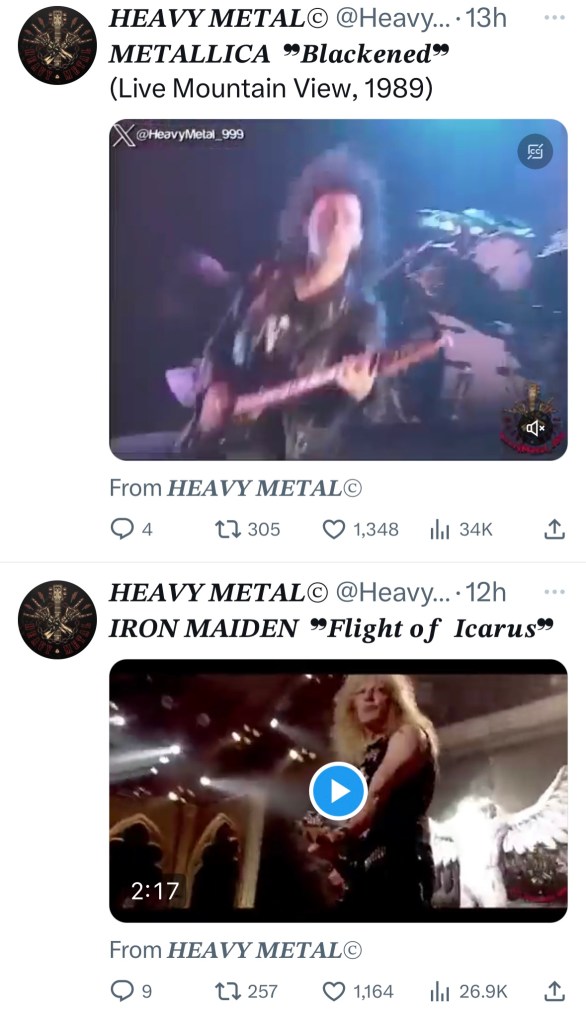
Twitter/X

Twitter/X users put up snippets of live concerts, music videos, interviews and basically themselves jamming to their favorite music or playing the vinyl or CD of their favorite music.

Posts like these.

Two minute snippets of live performances that someone recorded which isn’t the user.

Or something like this.

Footage from a concert that the user attended and shared on the platform.

The users on other social media sites do the same thing.

But the RIAA, the labels lobbyist and litigation arm don’t like it.

They have accused X Corp of breeding mass copyright infringement because the company fails to respond to takedown notices and lacks a proper termination policy.

For this crime, the labels want $250 million from X Corp.

Elon Musk wants the case dismissed and his legal team have asked the courts to consider it as the labels have no hard proof of any wrong doing.

$3 MILLION PER HOUR

It’s the combined amount of how much the labels made in the first six months of 2023.

And they made that money because they have schemed, paid or legislated their way into owning the rights of a lot of music.

The music created by artists in bedrooms, parents basements, hotels, tour buses and at soundchecks, the labels now own.

And they will own these rights for the life of the artist plus 70 years after their death. In some jurisdictions, it’s 90 years after their death.

Final Note

The artists who create culture and value are never in the conversation. Even if the labels (and the RIAA) get all the monies paid to them, they will not share any of it with the artists.

And it is the artists who gave them this power to litigate, by signing away their rights in shitty contracts so they could have a recording career. And maybe a chance to make it big.

Standard
A to Z of Making It, Copyright, Music, My Stories, Piracy, Stupidity

Four For Friday

RIAA POWERS

How much power is too much power?

Two years ago, the RIAA won a piracy lawsuit against two sites that offered YouTube-rippers. For those that don’t know, these sites allow the user to turn a YouTube video into an mp3.

After the verdict, the RIAA demanded $83 million in damages from the site owners.

And suddenly, there was an appeal.

As the TorrentFreak article explains;

“If the record companies can really get multi-million dollar judgments without having to prove a single instance of infringement within the United States, then no one who operates a website is safe,” Gurvits (Defense Lawyer) said at the time.

There has to be some onus on the RIAA to prove infringement.

And they can’t because they don’t know who infringed.

It’s easy to get a techie to run a report and say that the YouTube ripping sites were accessed by U.S IP addresses. But. It’s not easy to prove who is responsible when their evidence is made up of IP addresses.

But accessing the sites doesn’t constitute Copyright infringement. And the RIAA cannot prove what infringement took place or what videos from YouTube were turned into mp3s.

So why is the law allowing them to bring cases to trial without this proof.

JASON ALDEAN

The song “Try That In A Small Town” came out in May 2023 and it was out of the public conversation. It was a dud and no one cared enough to listen to it. His true fans did but no one else.

Then someone (Critic Zero) started the backlash against the song in the middle of July, 2023 and by doing so, they amplified the song by providing much needed free marketing.

The criticism then spread to other blogs and news outlets faster than Covid and as a by product the streams and downloads of the song kept going up. In the space of two weeks the songs Spotify numbers went from 1.5 million to 12.3 million.

To top off the controversy, Aldean and his team had to edit the music video because it contained footage which was copyrighted.

SPOTIFY INCREASE

The price of Premium Family is changing from A$18.99/month to A$20.99/month.

My favorite part is the reason Spotify gives for the increase, which is word for word to what Netflix gave a year ago;

We’re increasing the price of Premium Family so that we can continue to invest in and innovate on our product offerings and features, and bring you the best experience.

Really.

It’s nice to know that Spotify is using subscription money to pay people for podcasts that a lot of their customers don’t like.

BAND I’M SEEING

I’ve got tickets to watch “The Night Flight Orchestra” in Sydney next Friday. Readers of the blog will know that I am a fan. Each album has been reviewed glowingly.

In case you are interested.

You can read the debut album “Internal Affairs” (2012) review here.

“Skyline Whispers” (2015) is here.

“Amber Galactic” (2017) is here.

“Sometimes The World Ain’t Enough” (2018) is here.

“Aeromantic” (2020) is here.

“Aeromantic II” (2021) is here.

SONG IM LISTENING TO

“Crime Of The Century” by Revolution Saints. It’s a great piece of melodic rock and that Chorus just sticks around forever.

My review of the recent album is here.

Standard
A to Z of Making It, Copyright, Music, My Stories, Stupidity

Fair Recognition

Work For Hire agreements are crap.

The term was never mentioned when it came to signing an artist to create content. It became a thing, when the corporations had to find a legal loophole to use against the creators trying to get their rights back, even though Copyright law states they can get their rights back after a certain period.

A work made for hire, is a piece of copyrightable work created by employees as part of their job or as part of a limited type of commissioned work for a flat fee. In the United States and certain other copyright jurisdictions, if a work is “made for hire,” the employer, not the employee, is considered the legal author. In other words, the creator of the work gives up all ownership and administration rights for a flat fee.

The earliest use of “Work For Hire” was in the arts industry like comic books and artists who designed album covers. Marvel is no stranger to these kind of cases. Stan Lee (creator of most things Marvel), Gary Friedrich (creator of Ghost Rider), Joe Simon (Captain America creator) and Jack Kirby (illustrator/artist on the Stan Lee projects) are a few names that had litigation cases brought against Marvel.

The Superman creators wrote an article hoping that the original Christopher Reeve movies bomb at the box office because they weren’t fairly compensated. The movies did the exact opposite.

Read this Billboard interview with Don Henley, who is very interested in artists rights. While I agree and also disagree with Henley’s views on a wide range of topics, one thing is certain; Henley cares. As a member of The Eagles, and after being a Copyright rookie, he schooled himself on what his entitlements are as a creator. Don Henley owns his post 1978 work as a member of The Eagles and as a solo artist. He knows that his pre-1978 works can be reclaimed from 2028 due to another sneaky Copyright addition for pre-78 works.

If you don’t want to click on the Billboard link, here is the question from Billboard and Henley’s answer.

QUESTION:

The first issue you were known for being active on was the effort by the labels to have recordings considered “works for hire” — which I think was the origin of the Recording Artists Coalition. How important was the coalition in stopping that? And you learn anything from it?

In 1999, the lobbying group for the major labels, the RIAA, buried a fundamental change to the Copyright Act in a completely unrelated bill, the Satellite Home Viewer Improvement Act of 1999.

Without input from the artists, they amended the definition of ‘work for hire’ in the Copyright Act to include ‘sound recordings.’

The consequence of this amendment would have been devastating for recording artists. It would have effectively eliminated artists’ ability to regain ownership of their sound recordings in the United States.

The ability of the RIAA to pass a bill which amended the Copyright Act without opposition from the creative community was a direct result of the labels being organized and the artists not having a coalition to represent their voices.

So, a group of artists and artist representatives mobilized and formed the Recording Artists Coalition (RAC). Thanks to the many artists who spoke up, and the support of Congressman Howard Berman, sound recordings were stricken from the definition of ‘work for hire’ in the Work Made for Hire and Copyright Corrections Act of 2000. The only reason that recording artists can now regain control of their copyrights from the labels in the U.S. as Congress intended is because the RAC organized and artists spoke up.

I am all for the creators getting proper compensation for their works. There is no way that a corporation told a creator what to create.

Can you imagine the absurdity of it all?

A Publishing House is going to tell Steven King or George Martin or Paulo Coelho what to write. Yeah, right.

Or a Music company is going to tell an artists what kind of song to create.

Those same music companies including Capital Records, Warner Bros. and Sony Music have been falsely registering songs as “made for hire” in order to send takedown notices to the various ISP’s and YouTube.

I’m sure that’s gonna work out well in the long run especially when the artists don’t know that the label is doing that.

Then again, it doesn’t always work out well. This is just one of many.

The cover to Aqualung from Jethro Tull was created by Burton Silverman. The artwork was commissioned and purchased by Chrysalis Records head Terry Ellis in 1971.

Silverman was paid a flat fee of $1,500 for the painting and there was no written contract.

The artist says the art was only licensed for use as an album cover, and not for merchandising; he approached the band seeking remuneration for the additional uses, such as printing it on T-shirts and coffee mugs.

And he got told to piss off.

Standard