Classic Songs to Be Discovered, Derivative Works, Influenced, Music, My Stories, Unsung Heroes

Back In Black

By early 1980, the band’s hard work ethic and songs about life had them on the summit. The next album was crucial. Bon Scott was living the dream with women and booze, Angus Young was getting married and the band started writing the follow-up to “Highway To Hell”.

Bon Scott was involved in early sessions (as a drummer) for songs that would become “Have A Drink On Me” and “Let Me Put My Love Into You”. After those sessions, Bon said to meet up in a weeks’ time as that would give him time to write some lyrics, however that next session never eventuated.

By mid-Feb, 1980, Bon Scott was found dead in his car, and depression set it on the Young brothers. By mid-March, and on the back of words said by Bon’s father, Malcolm called Angus to start working again, just the two of them, no one else. In these sessions post Bon’s death, “Back In Black” would be written.

They finally auditioned some singers and Brian Johnson was hired. With the band complete, they went to the Bahamas to start writing and recording in stormy weather. And as much as the storms come to disrupt our lives now and then, they also clear the path. The bad weather led to “Hells Bells”. “Rock And Roll Aint Noise Pollution” was the last song written.

For the lyrics, a lot of ideas, choruses and melodies were already written by Malcolm and Angus before Brian joined. Stories exists that the brothers took the lyrics from Bon Scott’s notebook, which Angus denied in a Guitar World interview, saying, that all of Bon’s notebooks went direct to his parents.

Released in July, 1980, it was certified as Gold and Platinum in October, 1980 in the U.S. 

And these U.S certifications continued as AC/DC kept on releasing albums in the 80’s which no one bought, because everyone was still buying “Back In Black”.

By October, 1984, it was 5x Platinum and by October 1990 it was 10x Platinum. 10 million in sales. By June, 2004, it was 20x Platinum. The period between 1990 and 1999 is the” CD’s replacing vinyl/cassette’s period”, so it’s hard to quantify the real fans.

And now in December, 2019, its 25x Platinum.

I think it’s important to recognise the commercial and cultural impact of “Back In Black”. 

The cover.

All black, to signify a band in mourning due to the passing of Bon Scott. The opposite of the white album from The Beatles, and it’s funny how another band would use a similar black cover for their biggest selling album. And the label didn’t want it all black, so the grey outline on the logo was created.

Acca Dacca weren’t the first, as Pink Floyd employed a similar concept for “Dark Side Of The Moon” and so did Black Sabbath for “IV”

Even though the album isn’t a heavy metal album, it is still seen as an influential metal album. But it’s the crossover appeal which sent the album to the stratosphere. Guitarists who don’t normally play rock or metal, would still learn the songs from “Back In Black”. There is no escaping the title track, “You Shook Me All Night Long”, “Hells Bells” and “Shoot To Thrill”. Actually there isn’t a song on the album that I would skip or not wanna play.

Mutt Lange’s production on the album is still seen as the go to sound for how hard rock should sound and he did it in six weeks, which is short for Lange’s standard.

And how hard rock should sound, Lange style, is the same as Bob Rock’s production on “Dr Feelgood” and the self-titled “Black” album and how those albums are seen as the heavy rock/metal standard.

Lange’s focus on perfection for each breath, each note, changed the way bands would record in the 80’s, and his attention to detail, pushed recording budgets into the millions. Good for him, as he got paid well and bad for bands who didn’t sell what the budget paid for. And Lange, brought his methods to the mainstream in a super big way on the backs of AC/DC, Foreigner, Cheap Trick, Def Leppard, Bryan Adams and Shania Twain albums.

And AC/DC is still doing its victory lap on the back of this album. They kept working, put their emotions towards creating and in the process delivered an album for the ages.
Standard
Classic Songs to Be Discovered, Music, My Stories, Unsung Heroes

My Streaming Decade

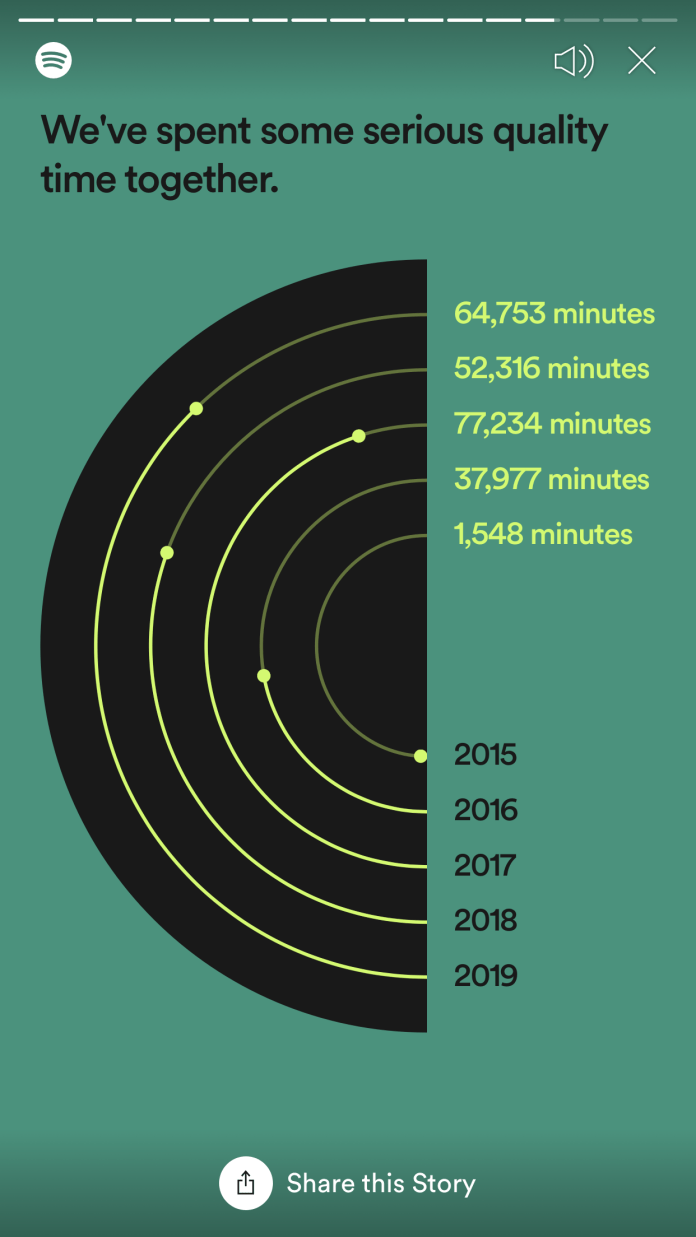
So Spotify has collated all of my data since I joined in 2013 and here it is.

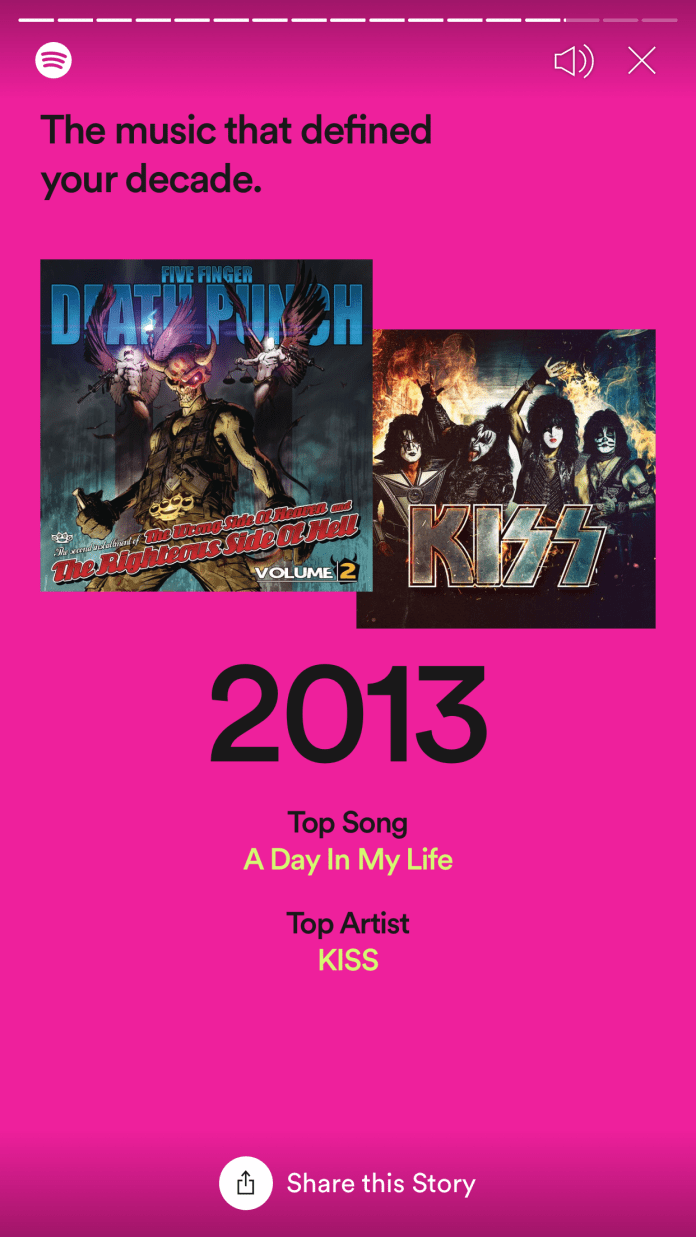
In 2013, my favourite artist was KISS and the song I listened to most was “A Day In My Life” from Five Finger Death Punch.

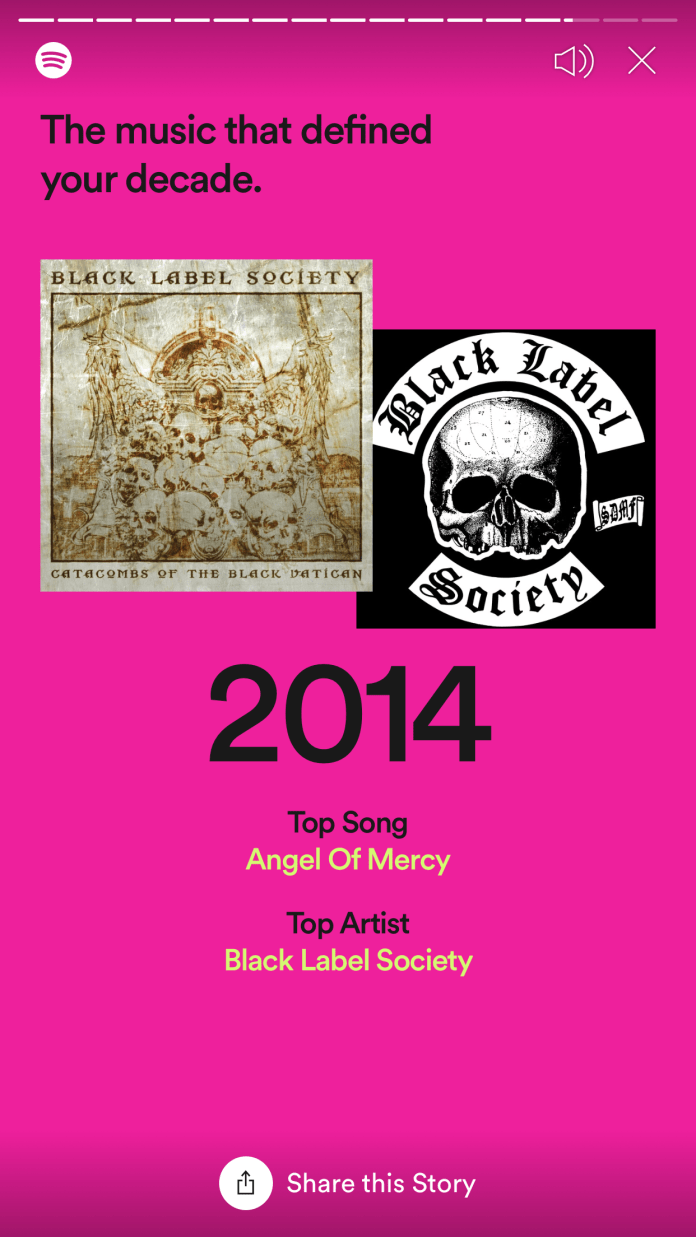
In 2014, my favourite artist was Black Label Society and the song I listened to most was “Angel Of Mercy” from Black Label Society.

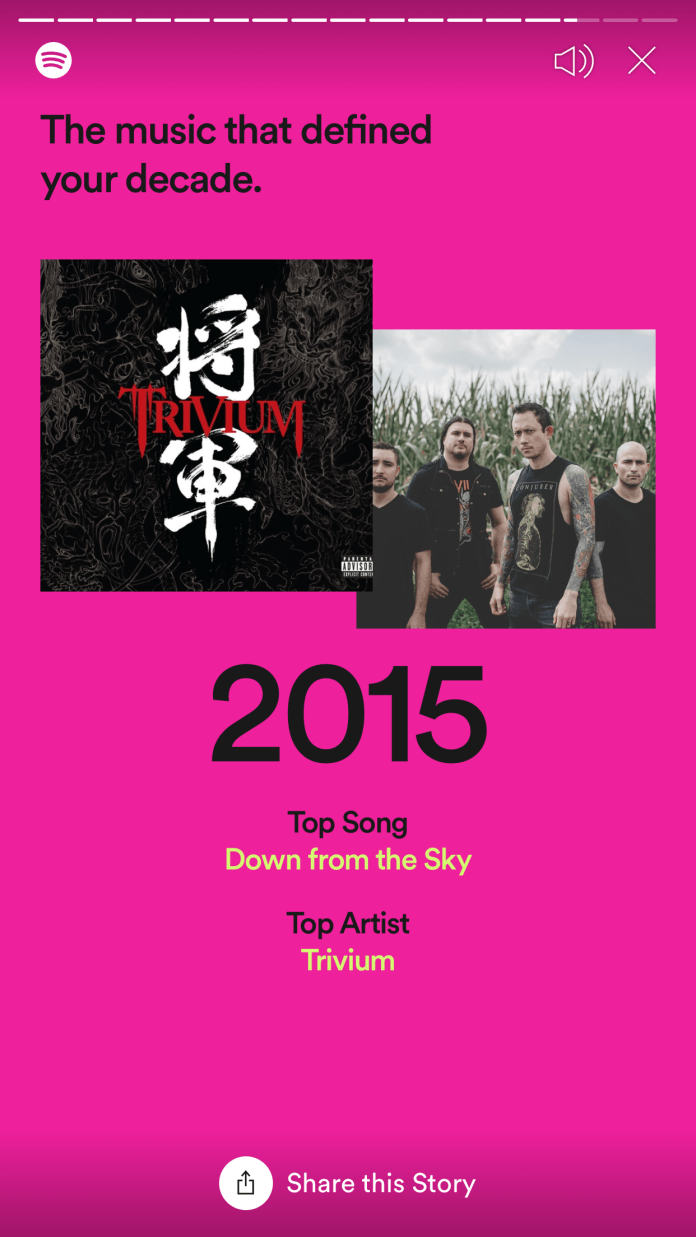
In 2015, my favourite artist was Trivium and the song I listened to most was “Down From The Sky” from Trivium.

In 2016, my favourite artist was Kingdom Come and the song my 5 year old listened to most was “The Mighty Eagle Song” from The Angry Birds Movie. And this was the reason why I went to a Spotify Family Account.

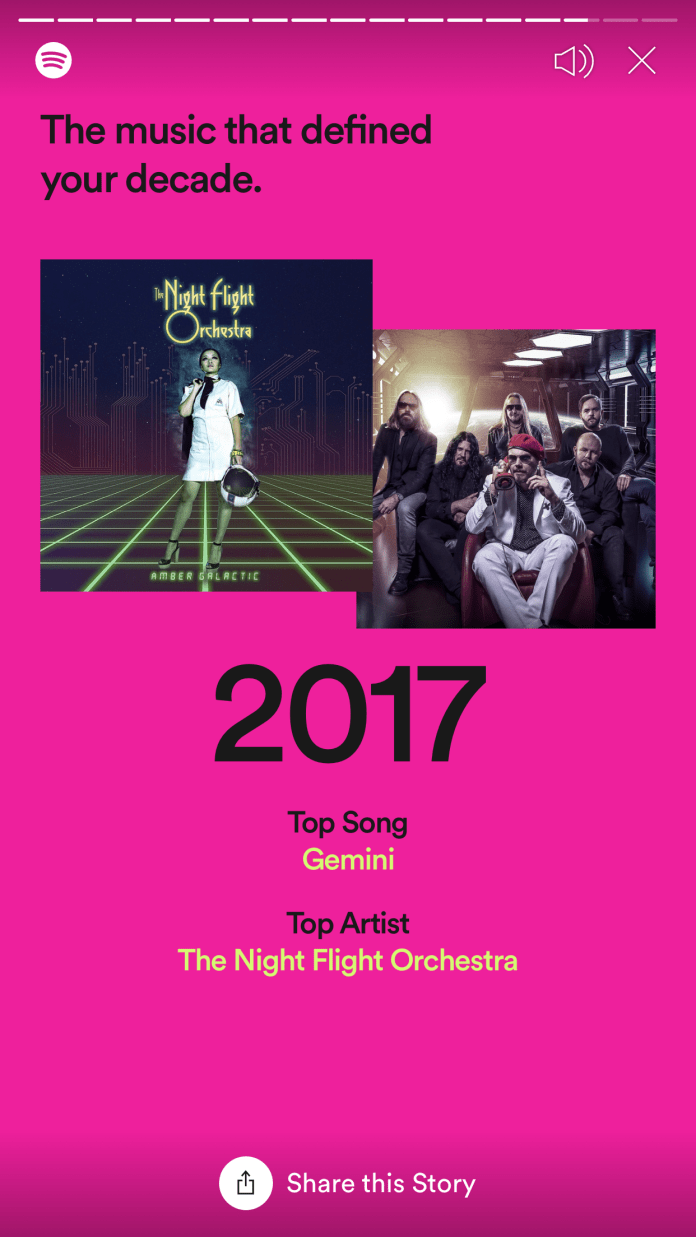
In 2017, my favourite artist was The Night Flight Orchestra and the song I listened to most was “Gemini”.

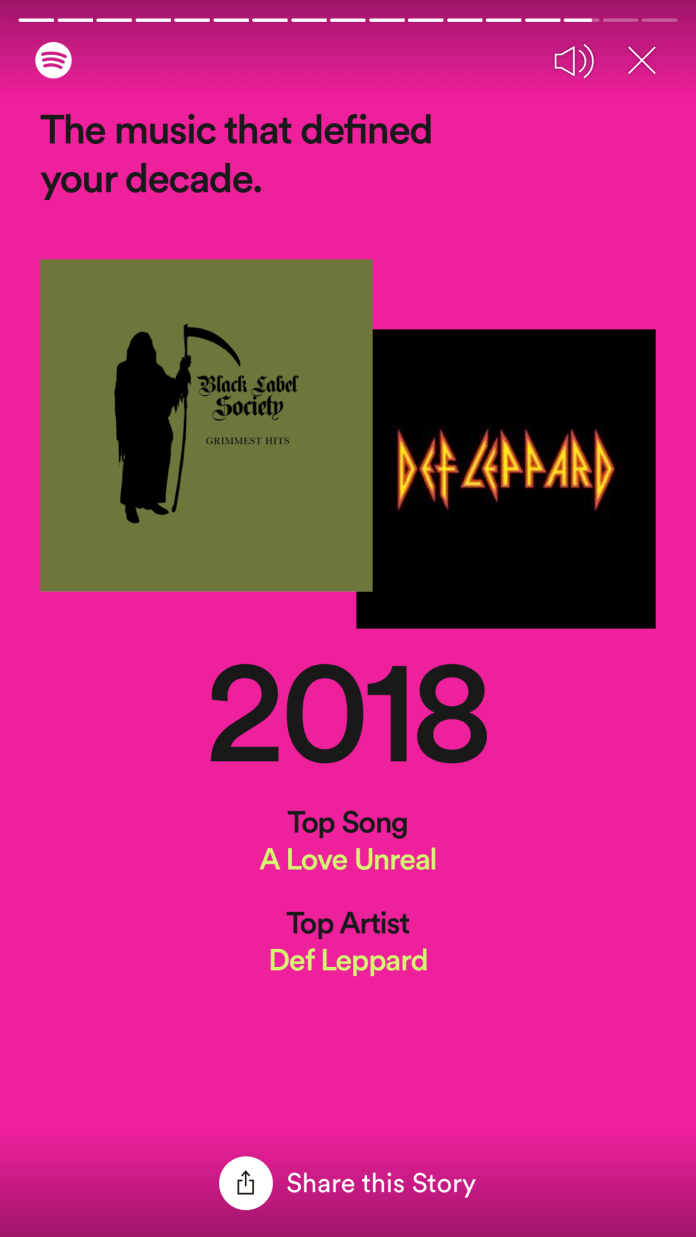
In 2018, my favourite artist was Def Leppard, which is no surprise as their catalogue was finally issued on digital services, but the song I listened to most was “A Love Unreal” from Black Label Society.

Finally, in 2019, Free Spirits Rising is listed as my favourite artist and “We Are Here” from Free Spirits Rising is the top song.

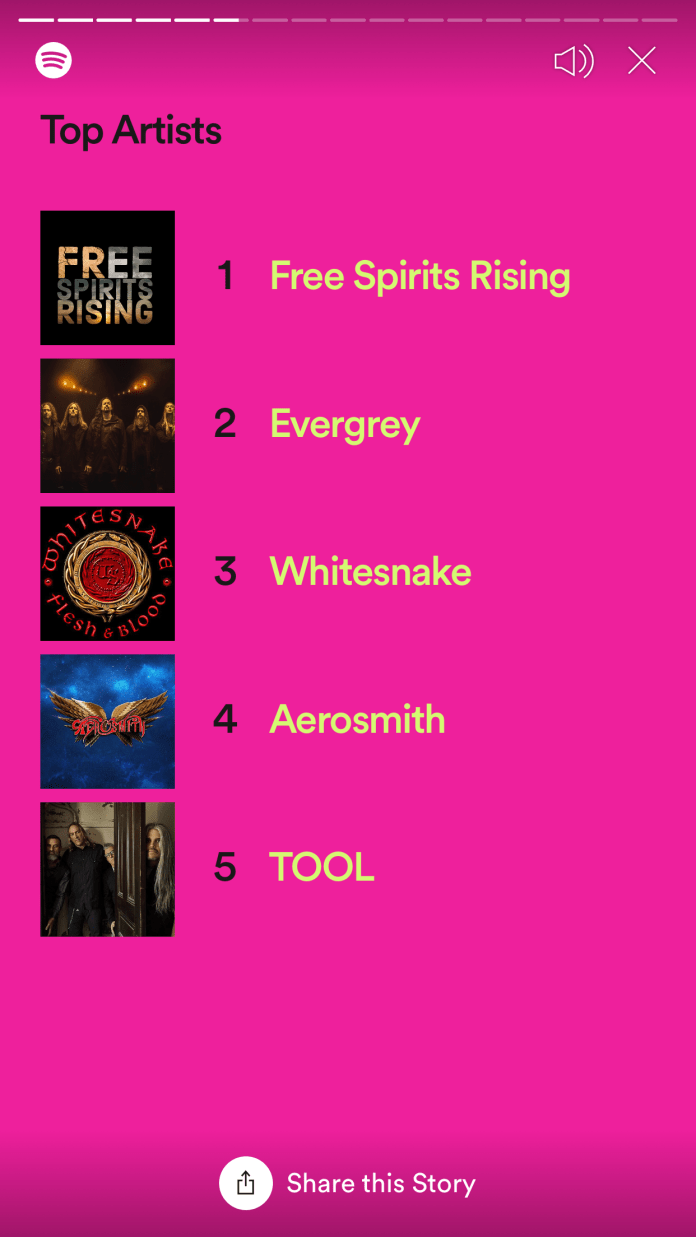
Overall, my top five artists for 2019 are, Free Spirits Rising, Everygrey, Whitesnake, Aerosmith and Tool.

But my favourite stat is the time spent listening to music on the service.

  • In 2016, it was 37,977 minutes.
  • In 2017, it was 77,234 minutes.
  • In 2018, it was 52,316 minutes.
  • In 2019, it was 64,753 minutes.

Let’s put some of these numbers into context.

A 38 hour working week equates to 2,280 minutes.

So 64,753 minutes divided by 2,280 minutes equates to 29 working weeks of listening. Over half a working week year of listening to music and somehow working at the same time.

Standard
Classic Songs to Be Discovered, Derivative Works, Influenced, Music, My Stories, Unsung Heroes

The Record Vault – Breaking Benjamin

I downloaded the first three albums via peer to peer networks, because of “Breath” and the “Phobia” album immediately became an influence. And when “Dear Agony” came out, I purchased it on release day along with the back catalogue, via Amazon U.S.

And you know how people complain that piracy has killed their career, well, Ben Burnley and his band Breaking Benjamin must be an anomaly. Check out the list of certifications for Breaking Benjamin, achieved in a market which is apparently “dominated by piracy”.

The albums;

  • “Phobia” is Platinum.
  • “We Are Not Alone” is Platinum.
  • “Dear Agony” is Platinum.
  • “Saturate” is Gold.
  • The comeback album, released in 2015, “Dark Before Dawn” is Gold.

The songs;

  • “The Diary of Jane” is 3x Platinum.
  • “I Will Not Bow” is 2x Platinum.
  • “So Cold” is Platinum.
  • “Breath” is Platinum.
  • “Blow Me Away” is Gold.
  • “Until The End” is Gold.
  • “Give Me A Sign” is Gold.
  • “Angels Fall” is Gold.
  • “Failure” is Gold.
  • “Dance With The Devil” is Gold.

Saturate

The debut album, released in 2002.

And the best songs to me are towards the end of the album.

“Home” is by far my favourite, followed by “Phase”, “No Games”, “Shallow Bay”, “Forever”, “Natural Life”, “Next To Nothing” and “Water”.

We Are Not Alone

The second album, released in 2004 and the sad ominous minor key intro of “So Cold” starts it all off, as singer Ben Burnley holds the so cold hand of an unnamed character. “Follow” rocks out of the gate with its staccato intro. “Forget It” soothes along. “Sooner or Later” brings the nu-metal flavour.
Phobia

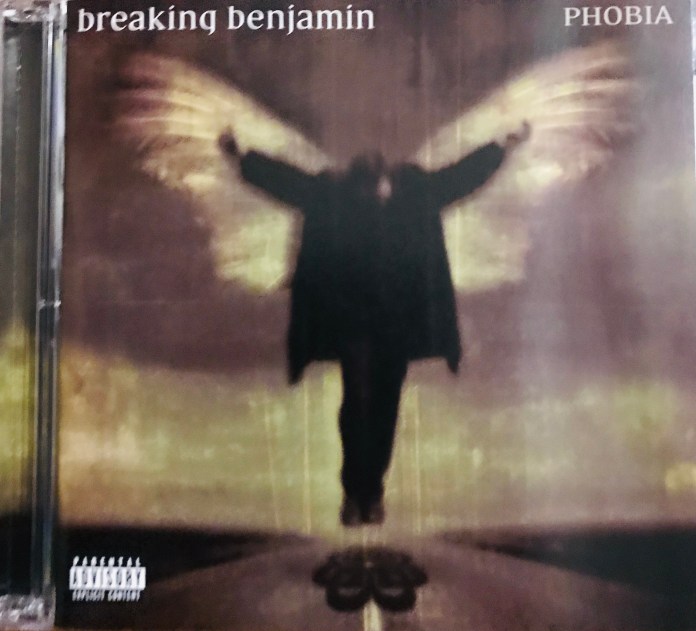
“Breath” was the drug that hooked me in to Breaking Benjamin. And the album released in 2006 had a lot of good songs on it, like “The Diary Of Jane”, “You”, “Evil Angel”, “Until The End”, “Dance With The Devil”, “Here We Are”, “Unknown Soldier”, “Had Enough” and “You Fight Me”.
Yeah the whole album.

Dear Agony

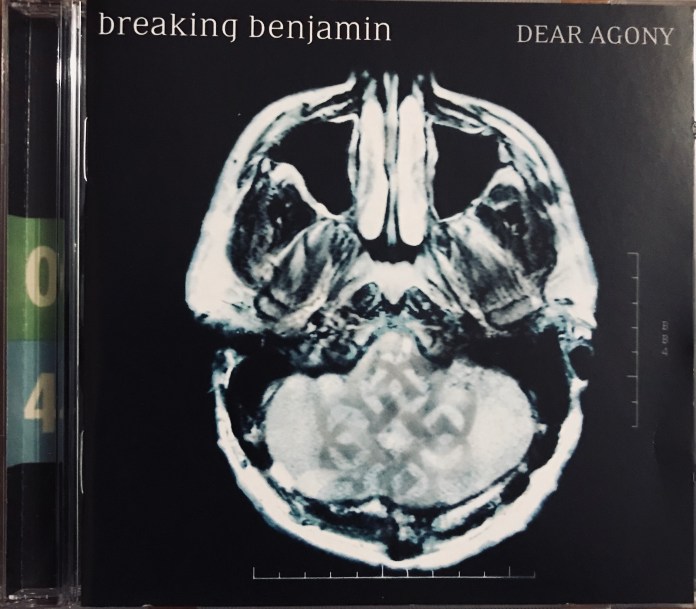
Released in 2009, with an image of Ben Burnley’s brain and it’s the last album before a long hiatus that involved a chronic pain condition to band founder Ben Burnley that is still undiagnosed and a court case between Ben Burnley, the record label and the band members who are now ex-band members over their involvement in a Greatest Hits release, without Burnley’s approval.
And if it’s not broke, why fix it, as the album is basically a re-write of “Phobia”, the same way bands in the past re-wrote popular albums, with little tweaks and improvements here and there.

“Fade Away” is a perfect opener like “The Diary Of Jane”. “I Will Not Bow” lines up with “Breath”. And all the songs on the album are favourites, like “Crawl”, “Give Me A Sign”, “Hopeless”, “What Lies Beneath”, “Anthem Of The Angels”, “Lights Out”, “Dear Agony”, “Into The Nothing” and “Without You”.

Yeah, the whole album again.

Dark Before Dawn

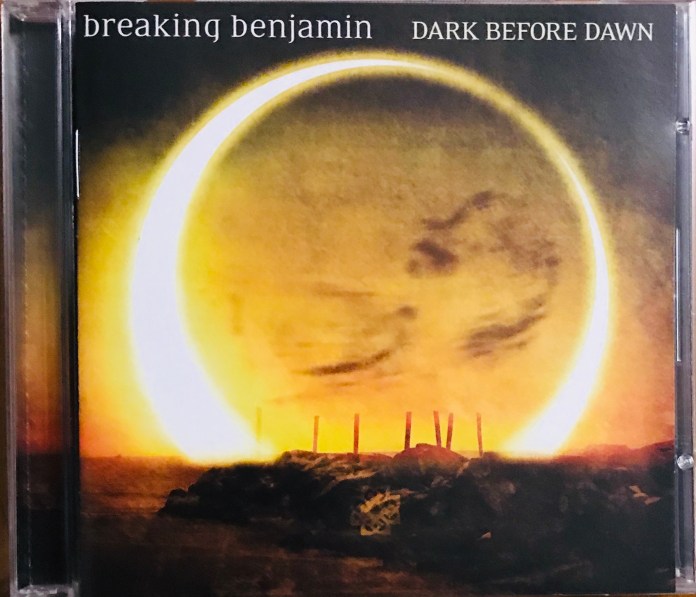
The comeback album released in 2015. And like the previous two albums, its taking what came before, made a few small tweaks and a new song is born.

“Failure” stands up there as being in the same vein of “Fade Away” and “The Diary Of Jane”. And the album flows like the previous ones. “Angels Fall”, “Breaking The Silence”, “Hollow” and “Close To Heaven” follow.

“Never Again”, “The Great Divide” and “Ashes To Eden” finalise the album.

And the songs from Breaking Benjamin, like Everygrey, are melancholic and therapeutic.

To be complete, “Ember” came out in 2018. I don’t own it, however I streamed it and it’s my least favourite. The saving light is “The Dark Of You”.

Standard
A to Z of Making It, Music, My Stories, Piracy

Listening Habits

It’s a tough crazy world.

Artists spend their blood, sweat and tears into their new product and no one seems to be paying attention.

How can they, with all the music coming out.

For 2019, I listened to 5,783 different songs on Spotify. To put that number into context that is roughly 16 different songs, each day, for 365 days. In the old vinyl LP days of 8 songs each, this would be two albums every day of different artists.

Streaming allows this diverse listening experience and for the fan, this is a good thing.

It’s also a good solution compared to peer to peer downloading. But people complain about the payments they receive, however there is no denying that streaming services have put some serious money back into the recording industry.

Prior to Spotify, the recording labels got nothing. And it’s a shame that those same labels don’t funnel those monies back to their artists. Because if wasn’t for the artists, the recording labels would not be in the position of power to negotiate anything. And if it wasn’t for the artists forming connections with people, then the labels would have no business model.

If you take streaming services out of the industry, people will not start buying CD’s again en masse.

Standard
A to Z of Making It, Music, My Stories

Fans

Fans maketh the artist and the fans taketh the artist.

For all artists, the need to create music is enough of a reason to start. Then some artists will have acceptance of their music. And suddenly artists have a thousand plus hard core fans.

Artists are normally happy to sell out the limited run of super deluxe editions of albums.

For the medium to larger acts, this is about 20,000 copies of an album between the prices of $50 to $200 each, and you can see a cool gross income between $1 million and $4 million. If the artists own their rights and are in control of their masters, then the deluxe editions if done right, can be a nice little supplement.

And streaming also gives the artist control of where their fans are, in which cities they live and which songs these fans are listening to. If the artists have the resources, then they can tour these places. Scorpions and Whitesnake are coming to Australia and I am pretty sure it’s on the back of some impressive streaming numbers, because it wouldn’t be on sales.

More so than ever, the fans decide how they want to commit to their relationship with the artist. And a lot of fans of music are also pretty content to listen to music at home, without feeling the need to go out and watch an artist live.

It’s part of the new world.

Standard
A to Z of Making It, Music, My Stories

Greatest Hits And Popular

Greatest hits get tiresome and I think I am suffering burnout on it. Not because artists are putting out greatest hits or best off collections, it’s because Spotify has the same popular songs from artists across hundreds of their own generated playlists like, songs to run to, work out to, songs of the 80’s, hard rock songs, glam rock songs and so forth. And then you go to the artist account and of course, the top 5 songs for the artist are the ones on the Spotify generated playlists.

Surprise, surprise.

And if all we do is listen to the most played songs, the hits, then we are missing out on the real good stuff. But it’s hard to escape the greatest hits, because the internet and every social media platform, push us to check out what is trending and what everyone else is checking out.

But to be popular or to make something popular, the creator is leaving out the important parts of the song, in case it turns people away, like a lyric that deals with dark thoughts or a guitar solo which takes the song into the 5 minute mark. You want a hit, call Max Martin, who has a team of writers working on the same song,

In other words, simplify things in exchange for attention.

It’s easier than it sounds, otherwise artists will go straight to the hit, or a director wont make those small indie films and make just the hit film.

Because no one will know what is a hit until they release it.

The Beatles recorded hundreds of songs before they even broke big. Black Sabbath never had a hit but are seen as hit makers today. David Coverdale wrote hundreds of songs before he hit the charts in a big way with the 87 album.

And the music we love, the soundtrack to our youth, well, those songs didn’t really get to number 1. Same deal for the books I read, the articles I read, the journals I read and documentaries I watched, that formed my viewpoints and shaped me.

Popular doesn’t mean the best. It’s just popular.

Remember “Gangnam Style” or “Achy Breaky Heart”.

Check out this great post from Seth Godin about Hits.

Standard
Alternate Reality, Copyright, Music, My Stories

Certification

Certifications still exist in 2019.

In order for an organisation to exist they need to find something relevant.

The RIAA is a lobby group for the record labels, and a trophy giver to artists. These little trophies, like a gold certification for 500,000 albums sold in the U.S. used to be a little bit easier to calculate when sales was the only metric used.

But when digital downloads and streaming started to take over, for right or wrong reasons, the RIAA and its sister like companies in other parts of the world, got all creative in their counting.

Suddenly, a thousand odd of streams is an album sale or 12 tracks downloaded is an album sale. Artists then would offer their albums with ticket bundles and if the fan clicked on the download link, that counted as a sale. Or artists would offer their albums with clothing sales and again, if the fan clicked on the download link, that would count as a sale.

For right or wrong reasons, certain artists and their backers are looking for bragging rights.

So what does a certification tell the world?

I was trolling through the recent certification awards on the RIAA website and I saw a lot of artists who I have never heard off, get a lot of single song certifications, so my assumption here is that these songs are streaming like crazy. And a check on Spotify confirmed that.

But two certifications got me interested because I used to cover these songs in bands. KANSAS got a triple platinum certification for “Dust In The Wind” and a 4x Platinum certification for “Carry On My Wayward Son”.

Now imagine that.

Song’s released in the 70’s are getting cherry picked by fans and listened to over and over and over again on streaming platforms. And you can’t say that the songs are part of a ticket or clothing bundle.

Here are the facts;

  • “Dust In The Wind” was released in January, 1978 and it got no certifications whatsoever back then, nor in the years after.
  • And the record labels have a habit of not spending money to promote old songs if they don’t make money, so those songs become forgotten.
  • It wasn’t until digital services like iTunes offered up the track that it got a Gold certification in December, 2005.
  • And 14 years after that and almost 9 years since streaming commenced, the track went from Gold to Platinum to 2x Platinum and now 3x Platinum.

Whereas;

  • “Carry On My Wayward Son”, released in November 1976, got its Gold certification in December 1990 and in November 2019, it got platinum x1, x2, x3 and x4 certification.
  • And when you look at the streaming numbers you can see why;
    • “Dust In The Wind” has 231,083,018 streams and “Carry On My Wayward Son” has a combined count of approx. 270,000,000 streams on Spotify.
    • On YouTube, the official video and audio of “Dust In The Wind” have a combined count of 300 million views and “Carry On My Wayward Son” has close to 160 million views of the official video and audio.
    • Plus you have the user uploads when all combined add up to a lot of million views.

    And it’s a long journey for a song and an artist.  

    Debates can be had on sales and certifications but what I find impressive when I see theses kind of things is how artists are still relevant even when they are out of the mainstream press. It’s like the saying goes, you can’t keep a good song down

    And it pisses me off how record label reps had so much control to kill an artists career once upon a time, even though the music from the artists always had an audience for their music.

    Standard
    Music, My Stories

    Going Out

    I asked my kids why they always stay home when they are not doing sports. And their answer was interesting. The older one wanted to relax, while the middle one and the younger one said they don’t need to go out, because everything they want, they have at home.

    If they want to listen to music, I have a large CD/Vinyl collection, plus I pay for a family Spotify account, plus they have YouTube and I also have a large mp3 collection as well.

    If they want to watch movies, I have a pretty decent DVD/Blu-ray collection, plus I pay for Netflix and Amazon Prime Video.

    If they want to watch sport, I have a football channel subscription. If they want to read, I also have a decent book collection as I enjoy reading fiction and non-fiction writings.

    Basically their entertainment needs are met.

    And if those things don’t entertain them, they pick up the guitar and play it or the keyboard.

    And if those things don’t tickle their interest they have their PS4 and online gaming.

    And if all of these things don’t amuse them, they have their iPhones or iPads and their social media accounts.

    Phew, I had to leave the house and go out to do any of these things once upon a time, like to buy a record, watch a concert, borrow a book from a library or a video from a video shop or find friends in the street to play a board game with and to get a job to purchase a guitar.

    And at the same time, I saw a post over at Seth Godin’s website, called “Break The Lecture” in which he mentioned that “in 1805, if you listened to music, you heard it live. Every time. Today, perhaps 1% of all the music we hear is live, if that.”  And he compared that to  a lecture for school or work, and how you had to hear it live in 1805 and its still true today, which he found strange. Why didn’t the lecture move over to digital.

    And it’s right, to listen to music, a person had to leave their home. Then came radio and television and home entertainment stereo systems that played vinyl, then cassettes, then CDs, then they became docking stations, then Bluetooth stations and the focus shifted from massive speakers to expensive headphones.

    And who knows what’s next.

    Microchips in our ears to capture soundwaves and Bluetooth waves. Suddenly we will all be like superheroes with advanced hearing, capturing concerts from miles away in our homes. Oh wait, that’s radio.

    I guess the more things change, the more they stay the same.

    Standard
    A to Z of Making It, Music, My Stories

    The Arc

    No artist is immune from the career arc, where you’re hot and then you’re not. Its happened to a lot of artists before in the 70s, the 80s, the 90s, the 00s and even more so in today’s internet world, where an artist can release something great and it can remain ignored in the marketplace.

    Remember Motley Crue who sold out arenas in the 80s, then half filled theaters in the 90s and they came back in the early 2000s to sold out arenas again then went away and are now coming back again.

    Remember Aerosmith.

    A huge band in the 70s, disappeared towards the end of that era and it wasn’t until 1987 that they became relevant again. And that relevance kept on rising until the late 90s and suddenly they weren’t as hot as before.

    Remember Iron Maiden. Sold out arenas in the 80s and then weren’t as hot after Bruce left, but took up the momentum again when he returned.

    And there are many more who were hot, then not hot and then hot again, but bands normally break up when their career is not as hot as it was in the past like Twisted Sister or Skid Row. Twisted did reform and became hot again, while Skid Row refuse to kiss and make up.

    And artists who have those royalties from all those old records can go on the road based on that music.

    But some artists are even fucking this up with ticketing bundles and scalping their own tickets.

    Standard
    Music, My Stories

    Metal And Streaming

    What does a metal head and a rocker need to do to play the music game, especially when streaming is dominated by hip-hop/pop?

    Metal heads are not 100% into streaming. But a few years back Spotify shocked the world when it said that metal is most loved genre.

    But metal doesn’t even exist when it comes to the weekly streaming charts Which are dominated by dance and hip hop tracks. But, when you combine the numbers from the different metal acts, metal music rules streaming because of fan loyalty.

    Turns out, that when Spotify analysed the number of streams divided by the number of listeners per artist, the Metal genre is way ahead of hip-hop, country and even rock. It basically means that metal fans listen to their favourite artist over and over and over and over again, until we overdose on their music, while fans of other genre’s hop and pop all over the place.

    And metal music still moves vinyl and CD’s, especially deluxe packages or limited edition packages. But the biggest thing that no one picks up is the regeneration of metals fan base. People who are not involved in the metal lifestyle believe it is an aging fan base, but that is so far removed from the truth. It is a fan base that regenerates with each generation and it keeps on growing.

    And if you’re in the metal game and you have a small but loyal fan base, then there’s absolutely no reason to sign with a major label. And if you need management, make sure you still own your tracks and pay management a percentage.

    And metal acts sell tickets. They may not be big on the radio or streaming, but they’ve got live audiences, and that’s where the money is.

    And metal music is going through another re-invention. There is a modern version of the old sound and there are artists who were around when the old sound was the new sound. Regardless, while metal music is not mainstream, it percolates, waiting for the time to rise up.

    Like embracing streaming.

    As mentioned above, it’s the main genre with the most loyal listeners.

    In addition, streaming has removed the costly barriers to acquiring music. Prospective new fans can instantly access the whole history of metal music. And the metal head consumer decides what is popular to them. It’s a beautiful utopian democracy. But metal purists will point out that you don’t own the music you pay Spotify for and how you are basically leasing it. Sound purists will argue the low sound quality of streaming music. But in the end, the 320kbps setting will satisfy 99% of people.

    And based on our listening habits, it satisfies us a lot of times.

    Streaming Up Your Arse…

    Standard