Classic Songs to Be Discovered, Music, Unsung Heroes

Megadeth

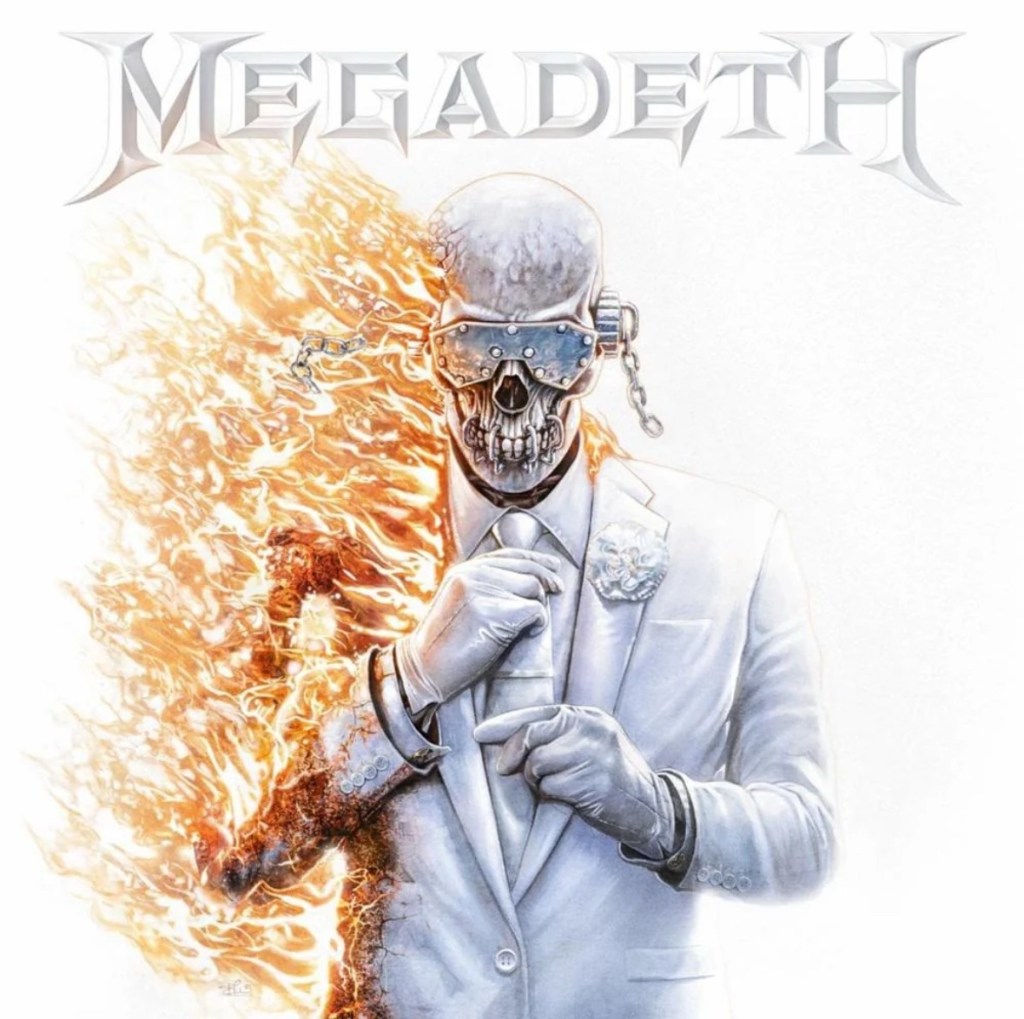
The album didn’t just arrive, it was staged.

Announced in August 2025 with Vic Rattlehead literally on fire, rolled out through four singles across four months, and framed as the final Megadeth statement.

Not a late-career album. A closing argument. The farewell tour wasn’t an afterthought; it was embedded in the release plan.

Production began quietly in late 2024 with producer Chris Rakestraw, largely remote at first. Mustaine and guitarist Teemu Mäntysaari traded ideas while the room was empty. This will be the only Megadeth studio album Mäntysaari will ever appear on, which gives his playing a different gravity, it’s not contribution, it’s inscription.

Mäntysaari arrives with a pedigree that matters more than hype: classically trained, composition-literate, and forged in the Scandinavian metal ecosystem where precision, melody, and structure are non-negotiable.

Best known for his work in Wintersun, he comes from a lineage that treats guitar not just as a weapon but as an architectural tool, stacked harmonies, modal phrasing, neoclassical discipline, and an almost orchestral sense of movement. You can hear influences ranging from European power metal and melodic death metal to classical and film-score logic, where riffs aren’t just aggressive but directional.

As a co-writer with Mustaine, Mäntysaari doesn’t challenge Megadeth’s DNA; he refracts it. The result is a distinctly Euro-metal contour, tighter harmonic logic, cleaner thematic development, and a sense of inevitability baked into the riffs, less street brawl, more war plan.

His presence subtly modernizes the band without diluting it, giving these songs a colder, more surgical feel that contrasts with Mustaine’s snarling, American thrash instincts. It’s not a takeover; it’s an overlay. And because this is his only Megadeth studio document, that influence feels permanent, etched, not experimented with.

By June 2025, vocals were being tracked. By January 2026, the album was positioned as history.

Tipping Point

This is the mission statement.

Flat-out thrash. No apology. No warm-up. The title is a tell, this isn’t about balance, it’s about inevitability. Musically, it does exactly what a “final album” lead single must do: reassure the base. “Yes, we can still do this. Yes, the hands still work.”

What’s more revealing is what it doesn’t do. No experimentation. No curveballs.

Mustaine knows the first impression defines the entire conversation.

And it works.

“Today I may bleed, but tonight you will die”

Patience weaponized.

“You buried the truth under layers of lies”

Self-inflicted decay. The deeper the stack, the more violent the reckoning.

“Push me, I push you back”

Symmetry established. You set the terms; I enforce them.

“Hiding your secrets out in plain sight”

Collective denial. The secret survives not by concealment, but tolerance.

And then the outro riff lands like a body blow.

“You won’t define me, you’ll never find me”

Refusal of containment. To define is to reduce. To find is to fix. Autonomy is reclaimed through disappearance.

The tipping point isn’t rage. It’s clarity.

I Don’t Care

Three minutes. Punk bones. No fat.

This reconnects Megadeth with the sneer that predates thrash orthodoxy. It’s not refined, and it’s not trying to be. That’s the point. Precision was never the whole story; attitude was.

Releasing this as the second single is a message: don’t expect reverence. This isn’t a victory lap. It’s a shrug with distortion.

“I don’t care what the headline said”

A rejection of outsourced reality. Headlines collapse complexity into verdicts built for attention, not truth.

“You know a rat never learns”

Not an insult, but pattern recognition. Repetition without reflection. Once behavior stabilizes, hope of reform disappears. Expectation shifts from change to containment.

Hey, God?!

Classic Mustaine: theology as confrontation, grievance elevated to cosmic scale. Musically solid, structurally familiar.

“The years are passing by like days”

Time compression, not aging. When days lose distinction, life accelerates.

The fear isn’t death, it’s unused life.

And make sure you stick around for the guitar solos.

Let There Be Shred

The most Megadeth song here, and the most ridiculous. Which is why it works.

Creation myth rewritten as guitar doctrine. No irony. No wink. Just total commitment. Mustaine dares you to flinch first.

“On the day I was born, a guitar in my hands”

Identity fused to function. Not “I chose this”, this chose me. Careerism disappears.

What’s left is vocation.

“Destroying pretenders, only ashes remains”

Authenticity under pressure.

Puppet Parade

The curveball.

Mid-tempo. Melodic. Built for repeat listens. The kind of song late-’90s Megadeth fans pretend never happened, and yet it’s arguably the best-written track here.

The irony is precise: the song about manipulation is the most controlled thing on the record. Hooks are intentional. Dynamics are measured. Accessibility was never incompetence; it was choice.

“I punch your clock, I play a role”

Labor as submission. Performance without belief. Effort is real; meaning is outsourced.

“Where the lies are truth / And our lives are trade”

The moral core. Reality assigned, not discovered. People reduced from ends to inputs. Exploitation normalized through redefinition.

Once that switch flips, marching doesn’t need enforcement. It’s automatic.

Another Bad Day

Functional. Efficient. Disposable.

Nothing offensive. Nothing essential.

“My life’s a mess, but I call it mine”

Ownership without redemption. No fixing. No reframing. Just authorship claimed.

“Every scar is a line I drew”

Pain turned into power. Not innocence, responsibility. The quiet weight that follows.

Made to Kill

Thrash returns, lean and calibrated.

This is Megadeth on autopilot, but it’s a well-tuned autopilot.

Mäntysaari proves he understands the internal math of Megadeth riffs. You don’t remember it for the message. You remember it because it moves.

“Taught to pray, yet made to kill”

Contradiction as training. Belief installed alongside violence. Prayer as insulation, not restraint.

“Truth is sold in streaming lies”

Propaganda as infrastructure. Truth isn’t erased, it’s monetized and drowned in volume until disbelief feels pointless.

What survives isn’t ignorance.

It’s exhaustion.

Obey the Call

Shadowy control. Puppetmasters. Faceless systems. A reflection of Mustaine’s conspiratorial gravity.

“It feeds on faith, but it bleeds gasoline”

Belief exploited as fuel. Devotion weaponized. The cost is always physical.

“And the pawns will rise / And empires fall”

Not heroics, structure. Collapse seeded by control itself.

I Am War

Shorter. Sharper. More effective.

Less sermon, more declaration. It knows exactly how much energy it has, and spends it carefully.

“To know you, I become you”

Empathy weaponized.

Understanding as assimilation.

Victory through total cognitive immersion.

“I am war, I am hurt and pain”

Not metaphor, identity. War isn’t something enacted; it’s embodied.

No separation between actor and action.

The Last Note

Five and a half minutes of unresolved intent.

Sentiment or defiance?

Curtain call or middle finger?

It wants both and never fully chooses. Which is fitting. Mustaine has never mastered endings.

“One more winding road that I won’t come back”

Finality without drama. Motion without return. Acceptance, not mourning.

“Each song has got beneath my skin”

Creation as accumulation. Art doesn’t cleanse, it erodes and stays.

“I can’t outrun the spinning hands of time”

Aging as pursuit. Speed once solved everything. Now it doesn’t.

“They gave me gold, they gave me a name”

Recognition as transaction.

Success always arrives with a bill.

Ride the Lightning (Metallica cover)

Not an encore, a provocation.

Ending the final album by revisiting the band that expelled you isn’t nostalgia. It’s wound management. The performance is heavier, cleaner, but its purpose isn’t musical.

It’s psychological.

“There’s someone else controlling me”

Agency surrendered to process. Terror born not from chaos, but automation.

“Consciousness, my only friend”

Everything external stripped away. Awareness remains, forced to witness its own erasure.

The cruelty isn’t death.

Its presence during death.

The “Ride the Lightning” cover didn’t drift into the middle, it drew a line. Based on a sample of X comments, fans either hear a powerful legacy statement or an unnecessary retread. The split is clean: some hear reverence and authority, others hear dilution and loss of danger, with a small group stuck in polite indifference.

For me, it works. The slightly increased tempo injects urgency without rewriting history, and the performance understands the assignment: pay homage, don’t vandalize the blueprint. It respects the original’s gravity while letting Megadeth’s muscle show through.

This isn’t really about quality. It’s about philosophy.

Do you want a cover to preserve the fire, or to replace it?

To sum it all up, it’s a controlled burn, a managed farewell that captures exactly what Megadeth has always been: brilliant, stubborn, technically elite, emotionally unresolved, and incapable of clean exits.

If this really is the end, it ends the only way it could.

Not with peace. With insistence.

And that’s the most honest thing Megadeth could have done.

P.S. i just listened to the bonus tracks “Bloodlust” and “Nobody’s Hero” on YouTube. Wow. But they will be for another post.

Standard
A to Z of Making It, Classic Songs to Be Discovered, Influenced, Music

Sydney’s Biggest Live Secret (Revisited): Candy Harlots and the Album That Took Five Years Too Long

Scenes don’t fail because the music isn’t good enough.

They fail because time, management, and momentum never align at the same moment.

Candy Harlots are the textbook case.

By the time their debut album “Five Wicked Ways” finally landed in May 1992, the band that had ignited Sydney in the late ’80s barely resembled the one that earned the deal in the first place. And yet, against all logic, it still worked.

To understand why, you have to start where the fire actually began.

Candy Harlots formed in Sydney in 1987, originally built by guitarist Ron Barrett, drummer Tony Cardinal, vocalist Mark Easton, and bassist Nick Szentkuti. Guitarist Marc De Hugar joined soon after, still a teenager, but already operating well above his age.

Szentkuti didn’t last long. Scott Millard stepped in briefly, followed by Leeno Dee, whose arrival quietly changed the band’s internal chemistry. Dee didn’t just anchor the low end, he added another songwriter to a band already driven by Easton and Barrett. That matters later.

This version of Candy Harlots wasn’t just loud. It was theatrical, sexual, and confrontational. Roses, lollipops, balloons, foam, striptease intros, dry ice. Mark Easton didn’t “front” the band, he detonated it.

The Kardomah Café became home base. From there, the band spread outward, often overwhelming suburban venues that didn’t quite know what they’d booked. Some crowds loved it. Some venues didn’t invite them back. That tension fueled the myth.

At the same time, another band called Rags ’n’ Riches were moving through the same ecosystem, more melodic, less confrontational, built around Scott Ginn’s songwriting instincts and Phil Bowley’s feel-driven guitar work. Two bands, same scene, radically different approaches.

Both mattered.

By 1989, Candy Harlots were peaking live.

They opened for The Cult, Cheap Trick, D.A.D., Kings of the Sun, and The Angels. They partied and jammed with members of Skid Row and Mötley Crüe. Industry attention followed quickly.

In fact, Virgin Records offered them a deal after just three shows.

They didn’t take it.

Not because the band said no, but because their manager did. Worse still, their management contract prevented the band from signing without approval. By the time that deal evaporated, momentum had already taken a hit that never fully healed.

So they did what bands used to do: they pressed their own record.

“Red Hot Rocket” landed in April 1989 on Au Go Go Records. A thousand red-vinyl copies, packaged with custom knickers, sold out in under three hours. The song sounded exactly like the band looked: sleazy, melodic, funny, dangerous.

This was the moment they should have been locked into an album cycle.

They weren’t.

The follow-up single “Danger” arrived in May 1990, backed with “Wrap 2 Arms.” Written by Leeno Dee, it’s arguably the strongest thing the band ever released, big chorus, melodic spine, raw power intact.

It barely registered.

Then everything collapsed.

In October 1990, founding guitarist Ron Barrett died after an asthma attack. He was 26. The band lost not just a player, but its emotional center. No amount of gigging compensates for that.

From here on, Candy Harlots became a band reacting to loss instead of generating momentum.

After Barrett’s death, Peter Masi was recruited on guitar. But the changes didn’t stop there.

In February 1991, Marc De Hugar was replaced by Phil Bowley, a move that aligned musically, but carried deep personal consequences. De Hugar had been a key writer, a visible drawcard due to his age, and had already invested years of unpaid work while negotiating a record deal that was now moving forward without him.

A month later, after a final performance at the Kardomah Café, Mark Easton walked away.

At this point, only Tony Cardinal remained from the original formation.

Shortly after, Tony “Aiz” Lynch joined as vocalist, a cross between Sebastian Bach, David Lee Roth and Vince Neil, he was as bad as a bad boy could be.

By now, the disastrous management deal had expired.

And suddenly, Virgin Records came knocking again.

This time, the band signed.

Virgin-backed promotion changed everything.

The Lynch-fronted Candy Harlots received more media attention than the Easton era ever had. In 1991, “Danger” was re-recorded and re-released, and for many fans, this was their entry point. Cassette single. CD single. Real distribution.

A promotional release, “The Tease Tapes,” appeared with Hot Metal magazine, hyping an album scheduled for October 1991.

October came and went.

Instead, early 1992 delivered the “Foreplay” EP—three album tracks plus a Kinks cover. A tease, literally.

Finally, in May 1992, five years after the band formed, the debut album arrived:

“Five Wicked Ways”.

And here’s the inconvenient truth:

It was good.

Really good.

The album carried LA sleaze DNA, Mötley Crüe, Guns N’ Roses, Ratt, Poison, but could pivot effortlessly into AC/DC, Kiss, Skid Row, even Dokken territory.

“Backstreet Boys” opens with pure AC/DC muscle, “Sister’s Crazy” updates the fallen-angel pop-metal trope, “Danger” finally gets its anthem moment, “Cheat On Me” leans punk-sleaze, “Where No One Dares” slows things down with genuinely strong guitar work.

“My Flame” rides a pulsing bass and bluesy swagger, “The Lady Shakes” kicks off with Cardinal’s drums before settling into a Bolan-esque groove.

“Wrap 2 Arms” resurrects Ron Barrett’s song, rightfully so “What Are We Fighting For”, penned by Lynch, is a late-album standout.

“Mercenary Baby” brings funk-rock tension, “The Other Side of Love” nods toward Dokken and “Devils Blues” closes things out acoustically.

Singles followed, “Sister’s Crazy,” “What Are We Fighting For”, with bonus tracks and covers, including AC/DC’s “Can I Sit Next To You Girl.”

For a debut album, it was shockingly complete.

And then it ended.

Not long after, Aiz Lynch was fired.

New singers arrived.

The band changed its name.

Momentum evaporated again.

And then it was over.

Candy Harlots didn’t miss success by inches.

They missed it by years.

Bad management decisions.

Delayed deals.

A death no band recovers from intact.

An album released after the cultural moment had already shifted.

And yet, “Five Wicked Ways” stands up.

That’s the part people forget.

The output is small. The story is messy. The timing was brutal.

But that record belongs in the same conversation as bands who “made it.”

Sydney didn’t lack talent.

It lacked alignment.

Some bands get immortalized.

Others become cautionary tales.

Candy Harlots were both.

And if you were there, if you remember the Kardomah, the radio static, the knickers in the single sleeve, the songs that should’ve been bigger, you already know:

This wasn’t a failure.

It was a delayed detonation.

Standard
Classic Songs to Be Discovered, Music

Best Of The Reissues (2025)

Whitesnake – Forevermore

No one does reissues like David Coverdale. That’s not consensus thinking, that’s pattern recognition. Every time he opens the vaults, he doesn’t ration. He overdelivers.

The “Evolution” demos remain the gold standard. You hear songs before they know what they’re supposed to be. No polish, no mythology, just instinct turning into architecture. Vocal phrasing evolves, melodies get bent, arrangements harden. This is songwriting exposed, not curated.

Most artists protect the illusion. Coverdale documents the process. That’s the difference.

Bruce Springsteen – Nebraska ’82: Expanded Edition

This is a great release, not because it’s archival, but because it reframes history.

You get demos that never made “Nebraska,” some of which migrate directly into “Born in the U.S.A.” like the title track, “Downbound Train”, “Working on the Highway”, and others. You can literally hear the pivot happening. Darkness bleeding into muscle.

Then there’s “Gun in Every Room.” Written 44 years ago. Still uncomfortably current. No irony. No distance. Just proof that the American psyche doesn’t evolve as fast as the technology around it.

Acoustic demos. Electric versions. Live performances. Album masters.

The instruction manual is simple:

Listen to this.

Watch “Springsteen: Deliver Me From Nowhere.”

Then listen again.

You’ll hear a different record the second time.

Dream Theater – Quarantième: Live à Paris

This one’s straightforward, and it should be.

It captures the 40th Anniversary Tour.

It documents Mike Portnoy’s return.
It sounds massive, precise, and unapologetically technical.

No revisionism required. No narrative scaffolding.

This is Dream Theater being Dream Theater again, with the missing limb reattached.

What more does a fan actually need?

Metallica – Load: Remastered

There’s something quietly profound about hearing James Hetfield build melodies out of oohs, ahhs, half-formed vowels and instinctive phrasing.

This is the god of heavy metal before the armor locks in.

These demos sit right alongside Coverdale’s Evolution material in terms of value. Not because they’re raw, but because they’re human. You hear uncertainty, exploration, and the willingness to sound wrong on the way to sounding right.

“Load” has always been misunderstood because people expected aggression instead of vulnerability. This reissue finally gives context instead of apology.

Mötley Crüe – Theatre of Pain (40th Anniversary Expanded Editions)

Context matters here.

If you don’t own the Crucial Crüe remasters with the bonus tracks, this is a solid pickup. The packaging is lavish, the presentation respectful, and it preserves a very specific moment when excess and melody were still coexisting.

But for longtime fans who already have the original, purchased the remasters and then bought “Dogs of War”, “Home Sweet Home” picture discs, “Cancelled” on vinyl and CD, this doesn’t move the needle much.

And at this stage, Crüe reissues are less about discovery and more about collecting variations of something you already know by heart.

The best reissues don’t just add tracks. They add understanding.

Coverdale and Springsteen treat the archive like a living organism.

Metallica lets you hear doubt before dominance.

Dream Theater captures continuity.

Crüe caters to completionists.

Reissues aren’t nostalgia when they’re done right. They’re blueprints.

And 2025 proved, again, that the artists who trust their process enough to expose it are the ones worth revisiting.

Standard