
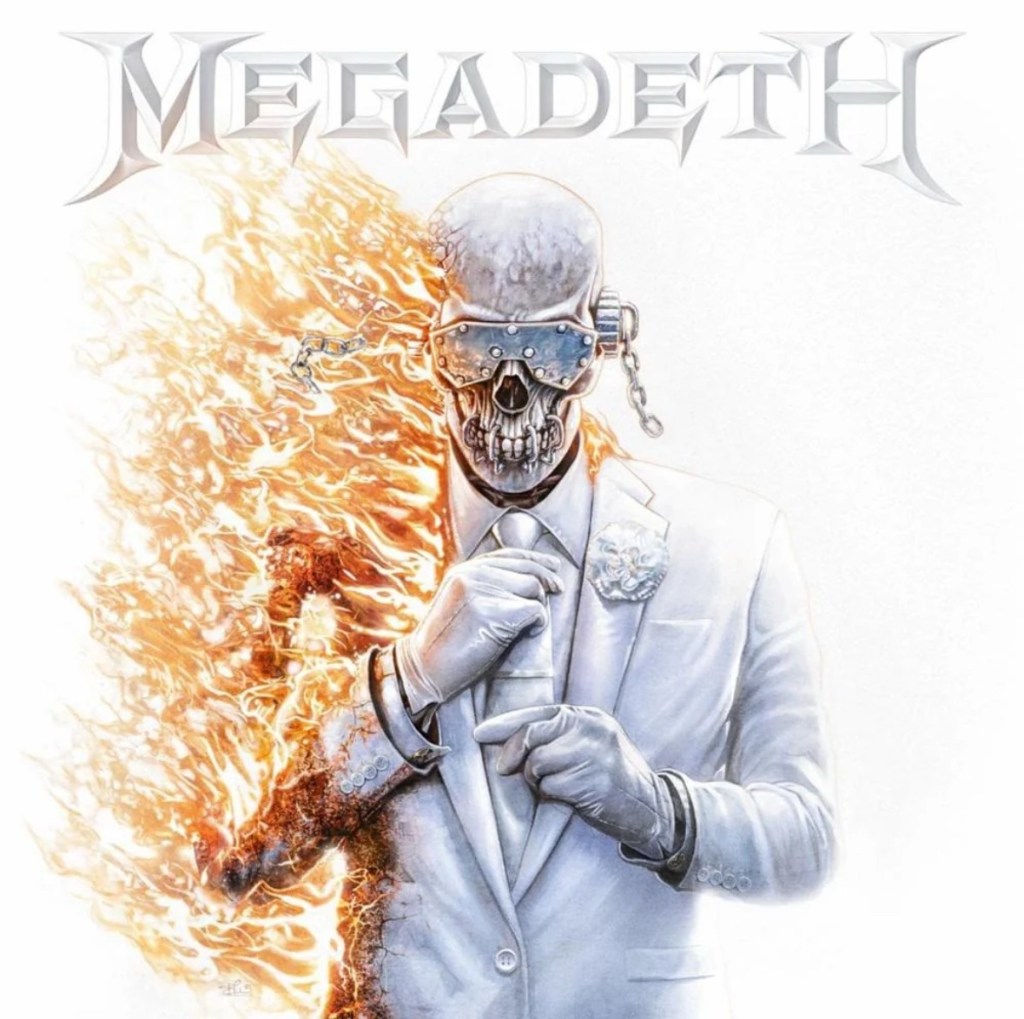
The album didn’t just arrive, it was staged.
Announced in August 2025 with Vic Rattlehead literally on fire, rolled out through four singles across four months, and framed as the final Megadeth statement.
Not a late-career album. A closing argument. The farewell tour wasn’t an afterthought; it was embedded in the release plan.
Production began quietly in late 2024 with producer Chris Rakestraw, largely remote at first. Mustaine and guitarist Teemu Mäntysaari traded ideas while the room was empty. This will be the only Megadeth studio album Mäntysaari will ever appear on, which gives his playing a different gravity, it’s not contribution, it’s inscription.
Mäntysaari arrives with a pedigree that matters more than hype: classically trained, composition-literate, and forged in the Scandinavian metal ecosystem where precision, melody, and structure are non-negotiable.
Best known for his work in Wintersun, he comes from a lineage that treats guitar not just as a weapon but as an architectural tool, stacked harmonies, modal phrasing, neoclassical discipline, and an almost orchestral sense of movement. You can hear influences ranging from European power metal and melodic death metal to classical and film-score logic, where riffs aren’t just aggressive but directional.
As a co-writer with Mustaine, Mäntysaari doesn’t challenge Megadeth’s DNA; he refracts it. The result is a distinctly Euro-metal contour, tighter harmonic logic, cleaner thematic development, and a sense of inevitability baked into the riffs, less street brawl, more war plan.
His presence subtly modernizes the band without diluting it, giving these songs a colder, more surgical feel that contrasts with Mustaine’s snarling, American thrash instincts. It’s not a takeover; it’s an overlay. And because this is his only Megadeth studio document, that influence feels permanent, etched, not experimented with.
By June 2025, vocals were being tracked. By January 2026, the album was positioned as history.
Tipping Point
This is the mission statement.
Flat-out thrash. No apology. No warm-up. The title is a tell, this isn’t about balance, it’s about inevitability. Musically, it does exactly what a “final album” lead single must do: reassure the base. “Yes, we can still do this. Yes, the hands still work.”
What’s more revealing is what it doesn’t do. No experimentation. No curveballs.
Mustaine knows the first impression defines the entire conversation.
And it works.
“Today I may bleed, but tonight you will die”
Patience weaponized.
“You buried the truth under layers of lies”
Self-inflicted decay. The deeper the stack, the more violent the reckoning.
“Push me, I push you back”
Symmetry established. You set the terms; I enforce them.
“Hiding your secrets out in plain sight”
Collective denial. The secret survives not by concealment, but tolerance.
And then the outro riff lands like a body blow.
“You won’t define me, you’ll never find me”
Refusal of containment. To define is to reduce. To find is to fix. Autonomy is reclaimed through disappearance.
The tipping point isn’t rage. It’s clarity.
I Don’t Care
Three minutes. Punk bones. No fat.
This reconnects Megadeth with the sneer that predates thrash orthodoxy. It’s not refined, and it’s not trying to be. That’s the point. Precision was never the whole story; attitude was.
Releasing this as the second single is a message: don’t expect reverence. This isn’t a victory lap. It’s a shrug with distortion.
“I don’t care what the headline said”
A rejection of outsourced reality. Headlines collapse complexity into verdicts built for attention, not truth.
“You know a rat never learns”
Not an insult, but pattern recognition. Repetition without reflection. Once behavior stabilizes, hope of reform disappears. Expectation shifts from change to containment.
Hey, God?!
Classic Mustaine: theology as confrontation, grievance elevated to cosmic scale. Musically solid, structurally familiar.
“The years are passing by like days”
Time compression, not aging. When days lose distinction, life accelerates.
The fear isn’t death, it’s unused life.
And make sure you stick around for the guitar solos.
Let There Be Shred
The most Megadeth song here, and the most ridiculous. Which is why it works.
Creation myth rewritten as guitar doctrine. No irony. No wink. Just total commitment. Mustaine dares you to flinch first.
“On the day I was born, a guitar in my hands”
Identity fused to function. Not “I chose this”, this chose me. Careerism disappears.
What’s left is vocation.
“Destroying pretenders, only ashes remains”
Authenticity under pressure.
Puppet Parade
The curveball.
Mid-tempo. Melodic. Built for repeat listens. The kind of song late-’90s Megadeth fans pretend never happened, and yet it’s arguably the best-written track here.
The irony is precise: the song about manipulation is the most controlled thing on the record. Hooks are intentional. Dynamics are measured. Accessibility was never incompetence; it was choice.
“I punch your clock, I play a role”
Labor as submission. Performance without belief. Effort is real; meaning is outsourced.
“Where the lies are truth / And our lives are trade”
The moral core. Reality assigned, not discovered. People reduced from ends to inputs. Exploitation normalized through redefinition.
Once that switch flips, marching doesn’t need enforcement. It’s automatic.
Another Bad Day
Functional. Efficient. Disposable.
Nothing offensive. Nothing essential.
“My life’s a mess, but I call it mine”
Ownership without redemption. No fixing. No reframing. Just authorship claimed.
“Every scar is a line I drew”
Pain turned into power. Not innocence, responsibility. The quiet weight that follows.
Made to Kill
Thrash returns, lean and calibrated.
This is Megadeth on autopilot, but it’s a well-tuned autopilot.
Mäntysaari proves he understands the internal math of Megadeth riffs. You don’t remember it for the message. You remember it because it moves.
“Taught to pray, yet made to kill”
Contradiction as training. Belief installed alongside violence. Prayer as insulation, not restraint.
“Truth is sold in streaming lies”
Propaganda as infrastructure. Truth isn’t erased, it’s monetized and drowned in volume until disbelief feels pointless.
What survives isn’t ignorance.
It’s exhaustion.
Obey the Call
Shadowy control. Puppetmasters. Faceless systems. A reflection of Mustaine’s conspiratorial gravity.
“It feeds on faith, but it bleeds gasoline”
Belief exploited as fuel. Devotion weaponized. The cost is always physical.
“And the pawns will rise / And empires fall”
Not heroics, structure. Collapse seeded by control itself.
I Am War
Shorter. Sharper. More effective.
Less sermon, more declaration. It knows exactly how much energy it has, and spends it carefully.
“To know you, I become you”
Empathy weaponized.
Understanding as assimilation.
Victory through total cognitive immersion.
“I am war, I am hurt and pain”
Not metaphor, identity. War isn’t something enacted; it’s embodied.
No separation between actor and action.
The Last Note
Five and a half minutes of unresolved intent.
Sentiment or defiance?
Curtain call or middle finger?
It wants both and never fully chooses. Which is fitting. Mustaine has never mastered endings.
“One more winding road that I won’t come back”
Finality without drama. Motion without return. Acceptance, not mourning.
“Each song has got beneath my skin”
Creation as accumulation. Art doesn’t cleanse, it erodes and stays.
“I can’t outrun the spinning hands of time”
Aging as pursuit. Speed once solved everything. Now it doesn’t.
“They gave me gold, they gave me a name”
Recognition as transaction.
Success always arrives with a bill.
Ride the Lightning (Metallica cover)
Not an encore, a provocation.
Ending the final album by revisiting the band that expelled you isn’t nostalgia. It’s wound management. The performance is heavier, cleaner, but its purpose isn’t musical.
It’s psychological.
“There’s someone else controlling me”
Agency surrendered to process. Terror born not from chaos, but automation.
“Consciousness, my only friend”
Everything external stripped away. Awareness remains, forced to witness its own erasure.
The cruelty isn’t death.
Its presence during death.
The “Ride the Lightning” cover didn’t drift into the middle, it drew a line. Based on a sample of X comments, fans either hear a powerful legacy statement or an unnecessary retread. The split is clean: some hear reverence and authority, others hear dilution and loss of danger, with a small group stuck in polite indifference.
For me, it works. The slightly increased tempo injects urgency without rewriting history, and the performance understands the assignment: pay homage, don’t vandalize the blueprint. It respects the original’s gravity while letting Megadeth’s muscle show through.
This isn’t really about quality. It’s about philosophy.
Do you want a cover to preserve the fire, or to replace it?
To sum it all up, it’s a controlled burn, a managed farewell that captures exactly what Megadeth has always been: brilliant, stubborn, technically elite, emotionally unresolved, and incapable of clean exits.
If this really is the end, it ends the only way it could.
Not with peace. With insistence.
And that’s the most honest thing Megadeth could have done.
P.S. i just listened to the bonus tracks “Bloodlust” and “Nobody’s Hero” on YouTube. Wow. But they will be for another post.
 destroyerofharmony