“Run With The Pack” dropped in 1976. Ron Nevison engineered it and Eddie Kramer mixed it. Two names who appeared on a lot of hard rock and metal release I acquired in the 80’s.
For Bad Company, this is three albums in three years but when Daniel Ek from Spotify said that artists need to release more frequently, there was an uproar.
Did anyone see the recorded output from Ronnie James Dio?
From Elf, to Rainbow, to Black Sabbath and his solo career, he was doing a release a year.
“Run With The Pack” is not as solid as the first two albums from start to finish, but there is still enough quality to get people’s attention and it also helps when the first two albums are still selling and being played on radio.
LIVE FOR THE MUSIC
Great title.
The chord and a vocal line, the chord again and another vocal line. And that funky riff in the chorus.
“But when the night time comes I’m ready to rock”
The night is my domain. I feel I’m at my most creative then.
Check out the guitar solo. It’s a simple three note melody, repeated over three bars, with just a small change on the last bar. So simple, but effective. And it pissed me off when writers in the 90’s wrote about how simple and effective the Seattle solos were. I guess they never checked out Bad Company.
Unsung hero here is Boz Burrell on the bass. His holding down the groove but also playing the melody and towards the end of the song, it’s just Simon Kirke and Burrell, grooving away.
SIMPLE MAN
As good as anything from the first two albums.
I love the way the song just rolls after those opening arpeggios. It’s an anthem. So many good lyrical lines like;
“I’m just a simple man trying to be free” “Freedom is the only thing that means a damn to me”
Ralphs use of acoustic and electric guitars is the same technique he employed on “Feel like Makin’ Love” from the “Straight Shooter” album.
HONEY CHILD
It’s “Can’t Get Enough” part 2.
LOVE ME SOMEBODY
A country blues piano ballad. Songs like these showcase the variation of the 70’s acts. An album purchase would give the listener so many different styles.
RUN WITH THE PACK
It starts off as a rocker and roller.
But the slow-down in the chorus. I love it.
Listen, especially when the violins come in towards the end.
SILVER, BLUE AND GOLD
It’s a fan favourite, with a sweet solo.
YOUNG BLOOD
A rock-a-billy cover. Not my favorite.
DO RIGHT BY YOUR WOMAN
Another country rock cut.
SWEET LIL’ SISTER
It’s “Movin On” part 2. The chord progression was overused. “Sweet Home Alabama” comes to mind.
FADE AWAY
The piano riff is excellent.
They tried to rewrite “Bad Company” and they did a good job with it. It has enough variation to make it sound unique. U.F.O sounded like this on the “Lights Out” album. And Check out the emotive solo.
The album cover captured my attention immediately.
The “Red Star” was easily associated with the Communist governments of the time. Kids these days would have no idea, but in 1976, Eastern Europe and parts of South East Asia, Africa, the Middle East and Central/South America were under Communist governments or military dictatorships. And these kind of governments like to control everything and everyone.
Coming into 2112, Rush was in a predicament. D
o they stay true to themselves and their art or do they give in to what the label wants?
In the Guitar Legends magazine focusing on Rush, Neal Peart said the following;
“Caress didn’t actually do any worse than the albums before it, at that point, all three had sold about 100,000 copies a piece in the U.S.
But if our record company hadn’t been in such turmoil I don’t think we would have been able to keep our recording contract.
By the end of that year we were unable to pay our crews salary or even our own. Things were dire and we were getting a lot of pressure.
Polygram had written us off before “2112” had come out. We’d seen their financial predictions for 1976 and we weren’t even on the list!”
In the same magazine, Alex Lifeson said the following;
“The Fountain Of Lamneth” on “Caress of Steel” was really our first fill concept song and “2112” was an extension of it.
That was a tough period for Rush because “Caress of Steel” didn’t do that well commercially, but we were really happy with it and wanted to develop that style.
Because there was so much negative feeling from the record company and our management was worried, we came back with full force with “2112”. There was a lot of passion and anger on that record. It was about one person standing up against everybody else”.
History shows that they made the right decision.
And for all the hate “Caress Of Steel” got from the label, it was the album that bridged the first era of Rush albums to “2112”.
The entire Side One is all “2112”. Which is broken up into 7 sections.
I. “Overture”
An instrumental that acts as a summary in which you get to hear all of the melodic pieces which appear on the song.
II. “The Temples of Syrinx”
A sombre melody with the words “And the meek shall inherit the Earth” is sung before the distorted guitars kick in for “The Temples of Syrinx”.
This is a future where individualism and creativity are outlawed and the population controlled by a cabal of malevolent Priests who reside in the Temples of Syrinx.
And the way copyright law is going, creativity can be outlawed as every single melody known to the human race has been used and corporations are doing their best to lock them up under ridiculous terms, like life of the creator plus 90 years after death. But they seem to forget that creativity is based on influences.
We’ve taken care of everything The words you read, the songs you sing The pictures that give pleasure to your eyes
The schooling system is designed for conformity, a one size fits millions approach. The schools are factories for degrees later on. You can’t even get an Administration role in a Company without a Uni/College degree. And Masters Degrees are the biggest scams ever. A pure profit making product for the colleges.
III. “Discovery”
A classical acoustic guitar announces the arrival of “Discovery”, found inside a cave and the founder rediscovers the lost art of music.
I can’t wait to share this new wonder The people will all see its light Let them all make their own music The Priests praise my name on this night
Creativity and imagination is progress. Without it, we stagnate.
IV. “Presentation”
This is like Zeppelin Rush which tells the story of how the guitar is presented to the priest of the Temple of Syrinx, who then proceed to destroy it and banish the man who found it.
Listen to my music And hear what it can do There’s something here as strong as life I know that it will reach you
But the Priests didn’t want to know about his ancient relic. It was the downfall of The Elders. The emotion and escapism that comes from listening to music.
Just before the song finishes, they go into the “Temples of Syrinx” riff and Lifeson solo’s over it. Check it out, its guitar hero worthy.
V. “Oracle: The Dream”
A shimmering chorus guitar kicks off the song in which the man who found the guitar dreams of another world in which creativity and individualism is allowed and full of song and laughter.
VI. “Soliloquy”
We are back to the sounds of water running down, like how we heard in “Discovery”. But the lyrical theme is heavy. The man who was filled with joy at finding the guitar, is now in despair at living a life that’s cold and empty. So the only way for him to be with the world in his dream is for his life’s blood to spill over.
Make sure you check out Lifeson’s solo. So bluesy, full of bends and emotion. Brilliant.
VII. “Grand Finale”
Major key chords kick off the “Grand Finale”. And it’s up to the listener to decide what happened.
When I first heard the lines “Attention all planets of the Solar Federation, We have assumed control” I presumed that the “Solar Federation” put down some uprising and assumed control again.
Then I thought it meant that the “Solar Federation” was overthrown by someone and they are alerting all the planets that there is a new government in control.
“A Passage to Bangkok”
It kicks off Side 2.
A great riff to start a song about all the places in the world that grow the best weed. The track names a number of cities and countries, including Bogotá, Acapulco, Morocco, Bangkok and Kathmandu, Nepal.
I just finished watching “The Serpent” on Netflix and how the main character preyed on tourists who came to Bangkok and Kathmandu in the late 60s and 70’s to experience those weed highs, kidnapping them, robbing them and then killing them.
“The Twilight Zone”
I like the harmony guitars to kick off the song.
How good is the music in the section, when Lee sings, “you have entered the twilight zone”?
Use the key, unlock the door See what your fate might have in store…
I never watched “The Twilight Zone” on TV. I’ve read some short stories on it and in the 80’s a documentary was aired on Australian TV’s about strange phenomena and they called it “The Twilight Zone”.
“Lessons”
It’s Lifeson expressing his love for Led Zeppelin. It’s got hard rock distorted chords and clean tone strummed verses.
“Tears”
This is a great song.
How good are the verse riff arpeggios?
“Something for Nothing”
The acoustic guitar intro gets me interested. And the way Lee and Peart come in, they change the groove completely.
The song is about freewill and decision making, a topic I write about regularly on this blog when I’m putting my point of views out there on certain songs and the lyrical message.
You don’t get something for nothing You can’t have freedom for free
In the end “Freedom isn’t free”.
If you don’t believe me, why does it cost so much to live in a free country.
What you own is your own kingdom What you do is your own glory What you love is your own power What you live is your own story In your head is the answer Let it guide you along Let your heart be the anchor And the beat of your own song
The lyrics are prophetic. Rush didn’t wait for someone to tell them what to do. They did what they wanted to do and they wrote their own story. In the end, it was a backs against the wall album. If it bombed commercially, they would go down in flames. But it didn’t.
They stuck to their guns, did what was important to them and built a career from it.
3x Platinum in the U.S and 2x Platinum in Canada.
Press Play, relax and “Attention all Planets of the Solar Federation. We have assumed control.”
It’s not on Spotify as their original label Gull owns the rights and the split between artist and label was hostile.
Judas Priest recorded this album on a very small budget, whilst working part-time jobs and living off of one meal a day. As they say, hard times and adversity breeds genius.
This album is the transition point between blues rock and a new style about to be born, which is basically the metal that I got to know.
“Victim Of Changes”
It kicks off the album, a combination of two separate songs. “Whiskey Woman” from the band co-founder and original singer, Al Atkins (who also gave the band its name) and “Red Light Lady” from the person who replaced him, Rob Halford.
The riff reminds me of “Stormbringer” from Deep Purple and both songs came out at a similar time. There is a little lick towards the end of the riff that Metallica swiped for “Seek And Destroy” which they use to “get out” of the intro riff pattern and into the verse riff. Wikipedia quotes a source that the riff was inspired by “Black Dog” from Led Zeppelin.
Regardless of the source inspiration, it’s a beautiful example of how you take little bits and pieces of what came before and make it your own.
“The Ripper”
A lot of bands at this time were doing similar riffs, borrowing from each other and allowing themselves to be influenced. The main riff here is reminiscent of “Stranglehold” from Ted Nugent, however both songs came out at the same time. It could be pure coincidence, but it also means that the artists in question had the same influences.
The Chorus riff feels like a Pink Panther soundtrack and the solo section is the way Muse do their solo sections.
“Dreamer Deceiver”
If you want to know the inspiration behind “The Warning” album from Queensryche, just listen to this.
It’s one of those moody slow tempo songs I really like from acts in the Seventies. From a Judas Priest viewpoint, this song is an underrated cut. I would even call it a masterpiece.
Halford covers so much ground with his voice, singing across four octaves at different times of the song.
And the guitar solo from Glenn Tipton. One of the best guitar solos of all time. So overlooked. It’s on par with “Comfortably Numb” by Pink Floyd for pure emotion.
As the solo went on, Halford came in with his super falsetto ohhhs and ahhhs.
“Deceiver”
It has the triplet galloping style of riffing that Sabbath used in “Children Of The Grave” which came out in 1971. And Halford is going to town with his falsetto voice, clearly showing a certain Scandinavian singer called King Diamond, how to develop his style.
“Prelude”
It’s soundtrack music. A friend of mine said, its influenced by “The March Of The Black Queen” from the Queen “II” album. Listen to em both and you decide.
“Tyrant”
I reckon a young EVH was clearly influenced by the riffs in this song. Listen to the intro riff and you will hear it sounds like a certain Van Halen song.
“Genocide”
There is a lot of Deep Purple in this track. “Smoke On The Water” and “Woman from Tokyo” come to mind, from a groove and feel point of view.
“Epitaph”
It’s a progressive song, with layered vocals while musically, it’s just a piano riff. Black Sabbath’s “Changes” and Queen and ELP comes to mind.
“Island of Domination”
And they close off the album with a track that reminds me of “IV” from Sabbath.
The main riff sounds an awful lot like Nazareth’s “Railroad Boy” released a year earlier.
And you all know my view on this, all music is a derivative of some other music. If you listen closely, the section from 2.20 reminds me of “Wake Up Dead” from Megadeth.
For just their second album, there is a lot of ground covered.
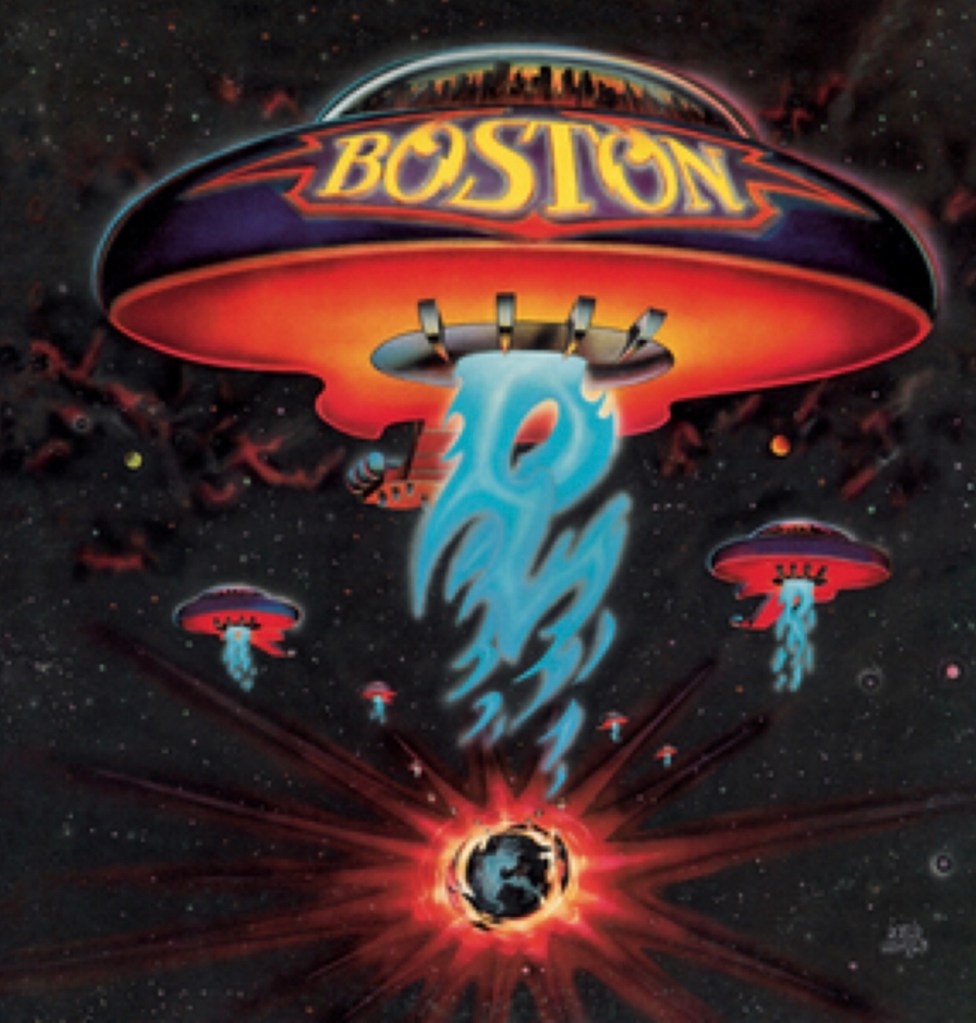
It’s another band I really got into during the 90’s and I’ve posted my record collection of Boston here.
It was a Guitar World issue that got me interested to hear Boston as it spoke about the making of the album, Tom Scholz diligence to sound and it also had a transcription of the opening track, “More Than A Feeling”. At 445.7 million plus streams on Spotify, it’s a monster track.
At 29 years of age when the album was released, Tom Scholz wasn’t your typical rock star in waiting, working as a project manager for Polaroid with a Master’s degree in engineering and writing songs that he liked to hear in his basement when he wasn’t working. And as good as Scholz is, he needed a voice for his songs, and that voice came from Brad Delp.
Disco also ruled the airwaves when this album hit the record stores. Most labels passed on the band because they didn’t believe a guitar heavy rock record could even chart. But Scholz stumbled onto a sound that would be imitated by all bands since.
My favourite is “Peace Of Mind” purely for the guitar leads in the intro and the outro. On Spotify, its sitting at 117.8 million streams.
I then ignored the rest of the album for a long time, finding it generic. An Epic A&R rep even said to the band in one of the rejection letters that they have nothing new to offer and sounded generic, but then credited himself as discovering the band when they broke big.
Then in the 2000’s I revisited the album.
“Foreplay/Long Time” came into my life and I didn’t notice it before but it has a similar riff in it as “More Than A Feeling. On Spotify, its sitting at 74.4 million streams.
“Rock And Roll Band” and “Smokin” are your standard blues rock fares, with “Smokin” having a more ELP vibe in the middle section. It’s also sitting at 47.3 million streams on Spotify.
And the other tracks are “Hitch A Ride”, “Something About You” and “Let Me Take You Home Tonight” showcase a more of blues country rock feel, but compared to the massive first two songs, they are lost in the “deep album cut” landscape. And it’s those first two tracks which sold the album throughout the world.
17 million sales in the U.S alone. Not bad for an album recorded in a basement.
In 2013, Scholz filed a termination notice to claim back his copyrights to the debut album and “Dont Look Back” as per the clause in Copyright Law which allows him to do so after 35 years. And it ended up in the courts.


 destroyerofharmony