A to Z of Making It, Classic Songs to Be Discovered, Derivative Works, Influenced, Music, My Stories, Unsung Heroes

The Record Vault: Deep Purple – Come Taste The Band

It took Deep Purple seven years to make it to the top and two years to break up. The air is thin at the mountain top.

Deep Purple had lost their lead singer Ian Gillan and bassist Roger Glover in 1973 and replaced them with David Coverdale and Glen Hughes. This MK3 version recorded two albums and then guitarist Richie Blackmore left at the start of 1975. This was weird as Deep Purple was seen as “his” band. And from looking at it, it’s like the owner of the house vacating their premises for the guests to take over running the house.

But Deep Purple would soldier on, replacing Blackmore with a young guitar hero from the U.S. known as Tommy Bolin. Rounding out the band is the rest of MK3, David Coverdale, Glenn Hughes, Jon Lord and Ian Paice.

And MK4 was created.

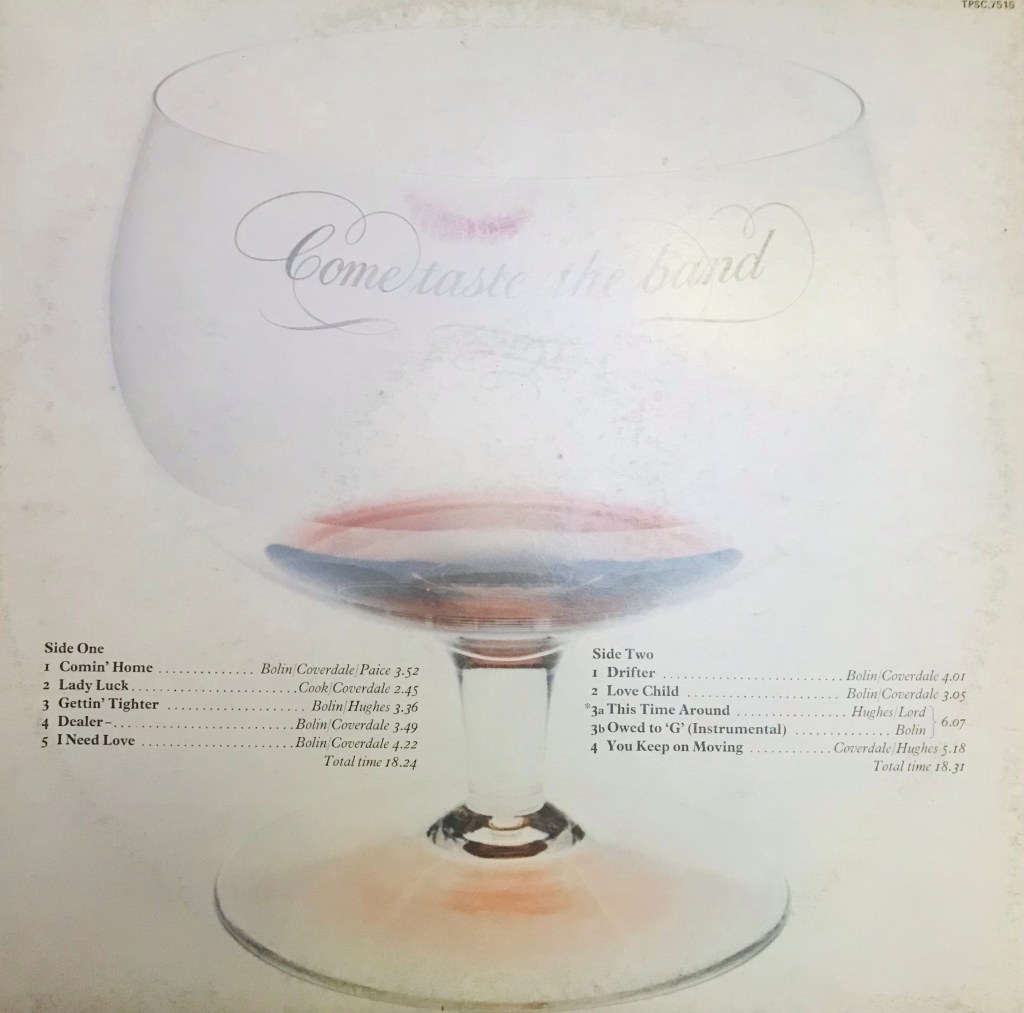
“Come Taste The Band” came out in 1975. It’s the usual production team of the band and Martin Birch.

The name Tommy Bolin came into my life because of Motley Crue. The Crue covered the song “Teaser” for a Compilation album and they also released it on a Raw Tracks CD made for the Japanese market, which I got my hands on. The song is so good and sleazy it sounded like a Crue original and I was curious to hear more from Bolin.

So as I was going back into the career of David Coverdale because of Whitesnake’s attention grabbing 87 LP, I was doing the same for Tommy Bolin.

So I got my hands on the “Teaser” and “Private Eyes” album first and imagine my surprise when I came across an album that had both Coverdale and Bolin on it.

Comin’ Home

Written by Tommy Bolin, David Coverdale and Ian Paice with vocals provided by Coverdale.

This song rocks out of the gate paying homage to the fast rock sounds of Deep Purple MK1, MK2 and MK3. But it was more Grand Funk, like “We’re An American Band”.

Lady Luck

Written by Jeffrey Cook who co-wrote songs with Bolin for the “Teaser” record with lyrical contributions from Coverdale.

Vocals are provided by Coverdale. In didn’t really do much for me.

Gettin’ Tighter

Written by Bolin and Hughes with vocals provided by Hughes.

This song is funky out of the gate, and sleazy once the whole band comes in.

Dealer

Written by Bolin and Coverdale with vocals provided by Coverdale and Bolin.

It’s very Hendrix “Purple Haze” like in the riff departments with a Beatles like Folk Rock interlude which Bolin sung.

I Need Love

Written by Bolin and Coverdale with vocals provided by Coverdale.

I like the groove on this, and the way the verse riffs are played out with the heavy synth from Lord.

Drifter

Side 2 begins with this song written by Bolin and Coverdale with vocals provided by Coverdale.

It’s got a great Intro which reminds of “You Really Got Me” or “American Woman” and check out the groove that comes in once the drums and bass kick in.

Coverdale’s bluesy voice is a highlight.

At 2.36 there is just a bass and keys section over a drum groove. It reminds me of things that Rush would do.

Then Bolin comes in, with volume swells and a solo begins. The drums and bass become busy as they build it up, and the vocals come back in. Its brilliant, it gives me goose bumps all the time, so press play just to hear that.

Love Child

“Heartbreaker” anyone. Press play and listen to the intro.

Written by Bolin and Coverdale with vocals provided by Coverdale.

The verse groove and riff are my favourites even though the whole “love child driving me wild” lyric didn’t set the world on fire.

At 1.50, they go into a progressive rock style groove and Lord solos over it.

This Time Around / Owed to ‘G’

Written by Hughes, Lord and Bolin with vocals provided by Hughes.

It’s very progressive sounding, like ELO and it moves into a great instrumental jam over a 12/8 groove with excellent lead guitar from Mr Bolin himself.

You Keep On Moving

Written by Coverdale and Hughes with vocals provided by Coverdale and Hughes.

This is the standout track. Its haunting and melancholic and it was written during the “Burn” sessions but not used.
Norway, Sweden, Denmark, Holland, Czechoslovakia and West Germany all got behind this version of the band. The Japanese still loved em and New Zealand loved em even more.

But.

The classical progressions and jams had been replaced with groove, soul and funk. It could be seen as an early Whitesnake album, as a few tracks have “Love” in the title, which is similar to every Whitesnake album.

Also in 1975, Tommy Bolin had two records competing against each other, which probably wasn’t the best scenario for Deep Purple however I have seen “Teaser” album pictures with a sticker on em that said “Guitarist Of Deep Purple”. Since most of the songs were written by Coverdale and Bolin, the project could have been billed as Coverdale/Bolin.

After the tour for this album finished in March, 1976, Deep Purple MK4 was no more. Glen Hughes was already having issues and was in and out of rehab. David Coverdale would form Whitesnake and get Jon Lord and Ian Paice into the project. And Tommy Bolin by December 1976, was dead from drug intoxication as morphine, cocaine, lidocaine and alcohol were all found in his system.

But the music lives on.

Standard
Classic Songs to Be Discovered, Influenced, Music, My Stories

1976 – Part 3.5: Doobie Brothers – Takin It To The Streets

It’s a great album title but people hated the cover, thinking it was lazy.

“Takin’ It to the Streets” came out in 1976 and it’s the first to feature Michael McDonald on lead vocals. If you own the “1984” album by Van Halen, you will see Michael McDonald listed as a co-writer to “I’ll Wait”.

Tom Johnston was the leader and main songwriter in The Doobie Brothers. But in 1974 while touring, he fell ill and he had to reduce his involvement with the band. This got the label nervous as they didn’t want the band to continue without Johnston and the other members considered calling it quits.

But newbie guitarist Jeff Baxter suggested calling up a friend and fellow Steely Dan graduate Michael McDonald to finish the tour. McDonald thought that once the tour was over, he would be on his way, but was then asked to come into the studio to work on their next album.

Producer Ted Templeman (another familiar name for Van Halen fans) started going over the songs the band had available, but he knew they needed more and McDonald was asked to contribute his own songs. Which were very different sounding to what the Doobies played and if the band recorded em, would take the band in a different direction.

And that is what happened. So let’s see how the bridge between the Johnston and McDonald era sounded.

The musicians for the album are Tom Johnston who was still around to contribute and he played electric guitar, lead and backing vocals on the track “Turn It Loose” and vocals on “Wheels of Fortune”.

Patrick Simmons played electric guitars and lead vocals on a few songs,

Jeff “Skunk” Baxter is on electric guitars.

Michael McDonald played all the piano and synths as well as lead and backing vocals.

Tiran Porter on bass, backing vocals and lead vocal on “For Someone Special”. Drums were provided by John Hartman and Keith Knudsen.

The album had a The Memphis Horns section and various other musicians playing congas and violas and what not. Even Templeman chimed in with some percussion.

Speaking of the Production team Donn Landee (another familiar name for Van Halen fans) was there as Engineer.

Wheels of Fortune

The clean tone riff to start the song rocks and grooves. Almost funk rock like. Dare I say it, Steely Dan like.

Written by Patrick Simmons, Jeff Baxter and John Hartman, it’s still the old Doobies sound.

Vocals are provided by Tom Johnston.

Changin’ wheels of fortune
Drivin’ us on and on
Winnin’, sometimes losin’
As soon as it’s here it’s gone

Living from payday to payday is the only way for a lot of people.

Takin’ It to the Streets

The Michael McDonald era begins. The title tracks is solely written by McDonald. Its piano driven, and it funks and sort of rocks.

I also like the bass playing from Tiran Porter. Check it out.

And the solo is driven by The Memphis Horn Section. Yep horns and not guitar.

I ain’t blind and I don’t like what I think I see
Takin’ it to the streets

People have taken to the streets to protest a lot these last 15 years, but it’s still the same rubbish.

8th Avenue Shuffle

Guitarist Patrick Simmons wrote this one. It’s a blues soul funk tune, with some wonderful bass playing. Hell, it could appear on an Eagles album and not be out of place.

Losin’ End

Another track written by McDonald. It does nothing for me.

Next.

Rio

A track written by guitarists Simmons and Baxter, with vocals provided by Simmons and McDonald.

A Charlie Watts style drum beat starts the song, and when the Latin percussion comes in, I felt like I was listening to an Al Di Meola cut.

This track is the definition of “Yacht Rock”.

For Someone Special

Written by bass player Tiran Porter and the vocals are delivered by Porter himself.

The 70’s acts all had capable musicians who could play and sing.

The bass plays the main riff here, while the guitars and keys decorate. It’s trippy and I feel like he’s venting his feelings about Tom Johnston.

To reach down inside
And push that nightmare away
Now I’m glad that it’s over, it’s over
Now I can play

It’s always difficult for a band when a person who is like a band leader steps away. And the label does it’s best to make the other members feel worthless.

It Keeps You Runnin’

Another cut written by McDonald by himself, the lone wolf.

Not a favourite.

Turn It Loose

Johnston definitely gave the band a rocking edge. So even though he was done with the band, he did deliver this excellent cut.

People all around me
Everywhere I go
I thought I had a grip on things
Now I just don’t know

I’m not a big enough fan to know everything about The Doobie Brothers, but Johnston was seen as the driving force of the band and one of the main writers by the press and the label.

So when he disappeared, no one knew what was going to happen.

Carry Me Away

Written by Simmons, Baxter and McDonald. It’s just too much like a 70’s TV intro theme song.

In the end the album has more of a jazz, urban, soulful, funk than rock tunes and a new era started.

Michael McDonald and The Doobies.

Standard