A to Z of Making It, Music, My Stories

The Destination

There is a post I read on Seth Godin’s blog, called “The Compass And The Map” about a soldier who escaped a Japanese prison in Burma during World War 2.

For five months, he used a map and a compass that he had found to get him to India as he was too suspicious to ask the Burmese for help. He scribbled on the map, his turns and marked down the rivers he crossed.

When he showed the Intelligence Officers in India his map, it was a map of the streets of London. As Seth Godin concludes, “if you’ve got the wrong map, the right compass will get you home, if you know how to use it.

In other words you need to know where you want to go and be flexible with the route.

Do artists have these same ideals?

The days of a record label A&R person signing you and employing people around you to do the work, while you write and record and tour and make lots of money are long gone. For that era, the artists had the map which was controlled by a gatekeeper, as it was a step by step guide on how to get from playing to your bedroom wall to maybe getting an A&R rep to see you play live, to signing a deal and then playing to thousands of people.

But that map will not serve you well in the music world today. You need that compass that takes you in the direction you want to go, as long as you know your destination.

Standard
A to Z of Making It, Music, My Stories

Saying Something Without Giving Too Much Away

Nearly all the writers about the 90’s like to re-write history to suit their own viewpoint especially after Seattle became the new Sunset Strip.

I recall reading hundreds of articles that said the lyrics of the grunge bands became personal, deeper and showed an angst that resonated more with people than the lyrics of the 80’s hard rock bands who focused so much on the usual SDRR (Sex, Drugs and Rock N Roll) themes.

I think there are millions of peaches that disagree.

And I always disagreed with that view point because I felt that hard rock bands from the 80’s did write personal lyrics and on topics different to the usual SDRR themes.

Dee Snider on the “Stay Hungry” album wrote about censorship, rebellion, about being away from his family, his fan base and about keeping the fire burning when you think that goal is unachievable.

Nikki Sixx wrote “On With The Show” about the night that Frankie became Nikki.

People talk about the lyrics that Layne Staley wrote in the grips of an heroin addiction. What about “Dancin On Glass” from Nikki Sixx, which is referencing Nikki’s overdose in London.

Skid Row broke big with a song about rebellion in “Youth Gone Wild”, cemented their rebellious status with their fight song “Piece Of Me” and nailed the power ballad charts with “I Remember You”. But it was their follow up album that covered so many social issues. “Slave To The Grind”.

Guns N Roses built their career on singing about cities and relationships. “Welcome To The Jungle” is about LA and “Paradise City” is about San Francisco, while “Sweet Child O Mine” is basically a love song.

However, the songs are done in a way that they seem general. Maybe that was the difference between the 80’s and 90’s songwriters.

How can you say something effective without giving too much away?

Standard
Classic Songs to Be Discovered, Derivative Works, Influenced, Music, My Stories, Unsung Heroes

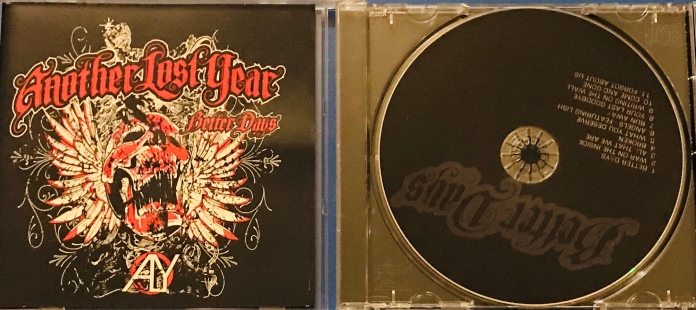
The Record Vault – Another Lost Year

You can’t find “Better Days” on streaming services in Australia. Which is ridicilous if you ask me, but hey, lets find a way to stop fans from listening to your album legally, however YouTube has songs from the album and it pays less.

Like Adelita’s Way, I got access to the music of ALY via peer to peer services. And i liked it and I purchased.

And then I never heard from em, until I looked em up on Spotify recently and have seen the following content;

A six song EP, called “The Revolution: Pt. 1 The Other Side”, released in 2014. Another six song EP, called “The Revolution: Pt. 2 It’s A Long Way Home”, released in 2016, an album called “Alien Architect”, released in 2016 and a 3 song EP called “Democrazy”, released in 2019. But no “Better Days”.

Anyway”Better Days” came out in 2012.

“I know I will move on to better days”

To have hope is to be human. To think that there is a light at the end of the tunnel, keeps us going. Not all of us make it, but we try our hardest to get there.

“War On The Inside” is heavy and yet accessable at the same time. And the lyric line of “All these voices, calling my name” begins the mental struggle within.

Am I good enough?

What if I make a mistake?

How will people see me?

What if i look like a fool?

I dont want to fail.

If you’ve spoken the above thoughts to yourself, then you are part of the many who has a war within everytime you step out of your comfort zone.

What if you replaced those thoughts, with, how would it be in 12 months if I fail today?

In “All That We Are” there is a lyric in the Chorus which connects.

“If you could just believe in all that we are”.

Trying to convince someone that the relationship (either friends or romantic or band) is worth keeping when they have mentally checked out, is difficult.

“Broken” has a bone crushing riff in the intro and verses.

“What I Deserve” has an intro that reminds me of Bonfire’s “Ready For Reaction” from the Fireworks album. And in the verses, I feel like I’m listening to “Love Song” from The Cure.

“Angels” is a ballad and it’s my favourite song.

“Theres nothing left, theres nowhere to hide”.

I never really sat down and payed super attention to the whole message of “Angels”. I just gravitated to the lines that grabbed me.

Eventually all the riches and good and bad deeds won’t save you when it’s time to meet your end.

“All the worlds you built they all fall down”

We can build walls to keep people out but if history has taught us one thing, all great civilizations fall. And that’s no different to our personal relationships and our private thoughts. It all falls down.

Basically after six tracks, its a six from six for me.

“Runaway” could have come from a Three Days Grace or Shinedown album. “Writing On The Wall” sounds very familiar and that Chorus. Brilliant.

“Come And Gone” is sad and hopeful at the same time and that lyric line, my time has come and gone.

Standard
A to Z of Making It, Music, My Stories

Sales Or Subscription

You can’t sell a book if there isn’t thousands of books competing against it for your attention. And LPs back in the day didn’t sell in a place that had just one LP to sell. Hence why the record stores became huge.

To be surrounded by competition is good for business because it’s not about if a person will invest time, it’s about which artist will the person invest time on.

Bands used to play Clubs before. Once upon a time, streets of businesses were lined up with live bands. The people of the time demanded it. And they selected which venue and artists got their attention. People pub-crawled to see different acts and today pub crawls are all about drinking sessions.

Today, you would be lucky to find a live music venue and if you did, the style of music may not be to your liking. And there wouldn’t be another venue to visit if that was the case.

Streaming or digital mp3s follows the same old principle. Put enough music tracks on a platform in which compete against each other and let the person decide on which artist they will invest time on.

Some people can’t handle the noise and just double down on the bands they already like. Some enjoy the search for the next favorite and some are happy for the algorithms to recommend the next song. Some fans refuse digital and still go shopping. There’s no one size fits all fan.

Adobe went from a sales business to a subscription business. In the beginning, income dried up but now it’s at an all time high. The customer is happy and they get updates of new features monthly plus they pay every month, not just once a year or every 2 years.

But artists and the labels just can’t let go of that sales model. The definition of insanity is doing the same thing and expecting a different result.

Imagine if an artist did something different.

How would that look a year from now?

Standard
A to Z of Making It, Copyright, Derivative Works, Music, My Stories, Stupidity

Andy Warhol Was Right

As I was reading a Copyright story about a suit being brought against Lady Gaga for the song “Shallow”, I was also listening to “Andy Warhol Was Right” from Warrant.

And I couldn’t find any difference between the chords of these songs. And Warrant or the heirs of Jani Lane could have gone to court with Lady Gaga, but they haven’t.

And then you get a nobody like Steve Rosen who reckons that the song he created is so original and free from influence that someone must have copied him.

And he is claiming that his song “Almost” must have been copied. And he uploaded it to SoundCloud six years before “Shallow” was released, to prove that he was first.

Well, Warrant released “Andy Warhol Was Right” 20 years before Rosen’s “Almost”.

Andy Warhol said that every person will have their fifteen minutes of fame. I guess it’s the perfect song to sum up the range of copyright cases. People searching for their fifteen minutes.

Standard
Music, My Stories, Stupidity

What’s A Person To Do?

Some people are just bad people. Some people get away with their crap. Some people think they’re getting away with their crap but aren’t. Some are takers and some are givers.

And it all doesn’t balance out, no way.

The Governments still don’t care about global warming or gun violence and Corporations still have their fingerprints all over legislation and trade agreements.

You can complain all day, but it makes no difference, you have to decide who you want to be, grow up and make your own choices.

It’s like Sammy Hagar said in “Mine All Mine”, “you’ve got Allah in the East, you’ve got Jesus in the West, Christ, what’s a man to do?”.

And once upon a time it was about supremacy of race and religion. Now it’s about status supremacy and likes supremacy. And people are fighting over about what side they want to be on. To paraphrase a line from the excellent Netflix show “Ozarks”, would you rather be the one holding the gun or running away from the gun.

And it’s probably a bad phrase to use with all the talk about gun violence and gun control in America but life boils down to control.

As long as we have to answer to somebody, then we have no freedom. And that somebody can be an employer, a partner, a lending company, a credit card company or the taxation department or utilities company.

Regardless of your place in society, be grateful. Because humans are made by nature to survive and produce, so if you are living you have done okay.

Standard
A to Z of Making It, Copyright, Influenced, movies, Music, My Stories, Stupidity, Unsung Heroes

Past Success

Is past success a good indication that you will have success again in the future?

Netflix thinks so, with the signing of the “Game Of Thrones” TV show creators to a $200 million deal. Their track record on reinterpreting other peoples material is pretty good, but their original content is pending review especially how they reinterpreted the last two seasons of GoT without really having source material to fill in the details.

This is like signing an artist to a $200 million deal when all of their songs are written by outside writers.

Remember the band Bananarama. They had a hit with “Venus”, a cover song and then their other hits were songs written by a British songwriting team called Stock-Aitken-Waterman. Well they got the mega deal, but didn’t really get the hits again.

Kevin DuBrow was given a million dollar contract to form his own band DuBrow but what the label failed to notice was that Quiet Riot’s two biggest songs are cover songs. Or offering Jay Jay French from Twisted Sister the same deal when Dee Snider wrote the material which made the band famous.

When Dokken splintered, Geffen went after Don Dokken and Elektra went after George Lynch, but what both labels failed to notice was that Jeff Pilson was the maestro, with a hand in co-writing all of Dokken’s most successful tracks. But no label went after him.

Even when Vince Neil left Motley Crue, he was courted by label’s and Warner Bros eventually signed him. But his fame is based on tracks Nikki Sixx had written.

Good business sense would be to see what their original shows or movies end up like.

But businesses don’t think like that. Netflix is losing subscribers for the first time in 11 years, Disney is taking back their content for their own streaming service and HBO and Amazon are also keen to get the GoT guys.

So by Netflix having these guys on board, by 2022 they would expect something in return. And Netflix would count on people keeping their subscriptions because of what they have in the pipeline.

But it’s all based on one key metric, as long as the GoT TV show creators brand doesn’t get further damaged in the meantime.

Standard
Classic Songs to Be Discovered, Derivative Works, Influenced, Music, My Stories, Unsung Heroes

1984 – VI – The Reckless Knights Of Thunder Seven And The Purple Rain

Was the news we read and saw on TV ever legit, independent and free from corporate interests.

These days, it’s evident that 99% of news publishers are teamed up with a corporation who sets the agenda. And the public interests are not served at all. Which means, the public needs to read critically and make up their own mind on the situation.

But researchers are finding out that the majority will read the headline, maybe the opening paragraph and then move on to another story. It wasn’t like that before. I remember my older brothers buying three different newspapers, from three different organisations. And the same stories had vastly different headlines.

Sort of like when you purchased a music magazine back in the day. When it was all just metal, it was okay. Then the magazines diverged into metal and rock and suddenly, the metal mags had nothing good to say about “rock” bands which a few months before were “metal” bands. And then those metal bands became hair bands and the cycle repeats.

Anyway, here are some artists that rock as hard as the rock heads and metal heads but you wouldn’t see them written up in any of those magazines.

Here are the previous parts of the 1984 series if you’re interested;

Part 1 – Ep 1

Part 2 – Ep 2

Part 3 – Are We Evil Or Divine?

Part 4 – The Warning

Part 5 – Grace Under Pressure

And here is the Spotify playlist for Part 6.

TNT – Knights Of The New Thunder

TNT.

What can I say about this band?

From Finland, who had a record deal with Polygram. They had a guitar hero in Ronnie Le Tekro who is still virtually unknown outside of the TNT fan base and a vocalist in Tony Harnell (Hansen on the album) who had the chops.

They got me interested, they lost me, they got me interested again and lost me again. I still check them out to this day.

Let’s talk about the title track.

Has anyone heard it?

“Knights Of The New Thunder” has an intro keyboard riff that Jack White might have heard at some point and then decided to use that same keyboard riff for a song called “Seven Nation Army” by White Stripes.

And of course, “Seven Nation Army” becomes huge, makes a lot of money and Jack White, along with his publisher are now going after any artist who has anything similar. A recent Eurovision winner from Israel copped a lawsuit from Jack White’s publisher.

But, but, TNT was there many years before that. And I am sure if someone digs in deeper, they will find that riff in previous songs before that even going back to classical music.

Regardless both songs are great.

“Seven Seas” has a riff which I like and a chorus melody which is catchy.

“We are rulers of the ocean, kings of the seven seas”

“Tor With The Hammer” is dumb lyrically, but a great listen for the riffs.

“Break The Ice” and “U.S.A” is typical LA Sunset Strip fare and either song could have appeared on any RATT or Motley Crue album.

And TNT’s style on this album is something that Crimson Glory would use and follow a few years later. But TNT would keep evolving and changing from their metal influences into a more glam rock direction.

Honeymoon Suite – Honeymoon Suite

They did cross over into the mainstream for a while, but for me, it’s the album songs, that rock.

“Burning In Love” is the song that hooked me musically, especially the section from 2 minutes onwards. And the outro solo is perfect.

“Stay In The Light” has a cool palm muted arpeggio riff in the intro, which made me pick up the guitar to learn it. And the keyboard lead over it which is the chorus vocal line,  reminds me of the UK pop scene like Duran Duran and New Order.  

“Now That You Got Me” has a cool distorted riff which drives the song. And the chorus musically, is syncopated with the keys and the guitar and it’s addictive.

“Funny Business” is a feel good up-tempo rocker which feels like it could come from a Van Halen album.

Lyrically, there was no connection for me, but musically, the four songs above connected enough to make me want to learn how to play them.

Bryan Adams – Reckless

This album was my first exposure to Bryan Adams. And it’s a perfect introduction to any person wanting to learn how to write good hard rock songs with a pop rock influence. It had a mixture of a lot of styles, like a classic Led Zep/Queen album and man, didn’t the music buying public splash out on it.

The unsung heroes on this album is the song writing team of Bryan Adams and Jim Vallance. They had a connection, and hell, they even wrote, “War Machine” for Kiss.

Guitarist Keith Scott, decorates the songs with leads and licks and melodic motifs. Finally, the guitar playing abilities of Bryan Adams is never mentioned, but the dude has chops and he can play.

The power chords of “One Night Love Affair” in the intro got me interested. The arpeggios in the Chorus seal the deal and the vocal melody remains with me long after the song is finished. Basically I was hooked.

“She’s Only Happy When She’s Dancing” could have come from a John Cougar or Bruce Springsteen album. But it’s all Bryan.

“Run To You” is a song I used to cover in bands and it has that iconic guitar arpeggio intro which is as good as the “Stairway To Heaven” or “Smoke On The Water” or “Enter Sandman” riffs.

The ballad “Heaven” is huge and when you translate the vocal melody, the piano and the guitar to one guitar track, it’s worth investing time to learn.

“Somebody” is my favourite track, and I think it’s because it reminds me of “We Don’t Need Another Hero” from Tina Turner and the Mad Max movie “Beyond Thunderdome”.

And the knockout punches keep coming with “Summer of 69”. It wasn’t a hit when it came out as a single, because during the album run, people had already purchased the full album, and they knew the song, so there was no need to purchase the single.  

Sort of like “Wanted Dead Or Alive” from Jovi. It’s a classic track, a hit, but it never went to number 1 as a single, because by the time it came out as single, everyone who was into the band already had the album.

The “Kids Wanna Rock” has this 12 bar blues style which works perfectly in a pop context and it was so true in the 80’s, everywhere artists went, the kids wanted to turn up, pay for their ticket and rock. A duet with Tina Turner called “It’s Only Love” rounds out a perfect album for me. The last two songs could have been left off and no one would have complained.

And looking back at this album today, I think the secret to liking it for me is the fact that each song made me want to pick up the guitar and learn it. So I invested time, learning the licks, the chords and in some cases, the vocal melodies.

Prince and The Revolution – Purple Rain

I’m not a Prince fan by any means, but man, on occasions he wrote songs which crossed over into multiple styles and eras.

“When Doves Cry” has a drum beat which establishes a cool groove and Prince’s vocal melody is perfect, outlining the chord structure with the words.

“Purple Rain” and “Faithfully” from Journey are pretty similar but hey, no one in the music business wrote a song without hearing a song before it.  

REO Speedwagon – Wheels Are Turnin’

How do you follow up the mega million “Keep On Lovin’ You”?

The thing is you don’t, but artists, pushed on by their labels, want the same public acceptance for their new tracks as their old tracks. So the artist is now writing to get another hit, instead of writing to please themselves and to get their message across.

“Can’t Fight This Feeling” was the song offered up as “Keep On Loving You” part 2. And it got what the label wanted, but it also further removed the rockers from REO’s audience, because songs like “Gotta Feel More” don’t even get a mention these days. It’s a rocker and there is this synth line which is addictive and the guitars do a great job decorating it. “Rock And Roll Star” is another cool song with an outro solo which I like.

Triumph – Thunder Seven

They could write songs and they could really play their instruments. Sometimes when you get musicians this good into a room, it becomes a mess of epic proportions and sometimes, you get some great music. Triumph sits on the great side, as they had a magical run up to the late 80’s.

Man that riff to kick off “Spellbound”.

How good is it?

And when the whole band kicks in, it’s perfect.

How good is “Rock Out, Roll On”?

The intro riff and feel reminds me of the “Kashmir” groove plus the vocal melody and performance is excellent.

“Cool Down” is Led Zep territory and “Follow Your Heart” takes it out of the ballpark with its “Dance The Night Away” riff merged with “Unchained”.

“Time Goes By” is sitting at track 5 and its one of those tracks that highlights the diversity of “Triumph”, morphing between metal like riffage to hard rock riffage to pop rock riffage.

And that’s where I stop my listening experience with this album. Those first five tracks are all killer, no filler.

The Cars – Heartbeat City

I didn’t hear this album until I heard the song “Drive” in 2007 from the first Transformers movie.

And man, I was surprised how much I enjoyed the album.

It’s different, but it still rocked enough for me to pick up the guitar and play along to it. You know how songs from artists like Depeche Mode, Duran Duran and New Order work well in a rock and metal context, well, The Cars fall into that same category.

“Hello Again” starts off with a layered vocal line that could have come from Def Leppard and combined with “Looking For Love” it’s a great opening one two combination.

“Magic” could have come from any rock band with it’s “I Love Rock N Roll” inspired riff in the verses and a pre chorus which sounds like it came from “Hysteria” before “Hysteria” was written.

And “Drive” is one of those tracks that crosses over. It’s got a simple drum groove and the iconic lyric of “whose gonna drive you home” that remains long after the song is done.

“Why Can’t I Have You” has all the new tech from the mid 80’s around midi’s and a multi-layered Chorus like Def Leppard in the Chorus.

Steve Perry – Street Talk

I got this album at the same time I got “Raised On Radio” from Journey, well into the 90’s. I was expecting both albums to be rock albums and it wasn’t to be.

In saying that, “Oh Sherrie” has keyboard parts which sound good on guitar and man, Steve Perry can carry a song on his voice alone.

To me, the best songs like “You Should Be Happy”, “Captured By The Moment” and “Strung Out” are hidden deep within the album. The verses on “You Should Be Happy” are excellent, as the riff rocks and Perry’s vocal melody is hooky. “Captured By The Moment” has an arena rock chorus while “Strung Out” could have come from a Bryan Adams album.

38 Special – Tour De Force

Another band I got into very late.

“If I’d Been The One” just feels good as soon as it blasts out from the speakers. “Back Where You Belong” continues that feel good theme. It’s pop hard rock at its best.

“Twentieth Century Fox” is more on the rock side, with its Status Quo meets AC/DC vibe meets ZZ Top “La Grange” vibe.

“Long Distance Affair” has a cool lead break, “One Of The Lonely Ones” is back to the melodic rock and “Undercover Lover” closes the album with pure hard rock gold.

Basically, it’s a cool melodic rock album to listen to.

Jefferson Starship – Nuclear Furniture

The big keyboard riffs in “Layin’ It On The Line” get me hooked.

“Sorry Me, Sorry You” rocks out of the gate, with a lead guitar that reminds me of “Wild Frontier” from Gary Moore and the vocal melody in the chorus is excellent.

“Shining In The Moonlight” has a cool riff to kick it off before it morphs into clean tone arpeggios for the verses.

Basically, this is another cool melodic rock album to listen to.

John Waite – No Brakes

I wasn’t expecting the Van Halen “Hot For Teacher” style drumming and fast picked guitar riff in “Saturday Night” to kick off a John Waite album. But it did and it kept me listening.

And then it went into the big radio rocker, “Missing You” which to be honest is a cool listen. But man, after that frantic opening song, “Missing You” as track two was just too much of a departure. John Kalodner should have been on the scene here to co-ordinate the track sequencing.

“Dark Side Of The Sun” is subdued as it smoulders along while “Euroshima” is another fast paced rocker.

The Cult – Dreamtime

How good is the start of “Spiritwalker” with the arpeggio guitar riff and the drum groove along with Ian Astbury’s native Indian like chant?

And ’83rd Dream” has this progressive feel to it which I like. “A Flower In The Desert” has “The Call of Ktulu” style riff, which is based around the “Kashmir” riff which moves up chromatically.

Fates Warning – Night on Brocken

This album came to me at a time when I was in the mindset to hear progressive metal and Fates Warning became a favourite instantly.

“Buried Alive” kicks it off and “Kiss Of Death” musically sounds like a Rush song, with the distortion cranked to 10 and the tempo’s increased a little bit more.

“S.E.K” is a short minute and a half song, that’s like a classical/flamenco style acoustic guitar arrangement.

The opening riff in “Misfit” reappeared again in “Be Quick Or Be Dead” by the might Maiden and a harmony lead that reminds me of Megadeth’s “She Wolf”.

“Shadowfax” and “Jump In The Fire” sound like they were written from the same source material, being Rush. But after the intro, it sounds like a Maiden song.

Well that’s Part 6 done. 1984 was a big year for releases, so there are a few more parts to come. Stay tuned.

Standard
A to Z of Making It, Copyright, Music, My Stories, Piracy, Stupidity, Treating Fans Like Shit

The Billions Artists Don’t Get But Should

This is the world that the artists have created when they signed away their masters and Copyrights to a record label. And for this tragedy to be fixed, the artists need to understand that it starts with them.

The labels have been the recording music gatekeepers for decades and they had full control to sign artists to contracts with less favourable terms.

In the process, the labels amassed a catalogue of music which gave them negotiating power at the table and when it came to take overs or selling off parts of the label, these profitable back catalogues bring in a lot of money.

French entertainment giant Vivendi owns Universal Music Group (UMG). Now Chinese tech company Tencent is looking at a 10% stake in UMG worth up to $3.6 billion dollars. The worth of that stake is because of the artists and the works UMG holds on behalf of the artists; works which they more or less paid a pittance for and works which have probably really recouped 100 times over.

How much of those billions would go back to the artists?

But hey, artists instead are forming a lobby group to fight against the tech lobby groups in the U.S. Because the distributor is now a problem. This is the same as the artists forming a lobby group in the past to fight against the truck drivers and the record stores.

I’m all for more power to the artist. It’s the artist that creates the song which connects with audiences and makes dollars. But for the artist to also have a fair say, they need to lobby hard against their employers (if they have a label deal) and the publishers, because these organisations make billions from the deals they organise with streaming companies and by selling off their small stake in the company.

And going back to the Music Artists Coalition (MAC), which also includes high profile managers, I don’t see how they will advocate for the 98% of artists doing it tough, when they represent the 2%.

But it’s a start.

Will MAC get back the masters from the labels. Oh, wait, most of those masters got destroyed in a Universal Warehouse fire.

We’ll lucky for the Public, that there is a copy of the music online. Otherwise, the tunes would be lost forever, in peoples records collections, which either end up in the trash or in a second hand book shop.

Because the labels don’t really care about this history. If they did, they would have stored the masters better, in a climate controlled room instead of a basic warehouse and they would have stored the back-ups at a different location instead of the same building.

All the labels care about is the free Spotify and YouTube users and those users who “stream rip”.

The labels (with their lobby groups) have court granted blocking on their side in most countries, so visits to sites like The Pirate Bay have reduced. However, fans of music just use YouTube and the free tier of Spotify to access music (which are both legal) and the labels don’t like it, because they are unable to find a way to convert the users of the free tiers to paying subscribers, especially in Italy.

So in this case, the labels cant increase the price to access music because people are not paying the current price as it is. So the price needs to come down. But the labels don’t want that. The option they want is to cut off the free-tiers, however this will just drive people back to the pirate sites.

And if the price to stream in Italy comes down, the record labels need to be reasonable here and still pay the artists their fair share, but we know that the words fair and reasonable are not associated with the labels.

Standard
A to Z of Making It, Copyright, Music, My Stories, Piracy

Compensating Artists

Social media connects artists to fans. And that is a good thing.

The issue is that a lot of artists use social media as a one way street to market themselves and push their product. But for people to invest in you, you need to connect with them, and there are artists who do it better than others.

Dee Snider comes to mind immediately as one who does a great job connecting with fans. Dave Mustaine and Sebastian Bach do a good job as well, while Robb Flynn and Nikki Sixx do a fantastic job. Another artist who has two way comms going is Corey Taylor. There are a lot more, I know and I follow quite a few.

A simple question from a Depressed Reds Fan user account to Corey Taylor on Twitter got me interested;

“Just curious, where does the main source of income come from? I’d assume touring and merchandise, but I really don’t know.”

Corey Taylor responded with the following;

“We HAVE to tour. It’s the only way we can make a living. Merch helps, but the merch companies make the lion’s share. Streaming is pricing artists – old AND new – out of careers.”

Another user “Rock Feed” added that;

“People have this idea that bands are filthy rich. Royalties are so low for bands once all the suits get their take.”

And this started a conversation from the fans about what they try to do as consumers to make it profitable for the artist they support to earn a decent wage and continue creating music.

But, in order to fix the argument about streaming payments or digital payments or how the artist can be compensated, there needs to be a line drawn in the sand, because it is NOT THE CONSUMERS FAULT.

As consumers, we stream, we buy, we go to the shows, we buy the merch and we buy the collector’s edition.

How much more can the consumer do?

Of course, according to the record labels, we should pay more for streaming. Because if we did, more royalties would go to the artists which is all BS. The royalties going to the artist would be the same regardless of what the streaming rate is.

What about the record labels paying more to the artists in royalties?

Then you have the government controlling the rate of payments, which means, music doesn’t operate in a free market, instead it operates in a government granted monopoly.

And Publishers make billions for doing really nothing and pay out nothing because hey, it’s the consumers fault and the streaming companies fault according to them.

Other posts from other artists got screen shotted and re-tweeted.

James Blunt said he got paid 00.0004499368 pounds per stream. Beers are on him. Another user jumped on that and did the math that 1,000,000 streams of a song = 440 pounds. And when you split that amongst band members it doesn’t add up to a lot.

Another user called Source Code tweeted that they read;

“The Who back in the 70’s started a tour 40K in debt. They had a very successful time but afterwards the band were told they were still 40K in debt. It wasn’t the drinking or smashing up equipment that cost them, it was the anonymous greedy suits stealing.”

Corey Taylor re-added that;

“Musicians are LITERALLY the last to be paid”.

And that is true.

Artists are paid once all the expenses are paid. That advance payment has to be recouped. Studio time and promotion needs to be recouped. Legal needs to be paid and Management needs to be paid. Somewhere in between, the digital service provider takes up to 30% of the royalty paid. The label takes the rest and then distributes what the contact states to the artist. Then you have the publishers. Same deal there. The digital service provider takes up to 30% and the publisher takes the rest, distributing the money according to the contract they have with the artist. If the artist sells vinyl and product, they get a higher rate once the monies are recouped.

You know when you see articles like Steve Perry signing a publishing agreement or Nikki Sixx signing a publishing agreement and you can interchange any other artist who has a valuable back catalogue into the phrase.

Well, those artists don’t sign those agreements and get nothing in return. Obviously they are in a position of power to sign an agreement to their terms and get a favourable royalty rate, but there will be rules that the publisher would pay up front an advance fee and recoup that fee over the term.  

And when artists go out on tour and depending on their pull, they even scalp their own tickets to make more money on the show, because why should the booking agent, the venue, the parking stations and the food places make more than the artist. It’s wrong but legal.

Phil Labonte from All That Remains posted that their biggest song has 67 million views on YouTube and they have over 1.3 million monthly listeners on Spotify but see nothing from it.

Phil further mentioned that the band ends up making between 10 to 15% of gross on a tour. Then they need to split that amount 5 ways and pay their taxes. Once that is don’t, they can start paying their bills.

Bigger bands, will take an upfront payment and then negotiate this per show split afterwards.

But for a smaller band, if they have a show that has 1000 people at $20 a ticket, then that is $20,000 in gross earnings. Based on Phil’s numbers, the band stands to make between $2K to $3K for the show. Split 5 ways, it’s $400 to $600 per person. Play 20 shows and if you get the same crowds, then that’s $8K to $12K per person. Gross. Then tax.

And by the end of all the conversations, the artists didn’t care how people got the music, they just wanted to be compensated.

But music operates in a government granted bubble, and not a free market price, so the prices set are relient on Copyright rules (created by the Government) to make up the difference.

Artists tried “pay as you want” bundles (which is a way to test what the free market would pay for your work) and I don’t see too many of those bundles on offer today.

And there was two way communications between Corey and fans, who said, that since Corey plays music in a genre which isn’t popular, how can he expect to make coin on royalties to which Corey replied back with that he doesn’t believe that is the case, as all of the shows sell out and the genre is popular to the masses.

Its back to the same old argument; metal fans don’t stream as much as pop fans. And as an artist, do you want your fans to buy your album or stream it or both.

The best part of all of the conversations was the comment from Corey which said;

“As long as the RECORD LABELS get THEIR money, they don’t CARE if the ARTIST gets paid at ALL. Or who plays their music – unless it’s a critic on YouTube, THEN THEY’RE UP IN ARMS.

So much truth there. The bottom line is this; the Record Labels own a stake in Spotify. And they own this stake, because they had negotiating power from all the Copyrights they held, who really should be owned by the artists.

Did anyone notice that Tool recently entered the world of streaming?

And they would have done it on their terms, and their own rate. And they will be well compensated.

Standard